

The Political Salience of Cultural Difference: Why Chewas and Tumbukas Are Allies in Zambia and Adversaries in Malawi
Open accessThe DOI matches its Crossref record; 52 of the 54 references it cites were found in a registry or an index, and 1 are not checked yet; none of the 26 sources its claims cite is checked for support yet.
Abstract
This paper explores the conditions under which cultural cleavages become politically salient. It does so by taking advantage of the natural experiment afforded by the division of the Chewa and Tumbuka peoples by the border between Zambia and Malawi. I document that, while the objective cultural differences between Chewas and Tumbukas on both sides of the border are identical, the political salience of the division between these communities is altogether different. I argue that this difference stems from the different sizes of the Chewa and Tumbuka communities in each country relative to each country's national political arena. In Malawi, Chewas and Tumbukas are each large groups vis-à-vis the country as a whole and, thus, serve as viable bases for political coalition-building. In Zambia, Chewas and Tumbukas are small relative to the country as a whole and, thus, not useful to mobilize as bases of political support. The analysis suggests that the political salience of a cultural cleavage depends not on the nature of the cleavage itself (since it is identical in both countries) but on the sizes of the groups it defines and whether or not they will be useful vehicles for political competition.
Checked 2026-11-22 · 1 reference not checked yet
Overview
CoChat Summary
## TL;DR
Posner argues that a cultural cleavage becomes politically and socially salient when the groups it defines are large enough to be useful coalitional building blocks in a given political arena. Using survey evidence from Chewa and Tumbuka villages in Zambia and Malawi, he shows that the same cultural differences are politically and socially much more salient in Malawi than in Zambia because of differences in group size relative to the national arena.
## Key findings
- In the border-area survey, respondents in all four villages identified the same Chewa-Tumbuka cultural differences; 83% overall could name at least one difference, with an average of 1.36 differences mentioned, and the average among those naming at least one was nearly identical across borders (1.66 in Zambia, 1.70 in Malawi).
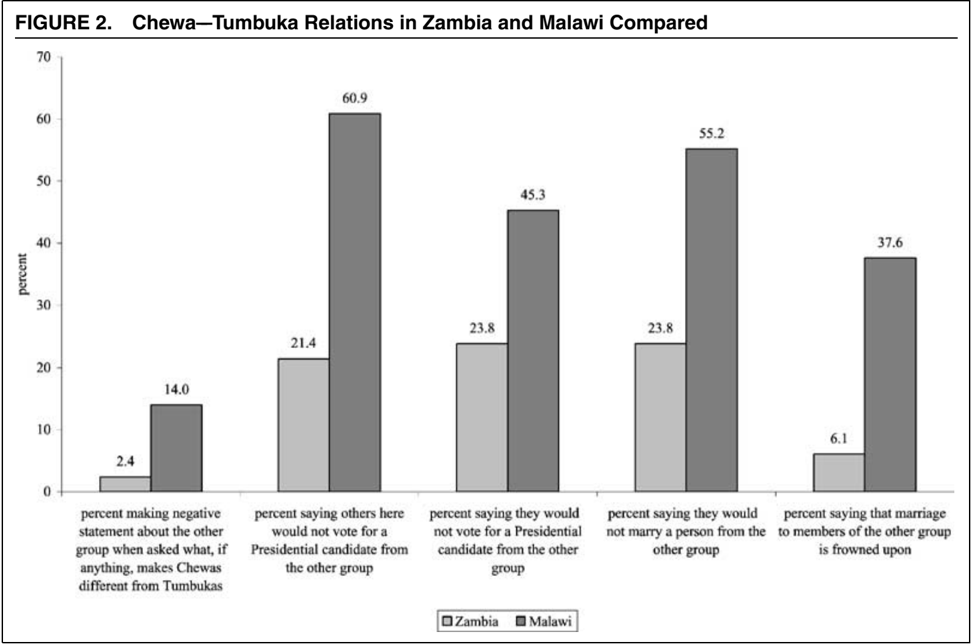
- Yet the cleavage was much more socially and politically salient in Malawi: 61% of Malawians versus 21% of Zambians said others in their village would be unwilling to vote for a candidate from the other group; 45% of Malawians versus 24% of Zambians said they themselves would not vote for such a candidate.
- On marriage, 55% of Malawians versus 24% of Zambians said they would not marry a member of the other group, and 38% of Malawians versus 6% of Zambians said intermarriage was frowned upon.
- The paper’s regressions find that the perceived number of cultural differences is not a significant predictor of attitudes in any of the four models, while country is strongly significant; the table notes sample sizes of 172, 175, 176, and 172.
## Methods
- Comparative natural-experiment design: the Zambia-Malawi border partitions Chewas and Tumbukas, who are otherwise culturally similar across sides of the border, allowing comparison of the same cleavage in different political settings.
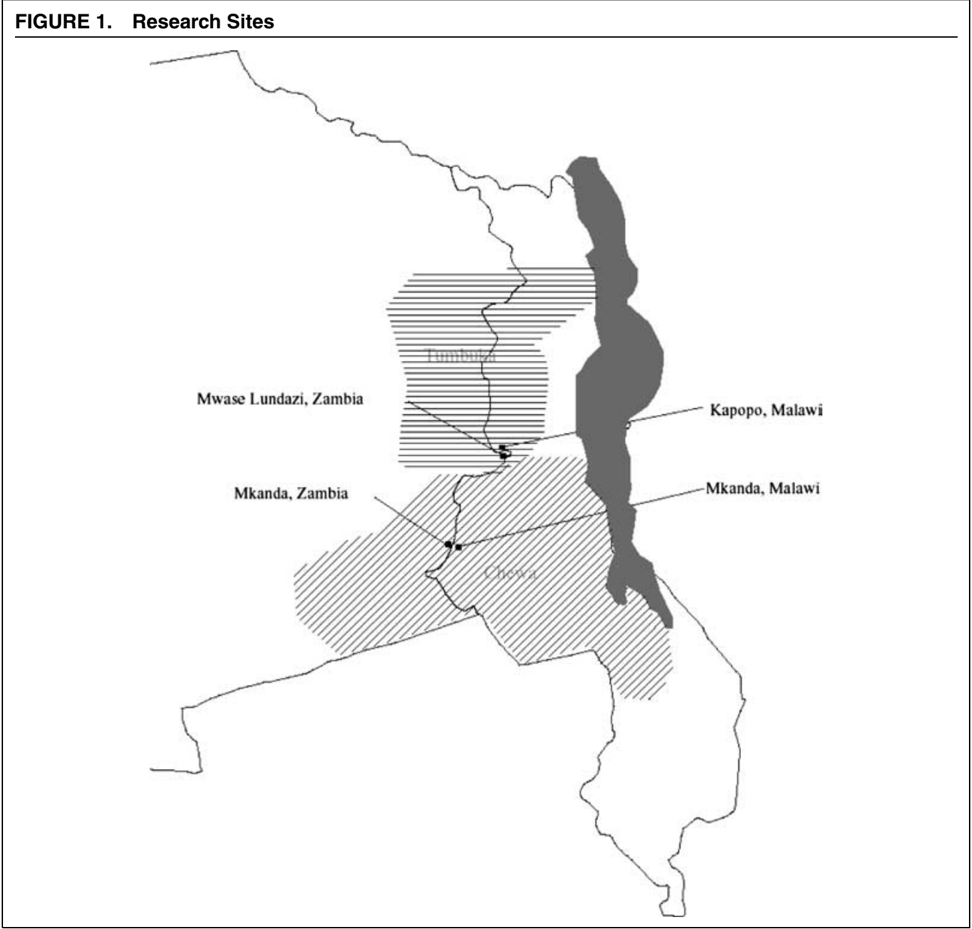
- Original field survey in July-August 2001 in four villages directly across the border: two Chewa villages and two Tumbuka villages; 42 respondents in each Zambian village and 48 in each Malawian village, for a total sample of 180, selected by random stratified quota sampling from every third unrelated household.
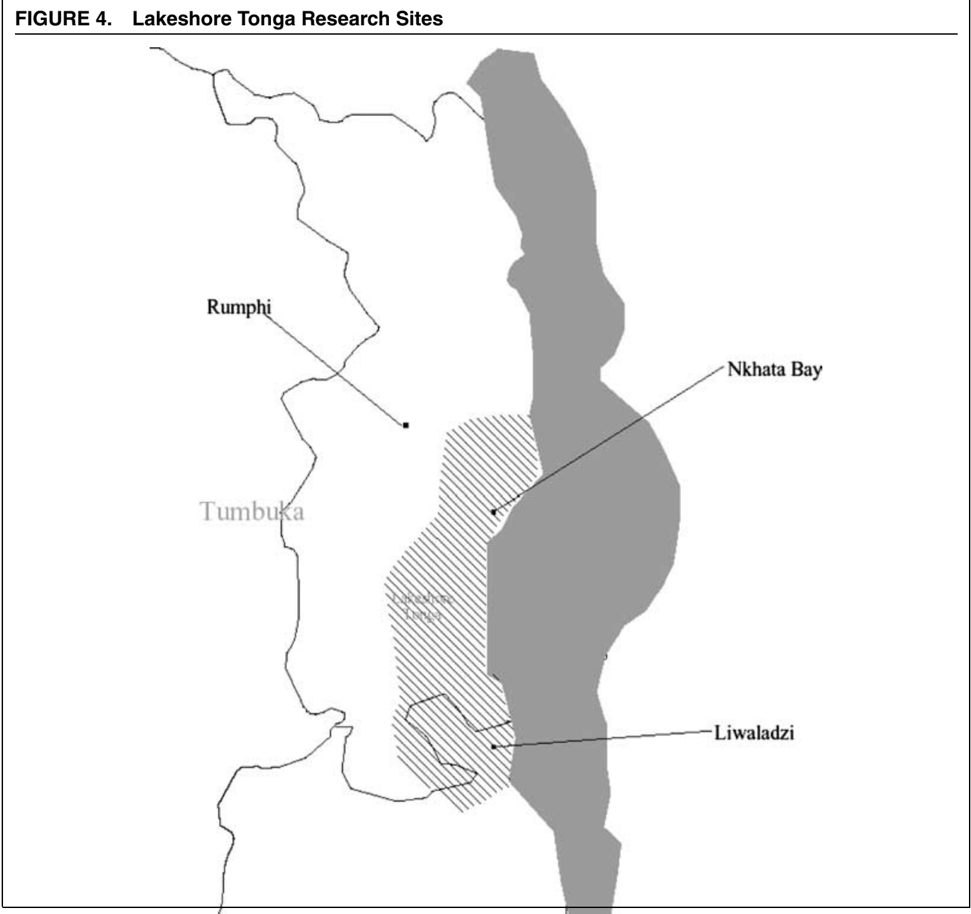
- Main analysis combines open-ended survey responses, descriptive comparisons, logit regressions controlling for tribal affiliation, gender, age, and the number of reported cultural differences, plus a second survey of 30 Lakeshore Tonga respondents to test whether an administrative boundary can create salience.
## Limitations
- Stated by the paper: the author notes that testing whether social divisions are products of political divisions would require time-series data on changes in political divisions, trust, and intermarriage, which are “currently unavailable.”
- Stated by the paper: the Lakeshore Tonga administrative-boundary test is described as “suggestive” because the sample is small.
- Evident from the text: the main survey is limited to four villages in one border region and relies on self-reported attitudes and a small, non-national sample, so generalization beyond the studied sites is not directly demonstrated.
Model-written summary. Check it against the paper before relying on it.
Integrity signals
Registry
Cites
Statistics
Figures
Verification
Claims the paper makes
0 Valid · 1 Not valid · 17 Not checked · 101 Own results and interpretations
A result the paper reports from its own data — it cites no other source for it, so there is none to check. The quote shows it is in the paper.
In the paper
“In fact, the modal Zambian response to our request for a list of differences between Chewas and Tumbukas was to emphasize that 'We are one' or 'We are united.'”
plain- Asserted: passes — The authors put it forward as true.
- Checkable: passes — It can be checked against evidence.
- Load-bearing: passes — The paper’s conclusions depend on it.
- Based: passes — The paper gives a reason why it holds.
A result the paper reports from its own data — it cites no other source for it, so there is none to check. The quote shows it is in the paper.
In the paper
“The most important finding, however, is that, controlling for all of these other factors, the most powerful determinant of a respondent's attitudes toward members of the other community is his or her physical- -and, it bears underscoring, from an historical perspective, entirely accidental- location on one side of the Zambia-Malawi border or the other.”
boostedstates a cause- Asserted: passes — The authors put it forward as true.
- Checkable: passes — It can be checked against evidence.
- Load-bearing: passes — The paper’s conclusions depend on it.
- Based: passes — The paper gives a reason why it holds.
A result the paper reports from its own data — it cites no other source for it, so there is none to check. The quote shows it is in the paper.
In the paper
“Malawian respondents are significantly less willing to vote for a presidential candidate from the other group and significantly less willing to marry across group lines than are their otherwise identical Zambian counterparts.”
plainstates an association- Asserted: passes — The authors put it forward as true.
- Checkable: passes — It can be checked against evidence.
- Load-bearing: passes — The paper’s conclusions depend on it.
- Based: passes — The paper gives a reason why it holds.
A result the paper reports from its own data — it cites no other source for it, so there is none to check. The quote shows it is in the paper.
In the paper
“Again and again, respondents in all four villages identified the same attributes as distinguishing members of the two communities.”
plain- Asserted: passes — The authors put it forward as true.
- Checkable: passes — It can be checked against evidence.
- Load-bearing: passes — The paper’s conclusions depend on it.
- Based: passes — The paper gives a reason why it holds.
A result the paper reports from its own data — it cites no other source for it, so there is none to check. The quote shows it is in the paper.
In the paper
“While the specific cultural practices that respondents mentioned varied somewhat from person to person, nearly every interviewee on both sides of the border (83% overall) was able to identify at least one attribute, tradition, or custom- -and often several- -that made Chewas and Tumbukas culturally different from one another.”
plain- Asserted: passes — The authors put it forward as true.
- Checkable: passes — It can be checked against evidence.
- Load-bearing: passes — The paper’s conclusions depend on it.
- Based: passes — The paper gives a reason why it holds.
66 more claims
Create a free account to see all 119 claims and every source verdict.
- It may state two separate claims as one. 42
- Probably not a substantial claim. 8
Citations
Cites
The clash of civilizations and the remaking of world order
(1997) · Long Range Planning · doi:10.1016/s0024-6301(97)80966-1 · Cited by 7,457
Political Order in Changing Societies
Huntington, S. P. (1970) · Verfassung in Recht und Übersee · doi:10.5771/0506-7286-1970-2-257 · Cited by 6,333
Kuper, L., & Horowitz, D. L. (1986) · Contemporary Sociology · doi:10.2307/2069338 · Cited by 4,869
Democracy in Plural Societies: A Comparative Exploration
Nagata, J., & Lijphart, A. (1979) · International Journal · doi:10.2307/40201796 · Cited by 2,255
Ethnic and Cultural Diversity by Country*
Fearon, J. D. (2003) · Journal of Economic Growth · doi:10.1023/a:1024419522867 · Cited by 1,829 · cited 1×
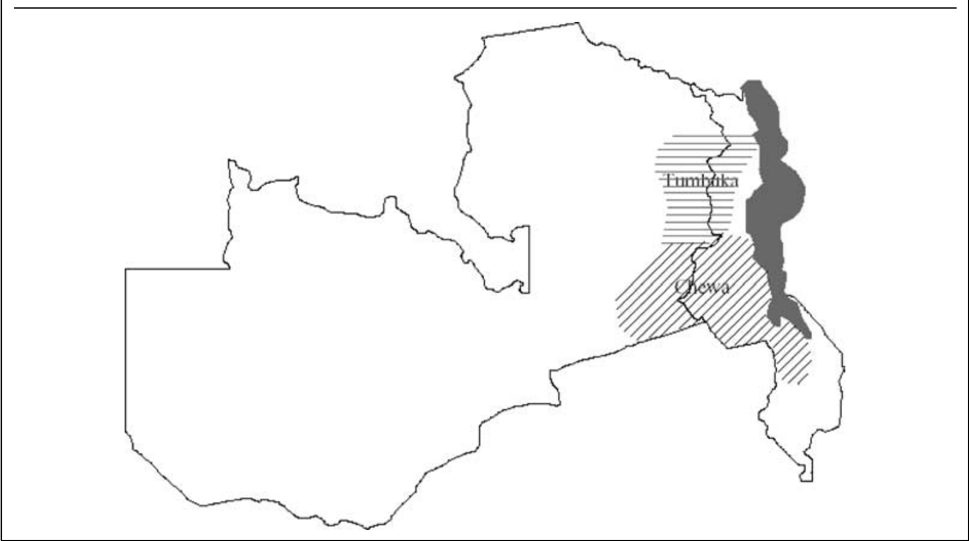
“As Figure 3 makes clear, the Chewa and Tumbuka communities are both large in Malawi (28% and 12% of the national population, respectively) but peripheral in Zambia (7% and 4%, respectively).16 Much more 16 Malawi’s figures come from Fearon 2003.”
BackgroundExplaining Interethnic Cooperation
Fearon, J. D., & Laitin, D. D. (1996) · American Political Science Review · doi:10.2307/2945838 · Cited by 1,606
Ethnologue: Languages of the World
(2015) · Choice Reviews Online · doi:10.5860/choice.192005 · Cited by 1,176
Social Mobilization and Political Development
Deutsch, K. W. (1961) · American Political Science Review · doi:10.1017/s0003055400125134 · Cited by 1,077
Why Ethnic Parties Succeed: Patronage and Ethnic Head Counts in India
Chandra, K. (2004) · Cambridge University Press eBooks · doi:10.1017/9781108573481 · Cited by 1,064
Horowitz, D. L. (2001) · University of California Press eBooks · doi:10.1525/9780520342057 · Cited by 925
Research works printed but not linked: 6
- Vail, Leroy, and Landeg White. 1989. 'Tribalism in the Political History of Malawi.' In The Creation of Tribalism in Southern Africa , ed. Leroy Vail. Berkeley and Los Angeles: University of California Press, 151- -92.
- Lijphart, Arend. 1977. DemocracyinPlural Societies: A Comparative Exploration . New Haven, CT: Yale University Press.
- Henkel, Reinhard. 1985. 'Mission Stations in Zambia: Their Location and Diffusion Patterns.' Zambia Geographical Journal 35: 1- -18.
- Hobsbawm, Eric. 1996. 'Are all Tongues Equal?' In Living as Equals , ed. Paul Barker. New York: Oxford University Press, 85- 98.
- Bratton, Michael. 1994. 'Economic Crisis and Political Realignment in Zambia.' In Economic Change and Political Liberalization in Sub-Saharan Africa , ed. Jennifer A. Widner. Baltimore: Johns Hopkins University Press, 101- -28.
- Lipset, Seymour Martin, and Stein Rokkan. 1967. 'Cleavage Structures, Party Systems and Voter Alignments: An Introduction.' In Party Systems and Voter Alignments: Cross-National Perspectives , ed. Seymour M. Lipset and Stein Rokkan. New York: Free Press, 1- -64.
Cited by
Items 101–200 of 948
A Checkpoint Effect? Evidence from a Natural Experiment on Travel Restrictions in the West Bank
Longo, M., Canetti, D., & Hite-Rubin, N. (2014) · American Journal of Political Science · doi:10.1111/ajps.12109 · Cited by 82
E pluribus unum, ex uno plures
Seymour, L. J. M., Bakke, K. M., & Cunningham, K. G. (2015) · Journal of Peace Research · doi:10.1177/0022343315605571 · Cited by 105
Mironova, V., & Whitt, S. (2016) · British Journal of Political Science · doi:10.1017/s0007123416000028 · Cited by 92
On the Size and Shape of African States1
Green, E. D. (2012) · International Studies Quarterly · doi:10.1111/j.1468-2478.2012.00723.x · Cited by 78
Sacks, A., & Levi, M. (2010) · Social Forces · doi:10.1353/sof.2010.0044 · Cited by 88
The Power of American governors winning on budgets and losing on policy
Kousser, T. B., & Phillips, J. H. (2012) · Cited by 72
Symbolic versus material concerns of rural consciousness in the United States
Trujillo, K. L., & Crowley, Z. (2022) · Political Geography · doi:10.1016/j.polgeo.2022.102658 · Cited by 87
The Structure of Ethnic Inequality and Ethnic Voting
Houle, C., Kenny, P. D., & Park, C. (2018) · The Journal of Politics · doi:10.1086/700200 · Cited by 73
Persistent misconceptions about HIV transmission among males and females in Malawi
Sano, Y., Antabe, R., Atuoye, K. N., Hussey, L. K., Bayne, J., Galaa, S. Z., Mkandawire, P., & Luginaah, I. (2016) · BMC International Health and Human Rights · doi:10.1186/s12914-016-0089-8 · Cited by 80
“Historically, the Tumbuka, compared to other ethnic groups, has had access to formal education through the effort of missionaries associated with the Livingstonia Mission, a branch of the Free Church of Scotland [43].”
BackgroundToo Close for Comfort? Immigrant Exclusion in Africa
Adida, C. L. (2011) · Comparative Political Studies · doi:10.1177/0010414011407467 · Cited by 74
“…among the indigenous population in the streets of Accra and Niamey.8 In Ghana, 100 respondents were randomly asked whether they would vote for a Hausa presidential candidate, and the other 100 were randomly asked whether they would vote for a Yoruba presidential candidate (e.g., Posner, 2004).”
BackgroundEthnic party competition beyond the segmented market
Zuber, C. I. (2012) · Nationalities Papers · doi:10.1080/00905992.2012.742988 · Cited by 77
The Effect of Segregation on Intergroup Relations
Enos, R. D., & Celaya, C. (2018) · Journal of Experimental Political Science · doi:10.1017/xps.2017.28 · Cited by 77
Direct and Indirect Xenophobic Attacks: Unpacking Portfolios of Identity
Garcia-Rios, S., Pedraza, F. I., & Wilcox-Archuleta, B. (2018) · Political Behavior · doi:10.1007/s11109-018-9465-5 · Cited by 72
“While the political context may determine which identities become politically consequential (Posner 2004; Valenzuela and Michelson 2016), that still leaves undeveloped why, psychologically, individuals who share components (e.g., attachment to individual social identity categories) of an identity…”
BackgroundEthnic Polarization, Ethnic Salience, and Civil War
Bhavnani, R., & Miodownik, D. (2008) · Journal of Conflict Resolution · doi:10.1177/0022002708325945 · Cited by 78
The Political Boundaries of Ethnic Divisions
Bazzi, S., & Gudgeon, M. (2020) · American Economic Journal Applied Economics · doi:10.1257/app.20190309 · Cited by 96
“For example, individuals from the same two ethnic backgrounds may face incentives for conflict in one political unit and incentives for cooperation in another (Michalopoulos and Papaioannou, 2016; Posner, 2004).”
From Within to Between Nations: Subnational Comparison across Borders
Sellers, J. M. (2019) · Perspectives on Politics · doi:10.1017/s1537592718002104 · Cited by 76
“…or statistical or experimental testing on controlled sample Statistical testing on comprehensive or representative sample Varies Examples Posner 2004; Maclean 2010; Bubb 2013 Ostrom 1990; Pasotti 2010; Stokes et al. 2013 Diaz Cayeros 2010; Corstange 2015; Holland 2016 Sellers 2002;…”
BackgroundInfluentialCULTURE IN COMPARATIVE POLITICAL ANALYSIS
Ross, M. H. (2009) · Cambridge University Press eBooks · doi:10.1017/cbo9780511804007.007 · Cited by 87
Cunningham, K. G., Bakke, K. M., & Seymour, L. J. M. (2013) · SSRN Electronic Journal · doi:10.2139/ssrn.2178691 · Cited by 63
Does Diversity Impair Human Development? A Multi-Level Test of the Diversity Debit Hypothesis
Gerring, J., Thacker, S. C., Lu, Y., & Huang, W. (2014) · World Development · doi:10.1016/j.worlddev.2014.07.019 · Cited by 76
“Granted, ethnicity can be measured in many different ways (Abdelal, Herrera, Johnston, & McDermott, 2009; Chandra, 2006; Fearon, 2003; Kanbur, Rajaram, & Varshney, 2011; Posner, 2004a; Posner, 2004b).”
Intergroup Behavioral Strategies as Contextually Determined: Experimental Evidence from Israel
Enos, R. D., & Gidron, N. (2016) · The Journal of Politics · doi:10.1086/685545 · Cited by 61
The state and identity politics in Zanzibar: challenges to democratic consolidation in Tanzania
Killian, B. (2008) · African Identities · doi:10.1080/14725840801933932 · Cited by 61
“Indeed, it seems like political leaders are responding to ethnic demography by mobilizing ethnic groups that are large enough to represent a viable political support base for competition over state power (Posner 2004).”
BackgroundThreading a needle: K azakhstan between civic and ethno‐nationalist state‐building
Beacháin, D. Ó., & Kevlihan, R. (2013) · Nations and Nationalism · doi:10.1111/nana.12022 · Cited by 66
“For a more specific study of how political competition can impact on regional and ethnic self-identification and mobilization, see Posner (2004).”
BackgroundFeminism and rational choice theory
Driscoll, A., & Krook, M. L. (2011) · European Political Science Review · doi:10.1017/s175577391100018x · Cited by 82
Population and Politics: The Impact of Scale
Gerring, J., & Veenendaal, W. P. (2020) · Cambridge University Press eBooks · doi:10.1017/9781108657099 · Cited by 83
Local political business cycles: Evidence from Philippine municipalities
Labonne, J. (2016) · Journal of Development Economics · doi:10.1016/j.jdeveco.2016.03.004 · Cited by 85
“10 create measures that incorporate the concept of linguistic ‘distance’ between groups; Posner (2004b) develops an index based on groups who engage in political competition, called the PREG index (for Politically Relevant Ethnic Groups); and Baldwin and Huber (2010) highlight the importance of…”
BackgroundInfluentialGiraudy, A., Moncada, E., & Snyder, R. (2019) · Cambridge University Press eBooks · doi:10.1017/9781108678384.001 · Cited by 81
“…1.1 Varieties of Territorial Units 8 The division of ethnic groups by a national boundary was employed implicitly as a natural experiment by Linz (1986) and Miles (1994) and explicitly by Posner (2004) and by Acemoglu and Robinson in the vignette mentioned in the second paragraph of this chapter.”
BackgroundMethodInfluentialEthnic Diversity and Ethnic Strife. An Interdisciplinary Perspective
Kanbur, R., Rajaram, P. K., & Varshney, A. (2010) · World Development · doi:10.1016/j.worlddev.2009.11.034 · Cited by 81
“In political science, a powerful critique of the ELF approach has emerged, influenced in part by constructivist insights (Chandra, 2006; Posner, 2004a, 2004b).”
BackgroundExplaining Kazakhstani identity: supraethnic identity, ethnicity, language, and citizenship
Rees, K. M., & Williams, N. W. (2017) · Nationalities Papers · doi:10.1080/00905992.2017.1288204 · Cited by 69
Electoral Systems, Ethnic Heterogeneity and Party System Fragmentation
Lublin, D. I. (2015) · British Journal of Political Science · doi:10.1017/s0007123415000137 · Cited by 59
Religious riots and electoral politics in India
Iyer, S., & Shrivastava, A. (2017) · Journal of Development Economics · doi:10.1016/j.jdeveco.2017.11.003 · Cited by 75
Places to Hide: Terrain, Ethnicity, and Civil Conflict
Carter, D. B., Shaver, A., & Wright, A. L. (2019) · The Journal of Politics · doi:10.1086/704597 · Cited by 61
Experimental Approaches to International Relations
Mintz, A., Yang, Y. E., & McDermott, R. (2011) · International Studies Quarterly · doi:10.1111/j.1468-2478.2011.00662.x · Cited by 62
Close to Home : Local Ties and Voting Radical Right in Europe
Fitzgerald, J. (2018) · Cited by 47
Political Violence in Kenya: Land, Elections, and Claim-Making
Klaus, K. (2020) · Cited by 50
Sijilmassi, A., Safra, L., & Baumard, N. (2024) · Behavioral and Brain Sciences · doi:10.1017/s0140525x24000013 · Cited by 59
Ethnicity, Voter Alignment and Political Party Affiliation - An African Case: ZambiaPreprint
Erdmann, G. (2007) · SSRN Electronic Journal · doi:10.2139/ssrn.978175 · Cited by 50
Marquardt, K. L. (2017) · Comparative Political Studies · doi:10.1177/0010414017720701 · Cited by 50
“In this regard, this body of work matches the overall trend in social-scientific literature, which treats the political importance of ethnicity as largely epiphenomenal to institutional structures in a polity (Posner, 2004b, 2005; Wimmer, 2008).”
BackgroundInternal Borders: Ethnic-Based Market Segmentation in Malawi
Robinson, A. L. (2016) · World Development · doi:10.1016/j.worlddev.2016.07.006 · Cited by 53
World Citizens on the Periphery: Threat and Identification with Global Society
Gorman, B., & Seguin, C. (2018) · American Journal of Sociology · doi:10.1086/699652 · Cited by 52
“In the wake of the 9/11 attacks, for example, Americansweremore likely to identify as American and tended to define Americanness in terms of support for government policies (Pyszczynski et al. 2003, pp. 101–4; Albertson and Gadarian 2015, pp. 75–77). When individuals believe that a social collectivity lacks access to…”
BackgroundØstby, G. (2007) · World Bank, Washington, DC eBooks · doi:10.1596/1813-9450-4193 · Cited by 47
“…One should also note a possible reverse causality, implying that political inequalities might lead to economic inequalities. grievances are generally rare and more moderate while there are plenty of possibilities to express these grievances and to secure change through channels other than violence.”
Beyond the Racial Census: The Political Salience of Ethnolinguistic Cleavages in South Africa
McLaughlin, E. S. (2007) · Comparative Political Studies · doi:10.1177/0010414006294420 · Cited by 56
Peace by Design: Managing Intrastate Conflict through Decentralization
Brancati, D. (2008) · doi:10.1093/acprof:oso/9780199549009.001.0001 · Cited by 133
Chinese Aid and Local Ethnic Identification
Isaksson, A. (2020) · International Organization · doi:10.1017/s0020818320000260 · Cited by 46
“First, it contributes directly to the literature on ethnic mobilization in Africa (e.g. Posner, 2003; Posner, 2004; Eifert et al., 2010).”
InfluentialCultural legacies and political preferences: the failure of separatism in the Swiss Jura
Siroky, D. S., Mueller, S., & Hechter, M. (2015) · European Political Science Review · doi:10.1017/s1755773915000399 · Cited by 51
Linking Ethnic Data from Africa (LEDA)
Müller‐Crepon, C., Pengl, Y., & Bormann, N. (2021) · Journal of Peace Research · doi:10.1177/00223433211016528 · Cited by 63
THE CAUSAL HISTORY OF AFRICA: A RESPONSE TO HOPKINS
Fenske, J. E. (2010) · Economic History of Developing Regions · doi:10.1080/20780389.2010.527693 · Cited by 59
Mobilizing the Masses for Genocide
Rogall, T. (2020) · American Economic Review · doi:10.1257/aer.20160999 · Cited by 59
Secession Risk and Fiscal Federalism
Sorens, J. (2015) · Publius The Journal of Federalism · doi:10.1093/publius/pjv037 · Cited by 43
“The idea here is that the territorial scope of political contestation determines the territorial scope of ethnic identities (Posner 2004).”
BackgroundWhat explains the rise of majority–minority tensions and conflict in Xinjiang?
Hasmath, R. (2018) · Central Asian Survey · doi:10.1080/02634937.2018.1496067 · Cited by 47
“For the latter point, forging ethno-religious connections has been a starting point in other jurisdictions to foster a collective consciousness that creates division, ultimately leading to potential political mobilization (Giuliano 2000; Posner 2004).”
Erdmann, G. (2007) · SSRN Electronic Journal · doi:10.2139/ssrn.1068633 · Cited by 42
Does ethnic voting harm democracy?
Houle, C. (2018) · Democratization · doi:10.1080/13510347.2017.1423055 · Cited by 52
Political Violence in Kenya: Land, Elections, and Claim-Making
Klaus, K. (2020) · Cambridge University Press eBooks · doi:10.1017/9781108764063 · Cited by 129
Jenne, E. K., & Bieber, F. (2014) · Ethnopolitics · doi:10.1080/17449057.2014.912447 · Cited by 42
“Nor does ethnic distance predict the strength of national divisions, as identical ethnic dyads may be conflictual in one country but cooperative in another (Posner, 2004).”
BackgroundKimengsi, J. N., Owusu, R., Djenontin, I. N. S., Pretzsch, J., Gießen, L., Buchenrieder, G. R., Pouliot, M., & Acosta, A. N. (2021) · Land Use Policy · doi:10.1016/j.landusepol.2021.105931 · Cited by 49
“This diversity also plays out as a lethargy in forest resource use and management and produces (sometimes) sub-optimal outcomes (Posner, 2004).”
BackgroundA House Divided: Threat Perception, Military Factionalism, and Repression in Africa
Hendrix, C. S., & Salehyan, I. (2016) · Journal of Conflict Resolution · doi:10.1177/0022002715620473 · Cited by 56
Clientelism and Party Politics
Hopkin, J. (2006) · SAGE Publications Ltd eBooks · doi:10.4135/9781848608047.n35 · Cited by 69
Ethnic Inequality and the Strength of Ethnic Identities in Sub-Saharan Africa
Higashijima, M., & Houle, C. (2017) · Political Behavior · doi:10.1007/s11109-017-9430-8 · Cited by 47
Østby, G. (2006) · Cited by 40
Can Politicians Exploit Ethnic Grievances? An Experimental Study of Land Appeals in Kenya
Horowitz, J. D., & Klaus, K. (2018) · Political Behavior · doi:10.1007/s11109-018-9485-1 · Cited by 47
“A large literature points to the utility of ethnic identity as a tool for mobilizing the political support of co-ethnic voters in diverse societies (Bates 1983; Horowitz 1985; Posner 2004; Wilkinson 2004; Chandra 2004).”
BackgroundEndogenous Colonial Borders: Precolonial States and Geography in the Partition of Africa
Paine, J., Qiu, X., & Ricart‐Huguet, J. (2024) · American Political Science Review · doi:10.1017/s0003055424000054 · Cited by 60
“…Tarango, and Carter 2002; Micha-lopoulos and Papaioannou 2016), international territorial disputes (Goemans and Schultz 2017; Touval 1972), economic development (Alesina, Easterly, and Matus-zeski 2011; Michalopoulos and Papaioannou 2013), and political identities (Posner 2004; Robinson 2016).”
When and why do some social cleavages become politically salient rather than others?
Posner, D. (2017) · Ethnic and Racial Studies · doi:10.1080/01419870.2017.1277033 · Cited by 49
Self-citationDevelopment at the Border: Policies and National Integration in Côte D'Ivoire and Its Neighbors
Cogneau, D., Mesplé‐Somps, S., & Spielvogel, G. (2013) · The World Bank Economic Review · doi:10.1093/wber/lht033 · Cited by 42
“Posner (2004) observes that among two ethnic groups at the border between Malawi and Zambia, ethnic identification varies when crossing the border.”
Muriaas, R. L., Wang, V., Benstead, L. J., Dulani, B., & Rakner, L. (2018) · Comparative Political Studies · doi:10.1177/0010414018774369 · Cited by 47
“…we will find clear differences between Malawians with different cultural backgrounds, as well as variation in the traditional norms of the two lineages systems, matrilineal and patrilineal, which have different practices with regard to women’s role in political leadership (Posner, 2004, p. 533).”
Religion and Armed Conflict: Evidence from the Kurdish Conflict in Turkey
Gurses, M., & Öztürk, A. E. (2020) · Journal for the Scientific Study of Religion · doi:10.1111/jssr.12652 · Cited by 38
Measuring Individual Identity: Experimental Evidence
Kuo, A. G., & Margalit, Y. M. (2012) · Comparative Politics · doi:10.5129/001041512801283013 · Cited by 45
Analysis of current events: Identity mobilization in hybrid regimes: Language in Ukrainian politics
Charnysh, V. (2013) · Nationalities Papers · doi:10.1080/00905992.2012.750288 · Cited by 40
Kendhammer, B. (2010) · Commonwealth and Comparative Politics · doi:10.1080/14662040903444509 · Cited by 51
“While a great deal of attention has recently been paid to how ethnic parties draw support from elites and masses (Chandra, 2004 , 2005 ) and how political entrepreneurs choose which ethnic identities to direct their appeals at (Posner, 2004 , 2005 ), the dilemmas faced by prospective members of MEC parties in ethnical…”
BackgroundParties and Voters in Emerging Democracies
Hagopian, F. (2009) · The Oxford Handbook of Comparative Politics · doi:10.1093/oxfordhb/9780199566020.003.0024 · Cited by 38
Managing culture in post-conflict societies
McEvoy, J. (2011) · Contemporary Social Science · doi:10.1080/17450144.2010.534493 · Cited by 37
Measuring parties’ ethnic appeals in democracies
Gadjanova, E. (2013) · Party Politics · doi:10.1177/1354068812472586 · Cited by 43
“…of identity suggests that political entrepreneurs engaged in ethnic appeals aim to raise the saliency of a preferred identity by selectively privileging aspects of it (Beall and Ngonyama, 2009; Bhavnani and Miodownik, 2009; Edwards and Doucette, 1987; Mullen et al., 1992; Posner, 2004).”
BackgroundReligion, Sexuality Politics, and the Transformation of Latin American Electorates
Smith, A. E., & Boas, T. C. (2023) · British Journal of Political Science · doi:10.1017/s0007123423000613 · Cited by 48
“Distinct from some scholars (for example, Posner 2004), we do not assume salience implies that an issue dimension influences political behaviour, which is the empirical question we seek to test. voting: increased news coverage of these issues is associated with a declining correlation between…”
BackgroundA Conditional Model of Local Income Shock and Civil Conflict
Buhaug, H., Croicu, M., Fjelde, H., & von Uexkull, N. (2021) · The Journal of Politics · doi:10.1086/709671 · Cited by 36
Representation, minorities and electoral reform: the case of the Palestinian minority in Israel
Kook, R. B. (2017) · Ethnic and Racial Studies · doi:10.1080/01419870.2017.1277027 · Cited by 40
“In addition to the deep rift between the ideological left and right wings, the identity-based divisions are national, ethnic and religious: between the Jewish majority and ArabPalestinian minority; and within the Jewish majority, divisions between a largely secular majority and a large minority of orthodox Jews and be…”
BackgroundInfluentialImproving causal inference: strengths and limitations of natural experiments
Dunning, T. (2015) · Revista Debates · doi:10.22456/1982-5269.54063 · Cited by 37
Social networks, ethnic diversity, and cooperative behavior in rural Malawi
Dionne, K. Y. (2014) · Journal of Theoretical Politics · doi:10.1177/0951629814556173 · Cited by 48
“That idea alone generates debate as scholars often assert that rural villages have high degrees of ethnic homogeneity (e.g. Posner, 2004).”
BackgroundJha, S. (2018) · Economic Policy · doi:10.1093/epolic/eiy009 · Cited by 46
VonDoepp, P. (2006) · Political Research Quarterly · doi:10.1177/106591290605900306 · Cited by 36
“Informed observers have pointed out that major ethnic group differences have played a more instrumental role in Malawi as compared to Zambia (Posner 2004; Osei-Hwedie 1998).”
BackgroundGoette, L. F., Huffman, D., Meier, S., & Sutter, M. (2010) · SSRN Electronic Journal · doi:10.2139/ssrn.1682710 · Cited by 43
Blattman, C., & Miguel, E. A. (2009) · National Bureau of Economic Research · doi:10.3386/w14801 · Cited by 46
“Ethnic polarization and the limits of democratic practice”
Shoup, B. D. (2018) · Democratization · doi:10.1080/13510347.2018.1475474 · Cited by 37
Religion, Violence, and Local Power-Sharing in Nigeria
Vinson, L. T. (2017) · Cambridge University Press eBooks · doi:10.1017/9781316832110 · Cited by 36
Cultural legacies and electoral performance of ethnic minority parties in post‐communist E urope
Bilinski, A. (2015) · Nations and Nationalism · doi:10.1111/nana.12143 · Cited by 36
UNsatisfied? Public Support for Postconflict International Missions
Kelmendi, P., & Radin, A. (2016) · Journal of Conflict Resolution · doi:10.1177/0022002716674536 · Cited by 34
Keele, L. J., Lorch, S. A., Passarella, M. A., Small, D. S., & Titiunik, R. (2017) · Emerald Group Publishing Limited eBooks · doi:10.1108/s0731-905320170000038007 · Cited by 47
Probability and Statistical Inference
Kellstedt, P. M., & Whitten, G. D. (2018) · Cambridge University Press eBooks · doi:10.1017/9781108131704.011 · Cited by 33
Masters of War : The Role of Elites in Sudan’s Communal Conflicts
Brosché, J. (2014) · Uppsala University Publications (Uppsala University) · Cited by 40
Do Birds of a Feather Flock Together? Rebel Constituencies and Civil War Alliances
Balcells, L., Chen, C., & Pischedda, C. (2020) · International Studies Quarterly · doi:10.1093/isq/sqab095 · Cited by 34
Inequality, ethnic diversity, and redistribution
Houle, C. (2016) · The Journal of Economic Inequality · doi:10.1007/s10888-016-9340-8 · Cited by 44
McCauley, J. F., & Posner, D. (2017) · British Journal of Political Science · doi:10.1017/s0007123416000594 · Cited by 34
“8 See, for example, Posner (2004).”
Self-citationThompson, J. C., Mackay, A., Nightingale, S., Wright, D., Choi, J., Welling, M., Blackmore, H., & Gomani‐Chindebvu, E. (2017) · Journal of Quaternary Science · doi:10.1002/jqs.3002 · Cited by 33
With Ballots and Bullets: Partisanship and Violence in the American Civil War
Kalmoe, N. P. (2020) · Cambridge University Press eBooks · doi:10.1017/9781108870504 · Cited by 38
Unpacking LogM: Toward a More General Theory of Party System Density
Lowery, D., Otjes, S., Gherghina, S., van Witteloostuijn, A. C., Péli, G., & Brasher, H. (2010) · American Journal of Political Science · doi:10.1111/j.1540-5907.2010.00469.x · Cited by 33
Dispersing Authority or Deepening Divisions? Decentralization and Ethnoregional Party Success
Lublin, D. I. (2012) · The Journal of Politics · doi:10.1017/s0022381612000667 · Cited by 34
Explaining Violent Intra-Ethnic Conflict: Group Fragmentation in the Shadow of State Power
Warren, T. C., & Troy, K. K. (2014) · Journal of Conflict Resolution · doi:10.1177/0022002713515400 · Cited by 61
Ethnic quotas and unintended effects on women’s political representation in Singapore
Tan, N. (2014) · International Political Science Review · doi:10.1177/0192512113508666 · Cited by 31
“As Posner (2004) suggests, the salience of ethnicity is higher than that of gender as it can be mobilised by elites to gain electoral support.”
BackgroundEthnicity and Electoral Politics
Birnir, J. K. (2001) · Cambridge University Press eBooks · doi:10.1017/cbo9780511607530 · Cited by 36
Expanding the measurement of culture with a sample of two billion humans
Obradovich, N., Özak, Ö., Martín, I., Ortuño-Ortín, I., Awad, E., Cebrián, M., Cuevas, R., Desmet, K., Rahwan, I., & Cuevas, Á. (2022) · Journal of The Royal Society Interface · doi:10.1098/rsif.2022.0085 · Cited by 30
Identity and conflict: Evidence from Tuareg rebellion in Mali
Ananyev, M., & Poyker, M. (2022) · World Development · doi:10.1016/j.worlddev.2022.106108 · Cited by 37
Ethnicity, nonviolent protest, and lethal repression in Africa
Hendrix, C. S., & Salehyan, I. (2019) · Journal of Peace Research · doi:10.1177/0022343318820088 · Cited by 32
“Herfindahl-like indices10 are commonly used in the study of legislative coalitions to proxy both the size and heterogeneity of multiparty coalition governments and are widely used in studies of ethnic politics (Alesina & La Ferrara, 2005; Posner, 2004b).”
BackgroundMethodResultInfluentialDemographic Diversity and District-Level Party Systems
Potter, J. D. (2014) · Comparative Political Studies · doi:10.1177/0010414013516918 · Cited by 30
Metadata
- Authors
- POSNER, D. N.
- Affiliations
- University of California, Los Angeles (US)
- Corresponding author
- POSNER, DANIEL N.
- ORCID
- POSNER, DANIEL N.
- Venue
- American Political Science Review
- Publisher
- Cambridge University Press (CUP)
- Published
- 2004-11
- Volume
- 98
- Issue
- 4
- Pages
- 529-545
- ISSN
- 0003-0554 (ISSN-L)
- 1537-5943
- OpenAlex
- W2169278049
- Cited by
- 940
- References
- 54
- Citations by year
- 2026: 22 · 2025: 22 · 2024: 117 · 2023: 45 · 2022: 40 · 2021: 28 · 2020: 94 · 2019: 34 · 2018: 72 · 2017: 45 · 2016: 49 · 2015: 46 · 2014: 58 · 2013: 45 · 2012: 32
- FWCI
- 79.46
- Type
- journal article
- Language
- en
- Open access
- green
- www.escholarship.org
- Locations
- American Political Science Review (publishedVersion)
- eScholarship (California Digital Library) (submittedVersion)
- RePEc: Research Papers in Economics (submittedVersion)
- Topics
- Social Sciences › Sociology and Political Science › Political Conflict and Governance
- Social Sciences › Sociology and Political Science › African Studies and Ethnography
- Social Sciences › Political Science and International Relations › Electoral Systems and Political Participation
- Keywords
- cultural cleavages, political salience, Chewa, Tumbuka, ethnic politics, ethnic group size, political coalition building, ethnic mobilization
About these checks
Registry, retraction, Cites and statistics results are computed, not judged, with one exception: a printed reference that no index lists is read once by a model before it counts as a citation error. Claims are extracted by a model and kept only when their quote appears verbatim in the text; each cited source is then checked, with a model’s help, for whether it says what the claim relies on. Those verdicts can be wrong — read the claim’s quote and the cited source before relying on one.
A language model drew the claims from the paper on 2026-10-11, under version 3 of the claim definition (model deepseek-v4.1-flash, prompt extract-v3).
A second model labelled each claim on 2026-10-11 (model jev-1.13-20260917, definition revision gold-guideline-v0.2).
Statistics and arithmetic are recomputed, not judged.
Confidence bands are shown only for fields calibrated on our annotated test set. None is calibrated yet, so no band is shown.
What counts as a claim ›How we measure confidence ›How we check this ›
Are you an author, or do you see a problem with this page? Request a review
Data sources
Bibliographic data: Semantic Scholar, OpenAlex, Crossref.
Contains information from the Semantic Scholar Academic Graph Datasets, made available under the ODC Attribution License (ODC-BY 1.0).
Semantic Scholar’s data is described in: Kinney, R., et al. (2023). The Semantic Scholar Open Data Platform. arXiv:2301.10140.
