

Prevalence of low-grade inflammation in depression: a systematic review and meta-analysis of CRP levels
Open accessThe DOI matches its Crossref record; 91 of the 91 references it cites were found in a registry or an index.
Abstract
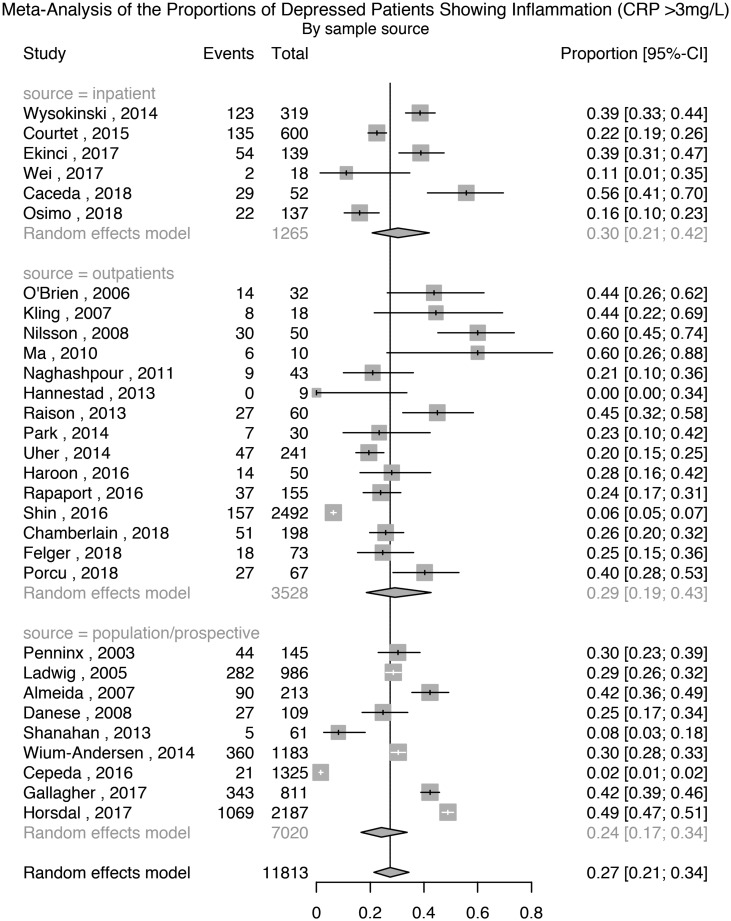
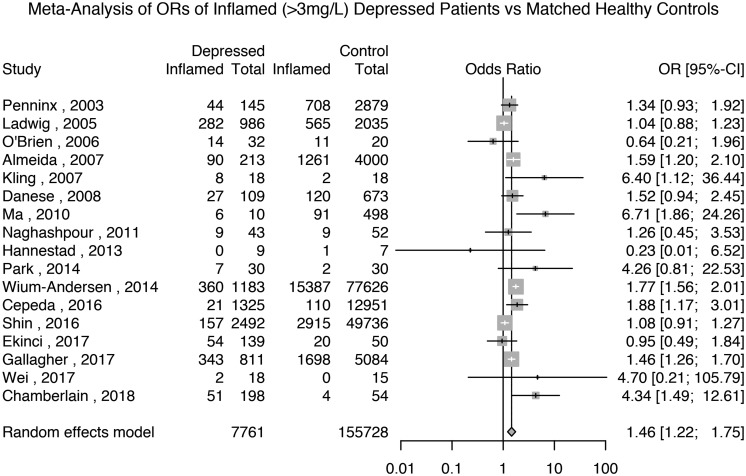
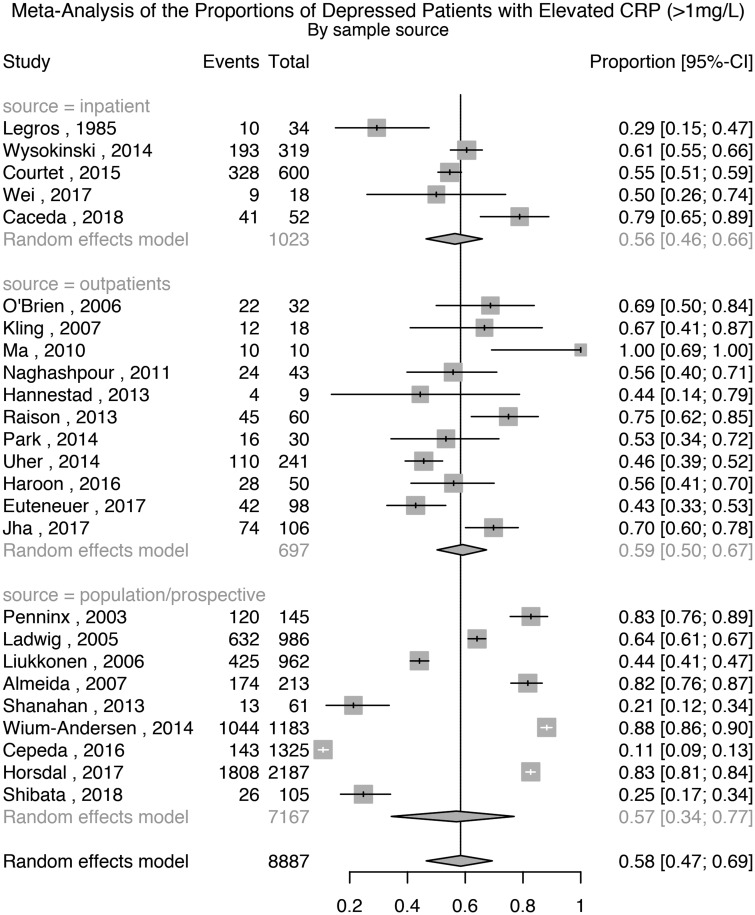
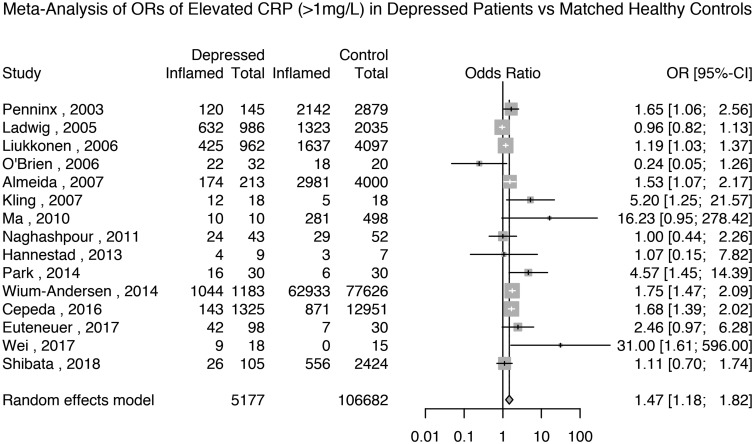
Background: Peripheral low-grade inflammation in depression is increasingly seen as a therapeutic target. We aimed to establish the prevalence of low-grade inflammation in depression, using different C-reactive protein (CRP) levels, through a systematic literature review and meta-analysis. Methods: We searched the PubMed database from its inception to July 2018, and selected studies that assessed depression using a validated tool/scale, and allowed the calculation of the proportion of patients with low-grade inflammation (CRP >3 mg/L) or elevated CRP (>1 mg/L). Results: After quality assessment, 37 studies comprising 13 541 depressed patients and 155 728 controls were included. Based on the meta-analysis of 30 studies, the prevalence of low-grade inflammation (CRP >3 mg/L) in depression was 27% (95% CI 21–34%); this prevalence was not associated with sample source (inpatient, outpatient or population-based), antidepressant treatment, participant age, BMI or ethnicity. Based on the meta-analysis of 17 studies of depression and matched healthy controls, the odds ratio for low-grade inflammation in depression was 1.46 (95% CI 1.22–1.75). The prevalence of elevated CRP (>1 mg/L) in depression was 58% (95% CI 47–69%), and the meta-analytic odds ratio for elevated CRP in depression compared with controls was 1.47 (95% CI 1.18–1.82). Conclusions: About a quarter of patients with depression show evidence of low-grade inflammation, and over half of patients show mildly elevated CRP levels. There are significant differences in the prevalence of low-grade inflammation between patients and matched healthy controls. These findings suggest that inflammation could be relevant to a large number of patients with depression.
Overview
The claims and statistics of this paper haven’t been checked yet.
Free: it reads the open-access text and checks the first 5 claims that cite a source we can check. Create a free account to check every claim.
Integrity signals
Registry
Cites
Statistics
Figures
Verification
Claims the paper makes
The claims and statistics of this paper haven’t been checked yet.
Free: it reads the open-access text and checks the first 5 claims that cite a source we can check. Create a free account to check every claim.
Claims other papers make about this one
Each is checked against this paper’s own text: does it say what the citing paper says it does?
The source backs part of the claim, not all of it — or backs it for a different population, condition or comparison.
In the citing paper
“Higher plasma levels of inflammatory cytokines, most consistently interleukin IL-1β, IL-6, and TNF-α, are correlated with greater depressive symptomatology.”
From Chronic stress, neuroinflammation, and depression: an overview of pathophysiological mechanisms and emerging anti-inflammatories (2023) · cites this paper as [6]
Experimental — accuracy not yet measuredThe cited source says what the claim attributes to it.
In the citing paper
“Low-grade inflammation – as indexed by a concentration of C-reactive protein (CRP) higher than 3 mg/L – is more likely in individuals with depression than in matched controls, occurring in around a quarter of the former according to a large meta-analysis (OR: 1.46, 95% CI: 1.22-1.75)205.”
From Comorbidity between major depressive disorder and physical diseases: a comprehensive review of epidemiology, mechanisms and management (2023) · cites this paper as [205]
In the citing paper
“Data were confirmed by a recent meta-analysis that included 13,541 depressed patients and 155,728 controls [121]. In 27% of the depressive patients there was a low-grade of inflammation (i.e., CRP > 3.0 mg/L) and over half of the patients showed a mildly elevated CRP level [121].”
From C-Reactive protein as a biomarker for major depressive disorder? (2022) · cites this paper as [121]
In the citing paper
“A very limited number of studies on CRP excluded participants presenting with an acute infection (CRP > 10 mg/L); we decided to include these studies because we previously found that the odds ratio of inflammation in patients vs controls is very similar if considering all patients (OR = 1.46) or excluding patients and controls with CRP > 10 mg/L (OR = 1.44) (Osimo et al., 2019), thus suggesting”
From Inflammatory markers in depression: a meta-analysis of mean differences and variability in 5,166 patients and 5,083 controls (2020) · cites this paper as Osimo et al., 2019
Self-check
Percentages, sums and reported differences re-computed from the paper’s own numbers.
The self-check needs the paper’s full text.
Citations
Cites
Quantifying heterogeneity in a meta‐analysis
Higgins, J. P. T., & Thompson, S. G. (2002) · Statistics in Medicine · doi:10.1002/sim.1186 · Cited by 36,763 · cited 1×
“Heterogeneity was tested using Cochrane’s Q-Test (Higgins and Thompson, 2002).”
Stang, A. (2010) · European Journal of Epidemiology · doi:10.1007/s10654-010-9491-z · Cited by 17,396 · cited 2×
“Study quality was assessed using the Newcastle–Ottawa Scale (Stang, 2010).”
MethodMolecular Mechanisms of Depression: Perspectives on New Treatment Strategies
Lang, U. E., & Borgwardt, S. (2013) · Cellular Physiology and Biochemistry · doi:10.1159/000350094 · Cited by 8,475
From inflammation to sickness and depression: when the immune system subjugates the brain
Dantzer, R., O'Connor, J. C., Freund, G. G., Johnson, R. W., & Kelley, K. W. (2008) · Nature Reviews Neuroscience · doi:10.1038/nrn2297 · Cited by 7,395 · cited 2×
“…commonly seen following an acute infection, shares many characteristics with depression, such as fatigue, sleep disturbance and decreased motivation (Dantzer et al., 2008); early-life infection and autoimmune diseases are associated with a higher risk of depression in adulthood (Benros et al.,…”
BackgroundPearson, T. A., Mensah, G. A., Alexander, R. W., Anderson, J. L., Cannon, R. O., Criqui, M., Fadl, Y. Y., Fortmann, S. P., Hong, Y., Myers, G. L., et al. (2003) · Circulation · doi:10.1161/01.cir.0000052939.59093.45 · Cited by 6,401 · cited 9×
“The American Heart Association and Center for Disease Control and Prevention have proposed clear CRP thresholds as indicators of inflammation levels (<1 = ‘low’, 1–3 = ‘medium’, >3 mg/L = ‘high’) (Pearson et al., 2003).”
BackgroundMethodInfluentialDiagnostic Criteria for Use in Psychiatric Research
Feighner, J. P. (1972) · Archives of General Psychiatry · doi:10.1001/archpsyc.1972.01750190059011 · Cited by 5,715
A Meta-Analysis of Cytokines in Major Depression
Dowlati, Y., Herrmann, N., Swardfager, W., Liu, H., Sham, L., Reim, E. K., & Lanctôt, K. L. (2010) · Biological Psychiatry · doi:10.1016/j.biopsych.2009.09.033 · Cited by 4,729 · cited 7×
“Meta-analyses of crosssectional studies confirm that mean concentrations of circulating CRP and inflammatory cytokines such as interleukin 6 (IL-6) are higher in patients with acute depression compared with controls (Howren et al., 2009; Dowlati et al., 2010; Haapakoski et al., 2015; Goldsmith et al., 2016).”
BackgroundResultInfluentialC-Reactive Protein, Interleukin 6, and Risk of Developing Type 2 Diabetes Mellitus
Pradhan, A. D. (2001) · JAMA · doi:10.1001/jama.286.3.327 · Cited by 4,433 · cited 1×
“In addition to depression and CVD, inflammation is associated with other physical and psychiatric disorders including diabetes mellitus (Pradhan et al., 2001), schizophrenia (Miller et al.”
BackgroundDanesh, J., Wheeler, J. G., Hirschfield, G. M., Eda, S., Eiriksdottir, G., Rumley, A., Lowe, G. D. O., Pepys, M. B., & Gudnason, V. (2004) · New England Journal of Medicine · doi:10.1056/nejmoa032804 · Cited by 2,953
Associations of depression with C-reactive protein, IL-1, and IL-6: a meta-analysis.
Howren, M. B., Lamkin, D. M., & Suls, J. (2009) · Psychosomatic Medicine · doi:10.1097/psy.0b013e3181907c1b · Cited by 2,766 · cited 7×
“Meta-analyses of crosssectional studies confirm that mean concentrations of circulating CRP and inflammatory cytokines such as interleukin 6 (IL-6) are higher in patients with acute depression compared with controls (Howren et al., 2009; Dowlati et al., 2010; Haapakoski et al., 2015; Goldsmith et al., 2016).”
BackgroundResultInfluential
Research works printed but not linked: 3
- Osimo, 2018, Prevalence of low-grade inflammation in depression: a review and meta-analysis of CRP data, PROSPERO
- Urbanek, 2015, Cairo: R graphics device using Cairo graphics library for creating high-quality bitmap (PNG, JPEG, TIFF), vector (PDF, SVG, PostScript) and display (X11 and Win32) output [Software], CRAN
- Khandaker, 2019, Shared mechanism between depression and coronary heart disease: findings from Mendelian randomization analysis of a large UK population-based cohort, Molecular Psychiatry
Cited by
Items 301–400 of 773
Schizophrenia and the COVID-19 pandemic: A narrative review from the biomedical perspective
Kowalski, K., & Misiak, B. (2023) · Revista de Psiquiatría y Salud Mental · doi:10.1016/j.rpsm.2023.04.002 · Cited by 16
Burrows, K., McNaughton, B. A., Figueroa‐Hall, L. K., Spechler, P. A., Kuplicki, R., Victor, T. A., Aupperle, R. L., Khalsa, S. S., Savitz, J. B., Teague, T. K., et al. (2023) · Scientific Reports · doi:10.1038/s41598-023-38410-4 · Cited by 18
Falaschi, V., Palego, L., Marazziti, D., Betti, L., Musetti, L., Maglio, A., Dell’Oste, V., Sagona, S., Felicioli, A., Carpita, B., et al. (2023) · Life · doi:10.3390/life13071555 · Cited by 14
“This is in line with the observation that depressive/anxious symptoms might be linked to mild increases in the CRP levels [31,32].”
ResultMetcalf, C. A., Johnson, R. L., Duffy, K. A., Freeman, E. W., Sammel, M. D., & Epperson, C. N. (2023) · Stress and Health · doi:10.1002/smi.3313 · Cited by 17
Christopher, M., Bowen, S. W., Witkiewitz, K. A., Grupe, D. W., Goerling, R. J., Hunsinger, M., Oken, B., Korecki, J. R., & Rosenbaum, N. A. (2024) · BMC Complementary Medicine and Therapies · doi:10.1186/s12906-024-04452-y · Cited by 19
“Elevated inflammation, which has been documented in several studies of LEOs [25, 26], is associated with increased aggression [27, 28], PTSD [29], depression [30], and alcohol use disorder [31] and with impaired decision-making [32].”
BackgroundBagarić, T., Mihaljević-Peleš, A., Skočić Hanžek, M., Živković, M., Kozmar, A., & Rogić, D. (2024) · Current Issues in Molecular Biology · doi:10.3390/cimb46050275 · Cited by 13
“Elevated IL-6 and CRP levels have been associated with the pathophysiology of both unipolar and bipolar disorders, indicating systemic inflammation as a common characteristic in these conditions [14,56,57].”
BackgroundDellink, A., Hebbrecht, K., Zeeuws, D., Baeken, C., Fré, G. D., Bervoets, C., Witte, S. D., Sabbe, B., Morrens, M., & Coppens, V. (2024) · Journal of Affective Disorders · doi:10.1016/j.jad.2024.06.078 · Cited by 14
Rosovsky, R. P. G., Mezue, K. N., Gharios, C., Civieri, G., Cardeiro, A., Zureigat, H., Lau, H. C., Pitman, R. K., Shin, L. M., Abohashem, S., et al. (2024) · American Journal of Hematology · doi:10.1002/ajh.27427 · Cited by 20
“39 In our cohort, anxiety disorders and depression associated with increased hs-CRP and reduced HRV (Table S8).”
Inflammation is associated with pain and fatigue in older adults
Norton, S. A., Blaydon, L., Niehaus, M., Miller, A. P., Hill, P. L., Oltmanns, T. F., & Bogdan, R. (2024) · Brain Behavior & Immunity - Health · doi:10.1016/j.bbih.2024.100874 · Cited by 19
Beyond Diabetes: Semaglutide's Role in Modulating Mood Disorders through Neuroinflammation Pathways
Piątkowska‐Chmiel, I., Wicha-Komsta, K., Pawłowski, K., Syrytczyk, A., Kocki, T., Dudka, J., & Herbet, M. (2025) · Cellular and Molecular Neurobiology · doi:10.1007/s10571-025-01534-4 · Cited by 14
“General inflammation can disturb neurochemical equilibrium and impair the functioning of brain regions essential for mood regulation (Osimo et al. 2019), potentially precipitating depressive symptoms such as low mood, fatigue, and reduced interest or pleasure (Maes et al. 2012).”
Preventive strategies for adolescent depression: What are we missing? A focus on biomarkers
Zonca, V. (2021) · Brain Behavior & Immunity - Health · doi:10.1016/j.bbih.2021.100385 · Cited by 14
Neurocognitive Performance in Depressed Patients with low-grade inflammation and somatic symptoms
Kaşer, M., Foley, É. M., & Khandaker, G. M. (2021) · Brain Behavior & Immunity - Health · doi:10.1016/j.bbih.2021.100409 · Cited by 12
Self-citationInflammatory Markers and Episodic Memory Functioning in Depressive Disorders
Wachowska, K., Szemraj, J., Śmigielski, J., & Gałecki, P. (2022) · Journal of Clinical Medicine · doi:10.3390/jcm11030693 · Cited by 13
Kim, J. O., Park, G. N., Oh, J., & Lee, S. (2023) · International Journal of Geriatric Psychiatry · doi:10.1002/gps.5963 · Cited by 13
“The underlying mechanisms explaining this relationship have been investigated; in particular, inflammatory response induced by oxidative stress has been comprehensively studied as a potential mechanism of mood disorders, including depression.(32,33) A study examining gender differences in oxidative stress and assessin…”
BackgroundPlasma metabolites were associated with spatial working memory in major depressive disorder
Du, Y., Wei, J., Yang, X., Dou, Y., Zhao, L., Qi, X., Yu, X., Guo, W., Wang, Q., Deng, W., et al. (2021) · Medicine · doi:10.1097/md.0000000000024581 · Cited by 13
“[56,57] And chronic low-grade inflammation in body and alteration in cytokines which are related to inflammation had proven to be one of the etiological factors of MDD.[58] In addition, valeric acid appears to be a similar structure to neurotransmitter GABA.”
BackgroundInfluentialKorchia, T., Faugère, M., Suc, N., Garosi, A., Andrieu-Haller, C., Breyton, M., Godin, O., Aouizerate, B., Arbus, C., Bennabi, D., et al. (2021) · Progress in Neuro-Psychopharmacology and Biological Psychiatry · doi:10.1016/j.pnpbp.2021.110479 · Cited by 13
The nature of the relation between mental well-being and ill-being
Tamnes, C. K., Bekkhus, M., Eilertsen, M., Nes, R. B., Prydz, M. B., Ystrøm, E., Aksnes, E. R., Andersen, S. N., Ask, H., Ayorech, Z., et al. (2025) · Nature Human Behaviour · doi:10.1038/s41562-025-02319-x · Cited by 16
“A systematic review of 56 studies reported inconsistent findings pertaining to both the brain regions involved and the direction of the associations 51 .”
Engler, H., Brinkhoff, A., Wilde, B., Kribben, A., Rohn, H., Witzke, O., Schedlowski, M., & Benson, S. (2023) · NeuroImmunoModulation · doi:10.1159/000534444 · Cited by 15
“CRP is a routine clinical marker of in fl am-mation that is not only increased in patients with infectious or in fl ammatory diseases but also in a substantial subset of patients with MDD [24, 25].”
BackgroundMaternal immune response during pregnancy and neurodevelopmental outcomes: A longitudinal approach
Euclydes, V. L. V., Braga, C., Gouveia, G. R., Martinez, R. C. R., Camilo, C., Simões, S. N., Martins, D., Fracolli, L. A., Argeu, A., Ferraro, A. A., et al. (2024) · Brain Behavior & Immunity - Health · doi:10.1016/j.bbih.2024.100832 · Cited by 13
“…as depression, low-grade inflammation was observed in a quarter of 13541 depressive patients and half of them presented mildly elevated CRP levels (Osimo et al., 2019), additionally, even not at thresholds to diagnosis criteria, the presence of depression symptoms in gestational could impact…”
BackgroundXu, C., Mutwalli, H., Haslam, R., Keeler, J. L., Treasure, J. L., & Himmerich, H. (2024) · Journal of Psychiatric Research · doi:10.1016/j.jpsychires.2024.12.039 · Cited by 14
Hack, L. M., Jubeir, J., Hilton, R. A., Tozzi, L., Boyar, L., Zhang, X., Lyons, T., Jo, B., O'Hara, R. M., Schatzberg, A. F., et al. (2025) · Nature Mental Health · doi:10.1038/s44220-025-00510-7 · Cited by 11
“Since low-grade inflammation has been observed in as many as one-third of patients with depression 32 , particularly those with cognitive deficits 33 , future studies could consider incorporating laboratory-based markers.”
SARS-CoV-2 Psychiatric Sequelae: An Urgent Need of Prevention
Bottemanne, H., Delaigue, F., & Lemogne, C. (2021) · Frontiers in Psychiatry · doi:10.3389/fpsyt.2021.738696 · Cited by 12
Hoshikawa, T., Okamoto, N., Natsuyama, T., Fujii, R., Ikenouchi, A., Honma, Y., Harada, M., & Yoshimura, R. (2022) · Neuropsychiatric Disease and Treatment · doi:10.2147/ndt.s350121 · Cited by 13
Hu, Y., & Zhan, G. (2022) · Immunity Inflammation and Disease · doi:10.1002/iid3.689 · Cited by 9
“(4) Similar to previous studies, long‐term systematic inflammation could harm mental health, thus CRP exhibits to be an independent factor for anxiety.(29,30) Despite the innovation of the current study, some limitations existed in the current study: (1) The current study was a single‐centered study, which might resul…”
ResultChandra, A., Miller, B. J., & Goldsmith, D. R. (2023) · Brain Behavior and Immunity · doi:10.1016/j.bbi.2023.08.001 · Cited by 11
The pattern of inflammatory markers during electroconvulsive therapy in older depressed patients
Carlier, A., Rhebergen, D., Schilder, F., Bouckaert, F., Sienaert, P. A., Veerhuis, R., Hoogendoorn, A. W., Eikelenboom, P., Stek, M. L., Dols, A., et al. (2021) · The World Journal of Biological Psychiatry · doi:10.1080/15622975.2021.1907718 · Cited by 14
“%) of patients experience low-grade inflammation (CRP >3mg/L) (Osimo et al. 2019).”
BackgroundRecent Evidence on the Antidepressant Effects of Ayahuasca
Palhano-Fontes, F., Mota-Rolim, S. A., Soares, B. L., Coelho, N. L. G., Maia‐de‐Oliveira, J. P., & de Araújo, D. B. (2021) · Springer eBooks · doi:10.1007/978-3-030-55688-4_2 · Cited by 14
Pinson, M. R., Deutz, N. E. P., Harrykissoon, R., Zachria, A. J., & ENGELEN, M. P. K. J. (2021) · BMC Pulmonary Medicine · doi:10.1186/s12890-021-01719-9 · Cited by 12
“Although elevated CRP levels are associated with depression [66], remarkably lower CRP values were found in the studied CD compared to CN, though both groups had an elevated systemic inflammatory response (CRP levels > 3 mg/L) [67].”
Reward System Dysfunction and the Motoric-Cognitive Risk Syndrome in Older Persons
Lauretani, F., Testa, C., Salvi, M., Zucchini, I., Lorenzi, B., Tagliaferri, S., Cattabiani, C., & Maggio, M. G. (2022) · Biomedicines · doi:10.3390/biomedicines10040808 · Cited by 12
“When analyzing the pathophysiological mechanisms of depression, regardless of the setting, high levels of inflammatory cytokines are positively correlated with the incidence of depression [92,93].”
BackgroundSuneson, K., Ängeby, F., Lindahl, J., Söderberg, G., Tjernberg, J., & Lindqvist, D. (2022) · BMC Psychiatry · doi:10.1186/s12888-022-04430-z · Cited by 12
“High-sensitivity C-Reactive Protein (hs-CRP) has been suggested as a candidate biomarker for this purpose [16, 21].”
BackgroundMethodThe Possible Role of NLRP3 Inflammasome in Depression and Myocardial Infarction Comorbidity
Baysak, E., Yıldırım, Ç., Sayar, N., Sayar, M. K., Halaris, A. E., & Arıcıoğlu, F. (2023) · Journal of Personalized Medicine · doi:10.3390/jpm13091295 · Cited by 12
Wang, B., Xiong, Y., Ren, L., & Zhang, S. (2024) · Journal of Affective Disorders · doi:10.1016/j.jad.2024.07.119 · Cited by 11
Prados‐Carmona, Á., Husein‐ElAhmed, H., Navarro‐Triviño, F. J., & Ruíz‐Villaverde, R. (2025) · Clinical Reviews in Allergy & Immunology · doi:10.1007/s12016-025-09075-w · Cited by 13
“This prevalence remains consistent regardless of age, sex, BMI, antidepressant use, or sample source (inpatient, outpatient, or community-based) [29].”
Vitali, E., Cattane, N., D’Aprile, I., Petrillo, G., & Cattaneo, A. (2025) · International Journal of Molecular Sciences · doi:10.3390/ijms26199382 · Cited by 12
“As reported in the meta-analysis by Osimo and colleagues, low-grade inflammation, defined as a C-reactive protein (CRP) level between 3 and 10 mg/L, occurs in approximately 30% of MDD patients [5,6], while about 60% of patients exhibit mildly elevated CRP levels (> 1mg/L).”
Personality Traits and Inflammation in Depressive Disorders
Wachowska, K., Gałecki, P., Szemraj, J., Śmigielski, J., & Orzechowska, A. (2022) · Journal of Clinical Medicine · doi:10.3390/jcm11071974 · Cited by 12
C-reactive protein as a potential biomarker in psychiatric practice: Are we there yet?
Baysak, E., Güden, D. S., Arıcıoğlu, F., & Halaris, A. E. (2021) · The World Journal of Biological Psychiatry · doi:10.1080/15622975.2021.1961502 · Cited by 13
“Systematic review and meta-analysis (Osimo et al. 2019)”
BackgroundInfluentialBeckmann, F., Seidenbecher, S., Metzger, C. D., Gescher, D. M., Carballedo, A., Tozzi, L., O’Keane, V., & Frodl, T. (2022) · Psychiatry Research Neuroimaging · doi:10.1016/j.pscychresns.2022.111440 · Cited by 11
Matits, L., Munk, M., Bizjak, D. A., Kolassa, I.-T., Karrasch, S., Vollrath, S., Jerg, A., & Steinacker, J. M. (2023) · Brain, Behavior, & Immunity - Health · doi:10.1016/j.bbih.2023.100614 · Cited by 10
“…with an alteration in inflammatory activity (Colasanto et al., 2020; Howren et al., 2009; K ¨ ohler et al., 2017; Lor-kiewicz and Waszkiewicz, 2021; Osimo et al., 2020): Approximately 30% of patients with depressive disorders show low-grade elevated inflammatory markers (Osimo et al., 2019).”
Kappelmann, N., Czamara, D., Rost, N., Moser, S., Schmoll, V., Trastulla, L., S̆tochl, J., Lucae, S., Charge Inflammation Working Group, Binder, E., et al. (2021) · medRxiv · doi:10.1101/2021.01.07.20248981 · Cited by 51
Self-citationDonnelly, N. A., Perry, B. I., Jones, H. J., & Khandaker, G. M. (2022) · Psychoneuroendocrinology · doi:10.1016/j.psyneuen.2022.105707 · Cited by 10
Self-citationZhang, H., Li, X., Zhang, F., Li, F., Jin, H., Su, Y., & Li, G. (2023) · Frontiers in Endocrinology · doi:10.3389/fendo.2023.934766 · Cited by 10
Resolving a paradox: antidepressants, neuroinflammation, and neurodegeneration
Rajkumar, R. P. (2024) · Exploration of Neuroprotective Therapy · doi:10.37349/ent.2024.00068 · Cited by 9
Duan, D., Wang, Y., Hu, X. Y., Wang, Y., Wang, Y., Hu, Y., Zhou, X., & Dong, X. (2024) · Neuroscience · doi:10.1016/j.neuroscience.2024.08.005 · Cited by 12
“Additionally, inflammation is also a significant contributor to depression susceptibility (Osimo et al., 2019; Cruz-Pereira et al., 2020).”
BackgroundLi, Y., & Zhang, Z. (2024) · Medicine · doi:10.1097/md.0000000000041052 · Cited by 15
Nakada, S., Ward, J., Strawbridge, R. J., Welsh, P. I., Celis-Morales, C. A., Ho, F. K. W., & Pell, J. P. (2025) · BMC Medicine · doi:10.1186/s12916-025-03915-4 · Cited by 14
“For example, whilst high blood pressure is more specific to anxiety disorder [40], inflammation is more associated with depression (particularly in the immunometabolic subtype) [41], and this may result in our contrasting findings in relation to modification.”
Interleukin 6 as a Treatment Target for Depression: A Proof-of-Concept Randomized Clinical Trial
Foley, É. M., Turner, N. L., Margelyte, R., Jones, H. J., Kaşer, M., Lewis, G., Jones, P. B., & Khandaker, G. M. (2026) · JAMA Psychiatry · doi:10.1001/jamapsychiatry.2026.1053 · Cited by 18
Self-citationThe United States index of socioeconomic deprivation for individuals (USiDep)
Dunlop, B. W., Rakofsky, J. J., Mischoulon, D., Mayberg, H. S., Kinkead, B. L., Nierenberg, A. A., Ziegler, T. R., Fava, M., & Rapaport, M. H. (2022) · Personalized Medicine in Psychiatry · doi:10.1016/j.pmip.2022.100091 · Cited by 11
“Additional eligibility criteria for PUFA included screening visit body mass index (BMI) > 25 kg/m2, a high-sensitivity plasma C-reactive protein concentration ≥ 3 mg/L [29], and a clinician-administered Inventory of Depressive Symptoms (IDS-C30) [30] score ≥ 25 at both the screening and baseline visits.”
BackgroundShaikh, N. F., Shen, C., LeMasters, T., Dwibedi, N., Ladani, A. P., & Sambamoorthi, U. (2023) · Cancer Informatics · doi:10.1177/11769351231165161 · Cited by 10
“21,24 Furthermore, there may be a bidirectional relationship between chronic inflammatory diseases and depression through low-grade chronic inflammation.”
BackgroundPutra, I. G. N. E., Daly, M., Sutin, A. R., Steptoe, A., & Robinson, E. (2023) · Health Psychology · doi:10.1037/hea0001284 · Cited by 10
Mechlińska, A., Wiglusz, M. S., Słupski, J., Włodarczyk, A., & Cubała, W. J. (2023) · Brain Sciences · doi:10.3390/brainsci13091262 · Cited by 15
“Regular screening for inflammation, along with the identification and management of the underlying causes, has the potential to enhance overall health outcomes [27].”
BackgroundFesharaki‐Zadeh, A. (2023) · Biomedicines · doi:10.3390/biomedicines11123158 · Cited by 10
Kuhlman, K. R., Cole, S. W., Tan, E. N., Swanson, J. A., & Rao, U. (2024) · Biomolecules · doi:10.3390/biom14020220 · Cited by 13
“This is particularly true when looking at immune mechanisms because adversity is associated with increasing peripheral markers of inflammation in adolescence [11,14], and individuals with MDD often evidence elevated markers of inflammation both centrally [35] and peripherally [36–39].”
BackgroundElevated interleukin‐6 in women with binge‐eating spectrum disorders
Campanile, A. A., Eckel, L. A., & Keel, P. K. (2024) · International Journal of Eating Disorders · doi:10.1002/eat.24183 · Cited by 11
Kim, A. W., Kakuhikire, B., Baguma, C., North, C. M., Satinsky, E. N., Perkins, J. M., Ayebare, P., Kiconco, A., Namara, E. B., Bangsberg, D. R., et al. (2021) · Journal of Global Health · doi:10.7189/jogh.11.04035 · Cited by 9
Systemic Inflammation and Cognitive Decrements in Patients With Stage B Heart Failure
Redwine, L. S., Hong, S., Kohn, J. N., Martinez, C. A., Hurwitz, B. E., Pung, M. A., Wilson, K. L., Pruitt, C., Greenberg, B., & Mills, P. J. (2021) · Psychosomatic Medicine · doi:10.1097/psy.0000000000001033 · Cited by 9
Metcalf, C. A., Johnson, R. L., Novick, A. M., Freeman, E. W., Sammel, M. D., Anthony, L. G., & Epperson, C. N. (2022) · Brain Behavior & Immunity - Health · doi:10.1016/j.bbih.2022.100411 · Cited by 11
Photonic sensor to detect rapid changes in CRP levels
Szczerska, M., Kosowska, M., Viter, R., & Wityk, P. (2022) · Journal of Biophotonics · doi:10.1002/jbio.202200213 · Cited by 10
Dietary inflammatory index and neuropsychiatric disorders
Nasab, M. G., Heidari, A., Sedighi, M., Shakerian, N., Mirbeyk, M., Saghazadeh, A., & Rezaei, N. (2023) · Reviews in the Neurosciences · doi:10.1515/revneuro-2023-0047 · Cited by 9
Mao, Y., Xiao, D., Deng, S.-J., & Xue, S.-Q. (2023) · BMC Nephrology · doi:10.1186/s12882-023-03284-1 · Cited by 9
“CRP is one of the most sensitive indicators of inflammatory response for diagnosing infectious diseases, and its elevated levels suggest that the body is in an inflammatory or oxidative stress state [27, 28].”
BackgroundGiollabhui, N. M., Kautz, M. M., Moriarity, D. P., Chat, I. K.-Y., Murray, S. M., Ellman, L. M., & Alloy, L. B. (2024) · Psychoneuroendocrinology · doi:10.1016/j.psyneuen.2024.106992 · Cited by 11
“%) of individuals (Osimo et al., 2019).”
Millar, S., Harrington, J. M., Perry, I. J., & Phillips, C. M. (2024) · Brain Behavior & Immunity - Health · doi:10.1016/j.bbih.2024.100759 · Cited by 10
“Increasing evidence has linked chronic low-grade inflammation and raised immune activation with depression and well-being (Berk et al., 2013; Osimo et al., 2019).”
BackgroundMicroglia and Microbiome-Gut-Brain Axis
Filho, A. M. C., Gomes, N. S., Lós, D. B., Leite, I. B., Tremblay, M., & Macêdo, D. S. (2024) · Advances in neurobiology · doi:10.1007/978-3-031-55529-9_17 · Cited by 8
The researcher's guide to selecting biomarkers in mental health studies
Verhoeven, J. E., Wolkowitz, O. M., Satz, I. B., Conklin, Q. A., Lamers, F., Lavebratt, C., Lin, J., Lindqvist, D., Mayer, S. E., Melas, P. A., et al. (2024) · BioEssays · doi:10.1002/bies.202300246 · Cited by 12
“A recent meta-analysis demonstrated that the prevalence of elevated C-reactiveprotein(CRP > 3mg/L)wasonly27%indepressedpersons, [99] and also in schizophrenia, it has been posed there may be distinct immune subgroups within patient groups.”
Ketogenic diets in clinical psychology: examining the evidence and implications for practice
Laurent, N., Bellamy, E. L., Hristova, D., & Houston, A. (2024) · Frontiers in Psychology · doi:10.3389/fpsyg.2024.1468894 · Cited by 13
Saturated fat in an evolutionary context
Garnås, E. (2025) · Lipids in Health and Disease · doi:10.1186/s12944-024-02399-0 · Cited by 13
“Elevated CRP and/ or cytokine levels have been found in disorders such as obesity, prediabetes, depression, and chronic fatigue syndrome [191, 202, 211, 212], suggesting low-grade chronic inflammation among significant proportions of contemporary industrialized populations.”
Stenger, S., Vorobyev, A., Bieber, K., Lange, T., Ludwig, R. J., & Hundt, J. E. (2025) · Frontiers in Network Physiology · doi:10.3389/fnetp.2025.1499297 · Cited by 10
Bisle, E., Haange, S., Rojas, R., Behnke, A., Karabatsiakis, A., Gumpp, A. M., Mack, M., Mavioğlu, R. N., Lutz‐Bonengel, S., Rolle-Kampczyk, U. E., et al. (2025) · Psychiatry Research · doi:10.1016/j.psychres.2025.116569 · Cited by 10
“Low-grade inflammation is observed in approximately one-quarter of patients with MDD (Osimo et al., 2019).”
Hallab, A., O'Bryant, S. E., Yaffe, K., Toga, A. W., Rissman, R., Johnson, L., Braskie, M. N., King, K., Hall, J. R., Petersen, M., et al. (2025) · Brain Behavior & Immunity - Health · doi:10.1016/j.bbih.2025.101031 · Cited by 11
“This status of low-grade inflammation predicts the onset and evolution of several neuropsychiatric disorders (Palmer et al., 2024; Osimo et al., 2019; Kim et al., 2020).”
Gawlik-Kotelnicka, O., Margulska, A., Gabryelska, A., Sochal, M., Białasiewicz, P., & Strzelecki, D. (2022) · Metabolites · doi:10.3390/metabo12020152 · Cited by 8
“On the other hand, emerging evidence suggests that chronic inflammation may mediate a part of depressive disorders cluster, especially atypical depression [22,23] and elevated plasma cytokines levels are common in major depressive disorder (MDD) [24,25].”
BackgroundZhang, N., Qi, X., Chang, H., Li, C., Qin, X., Wei, W., Cai, Q., He, D., Zhao, Y., Shi, S., et al. (2023) · Journal of Medical Virology · doi:10.1002/jmv.28726 · Cited by 9
“There is some evidence that systemic inflammation may be a risk factor for depression,(17) and CRP has been widely used as a measure of low‐to‐moderate inflammation in mental and physical conditions.(18) SII reflects immune response and systemic inflammation based on peripheral lymphocyte, neutrophil, and platelet cou…”
BackgroundRetractedMendelian randomization studies of depression: evidence, opportunities, and challenges
Ma, W.-R., Zhang, L., Ma, J., Yu, F. F., Hou, Y.-Q., Feng, X.-R., & Yang, L. (2023) · Annals of General Psychiatry · doi:10.1186/s12991-023-00479-6 · Cited by 9
“There is growing evidence of the involvement of the immune system in the pathogenesis of MDD. Elevated C-reactive protein (CRP) levels are present in approximately one-quarter of patients with MDD and longitudinally predict the onset of MDD-like symptoms [56].”
Backgroundter Hark, S. E., Vos, C. F., Aarnoutse, R. E., Schene, A. H., Coenen, M. J. H., & Janzing, J. (2022) · Journal of Psychiatric Research · doi:10.1016/j.jpsychires.2022.03.057 · Cited by 10
Vagnini, K. M., Boylan, J. M., Adams, M., & Masters, K. S. (2024) · Annals of Behavioral Medicine · doi:10.1093/abm/kaae032 · Cited by 11
“It is implicated in the pathogenesis of several major chronic diseases and conditions, such as autoimmune diseases [25], type 2 diabetes [26], cardiovascular disease [27], cancer [28], and depression [29], among others [30].”
BackgroundYuan, S., Bao, Y., Li, Y., Ran, Q., Zhou, Y., Xu, Y., Zhang, X., Han, L., Zhao, S., Zhang, Y., et al. (2024) · Environmental Pollution · doi:10.1016/j.envpol.2024.125402 · Cited by 8
Noortgate, M. V. D., Eede, F. V. D., Coppens, V., Giltay, E. J., Picker, L. D., & Morrens, M. (2025) · Brain Behavior & Immunity - Health · doi:10.1016/j.bbih.2025.100965 · Cited by 12
Husain, M. I., Foster, J. A., Mason, B. L., Chen, S., Zhao, H., Wang, W., Rotzinger, S., Rizvi, S. J., Ho, K. T., Lam, R. W. M., et al. (2023) · CNS Spectrums · doi:10.1017/s109285292300233x · Cited by 8
Miedlich, S. U., Sahay, P., Olivares, T. E., Lamberti, J. S., Morse, D. S., Brazill, K., Chhabra, K. H., & Bainbridge, L. (2024) · PLoS ONE · doi:10.1371/journal.pone.0306798 · Cited by 9
Yang, Y., Chen, Y., Jia, X., & Huang, X. (2024) · Journal of Affective Disorders · doi:10.1016/j.jad.2024.08.150 · Cited by 8
Omega-3 fatty acid supplementation for depression in children and adolescents
Campisi, S. C., Zasowski, C., Bradley-Ridout, G., Schumacher, A., Szatmári, P., & Korczak, D. J. (2024) · Cochrane Database of Systematic Reviews · doi:10.1002/14651858.cd014803.pub2 · Cited by 24
Gilliam‐Vigh, H., Ellegaard, A., Madsen, M. R., Lund, A., Jensen, B. A. H., Vilsbøll, T., Rigbolt, K. T. G., & Knop, F. K. (2025) · Gut · doi:10.1136/gutjnl-2024-334124 · Cited by 8
Li, S., Zhang, H., Gao, X., Huang, H., He, W., Zhang, H., & Sun, H. (2021) · Brain and Behavior · doi:10.1002/brb3.2046 · Cited by 10
“Numerous clinical studies have shown that a significantly higher circulating CRP level was involved in patients with depression (Iob et al., 2020; Osimo et al., 2019; Wang et al., 2018) and has a lower antidepressants efficacy (Li et al., 2019; Zhang, Yue, et al., 2019).”
BackgroundL-Methylfolate in Antidepressant Non-responders: The Impact of Body Weight and Inflammation
Macaluso, M. (2022) · Frontiers in Psychiatry · doi:10.3389/fpsyt.2022.840116 · Cited by 10
Réus, G. Z., Manosso, L. M., Arent, C. O., Borba, L. A., & Abelaira, H. M. (2022) · CNS & Neurological Disorders - Drug Targets · doi:10.2174/1570159x20666220329143804 · Cited by 7
Lee, C., & Min, S. H. (2023) · Biological Research For Nursing · doi:10.1177/10998004231157767 · Cited by 9
“Especially, the positive association between C-reactive protein (CRP), an acute-phase protein synthesized primarily by hepatocytes in the liver, and depression symptomology has been extensively highlighted (Osimo et al., 2019).”
BackgroundÅkerstedt, T., Schwarz, J., Theorell‐Haglöw, J., & Lindberg, E. (2023) · Sleep Medicine · doi:10.1016/j.sleep.2023.06.029 · Cited by 8
“Furthermore, levels of CRP and Interleukin 6 (IL-6) are increased in individuals with subjectively disturbed or short sleep [26], fatigue [14], or depression [32], while the link to anxiety is less well established [32].”
BackgroundThe incidence of adhesive capsulitis and COVID-19 pandemic effect
Korkoman, A. J., Alammari, A., Alqahtani, N. H., & AlQahtani, A. A. (2023) · JSES International · doi:10.1016/j.jseint.2023.07.007 · Cited by 7
Guerrero, L. R., Hong, S., Tarraf, W., Perreira, K. M., Camacho, Á., Kohn, J. N., Jimenez, D. E., Talavera, G. A., Gallo, L. C., Allison, M., et al. (2023) · PLoS ONE · doi:10.1371/journal.pone.0289833 · Cited by 10
C-reactive protein as a biomarker for unipolar versus bipolar depression: a cross-sectional study
Dessoki, H. H., Khattab, R., Moris, W., Abdelhakim, A. A. E., Lotfy, A. M. M., & Salah, H. (2023) · Middle East Current Psychiatry · doi:10.1186/s43045-023-00342-0 · Cited by 8
Rajkumar, R. P. (2024) · Brain Sciences · doi:10.3390/brainsci14060543 · Cited by 9
Special Issue: The intersection of inflammation and metabolism in neuropsychiatric disorders
Felger, J. C., & Capuron, L. (2020) · Brain Behavior and Immunity · doi:10.1016/j.bbi.2020.12.025 · Cited by 9
Immuno-psychiatrie et pandémie de SARS-CoV-2 : liens et possibles conséquences
Daaboul, J., Tamouza, R., & Leboyer, M. (2020) · L Encéphale · doi:10.1016/j.encep.2020.07.002 · Cited by 8
Bergstedt, J., Pasman, J. A., Ma, Z., Harder, A., Yao, S., Parker, N., Treur, J. L., Smit, D. J. A., Frei, O., Shadrin, A. A., et al. (2023) · medRxiv · doi:10.1101/2023.09.01.23294931 · Cited by 7
Hazeltine, D. B., Polokowski, A. R., & Reigada, L. C. (2022) · Frontiers in Psychiatry · doi:10.3389/fpsyt.2022.822466 · Cited by 6
“Emerging evidence suggests that a subgroup of individuals with depression have elevated inflammation (1, 2).”
BackgroundMartino, P., Pulopulos, M. M., Canto, C. D., Dupanlou, M. L., Rubio, S. M., & Bonet, J. L. (2021) · Revista de Psiquiatría y Salud Mental · doi:10.1016/j.rpsm.2021.10.002 · Cited by 6
Zhang, R., Shao, H., Hu, X., Liang, Y., Chen, H., Zheng, S., & Liu, L. (2025) · Sensors and Actuators B Chemical · doi:10.1016/j.snb.2025.137408 · Cited by 8
Thuery, G., Sheridan, C., Iusan, P., Brar, G., Ledden, K., Freyne, A., Kelly, J. R., & Harkin, A. (2025) · Acta Neuropsychiatrica · doi:10.1017/neu.2025.10030 · Cited by 8
“A meta-analysis conducted by Osimo et al .”
Bi, J., Zhang, H., Jia, W., Huang, X., Dong, Y., Dong, Y., Xie, Y., Li, R., Chen, S., Zhao, Z., et al. (2025) · Behavioral and Brain Functions · doi:10.1186/s12993-025-00298-7 · Cited by 7
Boyle, C. C., Cho, H. J., Eisenberger, N. I., Olmstead, R., Sadeghi, N., Castillo, D., & Irwin, M. R. (2025) · Translational Psychiatry · doi:10.1038/s41398-025-03752-2 · Cited by 7
“Depressed individuals show elevated peripheral in fl ammation compared to controls according to meta-analyses [6, 7], and in fl ammation is implicated in depression pathophysiology [6, 8].”
Sampada, Naseem, M., Solanki, M., Sharma, R., Singh, C., & Sohal, A. (2025) · World Journal of Gastrointestinal Pathophysiology · doi:10.4291/wjgp.v16.i4.111029 · Cited by 6
He, H., Cathomas, F., Parise, L. F., David, E., Rizk, M., Hawkins, K. A., Karpman, E., Russo, S. J., Guttman, E., & Murrough, J. W. (2026) · Molecular Psychiatry · doi:10.1038/s41380-025-03383-5 · Cited by 11
Metadata
- Authors
- Osimo, E. F., Baxter, L. J., Lewis, G., Jones, P. B., & Khandaker, G. M.
- Affiliations
- University of Cambridge (GB)
- University College London (GB)
- Corresponding author
- Osimo, Emanuele Felice
- Venue
- Psychological Medicine
- Publisher
- Cambridge University Press (CUP)
- Published
- 2019-07-01
- Volume
- 49
- Issue
- 12
- Pages
- 1958-1970
- ISSN
- 0033-2917 (ISSN-L)
- 1469-8978
- PMC
- PMC6712955
- OpenAlex
- W2955079055
- Cited by
- 774
- References
- 91
- Citations by year
- 2026: 126 · 2025: 141 · 2024: 119 · 2023: 127 · 2022: 107 · 2021: 100 · 2020: 49 · 2019: 4
- FWCI
- 3.94
- Type
- journal article
- Language
- en
- Open access
- hybrid
- doi.org
- Locations
- Psychological Medicine (publishedVersion, cc-by)
- PubMed Central (publishedVersion, cc-by)
- PubMed (publishedVersion)
- UCL Discovery (University College London) (submittedVersion)
- Explore Bristol Research (submittedVersion)
- Funders
- Wellcome Trust (RP-PG-0616-20003, 088869/Z/09/Z, 095844/Z/11/Z, 20003, 088869, /Z/11/Z, 201486 /Z/16/Z, 201486, MQDS17/40, 095844, MC_PC_17213)
- MQ: Transforming Mental Health (MQDS17/40)
- National Institute for Health and Care Research (MQDS17/40, RP-PG-0616-20003, ACF-2017-14-007)
- Medical Research Council (201486/Z/16/Z, MQDS17/40, MC_PC_17213)
- Topics
- Life Sciences › Neuroscience › Biological Psychiatry › Tryptophan and brain disorders
- Health Sciences › Medicine › Pharmacology (medical) › Treatment of Major Depression
- Life Sciences › Neuroscience › Behavioral Neuroscience › Stress Responses and Cortisol
- Keywords
- depression, low-grade inflammation, C-reactive protein, prevalence, depression biomarkers
- MeSH terms
- Antidepressive Agents, C-Reactive Protein, Depressive Disorder, Humans, Inflammation, Prevalence, Odds Ratio
About these checks
Registry, retraction, Cites and statistics results are computed, not judged, with one exception: a printed reference that no index lists is read once by a model before it counts as a citation error. Claims are extracted by a model and kept only when their quote appears verbatim in the text; each cited source is then checked, with a model’s help, for whether it says what the claim relies on. Those verdicts can be wrong — read the claim’s quote and the cited source before relying on one.
Statistics and arithmetic are recomputed, not judged.
Confidence bands are shown only for fields calibrated on our annotated test set. None is calibrated yet, so no band is shown.
What counts as a claim ›How we measure confidence ›How we check this ›
Are you an author, or do you see a problem with this page? Request a review
Data sources
Bibliographic data: Semantic Scholar, OpenAlex, Crossref.
Contains information from the Semantic Scholar Academic Graph Datasets, made available under the ODC Attribution License (ODC-BY 1.0).
Semantic Scholar’s data is described in: Kinney, R., et al. (2023). The Semantic Scholar Open Data Platform. arXiv:2301.10140.
