

Prevalence of low-grade inflammation in depression: a systematic review and meta-analysis of CRP levels
Open accessThe DOI matches its Crossref record; 91 of the 91 references it cites were found in a registry or an index.
Abstract
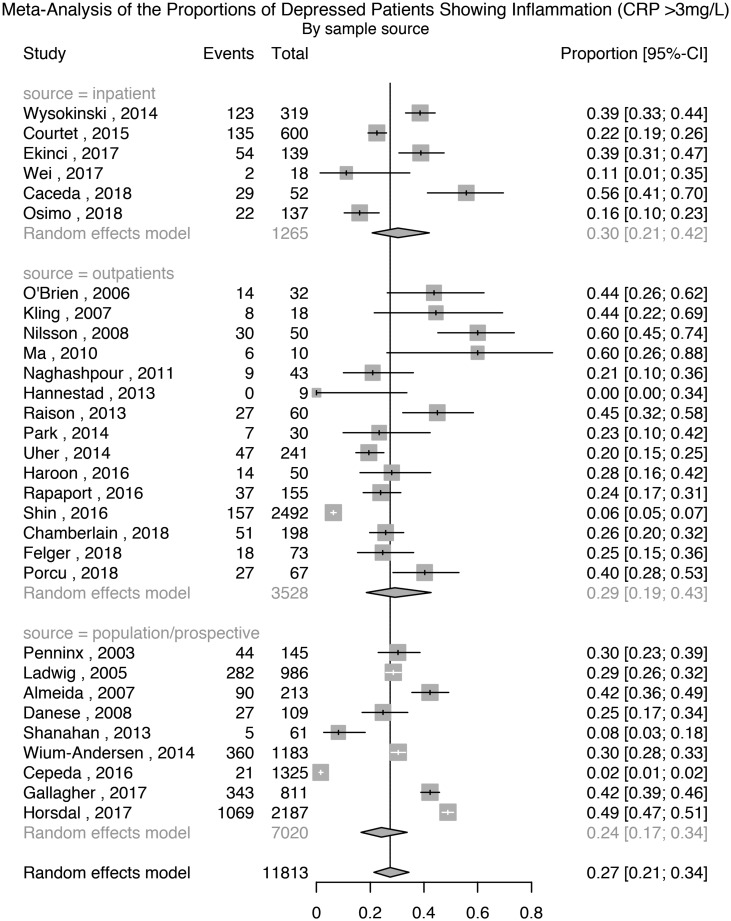
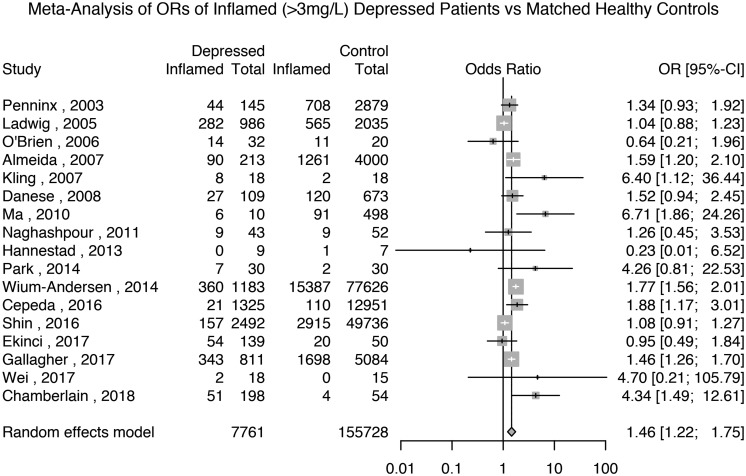
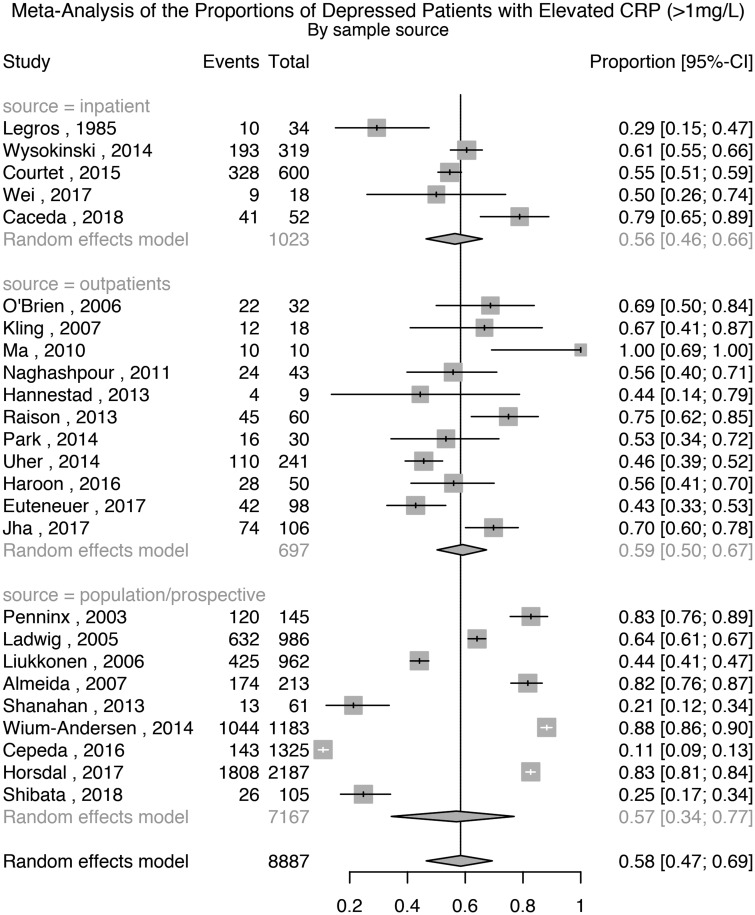
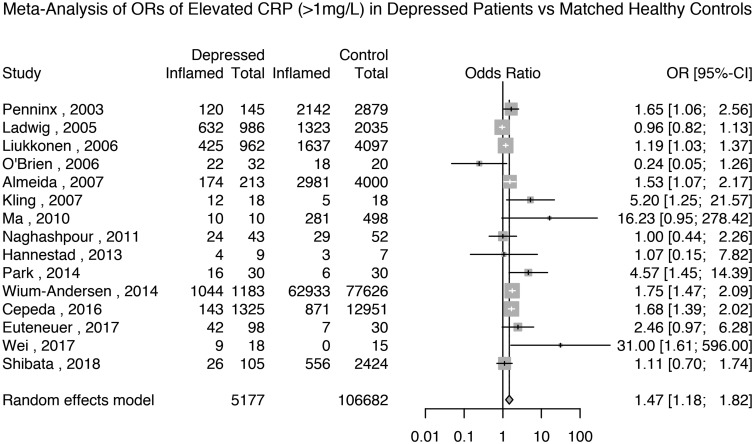
Background: Peripheral low-grade inflammation in depression is increasingly seen as a therapeutic target. We aimed to establish the prevalence of low-grade inflammation in depression, using different C-reactive protein (CRP) levels, through a systematic literature review and meta-analysis. Methods: We searched the PubMed database from its inception to July 2018, and selected studies that assessed depression using a validated tool/scale, and allowed the calculation of the proportion of patients with low-grade inflammation (CRP >3 mg/L) or elevated CRP (>1 mg/L). Results: After quality assessment, 37 studies comprising 13 541 depressed patients and 155 728 controls were included. Based on the meta-analysis of 30 studies, the prevalence of low-grade inflammation (CRP >3 mg/L) in depression was 27% (95% CI 21–34%); this prevalence was not associated with sample source (inpatient, outpatient or population-based), antidepressant treatment, participant age, BMI or ethnicity. Based on the meta-analysis of 17 studies of depression and matched healthy controls, the odds ratio for low-grade inflammation in depression was 1.46 (95% CI 1.22–1.75). The prevalence of elevated CRP (>1 mg/L) in depression was 58% (95% CI 47–69%), and the meta-analytic odds ratio for elevated CRP in depression compared with controls was 1.47 (95% CI 1.18–1.82). Conclusions: About a quarter of patients with depression show evidence of low-grade inflammation, and over half of patients show mildly elevated CRP levels. There are significant differences in the prevalence of low-grade inflammation between patients and matched healthy controls. These findings suggest that inflammation could be relevant to a large number of patients with depression.
Overview
The claims and statistics of this paper haven’t been checked yet.
Free: it reads the open-access text and checks the first 5 claims that cite a source we can check. Create a free account to check every claim.
Integrity signals
Registry
Cites
Statistics
Figures
Verification
Claims the paper makes
The claims and statistics of this paper haven’t been checked yet.
Free: it reads the open-access text and checks the first 5 claims that cite a source we can check. Create a free account to check every claim.
Claims other papers make about this one
Each is checked against this paper’s own text: does it say what the citing paper says it does?
The source backs part of the claim, not all of it — or backs it for a different population, condition or comparison.
In the citing paper
“Higher plasma levels of inflammatory cytokines, most consistently interleukin IL-1β, IL-6, and TNF-α, are correlated with greater depressive symptomatology.”
From Chronic stress, neuroinflammation, and depression: an overview of pathophysiological mechanisms and emerging anti-inflammatories (2023) · cites this paper as [6]
Experimental — accuracy not yet measuredThe cited source says what the claim attributes to it.
In the citing paper
“Low-grade inflammation – as indexed by a concentration of C-reactive protein (CRP) higher than 3 mg/L – is more likely in individuals with depression than in matched controls, occurring in around a quarter of the former according to a large meta-analysis (OR: 1.46, 95% CI: 1.22-1.75)205.”
From Comorbidity between major depressive disorder and physical diseases: a comprehensive review of epidemiology, mechanisms and management (2023) · cites this paper as [205]
In the citing paper
“Data were confirmed by a recent meta-analysis that included 13,541 depressed patients and 155,728 controls [121]. In 27% of the depressive patients there was a low-grade of inflammation (i.e., CRP > 3.0 mg/L) and over half of the patients showed a mildly elevated CRP level [121].”
From C-Reactive protein as a biomarker for major depressive disorder? (2022) · cites this paper as [121]
In the citing paper
“A very limited number of studies on CRP excluded participants presenting with an acute infection (CRP > 10 mg/L); we decided to include these studies because we previously found that the odds ratio of inflammation in patients vs controls is very similar if considering all patients (OR = 1.46) or excluding patients and controls with CRP > 10 mg/L (OR = 1.44) (Osimo et al., 2019), thus suggesting”
From Inflammatory markers in depression: a meta-analysis of mean differences and variability in 5,166 patients and 5,083 controls (2020) · cites this paper as Osimo et al., 2019
Self-check
Percentages, sums and reported differences re-computed from the paper’s own numbers.
The self-check needs the paper’s full text.
Citations
Cites
Quantifying heterogeneity in a meta‐analysis
Higgins, J. P. T., & Thompson, S. G. (2002) · Statistics in Medicine · doi:10.1002/sim.1186 · Cited by 36,763 · cited 1×
“Heterogeneity was tested using Cochrane’s Q-Test (Higgins and Thompson, 2002).”
Stang, A. (2010) · European Journal of Epidemiology · doi:10.1007/s10654-010-9491-z · Cited by 17,396 · cited 2×
“Study quality was assessed using the Newcastle–Ottawa Scale (Stang, 2010).”
MethodMolecular Mechanisms of Depression: Perspectives on New Treatment Strategies
Lang, U. E., & Borgwardt, S. (2013) · Cellular Physiology and Biochemistry · doi:10.1159/000350094 · Cited by 8,475
From inflammation to sickness and depression: when the immune system subjugates the brain
Dantzer, R., O'Connor, J. C., Freund, G. G., Johnson, R. W., & Kelley, K. W. (2008) · Nature Reviews Neuroscience · doi:10.1038/nrn2297 · Cited by 7,395 · cited 2×
“…commonly seen following an acute infection, shares many characteristics with depression, such as fatigue, sleep disturbance and decreased motivation (Dantzer et al., 2008); early-life infection and autoimmune diseases are associated with a higher risk of depression in adulthood (Benros et al.,…”
BackgroundPearson, T. A., Mensah, G. A., Alexander, R. W., Anderson, J. L., Cannon, R. O., Criqui, M., Fadl, Y. Y., Fortmann, S. P., Hong, Y., Myers, G. L., et al. (2003) · Circulation · doi:10.1161/01.cir.0000052939.59093.45 · Cited by 6,401 · cited 9×
“The American Heart Association and Center for Disease Control and Prevention have proposed clear CRP thresholds as indicators of inflammation levels (<1 = ‘low’, 1–3 = ‘medium’, >3 mg/L = ‘high’) (Pearson et al., 2003).”
BackgroundMethodInfluentialDiagnostic Criteria for Use in Psychiatric Research
Feighner, J. P. (1972) · Archives of General Psychiatry · doi:10.1001/archpsyc.1972.01750190059011 · Cited by 5,715
A Meta-Analysis of Cytokines in Major Depression
Dowlati, Y., Herrmann, N., Swardfager, W., Liu, H., Sham, L., Reim, E. K., & Lanctôt, K. L. (2010) · Biological Psychiatry · doi:10.1016/j.biopsych.2009.09.033 · Cited by 4,729 · cited 7×
“Meta-analyses of crosssectional studies confirm that mean concentrations of circulating CRP and inflammatory cytokines such as interleukin 6 (IL-6) are higher in patients with acute depression compared with controls (Howren et al., 2009; Dowlati et al., 2010; Haapakoski et al., 2015; Goldsmith et al., 2016).”
BackgroundResultInfluentialC-Reactive Protein, Interleukin 6, and Risk of Developing Type 2 Diabetes Mellitus
Pradhan, A. D. (2001) · JAMA · doi:10.1001/jama.286.3.327 · Cited by 4,433 · cited 1×
“In addition to depression and CVD, inflammation is associated with other physical and psychiatric disorders including diabetes mellitus (Pradhan et al., 2001), schizophrenia (Miller et al.”
BackgroundDanesh, J., Wheeler, J. G., Hirschfield, G. M., Eda, S., Eiriksdottir, G., Rumley, A., Lowe, G. D. O., Pepys, M. B., & Gudnason, V. (2004) · New England Journal of Medicine · doi:10.1056/nejmoa032804 · Cited by 2,953
Associations of depression with C-reactive protein, IL-1, and IL-6: a meta-analysis.
Howren, M. B., Lamkin, D. M., & Suls, J. (2009) · Psychosomatic Medicine · doi:10.1097/psy.0b013e3181907c1b · Cited by 2,766 · cited 7×
“Meta-analyses of crosssectional studies confirm that mean concentrations of circulating CRP and inflammatory cytokines such as interleukin 6 (IL-6) are higher in patients with acute depression compared with controls (Howren et al., 2009; Dowlati et al., 2010; Haapakoski et al., 2015; Goldsmith et al., 2016).”
BackgroundResultInfluential
Research works printed but not linked: 3
- Osimo, 2018, Prevalence of low-grade inflammation in depression: a review and meta-analysis of CRP data, PROSPERO
- Urbanek, 2015, Cairo: R graphics device using Cairo graphics library for creating high-quality bitmap (PNG, JPEG, TIFF), vector (PDF, SVG, PostScript) and display (X11 and Win32) output [Software], CRAN
- Khandaker, 2019, Shared mechanism between depression and coronary heart disease: findings from Mendelian randomization analysis of a large UK population-based cohort, Molecular Psychiatry
Cited by
Osimo, E. F., Pillinger, T., Rodriguez, I. M., Khandaker, G. M., Pariante, C. M., & Howes, O. D. (2020) · Brain, Behavior, and Immunity · doi:10.1016/j.bbi.2020.02.010 · Cited by 937
“This is important as in the past there have been suggestions that inflammation in depression could be due to a sub-group of “inflamed and depressed” subjects, who might potentially be part of a separate sub-group of the depressed population (Miller and Cole, 2012).”
Self-citationHassamal, S. (2023) · Frontiers in Psychiatry · doi:10.3389/fpsyt.2023.1130989 · Cited by 578
“There is no unifying diagnostic criteria for depression associated with inflammation, however a peripheral C-reactive protein (CRP) level exceeding 3 mg/L is commonly used as a marker of subtyping inflammation (8).”
BackgroundInfluentialComorbid depression in medical diseases
Gold, S. M., Köhler-Forsberg, O., Moss-Morris, R., Mehnert, A., Miranda, J. J., Bullinger, M., Steptoe, A., Whooley, M. A., & Otte, C. (2020) · Nature Reviews Disease Primers · doi:10.1038/s41572-020-0200-2 · Cited by 534
Molecular pathways of major depressive disorder converge on the synapse
Fries, G. R., Saldana, V. A., Finnstein, J., & Rein, T. (2023) · Molecular Psychiatry · doi:10.1038/s41380-022-01806-1 · Cited by 504
“Apoptotic events may eventually contribute to the activation of the immune system and lead to the chronic low-grade inflammatory status seen in MDD [210].”
BackgroundMac Giollabhui, N., Ng, T. H., Ellman, L. M., & Alloy, L. B. (2021) · Molecular Psychiatry · doi:10.1038/s41380-020-00867-4 · Cited by 361
Milaneschi, Y., Kappelmann, N., Ye, Z., Lamers, F., Moser, S., Jones, P. B., Burgess, S., Penninx, B. W. J. H., & Khandaker, G. M. (2021) · Molecular Psychiatry · doi:10.1038/s41380-021-01188-w · Cited by 350
Self-citationBerk, M., Köhler‐Forsberg, O., Turner, M., Penninx, B. W. J. H., Wrobel, A., Firth, J., Loughman, A., Reavley, N. J., McGrath, J. J., Momen, N. C., et al. (2023) · World Psychiatry · doi:10.1002/wps.21110 · Cited by 336
Watson, D., Levin‐Aspenson, H. F., Waszczuk, M. A., Conway, C. C., Dalgleish, T., Dretsch, M. N., Eaton, N. R., Forbes, M. K., Forbush, K. T., Hobbs, K. A., et al. (2022) · World Psychiatry · doi:10.1002/wps.20943 · Cited by 265
Kappelmann, N., Arloth, J., Georgakis, M. K., Czamara, D., Rost, N., Ligthart, S., Khandaker, G. M., & Binder, E. B. (2021) · JAMA Psychiatry · doi:10.1001/jamapsychiatry.2020.3436 · Cited by 266
Self-citationNettis, M. A., Lombardo, G., Hastings, C., Zajkowska, Z., Mariani, N., Nikkheslat, N., Worrell, C., Enache, D., McLaughlin, A., Kose, M., et al. (2021) · Neuropsychopharmacology · doi:10.1038/s41386-020-00948-6 · Cited by 235
PI3K/AKT signaling pathway: Molecular mechanisms and therapeutic potential in depression
Guo, N., Wang, X., Xu, M., Bai, J., Yu, H., & Zhang, L. (2024) · Pharmacological Research · doi:10.1016/j.phrs.2024.107300 · Cited by 218
Pitharouli, M. C., Hagenaars, S. P., Glanville, K. P., Coleman, J. R. I., Hotopf, M., Lewis, C. M., & Pariante, C. M. (2021) · American Journal of Psychiatry · doi:10.1176/appi.ajp.2020.20060947 · Cited by 218
Kouba, B. R., de Araujo Borba, L., Borges de Souza, P., Gil-Mohapel, J., & Rodrigues, A. L. S. (2024) · Cells · doi:10.3390/cells13050423 · Cited by 209
“Indeed, although it has been reported that individuals with depression have increased serum levels of inflammatory cytokines when compared to healthy individuals [10,204,331], the use of these cytokines as biomarkers for MDD presents various limitations, such as their low detection limit.”
BackgroundC-Reactive protein as a biomarker for major depressive disorder?
Orsolini, L., Pompili, S., Tempia Valenta, S., Salvi, V., & Volpe, U. (2022) · International Journal of Molecular Sciences · doi:10.3390/ijms23031616 · Cited by 171
“Different mechanisms were assumed to explain how a low-grade inflammation may interact with the severity of depressive symptoms, including cognitive impairment, and with treatment resistance in MDD patients [56,121,134].”
BackgroundInfluentialHusain, M. I., Chaudhry, I. B., Khoso, A. B., Husain, M. O., Hodsoll, J., Ansari, M. A., Naqvi, H. A., Minhas, F. A., Carvalho, A. F., Meyer, J. H., et al. (2020) · The Lancet Psychiatry · doi:10.1016/s2215-0366(20)30138-3 · Cited by 167
Beyond depression: the expanding role of inflammation in psychiatric disorders
Miller, A. H. (2020) · World Psychiatry · doi:10.1002/wps.20723 · Cited by 156
Depression profilers and immuno-metabolic dysregulation: Longitudinal results from the NESDA study
Lamers, F., Milaneschi, Y., Vinkers, C. H., Schoevers, R. A., Giltay, E. J., & Penninx, B. W. J. H. (2020) · Brain, Behavior, and Immunity · doi:10.1016/j.bbi.2020.04.002 · Cited by 151
Yin, Y., Ju, T., Zeng, D., Duan, F., Zhu, Y., Liu, J., Li, Y., & Lu, W. (2024) · Pharmacological Research · doi:10.1016/j.phrs.2024.107322 · Cited by 179
Peripheral blood cellular immunophenotype in depression: a systematic review and meta-analysis
Foley, É. M., Parkinson, J. T., Mitchell, R. E., Turner, L., & Khandaker, G. M. (2023) · Molecular Psychiatry · doi:10.1038/s41380-022-01919-7 · Cited by 138
“Search terms incorporated key indexing terms and wildcards to maximise return and included: (depression OR depressive disorder OR major depressive disorder) AND (leukocyte count OR fl ow cytometry OR mass cytometry OR immunophenotype OR immunophenotyping OR peripheral blood mononuclear cell).”
BackgroundSelf-citationChanges in inflammatory biomarkers are related to the antidepressant effects of Ayahuasca
Galvão-Coelho, N. L., de Menezes Galvão, A. C., de Almeida, R. N., Palhano-Fontes, F., Campos Braga, I., Lobão Soares, B., Maia-de-Oliveira, J. P., Perkins, D., Sarris, J., & de Araujo, D. B. (2020) · Journal of Psychopharmacology · doi:10.1177/0269881120936486 · Cited by 128
“The pre-treatment CRP levels observed here in patients were characterized as a low-grade inflammatory profile (CRP level >3 mg/L; healthy adult population <1 mg /L) (Macy et al., 1997; Osimo et al., 2019; Raison et al., 2013; Shine et al., 1981).”
BackgroundAiding and Abetting Anhedonia: Impact of Inflammation on the Brain and Pharmacological Implications
Lucido, M. J., Bekhbat, M., Goldsmith, D. R., Treadway, M. T., Haroon, E., Felger, J. C., & Miller, A. H. (2021) · Pharmacological Reviews · doi:10.1124/pharmrev.120.000043 · Cited by 138
“Few studies have directly examined this issue, but the estimate based on a recent meta-analysis of the literature is that approximately 30% of patients with depression exhibit high inflammation (as reflected by a CRP > 3 mg/l) (Osimo et al., 2019).”
BackgroundBower, J. E., & Kuhlman, K. R. (2023) · Annual Review of Clinical Psychology · doi:10.1146/annurev-clinpsy-080621-045153 · Cited by 155
The immunology of stress and the impact of inflammation on the brain and behaviour
Ravi, M., Miller, A. H., & Michopoulos, V. (2021) · BJPsych Advances · doi:10.1192/bja.2020.82 · Cited by 147
“…effectiveness in otherwise healthy depressed individuals, however the off-target effects of these medications and the fact that increased inflammation occurs in only about 1/3 of depressed patients leaves some level of doubt regarding the specificity of findings relative to inflammation (33, 34).”
Immuno-metabolic depression: from concept to implementation
Penninx, B. W. J. H., Lamers, F., Jansen, R., Berk, M., Khandaker, G. M., Picker, L. D., & Milaneschi, Y. (2024) · The Lancet Regional Health - Europe · doi:10.1016/j.lanepe.2024.101166 · Cited by 170
Self-citationLoneliness and Risk for Cardiovascular Disease: Mechanisms and Future Directions
Paul, E., Bu, F., & Fancourt, D. E. (2021) · Current Cardiology Reports · doi:10.1007/s11886-021-01495-2 · Cited by 143
Peruzzolo, T. L., Pinto, J. V., Roza, T. H., Shintani, A. O., Anzolin, A. P., Gnielka, V., Kohmann, A. M., Marin, A. S., Lorenzon, V. R., Brunoni, A. R., et al. (2022) · Molecular Psychiatry · doi:10.1038/s41380-022-01564-0 · Cited by 140
Cattaneo, A., Ferrari, C., Turner, L., Mariani, N., Enache, D., Hastings, C., Kose, M., Lombardo, G., McLaughlin, A. P., Nettis, M. A., et al. (2020) · Translational Psychiatry · doi:10.1038/s41398-020-00874-7 · Cited by 115
The kynurenine pathway in major depression: What we know and where to next
Brown, S. J., Huang, X.-F., & Newell, K. A. (2021) · Neuroscience & Biobehavioral Reviews · doi:10.1016/j.neubiorev.2021.05.018 · Cited by 113
Circadian depression: A mood disorder phenotype
Carpenter, J. S., Crouse, J. J., Scott, E. M., Naismith, S. L., Wilson, C., Scott, J., Merikangas, K. R., & Hickie, I. B. (2021) · Neuroscience & Biobehavioral Reviews · doi:10.1016/j.neubiorev.2021.02.045 · Cited by 114
Post-acute sequelae of COVID-19: Evidence of mood & cognitive impairment
Lamontagne, S. J., Winters, M. F., Pizzagalli, D. A., & Olmstead, M. C. (2021) · Brain Behavior & Immunity - Health · doi:10.1016/j.bbih.2021.100347 · Cited by 139
Inflammation as a treatment target in mood disorders: review
Jones, B. D. M., Daskalakis, Z. J., Carvalho, A. F., Strawbridge, R., Young, A. H., Mulsant, B. H., & Husain, M. I. (2020) · BJPsych Open · doi:10.1192/bjo.2020.43 · Cited by 106
Recognizing the role of the vagus nerve in depression from microbiota-gut brain axis
Tan, C., Yan, Q., Ma, Y., Fang, J., & Yang, Y. (2022) · Frontiers in Neurology · doi:10.3389/fneur.2022.1015175 · Cited by 130
Mekhora, C., Lamport, D. J., & Spencer, J. P. E. (2024) · Neurochemistry International · doi:10.1016/j.neuint.2024.105900 · Cited by 118
“In healthy adults, the average serum CRP concentration is 0.2 – 3.0 mg/L. Elevated serum CRP of more than 3 mg/L might be considered low-grade inflammation (Osimo et al., 2019).”
InfluentialGreen, C., Shen, X., Stevenson, A. J., Conole, E. L. S., Harris, M. A., Barbu, M. C., Hawkins, E. L., Adams, M. J., Hillary, R. F., Lawrie, S. M., et al. (2020) · Brain Behavior and Immunity · doi:10.1016/j.bbi.2020.11.024 · Cited by 105
Ye, Z., Kappelmann, N., Moser, S., Davey Smith, G., Burgess, S., Jones, P. B., & Khandaker, G. M. (2021) · eClinicalMedicine · doi:10.1016/j.eclinm.2021.100992 · Cited by 96
“A previous meta-analysis reported no sex-specificity of the association between CRP and depression [3].”
BackgroundMethodSelf-citationGut microbiota variations in patients diagnosed with major depressive disorder—A systematic review
Knudsen, J. K., Bundgaard‐Nielsen, C., Hjerrild, S., Nielsen, R. E., Leutscher, P., & Sørensen, S. (2021) · Brain and Behavior · doi:10.1002/brb3.2177 · Cited by 97
Inflammation and depression in young people: a systematic review and proposed inflammatory pathways
Toenders, Y. J., Laskaris, L., Davey, C. G., Berk, M., Milaneschi, Y., Lamers, F., Penninx, B. W. J. H., & Schmaal, L. (2021) · Molecular Psychiatry · doi:10.1038/s41380-021-01306-8 · Cited by 114
Treatment-Resistant Depression Revisited: A Glimmer of Hope
Halaris, A. E., Sohl, E., & Whitham, E. A. (2021) · Journal of Personalized Medicine · doi:10.3390/jpm11020155 · Cited by 110
Antihypertensive Drugs and Risk of Depression: A Nationwide Population-Based Study
Kessing, L. V., Rytgaard, H. C. W., Ekstrøm, C. T., Torp-Pedersen, C. T., Berk, M., & Gerds, T. A. (2020) · Hypertension · doi:10.1161/hypertensionaha.120.15605 · Cited by 107
“Low-grade systemic inflammation and neuroinflammation is prevalent in hypertension and cardiovascular and cerebrovascular diseases,(1,14) as well as in depression.(15) Evidence points to increased inflammatory mediators including increased levels of proinflammatory cytokines such as IL (interleukin)-1β, IL-6, IL-8, IL…”
BackgroundDietary inflammatory index (DII®) and the risk of depression symptoms in adults
Shakya, P. R., Melaku, Y. A., Shivappa, N., Hébert, J. R., Adams, R., Page, A. J., & Gill, T. K. (2020) · Clinical Nutrition · doi:10.1016/j.clnu.2020.12.031 · Cited by 104
The emerging tale of microglia in psychiatric disorders
Rahimian, R., Wakid, M., O’Leary, L. A., & Mechawar, N. (2021) · Neuroscience & Biobehavioral Reviews · doi:10.1016/j.neubiorev.2021.09.023 · Cited by 102
Depression and anxiety in colorectal cancer patients: Ties to pain, fatigue, and inflammation
Renna, M. E., Shrout, M. R., Madison, A. A., Alfano, C. M., Povoski, S. P., Lipari, A. M., Carson, W. E., Malarkey, W. B., & Kiecolt‐Glaser, J. K. (2022) · Psycho-Oncology · doi:10.1002/pon.5986 · Cited by 98
Mason, N. L., Szabó, A., Kuypers, K. P. C., Mallaroni, P., de la Torre, R., Reckweg, J. T., Tse, D. H. Y., Hutten, N. R. P. W., Feilding, A., & Ramaekers, J. G. (2023) · Brain Behavior and Immunity · doi:10.1016/j.bbi.2023.09.004 · Cited by 102
Réus, G. Z., Manosso, L. M., Quevedo, J., & Carvalho, A. F. (2023) · Neuroscience & Biobehavioral Reviews · doi:10.1016/j.neubiorev.2023.105425 · Cited by 103
The interface of depression and diabetes: treatment considerations
Fanelli, G., Raschi, E., Hafez, G., Matura, S., Schiweck, C., Poluzzi, E., & Lunghi, C. (2025) · Translational Psychiatry · doi:10.1038/s41398-025-03234-5 · Cited by 129
De Giorgi, R., Ghenciulescu, A., Dziwisz, O., Taquet, M., Adler, A. I., Koychev, I., Upthegrove, R., Solmi, M., McCutcheon, R., Pillinger, T., et al. (2025) · Nature Mental Health · doi:10.1038/s44220-025-00390-x · Cited by 77
“For example, inflammation is known to play a role in at least a subset of depressive 238 and psychotic disorders 239 ; therefore, it is conceivable that the use of GLP-1RAs may be beneficial in these patients’ groups—although”
A sex-specific genome-wide association study of depression phenotypes in UK Biobank
Silveira, P. P., Pokhvisneva, I., Howard, D. M., & Meaney, M. J. (2023) · Molecular Psychiatry · doi:10.1038/s41380-023-01960-0 · Cited by 90
Liu, H., Zhang, X., Shi, P., Yuan, J., Jia, Q., Pi, C., Chen, T., Xiong, L., Chen, J., Tang, J., et al. (2023) · Journal of Neuroinflammation · doi:10.1186/s12974-023-02768-z · Cited by 92
Sex differences in the inflammation-depression link: A systematic review and meta-analysis
Jarkas, D., Villeneuve, A. H., Daneshmend, A., Villeneuve, P. J., & McQuaid, R. J. (2024) · Brain Behavior and Immunity · doi:10.1016/j.bbi.2024.07.037 · Cited by 97
“In general, these overall effects for IL-6, TNF-α , and IL-1 β support previous meta -analytical findings (Dowlati et al., 2010; Goldsmith et al., 2016; Osimo et al., 2019; Osimo et al., 2020).”
BackgroundResultInfluentialHird, E. J., Slanina-Davies, A., Lewis, G., Hamer, M., & Roiser, J. P. (2024) · Translational Psychiatry · doi:10.1038/s41398-024-02922-y · Cited by 79
“…important methodological limitations remain: in particular, because increased in fl ammation is only present in a subset of depressed individuals [128], participants should ideally be strati fi ed by their in fl ammatory status at baseline and in fl amma-tory markers should be assessed pre-and…”
Self-citationIs depression the missing link between inflammatory mediators and cancer?
Polityńska, B., Pokorska, O., Wojtukiewicz, A. M., Sawicka, M., Mysliwiec, M., Honn, K. V., Tucker, S. C., & Wojtukiewicz, M. Z. (2022) · Pharmacology & Therapeutics · doi:10.1016/j.pharmthera.2022.108293 · Cited by 89
de Vries, L. P., van de Weijer, M. P., & Bartels, M. (2022) · Neuroscience & Biobehavioral Reviews · doi:10.1016/j.neubiorev.2022.104733 · Cited by 92
Advancing an Inflammatory Subtype of Major Depression
Miller, A. H. (2025) · American Journal of Psychiatry · doi:10.1176/appi.ajp.20250289 · Cited by 100
“Based on a meta-analysis of 30 studies, only about 25% of patients with depression exhibit evidence of chronic low-grade inflammation as indexed by a peripheral blood CRP level > 3 mg/L (12).”
North, H. F., Bruggemann, J. M., Cropley, V., Swaminathan, V., Sundram, S., Lenroot, R., Pereira, A. M., Zalesky, A., Bousman, C., Pantelis, C., et al. (2021) · European Archives of Psychiatry and Clinical Neuroscience · doi:10.1007/s00406-021-01237-z · Cited by 82
Milaneschi, Y., Allers, K. A., Beekman, A. T. F., Giltay, E. J., Keller, S., Schoevers, R. A., Süßmuth, S. D., Niessen, H. G., & Penninx, B. W. J. H. (2021) · Brain Behavior and Immunity · doi:10.1016/j.bbi.2021.07.007 · Cited by 75
Mosiołek, A., Pięta, A., Jakima, S., Zborowska, N., Mosiołek, J., & Szulc, A. (2021) · Journal of Clinical Medicine · doi:10.3390/jcm10081706 · Cited by 72
“CRP is used in psychiatry as a marker of chronic inflammation [45].”
Neuroinflammation in HIV-associated depression: evidence and future perspectives
Rakshasa-Loots, A. M., Whalley, H. C., Vera, J. H., & Cox, S. R. (2022) · Molecular Psychiatry · doi:10.1038/s41380-022-01619-2 · Cited by 83
“While studies generally agree that cytokines such as IL-6 and TNF-α are correlated with depression, the role of CRP (a cytokine that generally exhibits robust correlations with depression 141, 186 ) specifically in HIV-associated depression is a major area of debate.”
Civieri, G., Abohashem, S., Grewal, S., Aldosoky, W., Qamar, I., Hanlon, E. C., Choi, K. W., Shin, L. M., Rosovsky, R. P. G., Bollepalli, S. C., et al. (2024) · JACC Advances · doi:10.1016/j.jacadv.2024.101208 · Cited by 85
Psychedelic therapy's transdiagnostic effects: A research domain criteria (RDoC) perspective
Kelly, J. R., Gillan, C. M., Prenderville, J., Kelly, C., Harkin, A., Clarke, G., & O'Keane, V. (2021) · Frontiers in Psychiatry · doi:10.3389/fpsyt.2021.800072 · Cited by 69
Microglia and HPA axis in depression: An overview of participation and relationship
Pereira, G. C., Piton, E., dos Santos, B. M., Ramanzini, L. G., Camargo, L. F. M., da Silva, R. M., & Bochi, G. V. (2021) · The World Journal of Biological Psychiatry · doi:10.1080/15622975.2021.1939154 · Cited by 74
“Curiously, both GCs increase (Kennis et al. 2020) and neuroinflammation (Osimo et al. 2019) have been reported as playing a role in the pathophysiology of depression.”
BackgroundXu, X. M., Zeng, X., Cui, Y., Li, Y.-B., Cheng, J.-H., Zhao, X., Xu, G., Ma, J., Piao, H., Jin, X., et al. (2020) · ACS Chemical Neuroscience · doi:10.1021/acschemneuro.0c00120 · Cited by 69
Inflammation, stress and depression: An exploration of ketamine’s therapeutic profile
Johnston, J. N., Greenwald, M. S., Henter, I. D., Kraus, C., Mkrtchian, A., Clark, N. G., Park, L. T., Gold, P. W., Zarate, C. A., & Kadriu, B. (2023) · Drug Discovery Today · doi:10.1016/j.drudis.2023.103518 · Cited by 79
Sickness behaviour and depression: An updated model of peripheral-central immunity interactions
Turkheimer, F., Veronese, M., Mondelli, V., Cash, D., & Pariante, C. M. (2023) · Brain Behavior and Immunity · doi:10.1016/j.bbi.2023.03.031 · Cited by 73
“Most reliable markers of inflammation in MDD relate to the acute phase protein CRP (C-reactive protein) and cytokines of the innate immune response (TNF-α, IL-6, IL-12, IL-18) (Osimo et al., 2019; Osimo et al., 2020; Pitharouli et al., 2021).”
BackgroundResultSnijders, G. J. L., Sneeboer, M. A. M., Fernández-Andreu, A., Udine, E., (NBB-Psy), P. D. P. O. T. N. B. B., Boks, M. P., Ormel, P. R., van Berlekom, A. B., van Mierlo, H. C., Böttcher, C., et al. (2020) · Molecular Psychiatry · doi:10.1038/s41380-020-00896-z · Cited by 72
Potential Role of Curcumin for the Treatment of Major Depressive Disorder
Lopresti, A. L. (2022) · CNS Drugs · doi:10.1007/s40263-022-00901-9 · Cited by 80
“Moreover, approximately one-quarter of patients with depression show evidence of low-grade inflammation, and over half of patients show mildly elevated CRP levels [91].”
BackgroundAmasi-Hartoonian, N., Sforzini, L., Cattaneo, A., & Pariante, C. M. (2022) · Current Opinion in Endocrine and Metabolic Research · doi:10.1016/j.coemr.2022.100356 · Cited by 90
Sealock, J., Lee, Y. A., Moscati, A., Venkatesh, S., Voloudakis, G., Straub, P., Singh, K., Feng, Y. A., Ge, T., Roussos, P., et al. (2021) · JAMA Psychiatry · doi:10.1001/jamapsychiatry.2021.2959 · Cited by 71
Annual Research Review: Neuroimmune network model of depression: a developmental perspective
Nusslock, R., Alloy, L. B., Brody, G. H., & Miller, G. E. (2024) · Journal of Child Psychology and Psychiatry · doi:10.1111/jcpp.13961 · Cited by 70
“Recent (Glassman & Miller, 2007) meta-analytic research indicates that only about 30% of individuals with depression display heightened inflammation, as defined by a CRP level greater than 3 mg/L (Osimo et al., 2019).”
InfluentialWei, Y., Feng, J., Ma, J., Chen, D., & Chen, J. (2022) · Journal of Affective Disorders · doi:10.1016/j.jad.2022.04.092 · Cited by 56
(2024) · doi:10.1038/s41598-024-70097-z · Cited by 58
Riveros, M. E., Ávila, A., Schruers, K. R. J., & Ezquer, F. E. (2022) · Antioxidants · doi:10.3390/antiox11030540 · Cited by 66
“It is well-known that inflammatory mediators are elevated in depressed patients; for example, C-reactive protein (CRP) levels are elevated in MDD patients as compared to healthy controls, and a third of them have CRP levels compatible with low-grade inflammation [80].”
BackgroundDepression after stoma surgery: a systematic review and meta-analysis
Kovoor, J. G., Jacobsen, J. H. W., Stretton, B., Bacchi, S., Gupta, A. K., Claridge, B., van der Steen, M., Bhanushali, A., Bartholomeusz, L., Edwards, S., et al. (2023) · BMC Psychiatry · doi:10.1186/s12888-023-04871-0 · Cited by 74
“About a quarter of patients with depression likely display evidence of low-grade inflammation, with over half of patients having mildly elevated C-Reactive Protein levels [110].”
BackgroundRenna, M. E. (2021) · Brain Behavior & Immunity - Health · doi:10.1016/j.bbih.2021.100397 · Cited by 73
Silva, R. C., Pisanu, C., Maffioletti, E., Menesello, V., Bortolomasi, M., Gennarelli, M., Baune, B. T., Squassina, A., & Minelli, A. (2023) · European Neuropsychopharmacology · doi:10.1016/j.euroneuro.2023.07.012 · Cited by 61
Kappelmann, N., Czamara, D., Rost, N., Moser, S., Schmoll, V., Trastulla, L., Štochl, J., Lucae, S., CHARGE inflammation working group, Binder, E. B., et al. (2021) · Brain Behavior and Immunity · doi:10.1016/j.bbi.2021.03.024 · Cited by 68
Self-citationBiomarkers Common for Inflammatory Periodontal Disease and Depression: A Systematic Review
Neupane, S. P., Virtej, A., Myhren, L. E., & Bull, V. H. (2022) · Brain, Behavior, & Immunity - Health · doi:10.1016/j.bbih.2022.100450 · Cited by 52
“Altered levels of immune-inflammatory markers including proinflammatory cytokines, oxidative and nitrosative stress markers, neurotoxic metabolites of tryptophan degradation and reduced neurotrophic levels are detected in a considerable proportion of individuals with depression (Mac Giollabhui et al., 2021; Maes et al…”
BackgroundMechanisms of Cognitive Impairment in Depression. May Probiotics Help?
Dobielska, M., Bartosik, N. K., Zyzik, K. A., Kowalczyk, E., & Karbownik, M. S. (2022) · Frontiers in Psychiatry · doi:10.3389/fpsyt.2022.904426 · Cited by 61
Bergstedt, J., Pasman, J. A., Ma, Z., Harder, A., Yao, S., Parker, N., Treur, J. L., Smit, D. J. A., Frei, O., Shadrin, A. A., et al. (2024) · Nature Cardiovascular Research · doi:10.1038/s44161-024-00488-y · Cited by 67
“Importantly, low-grade inflammation, measured by high C-reactive protein levels, has been observed in more than a quarter of patients with depression 18 , suggesting the presence of an inflammatory subtype of MDD 19 , which might be especially strongly associated with CVD.”
Parkinson, J. T., Foley, É. M., Jadon, D. R., & Khandaker, G. M. (2020) · Therapeutic Advances in Musculoskeletal Disease · doi:10.1177/1759720x20970028 · Cited by 56
Self-citationNettis, M. A., Veronese, M., Nikkheslat, N., Mariani, N., Lombardo, G., Sforzini, L., Enache, D., Harrison, N. A., Turkheimer, F. E., Mondelli, V., et al. (2020) · Translational Psychiatry · doi:10.1038/s41398-020-0768-z · Cited by 49
Advancing precision psychiatry and targeted treatments: Insights from immunopsychiatry
Miller, A. H., Berk, M., Bloch, G., Briquet-Laugier, V., Brouillon, C., Cuthbert, B. N., Dantzer, R., Davis, M. C., Picker, L. D., Drevets, W. C., et al. (2025) · Brain Behavior and Immunity · doi:10.1016/j.bbi.2025.01.002 · Cited by 61
Effects of the consumption of guarana on human health: A narrative review
Torres, E. A. F. D. S., Pinaffi‐Langley, A. C. D. C., Figueira, M. D. S., Cordeiro, K. S., Negrão, L. D., Soares, M. J., da Silva, C. P., Alfino, M. C. Z., Sampaio, G. R., & de Camargo, A. C. (2021) · Comprehensive Reviews in Food Science and Food Safety · doi:10.1111/1541-4337.12862 · Cited by 82
Lestra, V., Roméo, B., Martelli, C., Benyamina, A., & Hamdani, N. (2022) · Schizophrenia Research · doi:10.1016/j.schres.2022.06.026 · Cited by 59
Houben, S., & Bonnechère, B. (2022) · International Journal of Environmental Research and Public Health · doi:10.3390/ijerph19137748 · Cited by 54
“This persistence of inflammation was already correlated with depression [58] and can lead to a disruption of the blood–brain barrier (BBB), also resulting in neuronal and glial cells damages [59].”
BackgroundSforzini, L., Marizzoni, M., Bottanelli, C., Kunšteková, V., Zonca, V., Saleri, S., Kose, M., Lombardo, G., Mariani, N., Nettis, M. A., et al. (2024) · Molecular Psychiatry · doi:10.1038/s41380-024-02736-w · Cited by 60
Petrova, D., Catena, A., Rodríguez‐Barranco, M., Redondo‐Sánchez, D., Bayo-Lozano, E., García‐Retamero, R., Jiménez‐Moleón, J. J., & Sánchez, M. (2021) · Cancers · doi:10.3390/cancers13133368 · Cited by 54
Perry, B. I., Zammit, S., Jones, P. B., & Khandaker, G. M. (2021) · Schizophrenia Research · doi:10.1016/j.schres.2021.02.008 · Cited by 54
Self-citationNg, T. K. S., Coughlan, C. M., Heyn, P. C., Tagawa, A., Carollo, J. J., Kua, E. H., & Mahendran, R. (2021) · Aging · doi:10.18632/aging.203598 · Cited by 55
“These findings might shed light on the contradictory findings on hs-CRP in MDD [45, 57, 58], as co-morbidities were frequently present in previous studies.”
ResultXi, L., Fang, F., Zhou, J., Xu, P., Zhang, Y., Zhu, P., Tu, J., & Sun, Q. (2023) · Journal of Affective Disorders · doi:10.1016/j.jad.2023.10.027 · Cited by 51
Identifying Immunophenotypes of Inflammation in Depression: Dismantling the Monolith
Felger, J. C., & Miller, A. H. (2020) · Biological Psychiatry · doi:10.1016/j.biopsych.2020.04.024 · Cited by 43
Neurobiological findings underlying depressive behavior in Parkinson’s disease: A review
Mendonça, I. P., Duarte-Silva, E. P., Chaves-Filho, A. J. M., Andrade‐da‐Costa, B. L. D. S., & Peixoto, C. A. (2020) · International Immunopharmacology · doi:10.1016/j.intimp.2020.106434 · Cited by 42
Depressive symptoms predict clinical recurrence of inflammatory bowel disease
Jordi, S. B. U., Lang, B. M., Auschra, B., von Känel, R., Biedermann, L., Greuter, T., Schreiner, P., Rogler, G., Krupka, N., Sulz, M. C., et al. (2022) · Inflammatory Bowel Diseases · doi:10.1093/ibd/izab136 · Cited by 41
The role of immunomodulators in treatment-resistant depression: case studies
Beckett, C. W., & Niklison-Chirou, M. V. (2022) · Cell Death Discovery · doi:10.1038/s41420-022-01147-6 · Cited by 45
“Around one-quarter of patients with depression have raised low-level inflammation [20].”
BackgroundOsimo, E. F., Baxter, L., Štochl, J., Perry, B. I., Metcalf, S. A., Kunutsor, S. K., Laukkanen, J. A., Wium‐Andersen, M. K., Jones, P. B., & Khandaker, G. M. (2021) · Schizophrenia · doi:10.1038/s41537-021-00161-4 · Cited by 44
Self-citationSforzini, L., Cattaneo, A., Ferrari, C., Turner, L., Mariani, N., Enache, D., Hastings, C. N. M., Lombardo, G., Nettis, M. A., Nikkheslat, N., et al. (2023) · Translational Psychiatry · doi:10.1038/s41398-023-02438-x · Cited by 44
“Increased concentrations of CRP have been consistently associated with MDD [2, 14, 15].”
BackgroundPinzi, M., Fagiolini, A. M., Koukouna, D., Gualtieri, G., Rescalli, M. B., Pierini, C., Pardossi, S., Patrizio, B., & Cuomo, A. (2025) · Cells · doi:10.3390/cells14191558 · Cited by 54
“Indeed, meta-analyses show elevations of CRP, IL-6, IL-12/IL-18, sIL-2R, and TNF-α in MDD. Low-grade inflammation (CRP > 3 mg/L) is present in ~27% of patients, with >1 mg/L in nearly 60%, delineating an “inflamed depression” subgroup [60].”
InfluentialRecent trends in the management of depression in persons with cancer
Panjwani, A. A., & Li, M. (2021) · Current Opinion in Psychiatry · doi:10.1097/yco.0000000000000727 · Cited by 40
Giollabhui, N. M., Slaney, C., Hemani, G., Foley, É. M., van der Most, P. J., Nolte, I. M., Snieder, H., Smith, G. D., Khandaker, G. M., & Hartman, C. A. (2025) · Translational Psychiatry · doi:10.1038/s41398-025-03372-w · Cited by 56
“…high levels of comorbid depression and anxiety (i.e., higher CRP in anxiety is con fi ned primarily to anxious individuals with depression) or that the proportion of individuals with in fl ammatory anxiety is even smaller than the ~25% of depressed individuals with an in fl ammatory phenotype [108].”
Self-citationChan, S. Y., Probert, F., Radford‐Smith, D. E., Hebert, J. C., Claridge, T. D. W., Anthony, D. C., & Burnet, P. W. J. (2020) · Scientific Reports · doi:10.1038/s41598-020-74008-w · Cited by 42
Can selective serotonin reuptake inhibitors have a neuroprotective effect during COVID-19?
da Costa, L. H. A., Santos, B. M., & Branco, L. G. S. (2020) · European Journal of Pharmacology · doi:10.1016/j.ejphar.2020.173629 · Cited by 41
Metadata
- Authors
- Osimo, E. F., Baxter, L. J., Lewis, G., Jones, P. B., & Khandaker, G. M.
- Affiliations
- University of Cambridge (GB)
- University College London (GB)
- Corresponding author
- Osimo, Emanuele Felice
- Venue
- Psychological Medicine
- Publisher
- Cambridge University Press (CUP)
- Published
- 2019-07-01
- Volume
- 49
- Issue
- 12
- Pages
- 1958-1970
- ISSN
- 0033-2917 (ISSN-L)
- 1469-8978
- PMC
- PMC6712955
- OpenAlex
- W2955079055
- Cited by
- 774
- References
- 91
- Citations by year
- 2026: 126 · 2025: 141 · 2024: 119 · 2023: 127 · 2022: 107 · 2021: 100 · 2020: 49 · 2019: 4
- FWCI
- 3.94
- Type
- journal article
- Language
- en
- Open access
- hybrid
- doi.org
- Locations
- Psychological Medicine (publishedVersion, cc-by)
- PubMed Central (publishedVersion, cc-by)
- PubMed (publishedVersion)
- UCL Discovery (University College London) (submittedVersion)
- Explore Bristol Research (submittedVersion)
- Funders
- Wellcome Trust (RP-PG-0616-20003, 088869/Z/09/Z, 095844/Z/11/Z, 20003, 088869, /Z/11/Z, 201486 /Z/16/Z, 201486, MQDS17/40, 095844, MC_PC_17213)
- MQ: Transforming Mental Health (MQDS17/40)
- National Institute for Health and Care Research (MQDS17/40, RP-PG-0616-20003, ACF-2017-14-007)
- Medical Research Council (201486/Z/16/Z, MQDS17/40, MC_PC_17213)
- Topics
- Life Sciences › Neuroscience › Biological Psychiatry › Tryptophan and brain disorders
- Health Sciences › Medicine › Pharmacology (medical) › Treatment of Major Depression
- Life Sciences › Neuroscience › Behavioral Neuroscience › Stress Responses and Cortisol
- Keywords
- depression, low-grade inflammation, C-reactive protein, prevalence, depression biomarkers
- MeSH terms
- Antidepressive Agents, C-Reactive Protein, Depressive Disorder, Humans, Inflammation, Prevalence, Odds Ratio
About these checks
Registry, retraction, Cites and statistics results are computed, not judged, with one exception: a printed reference that no index lists is read once by a model before it counts as a citation error. Claims are extracted by a model and kept only when their quote appears verbatim in the text; each cited source is then checked, with a model’s help, for whether it says what the claim relies on. Those verdicts can be wrong — read the claim’s quote and the cited source before relying on one.
Statistics and arithmetic are recomputed, not judged.
Confidence bands are shown only for fields calibrated on our annotated test set. None is calibrated yet, so no band is shown.
What counts as a claim ›How we measure confidence ›How we check this ›
Are you an author, or do you see a problem with this page? Request a review
Data sources
Bibliographic data: Semantic Scholar, OpenAlex, Crossref.
Contains information from the Semantic Scholar Academic Graph Datasets, made available under the ODC Attribution License (ODC-BY 1.0).
Semantic Scholar’s data is described in: Kinney, R., et al. (2023). The Semantic Scholar Open Data Platform. arXiv:2301.10140.
