

Prevalence of low-grade inflammation in depression: a systematic review and meta-analysis of CRP levels
Open accessThe DOI matches its Crossref record; 91 of the 91 references it cites were found in a registry or an index.
Abstract
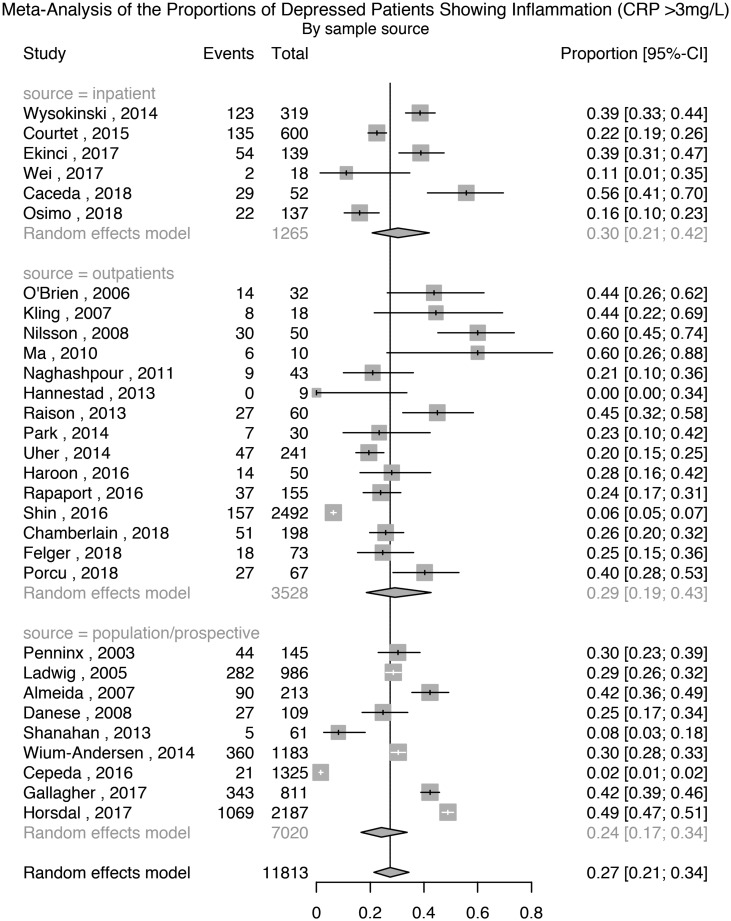
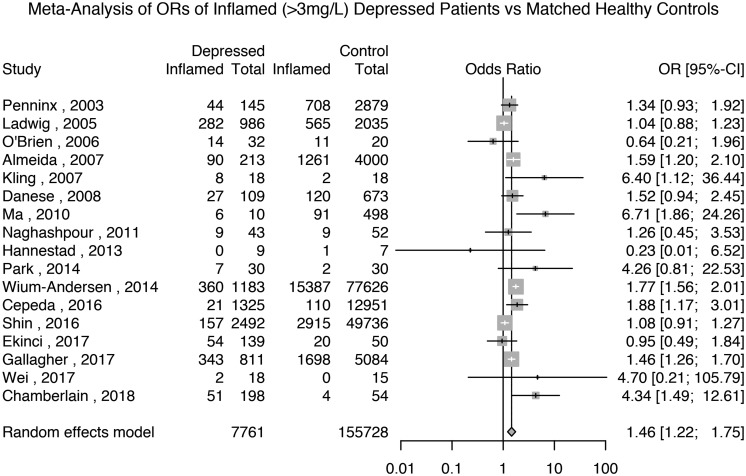
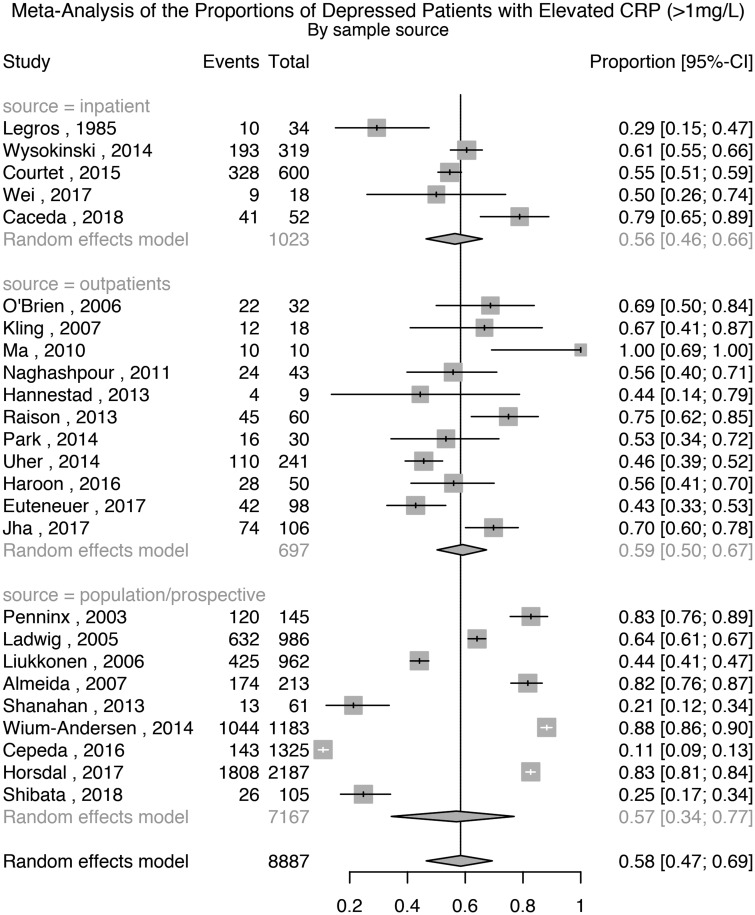
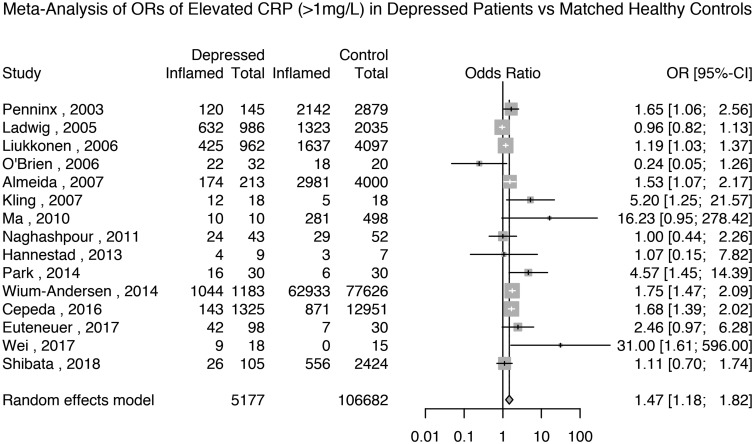
Background: Peripheral low-grade inflammation in depression is increasingly seen as a therapeutic target. We aimed to establish the prevalence of low-grade inflammation in depression, using different C-reactive protein (CRP) levels, through a systematic literature review and meta-analysis. Methods: We searched the PubMed database from its inception to July 2018, and selected studies that assessed depression using a validated tool/scale, and allowed the calculation of the proportion of patients with low-grade inflammation (CRP >3 mg/L) or elevated CRP (>1 mg/L). Results: After quality assessment, 37 studies comprising 13 541 depressed patients and 155 728 controls were included. Based on the meta-analysis of 30 studies, the prevalence of low-grade inflammation (CRP >3 mg/L) in depression was 27% (95% CI 21–34%); this prevalence was not associated with sample source (inpatient, outpatient or population-based), antidepressant treatment, participant age, BMI or ethnicity. Based on the meta-analysis of 17 studies of depression and matched healthy controls, the odds ratio for low-grade inflammation in depression was 1.46 (95% CI 1.22–1.75). The prevalence of elevated CRP (>1 mg/L) in depression was 58% (95% CI 47–69%), and the meta-analytic odds ratio for elevated CRP in depression compared with controls was 1.47 (95% CI 1.18–1.82). Conclusions: About a quarter of patients with depression show evidence of low-grade inflammation, and over half of patients show mildly elevated CRP levels. There are significant differences in the prevalence of low-grade inflammation between patients and matched healthy controls. These findings suggest that inflammation could be relevant to a large number of patients with depression.
Overview
The claims and statistics of this paper haven’t been checked yet.
Free: it reads the open-access text and checks the first 5 claims that cite a source we can check. Create a free account to check every claim.
Integrity signals
Registry
Cites
Statistics
Figures
Verification
Claims the paper makes
The claims and statistics of this paper haven’t been checked yet.
Free: it reads the open-access text and checks the first 5 claims that cite a source we can check. Create a free account to check every claim.
Claims other papers make about this one
Each is checked against this paper’s own text: does it say what the citing paper says it does?
The source backs part of the claim, not all of it — or backs it for a different population, condition or comparison.
In the citing paper
“Higher plasma levels of inflammatory cytokines, most consistently interleukin IL-1β, IL-6, and TNF-α, are correlated with greater depressive symptomatology.”
From Chronic stress, neuroinflammation, and depression: an overview of pathophysiological mechanisms and emerging anti-inflammatories (2023) · cites this paper as [6]
Experimental — accuracy not yet measuredThe cited source says what the claim attributes to it.
In the citing paper
“Low-grade inflammation – as indexed by a concentration of C-reactive protein (CRP) higher than 3 mg/L – is more likely in individuals with depression than in matched controls, occurring in around a quarter of the former according to a large meta-analysis (OR: 1.46, 95% CI: 1.22-1.75)205.”
From Comorbidity between major depressive disorder and physical diseases: a comprehensive review of epidemiology, mechanisms and management (2023) · cites this paper as [205]
In the citing paper
“Data were confirmed by a recent meta-analysis that included 13,541 depressed patients and 155,728 controls [121]. In 27% of the depressive patients there was a low-grade of inflammation (i.e., CRP > 3.0 mg/L) and over half of the patients showed a mildly elevated CRP level [121].”
From C-Reactive protein as a biomarker for major depressive disorder? (2022) · cites this paper as [121]
In the citing paper
“A very limited number of studies on CRP excluded participants presenting with an acute infection (CRP > 10 mg/L); we decided to include these studies because we previously found that the odds ratio of inflammation in patients vs controls is very similar if considering all patients (OR = 1.46) or excluding patients and controls with CRP > 10 mg/L (OR = 1.44) (Osimo et al., 2019), thus suggesting”
From Inflammatory markers in depression: a meta-analysis of mean differences and variability in 5,166 patients and 5,083 controls (2020) · cites this paper as Osimo et al., 2019
Self-check
Percentages, sums and reported differences re-computed from the paper’s own numbers.
The self-check needs the paper’s full text.
Citations
Cites
Quantifying heterogeneity in a meta‐analysis
Higgins, J. P. T., & Thompson, S. G. (2002) · Statistics in Medicine · doi:10.1002/sim.1186 · Cited by 36,763 · cited 1×
“Heterogeneity was tested using Cochrane’s Q-Test (Higgins and Thompson, 2002).”
Stang, A. (2010) · European Journal of Epidemiology · doi:10.1007/s10654-010-9491-z · Cited by 17,396 · cited 2×
“Study quality was assessed using the Newcastle–Ottawa Scale (Stang, 2010).”
MethodMolecular Mechanisms of Depression: Perspectives on New Treatment Strategies
Lang, U. E., & Borgwardt, S. (2013) · Cellular Physiology and Biochemistry · doi:10.1159/000350094 · Cited by 8,475
From inflammation to sickness and depression: when the immune system subjugates the brain
Dantzer, R., O'Connor, J. C., Freund, G. G., Johnson, R. W., & Kelley, K. W. (2008) · Nature Reviews Neuroscience · doi:10.1038/nrn2297 · Cited by 7,395 · cited 2×
“…commonly seen following an acute infection, shares many characteristics with depression, such as fatigue, sleep disturbance and decreased motivation (Dantzer et al., 2008); early-life infection and autoimmune diseases are associated with a higher risk of depression in adulthood (Benros et al.,…”
BackgroundPearson, T. A., Mensah, G. A., Alexander, R. W., Anderson, J. L., Cannon, R. O., Criqui, M., Fadl, Y. Y., Fortmann, S. P., Hong, Y., Myers, G. L., et al. (2003) · Circulation · doi:10.1161/01.cir.0000052939.59093.45 · Cited by 6,401 · cited 9×
“The American Heart Association and Center for Disease Control and Prevention have proposed clear CRP thresholds as indicators of inflammation levels (<1 = ‘low’, 1–3 = ‘medium’, >3 mg/L = ‘high’) (Pearson et al., 2003).”
BackgroundMethodInfluentialDiagnostic Criteria for Use in Psychiatric Research
Feighner, J. P. (1972) · Archives of General Psychiatry · doi:10.1001/archpsyc.1972.01750190059011 · Cited by 5,715
A Meta-Analysis of Cytokines in Major Depression
Dowlati, Y., Herrmann, N., Swardfager, W., Liu, H., Sham, L., Reim, E. K., & Lanctôt, K. L. (2010) · Biological Psychiatry · doi:10.1016/j.biopsych.2009.09.033 · Cited by 4,729 · cited 7×
“Meta-analyses of crosssectional studies confirm that mean concentrations of circulating CRP and inflammatory cytokines such as interleukin 6 (IL-6) are higher in patients with acute depression compared with controls (Howren et al., 2009; Dowlati et al., 2010; Haapakoski et al., 2015; Goldsmith et al., 2016).”
BackgroundResultInfluentialC-Reactive Protein, Interleukin 6, and Risk of Developing Type 2 Diabetes Mellitus
Pradhan, A. D. (2001) · JAMA · doi:10.1001/jama.286.3.327 · Cited by 4,433 · cited 1×
“In addition to depression and CVD, inflammation is associated with other physical and psychiatric disorders including diabetes mellitus (Pradhan et al., 2001), schizophrenia (Miller et al.”
BackgroundDanesh, J., Wheeler, J. G., Hirschfield, G. M., Eda, S., Eiriksdottir, G., Rumley, A., Lowe, G. D. O., Pepys, M. B., & Gudnason, V. (2004) · New England Journal of Medicine · doi:10.1056/nejmoa032804 · Cited by 2,953
Associations of depression with C-reactive protein, IL-1, and IL-6: a meta-analysis.
Howren, M. B., Lamkin, D. M., & Suls, J. (2009) · Psychosomatic Medicine · doi:10.1097/psy.0b013e3181907c1b · Cited by 2,766 · cited 7×
“Meta-analyses of crosssectional studies confirm that mean concentrations of circulating CRP and inflammatory cytokines such as interleukin 6 (IL-6) are higher in patients with acute depression compared with controls (Howren et al., 2009; Dowlati et al., 2010; Haapakoski et al., 2015; Goldsmith et al., 2016).”
BackgroundResultInfluential
Research works printed but not linked: 3
- Osimo, 2018, Prevalence of low-grade inflammation in depression: a review and meta-analysis of CRP data, PROSPERO
- Urbanek, 2015, Cairo: R graphics device using Cairo graphics library for creating high-quality bitmap (PNG, JPEG, TIFF), vector (PDF, SVG, PostScript) and display (X11 and Win32) output [Software], CRAN
- Khandaker, 2019, Shared mechanism between depression and coronary heart disease: findings from Mendelian randomization analysis of a large UK population-based cohort, Molecular Psychiatry
Cited by
Items 701–773 of 773
Zhou, Y., Han, Z., Yang, N., Li, M., Xie, M., Zhang, C., Wang, S., Gao, Y., & Li, J. (2026) · European Archives of Psychiatry and Clinical Neuroscience · doi:10.1007/s00406-026-02218-w
“An important Yan Zhou, Zhuojun Han, and Ning Yang contributed equally to this work. pathogenic pathway in MDD involves chronic inflamma - tion, with an estimated 30% of patients displaying robust inflammatory activation, suggesting a clinically relevant inflammatory subtype [ 33, 38].”
Li, S., Li, J., Xiang, F., Huang, Q., 鲜小华, Liu, J., & Xian, Y. (2026) · Scientific Reports · doi:10.1038/s41598-026-44940-4
“Elevated triglyceride (TG) levels may contribute to depression through inflammatory pathways 5,6 .”
Cheng, Q., Cao, Q., Teng, W., Dai, R., Jia, Q., Bai, X., Li, Q., Wu, Y., & Huang, Y. (2026) · JMIR Medical Informatics · doi:10.2196/77940
“This dual approach minimizes misclassification bias inherent in single-source definitions [22].”
Yu, J., Cho, S., & Nguyen, A. W. (2026) · Journal of Affective Disorders · doi:10.1016/j.jad.2026.121784
Gama, C. S. D., Hanin, A., Goudard, G., Masson, V., Besnard, A., Dorgham, K., Gorochov, G., Dorothée, G., Frazzini, V., Navarro, V., et al. (2026) · JCI Insight · doi:10.1172/jci.insight.200419
Wang, J., Wang, T., Fang, J., Xie, T., Zhu, H., Shao, S., Zhang, L., Zhu, P., & Zhu, D. (2026) · Environmental Pollution · doi:10.1016/j.envpol.2026.128192
From run-to-failure to condition-based care: a multi-domain framework for preventive psychiatry
Alaoui, S. E. (2026) · Frontiers in Psychiatry · doi:10.3389/fpsyt.2026.1821471
Tang, Y., Zhao, S., Huang, Q., Chen, X., Lin, S., Li, Y., Hao, J., Liao, Z., & Shen, H. (2026) · Brain and Behavior · doi:10.1002/brb3.71437 · Cited by 1
Hsu, T., Li, J.-R., Tsai, S., Bai, Y., Su, T., Chen, T., Hsu, J.-W., Chen, M., & Liang, C. (2026) · Psychiatry Research · doi:10.1016/j.psychres.2026.117195
Nance, M., Gupta, T., Lindenmuth, M., Eckstrand, K., Rengasamy, M. L., Chat, I. K.-Y., & Forbes, E. E. (2026) · Brain Behavior & Immunity - Health · doi:10.1016/j.bbih.2026.101246
Николаевич, М. И., Lutova, N. B., & Savelyev, A. P. (2026) · Bulletin of psychotherapy · doi:10.25016/2782-652x-2026-0-97-92-106
Usemann, P. L., David, F. S., Sagcob, L., Hammes, V., Stein, F., Thomas‐Odenthal, F., Teutenberg, L., Flinkenflügel, K., Hubbert, J. M., Jurischka, C., et al. (2026) · Brain Behavior and Immunity · doi:10.1016/j.bbi.2026.106807
Akbas, F., Baykan, Ö., Avcıkurt, A. S., & Baykan, H. (2026) · BMC Psychiatry · doi:10.1186/s12888-026-08161-3
“This inflammatory activation is not uniformly present across patients with MDD and varies according to the marker and threshold used [4, 5].”
Breit, S. (2026) · Journal of Psychiatry and Brain Science · doi:10.20900/jpbs.20260006
Esmaeilnejad, A., Lafzi, A., Neishabouri, S. M., & Bigham, M. M. (2026) · Clinical and Experimental Dental Research · doi:10.1002/cre2.70379
“…increased oxidative and nitrosative stress, altered tryptophan metabolism, and diminished levels of neurotrophic factors (Mac Giollabhui et al. 2021; Osimo et al. 2019). demonstrated a positive association between anhedonia‐like behavior and the RANKL/OPG ratio in mice, suggesting a potential…”
Pakhomova, T. E., Ndung’u, T., Brockman, M. A., Gadermann, A., Salway, T. J., Beksinska, M. E., Rowlands, A., Closson, K., Jesson, J., Vermaak, S., et al. (2026) · Brain Behavior & Immunity - Health · doi:10.1016/j.bbih.2026.101265
“…markers of chronic inflammation and are linked with depressive symptoms, the evidence is most consistent for IL-6 and CRP, which have the most robust and consistent associations with depression (Haapakoski et al., 2015; Osimo et al., 2019; Valkanova et al., 2013; Strawbridge et al., 2017).”
InfluentialAssociation between C-reactive protein to lymphocyte ratio and depression: A population-based study
Zheng, Z., Wu, J., & Shi, Q. (2026) · Progress in Neuro-Psychopharmacology and Biological Psychiatry · doi:10.1016/j.pnpbp.2026.111750
Kusumo, L. E., Reese, G. A., Folh, M. J., Duhon, J. P., Bonner, R. L., Read, G., Fowler, C. G., & Vichaya, E. G. (2026) · Brain Behavior & Immunity - Health · doi:10.1016/j.bbih.2026.101271 · Cited by 1
“…portion of depressed patients and a number of murine models of depression show elevated levels of inflammatory cytokines, including interleukin-1 β (IL-1 β ) and tumor necrosis factor-α (TNF-α ) (Dantzer et al., 2008; Gilak-Dalasm et al., 2021; Osimo et al., 2019; Vogelzangs et al., 2012).”
Sigma-1R–CD36 axis in myeloid cells contributes to the alleviation of depression-like behaviors
Liang, M., Wang, Z., Li, G., Du, C., Chen, J., Lu, J., Sun, M., Lyu, Y., Huang, M., Sun, J., et al. (2026) · Journal of Translational Medicine · doi:10.1186/s12967-026-08297-6
“However, inflammatory elevations are heterogeneous, with recent meta-analyses estimating that only approximately 30% of patients meet the common “high inflammation” thresholds (e.g., CRP > 3 mg/L) [71].”
Crossanoff, A. F., & Balanoff, W. L. (2026) · Cureus · doi:10.7759/cureus.110049
“Parallel evidence shows that the same inflammatory mediators are tightly associated with depressive symptom severity and treatment resistance, and that a substantial subset of individuals with depression exhibit low-grade systemic inflammation [28-30].”
Yan, M., Yang, H., Cui, D., & Zhang, Y.-S. (2026) · World Journal of Psychiatry · doi:10.5498/wjp.120241
Srisurapanont, M., Suradom, C., & Suttajit, S. (2026) · Brain Behavior & Immunity - Health · doi:10.1016/j.bbih.2026.101277
“Including participants without high inflammation may introduce heterogeneity and affect the results of this SR/MA. Approximately 27% of patients with depression exhibit low-grade inflammation (e.g., CRP > 3 mg/L) (Osimo et al., 2019).”
Pan, K., Jin, S., Gao, X., He, C., Shi, B., Zhang, M., Wei, Y., & Quan, M. (2026) · Journal of Attention Disorders · doi:10.1177/10870547261458103
Rodríguez-Romero, M. D., Carabí‐Gassol, P., Cabana‐Domínguez, J., Llonga, N., Zubizarreta‐Arruti, U., Graell, M., Macias‐Chimborazo, V., Ramos‐Quiroga, J. A., Arteaga-Henríquez, G., Ribasés, M., et al. (2026) · European Neuropsychopharmacology · doi:10.1016/j.euroneuro.2026.112901
Kynurenic Acid Offers Added Value in Predicting ECT Outcomes in Depression
Dellink, A., Belge, J.-B., Sienaert, P. A., Lambrichts, S., Schrijvers, D. L., van Diermen, L., Morrens, M., & Coppens, V. (2026) · Neuropsychobiology · doi:10.1159/000552240
“Subgroup analyses were conducted for diagnosis, sex, and comorbid inflammation (acute infections, chronic inflammatory disease, or CRP > 10 mg/L) [27, 45].”
Pedraz-Petrozzi, B., Wilkening, J., Ziegler, N., Arns, M., Sartorius, A., & Goya‐Maldonado, R. (2026) · Progress in Neuro-Psychopharmacology and Biological Psychiatry · doi:10.1016/j.pnpbp.2026.111814
Dabboussi, N., Debs, E., Bouji, M., Kassab, R., Khalil, R. B., Farès, N., & Rafei, R. (2026) · Brain Sciences · doi:10.3390/brainsci16070681
“Similarly, meta-analyses demonstrate elevated inflammatory markers in MDD compared with controls, though the effect sizes are generally modest and sensitive to adjustment [3,5].”
Memory B Cells in Major Depressive Disorder: Toward Mechanistic and Clinical Refinement
Yin, M.-Q., & Xu, K. (2026) · Current Medical Science · doi:10.1007/s11596-026-00214-8
“This finding highlights the biological heterogeneity that may be masked by broad case definitions [6].”
Meier, L., Mulaw, M., Durner, V., Schäfer, L., Schönfeldt‐Lecuona, C., Bopp, V., Graf, H., Otto, M., Steinacker, P., Großkopf, H., et al. (2026) · BMJ Connections Mental Health · doi:10.1136/bmjcment-2025-000016
Meng, T., Jiang, Y., Guo, G., Dong, J., Lai, X., Liu, J., Rong, H., & Li, J. (2026) · Healthcare · doi:10.3390/healthcare14131986
Jiang, Z., Cai, X., Tang, F., Zhao, Z., & Lin, H. (2026) · European Archives of Psychiatry and Clinical Neuroscience · doi:10.1007/s00406-026-02311-0
“Meta-analytic data have confirmed a robust association between clinically relevant inflammation and depression [ 26], while nutritional frailty has been established as a significant risk factor for the onset of depressive symptoms [27].”
Mengist, B., Davoodian, N., Lotfaliany, M., Pasco, J. A., Agustini, B., Forbes, M., Marx, W., Yu, C., Neumann, J. T., Lacaze, P. A., et al. (2026) · Molecular Psychiatry · doi:10.1038/s41380-026-03762-6
“Studies also show that people with depression exhibit low-grade in fl ammation, re fl ected by elevated CRP levels [11].”
Mondo, G. S., Pedro, L. C., Arent, C. O., Pereira, L. C., Fernandes, J. L., Maciel, A. L., Ceretta, L. B., Ignácio, Z. M., & Réus, G. Z. (2026) · Metabolic Brain Disease · doi:10.1007/s11011-026-01936-3
“This activation can alter neurotransmitter pathways and cause hypothalamic–pituitary–adrenal (HPA) axis dysregulation, which is closely linked to affec - tive symptoms (Dantzer et al. 2008 ; Howren et al. 2009; Osimo et al. 2019; Mac Giollabhui et al. 2025).”
Plasma proteomic profile of inflammatory depressive symptoms
Ängeby, F., Ventorp, F., Stiernborg, M., Suneson, K., Veibäck, G. S., Lindahl, J., Tjernberg, J., Ståhl, D., Berge, J., Lavebratt, C., et al. (2026) · Brain Behavior & Immunity - Health · doi:10.1016/j.bbih.2026.101311
“Evidence suggests that this profile may characterize approximately one-third of patients with MDD (Osimo et al., 2019).”
Mental health and gut-brain crosstalk: implications for depression and Alzheimer's disease
Skourti, K., Katsaitis, F., Pavlidi, P., Anesti, M., Balla, J., Emvalomatis, A., Kokras, N., Dalla, C., & Sotiropoulos, I. (2026) · Neuroscience Applied · doi:10.1016/j.nsa.2026.107023
“In addition, physical activity is well known for its ’ systemic anti-inflammatory effects, specifically for reducing chronic, low-grade inflammation, which is typically linked to mental health disorders such as depression and anxiety (Osimo et al., 2019).”
The role of inflammation and oxidative stress in the pathogenesis of depressive disorders: A review
Nikel, K., Stojko, M., Chudy, J., & Smolarczyk, J. (2026) · Annales Academiae Medicae Silesiensis · doi:10.18794/aams/225679
Ling, Y., Zou, J., Cai, L., Cheng, Q., Jiang, H., 李朝军, Gao, J., Chen, X., & Liu, M. (2026) · Frontiers in Psychiatry · doi:10.3389/fpsyt.2026.1839701 · Cited by 1
Daray, F. M., Grendas, L. N., Chiapella, L. C., Tifner, V., López-Carvajal, J. E., Arena, Á. R., Olaviaga, A., Prokopez, C. R., Robetto, J., Silva, E. A. C., et al. (2026) · Progress in Neuro-Psychopharmacology and Biological Psychiatry · doi:10.1016/j.pnpbp.2026.111874
A habenula-enriched GPCR, GPR151, regulates behavioral sensitivity to inflammationPreprint
Rios, L., Lin, Y., Yuan, L., Sharma, Y., Arias, H., Jeddy, F., Thotakura, S., Geleta, A., Rajesh, R., & Shabel, S. J. (2026) · bioRxiv (Cold Spring Harbor Laboratory) · doi:10.64898/2026.08.02.742327
Milasauskiene, E., Burkauskas, J., Jesmanas, S., Gleiznienė, R., Borutaitė, V., Raškauskienė, N., Škėmienė, K., Adomaitienė, V., Gradauskienė, B., Brown, G. C., et al. (2026) · Brain Sciences · doi:10.3390/brainsci16080852
“Severe MDD is known to have a range of qualitative differences from milder forms of MDD [4,57–60], and prior evidence indicates that only a subset of patients with MDD exhibit inflammatory dysregulation [1,3,61,62].”
Paganin, W. (2026) · Consortium Psychiatricum · doi:10.17816/cp15810
Jamain, S., Altersitz, C., Arthaud, S., Dubois, M., Vaugeois, J., & Yacoubi, M. E. (2026) · Research Square · doi:10.21203/rs.3.rs-10628410/v1
Saillart, E., Jacobs, K., Claes, S. J., & Vergaelen, E. (2026) · Brain Behavior & Immunity - Health · doi:10.1016/j.bbih.2026.101334
“This subgroup is often identified by elevated levels of high-sensitivity C-reactive protein (hsCRP), an acute-phase protein produced by the liver during inflammation (Osimo et al., 2019).”
Heritage, L. A., Chat, I. K.-Y., Ahern, J., Loughnan, R. J., Aupperle, R. L., Fan, C. C., Paulus, M. P., Thompson, W. K., & Zheng, H. (2026) · Brain Behavior and Immunity · doi:10.1016/j.bbi.2026.106970
“…linked to greater increases in anhedonia (Savitz et al., 2025) following inflammatory challenge, and higher CRP levels have also been observed in a subset of individuals with depression (Osimo et al., 2019), a condition characterized by alterations in reward processing (Nestler and Carlezon, 2006).”
InfluentialNicola, M. D., Pepe, M., Aguglia, A., Albert, U., Bartoli, F., Carbone, E. A., Carrà, G., Castellini, G., Fazio, P. D., Lorenzo, G. D., et al. (2026) · Psychoneuroendocrinology · doi:10.1016/j.psyneuen.2026.108000
Mitochondrial control of blood-brain barrier homeostasis in neuroinflammatory psychiatric disorders
Pérez-López, L. M., Camacho‐Morales, A., Álvarez, I. H., & Pérez‐Maya, A. A. (2026) · Frontiers in Molecular Neuroscience · doi:10.3389/fnmol.2026.1924581
Kang, Y., Jung, M., Park, J., Shin, D., Kim, A., Tae, W., Ham, B., & Han, K. (2026) · Psychiatry Research Neuroimaging · doi:10.1016/j.pscychresns.2026.112314
Tang, E. E. X., Siripaopradit, Y., Thanakitcharu, J., Tang, E. E. S., & Chan, L. F. (2026) · Brain Behavior and Immunity · doi:10.1016/j.bbi.2026.106987
Associations between inflammation and depressive symptoms in diabetes: A scoping review
Smail, N. J., Frisbee, J. C., & Frisbee, S. J. (2026) · Diabetes and Vascular Disease Research · doi:10.1177/14791641261476326
“Longitudinal studies were fewer (7/37) and reported more varied findings than cross-sectional studies (Supplementary Table S8).”
Oxidative Stress and Neuroimaging Alterations in Major Depressive Disorder: A Systematic Review
Gutiérrez-Corral, F. J., Santiago, A. E. G., Gómez‐Cabrera, A. S., Castañeda‐Arellano, R., Corona-Meraz, F.-I., & Parada, M. G. S. (2026) · International Journal of Molecular Sciences · doi:10.3390/ijms27177961
“Meta-analyses have consistently reported low-grade inflammatory activity—including elevated C-reactive protein concentrations—in subsets of patients with depression, and have reported the potential antidepressant effects of anti-inflammatory interventions in selected populations [29,33,51,52].”
Liu, Y., Geng, G., Liu, S., Wu, R., Ren, M., & Fu, X. (2026) · Psychoneuroendocrinology · doi:10.1016/j.psyneuen.2026.108022
Rostevanov, I. S., Damri, O., Azab, A. N., & Agam, G. (2026) · Pharmaceuticals · doi:10.3390/ph19091483
“Meta-analyses directly comparing the three disorders describe overlapping but non-identical cytokine profiles, with IL-6 and TNF-α elevated during acute episodes of MDD, BD and schizophrenia [67], and low-grade inflammation is present in a substantial proportion of patients with MDD [68].”
Sharma, D., Rueda, A., Lin, Q., Meshkat, S., Perivolaris, A., & Bhat, V. (2026) · PLOS Digital Health · doi:10.1371/journal.pdig.0001719
“In particular, the prominence of immune and metabolic markers in Cluster 2, including white blood cell count, eosinophil percentage, and HDL cholesterol, is consistent with prior literature linking inflammatory and metabolic dysregulation with depression [6,7].”
Complement-mediated synaptic loss in inflammatory depression: mechanisms and therapeutic prospects
Ye, F., Qiu, S., Chen, Y., Xu, J., & Wang, H. (2026) · Brain Behavior and Immunity · doi:10.1016/j.bbi.2026.107027
Depression, C-Reactive Protein, and the Risk of Mortality During Middle and Late Adulthood
Banerjee, S. K., Khubchandani, J., Beydoun, M. A., Nkemjika, S., & Batra, K. (2026) · Epidemiologia · doi:10.3390/epidemiologia7050133
“Recently published studies and meta-analyses have suggested that there could be a bidirectional relationship between depression and CRP [18–21].”
Ellul, G., Bitar, D. C., & Grech, G. (2026) · Advances in predictive, preventive and personalised medicine · doi:10.1007/978-3-032-32838-0_6
Iskakova, D. M., İlçe, B. Y., Kamzanova, A. T., Sitakanova, A., Hamoudi, R., & Kustubayeva, A. (2026) · Frontiers in Integrative Neuroscience · doi:10.3389/fnint.2026.1904444
Gao, J., Wang, J., & Du, J. (2026) · Psychiatry Research · doi:10.1016/j.psychres.2026.117481
Fleischer, A., Schrader, H., & Kim, Y. (2026) · Progress in Neuro-Psychopharmacology and Biological Psychiatry · doi:10.1016/j.pnpbp.2026.111955 · Cited by 1
Depressive symptom profiles and risk of cardiometabolic disease incidence
Zwiep, J. C., Milaneschi, Y., Vinkers, C. H., Giltay, E. J., Schroevers, R. A., Penninx, B. W. J. H., & Lamers, F. (2026) · Journal of Affective Disorders · doi:10.1016/j.jad.2026.122580
Adolescent Depressive Symptoms and Adult Functioning Within Major U.S. Racial Groups
Millwood, S. N. (2026) · Digital Commons - DU (University of Denver) · doi:10.56902/etdcrp.2026.175
Yang, L., Zhang, Y., Jin-bao, Y., Shuang-xin, D., Shuai-hao, Z., Zheng, X.-M., & Cui, J.-W. (2026) · Current Psychology · doi:10.1007/s12144-026-10014-x
“In healthy indi - viduals, low levels of CRP are typically observed (Osimo et al. 2019 ) (e.g., < 3 mg/L is often regarded as the reference standard for “low-grade inflammation” in numerous stud - ies).”
Hockin, J. D., Millar, S., Perry, I. J., & Phillips, C. M. (2026) · Psychiatry Research · doi:10.1016/j.psychres.2026.117513
Deng, B., Zhang, W., Zhang, X., Peng, Z., & 刘文华 (2026) · Frontiers in Public Health · doi:10.3389/fpubh.2026.1976857
Wu, Y., Xu, Z., & Wu, D. (2026) · Frontiers in Psychiatry · doi:10.3389/fpsyt.2026.1935185
Shahi, S., Hu, Z., Zhang, Q., Ma, D., Li, M., Xu, Y., Deng, Y., & Liu, K. (2026) · Psychiatry Research Neuroimaging · doi:10.1016/j.pscychresns.2026.112357
Depression and Heart Failure With Preserved Ejection Fraction: An Inflammatory Perspective
Chen, H., Zhang, N., Feng, Y., Tao, M., & Geng, C. (2026) · Depression and Anxiety · doi:10.1155/da/7169650
“Clinical studies have shown that depressive disorders are linked to heightened systemic in fl ammation, marked by elevated levels of C-reactive protein (CRP) and proin fl ammatory cytokines in patients with MDD [53, 54].”
Design priorities for clinical trials of immunotherapy in psychiatry: What, how, and for whom?
Foley, É. M., Treadway, M. T., Miller, A. H., & Khandaker, G. M. (2026) · Brain Behavior and Immunity · doi:10.1016/j.bbi.2026.107081
Self-citationInnate Immune Correlates of Sickness-Like Depressive Symptoms in Breast Cancer SurvivorsPreprint
Chat, I. K.-Y., Cole, S. W., & Bower, J. E. (2026) · bioRxiv (Cold Spring Harbor Laboratory) · doi:10.64898/2026.10.12.758659
“Emerging evidence suggests that elevated inflammation may be an underlying mechanism in a subset of individuals with depression (6,7).”
Metadata
- Authors
- Osimo, E. F., Baxter, L. J., Lewis, G., Jones, P. B., & Khandaker, G. M.
- Affiliations
- University of Cambridge (GB)
- University College London (GB)
- Corresponding author
- Osimo, Emanuele Felice
- Venue
- Psychological Medicine
- Publisher
- Cambridge University Press (CUP)
- Published
- 2019-07-01
- Volume
- 49
- Issue
- 12
- Pages
- 1958-1970
- ISSN
- 0033-2917 (ISSN-L)
- 1469-8978
- PMC
- PMC6712955
- OpenAlex
- W2955079055
- Cited by
- 774
- References
- 91
- Citations by year
- 2026: 126 · 2025: 141 · 2024: 119 · 2023: 127 · 2022: 107 · 2021: 100 · 2020: 49 · 2019: 4
- FWCI
- 3.94
- Type
- journal article
- Language
- en
- Open access
- hybrid
- doi.org
- Locations
- Psychological Medicine (publishedVersion, cc-by)
- PubMed Central (publishedVersion, cc-by)
- PubMed (publishedVersion)
- UCL Discovery (University College London) (submittedVersion)
- Explore Bristol Research (submittedVersion)
- Funders
- Wellcome Trust (RP-PG-0616-20003, 088869/Z/09/Z, 095844/Z/11/Z, 20003, 088869, /Z/11/Z, 201486 /Z/16/Z, 201486, MQDS17/40, 095844, MC_PC_17213)
- MQ: Transforming Mental Health (MQDS17/40)
- National Institute for Health and Care Research (MQDS17/40, RP-PG-0616-20003, ACF-2017-14-007)
- Medical Research Council (201486/Z/16/Z, MQDS17/40, MC_PC_17213)
- Topics
- Life Sciences › Neuroscience › Biological Psychiatry › Tryptophan and brain disorders
- Health Sciences › Medicine › Pharmacology (medical) › Treatment of Major Depression
- Life Sciences › Neuroscience › Behavioral Neuroscience › Stress Responses and Cortisol
- Keywords
- depression, low-grade inflammation, C-reactive protein, prevalence, depression biomarkers
- MeSH terms
- Antidepressive Agents, C-Reactive Protein, Depressive Disorder, Humans, Inflammation, Prevalence, Odds Ratio
About these checks
Registry, retraction, Cites and statistics results are computed, not judged, with one exception: a printed reference that no index lists is read once by a model before it counts as a citation error. Claims are extracted by a model and kept only when their quote appears verbatim in the text; each cited source is then checked, with a model’s help, for whether it says what the claim relies on. Those verdicts can be wrong — read the claim’s quote and the cited source before relying on one.
Statistics and arithmetic are recomputed, not judged.
Confidence bands are shown only for fields calibrated on our annotated test set. None is calibrated yet, so no band is shown.
What counts as a claim ›How we measure confidence ›How we check this ›
Are you an author, or do you see a problem with this page? Request a review
Data sources
Bibliographic data: Semantic Scholar, OpenAlex, Crossref.
Contains information from the Semantic Scholar Academic Graph Datasets, made available under the ODC Attribution License (ODC-BY 1.0).
Semantic Scholar’s data is described in: Kinney, R., et al. (2023). The Semantic Scholar Open Data Platform. arXiv:2301.10140.
