

Prevalence of low-grade inflammation in depression: a systematic review and meta-analysis of CRP levels
Open accessThe DOI matches its Crossref record; 91 of the 91 references it cites were found in a registry or an index.
Abstract
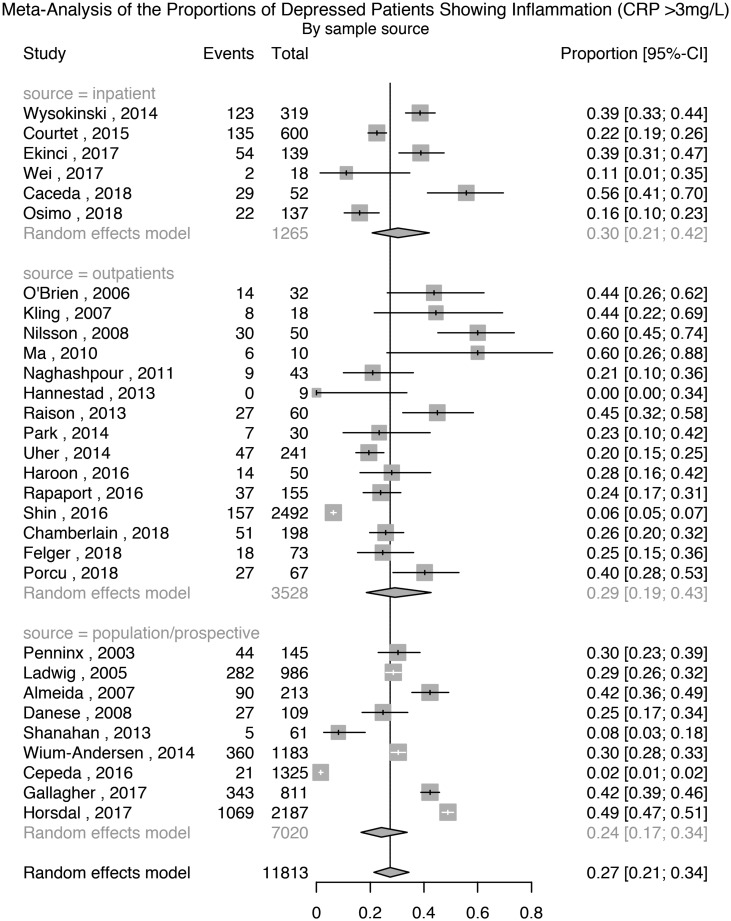
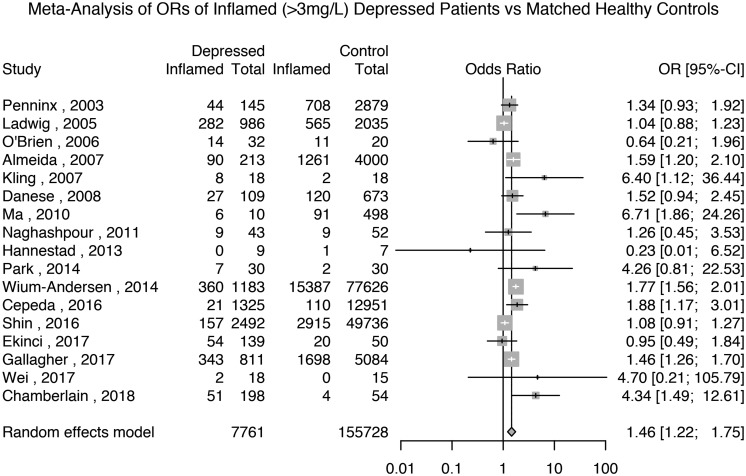
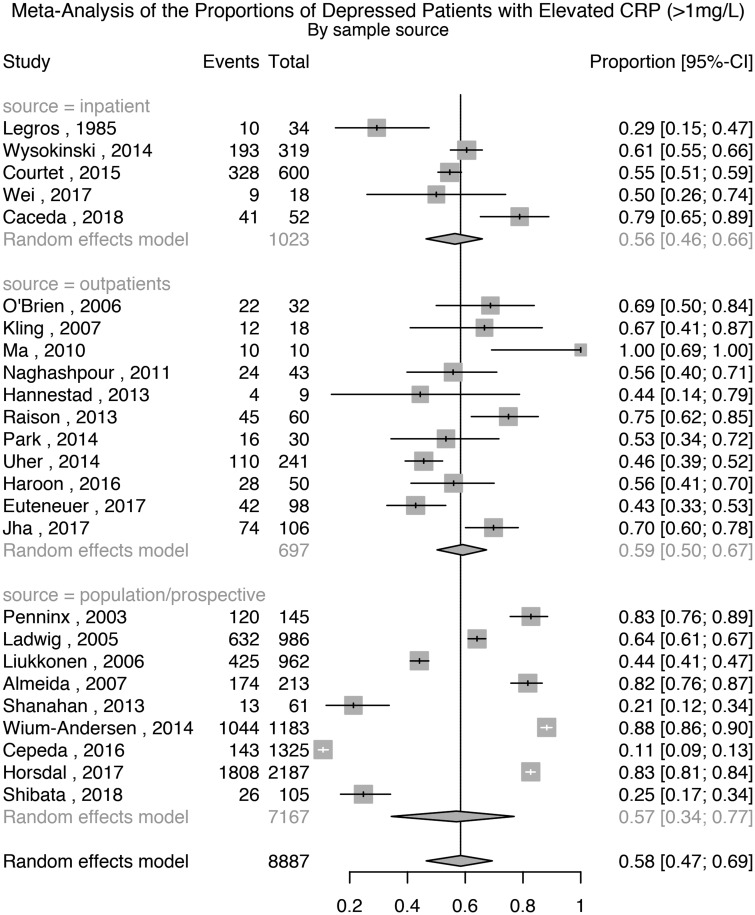
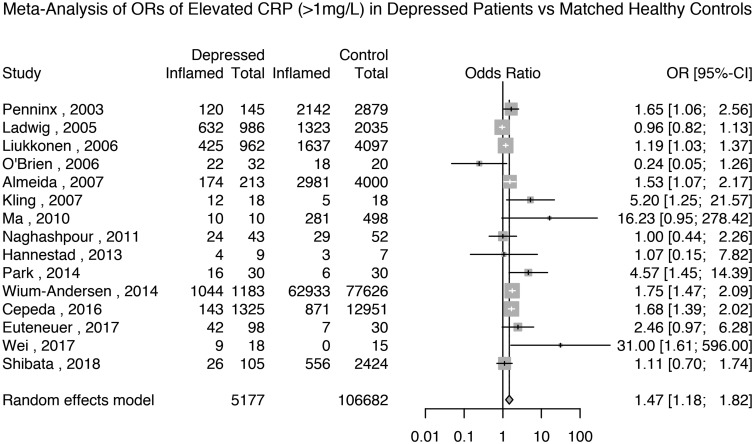
Background: Peripheral low-grade inflammation in depression is increasingly seen as a therapeutic target. We aimed to establish the prevalence of low-grade inflammation in depression, using different C-reactive protein (CRP) levels, through a systematic literature review and meta-analysis. Methods: We searched the PubMed database from its inception to July 2018, and selected studies that assessed depression using a validated tool/scale, and allowed the calculation of the proportion of patients with low-grade inflammation (CRP >3 mg/L) or elevated CRP (>1 mg/L). Results: After quality assessment, 37 studies comprising 13 541 depressed patients and 155 728 controls were included. Based on the meta-analysis of 30 studies, the prevalence of low-grade inflammation (CRP >3 mg/L) in depression was 27% (95% CI 21–34%); this prevalence was not associated with sample source (inpatient, outpatient or population-based), antidepressant treatment, participant age, BMI or ethnicity. Based on the meta-analysis of 17 studies of depression and matched healthy controls, the odds ratio for low-grade inflammation in depression was 1.46 (95% CI 1.22–1.75). The prevalence of elevated CRP (>1 mg/L) in depression was 58% (95% CI 47–69%), and the meta-analytic odds ratio for elevated CRP in depression compared with controls was 1.47 (95% CI 1.18–1.82). Conclusions: About a quarter of patients with depression show evidence of low-grade inflammation, and over half of patients show mildly elevated CRP levels. There are significant differences in the prevalence of low-grade inflammation between patients and matched healthy controls. These findings suggest that inflammation could be relevant to a large number of patients with depression.
Overview
The claims and statistics of this paper haven’t been checked yet.
Free: it reads the open-access text and checks the first 5 claims that cite a source we can check. Create a free account to check every claim.
Integrity signals
Registry
Cites
Statistics
Figures
Verification
Claims the paper makes
The claims and statistics of this paper haven’t been checked yet.
Free: it reads the open-access text and checks the first 5 claims that cite a source we can check. Create a free account to check every claim.
Claims other papers make about this one
Each is checked against this paper’s own text: does it say what the citing paper says it does?
The source backs part of the claim, not all of it — or backs it for a different population, condition or comparison.
In the citing paper
“Higher plasma levels of inflammatory cytokines, most consistently interleukin IL-1β, IL-6, and TNF-α, are correlated with greater depressive symptomatology.”
From Chronic stress, neuroinflammation, and depression: an overview of pathophysiological mechanisms and emerging anti-inflammatories (2023) · cites this paper as [6]
Experimental — accuracy not yet measuredThe cited source says what the claim attributes to it.
In the citing paper
“Low-grade inflammation – as indexed by a concentration of C-reactive protein (CRP) higher than 3 mg/L – is more likely in individuals with depression than in matched controls, occurring in around a quarter of the former according to a large meta-analysis (OR: 1.46, 95% CI: 1.22-1.75)205.”
From Comorbidity between major depressive disorder and physical diseases: a comprehensive review of epidemiology, mechanisms and management (2023) · cites this paper as [205]
In the citing paper
“Data were confirmed by a recent meta-analysis that included 13,541 depressed patients and 155,728 controls [121]. In 27% of the depressive patients there was a low-grade of inflammation (i.e., CRP > 3.0 mg/L) and over half of the patients showed a mildly elevated CRP level [121].”
From C-Reactive protein as a biomarker for major depressive disorder? (2022) · cites this paper as [121]
In the citing paper
“A very limited number of studies on CRP excluded participants presenting with an acute infection (CRP > 10 mg/L); we decided to include these studies because we previously found that the odds ratio of inflammation in patients vs controls is very similar if considering all patients (OR = 1.46) or excluding patients and controls with CRP > 10 mg/L (OR = 1.44) (Osimo et al., 2019), thus suggesting”
From Inflammatory markers in depression: a meta-analysis of mean differences and variability in 5,166 patients and 5,083 controls (2020) · cites this paper as Osimo et al., 2019
Self-check
Percentages, sums and reported differences re-computed from the paper’s own numbers.
The self-check needs the paper’s full text.
Citations
Cites
Quantifying heterogeneity in a meta‐analysis
Higgins, J. P. T., & Thompson, S. G. (2002) · Statistics in Medicine · doi:10.1002/sim.1186 · Cited by 36,763 · cited 1×
“Heterogeneity was tested using Cochrane’s Q-Test (Higgins and Thompson, 2002).”
Stang, A. (2010) · European Journal of Epidemiology · doi:10.1007/s10654-010-9491-z · Cited by 17,396 · cited 2×
“Study quality was assessed using the Newcastle–Ottawa Scale (Stang, 2010).”
MethodMolecular Mechanisms of Depression: Perspectives on New Treatment Strategies
Lang, U. E., & Borgwardt, S. (2013) · Cellular Physiology and Biochemistry · doi:10.1159/000350094 · Cited by 8,475
From inflammation to sickness and depression: when the immune system subjugates the brain
Dantzer, R., O'Connor, J. C., Freund, G. G., Johnson, R. W., & Kelley, K. W. (2008) · Nature Reviews Neuroscience · doi:10.1038/nrn2297 · Cited by 7,395 · cited 2×
“…commonly seen following an acute infection, shares many characteristics with depression, such as fatigue, sleep disturbance and decreased motivation (Dantzer et al., 2008); early-life infection and autoimmune diseases are associated with a higher risk of depression in adulthood (Benros et al.,…”
BackgroundPearson, T. A., Mensah, G. A., Alexander, R. W., Anderson, J. L., Cannon, R. O., Criqui, M., Fadl, Y. Y., Fortmann, S. P., Hong, Y., Myers, G. L., et al. (2003) · Circulation · doi:10.1161/01.cir.0000052939.59093.45 · Cited by 6,401 · cited 9×
“The American Heart Association and Center for Disease Control and Prevention have proposed clear CRP thresholds as indicators of inflammation levels (<1 = ‘low’, 1–3 = ‘medium’, >3 mg/L = ‘high’) (Pearson et al., 2003).”
BackgroundMethodInfluentialDiagnostic Criteria for Use in Psychiatric Research
Feighner, J. P. (1972) · Archives of General Psychiatry · doi:10.1001/archpsyc.1972.01750190059011 · Cited by 5,715
A Meta-Analysis of Cytokines in Major Depression
Dowlati, Y., Herrmann, N., Swardfager, W., Liu, H., Sham, L., Reim, E. K., & Lanctôt, K. L. (2010) · Biological Psychiatry · doi:10.1016/j.biopsych.2009.09.033 · Cited by 4,729 · cited 7×
“Meta-analyses of crosssectional studies confirm that mean concentrations of circulating CRP and inflammatory cytokines such as interleukin 6 (IL-6) are higher in patients with acute depression compared with controls (Howren et al., 2009; Dowlati et al., 2010; Haapakoski et al., 2015; Goldsmith et al., 2016).”
BackgroundResultInfluentialC-Reactive Protein, Interleukin 6, and Risk of Developing Type 2 Diabetes Mellitus
Pradhan, A. D. (2001) · JAMA · doi:10.1001/jama.286.3.327 · Cited by 4,433 · cited 1×
“In addition to depression and CVD, inflammation is associated with other physical and psychiatric disorders including diabetes mellitus (Pradhan et al., 2001), schizophrenia (Miller et al.”
BackgroundDanesh, J., Wheeler, J. G., Hirschfield, G. M., Eda, S., Eiriksdottir, G., Rumley, A., Lowe, G. D. O., Pepys, M. B., & Gudnason, V. (2004) · New England Journal of Medicine · doi:10.1056/nejmoa032804 · Cited by 2,953
Associations of depression with C-reactive protein, IL-1, and IL-6: a meta-analysis.
Howren, M. B., Lamkin, D. M., & Suls, J. (2009) · Psychosomatic Medicine · doi:10.1097/psy.0b013e3181907c1b · Cited by 2,766 · cited 7×
“Meta-analyses of crosssectional studies confirm that mean concentrations of circulating CRP and inflammatory cytokines such as interleukin 6 (IL-6) are higher in patients with acute depression compared with controls (Howren et al., 2009; Dowlati et al., 2010; Haapakoski et al., 2015; Goldsmith et al., 2016).”
BackgroundResultInfluential
Research works printed but not linked: 3
- Osimo, 2018, Prevalence of low-grade inflammation in depression: a review and meta-analysis of CRP data, PROSPERO
- Urbanek, 2015, Cairo: R graphics device using Cairo graphics library for creating high-quality bitmap (PNG, JPEG, TIFF), vector (PDF, SVG, PostScript) and display (X11 and Win32) output [Software], CRAN
- Khandaker, 2019, Shared mechanism between depression and coronary heart disease: findings from Mendelian randomization analysis of a large UK population-based cohort, Molecular Psychiatry
Cited by
Items 501–600 of 773
Vreijling, S. R., Neuhaus, L., Brouwer, A., Penninx, B. W. J. H., Beekman, A. T. F., Lamers, F., Jansen, R., & Bremmer, M. A. (2024) · Journal of Psychosomatic Research · doi:10.1016/j.jpsychores.2024.111671 · Cited by 5
Low-grade inflammation and serotonin 4 receptor binding in the healthy and the depressed brain
Clausen, M. R., Larsen, S. V., Høgsted, E. S., Nasser, A., Svarer, C., Knudsen, G. M., & Frøkjær, V. G. (2024) · Neuroscience Applied · doi:10.1016/j.nsa.2024.104078 · Cited by 3
“Osimo et al. showed that almost 58 % of depressed patients have CRP > 1 (Osimo et al., 2019) compared to only 43 % in our study population.”
Pan, T., Zhang, C., Liang, J., Wang, X., Di, X., Zhou, Y., Bai, P., & Yuan, H. (2024) · Scientific Reports · doi:10.1038/s41598-024-69777-7 · Cited by 4
Association between dietary inflammatory index and the risk of postpartum depression in China
Zhang, G., Lin, H., Ren, Q., Yin, L., Zhao, J., Yang, F., Li, Z., Ran, J., Liu, H., Li, W., et al. (2025) · Journal of Affective Disorders · doi:10.1016/j.jad.2025.05.015 · Cited by 3
Liu, Y., Liang, S. L. L., & Zhang, D. (2021) · Annals of Translational Medicine · doi:10.21037/atm-21-2733 · Cited by 3
“More importantly, one particular study highlighted CRP as the most powerful predictor and risk factor for cardiovascular disease (28).”
BackgroundOkamoto, N., Hoshikawa, T., Ikenouchi, A., & Yoshimura, R. (2021) · Therapeutic Advances in Psychopharmacology · doi:10.1177/20451253211060228 · Cited by 3
Binder, M. R. (2022) · American Journal of Clinical and Experimental Medicine · doi:10.11648/j.ajcem.20221001.14 · Cited by 3
Tsamakis, K., Mueller, C., Tsirigotis, P. D., Tsiptsios, D., Tsamakis, C., Charakopoulos, E., Charalampous, C., Spandidos, D. A., Douzenis, A., Papageorgiou, C., et al. (2019) · Molecular and Clinical Oncology · doi:10.3892/mco.2019.1970 · Cited by 3
“There has been increased focus in recent literature on the possible role of inflammation in the pathogenesis of depression (1,2).”
Understanding suicide: A biopsychosocial framework
Tandon, S. (2022) · Current Medicine Research and Practice · doi:10.4103/cmrp.cmrp_48_22 · Cited by 3
Hack, L. M., Brawer, J., Chesnut, M., Zhang, X., Wintermark, M., Jiang, B., Grant, P., Bonilla, H. F., Stetz, P. C., Yesavage, J. A., et al. (2021) · medRxiv · doi:10.1101/2021.08.23.21256078 · Cited by 3
Shin, M., Crouse, J. J., Nichles, A., Zmicerevska, N., Song, C., Park, M., Froggatt, D., Janiszewski, C. M. S., Chan, K., Koethe, D., et al. (2024) · doi:10.33774/coe-2024-4g922 · Cited by 3
Tassone, V. K., Wu, M., Meshkat, S., Duffy, S. F., Baig, S., Jung, H. J., Lou, W. Y. W., & Bhat, V. (2024) · Brain Behavior & Immunity - Health · doi:10.1016/j.bbih.2024.100773 · Cited by 2
“While there is increasing literature supporting the presence of inflammation in depression (Osimo et al., 2019), (Osimo et al., 2020), it remains unclear whether this may be related to the high prevalence of concurrent obesity in this population (McLaughlin et al., 2021).”
Cui, S., Xiong, W., Zhao, Z., Han, Y., Cui, T., Qu, Z., Li, Z., & Zhang, X. (2024) · European Child & Adolescent Psychiatry · doi:10.1007/s00787-024-02572-x · Cited by 2
“Systematic review and meta-anal - ysis reported that over half of depressed patients show ele - vated CRP and IL-6 levels [ 60, 61].”
Chen, M.-H., Su, T., Lin, W.-C., Li, C., Wu, H.-J., Tsai, S., Bai, Y., Mao, W., & Tu, P. (2024) · Pharmacopsychiatry · doi:10.1055/a-2499-7207 · Cited by 4
“LGI was defined based on CRP levels ≥ 3 mg/L in the present study, which was compliant with the proposed cut-off point for CRP levels on LGI in previous studies [1].”
InfluentialGu, Y., Hu, P., Dai, C., Ni, S., & Huang, Q. (2025) · BMC Nursing · doi:10.1186/s12912-025-02767-w · Cited by 4
Nguyen, S. T., Le, T. D., Dinh, H. T., Nguyen, L. H. T., Nguyen, G. T., Vu, T. H., Nguyen, T. H., Công, T. L., Nguyen, B. V., Nguyen, T. D., et al. (2025) · Clinical Medicine Insights Endocrinology and Diabetes · doi:10.1177/11795514251323837 · Cited by 2
YIFEI, L., & Sun, X. (2025) · Journal of the American Medical Directors Association · doi:10.1016/j.jamda.2025.105769 · Cited by 2
Selçuk, M., & Koca, F. T. (2025) · Nordic Journal of Psychiatry · doi:10.1080/08039488.2025.2536809 · Cited by 5
“Our findings align with longitudinal studies reporting post-ECT reductions in IL-6, CRP and cell-based indices among clinical responders [8,9].”
Sigma-1 receptor: A potential target for modulating chronic pain and depression
Zhang, Y., Bai, Y., Du, Y., Liu, M., Zhang, M., & Wang, G. (2025) · European Journal of Pharmacology · doi:10.1016/j.ejphar.2025.178084 · Cited by 3
Multiple Komorbiditäten bei Migräne – gibt es eine gemeinsame Ursache?
Straube, A. M. (2025) · Der Schmerz · doi:10.1007/s00482-025-00901-w · Cited by 2
“Nicht nur bei vaskulären Erkrankungen laufenentzündlicheVorgängeab,auch bei Patienten mit einer Depression findet man Hinweise auf chronisch erhöhte CRP-Spie-gel als Zeichen einer niedrigschwelligen, anhaltenden Inflammation [58, 63].”
Orsolini, L., Longo, G., Cavallo, L., & Volpe, U. (2025) · Psychoneuroendocrinology · doi:10.1016/j.psyneuen.2025.107612 · Cited by 3
Ren, J., Zhou, L., Li, Y., Zhang, S., Xu, X., Chi, X., & Xie, H. (2025) · Frontiers in Nutrition · doi:10.3389/fnut.2025.1675892 · Cited by 5
“Research has shown that SB increases C-reactive protein levels, which are associated with the development of depressive symptoms (44).”
Beckett, C. W., & Lawson, R. P. (2025) · Journal of Affective Disorders · doi:10.1016/j.jad.2025.120731 · Cited by 5
Immunity in Rodent Models of Stress
Hachenberg, S., Russo, S. J., & Cathomas, F. (2025) · Biological Psychiatry · doi:10.1016/j.biopsych.2025.11.007 · Cited by 5
Wang, Q., Li, L., Yang, B., Wang, J., Wei, X., Shen, Y., Wang, Y., Fan, L., Wang, S., Shao, N., et al. (2026) · Journal of Affective Disorders · doi:10.1016/j.jad.2026.121435 · Cited by 2
Zheng, H., Savitz, J. B., Haroon, E., Ahern, J., Loughnan, R. J., Naber, F., Xu, B., Forthman, K. L., Aupperle, R. L., Williams, L. M., et al. (2026) · Nature Mental Health · doi:10.1038/s44220-026-00585-w · Cited by 3
Montet, J., Montalban, E., Dexpert, S., Magne, E., Beau, C., Forestier, D., Ledaguenel, P., Gostner, J. M., Fuchs, D., Aouizerate, B., et al. (2026) · Brain Behavior and Immunity · doi:10.1016/j.bbi.2026.106547 · Cited by 3
Lindahl, J., Veibäck, G. S., Suneson, K., Blanking, W., Tjernberg, J., Ståhl, D., Wiman, Å., Ventorp, F., Erhardt, S., & Lindqvist, D. (2026) · Brain Behavior & Immunity - Health · doi:10.1016/j.bbih.2026.101221 · Cited by 5
“When adjusting for BMI, the relationship between inflammation and depression have been shown to be attenuated (Fried et al., 2020b), but in a comprehensive systematic review (Osimo et al., 2019) BMI was not associated with low-grade inflammation in depression.”
Nussbaumer, M., Guest, P. C., Schiltz, K., Dudeck, L., Asl, L. S., Meyer-Lotz, G., Dobrowolny, H., Leucht, S., Bernstein, H., Nickl‐Jockschat, T., et al. (2026) · Molecular Psychiatry · doi:10.1038/s41380-026-03614-3 · Cited by 6
“For example, high-in fl ammation subgroups have been described in SCZ and BD, characterized by elevated cytokines and immune gene expression [28 – 30], and in fl ammatory phenotypes were also reported in subsets of MDD [24, 27, 31].”
Olsen, R. K., Arnfred, S., Randau, M., Madsen, C. D., Nielsen, K. D., Shaker, A. A., Masri, H., & Hovmand, O. R. (2026) · BMC Psychiatry · doi:10.1186/s12888-026-08094-x · Cited by 3
“Other works link depressive symptoms and symptoms of anxiety with low-grade inflammation [31–34, 89], especially in the atypical depression Our review indicates that fatigue is highly prevalent in depressive disorders, but that not all patients with depressive disorders suffer from fatigue.”
Vai, B., Cazzella, T., Monopoli, C., Bravi, B., Kontogianni, A., Wessa, C., Worrell, C., Simon, M. S., Baune, B. T., Benedetti, F., et al. (2026) · Brain Behavior and Immunity · doi:10.1016/j.bbi.2026.106957 · Cited by 3
“…proinflammatory signalling and sensitization of the hypothalamic – pituitary – adrenal axis (Dantzer et al., 2008; Haroon et al., 2017; Miller et al., 2013; Miller and Raison, 2016; Osimo et al., 2019; Stetler and Miller, 2011; Poletti et al., 2024a; De Picker et al., 2023; Treadway et al., 2025).”
InfluentialSelf-citation李, 贤., 郭, 延., 郭, 志., & 孙, 守. (2026) · 医学研究杂志 · doi:10.61654/yxyjzz2026.07.004 · Cited by 2
Bugge, E., Wynn, R., Mollnes, T. E., Reitan, S. K., Lapid, M. I., & Grønli, O. (2022) · Brain Behavior & Immunity - Health · doi:10.1016/j.bbih.2022.100571 · Cited by 5
Xiang, J.-J., Hong, S. L., Ran, L., Zeng, Q., Kong, Y., Zhang, C., Liao, J., & Kuang, L. (2023) · PubMed Central · doi:10.12182/20230360204 · Cited by 7
Association between psychosocial factors and C-reactive protein across income, race, and sex.
Cundiff, J. M., Bennett, A., Williams, A., Cushman, M., & Howard, V. J. (2023) · Health Psychology · doi:10.1037/hea0001310 · Cited by 4
Association between Severity of Depression and CRP Level: A Cross-sectional Study
Keisham, J., Sanapala, V., Vasireddy, N., Tata, R. S., Nukala, S., Singisetti, S., & Garapati, A. (2024) · Indian Journal of Private Psychiatry · doi:10.5005/jp-journals-10067-0167 · Cited by 3
Arnetz, B. B., Arnetz, J. E., Kaminski, N. E., Tomlin, R., Cole, A., Bartlett, P., Crawford, R. B., & Jameson, A. P. (2024) · AIDS Research and Treatment · doi:10.1155/2024/3432569 · Cited by 2
“CRP, an important clinical marker of systemic in-fammation, decreased signifcantly when comparing base-line to 6-month follow-up values [27–29].”
BackgroundInflammation as a link between depression and metabolic syndrome
Gorbunova, A. P., Rukavishnikov, G. V., & Mazo, G. E. (2024) · V M BEKHTEREV REVIEW OF PSYCHIATRY AND MEDICAL PSYCHOLOGY · doi:10.31363/2313-7053-2024-1005 · Cited by 4
Soeishi, T., Nakata, A., Nagata, T., Akutsu, S., Tondokoro, T., Inoue, Y., Katsumura, F., & Kikunaga, K. (2025) · Journal of Occupational and Environmental Medicine · doi:10.1097/jom.0000000000003307 · Cited by 2
“8,9 In line with the aforementioned, researchers have looked into inflammatory mediators as a means of evaluating clinically diagnosed depression 10,11 and psychological distress 12 because these conditions have been proposed to be inflammation-related disorders.”
Zheng, S., Yang, L., Dai, Q., Li, X., Masuoka, T., & Lv, J. (2025) · Biomedical Reports · doi:10.3892/br.2025.1924 · Cited by 3
“Low‑grade chronic inflammation, which is common in depressed patients, significantly contributes to atherosclerosis onset and progression (88).”
Cheng, Z., Wu, J., Xu, C., & Yan, X. (2025) · Journal of Affective Disorders · doi:10.1016/j.jad.2025.02.098 · Cited by 2
Cao, Y., Li, X., Gao, J., Zhang, N., Zhang, G., & Li, S. (2025) · Depression and Anxiety · doi:10.1155/da/3131579 · Cited by 2
“However, it is important to note that other studies [23] have reported an increase in neutrophil count and abnormal activity in patients with depression, indicating a potential correlation with the onset and progression of depression [86].”
Luo, Y., Blakey, R., Gkatzionis, A., Stergiakouli, E., & Dardani, C. (2025) · Psychological Medicine · doi:10.1017/s0033291725000480 · Cited by 3
“For example, previous work has suggested a central role of systemic inflammation, as reflected by CRP, in depression and rheumatoid arthritis (Osimo et al., 2019; Pope & Choy, 2021).”
Chang, E., & Shin, Y. (2025) · Nutrition Metabolism and Cardiovascular Diseases · doi:10.1016/j.numecd.2025.104108 · Cited by 3
A computational account of joint SSRI and anti-inflammatory treatment
Reneaux, M., Mayberg, H. S., Friston, K. J., & Pinotsis, D. A. (2025) · Frontiers in Immunology · doi:10.3389/fimmu.2025.1472732 · Cited by 6
“In brief, depression is a circuit illness affected severely by in fl ammation.”
Schwartz, W. A. H., Jacobson, T., Issa, R. P., Wafford, Q. E., Nunes, D., Funk, W. E., Miller, G. E., McDade, T. W., & Feinglass, J. M. (2025) · Social Psychiatry and Psychiatric Epidemiology · doi:10.1007/s00127-025-02941-0 · Cited by 3
“…ability to incorporate biomarker collection into nontraditional, participant-centered contexts was essential disadvantage, early life adversity, and mental health condi-tions—to elevated CRP, laying the groundwork for DBS-based research (Alley et al. 2006, [3], Ranjit et al. 2007; [69], [70], [71].”
Seizer, L., Renner, T. J., & Löchner, J. (2025) · Journal of Affective Disorders · doi:10.1016/j.jad.2025.119800 · Cited by 2
Fang, L., Wang, P., Xie, T., Ding, S., Wang, T., Zhang, J., Zhang, A., Zhu, P., & Zhu, D. (2025) · Frontiers in Psychiatry · doi:10.3389/fpsyt.2025.1574864 · Cited by 3
Cooney-Quane, J., Thomas, D. S., Nolan, Y. M., & Dockray, S. (2025) · Brain Behavior & Immunity - Health · doi:10.1016/j.bbih.2025.101082 · Cited by 2
“…systemic inflammation has been observed to be associated with depression (Dowlati et al., 2010; Howren et al., 2009; Mac Giollabhui et al., 2021; Osimo et al., 2019), and with anxiety (Costello et al., 2019), including among adolescent populations (Khandaker et al., 2016; Toenders et al.,…”
Jungo, S., Smaïl‐Faugeron, V., Guez, D., Hoertel, N., Lemogne, C., & Carra, M. C. (2025) · Journal of Periodontology · doi:10.1002/jper.70012 · Cited by 3
He, Y., Bo, Q., Mao, Z., Yang, J., Liu, M., Wang, H., Kastin, A. J., Pan, W., Wang, C., & Sun, Z. (2022) · Frontiers in Psychiatry · doi:10.3389/fpsyt.2022.842003 · Cited by 4
Sousa-Santos, N., Fialho, M., Madeira, T., Clara, C., Veiga, S., Martins, R. A., Barros, N., Santos, G., Santos, O., Almeida, C., et al. (2023) · BMC Psychiatry · doi:10.1186/s12888-023-04705-z · Cited by 4
“Estimating a prevalence of elevated inflammation in 30% of MDD patients and 10% of patients that don’t meet other inclusion criteria, the number of recruited participants estimated is 700 [2, 9].”
BackgroundChemokines, a novel target for personalised treatment in major depressive disorders
Arnone, D. (2020) · Brain Behavior and Immunity · doi:10.1016/j.bbi.2020.05.047 · Cited by 3
Efficacy of a Functional Therapy Program for Depression and C-Reactive Protein: A Pilot Study.
Maniaci, G., Cascia, C. L., Giammanco, A., Ferraro, L., Sardella, Z., Bivona, G., Ciaccio, M., & Barbera, D. L. (2021) · PubMed Central · doi:10.36131/cnfioritieditore20210402 · Cited by 2
“192 Clinical Neuropsychiatry (2021) 18, 4 such as CRP (Haapakoski et al., 2015; Khandaker et al., 2014; Köhler-Forsberg et al., 2017; Osimo et al., 2019).”
BackgroundInfluentialGreen, C., Shen, X., Stevenson, A. J., Conole, E. L. S., Harris, M. A., Barbu, M. C., Hawkins, E. L., Adams, M. J., Lawrie, S. M., Evans, K. L., et al. (2020) · medRxiv · doi:10.1101/2020.08.12.20173567 · Cited by 2
Sabri, Y., & Abdelsalam, N. M. (2022) · Middle East Current Psychiatry · doi:10.1186/s43045-022-00178-0 · Cited by 2
“• We defined evidence of low-grade inflammation as serum CRP > 3 mg/L, and no inflammation as CRP < 3 mg/L [11].”
BackgroundWeston, F. I., Sforzini, L., Cattaneo, A., & Pariante, C. M. (2023) · Masterclass in neuroendocrinology · doi:10.1007/978-3-031-21358-8_6 · Cited by 2
Sauserienė, J., Serapinas, D., Liseckienė, I., Budrevičiūtė, A., Vaičiūnienė, R., Gradauskienė, B., Tkačiovaitė, E., Sakalauskaitė, S., & Valius, L. (2024) · Medicina · doi:10.3390/medicina60030383 · Cited by 1
“One possible explanation for this may be the fact that depression is associated with general low-grade systemic inflammation [27].”
BackgroundNavigating the Intersection of Technology and Depression Precision Medicine
Irmak-Yazicioglu, M. B., & Arslan, A. (2024) · Advances in experimental medicine and biology · doi:10.1007/978-981-97-4402-2_20 · Cited by 1
Wang, X., Yi, G., Wu, L., Zhou, H., & He, J. (2024) · Frontiers in Aging Neuroscience · doi:10.3389/fnagi.2024.1455546 · Cited by 4
Piton, E., Pereira, G. C., Viero, F. T., Arboit, F., de Andrade, L. G., Becker, G., Fialho, M. F. P., Brum, E. D. S., Ferreira, J. E. D. S., Zanchet, E. M., et al. (2025) · Neuroscience · doi:10.1016/j.neuroscience.2024.12.031 · Cited by 1
Stratification in Immunopsychiatry
Borovčanin, M. (2024) · Integrated science · doi:10.1007/978-3-031-73061-0_17 · Cited by 1
Kostev, K., Yon, D. K., Gyasi, R. M., Hajek, A., & Jacob, L. (2025) · International Archives of Occupational and Environmental Health · doi:10.1007/s00420-025-02120-3 · Cited by 2
“These biomarkers of stress could be involved in these two mediating pathways, as both depression (Osimo et al. 2019) and type 2 diabetes (Duncan et al. 2003 ) involve a low-grade systemic inflam - mation.”
Dypvik, R., Fjukstad, K. K., Lydersen, S., Berge, T., Tveit, A., Røsjø, H. R., Omland, T., Einvik, G., & Lyngbakken, M. N. (2025) · Psychosomatic Medicine · doi:10.1097/psy.0000000000001365 · Cited by 3
Bahadır, F. E., Demirel, Ö. Ü., Yavuz, M., Firat, O., Yogurtcu, I., Govdeli, Y., & Furuncuoğlu, Y. (2025) · Endocrine and Metabolic Science · doi:10.1016/j.endmts.2025.100231 · Cited by 1
Formánek, T., Mladá, K., Mohr, P., Lim, M. F., Olejarová, M., Pavelká, K., Winkler, P., Osimo, E. F., Jones, P. B., & Hušáková, M. (2025) · BMJ Mental Health · doi:10.1136/bmjment-2024-301506 · Cited by 2
Self-citationRole of early life adversities in inflammation-related neuropsychiatric comorbidity in obesity
Montet, J., Dexpert, S., Darnaudéry, M., Beau, C., Forestier, D., Ledaguenel, P., Magne, E., Aouizerate, B., & Capuron, L. (2025) · Brain Behavior and Immunity · doi:10.1016/j.bbi.2025.04.039 · Cited by 1
Kim, S., Kim, S. I., & Lim, W. (2025) · Journal of Affective Disorders · doi:10.1016/j.jad.2025.119452 · Cited by 3
Neurobiological mechanisms of physical activity in age-related neuropsychiatric disorders
Seyfizadeh, N., Salatin, S., Hamidi, S., Dadkhah, M., Sarailoo, M., & Azarfarin, M. (2025) · Progress in brain research · doi:10.1016/bs.pbr.2025.08.018 · Cited by 4
An Integrated Immuno-Reward Model of Adolescent Depression: Theory, Evidence, and Implications
Alloy, L. B., & Nusslock, R. (2025) · Current Directions in Psychological Science · doi:10.1177/09637214251369722 · Cited by 1
“Although meta-analyses support a role of inflammation in depression, only about 30% of depressed individuals exhibit elevated inflammation (Osimo et al., 2019).”
Chen, X., Han, P., Liang, Z., Cao, L., Gao, J., Ding, K., Li, W., Zhu, S., Xue, Y., & Guo, Q. (2025) · BMC Psychiatry · doi:10.1186/s12888-025-07365-3 · Cited by 1
Diggs, M. D., Bamford, A. R., Thomas, E. A., & O’Connor, P. J. (2025) · Physiology & Behavior · doi:10.1016/j.physbeh.2025.115134 · Cited by 1
Bai, Y., Cheng, L., Lin, W.-C., Hsu, J.-W., Chen, L., Tu, P., Li, C., Tsai, S., Chen, L.-C., Su, T., et al. (2025) · Journal of Affective Disorders · doi:10.1016/j.jad.2025.120491 · Cited by 2
Li, W., Zhang, H., Li, S. B., Zhao, D. Y., Liang, M., Guo, Q. Q., Yan, R., Shang, L., & Shi, Y. (2025) · Journal of Digestive Diseases · doi:10.1111/1751-2980.70015 · Cited by 1
Wang, J., Le, Q., Li, X., Ye, M., & Wang, H. (2025) · International Journal of Surgery · doi:10.1097/js9.0000000000003779 · Cited by 1
van der Heide, A., Kischkel, B., Bleeker‐Rovers, C. P., de Jonge, M. I., Bloem, B. R., Verbeek, M. M., Joosten, L. A. B., & Helmich, R. C. G. (2025) · npj Parkinson's Disease · doi:10.1038/s41531-025-01178-7 · Cited by 3
“This aligns with prior research indicating higher CRP concentrations in depressed individuals 42 .”
Bernier, V., Mungo, A., Point, C., Wacquier, B., Loas, G., & Hein, M. (2025) · Medicina · doi:10.3390/medicina61122125 · Cited by 1
“The material was a Roche CRP4-Cobas with a minimum detection level of 0.3 mg/L. Low-grade inflammation was defined as absent when CRP levels were ≤ 3 mg/L and as present when CRP levels were >3 mg/L (and 10mg/L) [16,17].”
InfluentialZhang, W., Zhang, Y., Xu, T., Wang, Y., Yu, E., & Jing, Y. (2025) · BMC Psychiatry · doi:10.1186/s12888-025-07705-3 · Cited by 3
“A large meta-analysis of 37 studies found that 27% of patients with depression had low-grade inflammation (CRP >3.0 mg/L) [13], supporting the concept of MDD as an immune-inflammatory disorder.”
InfluentialAssociation between serum high-sensitivity C-reactive protein levels and migraine: a REFORM study
Tesfay, B., Ashina, H., Karlsson, W. K., Christensen, R. H., Al‐Khazali, H. M., Olsen, D. A., Madsen, J. S., & Ashina, M. (2025) · Neurological Sciences · doi:10.1007/s10072-025-08738-y · Cited by 6
Pregnant women's psychological responses to climate change: a rapid review
Rae, G. M., Obilor, H. N., Ross‐White, A., & Premji, S. (2025) · Social Sciences & Humanities Open · doi:10.1016/j.ssaho.2025.102002 · Cited by 1
Watson, C. B., Sharpley, C. F., & Bitsika, V. (2025) · NeuroSci · doi:10.3390/neurosci7010003 · Cited by 1
“Furthermore, while meta-analytic studies report a strong link between inflammation and depression [28,29], it is estimated that only one-quarter of depressed individuals display elevated inflammatory markers, which has led researchers to propose inflammation-linked depression as a subtype of…”
Comparison of rTMS and dTMS in TRD: evidence gaps, cost-effectiveness, and ethical priorities
Paganin, W. (2026) · Frontiers in Psychiatry · doi:10.3389/fpsyt.2025.1722486 · Cited by 1
Ma, J.-Y., Hu, J., Tang, F., Meng, Y., Ye, F., Hu, L., & Zhang, Y.-H. (2026) · Annals of General Psychiatry · doi:10.1186/s12991-025-00624-3 · Cited by 2
“Meta-analyses have indicated that CRP levels are generally elevated in individuals with depression [13].”
Zhang, X.-T., Zeng, Q.-T., & Fu, Y. (2026) · Journal of Affective Disorders · doi:10.1016/j.jad.2026.121236 · Cited by 2
Inflammatory models of depression in rodents and humans
Markov, D., Zozulya, S. A., & Dolotov, O. V. (2026) · Frontiers in Psychiatry · doi:10.3389/fpsyt.2026.1687579 · Cited by 5
Response to immune-based augmentation treatment for depression: a potential role of immunosenescence
Assche, E. V., Hohoff, C., Wissing, S. M., Steinbach, L., & Baune, B. T. (2026) · Neuroscience Applied · doi:10.1016/j.nsa.2026.106986 · Cited by 1
“It has also been observed that many individuals with major depressive disorder may have systemic low-grade inflammation with sub-clinically increased C-reactive protein (CRP) levels (Penninx et al., 2025; Osimo et al., 2019).”
Cross-Organ Neuroimmunology of Behavior
Guo, X., & Russo, S. J. (2026) · Annual Review of Immunology · doi:10.1146/annurev-immunol-082924-064159 · Cited by 2
Herlaș-Pop, A., Radu, A.-F., Radu, A., Bungau, G. S., Ţiţ, D. M., Babeş, E. E., & Bustea, C. (2026) · Medical Sciences · doi:10.3390/medsci14010138 · Cited by 1
Aboumrad, M., Joshu, C. E., Jackson, J. W., & Visvanathan, K. (2026) · JNCI Journal of the National Cancer Institute · doi:10.1093/jnci/djag076 · Cited by 1
Liu, J., Zhai, X., Gao, C., Zhang, S., Fei, D., Zhang, X., Jin, M., & Wang, Y. (2026) · Frontiers in Psychiatry · doi:10.3389/fpsyt.2026.1781733 · Cited by 1
“A compelling body of evidence has established a link between depression and immune system dysregulation, with chronic low-grade in fl ammation emerging as a key pathophysiological mechanism in MDD (19, 20).”
Hammond, E. R., Monari, P. K., Luebke, E. M., Johnson, A. K., Auger, A. P., & Marler, C. A. (2026) · Behavioural Brain Research · doi:10.1016/j.bbr.2026.116194 · Cited by 1
Schlarbaum, L., Jankovic, N., Bühlmeier, J., Hohoff, E., Dankers, R., Engler, H., Hirtz, R., Zwanziger, D., Grasemann, C., Peters, T., et al. (2026) · European Journal of Nutrition · doi:10.1007/s00394-026-03920-0 · Cited by 1
“While sex-specific patterns in the inflammation– depression link have been suggested [54], other studies report no association between CRP levels and sex or gen - der [15].”
InfluentialThe Price of Protection: Evolutionary tradeoffs in inflammatory depression
Bindroo, A., & Savitz, J. B. (2026) · Brain Behavior and Immunity · doi:10.1016/j.bbi.2026.106577 · Cited by 1
Cheng, Y., Song, M., Xu, P., Shang, J., Dong, S., Lv, X., Zhang, L., Sun, P., & Zhang, J. (2026) · Journal of Affective Disorders · doi:10.1016/j.jad.2026.121861 · Cited by 1
Jones-Murphy, A., Liew, E., Baminiwatta, A., Griffin, S., Berk, M., Diniz, B. S., & Forbes, M. (2026) · Journal of Affective Disorders · doi:10.1016/j.jad.2026.121837 · Cited by 3
Molecular signatures of aberrant dynamic structure-function coupling in major depressive disorder
Zhang, J., Li, J., Sun, H., Li, W., Chen, J., Zhang, H., Shang, W., Wang, L., Wu, Z., & Wang, J. (2026) · Journal of Affective Disorders · doi:10.1016/j.jad.2026.121984 · Cited by 1
Cordero, A., Frazier, M. R., Jost, G. M., Hostinar, C. E., & Swartz, J. R. (2026) · Brain Behavior and Immunity · doi:10.1016/j.bbi.2026.106827 · Cited by 2
Neuroinflammatory Mechanisms in Depression: From Biomarkers to Anti-Inflammatory Therapy
Li, S., Wang, Q., Li, J., & Luo, Q. (2026) · Brain Sciences · doi:10.3390/brainsci16060632 · Cited by 4
“Current evidence suggests that anti-inflammatory therapies are unlikely to benefit all patients with MDD, but may be more relevant for biologically enriched subgroups characterized by elevated immune activation [17].”
Non-Recovery Stories: Relational and Structural Constraints on Recovery
Strømland, M., Larsen, I. B., Fredwall, T. E., & Topor, A. (2026) · Journal of Psychosocial Rehabilitation and Mental Health · doi:10.1007/s40737-026-00540-z · Cited by 1
Depression in neurodegenerative disease: neurobiological mechanisms and emerging treatments
Costello, H., Reeves, S., Glue, P., Young, A. H., & Howard, R. J. (2026) · Molecular Psychiatry · doi:10.1038/s41380-026-03728-8 · Cited by 3
“Approximately one-third of patients exhibit elevated C-reactive protein (>3 mg/L) [180], alongside increased interleukin-6 (IL-6) and other cytokines in serum and CSF.”
Metadata
- Authors
- Osimo, E. F., Baxter, L. J., Lewis, G., Jones, P. B., & Khandaker, G. M.
- Affiliations
- University of Cambridge (GB)
- University College London (GB)
- Corresponding author
- Osimo, Emanuele Felice
- Venue
- Psychological Medicine
- Publisher
- Cambridge University Press (CUP)
- Published
- 2019-07-01
- Volume
- 49
- Issue
- 12
- Pages
- 1958-1970
- ISSN
- 0033-2917 (ISSN-L)
- 1469-8978
- PMC
- PMC6712955
- OpenAlex
- W2955079055
- Cited by
- 774
- References
- 91
- Citations by year
- 2026: 126 · 2025: 141 · 2024: 119 · 2023: 127 · 2022: 107 · 2021: 100 · 2020: 49 · 2019: 4
- FWCI
- 3.94
- Type
- journal article
- Language
- en
- Open access
- hybrid
- doi.org
- Locations
- Psychological Medicine (publishedVersion, cc-by)
- PubMed Central (publishedVersion, cc-by)
- PubMed (publishedVersion)
- UCL Discovery (University College London) (submittedVersion)
- Explore Bristol Research (submittedVersion)
- Funders
- Wellcome Trust (RP-PG-0616-20003, 088869/Z/09/Z, 095844/Z/11/Z, 20003, 088869, /Z/11/Z, 201486 /Z/16/Z, 201486, MQDS17/40, 095844, MC_PC_17213)
- MQ: Transforming Mental Health (MQDS17/40)
- National Institute for Health and Care Research (MQDS17/40, RP-PG-0616-20003, ACF-2017-14-007)
- Medical Research Council (201486/Z/16/Z, MQDS17/40, MC_PC_17213)
- Topics
- Life Sciences › Neuroscience › Biological Psychiatry › Tryptophan and brain disorders
- Health Sciences › Medicine › Pharmacology (medical) › Treatment of Major Depression
- Life Sciences › Neuroscience › Behavioral Neuroscience › Stress Responses and Cortisol
- Keywords
- depression, low-grade inflammation, C-reactive protein, prevalence, depression biomarkers
- MeSH terms
- Antidepressive Agents, C-Reactive Protein, Depressive Disorder, Humans, Inflammation, Prevalence, Odds Ratio
About these checks
Registry, retraction, Cites and statistics results are computed, not judged, with one exception: a printed reference that no index lists is read once by a model before it counts as a citation error. Claims are extracted by a model and kept only when their quote appears verbatim in the text; each cited source is then checked, with a model’s help, for whether it says what the claim relies on. Those verdicts can be wrong — read the claim’s quote and the cited source before relying on one.
Statistics and arithmetic are recomputed, not judged.
Confidence bands are shown only for fields calibrated on our annotated test set. None is calibrated yet, so no band is shown.
What counts as a claim ›How we measure confidence ›How we check this ›
Are you an author, or do you see a problem with this page? Request a review
Data sources
Bibliographic data: Semantic Scholar, OpenAlex, Crossref.
Contains information from the Semantic Scholar Academic Graph Datasets, made available under the ODC Attribution License (ODC-BY 1.0).
Semantic Scholar’s data is described in: Kinney, R., et al. (2023). The Semantic Scholar Open Data Platform. arXiv:2301.10140.
