

Prevalence of low-grade inflammation in depression: a systematic review and meta-analysis of CRP levels
Open accessThe DOI matches its Crossref record; 91 of the 91 references it cites were found in a registry or an index.
Abstract
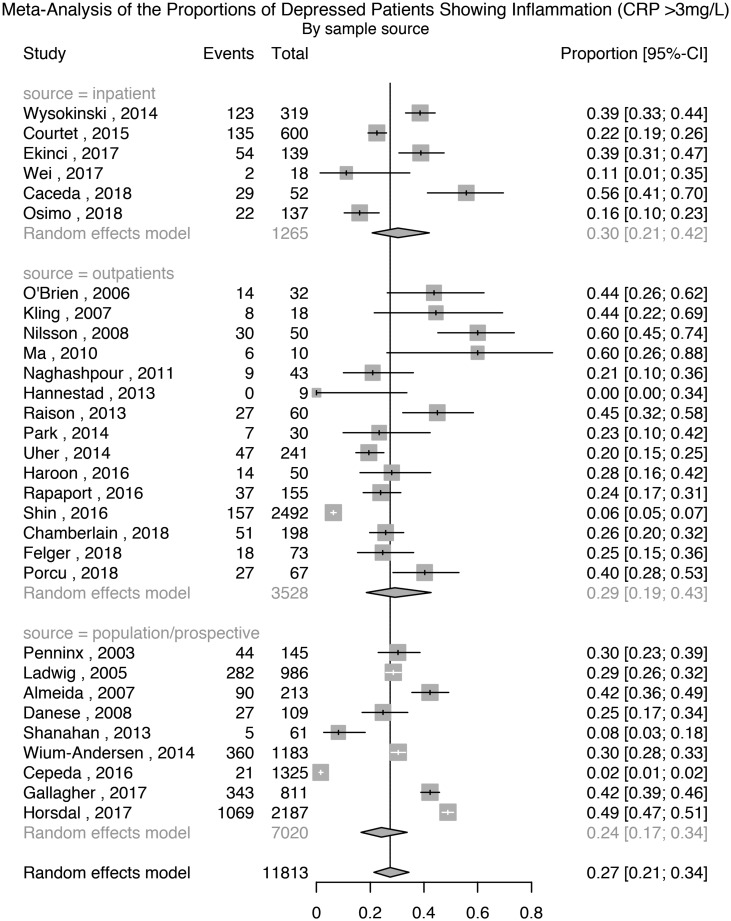
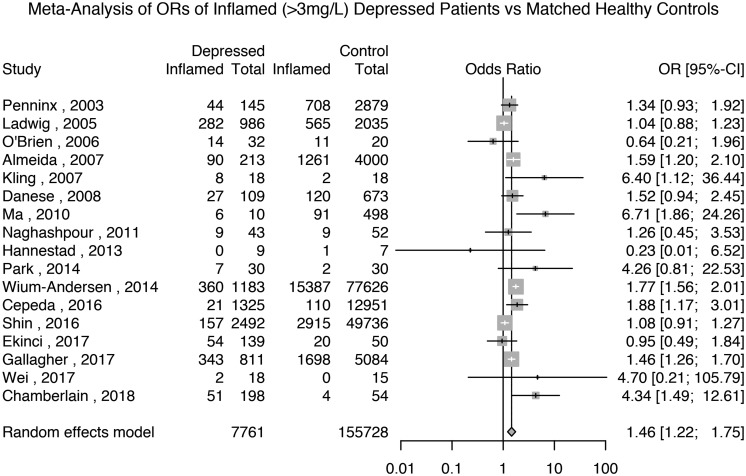
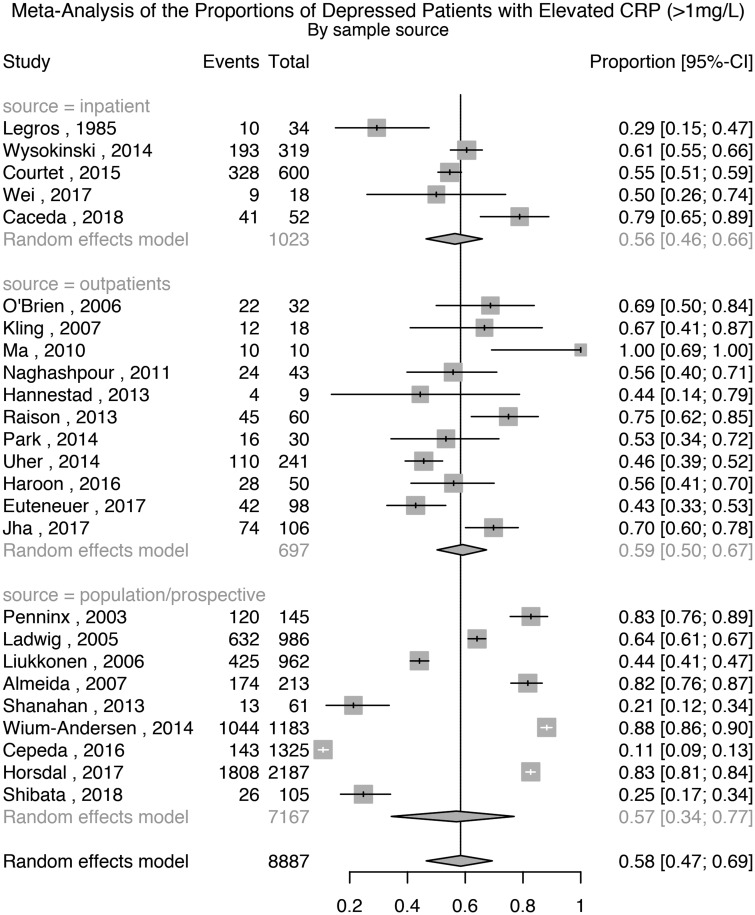
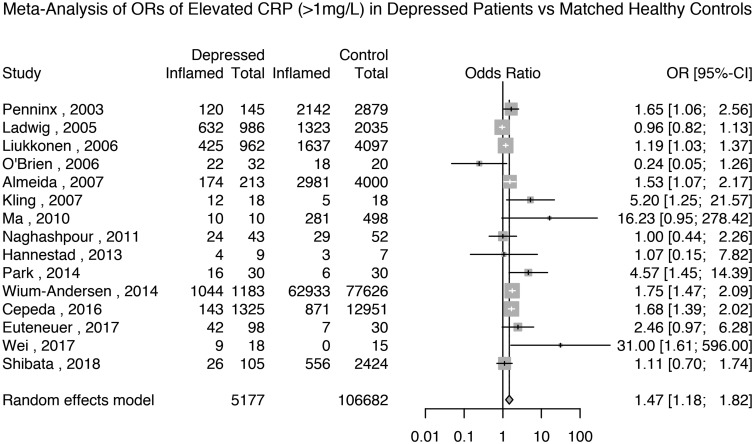
Background: Peripheral low-grade inflammation in depression is increasingly seen as a therapeutic target. We aimed to establish the prevalence of low-grade inflammation in depression, using different C-reactive protein (CRP) levels, through a systematic literature review and meta-analysis. Methods: We searched the PubMed database from its inception to July 2018, and selected studies that assessed depression using a validated tool/scale, and allowed the calculation of the proportion of patients with low-grade inflammation (CRP >3 mg/L) or elevated CRP (>1 mg/L). Results: After quality assessment, 37 studies comprising 13 541 depressed patients and 155 728 controls were included. Based on the meta-analysis of 30 studies, the prevalence of low-grade inflammation (CRP >3 mg/L) in depression was 27% (95% CI 21–34%); this prevalence was not associated with sample source (inpatient, outpatient or population-based), antidepressant treatment, participant age, BMI or ethnicity. Based on the meta-analysis of 17 studies of depression and matched healthy controls, the odds ratio for low-grade inflammation in depression was 1.46 (95% CI 1.22–1.75). The prevalence of elevated CRP (>1 mg/L) in depression was 58% (95% CI 47–69%), and the meta-analytic odds ratio for elevated CRP in depression compared with controls was 1.47 (95% CI 1.18–1.82). Conclusions: About a quarter of patients with depression show evidence of low-grade inflammation, and over half of patients show mildly elevated CRP levels. There are significant differences in the prevalence of low-grade inflammation between patients and matched healthy controls. These findings suggest that inflammation could be relevant to a large number of patients with depression.
Overview
The claims and statistics of this paper haven’t been checked yet.
Free: it reads the open-access text and checks the first 5 claims that cite a source we can check. Create a free account to check every claim.
Integrity signals
Registry
Cites
Statistics
Figures
Verification
Claims the paper makes
The claims and statistics of this paper haven’t been checked yet.
Free: it reads the open-access text and checks the first 5 claims that cite a source we can check. Create a free account to check every claim.
Claims other papers make about this one
Each is checked against this paper’s own text: does it say what the citing paper says it does?
The source backs part of the claim, not all of it — or backs it for a different population, condition or comparison.
In the citing paper
“Higher plasma levels of inflammatory cytokines, most consistently interleukin IL-1β, IL-6, and TNF-α, are correlated with greater depressive symptomatology.”
From Chronic stress, neuroinflammation, and depression: an overview of pathophysiological mechanisms and emerging anti-inflammatories (2023) · cites this paper as [6]
Experimental — accuracy not yet measuredThe cited source says what the claim attributes to it.
In the citing paper
“Low-grade inflammation – as indexed by a concentration of C-reactive protein (CRP) higher than 3 mg/L – is more likely in individuals with depression than in matched controls, occurring in around a quarter of the former according to a large meta-analysis (OR: 1.46, 95% CI: 1.22-1.75)205.”
From Comorbidity between major depressive disorder and physical diseases: a comprehensive review of epidemiology, mechanisms and management (2023) · cites this paper as [205]
In the citing paper
“Data were confirmed by a recent meta-analysis that included 13,541 depressed patients and 155,728 controls [121]. In 27% of the depressive patients there was a low-grade of inflammation (i.e., CRP > 3.0 mg/L) and over half of the patients showed a mildly elevated CRP level [121].”
From C-Reactive protein as a biomarker for major depressive disorder? (2022) · cites this paper as [121]
In the citing paper
“A very limited number of studies on CRP excluded participants presenting with an acute infection (CRP > 10 mg/L); we decided to include these studies because we previously found that the odds ratio of inflammation in patients vs controls is very similar if considering all patients (OR = 1.46) or excluding patients and controls with CRP > 10 mg/L (OR = 1.44) (Osimo et al., 2019), thus suggesting”
From Inflammatory markers in depression: a meta-analysis of mean differences and variability in 5,166 patients and 5,083 controls (2020) · cites this paper as Osimo et al., 2019
Self-check
Percentages, sums and reported differences re-computed from the paper’s own numbers.
The self-check needs the paper’s full text.
Citations
Cites
Quantifying heterogeneity in a meta‐analysis
Higgins, J. P. T., & Thompson, S. G. (2002) · Statistics in Medicine · doi:10.1002/sim.1186 · Cited by 36,763 · cited 1×
“Heterogeneity was tested using Cochrane’s Q-Test (Higgins and Thompson, 2002).”
Stang, A. (2010) · European Journal of Epidemiology · doi:10.1007/s10654-010-9491-z · Cited by 17,396 · cited 2×
“Study quality was assessed using the Newcastle–Ottawa Scale (Stang, 2010).”
MethodMolecular Mechanisms of Depression: Perspectives on New Treatment Strategies
Lang, U. E., & Borgwardt, S. (2013) · Cellular Physiology and Biochemistry · doi:10.1159/000350094 · Cited by 8,475
From inflammation to sickness and depression: when the immune system subjugates the brain
Dantzer, R., O'Connor, J. C., Freund, G. G., Johnson, R. W., & Kelley, K. W. (2008) · Nature Reviews Neuroscience · doi:10.1038/nrn2297 · Cited by 7,395 · cited 2×
“…commonly seen following an acute infection, shares many characteristics with depression, such as fatigue, sleep disturbance and decreased motivation (Dantzer et al., 2008); early-life infection and autoimmune diseases are associated with a higher risk of depression in adulthood (Benros et al.,…”
BackgroundPearson, T. A., Mensah, G. A., Alexander, R. W., Anderson, J. L., Cannon, R. O., Criqui, M., Fadl, Y. Y., Fortmann, S. P., Hong, Y., Myers, G. L., et al. (2003) · Circulation · doi:10.1161/01.cir.0000052939.59093.45 · Cited by 6,401 · cited 9×
“The American Heart Association and Center for Disease Control and Prevention have proposed clear CRP thresholds as indicators of inflammation levels (<1 = ‘low’, 1–3 = ‘medium’, >3 mg/L = ‘high’) (Pearson et al., 2003).”
BackgroundMethodInfluentialDiagnostic Criteria for Use in Psychiatric Research
Feighner, J. P. (1972) · Archives of General Psychiatry · doi:10.1001/archpsyc.1972.01750190059011 · Cited by 5,715
A Meta-Analysis of Cytokines in Major Depression
Dowlati, Y., Herrmann, N., Swardfager, W., Liu, H., Sham, L., Reim, E. K., & Lanctôt, K. L. (2010) · Biological Psychiatry · doi:10.1016/j.biopsych.2009.09.033 · Cited by 4,729 · cited 7×
“Meta-analyses of crosssectional studies confirm that mean concentrations of circulating CRP and inflammatory cytokines such as interleukin 6 (IL-6) are higher in patients with acute depression compared with controls (Howren et al., 2009; Dowlati et al., 2010; Haapakoski et al., 2015; Goldsmith et al., 2016).”
BackgroundResultInfluentialC-Reactive Protein, Interleukin 6, and Risk of Developing Type 2 Diabetes Mellitus
Pradhan, A. D. (2001) · JAMA · doi:10.1001/jama.286.3.327 · Cited by 4,433 · cited 1×
“In addition to depression and CVD, inflammation is associated with other physical and psychiatric disorders including diabetes mellitus (Pradhan et al., 2001), schizophrenia (Miller et al.”
BackgroundDanesh, J., Wheeler, J. G., Hirschfield, G. M., Eda, S., Eiriksdottir, G., Rumley, A., Lowe, G. D. O., Pepys, M. B., & Gudnason, V. (2004) · New England Journal of Medicine · doi:10.1056/nejmoa032804 · Cited by 2,953
Associations of depression with C-reactive protein, IL-1, and IL-6: a meta-analysis.
Howren, M. B., Lamkin, D. M., & Suls, J. (2009) · Psychosomatic Medicine · doi:10.1097/psy.0b013e3181907c1b · Cited by 2,766 · cited 7×
“Meta-analyses of crosssectional studies confirm that mean concentrations of circulating CRP and inflammatory cytokines such as interleukin 6 (IL-6) are higher in patients with acute depression compared with controls (Howren et al., 2009; Dowlati et al., 2010; Haapakoski et al., 2015; Goldsmith et al., 2016).”
BackgroundResultInfluential
Research works printed but not linked: 3
- Osimo, 2018, Prevalence of low-grade inflammation in depression: a review and meta-analysis of CRP data, PROSPERO
- Urbanek, 2015, Cairo: R graphics device using Cairo graphics library for creating high-quality bitmap (PNG, JPEG, TIFF), vector (PDF, SVG, PostScript) and display (X11 and Win32) output [Software], CRAN
- Khandaker, 2019, Shared mechanism between depression and coronary heart disease: findings from Mendelian randomization analysis of a large UK population-based cohort, Molecular Psychiatry
Cited by
Items 401–500 of 773
Simões, J. L. B., Braga, G. D. C., Assmann, C. E., & Bagatini, M. D. (2026) · Frontiers in Pharmacology · doi:10.3389/fphar.2026.1793292 · Cited by 7
“However, in IBD patients in clinical remission, markers like CRP often do not correlate with the persistence of symptoms like fatigue and depressed mood (Osimo et al., 2019).”
Eggart, M., Valdés‐Stauber, J., Müller-Oerlinghausen, B., & Heinze, M. (2023) · Brain Sciences · doi:10.3390/brainsci13020353 · Cited by 6
“0 as indicative of acute inflammation [10].”
ResultZhang, Y., Li, X., Wang, X., Wang, X., Li, G., Xue, Q.-Y., Zhang, M., & Ao, H. (2023) · Pharmaceuticals · doi:10.3390/ph16111607 · Cited by 8
Strumberger, M. A., Häberling, I. S., Emery, S., Albermann, M., Baumgartner, N., Pedrett, C. I., Wild, S., Contin-Waldvogel, B., Walitza, S., Berger, G. E., et al. (2024) · Sleep Medicine · doi:10.1016/j.sleep.2024.04.007 · Cited by 6
Dou, K., Shi, Y., Yang, B., & Zhao, Z. (2024) · Journal of Stomatology Oral and Maxillofacial Surgery · doi:10.1016/j.jormas.2024.101954 · Cited by 7
Immunologische Aspekte und Stressregulation bei Fatigue
Peters, E. M. J. (2024) · Bundesgesundheitsblatt - Gesundheitsforschung - Gesundheitsschutz · doi:10.1007/s00103-024-03952-z · Cited by 6
Ballesio, A., Vacca, M., Fiori, V., Micheli, F., Baccini, F., Nardo, G. D., & Lombardo, C. (2024) · Journal of Sleep Research · doi:10.1111/jsr.14395 · Cited by 7
“In another context, such as cardiovascular disease or psy-choneuroimmunology research, a CRP concentration of ≥ 3 mg L (cid:1) 1 is considered a cut-off for chronic low-grade systemic inflammation (Osimo et al., 2019).”
Janowska, M., Róg, J., & Karakuła‐Juchnowicz, H. (2021) · Annals of Agricultural and Environmental Medicine · doi:10.26444/aaem/132452 · Cited by 6
“Low-grade inflammation is observed among a quarter of patients with depression [27].”
BackgroundDobre, D., Schwan, R., Jansen, C., Schwitzer, T., Martin, O., Ligier, F., Rolland, B., Abdel-Ahad, P., Capdevielle, D., Corruble, E., et al. (2020) · Psychological Medicine · doi:10.1017/s0033291721001537 · Cited by 6
Al-Agam, A. N. M., Obeiad, A. W., Alzughaibi, M. A. K., Al-Hindy, H. A.-A. M., & Alhaideri, A. F. (2021) · Iranian Rehabilitation Journal · doi:10.32598/irj.19.4.1619.1 · Cited by 11
Evolutionary Perspectives on Depression
Rantala, M. J., & Luoto, S. (2022) · Cambridge University Press eBooks · doi:10.1017/9781009030564.010 · Cited by 12
The Tale of Depression and Inflammation Unraveled: On Depression Measurement Levels and Next Steps
Lamers, F. (2022) · Biological Psychiatry · doi:10.1016/j.biopsych.2022.11.007 · Cited by 6
Saravanan, A., Bai, J., Bajaj, P., Sterner, E. A., Rajagopal, M., Sanders, S., Luckose, A. B., Kushnick, M. R., & Starkweather, A. R. (2023) · Biological Research For Nursing · doi:10.1177/10998004231171146 · Cited by 7
“…have reported that inflammatory markers (i.e., CRP, IL-6, IL-1, and IL-1Ra) are positively associated with depression (Howren et al., 2009; Osimo et al., 2019) while higher IL-6 levels have been linked with both greater pain and greater chronic medical comorbidity in patients with greater…”
BackgroundAssociation between coffee consumption and high C-reactive protein levels in Korean adults
Choi, S., & Je, Y. (2023) · British Journal Of Nutrition · doi:10.1017/s0007114523001241 · Cited by 7
“Coffee consumption is inversely associated with risk of CVD (21) , certain types of cancer (22 – 24) , Parkinson ’ s disease (25) , depression (26) and mortality (27) , which have been also associated with higher CRP levels (28 – 35) .”
BackgroundWhere does inflammation in insomnia come from? and does it matter for comorbidity?
Ballesio, A. (2023) · SLEEP · doi:10.1093/sleep/zsad223 · Cited by 8
Qin, N., Yi, S., Dai, C., Liu, X., Duan, Y., Zhou, Y., Wan, Z., Kang, Y. J., Zhou, X., Xie, J., et al. (2023) · Supportive Care in Cancer · doi:10.1007/s00520-023-08145-z · Cited by 10
Association between psoriasis and dementia: A systematic review
Zhao, J., Li, T., & Wang, J. (2023) · Neurología (English Edition) · doi:10.1016/j.nrleng.2023.12.005 · Cited by 19
Depression in Frail Older Adults: Associations and Gender Difference
Özer, F. F. (2021) · Northern Clinics of Istanbul · doi:10.14744/nci.2021.55938 · Cited by 6
Omega-3 fatty acid supplementation for depression in children and adolescents
Campisi, S. C., Zasowski, C., Shah, S., Bradley-Ridout, G., Szatmári, P., & Korczak, D. J. (2021) · Cochrane Database of Systematic Reviews · doi:10.1002/14651858.cd014803 · Cited by 7
Does Neuroinflammation Underlie the Cognitive Changes Observed With Dietary Interventions?
Robbins, J. P., & Solito, E. (2022) · Frontiers in Neuroscience · doi:10.3389/fnins.2022.854050 · Cited by 6
Impacts of Unhealthy Behaviors on Mental Health among Public Health Residents: The PHRASI Study
Gianfredi, V., Stacchini, L., Minutolo, G., Nicolò, V. D., Berselli, N., Ancona, A., Catalini, A., & Cedrone, F. (2024) · Diseases · doi:10.3390/diseases12070134 · Cited by 7
Ali, S. Y., Sadik, M. I., Seid, A. M., Mohammed, A. H., Yimam, A. A., Shegere, M. M., Ayele, T. S., Wako, A. J., & Ibrahim, M. M. (2025) · Frontiers in Endocrinology · doi:10.3389/fendo.2025.1454793 · Cited by 4
Nutrition and Neuroinflammation: Are Middle-Aged Women in the Red Zone?
Bernier, V., Chatelan, A., Point, C., & Strauss, M. (2025) · Nutrients · doi:10.3390/nu17101607 · Cited by 8
Zhao, Y.-H., Wang, Q., Wu, Z., Zhou, Y., Gao, X., Gong, W., Qin, X., Ren, Y., & Tian, J. (2025) · Phytomedicine · doi:10.1016/j.phymed.2025.157241 · Cited by 6
Batail, J.-M. V., Corouge, I., Blanchard, T., Roy, J.-C., Robert, G. H., & Drapier, D. (2025) · Translational Psychiatry · doi:10.1038/s41398-025-03587-x · Cited by 11
“Based on the existing literature [5, 51], CRP level greater than or equal to 10 mg/L led to patient exclusion, as there was a substantial likelihood that the elevated level could be attributed to a factor unrelated to MDD.”
Cavalcanti-Ribeiro, P., Souza, L. C. A. M. D., Tavares, V. D. D. O., de Almeida, R. N., Lima, N. B. D. M., Gonçalves, K. T. D. C., Lopes, E. I. T. C., Bolcont, R., de Brito, A. J. C., Falchi-Carvalho, M., et al. (2025) · Journal of Affective Disorders · doi:10.1016/j.jad.2025.120877 · Cited by 4
Synaptic effects of interleukin-6 on human iPSC-derived dopaminergic neurons
Huang, Y., Michalski, C., Zhou, Y., Xu, C., Niu, W., Lucido, M. J., Wang, J., Feng, Y., Miller, A. H., & Wen, Z. (2026) · Neuropsychopharmacology · doi:10.1038/s41386-025-02320-y · Cited by 5
Glycolytic metabolism: Food for immune cells, fuel for depression?
Bekhbat, M. (2024) · Brain Behavior & Immunity - Health · doi:10.1016/j.bbih.2024.100843 · Cited by 13
“…inflammatory cytokines and other biomarkers of inflammation (e.g., C-reactive protein [CRP]) in association with risk factors like stress, trauma, metabolic and sleep disturbances, and aging (Osimo et al., 2019; Raison et al., 2013; Michopoulos et al., 2017; Felger, 2018; Passos et al., 2015).”
BackgroundWhat can the psychoneuroimmunology of yoga teach us about depression's psychopathology?
Chiarpenello, C., & Brodmann, K. (2024) · Brain Behavior & Immunity - Health · doi:10.1016/j.bbih.2024.100877 · Cited by 8
“In depression, hyperactive HPA axis modulation leads to chronic inflammation (Osimo et al., 2019; Keller et al., 2016).”
BackgroundInfluentialFellows, E., Jones, B. D. M., Hodsoll, J. P., Husain, N., Khoso, A. B., Young, A. H., Chaudhry, I. B., & Husain, M. I. (2024) · BJPsych Open · doi:10.1192/bjo.2024.735 · Cited by 6
“28 We previously found similarly high rates of low-grade inflammation in adult people with bipolar depression in Pakistan.”
Inflammation and depressive mood
Lemogne, C., Vedrines, C. O., Capuron, L., & Hoertel, N. (2024) · Joint Bone Spine · doi:10.1016/j.jbspin.2024.105832 · Cited by 6
Kalluri, A. L., Ejimogu, E., Reddy, S. C., Wang, E. T., Nair, S. K., Kilgore, C. B., Alkhars, H. M., Abdulrahim, M., Yedavalli, V. S., Lim, M. K., et al. (2025) · Clinical Neurology and Neurosurgery · doi:10.1016/j.clineuro.2025.108733 · Cited by 6
Azarfarin, M., Shahla, M. M., Mohaddes, G., & Dadkhah, M. (2025) · Acta Neuropsychiatrica · doi:10.1017/neu.2024.39 · Cited by 5
“Mounting evidence supports a positive link between the elevated concentration of inflammatory cytokines in serum and CSF and depression severity and treatment resistance (Osimo et al ., 2019).”
Şahin, K., Yardımcı, H., Açık, M., Akman, A. Ö., & Yüksel, F. (2025) · ALPHA PSYCHIATRY · doi:10.31083/ap38791 · Cited by 5
“…cytokines such as interleukin (IL)-6, C-reactive protein (CRP), and tumor necrosis factor alpha (TNF-α ) were found to be high in patients with a clinical diagnosis of depression or anxiety, probably because of the effect of psychological and physiological stress on the immune system [5,6].”
Network analysis of central symptoms in Chinese young adults with subthreshold depression
Jiang, X., Wang, X., Yu, L., He, J., Wu, S., Zhou, Y., Zhang, M., Yao, L., Yan, J., Zheng, Y., et al. (2025) · Translational Psychiatry · doi:10.1038/s41398-025-03307-5 · Cited by 11
Zeng, Y., Liu, T., Qiu, R., & Lian, Q. (2025) · BMC Psychiatry · doi:10.1186/s12888-025-07181-9 · Cited by 5
“This conceptual model is supported by evidence that depressive symptoms affect multiple biological and behavioral pathways—including systemic inflammation [19], neuro-endocrine dysregulation [20, 21], and reduced treatment adherence [22]—that are directly linked to premature death.”
Bottaccioli, F., Bottaccioli, A. G., Marzola, E., Longo, P., Minelli, A., & Daga, G. A. (2021) · Endocrines · doi:10.3390/endocrines2030022 · Cited by 11
“Recently, several meta-analyses documented clinical depression as a pro-inflammatory state [26,27], and anti-inflammatory added on standard treatment showed improvement of psychotic disorders [28].”
BackgroundSamuel, R., Carroll, M. T. C., Ikin, J. F., Gao, C. X., Monaco, A. D., McFARLANE, A. C., Berger, E., Maybery, D. J., Broder, J. C., Brown, D., et al. (2021) · Stress and Health · doi:10.1002/smi.3097 · Cited by 4
Meinlschmidt, G., Guemghar, S., Roemmel, N., Battegay, E., Hunziker, S., & Schaefert, R. (2022) · Epidemiology and Psychiatric Sciences · doi:10.1017/s2045796021000676 · Cited by 6
Walker, A. J., Mohebbi, M., Maes, M. H. J., Berk, M., Walder, K. R., Bortolasci, C. C., Liu, Z. S.-J., Ng, C. H., Ashton, M. M., Berk, L., et al. (2022) · Brain Behavior & Immunity - Health · doi:10.1016/j.bbih.2022.100581 · Cited by 8
Dua, D., Stubbs, O., Urasa, S. J., Rogathe, J., Duinmaijer, A., Howlett, W. P., Dekker, M. C. J., Kisoli, A., Mukaetova-Ladinska, E. B., Gray, W. K., et al. (2023) · Journal of NeuroVirology · doi:10.1007/s13365-023-01140-4 · Cited by 16
Strumberger, M. A., Häberling, I. S., Emery, S., Albermann, M., Baumgartner, N., Bucher, N., Erb, S., Bachmann, S., Wöckel, L., Müller-Knapp, U., et al. (2023) · Journal of Clinical Sleep Medicine · doi:10.5664/jcsm.10678 · Cited by 6
Peripheral inflammatory markers in melancholic versus non-melancholic depression
Bayes, A. J., Weickert, T. W., Parker, G. B., Spoelma, M. J., North, H. F., Lam-Po-Tang, J., & Weickert, C. S. (2023) · Psychoneuroendocrinology · doi:10.1016/j.psyneuen.2023.106418 · Cited by 8
Elevated levels of oxLDL and LOX-1: Implications for schizophrenia pathophysiology
Akkuş, M., & Solak, H. (2024) · Journal of Psychiatric Research · doi:10.1016/j.jpsychires.2024.07.015 · Cited by 5
Ji, D., Francesconi, M., Flouri, E., & Papachristou, E. (2022) · Brain Behavior and Immunity · doi:10.1016/j.bbi.2022.07.002 · Cited by 6
Mason, N. L., Szabó, A., Kuypers, K. P. C., Mallaroni, P., de la Torre, R., Reckweg, J. T., Tse, D. H. Y., Hutten, N. R. P. W., Feilding, A., & Ramaekers, J. G. (2022) · medRxiv · doi:10.1101/2022.10.31.22281688 · Cited by 5
“IL-6 and CRP are established, robust markers in major depressive (MDD) and anxiety disorders where elevated concentrations are associated with more severe symptoms and symptomdynamics[61-66].”
BackgroundWu, D., Nan, W., & Xing, Z. (2025) · Psychotherapy and Psychosomatics · doi:10.1159/000549345 · Cited by 4
“Physiological measures included bilateral grip strength (mean of right and left hands, normalized to body weight) [21, 22], plasma C-reactive protein (CRP), and low-density lipoprotein (LDL) cholesterol [23, 24], all obtained using standardized protocols by trained personnel.”
Fleig, K., Haslinger, L., Dawczynski, C., & Kolassa, I. (2026) · Frontiers in Nutrition · doi:10.3389/fnut.2026.1748196 · Cited by 6
“These changes, however, typically affect only a subset of patients and remain within the range of low-grade inflammation (28, 29).”
Investigating inflammation in depression in the chronically ill: Theoretical model and perspectives
Clesse, C., Yaqoob, M. M., Jayakumar, S., Bhui, K. S., & Carvalho, L. A. (2022) · The Journal of the Royal College of Physicians of Edinburgh · doi:10.1177/14782715221115776 · Cited by 4
“Five categories of factors have an impact on chronic physical illness and depression through inflammation: (1) social– demographic factors (e.”
BackgroundFeng, L., Yuan, J., Li, L., & Tang, J. (2024) · Molecular Biotechnology · doi:10.1007/s12033-024-01252-0 · Cited by 4
“It is evident that inflammation is closely involved in the development of MDD, with treatment-resistant MDD associated with increased peripheral inflammation [55].”
Dai, G., Liu, D., Wang, Y., Wang, Y., Huang, Q., San, W., Wang, X., & Ju, W. (2025) · Biomedical Chromatography · doi:10.1002/bmc.70041 · Cited by 6
Stager, L. M., Thompson, K. A., Morgan, C. H., Watson, C. S., Grant, M. M., & Fobian, A. D. (2023) · Journal of Adolescent Health · doi:10.1016/j.jadohealth.2023.05.018 · Cited by 4
Fan, W., Zhu, D., Cao, L., Wang, S., Tong, Y., Xie, F., Zhang, X., Su, P., & Wang, G. (2024) · Neuroscience · doi:10.1016/j.neuroscience.2024.07.027 · Cited by 7
Shin, M., McKenna, S., Crouse, J. J., Phung, E., Zmicerevska, N., Nichles, A., Song, Y. J. C., Tonini, E., Carpenter, J. S., Hickie, I. B., et al. (2024) · Research Directions Depression · doi:10.1017/dep.2024.8 · Cited by 5
“We defined “ elevated risk ” by HOMA2-IR greater than 1.5, as outlined in our previous report (Scott et al. 2019), insulin level greater than 10 mU/L (consistent with HOMA2-IR >= 1.5) (Shin et al. 2024), FBG level greater than 5.6 mmol/L, and CRP greater than 3mg/L (Osimo et al. 2019).”
InfluentialBaltramonaityte, V., Karhunen, V., Felix, J. F., Penninx, B. W. J. H., Cecil, C. A. M., Fairchild, G. F., Milaneschi, Y., & Walton, E. (2025) · Brain Behavior and Immunity · doi:10.1016/j.bbi.2025.01.024 · Cited by 6
“…that has implicated inflammation in the development of depression, coronary artery disease and type 2 diabetes (i.e., the single diseases that make up our definition of multimorbidity) (Ju et al., 2020; Montarello et al., 2022; Okdahl et al., 2022; Osimo et al., 2019; Toenders et al., 2022).”
Tavares, V. D. D. O., Schuch, F. B., de Sousa, G. M., Hallgren, M. Å., Teychenne, M. J., de Almeida, R. N., Browne, R. A. V., Barros, M. L. D. M., Bezerra, R. C., Hallak, J. E. C., et al. (2025) · Journal of Psychiatric Research · doi:10.1016/j.jpsychires.2025.02.023 · Cited by 6
Risk of Major Depression Associated with Excessive Daytime Sleepiness in Apneic Individuals
Conenna, M., Point, C., Wacquier, B., Lanquart, J., & Hein, M. (2025) · Clocks & Sleep · doi:10.3390/clockssleep7020022 · Cited by 7
“Indeed, consistent with the literature [81–83], we confirmed that the presence of low-grade inflammation played a central role in the occurrence of MDD, which could be explained by the potential negative impact of this low-grade inflammation on the central synthesis and reuptake of monoamine…”
Solak, H., Akkuş, M., & Avşar, P. A. (2025) · Journal of Psychiatric Research · doi:10.1016/j.jpsychires.2025.07.023 · Cited by 4
Chen, T., Niu, M., Luo, Y., Li, J., Almulla, A. F., Zhang, Y., & Maes, M. H. J. (2026) · Brain Behavior and Immunity · doi:10.1016/j.bbi.2026.106923 · Cited by 9
Prados-Ojeda, J. L., Luque, R., Gordillo-Urbano, R. M., Guler, I., Medina, C. L., Collantes‐Estévez, E., & Escudero‐Contreras, A. (2021) · Journal of Clinical Medicine · doi:10.3390/jcm10163461 · Cited by 5
“Mechanisms of autoimmunity [19–21] and inflammation [9,10,13–16] have been re-ported to play a role in the etiology of psychotic disorders.”
BackgroundInflammation, Sickness Behaviour and Depression
Khandaker, G. M., Colasanti, A., & Harrison, N. A. (2021) · Cambridge University Press eBooks · doi:10.1017/9781108539623.008 · Cited by 5
Self-citationCao, B., Li, R., Ding, L., Xu, J., Ma, H., Liu, J., & Xue, J. (2021) · BMJ Open · doi:10.1136/bmjopen-2020-048162 · Cited by 6
Ivanković, S., Ćorić, V., Paić, F., Peleš, A. M., Svaguša, T., Kalamar, V., Petričević, M., & Biočina, B. (2022) · Applied Sciences · doi:10.3390/app122010201 · Cited by 5
Nonlinear Relationship Between C-Reactive Protein and Depression Among Obese Middle-Aged Adults
Lee, C., Min, S. H., & Niitsu, K. (2023) · Nursing Research · doi:10.1097/nnr.0000000000000646 · Cited by 4
“…obesity Nursing Research, May/June 2023, Vol 72, No 3, 236–245 C -reactive protein (CRP)—a nonspecific biomarker ofinflammation produced mainly by the liver in re-sponse to interleukin-6—has been shown to strongly correlate with depression in preclinical and clinical studies (Osimo et al., 2019).”
BackgroundMethodAbe, H., Okada‐Tsuchioka, M., Kajitani, N., Omori, W., Itagaki, K., Shibasaki, C., Boku, S., Matsuhisa, T., & Takebayashi, M. (2023) · Neuropsychopharmacology Reports · doi:10.1002/npr2.12358 · Cited by 4
Teepe, G. W., Lukic, Y. X., Kleim, B., Jacobson, N. C., Schneider, F., Santhanam, P., Fleisch, E., & Kowatsch, T. (2023) · BMC Psychology · doi:10.1186/s40359-023-01215-1 · Cited by 8
Fissler, P., Mavioğlu, R. N., Wenzel, M., Filippi, M., Stoewer, S., Wolff, W., Karabatsiakis, A., Pruessner, J. C., Kolassa, I., & Krähenmann, R. (2022) · PsyArXiv (OSF Preprints) · doi:10.31234/osf.io/b3qf5 · Cited by 4
Zhang, Y., Zhen, F., Zhang, Y., & An, C. (2025) · Frontiers in Psychiatry · doi:10.3389/fpsyt.2024.1506726 · Cited by 3
Naidoo, S., & Naidoo, N. (2025) · PLoS ONE · doi:10.1371/journal.pone.0319188 · Cited by 4
Tian, R.-N., Zhang, S., Zhang, N., Wu, W.-J., Guo, H.-Q., Wang, C., & Duan, Z.-G. (2025) · Frontiers in Nutrition · doi:10.3389/fnut.2025.1623482 · Cited by 3
Hao, J., Bai, H., Hou, L., Xiao, W., Zhou, J., Sun, W., Wang, J., Song, P., & Hesketh, T. M. (2025) · BMC Public Health · doi:10.1186/s12889-025-24127-8 · Cited by 3
“Shorter sleep duration may contribute to increased inflammation, which is a factor associated with various mental disorders [51, 52].”
Huang, M., He, S., Wang, Y., Zeng, Y., Chen, Q., Chen, Y., Wang, X., Li, Y., Chen, L., Zheng, S., et al. (2025) · Communications Biology · doi:10.1038/s42003-025-08719-z · Cited by 3
Jin, R. R., Wong, N. M. L., Ma, J., Fang, J., Lin, C.-M., Toh, C., Wu, K.-Y., Hsu, J., Huang, C., Lee, S.-H., et al. (2025) · Translational Psychiatry · doi:10.1038/s41398-025-03547-5 · Cited by 4
Lazaridou, A., Sivakumar, S., Biefer, H. R. C., Weilenmann, S., Princip, M., Zuccarella‐Hackl, C., Petzschner, F. H., Heinzle, J., Stephan, K. E., Dzemali, O., et al. (2025) · BMJ Open · doi:10.1136/bmjopen-2025-108061 · Cited by 5
“29 Older adults show elevated IL-6 levels; higher baseline IL-6 and CRP predicted depressive symptoms, independent of other risk factors.”
Zhou, M., Li, D., Mao, C., Zhan, H., & Qiu, H. (2025) · Journal of Affective Disorders · doi:10.1016/j.jad.2025.120328 · Cited by 4
D’Aprile, I., Petrillo, G., Begni, V., Creutzberg, K. C., Orso, R., Grassi‐Oliveira, R., Riva, M. A., & Cattaneo, A. (2025) · Translational Psychiatry · doi:10.1038/s41398-025-03622-x · Cited by 3
“…are associated with the presence of high levels of in fl ammatory markers [15 – 18] and that patients with mental disorders, such as depression [19, 20], generalized anxiety disorder [21], post-traumatic stress disorder [22] or metabolism dysfunction [23 – 25] are characterized by altered…”
Han, X., Liu, Y., Wei, Y., Ma, L., Lim, S. S., & Wang, Z. (2026) · Agricultural Products Processing and Storage · doi:10.1007/s44462-025-00054-0 · Cited by 3
“Proposed pathophysiological mechanisms include neuroinflammation [4], oxidative stress [5], brain-derived neurotrophic factor (BDNF) deficiency [6], and hypothalamic-pituitary-adrenal (HPA) axis dysregulation [7].”
Akif, A., Kadir, M. F., & Islam, M. R. (2026) · CNS Neuroscience & Therapeutics · doi:10.1002/cns.70791 · Cited by 4
““Low-grade inflammation” may refer to modest, chronic elevations in inflammatory markers (e.g., hs-CRP and circulating cytokines) in the absence of acute infection [13, 14].”
The Relationship Between Polycystic Ovary Syndrome (PCOS) and Depression
Karampela, A. I., & Druce, M. R. (2026) · Clinical Endocrinology · doi:10.1111/cen.70124 · Cited by 3
“Concerning depression, a recent systematic review suggests that up to a quarter of this group of patients demonstrate low‐grade inflammation measured by C‐reactive protein (CRP) levels [ 35].”
Sprengel, M. L., Mansoor, R., Latsou, N., Allen, S., Lubarsky, O., Mark, K., Gizzi, L., & Vieten, C. (2026) · Frontiers in Nutrition · doi:10.3389/fnut.2026.1795350 · Cited by 3
Yu, B., Zhao, W.-W., Tao, L., & Li, K. (2026) · Frontiers in Microbiology · doi:10.3389/fmicb.2026.1800520 · Cited by 8
Zhang, Y. J., Sa, R., Jia, H., Wang, X., Ma, R., & Tong, L. (2026) · Health Science Reports · doi:10.1002/hsr2.72387 · Cited by 4
“Osimo et al [57] found that one‐ quarter of individuals with depression display low grade inflammation, with over half showing mildly increased CRP levels.”
Matits, L., Gumpp, A. M., Kolassa, I., Behnke, A., & Mack, M. (2022) · Zeitschrift für Klinische Psychologie und Psychotherapie · doi:10.1026/1616-3443/a000666 · Cited by 4
Dessoki, H. H., Soltan, M. R., Ragheb, A. S., & Dawoud, M. E. (2024) · Middle East Current Psychiatry · doi:10.1186/s43045-024-00453-2 · Cited by 3
“This result is in agreement with a latest meta-analysis that noted that serum CRP levels were extreme in depressive cases than those in non-depressive ones [18, 40, 41].”
ResultEndocrinological Treatment Targets for Depressive Disorder
Yoon, S., & Kim, Y. (2024) · Advances in experimental medicine and biology · doi:10.1007/978-981-97-4402-2_1 · Cited by 3
Jarkas, D., Robillard, R., Malenfant, C.-R., Richards, C., Lanthier, M., Beaurepaire, C., Nicholson, A. A., Jaworska, N., Cassidy, C., Shlik, J., et al. (2025) · Psychoneuroendocrinology · doi:10.1016/j.psyneuen.2025.107406 · Cited by 5
“…may be a fundamental pathophysiological element of PTSD. Nonetheless, CRP is a general inflammatory marker not specific to PTSD alone, given its significant association with depressive symptomatology (Miller and Raison, 2016; Osimo et al., 2019; Franklyn et al., 2022; Jarkas et al., 2024).”
Liu, X., Zheng, W., Sun, Y., Yansong, L. I., Pan, Y., Wang, K., Lu, M., & Xu, D. (2025) · Preventive Medicine · doi:10.1016/j.ypmed.2025.108273 · Cited by 3
Oluboka, O. J., Habert, J., Khullar, A., Robinson, D. J., Katzman, M. A., Klassen, L. J., Soares, C., Chokka, P. R., Oakander, M. A., McIntyre, R. S., et al. (2025) · CNS Spectrums · doi:10.1017/s1092852925000276 · Cited by 3
“54,55 Circulating inflammatory marker levels are a predictor of coronary heart disease, 56,57 and inflammatory cytokine levels are significantly elevated in some people with depression compared with healthy controls 47,58 – 61 (Table 1).”
Adibi, A., Motahharynia, A., Adibi, I., & Sanayei, M. (2025) · Discover Mental Health · doi:10.1007/s44192-025-00193-7 · Cited by 3
“According to current literature, depression is accompanied by neuroinflammation and oxidative stress [105, 106], which can affect energy metabolism and cause damage to DNA, RNA, lipids, and proteins [107].”
Fischer, I. C., Overstreet, C. M., Cabrera‐Mendoza, B., Qiu, D., Krystal, J. H., Polimanti, R. A., Gelernter, J. E., & Pietrzak, R. H. (2025) · The World Journal of Biological Psychiatry · doi:10.1080/15622975.2025.2498352 · Cited by 3
Depression and Inflammation Predict Depression Trajectory of Non–Small Cell Lung Cancer Patients
Park, K. R., Shields, P. G., Myers, J., Reisinger, S. A., & Andersen, B. L. (2025) · Psychosomatic Medicine · doi:10.1097/psy.0000000000001379 · Cited by 4
Chen, L.-C., Bai, Y., Tsai, S., Hsu, J.-W., & Chen, M. (2025) · Psychiatry Research · doi:10.1016/j.psychres.2025.116644 · Cited by 5
Duong, A., Jeong, H., Sabbagh, D. E. S. E., & Andreazza, A. C. (2022) · Biological Psychiatry Global Open Science · doi:10.1016/j.bpsgos.2022.01.006 · Cited by 3
High hs-CRP levels after an attempted suicide: A matched case-control study
Toffol, E., Miola, A., Magnolfi, G., Trevisan, G., & Scocco, P. (2022) · Journal of Affective Disorders Reports · doi:10.1016/j.jadr.2022.100381 · Cited by 3
Romankiewicz, L., Schaare, H. L., Nestler, S., Villringer, A., & Blöchl, M. (2023) · Biological Psychiatry Global Open Science · doi:10.1016/j.bpsgos.2023.04.008 · Cited by 3
“For example, elevated levels of C-reactive protein (CRP), a hallmark of low-grade systemic in fl ammation, have been associated with higher depressive symptoms in population-based studies (28 – 31) and shown to be present in a considerable proportion of patients with depression (32).”
BackgroundBinder, M. R. (2023) · International Journal of Psychiatry Research · doi:10.33425/2641-4317.1167 · Cited by 4
“However, studies have found that reducing inflammation fails to completely eliminate psychiatric symptoms [40,41].”
Therapeutic mechanisms of ellagic acid for inflammation and related conditions
Zhang, C. (2023) · International Conference on Modern Medicine and Global Health (ICMMGH) · doi:10.1117/12.2692865 · Cited by 3
“Numerous studies have identified increased levels of inflammatory markers (IL-1, IL-6, and tumour necrosis [43] factor, C-reactive protein (CRP) and TNF-α) that are linked to depression in the blood of MDD patients [44,45].”
BackgroundMoilanen, P., Liukkonen, T., Jokelainen, J. J., Keinanen-Kiukaanniemi, S. M., Puukka, K. S., Timonen, M., AUVINEN, J. P., & Eskola, P. J. (2023) · Nordic Journal of Psychiatry · doi:10.1080/08039488.2023.2274341 · Cited by 4
“In sum, regarding the association under investigation, accumulating evidence suggests an association between inflammation and depressive symptoms, at least among a subgroup of depressive subjects [3].”
BackgroundSamaryn, E., Galińska-Skok, B., Nobis, A., Zalewski, D., Maciejczyk, M., Gudowska-Sawczuk, M., Mroczko, B., Zalewska, A., & Waszkiewicz, N. (2023) · Journal of Clinical Medicine · doi:10.3390/jcm12227049 · Cited by 4
“A meta-analysis by Osimo et al. found that more than half of depressed patients present slightly elevated CRP levels, and about a quarter of patients show signs of low-grade inflammation [69].”
BackgroundInflammatory depression is associated with selective glomerular hypofiltration
Veibäck, G. S., Malmgren, L., Asp, M., Ventorp, F., Suneson, K., Grudet, C., Westrin, Å., & Lindqvist, D. (2024) · Journal of Affective Disorders · doi:10.1016/j.jad.2024.04.007 · Cited by 3
Metadata
- Authors
- Osimo, E. F., Baxter, L. J., Lewis, G., Jones, P. B., & Khandaker, G. M.
- Affiliations
- University of Cambridge (GB)
- University College London (GB)
- Corresponding author
- Osimo, Emanuele Felice
- Venue
- Psychological Medicine
- Publisher
- Cambridge University Press (CUP)
- Published
- 2019-07-01
- Volume
- 49
- Issue
- 12
- Pages
- 1958-1970
- ISSN
- 0033-2917 (ISSN-L)
- 1469-8978
- PMC
- PMC6712955
- OpenAlex
- W2955079055
- Cited by
- 774
- References
- 91
- Citations by year
- 2026: 126 · 2025: 141 · 2024: 119 · 2023: 127 · 2022: 107 · 2021: 100 · 2020: 49 · 2019: 4
- FWCI
- 3.94
- Type
- journal article
- Language
- en
- Open access
- hybrid
- doi.org
- Locations
- Psychological Medicine (publishedVersion, cc-by)
- PubMed Central (publishedVersion, cc-by)
- PubMed (publishedVersion)
- UCL Discovery (University College London) (submittedVersion)
- Explore Bristol Research (submittedVersion)
- Funders
- Wellcome Trust (RP-PG-0616-20003, 088869/Z/09/Z, 095844/Z/11/Z, 20003, 088869, /Z/11/Z, 201486 /Z/16/Z, 201486, MQDS17/40, 095844, MC_PC_17213)
- MQ: Transforming Mental Health (MQDS17/40)
- National Institute for Health and Care Research (MQDS17/40, RP-PG-0616-20003, ACF-2017-14-007)
- Medical Research Council (201486/Z/16/Z, MQDS17/40, MC_PC_17213)
- Topics
- Life Sciences › Neuroscience › Biological Psychiatry › Tryptophan and brain disorders
- Health Sciences › Medicine › Pharmacology (medical) › Treatment of Major Depression
- Life Sciences › Neuroscience › Behavioral Neuroscience › Stress Responses and Cortisol
- Keywords
- depression, low-grade inflammation, C-reactive protein, prevalence, depression biomarkers
- MeSH terms
- Antidepressive Agents, C-Reactive Protein, Depressive Disorder, Humans, Inflammation, Prevalence, Odds Ratio
About these checks
Registry, retraction, Cites and statistics results are computed, not judged, with one exception: a printed reference that no index lists is read once by a model before it counts as a citation error. Claims are extracted by a model and kept only when their quote appears verbatim in the text; each cited source is then checked, with a model’s help, for whether it says what the claim relies on. Those verdicts can be wrong — read the claim’s quote and the cited source before relying on one.
Statistics and arithmetic are recomputed, not judged.
Confidence bands are shown only for fields calibrated on our annotated test set. None is calibrated yet, so no band is shown.
What counts as a claim ›How we measure confidence ›How we check this ›
Are you an author, or do you see a problem with this page? Request a review
Data sources
Bibliographic data: Semantic Scholar, OpenAlex, Crossref.
Contains information from the Semantic Scholar Academic Graph Datasets, made available under the ODC Attribution License (ODC-BY 1.0).
Semantic Scholar’s data is described in: Kinney, R., et al. (2023). The Semantic Scholar Open Data Platform. arXiv:2301.10140.
