

Prevalence of low-grade inflammation in depression: a systematic review and meta-analysis of CRP levels
Open accessThe DOI matches its Crossref record; 91 of the 91 references it cites were found in a registry or an index.
Abstract
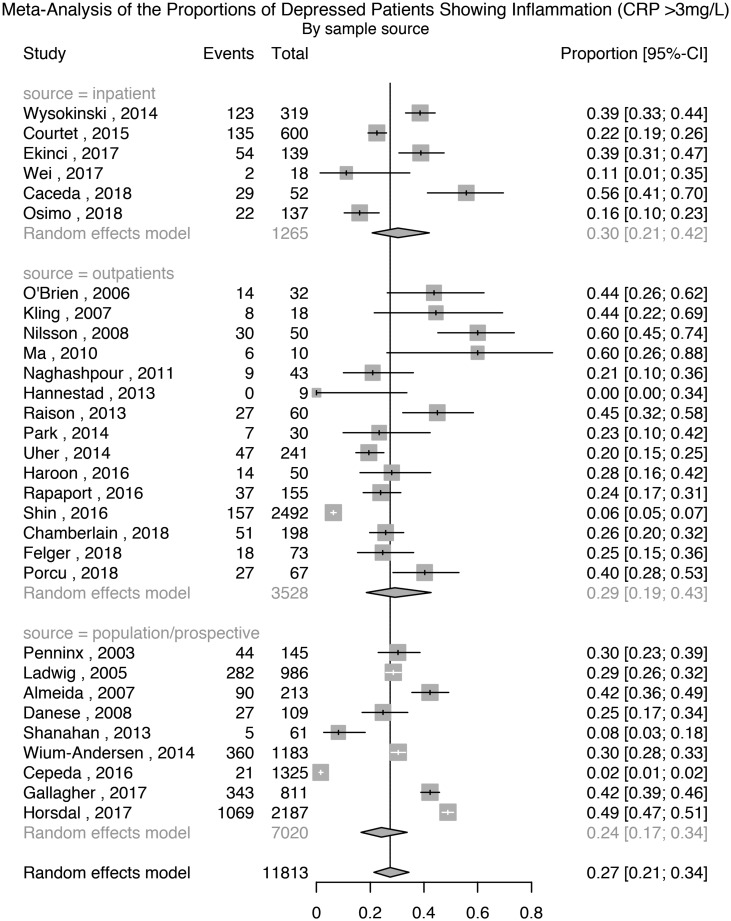
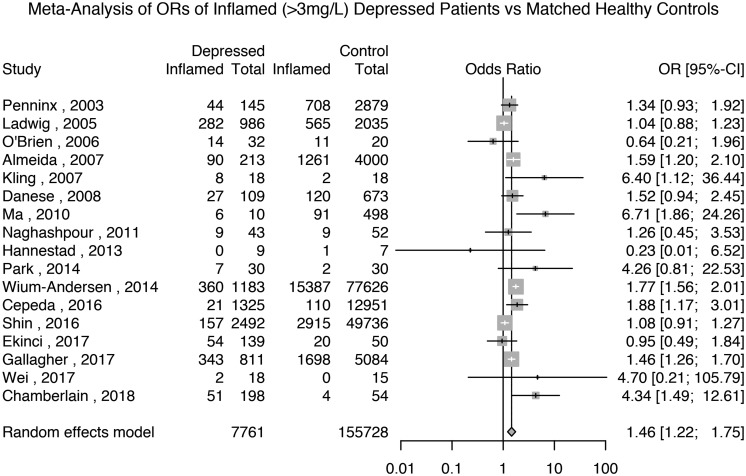
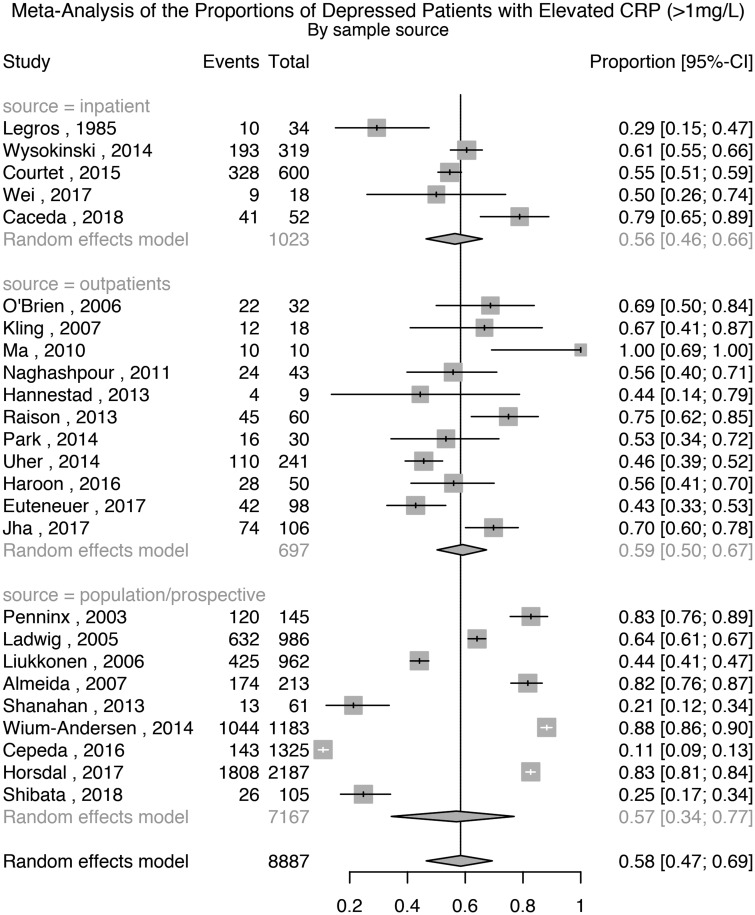
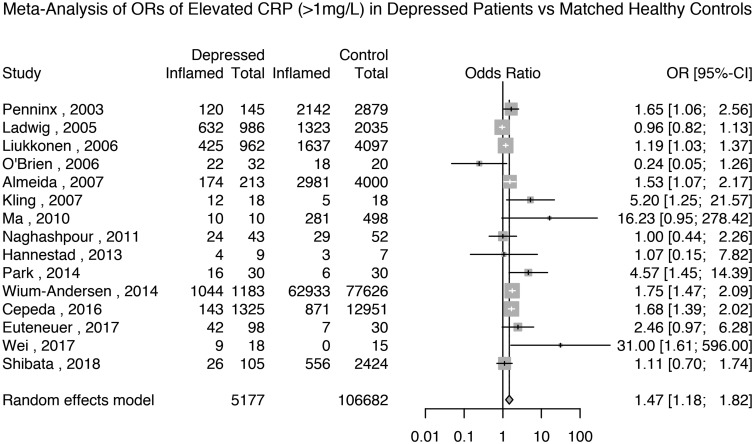
Background: Peripheral low-grade inflammation in depression is increasingly seen as a therapeutic target. We aimed to establish the prevalence of low-grade inflammation in depression, using different C-reactive protein (CRP) levels, through a systematic literature review and meta-analysis. Methods: We searched the PubMed database from its inception to July 2018, and selected studies that assessed depression using a validated tool/scale, and allowed the calculation of the proportion of patients with low-grade inflammation (CRP >3 mg/L) or elevated CRP (>1 mg/L). Results: After quality assessment, 37 studies comprising 13 541 depressed patients and 155 728 controls were included. Based on the meta-analysis of 30 studies, the prevalence of low-grade inflammation (CRP >3 mg/L) in depression was 27% (95% CI 21–34%); this prevalence was not associated with sample source (inpatient, outpatient or population-based), antidepressant treatment, participant age, BMI or ethnicity. Based on the meta-analysis of 17 studies of depression and matched healthy controls, the odds ratio for low-grade inflammation in depression was 1.46 (95% CI 1.22–1.75). The prevalence of elevated CRP (>1 mg/L) in depression was 58% (95% CI 47–69%), and the meta-analytic odds ratio for elevated CRP in depression compared with controls was 1.47 (95% CI 1.18–1.82). Conclusions: About a quarter of patients with depression show evidence of low-grade inflammation, and over half of patients show mildly elevated CRP levels. There are significant differences in the prevalence of low-grade inflammation between patients and matched healthy controls. These findings suggest that inflammation could be relevant to a large number of patients with depression.
Overview
The claims and statistics of this paper haven’t been checked yet.
Free: it reads the open-access text and checks the first 5 claims that cite a source we can check. Create a free account to check every claim.
Integrity signals
Registry
Cites
Statistics
Figures
Verification
Claims the paper makes
The claims and statistics of this paper haven’t been checked yet.
Free: it reads the open-access text and checks the first 5 claims that cite a source we can check. Create a free account to check every claim.
Claims other papers make about this one
Each is checked against this paper’s own text: does it say what the citing paper says it does?
The source backs part of the claim, not all of it — or backs it for a different population, condition or comparison.
In the citing paper
“Higher plasma levels of inflammatory cytokines, most consistently interleukin IL-1β, IL-6, and TNF-α, are correlated with greater depressive symptomatology.”
From Chronic stress, neuroinflammation, and depression: an overview of pathophysiological mechanisms and emerging anti-inflammatories (2023) · cites this paper as [6]
Experimental — accuracy not yet measuredThe cited source says what the claim attributes to it.
In the citing paper
“Low-grade inflammation – as indexed by a concentration of C-reactive protein (CRP) higher than 3 mg/L – is more likely in individuals with depression than in matched controls, occurring in around a quarter of the former according to a large meta-analysis (OR: 1.46, 95% CI: 1.22-1.75)205.”
From Comorbidity between major depressive disorder and physical diseases: a comprehensive review of epidemiology, mechanisms and management (2023) · cites this paper as [205]
In the citing paper
“Data were confirmed by a recent meta-analysis that included 13,541 depressed patients and 155,728 controls [121]. In 27% of the depressive patients there was a low-grade of inflammation (i.e., CRP > 3.0 mg/L) and over half of the patients showed a mildly elevated CRP level [121].”
From C-Reactive protein as a biomarker for major depressive disorder? (2022) · cites this paper as [121]
In the citing paper
“A very limited number of studies on CRP excluded participants presenting with an acute infection (CRP > 10 mg/L); we decided to include these studies because we previously found that the odds ratio of inflammation in patients vs controls is very similar if considering all patients (OR = 1.46) or excluding patients and controls with CRP > 10 mg/L (OR = 1.44) (Osimo et al., 2019), thus suggesting”
From Inflammatory markers in depression: a meta-analysis of mean differences and variability in 5,166 patients and 5,083 controls (2020) · cites this paper as Osimo et al., 2019
Self-check
Percentages, sums and reported differences re-computed from the paper’s own numbers.
The self-check needs the paper’s full text.
Citations
Cites
Quantifying heterogeneity in a meta‐analysis
Higgins, J. P. T., & Thompson, S. G. (2002) · Statistics in Medicine · doi:10.1002/sim.1186 · Cited by 36,763 · cited 1×
“Heterogeneity was tested using Cochrane’s Q-Test (Higgins and Thompson, 2002).”
Stang, A. (2010) · European Journal of Epidemiology · doi:10.1007/s10654-010-9491-z · Cited by 17,396 · cited 2×
“Study quality was assessed using the Newcastle–Ottawa Scale (Stang, 2010).”
MethodMolecular Mechanisms of Depression: Perspectives on New Treatment Strategies
Lang, U. E., & Borgwardt, S. (2013) · Cellular Physiology and Biochemistry · doi:10.1159/000350094 · Cited by 8,475
From inflammation to sickness and depression: when the immune system subjugates the brain
Dantzer, R., O'Connor, J. C., Freund, G. G., Johnson, R. W., & Kelley, K. W. (2008) · Nature Reviews Neuroscience · doi:10.1038/nrn2297 · Cited by 7,395 · cited 2×
“…commonly seen following an acute infection, shares many characteristics with depression, such as fatigue, sleep disturbance and decreased motivation (Dantzer et al., 2008); early-life infection and autoimmune diseases are associated with a higher risk of depression in adulthood (Benros et al.,…”
BackgroundPearson, T. A., Mensah, G. A., Alexander, R. W., Anderson, J. L., Cannon, R. O., Criqui, M., Fadl, Y. Y., Fortmann, S. P., Hong, Y., Myers, G. L., et al. (2003) · Circulation · doi:10.1161/01.cir.0000052939.59093.45 · Cited by 6,401 · cited 9×
“The American Heart Association and Center for Disease Control and Prevention have proposed clear CRP thresholds as indicators of inflammation levels (<1 = ‘low’, 1–3 = ‘medium’, >3 mg/L = ‘high’) (Pearson et al., 2003).”
BackgroundMethodInfluentialDiagnostic Criteria for Use in Psychiatric Research
Feighner, J. P. (1972) · Archives of General Psychiatry · doi:10.1001/archpsyc.1972.01750190059011 · Cited by 5,715
A Meta-Analysis of Cytokines in Major Depression
Dowlati, Y., Herrmann, N., Swardfager, W., Liu, H., Sham, L., Reim, E. K., & Lanctôt, K. L. (2010) · Biological Psychiatry · doi:10.1016/j.biopsych.2009.09.033 · Cited by 4,729 · cited 7×
“Meta-analyses of crosssectional studies confirm that mean concentrations of circulating CRP and inflammatory cytokines such as interleukin 6 (IL-6) are higher in patients with acute depression compared with controls (Howren et al., 2009; Dowlati et al., 2010; Haapakoski et al., 2015; Goldsmith et al., 2016).”
BackgroundResultInfluentialC-Reactive Protein, Interleukin 6, and Risk of Developing Type 2 Diabetes Mellitus
Pradhan, A. D. (2001) · JAMA · doi:10.1001/jama.286.3.327 · Cited by 4,433 · cited 1×
“In addition to depression and CVD, inflammation is associated with other physical and psychiatric disorders including diabetes mellitus (Pradhan et al., 2001), schizophrenia (Miller et al.”
BackgroundDanesh, J., Wheeler, J. G., Hirschfield, G. M., Eda, S., Eiriksdottir, G., Rumley, A., Lowe, G. D. O., Pepys, M. B., & Gudnason, V. (2004) · New England Journal of Medicine · doi:10.1056/nejmoa032804 · Cited by 2,953
Associations of depression with C-reactive protein, IL-1, and IL-6: a meta-analysis.
Howren, M. B., Lamkin, D. M., & Suls, J. (2009) · Psychosomatic Medicine · doi:10.1097/psy.0b013e3181907c1b · Cited by 2,766 · cited 7×
“Meta-analyses of crosssectional studies confirm that mean concentrations of circulating CRP and inflammatory cytokines such as interleukin 6 (IL-6) are higher in patients with acute depression compared with controls (Howren et al., 2009; Dowlati et al., 2010; Haapakoski et al., 2015; Goldsmith et al., 2016).”
BackgroundResultInfluential
Research works printed but not linked: 3
- Osimo, 2018, Prevalence of low-grade inflammation in depression: a review and meta-analysis of CRP data, PROSPERO
- Urbanek, 2015, Cairo: R graphics device using Cairo graphics library for creating high-quality bitmap (PNG, JPEG, TIFF), vector (PDF, SVG, PostScript) and display (X11 and Win32) output [Software], CRAN
- Khandaker, 2019, Shared mechanism between depression and coronary heart disease: findings from Mendelian randomization analysis of a large UK population-based cohort, Molecular Psychiatry
Cited by
Items 201–300 of 773
Early Life Stress Detection Using Physiological Signals and Machine Learning Pipelines
Shahbazi, Z., & Byun, Y.-C. (2023) · Biology · doi:10.3390/biology12010091 · Cited by 26
“Although higher pro-inflammatory proteins are frequently linked to trauma exposure, these biomarkers are not very specific, as they are also elevated in a wide range of physical and mental problems [12].”
BackgroundNettis, M. A., Lombardo, G., Hastings, C. N. M., Zajkowska, Z., Mariani, N., Nikkheslat, N., Sforzini, L., Worrell, C., Begum, A., Brown, M., et al. (2023) · Journal of Psychopharmacology · doi:10.1177/02698811231173588 · Cited by 23
“This is a CRP threshold that, according to a recent meta-analysis, defines ‘elevated levels of CRP’ that are present in around 60% of depressed patients (Osimo et al., 2019).”
Mitochondrial Biomarkers and Metabolic Syndrome in Bipolar Disorder
Zachos, K. A., Choi, J., Godin, O., Chernega, T., Kwak, H. A., Jung, J. H., Aouizerate, B., Aubin, V., Bellivier, F., Belzeaux-R, R., et al. (2024) · Psychiatry Research · doi:10.1016/j.psychres.2024.116063 · Cited by 30
Sun, W.-X., Baranova, A. V., Liu, D., Cao, H., Zhang, X., & Zhang, F. (2024) · Translational Psychiatry · doi:10.1038/s41398-024-03216-z · Cited by 27
Suchy‐Dicey, A. M., Eyituoyo, H. O., O’Leary, M. A., Cole, S. A., Traore, A., Verney, S. P., Howard, B. V., Manson, S. M., Buchwald, D., & Whitney, P. J. (2022) · Social Psychiatry and Psychiatric Epidemiology · doi:10.1007/s00127-022-02237-7 · Cited by 26
NLRP3 inflammatory pathway. Can we unlock depression?
Jahromi, G. G., Razi, S., & Rezaei, N. (2023) · Brain Research · doi:10.1016/j.brainres.2023.148644 · Cited by 26
Murphy, J., Zierotin, A., Mongan, D., Healy, C., Susai, S. R., O'Donoghue, B. N., Clarke, M., O’Connor, K., Cannon, M. D., & Cotter, D. (2024) · Brain Behavior and Immunity · doi:10.1016/j.bbi.2024.06.003 · Cited by 20
“…of a variety of circulating inflammatory markers including acute-phase proteins, pro-and anti-inflammatory cytokines, chemokines and growth factors (Osimo et al., 2019) and several studies support the dysregulation of some of these blood-based markers in the development of various disorders.”
The Pelvic Girdle Pain deadlock: 2. Topics that, so far, have remained out of focus
Meijer, O. G., Barbe, M. F., Prins, M. R., Schipholt, I. J. L., Hu, H., & Daffertshofer, A. (2020) · Musculoskeletal Science and Practice · doi:10.1016/j.msksp.2020.102166 · Cited by 24
Salzmann, S., Euteneuer, F., Laferton, J. A. C., Mora, M. C. S., Schedlowski, M., Moosdorf, R., & Rief, W. (2020) · Brain Behavior and Immunity · doi:10.1016/j.bbi.2020.09.028 · Cited by 20
Chat, I. K.-Y., Nusslock, R., Moriarity, D. P., Bart, C. P., Giollabhui, N. M., Damme, K. S. F., Carroll, A., Miller, G. E., & Alloy, L. B. (2021) · Brain Behavior and Immunity · doi:10.1016/j.bbi.2021.03.006 · Cited by 19
“This finding suggests that, in some contexts, persistence may compromise well-being and health, given that excessive and persistent inflammation can generate risk for numerous mental and physical illnesses (Kaptoge et al., 2014; Osimo et al., 2019).”
Sex-related patterns of the gut-microbiota-brain axis in the neuropsychiatric conditions
Manosso, L. M., Lin, J. H. X., Carlessi, A. S., Recco, K. C. C., Quevedo, J., Gonçalves, C. L., & Réus, G. Z. (2021) · Brain Research Bulletin · doi:10.1016/j.brainresbull.2021.04.001 · Cited by 24
Ballesio, A., Zagaria, A., Ottaviani, C., Steptoe, A., & Lombardo, C. (2022) · Psychoneuroendocrinology · doi:10.1016/j.psyneuen.2022.105770 · Cited by 22
Sánchez‐Carro, Y., de la Torre‐Luque, A., Leal‐Leturia, I., Salvat‐Pujol, N., Massaneda‐Tuneu, C., de Arriba‐Arnau, A., Urretavizcaya, M., Pérez, V., Toll, A., Martínez-Ruiz, A., et al. (2022) · Progress in Neuro-Psychopharmacology and Biological Psychiatry · doi:10.1016/j.pnpbp.2022.110674 · Cited by 25
“Thus, the increased production of glutathione, TNF or CRP in MDD patients (Beurel et al., 2020; Ma et al., 2016; Mazereeuw et al., 2015; Osimo et al., 2019; Rae and Williams, 2017; Zalachoras et al., 2020) is an important factor in the differentiation between healthy subjects and MDD patients.”
BackgroundSuicide Risk in Post-COVID-19 Syndrome
Simonetti, A., Bernardi, E., Janiri, D., Mazza, M., Montanari, S., Catinari, A., Terenzi, B., Tosato, M., Galluzzo, V., Ciciarello, F., et al. (2022) · Journal of Personalized Medicine · doi:10.3390/jpm12122019 · Cited by 22
“Hyperinflammation has been also hypothesized to underlie the pathophysiology of psychiatric syndromes, either in the context of COVID-19 or in subjects without physical complaints [86,87].”
BackgroundLi, K., Shi, Z., Wang, Y., Yan, F., Li, Z., Wang, Z., & Zhu, Z. (2023) · Microchemical Journal · doi:10.1016/j.microc.2023.109479 · Cited by 20
Hoisington, A. J., Stearns‐Yoder, K. A., Kovacs, E. J., Postolache, T. T., & Brenner, L. A. (2024) · Current Environmental Health Reports · doi:10.1007/s40572-024-00437-8 · Cited by 22
“Chronic low-grade inflammation escalates the risk of stress-related psychiatric conditions, including depression [128], anxiety [129], and PTSD [130].”
Gawlik-Kotelnicka, O., Margulska, A., Płeska, K., Skowrońska, A., & Strzelecki, D. (2024) · Nutrients · doi:10.3390/nu16091389 · Cited by 28
BPCO, troubles anxio-dépressifs et cognitifs : l’inflammation joue-t-elle un rôle prépondérant ?
Peiffer, G., Underner, M., Perriot, J., & Fond, G. B. (2021) · Revue des Maladies Respiratoires · doi:10.1016/j.rmr.2021.03.004 · Cited by 25
Elbakary, N., Al‐Khuzaei, N., Hussain, T. A., Karawia, A., Smida, M., Abu-Rahma, N., Akel, F., Mahmoud, S. E., Currie, J., Khoodoruth, M. A. S., et al. (2025) · Journal of Affective Disorders · doi:10.1016/j.jad.2025.119545 · Cited by 25
Association between psoriasis and dementia: A systematic review
Zhao, J., Li, T., & Wang, J. (2021) · Neurología · doi:10.1016/j.nrl.2020.12.007 · Cited by 23
Maples‐Keller, J. L., Yasinski, C. W., Stojek, M. M., Ravi, M., Watkins, L. E., Patton, S. C., Rothbaum, A. O., Unongo, M. H., Dunlop, B. W., Rauch, S. A. M., et al. (2022) · Brain Behavior and Immunity · doi:10.1016/j.bbi.2021.12.025 · Cited by 20
Palmos, A., Hübel, C., Lim, K. X., Hunjan, A. K., Coleman, J. R. I., & Breen, G. D. (2022) · Biological Psychiatry Global Open Science · doi:10.1016/j.bpsgos.2022.01.003 · Cited by 26
“Finally, although our findings suggest that BMI may be a major confounding factor when investigating the CRP-MDD association, other studies do suggest that increased CRP in patients with MDD compared with control subjects cannot be fully explained by BMI (78).”
BackgroundBekhbat, M., Ulukaya, G. B., Bhasin, M., Felger, J. C., & Miller, A. H. (2022) · Neurobiology of Stress · doi:10.1016/j.ynstr.2022.100462 · Cited by 22
“known risk factors for depression (Miller and Raison, 2016; Miller et al., 2009; Osimo et al., 2019).”
Buabeid, M. A., Arafa, E. A., Yaseen, H. S., Umar, M. I., & Murtaza, G. (2022) · Artificial Cells Nanomedicine and Biotechnology · doi:10.1080/21691401.2022.2098306 · Cited by 20
“Reportedly, 60% mortality rate in whole world is associated with chronic inflammation [2].”
BackgroundGianfredi, V., Schaper, N. C., Odone, A., Signorelli, C., Amerio, A., Eussen, S. J. P. M., Köhler, S., Savelberg, H. H. C. M., Stehouwer, C. D. A., Dagnelie, P. C., et al. (2022) · Scandinavian Journal of Medicine and Science in Sports · doi:10.1111/sms.14235 · Cited by 23
Association between sedentary behavior and depression among South Korean adolescents
Kim, J., Kim, H., Jang, S., & Park, E. (2022) · BMC Psychiatry · doi:10.1186/s12888-022-04262-x · Cited by 26
“In the aspect of biology, sedentary behavior causes the increase of C-Reactive Protein (CRP), which is an inflammatory factor [32], and finally, it might result in the increased potential of depressed mood [33].”
BackgroundGrodin, E. N., Meredith, L. R., Burnette, E. M., Miotto, K. A., Irwin, M. R., & Ray, L. A. (2022) · The American Journal of Drug and Alcohol Abuse · doi:10.1080/00952990.2022.2124918 · Cited by 21
Plasma cytokine and growth factor response to acute psychosocial stress in major depressive disorder
Annam, J., Galfalvy, H., Keilp, J. G., Simpson, N. R., Huang, Y.-Y., Nandakumar, R., Byrnes, A., Nitahara, K., Hall, A., Stanley, B., et al. (2023) · Journal of Psychiatric Research · doi:10.1016/j.jpsychires.2023.11.029 · Cited by 20
Namiot, E. D., Smirnovová, D., Sokolov, A. V., Chubarev, V. N., Tarasov, V. V., & Schiöth, H. B. (2024) · Translational Psychiatry · doi:10.1038/s41398-024-03031-6 · Cited by 27
“A systematic review involving over 13,000 depressed patients revealed that more than a quarter of them displayed low-grade in fl ammation and elevated levels of C-reactive protein [10].”
BackgroundLucido, M. J., & Dunlop, B. W. (2025) · Brain Sciences · doi:10.3390/brainsci15020161 · Cited by 25
“A recent meta-analysis estimated the prevalence of low-grade inflammation, defined as the elevation of the acute-phase reactant C-reactive protein (CRP) to >3 mg/L, to be nearly 30% in a sample of patients with MDD [169].”
Watson, A., Giordano, A., Suckling, J., Barnes, T. R. E., Husain, N., Jones, P. B., Krynicki, C. R., Lawrie, S. M., Lewis, S. W., Nikkheslat, N., et al. (2022) · Psychological Medicine · doi:10.1017/s0033291721004815 · Cited by 23
“Participant sex and age, and MRI acquisition centre were included as covariates in between-group analyses.”
InfluentialSelf-citationZheng, H., & Savitz, J. B. (2022) · Current topics in behavioral neurosciences · doi:10.1007/7854_2022_361 · Cited by 22
Liu, X., Lin, W., Huang, J., Cao, Z., Wu, M., Chen, Z., Zhu, W., Tan, Z., Yu, P., Ma, J., et al. (2023) · Journal of Affective Disorders · doi:10.1016/j.jad.2023.02.150 · Cited by 25
Inflammation in Posttraumatic Stress Disorder: Dysregulation or Recalibration?
Patas, K., Baker, D. G., Chrousos, G. P., & Agorastos, A. (2023) · Current Neuropharmacology · doi:10.2174/1570159x21666230807152051 · Cited by 22
“…in response to severe life challenges and enduring psychosocial stressors, such as those described in PTSD and other stress-related disorders ([29-31], see also next section), is rarely interpreted as a dynamic process with inherently pleiotropic - both detrimental and beneficial -…”
BackgroundVöckel, J., Markser, A. M., Wege, L., Wunram, H. L., Sigrist, C., & Koenig, J. (2023) · European Neuropsychopharmacology · doi:10.1016/j.euroneuro.2023.09.006 · Cited by 20
Branchi, I., Viglione, A., Vai, B., Cirulli, F., Benedetti, F., & Poggini, S. (2023) · Neuroscience Applied · doi:10.1016/j.nsa.2023.103923 · Cited by 19
“In addition, around thirty percent of depressed patients show high levels of inflammatory markers in the blood (Miller and Raison, 2016; Osimo et al., 2019; Raison et al., 2006, 2013) such as Interleukin (IL)-1 β , IL-6, Tumor necrosis factor (TNF)- α and C-reactive protein (CRP) (Benros et al.,…”
Liu, A., Hong, P.-Y., Su, B., Wu, J.-H., & Chen, Z. (2024) · Journal of Affective Disorders · doi:10.1016/j.jad.2024.02.022 · Cited by 18
Self-reported cannabis use and biomarkers of inflammation among adults in the United States
Okafor, C. N., Li, M. J., & Paltzer, J. (2020) · Brain Behavior & Immunity - Health · doi:10.1016/j.bbih.2020.100109 · Cited by 23
Novel neuronal surface autoantibodies in plasma of patients with depression and anxiety
Zong, S., Hoffmann, C., Mané-Damas, M., Kappelmann, N., Molenaar, P. C., van Grootheest, G., Penninx, B. W. J. H., Rouhl, R. P. W., Losen, M. H., & Martínez‐Martínez, P. (2020) · Translational Psychiatry · doi:10.1038/s41398-020-01083-y · Cited by 19
Add-on probiotics for inflammatory depression – A double-blind randomized placebo-controlled trial
Veibäck, G. S., Lindahl, J., Suneson, K., Tjernberg, J., Ståhl, D., Landberg, R., Asp, M., Kjellberg, A., Falknäs, F., Sjöberg, K., et al. (2025) · Brain Behavior and Immunity · doi:10.1016/j.bbi.2025.06.002 · Cited by 25
Gędek, A., Modrzejewski, S., Materna, M., Iwański, M., Wichniak, A., & Dominiak, M. (2025) · International Journal of Molecular Sciences · doi:10.3390/ijms262110362 · Cited by 28
Karth, M. M., Baugher, B. J., Daly, N., Karth, M. D., Gironda, S. C., & Sachs, B. D. (2019) · Frontiers in Molecular Neuroscience · doi:10.3389/fnmol.2019.00298 · Cited by 18
Li, J., Zhang, J., Kong, B., Chen, L., Yuan, J., He, M., Wang, Y., Wei, S., Chen, W., Tang, Y., et al. (2023) · Journal of Psychosomatic Research · doi:10.1016/j.jpsychores.2023.111474 · Cited by 19
Gao, W., Gao, Y., Xu, Y., Liang, J., Sun, Y., Zhang, Y., Shan, F., Ge, J., & Xia, Q. (2024) · BMC Psychiatry · doi:10.1186/s12888-024-05910-0 · Cited by 18
“A meta-analysis demonstrated that interleukin-6 (IL-6), C-reactive protein (CRP), and tumor necrosis factor-α (TNF-α) are the inflammatory factors most closely associated with depression [5, 6].”
BackgroundSwann, P., Mirza-Davies, A., & O'Brien, J. T. (2024) · Journal of Inflammation Research · doi:10.2147/jir.s385825 · Cited by 19
“206 A possible mechanism that links peripheral cytokine changes to depressive symptoms is the impact on functional connectivity 207”
BackgroundEarlier age of onset is associated with a pro-inflammatory state in major depressive disorder
Anzolin, A. P., Feiten, J. G., Bristot, G., Possebon, G. M. P., Fleck, M. P. D. A., Caldieraro, M. A., & Kauer‐Sant’Anna, M. (2022) · Psychiatry Research · doi:10.1016/j.psychres.2022.114601 · Cited by 19
Carrera‐Bastos, P., Silva, B. M. B. D. M., Stults‐Kolehmainen, M., Schuch, F. B., Ordóñez, F. M., Müller, P. D. T., Blanco, J. R., & Boullosa, D. A. (2025) · Frontiers in Psychology · doi:10.3389/fpsyg.2025.1554062 · Cited by 23
“…osteoporosis, sarcopenia, neurodegenerative diseases, and psychiatric disorders such as MDD (Haapakoski et al., 2015; Köhler et al., 2017; Arteaga-Henríquez et al., 2019; Furman et al., 2019; Osimo et al., 2019; Bai et al., 2020; Costanza et al., 2024; Vöckel et al., 2024; Yin et al., 2024).”
Chen, W. L., Faris, M. E., Bragazzi, N. L., Algahtani, H. M., Saif, Z., Jahrami, A., Shivappa, N., Hébert, J. R., & Jahrami, H. (2021) · Journal of Inflammation Research · doi:10.2147/jir.s306315 · Cited by 19
The handgrip strength and risk of depressive symptoms: a meta-analysis of prospective cohort studies
Huang, X., Ma, J., Ying, Y., Liu, K., Jing, C., & Hao, G. (2021) · Quality of Life Research · doi:10.1007/s11136-021-02858-6 · Cited by 22
“Moreover, previous studies have suggested that low muscle strength was associated with inflammation marker (serum IL-6 and CRP) [51, 52] and oxidative stress [53, 54], which have been consistently associated with depression [55].”
BackgroundC-Reactive Protein (CRP): A Potent Inflammation Biomarker in Psychiatric Disorders
Orsolini, L., Pompili, S., & Volpe, U. (2023) · Advances in experimental medicine and biology · doi:10.1007/978-981-19-7376-5_7 · Cited by 22
Ahmadpanah, M., Amini, S., Mazdeh, M., Haghighi, M., Soltanian, A. R., Jahangard, L., Keshavarzi, A., & Brand, S. (2023) · Journal of Clinical Medicine · doi:10.3390/jcm12072525 · Cited by 17
Bekkevold, O.-J., Damås, J. K., Brumpton, B. M., & Åsvold, B. O. (2023) · Psychological Medicine · doi:10.1017/s0033291723001290 · Cited by 20
“…and lower life satisfaction, which would be in agreement with conventional observational studies showing serum CRP to be elevated in a quarter of patience with depression (Osimo et al., 2019) and serum CRP to be elevated in subgroups of patients with anxiety disorders (Vogelzangs et al., 2013).”
ResultNoortgate, M. V. D., Morrens, M., Foiselle, M., & Picker, L. D. (2025) · Brain Behavior and Immunity · doi:10.1016/j.bbi.2025.03.002 · Cited by 21
“Significant patient-control differences were also found for CRP in the CM-stratum (k = 15; OR = 1.403; 95 %CI = 1.148 – 1.715; Z = 3.308; I2 = 22.0; p = 0.001) as well as borderline significant results for the CM + stratum (k = 15; OR = 1.190; 95 %CI = 0.977 – 1.420; Z = 1.931; I2 = 17.2; p = 0.053).”
InfluentialCharacteristics of the gut microbiota in women with premenstrual symptoms: A cross-sectional study
Takeda, T., Yoshimi, K., Kai, S., Ozawa, G., Yamada, K., & Hiramatsu, K. (2022) · PLoS ONE · doi:10.1371/journal.pone.0268466 · Cited by 21
“According to clinical data, MDD is associated with low-grade inflammation (C reactive protein (CRP) >3 mg/L) [22, 23].”
BackgroundRossi, G. N., Hallak, J. E. C., Baker, G. B., Dursun, S. M., & SANTOS, R. G. D. (2022) · European Archives of Psychiatry and Clinical Neuroscience · doi:10.1007/s00406-022-01460-2 · Cited by 16
“A previous meta-analysis found that only 58% of depressed patients showed mildly elevated CRP levels [78].”
MethodRhee, S. J., Lee, H., & Ahn, Y. M. (2021) · Scientific Reports · doi:10.1038/s41598-021-99312-x · Cited by 15
Relationship between CRP and depression: A genetically sensitive study in Sri Lanka
Zavos, H. M. S., Zunszain, P. A., Jayaweera, K., Powell, T. R., Chatzivasileiadou, M., Harber-Aschan, L., Adikari, A., Pannala, G., Siribaddana, S., Badini, I., et al. (2022) · Journal of Affective Disorders · doi:10.1016/j.jad.2021.10.003 · Cited by 15
Edmondson-Stait, A. J., Davyson, E., Shen, X., Adams, M. J., Khandaker, G. M., Miron, V. E., McIntosh, A. M., Lawrie, S. M., Kwong, A. S. F., & Whalley, H. C. (2025) · European Psychiatry · doi:10.1192/j.eurpsy.2025.7 · Cited by 16
“…of IL-6, when individuals taking anti-inflammatory medication were removed, when individuals with inflammatory conditions were removed, when individuals with BMI ≤ 40 were removed, and when subsetting to only participants who were alive after the initial appointment (Supplementary Tables 24 – 28).”
Self-citationMandal, G., Alboni, S., Cattane, N., Marizzoni, M., Saleri, S., Arslanovski, N., Mariani, N., Kirkpatrick, M., Cattaneo, A., Pariante, C. M., et al. (2025) · Molecular Psychiatry · doi:10.1038/s41380-025-03119-5 · Cited by 16
Shan, M., Lü, S., Cui, R., Yang, Y., Sun, Z., & Pan, Y. (2022) · Journal of Psychosomatic Research · doi:10.1016/j.jpsychores.2022.111041 · Cited by 15
Tao, W., Su, K., Huang, Y., Lu, Z., Wang, Y., Yang, L., Zhang, G., & Liu, W. (2023) · Journal of Ethnopharmacology · doi:10.1016/j.jep.2023.116487 · Cited by 16
Zuccarella‐Hackl, C., Princip, M., Auschra, B., Meister‐Langraf, R. E., Barth, J., & von Känel, R. (2023) · Neuroscience & Biobehavioral Reviews · doi:10.1016/j.neubiorev.2023.105186 · Cited by 17
New Perspectives on Treatment of Depression in Coronary Heart Disease
Carney, R. M., & Freedland, K. E. (2023) · Psychosomatic Medicine · doi:10.1097/psy.0000000000001219 · Cited by 36
Madison, A. A., Andridge, R., Kantaras, A. H., Renna, M. E., Bennett, J. M., Alfano, C. M., Povoski, S. P., Agnese, D. M., Lustberg, M., Wesolowski, R., et al. (2023) · Cancers · doi:10.3390/cancers15174414 · Cited by 14
“Clinically elevated inflammation accompanies at least 25% of depression cases [19], and the two may reciprocally reinforce one another [20]—a difficult-to-treat immune-mediated depression subtype.”
BackgroundBiomarkers of stress resilience: A review
Paribello, P., Branchi, I., Viglione, A., Mancini, G. F., Morena, M., Campolongo, P., & Manchia, M. (2024) · Neuroscience Applied · doi:10.1016/j.nsa.2024.104052 · Cited by 18
Aldossary, K. M., Ali, L. S., Abdallah, M. S., Bahaa, M. M., El-Masry, T. A., Elberri, E. I., Kotkata, F. A., Sabaa, R. M. E., Elmorsi, Y. M., Kamel, M. M., et al. (2024) · Frontiers in Pharmacology · doi:10.3389/fphar.2024.1381523 · Cited by 22
Associations between Life's Essential 8 and depression among US adults
Zhao, S., Tang, Y., Li, Y., Shen, H., & Liu, A. (2024) · Psychiatry Research · doi:10.1016/j.psychres.2024.115986 · Cited by 16
Network analysis of depressive symptoms and C-reactive protein levels in major depressive disorder
Wang, D., Xu, J., Liang, N., Xue, Z., Yang, X., Lu, J., & Ma, Y. (2024) · Journal of Affective Disorders · doi:10.1016/j.jad.2024.08.152 · Cited by 19
Wessa, C., Janssens, J., Coppens, V., Abdellati, K. E., Vergaelen, E., van den Ameele, S., Baeken, C., Zeeuws, D., Milaneschi, Y., Lamers, F., et al. (2024) · Brain Behavior & Immunity - Health · doi:10.1016/j.bbih.2024.100871 · Cited by 26
“In a recent meta-analysis of 11.813 depressed patients, 27% displayed evidence of low-grade inflammation (CRP > 3 mg/L) (Osimo et al., 2019).”
BackgroundInfluentialPhytochemicals in the treatment of patients with depression: a systemic review
Picheta, N., Piekarz, J., Daniłowska, K., Mazur, K., Piecewicz‐Szczęsna, H., & Smoleń, A. (2024) · Frontiers in Psychiatry · doi:10.3389/fpsyt.2024.1509109 · Cited by 25
Taheri, E., Bostick, R. M., Hatami, B., Pourhoseingholi, M. A., Aghdaei, H. A., Moslem, A., Jarrahi, S. A. M., & Zali, M. R. (2021) · Journal of Nutrition · doi:10.1093/jn/nxab391 · Cited by 19
Liu, S.-T., Lin, S.-C., Chang, J. P., Yang, K.-J., Chu, C., Yang, C.-C., Liang, C., Sun, C.-F., Wang, S.-C., Satyanarayanan, S. K., et al. (2023) · Clinical Psychopharmacology and Neuroscience · doi:10.9758/cpn.2023.21.1.10 · Cited by 19
“and C-reactive protein (CRP), positively associated with severity of depression [39-44].”
BackgroundSolmi, F., Bulik, C. M., Stavola, B. L. D., Dalman, C., Khandaker, G. M., & Lewis, G. (2020) · Brain Behavior and Immunity · doi:10.1016/j.bbi.2020.07.040 · Cited by 16
“Cross-sectional studies have shown that individuals with depression and anxiety commonly display altered immunological profiles.(Costello et al., 2019; Osimo et al., 2019) Elevated serum concentrations of pro-inflammatory cytokines, such as Interleukin-6(IL-6) and C-Reactive Protein(CRP), are also prospectively associ…”
BackgroundSelf-citationRecent Progress in Biosensors for Depression Monitoring—Advancing Personalized Treatment
Yin, J., Jia, X., Li, H., Zhao, B., Yang, Y., & Ren, T. (2024) · Biosensors · doi:10.3390/bios14090422 · Cited by 15
Hori, H., Izawa, S., Yoshida, F., Kunugi, H., Kim, Y., Mizukami, S., Inoue, Y., Tagaya, H., & Hakamata, Y. (2022) · Brain Behavior and Immunity · doi:10.1016/j.bbi.2022.01.020 · Cited by 18
Investigating the relationship between early life adversity, inflammation and alcohol use
Battista, J. T., Piacentino, D., Schwandt, M. L., Lee, M. R., Faulkner, M. L., Farokhnia, M., & Leggio, L. (2023) · Addiction Biology · doi:10.1111/adb.13274 · Cited by 17
“The present study investigated the relationship between early life adversity, systemic inflammation, and alcohol use in a sample of individuals with and without AUD.”
BackgroundInfluentialKavakbasi, E., Sampson, E., Mills, N. T., Hori, H., Schwarte, K., Hohoff, C., Schubert, K. O., Clark, S. R., Fourrier, C., & Baune, B. T. (2023) · Journal of Neurochemistry · doi:10.1111/jnc.15946 · Cited by 23
“In a systematic review by Osimo et al. (2019), different levels of CRP have been used to characterize peripheral inflammation in depressed patients.”
Cao, Y., Lizano, P. L., Li, M., Opel, N., Şen, Z. D., Čolić, L., Sun, H., Zhou, X., Aruci, M., Chand, T., et al. (2025) · Brain Behavior and Immunity · doi:10.1016/j.bbi.2025.04.005 · Cited by 15
“Recently, low-grade inflammation has been implicated in the progression of neuropsychiatric disorders including psychosis (Parksepp et al., 2022), unipolar and BDII-D (Cao et al., 2023; Osimo et al., 2019).”
Stassen, H. H., Bachmann, S., Bridler, R., Cattapan, K., Herzig, D., Schneeberger, A. R., & Seifritz, E. (2020) · European Archives of Psychiatry and Clinical Neuroscience · doi:10.1007/s00406-020-01169-0 · Cited by 16
“At this point, it is worth noting that low-grade inflammation [32, 33] is neither a necessary nor a sufficient condition for an interrelation between psychiatric disorder and inflammatory response system.”
BackgroundSforzini, L. (2021) · Brain Behavior & Immunity - Health · doi:10.1016/j.bbih.2021.100331 · Cited by 15
“In addition, individuals with MDD frequently exhibit a pro-inflammatory profile (Valkanova et al., 2013), about a quarter show evidence of low-grade inflammation (C-reactive protein, CRP>3 mg/L), and over half show mildly elevated CRP levels (>1 mg/L) (Osimo et al., 2019).”
Kaiser, A., Schaefer, S. M., Behrendt, I., Eichner, G., & Faßhauer, M. (2022) · European Journal of Nutrition · doi:10.1007/s00394-022-03022-7 · Cited by 20
Lee, S., Lee, K. H., Park, K. M., Park, S. J., Kim, W. J., Lee, J., Kronbichler, A., Smith, L., Solmi, M., Stubbs, B., et al. (2021) · Psychological Medicine · doi:10.1017/s0033291721003767 · Cited by 15
Sun, S., Sheridan, M. A., Tyrka, A. R., Donofry, S. D., Erickson, K. I., & Loucks, E. B. (2022) · Neuroscience & Biobehavioral Reviews · doi:10.1016/j.neubiorev.2022.104526 · Cited by 18
Giollabhui, N. M., Mischoulon, D., Dunlop, B. W., Kinkead, B. L., Schettler, P. J., Liu, R. T., Okereke, O. I., Lamon‐Fava, S., Fava, M., & Rapaport, M. H. (2023) · Brain Behavior & Immunity - Health · doi:10.1016/j.bbih.2023.100666 · Cited by 19
“(Osimo et al., 2019; Brydges et al., 2022) and circulating levels of cytokines [e.”
Major Depressive Disorder, Inflammation, and Nutrition: A Tricky Pattern?
Bernier, V., Debarge, M.-H., Hein, M., Ammendola, S., Mungo, A., & Loas, G. (2023) · Nutrients · doi:10.3390/nu15153438 · Cited by 17
“The 2019 meta-analysis conducted by Cambridge University determined that 27% of depressed patients have a CRP level above 3 to 10 mg/L, and 58% above 1 to 10 mg/L [5].”
BackgroundMethodResultInfluentialKabthymer, R. H., Saadati, S., Lee, M., Hariharan, R., Feehan, J., Mousa, A., & de Courten, B. V. (2024) · Nutrition Reviews · doi:10.1093/nutrit/nuae021 · Cited by 18
Low-Grade Inflammation Associated with Major Depression Subtypes: A Cross-Sectional Study
Bernier, V., Alsaleh, G., Point, C., Wacquier, B., Lanquart, J., Loas, G., & Hein, M. (2024) · Brain Sciences · doi:10.3390/brainsci14090850 · Cited by 17
“We made this adjustment to be consistent with the LGI value range defined in the Cambridge meta-analysis [4].”
BackgroundMethodResultInfluentialTowards a consensus roadmap for a new diagnostic framework for mental disorders
Kas, M. J., Hyman, S. E., Williams, L. M., Hidalgo‐Mazzei, D., Huys, Q. J. M., Hotopf, M. H., Cuthbert, B. N., Lewis, C. M., Picker, L. D., Lalousis, P. A., et al. (2024) · European Neuropsychopharmacology · doi:10.1016/j.euroneuro.2024.08.515 · Cited by 17
“(Capuron et al., 2000, 2004; Langley et al., 2010; Tyring et al., 2006; Udina et al., 2012)(Milaneschi et al., 2021; Osimo et al., 2019).”
Kang, Y., Shin, D., Kim, A., Tae, W., Ham, B., & Han, K. (2024) · Journal of Affective Disorders · doi:10.1016/j.jad.2024.11.017 · Cited by 16
Nonlinear and symptom specific associations between chronotype and depression
Seizer, L., Martínez-Albert, E., & Löchner, J. (2024) · Scientific Reports · doi:10.1038/s41598-024-79868-0 · Cited by 19
Caldirola, D., Daccò, S., Cuniberti, F., Grassi, M., Lorusso, S., Diaferia, G., & Perna, G. (2021) · Journal of Psychosomatic Research · doi:10.1016/j.jpsychores.2021.110604 · Cited by 14
C-reactive protein in major depressive disorder: Promise and challenge
Halaris, A. E., Prochaska, D., Stefanski, A., & Filip, M. (2022) · Journal of Affective Disorders Reports · doi:10.1016/j.jadr.2022.100427 · Cited by 22
Orsolini, L., Ricci, L., Pompili, S., Cicolini, A., & Volpe, U. (2023) · Journal of Affective Disorders · doi:10.1016/j.jad.2023.04.004 · Cited by 14
Fond, G. B., Faugère, M., Boyer, L., Peri, P., Stéphan, F., Molière, F., Anguill, L., Bennabi, D., Haffen, É., Bouvard, A., et al. (2023) · Progress in Neuro-Psychopharmacology and Biological Psychiatry · doi:10.1016/j.pnpbp.2023.110779 · Cited by 16
Ballesio, A., Micheli, F., Baccini, F., Zagaria, A., Forno, A. D., Fiori, V., Palombelli, G., Scalamonti, S., Ruffa, A., Magiotta, A., et al. (2024) · Journal of Psychosomatic Research · doi:10.1016/j.jpsychores.2024.111592 · Cited by 13
Eskandar, K. (2025) · Middle East Current Psychiatry · doi:10.1186/s43045-025-00585-z · Cited by 15
“…cytokines in MDD: a meta-analysis that pooled > 6,000 participants found medium standardized effects for IL-6 (g ≈ 0.62) and TNF-α (g ≈ 0.64) in MDD versus healthy controls [37, 39], and earlier meta-analyses have similarly documented elevations of CRP and other inflammatory markers [46, 47].”
InfluentialQiu, T., Li, X., Chen, W., He, J., Shi, L., Zhou, C., Zheng, A., Lei, Z., Tang, C., Yu, Q., et al. (2023) · Frontiers in Psychiatry · doi:10.3389/fpsyt.2023.1132791 · Cited by 17
Balter, L. J. T., Li, X., Schwieler, L., Erhardt, S., Axelsson, J., Olsson, M. J., Lasselin, J., & Lekander, M. (2023) · Psychoneuroendocrinology · doi:10.1016/j.psyneuen.2023.106110 · Cited by 13
Crick, D. C. P., Sanderson, E. C. M., Jones, H. J., Goulding, N., Borges, M. C., Clayton, G., Carter, A. R., Halligan, S. L., Lawlor, D. A., Khandaker, G. M., et al. (2023) · Journal of Affective Disorders · doi:10.1016/j.jad.2023.05.033 · Cited by 14
“Given that these results replicate previous findings in the literature (Brunoni et al., 2020; Chu et al., 2021; Gimeno et al., 2009; Milaneschi et al., 2021b; Osimo et al., 2019; Perry et al., 2021) it provides assurance of the quality in our methodology and data sources.”
BackgroundResultSelf-citationLi, X., Yan, D., Liao, M., Zhang, L., Li, Z., Liu, B., Chen, Y., Zhang, Y., Liu, J., & Li, L. (2023) · Frontiers in Psychiatry · doi:10.3389/fpsyt.2023.1163754 · Cited by 15
“Significant differences in inflammatory factors between patients with MDD and matched healthy controls (HCs) in the central nervous and peripheral blood systems have been found (12, 13), antidepressant could decrease the elevated inflammatory factors in patients with MDD (14), and anti-inflammatory treatment could hel…”
Background
Metadata
- Authors
- Osimo, E. F., Baxter, L. J., Lewis, G., Jones, P. B., & Khandaker, G. M.
- Affiliations
- University of Cambridge (GB)
- University College London (GB)
- Corresponding author
- Osimo, Emanuele Felice
- Venue
- Psychological Medicine
- Publisher
- Cambridge University Press (CUP)
- Published
- 2019-07-01
- Volume
- 49
- Issue
- 12
- Pages
- 1958-1970
- ISSN
- 0033-2917 (ISSN-L)
- 1469-8978
- PMC
- PMC6712955
- OpenAlex
- W2955079055
- Cited by
- 774
- References
- 91
- Citations by year
- 2026: 126 · 2025: 141 · 2024: 119 · 2023: 127 · 2022: 107 · 2021: 100 · 2020: 49 · 2019: 4
- FWCI
- 3.94
- Type
- journal article
- Language
- en
- Open access
- hybrid
- doi.org
- Locations
- Psychological Medicine (publishedVersion, cc-by)
- PubMed Central (publishedVersion, cc-by)
- PubMed (publishedVersion)
- UCL Discovery (University College London) (submittedVersion)
- Explore Bristol Research (submittedVersion)
- Funders
- Wellcome Trust (RP-PG-0616-20003, 088869/Z/09/Z, 095844/Z/11/Z, 20003, 088869, /Z/11/Z, 201486 /Z/16/Z, 201486, MQDS17/40, 095844, MC_PC_17213)
- MQ: Transforming Mental Health (MQDS17/40)
- National Institute for Health and Care Research (MQDS17/40, RP-PG-0616-20003, ACF-2017-14-007)
- Medical Research Council (201486/Z/16/Z, MQDS17/40, MC_PC_17213)
- Topics
- Life Sciences › Neuroscience › Biological Psychiatry › Tryptophan and brain disorders
- Health Sciences › Medicine › Pharmacology (medical) › Treatment of Major Depression
- Life Sciences › Neuroscience › Behavioral Neuroscience › Stress Responses and Cortisol
- Keywords
- depression, low-grade inflammation, C-reactive protein, prevalence, depression biomarkers
- MeSH terms
- Antidepressive Agents, C-Reactive Protein, Depressive Disorder, Humans, Inflammation, Prevalence, Odds Ratio
About these checks
Registry, retraction, Cites and statistics results are computed, not judged, with one exception: a printed reference that no index lists is read once by a model before it counts as a citation error. Claims are extracted by a model and kept only when their quote appears verbatim in the text; each cited source is then checked, with a model’s help, for whether it says what the claim relies on. Those verdicts can be wrong — read the claim’s quote and the cited source before relying on one.
Statistics and arithmetic are recomputed, not judged.
Confidence bands are shown only for fields calibrated on our annotated test set. None is calibrated yet, so no band is shown.
What counts as a claim ›How we measure confidence ›How we check this ›
Are you an author, or do you see a problem with this page? Request a review
Data sources
Bibliographic data: Semantic Scholar, OpenAlex, Crossref.
Contains information from the Semantic Scholar Academic Graph Datasets, made available under the ODC Attribution License (ODC-BY 1.0).
Semantic Scholar’s data is described in: Kinney, R., et al. (2023). The Semantic Scholar Open Data Platform. arXiv:2301.10140.
