

Prevalence of low-grade inflammation in depression: a systematic review and meta-analysis of CRP levels
Open accessThe DOI matches its Crossref record; 91 of the 91 references it cites were found in a registry or an index.
Abstract
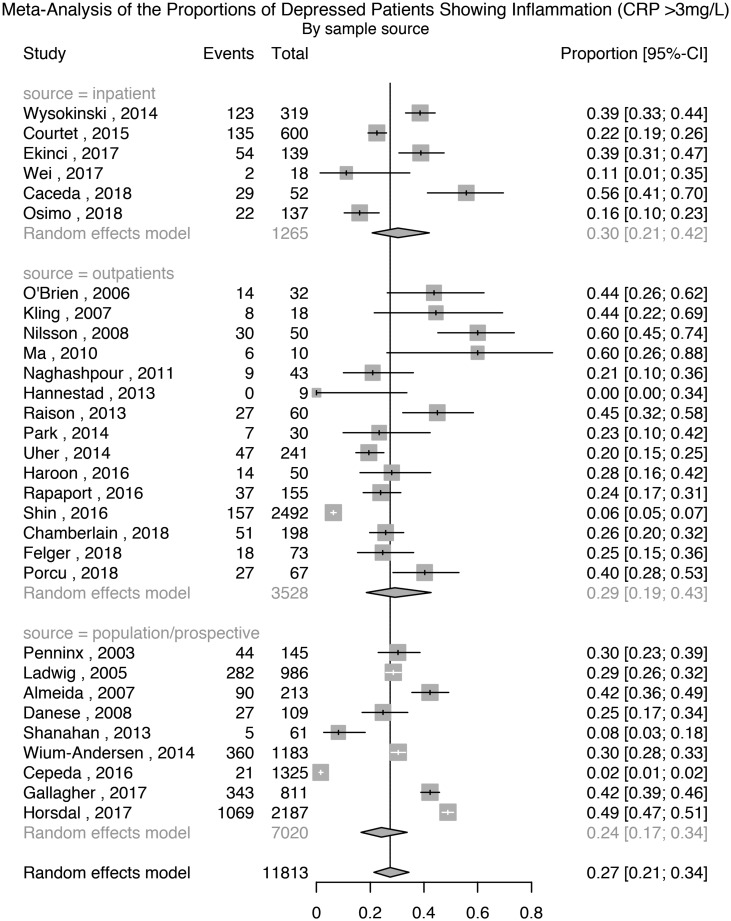
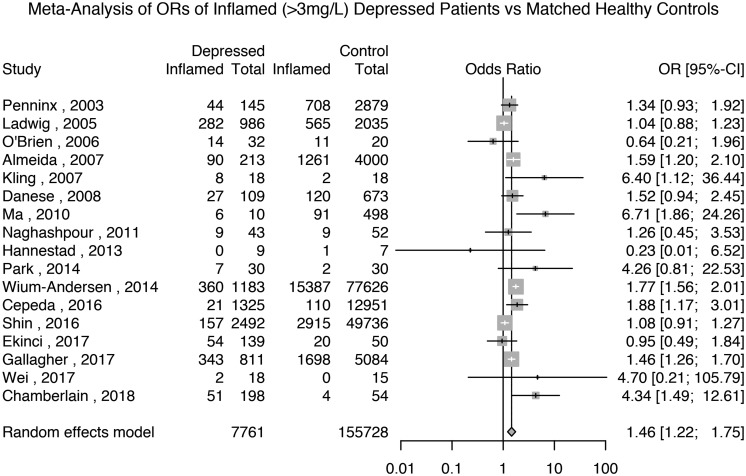
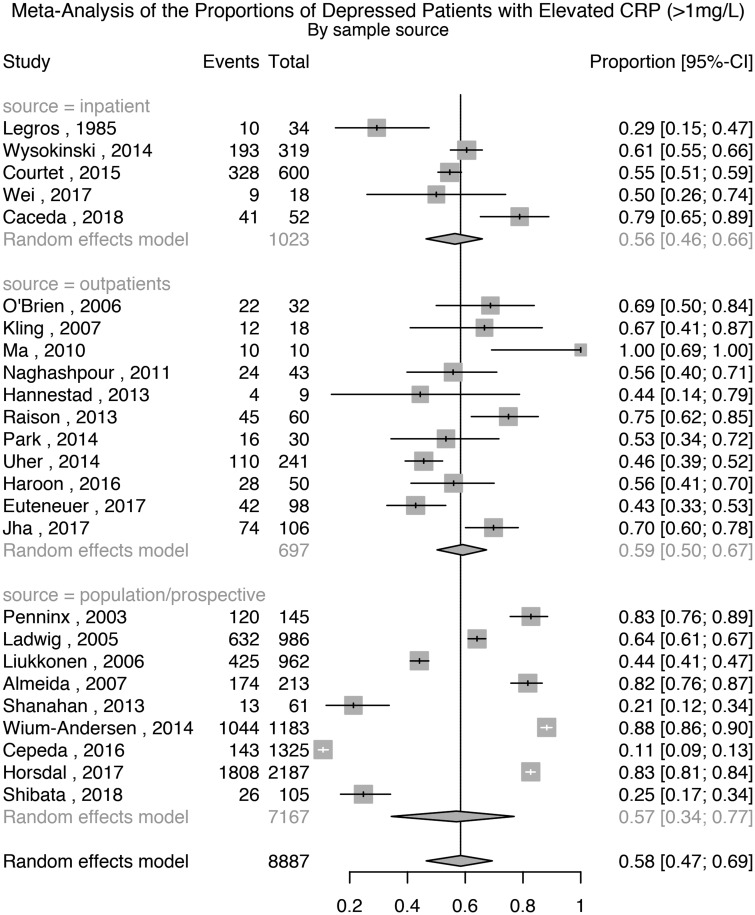
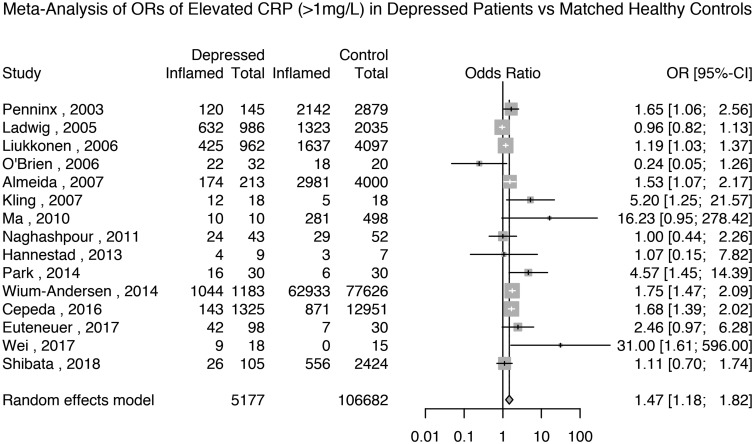
Background: Peripheral low-grade inflammation in depression is increasingly seen as a therapeutic target. We aimed to establish the prevalence of low-grade inflammation in depression, using different C-reactive protein (CRP) levels, through a systematic literature review and meta-analysis. Methods: We searched the PubMed database from its inception to July 2018, and selected studies that assessed depression using a validated tool/scale, and allowed the calculation of the proportion of patients with low-grade inflammation (CRP >3 mg/L) or elevated CRP (>1 mg/L). Results: After quality assessment, 37 studies comprising 13 541 depressed patients and 155 728 controls were included. Based on the meta-analysis of 30 studies, the prevalence of low-grade inflammation (CRP >3 mg/L) in depression was 27% (95% CI 21–34%); this prevalence was not associated with sample source (inpatient, outpatient or population-based), antidepressant treatment, participant age, BMI or ethnicity. Based on the meta-analysis of 17 studies of depression and matched healthy controls, the odds ratio for low-grade inflammation in depression was 1.46 (95% CI 1.22–1.75). The prevalence of elevated CRP (>1 mg/L) in depression was 58% (95% CI 47–69%), and the meta-analytic odds ratio for elevated CRP in depression compared with controls was 1.47 (95% CI 1.18–1.82). Conclusions: About a quarter of patients with depression show evidence of low-grade inflammation, and over half of patients show mildly elevated CRP levels. There are significant differences in the prevalence of low-grade inflammation between patients and matched healthy controls. These findings suggest that inflammation could be relevant to a large number of patients with depression.
Overview
The claims and statistics of this paper haven’t been checked yet.
Free: it reads the open-access text and checks the first 5 claims that cite a source we can check. Create a free account to check every claim.
Integrity signals
Registry
Cites
Statistics
Figures
Verification
Claims the paper makes
The claims and statistics of this paper haven’t been checked yet.
Free: it reads the open-access text and checks the first 5 claims that cite a source we can check. Create a free account to check every claim.
Claims other papers make about this one
Each is checked against this paper’s own text: does it say what the citing paper says it does?
The source backs part of the claim, not all of it — or backs it for a different population, condition or comparison.
In the citing paper
“Higher plasma levels of inflammatory cytokines, most consistently interleukin IL-1β, IL-6, and TNF-α, are correlated with greater depressive symptomatology.”
From Chronic stress, neuroinflammation, and depression: an overview of pathophysiological mechanisms and emerging anti-inflammatories (2023) · cites this paper as [6]
Experimental — accuracy not yet measuredThe cited source says what the claim attributes to it.
In the citing paper
“Low-grade inflammation – as indexed by a concentration of C-reactive protein (CRP) higher than 3 mg/L – is more likely in individuals with depression than in matched controls, occurring in around a quarter of the former according to a large meta-analysis (OR: 1.46, 95% CI: 1.22-1.75)205.”
From Comorbidity between major depressive disorder and physical diseases: a comprehensive review of epidemiology, mechanisms and management (2023) · cites this paper as [205]
In the citing paper
“Data were confirmed by a recent meta-analysis that included 13,541 depressed patients and 155,728 controls [121]. In 27% of the depressive patients there was a low-grade of inflammation (i.e., CRP > 3.0 mg/L) and over half of the patients showed a mildly elevated CRP level [121].”
From C-Reactive protein as a biomarker for major depressive disorder? (2022) · cites this paper as [121]
In the citing paper
“A very limited number of studies on CRP excluded participants presenting with an acute infection (CRP > 10 mg/L); we decided to include these studies because we previously found that the odds ratio of inflammation in patients vs controls is very similar if considering all patients (OR = 1.46) or excluding patients and controls with CRP > 10 mg/L (OR = 1.44) (Osimo et al., 2019), thus suggesting”
From Inflammatory markers in depression: a meta-analysis of mean differences and variability in 5,166 patients and 5,083 controls (2020) · cites this paper as Osimo et al., 2019
Self-check
Percentages, sums and reported differences re-computed from the paper’s own numbers.
The self-check needs the paper’s full text.
Citations
Cites
Quantifying heterogeneity in a meta‐analysis
Higgins, J. P. T., & Thompson, S. G. (2002) · Statistics in Medicine · doi:10.1002/sim.1186 · Cited by 36,763 · cited 1×
“Heterogeneity was tested using Cochrane’s Q-Test (Higgins and Thompson, 2002).”
Stang, A. (2010) · European Journal of Epidemiology · doi:10.1007/s10654-010-9491-z · Cited by 17,396 · cited 2×
“Study quality was assessed using the Newcastle–Ottawa Scale (Stang, 2010).”
MethodMolecular Mechanisms of Depression: Perspectives on New Treatment Strategies
Lang, U. E., & Borgwardt, S. (2013) · Cellular Physiology and Biochemistry · doi:10.1159/000350094 · Cited by 8,475
From inflammation to sickness and depression: when the immune system subjugates the brain
Dantzer, R., O'Connor, J. C., Freund, G. G., Johnson, R. W., & Kelley, K. W. (2008) · Nature Reviews Neuroscience · doi:10.1038/nrn2297 · Cited by 7,395 · cited 2×
“…commonly seen following an acute infection, shares many characteristics with depression, such as fatigue, sleep disturbance and decreased motivation (Dantzer et al., 2008); early-life infection and autoimmune diseases are associated with a higher risk of depression in adulthood (Benros et al.,…”
BackgroundPearson, T. A., Mensah, G. A., Alexander, R. W., Anderson, J. L., Cannon, R. O., Criqui, M., Fadl, Y. Y., Fortmann, S. P., Hong, Y., Myers, G. L., et al. (2003) · Circulation · doi:10.1161/01.cir.0000052939.59093.45 · Cited by 6,401 · cited 9×
“The American Heart Association and Center for Disease Control and Prevention have proposed clear CRP thresholds as indicators of inflammation levels (<1 = ‘low’, 1–3 = ‘medium’, >3 mg/L = ‘high’) (Pearson et al., 2003).”
BackgroundMethodInfluentialDiagnostic Criteria for Use in Psychiatric Research
Feighner, J. P. (1972) · Archives of General Psychiatry · doi:10.1001/archpsyc.1972.01750190059011 · Cited by 5,715
A Meta-Analysis of Cytokines in Major Depression
Dowlati, Y., Herrmann, N., Swardfager, W., Liu, H., Sham, L., Reim, E. K., & Lanctôt, K. L. (2010) · Biological Psychiatry · doi:10.1016/j.biopsych.2009.09.033 · Cited by 4,729 · cited 7×
“Meta-analyses of crosssectional studies confirm that mean concentrations of circulating CRP and inflammatory cytokines such as interleukin 6 (IL-6) are higher in patients with acute depression compared with controls (Howren et al., 2009; Dowlati et al., 2010; Haapakoski et al., 2015; Goldsmith et al., 2016).”
BackgroundResultInfluentialC-Reactive Protein, Interleukin 6, and Risk of Developing Type 2 Diabetes Mellitus
Pradhan, A. D. (2001) · JAMA · doi:10.1001/jama.286.3.327 · Cited by 4,433 · cited 1×
“In addition to depression and CVD, inflammation is associated with other physical and psychiatric disorders including diabetes mellitus (Pradhan et al., 2001), schizophrenia (Miller et al.”
BackgroundDanesh, J., Wheeler, J. G., Hirschfield, G. M., Eda, S., Eiriksdottir, G., Rumley, A., Lowe, G. D. O., Pepys, M. B., & Gudnason, V. (2004) · New England Journal of Medicine · doi:10.1056/nejmoa032804 · Cited by 2,953
Associations of depression with C-reactive protein, IL-1, and IL-6: a meta-analysis.
Howren, M. B., Lamkin, D. M., & Suls, J. (2009) · Psychosomatic Medicine · doi:10.1097/psy.0b013e3181907c1b · Cited by 2,766 · cited 7×
“Meta-analyses of crosssectional studies confirm that mean concentrations of circulating CRP and inflammatory cytokines such as interleukin 6 (IL-6) are higher in patients with acute depression compared with controls (Howren et al., 2009; Dowlati et al., 2010; Haapakoski et al., 2015; Goldsmith et al., 2016).”
BackgroundResultInfluential
Research works printed but not linked: 3
- Osimo, 2018, Prevalence of low-grade inflammation in depression: a review and meta-analysis of CRP data, PROSPERO
- Urbanek, 2015, Cairo: R graphics device using Cairo graphics library for creating high-quality bitmap (PNG, JPEG, TIFF), vector (PDF, SVG, PostScript) and display (X11 and Win32) output [Software], CRAN
- Khandaker, 2019, Shared mechanism between depression and coronary heart disease: findings from Mendelian randomization analysis of a large UK population-based cohort, Molecular Psychiatry
Cited by
Items 601–700 of 773
Zhang, Y., Zheng, Y., Zhang, Y., Meng, W., & Chen, C. (2026) · The International Journal of Psychiatry in Medicine · doi:10.1177/00912174261464297 · Cited by 1
Salzmann, S., Euteneuer, F., Domroese, R., Boeken, U., Lichtenberg, A., Dinger, U., Zimmermann, C., Neumann, M., Schäfer, R., & Markser, A. M. (2026) · Brain Behavior & Immunity - Health · doi:10.1016/j.bbih.2026.101306 · Cited by 1
“Serum CRP concentrations have also been found to be elevated in a substantial proportion of patients with major depressive disorder (Wium-Andersen et al., 2013; Osimo et al., 2019, 2020; Pitharouli et al., 2021).”
Kordas, B. (2026) · Nutrients · doi:10.3390/nu18162716 · Cited by 1
“The same applies to inflammation, as elevated inflammatory markers are found mainly in a subgroup of patients [2–4].”
Herrera, M. J. (2021) · STARS (University of Central Florida) · Cited by 1
Immunotherapies for Depression
Kappelmann, N., Bullmore, E. T., & Khandaker, G. M. (2021) · Cambridge University Press eBooks · doi:10.1017/9781108539623.009 · Cited by 1
Self-citationPerceived stress and depressive symptoms in undergraduate students: The effect of emotional eating
Amestoy, M. E., & Fiocco, A. J. (2021) · Journal of Student Research · doi:10.47611/jsr.v10i3.1281 · Cited by 5
“In recent years, research has revealed peripheral inflammation as a potential antecedent in the development of depression (Lee & Giuliani, 2019), evidenced by increased low-grade inflammation among patients with depression relative to healthy controls (Osimo et al., 2019), and prospective longitudinal studies associat…”
Backgroundda Silva, C. S., Teles, G. D. O., Marques, V. A., Silva, M. S., Rebelo, A. C. S., & Fiuza, T. D. S. (2022) · Research Society and Development · doi:10.33448/rsd-v11i1.25000 · Cited by 2
“(2021) identified that in young people aged up to 24 years, obesity is a risk factor for depression, as it promotes dysregulation of the hypothalamic-pituitaryadrenal axis, insulin resistance, and psychological distress (Osimo et al., 2019).”
BackgroundZhang, Y., Chen, J., Tang, R., Deng, J., Guo, H., Wu, X., & Xu, Q. (2023) · BMC Nephrology · doi:10.1186/s12882-023-03291-2 · Cited by 1
“0 mg/L was defined as normal and ≥ 3 mg/L is considered a clinically significant status of low-grade inflammation [17].”
BackgroundKlettke, E. E., Holmes, M. D., Meyer, T. D., & Jones, G. H. (2023) · Personalized Medicine in Psychiatry · doi:10.1016/j.pmip.2023.100112 · Cited by 1
Depressive Symptoms are Associated With C-Reactive Protein in Older Adults With Obesity
Heisey, H. D., Qualls, C., Villareal, D. T., Segoviano-Escobar, M. B., Nava, M. L. D., Gatchel, J. R., & Kunik, M. E. (2023) · Journal of Geriatric Psychiatry and Neurology · doi:10.1177/08919887231215041 · Cited by 1
“12 Elevation in hs-CRP may precede development of depressive symptoms in older adults 13 ; and, mechanistically, elevations in hs-CRP may induce depressive symptoms through disruption of normal endothelial function at the blood-brain barrier.”
BackgroundSharpley, C. F., Evans, I. D., Bitsika, V., Arnold, W. M., Jesulola, E., & Agnew, L. L. (2023) · Symmetry · doi:10.3390/sym15122201 · Cited by 3
An Evolutionary Psychoneuroimmunological Approach to Major Depressive Disorder
Rantala, M. J., & Borráz-León, J. I. (2024) · Oxford University Press eBooks · doi:10.1093/med/9780197676592.003.0014 · Cited by 2
Nakada, S., Celis-Morales, C. A., Pell, J. P., & Ho, F. K. W. (2024) · Journal of Affective Disorders · doi:10.1016/j.jad.2024.12.060 · Cited by 4
“A meta-analysis showed that the association between depression and a CRP concentration > 3 mg/L had an odds ratio of 1.46 (95 % CI: 1.22 – 1.75) (Osimo et al., 2019).”
InfluentialHuang, S.-M., Wu, F.-H., Ma, K.-J., & Wang, J. (2025) · BMC Psychiatry · doi:10.1186/s12888-025-06652-3 · Cited by 3
“This is because inflammation disrupts key neurotransmitter systems, including serotonin, dopamine, and glutamate pathways, which are crucial for mood regulation, as well as the neurotoxic metabolites produced through the tryptophan-kynuren-ine pathway [12].”
Les premiers succès de la piste immuno-métabolique en psychiatrie de précision
Godin, O., Frajerman, A., Lengvenytė, A., Bernard, J., Andreazza, A. C., Étain, B., & Leboyer, M. (2025) · médecine/sciences · doi:10.1051/medsci/2025063 · Cited by 3
Volkos, P., Linardakis, M. K., & Symvoulakis, E. K. (2025) · Journal of Clinical Medicine · doi:10.3390/jcm14124236 · Cited by 2
“Two meta-analyses have reported direct associations between depression and inflammation, as measured by CRP, in both adolescents and adults [8,9].”
Wang, K.-X., Liu, G.-F., Pan, Y., Li, S., Zhu, X., Qu, H., Liang, X.-S., Chen, S., & Fu, W. (2025) · Journal of Affective Disorders · doi:10.1016/j.jad.2025.119736 · Cited by 1
Does caregiver stress get under the skin? Associations with care recipient inflammation
Tsuker, S., Liu, Y., Bangerter, L. R., Baker, E., Lee, H., & Leggett, A. N. (2025) · The Gerontologist · doi:10.1093/geront/gnaf175 · Cited by 1
O’Shields, J., & Mowbray, O. P. (2021) · Brain Behavior & Immunity - Health · doi:10.1016/j.bbih.2021.100316 · Cited by 1
Wang, X., Yi, G., Wu, L., Zhou, H., & He, J. (2024) · Research Square · doi:10.21203/rs.3.rs-4207923/v1 · Cited by 1
Targeting Inflammation: How Meta-Analysis Can Advance Precision Psychiatry
Lamers, F. (2026) · American Journal of Psychiatry · doi:10.1176/appi.ajp.20251108 · Cited by 1
Rnic, K. (2019) · Scholarship@Western (Western University) · Cited by 1
Euteneuer, F., Neubert, M., Salzmann, S., Unruh, I., von Eitzen, L., & Wilhelm, M. (2020) · Verhaltenstherapie · doi:10.1159/000505275 · Cited by 1
“…immunologischen und autonomen Veränderungen sind nicht spezifisch für die Major Depression und können nicht als notwendige oder hinreichende Bedingungen für depressive Störungen betrachtet werden [Kiecolt-Glaser et al., 2015; Kemp et al., 2017; Euteneuer et al., 2017a; Osimo et al., 2019].”
BackgroundP.730 Characteristics of inflammation-related depression
Foley, É. M., Parkinson, J. T., & Khandaker, G. M. (2020) · European Neuropsychopharmacology · doi:10.1016/j.euroneuro.2020.09.537
Self-citationIs depression associated with the risk of cardiovascular disease or vice versa?
Baysak, E., & Arıcıoğlu, F. (2020) · Clinical and Experimental Health Sciences · doi:10.33808/clinexphealthsci.824534
“Also, higher levels of CRP at baseline are associated with an increased risk of depression in subsequent follow-ups (62).”
BackgroundKarakuła, K. H., Padała, O., Ryczkowski, A. J., Forma, A., & Juchnowicz, D. (2020) · Current Problems of Psychiatry · doi:10.2478/cpp-2020-0023
Uygur, A. B., & Çankaya, Ş. (2021) · Acta Medica Alanya · doi:10.30565/medalanya.880254
Prospects for the use of drugs with anti-inflammatory properties for the treatment of depression
Komysheva, N. P., & Shishkina, G. T. (2021) · S S Korsakov Journal of Neurology and Psychiatry · doi:10.17116/jnevro2021121061124
Holmskov, J., Licht, R. W., Andersen, K., Nilsson, F. M., Valentin, J. B., Stage, K. B., & Nielsen, R. E. (2021) · The European Journal of Psychiatry · doi:10.1016/j.ejpsy.2021.04.001
Pop, M., & Tarba, C. (1988) · PubMed
Peripheral biomarkers in Repeated Ketamine Infusions Trial
Geel, A. V. (2021) · Carleton University's Institutional Repository (MacOdrum Library, Carleton University) · doi:10.22215/etd/2021-14775
Zhang, Y., Dong, Y., Zhu, Y., Sun, D., Wang, S., Weng, J., Zhu, Y., Yu, B., & Jiang, Y. (2022) · SSRN Electronic Journal · doi:10.2139/ssrn.4017414
Franklyn, S. I. (2020) · Carleton University's Institutional Repository (MacOdrum Library, Carleton University) · doi:10.22215/etd/2020-14356
zhang, R., Liang, X., Wang, B., Ma, H., & Yang, L. (2022) · Research Square · doi:10.21203/rs.3.rs-1784771/v1 · Cited by 2
Beslenme ve Mikrobiyotanın Depresyon Üzerine Olası Etkileri
Koç, E., & Duman, E. (2022) · Bandırma Onyedi Eylül Üniversitesi Sağlık Bilimleri ve Araştırmaları Dergisi · doi:10.46413/boneyusbad.1105519
Han, Y. (2022) · Frontiers in Medical Science Research · doi:10.25236/fmsr.2022.040203
Romankiewicz, L., Schaare, H. L., Nestler, S., Villringer, A., & Blöchl, M. (2022) · doi:10.31234/osf.io/m8zv4
Association of C-Reactive Protein (CRP) with Bipolar Disorder & Gender
Tariq, T., Noor, A., Akram, S., Khan, M. A., Ibad, N., Tariq, F., Fahim-Ul-Haq, M., & Shahid, S. (2022) · Pakistan Journal of Medical and Health Sciences · doi:10.53350/pjmhs221610233
“Monitoring CRP levels in the blood offers a trustworthy indicator of inflammation brought on by viral diseases and other inflammatory triggers((7)).”
BackgroundJarkas, D. (2022) · Carleton University's Institutional Repository (MacOdrum Library, Carleton University) · doi:10.22215/etd/2022-15321
Schiweck, C., Aichholzer, M., Reif-Leonhard, C., Reif, A., & Thanarajah, S. E. (2022) · Neuroscience Applied · doi:10.1016/j.nsa.2022.100777
Habets, P. C., Thomas, R. M., Milaneschi, Y., Jansen, R., Pool, R., Peyrot, W. J., Penninx, B. W. J. H., Meijer, O. C., van Wingen, G. A., & Vinkers, C. H. (2023) · bioRxiv (Cold Spring Harbor Laboratory) · doi:10.1101/2023.01.10.523383
Liu, B., Zhang, S., Sun, L., Huang, L., Zhang, R., Liu, Z., & An, L. (2023) · Research Square · doi:10.21203/rs.3.rs-2812900/v1
Research Progress on Biological Markers of Suicide in Patients with Schizophrenia
高, 贺. (2023) · Advances in Clinical Medicine · doi:10.12677/acm.2023.1351025
Yap, S. Y., Foo, C. N., Lim, Y. M., Ng, F. L., Tang, P. Y., Singh, J. K. N., Sidik, S. M., & Pheh, K. S. (2023) · International Electronic Conference on Biomedicines (IECBM) · doi:10.3390/ecb2023-14089
“A meta-analysis consisting of 30 studies with 11,813 participants showed that the presence of low-grade inflammation and elevated CRP levels were found in depressed patients [15].”
MethodImmune, inflammatory, and neural systems in neuropsychiatric disease
Bertsch-Gout, M., Reder, A. T., & Lee, R. (2023) · Elsevier eBooks · doi:10.1016/b978-0-12-817558-3.00017-2
Immunological Changes and Brain Function over a Psychotic-Depressive Spectrum
Paul, E. R. (2023) · Linköping University medical dissertations · doi:10.3384/9789180753098
Associação entre eventos de vida, depressão e doença periodontal: revisão de literatura
Santos, L. G., Neto, A. A. S., Pereira, A. D. L., Cordeiro, W. A., & Cunha, P. D. O. (2023) · Brazilian Journal of Health Review · doi:10.34119/bjhrv6n6-056
Meller, F. D. O., Manosso, L. M., Quadra, M. R., da Silva, T. J., Eugênio, F. D., Honorato, M. F., & Schäfer, A. A. (2023) · Revista Contexto & Saúde · doi:10.21527/2176-7114.2023.47.14702 · Cited by 2
Sex differences in the association between peripheral inflammation and melancholia symptoms
Sharpley, C. F., Bitsika, V., Arnold, W. M., Evans, I. D., Jesulola, E., & Agnew, L. L. (2024) · Psychiatry Research Communications · doi:10.1016/j.psycom.2024.100163
Kosar, E. B., Manavlı, B., Dilek, O., Çolak, G., & Demirtürk, N. (2024) · Klimik Dergisi/Klimik Journal · doi:10.36519/kd.2024.4604
Amestoy, M. E., & Fiocco, A. J. (2024) · doi:10.32920/25569636.v1
Amestoy, M. E., & Fiocco, A. J. (2024) · doi:10.32920/25569636
Meilicke, H. M. X., Hui, Y., Li, J., Čolić, L., Wu, S., Chen, S., Zhang, S., Li, R., Lv, B., Li, H., et al. (2024) · Biomarkers in Neuropsychiatry · doi:10.1016/j.bionps.2024.100094
MNLFA NhanesPreprint
Moriarity, D. P., Sullivan‐Toole, H., Gassen, J., Lee, C., Olino, T. M., & Slavich, G. M. (2024) · PsyArXiv (OSF Preprints) · doi:10.31234/osf.io/jqvdn
Muneer, A., Munir, N., Shams, N., Inam, M., Ghani, U., & Ayub, N. (2023) · Journal of Rawalpindi Medical College · doi:10.37939/jrmc.v27i4.2343
Psychological Condition of Nurses in the Aftermath of COVID-19 - Indonesian Nurses’ Perspective
Rokhman, A., Hidayati, N. L., & Ubudiyah, M. (2024) · Babali Nursing Research · doi:10.37363/bnr.2024.52354 · Cited by 2
Chapter 5. Brain–Immune System Interactions
Dhabhar, F. S., Raison, C. L., & Miller, A. H. (2024) · American Psychiatric Association Publishing eBooks · doi:10.1176/appi.books.9781615375523.as05
Yao, X., Lü, S., Zhou, K., Li, N., Wang, Y., Hong, J., & Sun, L. (2024) · Sleep And Breathing · doi:10.1007/s11325-024-03118-w
“The population-based studies showed an elevated level of C-reactive protein (CRP) in individuals with depression [ 12 ] was associated with a rise in depressive symptoms [ 13 – 15 ] or a greater score of depression score [ 16 ].”
Gillespie, C. F., & Nemeroff, C. B. (2024) · Elsevier eBooks · doi:10.1016/b978-0-443-19176-3.00046-7
Optimal Sleep Durations for Depression Prevention: Evidence from the China Family Panel StudiesPreprint
Song, Y., Chen, L., Liu, H., & Liu, Y. (2024) · Research Square · doi:10.21203/rs.3.rs-5460471/v1
Research Progress on Biomarkers of the Depression
Liu, Y. (2024) · Highlights in Science Engineering and Technology · doi:10.54097/740eqh03
“The result showed that the more severe the depressive symptoms, the higher the CRP level (r = 0.27, p = 0.03) [2].”
InfluentialThe Role of the Immune System in Creating Depression, Post-traumatic-Stress-Disorder, and Psychosis
Littrell, J. L. (2024) · Integrated science · doi:10.1007/978-3-031-72079-6_2 · Cited by 1
de Azevedo, S. C., Feiten, J. G., Fleck, M. P., & Caldieraro, M. A. (2025) · Journal of Psychiatric Research · doi:10.1016/j.jpsychires.2025.01.039
Lemogne, C., Vedrines, C. O., Capuron, L., & Hoertel, N. (2025) · Revue du Rhumatisme · doi:10.1016/j.rhum.2025.05.011
Genetic liability to depression and cerebral small vessel disease: A mendelian randomization study
Wang, M., Daghlas, I., & Wei, N. (2025) · Journal of Stroke and Cerebrovascular Diseases · doi:10.1016/j.jstrokecerebrovasdis.2025.108385
Tagar, M., Batool, S., Kalhoro, M. A., Shoro, P., Memon, N., & Laghari, H. (2025) · Pakistan Journal of Pathology · doi:10.55629/pakjpathol.v36i2.906 · Cited by 1
Polycystás ovarium szindrómás betegek életminőségét vizsgáló kérdőív magyar nyelvű adaptációja
Nagy, V., & Papp-Zipernovszky, O. (2025) · Orvosi Hetilap · doi:10.1556/650.2025.33312
Gut Barrier Permeability, Microbiota, and Brain Health: Oxford Handbook
Madison, A. A., Duff, A. F., & Bailey, M. T. (2025) · Oxford University Press eBooks · doi:10.1093/oxfordhb/9780190931544.013.17
Koloi, A., Dobretz, K., Damman, D., Quax, R., Zaridis, D. I., Papaloukas, C. L., Fotiadis, D. I., & Bosch, J. A. (2025) · Research Square · doi:10.21203/rs.3.rs-6422455/v1
Examining whether inflammation mediates effects of genetic risk and trauma on psychopathology
Lilford, P., Hammerton, G., Khandaker, G. M., Hall, J., Zammit, S., & Jones, H. J. (2025) · BJPsych Open · doi:10.1192/bjo.2025.10054
“12 Similarly, schizophrenia is a complex syndrome with a wide variety of phenotypes.”
Self-citationMeier, L., Mulaw, M. A., Durner, V., Schäfer, L., Schönfeldt‐Lecuona, C., Bopp, V., Graf, H., Otto, M., Steinacker, P., Großkopf, H., et al. (2025) · bioRxiv (Cold Spring Harbor Laboratory) · doi:10.1101/2025.08.12.669833
“Emerging evidence suggests that a subset of patients suffering from depression shows a pattern of inflammation, indicated by elevated cytokine and acute-phase protein levels 4,5 .”
Lei, D., Liu, Q., He, Q., & Fu, Z. (2025) · Frontiers in Psychiatry · doi:10.3389/fpsyt.2025.1607551
Treiber, M., Baune, B. T., Gramser, A., Saelens, J., Grüll, N., Rössler, K., Novak, K., Bouzouina, A., Thanarajah, S. E., Reif-Leonhard, C., et al. (2025) · SSRN Electronic Journal · doi:10.1101/2025.08.31.25334709
“A growing body of evidence supports the notion of Inflammation as a major factor in the pathogenesis and the course of MDD (Karageorgiou et al., 2023; Kofod et al., 2022; Osimo et al., 2019; Sforzini et al., 2025).”
Dyndał, K., Broda, M., Jędrzejewska-Rzezak, P., Mokrzycka, A., Żuczek, A., Urbańska, K., Szczap, I., Hawryluk, A., Żuczek, O., & Marzec, K. (2025) · International Journal of Innovative Technologies in Social Science · doi:10.31435/ijitss.3(47).2025.3901 · Cited by 3
Mori, K., Kodaka, F., Ishii, J., Oka, N., Kondo, K., & Kito, S. (2025) · Neuropsychopharmacology Reports · doi:10.1002/npr2.70055
“Previous studies targeting depression reported an odds ratio of 12.2 for SITH-1, whereas the conventional inflammatory markers, such as C-reactive protein and interleukin-6, typically exhibit an odds ratio of 1.0 to 1.5 [32, 33].”
InfluentialAltered gut microbiota and inflammatory markers in depression: A cross-sectional study.
Pati, S. S., Biswal, S. P., Sahoo, D., & Mahanta, J. (2025) · Student s Journal of Health Research Africa · doi:10.51168/sjhrafrica.v6i6.1911
Song, Y., Liu, Y., & Liu, L. N. (2025) · Frontiers in Psychiatry · doi:10.3389/fpsyt.2025.1680714
Schillo, S., Schiweck, C., Aichholzer, M., Yotova, A. Y., Tsengenbayar, T., Thanarajah, S. E., Reif, A., & Freudenberg, F. (2025) · Frontiers in Psychiatry · doi:10.3389/fpsyt.2025.1576880
“Increasing evidence shows an association between elevated in fl ammatory markers in both serum and cerebrospinal fl uid, severity of depression (22), and treatment resistance (7).”
Albertson, D. N., Tracy, D. K., Joyce, D. W., & Shergill, S. S. (2025) · Cambridge University Press eBooks · doi:10.1017/9781009028967.016
Bastelica, T., Carré, A., Lespine, L., Boukouaci, W., Wu, C., Pelletier, A., Étain, B., Bellivier, F., Aouizerate, B., Martinez, P., et al. (2025) · Brain Behavior and Immunity · doi:10.1016/j.bbi.2025.106164 · Cited by 1
Asdaq, S. M. B., Imran, M., Alsanie, W. F., Alamri, A. S., Alhomrani, M., Alshammary, A. F., Sultana, R., Mannasaheb, B. A., Rabbani, S. I., & Almuqbil, M. S. (2025) · Scientific Reports · doi:10.1038/s41598-025-23235-0 · Cited by 2
Jeon, S., & Lee, Y. (2025) · Journal of Korean Biological Nursing Science · doi:10.7586/jkbns.25.042
Value-based cognitive control moderates the relation of inflammation with depression in adolescents
Yuan, J. P., Miller, J. G., Joachimsthaler, J., Uy, J. P., Ho, T. C., & Gotlib, I. H. (2025) · Social Cognitive and Affective Neuroscience · doi:10.1093/scan/nsaf121
Manook, A., Hiergeist, A., Liebisch, G., Dischinger, U., Petrera, A., Schwarzbach, J. V., Gessner, A., Gruber, O., & Baghai, T. C. (2025) · medRxiv · doi:10.64898/2025.12.01.25341376
Admixture Analysis of Age of Onset in Late-Life Major Depressive Disorder
Kabia, F. M., Roelfsema, H. S., Aderka, I. M., Ottenheim, N. R., Kok, A. A. L., Beekman, A. T. F., Rhebergen, D., & Hegeman, A. J. M. (2025) · American Journal of Geriatric Psychiatry · doi:10.1016/j.jagp.2025.12.002
Additional file 1 of Depression after stoma surgery: a systematic review and meta-analysis
Kovoor, J. G., Jacobsen, J. H. W., Stretton, B., Bacchi, S., Gupta, A. K., Claridge, B., van der Steen, M., Bhanushali, A., Bartholomeusz, L., Edwards, S., et al. (2023) · Figshare · doi:10.6084/m9.figshare.23083987
Palazuelos-González, R., Salinas-Rodríguez, A., & Manrique-Espinoza, B. (2023) · Research Square · doi:10.21203/rs.3.rs-3582657/v1
Teepe, G. W., Lukic, Y. X., Kleim, B., Jacobson, N. C., Schneider, F., Santhanam, P., Fleisch, E., & Kowatsch, T. (2024) · Figshare · doi:10.6084/m9.figshare.26599091
Predictive comparison of specific depression symptoms for peripheral inflammation
Seizer, L. (2026) · Brain Behavior and Immunity · doi:10.1016/j.bbi.2026.106258
Abebe, E. C., Mulugeta, A., Madakkatel, I., Stacey, D., & Hyppönen, E. (2026) · Journal of Affective Disorders · doi:10.1016/j.jad.2025.121134 · Cited by 1
Metabolic shifts, a consequence of hyperosmolarity, are a hallmark of mental disorders
Schwartz, L. H., Bakkar, A., Bouillaud, F., Attal, R., & Leboyer, M. (2026) · Journal of Psychiatric Research · doi:10.1016/j.jpsychires.2026.01.047
Understanding nutrition beyond calories and vitamins—why plants are beneficial
Lee, M. F., & Storz, M. A. (2026) · Elsevier eBooks · doi:10.1016/b978-0-443-33841-0.00022-1
Cortisol and C-reactive protein interact to predict depressive symptoms
Doan, S. N., Hoell, D. J., & Fuller‐Rowell, T. E. (2026) · Psychoneuroendocrinology · doi:10.1016/j.psyneuen.2026.107780 · Cited by 2
“Plasma CRP is correlated with other pro-inflammatory biomarkers in both plasma and cerebrospinal fluid (Felger et al., 2020), and associated with depressive symptoms (Osimo et al., 2019) longitudinally (Mac Giollabhui et al., 2021).”
Genetic evidence for repurposing immunomodulatory drugs for major depressive disorderPreprint
Jesuthasan, J., ter Kuile, A., Roiser, J. P., Carvalho, L. A., Pitman, A., Chopade, S., Finan, C., Schmidt, A. F., & Pingault, J. (2026) · medRxiv · doi:10.64898/2026.02.07.26345798
Polyphenols and Probiotics Improve Mood Disorders by Regulating the Gut-Lung Axis
Dai, D., Hu, B., Hao, X., Xu, H., & Zhang, X. (2026) · Food Reviews International · doi:10.1080/87559129.2026.2631074
“[51] Both polyphenol and probiotic treatments contribute to BBB protection largely by lowering circulating IL-6 and TNF-α.”
An, H., Zhang, L., Li, Y., Liu, J., Zhu, H., He, L., & Zhao, Y. (2026) · Medicine · doi:10.1097/md.0000000000047657
Determinants and outcomes of pubertal stress recalibration process: A scoping review
Kwon, E., Adekunle, D., Ginty, A. T., Vichaya, E. G., Carriveau, K. L., & Oshri, A. (2026) · Biological Psychology · doi:10.1016/j.biopsycho.2026.109238 · Cited by 1
Yamada, T., Murakoshi, T., Nishiyama, A., Suzuki, R., & Adachi, H. (2026) · Journal of Midwifery & Women s Health · doi:10.1111/jmwh.70092
Seetharaman, A., Suresh, K., Thirumal, R., & Radhakrishnan, S. (2026) · European Journal of Clinical and Experimental Medicine · doi:10.15584/ejcem.2026.1.13
Metadata
- Authors
- Osimo, E. F., Baxter, L. J., Lewis, G., Jones, P. B., & Khandaker, G. M.
- Affiliations
- University of Cambridge (GB)
- University College London (GB)
- Corresponding author
- Osimo, Emanuele Felice
- Venue
- Psychological Medicine
- Publisher
- Cambridge University Press (CUP)
- Published
- 2019-07-01
- Volume
- 49
- Issue
- 12
- Pages
- 1958-1970
- ISSN
- 0033-2917 (ISSN-L)
- 1469-8978
- PMC
- PMC6712955
- OpenAlex
- W2955079055
- Cited by
- 774
- References
- 91
- Citations by year
- 2026: 126 · 2025: 141 · 2024: 119 · 2023: 127 · 2022: 107 · 2021: 100 · 2020: 49 · 2019: 4
- FWCI
- 3.94
- Type
- journal article
- Language
- en
- Open access
- hybrid
- doi.org
- Locations
- Psychological Medicine (publishedVersion, cc-by)
- PubMed Central (publishedVersion, cc-by)
- PubMed (publishedVersion)
- UCL Discovery (University College London) (submittedVersion)
- Explore Bristol Research (submittedVersion)
- Funders
- Wellcome Trust (RP-PG-0616-20003, 088869/Z/09/Z, 095844/Z/11/Z, 20003, 088869, /Z/11/Z, 201486 /Z/16/Z, 201486, MQDS17/40, 095844, MC_PC_17213)
- MQ: Transforming Mental Health (MQDS17/40)
- National Institute for Health and Care Research (MQDS17/40, RP-PG-0616-20003, ACF-2017-14-007)
- Medical Research Council (201486/Z/16/Z, MQDS17/40, MC_PC_17213)
- Topics
- Life Sciences › Neuroscience › Biological Psychiatry › Tryptophan and brain disorders
- Health Sciences › Medicine › Pharmacology (medical) › Treatment of Major Depression
- Life Sciences › Neuroscience › Behavioral Neuroscience › Stress Responses and Cortisol
- Keywords
- depression, low-grade inflammation, C-reactive protein, prevalence, depression biomarkers
- MeSH terms
- Antidepressive Agents, C-Reactive Protein, Depressive Disorder, Humans, Inflammation, Prevalence, Odds Ratio
About these checks
Registry, retraction, Cites and statistics results are computed, not judged, with one exception: a printed reference that no index lists is read once by a model before it counts as a citation error. Claims are extracted by a model and kept only when their quote appears verbatim in the text; each cited source is then checked, with a model’s help, for whether it says what the claim relies on. Those verdicts can be wrong — read the claim’s quote and the cited source before relying on one.
Statistics and arithmetic are recomputed, not judged.
Confidence bands are shown only for fields calibrated on our annotated test set. None is calibrated yet, so no band is shown.
What counts as a claim ›How we measure confidence ›How we check this ›
Are you an author, or do you see a problem with this page? Request a review
Data sources
Bibliographic data: Semantic Scholar, OpenAlex, Crossref.
Contains information from the Semantic Scholar Academic Graph Datasets, made available under the ODC Attribution License (ODC-BY 1.0).
Semantic Scholar’s data is described in: Kinney, R., et al. (2023). The Semantic Scholar Open Data Platform. arXiv:2301.10140.
