

Prevalence of low-grade inflammation in depression: a systematic review and meta-analysis of CRP levels
Open accessThe DOI matches its Crossref record; 91 of the 91 references it cites were found in a registry or an index.
Abstract
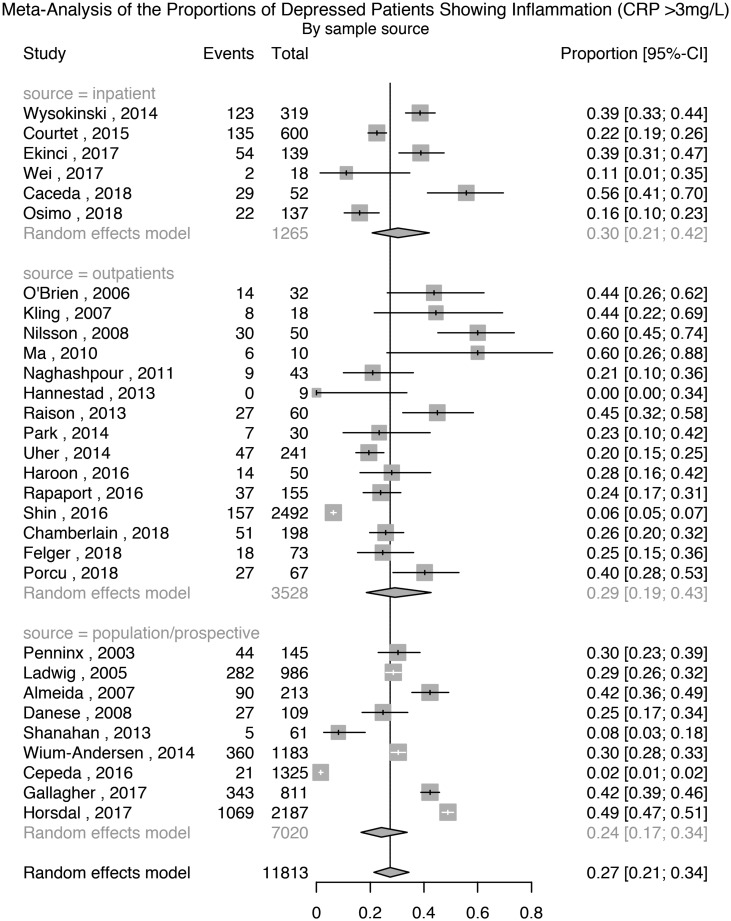
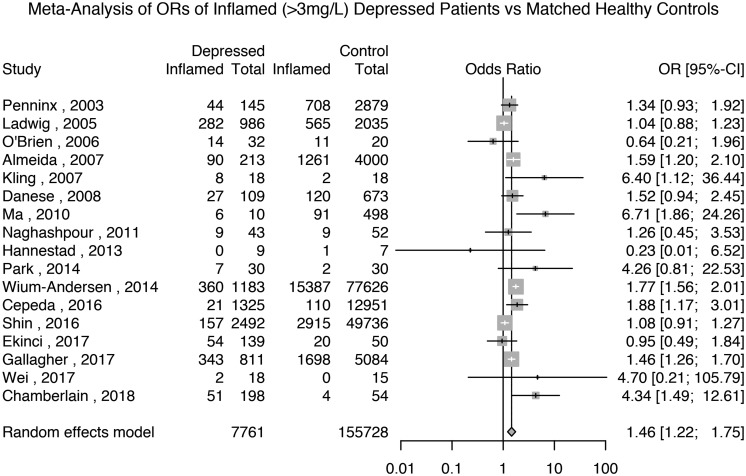
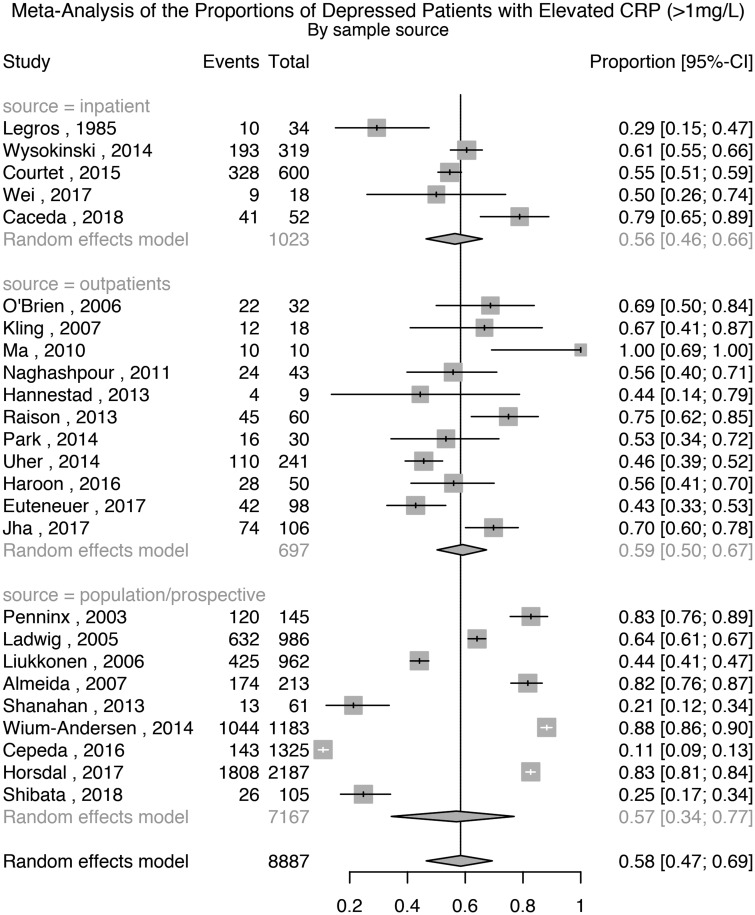
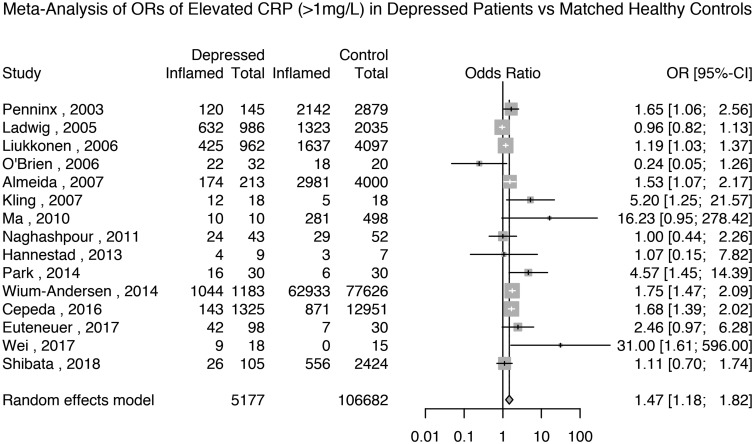
Background: Peripheral low-grade inflammation in depression is increasingly seen as a therapeutic target. We aimed to establish the prevalence of low-grade inflammation in depression, using different C-reactive protein (CRP) levels, through a systematic literature review and meta-analysis. Methods: We searched the PubMed database from its inception to July 2018, and selected studies that assessed depression using a validated tool/scale, and allowed the calculation of the proportion of patients with low-grade inflammation (CRP >3 mg/L) or elevated CRP (>1 mg/L). Results: After quality assessment, 37 studies comprising 13 541 depressed patients and 155 728 controls were included. Based on the meta-analysis of 30 studies, the prevalence of low-grade inflammation (CRP >3 mg/L) in depression was 27% (95% CI 21–34%); this prevalence was not associated with sample source (inpatient, outpatient or population-based), antidepressant treatment, participant age, BMI or ethnicity. Based on the meta-analysis of 17 studies of depression and matched healthy controls, the odds ratio for low-grade inflammation in depression was 1.46 (95% CI 1.22–1.75). The prevalence of elevated CRP (>1 mg/L) in depression was 58% (95% CI 47–69%), and the meta-analytic odds ratio for elevated CRP in depression compared with controls was 1.47 (95% CI 1.18–1.82). Conclusions: About a quarter of patients with depression show evidence of low-grade inflammation, and over half of patients show mildly elevated CRP levels. There are significant differences in the prevalence of low-grade inflammation between patients and matched healthy controls. These findings suggest that inflammation could be relevant to a large number of patients with depression.
Overview
The claims and statistics of this paper haven’t been checked yet.
Free: it reads the open-access text and checks the first 5 claims that cite a source we can check. Create a free account to check every claim.
Integrity signals
Registry
Cites
Statistics
Figures
Verification
Claims the paper makes
The claims and statistics of this paper haven’t been checked yet.
Free: it reads the open-access text and checks the first 5 claims that cite a source we can check. Create a free account to check every claim.
Claims other papers make about this one
Each is checked against this paper’s own text: does it say what the citing paper says it does?
The source backs part of the claim, not all of it — or backs it for a different population, condition or comparison.
In the citing paper
“Higher plasma levels of inflammatory cytokines, most consistently interleukin IL-1β, IL-6, and TNF-α, are correlated with greater depressive symptomatology.”
From Chronic stress, neuroinflammation, and depression: an overview of pathophysiological mechanisms and emerging anti-inflammatories (2023) · cites this paper as [6]
Experimental — accuracy not yet measuredThe cited source says what the claim attributes to it.
In the citing paper
“Low-grade inflammation – as indexed by a concentration of C-reactive protein (CRP) higher than 3 mg/L – is more likely in individuals with depression than in matched controls, occurring in around a quarter of the former according to a large meta-analysis (OR: 1.46, 95% CI: 1.22-1.75)205.”
From Comorbidity between major depressive disorder and physical diseases: a comprehensive review of epidemiology, mechanisms and management (2023) · cites this paper as [205]
In the citing paper
“Data were confirmed by a recent meta-analysis that included 13,541 depressed patients and 155,728 controls [121]. In 27% of the depressive patients there was a low-grade of inflammation (i.e., CRP > 3.0 mg/L) and over half of the patients showed a mildly elevated CRP level [121].”
From C-Reactive protein as a biomarker for major depressive disorder? (2022) · cites this paper as [121]
In the citing paper
“A very limited number of studies on CRP excluded participants presenting with an acute infection (CRP > 10 mg/L); we decided to include these studies because we previously found that the odds ratio of inflammation in patients vs controls is very similar if considering all patients (OR = 1.46) or excluding patients and controls with CRP > 10 mg/L (OR = 1.44) (Osimo et al., 2019), thus suggesting”
From Inflammatory markers in depression: a meta-analysis of mean differences and variability in 5,166 patients and 5,083 controls (2020) · cites this paper as Osimo et al., 2019
Self-check
Percentages, sums and reported differences re-computed from the paper’s own numbers.
The self-check needs the paper’s full text.
Citations
Cites
Quantifying heterogeneity in a meta‐analysis
Higgins, J. P. T., & Thompson, S. G. (2002) · Statistics in Medicine · doi:10.1002/sim.1186 · Cited by 36,763 · cited 1×
“Heterogeneity was tested using Cochrane’s Q-Test (Higgins and Thompson, 2002).”
Stang, A. (2010) · European Journal of Epidemiology · doi:10.1007/s10654-010-9491-z · Cited by 17,396 · cited 2×
“Study quality was assessed using the Newcastle–Ottawa Scale (Stang, 2010).”
MethodMolecular Mechanisms of Depression: Perspectives on New Treatment Strategies
Lang, U. E., & Borgwardt, S. (2013) · Cellular Physiology and Biochemistry · doi:10.1159/000350094 · Cited by 8,475
From inflammation to sickness and depression: when the immune system subjugates the brain
Dantzer, R., O'Connor, J. C., Freund, G. G., Johnson, R. W., & Kelley, K. W. (2008) · Nature Reviews Neuroscience · doi:10.1038/nrn2297 · Cited by 7,395 · cited 2×
“…commonly seen following an acute infection, shares many characteristics with depression, such as fatigue, sleep disturbance and decreased motivation (Dantzer et al., 2008); early-life infection and autoimmune diseases are associated with a higher risk of depression in adulthood (Benros et al.,…”
BackgroundPearson, T. A., Mensah, G. A., Alexander, R. W., Anderson, J. L., Cannon, R. O., Criqui, M., Fadl, Y. Y., Fortmann, S. P., Hong, Y., Myers, G. L., et al. (2003) · Circulation · doi:10.1161/01.cir.0000052939.59093.45 · Cited by 6,401 · cited 9×
“The American Heart Association and Center for Disease Control and Prevention have proposed clear CRP thresholds as indicators of inflammation levels (<1 = ‘low’, 1–3 = ‘medium’, >3 mg/L = ‘high’) (Pearson et al., 2003).”
BackgroundMethodInfluentialDiagnostic Criteria for Use in Psychiatric Research
Feighner, J. P. (1972) · Archives of General Psychiatry · doi:10.1001/archpsyc.1972.01750190059011 · Cited by 5,715
A Meta-Analysis of Cytokines in Major Depression
Dowlati, Y., Herrmann, N., Swardfager, W., Liu, H., Sham, L., Reim, E. K., & Lanctôt, K. L. (2010) · Biological Psychiatry · doi:10.1016/j.biopsych.2009.09.033 · Cited by 4,729 · cited 7×
“Meta-analyses of crosssectional studies confirm that mean concentrations of circulating CRP and inflammatory cytokines such as interleukin 6 (IL-6) are higher in patients with acute depression compared with controls (Howren et al., 2009; Dowlati et al., 2010; Haapakoski et al., 2015; Goldsmith et al., 2016).”
BackgroundResultInfluentialC-Reactive Protein, Interleukin 6, and Risk of Developing Type 2 Diabetes Mellitus
Pradhan, A. D. (2001) · JAMA · doi:10.1001/jama.286.3.327 · Cited by 4,433 · cited 1×
“In addition to depression and CVD, inflammation is associated with other physical and psychiatric disorders including diabetes mellitus (Pradhan et al., 2001), schizophrenia (Miller et al.”
BackgroundDanesh, J., Wheeler, J. G., Hirschfield, G. M., Eda, S., Eiriksdottir, G., Rumley, A., Lowe, G. D. O., Pepys, M. B., & Gudnason, V. (2004) · New England Journal of Medicine · doi:10.1056/nejmoa032804 · Cited by 2,953
Associations of depression with C-reactive protein, IL-1, and IL-6: a meta-analysis.
Howren, M. B., Lamkin, D. M., & Suls, J. (2009) · Psychosomatic Medicine · doi:10.1097/psy.0b013e3181907c1b · Cited by 2,766 · cited 7×
“Meta-analyses of crosssectional studies confirm that mean concentrations of circulating CRP and inflammatory cytokines such as interleukin 6 (IL-6) are higher in patients with acute depression compared with controls (Howren et al., 2009; Dowlati et al., 2010; Haapakoski et al., 2015; Goldsmith et al., 2016).”
BackgroundResultInfluential
Research works printed but not linked: 3
- Osimo, 2018, Prevalence of low-grade inflammation in depression: a review and meta-analysis of CRP data, PROSPERO
- Urbanek, 2015, Cairo: R graphics device using Cairo graphics library for creating high-quality bitmap (PNG, JPEG, TIFF), vector (PDF, SVG, PostScript) and display (X11 and Win32) output [Software], CRAN
- Khandaker, 2019, Shared mechanism between depression and coronary heart disease: findings from Mendelian randomization analysis of a large UK population-based cohort, Molecular Psychiatry
Cited by
Items 101–200 of 773
Yu, S., Liu, S., Wang, N., Yu, D., Qin, M., Wu, J., & Guan, Q. (2021) · Phytomedicine · doi:10.1016/j.phymed.2021.153792 · Cited by 45
Ye, G., Li, Z., Yue, Y., Wu, Y., Yang, R., Wang, H., Wu, S., Zhou, Y. X., Zhao, X., Lv, X., et al. (2022) · BMC Psychiatry · doi:10.1186/s12888-022-04254-x · Cited by 45
Trial failures of anti-inflammatory drugs in depression
Miller, A. H., & Pariante, C. M. (2020) · The Lancet Psychiatry · doi:10.1016/s2215-0366(20)30357-6 · Cited by 41
Moriarity, D. P., Slavich, G. M., Alloy, L. B., & Olino, T. M. (2022) · PsyArXiv (OSF Preprints) · doi:10.1016/j.biopsych.2022.08.017 · Cited by 45
“To illustrate, consider the growing body of research showing that some inflammatory proteins, such as C-reactive protein (CRP), are related to depression symptom severity (5) and depression diagnoses (6).”
BackgroundChen, Y., Meng, P., Cheng, S., Jia, Y., Wen, Y. F., Yang, X., Yao, Y., Pan, C., Li, C., Zhang, H., et al. (2021) · Molecular Brain · doi:10.1186/s13041-021-00843-1 · Cited by 47
Giollabhui, N. M. (2021) · Brain Behavior & Immunity - Health · doi:10.1016/j.bbih.2021.100278 · Cited by 47
“These studies provide evidence that inflammation may play a causal role in depression, although probably only for the subset of depressed individuals ( 25%) who exhibit elevated inflammatory biomarkers (CRP 3 mg/L) (Osimo et al., 2019).”
BackgroundChaplin, A. B., Daniels, N. F., Ples, D., Anderson, R. Z., Gregory-Jones, A., Jones, P. B., & Khandaker, G. M. (2021) · Psychological Medicine · doi:10.1017/s0033291721002488 · Cited by 47
“Inflammation is evident in around 25% of individuals with depression (Osimo, Baxter, Lewis, Jones, & Khandaker, 2019) and atypical depression is associated with inflammation and metabolic dysregulation (Lamers et al., 2013, 2020).”
Self-citationDeveloping symptom clusters: linking inflammatory biomarkers to depressive symptom profiles
Franklyn, S. I., Stewart, J., Beaurepaire, C., Thaw, E., & McQuaid, R. J. (2022) · Translational Psychiatry · doi:10.1038/s41398-022-01900-6 · Cited by 50
“Individuals with depression frequently exhibit elevated peripheral levels of cortisol and inflammatory markers relative to nondepressed individuals [10, 11].”
BackgroundBrick by Brick: Building a Transdiagnostic Understanding of Inflammation in Psychiatry
Thylur, D. S., & Goldsmith, D. R. (2022) · Harvard Review of Psychiatry · doi:10.1097/hrp.0000000000000326 · Cited by 45
López‐Bueno, R., Calatayud, J., Andersen, L. L., Casaña, J., Koyanagi, A., Cruz, B. D. P., & Smith, L. (2022) · The British Journal of Psychiatry · doi:10.1192/bjp.2022.178 · Cited by 42
Shen, C., Wang, K., Wang, H., Gao, Y., Nie, K., Jiang, X., Su, H., Tang, Y., Lu, F., Dong, H., et al. (2024) · Pharmacological Research · doi:10.1016/j.phrs.2024.107090 · Cited by 38
Dabboussi, N., Debs, E., Bouji, M., Rafei, R., & Farès, N. (2024) · Brain Research Bulletin · doi:10.1016/j.brainresbull.2024.111056 · Cited by 39
Cerebrospinal Fluid Pathologies in Schizophrenia-Spectrum Disorder—A Retrospective Chart Review
Campana, M., Strauß, J., Muenz, S., Oviedo-Salcedo, T., Fernando, P., Eichhorn, P., Falkai, P., Hasan, A., & Wagner, E. M. (2021) · Schizophrenia Bulletin · doi:10.1093/schbul/sbab105 · Cited by 37
Choi, K. W., Jang, E. H., Kim, A. Y., Kim, H., Park, M. J., Byun, S., Fava, M., Mischoulon, D., Papakostas, G. I., Yu, H. Y., et al. (2021) · Journal of Psychiatric Research · doi:10.1016/j.jpsychires.2020.12.011 · Cited by 35
McQuaid, R. J. (2021) · Brain, Behavior, & Immunity - Health · doi:10.1016/j.bbih.2021.100303 · Cited by 35
Clinical phenotypes of depressed patients with evidence of inflammation and somatic symptoms
Foley, É. M., Parkinson, J. T., Kappelmann, N., & Khandaker, G. M. (2021) · Comprehensive Psychoneuroendocrinology · doi:10.1016/j.cpnec.2021.100079 · Cited by 34
Self-citationVreijling, S. R., Fatt, C. C., Williams, L. M., Schatzberg, A. F., Usherwood, T. P., Nemeroff, C. B., Rush, A. J., Uher, R., Aitchison, K. J., Köhler‐Forsberg, O., et al. (2023) · The British Journal of Psychiatry · doi:10.1192/bjp.2023.148 · Cited by 47
Ahrens, A. P., Sanchez-Padilla, D. E., Drew, J. C., Oli, M. W., Roesch, L. F. W., & Triplett, E. W. (2022) · Scientific Reports · doi:10.1038/s41598-022-18020-2 · Cited by 38
Statins: Neurobiological underpinnings and mechanisms in mood disorders
Walker, A. J., Kim, Y., Borissiouk, I., Rehder, R., Dodd, S., Morris, G., Nierenberg, A. A., Maes, M., Fernandes, B. S., Dean, O. M., et al. (2021) · Neuroscience & Biobehavioral Reviews · doi:10.1016/j.neubiorev.2021.07.012 · Cited by 33
Qi, X., Ng, T. K. S., & Wu, B. (2023) · Psychoneuroendocrinology · doi:10.1016/j.psyneuen.2023.106023 · Cited by 35
Depression in maintenance hemodialysis patients: What do we need to know?
Li, Y., Zhu, B., Shen, J., & Miao, L. (2023) · Heliyon · doi:10.1016/j.heliyon.2023.e19383 · Cited by 55
Ernst, M., Brähler, E., Otten, D., Werner, A. M., Tibubos, A. N., Reiner, I., Wicke, F. S., Wiltink, J., Michal, M., Nagler, M., et al. (2021) · Scientific Reports · doi:10.1038/s41598-021-81927-9 · Cited by 41
Gong, S., & Deng, F. (2023) · Frontiers in Immunology · doi:10.3389/fimmu.2022.1053136 · Cited by 51
Adekkanattu, P. M., Olfson, M., Susser, L. C., Patra, B. G., Vekaria, V., Coombes, B. J., Lepow, L., Fennessy, B., Charney, A. W., Ryu, E., et al. (2022) · Journal of Affective Disorders · doi:10.1016/j.jad.2022.12.044 · Cited by 46
Gao, H., Bai, Y., He, B., & Tan, C. S. (2022) · Biosensors · doi:10.3390/bios12121180 · Cited by 35
“Some studies demonstrated that the epidemiological profile for diagnosing hypo-inflammatory depression can be verified by using the level of C-reactive proteins [17].”
BackgroundObesity in Late-Life as a Protective Factor Against Dementia and Dementia-Related Mortality
Natale, G., Zhang, Y., Hanes, D. W., & Clouston, S. (2023) · American Journal of Alzheimer s Disease & Other Dementias® · doi:10.1177/15333175221111658 · Cited by 41
“51”
Yang, L., Huang, Y., Chen, F., Wang, Y., Su, K., Zhao, M., Tao, W., & Liu, W. (2023) · International Immunopharmacology · doi:10.1016/j.intimp.2023.110808 · Cited by 35
C-Reactive Protein (CRP) is Associated With Chronic Pain Independently of Biopsychosocial Factors
Farrell, S. F., Armfield, N. R., Cabot, P. J., Elphinston, R. A., Gray, P. D., Minhas, G., Collyer, M. R., & Sterling, M. M. (2023) · Journal of Pain · doi:10.1016/j.jpain.2023.09.008 · Cited by 39
Hagenberg, J., BeCOME study group, OPTIMA Study Group, Brückl, T. M., Erhart, M., Kopf‐Beck, J., Ködel, M., Rehawi, G., Roeh, S., Sauer, S., et al. (2024) · Brain Behavior and Immunity · doi:10.1016/j.bbi.2024.09.013 · Cited by 36
“Accordingly, a subgroup of roughly 30 % of MDD patients shows a proinflammatory profile (cid:0) often referred to as low-grade inflammation (cid:0) characterized by elevated levels of C-reactive protein (CRP) (Osimo et al., 2019).”
BackgroundBleibel, L., Sokołowska, P., Henrykowska, G. A., Owczarek, J., & Wiktorowska‐Owczarek, A. (2025) · Pharmaceuticals · doi:10.3390/ph18060867 · Cited by 40
Millett, C. E., Harder, J., Locascio, J. J., Shanahan, M., Santone, G., Fichorova, R. N., Corrigan, A., Baecher‐Allan, C., & Burdick, K. E. (2020) · Brain Behavior and Immunity · doi:10.1016/j.bbi.2020.04.003 · Cited by 36
“This idea is supported by a recent meta-analysis which indicated that only a subset (27%) of patients present with low-grade inflammation in depression (Osimo et al., 2019).”
ResultLai, J. C. L., Lee, D. Y. H., & Leung, M. O. Y. (2020) · International Journal of Environmental Research and Public Health · doi:10.3390/ijerph18010029 · Cited by 36
“Given the relevance of inflammation to cardiometabolic and psychiatric disorders [66,67], the elevation in proinflammatory markers could be a plausible pathway leading CA to poor health in adulthood.”
BackgroundMcLaughlin, A. P., Nikkheslat, N., Hastings, C. N. M., Nettis, M. A., Kose, M., Worrell, C., Zajkowska, Z., Mariani, N., Enache, D., Lombardo, G., et al. (2021) · Psychological Medicine · doi:10.1017/s0033291721000088 · Cited by 39
Microbiota-Gut-Brain Communication in the SARS-CoV-2 Infection
Manosso, L. M., Arent, C. O., Borba, L. A., Ceretta, L. B., Quevedo, J., & Réus, G. Z. (2021) · Cells · doi:10.3390/cells10081993 · Cited by 38
Zheng, H., Teague, T. K., Yeh, F.-C. F., Burrows, K., Figueroa‐Hall, L. K., Aupperle, R. L., Khalsa, S. S., Paulus, M. P., & Savitz, J. B. (2022) · Brain Behavior and Immunity · doi:10.1016/j.bbi.2022.07.011 · Cited by 36
A facile indole probe for ultrasensitive immunosensor fabrication toward C-reactive protein sensing
Cheng, Y.-Y., Feng, X., Zhan, T., An, Q.-Q., Han, G., Chen, Z., & Kraatz, H. (2023) · Talanta · doi:10.1016/j.talanta.2023.124696 · Cited by 32
Garés-Caballer, M., Sánchez‐Ortí, J. V., Correa‐Ghisays, P., Balanzá‐Martínez, V., Selva‐Vera, G., Vila‐Francés, J., Magdalena‐Benedito, R., Valenzuela, C. S. M., Víctor, V. M., Escribano‐López, I., et al. (2022) · Frontiers in Neurology · doi:10.3389/fneur.2022.883927 · Cited by 39
An inflamed subtype of difficult-to-treat depression
Suneson, K., Grudet, C., Ventorp, F., Malm, J., Asp, M., Westrin, Å., & Lindqvist, D. (2023) · Progress in Neuro-Psychopharmacology and Biological Psychiatry · doi:10.1016/j.pnpbp.2023.110763 · Cited by 35
“If replicated in other studies, these findings could inform the design of future treatment studies testing the antidepressant effects of anti-inflammatory compounds [8, 34].”
InfluentialBeck, E. D., Yoneda, T. B., James, B. D., Bennett, D. A., Hassenstab, J. J., Katz, M. J., Lipton, R. B., Morris, J. C., Mroczek, D. K., & Graham, E. K. (2023) · Alzheimer s & Dementia · doi:10.1002/alz.13523 · Cited by 46
Sempach, L., Doll, J. P. K., Limbach, V., Marzetta, F., Schaub, A.-C., Schneider, E., Kettelhack, C., Mählmann, L., Schweinfurth, N., Ibberson, M. R., et al. (2024) · Translational Psychiatry · doi:10.1038/s41398-024-03030-7 · Cited by 38
“This pro-in fl ammatory microbial state is particularly noteworthy for depression, as chronic low-grade in fl ammation is a known pathologic feature of depression [18].”
BackgroundSolmi, M., Miola, A., Capone, F., Pallottino, S., Højlund, M., Firth, J., Siskind, D. J., Holt, R. I. G., Corbeil, O., Cortese, S., et al. (2024) · Expert Opinion on Drug Safety · doi:10.1080/14740338.2024.2396396 · Cited by 40
Schubert, J. J., Veronese, M., Fryer, T. D., Manavaki, R., Kitzbichler, M. G., Nettis, M. A., Mondelli, V., Pariante, C. M., Bullmore, E. T., Wlazly, D., et al. (2021) · Biological Psychiatry Cognitive Neuroscience and Neuroimaging · doi:10.1016/j.bpsc.2020.12.017 · Cited by 38
“Increased peripheral (51,59) and central (1,3,4,6) inflammatory markers have been separately observed in MDD subjects that do not present with inflammatory comorbidities, which suggests that both peripheral and central inflammation may play a part in the development or progression of MDD.”
BackgroundLian, Y., Wang, G., Chen, G., & Jia, C.-X. (2021) · Journal of the American Medical Directors Association · doi:10.1016/j.jamda.2021.04.006 · Cited by 36
Aschbacher, K., Hagan, M. J., Steine, I. M., Rivera, L. M., Cole, S. W., Baccarella, A., Epel, E. S., Lieberman, A. F., & Bush, N. R. (2021) · Translational Psychiatry · doi:10.1038/s41398-021-01498-1 · Cited by 33
Pathophysiology of Major Depression by Clinical Stages
de Menezes Galvão, A. C., Almeida, R. N., de Sousa, G. M., Leocadio-Miguel, M. A., Palhano-Fontes, F., de Araujo, D. B., Lobão-Soares, B., Maia-de-Oliveira, J. P., Nunes, E. A., Hallak, J. E. C., et al. (2021) · Frontiers in Psychology · doi:10.3389/fpsyg.2021.641779 · Cited by 31
Wicke, F. S., Ernst, M., Otten, D., Werner, A. M., Dreier, M., Brähler, E., Tibubos, A. N., Reiner, I., Michal, M., Wiltink, J., et al. (2022) · Journal of Affective Disorders · doi:10.1016/j.jad.2022.02.034 · Cited by 36
Andersen, B. L., Myers, J. A., Blevins, T. R., Park, K. R., Smith, R. M., Reisinger, S. A., Carbone, D. P., Presley, C. J., Shields, P. G., & Carson, W. E. (2023) · PLoS ONE · doi:10.1371/journal.pone.0282206 · Cited by 34
Carvalho, A. F., Maes, M. H. J., Solmi, M., Brunoni, A. R., Lange, S., Husain, M. I., Kurdyak, P. A., Rehm, J. T., & Koyanagi, A. (2019) · Aging & Mental Health · doi:10.1080/13607863.2019.1699021 · Cited by 34
Zhang, Y., Dong, Y., Zhu, Y., Sun, D., Wang, S., Weng, J., Zhu, Y., Peng, W., Yu, B., & Jiang, Y. (2022) · Neurobiology of Stress · doi:10.1016/j.ynstr.2022.100495 · Cited by 34
Breit, S., Mazza, E. A., Poletti, S., & Benedetti, F. (2023) · Journal of Psychiatric Research · doi:10.1016/j.jpsychires.2022.12.009 · Cited by 33
Inflammatory hypotheses of sleep disturbance - depression link: Update and research agenda
Ballesio, A. (2023) · Brain Behavior & Immunity - Health · doi:10.1016/j.bbih.2023.100647 · Cited by 43
Kalkman, H. O. (2020) · Pharmaceuticals · doi:10.3390/ph13050092 · Cited by 34
“Although many depressed patients display elevated levels of proinflammatory cytokines, this is not the case in every patient [116,193,194].”
BackgroundAntidepressants and type 2 diabetes: highways to knowns and unknowns
Alruwaili, N. S., Al-Kuraishy, H. M., Al-Gareeb, A. I., Albuhadily, A. K., Ragab, A. E., Alenazi, A. A., Alexiou, A. T., Papadakis, M., & Batiha, G. E. (2023) · Diabetology & Metabolic Syndrome · doi:10.1186/s13098-023-01149-z · Cited by 40
Clinical Implications of Cancer Related Inflammation and Depression: A Critical Review
McFarland, D. C., Riba, M., & Grassi, L. G. (2021) · Clinical Practice and Epidemiology in Mental Health · doi:10.2174/1745017902117010287 · Cited by 38
“The percentage of patients with increased inflammation (defined as a CRP>3mg/L) has not been well studied in patients with cancer, but in otherwise healthy depressed subjects, the percentage is ~28% rising to almost 50% in treatment-resistant depressed subjects [50, 51].”
BackgroundParente, J., Gianlorenço, A. C., Rebello‐Sanchez, I., Kim, M., Prati, J. M., Kim, C. K., Choi, S., Song, J., & Fregni, F. (2023) · The International Journal of Neuropsychopharmacology · doi:10.1093/ijnp/pyad058 · Cited by 34
The (neuro)inflammatory system in anxiety disorders and PTSD: Potential treatment targets
Sah, A., & Singewald, N. (2025) · Pharmacology & Therapeutics · doi:10.1016/j.pharmthera.2025.108825 · Cited by 48
The Future of DSM : Role of Candidate Biomarkers and Biological Factors
Cuthbert, B. N., Ajilore, O., Alpert, J. E., Clarke, D. E., Compton, W. M., Drexler, K. P. G., Fung, K. P.-L., Gogtay, N., Kas, M. J., Kumar, A., et al. (2026) · American Journal of Psychiatry · doi:10.1176/appi.ajp.20250877 · Cited by 43
Physiological stress markers, mental health and objective physical function
Milligen, B. A. L.-V., Lamers, F., Smit, J. H., & Penninx, B. W. J. H. (2020) · Journal of Psychosomatic Research · doi:10.1016/j.jpsychores.2020.109996 · Cited by 32
Nettis, M. A. (2021) · Brain Behavior & Immunity - Health · doi:10.1016/j.bbih.2021.100335 · Cited by 37
“Interestingly, CRP = ~3 mg/L (low-grade inflammation) can predict immune related physical illnesses in comorbidity with depression (Osimo et al., 2019).”
Ryan, K. M., & McLoughlin, D. M. (2022) · Psychiatry Research · doi:10.1016/j.psychres.2022.114725 · Cited by 38
Nguyen, K. X., Minh, T. B., Dinh, H. T., Tran, T. V., Le, T. D., Nguyen, N. P. T., Tran, T. T. H., Vu, T. H., Nguyen, L. H. T., Nguyen, K. T., et al. (2023) · International Journal of General Medicine · doi:10.2147/ijgm.s408856 · Cited by 29
“Our study defined LGI as participants with GDM whose CRP levels ranged from 3 to 10 mg/L.(18) NLR, PLR, and CRP were markers for LGI assessed in this study.”
MethodBallesio, A., Zagaria, A., Vacca, M., Pariante, C. M., & Lombardo, C. (2023) · Brain Behavior and Immunity · doi:10.1016/j.bbi.2023.05.006 · Cited by 32
“Additionally, current knowledge in immunopsychiatry suggests that inflammation may be relevant for only a subset of patients with mental disorders such as the 27% of those with major depression who show CRP > 3 mg/L. (Osimo et al., 2019).”
Zhang, N., Gao, X., Li, Y., Xu, L., Zhou, G., Xu, M., Peng, L., Sun, G., Pan, F., Li, Y., et al. (2024) · Microbiology Spectrum · doi:10.1128/spectrum.01437-23 · Cited by 39
“Previous studies have repor ted that peripheral low-grade inflammation is increasingly observed in patients with psychiatric disorders (51–54).”
BackgroundTNF-α/TNFR1 activated astrocytes exacerbate depression-like behavior in CUMS mice
Gao, M., Song, Y., Liu, Y., Miao, Y., Guo, Y., & Chai, H. (2024) · Cell Death Discovery · doi:10.1038/s41420-024-01987-4 · Cited by 34
“Clinical studies have suggested that inhibition of pro-in fl ammatory cytokines or their signaling pathways may improve depressed mood and increase responses to treatments with antidepressants [21].”
BackgroundNavinés, R., Oriolo, G., Horrillo, I., Cavero, M., Aouizerate, B., Schaefer, M., Capuron, L., Meana, J. J., & Martín‐Santos, R. (2022) · The International Journal of Neuropsychopharmacology · doi:10.1093/ijnp/pyac016 · Cited by 34
Mundula, T., Russo, E., Curini, L., Giudici, F., Piccioni, A., Franceschi, F., & Amedei, A. (2022) · Current Medicinal Chemistry · doi:10.2174/0929867329666220430131018 · Cited by 35
“These findings are confirmed by neuroimaging studies that revealed how peripheral cytokines affect brain health, changing neurotransmitters’ production and their release in several neural circuits [57-59].”
ResultInflammation and Treatment-Resistant Depression from Clinical to Animal Study: A Possible Link?
Almutabagani, L. F., Almanqour, R. A., Alsabhan, J. F., Alhossan, A., Alamin, M. A., Alrajeh, H. M., Alonazi, A. S., El-Malky, A. M., & Al-Rasheed, N. M. (2023) · Neurology International · doi:10.3390/neurolint15010009 · Cited by 34
“We expected inflammation to be the likely cause of depression [18].”
BackgroundMac Giollabhui, N., Alloy, L. B., Schweren, L. J. S., & Hartman, C. A. (2021) · Brain Behavior and Immunity · doi:10.1016/j.bbi.2021.05.022 · Cited by 25
Higher handgrip strength predicts a lower risk of depressive symptoms in rural Chinese populations
Zhao, Z., Ji, C., Liu, Y., Gao, S., & Xia, Y. (2020) · Journal of Affective Disorders · doi:10.1016/j.jad.2020.03.028 · Cited by 29
Moriarity, D. P., Ellman, L. M., Coe, C. L., Olino, T. M., & Alloy, L. B. (2021) · Brain Behavior & Immunity - Health · doi:10.1016/j.bbih.2021.100391 · Cited by 34
“, 2013), depression (Osimo et al., 2019), and is a proposed mechanism between rheumatoid arthritis (a disease characterized by chronically high inflammation) and secondary adverse medical conditions (e.”
BackgroundChae, W. R., Nübel, J., Baumert, J. J., Gold, S. M., & Otte, C. (2022) · Brain Behavior and Immunity · doi:10.1016/j.bbi.2022.04.024 · Cited by 36
Taylor, K. S., Steptoe, A., & Iob, E. (2022) · Molecular Psychiatry · doi:10.1038/s41380-022-01805-2 · Cited by 31
Curcumin and nano‐curcumin applications in psychiatric disorders
Mohammadzadeh, R., Fathi, M., Pourseif, M. M., Omidi, Y., Farhang, S., Barzegar-Jalali, M., Valizadeh, H., Nakhlband, A., & Adibkia, K. (2024) · Phytotherapy Research · doi:10.1002/ptr.8265 · Cited by 28
Cerebrospinal fluid proteome evaluation in major depressive disorder by mass spectrometry
Franzen, A. D., Lam, T. T., Williams, K. R., Nairn, A. C., Duman, R. S., Sathyanesan, M., Kumar, V., Carpenter, L. L., & Newton, S. S. (2020) · BMC Psychiatry · doi:10.1186/s12888-020-02874-9 · Cited by 27
Forbes, M., O'Neil, A. E., Lane, M. M., Agustini, B., Myles, N., & Berk, M. (2021) · Drugs & Aging · doi:10.1007/s40266-021-00858-2 · Cited by 28
Ronaldson, A., de la Torre, J. A., Sima, R., Ashworth, M. J., Armstrong, D., Bakolis, I., Hotopf, M. H., & Dregan, A. (2022) · Brain Behavior and Immunity · doi:10.1016/j.bbi.2022.02.023 · Cited by 32
Inflammatory markers and depression in Parkinson’s disease: a systematic review
Ramanzini, L. G., Camargo, L. F. M., Silveira, J. O. F., & Bochi, G. V. (2022) · Neurological Sciences · doi:10.1007/s10072-022-06363-7 · Cited by 27
Cao, H., Yang, D., Nie, K., Lin, R., Peng, L., Zhou, C., Zhang, M., Zeng, Y., Liu, L., & Huang, W. (2023) · European Journal of Pharmacology · doi:10.1016/j.ejphar.2023.175670 · Cited by 34
Omega-3 fatty acids for inflamed depression – A match/mismatch study
Suneson, K., Veibäck, G. S., Lindahl, J., Tjernberg, J., Ståhl, D., Ventorp, S., Ängeby, F., Lundblad, K., Wolkowitz, O. M., & Lindqvist, D. (2024) · Brain Behavior and Immunity · doi:10.1016/j.bbi.2024.02.029 · Cited by 33
Lombardo, G., Mondelli, V., Worrell, C., Sforzini, L., Mariani, N., Nikkheslat, N., Nettis, M. A., Kose, M., Zajkowska, Z., Cattaneo, A., et al. (2024) · Journal of Affective Disorders · doi:10.1016/j.jad.2024.03.018 · Cited by 26
Association between hs-CRP and depressive symptoms: a cross-sectional study
Ji, Y., Wang, J., Chen, H., Li, J., & Chen, M. (2024) · Frontiers in Psychiatry · doi:10.3389/fpsyt.2024.1339208 · Cited by 31
Depression with immuno-metabolic dysregulation: Testing pragmatic criteria to stratify patients
Zwiep, J. C., Milaneschi, Y., Giltay, E. J., Vinkers, C. H., Penninx, B. W. J. H., & Lamers, F. (2024) · Brain Behavior and Immunity · doi:10.1016/j.bbi.2024.11.033 · Cited by 34
“(Osimo et al., 2019) and mainly these patients could potentially benefit from a more individualized intervention, such as an anti-inflammatory treatment.”
Purpose in life and markers of immunity and inflammation: Testing pathways of episodic memory
Sutin, A. R., Stéphan, Y., Luchetti, M., & Terracciano, A. (2023) · Journal of Psychosomatic Research · doi:10.1016/j.jpsychores.2023.111487 · Cited by 29
Seizer, L., Fuchs, D., Bliem, H. R., & Schubert, C. (2023) · PLoS ONE · doi:10.1371/journal.pone.0290032 · Cited by 28
Increased inflammation in depression: a little in all, or a lot in a few?
Pariante, C. M. (2021) · American Journal of Psychiatry · doi:10.1176/appi.ajp.2021.21101043 · Cited by 24
Giollabhui, N. M., Alloy, L. B., & Hartman, C. A. (2020) · Brain Behavior and Immunity · doi:10.1016/j.bbi.2020.08.030 · Cited by 27
Schäfer, A. A., Santos, L. P., Manosso, L. M., Quadra, M. R., & Meller, F. D. O. (2022) · Journal of Psychosomatic Research · doi:10.1016/j.jpsychores.2022.110910 · Cited by 27
“Interestingly, inflammation is not only associated with depression and stress disorder, but it can also play an important role in their pathophysiology [39,40].”
BackgroundZwiep, J. C., Bet, P. M., Rhebergen, D., Nurmohamed, M. T., Vinkers, C. H., Penninx, B. W. J. H., Milaneschi, Y., & Lamers, F. (2022) · Brain Behavior & Immunity - Health · doi:10.1016/j.bbih.2022.100585 · Cited by 32
Dellink, A., Vanderhaegen, G., Coppens, V., Ryan, K. M., McLoughlin, D. M., Kruse, J. L., van Exel, E. R., van Diermen, L., Belge, J.-B., Aarsland, T. I. M., et al. (2025) · Neuroscience & Biobehavioral Reviews · doi:10.1016/j.neubiorev.2025.106060 · Cited by 30
Chakraborty, S., Rao, S., & Tripathi, S. J. (2025) · Neuropharmacology · doi:10.1016/j.neuropharm.2025.110527 · Cited by 26
Giollabhui, N. M., Madison, A. A., Lydston, M., Quang, E. L., Miller, A. H., & Liu, R. T. (2025) · American Journal of Psychiatry · doi:10.1176/appi.ajp.20241115 · Cited by 38
Liu, L., Cheng, S., Qi, X., Meng, P., Yang, X., Pan, C., Chen, Y., Zhang, H., Zhang, Z., Zhang, J., et al. (2023) · Translational Psychiatry · doi:10.1038/s41398-023-02518-y · Cited by 27
“Patients of depression showed evidence of low-grade inflammation (>3mg/L) and mildly elevated CRP levels (>1mg/L) [19].”
BackgroundManfro, P. H., Anselmi, L., Barros, F., Gonçalves, H., Murray, J., Oliveira, I. O., Tovo-Rodrigues, L., Wehrmeister, F. C., Menezes, A. M. B., Mondelli, V., et al. (2022) · Journal of Psychiatric Research · doi:10.1016/j.jpsychires.2022.03.065 · Cited by 22
Zonca, V., Marizzoni, M., Saleri, S., Zajkowska, Z., Manfro, P. H., Souza, L., Viduani, A. C., Sforzini, L., Swartz, J. R., Fisher, H. L., et al. (2024) · Translational Psychiatry · doi:10.1038/s41398-024-02959-z · Cited by 28
da Silva, M. G., Daros, G. C., & de Bitencourt, R. M. (2020) · Behavioural Brain Research · doi:10.1016/j.bbr.2020.113003 · Cited by 28
Lauden, A., Geishin, A., Merzon, E., Korobeinikov, A., Green, I., Golan‐Cohen, A., Vinker, S., Manor, I., Weizman, A., & Magen, E. (2021) · Brain Behavior & Immunity - Health · doi:10.1016/j.bbih.2021.100313 · Cited by 26
Natale, G., Clouston, S., & Smith, D. M. (2021) · The Journals of Gerontology Series A · doi:10.1093/gerona/glab282 · Cited by 22
“Concurrent evidence of higher CRP concentrations would support the psycho-neuro-inflammatory theory as it contributes depressive symptoms and AD in older adults(41).”
BackgroundThomas, M., Savitz, J. B., Zhang, Y., Burrows, K., Smith, R. S., Figueroa‐Hall, L. K., Kuplicki, R., Khalsa, S. S., Taki, Y., Teague, T. K., et al. (2021) · Life · doi:10.3390/life12010043 · Cited by 24
Prenatal and Childhood Immuno-Metabolic Risk Factors for Adult Depression and Psychosis
Kappelmann, N., Perry, B. I., & Khandaker, G. M. (2022) · Harvard Review of Psychiatry · doi:10.1097/hrp.0000000000000322 · Cited by 23
Self-citationWang, Q., Zeng, L., Hong, W., Luo, M., Zhao, N., Hu, X., Shi, M., Qiu, J., Shen, Y., Teng, X., et al. (2022) · Frontiers in Psychiatry · doi:10.3389/fpsyt.2022.925007 · Cited by 28
Metadata
- Authors
- Osimo, E. F., Baxter, L. J., Lewis, G., Jones, P. B., & Khandaker, G. M.
- Affiliations
- University of Cambridge (GB)
- University College London (GB)
- Corresponding author
- Osimo, Emanuele Felice
- Venue
- Psychological Medicine
- Publisher
- Cambridge University Press (CUP)
- Published
- 2019-07-01
- Volume
- 49
- Issue
- 12
- Pages
- 1958-1970
- ISSN
- 0033-2917 (ISSN-L)
- 1469-8978
- PMC
- PMC6712955
- OpenAlex
- W2955079055
- Cited by
- 774
- References
- 91
- Citations by year
- 2026: 126 · 2025: 141 · 2024: 119 · 2023: 127 · 2022: 107 · 2021: 100 · 2020: 49 · 2019: 4
- FWCI
- 3.94
- Type
- journal article
- Language
- en
- Open access
- hybrid
- doi.org
- Locations
- Psychological Medicine (publishedVersion, cc-by)
- PubMed Central (publishedVersion, cc-by)
- PubMed (publishedVersion)
- UCL Discovery (University College London) (submittedVersion)
- Explore Bristol Research (submittedVersion)
- Funders
- Wellcome Trust (RP-PG-0616-20003, 088869/Z/09/Z, 095844/Z/11/Z, 20003, 088869, /Z/11/Z, 201486 /Z/16/Z, 201486, MQDS17/40, 095844, MC_PC_17213)
- MQ: Transforming Mental Health (MQDS17/40)
- National Institute for Health and Care Research (MQDS17/40, RP-PG-0616-20003, ACF-2017-14-007)
- Medical Research Council (201486/Z/16/Z, MQDS17/40, MC_PC_17213)
- Topics
- Life Sciences › Neuroscience › Biological Psychiatry › Tryptophan and brain disorders
- Health Sciences › Medicine › Pharmacology (medical) › Treatment of Major Depression
- Life Sciences › Neuroscience › Behavioral Neuroscience › Stress Responses and Cortisol
- Keywords
- depression, low-grade inflammation, C-reactive protein, prevalence, depression biomarkers
- MeSH terms
- Antidepressive Agents, C-Reactive Protein, Depressive Disorder, Humans, Inflammation, Prevalence, Odds Ratio
About these checks
Registry, retraction, Cites and statistics results are computed, not judged, with one exception: a printed reference that no index lists is read once by a model before it counts as a citation error. Claims are extracted by a model and kept only when their quote appears verbatim in the text; each cited source is then checked, with a model’s help, for whether it says what the claim relies on. Those verdicts can be wrong — read the claim’s quote and the cited source before relying on one.
Statistics and arithmetic are recomputed, not judged.
Confidence bands are shown only for fields calibrated on our annotated test set. None is calibrated yet, so no band is shown.
What counts as a claim ›How we measure confidence ›How we check this ›
Are you an author, or do you see a problem with this page? Request a review
Data sources
Bibliographic data: Semantic Scholar, OpenAlex, Crossref.
Contains information from the Semantic Scholar Academic Graph Datasets, made available under the ODC Attribution License (ODC-BY 1.0).
Semantic Scholar’s data is described in: Kinney, R., et al. (2023). The Semantic Scholar Open Data Platform. arXiv:2301.10140.
