

Irremediability in psychiatric euthanasia: examining the objective standard
Open accessThe DOI matches its Crossref record; 89 of the 91 references it cites were found in a registry or an index; 25 of the 67 sources its claims cite were checked for support.
Abstract
BACKGROUND: Irremediability is a key requirement for euthanasia and assisted suicide for psychiatric disorders (psychiatric EAS). Countries like the Netherlands and Belgium ask clinicians to assess irremediability in light of the patient's diagnosis and prognosis and 'according to current medical understanding'. Clarifying the relevance of a default objective standard for irremediability when applied to psychiatric EAS is crucial for solid policymaking. Yet so far, a thorough examination of this standard is lacking. METHODS: Using treatment-resistant depression (TRD) as a test case, through a scoping review in PubMed, we analyzed the state-of-the-art evidence for whether clinicians can accurately predict individual long-term outcome and single out irremediable cases, by examining the following questions: (1) What is the definition of TRD; (2) What are group-level long-term outcomes of TRD; and (3) Can clinicians make accurate individual outcome predictions in TRD? RESULTS: A uniform definition of TRD is lacking, with over 150 existing definitions, mostly focused on psychopharmacological research. Available yet limited studies about long-term outcomes indicate that a majority of patients with long-term TRD show significant improvement over time. Finally, evidence about individual predictions in TRD using precision medicine is growing, but methodological shortcomings and varying predictive accuracies pose important challenges for its implementation in clinical practice. CONCLUSION: Our findings support the claim that, as per available evidence, clinicians cannot accurately predict long-term chances of recovery in a particular patient with TRD. This means that the objective standard for irremediability cannot be met, with implications for policy and practice of psychiatric EAS.
Overview
CoChat Summary
TL;DR
This scoping review uses treatment-resistant depression (TRD) as a test case to examine whether clinicians can objectively assess irremediability for psychiatric euthanasia/assisted suicide (EAS). It concludes that current evidence does not support accurate individual long-term recovery prediction in TRD, so the objective standard for irremediability cannot be met.
Key findings
- There is no uniform definition of TRD: one systematic review found 155 definitions among 150 studies, with about half (50.3%) requiring at least 2 treatment failures and only 11% including neuromodulation; another review found only 20% of studies used the most common definition of at least 2 failed treatments plus adequate dose/duration.
- Long-term outcome evidence is limited but indicates many patients improve: in four naturalistic TRD follow-up studies, 69% achieved remission or partial remission (Fekadu et al., 2011), 60.2% reached full remission at mean 39 months (Fekadu et al., 2012), 60.3% were asymptomatic or subthreshold (Vergunst et al., 2013), and 66% had good outcome (Wooderson et al., 2014).
- Individual prediction studies (22 total) show variable and often modest accuracy; the model closest to real-life conditions predicted who would remain chronically depressed after two years in only 47% of cases, described as chance level.
- The authors conclude that clinicians cannot accurately predict long-term chances of recovery in a particular patient with TRD, and that statistical/staging tools cannot reliably assess irremediability.
Methods
- Scoping review in PubMed using TRD as a test case, addressing three questions: (1) definitions of TRD, (2) group-level long-term outcomes of TRD, and (3) individual outcome prediction in TRD.
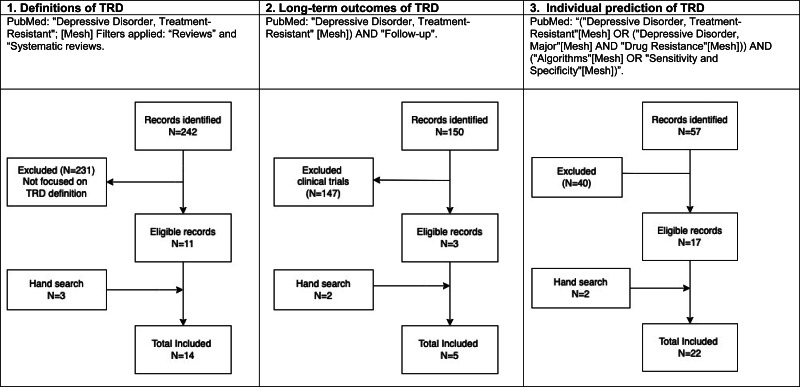
- For definitions, search yielded 1,525 results, narrowed to 242 reviews/systematic reviews, with 11 included plus 3 hand-searched (14 total). For long-term outcomes, search yielded 150 references, with 3 included plus 2 hand-searched (5 total). For individual prediction, search returned 57 references, leaving 17 studies plus 5 hand-searched (22 total).
- Included studies were synthesized narratively, with attention to definitions, follow-up outcomes, predictors, and predictive accuracy metrics.
Limitations
- The paper states: TRD was chosen as the paradigm case, so results remain limited to TRD; the scoping review involved only one database; and the findings clarify the objective standard for irremediability, not the subjective standard.
- The text also makes evident: long-term outcome studies were few, had small samples (71–118), included overlapping participants, focused mainly on failed pharmacological treatments, lacked newer TRD agents, and had limited usefulness for individual prediction.
- Individual prediction studies were often small, underpowered, lacked external validation, used unconventional TRD definitions or limited interventions, and had potential inflation of accuracy estimates, limiting clinical implementation.
Model-written summary. Check it against the paper before relying on it.
Integrity signals
Registry
Cites
Statistics
Figures
Verification
Claims the paper makes
22 Valid · 0 Not valid · 24 Not checked · 47 Own results and interpretations
Every source the paper cites for this claim was checked and supports it.
In the paper
“Another review found that only 20% of studies used the most common definition of TRD of at least 2 failed treatments and confirmation of prior adequate dose and duration (Gaynes et al., 2020).”
§ Irremediability in psychiatric euthanasia: examining the objective standard > Results > Is there a uniform definition of treatment-resistant depression?
What the sources say
- Supportedcites Gaynes et al., 2020 matched to “Defining treatment‐resistant depression” (2020) source
The Discussion (§4; page not supplied) states that only 20% of studies defined TRD using two prior treatment failures with confirmation of adequate dose and duration. It also identifies this as the most common definition for major depressive disorder. (LLM, conf=0.94)
plain- Asserted: passes — The authors put it forward as true.
- Checkable: passes — It can be checked against evidence.
- Load-bearing: unclear — It is unclear whether the paper’s conclusions depend on it.
- Based: passes — The paper gives a reason why it holds.
- Supported
The sources with a verdict support this claim; the rest weren’t checked yet, have no full text we could read, or their verdicts aren’t rated yet.
In the paper
“Four naturalistic studies focused on medium to long-term outcomes in patients who were explicitly defined as having TRD at beginning of follow-up (Fekadu et al., 2011, 2012; Vergunst et al., 2013; Wooderson et al., 2014).”
§ Irremediability in psychiatric euthanasia: examining the objective standard > Discussion > Discussion of main findings
What the sources say
- Supportedcites Fekadu et al., 2011 matched to “Long-Term Impact of Residual Symptoms in Treatment-Resistant Depression” (2011) source
The Abstract (p. 1) states that 118 patients with TRD 'received specialist inpatient treatment and were followed-up for a median of 3 years,' with longer-term longitudinal outcome as the primary outcome — a medium-to-long-term outcome study. The Participants section confirms TRD was explicitly established before follow-up began ('Diagnosis and level of treatment resistance were established within the unit before discharge. Only patients who had failed to respond to at least one adequate dose of ADs were included'), and the Discussion explicitly labels it 'a naturalistic study.' So this paper is itself one of the naturalistic medium/long-term TRD-defined outcome studies the citing sentence lists; the count of four is the citing authors' aggregation across the other three works and is not judged here. (LLM, conf=0.88)
- Supportedcites Fekadu et al., 2012 matched to “Prediction of longer-term outcome of treatment-resistant depression in tertiary care” (2012) source
The citation is offered as an exemplar of a naturalistic medium-to-long-term outcome study in explicitly defined TRD, and our copy of Fekadu et al. (2012) is exactly that: the Discussion (p. ~General outcome/Discussion) states the study 'is novel in that it takes a longitudinal perspective on the outcome, and predictors of outcome, in well-defined treatment-resistant depression in a naturalistic setting'; the Method (Design; Sociodemographic characteristics) describes a prospective follow-up of 118 patients discharged with confirmed treatment-resistant depression for 8-84 months (mean 39), and the introduction frames it against the absence of systematic reports on 'medium- and longer-term outcomes'. The count of 'four' such studies is the citing authors' own aggregation (drawn from their review, cf. reference 11 Fekadu et al. 2009) and is not attributed to this source alone, so nothing here is overstated for this citation. (LLM, conf=0.88)
- Not checked — no full text of the sourcecites Vergunst et al., 2013 matched to “Longitudinal course of symptom severity and fluctuation in patients with treatment-resistant unipolar and bipolar depression” (2013) source
plain- Asserted: passes — The authors put it forward as true.
- Checkable: passes — It can be checked against evidence.
- Load-bearing: passes — The paper’s conclusions depend on it.
- Based: passes — The paper gives a reason why it holds.
- Supported
The cited sources support only part of this claim — read each source’s verdict below.
In the paper
“A second set of five studies, involving large STAR*D or GRSD (Group for the Study of Resistant Depression) datasets, identified which depressed patients would not respond to their second (Kautzky et al., 2017, 2018, 2019; Perlis, 2013) or subsequent (Nie, Vairavan, Narayan, Ye, & Li, 2018) antidepressant trial.”
§ Irremediability in psychiatric euthanasia: examining the objective standard > Results > Can we make individual predictions of treatment-resistance in depression?
What the sources say
- Not checked — no full text of the sourcecites Kautzky et al., 2017 matched to “A New Prediction Model for Evaluating Treatment-Resistant Depression” (2017) source
- Not matchedcites Kautzky et al., 2018
An author–year citation the paper’s reference list doesn’t settle. We don’t search these by name.
- Partly supportedcites Kautzky et al., 2019 matched to “Clinical factors predicting treatment resistant depression: affirmative results from the European multicenter study” (2019) sourceExperimental — accuracy not yet measured
The Experimental procedures define treatment-resistant depression as persistent symptoms after at least two antidepressant trials, and the Results > Prediction analysis report a model predicting treatment outcome in GSRD datasets. But the study classifies outcomes retrospectively after at least two trials; it does not specifically identify who would fail their second trial. (LLM, conf=0.83)
plainstates an associationn = 2,454- Asserted: passes — The authors put it forward as true.
- Checkable: passes — It can be checked against evidence.
- Load-bearing: passes — The paper’s conclusions depend on it.
- Based: passes — The paper gives a reason why it holds.
The cited sources support only part of this claim — read each source’s verdict below.
In the paper
“Agreement between the model's predictions of treatment-resistance and the opinion of a board of expert clinicians was 76.4%.”
§ Irremediability in psychiatric euthanasia: examining the objective standard > Results > Can we make individual predictions of treatment-resistance in depression?
What the sources say
- Partly supportedcites Perlis et al., 2012 matched to “Using electronic medical records to enable large-scale studies in psychiatry: treatment resistant depression as a model” (2012) sourceExperimental — accuracy not yet measured
The Results report 0.764 concordance with a clinician gold standard, equivalent to 76.4%. But the Methods describe that standard as psychiatrists’ ratings of mood state at individual visits, not their opinions on treatment resistance; treatment data were not considered at that stage. The claim misidentifies what the clinicians rated. (LLM, conf=0.85)
plainstates an associationn = 5,198- Asserted: passes — The authors put it forward as true.
- Checkable: passes — It can be checked against evidence.
- Load-bearing: unclear — It is unclear whether the paper’s conclusions depend on it.
- Based: passes — The paper gives a reason why it holds.
- Partly supported
Every source the paper cites for this claim was checked and supports it.
In the paper
“A second study used natural language processing of 5198 patient records to develop a model predicting whether patients were depressed on every given visit following an antidepressant prescription (Perlis et al., 2012).”
§ Irremediability in psychiatric euthanasia: examining the objective standard > Results > Can we make individual predictions of treatment-resistance in depression?
What the sources say
- Supportedcites Perlis et al., 2012 matched to “Using electronic medical records to enable large-scale studies in psychiatry: treatment resistant depression as a model” (2012) source
The Method section (‘Identifying depressed and well patient visits’; page unavailable) identifies 5,198 patients selected for the study. The ‘Logistic regression model’ section describes NLP-based models predicting depression at the single-visit level, and ‘TRD longitudinal classification’ specifies that visits before an antidepressant prescription were excluded from the longitudinal analysis. (LLM, conf=0.88)
plainn = 5,198- Asserted: passes — The authors put it forward as true.
- Checkable: passes — It can be checked against evidence.
- Load-bearing: passes — The paper’s conclusions depend on it.
- Based: passes — The paper gives a reason why it holds.
- Supported
51 more claims · 9 with their cited sources checked
Create a free account to see all 93 claims and to verify the 9 references still open.
- Probably not a substantial claim. 15
- It may state two separate claims as one. 24
- The quote only partly states this claim. 1
Claims other papers make about this one
Each is checked against this paper’s own text: does it say what the citing paper says it does?
The source backs part of the claim, not all of it — or backs it for a different population, condition or comparison.
In the citing paper
“To illustrate the need for consideration of the diversity of mental disorders, Nicolini also identified the need for further expert opinion specifically regarding MAiD for personality disorders, as these cases often have complicated psychosocial histories, social isolation and chronic and complex psychiatric and physical comorbidities.”
From Medical Assistance in Dying for the Sole Underlying Condition of Mental Disorder (MAiD MD-SUMC): an analysis and qualitative evidence synthesis (2026) · cites this paper as [61]
Experimental — accuracy not yet measuredThe source backs part of the claim, not all of it — or backs it for a different population, condition or comparison.
In the citing paper
“A multidisciplinary framework is widely recommended to mitigate bias and distribute evaluative responsibility.”
From Medical Assistance in Dying for the Sole Underlying Condition of Mental Disorder (MAiD MD-SUMC): an analysis and qualitative evidence synthesis (2026) · cites this paper as [61]
Experimental — accuracy not yet measuredThe source backs part of the claim, not all of it — or backs it for a different population, condition or comparison.
In the citing paper
“the theoretical availability of such options does not necessarily imply clinical accessibility or patient responsiveness, rendering the judgment of irremediability inevitably complex, dynamic, and highly case-specific”
From Forensic-psychiatric and medico-legal challenges in euthanasia and assisted suicide for patients with mental disorders: balancing autonomy, vulnerability, and professional responsibility (2026) · cites this paper as [16]
Experimental — accuracy not yet measuredThe source backs part of the claim, not all of it — or backs it for a different population, condition or comparison.
In the citing paper
“The constant evolution of therapeutic options makes it particularly difficult to assign a definitive and irreversible character to psychological suffering, necessitating a prudent, probabilistic, and necessarily case-specific judgment with important ethical and medico-legal implications”
From Forensic-psychiatric and medico-legal challenges in euthanasia and assisted suicide for patients with mental disorders: balancing autonomy, vulnerability, and professional responsibility (2026) · cites this paper as [16]
Experimental — accuracy not yet measuredThe source backs part of the claim, not all of it — or backs it for a different population, condition or comparison.
In the citing paper
“in psychiatric disorders these difficulties are further amplified by non-linear clinical trajectories, high inter-individual variability in treatment response, and the absence of reliable prognostic markers”
From Forensic-psychiatric and medico-legal challenges in euthanasia and assisted suicide for patients with mental disorders: balancing autonomy, vulnerability, and professional responsibility (2026) · cites this paper as [16]
Experimental — accuracy not yet measured
5 more claims about this paper
Create a free account to see every claim other papers make about this one.
Citations
Cites
Rush, A. J., Trivedi, M. H., Wisniewski, S. R., Nierenberg, A. A., Stewart, J. W., Warden, D., Niederehe, G., Thase, M. E., Lavori, P. W., Lebowitz, B. D., et al. (2006) · American Journal of Psychiatry · doi:10.1176/ajp.2006.163.11.1905 · Cited by 5,643 · cited 3×
“Of the two largest studies, patients included had either chronic major depression of at least 4 previous episodes (Dunner et al., 2006), or a history of recurrent depression in 74.7%, with mean duration of illness of 15.3 years and mean age at first episode of 25.5 (Rush et al., 2006).”
BackgroundInfluentialEstablishment of Best Practices for Evidence for Prediction: A Review
Poldrack, R. A., Huckins, G., & Varoquaux, G. (2020) · JAMA Psychiatry · doi:10.1001/jamapsychiatry.2019.3671 · Cited by 738
Defining treatment‐resistant depression
Gaynes, B. N., Lux, L., Gartlehner, G., Asher, G., Forman‐Hoffman, V., Green, J., Boland, E., Weber, R. P., Randolph, C., Bann, C., et al. (2020) · Depression and Anxiety · doi:10.1002/da.22968 · Cited by 447 · cited 2×
“They either focused on definitions of TRD and staging models (Brown et al., 2019; Demyttenaere & Van Duppen, 2019; Gaynes et al., 2020; Malhi & Byrow, 2016; McIntyre et al., 2014; Ng et al., 2019; Pandarakalam, 2108; Ruhé, Van Rooijen, Spijker, Peeters, & Schene, 2012; Sackeim et al., 2019; Trevino, McClintock, McDona…”
BackgroundTreatment-resistant depression: Definitions, review of the evidence, and algorithmic approach
McIntyre, R. S., Filteau, M.-J., Martin, L., Patry, S., Carvalho, A., Cha, D. S., Barakat, M., & Miguelez, M. (2014) · Journal of Affective Disorders · doi:10.1016/j.jad.2013.10.043 · Cited by 421 · cited 1×
“…focused on definitions of TRD and staging models (Brown et al., 2019; Demyttenaere & Van Duppen, 2019; Gaynes et al., 2020; Malhi & Byrow, 2016; McIntyre et al., 2014; Ng et al., 2019; Pandarakalam, 2108; Ruhé, Van Rooijen, Spijker, Peeters, & Schene, 2012; Sackeim et al., 2019; Trevino,…”
MethodKim, S. Y. H., De Vries, R. G., & Peteet, J. R. (2016) · JAMA Psychiatry · doi:10.1001/jamapsychiatry.2015.2887 · Cited by 320 · cited 2×
“…support is especially relevant for psychiatric EAS, as loneliness and social isolation are reported in over half of Dutch psychiatric EAS cases (Kim et al., 2016), and described explicitly as one of the reasons for requesting psychiatric EAS in a Belgian qualitative study (Verhofstadt,…”
BackgroundSelf-citationFekadu, A., Wooderson, S. C., Markopoulo, K., Donaldson, C., Papadopoulos, A., & Cleare, A. J. (2009) · Journal of Affective Disorders · doi:10.1016/j.jad.2008.10.014 · Cited by 299
McAllister-Williams, R. H., Arango, C., Blier, P., Demyttenaere, K., Falkai, P., Gorwood, P., Hopwood, M., Javed, A., Kasper, S., Malhi, G. S., et al. (2020) · Journal of Affective Disorders · doi:10.1016/j.jad.2020.02.023 · Cited by 278 · cited 2×
“Proponents of the shift to ‘difficult-to-treat’ depression call for a more holistic dimensional focus that includes psychosocial functioning and quality-of-life (McAllister-Williams et al., 2020; Rush et al., 2019).”
BackgroundDunner, D. L., Rush, A. J., Russell, J. M., Burke, M., Woodard, S., Wingard, P., & Allen, J. (2006) · The Journal of Clinical Psychiatry · doi:10.4088/jcp.v67n0501 · Cited by 234 · cited 3×
“Of the two largest studies, patients included had either chronic major depression of at least 4 previous episodes (Dunner et al., 2006), or a history of recurrent depression in 74.”
InfluentialThienpont, L., Verhofstadt, M., Van Loon, T., Distelmans, W., Audenaert, K., & De Deyn, P. P. (2015) · BMJ Open · doi:10.1136/bmjopen-2014-007454 · Cited by 231 · cited 3×
“, persons with extensive psychiatric histories, comparable those requesting and receiving psychiatric EAS currently (Kim, De Vries, & Peteet, 2016; Nicolini, Peteet, Donovan, & Kim, 2020b; Thienpont et al., 2015) – a majority significantly improved – i.”
BackgroundStaging methods for treatment resistant depression. A systematic review
Ruhé, H. G., van Rooijen, G., Spijker, J., Peeters, F. P. M. L., & Schene, A. H. (2012) · Journal of Affective Disorders · doi:10.1016/j.jad.2011.02.020 · Cited by 210
Perlis, R. H., Iosifescu, D. V., Castro, V. M., Murphy, S. N., Gainer, V. S., Minnier, J., Cai, T., Goryachev, S., Zeng, Q., Gallagher, P. J., et al. (2012) · Psychological Medicine · doi:10.1017/s0033291711000997 · Cited by 193 · cited 24×
“17 TRD patients Resistance as defined by≥ 17 on HAM-D and failure at least 2 AD trials 2 doses of psilocybin Responders (metrics recalculated) 50% reduction in QIDS 5 weeks post-treatment 2 features: average positivity and average negativity during baseline autobiographical memory test (Continued ) Psychological M edi…”
InfluentialA Clinical Risk Stratification Tool for Predicting Treatment Resistance in Major Depressive Disorder
Perlis, R. H. (2013) · Biological Psychiatry · doi:10.1016/j.biopsych.2012.12.007 · Cited by 169 · cited 5×
“(from GRSD’s TRD-I) Perlis (2013) Among depressed patients, use clinical variables to predict who will respond after 1–2 antidepressant trials v. who will not respond after 2.”
BackgroundMethodInfluentialI tried a bunch of things: The dangers of unexpected overfitting in classification of brain data
Hosseini, M., Powell, M., Collins, J., Callahan-Flintoft, C., Jones, W., Bowman, H., & Wyble, B. (2020) · Neuroscience & Biobehavioral Reviews · doi:10.1016/j.neubiorev.2020.09.036 · Cited by 165
van Waarde, J. A., Scholte, H. S., van Oudheusden, L. J. B., Verwey, B., Denys, D., & van Wingen, G. A. (2015) · Molecular Psychiatry · doi:10.1038/mp.2014.78 · Cited by 164
Bailey, N. W., Hoy, K. E., Rogasch, N. C., Thomson, R. H., McQueen, S., Elliot, D., Sullivan, C. M., Fulcher, B. D., Daskalakis, Z. J., & Fitzgerald, P. B. (2018) · Brain Stimulation · doi:10.1016/j.brs.2017.10.015 · Cited by 162 · cited 3×
“Acc F1 Other Section A. Predicting TRD patients’ response to additional treatment Bailey et al. (2018) Linear support vector machine (SVM) classifier with 5-fold cross-validation Cross-validation Yes 0.92* 0.91* 0.91 0.93 10 responders of 39, prevalence = 0.2564 Bailey et al. (2019) Linear support…”
BackgroundMethodInfluentialKhodayari-Rostamabad, A., Reilly, J. P., Hasey, G. M., de Bruin, H., & MacCrimmon, D. J. (2013) · Clinical Neurophysiology · doi:10.1016/j.clinph.2013.04.010 · Cited by 161 · cited 2×
“…one) Responders (metrics recalculated) HAM-D > 17 after at least one AD trial At the end of treatment 3 SNPs and 1 clinical variable (melacholia) Khodayari-Rostamabad et al. (2013) Among treatment resistant patients, use baseline EEG measures to predict who will respond to an additional…”
BackgroundMethodInfluentialBrown, S., Rittenbach, K., Cheung, S., McKean, G., MacMaster, F. P., & Clement, F. (2019) · The Canadian Journal of Psychiatry · doi:10.1177/0706743719828965 · Cited by 151
Kautzky, A., Dold, M., Bartova, L., Spies, M., Kranz, G. S., Souery, D., Montgomery, S., Mendlewicz, J., Zohar, J., Fabbri, C., et al. (2019) · Acta Psychiatrica Scandinavica · doi:10.1111/acps.12959 · Cited by 148
Sun, Y., Farzan, F., Mulsant, B. H., Rajji, T. K., Fitzgerald, P. B., Barr, M. S., Downar, J., Wong, W., Blumberger, D. M., & Daskalakis, Z. J. (2016) · JAMA Psychiatry · doi:10.1001/jamapsychiatry.2015.3097 · Cited by 140
Data Mining Algorithms and Techniques in Mental Health: A Systematic Review
Alonso, S. G., Díez, I. D. L. T., Hamrioui, S., López-Coronado, M., Barreno, D. C., Nozaleda, L. M., & Franco, M. (2018) · Journal of Medical Systems · doi:10.1007/s10916-018-1018-2 · Cited by 138 · cited 1×
“However, this type of review can be applied to other psychiatric disorders such as schizophrenia or bipolar, e.g. using available evidence for prediction algorithms (Alonso et al., 2018).”
BackgroundDefining Treatment-Resistant Depression: A Comprehensive Review of the Literature
Trevino, K., McClintock, S. M., Fischer, N. M., Vora, A., & Husain, M. M. (2014) · Annals of Clinical Psychiatry · doi:10.1177/104012371402600310 · Cited by 130
From Many to One to Many—the Search for Causes of Psychiatric Illness
Kendler, K. S. (2019) · JAMA Psychiatry · doi:10.1001/jamapsychiatry.2019.1200 · Cited by 129
CHALLENGES OF TREATMENT-RESISTANT DEPRESSION
Department of Psychiatry, N. B. H. N. F. T., & Pandarakalam, J. P. (2108) · Psychiatria Danubina · doi:10.24869/psyd.2018.273 · Cited by 127 · cited 1×
“They either focused on definitions of TRD and staging models (Brown et al., 2019; Demyttenaere & Van Duppen, 2019; Gaynes et al., 2020; Malhi & Byrow, 2016; McIntyre et al., 2014; Ng et al., 2019; Pandarakalam, 2108; Ruhé, Van Rooijen, Spijker, Peeters, & Schene, 2012; Sackeim et al., 2019; Trevino, McClintock, McDona…”
BackgroundDinga, R., Marquand, A. F., Veltman, D. J., Beekman, A. T. F., Schoevers, R. A., van Hemert, A. M., Penninx, B. W. J. H., & Schmaal, L. (2018) · Translational Psychiatry · doi:10.1038/s41398-018-0289-1 · Cited by 125 · cited 8×
“Acc F1 Other Section B. Predicting depressed patients’ development of TRD Dinga et al. (2018) Multinomial generalization of penalized elastic net logistic regression classifiers with 10-fold cross-validation Cross-validation No 0.66 0.47 0.61 Chang et al. (2019) Neural network architecture with a…”
BackgroundMethodResultInfluentialDifficult-to-treat depression: A clinical and research roadmap for when remission is elusive
Rush, A. J., Aaronson, S. T., & Demyttenaere, K. (2019) · Australian & New Zealand Journal of Psychiatry · doi:10.1177/0004867418808585 · Cited by 120 · cited 1×
“Proponents of the shift to ‘difficult-to-treat’ depression call for a more holistic dimensional focus that includes psychosocial functioning and quality-of-life (McAllister-Williams et al., 2020; Rush et al., 2019).”
BackgroundSackeim, H. A., Aaronson, S. T., Bunker, M. T., Conway, C. R., Demitrack, M. A., George, M. S., Prudic, J., Thase, M. E., & Rush, A. J. (2019) · Journal of Psychiatric Research · doi:10.1016/j.jpsychires.2019.03.021 · Cited by 109 · cited 2×
“They either focused on definitions of TRD and staging models (Brown et al., 2019; Demyttenaere & Van Duppen, 2019; Gaynes et al., 2020; Malhi & Byrow, 2016; McIntyre et al., 2014; Ng et al., 2019; Pandarakalam, 2108; Ruhé, Van Rooijen, Spijker, Peeters, & Schene, 2012; Sackeim et al., 2019; Trevino, McClintock, McDona…”
BackgroundKautzky, A., Baldinger, P., Souery, D., Montgomery, S., Mendlewicz, J., Zohar, J., Serretti, A., Lanzenberger, R. R., & Kasper, S. F. (2015) · European Neuropsychopharmacology · doi:10.1016/j.euroneuro.2015.01.001 · Cited by 100
Kautzky, A., Dold, M., Bartova, L., Spies, M., Vanicek, T., Souery, D., Montgomery, S., Mendlewicz, J., Zohar, J., Fabbri, C., et al. (2018) · The Journal of Clinical Psychiatry · doi:10.4088/jcp.16m11385 · Cited by 100
The Impact of (the Concept of) Treatment-Resistant Depression: An Opinion Review
Demyttenaere, K., & Van Duppen, Z. (2019) · International Journal of Neuropsychopharmacology · doi:10.1093/ijnp/pyy052 · Cited by 98
When unbearable suffering incites psychiatric patients to request euthanasia: qualitative study
Verhofstadt, M., Thienpont, L., & Peters, G.-J. Y. (2017) · British Journal of Psychiatry · doi:10.1192/bjp.bp.117.199331 · Cited by 97
(2008) · Hart Publishing eBooks · doi:10.5040/9781472564368 · Cited by 95
A New Prediction Model for Evaluating Treatment-Resistant Depression
Kautzky, A., Baldinger-Melich, P., Kranz, G. S., Vanicek, T., Souery, D., Montgomery, S., Mendlewicz, J., Zohar, J., Serretti, A., Lanzenberger, R., et al. (2017) · The Journal of Clinical Psychiatry · doi:10.4088/jcp.15m10381 · Cited by 94 · cited 3×
“…0.79 Perlis et al. (2012) Logistic regression classifier with adaptive LASSO procedure and 3-fold cross-validation Cross-validation No 0.764 Kautzky et al. (2017) Random forest classifier with 10-fold cross-validation External validation No 0.633 0.8 0.665 0.784 0.737 Kautzky et al.…”
InfluentialTreatment-resistant major depressive disorder and assisted dying
Schuklenk, U., & Vathorst, S. V. D. (2015) · Journal of Medical Ethics · doi:10.1136/medethics-2014-102458 · Cited by 93
Bailey, N., Hoy, K., Rogasch, N., Thomson, R., McQueen, S., Elliot, D., Sullivan, C., Fulcher, B., Daskalakis, Z., & Fitzgerald, P. (2019) · Journal of Affective Disorders · doi:10.1016/j.jad.2018.08.058 · Cited by 90 · cited 3×
“A), all but two had under fifty participants and several involved machine learning (Bailey et al., 2018, 2019; Bares, Novak, Brunovsky, Kopecek, & Höschl, 2017; Bares et al., 2015; Carrillo et al., 2018; Ge et al., 2017; Kautzky et al., 2015; Khodayari-Rostamabad, Reilly, Hasey, de Bruin, &…”
BackgroundMethodInfluentialMedicine and the Mind — The Consequences of Psychiatry’s Identity Crisis
Gardner, C., & Kleinman, A. (2019) · New England Journal of Medicine · doi:10.1056/nejmp1910603 · Cited by 89 · cited 1×
“The role of social factors points to the key issue of explanatory pluralism in psychiatry (Gardner & Kleinman, 2019; Kendler, 2019) – a foundational question of clear ethical relevance for the debate about psychiatric EAS.”
Euthanasia and Assisted Suicide: Lessons from Belgium
(2017) · doi:10.1017/9781108182799 · Cited by 81
Seizure Adequacy Markers and the Prediction of Electroconvulsive Therapy Response
Minelli, A., Abate, M., Zampieri, E., Gainelli, G., Trabucchi, L., Segala, M., Sartori, R., Gennarelli, M., Conca, A., & Bortolomasi, M. (2016) · The Journal of ECT · doi:10.1097/yct.0000000000000274 · Cited by 79 · cited 6×
“When predictive values were reported, predictions that a patient would not respond to the specific intervention tested varied, with accurate predictions ranging from 61.5% (total N = 45) to 100% (total N = 21) (Micoulaud-Franchi et al., 2012; Minelli et al., 2016).”
InfluentialPrediction of longer-term outcome of treatment-resistant depression in tertiary care
Fekadu, A., Rane, L. J., Wooderson, S. C., Markopoulou, K., Poon, L., & Cleare, A. J. (2012) · British Journal of Psychiatry · doi:10.1192/bjp.bp.111.102665 · Cited by 77
Nicolini, M. E., Kim, S. Y. H., Churchill, M. E., & Gastmans, C. (2020) · Psychological Medicine · doi:10.1017/s0033291720001543 · Cited by 77 · cited 2×
“The question of whether clinicians can, on an objective standard, accurately determine irremediability and prognosis in psychiatry is the single most contested claim in the professional debate about the practice (Nicolini et al., 2020a).”
Self-citationGe, R., Blumberger, D. M., Downar, J. H., Daskalakis, Z. J., Dipinto, A. A., Tham, J. C. W., Lam, R. W. M., & Vila‐Rodriguez, F. (2017) · Journal of Affective Disorders · doi:10.1016/j.jad.2017.04.060 · Cited by 76 · cited 4×
“A), all but two had under fifty participants and several involved machine learning (Bailey et al., 2018, 2019; Bares, Novak, Brunovsky, Kopecek, & Höschl, 2017; Bares et al., 2015; Carrillo et al., 2018; Ge et al., 2017; Kautzky et al., 2015; Khodayari-Rostamabad, Reilly, Hasey, de Bruin, & Maccrimmon, 2013; Micoulaud…”
BackgroundMethodInfluentialPredictive value of brain perfusion SPECT for rTMS response in pharmacoresistant depression
Richieri, R. M., Boyer, L., Farisse, J., Colavolpe, C., MUNDLER, O., Lançon, C., & Guedj, É. (2011) · European Journal of Nuclear Medicine and Molecular Imaging · doi:10.1007/s00259-011-1850-9 · Cited by 74
Should assisted dying for psychiatric disorders be legalized in Canada?
Kim, S. Y. H., & Lemmens, T. (2016) · Canadian Medical Association Journal · doi:10.1503/cmaj.160365 · Cited by 68
Self-citationKissane, D. W., & Kelly, B. J. (2000) · Australian & New Zealand Journal of Psychiatry · doi:10.1080/j.1440-1614.2000.00692.x · Cited by 64 · cited 2×
“…preliminary evidence for the claim that non-biological social factors, e.g. social support, can affect chances of recovery in psychiatry (Blikshavn et al., 2017; Cowley, 2013; Jansen et al., 2019; Kelly, 2017; Kissane & Kelly, 2000; Miller & Appelbaum, 2018; Pearce, 2017; Schoevers et al., 1998).”
BackgroundCarrillo, F., Sigman, M., Slezak, D. F., Ashton, P., Fitzgerald, L., Stroud, J., Nutt, D. J., & Carhart-Harris, R. L. (2018) · Journal of Affective Disorders · doi:10.1016/j.jad.2018.01.006 · Cited by 64
Nie, Z., Vairavan, S., Narayan, V. A., Ye, J., & Li, Q. S. (2018) · PLOS ONE · doi:10.1371/journal.pone.0197268 · Cited by 62 · cited 2×
“…(2013) Of 4ML approaches using 10-fold cross-validation, logistic regression classifier performed the best External validation No 0.719 0.259 0.911 Nie et al. (2018) Of 5 ML approaches using 10-fold cross-validation, random forest classifier performed the best External validation No 0.86 0.92…”
MethodInfluentialFour Reasons Why Assisted Dying Should Not Be Offered for Depression
Blikshavn, T., Husum, T. L., & Magelssen, M. (2017) · Journal of Bioethical Inquiry · doi:10.1007/s11673-016-9759-4 · Cited by 60
van Veen, S. M. P., Ruissen, A. M., & Widdershoven, G. A. M. (2020) · The Canadian Journal of Psychiatry · doi:10.1177/0706743720923072 · Cited by 57
Van Wesemael, Y., Cohen, J., Onwuteaka-Philipsen, B. D., Bilsen, J., & Deliens, L. (2009) · BMC Health Services Research · doi:10.1186/1472-6963-9-220 · Cited by 55
The controversial issue of euthanasia in patients with psychiatric illness
Olié, E., & Courtet, P. (2016) · JAMA · doi:10.1001/jama.2016.9883 · Cited by 55 · cited 1×
“…2015; Cowley, 2013, 2015; Jansen, Wall, & Miller, 2019; Kelly, 2017; Kelly & McLoughlin, 2002; Kim & Lemmens, 2016; Kissane & Kelly, 2000; Miller, 2015; Naudts et al., 2006; Olié & Courtet, 2016; Schoevers, Asmus, & Van Tilburg, 1998; Simpson, 2018; Steinbock, 2017; Vandenberghe, 2011, 2018).”
Euthanasia: The role of the psychiatrist
Naudts, K., Ducatelle, C., Kovacs, J., Laurens, K., Van Den Eynde, F., & Van Heeringen, C. (2006) · British Journal of Psychiatry · doi:10.1192/bjp.bp.105.010256 · Cited by 52 · cited 2×
“First, our findings show that the objective standard for irremediability will be difficult to meet, at least in the paradigm case of depression, because a clinician cannot accurately determine irremediability, as argued by many (Appelbaum, 2017; Blikshavn et al., 2017; Broome & de Cates, 2015; Cowley, 2013, 2015; Jans…”
BackgroundDefinition of treatment-resistant depression – Asia Pacific perspectives
Ng, C. H., Kato, T., Han, C., Wang, G., Trivedi, M., Ramesh, V., Shao, D., Gala, S., Narayanan, S., Tan, W., et al. (2019) · Journal of Affective Disorders · doi:10.1016/j.jad.2018.11.038 · Cited by 52 · cited 2×
“They either focused on definitions of TRD and staging models (Brown et al., 2019; Demyttenaere & Van Duppen, 2019; Gaynes et al., 2020; Malhi & Byrow, 2016; McIntyre et al., 2014; Ng et al., 2019; Pandarakalam, 2108; Ruhé, Van Rooijen, Spijker, Peeters, & Schene, 2012; Sackeim et al., 2019; Trevino, McClintock, McDona…”
BackgroundNicolini, M. E., Peteet, J. R., Donovan, G. K., & Kim, S. Y. H. (2020) · Psychological Medicine · doi:10.1017/s0033291719000333 · Cited by 52 · cited 2×
“The question of whether clinicians can, on an objective standard, accurately determine irremediability and prognosis in psychiatry is the single most contested claim in the professional debate about the practice (Nicolini et al., 2020a).”
Self-citationCepeda, M. S., Reps, J., Fife, D., Blacketer, C., Stang, P., & Ryan, P. (2018) · Depression and Anxiety · doi:10.1002/da.22705 · Cited by 50
Physician-assisted suicide and psychiatric illness
Vandenberghe, J. (2018) · New England Journal of Medicine · doi:10.1056/nejmp1714496 · Cited by 50 · cited 1×
“…2015; Cowley, 2013, 2015; Jansen, Wall, & Miller, 2019; Kelly, 2017; Kelly & McLoughlin, 2002; Kim & Lemmens, 2016; Kissane & Kelly, 2000; Miller, 2015; Naudts et al., 2006; Olié & Courtet, 2016; Schoevers, Asmus, & Van Tilburg, 1998; Simpson, 2018; Steinbock, 2017; Vandenberghe, 2011, 2018).”
Euthanasia, assisted suicide and psychiatry: a Pandora's box
Kelly, B. D., & McLoughlin, D. M. (2002) · British Journal of Psychiatry · doi:10.1192/bjp.181.4.278 · Cited by 49 · cited 1×
“…as argued by many (Appelbaum, 2017; Blikshavn et al., 2017; Broome & de Cates, 2015; Cowley, 2013, 2015; Jansen, Wall, & Miller, 2019; Kelly, 2017; Kelly & McLoughlin, 2002; Kim & Lemmens, 2016; Kissane & Kelly, 2000; Miller, 2015; Naudts et al., 2006; Olié & Courtet, 2016; Schoevers, Asmus, &…”
Vergunst, F. K., Fekadu, A., Wooderson, S. C., Tunnard, C. S., Rane, L. J., Markopoulou, K., & Cleare, A. J. (2013) · Psychiatry Research · doi:10.1016/j.psychres.2013.03.022 · Cited by 45 · cited 6×
“The third study showed similar outcomes at follow-up: 60.3% were asymptomatic or at subthreshold level and 39.7% had chronic symptoms (Vergunst et al., 2013).”
BackgroundMethodInfluentialRooney, W., Schuklenk, U., & van de Vathorst, S. (2018) · Health Care Analysis · doi:10.1007/s10728-017-0344-8 · Cited by 44 · cited 2×
“This further shows that, in professional debates about irremediability, invoking the construct of TRD is not ‘a good starting point for identifying an irremediable psychiatric condition’ (Rooney et al., 2018).”
BackgroundResultPhysician-assisted death for psychiatric patients: misguided public policy.
Miller, F. G., & Appelbaum, P. S. (2018) · New England Journal of Medicine · doi:10.1056/nejmp1709024 · Cited by 44 · cited 1×
“…preliminary evidence for the claim that non-biological social factors, e.g. social support, can affect chances of recovery in psychiatry (Blikshavn et al., 2017; Cowley, 2013; Jansen et al., 2019; Kelly, 2017; Kissane & Kelly, 2000; Miller & Appelbaum, 2018; Pearce, 2017; Schoevers et al., 1998).”
Bareš, M., Novák, T., Kopeček, M., Brunovský, M., Stopková, P., & Höschl, C. (2014) · European Archives of Psychiatry and Clinical Neuroscience · doi:10.1007/s00406-014-0506-8 · Cited by 42
Is treatment-resistant depression a useful concept?
Malhi, G. S., & Byrow, Y. (2016) · Evidence Based Mental Health · doi:10.1136/eb-2015-102299 · Cited by 41 · cited 1×
“They either focused on definitions of TRD and staging models (Brown et al., 2019; Demyttenaere & Van Duppen, 2019; Gaynes et al., 2020; Malhi & Byrow, 2016; McIntyre et al., 2014; Ng et al., 2019; Pandarakalam, 2108; Ruhé, Van Rooijen, Spijker, Peeters, & Schene, 2012; Sackeim et al., 2019;…”
MethodShould Mental Disorders Be a Basis for Physician-Assisted Death?
Appelbaum, P. S. (2017) · Psychiatric Services · doi:10.1176/appi.ps.201700013 · Cited by 37 · cited 1×
“…difficult to meet, at least in the paradigm case of depression, because a clinician cannot accurately determine irremediability, as argued by many (Appelbaum, 2017; Blikshavn et al., 2017; Broome & de Cates, 2015; Cowley, 2013, 2015; Jansen, Wall, & Miller, 2019; Kelly, 2017; Kelly & McLoughlin,…”
BackgroundMicoulaud-Franchi, J.-A., Richieri, R., Cermolacce, M., Loundou, A., Lancon, C., & Vion-Dury, J. (2012) · Journal of Affective Disorders · doi:10.1016/j.jad.2011.12.030 · Cited by 36
Physician‐Assisted Death and Severe, Treatment‐Resistant Depression
Steinbock, B. (2017) · Hastings Center Report · doi:10.1002/hast.768 · Cited by 36 · cited 4×
“…depression’ as the paradigm case of an irremediable psychiatric condition (Blikshavn, Husum, & Magelssen, 2017; Broome & de Cates, 2015; Miller, 2015; Schuklenk & van de Vathorst, 2015; Steinbock, 2017), often assuming that treatment-resistant depression (TRD) is, by definition, irremediable.”
BackgroundInfluentialBroome, M. R., & de Cates, A. (2015) · Journal of Medical Ethics · doi:10.1136/medethics-2015-102812 · Cited by 35
ARPNet: Antidepressant Response Prediction Network for Major Depressive Disorder
Chang, B., Choi, Y., Jeon, M., Lee, J., Han, K.-M., Kim, A., Ham, B.-J., & Kang, J. (2019) · Genes · doi:10.3390/genes10110907 · Cited by 35
Treatment-resistant depression and physician-assisted death
MIller, F. G. (2015) · Journal of Medical Ethics · doi:10.1136/medethics-2015-103060 · Cited by 34 · cited 4×
“…depression’ as the paradigm case of an irremediable psychiatric condition (Blikshavn, Husum, & Magelssen, 2017; Broome & de Cates, 2015; Miller, 2015; Schuklenk & van de Vathorst, 2015; Steinbock, 2017), often assuming that treatment-resistant depression (TRD) is, by definition,…”
BackgroundInfluentialMedical Assistance in Dying and Mental Health: A Legal, Ethical, and Clinical Analysis
Simpson, A. I. F. (2018) · The Canadian Journal of Psychiatry · doi:10.1177/0706743717746662 · Cited by 32 · cited 1×
“First, our findings show that the objective standard for irremediability will be difficult to meet, at least in the paradigm case of depression, because a clinician cannot accurately determine irremediability, as argued by many (Appelbaum, 2017; Blikshavn et al., 2017; Broome & de Cates, 2015; Cowley, 2013, 2015; Jans…”
BackgroundPhysician-assisted suicide in psychiatry: developments in The Netherlands
Schoevers, R. A., Asmus, F. P., & Tilburg, W. V. (1998) · Psychiatric Services · doi:10.1176/ps.49.11.1475 · Cited by 28 · cited 2×
“…preliminary evidence for the claim that non-biological social factors, e.g. social support, can affect chances of recovery in psychiatry (Blikshavn et al., 2017; Cowley, 2013; Jansen et al., 2019; Kelly, 2017; Kissane & Kelly, 2000; Miller & Appelbaum, 2018; Pearce, 2017; Schoevers et al., 1998).”
BackgroundReconceptualising treatment-resistant depression as difficult-to-treat depression
Cosgrove, L., Naudet, F., Högberg, G., Shaughnessy, A. F., & Cristea, I. A. (2020) · The Lancet Psychiatry · doi:10.1016/s2215-0366(20)30416-8 · Cited by 28 · cited 1×
“At the same time, others were skeptical about creating a possibly over-inclusive label (Cosgrove et al., 2020).”
What is treatment resistance in psychiatry? A “difficult to treat” concept
Demyttenaere, K. (2019) · World Psychiatry · doi:10.1002/wps.20677 · Cited by 27 · cited 2×
“, 2019; Trevino, McClintock, McDonald Fischer, Vora, & Husain, 2014), or on the emerging shift away from the concept of TRD, in favor of the alternative notion of ‘difficult to treat’ depression (Cosgrove, Naudet, Hiogberg, Shaughnessy, & Cristea, 2020; Demyttenaere, 2019; McAllister-Williams et al., 2020; Rush, Aaron…”
BackgroundWet toetsing levensbeëindiging op verzoek en hulp bij zelfdoding: Wettekst
Beerepoot, C. C., van Donk, R. N., Hermans, H. E. G. M. C., & Linders, J. J. M. (2010) · Algemene Wet Bijzondere Ziektekosten · doi:10.1007/978-90-313-8820-2_32 · Cited by 24
Long-Term Impact of Residual Symptoms in Treatment-Resistant Depression
Fekadu, A., Wooderson, S. C., Rane, L. J., Markopoulou, K., Poon, L., & Cleare, A. J. (2011) · The Canadian Journal of Psychiatry · doi:10.1177/070674371105600906 · Cited by 23 · cited 6×
“Overall, sample sizes were relatively small, ranging from 71 to 118, and two of the four studies involved the same set of participants (Fekadu et al., 2011, 2012).”
BackgroundInfluentialWooderson, S. C., Fekadu, A., Markopoulou, K., Rane, L. J., Poon, L., Juruena, M. F., Strawbridge, R., & Cleare, A. J. (2014) · Journal of Affective Disorders · doi:10.1016/j.jad.2014.05.013 · Cited by 22 · cited 8×
“Although treatment-resistance was defined as a failed response to at least 1 antidepressant, the patients ’ severity of illness at entry was significant with a moderately severe to severe TRD (per the Maudsley Staging Method) (Fekadu et al., 2012), a mean duration of illness of 16 – 22.2 years (Fekadu et al., 2011), a…”
InfluentialBareš, M., Novák, T., Brunovský, M., Kopeček, M., & Höschl, C. (2016) · The Journal of Nervous and Mental Disease · doi:10.1097/nmd.0000000000000574 · Cited by 20 · cited 2×
“…classification; HAM-D > 20 5–8 weeks of rTMS Responders (metrics recalculated) <50% reduction in HAM-D At the end of treatment 53 EEG variables and 1 clinical (MADRS) Bares et al. (2017) Among treatment resistant patients, use one EEG and one clinical measure to predict response to SSRI treatment.”
InfluentialDrawing the line on physician-assisted death
Jansen, L. A., Wall, S., & Miller, F. G. (2019) · Journal of Medical Ethics · doi:10.1136/medethics-2018-105003 · Cited by 16
Is treatment-resistant depression really resistant?
KASPER, S. (2022) · European Neuropsychopharmacology · doi:10.1016/j.euroneuro.2022.02.001 · Cited by 13 · cited 1×
“Unlike what it seems to suggest, ‘treatment-resistance’ does not mean that there are no remaining options, and definitions evolve with the introduction of new treatments (e.g. esketamine, NNT of 5) (Kasper, 2022).”
BackgroundEuthanasia in psychiatry can never be justified. A reply to Wijsbek
Cowley, C. (2013) · Theoretical Medicine and Bioethics · doi:10.1007/s11017-013-9252-6 · Cited by 13
What Does “Irremediability” in Mental Illness Mean?
Gaind, K. S. (2020) · The Canadian Journal of Psychiatry · doi:10.1177/0706743720928656 · Cited by 12
Pairing Machine Learning and Clinical Psychology: How You Evaluate Predictive Performance Matters
Jacobucci, R., Littlefield, A. K., Millner, A. J., Kleiman, E., & Steinley, D. (2020) · doi:10.31234/osf.io/2yber · Cited by 12 · cited 1×
“…sample sizes, absence of testing model performance in an external sample, and problematic validation methods), precluding reliable immediate implementation in clinical practice (Hosseini et al., 2020; Jacobucci, Littlefield, Millner, Kleiman, & Steinley, 2020; Poldrack, Huckins, & Varoquaux, 2020).”
Nugent, A. C., Iadarola, N. D., Miller, F. G., Luckenbaugh, D. A., & Zarate, C. A. (2016) · The Lancet Psychiatry · doi:10.1016/s2215-0366(16)00006-7 · Cited by 11
Self-citationSinyor, M., & Schaffer, A. (2020) · The Canadian Journal of Psychiatry · doi:10.1177/0706743720928658 · Cited by 10 · cited 1×
“…an objective or subjective standard should https://doi.org/10.1017/S0033291722002951 Published online by Cambridge University Press prevail (Gaind, 2020; Nicolini, Kim, Churchill, & Gastmans, 2020a; Schuklenk, 2019; Sinyor & Schaffer, 2020; Smith, 2020; van Veen, Ruissen, & Widdershoven, 2020).”
InfluentialCommentary on ‘Treatment-resistant major depressive disorder and assisted dying’
Cowley, C. (2015) · Journal of Medical Ethics · doi:10.1136/medethics-2015-102811 · Cited by 10 · cited 1×
“…a clinician cannot accurately determine irremediability, as argued by many (Appelbaum, 2017; Blikshavn et al., 2017; Broome & de Cates, 2015; Cowley, 2013, 2015; Jansen, Wall, & Miller, 2019; Kelly, 2017; Kelly & McLoughlin, 2002; Kim & Lemmens, 2016; Kissane & Kelly, 2000; Miller, 2015;…”
Invited commentary on … when unbearable suffering incites psychiatric patients to request euthanasia
Kelly, B. D. (2017) · British Journal of Psychiatry · doi:10.1192/bjp.bp.117.199695 · Cited by 10 · cited 2×
“…preliminary evidence for the claim that non-biological social factors, e.g. social support, can affect chances of recovery in psychiatry (Blikshavn et al., 2017; Cowley, 2013; Jansen et al., 2019; Kelly, 2017; Kissane & Kelly, 2000; Miller & Appelbaum, 2018; Pearce, 2017; Schoevers et al., 1998).”
BackgroundAn Ethical-Legal Analysis of Medical Assistance in Dying for Those with Mental Illness
Tanner, R. (2018) · Alberta Law Review · doi:10.29173/alr2500 · Cited by 10 · cited 2×
“…do not support the claim, made by some, that clinicians can rely on existing statistical and staging tools like the Maudsley Staging Method to predict chances of recovery in a person requesting psychiatric EAS (Provencher-Renaud, Larivée, & Sénéchal, 2019; Rooney et al., 2018; Tanner, 2018).”
ResultPearce, S. (2017) · British Journal of Psychiatry · doi:10.1192/bjp.bp.117.199687 · Cited by 7 · cited 2×
“…preliminary evidence for the claim that non-biological social factors, e.g. social support, can affect chances of recovery in psychiatry (Blikshavn et al., 2017; Cowley, 2013; Jansen et al., 2019; Kelly, 2017; Kissane & Kelly, 2000; Miller & Appelbaum, 2018; Pearce, 2017; Schoevers et al., 1998).”
BackgroundL’accès à l’aide médicale à mourir pour les personnes souffrant de troubles mentaux
Provencher-Renaud, G., Larivée, S., & Sénéchal, C. (2019) · Annales Médico-psychologiques, revue psychiatrique · doi:10.1016/j.amp.2018.08.022 · Cited by 7
Certainty is not a morally defensible threshold to determine eligibility for assisted dying
Schuklenk, U. (2019) · Bioethics · doi:10.1111/bioe.12569 · Cited by 6 · cited 1×
“…an objective or subjective standard should https://doi.org/10.1017/S0033291722002951 Published online by Cambridge University Press prevail (Gaind, 2020; Nicolini, Kim, Churchill, & Gastmans, 2020a; Schuklenk, 2019; Sinyor & Schaffer, 2020; Smith, 2020; van Veen, Ruissen, & Widdershoven, 2020).”
Influential[The 'good death' in the Flemish psychiatry].
Vandenberghe, J. U. (2011) · PubMed · Cited by 4
Smith, D. H. (2020) · The Canadian Journal of Psychiatry · doi:10.1177/0706743720935650 · Cited by 2 · cited 1×
“…an objective or subjective standard should https://doi.org/10.1017/S0033291722002951 Published online by Cambridge University Press prevail (Gaind, 2020; Nicolini, Kim, Churchill, & Gastmans, 2020a; Schuklenk, 2019; Sinyor & Schaffer, 2020; Smith, 2020; van Veen, Ruissen, & Widdershoven, 2020).”
Influential
Research works printed but not linked: 2
- Onwuteaka-Philipsen, B. D., Legemaate, J., van Der Heide, A., van Delden, H., Evenblij, K., El Hammoud, I., … Willems, D. (2017). Derde evaluatie Wet toesting levensbeeindiging op verzoek en hulp bij zelfdoding [Third evaluation of the Dutch termination of life on request and assisted suicide act]. The Netherlands: ZonMw, Den Haag. 16223080
- Euthanasia Code. (2018). Review Procedures in Practice. Retrieved from https://english.euthanasiecommissie.nl/the-committees/code-of-practice. Regional Euthanasia Review Committees (Accessed June 2018).
Cited by
The realities of Medical Assistance in Dying in Canada
Coelho, R., Maher, J., Gaind, K. S., & Lemmens, T. (2023) · Palliative and Supportive Care · doi:10.1017/s1478951523001025 · Cited by 70
“Evidence-basedreviews,includingtheExpertAdvisoryGroup in2020andarecentpublicationbyNicolinietal,concludethat predictionsofirremediabilityformentalillnessesareatbest,no betterthanchance(EAG2020;Nicolinietal.2022).”
Canadian Medical Assistance in Dying and the Hegemony of Privilege
Kim, S. Y. H. (2023) · The American Journal of Bioethics · doi:10.1080/15265161.2023.2264096 · Cited by 11
Self-citationLyon, C. (2024) · Journal of Medical Ethics · doi:10.1136/jme-2023-109555 · Cited by 11
“…psychological decompensation is irremediable is even more challenging, as psychiatrists point out that it is virtually impossible to predict the course of a mental illness, 27 making cases of eligibility much more rigorously assessed, much rarer, but also far less likely to be errors or abuses.”
BackgroundAsada, Y., Campbell, L. A., Grignon, M., Hothi, H., Stainton, T., & Kim, S. Y. H. (2024) · The Lancet Regional Health - Americas · doi:10.1016/j.lana.2024.100810 · Cited by 9
“32 Further, emerging therapies such as ketamine, psychotherapy assisted psychedelics, and targeted transcranial magnetic stimulation show promise, but they may create further instances of mismatch between resource needs and availability.”
BackgroundSelf-citationEffects of ketamine on fear memory extinction: a review of preclinical literature
Boese, M., Berman, R. Y., Radford, K. D., Johnson, L. R., & Choi, K. H. (2025) · Frontiers in Neuroscience · doi:10.3389/fnins.2025.1546460 · Cited by 7
Metadata
- Authors
- Nicolini, M. E., Jardas, E., Zarate, C. A., Gastmans, C., & Kim, S. Y. H.
- Affiliations
- National Institutes of Health (US)
- KU Leuven (BE)
- Corresponding author
- Nicolini, Marie E.
- Venue
- Psychological Medicine
- Publisher
- Cambridge University Press (CUP)
- Published
- 2022-10-28
- Volume
- 53
- Issue
- 12
- Pages
- 5729-5747
- ISSN
- 0033-2917 (ISSN-L)
- 1469-8978
- PMC
- PMC10482705
- OpenAlex
- W4307497135
- Cited by
- 31
- References
- 91
- Citations by year
- 2026: 11 · 2025: 8 · 2024: 6 · 2023: 5 · 2022: 1
- FWCI
- 0.72
- Type
- journal article
- Language
- en
- Open access
- hybrid
- doi.org
- Locations
- Psychological Medicine (publishedVersion, cc-by)
- PubMed Central (publishedVersion, cc-by)
- PubMed (publishedVersion)
- Lirias (submittedVersion, cc-by)
- Topics
- Health Sciences › Medicine › Pharmacology (medical) › Treatment of Major Depression
- Health Sciences › Medicine › Psychiatry and Mental health › Electroconvulsive Therapy Studies
- Social Sciences › Psychology › Clinical Psychology › Suicide and Self-Harm Studies
- Keywords
- assisted suicide, treatment-resistant depression, long-term outcome prediction, precision medicine, end-of-life decisions, euthanasia policy
- MeSH terms
- Belgium, Euthanasia, Humans, Netherlands, Suicide, Assisted, Depressive Disorder, Treatment-Resistant
About these checks
Registry, retraction, Cites and statistics results are computed, not judged, with one exception: a printed reference that no index lists is read once by a model before it counts as a citation error. Claims are extracted by a model and kept only when their quote appears verbatim in the text; each cited source is then checked, with a model’s help, for whether it says what the claim relies on. Those verdicts can be wrong — read the claim’s quote and the cited source before relying on one.
The claim verdicts this report counts are experimental: their accuracy is not yet measured.
A language model drew the claims from the paper on 2026-10-10, under version 3 of the claim definition (model deepseek-v4.1-flash, prompt extract-v3).
A second model labelled each claim on 2026-10-10 (model jev-1.13-20260917, definition revision gold-guideline-v0.2).
Cited sources are checked with a language model’s help (gpt-6-sol and qwen3.8-omni-flash).
Statistics and arithmetic are recomputed, not judged.
Confidence bands are shown only for fields calibrated on our annotated test set. None is calibrated yet, so no band is shown.
What counts as a claim ›How we measure confidence ›How we check this ›
Are you an author, or do you see a problem with this page? Request a review
Data sources
Bibliographic data: Semantic Scholar, OpenAlex, Crossref.
Contains information from the Semantic Scholar Academic Graph Datasets, made available under the ODC Attribution License (ODC-BY 1.0).
Semantic Scholar’s data is described in: Kinney, R., et al. (2023). The Semantic Scholar Open Data Platform. arXiv:2301.10140.
