

Loneliness and Social Isolation During the COVID-19 Pandemic: A Systematic Review Enriched With Empirical Evidence From a Large-Scale Diary Study
Open accessThe DOI matches its Crossref record; 44 of the 44 references it cites were found in a registry or an index.
Abstract
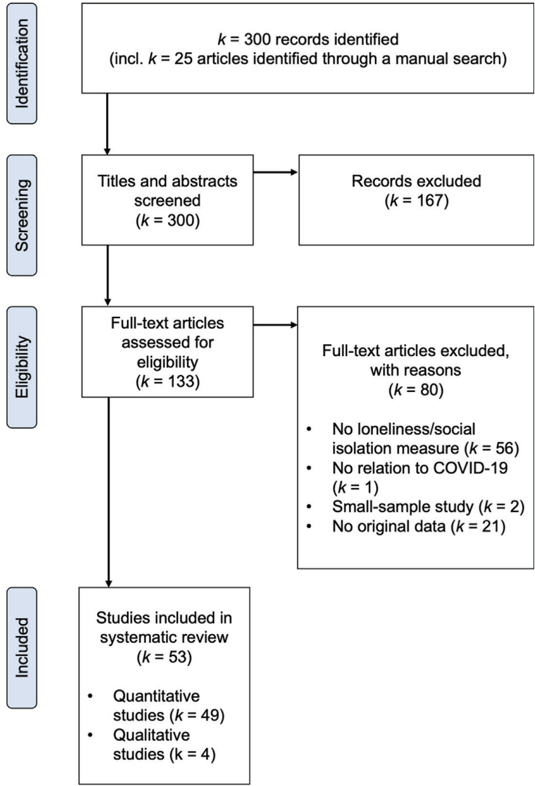
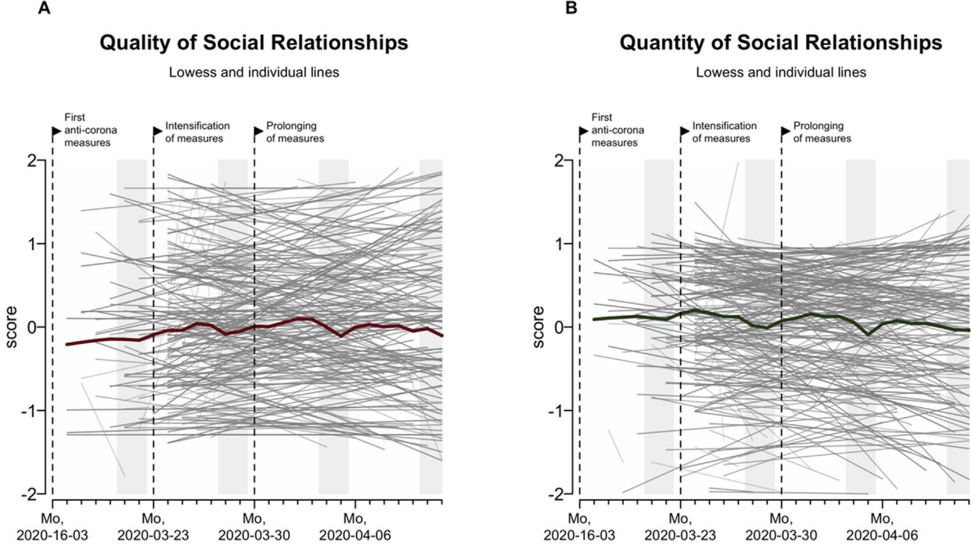
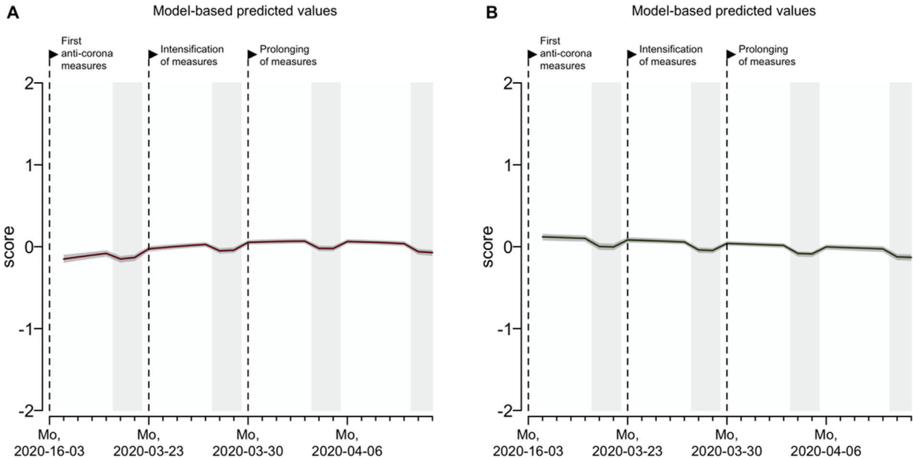
The outbreak of the global COVID-19 pandemic has drastically altered people’s lives. Loneliness and social isolation were publicly discussed as possible psychological consequences of the measures taken to slow the virus spread. These public discussions have sparked a surge in empirical studies on loneliness and social isolation. In this study, we first provide a systematic review synthesizing recent literature on the prevalence and correlates of loneliness and social isolation during the early phase of the COVID-19 pandemic ( k = 53 studies). We found that most quantitative studies included in the systematic review were cross-sectional. The few longitudinal studies mainly reported increases in loneliness, especially when the pre-pandemic measurement occasions were months or years before the COVID-19 pandemic. Studies with pre-pandemic measures weeks or days before the pandemic reported relatively stable or even decreasing loneliness trends. Second, we enrich the systematic review with an empirical investigation on daily changes in the perceived quality and quantity of social relationships during the pandemic compared to before the pandemic ( N = 4,823). This empirical investigation showed that, on average, the quality of social relationships was perceived worse during the pandemic than before. This perception got slightly stronger over the first 2 weeks of the pandemic but stagnated thereafter. Regarding the quantity of social relationships, participants reported on average that they had fewer social interactions at the beginning of the study than before the pandemic. This perceived reduction in the quantity of social interactions linearly decreased over time.
Overview
The claims and statistics of this paper haven’t been checked yet.
Free: it reads the open-access text and checks the first 5 claims that cite a source we can check. Create a free account to check every claim.
Integrity signals
Registry
Cites
Statistics
Figures


Verification
Claims the paper makes
The claims and statistics of this paper haven’t been checked yet.
Free: it reads the open-access text and checks the first 5 claims that cite a source we can check. Create a free account to check every claim.
Claims other papers make about this one
Each is checked against this paper’s own text: does it say what the citing paper says it does?
The source backs part of the claim, not all of it — or backs it for a different population, condition or comparison.
In the citing paper
“According to Buecker and Horstmann (2021), the evidence about pandemic containment measures being associated with changes in perceived quality or quantity of social relationships, or both, is inconclusive because studies have not examined these processes.”
From Adolescents' longitudinal trajectories of mental health and loneliness: The impact of COVID‐19 school closures (2022) · cites this paper as Buecker and Horstmann (2021)
Experimental — accuracy not yet measuredThe source backs part of the claim, not all of it — or backs it for a different population, condition or comparison.
In the citing paper
“Studies conducted with adults (age range 18–88 years) have shown that COVID‐19 either led to increased feelings of loneliness (for a review, see Buecker & Horstman, 2021) or had no effect on feelings of loneliness (Bu et al., 2020; Luchetti et al., 2020; Ray, 2021).”
From Adolescents' longitudinal trajectories of mental health and loneliness: The impact of COVID‐19 school closures (2022) · cites this paper as Buecker & Horstman, 2021
Experimental — accuracy not yet measuredThe source backs part of the claim, not all of it — or backs it for a different population, condition or comparison.
In the citing paper
“What is currently known about the prevalence of loneliness during the pandemic based on systematic reviews and meta-analyses has been largely limited to adult samples.”
From Loneliness and Well-Being in Children and Adolescents during the COVID-19 Pandemic: A Systematic Review (2023) · cites this paper as [17]
Experimental — accuracy not yet measuredThe check wasn’t confident either way, so it gives no verdict — never disputed.
In the citing paper
“In contrast, the increase in loneliness and decline in wellbeing (Hussong et al., 2021; Magson et al., 2021) attributed to extraverts during the first lockdown, reverses the typical pattern of results whereby extraversion is negatively associated with loneliness and mental health problems”
From Adolescent Loneliness and Negative Affect during the COVID-19 Pandemic: The Role of Extraversion and Neuroticism (2023) · cites this paper as Buecker & Horstmann, 2021
Experimental — accuracy not yet measuredThe check wasn’t confident either way, so it gives no verdict — never disputed.
In the citing paper
“It is worth noting that loneliness and negative affect are not commonly understood to be facets of any personality characteristic such as neuroticism”
From Adolescent Loneliness and Negative Affect during the COVID-19 Pandemic: The Role of Extraversion and Neuroticism (2023) · cites this paper as Buecker & Horstmann, 2021
Experimental — accuracy not yet measured
1 more claim about this paper
Create a free account to see every claim other papers make about this one.
Self-check
Percentages, sums and reported differences re-computed from the paper’s own numbers.
The self-check needs the paper’s full text.
Citations
Cites
R: A Language and Environment for Statistical Computing
R Core Team (2025) · doi:10.32614/r.manuals · Cited by 352,181
Fitting Linear Mixed-Effects Models Using lme4
Bates, D., Mächler, M., Bolker, B., & Walker, S. (2015) · Journal of Statistical Software · doi:10.18637/jss.v067.i01 · Cited by 86,835
Preferred Reporting Items for Systematic Reviews and Meta-Analyses: The PRISMA Statement
Moher, D., Liberati, A., Tetzlaff, J., Altman, D. G., & The PRISMA Group (2009) · PLoS Medicine · doi:10.1371/journal.pmed.1000097 · Cited by 64,042
lmerTest Package: Tests in Linear Mixed Effects Models
Kuznetsova, A., Brockhoff, P. B., & Christensen, R. H. B. (2017) · Journal of Statistical Software · doi:10.18637/jss.v082.i13 · Cited by 24,346
Loneliness and Social Isolation as Risk Factors for Mortality: A Meta-Analytic Review
Holt-Lunstad, J., Smith, T. B., Baker, M., Harris, T., & Stephenson, D. (2015) · Perspectives on Psychological Science · doi:10.1177/1745691614568352 · Cited by 6,043
Impact of COVID-19 pandemic on mental health in the general population: a systematic review
Xiong, J., Lipsitz, O., Nasri, F., Lui, L. M. W., Gill, H., Phan, L., Chen-Li, D., Iacobucci, M., Ho, R., Majeed, A., et al. (2020) · Journal of Affective Disorders · doi:10.1016/j.jad.2020.08.001 · Cited by 5,204
Elmer, T., Mepham, K., & Stadtfeld, C. (2020) · PLOS ONE · doi:10.1371/journal.pone.0236337 · Cited by 1,658
Pinquart, M., & Sörensen, S. (2000) · Psychology and Aging · doi:10.1037/0882-7974.15.2.187 · Cited by 1,549
Loneliness, health, and mortality in old age: A national longitudinal study
Luo, Y., Hawkley, L. C., Waite, L. J., & Cacioppo, J. T. (2012) · Social Science & Medicine · doi:10.1016/j.socscimed.2011.11.028 · Cited by 1,232
Loneliness in the general population: prevalence, determinants and relations to mental health
Beutel, M. E., Klein, E. M., Brähler, E., Reiner, I., Jünger, C., Michal, M., Wiltink, J., Wild, P. S., Münzel, T., Lackner, K. J., et al. (2017) · BMC Psychiatry · doi:10.1186/s12888-017-1262-x · Cited by 1,223
Psychological distress and loneliness reported by US adults in 2018 and April 2020
McGinty, E. E., Presskreischer, R., Han, H., & Barry, C. L. (2020) · JAMA · doi:10.1001/jama.2020.9740 · Cited by 978
The trajectory of loneliness in response to COVID-19
Luchetti, M., Lee, J. H., Aschwanden, D., Sesker, A., Strickhouser, J. E., Terracciano, A., & Sutin, A. R. (2020) · American Psychologist · doi:10.1037/amp0000690 · Cited by 903
Bu, F., Steptoe, A., & Fancourt, D. (2020) · Public Health · doi:10.1016/j.puhe.2020.06.036 · Cited by 703
Loneliness and Mental Health During the COVID-19 Pandemic: A Study Among Dutch Older Adults
van Tilburg, T. G., Steinmetz, S., Stolte, E., van der Roest, H., & de Vries, D. H. (2021) · The Journals of Gerontology: Series B · doi:10.1093/geronb/gbaa111 · Cited by 690
Predictors of COVID-19 voluntary compliance behaviors: An international investigation
Clark, C., Davila, A., Regis, M., & Kraus, S. (2020) · Global Transitions · doi:10.1016/j.glt.2020.06.003 · Cited by 649
Heisig, J. P., & Schaeffer, M. (2019) · European Sociological Review · doi:10.1093/esr/jcy053 · Cited by 552
Li, L. Z., & Wang, S. (2020) · Psychiatry Research · doi:10.1016/j.psychres.2020.113267 · Cited by 551
Social isolation, loneliness and depression in young adulthood: a behavioural genetic analysis
Matthews, T., Danese, A., Wertz, J., Odgers, C. L., Ambler, A., Moffitt, T. E., & Arseneault, L. (2016) · Social Psychiatry and Psychiatric Epidemiology · doi:10.1007/s00127-016-1178-7 · Cited by 534
Lee, C. M., Cadigan, J. M., & Rhew, I. C. (2020) · Journal of Adolescent Health · doi:10.1016/j.jadohealth.2020.08.009 · Cited by 526
Krendl, A. C., & Perry, B. L. (2021) · The Journals of Gerontology: Series B · doi:10.1093/geronb/gbaa110 · Cited by 495
Bu, F., Steptoe, A., & Fancourt, D. (2020) · Social Science & Medicine · doi:10.1016/j.socscimed.2020.113521 · Cited by 462
Says who? The significance of sampling in mental health surveys during COVID-19.
Pierce, M., McManus, S., Jessop, C., John, A., Hotopf, M., Ford, T., Hatch, S., Wessely, S., & Abel, K. M. (2020) · The Lancet Psychiatry · doi:10.1016/s2215-0366(20)30237-6 · Cited by 399
Rogers, A. A., Ha, T., & Ockey, S. (2021) · Journal of Adolescent Health · doi:10.1016/j.jadohealth.2020.09.039 · Cited by 349
Arslan, R. C., Walther, M. P., & Tata, C. S. (2020) · Behavior Research Methods · doi:10.3758/s13428-019-01236-y · Cited by 340
Ausín, B., González-Sanguino, C., Castellanos, M. Á., & Muñoz, M. (2021) · Journal of Gender Studies · doi:10.1080/09589236.2020.1799768 · Cited by 222
Personality and Individual Differences
Fellmann, F. (2021) · SpringerBriefs in Sociology · doi:10.1007/978-3-030-57351-5_5 · Cited by 215
BLUEPRINT FOR A SOCIAL PSYCHOLOGICAL THEORY OF LONELINESS
PEPLAU, L. A., & PERLMAN, D. (1979) · Love and Attraction · doi:10.1016/b978-0-08-022234-9.50020-0 · Cited by 204
Algren, M. H., Ekholm, O., Nielsen, L., Ersbøll, A. K., Bak, C. K., & Andersen, P. T. (2020) · SSM - Population Health · doi:10.1016/j.ssmph.2020.100546 · Cited by 154
Coombe, J., Kong, F. Y. S., Bittleston, H., Williams, H., Tomnay, J. E., Vaisey, A., Malta, S., Goller, J. L., Temple-Smith, M. J., Bourchier, L., et al. (2020) · Sexually Transmitted Infections · doi:10.1136/sextrans-2020-054688 · Cited by 141
Tracking Mental Health and Symptom Mentions on Twitter During COVID-19
Guntuku, S. C., Sherman, G., Stokes, D. C., Agarwal, A. K., Seltzer, E., Merchant, R. M., & Ungar, L. H. (2020) · Journal of General Internal Medicine · doi:10.1007/s11606-020-05988-8 · Cited by 125
Heidinger, T., & Richter, L. (2020) · Frontiers in Psychology · doi:10.3389/fpsyg.2020.585308 · Cited by 120
In a Lonely Place: Investigating Regional Differences in Loneliness
Buecker, S., Ebert, T., Götz, F. M., Entringer, T. M., & Luhmann, M. (2020) · Social Psychological and Personality Science · doi:10.1177/1948550620912881 · Cited by 107
Self-citationRuggieri, S., Ingoglia, S., Bonfanti, R. C., & Lo Coco, G. (2021) · Personality and Individual Differences · doi:10.1016/j.paid.2020.110486 · Cited by 107
Pan, Y., Yang, Z., Han, X., & Qi, S. (2020) · Personality and Individual Differences · doi:10.1016/j.paid.2020.110490 · Cited by 105
Buecker, S., Horstmann, K. T., Krasko, J., Kritzler, S., Terwiel, S., Kaiser, T., & Luhmann, M. (2020) · Social Science & Medicine · doi:10.1016/j.socscimed.2020.113541 · Cited by 105
Self-citationImpact of the COVID-19 Pandemic on Loneliness Among Older Adults
Seifert, A., & Hassler, B. (2020) · Frontiers in Sociology · doi:10.3389/fsoc.2020.590935 · Cited by 103
Did Social Connection Decline During the First Wave of COVID-19?: The Role of Extraversion
Folk, D., Okabe-Miyamoto, K., Dunn, E., & Lyubomirsky, S. (2020) · Collabra: Psychology · doi:10.1525/collabra.365 · Cited by 99
Loneliness and COVID-19 preventive behaviours among Japanese adults
Stickley, A., Matsubayashi, T., & Ueda, M. (2020) · Journal of Public Health · doi:10.1093/pubmed/fdaa151 · Cited by 82
The COVID-19 pandemic brings a second wave of social isolation and disrupted services
Stefana, A., Youngstrom, E. A., Hopwood, C. J., & Dakanalis, A. (2020) · European Archives of Psychiatry and Clinical Neuroscience · doi:10.1007/s00406-020-01137-8 · Cited by 75
Chou, W., Wang, P., Chen, S., Chang, Y., Wu, C.-F., Lu, W.-H., & Yen, C. (2020) · International Journal of Environmental Research and Public Health · doi:10.3390/ijerph17218039 · Cited by 58
Who does or does not use the ‘Corona-Warn-App’ and why?
Horstmann, K. T., Buecker, S., Krasko, J., Kritzler, S., & Terwiel, S. (2020) · European Journal of Public Health · doi:10.1093/eurpub/ckaa239 · Cited by 58
Self-citationde Lange, A.-M. G., Kaufmann, T., Quintana, D. S., Winterton, A., Andreassen, O. A., Westlye, L. T., & Ebmeier, K. P. (2021) · Behavioural Brain Research · doi:10.1016/j.bbr.2021.113510 · Cited by 35
Sexually Transmitted Infections
Fantasia, H. C. (2020) · Springer eBooks · doi:10.1007/978-3-030-02200-6 · Cited by 25
de Lange, A. G., Kaufmann, T., Quintana, D. S., et al. (2020) · doi:10.31234/osf.io/q8kjv · Cited by 7
Research works printed but not linked: 2
- Ó 2021 The Author(s). Distributed as a Hogrefe OpenMind article under European Psychologist (2021), 26(4), 272-284
- Perlman, D., & Peplau, L. A. (1981). Toward a social psychology of loneliness. In R. Gilmour & S. Duck (Eds.), Personal relation- ships: 3 Relationships in disorder (pp. 31-56). Academic Press.
Cited by
Loneliness Before and During the COVID-19 Pandemic: A Systematic Review with Meta-Analysis
Ernst, M., Niederer, D., Werner, A. M., Czaja, S. J., Mikton, C., Ong, A., Rosen, T., Braehler, E., & Beutel, M. E. (2022) · doi:10.31234/osf.io/wjx5v · Cited by 584
Loneliness before and during the COVID-19 pandemic: A systematic review with meta-analysis.
Ernst, M., Niederer, D., Werner, A. M., Czaja, S. J., Mikton, C., Ong, A. D., Rosen, T., Brähler, E., & Beutel, M. E. (2022) · American Psychologist · doi:10.1037/amp0001005 · Cited by 584
Li, L. Z., & Wang, S. (2020) · Psychiatry Research · doi:10.1016/j.psychres.2020.113267 · Cited by 551
Su, Y., Rao, W., Li, M., Caron, G., D’Arcy, C., & Meng, X. (2023) · International Psychogeriatrics · doi:10.1017/s1041610222000199 · Cited by 275
Hickin, N., Käll, A., Shafran, R., Sutcliffe, S., Manzotti, G., & Langan, D. (2021) · Clinical Psychology Review · doi:10.1016/j.cpr.2021.102066 · Cited by 271
Metadata
- Authors
- Buecker, S., & Horstmann, K. T.
- Affiliations
- Ruhr University Bochum (DE)
- Humboldt-Universität zu Berlin (DE)
- Venue
- European Psychologist
- Publisher
- Hogrefe Publishing Group
- Published
- 2021-10
- Volume
- 26
- Issue
- 4
- Pages
- 272-284
- ISSN
- 1016-9040 (ISSN-L)
- 1878-531X
- OpenAlex
- W4235676602
- Cited by
- 225
- References
- 39
- Citations by year
- 2026: 15 · 2025: 32 · 2024: 48 · 2023: 47 · 2022: 57 · 2021: 19
- FWCI
- 29.22
- Type
- journal article
- Language
- en
- Open access
- hybrid
- doi.org
- Licence
- Locations
- European Psychologist (publishedVersion, cc-by-nc)
- edoc Publication server (Humboldt University of Berlin) (submittedVersion, cc-by-nc)
- Dokumentenrepositorium der RUB (Ruhr University Bochum) (submittedVersion, cc-by-nc)
- edoc Publication server (Humboldt University of Berlin)
- Topics
- Social Sciences › Psychology › Clinical Psychology › COVID-19 and Mental Health
- Social Sciences › Health › Health disparities and outcomes
- Social Sciences › Sociology and Political Science › Social impacts of COVID-19
- Keywords
- loneliness, social isolation, COVID-19 pandemic, interpersonal relationships
About these checks
Registry, retraction, Cites and statistics results are computed, not judged, with one exception: a printed reference that no index lists is read once by a model before it counts as a citation error. Claims are extracted by a model and kept only when their quote appears verbatim in the text; each cited source is then checked, with a model’s help, for whether it says what the claim relies on. Those verdicts can be wrong — read the claim’s quote and the cited source before relying on one.
Statistics and arithmetic are recomputed, not judged.
Confidence bands are shown only for fields calibrated on our annotated test set. None is calibrated yet, so no band is shown.
What counts as a claim ›How we measure confidence ›How we check this ›
Are you an author, or do you see a problem with this page? Request a review
Data sources
Bibliographic data: Semantic Scholar, OpenAlex, Crossref.
Contains information from the Semantic Scholar Academic Graph Datasets, made available under the ODC Attribution License (ODC-BY 1.0).
Semantic Scholar’s data is described in: Kinney, R., et al. (2023). The Semantic Scholar Open Data Platform. arXiv:2301.10140.
