

Algorithm aversion: People erroneously avoid algorithms after seeing them err.
Open accessThe DOI matches its Crossref record; 23 of the 23 references it cites were found in a registry or an index; none of the 22 sources its claims cite is checked for support yet.
Abstract
Research shows that evidence-based algorithms more accurately predict the future than do human forecasters. Yet when forecasters are deciding whether to use a human forecaster or a statistical algorithm, they often choose the human forecaster. This phenomenon, which we call algorithm aversion, is costly, and it is important to understand its causes. We show that people are especially averse to algorithmic forecasters after seeing them perform, even when they see them outperform a human forecaster. This is because people more quickly lose confidence in algorithmic than human forecasters after seeing them make the same mistake. In 5 studies, participants either saw an algorithm make forecasts, a human make forecasts, both, or neither. They then decided whether to tie their incentives to the future predictions of the algorithm or the human. Participants who saw the algorithm perform were less confident in it, and less likely to choose it over an inferior human forecaster. This was true even among those who saw the algorithm outperform the human.
Overview
CoChat Summary
TL;DR
People become less willing to use a statistical algorithm after seeing it perform and make mistakes, even when it outperforms a human forecaster. This “algorithm aversion” is driven partly by people losing confidence in algorithms more quickly than in humans after observing errors.
Key findings
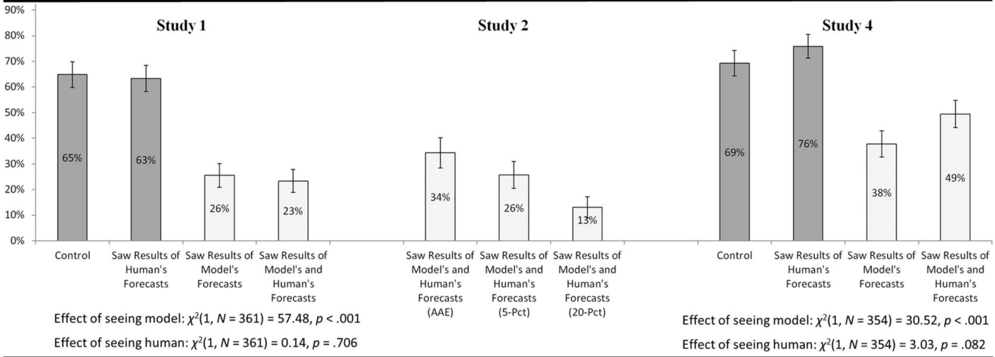
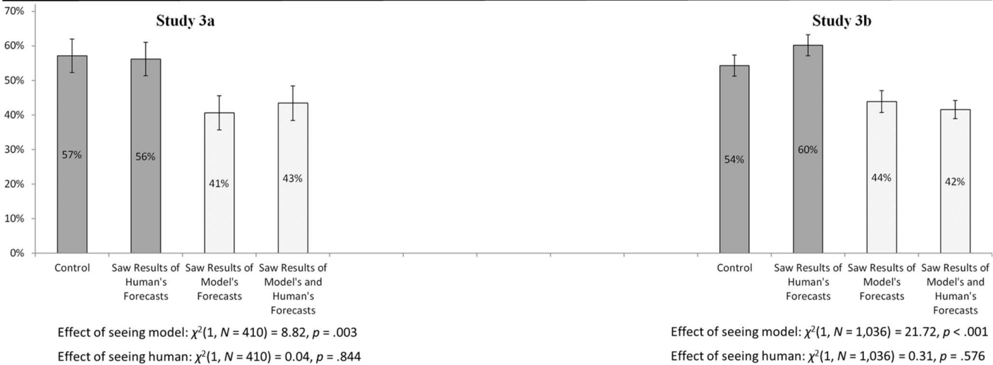
- Across five studies, seeing the algorithm perform reduced participants’ likelihood of choosing it over a human forecaster. In the model-and-human conditions, 610 of 741 participants (83%) saw the model outperform the human, yet these participants were among the least likely to choose the model.
- The model outperformed humans in all five studies. For example, bonuses if choosing model vs. human were Study 1: $1.78 vs. $1.38; Study 2: $1.77 vs. $1.09; Study 3a: $0.48 vs. $0.31; Study 3b: $0.49 vs. $0.30; Study 4: $1.79 vs. $1.38. Human forecasters produced 15–29% more error in the MBA task and 90–97% more error in the airline-passenger task.
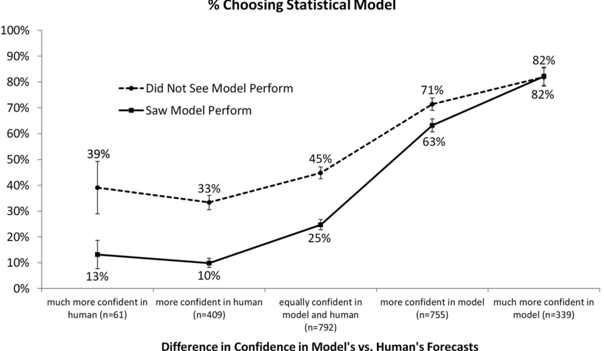
- Seeing the model perform significantly decreased confidence in the model’s forecasts in all four studies where this was tested, whereas seeing the human perform significantly decreased confidence in the human only in Study 4. Confidence in the model’s forecasts significantly mediated the effect of seeing the model perform on choosing the model; confidence in the human did not.
- In Study 2, participants paid for forecasts within 20 percentiles were less likely to choose the model than those paid within 5 percentiles, χ²(1, N = 139) = 3.56, p = .059, and those paid by average absolute error, χ²(1, N = 136) = 8.56, p = .003; this effect was mediated by confidence in their own forecasts, not confidence in the model’s forecasts.
Methods
- Five studies had participants forecast real outcomes: MBA student success (Studies 1, 2, and 4) or U.S. state rank in airline passengers (Studies 3a and 3b). Participants were assigned to control, human, model, or model-and-human conditions, then chose whether to tie incentivized bonuses to the model or the human forecaster (themselves in Studies 1–3, another participant in Study 4).
- Final samples were Study 1: 361; Study 2: 206; Study 3a: 410; Study 3b: 1,036; Study 4: 354. Studies 1, 2, and 4 were run in the Wharton Behavioral Lab; Studies 3a and 3b used Amazon Mechanical Turk.
- Main analyses compared forecasting performance and choice rates, measured confidence and beliefs, and used binary mediation analyses with Preacher and Hayes’s bootstrapping procedure.
Limitations
- The paper states it did not explore all boundaries of the effect, including whether it would persist if algorithms were many times more accurate than humans, and whether results depend on features shared by the two forecasting tasks.
- The paper states it did not explore how algorithm variations—complexity, transparency, forecaster involvement in construction, and designer expertise—affect algorithm aversion.
- The paper states algorithm aversion is not entirely driven by seeing algorithms err, and it has little to say about how best to reduce aversion among those who have seen an algorithm err. The text also cautions that cross-experiment comparisons should be made cautiously.
Model-written summary. Check it against the paper before relying on it.
Integrity signals
Registry
Cites
Statistics
Figures
Verification
Claims the paper makes
0 Valid · 2 Not valid · 16 Not checked · 90 Own results and interpretations
A result the paper reports from its own data — it cites no other source for it, so there is none to check. The quote shows it is in the paper.
In the paper
“the majority of people who were equally confident in the model's and human's forecasts chose to tie their bonuses to the human's forecasts, particularly when they had seen the model perform.”
plainstates an association- Asserted: passes — The authors put it forward as true.
- Checkable: passes — It can be checked against evidence.
- Load-bearing: passes — The paper’s conclusions depend on it.
- Based: passes — The paper gives a reason why it holds.
A result the paper reports from its own data — it cites no other source for it, so there is none to check. The quote shows it is in the paper.
In the paper
“Consistent with research on the adoption of decision aids (see Highhouse, 2008), participants thought that the human forecasters were better than the model at getting better with practice, learning from mistakes, and finding underappreciated candidates.”
plain- Asserted: passes — The authors put it forward as true.
- Checkable: passes — It can be checked against evidence.
- Load-bearing: passes — The paper’s conclusions depend on it.
- Based: passes — The paper gives a reason why it holds.
A result the paper reports from its own data — it cites no other source for it, so there is none to check. The quote shows it is in the paper.
In the paper
“Our studies show that this resistance at least partially arises from greater intolerance for error from algorithms than from humans.”
plainstates a possible cause- Asserted: passes — The authors put it forward as true.
- Checkable: passes — It can be checked against evidence.
- Load-bearing: passes — The paper’s conclusions depend on it.
- Based: passes — The paper gives a reason why it holds.
A result the paper reports from its own data — it cites no other source for it, so there is none to check. The quote shows it is in the paper.
In the paper
“Participants rightfully thought that the model was better than human forecasters at avoiding obvious mistakes, appropriately weighing various attributes, and consistently weighing information.”
plain- Asserted: passes — The authors put it forward as true.
- Checkable: passes — It can be checked against evidence.
- Load-bearing: unclear — It is unclear whether the paper’s conclusions depend on it.
- Based: passes — The paper gives a reason why it holds.
A result the paper reports from its own data — it cites no other source for it, so there is none to check. The quote shows it is in the paper.
In the paper
“This effect was evident in two distinct domains of judgment, including one in which the human forecasters produced nearly twice as much error as the algorithm.”
plain- Asserted: passes — The authors put it forward as true.
- Checkable: passes — It can be checked against evidence.
- Load-bearing: unclear — It is unclear whether the paper’s conclusions depend on it.
- Based: passes — The paper gives a reason why it holds.
75 more claims
Create a free account to see all 108 claims and to verify the 12 references still open.
- It may state two separate claims as one. 13
- Probably not a substantial claim. 16
Claims other papers make about this one
Each is checked against this paper’s own text: does it say what the citing paper says it does?
The source backs part of the claim, not all of it — or backs it for a different population, condition or comparison.
In the citing paper
“Traditional theorizing assumes trade-offs between trust and skepticism (Dietvorst et al., 2015), automation and engagement (Freeman et al., 2014), or efficiency and depth (Ishowo-Oloko et al., 2019)”
From Pedagogical partnerships with generative AI in higher education: how dual cognitive pathways paradoxically enable transformative learning (2026) · cites this paper as Dietvorst et al., 2015
Experimental — accuracy not yet measuredThe source backs part of the claim, not all of it — or backs it for a different population, condition or comparison.
In the citing paper
“Existing research typically examines trust versus skepticism in human-AI interactions as binary constructs (Dietvorst et al., 2015; Logg et al., 2019), missing the possibility that partnerships might simultaneously activate both vigilant and offloading behaviors.”
From Pedagogical partnerships with generative AI in higher education: how dual cognitive pathways paradoxically enable transformative learning (2026) · cites this paper as Dietvorst et al., 2015
Experimental — accuracy not yet measuredThe source backs part of the claim, not all of it — or backs it for a different population, condition or comparison.
In the citing paper
“It aligns with the theoretical rationale on algorithm aversion (Dietvorst et al. 2015;Hohensinn et al. 2024) and appreciation (Logg et al. 2019), which suggests that people are more likely to accept and trust AI systems when they produce desirable results but become skeptical when outcomes are unfavorable.”
From Holding AI Accountable Like Herding Cats: The Contingent Impact on the Legitimacy of Algorithmic Bureaucracy (2026) · cites this paper as Dietvorst et al. 2015
Experimental — accuracy not yet measuredThe source backs part of the claim, not all of it — or backs it for a different population, condition or comparison.
In the citing paper
“Research on algorithm appreciation and algorithm aversion further suggests that people may either defer to algorithms or reject them depending on prior experience, perceived expertise, and error visibility (Dietvorst et al., 2015; Logg et al., 2019).”
From College students' metacognitive awareness of generative-AI reliance: an experimental study of decision confidence and attribution bias (2026) · cites this paper as Dietvorst et al., 2015
Experimental — accuracy not yet measuredThe source backs part of the claim, not all of it — or backs it for a different population, condition or comparison.
In the citing paper
“Earlier research has mentioned gender, self-confidence, expertise, and general algorithm aversion or appreciation.15,28”
From Appropriate trust in artificial intelligence for the optical diagnosis of colorectal polyps: the role of human/artificial intelligence interaction (2024) · cites this paper as [28]
Experimental — accuracy not yet measured
22 more claims about this paper
Create a free account to see every claim other papers make about this one.
Statistics recomputed
Every reported test result, recomputed from its test statistic and degrees of freedom. A result shows as not adding up only once an independent check has confirmed it.
- Consistentt(360) = 4.98reported p < .001 · recomputed p < .001
“t (360) = 4.98, p < .001”
- Consistentt(204) = 6.26reported p < .001 · recomputed p < .001
“t (204) = 6.26, p < .001”
- Consistentt(405) = 7.73reported p < .001 · recomputed p < .001
“t (405) = 7.73, p < .001”
- Consistentt(353) = 5.11reported p < .001 · recomputed p < .001
“t (353) = 5.11, p < .001”
- Consistentχ²(1) = 39.94reported p < .001 · recomputed p < .001
“χ 2 (1, N = 271) = 39.94, p < .001”
19 more recomputed tests
Create a free account to see every test the Stats check recomputed.
Self-check
Percentages, sums and reported differences re-computed from the paper’s own numbers.
Self-check results appear here once an independent check has confirmed them.
Citations
Cites
Preacher, K. J., & Hayes, A. F. (2008) · Behavior Research Methods · doi:10.3758/brm.40.3.879 · Cited by 34,117 · cited 1×
“We then used Preacher and Hayes’s (2008) bootstrapping procedure to obtain unbiased 95% confidence intervals around the mediated effects.”
Method(2023) · doi:10.1126/science · Cited by 6,063
The trouble with overconfidence.
Moore, D. A., & Healy, P. J. (2008) · Psychological Review · doi:10.1037/0033-295x.115.2.502 · Cited by 2,358
“Clinical versus Actuarial Judgment.”
Dawes, R. M., Faust, D., & Meehl, P. E. (1989) · Science · doi:10.1126/science.2648573 · Cited by 2,298
The robust beauty of improper linear models in decision making.
Dawes, R. M. (1979) · American Psychologist · doi:10.1037/0003-066x.34.7.571 · Cited by 1,966
Preference and belief: Ambiguity and competence in choice under uncertainty
Heath, C., & Tversky, A. (1991) · Journal of Risk and Uncertainty · doi:10.1007/bf00057884 · Cited by 1,654
Clinical versus mechanical prediction: a meta-analysis
Grove, W. M., Zald, D. H., Lebow, B. S., Snitz, B. E., & Nelson, C. (2000) · Psychological Assessment · doi:10.1037/1040-3590.12.1.19 · Cited by 1,640
Grove, W. M., & Meehl, P. E. (1996) · Psychology, Public Policy, and Law · doi:10.1037/1076-8971.2.2.293 · Cited by 1,457 · cited 4×
“…1996), the notion that algorithms cannot properly consider individual targets (Grove & Meehl, 1996), concerns about the ethicality of relying on algorithms to make important decisions (Dawes, 1979), and the presumed inability of algorithms to incorporate qualitative data (Grove & Meehl, 1996).”
BackgroundMethodInfluential(2007) · Cited by 1,133
Competing on analytics: the new science of winning
(2007) · Choice Reviews Online · doi:10.5860/choice.44-6322 · Cited by 941
Research works printed but not linked: 1
- Clark, D. (2012, November 7). How Nate Silver won the 2012 presidential election. Harvard Business Review Blog . Retrieved from http://blogs .hbr.org/cs/2012/11/how\_nate\_silver\_won\_the\_2012\_p.html
Cited by
Items 3,701–3,800 of 3,918
Duan, J., Fan, C., Zhao, L., Qi, S., Wu, C., & Dai, L. (n.d.) · AIS Electronic Library (AISeL)
Hanus, B., & George, B. (n.d.) · Journal of the Association for Information Systems
Hardigg, G., & Galletta, D. (n.d.) · AIS Electronic Library (AISeL)
Heßler, P. O., Blay, T., Pfeiffer, J., & Hafenbrädl, S. (2026) · AIS Electronic Library (AISeL)
When Perfect Language Backfires: The Impact of Linguistic Accuracy on Review Helpfulness
Sun, P., Sun, S., & Liu, J. (n.d.) · AIS Electronic Library (AISeL)
Too Clear to Question: AI Summarization and Overestimation in Managerial Decision Making
Wang, P. Y., Animesh, A., Havakhor, T., & Jiao, W. (n.d.) · AIS Electronic Library (AISeL)
Fu, J., Zhang, Y., & Zhang, S. (2026) · Frontiers in Psychology · doi:10.3389/fpsyg.2026.1975796
The AI Decision Trap: Decision Quality and Managerial Learning in the Age of AI
Rizvi, A. A. (2026) · International Journal of Business and Management Sciences · doi:10.63468/ijbms.7.4.28
hosseini, S. J. (2026) · Research Square · doi:10.21203/rs.3.rs-11076896/v1
Sun, M., Tan, B., Niu, C., & Guo, X. (2026) · Journal of the Association for Information Systems
Jia, Q., & Zhang, Y. (2026) · AIS Electronic Library (AISeL)
The Effect of Agentic AI on Consumers’ Consumption Decisions in E-Commerce Context
Wang, Y., Guan, Y., & Li, Z. (2026) · Journal of the Association for Information Systems
Wei, K., Liu, J., Wang, S., & Sun, Y. (2026) · Frontiers in Psychology · doi:10.3389/fpsyg.2026.1905449
The Evolution of Economics in the Era of Artificial Intelligence
Cai, X., Chen, H., Hong, Y., Zhang, M., 刘作仪, Wu, G., Chen, Z., & Wu, L. (2026) · 中国科学基金 · doi:10.3724/bnsfc-2026-0204
Traversa, F. (2026) · Businesses · doi:10.3390/businesses6040056
Porat, C. S.-B. (2026) · SSRN Electronic Journal · doi:10.2139/ssrn.7649058
Faleiros, R. A., & Placca, J. A. (2026) · Conferência Latino-Americana de Tecnologias de Aprendizagem (LACLO) · doi:10.5753/laclo_estendido.2026.46038
The Missing Feedback Loop: Why Organisations Fail to Learn from Human Corrections to AI
Rizvi, A. A. (2025) · Research Journal for Social Affairs · doi:10.71317/rjsa.003.08.1192
Return on AI (RoAI): A framework for assessing AI investments in the marketing organization
Kanuri, V. K., Pattabhiramaiah, A., & Sridhar, S. (2026) · Journal of the Academy of Marketing Science · doi:10.1007/s11747-026-01217-6
Wang, D., & Song, Y. (2026) · Frontiers in Psychology · doi:10.3389/fpsyg.2026.1867910
Stewart, B., Colón‐Aguirre, M., & Ju, B. (2026) · The Journal of Academic Librarianship · doi:10.1016/j.acalib.2026.103358
Rawat, G., कुमार, ड. श., Adithiya, L. M. D. D., Chandra, R., M., A. P., Veetil, R. E. P., Jain, K., Sahani, T., Thapa, S., Khan, A. H., et al. (2026) · doi:10.63345/wp-icmr-2025
Şahin, M. A., & Yurder, Y. (2026) · Journal of theoretical and applied electronic commerce research · doi:10.3390/jtaer21110386
Evidence Against Authority: Costly Verification and the Audit of Unchanged DecisionsPreprint
Weinert, J.-H. (2026) · SSRN Electronic Journal · doi:10.2139/ssrn.7643998
Min, C., Qin, X., Wang, Y., Ziyi, L., & Ru, X. (2026) · International Journal of Human-Computer Interaction · doi:10.1080/10447318.2026.2749338
Hipergerçeklik Bağlamında Sanal AVM’lerde Algoritmik Tüketim: Eleştirel Bir Analiz
Geçit, E., & Doğru, G. (2026) · İmgelem · doi:10.53791/imgelem.1997730
Responsibility Attribution Shift and Trust Repair Mechanisms in Medical Human-AI Collaboration
王, 雪. (2026) · Advances in Psychology · doi:10.12677/ap.2026.1610495
BEYOND TECHNOSTRESS AI Fatigue as a Cumulative Adaptation Burden in Education and Work
Badawy, W. (2026) · Emirati Journal of Applied Psychology · doi:10.54878/bxxewh81
Sealed Before the Open: A Verifiable Standard for Measuring AI Forecasts of Financial MarketsPreprint
Chernets, V. (2026) · SSRN Electronic Journal · doi:10.2139/ssrn.7653679
Moghaddam, M. T., Alipour, M., & Grunert, K. G. (2026) · Research Square · doi:10.21203/rs.3.rs-11222729/v2
Fuchs, C., & Granulo, A. (2026) · Current Opinion in Psychology · doi:10.1016/j.copsyc.2026.102480
Recognition without obligation: AI, asset position, and the limits of structural explanations
Lee, Y., & Han, S. (2026) · Journal of Information Technology & Politics · doi:10.1080/19331681.2026.2752114
The ChatGPT source cue shapes answer acceptance in a reasoning task
Fabio, R. A., Rantuccio, E., & Bruno, F. (2026) · Frontiers in Psychology · doi:10.3389/fpsyg.2026.1923236
The As-If Machine: Personalized AI counterfactuals make distant policy risks feel closePreprint
Ashkinaze, J., Zhou, Y., Chen, P., Bhattacharya, A., Park, H., Zhang, Y., Preston, S. D., Gilbert, É., & Budak, C. (2026) · arXiv (Cornell University) · doi:10.13140/rg.2.2.34824.17926
Djanggih, H. (2026) · Research Square · doi:10.21203/rs.3.rs-11460998/v1
Tadlaoui, M. Y., & Bennis, K. (2026) · International Journal of Accounting, Finance, Auditing, Management and Economics · doi:10.5281/zenodo.23601122
Kauttonen, J., Tuomi, A., Vuori, J., Saaranen, P., & Lahtinen, A. (2026) · International Journal of Human-Computer Interaction · doi:10.1080/10447318.2026.2750593
Navigating Organizational Resistance to AI in the Travel Industry
Srivastava, A. P., Rajora, H., & Rathnasiri, M. S. H. (2026) · Advances in computational intelligence and robotics book series · doi:10.4018/979-8-2600-0522-4.ch011
Hudson, C., Goldsworthy, A. K., Jowsey, T., Tronstad, O., & Randall, M. (2026) · Journal of Psychology and AI · doi:10.1080/29974100.2026.2743005
Dhand, S., Patnaik, P., Huzooree, G., Jeffery, D., & Kumar, N. (2026) · Advances in computational intelligence and robotics book series · doi:10.4018/979-8-2600-0522-4.ch014
Xu, H., Liang, S., & Cheng, Q. (2026) · Information Technology and People · doi:10.1108/itp-05-2026-0970
Is this candidate for real? AI authorship disclosure and candidate evaluations
Dempsey, M. C. (2026) · Journal of Information Technology & Politics · doi:10.1080/19331681.2026.2743678 · Cited by 1
Jin, Y., Sun, Y., & Zhang, H. L. (2026) · Legal and Criminological Psychology · doi:10.1111/lcrp.70071
The Impact of AI-Driven Information Technology on Social Media Communication and Consumer Trust
Rahman, M. H., Afsar, T. B., & Alam, M. S. (2026) · doi:10.63125/2jq2bx46
Artificial Intelligence in Economic Business: A Systematic Review and Future Research Agenda
Octaviani, A. (2026) · Journal Economic Business Innovation · doi:10.69725/jebi.v2i4.367
Routing decisions, human judgement, and digitalisation in high-friction logistics environments
Çelebi, D., & Cekic, E. (2026) · Research in Transportation Business & Management · doi:10.1016/j.rtbm.2026.101921
WHEN METRICS REPLACE MANAGERS: ALGORITHMIC PERFORMANCE EVALUATION AND SUPERVISOR TRUST
M. Shunmugasundaram, D. S. G., Gangadharan, S., Azhagan, C. T., & Mahalaxmi, K. R. (2026) · Lex localis - Journal of Local Self-Government · doi:10.52152/d1pds138
Şen, B. (2026) · DergiPark
Nguyen, N.-T., Tran, N.-K. H., Pham, K.-M. N., & Duong, N.-H. (2026) · Acta Psychologica · doi:10.1016/j.actpsy.2026.108061
AI governance needs to consider users’ emotional responses
Västfjäll, D. (2026) · Nature Human Behaviour · doi:10.1038/s41562-026-02620-3
Salem, M. A. (2026) · Mathematics · doi:10.3390/math14213885
Schmitt, B. H. (2026) · Current Opinion in Psychology · doi:10.1016/j.copsyc.2026.102487
Smith, R. A., Dlamini, P., Adelodun, A. J., Adeyeye, B., Ogundeyi, O. J., & Randle, O. (2026) · Image & Text · doi:10.17159/2617-3255/2026/n40a13
Cognitive Mediation of Relational Evidence: An Investigation of Epistemic Judgment and Reliance
HUANG, W. (2026) · PhilPapers (PhilPapers Foundation) · doi:10.17613/f0zrz-29y64
Bias Cues and the Turn to AI: Perspectives from Minority and Marginalized Groups
Jones-Jang, S. M., & Kim, Y. (2026) · International Journal of Human-Computer Interaction · doi:10.1080/10447318.2026.2750610
Xue, M., Dai, Y., Liu, X., Liu, Y., & Jiang, Y. (2025) · Education insights. · doi:10.70088/0trkz013
Turgut, Y., & Gurbuz, A. (2026) · International Artificial Intelligence and Data Processing Symposium (IDAP) · doi:10.1109/idap71869.2026.11728097
When Should I Trust This? Designing and Evaluating Factuality Indicators for LLM-based ChatbotsPreprint
Warren, G., Lehane, C. M., Heal, J., Eser, S., Leto, D. M., & Augenstein, I. (2026) · arXiv (Cornell University) · doi:10.48550/arxiv.2610.32883
Accuracy is not enough: The roles of accuracy, reliability and personality in the trust process
Alarcon, G. M., Ryan, T. J., Capiola, A., & Willis, S. M. (2026) · Applied Ergonomics · doi:10.1016/j.apergo.2026.104916
Artificial Intelligence in Corporate Boards
Hruškа, D. (2026) · Encyclopedia · doi:10.3390/encyclopedia6110238
Azenzoul, A., KADIRI, H. E., Tayazime, J., Mahouat, N., Moussaid, A., & Mokhlis, K. (2026) · Encyclopedia · doi:10.3390/encyclopedia6110240
Liu, Y., Gao, X., Qi, G., & Lee, J. (2026) · Research Square · doi:10.21203/rs.3.rs-10842436/v1
Perceived algorithmic control and courier safety risk in last-mile delivery: a transparency paradox
Lin, Y., Zhao, Q., & Chang, J. (2026) · Industrial Management & Data Systems · doi:10.1108/imds-03-2026-0356
Beyond Algorithms: Psychological Pathways to Robo-Advisor Adoption Among Young Indians
Dhamija, A., Dhamija, D., Manrai, R., Badgujjar, K., & Ahuja, D. (2026) · doi:10.1109/icsl-dsga70378.2026.11736502
Mapping the Human-AI Collaboration in Strategic Decision-Making: A Bibliometric Review
Bidari, S., Sharma, L. R., & Molla, N. (2026) · NPRC Journal of Multidisciplinary Research. · doi:10.3126/nprcjmr.v3i10.100699
Artificial Intelligence and the Future of Accounting: Opportunities, Risks and Ethics
Muhammad, F., Yu, T. C., & Hsia, C. G. S. (2026) · International journal of research and scientific innovation · doi:10.51244/ijrsi.2026.1309000296
Zhang, T., Song, L., Zhao, Y., & Wang, Y. (2026) · ACM Transactions on Human-Robot Interaction · doi:10.1145/3860538
Event-Anchored Trust in AI-Powered Assessment: Why Trust Collapses Faster than It Repairs
Zhang, H. (2026) · SAGE Open · doi:10.1177/21582440261502067
Jarallah, J. A. A., Edwan, H. A. A., & Alharbi, F. S. (2026) · International Journal of Artificial Intelligence and Machine Learning · doi:10.51483/ijaiml.2946
From Explaining to Enabling: Actionable Transparency in Algorithmic Insurance PricingPreprint
Machado, A. F., & Huang, F. (2026) · arXiv (Cornell University) · doi:10.48550/arxiv.2610.34459
Baldus, B. J. (2026) · Journal of Marketing Education · doi:10.1177/02734753261491247
Li, W., & Su, Y.-H. (2026) · Frontiers in Psychology · doi:10.3389/fpsyg.2026.1989652
Armstrong, B. A., Cheuy, L., Kottler, N. E., & Larson, D. B. (2026) · American Journal of Roentgenology · doi:10.2214/ajr.26.35826
Stoiacovici, C. A., Tănase, A. D., Marin, K. C., & Ilie, A. C. (2026) · Healthcare · doi:10.3390/healthcare14213660
Botsitting : Conceptualizing Value-Enabling Hidden Human Labor in AI-Enabled Work
Dwivedi, Y. K., Crick, T., Michael, K., Samothrakis, S., Sarker, I., Naeem, R. M., Raman, R., Malik, T., Hughes, L., Raman, R., et al. (2026) · Journal of Computer Information Systems · doi:10.1080/08874417.2026.2749411
Conditional Values: The Contingent Foundations of Attitudes toward Artificial IntelligencePreprint
Flanders, S., & Nungsari, M. (2026) · arXiv (Cornell University) · doi:10.48550/arxiv.2610.37197
When Machines Mislead: Trust, Cognitive Processing, and Belief in AI-Labeled Misinformation
x, R., & Hemanth Babu, R. (2026) · International Journal of Science and Research (IJSR) · doi:10.21275/sr261026155939
Formal Randomness and Perceived Fairness in Workshop Work Order Allocation
Chen, M. (2026) · Frontiers in Public Management · doi:10.63313/fpm.9019
Kovalchuk, A. (2026) · Computers in Human Behavior Artificial Humans · doi:10.1016/j.chbah.2026.100409
AI Reliance in the Fantasy American Football Lineup-Setting Task
Nicholson, M. B., Keegan, B., & Semaan, B. (2026) · doi:10.1145/3838843.3838850
When signaling AI-generated content increases charitable giving: the role of consumer mindsets
Baek, T. H., Park, J., & Jhang, J. (2026) · International Journal of Advertising · doi:10.1080/02650487.2026.2751351
Alhebsi, A. S. (2026) · Emirati Journal of Business Economics & Social Studies · doi:10.54878/ty079w57
Human judgment as a design variable in AI-enabled decision systems
Sanders, N. R. (2026) · Journal of the Operational Research Society · doi:10.1080/01605682.2026.2753681
One Advisor, Many Faces: How User Personas Shape LLM Stock Recommendations
He, Y. (2026) · Workshop on Financial Technology and Natural Language Processing (FinNLP) · doi:10.18653/2026.finnlp-1.7
Öztürkcan, S. (2026) · Journal of Responsible Technology · doi:10.1016/j.jrt.2026.100197
Zhang, W., Song, L., & Hao, N. (2026) · Thinking Skills and Creativity · doi:10.1016/j.tsc.2026.102391
Flores-Barrios, R. A., Borda, R. F. C., Quispe, L. A. M., Bravo, J. L. R., la Cruz-Montoya, D. D., Pajuelo-Rodríguez, J. A., Bravo, M. R., Mora., Z. Z., Cajavilca-Gonzáles, B., & Quispe-Farfán, P. H. (2026) · F1000Research · doi:10.12688/f1000research.185557.1
Prorok, M., & Varga, J. (2026) · IEEE International Symposium on Intelligent Systems and Informatics (SISY) · doi:10.1109/sisy71351.2026.11738454
Park, S., Kim, S. Y., & Lee, C. (2026) · Behavioral Sciences · doi:10.3390/bs16112036
Yıldız, G. (2026) · Genel Tıp Dergisi · doi:10.54005/geneltip.1958245
Verification Learning Theory: A Process Model of Checking and Retention in AI-Assisted JudgmentPreprint
Trattner, C. (2026) · arXiv (Cornell University) · doi:10.48550/arxiv.2610.37875
Wunderlich, F., Reis, M., Kunde, W., & Memmert, D. (2026) · Psychological Research · doi:10.1007/s00426-026-02409-z
Beauty Is Human: When People Love AI-Generated Art, They Think a Human Made ItPreprint
Chen, Z., Zhu, D., & Zheng, L. N. (2026) · arXiv (Cornell University) · doi:10.48550/arxiv.2610.38113
Impact of AI-Based Investment Recommendations on Retail Investor Psychology Markets
Begum, V. J., Amin, D. U., Yadav, S., Singh, S., Saini, D. A., Darshan, D. S., Rupani, J., & Dongre, D. S. (2026) · Review of Futures Markets · doi:10.66668/rfm.v34i2.264
Who decides when the AI disagrees? A defensibility-threshold theory of accountable AI adjudication
Nafis, S. I., & Minh, S. T. (2026) · Digital Enterprise Studies · doi:10.68217/9pvd2v96
Lu, Y. (2023) · Journal of Business and Data Analytics · doi:10.63646/khol2482
Okpara, K. P. (2026) · International Journal on Cybernetics & Informatics · doi:10.5121/ijci.2026.150505
Gao, E., & Chen, Z. (2026) · ACM Symposium on User Interface Software and Technology (UIST) · doi:10.1145/3830398.3830669
Auditable pricing governance: Matched comparisons and cumulative consumer welfare trade-offs
Ashaye, A. L., Orisakahunsi, O. F., Lawal, O. L., Adeniyi, S. A., Adefisan-Williams, A. A., & Ishaku, P. K. (2026) · Strategic Business Research · doi:10.1016/j.sbr.2026.100315
Metadata
- Authors
- Dietvorst, B. J., Simmons, J. P., & Massey, C.
- Affiliations
- University of Pennsylvania (US)
- Venue
- Journal of Experimental Psychology: General
- Published
- 2015
- Volume
- 144
- Issue
- 1
- Pages
- 114-126
- ISSN
- 0096-3445 (ISSN-L)
- 1939-2222
- OpenAlex
- W3125633690
- Cited by
- 3,232
- References
- 22
- Citations by year
- 2026: 1025 · 2025: 563 · 2024: 445 · 2023: 404 · 2022: 266 · 2021: 216 · 2020: 137 · 2019: 88 · 2018: 41 · 2017: 26 · 2016: 14 · 2015: 5
- FWCI
- 13.96
- Type
- journal article
- Language
- en
- Open access
- green
- doi.org
- Locations
- Journal of Experimental Psychology General (publishedVersion)
- SSRN Electronic Journal (publishedVersion)
- PubMed (publishedVersion)
- ScholarlyCommons (University of Pennsylvania) (submittedVersion)
- Funders
- Wharton Behavioral Laboratory
- Wharton Risk Center Ackoff Doctoral Student Fellowship
- Topics
- Social Sciences › Decision Sciences › General Decision Sciences › Decision-Making and Behavioral Economics
- Social Sciences › Decision Sciences › Management Science and Operations Research › Forecasting Techniques and Applications
- Social Sciences › Human Factors and Ergonomics › Human-Automation Interaction and Safety
- Keywords
- algorithm aversion, trust in algorithms, prediction confidence, evidence-based algorithm, decision-making
- MeSH terms
- Algorithms, Avoidance Learning, Culture, Decision Making, Female, Forecasting, Humans, Male, Motivation, Comprehension, Young Adult
About these checks
Registry, retraction, Cites and statistics results are computed, not judged, with one exception: a printed reference that no index lists is read once by a model before it counts as a citation error. Claims are extracted by a model and kept only when their quote appears verbatim in the text; each cited source is then checked, with a model’s help, for whether it says what the claim relies on. Those verdicts can be wrong — read the claim’s quote and the cited source before relying on one.
A language model drew the claims from the paper on 2026-11-14, under version 3 of the claim definition (model deepseek-v4.1-flash, prompt extract-v3).
A second model labelled each claim on 2026-11-14 (model jev-1.13-20260917, definition revision gold-guideline-v0.2).
Statistics and arithmetic are recomputed, not judged.
Confidence bands are shown only for fields calibrated on our annotated test set. None is calibrated yet, so no band is shown.
What counts as a claim ›How we measure confidence ›How we check this ›
Are you an author, or do you see a problem with this page? Request a review
Data sources
Bibliographic data: Semantic Scholar, OpenAlex, Crossref.
Contains information from the Semantic Scholar Academic Graph Datasets, made available under the ODC Attribution License (ODC-BY 1.0).
Semantic Scholar’s data is described in: Kinney, R., et al. (2023). The Semantic Scholar Open Data Platform. arXiv:2301.10140.
