

Algorithm aversion: People erroneously avoid algorithms after seeing them err.
Open accessThe DOI matches its Crossref record; 23 of the 23 references it cites were found in a registry or an index; none of the 22 sources its claims cite is checked for support yet.
Abstract
Research shows that evidence-based algorithms more accurately predict the future than do human forecasters. Yet when forecasters are deciding whether to use a human forecaster or a statistical algorithm, they often choose the human forecaster. This phenomenon, which we call algorithm aversion, is costly, and it is important to understand its causes. We show that people are especially averse to algorithmic forecasters after seeing them perform, even when they see them outperform a human forecaster. This is because people more quickly lose confidence in algorithmic than human forecasters after seeing them make the same mistake. In 5 studies, participants either saw an algorithm make forecasts, a human make forecasts, both, or neither. They then decided whether to tie their incentives to the future predictions of the algorithm or the human. Participants who saw the algorithm perform were less confident in it, and less likely to choose it over an inferior human forecaster. This was true even among those who saw the algorithm outperform the human.
Overview
CoChat Summary
TL;DR
People become less willing to use a statistical algorithm after seeing it perform and make mistakes, even when it outperforms a human forecaster. This “algorithm aversion” is driven partly by people losing confidence in algorithms more quickly than in humans after observing errors.
Key findings
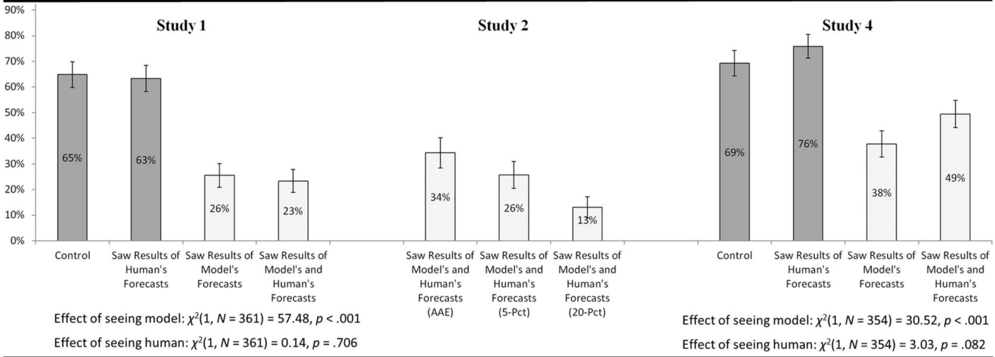
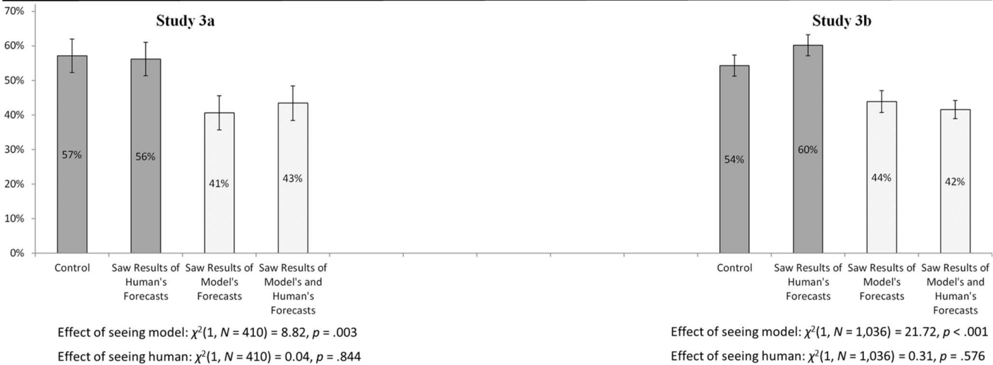
- Across five studies, seeing the algorithm perform reduced participants’ likelihood of choosing it over a human forecaster. In the model-and-human conditions, 610 of 741 participants (83%) saw the model outperform the human, yet these participants were among the least likely to choose the model.
- The model outperformed humans in all five studies. For example, bonuses if choosing model vs. human were Study 1: $1.78 vs. $1.38; Study 2: $1.77 vs. $1.09; Study 3a: $0.48 vs. $0.31; Study 3b: $0.49 vs. $0.30; Study 4: $1.79 vs. $1.38. Human forecasters produced 15–29% more error in the MBA task and 90–97% more error in the airline-passenger task.
- Seeing the model perform significantly decreased confidence in the model’s forecasts in all four studies where this was tested, whereas seeing the human perform significantly decreased confidence in the human only in Study 4. Confidence in the model’s forecasts significantly mediated the effect of seeing the model perform on choosing the model; confidence in the human did not.
- In Study 2, participants paid for forecasts within 20 percentiles were less likely to choose the model than those paid within 5 percentiles, χ²(1, N = 139) = 3.56, p = .059, and those paid by average absolute error, χ²(1, N = 136) = 8.56, p = .003; this effect was mediated by confidence in their own forecasts, not confidence in the model’s forecasts.
Methods
- Five studies had participants forecast real outcomes: MBA student success (Studies 1, 2, and 4) or U.S. state rank in airline passengers (Studies 3a and 3b). Participants were assigned to control, human, model, or model-and-human conditions, then chose whether to tie incentivized bonuses to the model or the human forecaster (themselves in Studies 1–3, another participant in Study 4).
- Final samples were Study 1: 361; Study 2: 206; Study 3a: 410; Study 3b: 1,036; Study 4: 354. Studies 1, 2, and 4 were run in the Wharton Behavioral Lab; Studies 3a and 3b used Amazon Mechanical Turk.
- Main analyses compared forecasting performance and choice rates, measured confidence and beliefs, and used binary mediation analyses with Preacher and Hayes’s bootstrapping procedure.
Limitations
- The paper states it did not explore all boundaries of the effect, including whether it would persist if algorithms were many times more accurate than humans, and whether results depend on features shared by the two forecasting tasks.
- The paper states it did not explore how algorithm variations—complexity, transparency, forecaster involvement in construction, and designer expertise—affect algorithm aversion.
- The paper states algorithm aversion is not entirely driven by seeing algorithms err, and it has little to say about how best to reduce aversion among those who have seen an algorithm err. The text also cautions that cross-experiment comparisons should be made cautiously.
Model-written summary. Check it against the paper before relying on it.
Integrity signals
Registry
Cites
Statistics
Figures
Verification
Claims the paper makes
0 Valid · 2 Not valid · 16 Not checked · 90 Own results and interpretations
A result the paper reports from its own data — it cites no other source for it, so there is none to check. The quote shows it is in the paper.
In the paper
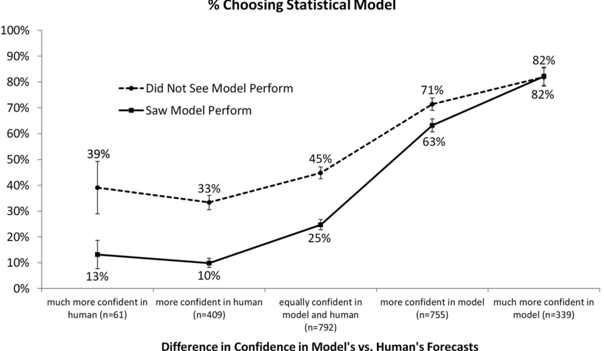
“the majority of people who were equally confident in the model's and human's forecasts chose to tie their bonuses to the human's forecasts, particularly when they had seen the model perform.”
plainstates an association- Asserted: passes — The authors put it forward as true.
- Checkable: passes — It can be checked against evidence.
- Load-bearing: passes — The paper’s conclusions depend on it.
- Based: passes — The paper gives a reason why it holds.
A result the paper reports from its own data — it cites no other source for it, so there is none to check. The quote shows it is in the paper.
In the paper
“Consistent with research on the adoption of decision aids (see Highhouse, 2008), participants thought that the human forecasters were better than the model at getting better with practice, learning from mistakes, and finding underappreciated candidates.”
plain- Asserted: passes — The authors put it forward as true.
- Checkable: passes — It can be checked against evidence.
- Load-bearing: passes — The paper’s conclusions depend on it.
- Based: passes — The paper gives a reason why it holds.
A result the paper reports from its own data — it cites no other source for it, so there is none to check. The quote shows it is in the paper.
In the paper
“Our studies show that this resistance at least partially arises from greater intolerance for error from algorithms than from humans.”
plainstates a possible cause- Asserted: passes — The authors put it forward as true.
- Checkable: passes — It can be checked against evidence.
- Load-bearing: passes — The paper’s conclusions depend on it.
- Based: passes — The paper gives a reason why it holds.
A result the paper reports from its own data — it cites no other source for it, so there is none to check. The quote shows it is in the paper.
In the paper
“Participants rightfully thought that the model was better than human forecasters at avoiding obvious mistakes, appropriately weighing various attributes, and consistently weighing information.”
plain- Asserted: passes — The authors put it forward as true.
- Checkable: passes — It can be checked against evidence.
- Load-bearing: unclear — It is unclear whether the paper’s conclusions depend on it.
- Based: passes — The paper gives a reason why it holds.
A result the paper reports from its own data — it cites no other source for it, so there is none to check. The quote shows it is in the paper.
In the paper
“This effect was evident in two distinct domains of judgment, including one in which the human forecasters produced nearly twice as much error as the algorithm.”
plain- Asserted: passes — The authors put it forward as true.
- Checkable: passes — It can be checked against evidence.
- Load-bearing: unclear — It is unclear whether the paper’s conclusions depend on it.
- Based: passes — The paper gives a reason why it holds.
75 more claims
Create a free account to see all 108 claims and to verify the 12 references still open.
- It may state two separate claims as one. 13
- Probably not a substantial claim. 16
Claims other papers make about this one
Each is checked against this paper’s own text: does it say what the citing paper says it does?
The source backs part of the claim, not all of it — or backs it for a different population, condition or comparison.
In the citing paper
“Traditional theorizing assumes trade-offs between trust and skepticism (Dietvorst et al., 2015), automation and engagement (Freeman et al., 2014), or efficiency and depth (Ishowo-Oloko et al., 2019)”
From Pedagogical partnerships with generative AI in higher education: how dual cognitive pathways paradoxically enable transformative learning (2026) · cites this paper as Dietvorst et al., 2015
Experimental — accuracy not yet measuredThe source backs part of the claim, not all of it — or backs it for a different population, condition or comparison.
In the citing paper
“Existing research typically examines trust versus skepticism in human-AI interactions as binary constructs (Dietvorst et al., 2015; Logg et al., 2019), missing the possibility that partnerships might simultaneously activate both vigilant and offloading behaviors.”
From Pedagogical partnerships with generative AI in higher education: how dual cognitive pathways paradoxically enable transformative learning (2026) · cites this paper as Dietvorst et al., 2015
Experimental — accuracy not yet measuredThe source backs part of the claim, not all of it — or backs it for a different population, condition or comparison.
In the citing paper
“It aligns with the theoretical rationale on algorithm aversion (Dietvorst et al. 2015;Hohensinn et al. 2024) and appreciation (Logg et al. 2019), which suggests that people are more likely to accept and trust AI systems when they produce desirable results but become skeptical when outcomes are unfavorable.”
From Holding AI Accountable Like Herding Cats: The Contingent Impact on the Legitimacy of Algorithmic Bureaucracy (2026) · cites this paper as Dietvorst et al. 2015
Experimental — accuracy not yet measuredThe source backs part of the claim, not all of it — or backs it for a different population, condition or comparison.
In the citing paper
“Research on algorithm appreciation and algorithm aversion further suggests that people may either defer to algorithms or reject them depending on prior experience, perceived expertise, and error visibility (Dietvorst et al., 2015; Logg et al., 2019).”
From College students' metacognitive awareness of generative-AI reliance: an experimental study of decision confidence and attribution bias (2026) · cites this paper as Dietvorst et al., 2015
Experimental — accuracy not yet measuredThe source backs part of the claim, not all of it — or backs it for a different population, condition or comparison.
In the citing paper
“Earlier research has mentioned gender, self-confidence, expertise, and general algorithm aversion or appreciation.15,28”
From Appropriate trust in artificial intelligence for the optical diagnosis of colorectal polyps: the role of human/artificial intelligence interaction (2024) · cites this paper as [28]
Experimental — accuracy not yet measured
22 more claims about this paper
Create a free account to see every claim other papers make about this one.
Statistics recomputed
Every reported test result, recomputed from its test statistic and degrees of freedom. A result shows as not adding up only once an independent check has confirmed it.
- Consistentt(360) = 4.98reported p < .001 · recomputed p < .001
“t (360) = 4.98, p < .001”
- Consistentt(204) = 6.26reported p < .001 · recomputed p < .001
“t (204) = 6.26, p < .001”
- Consistentt(405) = 7.73reported p < .001 · recomputed p < .001
“t (405) = 7.73, p < .001”
- Consistentt(353) = 5.11reported p < .001 · recomputed p < .001
“t (353) = 5.11, p < .001”
- Consistentχ²(1) = 39.94reported p < .001 · recomputed p < .001
“χ 2 (1, N = 271) = 39.94, p < .001”
19 more recomputed tests
Create a free account to see every test the Stats check recomputed.
Self-check
Percentages, sums and reported differences re-computed from the paper’s own numbers.
Self-check results appear here once an independent check has confirmed them.
Citations
Cites
Preacher, K. J., & Hayes, A. F. (2008) · Behavior Research Methods · doi:10.3758/brm.40.3.879 · Cited by 34,117 · cited 1×
“We then used Preacher and Hayes’s (2008) bootstrapping procedure to obtain unbiased 95% confidence intervals around the mediated effects.”
Method(2023) · doi:10.1126/science · Cited by 6,063
The trouble with overconfidence.
Moore, D. A., & Healy, P. J. (2008) · Psychological Review · doi:10.1037/0033-295x.115.2.502 · Cited by 2,358
“Clinical versus Actuarial Judgment.”
Dawes, R. M., Faust, D., & Meehl, P. E. (1989) · Science · doi:10.1126/science.2648573 · Cited by 2,298
The robust beauty of improper linear models in decision making.
Dawes, R. M. (1979) · American Psychologist · doi:10.1037/0003-066x.34.7.571 · Cited by 1,966
Preference and belief: Ambiguity and competence in choice under uncertainty
Heath, C., & Tversky, A. (1991) · Journal of Risk and Uncertainty · doi:10.1007/bf00057884 · Cited by 1,654
Clinical versus mechanical prediction: a meta-analysis
Grove, W. M., Zald, D. H., Lebow, B. S., Snitz, B. E., & Nelson, C. (2000) · Psychological Assessment · doi:10.1037/1040-3590.12.1.19 · Cited by 1,640
Grove, W. M., & Meehl, P. E. (1996) · Psychology, Public Policy, and Law · doi:10.1037/1076-8971.2.2.293 · Cited by 1,457 · cited 4×
“…1996), the notion that algorithms cannot properly consider individual targets (Grove & Meehl, 1996), concerns about the ethicality of relying on algorithms to make important decisions (Dawes, 1979), and the presumed inability of algorithms to incorporate qualitative data (Grove & Meehl, 1996).”
BackgroundMethodInfluential(2007) · Cited by 1,133
Competing on analytics: the new science of winning
(2007) · Choice Reviews Online · doi:10.5860/choice.44-6322 · Cited by 941
Research works printed but not linked: 1
- Clark, D. (2012, November 7). How Nate Silver won the 2012 presidential election. Harvard Business Review Blog . Retrieved from http://blogs .hbr.org/cs/2012/11/how\_nate\_silver\_won\_the\_2012\_p.html
Cited by
Items 3,801–3,900 of 3,918
Calibrating Control in Human–AI Collaboration: Trust and Delegation in Sequential Decisions
Dai, H., & Luo, D. X. (n.d.) · Journal of the Association for Information Systems
The hazard of fluency: a framework for governing AI liability in organizational decision-making
Zarco, C. G., & Zieni, B. (2026) · IEEE Technology and Engineering Management Conference - Latin America (TEMSCON LATAM) · doi:10.1109/temsconlatam69899.2026.11778273
Epistemic Risk in Human-Generative AI Interaction
Kim, J. (n.d.) · Journal of the Association for Information Systems
Arguing with the Mirror: Conscious Dismissal and Revealed Deference to an Appearance-Assessing AI
Clark, A., Chaput, A. C., Bullock, T., & James, T. (n.d.) · Journal of the Association for Information Systems
Appealing to the Machine: How AI Reviewers Change Grade Appeals
Persson, J., & Gaskin, J. (n.d.) · Journal of the Association for Information Systems
Sarmad, S., & Kadir, H. B. A. (2026) · Computer and decision making. · doi:10.1922/comdem.v3i6s.18853
Barreto, M. V. C., & Pinochet, L. H. C. (2026) · Anais ... Encontro Nacional de Engenharia de Produção/Anais do Encontro Nacional de Engenharia de Produção · doi:10.14488/enegep2026_tn_st_444_2204_54519
Akzeptanz ist gestaltbar: Vertrauen, Kontrolle und Verantwortung im Umgang mit KI
von Schenk, A., & Klockmann, V. (2026) · Wirtschaftsdienst · doi:10.2478/wd-2026-0181
Engenharia Cognitiva Operacional para Decisão Humano - IA: Uma Abordagem baseada em Simulação
de Carvalho, L. S., SANTOS, C. C. R., GOMES, L. D. F., & ANNA, A. M. O. S. (2026) · Anais ... Encontro Nacional de Engenharia de Produção/Anais do Encontro Nacional de Engenharia de Produção · doi:10.14488/enegep2026_tn_st_438_2166_52854
Chen, X., Ji, L., Zhuang, M., & Tang, C. (2026) · Information & Management · doi:10.1016/j.im.2026.104464
Trust in AI Clinical Decision Support Systems: A Scoping Review of Measurement and BehaviorPreprint
Li, Q., Inusah, A. S., Tang, Y., Li, X., & Qiao, S. (2026) · Research Square · doi:10.21203/rs.3.rs-11557716/v1
When History Overrides Intent: Relational Schema Lock-In in Human-LLM InteractionPreprint
Yang, W. (2026) · arXiv (Cornell University) · doi:10.48550/arxiv.2610.41367
Barolli, E., & Zeneli, M. (2025) · The Albanian Journal of Economy and Business · doi:10.70827/bxjw9358.2025.44.19
Bandara, R. J., Biswas, K., Akter, S., & Cooper, S. C. L. (2026) · Journal of Business Research · doi:10.1016/j.jbusres.2026.116626
Guo, K., & Wang, L. (2026) · PeerJ Computer Science · doi:10.7717/peerj-cs.4143
KREZEL, J. (2026) · Procedia Computer Science · doi:10.1016/j.procs.2026.09.461
Niedbał, R., & Pawełoszek, I. (2026) · Procedia Computer Science · doi:10.1016/j.procs.2026.09.151
On the Exculpatory Moral Economy of AI-DSS: Trustworthy AI and the Inadequacy of Human Oversight
de Carvalho, P. R. B., & Pele, A. (2026) · Oxford University Press eBooks · doi:10.1093/9780198945215.003.0079
Cabitza, F., Felice, M., Lancellotta, E., & Piras, E. M. (2026) · AI and Ethics · doi:10.1007/s43681-026-01481-w
Out of sync: Accommodation, evaluation, and emergence in five weeks with an agentic AI teammatePreprint
Nixon, N., Choi, J., de Bastos, P. M., & Samadi, M. A. (2026) · arXiv (Cornell University) · doi:10.48550/arxiv.2610.41057
Bao, R., Huang, Y., & Lin, Y. (2026) · SAGE Open · doi:10.1177/21582440261504502
Buyer and seller value from optional automated bargaining in electronic commercePreprint
Choudhary, B., & Sharma, M. (2026) · Research Square · doi:10.21203/rs.3.rs-11271405/v1
Consumer Resistance to AI-Assisted Content on Digital Platforms: Evidence From the Webtoon Industry
Eunji, A., & Lee, J. (2026) · SAGE Open · doi:10.1177/21582440261504086
Yousefi, M., Jiang, Z., & Zhang, J. (2026) · doi:10.1109/icaie70080.2026.11751062
Consumer Agency and Decision Quality in AI-Assisted Augmented-Reality Commerce
Faganel, A., & Mevlja, B. (2026) · Journal of theoretical and applied electronic commerce research · doi:10.3390/jtaer21110405
Sun, D., Chen, Y., & Xiong, J. (2026) · Technology in Society · doi:10.1016/j.techsoc.2026.103617
From explanation to persuasion: A systematic review of the effects of AI-generated health materials
Xu, J., & Shi, J. J. (2026) · AI Evidence-Based Medicine · doi:10.1097/ai9.0000000000000003
Abreham, E., Gibson, J. G., Chapala, S., Chinniah, P. K., & Botchu, R. (2026) · Indian journal of radiology and imaging - new series/Indian journal of radiology and imaging/Indian Journal of Radiology & Imaging · doi:10.1055/s-0046-1829888
Social signals dominate clinician trust in medical AIPreprint
Astobiza, A., Lozano, R. O., Alonso, M., & Ríos-Díaz, J. (2026) · arXiv (Cornell University) · doi:10.48550/arxiv.2611.00007
Nudrat, N., & Rahaman, K. M. (2026) · Research Square · doi:10.21203/rs.3.rs-11585608/v2
From what AI generates to what users can verify: Interface verifiability in AI-assisted shopping
Liu, Y., & Li, K. (2026) · Journal of Retailing and Consumer Services · doi:10.1016/j.jretconser.2026.105197
Kim, K., Yoo, J., Jeong, S., & Ihm, J. (2026) · International Journal of Business Communication · doi:10.1177/23294884261498410
A Study on Customer Trust in AI-Generated Financial Advice Among Groww Users in Hyderabad, Telangana
Vardhan, M. S. R. (2026) · International Journal of Research Publication and Reviews · doi:10.55248/gengpi.07.1026.34041
Chen, Q., He, Y., Hachey, S., Wang, H., & Hu, M. (2026) · Information & Management · doi:10.1016/j.im.2026.104467
How AI negative feedback shapes employee appraisals and job crafting
Li, F.-D., Li, Q., Zhuo, F.-C., & Yin, S. (2026) · Service Industries Journal · doi:10.1080/02642069.2026.2754018
MESLEK ETİĞİNDE ETİK DIŞI DAVRANIŞLAR, MESLEKİ YOZLAŞMA VE ÖNLEME
HÜNKAROĞLU, M. (2026) · Bidge Yayınları eBooks · doi:10.70269/10.70269/4362269775
Confiança e lealdade em tempos de algoritmos
Ranoya, C. A. (2026) · GV executivo \b (Impresso)/GV Executivo · doi:10.12660/gvexec.v25n4.2026.97305
徐玲, & Zhang, X. (2026) · Business Process Management Journal · doi:10.1108/bpmj-06-2026-0885
Just the facts: How dialogues with AI reduce conspiracy beliefsPreprint
Costello, T. H., Pennycook, G., & Rand, D. G. (2026) · PsyArXiv (OSF Preprints) · doi:10.31234/osf.io/h7n8u_v4
Generative Artificial Intelligence in Accounting and Auditing: A Bibliometric and Thematic Review
Ineizeh, N. I., Hamdan, M. K., Jammal, Z. M., & Dweikat, F. L. (2026) · International journal of digital accounting and fintech sustainability. · doi:10.70568/ijdafs.3.1.5
Dutt, S., Katasani, S. B. R., Jain, S., Sharma, R., -, M. D. S., & Singh, A. (2026) · Computer and decision making. · doi:10.1922/comdem.v3i6s.18908
Relating to AI: A relationship-orientation view of its impact on humans
Zhang, R. Z., Kyung, E. J., & Longoni, C. (2026) · Current Opinion in Psychology · doi:10.1016/j.copsyc.2026.102498
AI-generated medical advice is rated favourably but GP advice is more trusted in India
Pandey, P. R., Veltri, G., Zadorozhny, B. S., & Vlaev, I. (2026) · Scientific Reports · doi:10.1038/s41598-026-78721-w
The AI-ification paradox: the challenge of AI delegation in healthcare
Tuominen, V., Vuolasto, J., & Koskinen, K. (2026) · Strategy and Leadership · doi:10.1108/sl-08-2026-0402
Vasconcelos, E. S., Iack, C. B., Arruda, F. A. D. S., Filho, A. L. D. O. P., Abreu, C. M. F. D., Aguiar, M. N. C., Cezário, F. J. O., Ramos, M. O., TABOSA, D. S., & Lima, A. B. (2026) · Revista Tópicos · doi:10.70773/revistatopicos/793607968
Gawade, Y. (2024) · The Eastasouth Journal of Information System and Computer Science · doi:10.58812/esiscs.v2i01.1307
Sun, J., Yang, Y., Cheng, J., & Weichao, D. (2026) · Information Technology and People · doi:10.1108/itp-03-2026-0464
Liu, F., & Li, L. (2026) · Frontiers in Psychology · doi:10.3389/fpsyg.2026.1992462
Friedman, E., & Shaddy, F. (2026) · Consumer Psychology Review · doi:10.1002/arcp.70015
Would You Trust a Robot With Your Money? Bank Muscat and the AI-First Brand Dilemma
Biason, R. (2026) · Advances in computational intelligence and robotics book series · doi:10.4018/979-8-3373-9943-0.ch003
Bae, J.-E., & Shin, J. (2026) · Journal of Hospitality and Tourism Technology · doi:10.1108/jhtt-04-2026-0462
Shen, G. C.-C., & Huang, W.-H. (2026) · Internet Research · doi:10.1108/intr-12-2025-2025
From E-Commerce to AI Commerce: Rethinking the Consumer Journey in the Era of AI Agents
Dias, P., & Duarte, A. (2026) · Journal of theoretical and applied electronic commerce research · doi:10.3390/jtaer21110413
Made for the Region, Split for the Market: Careem and the AI-Mediated Brand Dilemma
Akarsu, T. N. (2026) · Advances in computational intelligence and robotics book series · doi:10.4018/979-8-3373-9943-0.ch014
Ong, C. L., Mertens, M., Li, S., Okada, Y., Savulescu, J., & Ong, M. E. H. (2026) · Resuscitation Plus · doi:10.1016/j.resplu.2026.101555
Wang, Y., Lu, X., Guo, W., & Zhang, H. (2026) · Informatics · doi:10.3390/informatics13110188
Sadat, S. M., & khan, H. (2026) · Perspectives in Social Sciences
Jammal, Z. M. (2026) · Universal Journal of Future Intelligence Innovations and Artificial Intelligence · doi:10.70568/ujfiiai.3.1.4
Ineizeh, R. N. (2026) · Universal Journal of Future Intelligence Innovations and Artificial Intelligence · doi:10.70568/ujfiiai.3.1.5
Tilavova, U. Q. (2026) · NamDU Ilmiy Axborotnomasi · doi:10.68010/tmqg4981
Kurnia, T., & Fitro, A. (2026) · International Journal Of Humanities Education and Social Sciences (IJHESS) · doi:10.55227/ijhess.v6i2.2502
The Influence of AI-Generated Recommendations on Consumer Trust and Purchase Intentions
Arora, M., Costin, A., Shruti, Kumar, S., Asthana, M., & MİSHRA, K. R. (2026) · Journal of Business Management and Information Systems · doi:10.48001/jbmis.1301003
Measuring Administrative Hiring Confidence of Music Teachers in the Context of Shallow Hiring Pools
Strum, A. M. (2026) · Aquila Digital Community (University of Southern Mississippi)
When AI signalling backfires: a threshold model of perceived firm innovativeness
Duy, P. K., & Le, T. T. (2026) · Journal of Services Marketing · doi:10.1108/jsm-03-2026-0205
The diagnosis-delivery gap: when evidence cannot become differentiated commitment
Newton, O., Enang, I., Adebowale, E., & Odofin, V. (2026) · Strategy and Leadership · doi:10.1108/sl-09-2026-0482
Choi, Y. (2026) · Journal of Promotion Management · doi:10.1080/10496491.2026.2759041
การวิเคราะห์องค์ประกอบเชิงยืนยันอันดับที่สอง การใช้ AI ในการบริหารงานวิชาการของสถานศึกษาขั้นพื้นฐาน
Seritanondh, S. (2026) · Journal of Humanities and Social Sciences Mahasarakham University
Kumar, G. P. (2026) · International Journal of Science Strategic Management and Technology · doi:10.55041/ijsmt.v2i11.013
AI Is Not an Employee: Workplace Mental Models and the Context Discovery Gap in Human-AI Interaction
Huang, J. R., & Lu, W. H. (2026) · International Journal of Human-Computer Interaction · doi:10.1080/10447318.2026.2757414
Different Logics, Similar Intentions: Heterogeneity in How Employees Evaluate AI Adoption
Zampetakis, L. A. (2026) · International Journal of Human-Computer Interaction · doi:10.1080/10447318.2026.2758475
AI error or AI creativity? Attributional ambiguity in AI-generated expectation-violating prerolls
Zhang, S., Peng, L., & Tan, Y. (. (2026) · Information & Management · doi:10.1016/j.im.2026.104465
Baker, J. J. (2026) · International Journal of Technology Management and Humanities · doi:10.21590/ijtmh.12.4.518
Wang, B., & Zou, J. (2026) · Frontiers in Psychology · doi:10.3389/fpsyg.2026.1899451
Byri, R. C. M. B. (2026) · Journal of Business Practice and Academic Research · doi:10.68207/hjyx6195
Age, Education, and Occupational Gradients in Artificial Intelligence Anxiety
Zimmermann, K. F., Karabulut, G., Keklik, Z., & Altıntaş, K. (2026) · doi:10.53330/ggjn5216
Park, H.-M., & Jeon, J.-E. (2026) · Research Square · doi:10.21203/rs.3.rs-10571464/v1
Label or not: AI-generated news labels and perceived credibility among Chinese readers
海韵 (2026) · Frontiers in Psychology · doi:10.3389/fpsyg.2026.1992187
Who decides? Decision-making risks and human control in AI-enabled military command
Papaioannou, C. (2026) · AI and Ethics · doi:10.1007/s43681-026-01519-z
Geyser, M., Roopa, M., & Schutte, C. (2026) · Administrative Sciences · doi:10.3390/admsci16110567
Bameyi, A. M., & Nkamnebe, A. D. (2026) · British Journal of Contemporary Research · doi:10.67693/bjcr-7efplu8u
Nurkholis, Rusydi, M. K., Puspita, A. F., Mujahidah, H., Hanifan, R., Lubis, R. A. S., & Putri, A. N. A. (2026) · Discover Artificial Intelligence · doi:10.1007/s44163-026-02704-z
Editorial: Rethinking technology adoption in the age of agentic artificial intelligence
Savoli, A., Akhlaghpour, S., Burton‐Jones, A., Bejar, A. H. C., Cheung, C. M. K., Miranda, S. M., Qahri‐Saremi, H., Robert, L., Srivastava, S. C., Weinert, C., et al. (2026) · Internet Research · doi:10.1108/intr-10-2026-036
Mei, M., Zhu, Q., Ma, K., & Shi, T. (2026) · Behavioral Sciences · doi:10.3390/bs16112136
Bibi, M., Shan, R. U., & Ullah, A. (2026) · Kashmir Journal of Academic Research and Development · doi:10.71317/kjard.2.11.2026.1008
Цибуляк, Н., & Suchikova, Y. (2026) · Discover Psychology · doi:10.1007/s44202-026-00994-z
Setiawan, J. T., Ependi, & Basri, H. (2026) · Ilmu Ekonomi Manajemen dan Akuntansi · doi:10.37012/ileka.v7i2.4064
Ali, H. (2026) · Journal of Accounting Literature · doi:10.1108/jal-06-2026-0363
In pricing we trust? Consumer responses to AI and human price setters in dynamic pricing
Kaplan, B., Minton, E. A., & Lamberton, C. P. (2026) · Journal of the Academy of Marketing Science · doi:10.1007/s11747-026-01224-7
Blanco-Rovira, R. A., Solá, A. Z., & Rojas, C. A. A. (2026) · Revista Interamericana de Psicología Ocupacional · doi:10.71332/jj8kd256
MORAL OUTSOURCING: GENERATIVE ARTIFICIAL INTELLIGENCE AND THE SUSTAINABILITY OF VALUE TRANSMISSION
Pankiv, O. (2026) · Izdevniecība “Baltija Publishing” eBooks · doi:10.30525/978-9934-26-715-4-44
Generating counterspeech to combat online hate speech: addressing the overlooked parts
Zheng, Y. (2026) · Edinburgh Research Archive (University of Edinburgh) · doi:10.7488/era/8005
The Authorship Reveal: Effects of AI Authorship Disclosure on Employer Attractiveness
Haupt, M., Wannow, S., & Freidank, J. (2026) · BRQ Business Research Quarterly · doi:10.1177/23409444261496297
Algorithmic Anxiety in Consumer Behavior
Aritzis, T. (2026) · Springer eBooks · doi:10.1007/978-3-031-75316-9_178-1
Tamilselvan, B. (2026) · Journal of Intelligent Decision Making and Information Science · doi:10.17762/jidmis.v3.5213
Gong, X., Liu, Q., Chen, X., & Zhou, Z. (2026) · International Journal of Human-Computer Interaction · doi:10.1080/10447318.2026.2757349
Integrating AI in Social Engineering: Impacts and Ethics across Business, Medicine, and Industry
(2026) · Frontiers research topics · doi:10.3389/978-2-8325-8990-8
Jiang, Z., & Lou, X. (2026) · Journal of Research in Interactive Marketing · doi:10.1108/jrim-01-2026-0015
Metadata
- Authors
- Dietvorst, B. J., Simmons, J. P., & Massey, C.
- Affiliations
- University of Pennsylvania (US)
- Venue
- Journal of Experimental Psychology: General
- Published
- 2015
- Volume
- 144
- Issue
- 1
- Pages
- 114-126
- ISSN
- 0096-3445 (ISSN-L)
- 1939-2222
- OpenAlex
- W3125633690
- Cited by
- 3,232
- References
- 22
- Citations by year
- 2026: 1025 · 2025: 563 · 2024: 445 · 2023: 404 · 2022: 266 · 2021: 216 · 2020: 137 · 2019: 88 · 2018: 41 · 2017: 26 · 2016: 14 · 2015: 5
- FWCI
- 13.96
- Type
- journal article
- Language
- en
- Open access
- green
- doi.org
- Locations
- Journal of Experimental Psychology General (publishedVersion)
- SSRN Electronic Journal (publishedVersion)
- PubMed (publishedVersion)
- ScholarlyCommons (University of Pennsylvania) (submittedVersion)
- Funders
- Wharton Behavioral Laboratory
- Wharton Risk Center Ackoff Doctoral Student Fellowship
- Topics
- Social Sciences › Decision Sciences › General Decision Sciences › Decision-Making and Behavioral Economics
- Social Sciences › Decision Sciences › Management Science and Operations Research › Forecasting Techniques and Applications
- Social Sciences › Human Factors and Ergonomics › Human-Automation Interaction and Safety
- Keywords
- algorithm aversion, trust in algorithms, prediction confidence, evidence-based algorithm, decision-making
- MeSH terms
- Algorithms, Avoidance Learning, Culture, Decision Making, Female, Forecasting, Humans, Male, Motivation, Comprehension, Young Adult
About these checks
Registry, retraction, Cites and statistics results are computed, not judged, with one exception: a printed reference that no index lists is read once by a model before it counts as a citation error. Claims are extracted by a model and kept only when their quote appears verbatim in the text; each cited source is then checked, with a model’s help, for whether it says what the claim relies on. Those verdicts can be wrong — read the claim’s quote and the cited source before relying on one.
A language model drew the claims from the paper on 2026-11-14, under version 3 of the claim definition (model deepseek-v4.1-flash, prompt extract-v3).
A second model labelled each claim on 2026-11-14 (model jev-1.13-20260917, definition revision gold-guideline-v0.2).
Statistics and arithmetic are recomputed, not judged.
Confidence bands are shown only for fields calibrated on our annotated test set. None is calibrated yet, so no band is shown.
What counts as a claim ›How we measure confidence ›How we check this ›
Are you an author, or do you see a problem with this page? Request a review
Data sources
Bibliographic data: Semantic Scholar, OpenAlex, Crossref.
Contains information from the Semantic Scholar Academic Graph Datasets, made available under the ODC Attribution License (ODC-BY 1.0).
Semantic Scholar’s data is described in: Kinney, R., et al. (2023). The Semantic Scholar Open Data Platform. arXiv:2301.10140.
