

The DOI matches its Crossref record; 72 of the 72 references it cites were found in a registry or an index.
The impact of evidence reliability on sensitivity and bias in decision confidence.
Open accessAbstract
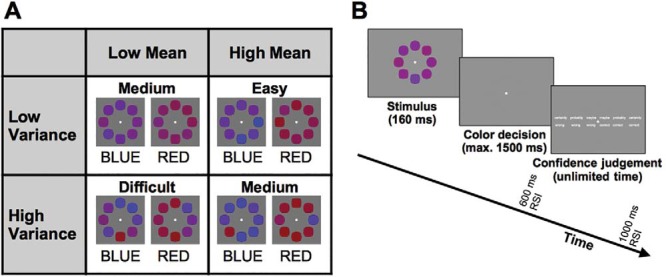
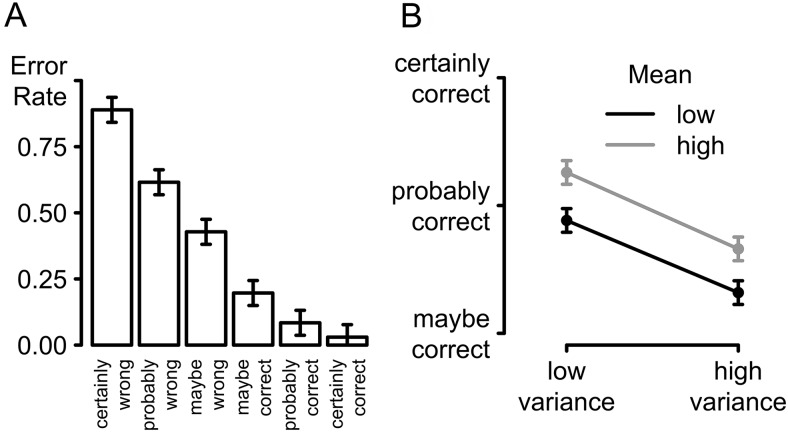
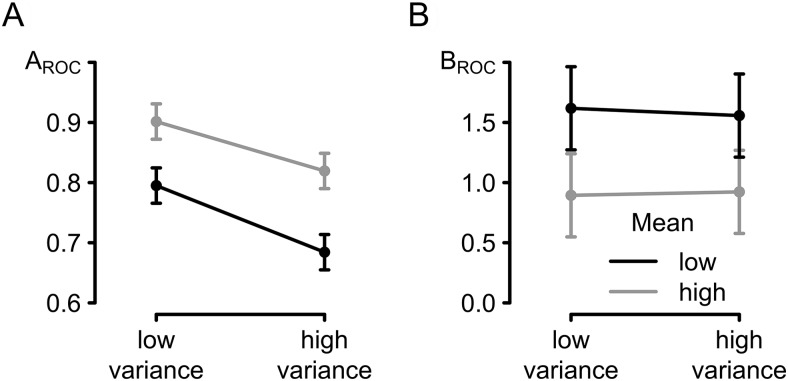
Human observers effortlessly and accurately judge their probability of being correct in their decisions, suggesting that metacognitive evaluation is an integral part of decision making. It remains a challenge for most models of confidence, however, to explain how metacognitive judgments are formed and which internal signals influence them. While the decision-making literature has suggested that confidence is based on privileged access to the evidence that gives rise to the decision itself, other lines of research on confidence have commonly taken the view of a multicue model of confidence. The present study aims at manipulating one such cue: the perceived reliability of evidence supporting an initial decision. Participants made a categorical judgment of the average color of an array of eight colored shapes, for which we critically manipulated both the distance of the mean color from the category boundary (evidence strength) and the variability of colors across the eight shapes (evidence reliability). Our results indicate that evidence reliability has a stronger impact on confidence than evidence strength. Specifically, we found that evidence reliability affects metacognitive readout, the mapping from subjectively experienced certainty to expressed confidence, allowing participants to adequately adjust their confidence ratings to match changes in objective task performance across conditions. (PsycINFO Database Record
Overview
The claims and statistics of this paper haven’t been checked yet.
Run the check — free, no account needed. It reads the open-access text and checks the sources it cites.
Integrity signals
Registry
Cites
Statistics
Figures
Verification
Claims the paper makes
The claims and statistics of this paper haven’t been checked yet.
Run the check — free, no account needed. It reads the open-access text and checks the sources it cites.
Claims other papers make about this one
Each is checked against this paper’s own text: does it say what the citing paper says it does?
The source backs part of the claim, not all of it — or backs it for a different population, condition or comparison.
In the citing paper
“A number of studies have presented evidence that confidence judgments are sensitive to the variability in perceptual evidence, although sometimes to a greater or lesser degree than predicted by an ideal observer model (Boldt et al. 2017, Spence et al. 2016, Zylberberg et al. 2014).”
From Metacognition and Confidence: A Review and Synthesis (2024) · cites this paper as Boldt et al. 2017
Experimental — accuracy not yet measured
Self-check
Percentages, sums and reported differences re-computed from the paper’s own numbers.
The self-check needs the paper’s full text.
Citations
Cites
Kass, R. E., & Raftery, A. E. (1995) · Journal of the American Statistical Association · doi:10.1080/01621459.1995.10476572 · Cited by 12,558
Kruger, J., & Dunning, D. (1999) · Journal of Personality and Social Psychology · doi:10.1037/0022-3514.77.6.1121 · Cited by 7,731
Bayesian t tests for accepting and rejecting the null hypothesis
Rouder, J. N., Speckman, P. L., Sun, D., Morey, R. D., & Iverson, G. (2009) · Psychonomic Bulletin & Review · doi:10.3758/pbr.16.2.225 · Cited by 3,688
Using confidence intervals in within-subject designs
Loftus, G. R., & Masson, M. E. J. (1994) · Psychonomic Bulletin & Review · doi:10.3758/bf03210951 · Cited by 2,433
Computing Bayes Factors by Combining Simulation and Asymptotic Approximations
DiCiccio, T., Kass, R., Raftery, A., & Wasserman, L. (1997) · Journal of the American Statistical Association · doi:10.1080/01621459.1997.10474045 · Cited by 2,029
The weighing of evidence and the determinants of confidence
Griffin, D., & Tversky, A. (1992) · Cognitive Psychology · doi:10.1016/0010-0285(92)90013-r · Cited by 1,866
Probabilistic mental models: a Brunswikian theory of confidence
Gigerenzer, G., Hoffrage, U., & Kleinbölting, H. (1991) · Psychological Review · doi:10.1037/0033-295x.98.4.506 · Cited by 1,506
Bayesian inference with probabilistic population codes
Ma, W. J., Beck, J. M., Latham, P. E., & Pouget, A. (2006) · Nature Neuroscience · doi:10.1038/nn1790 · Cited by 1,457
Bayesian model selection for group studies
Stephan, K. E., Penny, W. D., Daunizeau, J., Moran, R. J., & Friston, K. J. (2009) · NeuroImage · doi:10.1016/j.neuroimage.2009.03.025 · Cited by 1,423
Fleming, S. M., & Lau, H. C. (2014) · Frontiers in Human Neuroscience · doi:10.3389/fnhum.2014.00443 · Cited by 1,408 · cited 2×
“Caution is advised when comparing conditions that are not matched for accuracy, though (Fleming & Lau, 2014).”
BackgroundBayesFactor: Computation of Bayes Factors for Common Designs
Morey, R. D., & Rouder, J. N. (2012) · doi:10.32614/cran.package.bayesfactor · Cited by 1,220
Do those who know more also know more about how much they know?*1
Lichtenstein, S., & Fischhoff, B. (1977) · Organizational Behavior and Human Performance · doi:10.1016/0030-5073(77)90001-0 · Cited by 1,107
Representation of Confidence Associated with a Decision by Neurons in the Parietal Cortex
Kiani, R., & Shadlen, M. N. (2009) · Science · doi:10.1126/science.1169405 · Cited by 1,027
Bonaccio, S., & Dalal, R. S. (2006) · Organizational Behavior and Human Decision Processes · doi:10.1016/j.obhdp.2006.07.001 · Cited by 1,011
How do we know that we know? The accessibility model of the feeling of knowing
Koriat, A. (1993) · Psychological Review · doi:10.1037/0033-295x.100.4.609 · Cited by 895
Maniscalco, B., & Lau, H. (2012) · Consciousness and Cognition · doi:10.1016/j.concog.2011.09.021 · Cited by 883
Neural correlates, computation and behavioural impact of decision confidence
Kepecs, A., Uchida, N., Zariwala, H. A., & Mainen, Z. F. (2008) · Nature · doi:10.1038/nature07200 · Cited by 809
Bahrami, B., Olsen, K., Latham, P. E., Roepstorff, A., Rees, G., & Frith, C. D. (2010) · Science · doi:10.1126/science.1185718 · Cited by 738
Two-stage dynamic signal detection: A theory of choice, decision time, and confidence.
Pleskac, T. J., & Busemeyer, J. R. (2010) · Psychological Review · doi:10.1037/a0019737 · Cited by 722
Zhang, H., & Maloney, L. T. (2012) · Frontiers in Neuroscience · doi:10.3389/fnins.2012.00001 · Cited by 679
Statistically optimal perception and learning: from behavior to neural representations
Fiser, J., Berkes, P., Orbán, G., & Lengyel, M. (2010) · Trends in Cognitive Sciences · doi:10.1016/j.tics.2010.01.003 · Cited by 672
Metacognition in human decision-making: confidence and error monitoring
Yeung, N., & Summerfield, C. (2012) · Philosophical Transactions of the Royal Society B: Biological Sciences · doi:10.1098/rstb.2011.0416 · Cited by 667
Self-citationProbabilistic population codes for Bayesian decision making
Beck, J. M., Ma, W. J., Kiani, R., Hanks, T., Churchland, A. K., Roitman, J., Shadlen, M. N., Latham, P. E., & Pouget, A. (2008) · Neuron · doi:10.1016/j.neuron.2008.09.021 · Cited by 645
Bruyer, R., & Brysbaert, M. (2011) · Psychologica Belgica · doi:10.5334/pb-51-1-5 · Cited by 573
Confidence in value-based choice
De Martino, B., Fleming, S. M., Garrett, N., & Dolan, R. J. (2013) · Nature Neuroscience · doi:10.1038/nn.3279 · Cited by 534
Confidence and certainty: Distinct probabilistic quantities for different goals
Pouget, A., Drugowitsch, J., & Kepecs, A. (2016) · Nature Neuroscience · doi:10.1038/nn.4240 · Cited by 528
Choice Certainty Is Informed by Both Evidence and Decision Time
Kiani, R., Corthell, L., & Shadlen, M. N. (2014) · Neuron · doi:10.1016/j.neuron.2014.12.015 · Cited by 470
What determines initial feeling of knowing? Familiarity with question terms, not with the answer.
Reder, L. M., & Ritter, F. E. (1992) · Journal of Experimental Psychology: Learning, Memory, and Cognition · doi:10.1037/0278-7393.18.3.435 · Cited by 464
Fusaroli (2012) · doi:10.1177/0956797612436816 · Cited by 379
Juslin, P., Winman, A., & Olsson, H. (2000) · Psychological Review · doi:10.1037/0033-295x.107.2.384 · Cited by 379
The self-consistency model of subjective confidence.
Koriat, A. (2011) · Psychological Review · doi:10.1037/a0025648 · Cited by 355
Confidence as Bayesian probability: From neural origins to behavior
Meyniel, F., Sigman, M., & Mainen, Z. F. (2015) · Neuron · doi:10.1016/j.neuron.2015.09.039 · Cited by 349
Knowing how much you don't know: a neural organization of uncertainty estimates
Bach, D. R., & Dolan, R. J. (2012) · Nature Reviews Neuroscience · doi:10.1038/nrn3289 · Cited by 339
Koriat, A., & Nussinson, R. (2001) · Journal of Experimental Psychology Learning Memory and Cognition · doi:10.1037/0278-7393.27.1.34 · Cited by 316
The calibration and resolution of confidence in perceptual judgments
Baranski, J. V., & Petrusic, W. M. (1994) · Perception & Psychophysics · doi:10.3758/bf03205299 · Cited by 308
The construction of confidence in a perceptual decision
Zylberberg, A., Barttfeld, P., & Sigman, M. (2012) · Frontiers in Integrative Neuroscience · doi:10.3389/fnint.2012.00079 · Cited by 297
Shared neural markers of decision confidence and error detection
Boldt, A., & Yeung, N. (2015) · The Journal of Neuroscience · doi:10.1523/jneurosci.0797-14.2015 · Cited by 274
Self-citationAutomatic integration of confidence in the brain valuation signal
Lebreton, M., Abitbol, R., Daunizeau, J., & Pessiglione, M. (2015) · Nature Neuroscience · doi:10.1038/nn.4064 · Cited by 265
Sources of information in metamemory: Judgments of learning and feelings of knowing
Schwartz, B. L. (1994) · Psychonomic Bulletin & Review · doi:10.3758/bf03213977 · Cited by 261
Signatures of a Statistical Computation in the Human Sense of Confidence
Sanders, J. I., Hangya, B., & Kepecs, A. (2016) · Neuron · doi:10.1016/j.neuron.2016.03.025 · Cited by 253
Responses of pulvinar neurons reflect a subject's confidence in visual categorization
Komura, Y., Nikkuni, A., Hirashima, N., Uetake, T., & Miyamoto, A. (2013) · Nature Neuroscience · doi:10.1038/nn.3393 · Cited by 226
Moran, R., Teodorescu, A. R., & Usher, M. (2015) · Cognitive Psychology · doi:10.1016/j.cogpsych.2015.01.002 · Cited by 201
Causal evidence for frontal cortex organization for perceptual decision making
Rahnev, D., Nee, D. E., Riddle, J., Larson, A. S., & D’Esposito, M. (2016) · Proceedings of the National Academy of Sciences · doi:10.1073/pnas.1522551113 · Cited by 200
Accuracy of feeling-of-knowing judgments for predicting perceptual identification and relearning.
Nelson, T. O., Gerler, D., & Narens, L. (1984) · Journal of Experimental Psychology General · doi:10.1037/0096-3445.113.2.282 · Cited by 197
Spatial attention increases performance but not subjective confidence in a discrimination task
Wilimzig, C., Tsuchiya, N., Fahle, M., Einhäuser, W., & Koch, C. (2008) · Journal of Vision · doi:10.1167/8.5.7 · Cited by 196
Robust averaging during perceptual judgment
de Gardelle, V., & Summerfield, C. (2011) · Proceedings of the National Academy of Sciences · doi:10.1073/pnas.1104517108 · Cited by 196
Unexpected arousal modulates the influence of sensory noise on confidence
Allen, M., Frank, D., Schwarzkopf, D. S., Fardo, F., Winston, J. S., Hauser, T. U., & Rees, G. (2016) · eLife · doi:10.7554/elife.18103 · Cited by 182
Action-Specific Disruption of Perceptual Confidence
Fleming, S. M., Maniscalco, B., Ko, Y., Amendi, N., Ro, T., & Lau, H. C. (2014) · Psychological Science · doi:10.1177/0956797614557697 · Cited by 169
Probing the locus of confidence judgments: Experiments on the time to determine confidence.
Baranski, J. V., & Petrusic, W. M. (1998) · Journal of Experimental Psychology Human Perception & Performance · doi:10.1037//0096-1523.24.3.929 · Cited by 163
Measures of metacognition on signal-detection theoretic models
Barrett, A. B., Dienes, Z., & Seth, A. K. (2013) · Psychological Methods · doi:10.1037/a0033268 · Cited by 155
Zylberberg, A., Fetsch, C. R., & Shadlen, M. N. (2016) · eLife · doi:10.7554/elife.17688 · Cited by 152
Cognitive Illusions of Authorship Reveal Hierarchical Error Detection in Skilled Typists
Logan, G. D., & Crump, M. J. C. (2010) · Science · doi:10.1126/science.1190483 · Cited by 150
Kinds of access: different methods for report reveal different kinds of metacognitive access
Overgaard, M. S., & Sandberg, K. (2012) · Philosophical Transactions of the Royal Society B Biological Sciences · doi:10.1098/rstb.2011.0425 · Cited by 150
The Hard–Easy Effect in Subjective Probability Calibration
Suantak, L., Bolger, F., & Ferrell, W. R. (1996) · Organizational Behavior and Human Decision Processes · doi:10.1006/obhd.1996.0074 · Cited by 145
A stochastic model for individual choice behavior.
Audley, R. J. (1960) · Psychological Review · doi:10.1037/h0046438 · Cited by 143
Vickers, D., & Packer, J. (1982) · Acta Psychologica · doi:10.1016/0001-6918(82)90006-3 · Cited by 139
Probing the locus of confidence judgments: Experiments on the time to determine confidence.
Baranski, J. V., & Petrusic, W. M. (1998) · Journal of Experimental Psychology Human Perception & Performance · doi:10.1037/0096-1523.24.3.929 · Cited by 111
Bang, D., Fusaroli, R., Tylén, K., Olsen, K., Latham, P. E., Lau, J. Y. F., Roepstorff, A., Rees, G. E., Frith, C., & Bahrami, B. (2014) · Consciousness and Cognition · doi:10.1016/j.concog.2014.02.002 · Cited by 108
Variance misperception explains illusions of confidence in simple perceptual decisions
Zylberberg, A., Roelfsema, P. R., & Sigman, M. (2014) · Consciousness and Cognition · doi:10.1016/j.concog.2014.05.012 · Cited by 97
Moreno‐Bote, R. (2010) · Neural Computation · doi:10.1162/neco.2010.12-08-930 · Cited by 92
Computations underlying confidence in visual perception.
Spence, M. L., Dux, P. E., & Arnold, D. H. (2016) · Journal of Experimental Psychology: Human Perception and Performance · doi:10.1037/xhp0000179 · Cited by 89
Weighting Mean and Variability during Confidence Judgments
de Gardelle, V., & Mamassian, P. (2015) · PLoS ONE · doi:10.1371/journal.pone.0120870 · Cited by 82
Tests of two theories of decision in an "expanded judgment" situation.
Irwin, F. W., Smith, W., & Mayfield, J. F. (1956) · Journal of Experimental Psychology · doi:10.1037/h0041911 · Cited by 73
An application of the Poisson race model to confidence calibration.
Merkle, E. C., & Zandt, T. V. (2006) · Journal of Experimental Psychology General · doi:10.1037/0096-3445.135.3.391 · Cited by 73
Relation between belief and performance in perceptual decision making
Drugowitsch, J., Moreno-Bote, R., & Pouget, A. (2014) · PLoS ONE · doi:10.1371/journal.pone.0096511 · Cited by 72
Evaluation of a 'bias-free' measure of awareness
Azzopardi, P., & Evans, S. (2007) · Spatial Vision · doi:10.1163/156856807779369742 · Cited by 68
Computation of Bayes Factors for Common Designs
Morey, R. D., & Rouder, J. N. (2015) · Cited by 58
Kornbrot, D. E. (2006) · Perception & Psychophysics · doi:10.3758/bf03193685 · Cited by 48
The disutility of the hard-easy effect in choice confidence
Merkle, E. C. (2009) · Psychonomic Bulletin & Review · doi:10.3758/pbr.16.1.204 · Cited by 46
Strength and weight: The determinants of choice and confidence
Kvam, P. D., & Pleskac, T. J. (2016) · Cognition · doi:10.1016/j.cognition.2016.04.008 · Cited by 40
Shared Mechanisms for Confidence Judgements and Error Detection in Human Decision Making
Yeung, N., & Summerfield, C. (2014) · Springer eBooks · doi:10.1007/978-3-642-45190-4_7 · Cited by 38
Self-citationA Case-Based Model of Probability and Pricing Judgments: Biases in Buying and Selling Uncertainty
Brenner, L. A., Griffin, D. W., & Koehler, D. J. (2011) · Management Science · doi:10.1287/mnsc.1110.1429 · Cited by 13
Cited by
Sorted by citations
Subjective Confidence Predicts Information Seeking in Decision Making
Desender, K., Boldt, A., & Yeung, N. (2018) · Psychological Science · doi:10.1177/0956797617744771 · Cited by 296
Self-citationMetacognition and Confidence: A Review and Synthesis
Fleming, S. M. (2024) · Annual Review of Psychology · doi:10.1146/annurev-psych-022423-032425 · Cited by 256
“A number of studies have presented evidence that confidence judgments are sensitive to the variability in perceptual evidence – although sometimes to a greater or lesser degree than predicted by an ideal observer model (Zylberberg et al., 2014, Spence et al., 2016, Boldt et al., 2017).”
Distinct encoding of decision confidence in human medial prefrontal cortex
Bang, D., & Fleming, S. M. (2018) · Proceedings of the National Academy of Sciences · doi:10.1073/pnas.1800795115 · Cited by 207
In the body's eye: the computational anatomy of interoceptive inference
Allen, M., Levy, A., Parr, T., & Friston, K. J. (2022) · PLOS Computational Biology · doi:10.1371/journal.pcbi.1010490 · Cited by 185
Human Metacognition Across Domains: Insights from Individual Differences and Neuroimaging
Rouault, M., McWilliams, A., Allen, M. G., & Fleming, S. M. (2018) · Personality Neuroscience · doi:10.1017/pen.2018.16 · Cited by 176
Metadata
- Authors
- Boldt, A., de Gardelle, V., & Yeung, N.
- Affiliations
- University of Oxford (GB)
- Centre d'Économie de la Sorbonne (FR)
- Corresponding author
- Boldt, Annika
- Venue
- Journal of Experimental Psychology: Human Perception and Performance
- Published
- 2017-08
- Volume
- 43
- Issue
- 8
- Pages
- 1520-1531
- ISSN
- 0096-1523 (ISSN-L)
- 1939-1277
- PMC
- PMC5524444
- OpenAlex
- W2605154204
- Cited by
- 110
- References
- 71
- Citations by year
- 2026: 15 · 2025: 10 · 2024: 13 · 2023: 11 · 2022: 13 · 2021: 13 · 2020: 9 · 2019: 13 · 2018: 9 · 2017: 4
- FWCI
- 5.49
- Type
- journal article
- Language
- en
- Open access
- hybrid
- doi.org
- Licence
- Locations
- Journal of Experimental Psychology Human Perception & Performance (publishedVersion, cc-by)
- Europe PMC (PubMed Central) (publishedVersion, cc-by)
- PubMed Central (publishedVersion, cc-by)
- PubMed (publishedVersion)
- RePEc: Research Papers in Economics (submittedVersion)
- HAL (submittedVersion, other-oa)
- UCL Discovery (University College London) (submittedVersion)
- Funders
- Economic and Social Research Council
- Topics
- Life Sciences › Neuroscience › Cognitive Neuroscience › Visual perception and processing mechanisms
- Life Sciences › Neuroscience › Cognitive Neuroscience › Memory Processes and Influences
- Social Sciences › Decision Sciences › General Decision Sciences › Decision-Making and Behavioral Economics
- Keywords
- metacognition, decision confidence, reliability of evidence, quality of evidence, confidence bias, categorical judgment, variability, confidence calibration
- MeSH terms
- Metacognition, Adolescent, Adult, Color Perception, Decision Making, Female, Humans, Judgment, Male, Young Adult
About these checks
Registry, retraction, Cites and statistics results are computed, not judged, with one exception: a printed reference that no index lists is read once by a model before it counts as a citation error. Claims are extracted by a model and kept only when their quote appears verbatim in the text; each cited source is then checked, with a model’s help, for whether it says what the claim relies on. Those verdicts can be wrong — read the claim’s quote and the cited source before relying on one.
Statistics and arithmetic are recomputed, not judged.
Confidence bands are shown only for fields calibrated on our annotated test set. None is calibrated yet, so no band is shown.
What counts as a claim ›How we measure confidence ›How we check this ›
Are you an author, or do you see a problem with this page? Request a review
