

Two-dimensional gas of massless Dirac fermions in graphene
Open accessThe DOI matches its Crossref record; 32 of the 32 references it cites were found in a registry or an index; 12 of the 52 sources its claims cite were checked for support.
Abstract
Quantum electrodynamics (resulting from the merger of quantum mechanics and relativity theory) has provided a clear understanding of phenomena ranging from particle physics to cosmology and from astrophysics to quantum chemistry. The ideas underlying quantum electrodynamics also influence the theory of condensed matter, but quantum relativistic effects are usually minute in the known experimental systems that can be described accurately by the non-relativistic Schrödinger equation. Here we report an experimental study of a condensed-matter system (graphene, a single atomic layer of carbon) in which electron transport is essentially governed by Dirac's (relativistic) equation. The charge carriers in graphene mimic relativistic particles with zero rest mass and have an effective ‘speed of light’ c* ≈ 106 m s-1. Our study reveals a variety of unusual phenomena that are characteristic of two-dimensional Dirac fermions. In particular we have observed the following: first, graphene's conductivity never falls below a minimum value corresponding to the quantum unit of conductance, even when concentrations of charge carriers tend to zero; second, the integer quantum Hall effect in graphene is anomalous in that it occurs at half-integer filling factors; and third, the cyclotron mass mc of massless carriers in graphene is described by E = mcc*2. This two-dimensional system is not only interesting in itself but also allows access to the subtle and rich physics of quantum electrodynamics in a bench-top experiment.
Overview
CoChat Summary
TL;DR
Graphene is a two-dimensional gas of massless Dirac fermions with linear dispersion and an effective speed of light \(c^* \approx 10^6\) m/s. Transport measurements reveal an anomalous half-integer quantum Hall effect, a minimum conductivity, cyclotron mass \(m_c = E/c^{*2}\), and a \(\pi\) Berry-phase shift in Shubnikov–de Haas oscillations.
Key findings
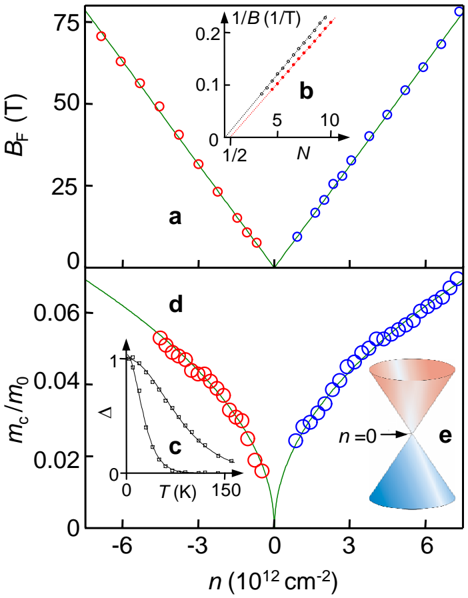
- Graphene’s charge carriers behave as massless Dirac fermions: the data imply \(E = \hbar k c^*\) for both electrons and holes, with \(c^* \approx 1 \times 10^6\) m/s; the cyclotron mass varies between \(\approx 0.02\) and \(0.07\,m_0\) and follows \(m_c \propto n^{1/2}\).
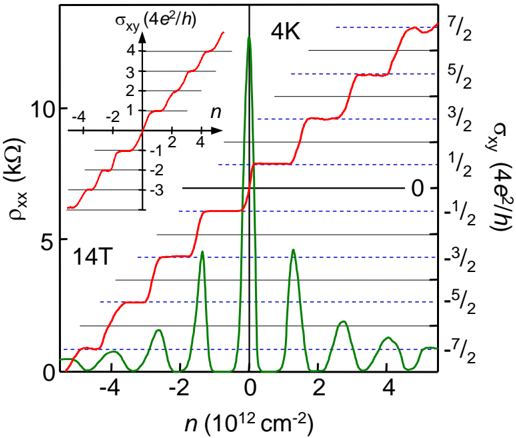
- The integer quantum Hall effect is anomalous: plateaux occur at half-integer \(\nu\), with sequence \((4e^2/h)(N+\tfrac12)\) and the first plateau at \(2e^2/h\); two-layer graphene returns to the normal integer sequence.
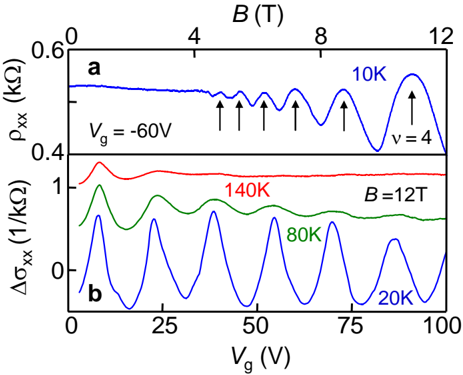
- Shubnikov–de Haas oscillations show a single set for electrons and holes, with \(B_F = \beta n\), \(\beta \approx 1.04 \times 10^{-15}\) T·m\(^2\) (\(\pm 2\%\)), yielding degeneracy \(f=4\); the oscillations exhibit a phase shift of \(\pi\) attributed to Berry’s phase.
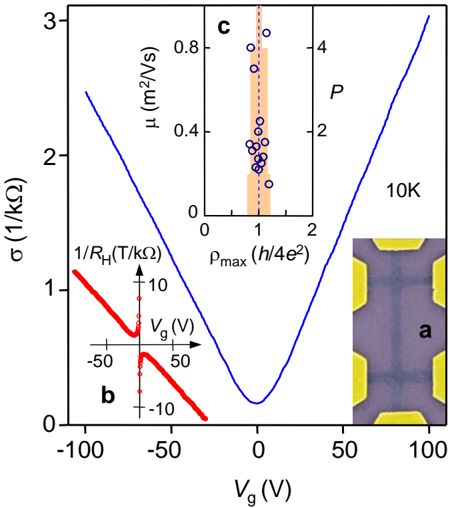
- Conductivity never falls below a minimum: \(\rho_{\max} \approx 6.5\) k\(\Omega\) in 15 devices (experimental error \(\approx 15\%\)), associated with \(h/fe^2 = 6.45\) k\(\Omega\), independent of mobility (which varied by a factor of 10) and of temperature between 4 and 100 K.
Methods
- Graphene samples were obtained by micromechanical cleavage of graphite, followed by identification and selection of monolayers using optical, scanning-electron, and atomic-force microscopies; selected films were processed into multi-terminal devices, with some devices made from 2 or 3 layers.
- Transport measurements included the electric field effect, Hall coefficient, Shubnikov–de Haas oscillations, and quantum Hall effect in magnetic fields; mobility was measured between 10 and 100 K, minimum conductivity between 4 and 100 K, and SdHO up to 140 K and room temperature.
- Analysis used fan diagrams to determine \(B_F\), fits of SdHO amplitude to \(T/\sinh(2\pi^2 k_B T m_c / h eB)\), and semiclassical expressions \(B_F = (h/2\pi e)S(E)\) and \(m_c = (h^2/2\pi)\partial S(E)/\partial E\) to infer \(E \propto k\).
Limitations
- The paper has no dedicated limitations section; stated caveats include that mobility was “probably still limited by defects in parent graphite,” that the two-layer finite-mass result is “to be published elsewhere,” and that most theories suggest a minimum conductivity of \(\approx e^2/\pi h\), in disagreement with the experiment.
- Evident from the text: devices are unprotected from the environment (though stable under ambient conditions), some measured devices consisted of 2 or 3 graphene layers, and the transition region was often shifted from zero \(V_g\) due to chemical doping, although annealing normally eliminated the shift.
- The inference of linear dispersion relies on a semiclassical model that the paper says is justified by recent theory, so the experimental conclusion depends on that theoretical framework.
Model-written summary. Check it against the paper before relying on it.
Integrity signals
Registry
Cites
Statistics
Figures
Verification
Claims the paper makes
3 Valid · 5 Not valid · 11 Not checked · 51 Own results and interpretations
The cited sources support only part of this claim — read each source’s verdict below.
In the paper
“d) Shubnikov-de Haas oscillations in graphene exhibit a phase shift of π due to Berry's phase”
- Also stated in: § Two-Dimensional Gas of Massless Dirac Fermions in Graphene · plain
“The shift is due to Berry's phase [9,15].”
What the sources say
- Partly supportedcites [9] Berger, C. et al. Ultrathin epitaxial graphite: 2D electron gas properties and a route toward graphene-based nanoelectronics. J. Phys. Chem. B 108, 19912–19916 (2004) sourceExperimental — accuracy not yet measured
The Figure 2 caption (p. 3) reports Shubnikov–de Haas oscillations in an epitaxial graphene sample. The discussion on pp. 3–4 addresses their occurrence and period, but does not report a π phase shift or attribute one to Berry’s phase. (LLM, conf=0.85)
- Partly supportedcites [15] Gusynin, V. P. & Sharapov, S. G. Unconventional integer quantum Hall effect in grapheme. Preprint at http://xxx.lanl.gov/abs/cond-mat/0506575 (2005). sourceExperimental — accuracy not yet measured
Our copy (Introduction, p. 1) does state that 'the phase of de Haas van Alphen and Shubnikov de Haas oscillations for Dirac quasiparticles is shifted ... compared to the phase of non-relativistic quasiparticles' (citing Refs. 7-10), so the existence of a phase shift in graphene is supported; the magnitude symbol itself is lost in our copy's undecoded formulas. What is NOT supported is the causal attribution to Berry's phase: no passage of our copy mentions Berry's phase at all (searched: 'Berry phase pseudospin topological phase π', 'oscillation phase factor'). Instead the paper explains the unconventional magneto-transport phenomena by the quantum anomaly of the n = 0 Landau level — its halved degeneracy and B-independent energy (p. 1 and p. 3) — and relates the oscillation minima to fillings ν_B = 2n+1 (p. 3). (LLM, conf=0.75)
plainstates a cause- Asserted: passes — The authors put it forward as true.
- Checkable: passes — It can be checked against evidence.
- Load-bearing: passes — The paper’s conclusions depend on it.
- Based: passes — The paper gives a reason why it holds.
- Also stated in: § Two-Dimensional Gas of Massless Dirac Fermions in Graphene · plain
The cited sources that could be checked couldn’t confirm or dispute this claim.
In the paper
“we invoke the formal expression [9-12] for the energy of massless relativistic fermions in quantized fields, EN =[2 e h c ∗ 2 B ( N +½ ± ½)] 1/2”
What the sources say
- Could not verifycites [9] Berger, C. et al. Ultrathin epitaxial graphite: 2D electron gas properties and a route toward graphene-based nanoelectronics. J. Phys. Chem. B 108, 19912–19916 (2004) sourceExperimental — accuracy not yet measured
The discussion of magnetoconductance (p. 3) says Shubnikov–de Haas oscillations indicate quantization of the electron energy spectrum, but it gives no energy formula. Searches for massless relativistic fermions, Landau levels, and the N + 1/2 ± 1/2 term found no passage stating the claimed expression. (LLM, conf=0.76)
- Not checked — no full text of the sourcecites [10] Bunch, J. S., Yaish, Y., Brink, M., Bolotin, K. & McEuen, P. L. Coulomb oscillations and Hall effect in quasi-2D graphite quantum dots. Nano Lett. 5, 287–290 (2005) source
- Not checked — no full text of the sourcecites [11] Dresselhaus, M. S. & Dresselhaus, G. Intercalation compounds of graphite. Adv. In Phys. 51, 1–186 (2002) source
- Not matchedcites [12] Brandt, N. B., Chudinov, S. M. & Ponomarev, Y. G. Semimetals 1: Graphite and Its Compounds (North-Holland, Amsterdam, 1988)
We searched by its title and found no matching paper.
plain- Asserted: passes — The authors put it forward as true.
- Checkable: passes — It can be checked against evidence.
- Load-bearing: passes — The paper’s conclusions depend on it.
- Based: passes — The paper gives a reason why it holds.
- Could not verify
The cited sources that could be checked couldn’t confirm or dispute this claim.
In the paper
“The employed semiclassical model is fully justified by a recent theory for graphene [9], which shows that SdHO's amplitude can indeed be described by the above expression T /sinh(2 π 2 k B Tm c / h eB ) with m c = E / c ∗ 2 .”
What the sources say
- Could not verifycites [9] Berger, C. et al. Ultrathin epitaxial graphite: 2D electron gas properties and a route toward graphene-based nanoelectronics. J. Phys. Chem. B 108, 19912–19916 (2004) sourceExperimental — accuracy not yet measured
The discussion of magnetoconductance (pp. 3–4) reports observed Shubnikov–de Haas oscillations, but does not give a theory for their amplitude. Searches for the temperature-dependent amplitude expression and m_c = E/c*² found no passage addressing either, so our copy cannot verify the attributed claim. (LLM, conf=0.76)
boostedstates a cause- Asserted: passes — The authors put it forward as true.
- Checkable: passes — It can be checked against evidence.
- Load-bearing: passes — The paper’s conclusions depend on it.
- Based: passes — The paper gives a reason why it holds.
- Could not verify
The cited sources that could be checked couldn’t confirm or dispute this claim.
In the paper
“The latter can be viewed as a direct consequence of the Atiyah-Singer index theorem that plays an important role in quantum field theory and the theory of superstrings [13,14].”
What the sources say
- Not checked — no full text of the sourcecites [13] Vonsovsky, S. V. & Katsnelson, M. I. Quantum Solid State Physics (Springer, New York, 1989) source
- Could not verifycites [14] Gusynin, V. P. & Sharapov, S. G. Magnetic oscillations in planar systems with the Dirac-like spectrum of quasiparticle excitations. Phys. Rev. B 71, 125124 (2005) sourceExperimental — accuracy not yet measured
Our copy of Gusynin & Sharapov II gives the relativistic Landau-level spectrum with n = 0, 1, ... in the Introduction (p. 1) and discusses the lowest level E_1 and its crossing of the Fermi surface (Discussion, p. 6; Sect. II.B, p. 6), but it never invokes or discusses the Atiyah-Singer index theorem, topology, or zero-mode counting as the reason for a level pinned at E = 0. Searches on 'Atiyah-Singer index theorem zero-energy Landau level', 'index theorem topological zero modes chiral anomaly', and 'zero-energy Landau level n=0 degeneracy independent of field strength' returned only the spectrum/quantization-condition passages. Since the index-theorem grounding is simply not addressed in our copy (and no alternative work is credited for it there), the attribution can be neither confirmed nor contradicted. (LLM, conf=0.68)
plainstates a cause- Asserted: passes — The authors put it forward as true.
- Checkable: passes — It can be checked against evidence.
- Load-bearing: unclear — It is unclear whether the paper’s conclusions depend on it.
- Based: passes — The paper gives a reason why it holds.
The cited sources that could be checked couldn’t confirm or dispute this claim.
In the paper
“in agreement with band structure calculations [6,7]”
What the sources say
- Could not verifycites [6] Novoselov, K. S. et al. Two dimensional atomic crystals. Proc. Natl Acad. Sci. USA 102, 10451–10453 (2005) sourceExperimental — accuracy not yet measured
The discussion of graphene transport in “Two Dimensional Atomic Crystals” (p. 3) reports carrier concentrations and mobilities, but not a fitted c* or a comparison with band-structure calculations. Searches for the velocity, its approximate value, and band-structure calculations found no passage addressing that comparison. (LLM, conf=0.76)
- Could not verifycites [7] Novoselov, K. S. et al. Electric field effect in atomically thin carbon films. Science 306, 666–669 (2004) sourceExperimental — accuracy not yet measured
The discussion on p. 2 says graphene is expected to have linear energy dispersion and massless carriers, but gives no calculated velocity to compare with c* ≈ 1·10^6 m/s. Searches for the velocity and band-structure comparison found no passage in our copy establishing the claimed agreement. (LLM, conf=0.73)
plainstates an association- Asserted: passes — The authors put it forward as true.
- Checkable: passes — It can be checked against evidence.
- Load-bearing: passes — The paper’s conclusions depend on it.
- Based: passes — The paper gives a reason why it holds.
- Could not verify
34 more claims
Create a free account to see all 70 claims and to verify the 10 references still open.
- It may state two separate claims as one. 27
- Probably not a substantial claim. 8
Claims other papers make about this one
Each is checked against this paper’s own text: does it say what the citing paper says it does?
The source backs part of the claim, not all of it — or backs it for a different population, condition or comparison.
In the citing paper
“Recently, the non-relativistic electrons in graphene monolayer were found to obey the massless relativistic dispersion known as the Dirac cone, leading to the realization of analogies to Zitterbewegung and Klein tunneling in low-energy condensed-matter physics and atom optics 4 -19 .”
From Observation of interaction-induced phenomena of relativistic quantum mechanics (2021) · cites this paper as [4]
Experimental — accuracy not yet measuredThe source backs part of the claim, not all of it — or backs it for a different population, condition or comparison.
In the citing paper
“Dirac points in graphene1–3 or photonic graphene12 belong to the first type, which occur in lattices with unbroken T. These occur in pairs and are stabilized by a symmetry of the underlying lattice.”
From Observation of an unpaired photonic Dirac point (2020) · cites this paper as [1]
Experimental — accuracy not yet measuredThe cited source says what the claim attributes to it.
In the citing paper
“The energy spectrum of ˆ H 1 is E n = sgn( n ) ℏ Ω √ | n | , where n = 0 , ± 1 , . . . , see Fig. 1.”
From Theory of electron Zitterbewegung in graphene probed by femtosecond laser pulses (2009) · cites this paper as [36]
The cited source says what the claim attributes to it.
In the citing paper
“Around Dirac cones, conduction and valence bands intersect linearly at a degenerate point resulting in the linear energy band and massless relativistic transport of electrons as quasiparticles [4].”
From Observing movement of Dirac cones from single-photon dynamics (2021) · cites this paper as [4]
The check wasn’t confident either way, so it gives no verdict — never disputed.
In the citing paper
“photonic Dirac points are known to occur in pairs in “photonic graphene” and other similar photonic crystals”
From Observation of an unpaired photonic Dirac point (2020) · cites this paper as [1]
Experimental — accuracy not yet measured
3 more claims about this paper
Create a free account to see every claim other papers make about this one.
Citations
Cites
Electric Field Effect in Atomically Thin Carbon Films
Novoselov, K. S., Geim, A. K., Morozov, S. V., Jiang, D., Zhang, Y., Dubonos, S. V., Grigorieva, I. V., & Firsov, A. A. (2004) · Science · doi:10.1126/science.1102896 · Cited by 66,834
Self-citationTwo-dimensional atomic crystals
Novoselov, K. S., Jiang, D., Schedin, F., Booth, T. J., Khotkevich, V. V., Morozov, S. V., & Geim, A. K. (2005) · Proceedings of the National Academy of Sciences · doi:10.1073/pnas.0502848102 · Cited by 11,788
Self-citationScaling Theory of Localization: Absence of Quantum Diffusion in Two Dimensions
Abrahams, E., Anderson, P. W., Licciardello, D. C., & Ramakrishnan, T. V. (1979) · Physical Review Letters · doi:10.1103/physrevlett.42.673 · Cited by 6,134
Berger, C., Song, Z., Li, T., Li, X., Ogbazghi, A. Y., Feng, R., Dai, Z., Marchenkov, A. N., Conrad, E. H., First, P. N., et al. (2004) · The Journal of Physical Chemistry B · doi:10.1021/jp040650f · Cited by 3,548
The Universe in a Helium Droplet
Volovik, G. E. (2009) · doi:10.1093/acprof:oso/9780199564842.001.0001 · Cited by 2,632
Intercalation compounds of graphite
Dresselhaus, M. S., & Dresselhaus, G. (2002) · Advances in Physics · doi:10.1080/00018730110113644 · Cited by 2,139
Geometry, Topology and Physics
Nakahara, M. (1990) · doi:10.1887/0750306068 · Cited by 1,620
Geometry, Topology and Physics
Nakahara, M. (2018) · CRC Press eBooks · doi:10.1201/9781315275826 · Cited by 1,505
Unconventional Integer Quantum Hall Effect in Graphene
Gusynin, V. P., & Sharapov, S. G. (2005) · Physical Review Letters · doi:10.1103/physrevlett.95.146801 · Cited by 1,374
Field Theories of Condensed Matter Systems
Fradkin, E. (2007) · Medical Entomology and Zoology · Cited by 1,118
Research works printed but not linked: 1
- Mott, N.F. & Davis, E.A. Electron Processes in Non-Crystalline Materials (Clarendon Press, Oxford, 1979).
Cited by
Items 401–500 of 21,614
Gas sensors using carbon nanomaterials: A review
Llobet, E. (2013) · Sensors and Actuators B: Chemical · doi:10.1016/j.snb.2012.11.014 · Cited by 692
Cao, A., Liu, Z., Chu, S., Wu, M., Ye, Z., Cai, Z., Chang, Y., Wang, S., Gong, Q., & Liu, Y. (2010) · Advanced Materials · doi:10.1002/adma.200901920 · Cited by 690
Quantum anomalous Hall effect in graphene from Rashba and exchange effects
Qiao, Z., Yang, S. A., Feng, W., Tse, W.-K., Ding, J., Yao, Y., Wang, J., & Niu, Q. (2010) · Physical Review B · doi:10.1103/physrevb.82.161414 · Cited by 689
George, P. A., Strait, J., Dawlaty, J., Shivaraman, S., Chandrashekhar, M., Rana, F., & Spencer, M. G. (2008) · Nano Letters · doi:10.1021/nl8019399 · Cited by 686
Zhang, S., Yang, J., Xu, R., Wang, F., Li, W., Ghufran, M., Zhang, Y.-W., Yu, Z., Zhang, G., Qin, Q., et al. (2014) · ACS Nano · doi:10.1021/nn503893j · Cited by 688
Preparation and electrochemical performance for methanol oxidation of pt/graphene nanocomposites
Li, Y., Tang, L., & Li, J. (2009) · Electrochemistry Communications · doi:10.1016/j.elecom.2009.02.009 · Cited by 689
Experimental Review of Graphene
Cooper, D. R., D’Anjou, B., Ghattamaneni, N., Harack, B., Hilke, M., Horth, A., Majlis, N., Massicotte, M., Vandsburger, L., Whiteway, E., et al. (2012) · ISRN Condensed Matter Physics · doi:10.5402/2012/501686 · Cited by 693
Anisotropic behaviours of massless Dirac fermions in graphene under periodic potentials
Park, C.-H., Yang, L., Son, Y.-W., Cohen, M. L., & Louie, S. G. (2008) · Nature Physics · doi:10.1038/nphys890 · Cited by 688
Graphene for energy conversion and storage in fuel cells and supercapacitors
Choi, H.-J., Jung, S.-M., Seo, J.-M., Chang, D. W., Dai, L., & Baek, J.-B. (2012) · Nano Energy · doi:10.1016/j.nanoen.2012.05.001 · Cited by 687
Heterointerface Engineering in Electromagnetic Absorbers: New Insights and Opportunities
Liang, L., Gu, W., Wu, Y., Zhang, B., Wang, G., Yang, Y., & Ji, G. (2022) · Advanced Materials · doi:10.1002/adma.202106195 · Cited by 670
Band-structure topologies of graphene: Spin-orbit coupling effects from first principles
Gmitra, M., Konschuh, S., Ertler, C., Ambrosch-Draxl, C., & Fabian, J. (2009) · Physical Review B · doi:10.1103/physrevb.80.235431 · Cited by 682
Heteroatom doped graphene engineering for energy storage and conversion
Kumar, R., Sahoo, S., Joanni, E., Singh, R. K., Maegawa, K., Tan, W. K., Kawamura, G., Kar, K. K., & Matsuda, A. (2020) · Materials Today · doi:10.1016/j.mattod.2020.04.010 · Cited by 681
Proposal for a New Class of Materials: Spin Gapless Semiconductors
Wang, X. L. (2008) · Physical Review Letters · doi:10.1103/physrevlett.100.156404 · Cited by 676
Continuous Germanene Layer on Al(111)
Derivaz, M., Dentel, D., Stephan, R., Hanf, M.-C., Mehdaoui, A., Sonnet, P., & Pirri, C. (2015) · Nano Letters · doi:10.1021/acs.nanolett.5b00085 · Cited by 671
Synthesis of Two‐Dimensional Materials for Capacitive Energy Storage
Mendoza‐Sánchez, B., & Gogotsi, Y. (2016) · Advanced Materials · doi:10.1002/adma.201506133 · Cited by 672
Band structure engineering of graphene by strain: First-principles calculations
Gui, G., Li, J., & Zhong, J. (2008) · Physical Review B · doi:10.1103/physrevb.78.075435 · Cited by 667
Electrochemical performance of graphene nanosheets as anode material for lithium-ion batteries
Guo, P., Song, H., & Chen, X. (2009) · Electrochemistry Communications · doi:10.1016/j.elecom.2009.04.036 · Cited by 669
Akhavan, O., Ghaderi, E., & Esfandiar, A. (2011) · The Journal of Physical Chemistry B · doi:10.1021/jp200686k · Cited by 669
In situ Polymerization Approach to Graphene-Reinforced Nylon-6 Composites
Xu, Z., & Gao, C. (2010) · Macromolecules · doi:10.1021/ma1009337 · Cited by 667
Graphene-enabled electrically switchable radar-absorbing surfaces
Balci, O., Polat, E. O., Kakenov, N., & Kocabas, C. (2015) · Nature Communications · doi:10.1038/ncomms7628 · Cited by 664
Characterizing Graphene, Graphite, and Carbon Nanotubes by Raman Spectroscopy
Dresselhaus, M. S., Jorio, A., & Saito, R. (2010) · Annual Review of Condensed Matter Physics · doi:10.1146/annurev-conmatphys-070909-103919 · Cited by 668
Electronic states and Landau levels in graphene stacks
Guinea, F., Castro Neto, A. H., & Peres, N. M. R. (2006) · Physical Review B · doi:10.1103/physrevb.73.245426 · Cited by 668
Quantum Transport of Massless Dirac Fermions
Nomura, K., & MacDonald, A. H. (2007) · Physical Review Letters · doi:10.1103/physrevlett.98.076602 · Cited by 667
Electronic and Magnetic Properties of Quasifreestanding Graphene on Ni
Varykhalov, A., Sánchez-Barriga, J., Shikin, A. M., Biswas, C., Vescovo, E., Rybkin, A., Marchenko, D., & Rader, O. (2008) · Physical Review Letters · doi:10.1103/physrevlett.101.157601 · Cited by 666
Plasma-assisted fabrication of monolayer phosphorene and its Raman characterization
Lu, W., Nan, H., Hong, J., Chen, Y., Zhu, C., Liang, Z., Ma, X., Ni, Z., Jin, C., & Zhang, Z. (2014) · Nano Research · doi:10.1007/s12274-014-0446-7 · Cited by 665
Wang, Z., Zhou, X.-F., Zhang, X., Zhu, Q., Dong, H., Zhao, M., & Oganov, A. R. (2015) · Nano Letters · doi:10.1021/acs.nanolett.5b02512 · Cited by 654
2D materials for spintronic devices
Ahn, E. C. (2020) · npj 2D Materials and Applications · doi:10.1038/s41699-020-0152-0 · Cited by 663
Phonon softening and crystallographic orientation of strained graphene studied by Raman spectroscopy
Huang, M., Yan, H., Chen, C., Song, D., Heinz, T. F., & Hone, J. (2009) · Proceedings of the National Academy of Sciences · doi:10.1073/pnas.0811754106 · Cited by 661
Emerging Applications of Elemental 2D Materials
Glavin, N. R., Rao, R., Varshney, V., Bianco, E., Apte, A., Roy, A., Ringe, E., & Ajayan, P. M. (2020) · Advanced Materials · doi:10.1002/adma.201904302 · Cited by 655
Disorder in van der Waals heterostructures of 2D materials
Rhodes, D., Chae, S. H., Ribeiro-Palau, R., & Hone, J. (2019) · Nature Materials · doi:10.1038/s41563-019-0366-8 · Cited by 656
Zitterbewegung, chirality, and minimal conductivity in graphene
Katsnelson, M. I. (2006) · The European Physical Journal B - Condensed Matter and Complex Systems · doi:10.1140/epjb/e2006-00203-1 · Cited by 660
Self-citationActive Tunable Absorption Enhancement with Graphene Nanodisk Arrays
Fang, Z., Wang, Y., Schlather, A. E., Liu, Z., Ajayan, P. M., García de Abajo, F. J., Nordlander, P., Zhu, X., & Halas, N. J. (2014) · Nano Letters · doi:10.1021/nl404042h · Cited by 653
Approaching the Dirac Point in High-Mobility Multilayer Epitaxial Graphene
Orlita, M., Faugeras, C., Plochocka, P., Neugebauer, P., Martinez, G., Maude, D. K., Barra, A.-L., Sprinkle, M., Berger, C., de Heer, W. A., et al. (2008) · Physical Review Letters · doi:10.1103/physrevlett.101.267601 · Cited by 649
High-harmonic generation in graphene enhanced by elliptically polarized light excitation
Yoshikawa, N., Tamaya, T., & Tanaka, K. (2017) · Science · doi:10.1126/science.aam8861 · Cited by 654
Chen, J.-H., Cullen, W. G., Jang, C., Fuhrer, M. S., & Williams, E. D. (2009) · Physical Review Letters · doi:10.1103/physrevlett.102.236805 · Cited by 653
Raman spectroscopy of graphene on different substrates and influence of defects
Das, A., Chakraborty, B., & Sood, A. K. (2008) · Bulletin of Materials Science · doi:10.1007/s12034-008-0090-5 · Cited by 649
Voltage-controlled quantum light from an atomically thin semiconductor
Chakraborty, C., Kinnischtzke, L., Goodfellow, K. M., Beams, R., & Vamivakas, A. N. (2015) · Nature Nanotechnology · doi:10.1038/nnano.2015.79 · Cited by 646
Effects of strain on electronic properties of graphene
Choi, S.-M., Jhi, S.-H., & Son, Y.-W. (2010) · Physical Review B · doi:10.1103/physrevb.81.081407 · Cited by 650
Large and Tunable Photothermoelectric Effect in Single-Layer MoS2
Buscema, M., Barkelid, M., Zwiller, V., van der Zant, H. S. J., Steele, G. A., & Castellanos-Gomez, A. (2013) · Nano Letters · doi:10.1021/nl303321g · Cited by 647
Room-Temperature Ferromagnetism of Graphene
Wang, Y., Huang, Y., Song, Y., Zhang, X., Ma, Y., Liang, J., & Chen, Y. (2009) · Nano Letters · doi:10.1021/nl802810g · Cited by 647
2D materials for quantum information science
Liu, X., & Hersam, M. C. (2019) · Nature Reviews Materials · doi:10.1038/s41578-019-0136-x · Cited by 642
Two‐Dimensional Fluorinated Graphene: Synthesis, Structures, Properties and Applications
Feng, W., Long, P., Feng, Y., & Li, Y. (2016) · Advanced Science · doi:10.1002/advs.201500413 · Cited by 640
Charge Carriers in Few-Layer Graphene Films
Latil, S., & Henrard, L. (2006) · Physical Review Letters · doi:10.1103/physrevlett.97.036803 · Cited by 645
Interfacial Stress Transfer in a Graphene Monolayer Nanocomposite
Gong, L., Kinloch, I. A., Young, R. J., Riaz, I., Jalil, R., & Novoselov, K. S. (2010) · Advanced Materials · doi:10.1002/adma.200904264 · Cited by 643
Self-citationObservation of an Electric-Field-Induced Band Gap in Bilayer Graphene by Infrared Spectroscopy
Mak, K. F., Lui, C. H., Shan, J., & Heinz, T. F. (2009) · Physical Review Letters · doi:10.1103/physrevlett.102.256405 · Cited by 638
Free-standing graphene at atomic resolution
Gass, M. H., Bangert, U., Bleloch, A. L., Wang, P., Nair, R. R., & Geim, A. K. (2008) · Nature Nanotechnology · doi:10.1038/nnano.2008.280 · Cited by 640
Self-citationGiant Faraday rotation in single- and multilayer graphene
Crassee, I., Levallois, J., Walter, A. L., Ostler, M., Bostwick, A., Rotenberg, E., Seyller, T., van der Marel, D., & Kuzmenko, A. B. (2011) · Nature Physics · doi:10.1038/nphys1816 · Cited by 637
Periodically Rippled Graphene: Growth and Spatially Resolved Electronic Structure
Vázquez de Parga, A. L., Calleja, F., Borca, B., Passeggi, M. C. G., Hinarejos, J. J., Guinea, F., & Miranda, R. (2008) · Physical Review Letters · doi:10.1103/physrevlett.100.056807 · Cited by 638
Semimetallic Two-Dimensional Boron Allotrope with Massless Dirac Fermions
Zhou, X.-F., Dong, X., Oganov, A. R., Zhu, Q., Tian, Y., & Wang, H.-T. (2014) · Physical Review Letters · doi:10.1103/physrevlett.112.085502 · Cited by 638
Huang, Y., Sutter, E., Shi, N. N., Zheng, J., Yang, T., Englund, D., Gao, H.-J., & Sutter, P. (2015) · ACS Nano · doi:10.1021/acsnano.5b04258 · Cited by 638
Laser-Thinning of MoS2: On Demand Generation of a Single-Layer Semiconductor
Castellanos-Gomez, A., Barkelid, M., Goossens, A. M., Calado, V. E., van der Zant, H. S. J., & Steele, G. A. (2012) · Nano Letters · doi:10.1021/nl301164v · Cited by 635
Making Graphene Luminescent by Oxygen Plasma Treatment
Gokus, T., Nair, R. R., Bonetti, A., Böhmler, M., Lombardo, A., Novoselov, K. S., Geim, A. K., Ferrari, A. C., & Hartschuh, A. (2009) · ACS Nano · doi:10.1021/nn9012753 · Cited by 636
Self-citationGraphene on Pt(111): Growth and substrate interaction
Sutter, P., Sadowski, J. T., & Sutter, E. (2009) · Physical Review B · doi:10.1103/physrevb.80.245411 · Cited by 636
Li, X., Tao, L., Chen, Z., Fang, H., Li, X., Wang, X., Xu, J.-B., & Zhu, H. (2017) · Applied Physics Reviews · doi:10.1063/1.4983646 · Cited by 634
Rayleigh Imaging of Graphene and Graphene Layers
Casiraghi, C., Hartschuh, A., Lidorikis, E., Qian, H., Harutyunyan, H., Gokus, T., Novoselov, K. S., & Ferrari, A. C. (2007) · Nano Letters · doi:10.1021/nl071168m · Cited by 629
Self-citationThe role of defects and doping in 2D graphene sheets and 1D nanoribbons
Terrones, H., Lv, R., Terrones, M., & Dresselhaus, M. S. (2012) · Reports on Progress in Physics · doi:10.1088/0034-4885/75/6/062501 · Cited by 626
Graphene-Based Electrochemical Sensors
Wu, S., He, Q., Tan, C., Wang, Y., & Zhang, H. (2013) · Small · doi:10.1002/smll.201202896 · Cited by 628
Graphene: New bridge between condensed matter physics and quantum electrodynamics
Katsnelson, M. I., & Novoselov, K. S. (2007) · Solid State Communications · doi:10.1016/j.ssc.2007.02.043 · Cited by 627
Self-citationToward the Application of High Frequency Electromagnetic Wave Absorption by Carbon Nanostructures
Li, Q., Zhang, Z., Qi, L., Liao, Q., Kang, Z., & Zhang, Y. (2019) · Advanced Science · doi:10.1002/advs.201801057 · Cited by 615
Open and Closed Edges of Graphene Layers
Liu, Z., Suenaga, K., Harris, P. J. F., & Iijima, S. (2009) · Physical Review Letters · doi:10.1103/physrevlett.102.015501 · Cited by 622
Photo-Thermoelectric Effect at a Graphene Interface Junction
Xu, X., Gabor, N. M., Alden, J. S., van der Zande, A. M., & McEuen, P. L. (2010) · Nano Letters · doi:10.1021/nl903451y · Cited by 618
Carrier statistics and quantum capacitance of graphene sheets and ribbons
Fang, T., Konar, A., Xing, H., & Jena, D. (2007) · Applied Physics Letters · doi:10.1063/1.2776887 · Cited by 616
Electrochemical sensing of heavy metal ions with inorganic, organic and bio-materials
Cui, L., Wu, J., & Ju, H. (2015) · Biosensors and Bioelectronics · doi:10.1016/j.bios.2014.07.052 · Cited by 613
Chen, J., Peng, H., Wang, X., Shao, F., Yuan, Z., & Han, H. (2014) · Nanoscale · doi:10.1039/c3nr04941h · Cited by 613
Current-induced cleaning of graphene
Moser, J., Barreiro, A., & Bachtold, A. (2007) · Applied Physics Letters · doi:10.1063/1.2789673 · Cited by 613
Dong, L., Gari, R. R. S., Li, Z., Craig, M. M., & Hou, S. (2010) · Carbon · doi:10.1016/j.carbon.2009.10.027 · Cited by 610
Stolyarova, E., Rim, K. T., Ryu, S., Maultzsch, J., Kim, P., Brus, L. E., Heinz, T. F., Hybertsen, M. S., & Flynn, G. W. (2007) · Proceedings of the National Academy of Sciences · doi:10.1073/pnas.0703337104 · Cited by 607
Nemes-Incze, P., Osváth, Z., Kamarás, K., & Biró, L. P. (2008) · Carbon · doi:10.1016/j.carbon.2008.06.022 · Cited by 607
Magnetic Impurities on the Surface of a Topological Insulator
Liu, Q., Liu, C.-X., Xu, C., Qi, X.-L., & Zhang, S.-C. (2009) · Physical Review Letters · doi:10.1103/physrevlett.102.156603 · Cited by 607
Fabrication of Graphene–Polymer Nanocomposites With Higher‐Order Three‐Dimensional Architectures
Vickery, J. L., Patil, A. J., & Mann, S. (2009) · Advanced Materials · doi:10.1002/adma.200803606 · Cited by 606
The electronic properties of bilayer graphene
McCann, E., & Koshino, M. (2013) · Lancaster EPrints (Lancaster University) · Cited by 595
Exploring graphene as a corrosion protection barrier
Kirkland, N. T., Schiller, T., Medhekar, N., & Birbilis, N. (2012) · Corrosion Science · doi:10.1016/j.corsci.2011.12.003 · Cited by 601
High-performance SnSe thermoelectric materials: Progress and future challenge
Chen, Z.-G., Shi, X., Zhao, L.-D., & Zou, J. (2018) · Progress in Materials Science · doi:10.1016/j.pmatsci.2018.04.005 · Cited by 597
Transferring and Identification of Single- and Few-Layer Graphene on Arbitrary Substrates
Reina, A., Son, H., Jiao, L., Fan, B., Dresselhaus, M. S., Liu, Z., & Kong, J. (2008) · The Journal of Physical Chemistry C · doi:10.1021/jp807380s · Cited by 601
Di Bartolomeo, A. (2016) · Physics Reports · doi:10.1016/j.physrep.2015.10.003 · Cited by 605
Graphene–inorganic nanocomposites
Bai, S., & Shen, X. (2012) · RSC Adv. · doi:10.1039/c1ra00260k · Cited by 602
Miransky, V. A., & Shovkovy, I. A. (2015) · Physics Reports · doi:10.1016/j.physrep.2015.02.003 · Cited by 602
A Review on Graphene-Based Gas/Vapor Sensors with Unique Properties and Potential Applications
Wang, T., Huang, D., Yang, Z., Xu, S., He, G., Li, X., Hu, N., Yin, G., He, D., & Zhang, L. (2016) · Nano-Micro Letters · doi:10.1007/s40820-015-0073-1 · Cited by 600
Electronic and Transport Properties of Boron-Doped Graphene Nanoribbons
Martins, T. B., Miwa, R. H., da Silva, A. J. R., & Fazzio, A. (2007) · Physical Review Letters · doi:10.1103/physrevlett.98.196803 · Cited by 599
Surface Transfer p-Type Doping of Epitaxial Graphene
Chen, W., Chen, S., Qi, D. C., Gao, X. Y., & Wee, A. T. S. (2007) · Journal of the American Chemical Society · doi:10.1021/ja071658g · Cited by 597
Graphene-based electrode materials for rechargeable lithium batteries
Liang, M., & Zhi, L. (2009) · Journal of Materials Chemistry · doi:10.1039/b901551e · Cited by 598
On the roughness of single- and bi-layer graphene membranes
Meyer, J. C., Geim, A. K., Katsnelson, M. I., Novoselov, K. S., Obergfell, D., Roth, S., Girit, C., & Zettl, A. (2007) · Solid State Communications · doi:10.1016/j.ssc.2007.02.047 · Cited by 596
Self-citationSynthesis and characterisation of hydrophilic and organophilic graphene nanosheets
Wang, G., Shen, X., Wang, B., Yao, J., & Park, J. (2009) · Carbon · doi:10.1016/j.carbon.2009.01.027 · Cited by 594
Broad Electrical Tuning of Graphene-Loaded Plasmonic Antennas
Yao, Y., Kats, M. A., Genevet, P., Yu, N., Song, Y., Kong, J., & Capasso, F. (2013) · Nano Letters · doi:10.1021/nl3047943 · Cited by 597
The Origin of Fluorescence from Graphene Oxide
Shang, J., Ma, L., Li, J., Ai, W., Yu, T., & Gurzadyan, G. G. (2012) · Scientific Reports · doi:10.1038/srep00792 · Cited by 595
Two-dimensional surface state in the quantum limit of a topological insulator
Analytis, J. G., McDonald, R. D., Riggs, S. C., Chu, J.-H., Boebinger, G. S., & Fisher, I. R. (2010) · Nature Physics · doi:10.1038/nphys1861 · Cited by 595
Raman Enhancement Effect on Two-Dimensional Layered Materials: Graphene, h-BN and MoS2
Ling, X., Fang, W., Lee, Y.-H., Araujo, P. T., Zhang, X., Rodriguez-Nieva, J. F., Lin, Y., Zhang, J., Kong, J., & Dresselhaus, M. S. (2014) · Nano Letters · doi:10.1021/nl404610c · Cited by 593
Quantum spin liquid emerging in two-dimensional correlated Dirac fermions
Meng, Z. Y., Lang, T. C., Wessel, S., Assaad, F. F., & Muramatsu, A. (2010) · Nature · doi:10.1038/nature08942 · Cited by 591
Landau Level Spectroscopy of Ultrathin Graphite Layers
Sadowski, M. L., Martinez, G., Potemski, M., Berger, C., & de Heer, W. A. (2006) · Physical Review Letters · doi:10.1103/physrevlett.97.266405 · Cited by 593
Infrared Spectroscopy of Landau Levels of Graphene
Jiang, Z., Henriksen, E. A., Tung, L. C., Wang, Y.-J., Schwartz, M. E., Han, M. Y., Kim, P., & Stormer, H. L. (2007) · Physical Review Letters · doi:10.1103/physrevlett.98.197403 · Cited by 587
Structure of Silicene Grown on Ag(111)
Lin, C.-L., Arafune, R., Kawahara, K., Tsukahara, N., Minamitani, E., Kim, Y., Takagi, N., & Kawai, M. (2012) · Applied Physics Express · doi:10.1143/apex.5.045802 · Cited by 588
Simple Method of Preparing Graphene Flakes by an Arc-Discharge Method
Subrahmanyam, K. S., Panchakarla, L. S., Govindaraj, A., & Rao, C. N. R. (2009) · The Journal of Physical Chemistry C · doi:10.1021/jp900791y · Cited by 585
Lower-Defect Graphene Oxide Nanoribbons from Multiwalled Carbon Nanotubes
Higginbotham, A. L., Kosynkin, D. V., Sinitskii, A., Sun, Z., & Tour, J. M. (2010) · ACS Nano · doi:10.1021/nn100118m · Cited by 585
Ab initio theory of gate induced gaps in graphene bilayers
Min, H., Sahu, B., Banerjee, S. K., & MacDonald, A. H. (2007) · Physical Review B · doi:10.1103/physrevb.75.155115 · Cited by 578
Doping Single‐Layer Graphene with Aromatic Molecules
Dong, X., Fu, D., Fang, W., Shi, Y., Chen, P., & Li, L. (2009) · Small · doi:10.1002/smll.200801711 · Cited by 580
Photocurrent Imaging and Efficient Photon Detection in a Graphene Transistor
Xia, F., Mueller, T., Golizadeh-Mojarad, R., Freitag, M., Lin, Y.-M., Tsang, J., Perebeinos, V., & Avouris, P. (2009) · Nano Letters · doi:10.1021/nl8033812 · Cited by 578
Facile Fabrication of Light, Flexible and Multifunctional Graphene Fibers
Dong, Z., Jiang, C., Cheng, H., Zhao, Y., Shi, G., Jiang, L., & Qu, L. (2012) · Advanced Materials · doi:10.1002/adma.201200170 · Cited by 579
Peng, Z., Chen, X., Fan, Y., Srolovitz, D. J., & Lei, D. (2020) · Light: Science & Applications · doi:10.1038/s41377-020-00421-5 · Cited by 575
“For example, charge carriers in graphene exhibit massless Dirac fermion behavior with relativistic particles traveling at near the “ speed of light ” (10 6 m/s) near the gapless K and K ′ points in the Brillouin zone (BZ) 5 .”
Recent trends in carbon nanomaterial-based electrochemical sensors for biomolecules: A review
Yang, C., Denno, M. E., Pyakurel, P., & Venton, B. J. (2015) · Analytica Chimica Acta · doi:10.1016/j.aca.2015.05.049 · Cited by 577
Electronic and optical properties of strained graphene and other strained 2D materials: a review
Naumis, G. G., Barraza-Lopez, S., Oliva-Leyva, M., & Terrones, H. (2017) · Reports on Progress in Physics · doi:10.1088/1361-6633/aa74ef · Cited by 569
Metadata
- Authors
- Novoselov, K. S., Geim, A. K., Morozov, S. V., Jiang, D., Katsnelson, M. I., Grigorieva, I. V., Dubonos, S. V., & Firsov, A. A.
- Affiliations
- University of Manchester (GB)
- Institute of Microelectronics Technology and High Purity Materials (RU)
- Radboud University Nijmegen (NL)
- Corresponding author
- Novoselov, K. S.
- Geim, A. K.
- Venue
- Nature
- Published
- 2005-11
- Volume
- 438
- Issue
- 7065
- Pages
- 197-200
- ISSN
- 0028-0836 (ISSN-L)
- 1476-4687
- OpenAlex
- W2125284466
- Semantic Scholar
- 228e604ea7c1333a99663b6b547cf47b98e721e7
- Cited by
- 21,611
- References
- 32
- Citations by year
- 2026: 442 · 2025: 677 · 2024: 798 · 2023: 924 · 2022: 992 · 2021: 1082 · 2020: 1230 · 2019: 1268 · 2018: 1350 · 2017: 1395 · 2016: 1501 · 2015: 1473 · 2014: 1387 · 2013: 1382 · 2012: 1375
- FWCI
- 217.72
- Type
- journal article
- Language
- en
- Open access
- green
- arxiv.org
- Licence
- www.springer.com/tdm (tdm)
- Locations
- Nature (publishedVersion)
- PubMed (publishedVersion)
- arXiv (Cornell University) (submittedVersion)
- RePEc: Research Papers in Economics (submittedVersion)
- Research Explorer (The University of Manchester) (submittedVersion)
- Radboud Repository (Radboud University) (submittedVersion)
- arXiv (Cornell University)
- Topics
- Physical Sciences › Materials Science › Materials Chemistry › Graphene research and applications
- Physical Sciences › Physics and Astronomy › Condensed Matter Physics › Topological Materials and Phenomena
- Physical Sciences › Physics and Astronomy › Atomic and Molecular Physics, and Optics › Quantum Electrodynamics and Casimir Effect
- Keywords
- graphene, massless Dirac fermions, two-dimensional Dirac fermions, quantum Hall effect, cyclotron mass, electron transport, relativistic electrons
About these checks
Registry, retraction, Cites and statistics results are computed, not judged, with one exception: a printed reference that no index lists is read once by a model before it counts as a citation error. Claims are extracted by a model and kept only when their quote appears verbatim in the text; each cited source is then checked, with a model’s help, for whether it says what the claim relies on. Those verdicts can be wrong — read the claim’s quote and the cited source before relying on one.
The claim verdicts this report counts are experimental: their accuracy is not yet measured.
A language model drew the claims from the paper on 2026-10-10, under version 3 of the claim definition (model deepseek-v4.1-flash, prompt extract-v3).
A second model labelled each claim on 2026-10-10 (model jev-1.13-20260917, definition revision gold-guideline-v0.2).
Cited sources are checked with a language model’s help (gpt-6-sol and qwen3.8-omni-flash).
Statistics and arithmetic are recomputed, not judged.
Confidence bands are shown only for fields calibrated on our annotated test set. None is calibrated yet, so no band is shown.
What counts as a claim ›How we measure confidence ›How we check this ›
Are you an author, or do you see a problem with this page? Request a review
Data sources
Bibliographic data: Semantic Scholar, OpenAlex, Crossref.
Contains information from the Semantic Scholar Academic Graph Datasets, made available under the ODC Attribution License (ODC-BY 1.0).
Semantic Scholar’s data is described in: Kinney, R., et al. (2023). The Semantic Scholar Open Data Platform. arXiv:2301.10140.
