

Genetic effects on gene expression across human tissues
Open accessThe DOI matches its Crossref record; 83 of the 83 references it cites were found in a registry or an index.
Abstract
Characterization of the molecular function of the human genome and its variation across individuals is essential for identifying the cellular mechanisms that underlie human genetic traits and diseases. The Genotype-Tissue Expression (GTEx) project aims to characterize variation in gene expression levels across individuals and diverse tissues of the human body, many of which are not easily accessible. Here we describe genetic effects on gene expression levels across 44 human tissues. We find that local genetic variation affects gene expression levels for the majority of genes, and we further identify inter-chromosomal genetic effects for 93 genes and 112 loci. On the basis of the identified genetic effects, we characterize patterns of tissue specificity, compare local and distal effects, and evaluate the functional properties of the genetic effects. We also demonstrate that multi-tissue, multi-individual data can be used to identify genes and pathways affected by human disease-associated variation, enabling a mechanistic interpretation of gene regulation and the genetic basis of disease.
Overview
The claims and statistics of this paper haven’t been checked yet.
Free: it reads the open-access text and checks the first 5 claims that cite a source we can check. Create a free account to check every claim.
Integrity signals
Registry
Cites
Statistics
Figures


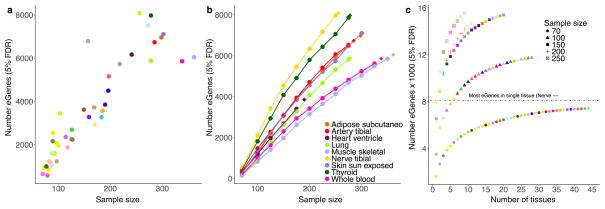
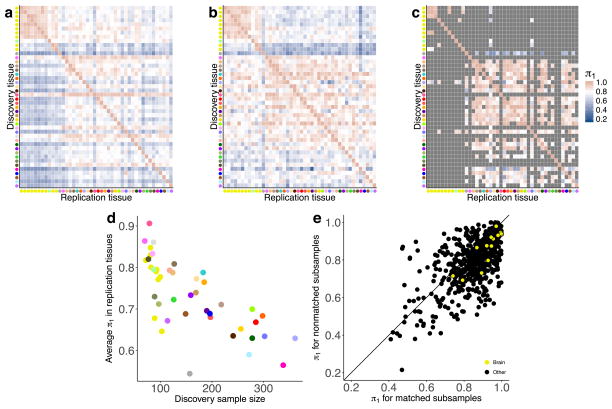
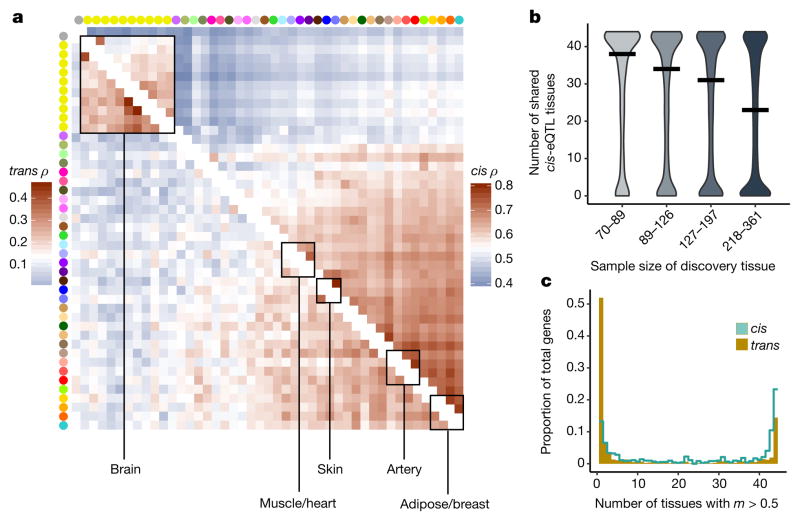
![Extended Data Figure 3 Properties of cis-eGenes and non-eGenes In these analyses, ‘non-eGenes’ refers to the set of genes with no significantly associated cis-eQTLs. a, Density of expression (mean across samples, median across tissues, in log10 scale) for cis-eGenes and non-eGenes. The difference in mean expression for cis-eGenes and non-eGenes is significant (Wald test; P <1 ×10⁻¹⁶). b, Box plots comparing the probability of being loss-of-function-intolerant (pLI) scores41 for cis-eGenes and non-eGenes, stratified by expression percentile across all genes (mean across samples, median across tissues, in log10 scale). On average, highly expressed non-eGenes have higher pLI scores than highly expressed cis-eGenes (t-test for the difference in mean pLI score between cis-eGenes and non-eGenes; BH adjusted P = 8.3 ×10⁻⁴ and 2.1 ×10⁻⁹ for (50,75]% and (75,100]%, respectively) and lowly expressed non-eGenes (t-test for the difference in mean pLI score between highly and lowly expressed non-eGenes; BH adjusted P ≤7.8 ×10−46, P ≤5.5 ×10⁻¹⁷ and P ≤2.1 ×10⁻³ for (75,100]% vs [0,25]%, (75,100 vs (25,50]% and (75,100]% vs (50,75]%, respectively). c, Gene Ontology (GO) analysis of tested protein-coding non-eGenes. We used the PANTHER overrepresentation test78 (release 20160715) against 20,972 human genes as background to test for enrichment in GO biological processes using the GO database release 2017-02-28. Significant GO IDs (Bonferroni adjusted P < 0.05) were selected for analysis with REVIGO79 to group similar ontological terms, which yielded 22 over-represented GO IDs. d, GO analysis of a more stringent set of protein-coding non-eGenes. Selected genes included those not tested in GTEx (532 genes) or those with a minimum nominal P value across tissues greater than 0.1 (692 genes). Of these stringent 1,224 non-eGenes, 808 were mapped in the GO analysis. Using a similar approach as in c, 20 over-represented GO IDs were identified. For both c and d, the x-axis represents the −log10 P value resulting from GO analysis. GO IDs are coloured by the broader enrichment category to which each corresponds. Box plots depict the IQR, whiskers depict 1.5× IQR.](https://figures.cochat.ai/paper-figures/ea51d71f9cd44f0ba04adaf266dc2572/genetic-effects-on-gene-expression-across-human-tissues-figure-3.jpg)






Verification
Claims the paper makes
The claims and statistics of this paper haven’t been checked yet.
Free: it reads the open-access text and checks the first 5 claims that cite a source we can check. Create a free account to check every claim.
Claims other papers make about this one
Each is checked against this paper’s own text: does it say what the citing paper says it does?
The source backs part of the claim, not all of it — or backs it for a different population, condition or comparison.
In the citing paper
“the ENCODE and Roadmap Epigenomics (Roadmap) projects have identified noncoding regions acting as enhancers and promoters (8–10).”
From Comprehensive functional genomic resource and integrative model for the human brain (2018) · cites this paper as [8]
Experimental — accuracy not yet measuredThe source backs part of the claim, not all of it — or backs it for a different population, condition or comparison.
In the citing paper
“The eQTL framework is very powerful, and for variants residing within distally located candidate enhancers, can provide in vivo validation of those enhancers while also linking them to their target genes136.”
From Towards a comprehensive catalogue of validated and target-linked human enhancers (2020) · cites this paper as [136]
Experimental — accuracy not yet measuredThe cited source says what the claim attributes to it.
In the citing paper
“Because only 9 of the 953 genes lack confirmed expression in any of the 34 neuro-related tissues tracked by IDG KMC (for example, GTEx40,41, HPA42 and HPM43), these data suggest that the remaining 80% of this set have the potential to be associated with human neurobehavioural phenotypes, paving the way for new research avenues in this direction (see Supplementary Table S8).”
From Unexplored therapeutic opportunities in the human genome (2018) · cites this paper as [41]
The cited source says what the claim attributes to it.
In the citing paper
“For example, the GTEx (Genotype-Tissue Expression) consortium has mapped thou sands of expression quantitative trait loci (QTLs) across hundreds of individuals and dozens of tissues112.”
From A brief history of human disease genetics (2020) · cites this paper as [112]
The cited source says what the claim attributes to it.
In the citing paper
“the Genotype-Tissue Expression (GTEx) project has associated many noncoding variants with expression quantitative-trait loci (eQTLs)”
From Comprehensive functional genomic resource and integrative model for the human brain (2018) · cites this paper as [8]
4 more claims about this paper
Create a free account to see every claim other papers make about this one.
Self-check
Percentages, sums and reported differences re-computed from the paper’s own numbers.
The self-check needs the paper’s full text.
Citations
Cites
Controlling the False Discovery Rate: A Practical and Powerful Approach to Multiple Testing
Benjamini, Y., & Hochberg, Y. (1995) · Journal of the Royal Statistical Society Series B: Statistical Methodology · doi:10.1111/j.2517-6161.1995.tb02031.x · Cited by 109,482
BEDTools: a flexible suite of utilities for comparing genomic features
Quinlan, A. R., & Hall, I. M. (2010) · Bioinformatics · doi:10.1093/bioinformatics/btq033 · Cited by 27,437
A global reference for human genetic variation
The 1000 Genomes Project Consortium, authors, C., Auton, A., Abecasis, G. R., Steering committee, Altshuler, D. M., Durbin, R. M., Abecasis, G. R., Bentley, D. R., Chakravarti, A., et al. (2015) · Nature · doi:10.1038/nature15393 · Cited by 18,247
The Molecular Signatures Database Hallmark Gene Set Collection
Liberzon, A., Birger, C., Thorvaldsdóttir, H., Ghandi, M., Mesirov, J. P., & Tamayo, P. (2015) · Cell Systems · doi:10.1016/j.cels.2015.12.004 · Cited by 13,807
Statistical significance for genomewide studies
Storey, J. D., & Tibshirani, R. (2003) · Proceedings of the National Academy of Sciences · doi:10.1073/pnas.1530509100 · Cited by 9,692
Analysis of protein-coding genetic variation in 60,706 humans
Exome Aggregation Consortium, Lek, M., Karczewski, K. J., Minikel, E. V., Samocha, K. E., Banks, E., Fennell, T., O’Donnell-Luria, A. H., Ware, J. S., Hill, A. J., et al. (2016) · Nature · doi:10.1038/nature19057 · Cited by 9,587
An integrated map of genetic variation from 1,092 human genomes
The 1000 Genomes Project Consortium (2012) · Nature · doi:10.1038/nature11632 · Cited by 7,711
Integrative analysis of 111 reference human epigenomes
Roadmap Epigenomics Consortium, Kundaje, A., Meuleman, W., Ernst, J., Bilenky, M., Yen, A., Heravi-Moussavi, A., Kheradpour, P., Zhang, Z., Wang, J., et al. (2015) · Nature · doi:10.1038/nature14248 · Cited by 6,368
REVIGO summarizes and visualizes long lists of gene ontology terms
Supek, F., Bošnjak, M., Škunca, N., & Šmuc, T. (2011) · PLoS ONE · doi:10.1371/journal.pone.0021800 · Cited by 6,264
The ENCODE Project Consortium (2007) · Nature · doi:10.1038/nature05874 · Cited by 5,223
Research works printed but not linked: 1
- Regev A The human cell atlas Preprint at http://www.biorxiv.org/content/early/2017/05/08/121202 2017
Cited by
Items 901–1,000 of 1,040
Zeng, Y., Amador, C., Xia, C., Marioni, R. E., Sproul, D., Walker, R. M., Morris, S. W., Bretherick, A. D., Canela‐Xandri, O., Boutin, T., et al. (2019) · Nature Communications · doi:10.1038/s41467-019-09301-y · Cited by 52
Tang, Y., Lenzini, P. A., Pop-Busui, R., Ray, P. R., Campbell, H., Perkins, B. A., Callaghan, B., Wagner, M. J., Motsinger-Reif, A. A., Buse, J. B., et al. (2019) · Diabetes · doi:10.2337/db19-0109 · Cited by 44
The genetics of human hematopoiesis and its disruption in disease
Bao, E. L., Cheng, A. N., & Sankaran, V. G. (2019) · EMBO Molecular Medicine · doi:10.15252/emmm.201910316 · Cited by 42
Wesolowska‐Andersen, A., Yu, G. Z., Nylander, V., Abaitua, F., Thurner, M., Torres, J., Mahajan, A., Gloyn, A. L., & McCarthy, M. I. (2020) · eLife · doi:10.7554/elife.51503 · Cited by 48
Lutz, S., Brion, C., Kliebhan, M., & Albert, F. W. (2019) · PLoS Genetics · doi:10.1371/journal.pgen.1008375 · Cited by 50
Functional annotation of rare structural variation in the human brain
Han, L., Zhao, X., Benton, M. L., Perumal, T. M., Collins, R. L., Hoffman, G. E., Johnson, J., Sloofman, L. G., Wang, H. Z., Stone, M. R., et al. (2020) · Nature Communications · doi:10.1038/s41467-020-16736-1 · Cited by 51
Steinbrenner, I., Schultheiß, U. T., Kotsis, F., Schlosser, P., Stockmann, H., Mohney, R. P., Schmid, M. C., Oefner, P. J., Eckardt, K., Köttgen, A., et al. (2021) · American Journal of Kidney Diseases · doi:10.1053/j.ajkd.2021.01.018 · Cited by 49
Pahl, M. C., Doege, C. A., Hodge, K. M., Littleton, S. H., Leonard, M. E., Lu, S., Rausch, R., Pippin, J. A., Rosa, M. C. D., Basak, A., et al. (2021) · Nature Communications · doi:10.1038/s41467-021-27001-4 · Cited by 53
Scholz, M. R., Horn, K., Pott, J., Gross, A., Kleber, M. E., Delgado, G. E., Mishra, P. P., Kirsten, H., Gieger, C., Müller‐Nurasyid, M., et al. (2022) · Nature Communications · doi:10.1038/s41467-021-27706-6 · Cited by 49
Benaglio, P., Newsome, J. M., Han, J. Y., Chiou, J., Aylward, A., Corban, S., Miller, M., Okino, M.-L., Kaur, J., Preißl, S., et al. (2023) · PLoS Genetics · doi:10.1371/journal.pgen.1010759 · Cited by 54
Brown, A. A., Fernandez-Tajes, J. J., Hong, M., Brorsson, C., Koivula, R. W., Davtian, D., Dupuis, T., Sartori, A., Michalettou, T.-D., Forgie, I. M., et al. (2023) · Nature Communications · doi:10.1038/s41467-023-40569-3 · Cited by 58
“To identify the proportion of cis-eQTLs, cis-pQTLs and metabo-QTLs active in other tissues, we extracted the same SNP-gene in GTEx v6p 25 , GTEx v8 12 ,and InsPIRE 3 thatwere signi fi cantly associated in DIRECT.”
Lacey, M. R., Baribault, C., Ehrlich, K. C., & Ehrlich, M. (2018) · Atherosclerosis · doi:10.1016/j.atherosclerosis.2018.11.031 · Cited by 49
Biological relevance of computationally predicted pathogenicity of noncoding variants
Liu, L., Sanderford, M. D., Patel, R., Chandrashekar, P. B., Gibson, G. C., & Kumar, S. (2019) · Nature Communications · doi:10.1038/s41467-018-08270-y · Cited by 49
Contribution of unfixed transposable element insertions to human regulatory variation
Goubert, C., Zevallos, N. A., & Feschotte, C. (2020) · Philosophical Transactions of the Royal Society B Biological Sciences · doi:10.1098/rstb.2019.0331 · Cited by 50
“Conditional analysis of these significant markers (including SNPs, indels and TEs) ranked ALU-NREF_1825 respectively 1/340 (top variant) and 74/346 in iPSC and LCL, respectively.”
BackgroundMethodResultInfluentialSchreiber, J. M., Bilmes, J. A., & Noble, W. S. (2020) · Genome biology · doi:10.1186/s13059-020-01978-5 · Cited by 53
Splicing mutations in inherited retinal diseases
Weisschuh, N., Buena‐Atienza, E., & Wissinger, B. (2020) · Progress in Retinal and Eye Research · doi:10.1016/j.preteyeres.2020.100874 · Cited by 46
Genomic mechanisms in Alzheimer's disease
Bertram, L., & Tanzi, R. E. (2020) · Brain Pathology · doi:10.1111/bpa.12882 · Cited by 42
“Importantly for the efforts described here, all GTEx data and results are made freely available via a dedicated website (www.gtexp ortal.org) and numerous variant-mapping algorithms have integrated these data into their “variant effect prediction.””
BackgroundMethodInfluentialGleason, K. J., Yang, F., Pierce, B. L., He, X., & Chen, L. (2020) · Genome biology · doi:10.1186/s13059-020-02125-w · Cited by 49
Fibrillar Collagen Variants in Spontaneous Coronary Artery Dissection
Zekavat, S. M., Chou, E. L., Zekavat, M., Pampana, A., Paruchuri, K., Cardenas, C. L. L., Koyama, S., Ghazzawi, Y., Kii, E., Uddin, M. M., et al. (2022) · JAMA Cardiology · doi:10.1001/jamacardio.2022.0001 · Cited by 49
Borie, R., Cardwell, J., Konigsberg, I. R., Moore, C. M., Zhang, W. E., Sasse, S. K., Gally, F., Dobrinskikh, E., Walts, A. D., Powers, J., et al. (2022) · American Journal of Respiratory and Critical Care Medicine · doi:10.1164/rccm.202110-2308oc · Cited by 48
Patsali, P., Turchiano, G., Papasavva, P. L., Romito, M., Loucari, C. C., Stephanou, C., Christou, S., Sitarou, M., Mussolino, C., Cornu, T. I., et al. (2019) · Haematologica · doi:10.3324/haematol.2018.215178 · Cited by 45
Neanderthal introgression reintroduced functional ancestral alleles lost in Eurasian populations
Rinker, D. C., Simonti, C. N., McArthur, E., Shaw, D., Hodges, E., & Capra, J. A. (2020) · Nature Ecology & Evolution · doi:10.1038/s41559-020-1261-z · Cited by 44
“We next evaluated the prevalence of RAs among eQTL in 48 tissues profiled in v7 of the 207 Genotype-Tissue Expression (GTEx) project (41).”
MethodLee, C., Chen, T., Lim, A. M. W., Chang, C.-C., Sie, J. J., Chen, P., Chang, S., Wu, S.-J., Hsu, C., Hsieh, A., et al. (2022) · Communications Biology · doi:10.1038/s42003-022-04168-0 · Cited by 48
Hao, X., Shao, Z., Zhang, N., Jiang, M., Cao, X., Li, S., Guan, Y., & Wang, C. (2023) · Nature Communications · doi:10.1038/s41467-023-43400-1 · Cited by 47
Genomics of schizophrenia, bipolar disorder and major depressive disorder
Owen, M. J., Bray, N. J., Walters, J., & O’Donovan, M. C. (2025) · Nature Reviews Genetics · doi:10.1038/s41576-025-00843-0 · Cited by 55
Richard, A. C., Peters, J. E., Yarkoni, N. S., Lee, J. C., Hawley, E., Meylan, F., Siegel, R. M., Lyons, P. A., & Smith, K. G. C. (2018) · PLoS Genetics · doi:10.1371/journal.pgen.1007458 · Cited by 46
Bariana, T. K., Labarque, V., Heremans, J., Thys, C., Reys, M. D., Greene, D., Jenkins, B., Grassi, L., Seyres, D., Burden, F., et al. (2018) · Haematologica · doi:10.3324/haematol.2018.204784 · Cited by 48
Aguirre‐Plans, J., Piñero, J., Sanz, F., Furlong, L. I., Fernández‐Fuentes, N., Oliva, B., & Güney, E. (2019) · Journal of Molecular Biology · doi:10.1016/j.jmb.2019.02.027 · Cited by 49
Tóth, D. M., Ocskó, T., Balog, A., Markovics, A., Mikecz, K., Kovács, L., Jolly, M., Bukiej, A., Ruthberg, A. D., Vida, A., et al. (2019) · Arthritis & Rheumatology · doi:10.1002/art.40877 · Cited by 45
“antiinflammatory drugs, and/or lowdose glucocorticoids does not provide a satisfactory response, highly specific biologic agents are introduced into the treatment regimen (2,3).”
BackgroundLOXL3 Function Beyond Amino Oxidase and Role in Pathologies, Including Cancer
Laurentino, T. D. S., Soares, R. D. S., Marie, S. K. N., & Oba‐Shinjo, S. M. (2019) · International Journal of Molecular Sciences · doi:10.3390/ijms20143587 · Cited by 46
Li, H., Qu, N., Hui, L., Cai, X. M., Zhang, C., Zhong, B., Zhang, S.-F., Chen, J., Xia, B., Wang, L., et al. (2020) · Translational Psychiatry · doi:10.1038/s41398-020-0777-y · Cited by 46
Liu, D., Zhou, D., Sun, Y., Zhu, J., Ghoneim, D. H., Wu, C., Yao, Q. C., Gamazon, E. R., Cox, N. J., & Wu, L. (2020) · Cancer Research · doi:10.1158/0008-5472.can-20-1353 · Cited by 47
“Details of RNA-sequencing experiments, quality control (QC) of the gene expression data, and genomic data have been described elsewhere (20, 21).”
MethodIntegrative genomics analysis reveals a 21q22.11 locus contributing risk to COVID-19
Ma, Y., Huang, Y., Zhao, S., Yao, Y., Zhang, Y., Qu, J., Wu, N., & Su, J. (2021) · Human Molecular Genetics · doi:10.1093/hmg/ddab125 · Cited by 48
“In light of multitissue data can be leveraged to identify genes and pathways influenced by human disease-associated variation, it is plausible to combine information available across multiple tissues in GTEx for mechanistically explain gene regulation and the genetic basis of disease (22).”
BackgroundGIGYF1 loss of function is associated with clonal mosaicism and adverse metabolic health
Zhao, Y., Stankovic, S., Koprulu, M., Wheeler, E., Day, F. R., Allen, H. L., Kerrison, N. D., Pietzner, M., Loh, P., Wareham, N. J., et al. (2021) · Nature Communications · doi:10.1038/s41467-021-24504-y · Cited by 50
Assigning function to SNPs: Considerations when interpreting genetic variation
Fadason, T., Farrow, S. L., Gokuladhas, S., Golovina, E., Nyaga, D. M., O'Sullivan, J. M., & Schierding, W. S. (2021) · Seminars in Cell and Developmental Biology · doi:10.1016/j.semcdb.2021.08.008 · Cited by 51
Soliai, M. M., Kato, A., Helling, B. A., Stanhope, C. T., Norton, J. E., Naughton, K. A., Klinger, A. I., Thompson, E. E., Clay, S. M., Kim, S., et al. (2021) · Genome Medicine · doi:10.1186/s13073-021-00967-y · Cited by 47
“These results are also consistent with previous studies 577 suggesting that functional variants from disease-relevant tissues are more enriched among 578 GWAS loci for those diseases [4, 41, 42].”
BackgroundResultGunasekara, C., MacKay, H., Scott, C. A., Li, S., Laritsky, E., Baker, M. S., Grimm, S. L., Jun, G., Li, Y., Chen, R., et al. (2023) · Genome biology · doi:10.1186/s13059-022-02827-3 · Cited by 50
Wang, Q. S., Hasegawa, T., Namkoong, H., Saiki, R., Edahiro, R., Sonehara, K., Tanaka, H., Azekawa, S., Chubachi, S., Takahashi, Y., et al. (2024) · Nature Genetics · doi:10.1038/s41588-024-01896-3 · Cited by 43
“…protein expression because of linkage disequilibrium between distinct nearby eQTLs and pQTLs. Studies of genetic regulation of mRNA expression (expression quantitative trait locus (eQTL) studies) is highly informative in interpreting associations between genetic variation and human diseases 1,2 .”
Atypical genomic cortical patterning in autism with poor early language outcome
Lombardo, M. V., Eyler, L. T., Pramparo, T., Gazestani, V., Hagler, D. J., Chen, C., Dale, A. M., Seidlitz, J., Bethlehem, R. A. I., Bertelsen, N., et al. (2021) · Science Advances · doi:10.1126/sciadv.abh1663 · Cited by 47
Baumert, P., Mäntyselkä, S., Schönfelder, M., Heiber, M., Jacobs, M. J., Swaminathan, A., Minderis, P., Dirmontas, M., Kleigrewe, K., Meng, C., et al. (2024) · Journal of Cachexia, Sarcopenia and Muscle · doi:10.1002/jcsm.13468 · Cited by 41
“In the next step, the Genotype-Tissue Expression (GTEx) portal 23 was used to analyse the association between the lean mass-related SNPs and the expression of speci fi c genes in different tissues ( P < 0.05).”
MethodInfluentialSakaue, S., Hirata, J., Maeda, Y., Kawakami, E., Nii, T., Kishikawa, T., Ishigaki, K., Terao, C., Ken, S., Akiyama, M., et al. (2018) · Nucleic Acids Research · doi:10.1093/nar/gky1066 · Cited by 53
Chen, Z., Wen, W., Beeghly-Fadiel, A. C., Shu, X., Díez‐Obrero, V., Long, J., Bao, J., Wang, J., Liu, Q., Cai, Q., et al. (2019) · The American Journal of Human Genetics · doi:10.1016/j.ajhg.2019.07.006 · Cited by 47
Wang, D., Lü, R., Rempała, G. A., & Sadée, W. (2019) · Molecular Pharmacology · doi:10.1124/mol.119.116897 · Cited by 43
Enhancer–gene maps in the human and zebrafish genomes using evolutionary linkage conservation
Clément, Y., Torbey, P., Gilardi-Hebenstreit, P., & Crollius, H. R. (2020) · Nucleic Acids Research · doi:10.1093/nar/gkz1199 · Cited by 41
Data-based RNA-seq simulations by binomial thinning
Gerard, D. (2020) · BMC Bioinformatics · doi:10.1186/s12859-020-3450-9 · Cited by 57
Cheng, X., & DeGiorgio, M. (2020) · Molecular Biology and Evolution · doi:10.1093/molbev/msaa134 · Cited by 48
Tubeuf, H., Charbonnier, C., Soukarieh, O., Blavier, A., Lefebvre, A., Dauchel, H., Frébourg, T., Gaildrat, P., & Martins, A. (2020) · Human Mutation · doi:10.1002/humu.24091 · Cited by 46
Said, M. A., van de Vegte, Y. J., Verweij, N., & van der Harst, P. (2020) · Journal of the American Heart Association · doi:10.1161/jaha.120.016808 · Cited by 49
Sapkota, Y., Qin, N., Ehrhardt, M. J., Wang, Z., Chen, Y., Wilson, C. L., Estepp, J. H., Rai, P., Hankins, J. S., Burridge, P. W., et al. (2020) · Cancer Research · doi:10.1158/0008-5472.can-20-2675 · Cited by 44
Minyaylo, O., Ponomarenko, I., Reshetnikov, E., Dvornyk, V., & Churnosov, M. I. (2021) · Scientific Reports · doi:10.1038/s41598-021-92527-y · Cited by 45
Transcription factor regulation of eQTL activity across individuals and tissues
Flynn, E. D., Tsu, A. L., Kasela, S., Kim-Hellmuth, S., Aguet, F., Ardlie, K., Bussemaker, H. J., Mohammadi, P., & Lappalainen, T. (2022) · PLoS Genetics · doi:10.1371/journal.pgen.1009719 · Cited by 57
Multiomic analysis reveals cell-type-specific molecular determinants of COVID-19 severity
Zhang, S., Cooper‐Knock, J., Weimer, A. K. K., Harvey, C., Julian, T. H., Wang, C., Li, J., Furini, S., Frullanti, E., Fava, F., et al. (2022) · Cell Systems · doi:10.1016/j.cels.2022.05.007 · Cited by 44
Al-Barghouthi, B. M., Rosenow, W. T., Du, K., Heo, J., Maynard, R. D., Mesner, L. D., Calabrese, G. M., Nakasone, A., Senwar, B., Gerstenfeld, L. C., et al. (2022) · eLife · doi:10.7554/elife.77285 · Cited by 47
Integrative methods for post-selection inference under convex constraints
Panigrahi, S., Taylor, J., & Weinstein, A. (2021) · The Annals of Statistics · doi:10.1214/21-aos2057 · Cited by 57
Bellott, D. W., & Page, D. C. (2021) · Genome Research · doi:10.1101/gr.268516.120 · Cited by 45
Ojelade, S. A., Lee, T. V., Giagtzoglou, N., Yu, L., Ugur, B., Li, Y., Duraine, L., Zuo, Z., Petyuk, V., De Jager, P. L., et al. (2019) · Cell Reports · doi:10.1016/j.celrep.2019.07.041 · Cited by 42
Bretherick, A. D., Canela-Xandri, O., Joshi, P. K., Clark, D. W., Rawlik, K., Boutin, T. S., Zeng, Y., Amador, C., Navarro, P., Rudan, I., et al. (2020) · PLOS Genetics · doi:10.1371/journal.pgen.1008785 · Cited by 42
Liu, H., Sun, Y., Zhang, X., Li, S., Hu, D., Xiao, L., Chen, Y., He, L., & Wang, D. W. (2020) · Frontiers in Psychiatry · doi:10.3389/fpsyt.2020.00256 · Cited by 52
Lee, I., Lee, J., & Kong, S. W. (2020) · Infection Genetics and Evolution · doi:10.1016/j.meegid.2020.104507 · Cited by 43
Genetic mechanisms of COVID-19 and its association with smoking and alcohol consumption
Rao, S., Baranova, A. V., Cao, H., Chen, J., Zhang, X., & Zhang, F. (2021) · Briefings in Bioinformatics · doi:10.1093/bib/bbab284 · Cited by 48
Aracena, K. A., Lin, Y., Luo, K., Pacis, A., Gona, S., Mu, Z., Yotova, V., Sindeaux, R., Pramatarova, A., Simon, M.-M., et al. (2024) · Nature Genetics · doi:10.1038/s41588-024-01668-z · Cited by 48
“Despite immense efforts to characterize eQTL across thousands of individuals, tissue types and experimental conditions 54,55 , only ~40% of GWAS variants colocalize with eQTL 56 .”
Tian, C., Zhang, Y., Tong, Y., Kock, K. H., Sim, D. Y., Liu, F., Dong, J., Jing, Z., Wang, W., Gao, J., et al. (2024) · Nature Genetics · doi:10.1038/s41588-024-02019-8 · Cited by 48
BarkBase: Epigenomic Annotation of Canine Genomes
Megquier, K., Genereux, D. P., Hekman, J. P., Swofford, R., Turner-Maier, J., Johnson, J., Alonso, J., Li, X., Morrill, K. M., Anguish, L. J., et al. (2019) · Genes · doi:10.3390/genes10060433 · Cited by 50
“Work investigating how germline variants affect gene expression in humans suggests sample sizes in the hundreds may be required [115].”
BackgroundBenaglio, P., D’Antonio‐Chronowska, A., Ma, W., Yang, F., Greenwald, W. W. Y., Donovan, M. K. R., DeBoever, C., Li, H., Drees, F., Singhal, S., et al. (2019) · Nature Genetics · doi:10.1038/s41588-019-0499-3 · Cited by 45
Lee, A. S., Rusch, J., Lima, A. C., Usmani, A., Huang, N., Lepamets, M., Vigh‐Conrad, K. A., Worthington, R. E., Mägi, R., Wu, X., et al. (2019) · Nature Communications · doi:10.1038/s41467-019-12522-w · Cited by 47
Jiang, L., Xue, C., Chen, S., Dai, S., Chen, P., Sham, P. C., Wang, H., & Li, M. (2019) · Genome biology · doi:10.1186/s13059-019-1801-5 · Cited by 66
van Rooij, J., Mandaviya, P. R., Claringbould, A., Felix, J. F., van Dongen, J., Jansen, R., Franke, L., Hoen, P. A. C. ’., Heijmans, B. T., & van Meurs, J. B. J. (2019) · Genome biology · doi:10.1186/s13059-019-1878-x · Cited by 44
An absolute human stemness index associated with oncogenic dedifferentiation
Zheng, H., Song, K., Fu, Y., You, T., Yang, J., Guo, W., Wang, K., Jin, L., Gu, Y., Qi, L., et al. (2020) · Briefings in Bioinformatics · doi:10.1093/bib/bbz174 · Cited by 47
Altered glucocorticoid metabolism represents a feature of macroph‐aging
Perez, J. V. V., Linnenberger, R., Dembek, A., Bruscoli, S., Riccardi, C., Schulz, M. H., Meyer, M. R., Kiemer, A. K., & Hoppstädter, J. (2020) · Aging Cell · doi:10.1111/acel.13156 · Cited by 43
Genome-wide analysis revealed sex-specific gene expression in asthmatics
Gautam, Y., Afanador, Y., Abebe, T., López, J. E., & Baye, T. M. (2019) · Human Molecular Genetics · doi:10.1093/hmg/ddz074 · Cited by 45
(2020) · doi:10.1038/s41398-020-0817-7 · Cited by 42
Genetics of endometriosis: state of the art on genetic risk factors for endometriosis
Fung, J. N., & Montgomery, G. W. (2018) · Best Practice & Research Clinical Obstetrics & Gynaecology · doi:10.1016/j.bpobgyn.2018.01.012 · Cited by 41
Human embryoid bodies as a novel system for genomic studies of functionally diverse cell types
Rhodes, K., Barr, K., Popp, J. M., Strober, B. J., Battle, A. J., & Gilad, Y. (2022) · eLife · doi:10.7554/elife.71361 · Cited by 49
Flynn, E., Almonte-Loya, A., & Fragiadakis, G. K. (2023) · Annual Review of Biomedical Data Science · doi:10.1146/annurev-biodatasci-020422-050645 · Cited by 54
Dissecting shared genetic architecture between obesity and multiple sclerosis
Zeng, R., Jiang, R., Huang, W., Wang, J., Zhang, L., Ma, Y., Wu, Y., Meng, M., Lan, H., Lian, Q., et al. (2023) · EBioMedicine · doi:10.1016/j.ebiom.2023.104647 · Cited by 43
Genetic insights into resting heart rate and its role in cardiovascular disease
van de Vegte, Y. J., Eppinga, R. N., van der Ende, M. Y., Hagemeijer, Y. P., Mahendran, Y., Salfati, E., Smith, A. V., Tan, V. Y., Arking, D. E., Ντάλλα, Ι., et al. (2023) · Nature Communications · doi:10.1038/s41467-023-39521-2 · Cited by 44
“Colocalization of multiple expression quantitative trait loci(eQTL) was performed using SMR and HEIDI analyses (version 0.710) 13 in data repositories from GTEx V7 71 , GTEx brain 71 , Brain-eMeta eQTL 72 , and blood eQTL from Westra 73 and CAGE 74 .”
InfluentialEmerging links between pediatric lysosomal storage diseases and adult parkinsonism
Ysselstein, D., Shulman, J. M., & Krainc, D. (2019) · Movement Disorders · doi:10.1002/mds.27631 · Cited by 40
Integrative Analysis Revealing Human Adipose-Specific Genes and Consolidating Obesity Loci
Ahn, J., Wu, H., & Lee, K. (2019) · Scientific Reports · doi:10.1038/s41598-019-39582-8 · Cited by 44
Wang, M., Fischer, J. D., & Song, Y. S. (2019) · The Annals of Applied Statistics · doi:10.1214/18-aoas1228 · Cited by 54
“Existing multi-tissue eQTL analyses usually proceed by identifying eQTLs in each tissue separately before combining single-tissue results via meta analysis (Battle et al. (2017)). However, the large numbers of genes, tissues, and genetic variants potentially incur a substantial penalty for multiple testing and there i…”
MethodInfluentialMoni, M. A., Rana, H. K., Islam, M. B., Ahmed, M. B., Xu, H., Hasan, M. A. M., Lei, Y., & Quinn, J. M. W. (2019) · Computers in Biology and Medicine · doi:10.1016/j.compbiomed.2019.103385 · Cited by 42
RetractedLeveraging allelic imbalance to refine fine-mapping for eQTL studies
Zou, J., Hormozdiari, F., Jew, B., Castel, S. E., Lappalainen, T., Ernst, J., Sul, J. H., & Eskin, E. (2019) · PLoS Genetics · doi:10.1371/journal.pgen.1008481 · Cited by 44
Omics in Neurodegenerative Disease: Hope or Hype?
Diaz‐Ortiz, M. E., & Chen‐Plotkin, A. S. (2020) · Trends in Genetics · doi:10.1016/j.tig.2019.12.002 · Cited by 43
Mulvey, B., Lagunas, T., & Dougherty, J. D. (2020) · Biological Psychiatry · doi:10.1016/j.biopsych.2020.06.011 · Cited by 44
“Cell type roles in putatively functional variation are also implicated by GWAS SNPs enrichment in tissue-specific eQTLs (59,75), neural cell type-specific chromatin interactions (62), and eQTLs that evade detection in bulk brain (i.”
BackgroundCao, X., Zhang, Y., Payer, L. M., Lords, H. J., Steranka, J. P., Burns, K. H., & Xing, J. (2020) · Genome biology · doi:10.1186/s13059-020-02101-4 · Cited by 46
“263 The GTEx project provides an excellent opportunity to study the impact of pMEI on gene 264 expression and alternative splicing in human tissues [30].”
BackgroundMethodResultInfluentialWu, M., Ma, L., Xue, L., Zhu, Q., Zhou, S., Dai, J., Yan, W., Zhang, J., & Wang, S. (2021) · Genomics · doi:10.1016/j.ygeno.2021.08.012 · Cited by 48
“As GTEx provides the complete data regarding sample collection, RNA-Seq experiments, quality control, and gene expression normalization, such information is not reproduced here [17,18].”
BackgroundCOPB2 loss of function causes a coatopathy with osteoporosis and developmental delay
Marom, R., Burrage, L. C., Clément, A., Blanco‐Sánchez, B., Venditti, R., Jain, M., Grafe, I., Scott, D. A., Rosenfeld, J. A., Sutton, V. R., et al. (2021) · The American Journal of Human Genetics · doi:10.1016/j.ajhg.2021.08.002 · Cited by 44
Bonfiglio, F., Liu, X., Smillie, C. S., Pandit, A., Kurilshikov, A., Bacigalupe, R., Zheng, T., Nim, H. T., García‐Etxebarria, K., Bujanda, L., et al. (2021) · Cell Genomics · doi:10.1016/j.xgen.2021.100069 · Cited by 48
Teyssonnière, E. M., Trébulle, P., Muenzner, J., Loegler, V., Ludwig, D., Amari, F., Mülleder, M., Friedrich, A., Hou, J., Ralser, M., et al. (2024) · Proceedings of the National Academy of Sciences · doi:10.1073/pnas.2319211121 · Cited by 40
The gene regulatory basis of genetic compensation during neural crest induction
Dooley, C. M., Wali, N., Sealy, I. M., White, R. J., Stemple, D. L., Collins, J. E., & Busch-Nentwich, E. M. (2019) · PLOS Genetics · doi:10.1371/journal.pgen.1008213 · Cited by 40
Younas, A., Wang, S., Asad, M., Mamun, A. A., Majeed, S., Sharif, A., Zhou, Q., Liu, Y., Geng, P., Shao, C., et al. (2025) · Materials Today Bio · doi:10.1016/j.mtbio.2025.102660 · Cited by 76
“…(GTEx) for tissue-specific expression, single-cell and imaging databases (e.g., the Single Cell Portal) for spatial resolution, and ClinicalTrials.gov for linking formulation parameters to therapeutic outcomes, collectively enhance the depth and context of AI training datasets [173 – 177].”
How to Consider Rare Genetic Variants in Personalized Drug Therapy
Lauschke, V. M., & Ingelman‐Sundberg, M. (2018) · Clinical Pharmacology & Therapeutics · doi:10.1002/cpt.976 · Cited by 40
“The recent GTEx project underlines the important impact of mutations in noncoding regions on their molecular phenotype and their impact on human health.(4) The overall importance of such mutations in the different pharmacogenes for causing altered drug pharmacokinetics and -dynamics is presently unknown, but it can be…”
BackgroundTaylor, K., Davey Smith, G., Relton, C. L., Gaunt, T. R., & Richardson, T. G. (2019) · Genome Medicine · doi:10.1186/s13073-019-0613-2 · Cited by 40
A characterization of cis- and trans-heritability of RNA-Seq-based gene expression
Ouwens, K. G., Jansen, R., Nivard, M. G., van Dongen, J., Frieser, M. J., Hottenga, J., Arindrarto, W., Claringbould, A., van Iterson, M., Mei, H., et al. (2019) · European Journal of Human Genetics · doi:10.1038/s41431-019-0511-5 · Cited by 44
Benson, K. K., Hu, W., Weller, A. H., Bennett, A. H., Chen, E. R., Khetarpal, S. A., Yoshino, S., Bone, W. P., Wang, L., Rabinowitz, J. D., et al. (2019) · Proceedings of the National Academy of Sciences · doi:10.1073/pnas.1913199116 · Cited by 52
“The University of California, Santa Cruz (UCSC) genome browser (48) was used for the identification and cross-species comparison of the PM20D1 segmental duplication, as well as localization of published GWAS lead SNPs. Human genetics of tissue-specific gene expression was interrogated using the GTEx portal (21).”
BackgroundMethodInfluentialA powerful fine-mapping method for transcriptome-wide association studies
Wu, C., & Pan, W. (2019) · Human Genetics · doi:10.1007/s00439-019-02098-2 · Cited by 47
Overlapping genetic architecture between Parkinson disease and melanoma
Dube, U., Ibáñez, L., Budde, J., Benítez, B. A., Davis, A. A., Harari, O., Iles, M. M., Law, M. H., Brown, K. M., & Cruchaga, C. (2019) · Acta Neuropathologica · doi:10.1007/s00401-019-02110-z · Cited by 43
Skeletal muscle enhancer interactions identify genes controlling whole-body metabolism
Williams, K., Ingerslev, L. R., Bork‐Jensen, J., Wohlwend, M., Hansen, A. N., Small, L., Ribel‐Madsen, R., Astrup, A. V., Pedersen, O. B., Auwerx, J. H., et al. (2020) · Nature Communications · doi:10.1038/s41467-020-16537-6 · Cited by 43
Systematic identification of functional SNPs interrupting 3’UTR polyadenylation signals
Shulman, E. D., & Elkon, R. (2020) · PLoS Genetics · doi:10.1371/journal.pgen.1008977 · Cited by 42
Sabik, O. L., Calabrese, G. M., Taleghani, E., Ackert‐Bicknell, C. L., & Farber, C. R. (2020) · Cell Reports · doi:10.1016/j.celrep.2020.108145 · Cited by 46
He, L., Loika, Y., Park, Y., Bennett, D. A., Kellis, M., Kulminski, A. M., & Initiative, A. D. N. (2021) · Translational Psychiatry · doi:10.1038/s41398-021-01263-4 · Cited by 44
Metadata
- Authors
- GTEx Consortium
- Venue
- Nature
- Published
- 2017-10-12
- Volume
- 550
- Issue
- 7675
- Pages
- 204-213
- ISSN
- 0028-0836 (ISSN-L)
- 1476-4687
- PMC
- PMC5776756
- OpenAlex
- W2761275051
- Cited by
- 4,036
- References
- 83
- Citations by year
- 2026: 248 · 2025: 355 · 2024: 412 · 2023: 401 · 2022: 507 · 2021: 634 · 2020: 600 · 2019: 516 · 2018: 320 · 2017: 35
- FWCI
- 266.52
- Type
- journal article
- Language
- en
- Update notices
- erratum (2017-12-20)
- Open access
- hybrid
- doi.org
- Licence
- cc-by
- creativecommons.org/licenses/by/4.0 (tdm)
- creativecommons.org/licenses/by/4.0 (vor)
- Locations
- Nature (publishedVersion, cc-by)
- PubMed (publishedVersion)
- RECERCAT (Consorci de Serveis Universitaris de Catalunya) (publishedVersion, other-oa)
- Archive ouverte UNIGE (University of Geneva) (publishedVersion, other-oa)
- UPCommons institutional repository (Universitat Politècnica de Catalunya) (publishedVersion, other-oa)
- Europe PMC (PubMed Central) (acceptedVersion, cc-by)
- PubMed Central (acceptedVersion, cc-by)
- SERVAL (Université de Lausanne) (acceptedVersion, cc-by)
- Discovery Research Portal (University of Dundee) (submittedVersion, cc-by)
- LA Referencia (Red Federada de Repositorios Institucionales de Publicaciones Científicas) (submittedVersion, public-domain)
- IRIS (submittedVersion, cc-by)
- Data Archiving and Networked Services (DANS) (submittedVersion)
- DSpace@MIT (Massachusetts Institute of Technology) (submittedVersion, cc-by-nc)
- eScholarship (California Digital Library) (submittedVersion)
- eScholarship (California Digital Library) (submittedVersion, cc-by)
- Minerva Access (University of Melbourne) (submittedVersion, cc-by)
- Repositori digital de la UPF (Universitat Pompeu Fabra) (submittedVersion, cc-by)
- Seoul National University Open Repository (Seoul National University) (submittedVersion)
- Archive ouverte UNIGE (University of Geneva) (submittedVersion, cc-by)
- TUScholarShare (Temple University) (cc-by)
- Funders
- National Science Foundation ((DGE-114747, DGE-165651 8, 114747, HHSN261200800001E, 1656518)
- University of Miami (DA006227)
- Wellcome Trust
- Broad Institute (HHSN268201000029C)
- Searle Scholars Program
- Leidos (HHSN261200800001E)
- National Institute for Health and Care Research (NF-SI-0611-10099)
- National Institutes of Health (10XS170, HHSN2682010000029C, #HHSN261200800001E, HHSN268201000029C, 10XS171, DGE-114747, HHSN261200800001C, DGE-1656518, 10ST1035)
- Center for Computational, Evolutionary and Human Genomics, Stanford University
- National Institute on Aging (P30AG010124)
- National Heart, Lung, and Blood Institute (HHSN268201000029C, HHSN268201000002C, HHSN261200800001E, HHSN268201000009C)
- National Institute of Mental Health (R01MH101814, R01MH101822, R01MH090937, R01MH106842, R01MH101810, HHSN261200800001E, R01MH101782, R01MH101819, R01MH101820, R01MH109905)
- National Institute on Drug Abuse (DA006227, R01DA006227)
- National Human Genome Research Institute (U01HG007900, UM1HG008901, R00HG006265, R01HG009125, U41HG002371, HHSN261200800001E, U01HG007591, K22HG000044, U01HG007436, R01HG008150, R21HG007840, U01HG009080, U54HG007990, T32HG003284, T32HG000044)
- NIH Office of the Director (HHSN261200800001E, R01MH101814)
- National Cancer Institute (HHSN261200800001E), HHSN268201000029C)
- National Institute of General Medical Sciences (T32GM007057, R01GM104371)
- National Institute of Diabetes and Digestive and Kidney Diseases (U54DK105566)
- National Institute of Neurological Disorders and Stroke
- U.S. National Library of Medicine (T15LM007033)
- Common Fund
- Topics
- Life Sciences › Biochemistry, Genetics and Molecular Biology › Genetics › Genetic Associations and Epidemiology
- Life Sciences › Biochemistry, Genetics and Molecular Biology › Molecular Biology › Genomics and Chromatin Dynamics
- Life Sciences › Biochemistry, Genetics and Molecular Biology › Molecular Biology › RNA Research and Splicing
- Keywords
- tissue-specific gene expression, gene expression regulation, GTEx, human genetic variation
- MeSH terms
- Alleles, Chromosomes, Human, Disease, Female, Gene Expression Regulation, Genotype, Humans, Male, Organ Specificity, Genetic Variation, Genome, Human, Gene Expression Profiling, Quantitative Trait Loci
About these checks
Registry, retraction, Cites and statistics results are computed, not judged, with one exception: a printed reference that no index lists is read once by a model before it counts as a citation error. Claims are extracted by a model and kept only when their quote appears verbatim in the text; each cited source is then checked, with a model’s help, for whether it says what the claim relies on. Those verdicts can be wrong — read the claim’s quote and the cited source before relying on one.
Statistics and arithmetic are recomputed, not judged.
Confidence bands are shown only for fields calibrated on our annotated test set. None is calibrated yet, so no band is shown.
What counts as a claim ›How we measure confidence ›How we check this ›
Are you an author, or do you see a problem with this page? Request a review
Data sources
Bibliographic data: Semantic Scholar, OpenAlex, Crossref.
Contains information from the Semantic Scholar Academic Graph Datasets, made available under the ODC Attribution License (ODC-BY 1.0).
Semantic Scholar’s data is described in: Kinney, R., et al. (2023). The Semantic Scholar Open Data Platform. arXiv:2301.10140.
