

Genetic effects on gene expression across human tissues
Open accessThe DOI matches its Crossref record; 83 of the 83 references it cites were found in a registry or an index.
Abstract
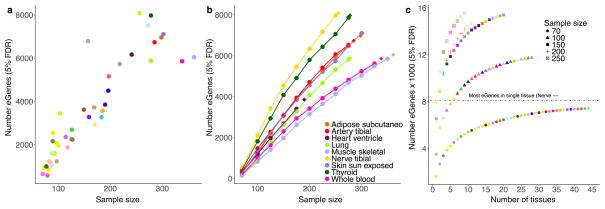
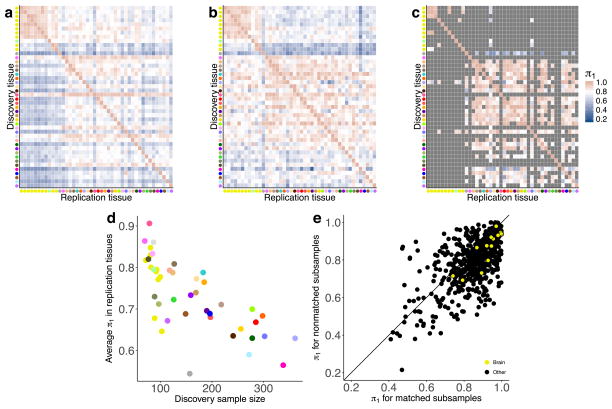
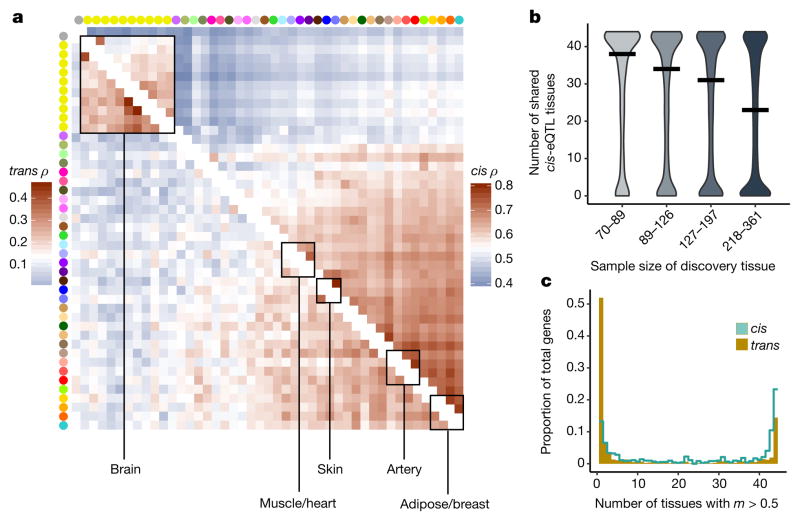
Characterization of the molecular function of the human genome and its variation across individuals is essential for identifying the cellular mechanisms that underlie human genetic traits and diseases. The Genotype-Tissue Expression (GTEx) project aims to characterize variation in gene expression levels across individuals and diverse tissues of the human body, many of which are not easily accessible. Here we describe genetic effects on gene expression levels across 44 human tissues. We find that local genetic variation affects gene expression levels for the majority of genes, and we further identify inter-chromosomal genetic effects for 93 genes and 112 loci. On the basis of the identified genetic effects, we characterize patterns of tissue specificity, compare local and distal effects, and evaluate the functional properties of the genetic effects. We also demonstrate that multi-tissue, multi-individual data can be used to identify genes and pathways affected by human disease-associated variation, enabling a mechanistic interpretation of gene regulation and the genetic basis of disease.
Overview
The claims and statistics of this paper haven’t been checked yet.
Free: it reads the open-access text and checks the first 5 claims that cite a source we can check. Create a free account to check every claim.
Integrity signals
Registry
Cites
Statistics
Figures


![Extended Data Figure 3 Properties of cis-eGenes and non-eGenes In these analyses, ‘non-eGenes’ refers to the set of genes with no significantly associated cis-eQTLs. a, Density of expression (mean across samples, median across tissues, in log10 scale) for cis-eGenes and non-eGenes. The difference in mean expression for cis-eGenes and non-eGenes is significant (Wald test; P <1 ×10⁻¹⁶). b, Box plots comparing the probability of being loss-of-function-intolerant (pLI) scores41 for cis-eGenes and non-eGenes, stratified by expression percentile across all genes (mean across samples, median across tissues, in log10 scale). On average, highly expressed non-eGenes have higher pLI scores than highly expressed cis-eGenes (t-test for the difference in mean pLI score between cis-eGenes and non-eGenes; BH adjusted P = 8.3 ×10⁻⁴ and 2.1 ×10⁻⁹ for (50,75]% and (75,100]%, respectively) and lowly expressed non-eGenes (t-test for the difference in mean pLI score between highly and lowly expressed non-eGenes; BH adjusted P ≤7.8 ×10−46, P ≤5.5 ×10⁻¹⁷ and P ≤2.1 ×10⁻³ for (75,100]% vs [0,25]%, (75,100 vs (25,50]% and (75,100]% vs (50,75]%, respectively). c, Gene Ontology (GO) analysis of tested protein-coding non-eGenes. We used the PANTHER overrepresentation test78 (release 20160715) against 20,972 human genes as background to test for enrichment in GO biological processes using the GO database release 2017-02-28. Significant GO IDs (Bonferroni adjusted P < 0.05) were selected for analysis with REVIGO79 to group similar ontological terms, which yielded 22 over-represented GO IDs. d, GO analysis of a more stringent set of protein-coding non-eGenes. Selected genes included those not tested in GTEx (532 genes) or those with a minimum nominal P value across tissues greater than 0.1 (692 genes). Of these stringent 1,224 non-eGenes, 808 were mapped in the GO analysis. Using a similar approach as in c, 20 over-represented GO IDs were identified. For both c and d, the x-axis represents the −log10 P value resulting from GO analysis. GO IDs are coloured by the broader enrichment category to which each corresponds. Box plots depict the IQR, whiskers depict 1.5× IQR.](https://figures.cochat.ai/paper-figures/ea51d71f9cd44f0ba04adaf266dc2572/genetic-effects-on-gene-expression-across-human-tissues-figure-3.jpg)






Verification
Claims the paper makes
The claims and statistics of this paper haven’t been checked yet.
Free: it reads the open-access text and checks the first 5 claims that cite a source we can check. Create a free account to check every claim.
Claims other papers make about this one
Each is checked against this paper’s own text: does it say what the citing paper says it does?
The source backs part of the claim, not all of it — or backs it for a different population, condition or comparison.
In the citing paper
“the ENCODE and Roadmap Epigenomics (Roadmap) projects have identified noncoding regions acting as enhancers and promoters (8–10).”
From Comprehensive functional genomic resource and integrative model for the human brain (2018) · cites this paper as [8]
Experimental — accuracy not yet measuredThe source backs part of the claim, not all of it — or backs it for a different population, condition or comparison.
In the citing paper
“The eQTL framework is very powerful, and for variants residing within distally located candidate enhancers, can provide in vivo validation of those enhancers while also linking them to their target genes136.”
From Towards a comprehensive catalogue of validated and target-linked human enhancers (2020) · cites this paper as [136]
Experimental — accuracy not yet measuredThe cited source says what the claim attributes to it.
In the citing paper
“Because only 9 of the 953 genes lack confirmed expression in any of the 34 neuro-related tissues tracked by IDG KMC (for example, GTEx40,41, HPA42 and HPM43), these data suggest that the remaining 80% of this set have the potential to be associated with human neurobehavioural phenotypes, paving the way for new research avenues in this direction (see Supplementary Table S8).”
From Unexplored therapeutic opportunities in the human genome (2018) · cites this paper as [41]
The cited source says what the claim attributes to it.
In the citing paper
“For example, the GTEx (Genotype-Tissue Expression) consortium has mapped thou sands of expression quantitative trait loci (QTLs) across hundreds of individuals and dozens of tissues112.”
From A brief history of human disease genetics (2020) · cites this paper as [112]
The cited source says what the claim attributes to it.
In the citing paper
“the Genotype-Tissue Expression (GTEx) project has associated many noncoding variants with expression quantitative-trait loci (eQTLs)”
From Comprehensive functional genomic resource and integrative model for the human brain (2018) · cites this paper as [8]
4 more claims about this paper
Create a free account to see every claim other papers make about this one.
Self-check
Percentages, sums and reported differences re-computed from the paper’s own numbers.
The self-check needs the paper’s full text.
Citations
Cites
Controlling the False Discovery Rate: A Practical and Powerful Approach to Multiple Testing
Benjamini, Y., & Hochberg, Y. (1995) · Journal of the Royal Statistical Society Series B: Statistical Methodology · doi:10.1111/j.2517-6161.1995.tb02031.x · Cited by 109,482
BEDTools: a flexible suite of utilities for comparing genomic features
Quinlan, A. R., & Hall, I. M. (2010) · Bioinformatics · doi:10.1093/bioinformatics/btq033 · Cited by 27,437
A global reference for human genetic variation
The 1000 Genomes Project Consortium, authors, C., Auton, A., Abecasis, G. R., Steering committee, Altshuler, D. M., Durbin, R. M., Abecasis, G. R., Bentley, D. R., Chakravarti, A., et al. (2015) · Nature · doi:10.1038/nature15393 · Cited by 18,247
The Molecular Signatures Database Hallmark Gene Set Collection
Liberzon, A., Birger, C., Thorvaldsdóttir, H., Ghandi, M., Mesirov, J. P., & Tamayo, P. (2015) · Cell Systems · doi:10.1016/j.cels.2015.12.004 · Cited by 13,807
Statistical significance for genomewide studies
Storey, J. D., & Tibshirani, R. (2003) · Proceedings of the National Academy of Sciences · doi:10.1073/pnas.1530509100 · Cited by 9,692
Analysis of protein-coding genetic variation in 60,706 humans
Exome Aggregation Consortium, Lek, M., Karczewski, K. J., Minikel, E. V., Samocha, K. E., Banks, E., Fennell, T., O’Donnell-Luria, A. H., Ware, J. S., Hill, A. J., et al. (2016) · Nature · doi:10.1038/nature19057 · Cited by 9,587
An integrated map of genetic variation from 1,092 human genomes
The 1000 Genomes Project Consortium (2012) · Nature · doi:10.1038/nature11632 · Cited by 7,711
Integrative analysis of 111 reference human epigenomes
Roadmap Epigenomics Consortium, Kundaje, A., Meuleman, W., Ernst, J., Bilenky, M., Yen, A., Heravi-Moussavi, A., Kheradpour, P., Zhang, Z., Wang, J., et al. (2015) · Nature · doi:10.1038/nature14248 · Cited by 6,368
REVIGO summarizes and visualizes long lists of gene ontology terms
Supek, F., Bošnjak, M., Škunca, N., & Šmuc, T. (2011) · PLoS ONE · doi:10.1371/journal.pone.0021800 · Cited by 6,264
The ENCODE Project Consortium (2007) · Nature · doi:10.1038/nature05874 · Cited by 5,223
Research works printed but not linked: 1
- Regev A The human cell atlas Preprint at http://www.biorxiv.org/content/early/2017/05/08/121202 2017
Cited by
The mutational constraint spectrum quantified from variation in 141,456 humans
Karczewski, K. J., Francioli, L. C., Tiao, G., Cummings, B. B., Alföldi, J., Wang, Q., Collins, R. L., Laricchia, K. M., Ganna, A., Birnbaum, D. P., et al. (2020) · Nature · doi:10.1038/s41586-020-2308-7 · Cited by 9,434
Self-citationThe GTEx Consortium atlas of genetic regulatory effects across human tissues
The GTEx Consortium, Aguet, F., Anand, S., Ardlie, K. G., Gabriel, S., Getz, G. A., Graubert, A., Hadley, K., Handsaker, R. E., Huang, K. H., et al. (2020) · Science · doi:10.1126/science.aaz1776 · Cited by 5,547
“We mapped independent cis-eQTLs and cis-sQTLs using stepwise regression, where the 5% FDR threshold for significance was defined by the single cis-QTL mapping (10).”
BackgroundMethodInfluentialVisualizing and interpreting cancer genomics data via the Xena platform
Goldman, M. J., Craft, B., Hastie, M., Repečka, K., McDade, F., Kamath, A., Banerjee, A., Luo, Y., Rogers, D., Brooks, A. N., et al. (2020) · Nature Biotechnology · doi:10.1038/s41587-020-0546-8 · Cited by 4,481
Next-generation characterization of the Cancer Cell Line Encyclopedia
Ghandi, M., Huang, F. W., Jané-Valbuena, J., Kryukov, G. V., Lo, C. C., McDonald, E. R., Barretina, J., Gelfand, E. T., Bielski, C. M., Li, H., et al. (2019) · Nature · doi:10.1038/s41586-019-1186-3 · Cited by 3,394
GENCODE reference annotation for the human and mouse genomes
Frankish, A., Diekhans, M., Ferreira, A.-M., Johnson, R., Jungreis, I., Loveland, J., Mudge, J. M., Sisu, C., Wright, J., Armstrong, J., et al. (2019) · Nucleic Acids Research · doi:10.1093/nar/gky955 · Cited by 3,040
Mapping genomic loci implicates genes and synaptic biology in schizophrenia
Trubetskoy, V., Pardiñas, A. F., Qi, T., Panagiotaropoulou, G., Awasthi, S., Bigdeli, T. B., Bryois, J., Chen, C.-Y., Dennison, C. A., Hall, L. S., et al. (2022) · Nature · doi:10.1038/s41586-022-04434-5 · Cited by 2,964
“B) Prioritised (Extended Data Table 1; N=106) of which 15 are SynGO annotated, 14 to cellular components.”
BackgroundInfluentialAlzheimer Disease Genetics Consortium (ADGC), Kunkle, B. W., The European Alzheimer’s Disease Initiative (EADI), Cohorts for Heart and Aging Research in Genomic Epidemiology Consortium (CHARGE), Genetic and Environmental Risk in AD/Defining Genetic, P. A. E. R. F. A. D. C. (., Grenier-Boley, B., Sims, R., Bis, J. C., Damotte, V., Naj, A. C., et al. (2019) · Nature Genetics · doi:10.1038/s41588-019-0358-2 · Cited by 2,946
Võsa, U., Claringbould, A., Westra, H.-J., Bonder, M. J., Deelen, P., Zeng, B., Kirsten, H., Saha, A., Kreuzhuber, R., Yazar, S., et al. (2021) · Nature Genetics · doi:10.1038/s41588-021-00913-z · Cited by 2,607
Self-citationYengo, L., Sidorenko, J., Kemper, K. E., Zheng, Z., Wood, A. R., Weedon, M. N., Frayling, T. M., Hirschhorn, J., Yang, J., Visscher, P. M., et al. (2018) · Human Molecular Genetics · doi:10.1093/hmg/ddy271 · Cited by 2,367
A cross-population atlas of genetic associations for 220 human phenotypes
Sakaue, S., Kanai, M., Tanigawa, Y., Karjalainen, J., Kurki, M., Koshiba, S., Narita, A., Konuma, T., Yamamoto, K., Akiyama, M., et al. (2021) · Nature Genetics · doi:10.1038/s41588-021-00931-x · Cited by 2,316
Satterstrom, F. K., Kosmicki, J. A., Wang, J., Breen, M. S., De Rubeis, S., An, J.-Y., Peng, M., Collins, R., Grove, J., Klei, L., et al. (2020) · Cell · doi:10.1016/j.cell.2019.12.036 · Cited by 2,321
Genomic atlas of the human plasma proteome
Sun, B. B., Maranville, J. C., Peters, J. E., Stacey, D., Staley, J. R., Blackshaw, J., Burgess, S., Jiang, T., Paige, E., Surendran, P., et al. (2018) · Nature · doi:10.1038/s41586-018-0175-2 · Cited by 2,268
PhenoScanner V2: an expanded tool for searching human genotype–phenotype associations
Kamat, M. A., Blackshaw, J. A., Young, R., Surendran, P., Burgess, S., Danesh, J., Butterworth, A. S., & Staley, J. R. (2019) · Bioinformatics · doi:10.1093/bioinformatics/btz469 · Cited by 2,155
23andMe Research Team, Liu, M., Psychiatry, H. A.-I., Jiang, Y., Wedow, R., Li, Y., Brazel, D. M., Chen, F., Datta, G., Davila-Velderrain, J., et al. (2019) · Nature Genetics · doi:10.1038/s41588-018-0307-5 · Cited by 1,896
Self-citationThe mutational constraint spectrum quantified from variation in 141,456 humans
Karczewski, K. J., Francioli, L. C., Tiao, G., Cummings, B. B., Alföldi, J., Wang, Q., Collins, R. L., Laricchia, K. M., Ganna, A., Birnbaum, D. P., et al. (2019) · doi:10.1101/531210 · Cited by 1,662
Self-citationMullins, N., Forstner, A. J., O’Connell, K. S., Coombes, B., Coleman, J. R. I., Qiao, Z., Als, T. D., Bigdeli, T. B., Børte, S., Bryois, J., et al. (2021) · Nature Genetics · doi:10.1038/s41588-021-00857-4 · Cited by 1,517
Integrative single-cell analysis
Stuart, T., & Satija, R. (2019) · Nature Reviews Genetics · doi:10.1038/s41576-019-0093-7 · Cited by 1,460
Genetic mechanisms of critical illness in COVID-19
The GenOMICC Investigators, Pairo-Castineira, E., The ISARIC4C Investigators, Initiative, T. C.-1. H. G., 23andMe Investigators, BRACOVID Investigators, Gen-COVID Investigators, Clohisey, S., Klaric, L., Bretherick, A. D., et al. (2021) · Nature · doi:10.1038/s41586-020-03065-y · Cited by 1,365
A global overview of pleiotropy and genetic architecture in complex traits
Watanabe, K., Stringer, S., Frei, O., Umićević Mirkov, M., de Leeuw, C., Polderman, T. J. C., van der Sluis, S., Andreassen, O. A., Neale, B. M., & Posthuma, D. (2019) · Nature Genetics · doi:10.1038/s41588-019-0481-0 · Cited by 1,332
Transcriptome-wide isoform-level dysregulation in ASD, schizophrenia, and bipolar disorder
Gandal, M. J., Zhang, P., Hadjimichael, E., Walker, R. L., Chen, C., Liu, S., Won, H., van Bakel, H., Varghese, M., Wang, Y., et al. (2018) · Science · doi:10.1126/science.aat8127 · Cited by 1,247
“Functional genomic studies often remove such cell type-specific signals, through use of large numbers of expression-derived principle components or surrogate variables as covariates, to remove unwanted sources of variation and maximize detection of cis eQTLs (44).”
An atlas of the protein-coding genes in the human, pig, and mouse brain
Sjöstedt, E., Zhong, W., Fagerberg, L., Karlsson, M., Mitsios, N., Adori, C., Oksvold, P., Edfors, F., Limiszewska, A., Hikmet, F., et al. (2020) · Science · doi:10.1126/science.aay5947 · Cited by 1,151
“For the human brain, we integrated publicly available RNA sequencing (RNA-seq) data generated by the GTEx consortium (18) and cap analysis of gene expression (CAGE) data from the FANTOM consortium (19), with data from the HPA (1), for a total of 1710 samples from selected human brain regions (table S1).”
BackgroundMethodInfluentialLandscape of X chromosome inactivation across human tissues
GTEx Consortium, Tukiainen, T., Villani, A.-C., Yen, A., Rivas, M. A., Marshall, J. L., Satija, R., Aguirre, M., Gauthier, L., Fleharty, M., et al. (2017) · Nature · doi:10.1038/nature24265 · Cited by 1,138
Self-citationA simple new approach to variable selection in regression, with application to genetic fine mapping
Wang, G., Sarkar, A., Carbonetto, P., & Stephens, M. (2020) · Journal of the Royal Statistical Society Series B (Statistical Methodology) · doi:10.1111/rssb.12388 · Cited by 1,121
“In our simulations, we used the real human genotype data from the n=574 genotype samples collected as part of the Genotype-Tissue Expression (GTEx) project (GTEx Consortium, 2017).”
MethodInitiative, A. N. G., Watson, H. J., Eating Disorders Working Group of the Psychiatric Genomics Consortium, Yilmaz, Z., Thornton, L. M., Hübel, C., Coleman, J. R. I., Gaspar, H. A., Bryois, J., Hinney, A., et al. (2019) · Nature Genetics · doi:10.1038/s41588-019-0439-2 · Cited by 1,109
A structural variation reference for medical and population genetics
Collins, R. L., Brand, H., Karczewski, K. J., Zhao, X., Alföldi, J., Francioli, L. C., Khera, A. V., Lowther, C., Gauthier, L. D., Wang, H., et al. (2020) · Nature · doi:10.1038/s41586-020-2287-8 · Cited by 1,037
Self-citationSatpathy, A. T., Granja, J. M., Yost, K. E., Qi, Y., Meschi, F., McDermott, G. P., Olsen, B. N., Mumbach, M. R., Pierce, S. E., Corces, M. R., et al. (2019) · Nature Biotechnology · doi:10.1038/s41587-019-0206-z · Cited by 980
“f g NK cells (18-20) B cells (14-16) CD4+ T cells (21-25) Basophils (17)”
Comprehensive functional genomic resource and integrative model for the human brain
Wang, D., Liu, S., Warrell, J., Won, H., Shi, X., Navarro, F. C. P., Clarke, D., Gu, M., Emani, P., Yang, Y. T., et al. (2018) · Science · doi:10.1126/science.aat8464 · Cited by 965
“This estimate identified substantially more eQTLs and associated eGenes than previous studies, reflecting our large sample size (8, 11, 21).”
ResultSynGO: An Evidence-Based, Expert-Curated Knowledge Base for the Synapse
Koopmans, F., van Nierop, P., Andres-Alonso, M., Byrnes, A., Cijsouw, T., Coba, M. P., Cornelisse, L. N., Farrell, R. J., Goldschmidt, H. L., Howrigan, D. P., et al. (2019) · Neuron · doi:10.1016/j.neuron.2019.05.002 · Cited by 938
From genome-wide associations to candidate causal variants by statistical fine-mapping
Schaid, D. J., Chen, W., & Larson, N. B. (2018) · Nature Reviews Genetics · doi:10.1038/s41576-018-0016-z · Cited by 885
Comprehensive Analysis of Alternative Splicing Across Tumors from 8,705 Patients
Kahles, A., Lehmann, K.-V., Toussaint, N. C., Hüser, M., Stark, S. G., Sachsenberg, T., Stegle, O., Kohlbacher, O., Sander, C., Caesar-Johnson, S. J., et al. (2018) · Cancer Cell · doi:10.1016/j.ccell.2018.07.001 · Cited by 897
Opportunities and challenges for transcriptome-wide association studies
Wainberg, M., Sinnott-Armstrong, N., Mancuso, N., Barbeira, A. N., Knowles, D. A., Golan, D., Ermel, R., Ruusalepp, A., Quertermous, T., Hao, K., et al. (2019) · Nature Genetics · doi:10.1038/s41588-019-0385-z · Cited by 917
Xue, A., Wu, Y., Zhu, Z., Zhang, F., Kemper, K. E., Zheng, Z., Yengo, L., Lloyd-Jones, L. R., Sidorenko, J., Wu, Y., et al. (2018) · Nature Communications · doi:10.1038/s41467-018-04951-w · Cited by 901
The UCSC Genome Browser database: 2019 update
Haeussler, M., Zweig, A. S., Tyner, C., Speir, M. L., Rosenbloom, K. R., Raney, B. J., Lee, C. M., Lee, B. T., Hinrichs, A. S., Gonzalez, J. N., et al. (2019) · Nucleic Acids Research · doi:10.1093/nar/gky1095 · Cited by 877
Discovering the anticancer potential of non-oncology drugs by systematic viability profiling
Corsello, S. M., Nagari, R. T., Spangler, R. D., Rossen, J., Kocak, M., Bryan, J. G., Humeidi, R., Peck, D., Wu, X., Tang, A. A., et al. (2020) · Nature Cancer · doi:10.1038/s43018-019-0018-6 · Cited by 878
Impact of Genetic Polymorphisms on Human Immune Cell Gene Expression
Schmiedel, B. J., Singh, D., Madrigal, A., Valdovino-Gonzalez, A. G., White, B. M., Zapardiel-Gonzalo, J., Ha, B., Altay, G., Greenbaum, J. A., McVicker, G., et al. (2018) · Cell · doi:10.1016/j.cell.2018.10.022 · Cited by 867
Dominguez, C. X., Müller, S., Keerthivasan, S., Koeppen, H., Hung, J., Gierke, S., Breart, B., Foreman, O., Bainbridge, T. W., Castiglioni, A., et al. (2020) · Cancer Discovery · doi:10.1158/2159-8290.cd-19-0644 · Cited by 857
A catalog of genetic loci associated with kidney function from analyses of a million individuals
Study, L. C., Wuttke, M., Program, V. A. M. V., Li, Y., Li, M., Sieber, K. B., Feitosa, M. F., Gorski, M., Tin, A., Wang, L., et al. (2019) · Nature Genetics · doi:10.1038/s41588-019-0407-x · Cited by 846
Shah, S., Henry, A., Roselli, C., Lin, H., Sveinbjörnsson, G., Fatemifar, G., Hedman, Å. K., Wilk, J. B., Morley, M. P., Chaffin, M. D., et al. (2020) · Nature Communications · doi:10.1038/s41467-019-13690-5 · Cited by 838
Genome-wide association studies of brain imaging phenotypes in UK Biobank
Elliott, L. T., Sharp, K., Alfaro-Almagro, F., Shi, S., Miller, K. L., Douaud, G., Marchini, J., & Smith, S. M. (2018) · Nature · doi:10.1038/s41586-018-0571-7 · Cited by 834
Major Impacts of Widespread Structural Variation on Gene Expression and Crop Improvement in Tomato
Alonge, M., Wang, X., Benoit, M., Soyk, S., Pereira, L., Zhang, L., Suresh, H., Ramakrishnan, S., Maumus, F., Ciren, D., et al. (2020) · Cell · doi:10.1016/j.cell.2020.05.021 · Cited by 819
Zheng, J., Haberland, V., Baird, D., Walker, V., Haycock, P., Hurle, M., Gutteridge, A., Erola, P., Liu, Y., Luo, S., et al. (2019) · doi:10.1101/627398 · Cited by 812
The trans-ancestral genomic architecture of glycemic traits
Chen, J., Spracklen, C. N., Marenne, G., Varshney, A., Corbin, L. J., Luan, J., Willems, S. M., Wu, Y., Zhang, X., Horikoshi, M., et al. (2021) · Nature Genetics · doi:10.1038/s41588-021-00852-9 · Cited by 793
Multi-ethnic genome-wide association study for atrial fibrillation
Roselli, C., Chaffin, M. D., Weng, L.-C., Aeschbacher, S., Ahlberg, G., Albert, C. M., Almgren, P., Alonso, A., Anderson, C. D., Aragam, K. G., et al. (2018) · Nature Genetics · doi:10.1038/s41588-018-0133-9 · Cited by 771
The fecal metabolome as a functional readout of the gut microbiome
Zierer, J., Jackson, M. A., Kastenmüller, G., Mangino, M., Long, T., Telenti, A., Mohney, R. P., Small, K. S., Bell, J. T., Steves, C. J., et al. (2018) · Nature Genetics · doi:10.1038/s41588-018-0135-7 · Cited by 733
Nanopore native RNA sequencing of a human poly(A) transcriptome
Workman, R. E., Tang, A. D., Tang, P. S., Jain, M., Tyson, J. R., Razaghi, R., Zuzarte, P. C., Gilpatrick, T., Payne, A., Quick, J., et al. (2019) · Nature Methods · doi:10.1038/s41592-019-0617-2 · Cited by 725
Aragam, K. G., Jiang, T., Goel, A., Kanoni, S., Wolford, B. N., Atri, D. S., Weeks, E. M., Wang, M., Hindy, G., Zhou, W., et al. (2022) · Nature Genetics · doi:10.1038/s41588-022-01233-6 · Cited by 723
“23 To examine whether the CAD associations were driven by changes in gene expression in CAD835 relevant tissues and cell types, we interrogated the Stockholm-Tartu Atherosclerosis Reverse 836 Network Engineering Task (STARNET) eQTL study and the Genotype-Tissue Expression (GTEx) 837 study.[37, 38] For STARNET we used…”
BackgroundMethodGenomic and drug target evaluation of 90 cardiovascular proteins in 30,931 individuals
Folkersen, L., Gustafsson, S., Wang, Q., Hansen, D. H., Hedman, Å. K., Schork, A., Page, K., Zhernakova, D. V., Wu, Y., Peters, J., et al. (2020) · Nature Metabolism · doi:10.1038/s42255-020-00287-2 · Cited by 705
Mahajan, A., Spracklen, C. N., Zhang, W., Ng, M. C. Y., Petty, L. E., Kitajima, H., Yu, G. Z., Rüeger, S., Speidel, L., Kim, Y. J., et al. (2022) · Nature Genetics · doi:10.1038/s41588-022-01058-3 · Cited by 704
A brief history of human disease genetics
Claussnitzer, M., Cho, J. H., Collins, R., Cox, N. J., Dermitzakis, E. T., Hurles, M. E., Kathiresan, S., Kenny, E. E., Lindgren, C. M., MacArthur, D. G., et al. (2020) · Nature · doi:10.1038/s41586-019-1879-7 · Cited by 697
Self-citationSingle-cell eQTL mapping identifies cell type–specific genetic control of autoimmune disease
Yazar, S., Alquicira-Hernandez, J., Wing, K., Senabouth, A., Gordon, M. G., Andersen, S., Lu, Q., Rowson, A., Taylor, T. R. P., Clarke, L., et al. (2022) · Science · doi:10.1126/science.abf3041 · Cited by 682
Genome-wide enhancer maps link risk variants to disease genes
Nasser, J., Bergman, D. T., Fulco, C. P., Guckelberger, P., Doughty, B. R., Patwardhan, T. A., Jones, T. R., Nguyen, T. H., Ulirsch, J. C., Lekschas, F., et al. (2021) · Nature · doi:10.1038/s41586-021-03446-x · Cited by 669
A DNA methylation atlas of normal human cell types
Loyfer, N., Magenheim, J., Peretz, A., Cann, G., Bredno, J., Klochendler, A., Fox-Fisher, I., Shabi-Porat, S., Hecht, M., Pelet, T., et al. (2023) · Nature · doi:10.1038/s41586-022-05580-6 · Cited by 656
The Translational Landscape of the Human Heart
van Heesch, S., Witte, F., Schneider-Lunitz, V., Schulz, J. F., Adami, E., Faber, A. B., Kirchner, M., Maatz, H., Blachut, S., Sandmann, C.-L., et al. (2019) · Cell · doi:10.1016/j.cell.2019.05.010 · Cited by 626
“We detect variants associated with mRNA abundance of 421 genes (FDR ≤ 0.05) (Figure S3A), with effects similar to GTEx (Aguet et al., 2017) and known left-ventricle eQTLs (Heinig et al., 2017).”
BackgroundMethodResultInfluentialGenetics of blood lipids among ∼300,000 multi-ethnic participants of the Million Veteran Program
Global Lipids Genetics Consortium, Klarin, D., Myocardial Infarction Genetics (MIGen) Consortium, The Geisinger-Regeneron DiscovEHR Collaboration, Program, T. V. M. V., Damrauer, S. M., Cho, K., Sun, Y. V., Teslovich, T. M., Honerlaw, J., et al. (2018) · Nature Genetics · doi:10.1038/s41588-018-0222-9 · Cited by 625
Multi-omics single-cell data integration and regulatory inference with graph-linked embedding
Cao, Z.-J., & Gao, G. (2022) · Nature Biotechnology · doi:10.1038/s41587-022-01284-4 · Cited by 616
“To further assess whether the score reflected actual cis -regulatory interactions, we compared it with external evidence, including pcHi-C 44 and eQTL 45 .”
ResultComparative Molecular Analysis of Gastrointestinal Adenocarcinomas
Liu, Y., Sethi, N. S., Hinoue, T., Schneider, B. G., Cherniack, A. D., Sanchez-Vega, F., Seoane, J. A., Farshidfar, F., Bowlby, R., Islam, M., et al. (2018) · Cancer Cell · doi:10.1016/j.ccell.2018.03.010 · Cited by 615
Stroke genetics informs drug discovery and risk prediction across ancestries
Mishra, A., Malik, R., Hachiya, T., Jürgenson, T., Namba, S., Posner, D. C., Kamanu, F. K., Koido, M., Le Grand, Q., Shi, M., et al. (2022) · Nature · doi:10.1038/s41586-022-05165-3 · Cited by 600
The UCSC Xena platform for public and private cancer genomics data visualization and interpretation
Goldman, M., Craft, B., Hastie, M., Repečka, K., Kamath, A., McDade, F., Rogers, D., Brooks, A. N., Zhu, J., & Haussler, D. (2018) · bioRxiv (Cold Spring Harbor Laboratory) · doi:10.1101/326470 · Cited by 448
The human body at cellular resolution: the NIH Human Biomolecular Atlas Program
HuBMAP Consortium, Writing Group, Snyder, M. P., Lin, S., Posgai, A., Atkinson, M., Regev, A., Rood, J., Rozenblatt-Rosen, O., Gaffney, L., et al. (2019) · Nature · doi:10.1038/s41586-019-1629-x · Cited by 595
Mountjoy, E., Schmidt, E. M., Carmona, M., Schwartzentruber, J., Peat, G., Miranda, A., Fumis, L., Hayhurst, J., Buniello, A., Karim, M. A., et al. (2021) · Nature Genetics · doi:10.1038/s41588-021-00945-5 · Cited by 581
Genetic drug target validation using Mendelian randomisation
Schmidt, A. F., Finan, C., Gordillo-Marañón, M., Asselbergs, F. W., Freitag, D. F., Patel, R. S., Tyl, B., Chopade, S., Faraway, R., Zwierzyna, M., et al. (2020) · Nature Communications · doi:10.1038/s41467-020-16969-0 · Cited by 567
An expanded set of genome-wide association studies of brain imaging phenotypes in UK Biobank
Smith, S. M., Douaud, G., Chen, W., Hanayik, T., Alfaro-Almagro, F., Sharp, K., & Elliott, L. T. (2021) · Nature Neuroscience · doi:10.1038/s41593-021-00826-4 · Cited by 558
Deep learning sequence-based ab initio prediction of variant effects on expression and disease risk
Zhou, J., Theesfeld, C. L., Yao, K., Chen, K. M., Wong, A. K., & Troyanskaya, O. G. (2018) · Nature Genetics · doi:10.1038/s41588-018-0160-6 · Cited by 559
Genetic determinants of daytime napping and effects on cardiometabolic health
Dashti, H. S., Daghlas, I., Lane, J. M., Huang, Y., Udler, M. S., Wang, H., Ollila, H. M., Jones, S. E., Kim, J., Wood, A. R., et al. (2021) · Nature Communications · doi:10.1038/s41467-020-20585-3 · Cited by 446
Transcriptional and Cellular Diversity of the Human Heart
Tucker, N. R., Chaffin, M., Fleming, S. J., Hall, A. W., Parsons, V. A., Bedi, K. C., Akkad, A.-D., Herndon, C. N., Arduini, A., Papangeli, I., et al. (2020) · Circulation · doi:10.1161/circulationaha.119.045401 · Cited by 554
“Left ventricle eQTL data was taken from the Genotype-Tissue Expression (GTEx) project [25] based on 272 samples and left atrial eQTL data was taken from the MAGNet repository (http://www.”
MethodLineage Tracing in Humans Enabled by Mitochondrial Mutations and Single-Cell Genomics
Ludwig, L. S., Lareau, C. A., Ulirsch, J. C., Christian, E., Muus, C., Li, L. H., Pelka, K., Ge, W., Oren, Y., Brack, A., et al. (2019) · Cell · doi:10.1016/j.cell.2019.01.022 · Cited by 567
Foley, C. N., Staley, J. R., Breen, P. G., Sun, B. B., Kirk, P. D. W., Burgess, S., & Howson, J. M. M. (2021) · Nature Communications · doi:10.1038/s41467-020-20885-8 · Cited by 557
Asparagine bioavailability governs metastasis in a model of breast cancer
Knott, S. R. V., Wagenblast, E., Khan, S., Kim, S. Y., Soto, M., Wagner, M., Turgeon, M.-O., Fish, L., Erard, N., Gable, A. L., et al. (2018) · Nature · doi:10.1038/nature25465 · Cited by 532
Sequential regulatory activity prediction across chromosomes with convolutional neural networks
Kelley, D. R., Reshef, Y. A., Bileschi, M., Belanger, D., McLean, C. Y., & Snoek, J. (2018) · Genome Research · doi:10.1101/gr.227819.117 · Cited by 537
Trans effects on gene expression can drive omnigenic inheritance
Liu, X., Li, Y. I., & Pritchard, J. K. (2019) · Cell · doi:10.1016/j.cell.2019.04.014 · Cited by 523
Shrine, N., Guyatt, A. L., Erzurumluoglu, A. M., Jackson, V. E., Hobbs, B. D., Melbourne, C. A., Batini, C., Fawcett, K. A., Song, K., Sakornsakolpat, P., et al. (2019) · Nature Genetics · doi:10.1038/s41588-018-0321-7 · Cited by 536
Ishigaki, K., Akiyama, M., Kanai, M., Takahashi, A., Kawakami, E., Sugishita, H., Sakaue, S., Matoba, N., Low, S.-K., Okada, Y., et al. (2020) · Nature Genetics · doi:10.1038/s41588-020-0640-3 · Cited by 508
Genomic and phenotypic insights from an atlas of genetic effects on DNA methylation
Min, J. L., Hemani, G., Hannon, E., Dekkers, K. F., Castillo-Fernandez, J., Luijk, R., Carnero-Montoro, E., Lawson, D. J., Burrows, K., Suderman, M., et al. (2021) · Nature Genetics · doi:10.1038/s41588-021-00923-x · Cited by 506
Gene regulatory network inference in the era of single-cell multi-omics
Badia-i-Mompel, P., Wessels, L., Müller-Dott, S., Trimbour, R., Ramirez Flores, R. O., Argelaguet, R., & Saez-Rodriguez, J. (2023) · Nature Reviews Genetics · doi:10.1038/s41576-023-00618-5 · Cited by 469
The International League Against Epilepsy Consortium on Complex Epilepsies, Abou-Khalil, B., Auce, P., Avbersek, A., Bahlo, M., Balding, D. J., Bast, T., Baum, L., Becker, A. J., Becker, F., et al. (2018) · Nature Communications · doi:10.1038/s41467-018-07524-z · Cited by 482
Efficient phasing and imputation of low-coverage sequencing data using large reference panels
Rubinacci, S., Ribeiro, D. M., Hofmeister, R. J., & Delaneau, O. (2021) · Nature Genetics · doi:10.1038/s41588-020-00756-0 · Cited by 465
Sex Differences in Gene Expression and Regulatory Networks across 29 Human Tissues
Lopes-Ramos, C. M., Chen, C.-Y., Kuijjer, M. L., Paulson, J. N., Sonawane, A. R., Fagny, M., Platig, J., Glass, K., Quackenbush, J., & DeMeo, D. L. (2020) · Cell Reports · doi:10.1016/j.celrep.2020.107795 · Cited by 445
Inherited and de novo genetic risk for autism impacts shared networks
Ruzzo, E. K., Pérez-Cano, L., Jung, J.-Y., Wang, L.-K., Kashef-Haghighi, D., Hartl, C., Singh, C., Xu, J., Hoekstra, J. N., Leventhal, O., et al. (2019) · Cell · doi:10.1016/j.cell.2019.07.015 · Cited by 457
Open Targets Platform: new developments and updates two years on
Carvalho-Silva, D., Pierleoni, A., Pignatelli, M., Ong, C., Fumis, L., Karamanis, N., Carmona, M., Faulconbridge, A., Hercules, A., McAuley, E., et al. (2019) · Nucleic Acids Research · doi:10.1093/nar/gky1133 · Cited by 472
Deciphering osteoarthritis genetics across 826,690 individuals from 9 populations
Boer, C. G., Hatzikotoulas, K., Southam, L., Stefánsdóttir, L., Zhang, Y., Coutinho de Almeida, R., Wu, T. T., Zheng, J., Hartley, A., Teder-Laving, M., et al. (2021) · Cell · doi:10.1016/j.cell.2021.07.038 · Cited by 434
Defining the genetic, genomic, cellular, and diagnostic architectures of psychiatric disorders
Sullivan, P. F., & Geschwind, D. H. (2019) · Cell · doi:10.1016/j.cell.2019.01.015 · Cited by 452
Interpreting type 1 diabetes risk with genetics and single-cell epigenomics
Chiou, J., Geusz, R. J., Okino, M.-L., Han, J. Y., Miller, M., Melton, R., Beebe, E., Benaglio, P., Huang, S., Korgaonkar, K., et al. (2021) · Nature · doi:10.1038/s41586-021-03552-w · Cited by 458
Eliciting priors and relaxing the single causal variant assumption in colocalisation analyses
Wallace, C. (2020) · PLOS Genetics · doi:10.1371/journal.pgen.1008720 · Cited by 441
Genetic architecture: the shape of the genetic contribution to human traits and disease
Timpson, N. J., Greenwood, C. M. T., Soranzo, N., Lawson, D. J., & Richards, J. B. (2018) · Nature Reviews Genetics · doi:10.1038/nrg.2017.101 · Cited by 434
“3 human common genetic variation is at least nominally associated with the expression of gene transcripts for protein coding genes.(11)”
BackgroundMulti-Omics Profiling for Health
Babu, M., & Snyder, M. (2023) · Molecular & Cellular Proteomics · doi:10.1016/j.mcpro.2023.100561 · Cited by 406
Qi, T., Wu, Y., Zeng, J., Zhang, F., Xue, A., Jiang, L., Zhu, Z., Kemper, K., Yengo, L., Zheng, Z., et al. (2018) · Nature Communications · doi:10.1038/s41467-018-04558-1 · Cited by 427
Deep learning enables accurate clustering with batch effect removal in single-cell RNA-seq analysis
Li, X., Wang, K., Lyu, Y., Pan, H., Zhang, J., Stambolian, D., Susztak, K., Reilly, M. P., Hu, G., & Li, M. (2020) · Nature Communications · doi:10.1038/s41467-020-15851-3 · Cited by 414
GTEx Consortium, Gamazon, E. R., Segrè, A. V., van de Bunt, M., Wen, X., Xi, H. S., Hormozdiari, F., Ongen, H., Konkashbaev, A., Derks, E. M., et al. (2018) · Nature Genetics · doi:10.1038/s41588-018-0154-4 · Cited by 412
Self-citationGenome-wide association study identifies 143 loci associated with 25 hydroxyvitamin D concentration
Revez, J. A., Lin, T., Qiao, Z., Xue, A., Holtz, Y., Zhu, Z., Zeng, J., Wang, H., Sidorenko, J., Kemper, K. E., et al. (2020) · Nature Communications · doi:10.1038/s41467-020-15421-7 · Cited by 415
Yu, D., Sul, J. H., Tsetsos, F., Nawaz, M. S., Huang, A. Y., Zelaya, I., Illmann, C., Osiecki, L., Darrow, S. M., Hirschtritt, M. E., et al. (2019) · American Journal of Psychiatry · doi:10.1176/appi.ajp.2018.18070857 · Cited by 410
Self-citationA statistical framework for cross-tissue transcriptome-wide association analysis
Alzheimer’s Disease Genetics Consortium, Hu, Y., Li, M., Lu, Q., Weng, H., Wang, J., Zekavat, S. M., Yu, Z., Li, B., Gu, J., et al. (2019) · Nature Genetics · doi:10.1038/s41588-019-0345-7 · Cited by 411
“accelerated discoveries for expression quantitative trait loci (eQTL) [4-7].”
BackgroundGenomic basis for RNA alterations in cancer
PCAWG Transcriptome Core Group, Calabrese, C., Davidson, N. R., Demircioğlu, D., Fonseca, N. A., He, Y., Kahles, A., Lehmann, K.-V., Liu, F., Shiraishi, Y., et al. (2020) · Nature · doi:10.1038/s41586-020-1970-0 · Cited by 393
Single-nucleus cross-tissue molecular reference maps toward understanding disease gene function
Eraslan, G., Drokhlyansky, E., Anand, S., Fiskin, E., Subramanian, A., Slyper, M., Wang, J., Van Wittenberghe, N., Rouhana, J. M., Waldman, J., et al. (2022) · Science · doi:10.1126/science.abl4290 · Cited by 405
“To characterize the cellular expression patterns of disease genes whose bulktissue expression levels are altered in muscle diseases, we analyzed the cell-type specificity of genes up-regulated in bulk RNA-seq data frommuscle tissues from 43 patients with rare muscle disorders (122) compared with healthy muscle tissues…”
BackgroundBrain age prediction using deep learning uncovers associated sequence variants
Jonsson, B. A., Bjornsdottir, G., Thorgeirsson, T. E., Ellingsen, L. M., Walters, G. B., Gudbjartsson, D. F., Stefansson, H., Stefansson, K., & Ulfarsson, M. O. (2019) · Nature Communications · doi:10.1038/s41467-019-13163-9 · Cited by 392
Towards a comprehensive catalogue of validated and target-linked human enhancers
Gasperini, M., Tome, J. M., & Shendure, J. (2020) · Nature Reviews Genetics · doi:10.1038/s41576-019-0209-0 · Cited by 396
Distinguishing genetic correlation from causation across 52 diseases and complex traits
O’Connor, L. J., & Price, A. L. (2018) · Nature Genetics · doi:10.1038/s41588-018-0255-0 · Cited by 394
A guide for the diagnosis of rare and undiagnosed disease: beyond the exome
Marwaha, S., Knowles, J. W., & Ashley, E. A. (2022) · Genome Medicine · doi:10.1186/s13073-022-01026-w · Cited by 359
Somatic mutations and clonal dynamics in healthy and cirrhotic human liver
Brunner, S. F., Roberts, N. D., Wylie, L. A., Moore, L., Aitken, S. J., Davies, S. E., Sanders, M. A., Ellis, P., Alder, C., Hooks, Y., et al. (2019) · Nature · doi:10.1038/s41586-019-1670-9 · Cited by 393
Exploring genetic interaction manifolds constructed from rich single-cell phenotypes
Norman, T. M., Horlbeck, M. A., Replogle, J. M., Ge, A. Y., Xu, A., Jost, M., Gilbert, L. A., & Weissman, J. S. (2019) · Science · doi:10.1126/science.aax4438 · Cited by 392
Probabilistic fine-mapping of transcriptome-wide association studies
Mancuso, N., Freund, M. K., Johnson, R., Shi, H., Kichaev, G., Gusev, A., & Pasaniuc, B. (2019) · Nature Genetics · doi:10.1038/s41588-019-0367-1 · Cited by 396
Metadata
- Authors
- GTEx Consortium
- Venue
- Nature
- Published
- 2017-10-12
- Volume
- 550
- Issue
- 7675
- Pages
- 204-213
- ISSN
- 0028-0836 (ISSN-L)
- 1476-4687
- PMC
- PMC5776756
- OpenAlex
- W2761275051
- Cited by
- 4,036
- References
- 83
- Citations by year
- 2026: 248 · 2025: 355 · 2024: 412 · 2023: 401 · 2022: 507 · 2021: 634 · 2020: 600 · 2019: 516 · 2018: 320 · 2017: 35
- FWCI
- 266.52
- Type
- journal article
- Language
- en
- Update notices
- erratum (2017-12-20)
- Open access
- hybrid
- doi.org
- Licence
- cc-by
- creativecommons.org/licenses/by/4.0 (tdm)
- creativecommons.org/licenses/by/4.0 (vor)
- Locations
- Nature (publishedVersion, cc-by)
- PubMed (publishedVersion)
- RECERCAT (Consorci de Serveis Universitaris de Catalunya) (publishedVersion, other-oa)
- Archive ouverte UNIGE (University of Geneva) (publishedVersion, other-oa)
- UPCommons institutional repository (Universitat Politècnica de Catalunya) (publishedVersion, other-oa)
- Europe PMC (PubMed Central) (acceptedVersion, cc-by)
- PubMed Central (acceptedVersion, cc-by)
- SERVAL (Université de Lausanne) (acceptedVersion, cc-by)
- Discovery Research Portal (University of Dundee) (submittedVersion, cc-by)
- LA Referencia (Red Federada de Repositorios Institucionales de Publicaciones Científicas) (submittedVersion, public-domain)
- IRIS (submittedVersion, cc-by)
- Data Archiving and Networked Services (DANS) (submittedVersion)
- DSpace@MIT (Massachusetts Institute of Technology) (submittedVersion, cc-by-nc)
- eScholarship (California Digital Library) (submittedVersion)
- eScholarship (California Digital Library) (submittedVersion, cc-by)
- Minerva Access (University of Melbourne) (submittedVersion, cc-by)
- Repositori digital de la UPF (Universitat Pompeu Fabra) (submittedVersion, cc-by)
- Seoul National University Open Repository (Seoul National University) (submittedVersion)
- Archive ouverte UNIGE (University of Geneva) (submittedVersion, cc-by)
- TUScholarShare (Temple University) (cc-by)
- Funders
- National Science Foundation ((DGE-114747, DGE-165651 8, 114747, HHSN261200800001E, 1656518)
- University of Miami (DA006227)
- Wellcome Trust
- Broad Institute (HHSN268201000029C)
- Searle Scholars Program
- Leidos (HHSN261200800001E)
- National Institute for Health and Care Research (NF-SI-0611-10099)
- National Institutes of Health (10XS170, HHSN2682010000029C, #HHSN261200800001E, HHSN268201000029C, 10XS171, DGE-114747, HHSN261200800001C, DGE-1656518, 10ST1035)
- Center for Computational, Evolutionary and Human Genomics, Stanford University
- National Institute on Aging (P30AG010124)
- National Heart, Lung, and Blood Institute (HHSN268201000029C, HHSN268201000002C, HHSN261200800001E, HHSN268201000009C)
- National Institute of Mental Health (R01MH101814, R01MH101822, R01MH090937, R01MH106842, R01MH101810, HHSN261200800001E, R01MH101782, R01MH101819, R01MH101820, R01MH109905)
- National Institute on Drug Abuse (DA006227, R01DA006227)
- National Human Genome Research Institute (U01HG007900, UM1HG008901, R00HG006265, R01HG009125, U41HG002371, HHSN261200800001E, U01HG007591, K22HG000044, U01HG007436, R01HG008150, R21HG007840, U01HG009080, U54HG007990, T32HG003284, T32HG000044)
- NIH Office of the Director (HHSN261200800001E, R01MH101814)
- National Cancer Institute (HHSN261200800001E), HHSN268201000029C)
- National Institute of General Medical Sciences (T32GM007057, R01GM104371)
- National Institute of Diabetes and Digestive and Kidney Diseases (U54DK105566)
- National Institute of Neurological Disorders and Stroke
- U.S. National Library of Medicine (T15LM007033)
- Common Fund
- Topics
- Life Sciences › Biochemistry, Genetics and Molecular Biology › Genetics › Genetic Associations and Epidemiology
- Life Sciences › Biochemistry, Genetics and Molecular Biology › Molecular Biology › Genomics and Chromatin Dynamics
- Life Sciences › Biochemistry, Genetics and Molecular Biology › Molecular Biology › RNA Research and Splicing
- Keywords
- tissue-specific gene expression, gene expression regulation, GTEx, human genetic variation
- MeSH terms
- Alleles, Chromosomes, Human, Disease, Female, Gene Expression Regulation, Genotype, Humans, Male, Organ Specificity, Genetic Variation, Genome, Human, Gene Expression Profiling, Quantitative Trait Loci
About these checks
Registry, retraction, Cites and statistics results are computed, not judged, with one exception: a printed reference that no index lists is read once by a model before it counts as a citation error. Claims are extracted by a model and kept only when their quote appears verbatim in the text; each cited source is then checked, with a model’s help, for whether it says what the claim relies on. Those verdicts can be wrong — read the claim’s quote and the cited source before relying on one.
Statistics and arithmetic are recomputed, not judged.
Confidence bands are shown only for fields calibrated on our annotated test set. None is calibrated yet, so no band is shown.
What counts as a claim ›How we measure confidence ›How we check this ›
Are you an author, or do you see a problem with this page? Request a review
Data sources
Bibliographic data: Semantic Scholar, OpenAlex, Crossref.
Contains information from the Semantic Scholar Academic Graph Datasets, made available under the ODC Attribution License (ODC-BY 1.0).
Semantic Scholar’s data is described in: Kinney, R., et al. (2023). The Semantic Scholar Open Data Platform. arXiv:2301.10140.
