

Genetic effects on gene expression across human tissues
Open accessThe DOI matches its Crossref record; 83 of the 83 references it cites were found in a registry or an index.
Abstract
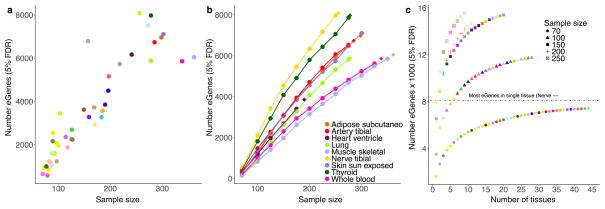
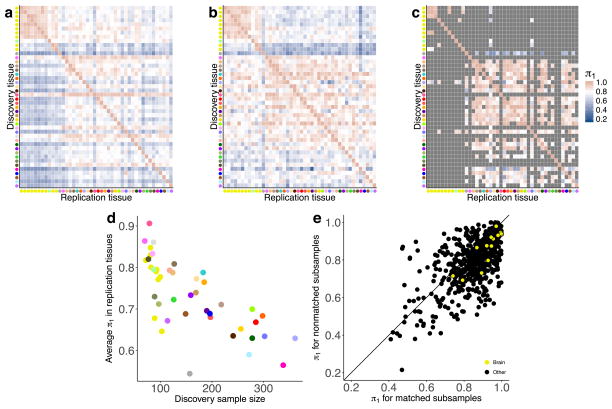
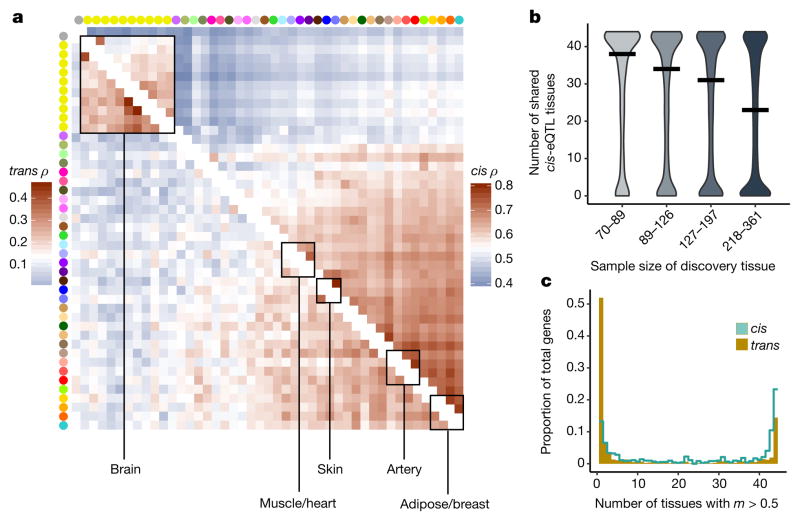
Characterization of the molecular function of the human genome and its variation across individuals is essential for identifying the cellular mechanisms that underlie human genetic traits and diseases. The Genotype-Tissue Expression (GTEx) project aims to characterize variation in gene expression levels across individuals and diverse tissues of the human body, many of which are not easily accessible. Here we describe genetic effects on gene expression levels across 44 human tissues. We find that local genetic variation affects gene expression levels for the majority of genes, and we further identify inter-chromosomal genetic effects for 93 genes and 112 loci. On the basis of the identified genetic effects, we characterize patterns of tissue specificity, compare local and distal effects, and evaluate the functional properties of the genetic effects. We also demonstrate that multi-tissue, multi-individual data can be used to identify genes and pathways affected by human disease-associated variation, enabling a mechanistic interpretation of gene regulation and the genetic basis of disease.
Overview
The claims and statistics of this paper haven’t been checked yet.
Free: it reads the open-access text and checks the first 5 claims that cite a source we can check. Create a free account to check every claim.
Integrity signals
Registry
Cites
Statistics
Figures


![Extended Data Figure 3 Properties of cis-eGenes and non-eGenes In these analyses, ‘non-eGenes’ refers to the set of genes with no significantly associated cis-eQTLs. a, Density of expression (mean across samples, median across tissues, in log10 scale) for cis-eGenes and non-eGenes. The difference in mean expression for cis-eGenes and non-eGenes is significant (Wald test; P <1 ×10⁻¹⁶). b, Box plots comparing the probability of being loss-of-function-intolerant (pLI) scores41 for cis-eGenes and non-eGenes, stratified by expression percentile across all genes (mean across samples, median across tissues, in log10 scale). On average, highly expressed non-eGenes have higher pLI scores than highly expressed cis-eGenes (t-test for the difference in mean pLI score between cis-eGenes and non-eGenes; BH adjusted P = 8.3 ×10⁻⁴ and 2.1 ×10⁻⁹ for (50,75]% and (75,100]%, respectively) and lowly expressed non-eGenes (t-test for the difference in mean pLI score between highly and lowly expressed non-eGenes; BH adjusted P ≤7.8 ×10−46, P ≤5.5 ×10⁻¹⁷ and P ≤2.1 ×10⁻³ for (75,100]% vs [0,25]%, (75,100 vs (25,50]% and (75,100]% vs (50,75]%, respectively). c, Gene Ontology (GO) analysis of tested protein-coding non-eGenes. We used the PANTHER overrepresentation test78 (release 20160715) against 20,972 human genes as background to test for enrichment in GO biological processes using the GO database release 2017-02-28. Significant GO IDs (Bonferroni adjusted P < 0.05) were selected for analysis with REVIGO79 to group similar ontological terms, which yielded 22 over-represented GO IDs. d, GO analysis of a more stringent set of protein-coding non-eGenes. Selected genes included those not tested in GTEx (532 genes) or those with a minimum nominal P value across tissues greater than 0.1 (692 genes). Of these stringent 1,224 non-eGenes, 808 were mapped in the GO analysis. Using a similar approach as in c, 20 over-represented GO IDs were identified. For both c and d, the x-axis represents the −log10 P value resulting from GO analysis. GO IDs are coloured by the broader enrichment category to which each corresponds. Box plots depict the IQR, whiskers depict 1.5× IQR.](https://figures.cochat.ai/paper-figures/ea51d71f9cd44f0ba04adaf266dc2572/genetic-effects-on-gene-expression-across-human-tissues-figure-3.jpg)






Verification
Claims the paper makes
The claims and statistics of this paper haven’t been checked yet.
Free: it reads the open-access text and checks the first 5 claims that cite a source we can check. Create a free account to check every claim.
Claims other papers make about this one
Each is checked against this paper’s own text: does it say what the citing paper says it does?
The source backs part of the claim, not all of it — or backs it for a different population, condition or comparison.
In the citing paper
“the ENCODE and Roadmap Epigenomics (Roadmap) projects have identified noncoding regions acting as enhancers and promoters (8–10).”
From Comprehensive functional genomic resource and integrative model for the human brain (2018) · cites this paper as [8]
Experimental — accuracy not yet measuredThe source backs part of the claim, not all of it — or backs it for a different population, condition or comparison.
In the citing paper
“The eQTL framework is very powerful, and for variants residing within distally located candidate enhancers, can provide in vivo validation of those enhancers while also linking them to their target genes136.”
From Towards a comprehensive catalogue of validated and target-linked human enhancers (2020) · cites this paper as [136]
Experimental — accuracy not yet measuredThe cited source says what the claim attributes to it.
In the citing paper
“Because only 9 of the 953 genes lack confirmed expression in any of the 34 neuro-related tissues tracked by IDG KMC (for example, GTEx40,41, HPA42 and HPM43), these data suggest that the remaining 80% of this set have the potential to be associated with human neurobehavioural phenotypes, paving the way for new research avenues in this direction (see Supplementary Table S8).”
From Unexplored therapeutic opportunities in the human genome (2018) · cites this paper as [41]
The cited source says what the claim attributes to it.
In the citing paper
“For example, the GTEx (Genotype-Tissue Expression) consortium has mapped thou sands of expression quantitative trait loci (QTLs) across hundreds of individuals and dozens of tissues112.”
From A brief history of human disease genetics (2020) · cites this paper as [112]
The cited source says what the claim attributes to it.
In the citing paper
“the Genotype-Tissue Expression (GTEx) project has associated many noncoding variants with expression quantitative-trait loci (eQTLs)”
From Comprehensive functional genomic resource and integrative model for the human brain (2018) · cites this paper as [8]
4 more claims about this paper
Create a free account to see every claim other papers make about this one.
Self-check
Percentages, sums and reported differences re-computed from the paper’s own numbers.
The self-check needs the paper’s full text.
Citations
Cites
Controlling the False Discovery Rate: A Practical and Powerful Approach to Multiple Testing
Benjamini, Y., & Hochberg, Y. (1995) · Journal of the Royal Statistical Society Series B: Statistical Methodology · doi:10.1111/j.2517-6161.1995.tb02031.x · Cited by 109,482
BEDTools: a flexible suite of utilities for comparing genomic features
Quinlan, A. R., & Hall, I. M. (2010) · Bioinformatics · doi:10.1093/bioinformatics/btq033 · Cited by 27,437
A global reference for human genetic variation
The 1000 Genomes Project Consortium, authors, C., Auton, A., Abecasis, G. R., Steering committee, Altshuler, D. M., Durbin, R. M., Abecasis, G. R., Bentley, D. R., Chakravarti, A., et al. (2015) · Nature · doi:10.1038/nature15393 · Cited by 18,247
The Molecular Signatures Database Hallmark Gene Set Collection
Liberzon, A., Birger, C., Thorvaldsdóttir, H., Ghandi, M., Mesirov, J. P., & Tamayo, P. (2015) · Cell Systems · doi:10.1016/j.cels.2015.12.004 · Cited by 13,807
Statistical significance for genomewide studies
Storey, J. D., & Tibshirani, R. (2003) · Proceedings of the National Academy of Sciences · doi:10.1073/pnas.1530509100 · Cited by 9,692
Analysis of protein-coding genetic variation in 60,706 humans
Exome Aggregation Consortium, Lek, M., Karczewski, K. J., Minikel, E. V., Samocha, K. E., Banks, E., Fennell, T., O’Donnell-Luria, A. H., Ware, J. S., Hill, A. J., et al. (2016) · Nature · doi:10.1038/nature19057 · Cited by 9,587
An integrated map of genetic variation from 1,092 human genomes
The 1000 Genomes Project Consortium (2012) · Nature · doi:10.1038/nature11632 · Cited by 7,711
Integrative analysis of 111 reference human epigenomes
Roadmap Epigenomics Consortium, Kundaje, A., Meuleman, W., Ernst, J., Bilenky, M., Yen, A., Heravi-Moussavi, A., Kheradpour, P., Zhang, Z., Wang, J., et al. (2015) · Nature · doi:10.1038/nature14248 · Cited by 6,368
REVIGO summarizes and visualizes long lists of gene ontology terms
Supek, F., Bošnjak, M., Škunca, N., & Šmuc, T. (2011) · PLoS ONE · doi:10.1371/journal.pone.0021800 · Cited by 6,264
The ENCODE Project Consortium (2007) · Nature · doi:10.1038/nature05874 · Cited by 5,223
Research works printed but not linked: 1
- Regev A The human cell atlas Preprint at http://www.biorxiv.org/content/early/2017/05/08/121202 2017
Cited by
Items 201–300 of 1,040
IBD risk loci are enriched in multigenic regulatory modules encompassing putative causative genes
Momozawa, Y., Dmitrieva, J., Théâtre, E., Deffontaine, V., Rahmouni, S., Charloteaux, B., Crins, F., Docampo, E., Elansary, M., Gori, A.-S., et al. (2018) · Nature Communications · doi:10.1038/s41467-018-04365-8 · Cited by 229
Cross-species regulatory sequence activity prediction
Kelley, D. R. (2020) · PLOS Computational Biology · doi:10.1371/journal.pcbi.1008050 · Cited by 228
Huan, T., Joehanes, R., Song, C., Peng, F., Guo, Y., Mendelson, M., Yao, C., Liu, C., Ma, J., Richard, M., et al. (2019) · Nature Communications · doi:10.1038/s41467-019-12228-z · Cited by 223
Synergistic effects of common schizophrenia risk variants
Schrode, N., Ho, S.-M., Yamamuro, K., Dobbyn, A., Huckins, L., Matos, M. R., Cheng, E., Deans, P. J. M., Flaherty, E., Barretto, N., et al. (2019) · Nature Genetics · doi:10.1038/s41588-019-0497-5 · Cited by 234
Somatic genomic changes in single Alzheimer’s disease neurons
Miller, M. B., Huang, A. Y., Kim, J., Zhou, Z., Kirkham, S. L., Maury, E. A., Ziegenfuss, J. S., Reed, H. C., Neil, J. E., Rento, L., et al. (2022) · Nature · doi:10.1038/s41586-022-04640-1 · Cited by 223
Oligogenic inheritance of a human heart disease involving a genetic modifier
Gifford, C. A., Ranade, S. S., Samarakoon, R., Salunga, H. T., de Soysa, T. Y., Huang, Y., Zhou, P., Elfenbein, A., Wyman, S. K., Bui, Y. K., et al. (2019) · Science · doi:10.1126/science.aat5056 · Cited by 213
Xie, J., Liu, L., Mladkova, N., Li, Y., Ren, H., Wang, W., Cui, Z., Lin, L., Hu, X., Yu, X., et al. (2020) · Nature Communications · doi:10.1038/s41467-020-15383-w · Cited by 215
Single-cell eQTL models reveal dynamic T cell state dependence of disease loci
Nathan, A., Asgari, S., Ishigaki, K., Valencia, C., Amariuta, T., Luo, Y., Beynor, J. I., Baglaenko, Y., Suliman, S., Price, A. L., et al. (2022) · Nature · doi:10.1038/s41586-022-04713-1 · Cited by 213
Dynamic genetic regulation of gene expression during cellular differentiation
Strober, B. J., Elorbany, R., Rhodes, K., Krishnan, N., Tayeb, K., Battle, A., & Gilad, Y. (2019) · Science · doi:10.1126/science.aaw0040 · Cited by 219
Self-citationClinical implementation of RNA sequencing for Mendelian disease diagnostics
Yépez, V. A., Gusic, M., Kopajtich, R., Mertes, C., Smith, N. H., Alston, C. L., Ban, R., Beblo, S., Berutti, R., Blessing, H., et al. (2022) · Genome Medicine · doi:10.1186/s13073-022-01019-9 · Cited by 209
Big data in digital healthcare: lessons learnt and recommendations for general practice
Agrawal, R., & Prabakaran, S. (2020) · Heredity · doi:10.1038/s41437-020-0303-2 · Cited by 218
The single-cell eQTLGen consortium
van der Wijst, M., de Vries, D., Groot, H., Trynka, G., Hon, C., Bonder, M., Stegle, O., Nawijn, M., Idaghdour, Y., van der Harst, P., et al. (2020) · eLife · doi:10.7554/elife.52155 · Cited by 218
Modified penetrance of coding variants by cis-regulatory variation contributes to disease risk
Castel, S. E., Cervera, A., Mohammadi, P., Aguet, F., Reverter, F., Wolman, A., Guigo, R., Iossifov, I., Vasileva, A., & Lappalainen, T. (2018) · Nature Genetics · doi:10.1038/s41588-018-0192-y · Cited by 217
Self-citationTraylor, M., Persyn, E., Tomppo, L., Klasson, S., Abedi, V., Bakker, M. K., Torres, N., Li, L., Bell, S., Rutten-Jacobs, L., et al. (2021) · The Lancet Neurology · doi:10.1016/s1474-4422(21)00031-4 · Cited by 213
Sajuthi, S. P., DeFord, P., Li, Y., Jackson, N. D., Montgomery, M. T., Everman, J. L., Rios, C. L., Pruesse, E., Nolin, J. D., Plender, E. G., et al. (2020) · Nature Communications · doi:10.1038/s41467-020-18781-2 · Cited by 186
The polygenic architecture of schizophrenia — rethinking pathogenesis and nosology
Smeland, O. B., Frei, O., Dale, A. M., & Andreassen, O. A. (2020) · Nature Reviews Neurology · doi:10.1038/s41582-020-0364-0 · Cited by 209
Zhao, W., Zhang, S., Zhu, Y., Xi, X., Bao, P., Ma, Z., Kapral, T. H., Chen, S., Zagrovic, B., Yang, Y. T., et al. (2022) · Nucleic Acids Research · doi:10.1093/nar/gkab702 · Cited by 200
“We added ∼78 million SNV from 1000 genomes (47), ∼679 million SNV from gnomAD (48), ∼40 million eQTLs, and ∼16 million sQTLs from GTEx (49,50) to annotate RBP binding sites with genomic variants, as well as ∼906k CCLE (51) variants, ∼406k denovo-db (52) variants and ∼7k HmtDB (53) variants as disease-associated mutati…”
BackgroundGenetic variants in mRNA untranslated regions
Steri, M., Idda, M. L., Whalen, M. B., & Orrù, V. (2018) · WIREs RNA · doi:10.1002/wrna.1474 · Cited by 202
“Other useful bioinformatic tools, although still in an early phase of verification, are represented by several algorithms developed to test for riboSNitch activity in transcripts and have had some success (Bindewald & Shapiro, 2006; Halvorsen et al., 2010; Smola et al., 2015).”
MethodInfluentialChromatin three-dimensional interactions mediate genetic effects on gene expression
Delaneau, O., Zazhytska, M., Borel, C., Giannuzzi, G., Rey, G., Howald, C., Kumar, S., Ongen, H., Popadin, K., Marbach, D., et al. (2019) · Science · doi:10.1126/science.aat8266 · Cited by 217
Discovery of target genes and pathways at GWAS loci by pooled single-cell CRISPR screens
Morris, J. A., Caragine, C., Daniloski, Z., Domingo, J., Barry, T., Lu, L., Davis, K., Ziosi, M., Glinos, D. A., Hao, S., et al. (2023) · Science · doi:10.1126/science.adh7699 · Cited by 208
The origins and genetic interactions of KRAS mutations are allele- and tissue-specific
Cook, J. H., Melloni, G. E. M., Gulhan, D. C., Park, P. J., & Haigis, K. M. (2021) · Nature Communications · doi:10.1038/s41467-021-22125-z · Cited by 208
Genome-wide association study of MRI markers of cerebral small vessel disease in 42,310 participants
Persyn, E., Hanscombe, K. B., Howson, J. M. M., Lewis, C. M., Traylor, M., & Markus, H. S. (2020) · Nature Communications · doi:10.1038/s41467-020-15932-3 · Cited by 213
McArthur, E., & Capra, J. A. (2021) · The American Journal of Human Genetics · doi:10.1016/j.ajhg.2021.01.001 · Cited by 202
“For example, how does genetic variation in different 3D contexts contribute to the risk of common complex disease? Furthermore, disease-causing regulatory variation is known to be tissue-specific; however, only recently has there been characterization of 3D-structure variation across multiple cell types and individual…”
BackgroundGenetic contributions to autism spectrum disorder
Havdahl, A., Niarchou, M., Starnawska, A., Uddin, M., van der Merwe, C., & Warrier, V. (2021) · Psychological Medicine · doi:10.1017/s0033291721000192 · Cited by 179
“Transcriptomics of post-mortem brain tissue Although blood-derived transcriptome can be feasible to study due to easy access to the biological specimen, blood transcriptome results are not necessarily representative of the transcriptional machinery in the brain (GTEx Consortium, 2017).”
BackgroundDepartment of Veterans Affairs Cooperative Studies Program (#575B) and Million Veteran Program, Gelernter, J., Sun, N., Polimanti, R., Pietrzak, R., Levey, D. F., Bryois, J., Lu, Q., Hu, Y., Li, B., et al. (2019) · Nature Neuroscience · doi:10.1038/s41593-019-0447-7 · Cited by 200
High-throughput identification of human SNPs affecting regulatory element activity
(2019) · doi:10.1038/s41588-019-0455-2 · Cited by 205
Systematic identification of human SNPs affecting regulatory element activity
(2018) · doi:10.1101/460402 · Cited by 205
Expanding the Boundaries of RNA Sequencing as a Diagnostic Tool for Rare Mendelian Disease
Gonorazky, H. D., Naumenko, S., Ramani, A. K., Nelakuditi, V., Mashouri, P., Wang, P., Kao, D., Ohri, K., Viththiyapaskaran, S., Tarnopolsky, M. A., et al. (2019) · The American Journal of Human Genetics · doi:10.1016/j.ajhg.2019.04.004 · Cited by 204
Zhang, Y., Lu, Q., Ye, Y., Huang, K., Liu, W., Wu, Y., Zhong, X., Li, B., Yu, Z., Travers, B. G., et al. (2021) · Genome Biology · doi:10.1186/s13059-021-02478-w · Cited by 201
Coleman, J. R. I., Gaspar, H. A., Bryois, J., Byrne, E. M., Forstner, A. J., Holmans, P. A., de Leeuw, C. A., Mattheisen, M., McQuillin, A., Whitehead Pavlides, J. M., et al. (2020) · Biological Psychiatry · doi:10.1016/j.biopsych.2019.10.015 · Cited by 199
Self-citationEstimating the causal tissues for complex traits and diseases
GTEx Consortium, Ongen, H., Brown, A. A., Delaneau, O., Panousis, N. I., Nica, A. C., & Dermitzakis, E. T. (2017) · Nature Genetics · doi:10.1038/ng.3981 · Cited by 198
Self-citationGenetic mapping of etiologic brain cell types for obesity
Timshel, P. N., Thompson, J. J., & Pers, T. H. (2020) · eLife · doi:10.7554/elife.55851 · Cited by 186
Patterns of de novo tandem repeat mutations and their role in autism
Mitra, I., Huang, B., Mousavi, N., Ma, N., Lamkin, M., Yanicky, R., Shleizer-Burko, S., Lohmueller, K. E., & Gymrek, M. (2021) · Nature · doi:10.1038/s41586-020-03078-7 · Cited by 194
Smith, S. M., Elliott, L. T., Alfaro-Almagro, F., McCarthy, P., Nichols, T. E., Douaud, G., & Miller, K. L. (2020) · eLife · doi:10.7554/elife.52677 · Cited by 190
Oliva, M., Demanelis, K., Lu, Y., Chernoff, M., Jasmine, F., Ahsan, H., Kibriya, M. G., Chen, L. S., & Pierce, B. L. (2023) · Nature Genetics · doi:10.1038/s41588-022-01248-z · Cited by 189
Estimating Sample-Specific Regulatory Networks
Kuijjer, M. L., Tung, M. G., Yuan, G., Quackenbush, J., & Glass, K. (2019) · iScience · doi:10.1016/j.isci.2019.03.021 · Cited by 182
Evaluating drug targets through human loss-of-function genetic variation
Minikel, E. V., Karczewski, K. J., Martin, H. C., Cummings, B. B., Whiffin, N., Rhodes, D., Alföldi, J., Trembath, R. C., van Heel, D. A., Daly, M. J., et al. (2020) · Nature · doi:10.1038/s41586-020-2267-z · Cited by 187
Genetics of trans-regulatory variation in gene expression
Albert, F. W., Bloom, J. S., Siegel, J., Day, L., & Kruglyak, L. (2018) · eLife · doi:10.7554/elife.35471 · Cited by 196
Fang, L., Cai, W., Liu, S., Canela-Xandri, O., Gao, Y., Jiang, J., Rawlik, K., Li, B., Schroeder, S. G., Rosen, B. D., et al. (2020) · Genome Research · doi:10.1101/gr.250704.119 · Cited by 185
Holmes, M. V., Richardson, T. G., Ference, B. A., Davies, N. M., & Davey Smith, G. (2021) · Nature Reviews Cardiology · doi:10.1038/s41569-020-00493-1 · Cited by 184
Link, V. M., Duttke, S. H., Chun, H. B., Holtman, I. R., Westin, E., Hoeksema, M. A., Abe, Y., Skola, D., Romanoski, C. E., Tao, J., et al. (2018) · Cell · doi:10.1016/j.cell.2018.04.018 · Cited by 182
Genome-wide analysis identifies molecular systems and 149 genetic loci associated with income
Hill, W. D., Davies, N. M., Ritchie, S. J., Skene, N. G., Bryois, J., Bell, S., Di Angelantonio, E., Roberts, D. J., Xueyi, S., Davies, G., et al. (2019) · Nature Communications · doi:10.1038/s41467-019-13585-5 · Cited by 185
Transcript expression-aware annotation improves rare variant interpretation
Cummings, B. B., Karczewski, K. J., Kosmicki, J. A., Seaby, E. G., Watts, N. A., Singer-Berk, M., Mudge, J. M., Karjalainen, J., Satterstrom, F. K., O’Donnell-Luria, A. H., et al. (2020) · Nature · doi:10.1038/s41586-020-2329-2 · Cited by 180
Xiang, R., Berg, I. V. D., MacLeod, I. M., Hayes, B. J., Prowse-Wilkins, C. P., Wang, M., Bolormaa, S., Liu, Z., Rochfort, S. J., Reich, C. M., et al. (2019) · Proceedings of the National Academy of Sciences · doi:10.1073/pnas.1904159116 · Cited by 170
“This has been demonstrated in many studies of human genomics, including but not limited to the analysis of intermediate trait quantitative trait loci (QTLs), such as metabolic QTLs (mQTLs) (7) and expression QTLs (eQTLs) (8) and analysis of regulatory elements, such as promoters”
BackgroundResultMulti-ancestry study of the genetics of problematic alcohol use in over 1 million individuals
Zhou, H., Kember, R. L., Deak, J. D., Xu, H., Toikumo, S., Yuan, K., Lind, P. A., Farajzadeh, L., Wang, L., Hatoum, A. S., et al. (2023) · Nature Medicine · doi:10.1038/s41591-023-02653-5 · Cited by 179
Aubourg, G., Rice, S. J., Bruce-Wootton, P., & Loughlin, J. (2022) · Osteoarthritis and Cartilage · doi:10.1016/j.joca.2021.03.002 · Cited by 159
Circulating inflammatory cytokines and risk of five cancers: a Mendelian randomization analysis
Bouras, E., Karhunen, V., Gill, D., Huang, J., Haycock, P. C., Gunter, M. J., Johansson, M., Brennan, P., Key, T., Lewis, S. J., et al. (2022) · BMC Medicine · doi:10.1186/s12916-021-02193-0 · Cited by 171
Enhancing GTEx by bridging the gaps between genotype, gene expression, and disease
eGTEx Project (2017) · Nature Genetics · doi:10.1038/ng.3969 · Cited by 178
Chauquet, S., Zhu, Z., O’Donovan, M. C., Walters, J. T. R., Wray, N. R., & Shah, S. (2021) · JAMA Psychiatry · doi:10.1001/jamapsychiatry.2021.0005 · Cited by 178
A second X chromosome contributes to resilience in a mouse model of Alzheimer’s disease
Davis, E. J., Broestl, L., Abdulai-Saiku, S., Worden, K., Bonham, L. W., Miñones-Moyano, E., Moreno, A. J., Wang, D., Chang, K., Williams, G., et al. (2020) · Science Translational Medicine · doi:10.1126/scitranslmed.aaz5677 · Cited by 176
Hormozdiari, F., Gazal, S., van de Geijn, B., Finucane, H. K., Ju, C. J.-T., Loh, P.-R., Schoech, A., Reshef, Y., Liu, X., O’Connor, L., et al. (2018) · Nature Genetics · doi:10.1038/s41588-018-0148-2 · Cited by 179
Griesemer, D., Xue, J. R., Reilly, S. K., Ulirsch, J. C., Kukreja, K., Davis, J. R., Kanai, M., Yang, D. K., Butts, J. C., Guney, M. H., et al. (2021) · Cell · doi:10.1016/j.cell.2021.08.025 · Cited by 176
An eQTL Landscape of Kidney Tissue in Human Nephrotic Syndrome
Gillies, C. E., Putler, R., Menon, R., Otto, E., Yasutake, K., Nair, V., Hoover, P., Lieb, D., Li, S., Eddy, S., et al. (2018) · The American Journal of Human Genetics · doi:10.1016/j.ajhg.2018.07.004 · Cited by 173
Lu, L., Liu, X., Huang, W.-K., Giusti-Rodríguez, P., Cui, J., Zhang, S., Xu, W., Wen, Z., Ma, S., Rosen, J. D., et al. (2020) · Molecular Cell · doi:10.1016/j.molcel.2020.06.007 · Cited by 179
Horgusluoglu, E., Neff, R., Song, W., Wang, M., Wang, Q., Arnold, M., Krumsiek, J., Galindo‐Prieto, B., Ming, C., Nho, K., et al. (2022) · Alzheimer's & Dementia · doi:10.1002/alz.12468 · Cited by 175
Mapping regulatory variants controlling gene expression in drought response and tolerance in maize
Liu, S., Li, C., Wang, H., Wang, S., Yang, S., Liu, X., Yan, J., Li, B., Beatty, M., Zastrow-Hayes, G., et al. (2020) · Genome Biology · doi:10.1186/s13059-020-02069-1 · Cited by 166
Co-expression networks reveal the tissue-specific regulation of transcription and splicing
Saha, A., Kim, Y., Gewirtz, A. D. H., Jo, B., Gao, C., McDowell, I. C., The GTEx Consortium, Engelhardt, B. E., & Battle, A. (2017) · Genome Research · doi:10.1101/gr.216721.116 · Cited by 169
Hawe, J. S., Wilson, R., Schmid, K. T., Zhou, L., Lakshmanan, L. N., Lehne, B. C., Kühnel, B., Scott, W. R., Wielscher, M., Yew, Y. W., et al. (2022) · Nature Genetics · doi:10.1038/s41588-021-00969-x · Cited by 161
“70,71 The specific datasets used for each experiment are documented.”
InfluentialFelsky, D., Roostaei, T., Nho, K., Risacher, S. L., Bradshaw, E. M., Petyuk, V., Schneider, J. A., Saykin, A., Bennett, D. A., & De Jager, P. L. (2019) · Nature Communications · doi:10.1038/s41467-018-08279-3 · Cited by 169
POSTAR: a platform for exploring post-transcriptional regulation coordinated by RNA-binding proteins
Hu, B., Yang, Y.-C. T., Huang, Y., Zhu, Y., & Lu, Z. J. (2017) · Nucleic Acids Research · doi:10.1093/nar/gkw888 · Cited by 174
Small, K. S., Todorčević, M., Civelek, M., El-Sayed Moustafa, J. S., Wang, X., Simon, M. M., Fernandez-Tajes, J., Mahajan, A., Horikoshi, M., Hugill, A., et al. (2018) · Nature Genetics · doi:10.1038/s41588-018-0088-x · Cited by 168
Song, M., Yang, X., Ren, X., Maliskova, L., Li, B., Jones, I. R., Wang, C., Jacob, F., Wu, K., Traglia, M., et al. (2019) · Nature Genetics · doi:10.1038/s41588-019-0472-1 · Cited by 177
Li, L., Huang, K.-L., Gao, Y., Cui, Y., Wang, G., Elrod, N. D., Li, Y., Chen, Y. E., Ji, P., Peng, F., et al. (2021) · Nature Genetics · doi:10.1038/s41588-021-00864-5 · Cited by 167
isoCirc catalogs full-length circular RNA isoforms in human transcriptomes
Xin, R., Gao, Y., Gao, Y., Wang, R., Kadash-Edmondson, K. E., Liu, B., Wang, Y., Lin, L., & Xing, Y. (2021) · Nature Communications · doi:10.1038/s41467-020-20459-8 · Cited by 161
Genome-wide Association Analysis in Humans Links Nucleotide Metabolism to Leukocyte Telomere Length
Li, C., Stoma, S., Lotta, L. A., Warner, S., Albrecht, E., Allione, A., Arp, P. P., Broer, L., Buxton, J. L., Da Silva Couto Alves, A., et al. (2020) · The American Journal of Human Genetics · doi:10.1016/j.ajhg.2020.02.006 · Cited by 162
Systematic analysis of binding of transcription factors to noncoding variants
Yan, J., Qiu, Y., Ribeiro dos Santos, A. M., Yin, Y., Li, Y. E., Vinckier, N., Nariai, N., Benaglio, P., Raman, A., Li, X., et al. (2021) · Nature · doi:10.1038/s41586-021-03211-0 · Cited by 158
Detection of aberrant gene expression events in RNA sequencing data
Yépez, V. A., Mertes, C., Müller, M. F., Klaproth-Andrade, D., Wachutka, L., Frésard, L., Gusic, M., Scheller, I. F., Goldberg, P. F., Prokisch, H., et al. (2021) · Nature Protocols · doi:10.1038/s41596-020-00462-5 · Cited by 165
Genetic architecture of gene expression traits across diverse populations
Mogil, L. S., Andaleon, A., Badalamenti, A., Dickinson, S. P., Guo, X., Rotter, J. I., Johnson, W. C., Im, H. K., Liu, Y., & Wheeler, H. E. (2018) · PLOS Genetics · doi:10.1371/journal.pgen.1007586 · Cited by 163
“As for eQTLs, we estimated the pairwise population prediction true positive rates with π1 statistics using the qvalue method [17, 29].”
MethodCurrent smoking and COVID-19 risk: results from a population symptom app in over 2.4 million people
Hopkinson, N. S., Rossi, N., Moustafa, J. S. E.-S., Laverty, A. A., Quint, J. K., Freidin, M. B., Visconti, A., Murray, B. A. K., Modat, M., Ourselin, S., et al. (2021) · Thorax · doi:10.1136/thoraxjnl-2020-216422 · Cited by 171
Tumor to normal single-cell mRNA comparisons reveal a pan-neuroblastoma cancer cell
Kildisiute, G., Kholosy, W. M., Young, M. D., Roberts, K., Elmentaite, R., van Hooff, S. R., Pacyna, C. N., Khabirova, E., Piapi, A., Thevanesan, C., et al. (2021) · Science Advances · doi:10.1126/sciadv.abd3311 · Cited by 163
“We then assessed their distribution across pan-body postnatal tissues [from Genotype-Tissue Expression (GTEx) data (21)] while validating their expression in neuroblastoma bulk transcriptomes.”
BackgroundMethodHandedness, language areas and neuropsychiatric diseases: insights from brain imaging and genetics
Wiberg, A., Ng, M., Al Omran, Y., Alfaro-Almagro, F., McCarthy, P., Marchini, J., Bennett, D. L., Smith, S., Douaud, G., & Furniss, D. (2019) · Brain · doi:10.1093/brain/awz257 · Cited by 156
Docherty, A. R., Mullins, N., Ashley-Koch, A. E., Qin, X., Coleman, J. R. I., Shabalin, A., Kang, J., Murnyak, B., Wendt, F., Adams, M., et al. (2023) · American Journal of Psychiatry · doi:10.1176/appi.ajp.21121266 · Cited by 160
Self-citationEpilepsy and developmental disorders: Next generation sequencing in the clinic
Symonds, J. D., & McTague, A. (2020) · European Journal of Paediatric Neurology · doi:10.1016/j.ejpn.2019.12.008 · Cited by 151
Prioritization of candidate causal genes for asthma in susceptibility loci derived from UK Biobank
Valette, K., Li, Z., Bon-Baret, V., Chignon, A., Bérubé, J.-C., Eslami, A., Lamothe, J., Gaudreault, N., Joubert, P., Obeidat, M., et al. (2021) · Communications Biology · doi:10.1038/s42003-021-02227-6 · Cited by 161
Patient Similarity Networks for Precision Medicine
Pai, S., & Bader, G. D. (2018) · Journal of Molecular Biology · doi:10.1016/j.jmb.2018.05.037 · Cited by 154
Taylor, D. L., Jackson, A. U., Narisu, N., Hemani, G., Erdos, M. R., Chines, P. S., Swift, A., Idol, J., Didion, J. P., Welch, R. P., et al. (2019) · Proceedings of the National Academy of Sciences · doi:10.1073/pnas.1814263116 · Cited by 166
Corbett, M. A., Kroes, T., Veneziano, L., Bennett, M. F., Florian, R., Schneider, A. L., Coppola, A., Licchetta, L., Franceschetti, S., Suppa, A., et al. (2019) · Nature Communications · doi:10.1038/s41467-019-12671-y · Cited by 157
GPNMB confers risk for Parkinson’s disease through interaction with α-synuclein
Diaz-Ortiz, M. E., Seo, Y., Posavi, M., Carceles Cordon, M., Clark, E., Jain, N., Charan, R., Gallagher, M. D., Unger, T. L., Amari, N., et al. (2022) · Science · doi:10.1126/science.abk0637 · Cited by 158
“GTEx Consortium, Genetic effects on gene expression across human tissues.”
BackgroundMethodInfluentialCouto Alves, A., De Silva, N. M. G., Karhunen, V., Sovio, U., Das, S., Taal, H. R., Warrington, N. M., Lewin, A. M., Kaakinen, M., Cousminer, D. L., et al. (2019) · Science Advances · doi:10.1126/sciadv.aaw3095 · Cited by 160
“These three variants were previously associated (P 5 × 10⁻⁸) with adult BMI and adult weight in the literature (table S4) and in the UK Biobank PheWAS (phenome-wide association study) (9) (table S5), as well as with several adiposity-related phenotypes in PhenoScanner (10) (see Methods).”
MethodInfluentialDietary Lactobacillus -Derived Exopolysaccharide Enhances Immune-Checkpoint Blockade Therapy
Kawanabe-Matsuda, H., Takeda, K., Nakamura, M., Makino, S., Karasaki, T., Kakimi, K., Nishimukai, M., Ohno, T., Omi, J., Kano, K., et al. (2022) · Cancer Discovery · doi:10.1158/2159-8290.cd-21-0929 · Cited by 150
“72) project, respectively.”
Chesi, A., Wagley, Y., Johnson, M. E., Manduchi, E., Su, C., Lu, S., Leonard, M. E., Hodge, K. M., Pippin, J. A., Hankenson, K. D., et al. (2019) · Nature Communications · doi:10.1038/s41467-019-09302-x · Cited by 158
Self-citationErlangsen, A., Appadurai, V., Wang, Y., Turecki, G., Mors, O., Werge, T., Mortensen, P. B., Starnawska, A., Børglum, A. D., Schork, A., et al. (2020) · Molecular Psychiatry · doi:10.1038/s41380-018-0218-y · Cited by 157
Sex differences in genetic architecture in the UK Biobank
Bernabeu, E., Canela-Xandri, O., Rawlik, K., Talenti, A., Prendergast, J., & Tenesa, A. (2021) · Nature Genetics · doi:10.1038/s41588-021-00912-0 · Cited by 157
Nam, Y., Kim, J., Jung, S., Woerner, J., Suh, E. H., Lee, D. A., Shivakumar, M., Lee, M. E., & Kim, D. (2024) · Annual Review of Biomedical Data Science · doi:10.1146/annurev-biodatasci-102523-103801 · Cited by 187
Sheng, X., Guan, Y., Ma, Z., Wu, J., Liu, H., Qiu, C., Vitale, S., Miao, Z., Seasock, M. J., Palmer, M., et al. (2021) · Nature Genetics · doi:10.1038/s41588-021-00909-9 · Cited by 157
Li, B., & Ritchie, M. D. (2021) · Frontiers in Genetics · doi:10.3389/fgene.2021.713230 · Cited by 183
Proteomic Architecture of Human Coronary and Aortic Atherosclerosis
Herrington, D. M., Mao, C., Parker, S. J., Fu, Z., Yu, G., Chen, L., Venkatraman, V., Fu, Y., Wang, Y., Howard, T. D., et al. (2018) · Circulation · doi:10.1161/circulationaha.118.034365 · Cited by 151
A high-resolution map of human RNA translation
Chothani, S. P., Adami, E., Widjaja, A. A., Langley, S. R., Viswanathan, S., Pua, C. J., Zhihao, N. T., Harmston, N., D’Agostino, G., Whiffin, N., et al. (2022) · Molecular Cell · doi:10.1016/j.molcel.2022.06.023 · Cited by 150
A first-generation pediatric cancer dependency map
Dharia, N. V., Kugener, G., Guenther, L. M., Malone, C. F., Durbin, A. D., Hong, A. L., Howard, T. P., Bandopadhayay, P., Wechsler, C. S., Fung, I., et al. (2021) · Nature Genetics · doi:10.1038/s41588-021-00819-w · Cited by 153
Genetic variants of calcium and vitamin D metabolism in kidney stone disease
Howles, S., Wiberg, A., Goldsworthy, M. E., Bayliss, A. L., Gluck, A., Ng, M., Grout, E., Tanikawa, C., Kamatani, Y., Terao, C., et al. (2019) · Nature Communications · doi:10.1038/s41467-019-13145-x · Cited by 173
Vallerga, C. L., Zhang, F., Fowdar, J., McRae, A. F., Qi, T., Nabais, M. F., Zhang, Q., Kassam, I., Henders, A. K., Wallace, L., et al. (2020) · Nature Communications · doi:10.1038/s41467-020-15065-7 · Cited by 150
Genetic variant effects on gene expression in human pancreatic islets and their implications for T2D
Viñuela, A., Varshney, A., van de Bunt, M., Prasad, R. B., Asplund, O., Bennett, A., Boehnke, M., Brown, A. A., Erdos, M. R., Fadista, J., et al. (2020) · Nature Communications · doi:10.1038/s41467-020-18581-8 · Cited by 152
Self-citationAn encyclopedia of human enhancer–gene regulatory interactions
Gschwind, A. R., Mualim, K. S., Karbalayghareh, A., Sheth, M. U., Dey, K. K., Jagoda, E., Nurtdinov, R., Xi, W., Tan, A. S., Galante, J., et al. (2026) · Nature · doi:10.1038/s41586-026-10781-4 · Cited by 180
Shortage of Cellular ATP as a Cause of Diseases and Strategies to Enhance ATP
Johnson, T. A., Jinnah, H. A., & Kamatani, N. (2019) · Frontiers in Pharmacology · doi:10.3389/fphar.2019.00098 · Cited by 158
Mechanisms of tissue and cell-type specificity in heritable traits and diseases
Hekselman, I., & Yeger‐Lotem, E. (2020) · Nature Reviews Genetics · doi:10.1038/s41576-019-0200-9 · Cited by 161
Love, M. I., Soneson, C., & Patro, R. (2018) · F1000Research · doi:10.12688/f1000research.15398.3 · Cited by 161
Genetic drivers of m6A methylation in human brain, lung, heart and muscle
Xiong, X., Hou, L., Park, Y., Molinié, B., Ardlie, K., Aguet, F., Gregory, R. I., & Kellis, M. (2021) · Nature Genetics · doi:10.1038/s41588-021-00890-3 · Cited by 174
The missing link between genetic association and regulatory function
Connally, N. J., Nazeen, S., Lee, D., Shi, H., Stamatoyannopoulos, J., Chun, S., Cotsapas, C., Cassa, C. A., & Sunyaev, S. R. (2022) · eLife · doi:10.7554/elife.74970 · Cited by 158
Inferring Interaction Networks From Multi-Omics Data
Hawe, J. S., Theis, F. J., & Heinig, M. (2019) · Frontiers in Genetics · doi:10.3389/fgene.2019.00535 · Cited by 169
Enhancer release and retargeting activates disease-susceptibility genes
Oh, S., Shao, J., Mitra, J., Xiong, F., D’Antonio, M., Wang, R., Garcia-Bassets, I., Ma, Q., Zhu, X., Lee, J.-H., et al. (2021) · Nature · doi:10.1038/s41586-021-03577-1 · Cited by 148
Metadata
- Authors
- GTEx Consortium
- Venue
- Nature
- Published
- 2017-10-12
- Volume
- 550
- Issue
- 7675
- Pages
- 204-213
- ISSN
- 0028-0836 (ISSN-L)
- 1476-4687
- PMC
- PMC5776756
- OpenAlex
- W2761275051
- Cited by
- 4,036
- References
- 83
- Citations by year
- 2026: 248 · 2025: 355 · 2024: 412 · 2023: 401 · 2022: 507 · 2021: 634 · 2020: 600 · 2019: 516 · 2018: 320 · 2017: 35
- FWCI
- 266.52
- Type
- journal article
- Language
- en
- Update notices
- erratum (2017-12-20)
- Open access
- hybrid
- doi.org
- Licence
- cc-by
- creativecommons.org/licenses/by/4.0 (tdm)
- creativecommons.org/licenses/by/4.0 (vor)
- Locations
- Nature (publishedVersion, cc-by)
- PubMed (publishedVersion)
- RECERCAT (Consorci de Serveis Universitaris de Catalunya) (publishedVersion, other-oa)
- Archive ouverte UNIGE (University of Geneva) (publishedVersion, other-oa)
- UPCommons institutional repository (Universitat Politècnica de Catalunya) (publishedVersion, other-oa)
- Europe PMC (PubMed Central) (acceptedVersion, cc-by)
- PubMed Central (acceptedVersion, cc-by)
- SERVAL (Université de Lausanne) (acceptedVersion, cc-by)
- Discovery Research Portal (University of Dundee) (submittedVersion, cc-by)
- LA Referencia (Red Federada de Repositorios Institucionales de Publicaciones Científicas) (submittedVersion, public-domain)
- IRIS (submittedVersion, cc-by)
- Data Archiving and Networked Services (DANS) (submittedVersion)
- DSpace@MIT (Massachusetts Institute of Technology) (submittedVersion, cc-by-nc)
- eScholarship (California Digital Library) (submittedVersion)
- eScholarship (California Digital Library) (submittedVersion, cc-by)
- Minerva Access (University of Melbourne) (submittedVersion, cc-by)
- Repositori digital de la UPF (Universitat Pompeu Fabra) (submittedVersion, cc-by)
- Seoul National University Open Repository (Seoul National University) (submittedVersion)
- Archive ouverte UNIGE (University of Geneva) (submittedVersion, cc-by)
- TUScholarShare (Temple University) (cc-by)
- Funders
- National Science Foundation ((DGE-114747, DGE-165651 8, 114747, HHSN261200800001E, 1656518)
- University of Miami (DA006227)
- Wellcome Trust
- Broad Institute (HHSN268201000029C)
- Searle Scholars Program
- Leidos (HHSN261200800001E)
- National Institute for Health and Care Research (NF-SI-0611-10099)
- National Institutes of Health (10XS170, HHSN2682010000029C, #HHSN261200800001E, HHSN268201000029C, 10XS171, DGE-114747, HHSN261200800001C, DGE-1656518, 10ST1035)
- Center for Computational, Evolutionary and Human Genomics, Stanford University
- National Institute on Aging (P30AG010124)
- National Heart, Lung, and Blood Institute (HHSN268201000029C, HHSN268201000002C, HHSN261200800001E, HHSN268201000009C)
- National Institute of Mental Health (R01MH101814, R01MH101822, R01MH090937, R01MH106842, R01MH101810, HHSN261200800001E, R01MH101782, R01MH101819, R01MH101820, R01MH109905)
- National Institute on Drug Abuse (DA006227, R01DA006227)
- National Human Genome Research Institute (U01HG007900, UM1HG008901, R00HG006265, R01HG009125, U41HG002371, HHSN261200800001E, U01HG007591, K22HG000044, U01HG007436, R01HG008150, R21HG007840, U01HG009080, U54HG007990, T32HG003284, T32HG000044)
- NIH Office of the Director (HHSN261200800001E, R01MH101814)
- National Cancer Institute (HHSN261200800001E), HHSN268201000029C)
- National Institute of General Medical Sciences (T32GM007057, R01GM104371)
- National Institute of Diabetes and Digestive and Kidney Diseases (U54DK105566)
- National Institute of Neurological Disorders and Stroke
- U.S. National Library of Medicine (T15LM007033)
- Common Fund
- Topics
- Life Sciences › Biochemistry, Genetics and Molecular Biology › Genetics › Genetic Associations and Epidemiology
- Life Sciences › Biochemistry, Genetics and Molecular Biology › Molecular Biology › Genomics and Chromatin Dynamics
- Life Sciences › Biochemistry, Genetics and Molecular Biology › Molecular Biology › RNA Research and Splicing
- Keywords
- tissue-specific gene expression, gene expression regulation, GTEx, human genetic variation
- MeSH terms
- Alleles, Chromosomes, Human, Disease, Female, Gene Expression Regulation, Genotype, Humans, Male, Organ Specificity, Genetic Variation, Genome, Human, Gene Expression Profiling, Quantitative Trait Loci
About these checks
Registry, retraction, Cites and statistics results are computed, not judged, with one exception: a printed reference that no index lists is read once by a model before it counts as a citation error. Claims are extracted by a model and kept only when their quote appears verbatim in the text; each cited source is then checked, with a model’s help, for whether it says what the claim relies on. Those verdicts can be wrong — read the claim’s quote and the cited source before relying on one.
Statistics and arithmetic are recomputed, not judged.
Confidence bands are shown only for fields calibrated on our annotated test set. None is calibrated yet, so no band is shown.
What counts as a claim ›How we measure confidence ›How we check this ›
Are you an author, or do you see a problem with this page? Request a review
Data sources
Bibliographic data: Semantic Scholar, OpenAlex, Crossref.
Contains information from the Semantic Scholar Academic Graph Datasets, made available under the ODC Attribution License (ODC-BY 1.0).
Semantic Scholar’s data is described in: Kinney, R., et al. (2023). The Semantic Scholar Open Data Platform. arXiv:2301.10140.
