

Genetic effects on gene expression across human tissues
Open accessThe DOI matches its Crossref record; 83 of the 83 references it cites were found in a registry or an index.
Abstract
Characterization of the molecular function of the human genome and its variation across individuals is essential for identifying the cellular mechanisms that underlie human genetic traits and diseases. The Genotype-Tissue Expression (GTEx) project aims to characterize variation in gene expression levels across individuals and diverse tissues of the human body, many of which are not easily accessible. Here we describe genetic effects on gene expression levels across 44 human tissues. We find that local genetic variation affects gene expression levels for the majority of genes, and we further identify inter-chromosomal genetic effects for 93 genes and 112 loci. On the basis of the identified genetic effects, we characterize patterns of tissue specificity, compare local and distal effects, and evaluate the functional properties of the genetic effects. We also demonstrate that multi-tissue, multi-individual data can be used to identify genes and pathways affected by human disease-associated variation, enabling a mechanistic interpretation of gene regulation and the genetic basis of disease.
Overview
The claims and statistics of this paper haven’t been checked yet.
Free: it reads the open-access text and checks the first 5 claims that cite a source we can check. Create a free account to check every claim.
Integrity signals
Registry
Cites
Statistics
Figures


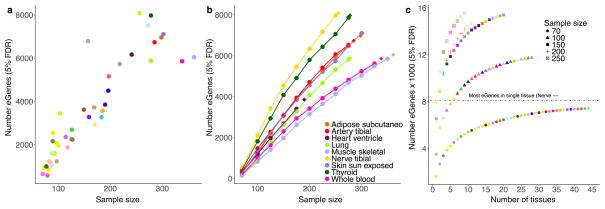
![Extended Data Figure 3 Properties of cis-eGenes and non-eGenes In these analyses, ‘non-eGenes’ refers to the set of genes with no significantly associated cis-eQTLs. a, Density of expression (mean across samples, median across tissues, in log10 scale) for cis-eGenes and non-eGenes. The difference in mean expression for cis-eGenes and non-eGenes is significant (Wald test; P <1 ×10⁻¹⁶). b, Box plots comparing the probability of being loss-of-function-intolerant (pLI) scores41 for cis-eGenes and non-eGenes, stratified by expression percentile across all genes (mean across samples, median across tissues, in log10 scale). On average, highly expressed non-eGenes have higher pLI scores than highly expressed cis-eGenes (t-test for the difference in mean pLI score between cis-eGenes and non-eGenes; BH adjusted P = 8.3 ×10⁻⁴ and 2.1 ×10⁻⁹ for (50,75]% and (75,100]%, respectively) and lowly expressed non-eGenes (t-test for the difference in mean pLI score between highly and lowly expressed non-eGenes; BH adjusted P ≤7.8 ×10−46, P ≤5.5 ×10⁻¹⁷ and P ≤2.1 ×10⁻³ for (75,100]% vs [0,25]%, (75,100 vs (25,50]% and (75,100]% vs (50,75]%, respectively). c, Gene Ontology (GO) analysis of tested protein-coding non-eGenes. We used the PANTHER overrepresentation test78 (release 20160715) against 20,972 human genes as background to test for enrichment in GO biological processes using the GO database release 2017-02-28. Significant GO IDs (Bonferroni adjusted P < 0.05) were selected for analysis with REVIGO79 to group similar ontological terms, which yielded 22 over-represented GO IDs. d, GO analysis of a more stringent set of protein-coding non-eGenes. Selected genes included those not tested in GTEx (532 genes) or those with a minimum nominal P value across tissues greater than 0.1 (692 genes). Of these stringent 1,224 non-eGenes, 808 were mapped in the GO analysis. Using a similar approach as in c, 20 over-represented GO IDs were identified. For both c and d, the x-axis represents the −log10 P value resulting from GO analysis. GO IDs are coloured by the broader enrichment category to which each corresponds. Box plots depict the IQR, whiskers depict 1.5× IQR.](https://figures.cochat.ai/paper-figures/ea51d71f9cd44f0ba04adaf266dc2572/genetic-effects-on-gene-expression-across-human-tissues-figure-3.jpg)






Verification
Claims the paper makes
The claims and statistics of this paper haven’t been checked yet.
Free: it reads the open-access text and checks the first 5 claims that cite a source we can check. Create a free account to check every claim.
Claims other papers make about this one
Each is checked against this paper’s own text: does it say what the citing paper says it does?
The source backs part of the claim, not all of it — or backs it for a different population, condition or comparison.
In the citing paper
“the ENCODE and Roadmap Epigenomics (Roadmap) projects have identified noncoding regions acting as enhancers and promoters (8–10).”
From Comprehensive functional genomic resource and integrative model for the human brain (2018) · cites this paper as [8]
Experimental — accuracy not yet measuredThe source backs part of the claim, not all of it — or backs it for a different population, condition or comparison.
In the citing paper
“The eQTL framework is very powerful, and for variants residing within distally located candidate enhancers, can provide in vivo validation of those enhancers while also linking them to their target genes136.”
From Towards a comprehensive catalogue of validated and target-linked human enhancers (2020) · cites this paper as [136]
Experimental — accuracy not yet measuredThe cited source says what the claim attributes to it.
In the citing paper
“Because only 9 of the 953 genes lack confirmed expression in any of the 34 neuro-related tissues tracked by IDG KMC (for example, GTEx40,41, HPA42 and HPM43), these data suggest that the remaining 80% of this set have the potential to be associated with human neurobehavioural phenotypes, paving the way for new research avenues in this direction (see Supplementary Table S8).”
From Unexplored therapeutic opportunities in the human genome (2018) · cites this paper as [41]
The cited source says what the claim attributes to it.
In the citing paper
“For example, the GTEx (Genotype-Tissue Expression) consortium has mapped thou sands of expression quantitative trait loci (QTLs) across hundreds of individuals and dozens of tissues112.”
From A brief history of human disease genetics (2020) · cites this paper as [112]
The cited source says what the claim attributes to it.
In the citing paper
“the Genotype-Tissue Expression (GTEx) project has associated many noncoding variants with expression quantitative-trait loci (eQTLs)”
From Comprehensive functional genomic resource and integrative model for the human brain (2018) · cites this paper as [8]
4 more claims about this paper
Create a free account to see every claim other papers make about this one.
Self-check
Percentages, sums and reported differences re-computed from the paper’s own numbers.
The self-check needs the paper’s full text.
Citations
Cites
Controlling the False Discovery Rate: A Practical and Powerful Approach to Multiple Testing
Benjamini, Y., & Hochberg, Y. (1995) · Journal of the Royal Statistical Society Series B: Statistical Methodology · doi:10.1111/j.2517-6161.1995.tb02031.x · Cited by 109,482
BEDTools: a flexible suite of utilities for comparing genomic features
Quinlan, A. R., & Hall, I. M. (2010) · Bioinformatics · doi:10.1093/bioinformatics/btq033 · Cited by 27,437
A global reference for human genetic variation
The 1000 Genomes Project Consortium, authors, C., Auton, A., Abecasis, G. R., Steering committee, Altshuler, D. M., Durbin, R. M., Abecasis, G. R., Bentley, D. R., Chakravarti, A., et al. (2015) · Nature · doi:10.1038/nature15393 · Cited by 18,247
The Molecular Signatures Database Hallmark Gene Set Collection
Liberzon, A., Birger, C., Thorvaldsdóttir, H., Ghandi, M., Mesirov, J. P., & Tamayo, P. (2015) · Cell Systems · doi:10.1016/j.cels.2015.12.004 · Cited by 13,807
Statistical significance for genomewide studies
Storey, J. D., & Tibshirani, R. (2003) · Proceedings of the National Academy of Sciences · doi:10.1073/pnas.1530509100 · Cited by 9,692
Analysis of protein-coding genetic variation in 60,706 humans
Exome Aggregation Consortium, Lek, M., Karczewski, K. J., Minikel, E. V., Samocha, K. E., Banks, E., Fennell, T., O’Donnell-Luria, A. H., Ware, J. S., Hill, A. J., et al. (2016) · Nature · doi:10.1038/nature19057 · Cited by 9,587
An integrated map of genetic variation from 1,092 human genomes
The 1000 Genomes Project Consortium (2012) · Nature · doi:10.1038/nature11632 · Cited by 7,711
Integrative analysis of 111 reference human epigenomes
Roadmap Epigenomics Consortium, Kundaje, A., Meuleman, W., Ernst, J., Bilenky, M., Yen, A., Heravi-Moussavi, A., Kheradpour, P., Zhang, Z., Wang, J., et al. (2015) · Nature · doi:10.1038/nature14248 · Cited by 6,368
REVIGO summarizes and visualizes long lists of gene ontology terms
Supek, F., Bošnjak, M., Škunca, N., & Šmuc, T. (2011) · PLoS ONE · doi:10.1371/journal.pone.0021800 · Cited by 6,264
The ENCODE Project Consortium (2007) · Nature · doi:10.1038/nature05874 · Cited by 5,223
Research works printed but not linked: 1
- Regev A The human cell atlas Preprint at http://www.biorxiv.org/content/early/2017/05/08/121202 2017
Cited by
Items 101–200 of 1,040
The GTEx Consortium atlas of genetic regulatory effects across human tissues
Aguet, F., Barbeira, A. N., Bonazzola, R., Brown, A., Castel, S. E., Jo, B., Kasela, S., Kim-Hellmuth, S., Liang, Y., Oliva, M., et al. (2019) · bioRxiv (Cold Spring Harbor Laboratory) · doi:10.1101/787903 · Cited by 366
Harnessing genomic information for livestock improvement
Georges, M., Charlier, C., & Hayes, B. (2019) · Nature Reviews Genetics · doi:10.1038/s41576-018-0082-2 · Cited by 384
Bryois, J., Skene, N. G., Hansen, T. F., Kogelman, L. J. A., Watson, H. J., Liu, Z., Eating Disorders Working Group of the Psychiatric Genomics Consortium, Adan, R., Alfredsson, L., Ando, T., et al. (2020) · Nature Genetics · doi:10.1038/s41588-020-0610-9 · Cited by 366
Polygenic basis and biomedical consequences of telomere length variation
Codd, V., Wang, Q., Allara, E., Musicha, C., Kaptoge, S., Stoma, S., Jiang, T., Hamby, S. E., Braund, P. S., Bountziouka, V., et al. (2021) · Nature Genetics · doi:10.1038/s41588-021-00944-6 · Cited by 379
Unexplored therapeutic opportunities in the human genome
Oprea, T. I., Bologa, C. G., Brunak, S., Campbell, A., Gan, G. N., Gaulton, A., Gomez, S. M., Guha, R., Hersey, A., Holmes, J., et al. (2018) · Nature Reviews Drug Discovery · doi:10.1038/nrd.2018.14 · Cited by 378
Epigenetic regulation in cardiovascular disease: mechanisms and advances in clinical trials
Shi, Y., Zhang, H., Huang, S., Yin, L., Wang, F., Luo, P., & Huang, H. (2022) · Signal Transduction and Targeted Therapy · doi:10.1038/s41392-022-01055-2 · Cited by 362
“The DNA methylation level of CG22304262 may affect SLC1A5 expression.(65) Myocardial glutamine storage disorder and SLC1A5 expression were decreased in patients with heart failure.”
BackgroundA comparative genomics multitool for scientific discovery and conservation
Zoonomia Consortium, Genereux, D. P., Serres, A., Armstrong, J., Johnson, J., Marinescu, V. D., Murén, E., Juan, D., Bejerano, G., Casewell, N. R., et al. (2020) · Nature · doi:10.1038/s41586-020-2876-6 · Cited by 373
Zhang, J., Dutta, D., Köttgen, A., Tin, A., Schlosser, P., Grams, M. E., Harvey, B., CKDGen Consortium, Yu, B., Boerwinkle, E., et al. (2022) · Nature Genetics · doi:10.1038/s41588-022-01051-w · Cited by 373
Polyploidy, the Nucleotype, and Novelty: The Impact of Genome Doubling on the Biology of the Cell
Doyle, J. J., & Coate, J. E. (2019) · International Journal of Plant Sciences · doi:10.1086/700636 · Cited by 365
“However, it is becoming clear that allele-specific expression is prevalent in eukaryotes (Battle et al. 2017), and expression of loci heterozygous in a diploid could presumably be affected by genome doubling (Finigan et al. 2012).”
BackgroundA cross-disorder dosage sensitivity map of the human genome
Collins, R. L., Glessner, J. T., Porcu, E., Lepamets, M., Brandon, R., Lauricella, C., Han, L., Morley, T., Niestroj, L.-M., Ulirsch, J., et al. (2022) · Cell · doi:10.1016/j.cell.2022.06.036 · Cited by 368
Immune complement and coagulation dysfunction in adverse outcomes of SARS-CoV-2 infection
Ramlall, V., Thangaraj, P. M., Meydan, C., Foox, J., Butler, D., Kim, J., May, B., De Freitas, J. K., Glicksberg, B. S., Mason, C. E., et al. (2020) · Nature Medicine · doi:10.1038/s41591-020-1021-2 · Cited by 351
Abundant associations with gene expression complicate GWAS follow-up
Liu, B., Gloudemans, M. J., Rao, A. S., Ingelsson, E., & Montgomery, S. B. (2019) · Nature Genetics · doi:10.1038/s41588-019-0404-0 · Cited by 368
Koyama, S., Ito, K., Terao, C., Akiyama, M., Horikoshi, M., Momozawa, Y., Matsunaga, H., Ieki, H., Ozaki, K., Onouchi, Y., et al. (2020) · Nature Genetics · doi:10.1038/s41588-020-0705-3 · Cited by 367
Zhou, H., Sealock, J. M., Sanchez-Roige, S., Clarke, T.-K., Levey, D. F., Cheng, Z., Li, B., Polimanti, R., Kember, R. L., Smith, R. V., et al. (2020) · Nature Neuroscience · doi:10.1038/s41593-020-0643-5 · Cited by 359
“Although the sample size for tissues used for eQTL analysis limits our ability to detect associations, there are substantial common eQTLs across tissues [16].”
BackgroundMethodInfluentialSegmental duplications and their variation in a complete human genome
Vollger, M. R., Guitart, X., Dishuck, P. C., Mercuri, L., Harvey, W. T., Gershman, A., Diekhans, M., Sulovari, A., Munson, K. M., Lewis, A. P., et al. (2022) · Science · doi:10.1126/science.abj6965 · Cited by 350
Context-specific regulation and function of mRNA alternative polyadenylation
Mitschka, S., & Mayr, C. (2022) · Nature Reviews Molecular Cell Biology · doi:10.1038/s41580-022-00507-5 · Cited by 336
Pividori, M., Schoettler, N., Nicolae, D. L., Ober, C., & Im, H. K. (2019) · The Lancet Respiratory Medicine · doi:10.1016/s2213-2600(19)30055-4 · Cited by 345
Ishigaki, K., Sakaue, S., Terao, C., Luo, Y., Sonehara, K., Yamaguchi, K., Amariuta, T., Too, C. L., Laufer, V. A., Scott, I. C., et al. (2022) · Nature Genetics · doi:10.1038/s41588-022-01213-w · Cited by 341
Li, Y., Ren, P., Dawson, A., Vasquez, H. G., Ageedi, W., Zhang, C., Luo, W., Chen, R., Li, Y., Kim, S., et al. (2020) · Circulation · doi:10.1161/circulationaha.120.046528 · Cited by 344
HIPSCI Consortium, Alasoo, K., Rodrigues, J., Mukhopadhyay, S., Knights, A. J., Mann, A. L., Kundu, K., Hale, C., Dougan, G., & Gaffney, D. J. (2018) · Nature Genetics · doi:10.1038/s41588-018-0046-7 · Cited by 338
Systematic differences in discovery of genetic effects on gene expression and complex traits
Mostafavi, H., Spence, J. P., Naqvi, S., & Pritchard, J. K. (2023) · Nature Genetics · doi:10.1038/s41588-023-01529-1 · Cited by 336
“We computed two enhancer features per gene using the enhancer–gene links inferred by Liu et al. based on the Roadmap Epigenomics Consortium dataset 50 : (1) the number of biosamples in which the gene is linked to at least one enhancer element, and (2) the total length of linked enhancers per biosample (Fig.”
InfluentialWeeks, E. M., Ulirsch, J. C., Cheng, N. Y., Trippe, B. L., Fine, R. S., Miao, J., Patwardhan, T. A., Kanai, M., Nasser, J., Fulco, C. P., et al. (2023) · Nature Genetics · doi:10.1038/s41588-023-01443-6 · Cited by 349
Unannotated proteins expand the MHC-I-restricted immunopeptidome in cancer
Ouspenskaia, T., Law, T., Clauser, K. R., Klaeger, S., Sarkizova, S., Aguet, F., Li, B., Christian, E., Knisbacher, B. A., Le, P. M., et al. (2022) · Nature Biotechnology · doi:10.1038/s41587-021-01021-3 · Cited by 298
Als, T. D., Kurki, M. I., Grove, J., Voloudakis, G., Therrien, K., Tasanko, E., Nielsen, T. T., Naamanka, J., Veerapen, K., Levey, D. F., et al. (2023) · Nature Medicine · doi:10.1038/s41591-023-02352-1 · Cited by 324
Cuomo, A. S. E., Seaton, D. D., McCarthy, D. J., Martinez, I., Bonder, M. J., Garcia-Bernardo, J., Amatya, S., Madrigal, P., Isaacson, A., Buettner, F., et al. (2020) · Nature Communications · doi:10.1038/s41467-020-14457-z · Cited by 331
Genome-wide association study of susceptibility to idiopathic pulmonary fibrosis
Allen, R. J., Guillen-Guio, B., Oldham, J. M., Ma, S.-F., Dressen, A., Paynton, M. L., Kraven, L. M., Obeidat, M., Li, X., Ng, M., et al. (2020) · American Journal of Respiratory and Critical Care Medicine · doi:10.1164/rccm.201905-1017oc · Cited by 329
Dynamic landscape of immune cell-specific gene regulation in immune-mediated diseases
Ota, M., Nagafuchi, Y., Hatano, H., Ishigaki, K., Terao, C., Takeshima, Y., Yanaoka, H., Kobayashi, S., Okubo, M., Shirai, H., et al. (2021) · Cell · doi:10.1016/j.cell.2021.03.056 · Cited by 331
Adams, M. J., Streit, F., Meng, X., Awasthi, S., Adey, B. N., Choi, K. W., Chundru, V. K., Coleman, J. R. I., Ferwerda, B., Foo, J. C., et al. (2025) · Cell · doi:10.1016/j.cell.2024.12.002 · Cited by 279
“The confidence intervals for the r 2 l were calculated using bootstrapping with 100 iterations.”
Porcu, E., Rüeger, S., Lepik, K., eQTLGen Consortium, Agbessi, M., Ahsan, H., Alves, I., Andiappan, A., Arindrarto, W., Awadalla, P., et al. (2019) · Nature Communications · doi:10.1038/s41467-019-10936-0 · Cited by 322
“We then applied our method to the largest publicly available GWAS summary statistics (based on sample sizes ranging from 20,883 to 339,224 individuals) and combined them with eQTL data from GTEx (Genotype Tissue Expression Project)[29] and the eQTLGen Consortium (n=31,684) [30] to provide an atlas of putatively functi…”
MethodInfluentialSelf-citationIdentification of rare-disease genes using blood transcriptome sequencing and large control cohorts
Undiagnosed Diseases Network, Frésard, L., Care4Rare Canada Consortium, Smail, C., Ferraro, N. M., Teran, N. A., Li, X., Smith, K. S., Bonner, D., Kernohan, K. D., et al. (2019) · Nature Medicine · doi:10.1038/s41591-019-0457-8 · Cited by 321
Self-citationA multi-tissue atlas of regulatory variants in cattle
Liu, S., Gao, Y., Canela-Xandri, O., Wang, S., Yu, Y., Cai, W., Li, B., Xiang, R., Chamberlain, A. J., Pairo-Castineira, E., et al. (2022) · Nature Genetics · doi:10.1038/s41588-022-01153-5 · Cited by 311
Dream: powerful differential expression analysis for repeated measures designs
Hoffman, G. E., & Roussos, P. (2021) · Bioinformatics · doi:10.1093/bioinformatics/btaa687 · Cited by 319
Genomic Analysis in the Age of Human Genome Sequencing
Lappalainen, T., Scott, A. J., Brandt, M., & Hall, I. M. (2019) · Cell · doi:10.1016/j.cell.2019.02.032 · Cited by 301
The genetic basis of endometriosis and comorbidity with other pain and inflammatory conditions
Rahmioglu, N., Mortlock, S., Ghiasi, M., Møller, P. L., Stefansdottir, L., Galarneau, G., Turman, C., Danning, R., Law, M. H., Sapkota, Y., et al. (2023) · Nature Genetics · doi:10.1038/s41588-023-01323-z · Cited by 305
Sieberts, S. K., Perumal, T. M., Carrasquillo, M. M., Allen, M., Reddy, J. S., Hoffman, G. E., Dang, K. K., Calley, J., Ebert, P. J., Eddy, J., et al. (2020) · Scientific Data · doi:10.1038/s41597-020-00642-8 · Cited by 318
Self-citationCopy number variation is highly correlated with differential gene expression: a pan-cancer study
Shao, X., Lv, N., Liao, J., Long, J., Xue, R., Ai, N., Xu, D., & Fan, X. (2019) · BMC Medical Genetics · doi:10.1186/s12881-019-0909-5 · Cited by 320
“affected by local genetic variation for most genes based on eQTL analysis [24].”
BackgroundIncomplete Penetrance and Variable Expressivity: From Clinical Studies to Population Cohorts
Kingdom, R., & Wright, C. F. (2022) · Frontiers in Genetics · doi:10.3389/fgene.2022.920390 · Cited by 287
“Significant allelic imbalance has been observed in up to 88% of genes in human tissues, potentially caused by genetic modifiers or stochastic factors (Aguet et al., 2017), and has been identified as both tissue-specific and genome-wide in mouse models (Pinter et al.”
BackgroundPrevalence Estimates of Polycystic Kidney and Liver Disease by Population Sequencing
Lanktree, M. B., Haghighi, A., Guiard, E., Iliuta, I.-A., Song, X., Harris, P. C., Paterson, A. D., & Pei, Y. (2018) · Journal of the American Society of Nephrology · doi:10.1681/asn.2018050493 · Cited by 300
Exploiting the GTEx resources to decipher the mechanisms at GWAS loci
Barbeira, A. N., Bonazzola, R., Gamazon, E. R., Liang, Y., Park, Y., Kim-Hellmuth, S., Wang, G., Jiang, Z., Zhou, D., Hormozdiari, F., et al. (2021) · Genome Biology · doi:10.1186/s13059-020-02252-4 · Cited by 299
Ratnapriya, R., Sosina, O. A., Starostik, M. R., Kwicklis, M., Kapphahn, R. J., Fritsche, L. G., Walton, A., Arvanitis, M., Gieser, L., Pietraszkiewicz, A., et al. (2019) · Nature Genetics · doi:10.1038/s41588-019-0351-9 · Cited by 312
Genomics of disease risk in globally diverse populations
Gurdasani, D., Barroso, I., Zeggini, E., & Sandhu, M. S. (2019) · Nature Reviews Genetics · doi:10.1038/s41576-019-0144-0 · Cited by 306
The effects of death and post-mortem cold ischemia on human tissue transcriptomes
Ferreira, P. G., Muñoz-Aguirre, M., Reverter, F., Sá Godinho, C. P., Sousa, A., Amadoz, A., Sodaei, R., Hidalgo, M. R., Pervouchine, D., Carbonell-Caballero, J., et al. (2018) · Nature Communications · doi:10.1038/s41467-017-02772-x · Cited by 309
Cloud computing for genomic data analysis and collaboration
Langmead, B., & Nellore, A. (2018) · Nature Reviews Genetics · doi:10.1038/nrg.2017.113 · Cited by 310
Systems biology in cardiovascular disease: a multiomics approach
Joshi, A., Rienks, M., Theofilatos, K., & Mayr, M. (2021) · Nature Reviews Cardiology · doi:10.1038/s41569-020-00477-1 · Cited by 301
Scaling computational genomics to millions of individuals with GPUs
Taylor-Weiner, A., Aguet, F., Haradhvala, N. J., Gosai, S., Anand, S., Kim, J., Ardlie, K., Van Allen, E. M., & Getz, G. (2019) · Genome Biology · doi:10.1186/s13059-019-1836-7 · Cited by 298
Erratum: Unexplored therapeutic opportunities in the human genome
Oprea, T. I., Bologa, C. G., Brunak, S., Campbell, A., Gan, G. N., Gaulton, A., Gomez, S. M., Guha, R., Hersey, A., Holmes, J., et al. (2018) · Nature Reviews Drug Discovery · doi:10.1038/nrd.2018.52 · Cited by 311
The role of sex in the genomics of human complex traits
Khramtsova, E. A., Davis, L. K., & Stranger, B. E. (2019) · Nature Reviews Genetics · doi:10.1038/s41576-018-0083-1 · Cited by 303
Zhang, M. J., Hou, K., Dey, K. K., Sakaue, S., Jagadeesh, K. A., Weinand, K., Taychameekiatchai, A., Rao, P., Pisco, A. O., Zou, J., et al. (2022) · Nature Genetics · doi:10.1038/s41588-022-01167-z · Cited by 302
Organic Cation Transporters in Health and Disease
Koepsell, H. (2020) · Pharmacological Reviews · doi:10.1124/pr.118.015578 · Cited by 297
Discovery and prioritization of variants and genes for kidney function in >1.2 million individuals
Stanzick, K. J., Li, Y., Schlosser, P., Gorski, M., Wuttke, M., Thomas, L. F., Rasheed, H., Rowan, B. X., Graham, S. E., Vanderweff, B. R., et al. (2021) · Nature Communications · doi:10.1038/s41467-021-24491-0 · Cited by 302
Deconstructing a Syndrome: Genomic Insights Into PCOS Causal Mechanisms and Classification
Dapas, M., & Dunaif, A. (2022) · Endocrine Reviews · doi:10.1210/endrev/bnac001 · Cited by 300
Where Are the Disease-Associated eQTLs?
Umans, B. D., Battle, A., & Gilad, Y. (2021) · Trends in Genetics · doi:10.1016/j.tig.2020.08.009 · Cited by 296
Self-citationWhole-genome deep-learning analysis identifies contribution of noncoding mutations to autism risk
Zhou, J., Park, C. Y., Theesfeld, C. L., Wong, A. K., Yuan, Y., Scheckel, C., Fak, J. J., Funk, J., Yao, K., Tajima, Y., et al. (2019) · Nature Genetics · doi:10.1038/s41588-019-0420-0 · Cited by 284
Overcoming challenges and dogmas to understand the functions of pseudogenes
Cheetham, S. W., Faulkner, G. J., & Dinger, M. E. (2020) · Nature Reviews Genetics · doi:10.1038/s41576-019-0196-1 · Cited by 281
Population-scale single-cell RNA-seq profiling across dopaminergic neuron differentiation
Jerber, J., Seaton, D. D., Cuomo, A. S. E., Kumasaka, N., Haldane, J., Steer, J., Patel, M., Pearce, D., Andersson, M., Bonder, M. J., et al. (2021) · Nature Genetics · doi:10.1038/s41588-021-00801-6 · Cited by 300
Genome-wide association study of peripheral artery disease in the Million Veteran Program
Program, V. M. V., Klarin, D., Lynch, J., Aragam, K., Chaffin, M., Assimes, T. L., Huang, J., Lee, K. M., Shao, Q., Huffman, J. E., et al. (2019) · Nature Medicine · doi:10.1038/s41591-019-0492-5 · Cited by 289
Yang, C., Farias, F. H. G., Ibanez, L., Suhy, A., Sadler, B., Fernandez, M. V., Wang, F., Bradley, J. L., Eiffert, B., Bahena, J. A., et al. (2021) · Nature Neuroscience · doi:10.1038/s41593-021-00886-6 · Cited by 290
Tadros, R., Francis, C., Xu, X., Vermeer, A. M. C., Harper, A. R., Huurman, R., Kelu Bisabu, K., Walsh, R., Hoorntje, E. T., te Rijdt, W. P., et al. (2021) · Nature Genetics · doi:10.1038/s41588-020-00762-2 · Cited by 282
Pan-cancer study detects genetic risk variants and shared genetic basis in two large cohorts
Rashkin, S. R., Graff, R. E., Kachuri, L., Thai, K. K., Alexeeff, S. E., Blatchins, M. A., Cavazos, T. B., Corley, D. A., Emami, N. C., Hoffman, J. D., et al. (2020) · Nature Communications · doi:10.1038/s41467-020-18246-6 · Cited by 289
Mendelian randomization for studying the effects of perturbing drug targets
Gill, D., Georgakis, M. K., Walker, V. M., Schmidt, A. F., Gkatzionis, A., Freitag, D. F., Finan, C., Hingorani, A. D., Howson, J. M. M., Burgess, S., et al. (2021) · Wellcome Open Research · doi:10.12688/wellcomeopenres.16544.2 · Cited by 133
The how and why of lncRNA function: An innate immune perspective
Robinson, E. K., Covarrubias, S., & Carpenter, S. (2020) · Biochimica et Biophysica Acta (BBA) - Gene Regulatory Mechanisms · doi:10.1016/j.bbagrm.2019.194419 · Cited by 285
Convolutional neural network models for cancer type prediction based on gene expression
Mostavi, M., Chiu, Y.-C., Huang, Y., & Chen, Y. (2020) · BMC Medical Genomics · doi:10.1186/s12920-020-0677-2 · Cited by 264
“this issue by introducing yet another rich source of transcriptomic data from GTEx collection[33].”
The impact of short tandem repeat variation on gene expression
Fotsing, S. F., Margoliash, J., Wang, C., Saini, S., Yanicky, R., Shleizer-Burko, S., Goren, A., & Gymrek, M. (2019) · Nature Genetics · doi:10.1038/s41588-019-0521-9 · Cited by 273
Quantifying genetic effects on disease mediated by assayed gene expression levels
Yao, D. W., O’Connor, L. J., Price, A. L., & Gusev, A. (2020) · Nature Genetics · doi:10.1038/s41588-020-0625-2 · Cited by 298
MALAT1 Long Non-Coding RNA: Functional Implications
Arun, G., Aggarwal, D., & Spector, D. L. (2020) · Non-Coding RNA · doi:10.3390/ncrna6020022 · Cited by 276
Vimentin Diversity in Health and Disease
Danielsson, F., Peterson, M. K., Caldeira Araújo, H., Lautenschläger, F., & Gad, A. K. B. (2018) · Cells · doi:10.3390/cells7100147 · Cited by 265
Molecular and evolutionary processes generating variation in gene expression
Hill, M. S., Vande Zande, P., & Wittkopp, P. J. (2021) · Nature Reviews Genetics · doi:10.1038/s41576-020-00304-w · Cited by 266
SLC25A39 is necessary for mitochondrial glutathione import in mammalian cells
Wang, Y., Yen, F. S., Zhu, X. G., Timson, R. C., Weber, R., Xing, C., Liu, Y., Allwein, B., Luo, H., Yeh, H.-W., et al. (2021) · Nature · doi:10.1038/s41586-021-04025-w · Cited by 261
de Klein, N., Tsai, E. A., Vochteloo, M., Baird, D., Huang, Y., Chen, C.-Y., van Dam, S., Oelen, R., Deelen, P., Bakker, O. B., et al. (2023) · Nature Genetics · doi:10.1038/s41588-023-01300-6 · Cited by 272
Genome-wide association study of multisite chronic pain in UK Biobank
Johnston, K. J. A., Adams, M. J., Nicholl, B. I., Ward, J., Strawbridge, R. J., Ferguson, A., McIntosh, A. M., Bailey, M. E. S., & Smith, D. J. (2019) · PLOS Genetics · doi:10.1371/journal.pgen.1008164 · Cited by 266
Genetic architecture of 11 organ traits derived from abdominal MRI using deep learning
Liu, Y., Basty, N., Whitcher, B., Bell, J. D., Sorokin, E. P., van Bruggen, N., Thomas, E. L., & Cule, M. (2021) · eLife · doi:10.7554/elife.65554 · Cited by 274
Extreme Polygenicity of Complex Traits Is Explained by Negative Selection
O'Connor, L. J., Schoech, A. P., Hormozdiari, F., Gazal, S., Patterson, N., & Price, A. L. (2019) · The American Journal of Human Genetics · doi:10.1016/j.ajhg.2019.07.003 · Cited by 268
Zhou, S., Butler-Laporte, G., Nakanishi, T., Morrison, D. R., Afilalo, J., Afilalo, M., Laurent, L., Pietzner, M., Kerrison, N., Zhao, K., et al. (2021) · Nature Medicine · doi:10.1038/s41591-021-01281-1 · Cited by 271
Mendelian randomization for studying the effects of perturbing drug targets
Gill, D., Georgakis, M. K., Walker, V. M., Schmidt, A. F., Gkatzionis, A., Freitag, D. F., Finan, C., Hingorani, A. D., Howson, J. M. M., Burgess, S., et al. (2021) · Wellcome Open Research · doi:10.12688/wellcomeopenres.16544.1 · Cited by 266
Pharmacogenomics: Driving Personalized Medicine
Sadee, W., Wang, D., Hartmann, K., & Toland, A. E. (2023) · Pharmacological Reviews · doi:10.1124/pharmrev.122.000810 · Cited by 235
Zhou, D., Jiang, Y., Zhong, X., Cox, N. J., Liu, C., & Gamazon, E. R. (2020) · Nature Genetics · doi:10.1038/s41588-020-0706-2 · Cited by 264
Genetic Control of Expression and Splicing in Developing Human Brain Informs Disease Mechanisms
Walker, R. L., Ramaswami, G., Hartl, C., Mancuso, N., Gandal, M. J., de la Torre-Ubieta, L., Pasaniuc, B., Stein, J. L., & Geschwind, D. H. (2019) · Cell · doi:10.1016/j.cell.2019.09.021 · Cited by 273
Conservation, acquisition, and functional impact of sex-biased gene expression in mammals
Naqvi, S., Godfrey, A. K., Hughes, J. F., Goodheart, M. L., Mitchell, R. N., & Page, D. C. (2019) · Science · doi:10.1126/science.aaw7317 · Cited by 265
“S17) with reference eQTL panels from 43 different tissues generated using data from GTEx (35).”
InfluentialTimmers, P. R., Mounier, N., Lall, K., Fischer, K., Ning, Z., Feng, X., Bretherick, A. D., Clark, D. W., eQTLGen Consortium, Agbessi, M., et al. (2019) · eLife · doi:10.7554/elife.39856 · Cited by 259
The impact of rare variation on gene expression across tissues
GTEx Consortium, Li, X., Kim, Y., Tsang, E. K., Davis, J. R., Damani, F. N., Chiang, C., Hess, G. T., Zappala, Z., Strober, B. J., et al. (2017) · Nature · doi:10.1038/nature24267 · Cited by 257
Virtual Histology of Cortical Thickness and Shared Neurobiology in 6 Psychiatric Disorders
Writing Committee for the Attention-Deficit/Hyperactivity Disorder, Disorder, A. S., Disorder, B., Disorder, M. D., Disorder, O.-C., Groups, A. S. E. W., Patel, Y., Parker, N., Shin, J., Howard, D., et al. (2021) · JAMA Psychiatry · doi:10.1001/jamapsychiatry.2020.2694 · Cited by 245
Multiomics study of nonalcoholic fatty liver disease
Sveinbjornsson, G., Ulfarsson, M. O., Thorolfsdottir, R. B., Jonsson, B. A., Einarsson, E., Gunnlaugsson, G., Rognvaldsson, S., Arnar, D. O., Baldvinsson, M., Bjarnason, R. G., et al. (2022) · Nature Genetics · doi:10.1038/s41588-022-01199-5 · Cited by 236
A Pan-cancer Transcriptome Analysis Reveals Pervasive Regulation through Alternative Promoters
Demircioğlu, D., Cukuroglu, E., Kindermans, M., Nandi, T., Calabrese, C., Fonseca, N. A., Kahles, A., Lehmann, K.-V., Stegle, O., Brazma, A., et al. (2019) · Cell · doi:10.1016/j.cell.2019.08.018 · Cited by 250
McCaw, Z. R., Lane, J. M., Saxena, R., Redline, S., & Lin, X. (2020) · Biometrics · doi:10.1111/biom.13214 · Cited by 249
Exome sequencing of 457 autism families recruited online provides evidence for autism risk genes
Feliciano, P., Zhou, X., Astrovskaya, I., Turner, T. N., Wang, T., Brueggeman, L., Barnard, R., Hsieh, A., Snyder, L. G., Muzny, D. M., et al. (2019) · npj Genomic Medicine · doi:10.1038/s41525-019-0093-8 · Cited by 247
Self-citationRask-Andersen, M., Karlsson, T., Ek, W. E., & Johansson, Å. (2019) · Nature Communications · doi:10.1038/s41467-018-08000-4 · Cited by 245
Expanding the Boundaries of RNA Sequencing as a Diagnostic Tool for Rare Mendelian Disease
Gonorazky, H. D., Naumenko, S., Ramani, A. K., Nelakuditi, V., Mashouri, P., Wang, P., Kao, D., Ohri, K., Viththiyapaskaran, S., Tarnopolsky, M. A., et al. (2019) · The American Journal of Human Genetics · doi:10.1016/j.ajhg.2019.01.012 · Cited by 236
The Blessings of Multiple Causes
Wang, Y., & Blei, D. M. (2019) · Journal of the American Statistical Association · doi:10.1080/01621459.2019.1686987 · Cited by 202
Ray, D., & Chatterjee, N. (2020) · PLOS Genetics · doi:10.1371/journal.pgen.1009218 · Cited by 235
A Single-Cell RNA Expression Map of Human Coronavirus Entry Factors
Singh, M., Bansal, V., & Feschotte, C. (2020) · Cell Reports · doi:10.1016/j.celrep.2020.108175 · Cited by 241
“SCARF expression in reproductive organs Of all adult tissues surveyed via bulk RNA-seq by the GTEx consortium (Aguet et al., 2017), ACE2 showed highest level of expression in human testis (Figure S4).”
Jagadeesh, K. A., Dey, K. K., Montoro, D. T., Mohan, R., Gazal, S., Engreitz, J. M., Xavier, R. J., Price, A. L., & Regev, A. (2022) · Nature Genetics · doi:10.1038/s41588-022-01187-9 · Cited by 239
Modeling alpha-synuclein pathology in a human brain-chip to assess blood-brain barrier disruption
Pediaditakis, I., Kodella, K. R., Manatakis, D. V., Le, C. Y., Hinojosa, C. D., Tien-Street, W., Manolakos, E. S., Vekrellis, K., Hamilton, G. A., Ewart, L., et al. (2021) · Nature Communications · doi:10.1038/s41467-021-26066-5 · Cited by 237
Genome-wide detection of tandem DNA repeats that are expanded in autism
Trost, B., Engchuan, W., Nguyen, C. M., Thiruvahindrapuram, B., Dolzhenko, E., Backstrom, I., Mirceta, M., Mojarad, B. A., Yin, Y., Dov, A., et al. (2020) · Nature · doi:10.1038/s41586-020-2579-z · Cited by 238
Mullins, N., Kang, J., Campos, A. I., Coleman, J. R. I., Edwards, A. C., Galfalvy, H., Levey, D. F., Lori, A., Shabalin, A., Starnawska, A., et al. (2022) · Biological Psychiatry · doi:10.1016/j.biopsych.2021.05.029 · Cited by 238
Self-citationComplement genes contribute sex-biased vulnerability in diverse disorders
Schizophrenia Working Group of the Psychiatric Genomics Consortium, Kamitaki, N., Sekar, A., Handsaker, R. E., de Rivera, H., Tooley, K., Morris, D. L., Taylor, K. E., Whelan, C. W., Tombleson, P., et al. (2020) · Nature · doi:10.1038/s41586-020-2277-x · Cited by 238
Wang, Z., Emmerich, A., Pillon, N. J., Moore, T., Hemerich, D., Cornelis, M. C., Mazzaferro, E., Broos, S., Ahluwalia, T. S., Bartz, T. M., et al. (2022) · Nature Genetics · doi:10.1038/s41588-022-01165-1 · Cited by 231
Viral manipulation of functionally distinct interneurons in mice, non-human primates and humans
Vormstein-Schneider, D., Lin, J. D., Pelkey, K. A., Chittajallu, R., Guo, B., Arias-Garcia, M. A., Allaway, K., Sakopoulos, S., Schneider, G., Stevenson, O., et al. (2020) · Nature Neuroscience · doi:10.1038/s41593-020-0692-9 · Cited by 235
Qiu, C., Huang, S., Park, J., Park, Y., Ko, Y.-A., Seasock, M. J., Bryer, J. S., Xu, X.-X., Song, W.-C., Palmer, M., et al. (2018) · Nature Medicine · doi:10.1038/s41591-018-0194-4 · Cited by 233
Smeland, O. B., Bahrami, S., Frei, O., Shadrin, A., O’Connell, K., Savage, J., Watanabe, K., Krull, F., Bettella, F., Steen, N. E., et al. (2020) · Molecular Psychiatry · doi:10.1038/s41380-018-0332-x · Cited by 229
International League Against Epilepsy Consortium on Complex Epilepsies, Stevelink, R., Campbell, C., Chen, S., Abou-Khalil, B., Adesoji, O. M., Afawi, Z., Amadori, E., Anderson, A., Anderson, J., et al. (2023) · Nature Genetics · doi:10.1038/s41588-023-01485-w · Cited by 214
Metadata
- Authors
- GTEx Consortium
- Venue
- Nature
- Published
- 2017-10-12
- Volume
- 550
- Issue
- 7675
- Pages
- 204-213
- ISSN
- 0028-0836 (ISSN-L)
- 1476-4687
- PMC
- PMC5776756
- OpenAlex
- W2761275051
- Cited by
- 4,036
- References
- 83
- Citations by year
- 2026: 248 · 2025: 355 · 2024: 412 · 2023: 401 · 2022: 507 · 2021: 634 · 2020: 600 · 2019: 516 · 2018: 320 · 2017: 35
- FWCI
- 266.52
- Type
- journal article
- Language
- en
- Update notices
- erratum (2017-12-20)
- Open access
- hybrid
- doi.org
- Licence
- cc-by
- creativecommons.org/licenses/by/4.0 (tdm)
- creativecommons.org/licenses/by/4.0 (vor)
- Locations
- Nature (publishedVersion, cc-by)
- PubMed (publishedVersion)
- RECERCAT (Consorci de Serveis Universitaris de Catalunya) (publishedVersion, other-oa)
- Archive ouverte UNIGE (University of Geneva) (publishedVersion, other-oa)
- UPCommons institutional repository (Universitat Politècnica de Catalunya) (publishedVersion, other-oa)
- Europe PMC (PubMed Central) (acceptedVersion, cc-by)
- PubMed Central (acceptedVersion, cc-by)
- SERVAL (Université de Lausanne) (acceptedVersion, cc-by)
- Discovery Research Portal (University of Dundee) (submittedVersion, cc-by)
- LA Referencia (Red Federada de Repositorios Institucionales de Publicaciones Científicas) (submittedVersion, public-domain)
- IRIS (submittedVersion, cc-by)
- Data Archiving and Networked Services (DANS) (submittedVersion)
- DSpace@MIT (Massachusetts Institute of Technology) (submittedVersion, cc-by-nc)
- eScholarship (California Digital Library) (submittedVersion)
- eScholarship (California Digital Library) (submittedVersion, cc-by)
- Minerva Access (University of Melbourne) (submittedVersion, cc-by)
- Repositori digital de la UPF (Universitat Pompeu Fabra) (submittedVersion, cc-by)
- Seoul National University Open Repository (Seoul National University) (submittedVersion)
- Archive ouverte UNIGE (University of Geneva) (submittedVersion, cc-by)
- TUScholarShare (Temple University) (cc-by)
- Funders
- National Science Foundation ((DGE-114747, DGE-165651 8, 114747, HHSN261200800001E, 1656518)
- University of Miami (DA006227)
- Wellcome Trust
- Broad Institute (HHSN268201000029C)
- Searle Scholars Program
- Leidos (HHSN261200800001E)
- National Institute for Health and Care Research (NF-SI-0611-10099)
- National Institutes of Health (10XS170, HHSN2682010000029C, #HHSN261200800001E, HHSN268201000029C, 10XS171, DGE-114747, HHSN261200800001C, DGE-1656518, 10ST1035)
- Center for Computational, Evolutionary and Human Genomics, Stanford University
- National Institute on Aging (P30AG010124)
- National Heart, Lung, and Blood Institute (HHSN268201000029C, HHSN268201000002C, HHSN261200800001E, HHSN268201000009C)
- National Institute of Mental Health (R01MH101814, R01MH101822, R01MH090937, R01MH106842, R01MH101810, HHSN261200800001E, R01MH101782, R01MH101819, R01MH101820, R01MH109905)
- National Institute on Drug Abuse (DA006227, R01DA006227)
- National Human Genome Research Institute (U01HG007900, UM1HG008901, R00HG006265, R01HG009125, U41HG002371, HHSN261200800001E, U01HG007591, K22HG000044, U01HG007436, R01HG008150, R21HG007840, U01HG009080, U54HG007990, T32HG003284, T32HG000044)
- NIH Office of the Director (HHSN261200800001E, R01MH101814)
- National Cancer Institute (HHSN261200800001E), HHSN268201000029C)
- National Institute of General Medical Sciences (T32GM007057, R01GM104371)
- National Institute of Diabetes and Digestive and Kidney Diseases (U54DK105566)
- National Institute of Neurological Disorders and Stroke
- U.S. National Library of Medicine (T15LM007033)
- Common Fund
- Topics
- Life Sciences › Biochemistry, Genetics and Molecular Biology › Genetics › Genetic Associations and Epidemiology
- Life Sciences › Biochemistry, Genetics and Molecular Biology › Molecular Biology › Genomics and Chromatin Dynamics
- Life Sciences › Biochemistry, Genetics and Molecular Biology › Molecular Biology › RNA Research and Splicing
- Keywords
- tissue-specific gene expression, gene expression regulation, GTEx, human genetic variation
- MeSH terms
- Alleles, Chromosomes, Human, Disease, Female, Gene Expression Regulation, Genotype, Humans, Male, Organ Specificity, Genetic Variation, Genome, Human, Gene Expression Profiling, Quantitative Trait Loci
About these checks
Registry, retraction, Cites and statistics results are computed, not judged, with one exception: a printed reference that no index lists is read once by a model before it counts as a citation error. Claims are extracted by a model and kept only when their quote appears verbatim in the text; each cited source is then checked, with a model’s help, for whether it says what the claim relies on. Those verdicts can be wrong — read the claim’s quote and the cited source before relying on one.
Statistics and arithmetic are recomputed, not judged.
Confidence bands are shown only for fields calibrated on our annotated test set. None is calibrated yet, so no band is shown.
What counts as a claim ›How we measure confidence ›How we check this ›
Are you an author, or do you see a problem with this page? Request a review
Data sources
Bibliographic data: Semantic Scholar, OpenAlex, Crossref.
Contains information from the Semantic Scholar Academic Graph Datasets, made available under the ODC Attribution License (ODC-BY 1.0).
Semantic Scholar’s data is described in: Kinney, R., et al. (2023). The Semantic Scholar Open Data Platform. arXiv:2301.10140.
