

Genetic effects on gene expression across human tissues
Open accessThe DOI matches its Crossref record; 83 of the 83 references it cites were found in a registry or an index.
Abstract
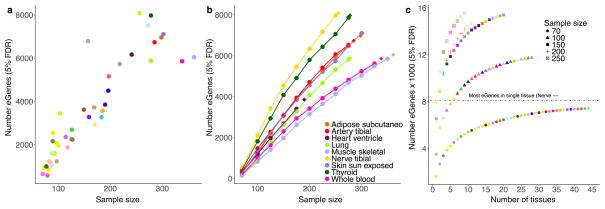
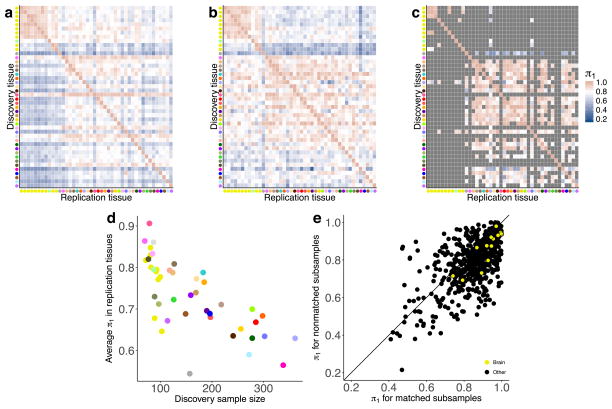
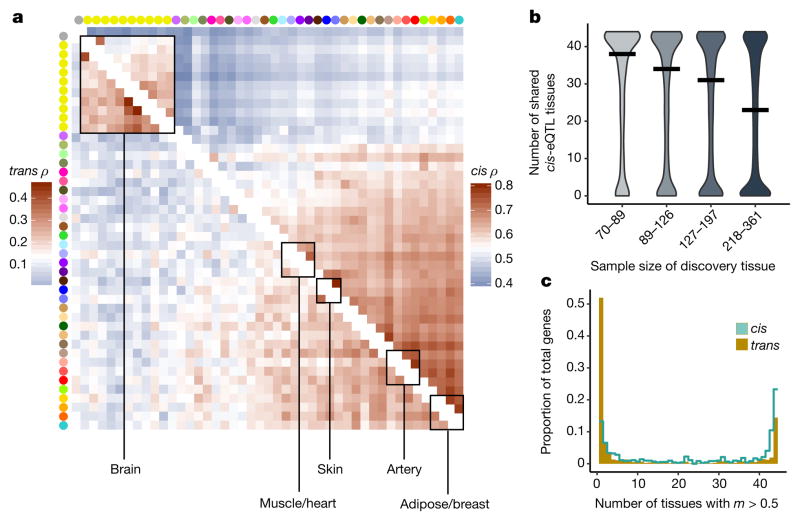
Characterization of the molecular function of the human genome and its variation across individuals is essential for identifying the cellular mechanisms that underlie human genetic traits and diseases. The Genotype-Tissue Expression (GTEx) project aims to characterize variation in gene expression levels across individuals and diverse tissues of the human body, many of which are not easily accessible. Here we describe genetic effects on gene expression levels across 44 human tissues. We find that local genetic variation affects gene expression levels for the majority of genes, and we further identify inter-chromosomal genetic effects for 93 genes and 112 loci. On the basis of the identified genetic effects, we characterize patterns of tissue specificity, compare local and distal effects, and evaluate the functional properties of the genetic effects. We also demonstrate that multi-tissue, multi-individual data can be used to identify genes and pathways affected by human disease-associated variation, enabling a mechanistic interpretation of gene regulation and the genetic basis of disease.
Overview
The claims and statistics of this paper haven’t been checked yet.
Free: it reads the open-access text and checks the first 5 claims that cite a source we can check. Create a free account to check every claim.
Integrity signals
Registry
Cites
Statistics
Figures


![Extended Data Figure 3 Properties of cis-eGenes and non-eGenes In these analyses, ‘non-eGenes’ refers to the set of genes with no significantly associated cis-eQTLs. a, Density of expression (mean across samples, median across tissues, in log10 scale) for cis-eGenes and non-eGenes. The difference in mean expression for cis-eGenes and non-eGenes is significant (Wald test; P <1 ×10⁻¹⁶). b, Box plots comparing the probability of being loss-of-function-intolerant (pLI) scores41 for cis-eGenes and non-eGenes, stratified by expression percentile across all genes (mean across samples, median across tissues, in log10 scale). On average, highly expressed non-eGenes have higher pLI scores than highly expressed cis-eGenes (t-test for the difference in mean pLI score between cis-eGenes and non-eGenes; BH adjusted P = 8.3 ×10⁻⁴ and 2.1 ×10⁻⁹ for (50,75]% and (75,100]%, respectively) and lowly expressed non-eGenes (t-test for the difference in mean pLI score between highly and lowly expressed non-eGenes; BH adjusted P ≤7.8 ×10−46, P ≤5.5 ×10⁻¹⁷ and P ≤2.1 ×10⁻³ for (75,100]% vs [0,25]%, (75,100 vs (25,50]% and (75,100]% vs (50,75]%, respectively). c, Gene Ontology (GO) analysis of tested protein-coding non-eGenes. We used the PANTHER overrepresentation test78 (release 20160715) against 20,972 human genes as background to test for enrichment in GO biological processes using the GO database release 2017-02-28. Significant GO IDs (Bonferroni adjusted P < 0.05) were selected for analysis with REVIGO79 to group similar ontological terms, which yielded 22 over-represented GO IDs. d, GO analysis of a more stringent set of protein-coding non-eGenes. Selected genes included those not tested in GTEx (532 genes) or those with a minimum nominal P value across tissues greater than 0.1 (692 genes). Of these stringent 1,224 non-eGenes, 808 were mapped in the GO analysis. Using a similar approach as in c, 20 over-represented GO IDs were identified. For both c and d, the x-axis represents the −log10 P value resulting from GO analysis. GO IDs are coloured by the broader enrichment category to which each corresponds. Box plots depict the IQR, whiskers depict 1.5× IQR.](https://figures.cochat.ai/paper-figures/ea51d71f9cd44f0ba04adaf266dc2572/genetic-effects-on-gene-expression-across-human-tissues-figure-3.jpg)






Verification
Claims the paper makes
The claims and statistics of this paper haven’t been checked yet.
Free: it reads the open-access text and checks the first 5 claims that cite a source we can check. Create a free account to check every claim.
Claims other papers make about this one
Each is checked against this paper’s own text: does it say what the citing paper says it does?
The source backs part of the claim, not all of it — or backs it for a different population, condition or comparison.
In the citing paper
“the ENCODE and Roadmap Epigenomics (Roadmap) projects have identified noncoding regions acting as enhancers and promoters (8–10).”
From Comprehensive functional genomic resource and integrative model for the human brain (2018) · cites this paper as [8]
Experimental — accuracy not yet measuredThe source backs part of the claim, not all of it — or backs it for a different population, condition or comparison.
In the citing paper
“The eQTL framework is very powerful, and for variants residing within distally located candidate enhancers, can provide in vivo validation of those enhancers while also linking them to their target genes136.”
From Towards a comprehensive catalogue of validated and target-linked human enhancers (2020) · cites this paper as [136]
Experimental — accuracy not yet measuredThe cited source says what the claim attributes to it.
In the citing paper
“Because only 9 of the 953 genes lack confirmed expression in any of the 34 neuro-related tissues tracked by IDG KMC (for example, GTEx40,41, HPA42 and HPM43), these data suggest that the remaining 80% of this set have the potential to be associated with human neurobehavioural phenotypes, paving the way for new research avenues in this direction (see Supplementary Table S8).”
From Unexplored therapeutic opportunities in the human genome (2018) · cites this paper as [41]
The cited source says what the claim attributes to it.
In the citing paper
“For example, the GTEx (Genotype-Tissue Expression) consortium has mapped thou sands of expression quantitative trait loci (QTLs) across hundreds of individuals and dozens of tissues112.”
From A brief history of human disease genetics (2020) · cites this paper as [112]
The cited source says what the claim attributes to it.
In the citing paper
“the Genotype-Tissue Expression (GTEx) project has associated many noncoding variants with expression quantitative-trait loci (eQTLs)”
From Comprehensive functional genomic resource and integrative model for the human brain (2018) · cites this paper as [8]
4 more claims about this paper
Create a free account to see every claim other papers make about this one.
Self-check
Percentages, sums and reported differences re-computed from the paper’s own numbers.
The self-check needs the paper’s full text.
Citations
Cites
Controlling the False Discovery Rate: A Practical and Powerful Approach to Multiple Testing
Benjamini, Y., & Hochberg, Y. (1995) · Journal of the Royal Statistical Society Series B: Statistical Methodology · doi:10.1111/j.2517-6161.1995.tb02031.x · Cited by 109,482
BEDTools: a flexible suite of utilities for comparing genomic features
Quinlan, A. R., & Hall, I. M. (2010) · Bioinformatics · doi:10.1093/bioinformatics/btq033 · Cited by 27,437
A global reference for human genetic variation
The 1000 Genomes Project Consortium, authors, C., Auton, A., Abecasis, G. R., Steering committee, Altshuler, D. M., Durbin, R. M., Abecasis, G. R., Bentley, D. R., Chakravarti, A., et al. (2015) · Nature · doi:10.1038/nature15393 · Cited by 18,247
The Molecular Signatures Database Hallmark Gene Set Collection
Liberzon, A., Birger, C., Thorvaldsdóttir, H., Ghandi, M., Mesirov, J. P., & Tamayo, P. (2015) · Cell Systems · doi:10.1016/j.cels.2015.12.004 · Cited by 13,807
Statistical significance for genomewide studies
Storey, J. D., & Tibshirani, R. (2003) · Proceedings of the National Academy of Sciences · doi:10.1073/pnas.1530509100 · Cited by 9,692
Analysis of protein-coding genetic variation in 60,706 humans
Exome Aggregation Consortium, Lek, M., Karczewski, K. J., Minikel, E. V., Samocha, K. E., Banks, E., Fennell, T., O’Donnell-Luria, A. H., Ware, J. S., Hill, A. J., et al. (2016) · Nature · doi:10.1038/nature19057 · Cited by 9,587
An integrated map of genetic variation from 1,092 human genomes
The 1000 Genomes Project Consortium (2012) · Nature · doi:10.1038/nature11632 · Cited by 7,711
Integrative analysis of 111 reference human epigenomes
Roadmap Epigenomics Consortium, Kundaje, A., Meuleman, W., Ernst, J., Bilenky, M., Yen, A., Heravi-Moussavi, A., Kheradpour, P., Zhang, Z., Wang, J., et al. (2015) · Nature · doi:10.1038/nature14248 · Cited by 6,368
REVIGO summarizes and visualizes long lists of gene ontology terms
Supek, F., Bošnjak, M., Škunca, N., & Šmuc, T. (2011) · PLoS ONE · doi:10.1371/journal.pone.0021800 · Cited by 6,264
The ENCODE Project Consortium (2007) · Nature · doi:10.1038/nature05874 · Cited by 5,223
Research works printed but not linked: 1
- Regev A The human cell atlas Preprint at http://www.biorxiv.org/content/early/2017/05/08/121202 2017
Cited by
Items 401–500 of 1,040
Dand, N., Stuart, P. E., Bowes, J., Ellinghaus, D., Nititham, J., Saklatvala, J. R., Teder‐Laving, M., Thomas, L. F., Traks, T., Uebe, S., et al. (2025) · Nature Communications · doi:10.1038/s41467-025-56719-8 · Cited by 131
Greenwald, W. W., Chiou, J., Yan, J., Qiu, Y., Dai, N., Wang, A., Nariai, N., Aylward, A., Han, J. Y., Kadakia, N., et al. (2019) · Nature Communications · doi:10.1038/s41467-019-09975-4 · Cited by 118
Evolution of DNA methylation in the human brain
Jeong, H., Mendizabal, I., Berto, S., Chatterjee, P., Layman, T. S., Usui, N., Toriumi, K., Douglas, C., Singh, D., Huh, I., et al. (2021) · Nature Communications · doi:10.1038/s41467-021-21917-7 · Cited by 119
Joint sequencing of human and pathogen genomes reveals the genetics of pneumococcal meningitis
Lees, J. A., Ferwerda, B., Kremer, P. H. C., Wheeler, N. E., Serón, M. V., Croucher, N. J., Gladstone, R. A., Bootsma, H. J., Rots, N. Y., Wijmenga‐Monsuur, A. J., et al. (2019) · Nature Communications · doi:10.1038/s41467-019-09976-3 · Cited by 129
The genetics of neuropsychiatric disorders
Bray, N. J., & O’Donovan, M. C. (2018) · Brain and Neuroscience Advances · doi:10.1177/2398212818799271 · Cited by 133
Into the Wild: GWAS Exploration of Non-coding RNAs
Giral, H., Landmesser, U., & Kratzer, A. (2018) · Frontiers in Cardiovascular Medicine · doi:10.3389/fcvm.2018.00181 · Cited by 125
“GenotypeTissue Expression (GTEx) project provides the possibility to study tissue-specific gene expression and regulation on large scale with 44 various tissues in 449 individuals, which allowed to build up a resourceful platform in order to identify genetic associations both for local (cis eQTLs) and distal (trans eQ…”
BackgroundClaudin-2 deficiency associates with hypercalciuria in mice and human kidney stone disease
Curry, J. N., Saurette, M., Askari, M., Pei, L., Filla, M. B., Beggs, M. R., Rowe, P. S., Fields, T. A., Sommer, A. J., Tanikawa, C., et al. (2020) · Journal of Clinical Investigation · doi:10.1172/jci127750 · Cited by 113
“project data set (74) (https://gtexportal.”
GRNdb: decoding the gene regulatory networks in diverse human and mouse conditions
Li, F., Li, Y., Ma, L., Xu, Q., Tan, F., & Chen, G. (2020) · Nucleic Acids Research · doi:10.1093/nar/gkaa995 · Cited by 124
Quach, B. C., Bray, M. J., Gaddis, N. C., Liu, M., Palviainen, T., Minica, C. C., Zellers, S., Sherva, R., Aliev, F., Nothnagel, M., et al. (2020) · Nature Communications · doi:10.1038/s41467-020-19265-z · Cited by 118
Determining sequencing depth in a single-cell RNA-seq experiment
Zhang, M. J., Ntranos, V., & Tse, D. (2020) · Nature Communications · doi:10.1038/s41467-020-14482-y · Cited by 112
An integrative approach for building personalized gene regulatory networks for precision medicine
van der Wijst, M. G. P., de Vries, D. H., Brugge, H., Westra, H.-J., & Franke, L. (2018) · Genome Medicine · doi:10.1186/s13073-018-0608-4 · Cited by 143
Deciphering the Emerging Complexities of Molecular Mechanisms at GWAS Loci
Cannon, M. E., & Mohlke, K. L. (2018) · The American Journal of Human Genetics · doi:10.1016/j.ajhg.2018.10.001 · Cited by 123
Zhu, Z., Wang, X., Li, X., Lin, Y., Shen, S., Liu, C.-L., Hobbs, B. D., Hasegawa, K., Liang, L., Boezen, H. M., et al. (2019) · Respiratory Research · doi:10.1186/s12931-019-1036-8 · Cited by 127
Human and mouse essentiality screens as a resource for disease gene discovery
Cacheiro, P., Muñoz-Fuentes, V., Murray, S. A., Dickinson, M. E., Bucan, M., Nutter, L. M. J., Peterson, K. A., Haselimashhadi, H., Flenniken, A. M., Morgan, H., et al. (2020) · Nature Communications · doi:10.1038/s41467-020-14284-2 · Cited by 106
“values by tissue were downloaded from the GTEx portal [https://gtexportal.org/ home/datasets; accessed 18.12.02, fi le “ GTEx_Analysis_2016-01-15_v7_RNA-SeQCv1.1.8_gene_median_tpm.gct.gz ” ] 61 .”
InfluentialImpact of admixture and ancestry on eQTL analysis and GWAS colocalization in GTEx
Gay, N. R., Gloudemans, M., Antonio, M. L., Abell, N. S., Balliu, B., Park, Y., Martin, A. R., Musharoff, S., Rao, A. S., Aguet, F., et al. (2020) · Genome Biology · doi:10.1186/s13059-020-02113-0 · Cited by 114
Advances in bulk and single-cell multi-omics approaches for systems biology and precision medicine
Li, Y., Ma, L., Wu, D., & Chen, G. (2021) · Briefings in Bioinformatics · doi:10.1093/bib/bbab024 · Cited by 133
Epigenetic reprogramming as a key to reverse ageing and increase longevity
Pereira, B., Correia, F. P., Alves, I. A., Costa, M., Gameiro, M. D., Martins, A. P., & Saraiva, J. A. (2024) · Ageing Research Reviews · doi:10.1016/j.arr.2024.102204 · Cited by 129
Sex-specific genetic predictors of Alzheimer’s disease biomarkers
(ADNI), A. D. N. I., Deming, Y., The Alzheimer Disease Genetics Consortium (ADGC), Dumitrescu, L., Barnes, L. L., Thambisetty, M., Kunkle, B., Gifford, K. A., Bush, W. S., Chibnik, L. B., et al. (2018) · Acta Neuropathologica · doi:10.1007/s00401-018-1881-4 · Cited by 110
Lessons Learned From GWAS of Asthma
Kim, K. W., & Ober, C. (2019) · Allergy Asthma and Immunology Research · doi:10.4168/aair.2019.11.2.170 · Cited by 110
Genome-wide Analysis of Transcriptional Variability in a Large Maize-Teosinte Population
Wang, X., Chen, Q., Wu, Y., Lemmon, Z. H., Xu, G., Huang, C., Liang, Y., Xu, D., Li, D., Doebley, J., et al. (2017) · Molecular Plant · doi:10.1016/j.molp.2017.12.011 · Cited by 139
Targeting Androgen Regulation of TMPRSS2 and ACE2 as a Therapeutic Strategy to Combat COVID-19
Deng, Q., Rasool, R. U., Russell, R. M., Natesan, R., & Asangani, I. A. (2020) · iScience · doi:10.1016/j.isci.2021.102254 · Cited by 112
scPower accelerates and optimizes the design of multi-sample single cell transcriptomic studies
Schmid, K. T., Höllbacher, B., Cruceanu, C., Böttcher, A., Lickert, H., Binder, E. B., Theis, F. J., & Heinig, M. (2021) · Nature Communications · doi:10.1038/s41467-021-26779-7 · Cited by 108
Patterns and mechanisms of structural variations in human cancer
Yi, K., & Ju, Y. S. (2018) · Experimental & Molecular Medicine · doi:10.1038/s12276-018-0112-3 · Cited by 126
Combinatorial Genetics Reveals a Scaling Law for the Effects of Mutations on Splicing
Baeza-Centurion, P., Miñana, B., Schmiedel, J. M., Valcárcel, J., & Lehner, B. (2019) · Cell · doi:10.1016/j.cell.2018.12.010 · Cited by 106
In vivo functional analysis of non-conserved human lncRNAs associated with cardiometabolic traits
Ruan, X., Li, P., Chen, Y., Shi, Y., Pirooznia, M., Seifuddin, F., Suemizu, H., Ohnishi, Y., Yoneda, N., Nishiwaki, M., et al. (2020) · Nature Communications · doi:10.1038/s41467-019-13688-z · Cited by 151
Genetic regulatory variation in populations informs transcriptome analysis in rare disease
Mohammadi, P., Castel, S. E., Cummings, B. B., Einson, J., Sousa, C., Hoffman, P., Donkervoort, S., Jiang, Z., Mohassel, P., Foley, A. R., et al. (2019) · Science · doi:10.1126/science.aay0256 · Cited by 108
“We applied ANEVA to 10,361 RNA-seq samples from 48 tissues and 620 individuals with whole genome sequencing (WGS) data from the GTEx v7 data (17, 18).”
MethodPeyrot, W. J., & Price, A. L. (2021) · Nature Genetics · doi:10.1038/s41588-021-00787-1 · Cited by 125
A compendium of conserved cleavage and polyadenylation events in mammalian genes
Wang, R., Zheng, D., Yehia, G., & Tian, B. (2018) · Genome Research · doi:10.1101/gr.237826.118 · Cited by 106
ASCOT identifies key regulators of neuronal subtype-specific splicing
Ling, J. P., Wilks, C., Charles, R., Leavey, P. J., Ghosh, D., Jiang, L., Santiago, C. P., Pang, B., Venkataraman, A., Clark, B. S., et al. (2020) · Nature Communications · doi:10.1038/s41467-019-14020-5 · Cited by 107
An ancestral recombination graph of human, Neanderthal, and Denisovan genomes
Schaefer, N. K., Shapiro, B., & Green, R. E. (2021) · Science Advances · doi:10.1126/sciadv.abc0776 · Cited by 106
Moore, J. E., Pratt, H. E., Purcaro, M. J., & Weng, Z. (2020) · Genome Biology · doi:10.1186/s13059-019-1924-8 · Cited by 106
Enhancer Domains Predict Gene Pathogenicity and Inform Gene Discovery in Complex Disease
Wang, X., & Goldstein, D. B. (2020) · The American Journal of Human Genetics · doi:10.1016/j.ajhg.2020.01.012 · Cited by 101
Discriminatory Power of Combinatorial Antigen Recognition in Cancer T Cell Therapies
Dannenfelser, R., Allen, G. M., VanderSluis, B., Koegel, A. K., Levinson, S., Stark, S. R., Yao, V., Tadych, A., Troyanskaya, O. G., & Lim, W. A. (2020) · Cell Systems · doi:10.1016/j.cels.2020.08.002 · Cited by 113
Ma, Y., Deng, C., Zhou, Y., Zhang, Y., Qiu, F., Jiang, D., Zheng, G., Li, J., Shuai, J., Zhang, Y., et al. (2023) · Cell Genomics · doi:10.1016/j.xgen.2023.100383 · Cited by 143
Ntalla, I., Weng, L.-C., Cartwright, J. H., Hall, A. W., Sveinbjornsson, G., Tucker, N. R., Choi, S. H., Chaffin, M. D., Roselli, C., Barnes, M. R., et al. (2020) · Nature Communications · doi:10.1038/s41467-020-15706-x · Cited by 106
Neavin, D., Nguyen, Q., Daniszewski, M. S., Liang, H. H., Chiu, H. S., Wee, Y. K., Senabouth, A., Lukowski, S. W., Crombie, D. E., Lidgerwood, G. E., et al. (2021) · Genome Biology · doi:10.1186/s13059-021-02293-3 · Cited by 103
Genetic control of the human brain proteome
Robins, C., Wingo, A. P., Fan, W., Duong, D. M., Meigs, J., Gerasimov, E. S., Dammer, E. B., Cutler, D. J., Jager, P. L. D., Bennett, D. A., et al. (2019) · doi:10.1101/816652 · Cited by 104
Gusev, A., Lawrenson, K., Lin, X., Junior, P. C. M. L., Kar, S., Vavra, K. C., Segato, F., Fonseca, M. A., Lee, J. M., Pejovic, T., et al. (2019) · Nature Genetics · doi:10.1038/s41588-019-0395-x · Cited by 125
“Both out-of-sample correlation and model significance were high across all cohorts and comparable to previous multi-tissue studies 36 .”
Delineating the Genetic Component of Gene Expression in Major Depression
Dall’Aglio, L., Lewis, C. M., & Pain, O. (2020) · Biological Psychiatry · doi:10.1016/j.biopsych.2020.09.010 · Cited by 118
Yang, Z., Wu, H., Lee, P. H., Tsetsos, F., Davis, L. K., Yu, D., Lee, S., Dalsgaard, S., Haavik, J., Barta, C., et al. (2021) · Biological Psychiatry · doi:10.1016/j.biopsych.2020.12.028 · Cited by 113
Gabriele, M., Lopez Tobon, A., D'Agostino, G., & Testa, G. (2018) · Progress in Neuro-Psychopharmacology and Biological Psychiatry · doi:10.1016/j.pnpbp.2017.12.013 · Cited by 103
High-resolution genetic mapping of putative causal interactions between regions of open chromatin
Kumasaka, N., Knights, A. J., & Gaffney, D. J. (2019) · Nature Genetics · doi:10.1038/s41588-018-0278-6 · Cited by 103
Fang, L., Liu, S., Liu, M., Kang, X., Lin, S., Li, B., Connor, E. E., Baldwin, R. L., Tenesa, A., Ma, L., et al. (2019) · BMC Biology · doi:10.1186/s12915-019-0687-8 · Cited by 145
“The gene expression among 53 tissues in human was obtained from [76].”
BackgroundA molecular quantitative trait locus map for osteoarthritis
Steinberg, J., Southam, L., Butterfield, N. C., Roumeliotis, T. I., Fontalis, A., Clark, M. J. R., Jayasuriya, R. L., Swift, D., Shah, K. M., Curry, K. F., et al. (2021) · Nature Communications · doi:10.1038/s41467-021-21593-7 · Cited by 114
Regulation of intronic polyadenylation by PCF11 impacts mRNA expression of long genes
Wang, R., Zheng, D., Wei, L., Ding, Q., & Tian, B. (2019) · Cell Reports · doi:10.1016/j.celrep.2019.02.049 · Cited by 107
“To further explore gene regulation by PCF11 in a broader context, we analyzed Genotype-Tissue Expression (GTEx) RNA-seq datasets (GTEx Consortium, 2017), consisting of 5,032 samples from 27 human tissue types in 545 human individuals.”
MethodMatsunaga, H., Ito, K., Akiyama, M., Takahashi, A., Koyama, S., Nomura, S., Ieki, H., Ozaki, K., Onouchi, Y., Sakaue, S., et al. (2020) · Circulation Genomic and Precision Medicine · doi:10.1161/circgen.119.002670 · Cited by 115
Wang, M., Song, W., Chen, M., Wang, Q., Zhou, X., Xu, P., Krek, A., Yoon, Y., Ho, L., Orr, M. E., et al. (2022) · Molecular Neurodegeneration · doi:10.1186/s13024-022-00517-z · Cited by 110
Addressing confounding artifacts in reconstruction of gene co-expression networks
Parsana, P., Ruberman, C., Jaffe, A. E., Schatz, M. C., Battle, A., & Leek, J. T. (2019) · Genome Biology · doi:10.1186/s13059-019-1700-9 · Cited by 100
Deconvolving the contributions of cell-type heterogeneity on cortical gene expression
Patrick, E., Taga, M., Ergun, A., Ng, B., Casazza, W., Cimpean, M., Yung, C., Schneider, J. A., Bennett, D. A., Gaiteri, C., et al. (2020) · PLOS Computational Biology · doi:10.1371/journal.pcbi.1008120 · Cited by 106
Degtyareva, A. O., Antontseva, E. V., & Merkulova, T. I. (2021) · International Journal of Molecular Sciences · doi:10.3390/ijms22126454 · Cited by 116
“According to eQTL analysis involving 373 unrelated European samples of lymphoblastoid cell lines, the minor allele A of rs13239597 was significantly associated with an increased IRF5 expression; this was also confirmed with GTEx data [6].”
BackgroundResultKember, R. L., Vickers‐Smith, R., Xu, H., Toikumo, S., Niarchou, M., Zhou, H., Hartwell, E. E., Crist, R. C., Rentsch, C. T., Program, M. V., et al. (2022) · Nature Neuroscience · doi:10.1038/s41593-022-01160-z · Cited by 111
Meta-analysis uncovers genome-wide significant variants for rapid kidney function decline
Gorski, M., Jung, B., Li, Y., Matías‐García, P. R., Wuttke, M., Coassin, S., Thio, C. H. L., Kleber, M. E., Winkler, T. W., Wanner, V., et al. (2020) · Kidney International · doi:10.1016/j.kint.2020.09.030 · Cited by 109
Ou, Y., Yang, Y., Deng, Y., Zhang, C. M., Hu, H., Wu, B., Liu, Y., Wang, Y., Zhu, Y., Suckling, J., et al. (2021) · Molecular Psychiatry · doi:10.1038/s41380-021-01251-6 · Cited by 111
“Compared with pQTL, eQTL studies employ more stringent criteria to identify distant regulatory variants as eQTL is more likely to be related to local regulatory elements [45].”
MethodHamel, A. R., Yan, W., Rouhana, J. M., Monavarfeshani, A., Jiang, X., Mehta, P. A., Advani, J., Luo, Y., Liang, Q., Rajasundaram, S., et al. (2024) · Nature Communications · doi:10.1038/s41467-023-44380-y · Cited by 113
Evolution and antiviral activity of a human protein of retroviral origin
Frank, J. A., Singh, M., Cullen, H. B., Kirou, R. A., Benkaddour-Boumzaouad, M., Cortes, J. L., Garcia Pérez, J., Coyne, C. B., & Feschotte, C. (2022) · Science · doi:10.1126/science.abq7871 · Cited by 95
Genetic regulation of gene expression across multiple tissues in chickens
Guan, D., Bai, Z., Zhu, X., Zhong, C., Hou, Y., Zhu, D., Li, H., Lan, F., Diao, S., Yao, Y., et al. (2025) · Nature Genetics · doi:10.1038/s41588-025-02155-9 · Cited by 116
“To assess the cross-tissue-sharing pattern of molQTL, we used multivariate adaptive shrinkage in R (MashR, v.0.2.57) 34 and METASOFT (v.2.0.0) 94 , as applied in human GTEx 15,16 .”
InfluentialMolecular quantitative trait loci
Aguet, F., Alasoo, K., Li, Y. I., Battle, A., Im, H. K., Montgomery, S. B., & Lappalainen, T. (2023) · Nature Reviews Methods Primers · doi:10.1038/s43586-022-00188-6 · Cited by 98
Self-citationSmeland, O. B., Shadrin, A., Bahrami, S., Broce, I., Tesli, M., Frei, O., Wirgenes, K. V., O’Connell, K. S., Krull, F., Bettella, F., et al. (2021) · Biological Psychiatry · doi:10.1016/j.biopsych.2020.01.026 · Cited by 100
Wang, Q. S., Kelley, D. R., Ulirsch, J., Kanai, M., Sadhuka, S., Cui, R., Albors, C., Cheng, N., Okada, Y., The Biobank Japan Project, et al. (2021) · Nature Communications · doi:10.1038/s41467-021-23134-8 · Cited by 87
Peanut oral immunotherapy differentially suppresses clonally distinct subsets of T helper cells
Monian, B., Tu, A. A., Ruiter, B., Morgan, D. M., Petrossian, P. M., Smith, N. P., Gierahn, T. M., Ginder, J. H., Shreffler, W. G., & Love, J. C. (2022) · Journal of Clinical Investigation · doi:10.1172/jci150634 · Cited by 100
“The 20-hour stimulation duration was intended to capture ex vivo cell states and reflect in vivo clonal distributions; it provides sufficient time for the processing of whole peanut proteins by antigen-presenting cells and the activation of peanut-reactive CD4+ T cells, but it is too short to induce substantial prolif…”
BackgroundEvolutionary history and adaptation of a human pygmy population of Flores Island, Indonesia
Tucci, S., Vohr, S. H., McCoy, R. C., Vernot, B., Robinson, M. R., Barbieri, C., Nelson, B. J., Fu, W., Purnomo, G. A., Sudoyo, H., et al. (2018) · Science · doi:10.1126/science.aar8486 · Cited by 97
Matoba, N., Liang, D., Sun, H., Aygün, N., McAfee, J. C., Davis, J. E., Raffield, L. M., Qian, H., Piven, J., Li, Y., et al. (2020) · Translational Psychiatry · doi:10.1038/s41398-020-00953-9 · Cited by 119
Zeng, P., Shao, Z., & Zhou, X. (2021) · Computational and Structural Biotechnology Journal · doi:10.1016/j.csbj.2021.05.042 · Cited by 114
Dong, X., Liao, Z., Gritsch, D., Hadzhiev, Y., Bai, Y., Locascio, J. J., Guennewig, B., Liu, G., Blauwendraat, C., Wang, T., et al. (2018) · Nature Neuroscience · doi:10.1038/s41593-018-0223-0 · Cited by 95
Walker, V. M., Kehoe, P. G., Martin, R. M., & Davies, N. M. (2018) · doi:10.1101/486878 · Cited by 96
Lombardo, M. V., Pramparo, T., Gazestani, V., Warrier, V., Bethlehem, R. A. I., Barnes, C. C., Lopez, L., Lewis, N. E., Eyler, L. T., Pierce, K., et al. (2018) · Nature Neuroscience · doi:10.1038/s41593-018-0281-3 · Cited by 102
Profiling of the plasma proteome across different stages of human heart failure
Egerstedt, A., Berntsson, J., Smith, M. L., Gidlöf, O., Nilsson, R., Benson, M. D., Wells, Q. S., Celik, S., Lejonberg, C., Farrell, L. A., et al. (2019) · Nature Communications · doi:10.1038/s41467-019-13306-y · Cited by 99
Lee, D. S. M., Ghanem, L. R., & Barash, Y. (2020) · Nature Communications · doi:10.1038/s41467-020-14404-y · Cited by 102
Jaffe, A. E., Hoeppner, D. J., Saito, T., Blanpain, L. T., Ukaigwe, J., Burke, E. E., Collado‐Torres, L., Tao, R., Tajinda, K., Maynard, K. R., et al. (2020) · Nature Neuroscience · doi:10.1038/s41593-020-0604-z · Cited by 114
Characterizing the Genetic Architecture of Parkinson's Disease in Latinos
Loesch, D. P., Horimoto, A. R. V. R., Heilbron, K., Sarihan, E. I., Inca‐Martinez, M., Mason, E., Cornejo‐Olivas, M., Torres, L., Mazzetti, P., Cosentino, C., et al. (2021) · Annals of Neurology · doi:10.1002/ana.26153 · Cited by 107
Genetics of myocardial interstitial fibrosis in the human heart and association with disease
Nauffal, V., Achille, P. D., Klarqvist, M. D. R., Cunningham, J. W., Hill, M. C., Pirruccello, J. P., Weng, L.-C. C., Morrill, V. N., Choi, S. H., Khurshid, S. S., et al. (2023) · Nature Genetics · doi:10.1038/s41588-023-01371-5 · Cited by 98
Walker, V. M., Kehoe, P. G., Martin, R. M., & Davies, N. M. (2020) · International Journal of Epidemiology · doi:10.1093/ije/dyz155 · Cited by 96
“(23) The full GTEx dataset, which consists of 714 donors, is 65.”
Backgroundstudy, L. C., Zhernakova, D. V., BIOS consortium, Le, T. H., Kurilshikov, A., Atanasovska, B., Bonder, M. J., Sanna, S., Claringbould, A., Võsa, U., et al. (2018) · Nature Genetics · doi:10.1038/s41588-018-0224-7 · Cited by 100
Genetic analysis of amyotrophic lateral sclerosis identifies contributing pathways and cell types
Saez-Atienzar, S., Bandres-Ciga, S., Langston, R. G., Kim, J. J., Choi, S. W., Reynolds, R. H., the International ALS Genomics Consortium, ITALSGEN, Abramzon, Y., Dewan, R., et al. (2021) · Science Advances · doi:10.1126/sciadv.abd9036 · Cited by 97
Genetic Regulatory Mechanisms of Smooth Muscle Cells Map to Coronary Artery Disease Risk Loci
Liu, B., Pjanic, M., Wang, T., Nguyen, T., Gloudemans, M., Rao, A., Castano, V. G., Nurnberg, S., Rader, D. J., Elwyn, S., et al. (2018) · The American Journal of Human Genetics · doi:10.1016/j.ajhg.2018.08.001 · Cited by 94
Self-citationIntegrated genetic and epigenetic analysis of myxofibrosarcoma
Ogura, K., Hosoda, F., Arai, Y., Nakamura, H. K., Hama, N., Totoki, Y., Yoshida, A., Nagai, M., Kato, M., Arakawa, E., et al. (2018) · Nature Communications · doi:10.1038/s41467-018-03891-9 · Cited by 99
Club Cell TRPV4 Serves as a Damage Sensor Driving Lung Allergic Inflammation
Wiesner, D. L., Merkhofer, R. M., Ober, C., Kujoth, G. C., Niu, M., Keller, N. P., Gern, J. E., Brockman‐Schneider, R. A., Evans, M. D., Jackson, D. J., et al. (2020) · Cell Host & Microbe · doi:10.1016/j.chom.2020.02.006 · Cited by 97
Functional Specialization of Human Salivary Glands and Origins of Proteins Intrinsic to Human Saliva
Saitou, M., Gaylord, E. A., Xu, E., May, A. J., Neznanova, L., Nathan, S., Grawe, A., Chang, J. L., Ryan, W. R., Rühl, S., et al. (2020) · Cell Reports · doi:10.1016/j.celrep.2020.108402 · Cited by 103
“org/home/documentationPage#AboutSamples) (28, 29), (Table S4).”
BackgroundMegaLMM: Mega-scale linear mixed models for genomic predictions with thousands of traits
Runcie, D. E., Qu, J., Cheng, H., & Crawford, L. (2021) · Genome Biology · doi:10.1186/s13059-021-02416-w · Cited by 80
Saha, A., & Battle, A. (2019) · F1000Research · doi:10.12688/f1000research.17145.2 · Cited by 62
Gene expression variability: the other dimension in transcriptome analysis
de Jong, T. V., Moshkin, Y. M., & Guryev, V. (2019) · Physiological Genomics · doi:10.1152/physiolgenomics.00128.2018 · Cited by 108
Epigenomes of Human Hearts Reveal New Genetic Variants Relevant for Cardiac Disease and Phenotype
Tan, W. L. W., Anene-Nzelu, C. G., Wong, E., Lee, C. J. M., Tan, H. S., Tang, S. J., Perrin, A., Wu, K. X., Zheng, W., Ashburn, R. J., et al. (2020) · Circulation Research · doi:10.1161/circresaha.120.317254 · Cited by 99
Predicting tissue-specific gene expression from whole blood transcriptome
Basu, M., Wang, K., Ruppin, E., & Hannenhalli, S. S. (2021) · Science Advances · doi:10.1126/sciadv.abd6991 · Cited by 102
Variable number tandem repeats mediate the expression of proximal genes
Bakhtiari, M., Park, J., Ding, Y.-C., Shleizer-Burko, S., Neuhausen, S. L., Halldórsson, B. V., Stefánsson, K., Gymrek, M., & Bafna, V. (2021) · Nature Communications · doi:10.1038/s41467-021-22206-z · Cited by 103
Epigenetic and Transcriptional Variability Shape Phenotypic Plasticity
Ecker, S., Pancaldi, V., Valencia, A., Beck, S., & Paul, D. S. (2018) · BioEssays · doi:10.1002/bies.201700148 · Cited by 87
Multi-ancestry study of blood lipid levels identifies four loci interacting with physical activity
Kilpeläinen, T. O., Bentley, A. R., Noordam, R., Sung, Y. J., Schwander, K., Winkler, T. W., Jakupović, H., Chasman, D. I., Manning, A., Ntalla, I., et al. (2019) · Nature Communications · doi:10.1038/s41467-018-08008-w · Cited by 92
The long noncoding RNA ROCKI regulates inflammatory gene expression
Zhang, Q., Chao, T., Patil, V. S., Qin, Y., Tiwari, S. K., Chiou, J., Dobin, A., Tsai, C., Li, Z., Dang, J. W., et al. (2019) · The EMBO Journal · doi:10.15252/embj.2018100041 · Cited by 96
Dapas, M., Sisk, R., Legro, R. S., Urbanek, M., Dunaif, A., & Hayes, M. G. (2019) · The Journal of Clinical Endocrinology & Metabolism · doi:10.1210/jc.2018-02496 · Cited by 92
von der Heyde, B., Emmanouilidou, A., Mazzaferro, E., Vicenzi, S., Höijer, I., Klingström, T., Jumaa, S., Dethlefsen, O., Snieder, H., de Geus, E., et al. (2020) · Scientific Reports · doi:10.1038/s41598-020-68567-1 · Cited by 91
Zeng, B., Bendl, J., Kosoy, R., Fullard, J. F., Hoffman, G. E., & Roussos, P. (2022) · Nature Genetics · doi:10.1038/s41588-021-00987-9 · Cited by 96
Schlosser, P., Scherer, N., Grundner-Culemann, F., Monteiro-Martins, S., Haug, S., Steinbrenner, I., Uluvar, B., Wuttke, M., Cheng, Y., Ekici, A. B., et al. (2023) · Nature Genetics · doi:10.1038/s41588-023-01409-8 · Cited by 102
Nakatochi, M., Kanai, M., Nakayama, A., Hishida, A., Kawamura, Y., Ichihara, S., Akiyama, M., Ikezaki, H., Furusyo, N., Shimizu, S., et al. (2019) · Communications Biology · doi:10.1038/s42003-019-0339-0 · Cited by 95
Sex-stratified genome-wide association study of multisite chronic pain in UK Biobank
Johnston, K. J. A., Ward, J., Ray, P. R., Adams, M. J., McIntosh, A. M., Smith, B. H., Strawbridge, R. J., Price, T. J., Smıth, D. J., Nicholl, B. I., et al. (2021) · PLoS Genetics · doi:10.1371/journal.pgen.1009428 · Cited by 97
He, F., Wang, W., Rutter, W. B., Jordan, K. W., Ren, J., Taagen, E., DeWitt, N., Sehgal, D., Sukumaran, S., Dreisigacker, S., et al. (2022) · Nature Communications · doi:10.1038/s41467-022-28453-y · Cited by 116
Advancing translational research and precision medicine with targeted proteomics
Uzozie, A. C., & Aebersold, R. H. (2018) · Journal of Proteomics · doi:10.1016/j.jprot.2018.02.021 · Cited by 99
Thériault, S., Dina, C., Messika-Zeitoun, D., Le Scouarnec, S., Capoulade, R., Gaudreault, N., Rigade, S., Li, Z., Simonet, F., Lamontagne, M., et al. (2019) · Circulation: Genomic and Precision Medicine · doi:10.1161/circgen.119.002617 · Cited by 90
A Multiple-Testing Procedure for High-Dimensional Mediation Hypotheses
Dai, J. Y., Stanford, J. L., & LeBlanc, M. L. (2020) · Journal of the American Statistical Association · doi:10.1080/01621459.2020.1765785 · Cited by 110
Using human genetics to improve safety assessment of therapeutics
Carss, K., Deaton, A. M., Río-Espínola, A. D., Diogo, D., Fielden, M. R., Kulkarni, D. A., Moggs, J. G., Newham, P., Nelson, M. R., Sistare, F. D., et al. (2022) · Nature Reviews Drug Discovery · doi:10.1038/s41573-022-00561-w · Cited by 100
Kachuri, L., Mak, A. C. Y., Hu, D., Eng, C. S., Huntsman, S., Elhawary, J. R., Gupta, N., Gabriel, S., Xiao, S., Keys, K. L., et al. (2023) · Nature Genetics · doi:10.1038/s41588-023-01377-z · Cited by 106
Selective vulnerability in α-synucleinopathies
Alegre-Abarrategui, J., Brimblecombe, K. R., Roberts, R. F., Velentza-Almpani, E., Tilley, B. S., Bengoa-Vergniory, N., & Proukakis, C. (2019) · Acta Neuropathologica · doi:10.1007/s00401-019-02010-2 · Cited by 87
Metadata
- Authors
- GTEx Consortium
- Venue
- Nature
- Published
- 2017-10-12
- Volume
- 550
- Issue
- 7675
- Pages
- 204-213
- ISSN
- 0028-0836 (ISSN-L)
- 1476-4687
- PMC
- PMC5776756
- OpenAlex
- W2761275051
- Cited by
- 4,036
- References
- 83
- Citations by year
- 2026: 248 · 2025: 355 · 2024: 412 · 2023: 401 · 2022: 507 · 2021: 634 · 2020: 600 · 2019: 516 · 2018: 320 · 2017: 35
- FWCI
- 266.52
- Type
- journal article
- Language
- en
- Update notices
- erratum (2017-12-20)
- Open access
- hybrid
- doi.org
- Licence
- cc-by
- creativecommons.org/licenses/by/4.0 (tdm)
- creativecommons.org/licenses/by/4.0 (vor)
- Locations
- Nature (publishedVersion, cc-by)
- PubMed (publishedVersion)
- RECERCAT (Consorci de Serveis Universitaris de Catalunya) (publishedVersion, other-oa)
- Archive ouverte UNIGE (University of Geneva) (publishedVersion, other-oa)
- UPCommons institutional repository (Universitat Politècnica de Catalunya) (publishedVersion, other-oa)
- Europe PMC (PubMed Central) (acceptedVersion, cc-by)
- PubMed Central (acceptedVersion, cc-by)
- SERVAL (Université de Lausanne) (acceptedVersion, cc-by)
- Discovery Research Portal (University of Dundee) (submittedVersion, cc-by)
- LA Referencia (Red Federada de Repositorios Institucionales de Publicaciones Científicas) (submittedVersion, public-domain)
- IRIS (submittedVersion, cc-by)
- Data Archiving and Networked Services (DANS) (submittedVersion)
- DSpace@MIT (Massachusetts Institute of Technology) (submittedVersion, cc-by-nc)
- eScholarship (California Digital Library) (submittedVersion)
- eScholarship (California Digital Library) (submittedVersion, cc-by)
- Minerva Access (University of Melbourne) (submittedVersion, cc-by)
- Repositori digital de la UPF (Universitat Pompeu Fabra) (submittedVersion, cc-by)
- Seoul National University Open Repository (Seoul National University) (submittedVersion)
- Archive ouverte UNIGE (University of Geneva) (submittedVersion, cc-by)
- TUScholarShare (Temple University) (cc-by)
- Funders
- National Science Foundation ((DGE-114747, DGE-165651 8, 114747, HHSN261200800001E, 1656518)
- University of Miami (DA006227)
- Wellcome Trust
- Broad Institute (HHSN268201000029C)
- Searle Scholars Program
- Leidos (HHSN261200800001E)
- National Institute for Health and Care Research (NF-SI-0611-10099)
- National Institutes of Health (10XS170, HHSN2682010000029C, #HHSN261200800001E, HHSN268201000029C, 10XS171, DGE-114747, HHSN261200800001C, DGE-1656518, 10ST1035)
- Center for Computational, Evolutionary and Human Genomics, Stanford University
- National Institute on Aging (P30AG010124)
- National Heart, Lung, and Blood Institute (HHSN268201000029C, HHSN268201000002C, HHSN261200800001E, HHSN268201000009C)
- National Institute of Mental Health (R01MH101814, R01MH101822, R01MH090937, R01MH106842, R01MH101810, HHSN261200800001E, R01MH101782, R01MH101819, R01MH101820, R01MH109905)
- National Institute on Drug Abuse (DA006227, R01DA006227)
- National Human Genome Research Institute (U01HG007900, UM1HG008901, R00HG006265, R01HG009125, U41HG002371, HHSN261200800001E, U01HG007591, K22HG000044, U01HG007436, R01HG008150, R21HG007840, U01HG009080, U54HG007990, T32HG003284, T32HG000044)
- NIH Office of the Director (HHSN261200800001E, R01MH101814)
- National Cancer Institute (HHSN261200800001E), HHSN268201000029C)
- National Institute of General Medical Sciences (T32GM007057, R01GM104371)
- National Institute of Diabetes and Digestive and Kidney Diseases (U54DK105566)
- National Institute of Neurological Disorders and Stroke
- U.S. National Library of Medicine (T15LM007033)
- Common Fund
- Topics
- Life Sciences › Biochemistry, Genetics and Molecular Biology › Genetics › Genetic Associations and Epidemiology
- Life Sciences › Biochemistry, Genetics and Molecular Biology › Molecular Biology › Genomics and Chromatin Dynamics
- Life Sciences › Biochemistry, Genetics and Molecular Biology › Molecular Biology › RNA Research and Splicing
- Keywords
- tissue-specific gene expression, gene expression regulation, GTEx, human genetic variation
- MeSH terms
- Alleles, Chromosomes, Human, Disease, Female, Gene Expression Regulation, Genotype, Humans, Male, Organ Specificity, Genetic Variation, Genome, Human, Gene Expression Profiling, Quantitative Trait Loci
About these checks
Registry, retraction, Cites and statistics results are computed, not judged, with one exception: a printed reference that no index lists is read once by a model before it counts as a citation error. Claims are extracted by a model and kept only when their quote appears verbatim in the text; each cited source is then checked, with a model’s help, for whether it says what the claim relies on. Those verdicts can be wrong — read the claim’s quote and the cited source before relying on one.
Statistics and arithmetic are recomputed, not judged.
Confidence bands are shown only for fields calibrated on our annotated test set. None is calibrated yet, so no band is shown.
What counts as a claim ›How we measure confidence ›How we check this ›
Are you an author, or do you see a problem with this page? Request a review
Data sources
Bibliographic data: Semantic Scholar, OpenAlex, Crossref.
Contains information from the Semantic Scholar Academic Graph Datasets, made available under the ODC Attribution License (ODC-BY 1.0).
Semantic Scholar’s data is described in: Kinney, R., et al. (2023). The Semantic Scholar Open Data Platform. arXiv:2301.10140.
