

A variational eigenvalue solver on a photonic quantum processor
Open accessThe DOI matches its Crossref record; 47 of the 48 references it cites were found in a registry or an index; 14 of the 31 sources its claims cite were checked for support.
Abstract
Quantum computers promise to efficiently solve important problems that are intractable on a conventional computer. For quantum systems, where the physical dimension grows exponentially, finding the eigenvalues of certain operators is one such intractable problem and remains a fundamental challenge. The quantum phase estimation algorithm efficiently finds the eigenvalue of a given eigenvector but requires fully coherent evolution. Here we present an alternative approach that greatly reduces the requirements for coherent evolution and combine this method with a new approach to state preparation based on ansätze and classical optimization. We implement the algorithm by combining a highly reconfigurable photonic quantum processor with a conventional computer. We experimentally demonstrate the feasibility of this approach with an example from quantum chemistry—calculating the ground-state molecular energy for He–H+. The proposed approach drastically reduces the coherence time requirements, enhancing the potential of quantum resources available today and in the near future. Quantum computers promise to efficiently solve problems that would be practically impossible with a normal computer. Peruzzo et al. develop a variational computation approach that uses any available quantum resources and, with a photonic quantum processing unit, find the ground-state molecular energy of He–H+.
Overview
CoChat Summary
## TL;DR
The paper introduces a variational alternative to quantum phase estimation for finding eigenvalues, combining short coherent quantum measurements with classical optimization. It experimentally demonstrates the approach on a photonic processor by estimating the ground-state energy curve of He–H\(^+\).
## Key findings
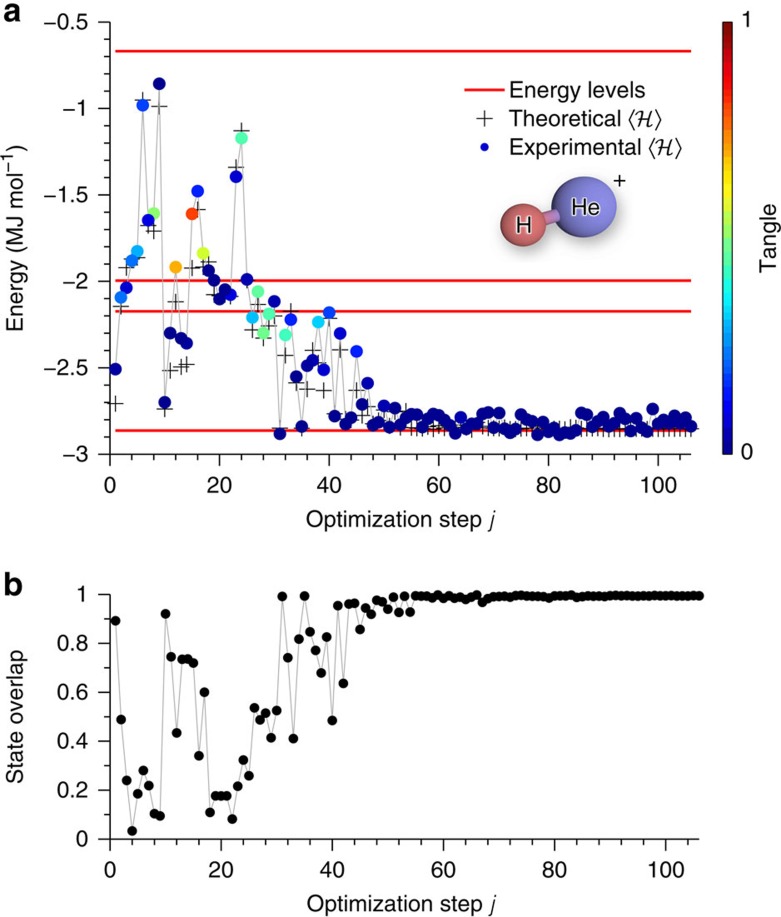
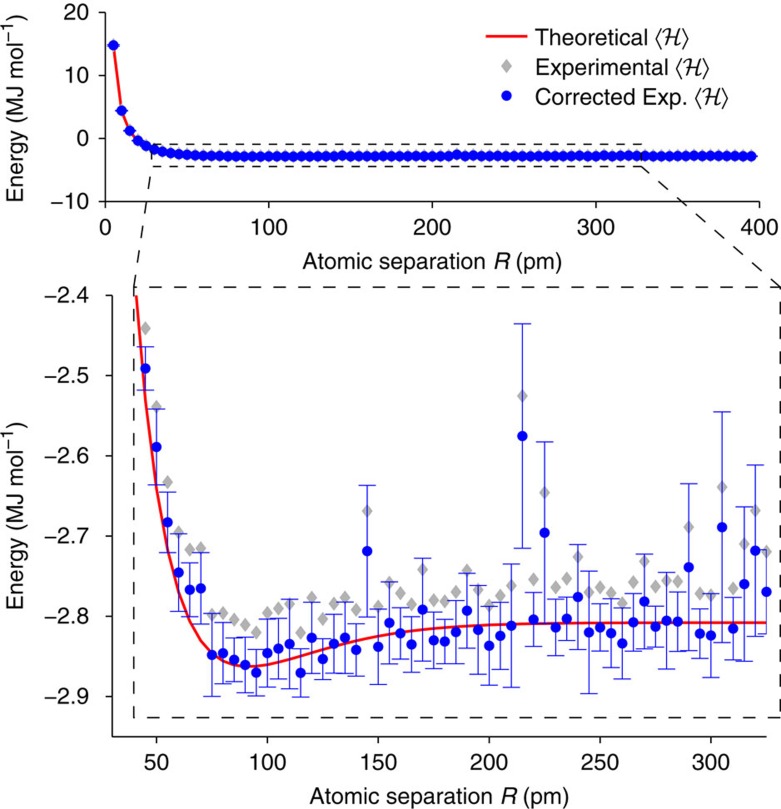
- The authors report an experimental ground-state result for He–H\(^+\): after correcting for experimental errors, they estimate the equilibrium bond length as \(R = 92.3 \pm 0.1\) pm and the ground-state electronic energy as \(E = -2.865 \pm 0.008\) MJ mol\(^{-1}\).
- For the bond dissociation curve, more than 96% of the experimental data are within chemical accuracy of the theoretical values.
- In the discussion, they state that for a 4 × 4 Hamiltonian like the one demonstrated, the QPE circuit would require at least 12 CNOT gates, whereas their method requires one.
- The full experiment was performed in about 158 h, and the bond dissociation curve was obtained by finding the ground states of 79 Hamiltonians.
## Methods
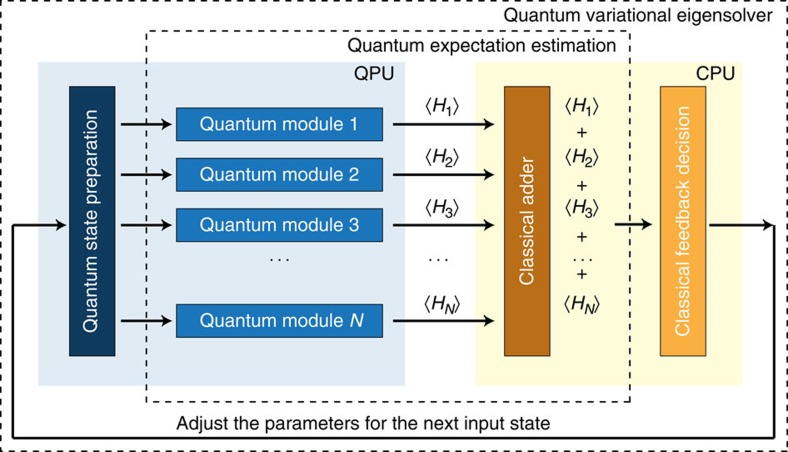
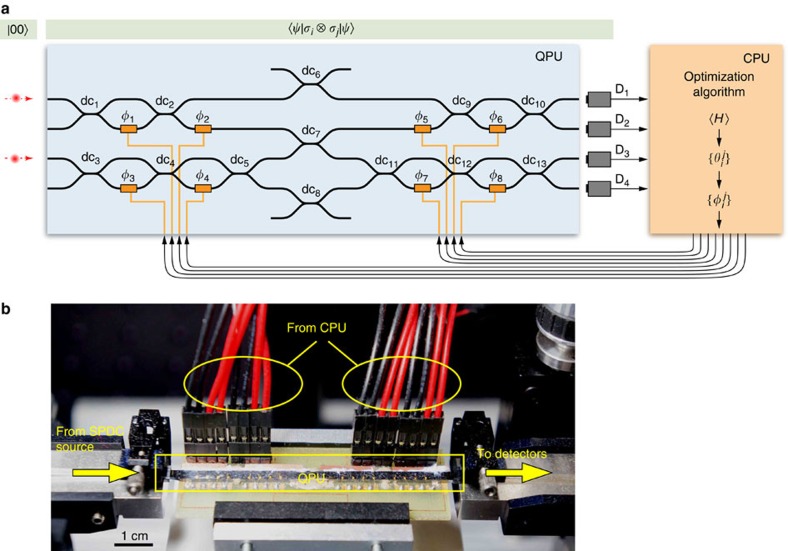
- The paper combines a reconfigurable integrated photonic quantum processor with a classical optimization algorithm: the quantum device estimates Hamiltonian expectation values, and the classical processor updates the state parameters variationally.
- The photonic chip prepares and measures arbitrary two-qubit pure states using single-qubit rotations and one two-qubit entangling gate; the experimental demonstration uses the He–H\(^+\) molecule in a minimal basis.
- For the classical optimization, they use the Nelder–Mead algorithm; expectation values are reconstructed from four two-qubit Pauli measurements at each point.
## Limitations
- The paper states that the method still requires a good approximation to the ground state as input/initialization, and the reliance on multiple separate measurements makes it sensitive to variations in state preparation between calculations.
- The authors report a constant systematic shift of \(\varepsilon = 50\) kJ mol\(^{-1}\) in the measured expectation values; they attribute this to photon-source impurity/distinguishability, circuit imperfections, and unbalanced coupling efficiencies.
- Evident from the text: the demonstration is limited to a two-qubit / 4 × 4 Hamiltonian prototype, so the scalability claim is not experimentally validated here.
Model-written summary. Check it against the paper before relying on it.
Integrity signals
Registry
Cites
Statistics
Figures
Verification
Claims the paper makes
7 Valid · 4 Not valid · 11 Not checked · 59 Own results and interpretations
The cited sources support only part of this claim — read each source’s verdict below.
In the paper
“Recent developments in the field of quantum computation offer a way forward for determining efficient solutions of many instances of large eigenvalue problems that are classically intractable6789101112”
§ A variational eigenvalue solver on a photonic quantum processor > Abstract
What the sources say
- Not matchedcites [6] Nielsen, M. A. & Chuang, I. L. Quantum Computation and Quantum Information Cambridge University Press (2000).
Couldn’t be matched to a paper in Crossref, so it can’t be checked.
- Could not verifycites [7] Kitaev, A. Quantum measurements and the Abelian stabilizer problem. Electronic Colloquium on Computational Complexity (ECCC) 3 (1996). sourceExperimental — accuracy not yet measured
Our copy under this DOI is the ISAAC 2021 paper 'Effective Resistance and Capacitance in Simplicial Complexes and a Quantum Algorithm' (Kitaev's 1995 work appears only as reference [9] in its bibliography), and it nowhere asserts that quantum computation gives efficient solutions to classically intractable large eigenvalue problems. Eigenvalues enter only as complexity parameters — λ, the smallest eigenvalue of the normalized up-Laplacian, in Lemma 31 and Theorem 26 (Section 6.3, 'Time efficient implementations') and in the phase-estimation machinery of Appendix A — and Section 1.1 ('Our Contributions') actually reports the opposite direction for its own problem: 'the quantum algorithm is slower than the classical algorithm in the worst case'. Searched: 'eigenvalue problems classically intractable', 'quantum speedup / exponential advantage', 'phase estimation', 'faster than classical'; no passage addresses the claim's point. (LLM, conf=0.70)
- Partly supportedcites [8] Griffiths, R. B. & Niu, C.-S. Semiclassical fourier transform for quantum computation. Phys. Rev. Lett. 76, 3228–3231 (1996). sourceExperimental — accuracy not yet measured
On p. 1, the paper says a quantum computer, if built, could solve certain problems such as factoring long numbers much faster than conventional algorithms. It also describes a simpler Fourier transform for Shor’s factorization and discrete-logarithm algorithms (p. 1). The copy does not support the claim about efficient solutions to many large eigenvalue problems. (LLM, conf=0.84)
plainstates a cause- Asserted: passes — The authors put it forward as true.
- Checkable: passes — It can be checked against evidence.
- Load-bearing: passes — The paper’s conclusions depend on it.
- Based: passes — The paper gives a reason why it holds.
- Not matched
Every source the paper cites for this claim was checked and supports it.
In the paper
“this would suffer from the N-representability problem, which is known to be intractable for both classical and quantum computers (it is in the quantum complexity class QMA-Hard24).”
§ A variational eigenvalue solver on a photonic quantum processor > Results > Quantum expectation estimation
What the sources say
- Supportedcites [24] Liu, Y.-K., Christandl, M. & Verstraete, F. Quantum computational complexity of the n-representability problem: Qma complete. Phys. Rev. Lett. 98, 110503 (2007). source
The paper states that N-representability is QMA-complete and hence QMA-hard and NP-hard (Abstract). Its discussion of quantum-chemistry relevance says the problem is intractable in the worst case even on a quantum computer, while allowing that particular physical systems may be easier. (LLM, conf=0.93)
boosted- Asserted: passes — The authors put it forward as true.
- Checkable: passes — It can be checked against evidence.
- Load-bearing: passes — The paper’s conclusions depend on it.
- Based: passes — The paper gives a reason why it holds.
- Supported
Every source the paper cites for this claim was checked and supports it.
In the paper
“We have implemented the QPU using integrated quantum photonics technology30.”
§ A variational eigenvalue solver on a photonic quantum processor > Results > Prototype demonstration
What the sources say
- Supportedcites [30] O'Brien, J. L., Furusawa, A. & Vuckovic, J. Photonic quantum technologies. Nat. Photon. 3, 687–695 (2009). source
The citation identifies integrated quantum photonics as the technology used, rather than attributing the citing authors’ QPU implementation to this review. The “Integrated quantum optical circuits” section (p. 6) describes on-chip waveguide circuits performing quantum logic gates and a compiled quantum factoring algorithm. (LLM, conf=0.87)
plain- Asserted: passes — The authors put it forward as true.
- Checkable: passes — It can be checked against evidence.
- Load-bearing: passes — The paper’s conclusions depend on it.
- Based: passes — The paper gives a reason why it holds.
- Supported
The cited sources support only part of this claim — read each source’s verdict below.
In the paper
“The time the quantum computer must remain coherent is determined by the necessity of O(p−1) successive applications of , each of which can require on the order of millions or billions of quantum gates for practical applications1719, as compared to the tens to hundreds of gates achievable in the short term.”
§ A variational eigenvalue solver on a photonic quantum processor > Abstract
What the sources say
- Partly supportedcites [17] Whitfield, J. D., Biamonte, J. & Aspuru-Guzik, A. Simulation of electronic structure hamiltonians using quantum computers. Mol. Phys. 109, 735–750 (2011). sourceExperimental — accuracy not yet measured
Split into 2 atoms — 1 confirmed, 1 partially supported, 0 disputed, 0 misattributed, 0 unverifiable. Expand the claim to see per-atom verdicts.
- Partly supportedcites [19] Jones, N. C. et al. Faster quantum chemistry simulation on fault-tolerant quantum computers. New J. Phys. 14, 115023 (2012). sourceExperimental — accuracy not yet measured
Split into 2 atoms — 0 confirmed, 2 partially supported, 0 disputed, 0 misattributed, 0 unverifiable. Expand the claim to see per-atom verdicts.
plainstates a cause- Asserted: passes — The authors put it forward as true.
- Checkable: passes — It can be checked against evidence.
- Load-bearing: passes — The paper’s conclusions depend on it.
- Based: passes — The paper gives a reason why it holds.
- Partly supported
A result the paper reports from its own data — it cites no other source for it, so there is none to check. The quote shows it is in the paper.
In the paper
“We experimentally demonstrate the feasibility of this approach with an example from quantum chemistry—calculating the ground-state molecular energy for He–H+.”
§ A variational eigenvalue solver on a photonic quantum processor > Abstract
boostedstates a causeSingle case- Asserted: passes — The authors put it forward as true.
- Checkable: passes — It can be checked against evidence.
- Load-bearing: passes — The paper’s conclusions depend on it.
- Based: passes — The paper gives a reason why it holds.
31 more claims
Create a free account to see all 81 claims and to verify the 4 references still open.
- It may state two separate claims as one. 28
- Probably not a substantial claim. 24
Claims other papers make about this one
Each is checked against this paper’s own text: does it say what the citing paper says it does?
The cited source doesn’t support the claim as written.
In the citing paper
“Leveraging quantum resources, the UCC ansatz was instead realized as a PQC on a photonic processor (Peruzzo et al. , 2014).”
From Noisy intermediate-scale quantum algorithms (2022) · cites this paper as Peruzzo et al., 2014
Checked by a reasoning model — may be wrong.
Experimental — accuracy not yet measuredThe cited source doesn’t support the claim as written.
In the citing paper
“The first on-chip GMM of four-qubit cluster state was realised in a laser-writing chip ( Fig.4e ), by manipulating both the polarisation and path DoFs of two photons [85].”
From Integrated photonic quantum technologies (2020) · cites this paper as [85]
Checked by a reasoning model — may be wrong.
Experimental — accuracy not yet measuredThe cited source doesn’t support the claim as written.
In the citing paper
“four-qubit linear- and box-cluster states are generated in a laser-writing photonic chip. This is enabled by on-chip manipulating the two-photon four-qubit hyperentangled state and cluster state, that are encoded in photon's path and polarisation DoFs. The Grover's search algorithm on a four-element database was implemented by controlling the device.”
From Integrated photonic quantum technologies (2020) · cites this paper as [85]
Checked by a reasoning model — may be wrong.
Experimental — accuracy not yet measuredThe source backs part of the claim, not all of it — or backs it for a different population, condition or comparison.
In the citing paper
“Due to its versatility, the variational Hamiltonian ansatz has been implemented for quantum chemistry [21, 29], optimization [24], and for quantum simulation problems [30].”
From Variational quantum algorithms (2021) · cites this paper as [29]
Experimental — accuracy not yet measuredThe source backs part of the claim, not all of it — or backs it for a different population, condition or comparison.
In the citing paper
“For the original VQE (Peruzzo et al. , 2014) and QAOA (Farhi et al. , 2014) it can, for example, be described as a single expectation value min θ ⟨ H ⟩ U ( θ ) , where the differences solely appear in the specific form and construction of the qubit Hamiltonian.”
From Noisy intermediate-scale quantum algorithms (2022) · cites this paper as Peruzzo et al., 2014
Experimental — accuracy not yet measured
12 more claims about this paper
Create a free account to see every claim other papers make about this one.
Citations
Cites
A Simplex Method for Function Minimization
Nelder, J. A., & Mead, R. (1965) · The Computer Journal · doi:10.1093/comjnl/7.4.308 · Cited by 28,905
Quantum computation and quantum information
Law, J. (2001) · ACM SIGSOFT Software Engineering Notes · doi:10.1145/505482.505499 · Cited by 18,842
(1999) · Cited by 12,854
Practical Methods of Optimization
Fletcher, R. (2000) · Wiley eBooks · doi:10.1002/9781118723203 · Cited by 7,605 · cited 3×
“[12] S.”
BackgroundMethodPractical methods of optimization
(1988) · Mathematics and Computers in Simulation · doi:10.1016/0378-4754(88)90129-2 · Cited by 5,818
Quantum Algorithm for Linear Systems of Equations
Harrow, A. W., Hassidim, A., & Lloyd, S. (2009) · Physical Review Letters · doi:10.1103/physrevlett.103.150502 · Cited by 3,325
Conn, A. R., Gould, N. I. M., & Toint, P. L. (2000) · Society for Industrial and Applied Mathematics eBooks · doi:10.1137/1.9780898719857 · Cited by 2,981 · cited 3×
“[14] D.”
MethodInfluential�ber das Paulische �quivalenzverbot
Jordan, P., & Wigner, E. (1928) · Zeitschrift f�r Physik · doi:10.1007/bf01331938 · Cited by 2,597
Molecular Electronic‐Structure Theory
Helgaker, T., Jørgensen, P., & Olsen, J. (2000) · doi:10.1002/9781119019572 · Cited by 2,594
O'Brien, J. L., Furusawa, A., & Vučković, J. (2009) · Nature Photonics · doi:10.1038/nphoton.2009.229 · Cited by 2,388
Self-citation
Research works printed but not linked: 3
- Helgaker, T., Jorgensen, P. & Olsen, J. Mol. Electronic Struct. Theory Wiley, Sussex (2002).
- Saad, Y. Numerical Methods for Large Eigenvalue Problems Vol. 158, (SIAM (1992).
- Rayleigh, J. W. In finding the correction for the open end of an organ-pipe. Phil. Trans. 161, 77 (1870).
Cited by
Items 2,801–2,900 of 4,572
Electronic Structure in a Fixed Basis is QMA-completePreprint
O’Gorman, B., Irani, S., Whitfield, J. D., & Fefferman, B. (2021) · arXiv (Cornell University) · doi:10.48550/arxiv.2103.08215 · Cited by 4
QFCNN: Quantum Fourier Convolutional Neural NetworkPreprint
Shen, F., & Liu, J. (2021) · arXiv (Cornell University) · doi:10.48550/arxiv.2106.10421 · Cited by 5
On-Surface Synthesis of a Doubly Anti-Aromatic Carbon Allotrope: Cyclo[16]carbonPreprint
Gao, Y., Albrecht, F., Rončević, I., Ettedgui, I., Kumar, P., Scriven, L. M., Christensen, K. E., Mishra, S., Righetti, L., Rossmannek, M., et al. (2023) · ChemRxiv · doi:10.26434/chemrxiv-2023-w124b · Cited by 4
Active SU(2) operation on Poincaré sphere
Saito, S. (2024) · Results in Physics · doi:10.48550/arxiv.2304.00013 · Cited by 9
Gsqas: Graph Self-Supervised Quantum Architecture SearchPreprint
He, Z., Deng, M., Zheng, S., Li, L., & Situ, H. (2023) · SSRN Electronic Journal · doi:10.2139/ssrn.4501980 · Cited by 6
Hybrid Quantum Algorithms and Quantum Software Development FrameworksPreprint
Ramouthar, R., & Şeker, H. (2023) · doi:10.14293/pr2199.000298.v1 · Cited by 7
Alexeev, Y., Amsler, M., Baity, P., Barroca, M. A., Bassini, S., Battelle, T., Camps, D., Casanova, D., Choi, Y. J., Chong, F. T., et al. (2023) · arXiv (Cornell University) · doi:10.48550/arxiv.2312.09733 · Cited by 4
Combinatorial optimization through variational quantum power method
Daskin, A. (2021) · Quantum Information Processing · doi:10.1007/s11128-021-03283-x · Cited by 4
“In order to maximize the probability P0; as in the standard variational quantum algorithm [5], a classical optimization algorithm such as NelderMead method [6] can be employed to determine the next values of θjs from the measurement output of the each individual qubits.”
MethodLimitations of Quantum Hardware for Molecular Energy Estimation Using VQE
Carreras, A., Orús, R., & Casanova, D. (2026) · Physical Chemistry Chemical Physics · doi:10.1039/d5cp03907j · Cited by 5
“Within the Noisy Intermediate-Scale Quantum (NISQ) era, Variational Quantum Eigensolvers (VQEs) [5] have emerged as one of the most promising algorithms for quantum chemistry applications.”
Implementing a Variational Quantum Eigensolver using Superconducting Qubits
Colless, J., Ramasesh, V., Dahlen, D., Blok, M., McClean, J., Carter, J., de Jong, W. A., & Siddiqi, I. (2017) · Quantum Information and Measurement (QIM) 2017 · doi:10.1364/qim.2017.qf6a.2 · Cited by 3
Self-citationQuantum technology for military applications
Krelina, M. (2021) · EPJ Quantum Technology · doi:10.1140/epjqt/s40507-021-00113-y · Cited by 176
“Simulating Molecules using VQE.”
BackgroundInfluentialAccounting for errors in quantum algorithms via individual error reduction
Otten, M., & Gray, S. K. (2019) · npj Quantum Information · doi:10.1038/s41534-019-0125-3 · Cited by 43
“While methods like quantum phase estimation(21) can give generally more accurate energies, VQE requires shorter circuits and has a natural robustness to noise.(2,13,22) VQE is not limited to quantum chemistry; it has also been used to study problems in nuclear physics.”
Calculating response functions of coupled oscillators using quantum phase estimation
Danz, S., Berta, M., Schröder, S., Kienast, P., Wilhelm, F. K., & Ciani, A. (2025) · Physical Review Research · doi:10.1103/5c6d-r1fb · Cited by 9
“Broadly speaking, one can distinguish between two categories of quantum algorithms for eigenproblems, namely algorithms based on the variational quantum eigensolver [5, 6], which lack rigorous scaling guarantees, and those based on the quantum phase estimation (QPE) subroutine [7–9].”
Deep Reinforcement Learning Strategies for Noise-Adaptive Qubit Routing
Pascoal, G. I. A. M., Fernandes, J. P., & Abreu, R. (2024) · IEEE International Conference on Quantum Software (QSW) · doi:10.1109/qsw62656.2024.00030 · Cited by 4
“Its broad set of potential applications, including quantum chemistry [1], machine learning [2]–[4], optimization [5], and simulation [6], has fostered research efforts and corporate investment [7], [8].”
BackgroundBenchmarking variational quantum algorithms for combinatorial optimization in practice
Schwägerl, T., Chai, Y., Hartung, T., Jansen, K., & Kühn, S. (2026) · Quantum Machine Intelligence · doi:10.1007/s42484-026-00355-y · Cited by 13
“Prominent examples are the quantum approximate optimization algorithm (QAOA) [15], the variational quantum eigensolver (VQE) [16] and numerous variations of both algorithms, which are reviewed in Ref.”
Tian, J., & Yang, W. (2024) · Entropy · doi:10.3390/e26110902 · Cited by 6
“Foundational works, such as the Quantum Approximate Optimization Algorithm [14] and the Variational Quantum Eigensolver [15], have paved the way for integrating quantum computing with neural network architectures.”
Efficient preparation of the AKLT State with Measurement-based Imaginary Time Evolution
Chen, T., & Byrnes, T. (2024) · Quantum · doi:10.22331/q-2024-12-10-1557 · Cited by 13
“Another approach that has gained recent popularity are variation approaches, such as the variational quantum eigensolver (VQE) [45, 46] and the quantum approximate optimization al-gorithm (QAOA) [47].”
Kanezashi, T., Tsukayama, D., Shirakashi, J., Shibuya, T., & Imai, H. (2025) · Applied Physics Express · doi:10.35848/1882-0786/adc5da · Cited by 3
A Quantum Computational Method for Corrosion Inhibition
Jain, N., & Felice, R. D. (2025) · Journal of Chemical Theory and Computation · doi:10.1021/acs.jctc.5c00469 · Cited by 5
Minami, S., Nakaji, K., Suzuki, Y., Aspuru‐Guzik, A., & Kadowaki, T. (2025) · Digital Discovery · doi:10.1039/d5dd00138b · Cited by 24
Self-citationProgramming Optical-Lattice Fermi-Hubbard Quantum Simulators
Tabares, C., Kokail, C., Zoller, P., González-Cuadra, D., & González-Tudela, A. (2025) · PRX Quantum · doi:10.1103/3nx4-bnyy · Cited by 18
Challenges and Advances in the Simulation of Targeted Covalent Inhibitors Using Quantum Computing
Chaudhuri, S., Huynh, B. C., Amory, R., Rogers, D. M., Cranney, A., Martínez-Martínez, L. Á., Macrì, T., Jones, G., Sheridan, E., Khedkar, A., et al. (2025) · The Journal of Physical Chemistry Letters · doi:10.1021/acs.jpclett.5c01680 · Cited by 8
Variational quantum algorithm for constrained topology optimization
Kim, J. E., & Wang, Y. (2025) · Quantum Science and Technology · doi:10.1088/2058-9565/adfc92 · Cited by 8
“Among the circuit-based computational approaches, variational quantum algorithms (VQAs) such as quantum approximate optimization algorithm (QAOA) [20, 21] and variational quantum eigensolver [22] are the most suitable ones to solve real-world problems on near-term quantum computers.”
Wang, Q., D’Cunha, R., Mitra, A., Gray, S. K., Otten, M., & Gagliardi, L. (2025) · The Journal of Physical Chemistry A · doi:10.1021/acs.jpca.5c03028 · Cited by 7
A repetitive amplitude encoding method for enhancing the mapping ability of quantum neural networks
Li, Z., Fu, X., Meng, L., & Du, R. (2025) · Scientific Reports · doi:10.1038/s41598-025-17651-5 · Cited by 8
“…[0, 3, 6], [1, 4, 7], [2, 5, 8], [3, 6, 9]; four classes: [1, 2, 3, 4], [1, 3, 5, 7], [2, 4, 6, 8], [5, 6, 7, 8]; five classes: [1, 2, 3, 4, 5], [1, 3, 5, 7, 9], [2, 4, 6, 8, 0], [6, 7, 8, 9, 0]; and six classes: [1, 2, 3, 4, 5, 6], [2, 3, 4, 5, 6, 7], [3, 4, 5, 6, 7, 8], [4, 5, 6, 7, 8, 9].”
InfluentialBridging quantum computing and nuclear structure: Atomic nuclei on a trapped-ion quantum computer
Yoshida, S., Sato, T., Ogata, T., & Kimura, M. (2026) · Physical Review Research · doi:10.1103/td9s-z7my · Cited by 13
“On near-term devices, variational approaches such as the Variational Quantum Eigensolver [2, 3] rely crucially on the choice of an ansatz that balances implementability and expressivity.”
Small graph perturbations, QAOA, and the MaxCut problem
Lavagna, L., Piperno, S., Ceschini, A., & Panella, M. (2025) · AVS Quantum Science · doi:10.1116/5.0253160 · Cited by 3
Ohgoe, T., Iwakiri, H., Ichikawa, K., Koh, S., & Kohda, M. (2025) · Journal of the Physical Society of Japan · doi:10.7566/jpsj.94.114002 · Cited by 10
“In this study, we use VQE [11] for the state preparation.”
Jha, R. K., Kasabov, N. K., Bhattacharyya, S., Coyle, D., & Prasad, G. (2025) · EPJ Quantum Technology · doi:10.1140/epjqt/s40507-025-00443-1 · Cited by 8
“Therefore, studies have been initiated in the direction of hybrid computational approaches that can leverage the strength of both classical and quantum resources to gain computational advantages [27].”
Almost fault-tolerant quantum machine learning with drastic overhead reduction
Kang, H., Kim, Y., Adermann, E., Sevior, M. E., & Usman, M. (2025) · Quantum Science and Technology · doi:10.1088/2058-9565/ae2157 · Cited by 8
Guha, D., Mitra, S., Kuiry, S., & Das, N. (2025) · Lecture notes in networks and systems · doi:10.1007/978-981-96-7742-9_20 · Cited by 6
Toward scalable quantum computations of atomic nuclei
Gu, C., Heinz, M., Kiss, O., & Papenbrock, T. (2026) · Physical Review C · doi:10.1103/gqdy-dvps · Cited by 14
“In this paper, we address how to construct scalable nuclear Hamiltonians and prepare initial states using the adaptive derivative-assembled pseudo-Trotter variational quantum eigensolver (ADAPT-VQE) [1, 60].”
InfluentialTensor-programmable quantum circuits for solving differential equations
Siegl, P., Reese, G. S., Hashizume, T., van Hülst, N.-L., & Jaksch, D. (2025) · Physical Review Research · doi:10.1103/2qzh-yf49 · Cited by 22
“…[18] algorithm and its extensions [19–22]; (ii) specific PDEs were solved efficiently with discrete time-stepping schemes [23, 24]; (iii) variational quantum algorithms (VQAs) [25–27], that rely on a hybrid scheme combining parameterized quantum circuits and a classical parameter optimization.”
Hakim, D. F., Prayitno, T. B., Choong, P. S., Sarwono, Y. P., & Kwek, L. C. (2026) · Physical Review A · doi:10.1103/jt1n-44dr · Cited by 5
Towards utility-scale electronic structure with sample-based quantum bootstrap embedding
Bierman, J., & Liu, Y. (2026) · Digital Discovery · doi:10.1039/d5dd00416k · Cited by 10
Khot, B. A. P., Mahadevaswamy, & Ittannavar, S. S. (2025) · International Conference on Software, Systems and Information Technology (SSITCON) · doi:10.1109/ssitcon66133.2025.11341965 · Cited by 4
Hardware‐Efficient Ansatz Variational Quantum Regression for Molecular Energy Prediction
Ramadhan, R. U., Permatahati, L. K., Prayitno, T. B., & Sarwono, Y. P. (2026) · ChemistrySelect · doi:10.1002/slct.202504473 · Cited by 6
Survey of Hybrid Quantum Generative Adversarial Networks
Badawy, W. M. (2025) · doi:10.1109/ic-ftai67960.2025.11384211 · Cited by 3
Mondal, D., Mukherjee, D., & Maitra, R. (2026) · The Journal of Chemical Physics · doi:10.1063/5.0307670 · Cited by 3
“The Variational Quantum Eigensolver (VQE) 3 is one of such algorithms for the determination of energetics of a molecular Hamiltonian.”
Chen, Z., & Yang, Y. (2026) · APL Computational Physics · doi:10.1063/5.0320607 · Cited by 4
Raedt, H. A. D., Kraus, J., Herten, A., Mehta, V., Bode, M., Hrywniak, M., Michielsen, K. F. L., & Lippert, T. (2026) · Future Generation Computer Systems · doi:10.1016/j.future.2026.108592 · Cited by 22
Wang, X., Feng, X., Funcke, L., Hartung, T., Jansen, K., Kühn, S., Polykratis, G., & Stornati, P. (2022) · International Symposium on Lattice Field Theory (LATTICE) · doi:10.22323/1.396.0603 · Cited by 4
Optimized Quantum Program Execution Ordering to Mitigate Errors in Simulations of Quantum Systems
Tomesh, T., Gui, K., Gokhale, P., Shi, Y., Chong, F. T., Martonosi, M., & Suchara, M. (2021) · IEEE International Conference on Rebooting Computing (ICRC) · doi:10.1109/icrc53822.2021.00013 · Cited by 15
Variational quantum simulation of the critical Ising model with symmetry averaging
Sewell, T. J., Bao, N., & Jordan, S. P. (2023) · Physical Review A · doi:10.1103/physreva.107.042620 · Cited by 6
“[10] Alberto Peruzzo, Jarrod McClean, Peter Shadbolt, Man-”
BackgroundThe set partitioning problem in a quantum context
Cação, R., Cortez, L. R. C. T., Forner, J., Validi, H., de Farias, I. R., & Hicks, I. V. (2023) · Optimization Letters · doi:10.1007/s11590-023-02029-1 · Cited by 4
“Peruzzo et al. [11] introduced the variational quantum eigensolver algorithm in the context of quantum chemistry.”
Xu, L., & Freericks, J. K. (2023) · Symmetry · doi:10.3390/sym15071429 · Cited by 6
Enabling Multi-threading in Heterogeneous Quantum-Classical Programming Models
Hayashi, A., Adams, A. S., Young, J., McCaskey, A., Dumitrescu, E., Sarkar, V., & Conte, T. M. (2023) · IEEE International Symposium on Parallel & Distributed Processing, Workshops and Phd Forum · doi:10.1109/ipdpsw59300.2023.00090 · Cited by 6
“VQE : VQE [21] optimizes a (Hamiltonian H ) cost function over a parameterized manifold of quantum states | ψ ( (cid:126)θ ) (cid:105) = U ( (cid:126)θ ) | ψ 0 (cid:105) as min (cid:126)θ ψ ( (cid:126)θ ) | H | ψ ( (cid:126)θ ) (cid:105) .”
Efficient Parameterised Compilation for Hybrid Quantum Programming
Krol, A. M., Mesman, K. J., Sarkar, A., & Al-Ars, Z. (2023) · IEEE International Conference on Quantum Computing and Engineering (QCE) · doi:10.1109/qce57702.2023.10192 · Cited by 4
“With VQE, quantum devices with as few as 40-50 qubits might outperform purely classical approaches [9].”
BackgroundQPLEX: Realizing the Integration of Quantum Computing into Combinatorial Optimization Software
Giraldo, J., Ossorio, J., Villegas, N. M., Tamura, G., & Stege, U. (2023) · IEEE International Conference on Quantum Computing and Engineering (QCE) · doi:10.1109/qce57702.2023.00118 · Cited by 5
“…into the specific instructions used by the target quantum device’s SDK. Ad-ditionally, the library offers a versatile gate-based algorithm execution workflow that is capable of running two gate-based quantum algorithms for optimization (i.e. QAOA [21] and VQE [22]) in a hardware-agnostic manner.”
BackgroundQNet: A Quantum-Native Sequence Encoder Architecture
Day, W., Chen, H., & Sun, M.-T. (2023) · IEEE International Conference on Quantum Computing and Engineering (QCE) · doi:10.1109/qce57702.2023.00035 · Cited by 4
Dual variational quantum eigensolver: A quantum algorithm to lower bound the ground-state energy
Westerheim, H., Chen, J., Holmes, Z., Luo, I., Nuradha, T., Patel, D., Rethinasamy, S., Wang, K., & Wilde, M. M. (2026) · Physical Review A · doi:10.1103/twrt-y691 · Cited by 13
“The variational quantum eigensolver (VQE) was the first such algorithm proposed [3]: it estimates an upper bound on the ground-state energy of a Hamiltonian.”
Optimal Clifford Initial States for Ising Hamiltonians
Bhattacharyya, B., & Ravi, G. S. (2023) · IEEE International Conference on Rebooting Computing (ICRC) · doi:10.1109/icrc60800.2023.10386971 · Cited by 9
“Variational quantum algorithms (VQAs) are anticipated to align well with NISQ machines, demonstrating a broad array of applications, including electronic energy estimation for molecules [21] and approximations for MAXCUT [4].”
BackgroundMethodProbabilistic tensor optimization of quantum circuits for the max−k−cut problem
Paradezhenko, G. V., Pervishko, A. A., & Yudin, D. (2024) · Physical Review A · doi:10.1103/physreva.109.012436 · Cited by 4
Nirmal, M. R., Yamijala, S. S. R. K. C., Ghosh, K., Kumar, S., & Nambiar, M. K. (2024) · International Conference on Communication Systems & Networks (COMSNETS) · doi:10.1109/comsnets59351.2024.10427294 · Cited by 4
“Since its introduction in 2014 [2], the variational quantum eigensolver (VQE) algorithm has been extensively applied in estimating the ground state energies of molecules on these devices.”
MethodSakurai, R., Backhouse, O. J., Booth, G. H., Mizukami, W., & Shinaoka, H. (2024) · Physical Review Research · doi:10.1103/physrevresearch.6.023110 · Cited by 5
“Ground-state calculation using VQE We use variational quantum eigensolver (VQE) [16, 41].”
BackgroundMethodStenger, J., Hellberg, C. S., & Gunlycke, D. (2024) · ACS Omega · doi:10.1021/acsomega.4c01642 · Cited by 5
Adaptive diversity-based quantum circuit architecture search
Huang, Y., Jin, S., Zeng, B., & Shao, Q. (2024) · Physical Review Research · doi:10.1103/physrevresearch.6.033033 · Cited by 11
Variational approach to learning photonic unitary operators
Bezuidenhout, H., Koni, M., Leach, J., Obando, P. C., Forbes, A., & Nape, I. M. (2024) · Optics Express · doi:10.1364/oe.532512 · Cited by 4
Safety with Non-Deterministic Control Action Selection Using Quantum Devices
Nieman, K., & Durand, H. (2024) · IFAC-PapersOnLine · doi:10.1016/j.ifacol.2024.08.413 · Cited by 3
“VQE (Peruzzo et al. (2014)) is designed to minimize the expectation value of a Hamiltonian using a parameterized quantum circuit, where the parameters are iteratively updated using a classical optimizer with gradient descent. expectation value of a Hamiltonian using a parameterized quantum circuit, where the parameter…”
InfluentialCan ML-Based Reliability Models Span Quantum Hardware Boundaries?
Ioannou, G., Kizhuvettil, G., Charrwi, M. W., & Saeed, S. M. (2024) · IEEE Computer Society Annual Symposium on VLSI · doi:10.1109/isvlsi61997.2024.00115 · Cited by 4
“While there are promising quantum algorithms for NISQ applications, such as variational quantum algorithms [1], [2], error mitigation remains a requirement to extract meaningful information from NISQ computers.”
MethodFull Software Control on MZI-Based Photonic Integrated Circuit
Kwon, Y. S., Bernard, M., Limongi, L., Piccoli, G., Ghulinyan, M., & Choi, B.-S. (2024) · IEEE Access · doi:10.1109/access.2024.3474014 · Cited by 3
“Also, the software platform could be considered to support testing special quantum algorithms such as the Quantum Approximate Optimization Algorithm or Variational Quantum Algorithms for solving quantum problems [45], [46], [47].”
MethodLi, H.-E., Li, X., Huang, J.-C., Zhang, G.-Z., Shen, Z.-P., Zhao, C., Li, J., & Hu, H. (2024) · The Journal of Chemical Physics · doi:10.1063/5.0228731 · Cited by 8
Yang, Y., Yang, R., & Xu, X. (2024) · Physical Review A · doi:10.1103/physreva.110.042623 · Cited by 4
Quantum Machine Learning Compiler for Hybrid Quantum-Classical Models
Srinidhi, S. K., Vishal, K. S., Shashank, U. S., & Belwal, M. (2024) · International Conference on Computing, Communication and Networking Technologies (ICCCNT) · doi:10.1109/icccnt61001.2024.10725839 · Cited by 3
“Peruzzo et al. [13] apply the Variational Quantum Eigensolver (VES) to compute eigenvalues and eigenstates of large matrices in quantum chemistry and physics, demonstrating accurate ground state energy estimation by combining classical optimization with quantum computation.”
MethodA Novel Noise-Aware Classical Optimizer for Variational Quantum Algorithms
Larson, J. M., Menickelly, M., & Shi, J. (2024) · INFORMS journal on computing · doi:10.1287/ijoc.2024.0578 · Cited by 14
Nonunitary Coupled Cluster Enabled by Midcircuit Measurements on Quantum Computers
Fleury, A., Brown, J., Lloyd, E., Hernandez, M., & Kim, I. H. (2024) · Journal of Chemical Theory and Computation · doi:10.1021/acs.jctc.4c00837 · Cited by 4
A Review on Quantum Machine Learning and Quantum Cryptography
Solar, M. (2024) · Memoria Investigaciones en Ingeniería · doi:10.36561/ing.27.12 · Cited by 2
Simplified projection on total spin zero for state preparation on quantum computers
Rule, E., Stetcu, I., & Carlson, J. (2024) · Physical Review C · doi:10.1103/physrevc.110.064003 · Cited by 4
“Symmetry restoration has been combined with variational quantum eigensolver methods [13, 14] to improve the determination of ground-state and excited-state energies of many-body systems [15–17].”
Quantum Hardware Roofline: Evaluating the Impact of Gate Expressivity on Quantum Processor Design
Kalloor, J., Weiden, M., Younis, E., Kubiatowicz, J. D., Jong, B. D., & Iancu, C. (2024) · IEEE International Conference on Quantum Computing and Engineering (QCE) · doi:10.1109/qce60285.2024.00100 · Cited by 14
piQture: A QML Library for Image Processing
Joshi, S., Justice, D., & Stege, U. (2024) · IEEE International Conference on Quantum Computing and Engineering (QCE) · doi:10.1109/qce60285.2024.10416 · Cited by 2
Decision Diagram vs. State Vector: A Comparative Study on Quantum Computing Simulation Efficiency
Kimura, Y., Li, S., Sato, H., & Fujita, M. (2024) · IEEE International Conference on Quantum Computing and Engineering (QCE) · doi:10.1109/qce60285.2024.00095 · Cited by 3
Munasinghe, T., Cornell, K. A., Wei, J., Berg, G., & Hendler, J. (2024) · IEEE International Conference on Big Data (BigData) · doi:10.1109/bigdata62323.2024.10826005 · Cited by 3
Quantum Computing Approach to Fixed-Node Monte Carlo Using Classical Shadows
Blunt, N. S., Caune, L., & Quiroz-Fernandez, J. (2025) · Journal of Chemical Theory and Computation · doi:10.1021/acs.jctc.4c01468 · Cited by 12
“There is now a large literature on how to prepare various quantum states as quantum circuits, that are challenging to prepare classically [13, 25–27].”
High-dimensional subspace expansion using classical shadows
Boyd, G., Koczor, B., & Cai, Z. (2025) · Physical Review A · doi:10.1103/physreva.111.022423 · Cited by 12
Classical and quantum algorithms for many-body problems
Ayral, T. (2025) · Comptes Rendus Physique · doi:10.5802/crphys.229 · Cited by 8
Tarocco, F., Materia, D., Ratini, L., & Guidoni, L. (2025) · Journal of Physics A Mathematical and Theoretical · doi:10.1088/1751-8121/adc4a1 · Cited by 5
“The variational principle, used in the Variational Quantum Eigensolver (VQE) algorithm [23, 24], states that the energy E obtained by exploiting a parametrized wavefunction Ψ( θ ) for a given system Hamiltonian H is strictly lower bounded by the ground state energy E 0 of the system H: The VQE…”
MethodQuCLEAR: Clifford Extraction and Absorption for Quantum Circuit Optimization
Liu, J., Gonzales, A., Huang, B., Saleem, Z. H., & Hovland, P. (2025) · IEEE International Symposium on High-Performance Computer Architecture (HPCA) · doi:10.1109/hpca61900.2025.00023 · Cited by 24
“Hybrid algorithms such as VQE [39] and QAOA [13] demonstrate that the evaluation of unitaries can be combined with classical optimizers on classical devices.”
Exact closed-form unitary transformations of fermionic operators
Evangelista, F. A., & Magoulas, I. (2025) · Physical Review A · doi:10.1103/physreva.111.042825 · Cited by 6
“Quantum-inspired classical algorithms based on unitary transformations of Pauli operators have also been proposed to block-diagonalize Hamiltonians [50] and to perform Heisenberg dynamics [22] and evaluate expectation values of operators [51].”
Variational LOCC-Assisted Quantum Circuits for Long-Range Entangled States
Yan, Y., Ma, M., Zhou, Y., & Ma, X. (2025) · Physical Review Letters · doi:10.1103/physrevlett.134.170601 · Cited by 21
“This subroutine is inspired by parameter shift rules [26–28], which directly hold for a single post-selected state Φ θ, v i .”
Quantum computing of magnetic-skyrmion-like patterns in Heisenberg ferromagnets
Komelj, M., Sršan, V., Žužek, K., & Šturm, S. (2025) · Physical Review Research · doi:10.1103/lq2d-s6zm · Cited by 3
“Therefore it makes sense to explore its properties by diagonalizing it using the variational quantum eigensolver (VQE)[13], which is a common tool for finding the ground state of a physical system in quantum chemistry and quantum magnetism[14].”
Phase diagram of the Schwinger model by adiabatic preparation of states on a quantum simulator
Kaikov, O., Saporiti, T., Sazonov, V., & Tamaazousti, M. (2025) · Physical Review A · doi:10.1103/physreva.111.062202 · Cited by 14
“Variational approaches, such as the variational quantum eigensolver (VQE) [39], can be computationally cheaper in comparison to adiabatic methods.”
Feedback-based optimally controlled quantum states
Brady, L. T., & Hadfield, S. (2025) · Physical Review A · doi:10.1103/physreva.111.062406 · Cited by 12
Osaba, E., Miranda-Rodriguez, P., Oikonomakis, A., Petrič, M., Ruiz, A., Bock, S., & Kourtis, M. (2025) · IEEE Congress on Evolutionary Computation (CEC) · doi:10.1109/cec65147.2025.11042978 · Cited by 8
“The authors in [17] propose using a QAOA and a Variational Quantum Eigensolver (VQE, [18]) to solve a drone collision avoidance problem.”
Chen, Y., Mendl, C. B., & Seidl, H. (2025) · Lecture notes in computer science · doi:10.1007/978-3-031-97632-2_10 · Cited by 5
Zhang, Y., Zhao, J., Jia, Y., & Shen, X. (2025) · Quantum Information Processing · doi:10.1007/s11128-025-04776-9 · Cited by 7
Estimation of Quantum Fisher Information via Stein's Identity in Variational Quantum Algorithms
Halla, M. (2025) · Quantum · doi:10.22331/q-2025-07-21-1798 · Cited by 12
“A particularly impactful algorithm within this class is the Variational Quantum Eigensolver (VQE) [4], which is designed to approximate ground-state energies of quantum systems, making it especially well-suited for near-term noisy intermediate-scale quantum (NISQ) devices.”
Efficient Encoding of the Traveling Salesperson Problem on a Quantum Computer
Stenger, J., Crowe, S., Diaz, J., Rodriguez, R., Gunlycke, D., & Ptasinski, J. (2025) · Quantum Reports · doi:10.3390/quantum7030032 · Cited by 4
Surrogate optimization of variational quantum circuits
Gustafson, E., Tiihonen, J., Chamaki, D., Sorourifar, F., Mullinax, J. W., Li, A. C. Y., Maciejewski, F. B., Sawaya, N. P. D., Krogel, J. T., Bernal, D. E., et al. (2025) · Proceedings of the National Academy of Sciences · doi:10.1073/pnas.2408530122 · Cited by 7
Singh, H., Bertels, L. W., Claudino, D., Economou, S. E., Barnes, E., Bauman, N. P., Kowalski, K., & Mayhall, N. J. (2025) · Journal of Chemical Theory and Computation · doi:10.1021/acs.jctc.5c00896 · Cited by 12
“14,18 A parameterized trial state | ψ ( ⃗θ ) ⟩ is prepared on the quantum processor via a parameterized quantum circuit corresponding to a unitary operator acting on a reference state: This trial state is then used to measure the expectation a r X i v : 2504 .”
Reducing quantum resources for attacking S-AES on quantum devices
Wang, Z., Zheng, M., Wu, J., Wen, K., Wei, S., & Long, G. (2025) · npj Quantum Information · doi:10.1038/s41534-025-01106-w · Cited by 6
ElBedoui, K., Lakhal, N. B., & Barhoumi, W. (2025) · The Journal of Supercomputing · doi:10.1007/s11227-025-07789-4 · Cited by 4
Qu, Z., Zhou, M., Sun, L., Yu, Y., & Muhammad, G. (2025) · IEEE Internet of Things Journal · doi:10.1109/jiot.2025.3621725 · Cited by 4
“Peruzzo et al. [19] introduced a hybrid quantum-classical algorithm using variational quantum circuits (VQCs), which established the paradigm for later models such as quantum classifiers and QNNs. Building on QNN theory, quantum CNNs (QCNNs) have gained attention for their ability to model local and…”
Fourier Analysis of Variational Quantum Circuits for Supervised Learning
Wiedmann, M., Periyasamy, M., & Scherer, D. D. (2025) · IEEE International Conference on Quantum Computing and Engineering (QCE) · doi:10.1109/qce65121.2025.00196 · Cited by 21
“Variational quantum algorithms (VQAs) have garnered a lot of attention in recent years as potentially demonstrating quantum utility in a plethora of fields like e.g. quantum chemistry [1]–[5], quantum machine learning (QML) [6]–[10] and quantum reinforcement learning [11]–[15].”
Quantum-classical reinforcement learning for decoding noisy classical parity information
Park, D. K., Park, J., & Rhee, J.-K. K. (2020) · Quantum Machine Intelligence · doi:10.1007/s42484-020-00019-5 · Cited by 4
Quantifying Athermality and Quantum Induced Deviations from Classical Fluctuation Relations
Holmes, Z., Mingo, E. H., Chen, C., & Mintert, F. (2020) · Entropy · doi:10.3390/e22010111 · Cited by 4
“This could perhaps be best performed on a quantum computer by utilising methods for Hamiltonian simulation [76,77] and with the thermal system modelled using “pre-processing” [40].”
MethodQuantum in the Cloud: Application Potentials and Research Opportunities
Leymann, F., Barzen, J., Falkenthal, M., Vietz, D., Weder, B., & Wild, K. (2020) · International Conference on Cloud Computing and Services Science · doi:10.5220/0009819800090024 · Cited by 87
“One example is a hybrid algorithm called Variational Quantum Eigensolver for determining eigenvalues (Peruzzo et al., 2014).”
MethodExperimental semi-autonomous eigensolver using reinforcement learning
Pan, C.-Y., Hao, M., Barraza, N., Solano, E., & Albarrán-Arriagada, F. (2021) · Scientific Reports · doi:10.1038/s41598-021-90534-7 · Cited by 3
Sparse-Hamiltonian approach to the time-evolution of molecules on quantum computers
Daniel, C., Dhawan, D., Zgid, D., & Freericks, J. K. (2021) · The European Physical Journal Special Topics · doi:10.1140/epjs/s11734-021-00098-w · Cited by 5
Quantum computing hardware in the cloud: Should a computational chemist care?
Rossi, A., Baity, P. G., Schäfer, V. M., & Weides, M. (2021) · International Journal of Quantum Chemistry · doi:10.1002/qua.26688 · Cited by 5
Quantum computing hardware in the cloud : should a computational chemist care?
Rossi, A., Baity, P., Schäfer, V. M., & Weides, M. P. (2021) · Strathprints: The University of Strathclyde institutional repository (University of Strathclyde) · Cited by 3
Metadata
- Authors
- Peruzzo, A., McClean, J., Shadbolt, P., Yung, M.-H., Zhou, X.-Q., Love, P. J., Aspuru-Guzik, A., & O’Brien, J. L.
- Affiliations
- The University of Sydney (AU)
- Harvard University (US)
- University of Bristol (GB)
- Haverford College (US)
- Corresponding author
- Peruzzo, Alberto
- O’Brien, Jeremy L.
- Venue
- Nature Communications
- Published
- 2014-07-23
- Volume
- 5
- Issue
- 1
- Pages
- 4213-4213
- ISSN
- 2041-1723 (ISSN-L)
- PMC
- PMC4124861
- OpenAlex
- W2161685427
- Cited by
- 4,552
- References
- 48
- Citations by year
- 2026: 591 · 2025: 765 · 2024: 722 · 2023: 658 · 2022: 564 · 2021: 561 · 2020: 346 · 2019: 191 · 2018: 83 · 2017: 29 · 2016: 18 · 2015: 16 · 2014: 4
- FWCI
- 22.24
- Type
- journal article
- Language
- en
- Open access
- hybrid
- doi.org
- Licence
- cc-by-nc-nd
- creativecommons.org/licenses/by-nc-nd/4.0 (tdm)
- creativecommons.org/licenses/by-nc-nd/4.0 (vor)
- Locations
- Nature Communications (publishedVersion, cc-by-nc-nd)
- Europe PMC (PubMed Central) (publishedVersion, cc-by-nc-nd)
- PubMed Central (publishedVersion, cc-by-nc-nd)
- PubMed (publishedVersion)
- arXiv (Cornell University) (submittedVersion)
- OSTI OAI (U.S. Department of Energy Office of Scientific and Technical Information) (submittedVersion, cc-by-nc-nd)
- Digital Access to Scholarship at Harvard (DASH) (Harvard University) (submittedVersion, cc-by)
- RePEc: Research Papers in Economics (submittedVersion)
- RMIT Research Repository (RMIT University Library) (submittedVersion, cc-by-nc-nd)
- Figshare (submittedVersion, cc-by-nc-nd)
- UWA Profiles and Research Repository (UWA) (submittedVersion, cc-by-nc-nd)
- Bristol Research (University of Bristol) (submittedVersion)
- arXiv (Cornell University)
- Funders
- National Science Foundation (DE-FG02-97ER25308, 0955518, 1037992)
- U.S. Department of Energy (DEFG0297ER25308, DE‐FG02‐, FG02-97ER25308)
- Alfred P. Sloan Foundation
- John Templeton Foundation
- Camille and Henry Dreyfus Foundation
- Royal Academy of Engineering
- National Natural Science Foundation of China (61033001, 61361136003)
- Engineering and Physical Sciences Research Council (EP/J017175/1, EP/L024020/1, EP/K021931/1)
- Australian Research Council (DE140101700)
- National Key Research and Development Program of China (61033001, 2011CBA00301, 61361136003, 2011CBA00300)
- Division of Chemistry (CHE-1037992)
- Air Force Office of Scientific Research (FA 9550-12-1-0046, FA9550-, FA9550-12, FA9550‐12‐1)
- Topics
- Physical Sciences › Computer Science › Artificial Intelligence › Quantum Computing Algorithms and Architecture
- Physical Sciences › Physics and Astronomy › Atomic and Molecular Physics, and Optics › Quantum Information and Cryptography
- Physical Sciences › Physics and Astronomy › Atomic and Molecular Physics, and Optics › Quantum many-body systems
- Keywords
- variational quantum eigensolver, photonic quantum processors, quantum chemistry, classical optimization, hybrid quantum-classical computation
About these checks
Registry, retraction, Cites and statistics results are computed, not judged, with one exception: a printed reference that no index lists is read once by a model before it counts as a citation error. Claims are extracted by a model and kept only when their quote appears verbatim in the text; each cited source is then checked, with a model’s help, for whether it says what the claim relies on. Those verdicts can be wrong — read the claim’s quote and the cited source before relying on one.
The claim verdicts this report counts are experimental: their accuracy is not yet measured.
A language model drew the claims from the paper on 2026-10-10, under version 3 of the claim definition (model deepseek-v4.1-flash, prompt extract-v3).
A second model labelled each claim on 2026-10-10 (model jev-1.13-20260917, definition revision gold-guideline-v0.2).
Cited sources are checked with a language model’s help (qwen3.8-omni-flash and gpt-6-sol).
Statistics and arithmetic are recomputed, not judged.
Confidence bands are shown only for fields calibrated on our annotated test set. None is calibrated yet, so no band is shown.
What counts as a claim ›How we measure confidence ›How we check this ›
Are you an author, or do you see a problem with this page? Request a review
Data sources
Bibliographic data: Semantic Scholar, OpenAlex, Crossref.
Contains information from the Semantic Scholar Academic Graph Datasets, made available under the ODC Attribution License (ODC-BY 1.0).
Semantic Scholar’s data is described in: Kinney, R., et al. (2023). The Semantic Scholar Open Data Platform. arXiv:2301.10140.
