

A variational eigenvalue solver on a photonic quantum processor
Open accessThe DOI matches its Crossref record; 47 of the 48 references it cites were found in a registry or an index; 14 of the 31 sources its claims cite were checked for support.
Abstract
Quantum computers promise to efficiently solve important problems that are intractable on a conventional computer. For quantum systems, where the physical dimension grows exponentially, finding the eigenvalues of certain operators is one such intractable problem and remains a fundamental challenge. The quantum phase estimation algorithm efficiently finds the eigenvalue of a given eigenvector but requires fully coherent evolution. Here we present an alternative approach that greatly reduces the requirements for coherent evolution and combine this method with a new approach to state preparation based on ansätze and classical optimization. We implement the algorithm by combining a highly reconfigurable photonic quantum processor with a conventional computer. We experimentally demonstrate the feasibility of this approach with an example from quantum chemistry—calculating the ground-state molecular energy for He–H+. The proposed approach drastically reduces the coherence time requirements, enhancing the potential of quantum resources available today and in the near future. Quantum computers promise to efficiently solve problems that would be practically impossible with a normal computer. Peruzzo et al. develop a variational computation approach that uses any available quantum resources and, with a photonic quantum processing unit, find the ground-state molecular energy of He–H+.
Overview
CoChat Summary
## TL;DR
The paper introduces a variational alternative to quantum phase estimation for finding eigenvalues, combining short coherent quantum measurements with classical optimization. It experimentally demonstrates the approach on a photonic processor by estimating the ground-state energy curve of He–H\(^+\).
## Key findings
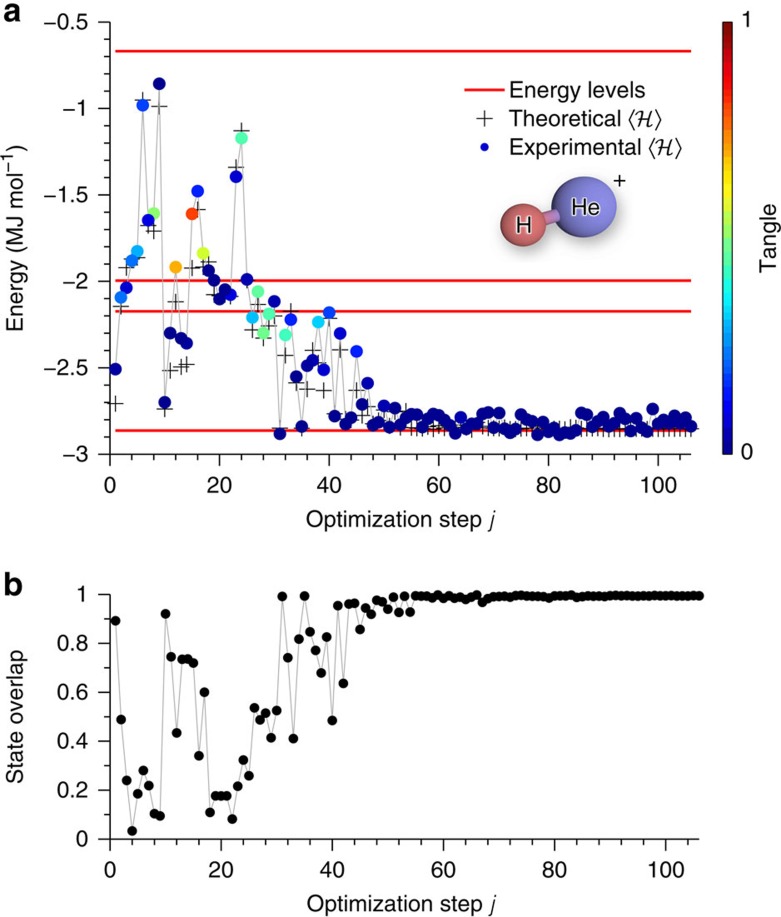
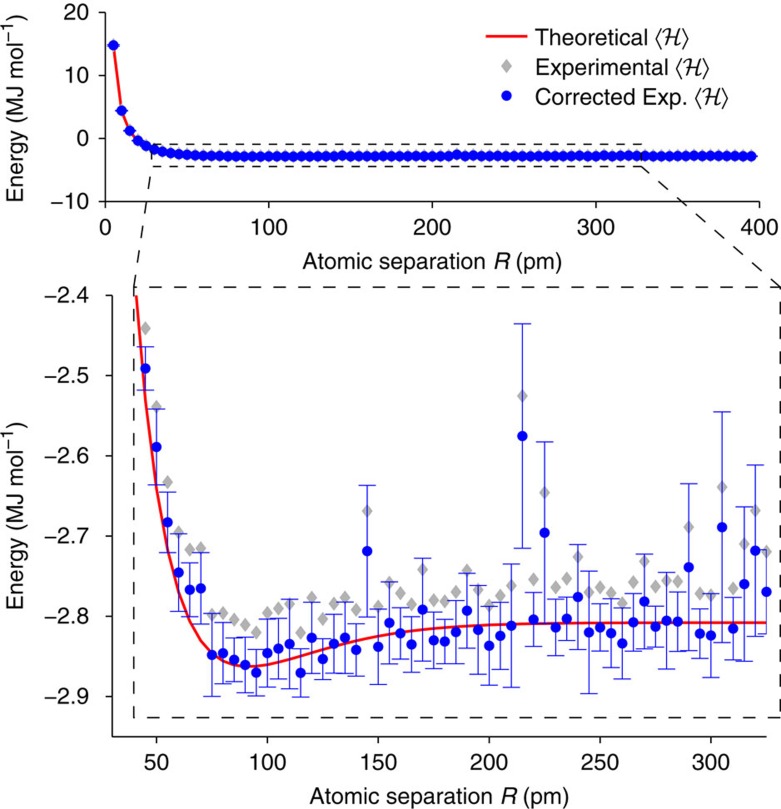
- The authors report an experimental ground-state result for He–H\(^+\): after correcting for experimental errors, they estimate the equilibrium bond length as \(R = 92.3 \pm 0.1\) pm and the ground-state electronic energy as \(E = -2.865 \pm 0.008\) MJ mol\(^{-1}\).
- For the bond dissociation curve, more than 96% of the experimental data are within chemical accuracy of the theoretical values.
- In the discussion, they state that for a 4 × 4 Hamiltonian like the one demonstrated, the QPE circuit would require at least 12 CNOT gates, whereas their method requires one.
- The full experiment was performed in about 158 h, and the bond dissociation curve was obtained by finding the ground states of 79 Hamiltonians.
## Methods
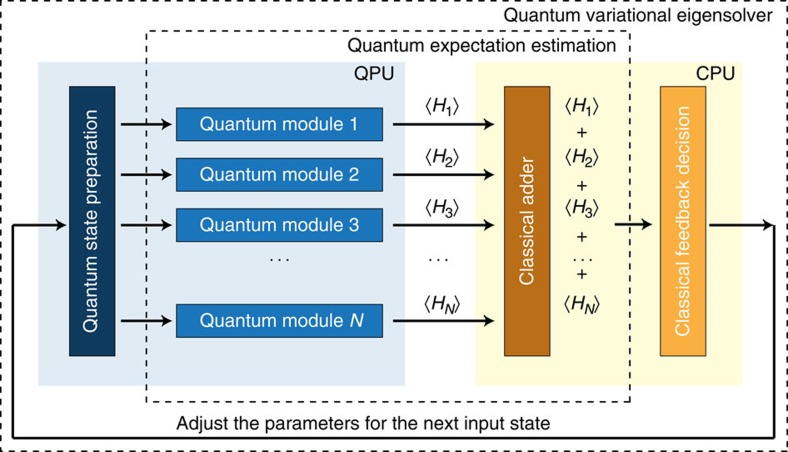
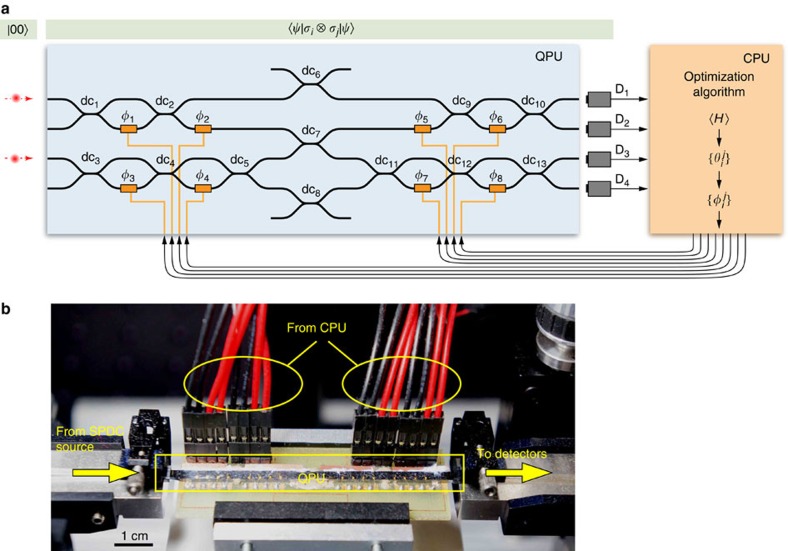
- The paper combines a reconfigurable integrated photonic quantum processor with a classical optimization algorithm: the quantum device estimates Hamiltonian expectation values, and the classical processor updates the state parameters variationally.
- The photonic chip prepares and measures arbitrary two-qubit pure states using single-qubit rotations and one two-qubit entangling gate; the experimental demonstration uses the He–H\(^+\) molecule in a minimal basis.
- For the classical optimization, they use the Nelder–Mead algorithm; expectation values are reconstructed from four two-qubit Pauli measurements at each point.
## Limitations
- The paper states that the method still requires a good approximation to the ground state as input/initialization, and the reliance on multiple separate measurements makes it sensitive to variations in state preparation between calculations.
- The authors report a constant systematic shift of \(\varepsilon = 50\) kJ mol\(^{-1}\) in the measured expectation values; they attribute this to photon-source impurity/distinguishability, circuit imperfections, and unbalanced coupling efficiencies.
- Evident from the text: the demonstration is limited to a two-qubit / 4 × 4 Hamiltonian prototype, so the scalability claim is not experimentally validated here.
Model-written summary. Check it against the paper before relying on it.
Integrity signals
Registry
Cites
Statistics
Figures
Verification
Claims the paper makes
7 Valid · 4 Not valid · 11 Not checked · 59 Own results and interpretations
The cited sources support only part of this claim — read each source’s verdict below.
In the paper
“Recent developments in the field of quantum computation offer a way forward for determining efficient solutions of many instances of large eigenvalue problems that are classically intractable6789101112”
§ A variational eigenvalue solver on a photonic quantum processor > Abstract
What the sources say
- Not matchedcites [6] Nielsen, M. A. & Chuang, I. L. Quantum Computation and Quantum Information Cambridge University Press (2000).
Couldn’t be matched to a paper in Crossref, so it can’t be checked.
- Could not verifycites [7] Kitaev, A. Quantum measurements and the Abelian stabilizer problem. Electronic Colloquium on Computational Complexity (ECCC) 3 (1996). sourceExperimental — accuracy not yet measured
Our copy under this DOI is the ISAAC 2021 paper 'Effective Resistance and Capacitance in Simplicial Complexes and a Quantum Algorithm' (Kitaev's 1995 work appears only as reference [9] in its bibliography), and it nowhere asserts that quantum computation gives efficient solutions to classically intractable large eigenvalue problems. Eigenvalues enter only as complexity parameters — λ, the smallest eigenvalue of the normalized up-Laplacian, in Lemma 31 and Theorem 26 (Section 6.3, 'Time efficient implementations') and in the phase-estimation machinery of Appendix A — and Section 1.1 ('Our Contributions') actually reports the opposite direction for its own problem: 'the quantum algorithm is slower than the classical algorithm in the worst case'. Searched: 'eigenvalue problems classically intractable', 'quantum speedup / exponential advantage', 'phase estimation', 'faster than classical'; no passage addresses the claim's point. (LLM, conf=0.70)
- Partly supportedcites [8] Griffiths, R. B. & Niu, C.-S. Semiclassical fourier transform for quantum computation. Phys. Rev. Lett. 76, 3228–3231 (1996). sourceExperimental — accuracy not yet measured
On p. 1, the paper says a quantum computer, if built, could solve certain problems such as factoring long numbers much faster than conventional algorithms. It also describes a simpler Fourier transform for Shor’s factorization and discrete-logarithm algorithms (p. 1). The copy does not support the claim about efficient solutions to many large eigenvalue problems. (LLM, conf=0.84)
plainstates a cause- Asserted: passes — The authors put it forward as true.
- Checkable: passes — It can be checked against evidence.
- Load-bearing: passes — The paper’s conclusions depend on it.
- Based: passes — The paper gives a reason why it holds.
- Not matched
Every source the paper cites for this claim was checked and supports it.
In the paper
“this would suffer from the N-representability problem, which is known to be intractable for both classical and quantum computers (it is in the quantum complexity class QMA-Hard24).”
§ A variational eigenvalue solver on a photonic quantum processor > Results > Quantum expectation estimation
What the sources say
- Supportedcites [24] Liu, Y.-K., Christandl, M. & Verstraete, F. Quantum computational complexity of the n-representability problem: Qma complete. Phys. Rev. Lett. 98, 110503 (2007). source
The paper states that N-representability is QMA-complete and hence QMA-hard and NP-hard (Abstract). Its discussion of quantum-chemistry relevance says the problem is intractable in the worst case even on a quantum computer, while allowing that particular physical systems may be easier. (LLM, conf=0.93)
boosted- Asserted: passes — The authors put it forward as true.
- Checkable: passes — It can be checked against evidence.
- Load-bearing: passes — The paper’s conclusions depend on it.
- Based: passes — The paper gives a reason why it holds.
- Supported
Every source the paper cites for this claim was checked and supports it.
In the paper
“We have implemented the QPU using integrated quantum photonics technology30.”
§ A variational eigenvalue solver on a photonic quantum processor > Results > Prototype demonstration
What the sources say
- Supportedcites [30] O'Brien, J. L., Furusawa, A. & Vuckovic, J. Photonic quantum technologies. Nat. Photon. 3, 687–695 (2009). source
The citation identifies integrated quantum photonics as the technology used, rather than attributing the citing authors’ QPU implementation to this review. The “Integrated quantum optical circuits” section (p. 6) describes on-chip waveguide circuits performing quantum logic gates and a compiled quantum factoring algorithm. (LLM, conf=0.87)
plain- Asserted: passes — The authors put it forward as true.
- Checkable: passes — It can be checked against evidence.
- Load-bearing: passes — The paper’s conclusions depend on it.
- Based: passes — The paper gives a reason why it holds.
- Supported
The cited sources support only part of this claim — read each source’s verdict below.
In the paper
“The time the quantum computer must remain coherent is determined by the necessity of O(p−1) successive applications of , each of which can require on the order of millions or billions of quantum gates for practical applications1719, as compared to the tens to hundreds of gates achievable in the short term.”
§ A variational eigenvalue solver on a photonic quantum processor > Abstract
What the sources say
- Partly supportedcites [17] Whitfield, J. D., Biamonte, J. & Aspuru-Guzik, A. Simulation of electronic structure hamiltonians using quantum computers. Mol. Phys. 109, 735–750 (2011). sourceExperimental — accuracy not yet measured
Split into 2 atoms — 1 confirmed, 1 partially supported, 0 disputed, 0 misattributed, 0 unverifiable. Expand the claim to see per-atom verdicts.
- Partly supportedcites [19] Jones, N. C. et al. Faster quantum chemistry simulation on fault-tolerant quantum computers. New J. Phys. 14, 115023 (2012). sourceExperimental — accuracy not yet measured
Split into 2 atoms — 0 confirmed, 2 partially supported, 0 disputed, 0 misattributed, 0 unverifiable. Expand the claim to see per-atom verdicts.
plainstates a cause- Asserted: passes — The authors put it forward as true.
- Checkable: passes — It can be checked against evidence.
- Load-bearing: passes — The paper’s conclusions depend on it.
- Based: passes — The paper gives a reason why it holds.
- Partly supported
A result the paper reports from its own data — it cites no other source for it, so there is none to check. The quote shows it is in the paper.
In the paper
“We experimentally demonstrate the feasibility of this approach with an example from quantum chemistry—calculating the ground-state molecular energy for He–H+.”
§ A variational eigenvalue solver on a photonic quantum processor > Abstract
boostedstates a causeSingle case- Asserted: passes — The authors put it forward as true.
- Checkable: passes — It can be checked against evidence.
- Load-bearing: passes — The paper’s conclusions depend on it.
- Based: passes — The paper gives a reason why it holds.
31 more claims
Create a free account to see all 81 claims and to verify the 4 references still open.
- It may state two separate claims as one. 28
- Probably not a substantial claim. 24
Claims other papers make about this one
Each is checked against this paper’s own text: does it say what the citing paper says it does?
The cited source doesn’t support the claim as written.
In the citing paper
“Leveraging quantum resources, the UCC ansatz was instead realized as a PQC on a photonic processor (Peruzzo et al. , 2014).”
From Noisy intermediate-scale quantum algorithms (2022) · cites this paper as Peruzzo et al., 2014
Checked by a reasoning model — may be wrong.
Experimental — accuracy not yet measuredThe cited source doesn’t support the claim as written.
In the citing paper
“The first on-chip GMM of four-qubit cluster state was realised in a laser-writing chip ( Fig.4e ), by manipulating both the polarisation and path DoFs of two photons [85].”
From Integrated photonic quantum technologies (2020) · cites this paper as [85]
Checked by a reasoning model — may be wrong.
Experimental — accuracy not yet measuredThe cited source doesn’t support the claim as written.
In the citing paper
“four-qubit linear- and box-cluster states are generated in a laser-writing photonic chip. This is enabled by on-chip manipulating the two-photon four-qubit hyperentangled state and cluster state, that are encoded in photon's path and polarisation DoFs. The Grover's search algorithm on a four-element database was implemented by controlling the device.”
From Integrated photonic quantum technologies (2020) · cites this paper as [85]
Checked by a reasoning model — may be wrong.
Experimental — accuracy not yet measuredThe source backs part of the claim, not all of it — or backs it for a different population, condition or comparison.
In the citing paper
“Due to its versatility, the variational Hamiltonian ansatz has been implemented for quantum chemistry [21, 29], optimization [24], and for quantum simulation problems [30].”
From Variational quantum algorithms (2021) · cites this paper as [29]
Experimental — accuracy not yet measuredThe source backs part of the claim, not all of it — or backs it for a different population, condition or comparison.
In the citing paper
“For the original VQE (Peruzzo et al. , 2014) and QAOA (Farhi et al. , 2014) it can, for example, be described as a single expectation value min θ ⟨ H ⟩ U ( θ ) , where the differences solely appear in the specific form and construction of the qubit Hamiltonian.”
From Noisy intermediate-scale quantum algorithms (2022) · cites this paper as Peruzzo et al., 2014
Experimental — accuracy not yet measured
12 more claims about this paper
Create a free account to see every claim other papers make about this one.
Citations
Cites
A Simplex Method for Function Minimization
Nelder, J. A., & Mead, R. (1965) · The Computer Journal · doi:10.1093/comjnl/7.4.308 · Cited by 28,905
Quantum computation and quantum information
Law, J. (2001) · ACM SIGSOFT Software Engineering Notes · doi:10.1145/505482.505499 · Cited by 18,842
(1999) · Cited by 12,854
Practical Methods of Optimization
Fletcher, R. (2000) · Wiley eBooks · doi:10.1002/9781118723203 · Cited by 7,605 · cited 3×
“[12] S.”
BackgroundMethodPractical methods of optimization
(1988) · Mathematics and Computers in Simulation · doi:10.1016/0378-4754(88)90129-2 · Cited by 5,818
Quantum Algorithm for Linear Systems of Equations
Harrow, A. W., Hassidim, A., & Lloyd, S. (2009) · Physical Review Letters · doi:10.1103/physrevlett.103.150502 · Cited by 3,325
Conn, A. R., Gould, N. I. M., & Toint, P. L. (2000) · Society for Industrial and Applied Mathematics eBooks · doi:10.1137/1.9780898719857 · Cited by 2,981 · cited 3×
“[14] D.”
MethodInfluential�ber das Paulische �quivalenzverbot
Jordan, P., & Wigner, E. (1928) · Zeitschrift f�r Physik · doi:10.1007/bf01331938 · Cited by 2,597
Molecular Electronic‐Structure Theory
Helgaker, T., Jørgensen, P., & Olsen, J. (2000) · doi:10.1002/9781119019572 · Cited by 2,594
O'Brien, J. L., Furusawa, A., & Vučković, J. (2009) · Nature Photonics · doi:10.1038/nphoton.2009.229 · Cited by 2,388
Self-citation
Research works printed but not linked: 3
- Helgaker, T., Jorgensen, P. & Olsen, J. Mol. Electronic Struct. Theory Wiley, Sussex (2002).
- Saad, Y. Numerical Methods for Large Eigenvalue Problems Vol. 158, (SIAM (1992).
- Rayleigh, J. W. In finding the correction for the open end of an organ-pipe. Phil. Trans. 161, 77 (1870).
Cited by
Items 3,001–3,100 of 4,572
Towards Efficient Superconducting Quantum Processor Architecture DesignPreprint
Li, G., Ding, Y., & Xie, Y. (2019) · arXiv (Cornell University) · doi:10.48550/arxiv.1911.12879 · Cited by 3
“3378500 1 Introduction As a promising computation paradigm, Quantum Computing (QC) has been rapidly growing in the last two decades and found its strong potential in many important areas, including machine learning [14, 20], chemistry simulation [32, 39], etc.”
BackgroundMethodTILT: Achieving Higher Fidelity on a Trapped-Ion Linear-Tape Quantum Computing ArchitecturePreprint
Wu, X.-C., Debroy, D. M., Ding, Y., et al. (2020) · arXiv (Cornell University) · doi:10.48550/arxiv.2010.15876 · Cited by 3
“By leveraging the quan tum mechanical principles of superposition and entangle ment, QC algorithms have the potential to revolutionize areas such as machine learning [11], quantum chemistry [43,69], and cryptography [76].”
MethodGradient-free quantum optimization on NISQ devices.Preprint
Franken, L., Georgiev, B., Mücke, S., Wolter, M., Piatkowski, N., & Bauckhage, C. (2020) · arXiv (Cornell University) · Cited by 4
On the Impossibility of General Parallel Fast-Forwarding of Hamiltonian Simulation
Chia, N.-H., Chung, K.-M., Hsieh, Y.-C., Lin, H.-H., Lin, Y.-T., & Shen, Y.-C. (2023) · DROPS (Schloss Dagstuhl – Leibniz Center for Informatics) · doi:10.4230/lipics.ccc.2023.33 · Cited by 7
Stair, N. H., & Evangelista, F. A. (2021) · arXiv (Cornell University) · doi:10.48550/arxiv.2108.04413 · Cited by 3
Kawashima, Y., Lloyd, E., Coons, M. P., et al. (2021) · arXiv (Cornell University) · doi:10.48550/arxiv.2102.07045 · Cited by 3
A framework for randomized benchmarking over compact groupsPreprint
Kong, L. (2021) · arXiv (Cornell University) · doi:10.48550/arxiv.2111.10357 · Cited by 16
The resource cost of large scale quantum computingPreprint
Fellous-Asiani, M. (2021) · arXiv (Cornell University) · doi:10.48550/arxiv.2112.04022 · Cited by 4
Cryogenic Embedded System to Support Quantum Computing: From 5nm FinFET to Full ProcessorPreprint
Genßler, P. R., Klemme, F., Parihar, S. S., et al. (2023) · doi:10.36227/techrxiv.23548242.v1 · Cited by 3
Robust ground-state energy estimation under depolarizing noisePreprint
Ding, Z., Dong, Y., Yu, T., et al. (2023) · Research Square · doi:10.21203/rs.3.rs-3222358/v1 · Cited by 3
Variational Quantum Search with Shallow Depth for Unstructured Database SearchPreprint
Zhan, J. (2023) · Research Square · doi:10.21203/rs.3.rs-3769828/v1 · Cited by 8
Chamorro, N. L. (2024) · Documento ocasional/Documento ocasional - Banco de España · doi:10.53479/36696 · Cited by 10
Efficient Mean-Field Simulation of Quantum Circuits Inspired by Density Functional Theory
Bernardi, M. (2023) · Journal of Chemical Theory and Computation · doi:10.1021/acs.jctc.3c00607 · Cited by 3
“Extending the variational quantum eigensolver (VQE) 30,31 discussion in Ref. x ( θ j ) | 00 . . . 0 N , where R x ( θ j ) is a rotation through angle θ j around the x -axis applied to qubit j (starting from an initial state | 00 . . . 0 N ), and θ = ( θ 1 , θ 2 , . . . , θ N ) is the set of…”
MethodPerformance of algorithms for emerging ion-trap quantum hardware
Kurlej, A., Alterman, S., & Obenland, K. (2024) · Future Generation Computer Systems · doi:10.1016/j.future.2024.06.005 · Cited by 3
Variational quantum cloning machine on an integrated photonic interferometer
Hoch, F., Rodari, G., Caruccio, E., Polacchi, B., Carvacho, G., Giordani, T., Doosti, M., Nicolau, S., Pentangelo, C., Piacentini, S., et al. (2025) · Optica Quantum · doi:10.1364/opticaq.553762 · Cited by 5
“Variational quantum algorithms have been used in many applications, including quantum chemistry [27], quantum algorithm discovery [28–31], foundations of quantum mechanics [32], and quantum machine learning (QML) [33–36].”
Lifetime of Strongly Correlated States on Near-Term Quantum Computers
Torres, L. I. P., Schouten, A. O., & Mazziotti, D. A. (2024) · The Journal of Physical Chemistry A · doi:10.1021/acs.jpca.4c02665 · Cited by 2
Effects of topological boundary conditions on Bell nonlocality
Emonts, P., Hu, M., Aloy, A., & Tura, J. (2024) · Physical Review A · doi:10.1103/physreva.110.032201 · Cited by 6
“The large gap between the classical and quantum value allows for an on-device energy-minimization with variational methods, like variational quantum eigen-solvers [50, 51].”
MethodA linear photonic swap test circuit for quantum kernel estimation
Baldazzi, A., Leone, N., Sanna, M., Azzini, S., & Pavesi, L. (2024) · Quantum Science and Technology · doi:10.1088/2058-9565/ad7be7 · Cited by 3
“Specifically, it holds: Similar to other quantum algorithms, such as the one proposed in [50], a computing problem is translated into a sampling problem.”
Soloviev, V. P., Dunjko, V., Bielza, C., Larrañaga, P., & Wang, H. (2024) · EPJ Quantum Technology · doi:10.1140/epjqt/s40507-024-00282-6 · Cited by 6
“Its adaptability and ability to efficiently explore solution spaces make them valuable tools for quantum computation, offering promising applications in areas such as quantum chemistry [2], optimization [3], and machine learning [4, 5], despite the challenges presented by the NISQ era hardware.”
BackgroundQuantum machine learning with indefinite causal order
Ma, N.-N., Zhao, P.-Z., & Gong, J. (2024) · Physical Review A · doi:10.1103/physreva.110.052406 · Cited by 4
Multi-target quantum compilation algorithm
Hai, V. T., Viet, N. T., Urbaneja, J., Linh, N. V., Tran, L. N., & Ho, L. B. (2024) · Machine Learning Science and Technology · doi:10.1088/2632-2153/ad9705 · Cited by 11
“For the VQE [56, 62], an upper bound of ground state energy E o of a given Hamiltonian is bounded by which is found by optimizing the parameters of quantum state | ψ ⟩ ≡ V l ( θ ) | 0 ⟩ .”
Emerging applications of measurement-based quantum computing
Qin, Z., Li, X., Zhou, Y., Zhang, S., Li, R., Du, C., & Xiao, Z. (2024) · Quantum Information Processing · doi:10.1007/s11128-024-04596-3 · Cited by 4
“Famous examples of VQA include the variational quantum eigensolver (VQE) [45] and the quantum approximate optimization algorithm (QAOA)[46,47].”
Evolved quantum Boltzmann machines
Minervini, M., Patel, D., & Wilde, M. M. (2026) · Physical Review A · doi:10.1103/k2hw-r25g · Cited by 17
Lew-Yee, J. F. H., & Piris, M. (2025) · Journal of Chemical Theory and Computation · doi:10.1021/acs.jctc.4c01734 · Cited by 2
Matsumoto, N., Tsutsui, S., Nakagawa, Y. O., Hidaka, Y., Kanasugi, S., Maruyama, K., Oshima, H., & Sato, S. (2025) · Physical Review Research · doi:10.1103/physrevresearch.7.013254 · Cited by 4
Photon-native quantum algorithms
Salavrakos, A., Maring, N., Emeriau, P.-E., & Mansfield, S. (2025) · Materials for Quantum Technology · doi:10.1088/2633-4356/adc531 · Cited by 9
Variance minimization for nuclear structure on a quantum computer
Hobday, I., Stevenson, P. D., & Benstead, J. (2025) · Physical Review C · doi:10.1103/44k6-w3dt · Cited by 7
Quantum Algorithms for Optimal Power Flow
Hafshejani, S. F., Uddin, M. M., Neufeld, D. A., et al. (2025) · doi:10.1109/cpeee64598.2025.10987353 · Cited by 2
“VQLS minimizes the expectation value of the Hamiltonian of the system, as in the Variational Quantum Eigensolver (VQE) [25].”
Kosugi, T., Huang, X., Nishi, H., & Matsushita, Y. (2025) · Physical Review A · doi:10.1103/physreva.111.052615 · Cited by 5
“In fact, the second-quantized formalism for finding ground states and calculating excitation properties [1–9] is suitable for quantum computation not only for sophisticated methodologies [10, 11] but also for requiring few resources to encode a many-electron state.”
Q-Gen: A Parameterized Quantum Circuit Generator
Mao, Y., Shresthamali, S., & Kondo, M. (2025) · IEEE Transactions on Quantum Engineering · doi:10.1109/tqe.2025.3572142 · Cited by 6
“We explain the architecture and design philosophy of our quantum circuit dataset, which is generated by utilizing the plentiful generation parameters provided by Q-gen.”
Soize, C., Joubert-Doriol, L., & Izmaylov, A. F. (2025) · Computer Methods in Applied Mechanics and Engineering · doi:10.1016/j.cma.2025.118080 · Cited by 5
Illésová, S., Beseda, M., Yalouz, S., Lasorne, B., & Senjean, B. (2025) · Journal of Chemical Theory and Computation · doi:10.1021/acs.jctc.5c00327 · Cited by 20
“As aforementioned, the SA-OO-VQE algorithm is the quantum analog of SA-MCSCF and can be viewed, as such, as the natural extension of VQE [42] to excited states [34, 38, 39].”
Bayesian phase difference estimation based on single-photon projective measurement
余, X.-H. 旭. Y., 韦, Y. 颖. W., 杨, R. 然. Y., 宋, W.-H. 文. S., 缪, Y. 应. M., 周, W. 唯. Z., 李, X. 新. L., 高, X. 小. G., Gong, Y.-X., & 祝, S.-N. 世. Z. (2025) · Chinese Physics B · doi:10.1088/1674-1056/adde33 · Cited by 2
Variational Quantum Algorithm for Solving Second-Order Linear Differential Equations
Sugaya, R., Sogabe, T., Kemmochi, T., & Zhang, S. (2025) · Quantum Information and Computation · doi:10.2478/qic-2025-0012 · Cited by 2
Yu, H., Zhang, Y., & Liu, J. (2025) · The Journal of Physical Chemistry A · doi:10.1021/acs.jpca.5c01293 · Cited by 3
Kuanysheva, T., Kendrick, B. K., Cincio, Ł., & Babikov, D. (2025) · The Journal of Physical Chemistry A · doi:10.1021/acs.jpca.5c02029 · Cited by 4
Extracting the spin excitation spectrum of a fermionic system using a quantum processor
Vilchez-Estevez, L., Santos, R. A., Wang, S. Y., & Gambetta, F. M. (2025) · Physical review. B./Physical review. B · doi:10.1103/ydfw-k83n · Cited by 13
“However, preparing the ground state of inter-acting many-body systems on a quantum simulator is a challenging problem on its own [77, 78] and, in general, costly in terms of circuit implementation [45, 79–81].”
Chiu, S.-W., Yang, C.-M., Hou, S.-J., Huang, P.-H., Wang, C.-C., Tu, C.-H., & Hung, S. (2025) · Practice and Experience in Advanced Research Computing · doi:10.1145/3708035.3736006 · Cited by 5
First-Order Symmetry-Adapted Perturbation Theory with Double Exchange for Multireference Systems
Cieśliński, D., Przybytek, M., Chałasiński, G., et al. (2025) · Journal of Chemical Theory and Computation · doi:10.1021/acs.jctc.5c00629 · Cited by 2
“[38], the quantum component of the calculation provides RDMs from active space variational quantum eigensolver wave functions [37, 39], while the ERPA response equations are solved classically.”
Effective temperature in approximate quantum many-body states
Chen, Y., & Zhang, S. (2025) · Physical Review Research · doi:10.1103/zpjv-bm5c · Cited by 5
“…quantum states (NQS) built on top of neural networks [16, 17], (3) output states from variational quantum circuits [18, 19] such as variational quantum eigensolvers (VQE), [20, 21] and (4) vector state ansatz (VEC) where each wavefunction component is directly modeled as a trainable parameter.”
Wang, Y., Avdic, I., & Mazziotti, D. A. (2025) · Physical Review A · doi:10.1103/1nml-xjqw · Cited by 9
Quantum Cardiovascular Medicine: From Hype to Hope—A Critical Review of Real-World Applications
Tomala, M. T., & Kłaczyński, M. (2025) · Journal of Clinical Medicine · doi:10.3390/jcm14176029 · Cited by 5
“Variational quantum eigensolver (VQE) techniques have been developed to calculate molecular ground states and excited states, allowing for the prediction of drug binding affinity and drug reaction pathways of interest [30].”
Density matrix representation of hybrid tensor networks for noisy quantum devices
Harada, H., Suzuki, Y., Yang, B., Tokunaga, Y., & Endo, S. (2025) · Quantum · doi:10.22331/q-2025-08-07-1823 · Cited by 11
“…work for the expectation value estimation, a broad range of NISQ algorithms, such as the variational quantum eigensolver (VQE), construct the target cost function from the expectation values of observables [7, 22, 29]; therefore, they are quite useful for large-scale simulations in the NISQ era.”
Joseph, S., Joshi, H., Hassan, M. M., Kulkarni, K., Mayekar, O., & Upadhyaya, N. (2025) · Lecture notes in networks and systems · doi:10.1007/978-3-031-94623-3_34 · Cited by 2
Yao, Q., & Li, H. (2025) · New Journal of Physics · doi:10.1088/1367-2630/ae0360 · Cited by 4
Ralli, A., Weaving, T., Coveney, P. V., & Love, P. J. (2025) · Journal of Chemical Theory and Computation · doi:10.1021/acs.jctc.5c00948 · Cited by 7
Self-citationQukkos: Measurement-Based Quantum Compilation System
Dang, S., Son, Y., & Kim, B. (2025) · International Conference on Artificial Intelligence, Computer, Data Sciences and Applications (ACDSA) · doi:10.1109/acdsa65407.2025.11165960 · Cited by 3
“…benchmark quantum algorithms that include Grover’s Search [27] and Quantum Approximate Optimization Algorithm (QAOA) [28] along with a collection of variational quantum eigen solvers (VQE) [29], because they are both widely utilized and computationally demanding within the quantum computing field.”
Modern Quantum Computing: Languages, Simulators, Architectures and Future Directions
Karhan, D., Çimen, S., & Güllü, M. (2025) · International Conference on Artificial Intelligence, Computer, Data Sciences and Applications (ACDSA) · doi:10.1109/acdsa65407.2025.11165857 · Cited by 2
“In the context of these current hardware and software limitations, hybrid algorithms such as VQE and QAOA stand out as promising approaches to leverage the potential of NISQ devices [19], [52].”
Kjellgren, E. R., Reinholdt, P., Ziems, K. M., Sauer, S. P. A., Coriani, S., & Kongsted, J. (2025) · The Journal of Chemical Physics · doi:10.1063/5.0284287 · Cited by 2
Jafarizadeh, A., Pollmann, F., & Gammon-Smith, A. (2025) · Physical Review Research · doi:10.1103/physrevresearch.7.043018 · Cited by 11
“The variational quantum eigensolver (VQE) [47, 48, 92–95] is a hybrid quantum-classical algorithm, where a quantum computer is used to prepare a trial (or ansatz) wavefunction, and a classical computer is used to optimize the parameters of the trial wavefunction.”
InfluentialVQ‐Rice: Integrating Variational Quantum Models for Intelligent Rice Disease Classification
Verma, D. S., Mishra, J. K., Kumar, A., Saudagar, A. K. J., & Mahato, S. (2025) · International Journal of Intelligent Systems · doi:10.1155/int/9911441 · Cited by 4
“Tis transformation maintains norm preservation ( ‖ U ( x )‖ � 1) and injects robustness against noise, a common challenge in real-world agricultural data [40].”
Modified conjugate quantum natural gradient
Halla, M. (2025) · EPJ Quantum Technology · doi:10.1140/epjqt/s40507-025-00432-4 · Cited by 8
“Among them, the Variational Quantum Eigensolver (VQE) [5] plays a crucial role in approximating ground-state energies of quantum systems, offering a hybrid quantum-classical optimization framework.”
Dynamical mean field theory for real materials on a quantum computer
Selisko, J., Amsler, M., Wever, C., Kawashima, Y., Samsonidze, G. G., Haq, R. U., Tacchino, F., Tavernelli, I., & Eckl, T. (2025) · npj Computational Materials · doi:10.1038/s41524-025-01772-6 · Cited by 32
“We therefore employ theconventionalVQEforthistask 46 – 48 .”
InfluentialBistafa, C., Takahashi, N., Koyama, J., Sato, S., & Okuno, Y. (2025) · ACS Omega · doi:10.1021/acsomega.5c07817 · Cited by 6
Tkachenko, N. V., Ren, H., Billings, W. M., Tomann, R., Whaley, K. B., & Head‐Gordon, M. (2025) · Chemical Science · doi:10.1039/d5sc03585f · Cited by 6
Tangent Space Excitation Ansatz for Quantum Circuits
Chen, J.-Y., Huang, B., Zhou, D. L., Schuch, N., Cao, C., & Yang, M. (2026) · Physical Review Letters · doi:10.1103/k2lc-v1hn · Cited by 3
“Since the early days of noisy intermediate-scale quantum era [11], the variational quantum eigensolver (VQE) [12–28] has been one of the most studied quantum algorithms that offers a potential pathway to quantum speedup.”
Entanglement-Minimized Orbitals Enable Faster Quantum Simulation of Molecules
Li, Z. (2025) · Physical Review Letters · doi:10.1103/bwvc-z9hz · Cited by 14
Mastorakis, E., Umer, M., Guevara-Bertsch, M., Ulmanis, J., Rohde, F., & Angelakis, D. G. (2026) · Quantum Science and Technology · doi:10.1088/2058-9565/ae3a13 · Cited by 9
“The low-depth implementation of the Hadamard test circuits discussed in section 2 is generic, and can be applied for applications in quantum chemistry [11, 13, 57], quantum dynamics [20–22], quantum finance [19], and combinatorial optimization problems [25, 27].”
A physics-informed measurement protocol for expectation values of fermionic observables
Bincoletto, D., & Kottmann, J. S. (2025) · Digital Discovery · doi:10.1039/d5dd00251f · Cited by 3
“[1] They aim to solve the eigenvalue problem in a variational way and are often considered promising candidates for practical quantum advantage.”
Joven, K. J., Das, E. R., Bierman, J., Majumdar, A., Heris, M. H., & Liu, Y. (2026) · APL Computational Physics · doi:10.1063/5.0312254 · Cited by 11
From bound states to quantum spin models: chiral coherent dynamics in topological photonic rings
Davoodi, F. (2025) · Nanophotonics · doi:10.1515/nanoph-2025-0473 · Cited by 8
“Preserving quantum coherence in complex photonic environments is a central challenge in quantum science [1], [2], key advances in single-photon sources [3], [4], quantum communication, and beyond [5]–[8].”
Local Optimization of Quantum Circuits
Arora, J., Xu, M., Westrick, S., Liu, P., Li, D., Ding, Y., & Acar, U. A. (2025) · IEEE International Conference on Quantum Computing and Engineering (QCE) · doi:10.1109/qce65121.2025.00069 · Cited by 5
Evolving a Multi-Population Evolutionary-QAOA on Distributed QPUs
Schiavello, F., Altamura, E., Tavernelli, I., Mensa, S., & Symons, B. C. B. (2025) · IEEE International Conference on Quantum Computing and Engineering (QCE) · doi:10.1109/qce65121.2025.00012 · Cited by 4
“The QAOA is a variational algorithm [6] and therefore faces the well-known challenges of barren plateaus and noise degradation [7], [8] that occur with increasing circuit width and depth in the current era of noisy, near-term quantum computers.”
A Practical Framework for Assessing the Performance of Observable Estimation in Quantum Simulation
Niu, S., Kökcü, E., Johri, S., Ramesh, A., Chatterjee, A., Neira, D. E. B., Camps, D., & Lubinski, T. (2025) · IEEE International Conference on Quantum Computing and Engineering (QCE) · doi:10.1109/qce65121.2025.00050 · Cited by 6
“It measures execution quality, runtime costs, and resource requirements for both single-circuit executions and iterative algorithms like QAOA [25] and VQE [35], using normalized Hellinger fidelity to assess circuit quality under noise [42].”
Algorithm for multireference unitary coupled-cluster quantum computations of molecule systems
Wu, D., Bai, C. L., Sagawa, H., & Zhang, H. Q. (2025) · Physical Review A · doi:10.1103/19cp-hfj9 · Cited by 4
Variational quantum thermalizers based on weakly-symmetric nonunitary multi-qubit operations
Zapusek, E., Kirova, K., Hahn, W., Marthaler, M., & Reiter, F. (2025) · Quantum Science and Technology · doi:10.1088/2058-9565/ae2886 · Cited by 7
“It captures the energy of the state, E = ⟨ H ⟩ = Tr[ Hρ ], which for models consisting only of local Pauli strings can be efficiently computed on a quantum computer [2].”
Cracking chemistry with quantum simulations
Schleich, P., & Aspuru‐Guzik, A. (2025) · Science · doi:10.1126/science.ado6686 · Cited by 4
Self-citationDistribution-adaptive dynamic shot optimization for variational quantum algorithms
Kim, Y., Jang, E., Kim, H. J., Choi, S., Lee, C., Kim, D., Kyoung, W., Shin, K., & Ro, W. W. (2025) · Physical Review Research · doi:10.1103/vwhk-22b8 · Cited by 10
Provable and Verifiable Quantum Advantage in Sample Complexity
Benedetti, M., Buhrman, H., & Weggemans, J. R. (2025) · Physical Review Letters · doi:10.1103/q55v-wm7y · Cited by 11
“There exist many other proposals, like Shor’s algorithm [11], Yamakawa and Zhandry search [12], variational quantum eigensolvers [13], algorithms for verifying quantumness [14], and more, that all seem to satisfy at most two of the above three points.”
Exponential Distillation of Dominant Eigenproperties
Bakó, B., Araki, T., & Koczor, B. (2025) · PRX Quantum · doi:10.1103/bglh-9snd · Cited by 4
“We demonstrate in explicit numerical simulations that the initial state can be successfully prepared using Hartree-Fock or matrix product state (MPS) [37– 39] approximations, or through quantum heuristics such as the variational quantum eigensolver (VQE) [43].”
Data-efficient predictor-based quantum architecture search with semi-supervised learning
Situ, H., Li, G., Li, Z., He, Z., Li, Y., & Li, L. (2025) · Physical Review A · doi:10.1103/9nc8-pjbf · Cited by 3
Coupled cluster downfolding theory in simulations of correlated systems on quantum hardware
Bauman, N. P., Zheng, M., Liu, C., Myers, N. M., Panyala, A., Peng, B., Li, A., & Kowalski, K. (2025) · Physical Review Research · doi:10.1103/b1t6-ln6v · Cited by 12
Iryanti, I., Hue, J. H., Soesanto, Q. M. B., Hanna, M. Y., Rangkuti, C. N., Kwek, L. C., & Sarwono, Y. P. (2025) · Physica Scripta · doi:10.1088/1402-4896/ae2da6 · Cited by 5
Quantum computation of the electronic structure of some prototype solids
Khandelwal, N., Verma, N., Jamdagni, P., & Kumar, A. (2025) · Scientific Reports · doi:10.1038/s41598-025-27675-6 · Cited by 5
“It achieves this by alternating between quantum measurements and classical optimization routines 10,20,24 .”
Photonic variational quantum eigensolver for NISQ-compatible quantum technology
Hu, K.-M., Namkung, M., & Lim, H. (2025) · Nano Convergence · doi:10.1186/s40580-025-00525-x · Cited by 4
“5(b) [58].”
Quantum computing for automotive applications
Riofrío, C. A., Klepsch, J., Finžgar, J. R., Kiwit, F. J., Hölscher, L., Erdmann, M., Müller, L., Kumar, C., Berrada, Y. A., & Luckow, A. (2025) · Elsevier eBooks · doi:10.1016/b978-0-44-330259-6.00020-7 · Cited by 16
A Simple Method for Seniority-Zero Quantum State Preparation
Krompiec, M., Kirsopp, J. J. M., Romero, A. M., & Soloviev, V. P. (2025) · Journal of Chemical Theory and Computation · doi:10.1021/acs.jctc.5c01452 · Cited by 4
“On the other hand, variational methods based on the Variational Quantum Eigen-solver (VQE) 17 can be used to construct shallower circuits: even the Efficient Symmetry Ansatz (which can parameterize any quantum state) 18 results in about an order of magni-2 tude lower number of quantum gates than CIPSI with CVO-QRAM, for…”
InfluentialQuantum audio neural networks with time-series encoding for audio classification
Dai, W., Wang, W., Lu, Y., et al. (2026) · Quantum Information Processing · doi:10.1007/s11128-025-05027-7 · Cited by 2
“This lack of focus may be attributed to the fact that quantum audio technology is still in its nascent stage [37], with relevant theories, models, and applications yet to reach maturity.”
A Hybrid Quantum-Enhanced Sandwich Convolutional Neural Network for Medical Image Classification
Long, C., Li, S., Huang, M., Ye, X., & Sakurai, T. (2026) · Current Bioinformatics · doi:10.2174/0115748936418250251104114256 · Cited by 4
Optimizing a parameterized controlled gate using free quaternion selection
Kurogi, H., Endo, K., Sato, Y., Sugawara, M., Wada, K., Sugisaki, K., Kanno, S., Watanabe, H. C., & Nakano, H. (2026) · Quantum Science and Technology · doi:10.1088/2058-9565/ae379d · Cited by 4
“For example, UCCSD ansatz [1], the most widely known physics-inspired circuit structure for molecular Hamiltonian, can also induce a barren plateau [13].”
Differentiable architecture search for adversarially robust quantum computer vision
Afane, M., Long, Q., Shen, H., Mao, Y., Farooq, J., Wang, Y. N., & Chen, J. (2026) · Quantum Machine Intelligence · doi:10.1007/s42484-026-00353-0 · Cited by 6
“Recent years have witnessed a surge of research in quantum machine learning propelled by advances in quantum computing hardware and novel algorithmic techniques (Feynman 2018; Peruzzo et al. 2014 ; Hadfield et al. 2019).”
Dead gate elimination in hybrid quantum–classical programs
Chen, Y., Mendl, C. B., & Seidl, H. (2026) · Journal of Computational Science · doi:10.1016/j.jocs.2026.102789 · Cited by 5
Assad, D. B. N., da Costa, P. G. F., Spiegel, T., & Rocha, H. D. O. (2026) · Engineering Reports · doi:10.1002/eng2.70604 · Cited by 1
Diffusion‐Enhanced Optimization of Variational Quantum Eigensolver for General Hamiltonians
Zhang, S., Qin, Z., Zhang, Y., Zhou, Y., Li, R., Du, C., & Xiao, Z. (2026) · Advanced Quantum Technologies · doi:10.1002/qute.202500766 · Cited by 11
“In standard VQE setups, the optimization process must be repeated many times for each Hamiltonian with a specific parameter setting, amplifying the aforementioned optimization challenges.”
Srimahajariyapong, K., Thanasilp, S., & Chotibut, T. (2026) · Communications Physics · doi:10.1038/s42005-026-02528-4 · Cited by 5
Quantifying the advantages of applying quantum approximate algorithms to portfolio optimisation
Yuan, H., Long, C. K., Lepage, H. V., & Barnes, C. H. W. (2026) · Quantum Science and Technology · doi:10.1088/2058-9565/ae4a48 · Cited by 15
“Other quantum algorithms have been developed tackling portfolio optimisation with simple models [10–13].”
MethodBidart, A., Vaish, P., Kabengele, T., Pang, Y., Liu, Y., & Rubenstein, B. M. (2026) · Annual Review of Physical Chemistry · doi:10.1146/annurev-physchem-082624-084635 · Cited by 10
“The most prominent near-term method for doing so is the Variational Quantum Eigensolver (VQE) [14, 15], a hybrid quantum-classical routine in which a quantum computer prepares a trial state using a parametrized ansatz and a classical optimizer iteratively updates the parameters to minimize the…”
Emerging Paradigm of Quantum Machine Learning: Knowledge Insights and Future Prospects
Rawat, K. S., & Sharma, T. K. (2026) · IEEE Transactions on Artificial Intelligence · doi:10.1109/tai.2026.3669545 · Cited by 7
“They have to face issues such as barren plateaus and thus, structured ansatzes and quantum natural gradients alike methods are explored for addressing these [166], [39].”
Why Oracle-Based Quantum Search Cannot Use Deep Loops: Physical Limits on Sequential Operations
(18461), Y. L. (2026) · Journal of Quantum Information Science · doi:10.4236/jqis.2026.161003 · Cited by 3
Quantum simulation of carbon capture in periodic metal–organic frameworks
Rocca, D., Gonthier, J. F., Levin, J., Schäfer, T., Grüneis, A., Lee, H. W., & Kang, B. (2026) · Digital Discovery · doi:10.1039/d6dd00023a · Cited by 4
Gupta, N., Punia, D., Gautam, K., Sikka, G., Sharma, A. K., & Farouk, A. (2026) · Computer Science Review · doi:10.1016/j.cosrev.2026.100942 · Cited by 4
Parametrized Quantum Circuit Learning for Quantum Chemical Applications
Jones, G. M., Prasad, V. K., Fekl, U., & Jacobsen, H. (2026) · Journal of Chemical Information and Modeling · doi:10.1021/acs.jcim.6c00376 · Cited by 5
Fedouaki, F., Fri, M., Douaioui, K., & Amellal, A. (2026) · Logistics · doi:10.3390/logistics10030067 · Cited by 7
Advancing quantum machine learning from conceptual design to practical use
Tera, S. P., Chinthaginjala, R., Zhao, X., & Hamdi, M. (2026) · Expert Systems with Applications · doi:10.1016/j.eswa.2026.132127 · Cited by 5
A Review of Quantum Computing Systems and Software
Yin, J.-W., Chen, Z.-R., Peng, S., Luo, H.-C., Tao, C.-N., Tan, S.-W., & Lu, L.-Q. (2026) · Journal of Computer Science and Technology · doi:10.1007/s11390-025-5953-3 · Cited by 4
Patel, S., Jayakumar, P., Huang, R., Zeng, T., & Izmaylov, A. F. (2026) · Journal of Chemical Theory and Computation · doi:10.1021/acs.jctc.6c00017 · Cited by 14
“While physically motivated ans¨atze such as qubit-or unitary-coupled-cluster (QCC/UCC) alleviate some of the optimization difficulty by using energy gradients, the underlying limitations remain [1, 5–10].”
Aslanova, H. F., Shikhverdiyeva, N., Seyidova, C. M., Shikhverdiyev, I. V., Tagiyev, S. D., Zeynalov, N. A., & Tagiyev, D. B. (2026) · Journal of Computational Chemistry · doi:10.1002/jcc.70383 · Cited by 3
Quantum-based self-attention mechanism for hardware-aware differentiable quantum architecture search
Liu, Y., Li, S., Meng, F., Zhang, Z., & Yu, X. (2026) · Physical Review Applied · doi:10.1103/qnld-73pk · Cited by 3
Molecular Quantum Computations on a Protein
Shajan, A., Kaliakin, D. S., Liang, F., Pellegrini, T., Doğa, H., Bhowmik, S., Das, S., Mezzacapo, A., Motta, M., & Merz, K. M. (2026) · Journal of Chemical Theory and Computation · doi:10.1021/acs.jctc.6c00364 · Cited by 23
“…the decomposition of a prohibitively large system into manageable subsystems, and typically employ a quantum embedding scheme, where subsystems are treated with the higher-level method while lower-level methods are used to generate the initial mean-field object corresponding to the entire system.”
Hybrid quantum Graph Neural Networks for robust botnet detection in modern IoT ecosystems
Sammartino, V. (2026) · Future Generation Computer Systems · doi:10.1016/j.future.2026.108650 · Cited by 5
Metadata
- Authors
- Peruzzo, A., McClean, J., Shadbolt, P., Yung, M.-H., Zhou, X.-Q., Love, P. J., Aspuru-Guzik, A., & O’Brien, J. L.
- Affiliations
- The University of Sydney (AU)
- Harvard University (US)
- University of Bristol (GB)
- Haverford College (US)
- Corresponding author
- Peruzzo, Alberto
- O’Brien, Jeremy L.
- Venue
- Nature Communications
- Published
- 2014-07-23
- Volume
- 5
- Issue
- 1
- Pages
- 4213-4213
- ISSN
- 2041-1723 (ISSN-L)
- PMC
- PMC4124861
- OpenAlex
- W2161685427
- Cited by
- 4,552
- References
- 48
- Citations by year
- 2026: 591 · 2025: 765 · 2024: 722 · 2023: 658 · 2022: 564 · 2021: 561 · 2020: 346 · 2019: 191 · 2018: 83 · 2017: 29 · 2016: 18 · 2015: 16 · 2014: 4
- FWCI
- 22.24
- Type
- journal article
- Language
- en
- Open access
- hybrid
- doi.org
- Licence
- cc-by-nc-nd
- creativecommons.org/licenses/by-nc-nd/4.0 (tdm)
- creativecommons.org/licenses/by-nc-nd/4.0 (vor)
- Locations
- Nature Communications (publishedVersion, cc-by-nc-nd)
- Europe PMC (PubMed Central) (publishedVersion, cc-by-nc-nd)
- PubMed Central (publishedVersion, cc-by-nc-nd)
- PubMed (publishedVersion)
- arXiv (Cornell University) (submittedVersion)
- OSTI OAI (U.S. Department of Energy Office of Scientific and Technical Information) (submittedVersion, cc-by-nc-nd)
- Digital Access to Scholarship at Harvard (DASH) (Harvard University) (submittedVersion, cc-by)
- RePEc: Research Papers in Economics (submittedVersion)
- RMIT Research Repository (RMIT University Library) (submittedVersion, cc-by-nc-nd)
- Figshare (submittedVersion, cc-by-nc-nd)
- UWA Profiles and Research Repository (UWA) (submittedVersion, cc-by-nc-nd)
- Bristol Research (University of Bristol) (submittedVersion)
- arXiv (Cornell University)
- Funders
- National Science Foundation (DE-FG02-97ER25308, 0955518, 1037992)
- U.S. Department of Energy (DEFG0297ER25308, DE‐FG02‐, FG02-97ER25308)
- Alfred P. Sloan Foundation
- John Templeton Foundation
- Camille and Henry Dreyfus Foundation
- Royal Academy of Engineering
- National Natural Science Foundation of China (61033001, 61361136003)
- Engineering and Physical Sciences Research Council (EP/J017175/1, EP/L024020/1, EP/K021931/1)
- Australian Research Council (DE140101700)
- National Key Research and Development Program of China (61033001, 2011CBA00301, 61361136003, 2011CBA00300)
- Division of Chemistry (CHE-1037992)
- Air Force Office of Scientific Research (FA 9550-12-1-0046, FA9550-, FA9550-12, FA9550‐12‐1)
- Topics
- Physical Sciences › Computer Science › Artificial Intelligence › Quantum Computing Algorithms and Architecture
- Physical Sciences › Physics and Astronomy › Atomic and Molecular Physics, and Optics › Quantum Information and Cryptography
- Physical Sciences › Physics and Astronomy › Atomic and Molecular Physics, and Optics › Quantum many-body systems
- Keywords
- variational quantum eigensolver, photonic quantum processors, quantum chemistry, classical optimization, hybrid quantum-classical computation
About these checks
Registry, retraction, Cites and statistics results are computed, not judged, with one exception: a printed reference that no index lists is read once by a model before it counts as a citation error. Claims are extracted by a model and kept only when their quote appears verbatim in the text; each cited source is then checked, with a model’s help, for whether it says what the claim relies on. Those verdicts can be wrong — read the claim’s quote and the cited source before relying on one.
The claim verdicts this report counts are experimental: their accuracy is not yet measured.
A language model drew the claims from the paper on 2026-10-10, under version 3 of the claim definition (model deepseek-v4.1-flash, prompt extract-v3).
A second model labelled each claim on 2026-10-10 (model jev-1.13-20260917, definition revision gold-guideline-v0.2).
Cited sources are checked with a language model’s help (qwen3.8-omni-flash and gpt-6-sol).
Statistics and arithmetic are recomputed, not judged.
Confidence bands are shown only for fields calibrated on our annotated test set. None is calibrated yet, so no band is shown.
What counts as a claim ›How we measure confidence ›How we check this ›
Are you an author, or do you see a problem with this page? Request a review
Data sources
Bibliographic data: Semantic Scholar, OpenAlex, Crossref.
Contains information from the Semantic Scholar Academic Graph Datasets, made available under the ODC Attribution License (ODC-BY 1.0).
Semantic Scholar’s data is described in: Kinney, R., et al. (2023). The Semantic Scholar Open Data Platform. arXiv:2301.10140.
