

A variational eigenvalue solver on a photonic quantum processor
Open accessThe DOI matches its Crossref record; 47 of the 48 references it cites were found in a registry or an index; 14 of the 31 sources its claims cite were checked for support.
Abstract
Quantum computers promise to efficiently solve important problems that are intractable on a conventional computer. For quantum systems, where the physical dimension grows exponentially, finding the eigenvalues of certain operators is one such intractable problem and remains a fundamental challenge. The quantum phase estimation algorithm efficiently finds the eigenvalue of a given eigenvector but requires fully coherent evolution. Here we present an alternative approach that greatly reduces the requirements for coherent evolution and combine this method with a new approach to state preparation based on ansätze and classical optimization. We implement the algorithm by combining a highly reconfigurable photonic quantum processor with a conventional computer. We experimentally demonstrate the feasibility of this approach with an example from quantum chemistry—calculating the ground-state molecular energy for He–H+. The proposed approach drastically reduces the coherence time requirements, enhancing the potential of quantum resources available today and in the near future. Quantum computers promise to efficiently solve problems that would be practically impossible with a normal computer. Peruzzo et al. develop a variational computation approach that uses any available quantum resources and, with a photonic quantum processing unit, find the ground-state molecular energy of He–H+.
Overview
CoChat Summary
## TL;DR
The paper introduces a variational alternative to quantum phase estimation for finding eigenvalues, combining short coherent quantum measurements with classical optimization. It experimentally demonstrates the approach on a photonic processor by estimating the ground-state energy curve of He–H\(^+\).
## Key findings
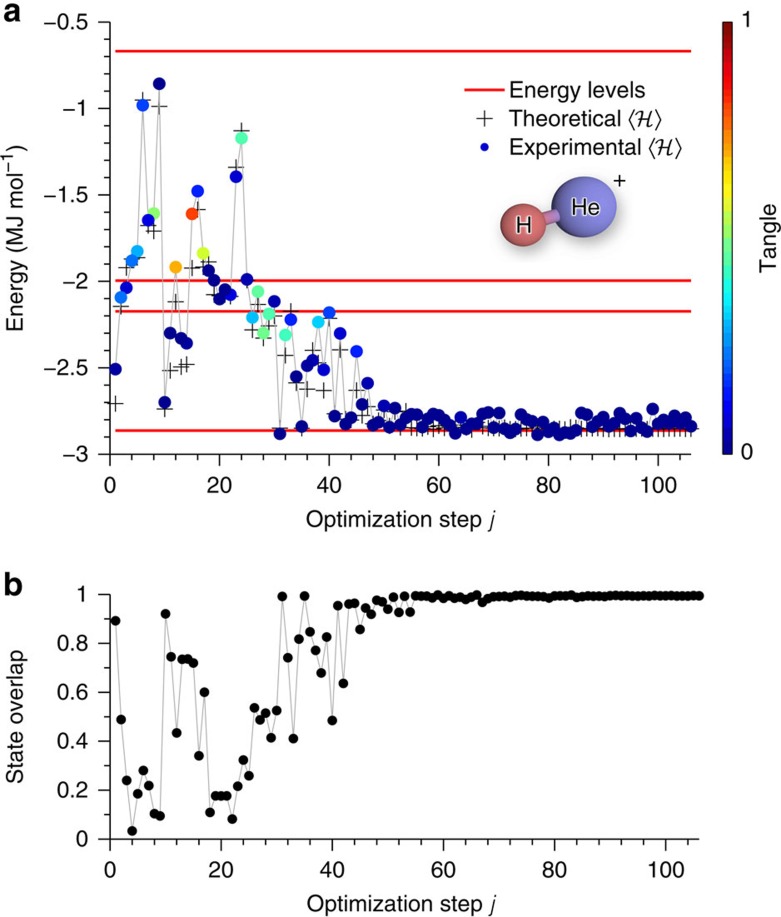
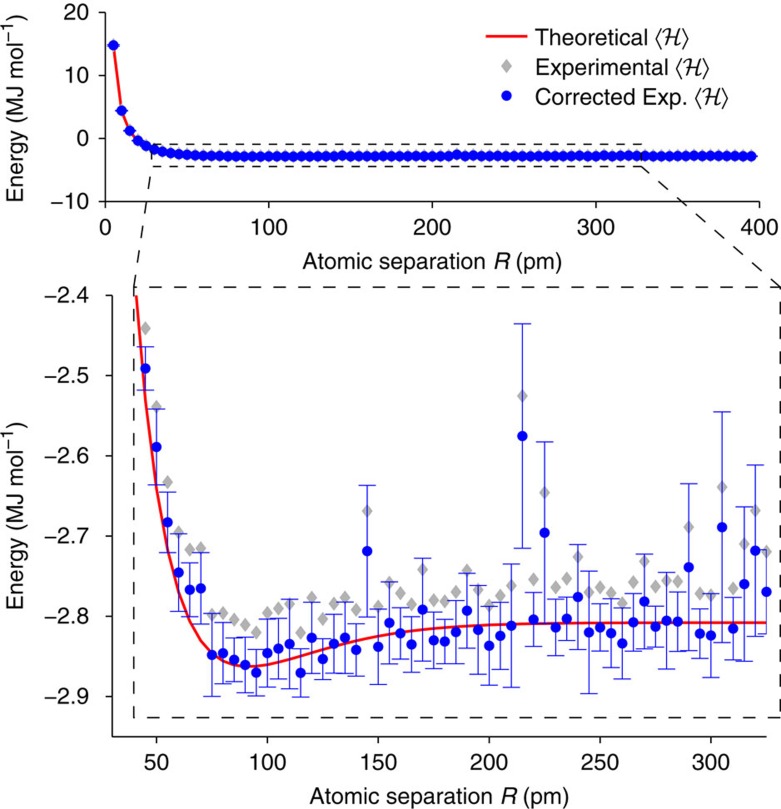
- The authors report an experimental ground-state result for He–H\(^+\): after correcting for experimental errors, they estimate the equilibrium bond length as \(R = 92.3 \pm 0.1\) pm and the ground-state electronic energy as \(E = -2.865 \pm 0.008\) MJ mol\(^{-1}\).
- For the bond dissociation curve, more than 96% of the experimental data are within chemical accuracy of the theoretical values.
- In the discussion, they state that for a 4 × 4 Hamiltonian like the one demonstrated, the QPE circuit would require at least 12 CNOT gates, whereas their method requires one.
- The full experiment was performed in about 158 h, and the bond dissociation curve was obtained by finding the ground states of 79 Hamiltonians.
## Methods
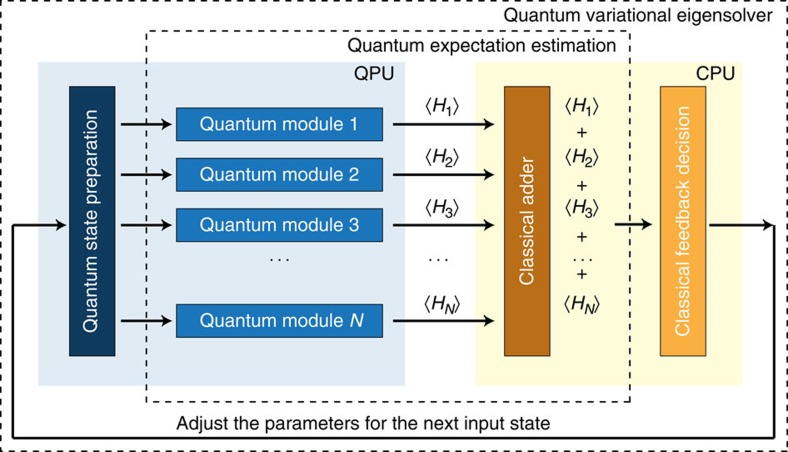
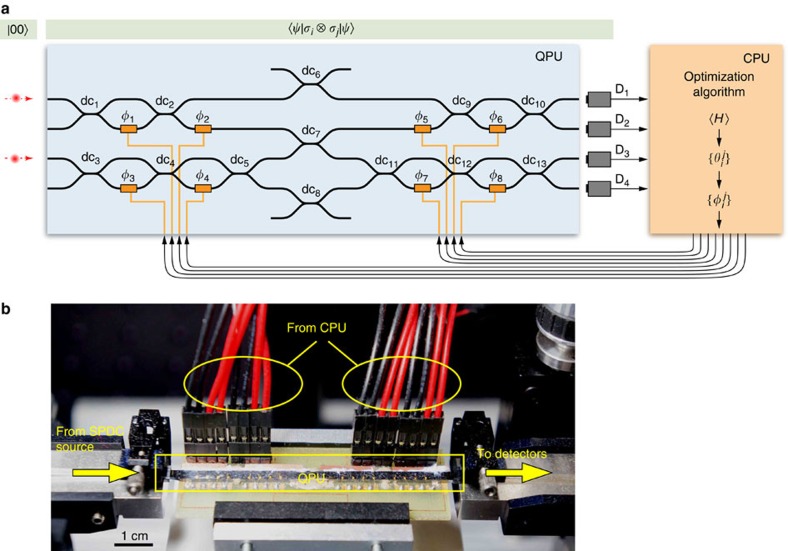
- The paper combines a reconfigurable integrated photonic quantum processor with a classical optimization algorithm: the quantum device estimates Hamiltonian expectation values, and the classical processor updates the state parameters variationally.
- The photonic chip prepares and measures arbitrary two-qubit pure states using single-qubit rotations and one two-qubit entangling gate; the experimental demonstration uses the He–H\(^+\) molecule in a minimal basis.
- For the classical optimization, they use the Nelder–Mead algorithm; expectation values are reconstructed from four two-qubit Pauli measurements at each point.
## Limitations
- The paper states that the method still requires a good approximation to the ground state as input/initialization, and the reliance on multiple separate measurements makes it sensitive to variations in state preparation between calculations.
- The authors report a constant systematic shift of \(\varepsilon = 50\) kJ mol\(^{-1}\) in the measured expectation values; they attribute this to photon-source impurity/distinguishability, circuit imperfections, and unbalanced coupling efficiencies.
- Evident from the text: the demonstration is limited to a two-qubit / 4 × 4 Hamiltonian prototype, so the scalability claim is not experimentally validated here.
Model-written summary. Check it against the paper before relying on it.
Integrity signals
Registry
Cites
Statistics
Figures
Verification
Claims the paper makes
7 Valid · 4 Not valid · 11 Not checked · 59 Own results and interpretations
The cited sources support only part of this claim — read each source’s verdict below.
In the paper
“Recent developments in the field of quantum computation offer a way forward for determining efficient solutions of many instances of large eigenvalue problems that are classically intractable6789101112”
§ A variational eigenvalue solver on a photonic quantum processor > Abstract
What the sources say
- Not matchedcites [6] Nielsen, M. A. & Chuang, I. L. Quantum Computation and Quantum Information Cambridge University Press (2000).
Couldn’t be matched to a paper in Crossref, so it can’t be checked.
- Could not verifycites [7] Kitaev, A. Quantum measurements and the Abelian stabilizer problem. Electronic Colloquium on Computational Complexity (ECCC) 3 (1996). sourceExperimental — accuracy not yet measured
Our copy under this DOI is the ISAAC 2021 paper 'Effective Resistance and Capacitance in Simplicial Complexes and a Quantum Algorithm' (Kitaev's 1995 work appears only as reference [9] in its bibliography), and it nowhere asserts that quantum computation gives efficient solutions to classically intractable large eigenvalue problems. Eigenvalues enter only as complexity parameters — λ, the smallest eigenvalue of the normalized up-Laplacian, in Lemma 31 and Theorem 26 (Section 6.3, 'Time efficient implementations') and in the phase-estimation machinery of Appendix A — and Section 1.1 ('Our Contributions') actually reports the opposite direction for its own problem: 'the quantum algorithm is slower than the classical algorithm in the worst case'. Searched: 'eigenvalue problems classically intractable', 'quantum speedup / exponential advantage', 'phase estimation', 'faster than classical'; no passage addresses the claim's point. (LLM, conf=0.70)
- Partly supportedcites [8] Griffiths, R. B. & Niu, C.-S. Semiclassical fourier transform for quantum computation. Phys. Rev. Lett. 76, 3228–3231 (1996). sourceExperimental — accuracy not yet measured
On p. 1, the paper says a quantum computer, if built, could solve certain problems such as factoring long numbers much faster than conventional algorithms. It also describes a simpler Fourier transform for Shor’s factorization and discrete-logarithm algorithms (p. 1). The copy does not support the claim about efficient solutions to many large eigenvalue problems. (LLM, conf=0.84)
plainstates a cause- Asserted: passes — The authors put it forward as true.
- Checkable: passes — It can be checked against evidence.
- Load-bearing: passes — The paper’s conclusions depend on it.
- Based: passes — The paper gives a reason why it holds.
- Not matched
Every source the paper cites for this claim was checked and supports it.
In the paper
“this would suffer from the N-representability problem, which is known to be intractable for both classical and quantum computers (it is in the quantum complexity class QMA-Hard24).”
§ A variational eigenvalue solver on a photonic quantum processor > Results > Quantum expectation estimation
What the sources say
- Supportedcites [24] Liu, Y.-K., Christandl, M. & Verstraete, F. Quantum computational complexity of the n-representability problem: Qma complete. Phys. Rev. Lett. 98, 110503 (2007). source
The paper states that N-representability is QMA-complete and hence QMA-hard and NP-hard (Abstract). Its discussion of quantum-chemistry relevance says the problem is intractable in the worst case even on a quantum computer, while allowing that particular physical systems may be easier. (LLM, conf=0.93)
boosted- Asserted: passes — The authors put it forward as true.
- Checkable: passes — It can be checked against evidence.
- Load-bearing: passes — The paper’s conclusions depend on it.
- Based: passes — The paper gives a reason why it holds.
- Supported
Every source the paper cites for this claim was checked and supports it.
In the paper
“We have implemented the QPU using integrated quantum photonics technology30.”
§ A variational eigenvalue solver on a photonic quantum processor > Results > Prototype demonstration
What the sources say
- Supportedcites [30] O'Brien, J. L., Furusawa, A. & Vuckovic, J. Photonic quantum technologies. Nat. Photon. 3, 687–695 (2009). source
The citation identifies integrated quantum photonics as the technology used, rather than attributing the citing authors’ QPU implementation to this review. The “Integrated quantum optical circuits” section (p. 6) describes on-chip waveguide circuits performing quantum logic gates and a compiled quantum factoring algorithm. (LLM, conf=0.87)
plain- Asserted: passes — The authors put it forward as true.
- Checkable: passes — It can be checked against evidence.
- Load-bearing: passes — The paper’s conclusions depend on it.
- Based: passes — The paper gives a reason why it holds.
- Supported
The cited sources support only part of this claim — read each source’s verdict below.
In the paper
“The time the quantum computer must remain coherent is determined by the necessity of O(p−1) successive applications of , each of which can require on the order of millions or billions of quantum gates for practical applications1719, as compared to the tens to hundreds of gates achievable in the short term.”
§ A variational eigenvalue solver on a photonic quantum processor > Abstract
What the sources say
- Partly supportedcites [17] Whitfield, J. D., Biamonte, J. & Aspuru-Guzik, A. Simulation of electronic structure hamiltonians using quantum computers. Mol. Phys. 109, 735–750 (2011). sourceExperimental — accuracy not yet measured
Split into 2 atoms — 1 confirmed, 1 partially supported, 0 disputed, 0 misattributed, 0 unverifiable. Expand the claim to see per-atom verdicts.
- Partly supportedcites [19] Jones, N. C. et al. Faster quantum chemistry simulation on fault-tolerant quantum computers. New J. Phys. 14, 115023 (2012). sourceExperimental — accuracy not yet measured
Split into 2 atoms — 0 confirmed, 2 partially supported, 0 disputed, 0 misattributed, 0 unverifiable. Expand the claim to see per-atom verdicts.
plainstates a cause- Asserted: passes — The authors put it forward as true.
- Checkable: passes — It can be checked against evidence.
- Load-bearing: passes — The paper’s conclusions depend on it.
- Based: passes — The paper gives a reason why it holds.
- Partly supported
A result the paper reports from its own data — it cites no other source for it, so there is none to check. The quote shows it is in the paper.
In the paper
“We experimentally demonstrate the feasibility of this approach with an example from quantum chemistry—calculating the ground-state molecular energy for He–H+.”
§ A variational eigenvalue solver on a photonic quantum processor > Abstract
boostedstates a causeSingle case- Asserted: passes — The authors put it forward as true.
- Checkable: passes — It can be checked against evidence.
- Load-bearing: passes — The paper’s conclusions depend on it.
- Based: passes — The paper gives a reason why it holds.
31 more claims
Create a free account to see all 81 claims and to verify the 4 references still open.
- It may state two separate claims as one. 28
- Probably not a substantial claim. 24
Claims other papers make about this one
Each is checked against this paper’s own text: does it say what the citing paper says it does?
The cited source doesn’t support the claim as written.
In the citing paper
“Leveraging quantum resources, the UCC ansatz was instead realized as a PQC on a photonic processor (Peruzzo et al. , 2014).”
From Noisy intermediate-scale quantum algorithms (2022) · cites this paper as Peruzzo et al., 2014
Checked by a reasoning model — may be wrong.
Experimental — accuracy not yet measuredThe cited source doesn’t support the claim as written.
In the citing paper
“The first on-chip GMM of four-qubit cluster state was realised in a laser-writing chip ( Fig.4e ), by manipulating both the polarisation and path DoFs of two photons [85].”
From Integrated photonic quantum technologies (2020) · cites this paper as [85]
Checked by a reasoning model — may be wrong.
Experimental — accuracy not yet measuredThe cited source doesn’t support the claim as written.
In the citing paper
“four-qubit linear- and box-cluster states are generated in a laser-writing photonic chip. This is enabled by on-chip manipulating the two-photon four-qubit hyperentangled state and cluster state, that are encoded in photon's path and polarisation DoFs. The Grover's search algorithm on a four-element database was implemented by controlling the device.”
From Integrated photonic quantum technologies (2020) · cites this paper as [85]
Checked by a reasoning model — may be wrong.
Experimental — accuracy not yet measuredThe source backs part of the claim, not all of it — or backs it for a different population, condition or comparison.
In the citing paper
“Due to its versatility, the variational Hamiltonian ansatz has been implemented for quantum chemistry [21, 29], optimization [24], and for quantum simulation problems [30].”
From Variational quantum algorithms (2021) · cites this paper as [29]
Experimental — accuracy not yet measuredThe source backs part of the claim, not all of it — or backs it for a different population, condition or comparison.
In the citing paper
“For the original VQE (Peruzzo et al. , 2014) and QAOA (Farhi et al. , 2014) it can, for example, be described as a single expectation value min θ ⟨ H ⟩ U ( θ ) , where the differences solely appear in the specific form and construction of the qubit Hamiltonian.”
From Noisy intermediate-scale quantum algorithms (2022) · cites this paper as Peruzzo et al., 2014
Experimental — accuracy not yet measured
12 more claims about this paper
Create a free account to see every claim other papers make about this one.
Citations
Cites
A Simplex Method for Function Minimization
Nelder, J. A., & Mead, R. (1965) · The Computer Journal · doi:10.1093/comjnl/7.4.308 · Cited by 28,905
Quantum computation and quantum information
Law, J. (2001) · ACM SIGSOFT Software Engineering Notes · doi:10.1145/505482.505499 · Cited by 18,842
(1999) · Cited by 12,854
Practical Methods of Optimization
Fletcher, R. (2000) · Wiley eBooks · doi:10.1002/9781118723203 · Cited by 7,605 · cited 3×
“[12] S.”
BackgroundMethodPractical methods of optimization
(1988) · Mathematics and Computers in Simulation · doi:10.1016/0378-4754(88)90129-2 · Cited by 5,818
Quantum Algorithm for Linear Systems of Equations
Harrow, A. W., Hassidim, A., & Lloyd, S. (2009) · Physical Review Letters · doi:10.1103/physrevlett.103.150502 · Cited by 3,325
Conn, A. R., Gould, N. I. M., & Toint, P. L. (2000) · Society for Industrial and Applied Mathematics eBooks · doi:10.1137/1.9780898719857 · Cited by 2,981 · cited 3×
“[14] D.”
MethodInfluential�ber das Paulische �quivalenzverbot
Jordan, P., & Wigner, E. (1928) · Zeitschrift f�r Physik · doi:10.1007/bf01331938 · Cited by 2,597
Molecular Electronic‐Structure Theory
Helgaker, T., Jørgensen, P., & Olsen, J. (2000) · doi:10.1002/9781119019572 · Cited by 2,594
O'Brien, J. L., Furusawa, A., & Vučković, J. (2009) · Nature Photonics · doi:10.1038/nphoton.2009.229 · Cited by 2,388
Self-citation
Research works printed but not linked: 3
- Helgaker, T., Jorgensen, P. & Olsen, J. Mol. Electronic Struct. Theory Wiley, Sussex (2002).
- Saad, Y. Numerical Methods for Large Eigenvalue Problems Vol. 158, (SIAM (1992).
- Rayleigh, J. W. In finding the correction for the open end of an organ-pipe. Phil. Trans. 161, 77 (1870).
Cited by
Items 3,201–3,300 of 4,572
Quantum-inspired dynamical models on quantum and classical annealers
Hanussek, P., Pawłowski, J., Mzaouali, Z., & Gardas, B. (2026) · Physical Review Applied · doi:10.1103/rrf3-jm5m · Cited by 6
Hamiltonian lattice formulation of compact Maxwell-Chern-Simons theory
Anonymous, Diamantini, M. C., Funcke, L., Hassan, S. M. A., Jansen, K., Kühn, S., Luo, D., & Naredi, P. (2026) · Physical review. D/Physical review. D. · doi:10.1103/rrzw-s456 · Cited by 16
Approximate graph spectral decomposition with the Variational Quantum Eigensolver
Payne, J., & Srouji, M. (2020) · doi:10.1117/12.2542854 · Cited by 3
Parallelization of Classical Numerical optimization in Quantum Variational Algorithms
Pistoia, M., Liu, P., Chen, C. F., Hu, S., & Wood, S. (2020) · IEEE International Conference on Software Testing, Verification and Validation (ICST) · doi:10.1109/icst46399.2020.00039 · Cited by 3
Optical vortices in nanophotonics
Li, C., Maier, S. A., & Haoran, R. (2021) · Chinese Optics · doi:10.37188/co.en.2021-0066 · Cited by 2
Quantum computing simulation of the hydrogen molecular ground-state energies with limited resources
Abu-Nada, A. (2021) · Open Physics · doi:10.1515/phys-2021-0071 · Cited by 5
Error Analysis of the Variational Quantum Eigensolver Algorithm
Brandhofer, S., Devitt, S. J., & Polian, I. (2021) · IEEE/ACM International Symposium on Nanoscale Architectures (NANOARCH) · doi:10.1109/nanoarch53687.2021.9642249 · Cited by 5
“In the recent past, computations of variational quantum algorithms subject to errors were investigated through theoretical analyses [12], simulations [30]–[33] and experiments [1]– [3] on quantum computers.”
BackgroundMethodInfluentialKoide‐Majima, N., & Majima, K. (2021) · Physical Review A · doi:10.1103/physreva.104.062411 · Cited by 4
Xiong, Y., Ng, S. X., & Hanzo, L. (2022) · IEEE Transactions on Communications · doi:10.1109/tcomm.2022.3144469 · Cited by 5
“Alternatively, a class of algorithms tailored for these computers, namely that of the variational quantum algorithms (VQAs) [12]–[15], is receiving much attention.”
BackgroundMethodInfluentialde Lima, E. F., Fernandes, M. E. F., & Castelano, L. K. (2022) · Physical Review A · doi:10.1103/physreva.105.032454 · Cited by 4
Perfect Photon Indistinguishability from a Set of Dissipative Quantum Emitters
Guimbao, J., Sánchis, L., Weituschat, L., Llorens, J. M., & Postigo, P. A. (2022) · Nanomaterials · doi:10.3390/nano12162800 · Cited by 2
“, quantum internet) was reported in 2021 [5]; (Quantum Computation) Gaussian boson sampling scheme with 50 photons for specific quantum computing demonstrated quantum advantage for the first time in 2020 [6]; (Quantum simulation) A IQP based variational eigensolver for calculation of the ground state energy of H2 mole…”
BackgroundQuantum approximation of normalized Schatten norms and applications to learning
Chen, Y., Miyahara, H., Bouchard, L., & Roychowdhury, V. (2022) · Physical Review A · doi:10.1103/physreva.106.052409 · Cited by 4
“1 Introduction Recent advances in quantum approximate optimization algorithms (QAOA, [1, 2]), variational quantum eigensolver (VQE, [3]) and the promise of implementing such algorithms using noisy intermediate-scale quantum (NISQ) devices [4] have rekindled the prospect of a new era in quantum computing.”
BackgroundPemmaraju, C. D., & Deshmukh, A. A. (2022) · Physical Review A · doi:10.1103/physreva.106.042807 · Cited by 3
Physical constraint-aware CNOT quantum circuit synthesis and optimization
Zhu, M., Cheng, X., Zhu, P., Chen, L., & Guan, Z. (2022) · Quantum Information Processing · doi:10.1007/s11128-022-03716-1 · Cited by 5
“Due to its potential in a variety of significant application sectors, such as integer factorization [1], database search [2] and quantum simulation [3], quantum computing (QC) has been a very active research area in recent years.”
BackgroundCombarro, E. F. (2022) · Springer eBooks · doi:10.1007/978-3-031-05324-5_1 · Cited by 4
Noise tailoring for robust amplitude estimation
Dalal, A., & Katabarwa, A. (2023) · New Journal of Physics · doi:10.1088/1367-2630/acb5bc · Cited by 7
Type-safe Quantum Programming in Idris
Dandy, L.-J., Jeandel, E., & Zamdzhiev, V. (2023) · Lecture notes in computer science · doi:10.1007/978-3-031-30044-8_19 · Cited by 2
The Role of Initial Entanglement in Adaptive Gibbs State Preparation on Quantum Computers
Economou, S. E., Warren, A., & Barnes, E. (2023) · IEEE International Conference on Acoustics Speech and Signal Processing · doi:10.1109/icassp49357.2023.10094697 · Cited by 7
“One such family of problems involves the creation of entangled many-qubit states that represent the ground states of molecules or other quantum systems of interest [1, 2, 3].”
BackgroundArchitectures for Quantum Information Processing
Upadhyay, S., Alam, M., & Ghosh, S. (2023) · Springer eBooks · doi:10.1007/978-981-15-6401-7_64-1 · Cited by 4
Quantum algorithms for optimal effective theory of many-body systems
Yang, Y., Zhang, Z., Xu, X., Lu, B.-N., & Li, Y. (2023) · Physical Review A · doi:10.1103/physreva.108.032403 · Cited by 3
“[24] Alberto Peruzzo, A variational eigenvalue solver on a photonic quantum processor.”
MethodA user-centric quantum benchmarking test suite and evaluation framework
Liu, W., Wang, F., Lin, H., & Shang, J. (2023) · Quantum Information Processing · doi:10.1007/s11128-023-04154-3 · Cited by 3
“The suite uses specific algorithms, such as Grover’s algorithm [34], VQE algorithm [35], and QFT algorithm [36], as benchmark test sets.”
MethodTowards real-world implementations of quantum machine learning
Liu, J. (2023) · doi:10.22331/qv-2023-11-29-77 · Cited by 2
Application of the Variational Quantum Eigensolver to the Ultimate Pit Problem
Hindy, Y., Pointing, J., Tolunay, M., Venkatarao, S., Motta, M., & Latone, J. A. (2023) · IEEE International Conference on Quantum Computing and Engineering (QCE) · doi:10.1109/qce57702.2023.00083 · Cited by 2
“…are the quantum approximate optimization algorithm (QAOA) [1], [16], which is a variational quantum algorithm with ansatz inspired by ASP, the variational quantum eigensolver (VQE) [17]–[19], where the variational principle is combined with an arbitrarily flexible and hardware-aware ansatz.”
MethodMohtashim, S. I., Mahatabuddin, S., & Jabbar, M. A. (2023) · IEEE International Conference on Quantum Computing and Engineering (QCE) · doi:10.1109/qce57702.2023.20329 · Cited by 2
“The Variational Quantum Eigensolver (VQE) [1] is a widely-studied algorithm for solving quantum chemistry problems on quantum computers.”
BackgroundJojo, J., Khandelwal, A., & Chandra, M. G. (2024) · International Conference on Communication Systems & Networks (COMSNETS) · doi:10.1109/comsnets59351.2024.10427083 · Cited by 3
“The usual way to deal with this [12], [13] is as follows - Step 1: Get the Pauli decomposition of Step 2: Compute |⟨ i | W † ( ⃗α ) P ⃗s W ( ⃗β ) | i ⟩| 2 on a quantum computer for all ⃗s and for all i .”
Practical limitations of quantum data propagation on noisy quantum processors
Saxena, G., Shalabi, A., & Kyaw, T. H. (2024) · Physical Review Applied · doi:10.1103/physrevapplied.21.054014 · Cited by 3
“One such important class of algorithms are variational quantum algorithms (VQAs) [12–14].”
BackgroundMethodQuantum Computing’s Path to Supremacy: Progress in the NISQ Epoch
Puthussery, E. S., & Poonia, R. C. (2024) · Lecture notes in networks and systems · doi:10.1007/978-981-97-3591-4_25 · Cited by 2
Low depth virtual distillation of quantum circuits by deterministic circuit decomposition
Karim, A., Zhang, S., & Usman, M. (2024) · Physical Review Research · doi:10.1103/physrevresearch.6.033223 · Cited by 7
“Our method works for any algorithm that requires expectation values, therefore we demonstrate its effectiveness on the variational quantum eigensolver (VQE) [11] for two qubits (H 2 ), three qubits (H 3 ), and four qubits (H 2 no symmetry reduction).”
MethodMesman, K. J., Battistel, F., Reehuis, E., de Jong, D., Tiggelman, M. J., Gloudemans, J., van Oven, J. C., & Bultink, C. C. (2024) · IEEE International Conference on Quantum Software (QSW) · doi:10.1109/qsw62656.2024.00026 · Cited by 5
“Examples of these algorithms are QAOA (Quantum Approximate Optimization Algorithm) [2] and VQE (Variational Quantum Eigensolver) [14].”
MethodSugisaki, K. (2024) · AIP Advances · doi:10.1063/5.0223661 · Cited by 5
“24 In 2014, the quantum–classical hybrid approach known as a variational quantum eigensolver (VQE) was proposed for quantum chemical calculations using noisy intermediate-scale quantum devices.”
MethodOshima, K. (2024) · Quantum Engineering · doi:10.1155/2024/3854366 · Cited by 1
Dynamical transition in controllable quantum neural networks with large depth
Zhang, B., Liu, J., Wu, X.-C., Jiang, L., & Zhuang, Q. (2024) · Nature Communications · doi:10.1038/s41467-024-53769-2 · Cited by 10
State of practice: Evaluating GPU performance of state vector and tensor network methods
Vallero, M., Rech, P., & Vella, F. (2025) · Future Generation Computer Systems · doi:10.1016/j.future.2025.107927 · Cited by 18
“In the last decade, the progress in the various technologies used for building quantum devices has reached commercial applications, such as the cloud services proposed by IBM, D-Wave and Google, among others.”
Subuniversal variational circuits for combinatorial optimization problems
Weitz, G., Pira, L., Ferrie, C., & Combes, J. (2025) · Physical Review A · doi:10.1103/v1sh-fg6f · Cited by 7
“Such circuits can find applications in quantum chemistry, for example, using variational quantum eigensolvers [2] or quantum machine learning [3].”
Hybrid Quantum-Classical Machine Learning Architectures for Accelerated Drug Discover
Pal, V. (2021) · International Journal of Advanced Research in Science Communication and Technology · doi:10.48175/ijarsct-6582m · Cited by 2
Context-aware quantum simulation of a matrix stored in quantum memory
Daskin, A., Bian, T., Xia, R., & Kais, S. (2019) · Quantum Information Processing · doi:10.1007/s11128-019-2469-1 · Cited by 2
“Recent methods such as variational quantum eigensolver [10,11] and quantum signal processing [12] have proved that the exponential eiHt is not needed to find the eigenpair of H.”
MethodMiyagawa, K., Shoji, M., Isobe, H., Yamanaka, S., Kawakami, T., Okumura, M., & Yamaguchi, K. (2020) · Chemical Physics Letters · doi:10.1016/j.cplett.2020.137252 · Cited by 2
Lee, J., & Kim, S. (2025) · Advances in computers · doi:10.1016/bs.adcom.2025.06.002 · Cited by 4
Modelling for Quantum Error Mitigation
Weber, T., Riebisch, M., Borras, K., Jansen, K., & Krücker, D. (2021) · IEEE International Conference on Software Architecture Companion (ICSA-C) · doi:10.1109/icsa-c52384.2021.00026 · Cited by 4
Optimization of VQE-UCC Algorithm Based on Spin State Symmetry
Guo, Q., & Chen, P. (2021) · Frontiers in Physics · doi:10.3389/fphy.2021.735321 · Cited by 4
QuantMark: A Benchmarking API for VQE Algorithms
de Griend, A. M.-V., & Nurminen, J. K. (2022) · IEEE Transactions on Quantum Engineering · doi:10.1109/tqe.2022.3159327 · Cited by 3
NISQ algorithm for the matrix elements of a generic observable
Erbanni, R., Bharti, K., Kwek, L. C., & Poletti, D. (2023) · SciPost Physics · doi:10.21468/scipostphys.15.4.180 · Cited by 2
“There has been an explosion of recent work on NISQ algorithms to address problems such as finding ground state of Hamiltonians [ 3–5, 8– 19 ] Many problems in nuclear physics and other sciences make extensive use of off-diagonal matrix elements.”
MethodComputability and Complexity of Unconventional Computing DevicesPreprint
Broersma, H. J., Stepney, S., & Wendin, G. P. (2017) · arXiv (Cornell University) · doi:10.48550/arxiv.1702.02980 · Cited by 6
“…the focus of intense engineering and experimental efforts (Cirac and Zoller; 2010; Lanyon et al.; 2010; Barreiro et al.; 2011; Blatt and Roos; 2012; Peruzzo et al.; 2014; Wang et al.; 2015; Salathe et al.; 2015; Barends et al.; 2015, 2016; O’Malley et al.; 2016; Boixo, Isakov, Smelyanskiy,…”
BackgroundHigh-Quality Protein Force Fields with Noisy Quantum ProcessorsPreprint
Mishra, A., & Shabani, A. (2019) · arXiv (Cornell University) · doi:10.48550/arxiv.1907.07128 · Cited by 2
“On current generation of quantum computers, small molecules such as H2 [39, 42, 43], HeH+ [38, 44], LiH [42] and BeH2 [42] have been simulated to good accuracy by utilizing up to six qubits.”
Discontinuous Galerkin discretization for quantum simulation of chemistryPreprint
McClean, J. R., Faulstich, F. M., Zhu, Q., O’Gorman, B., Qiu, Y., White, S. R., Babbush, R., & Lin, L. (2019) · arXiv (Cornell University) · doi:10.48550/arxiv.1909.00028 · Cited by 2
“[18] A.”
BackgroundSelf-citationA simple approach to design quantum neural networks and its applications to kernel-learning methodsPreprint
Shao, C. (2019) · arXiv (Cornell University) · Cited by 2
Quantum locally linear embeddingPreprint
He, X., Li, S., Lyu, C., & Wang, X. (2019) · arXiv (Cornell University) · Cited by 2
Charge and spin response functions on a quantum computer: applications to moleculesPreprint
Kosugi, T., & Matsushita, Y. (2019) · arXiv (Cornell University) · doi:10.48550/arxiv.1911.00293 · Cited by 4
Postmodern Electronic Structure Theory
Lee, J. (2019) · eScholarship (California Digital Library) · Cited by 3
Bayesian machine learning for Boltzmann machine in quantum-enhanced feature spacesPreprint
Wu, Y., Yu, C., Qin, S., Wen, Q., & Gao, F. (2019) · arXiv (Cornell University) · doi:10.48550/arxiv.1912.10857 · Cited by 4
Computing thermodynamic observables on noisy quantum computers with chemical accuracyPreprint
Stober, S. T., Harwood, S. M., Greenberg, D., Gujarati, T. P., Mostame, S., Raman, S., & Trenev, D. (2020) · arXiv (Cornell University) · Cited by 2
Practical Quantum Computing: The value of local computationPreprint
Cruise, J. R., Gillespie, N. I., & Reid, B. (2020) · arXiv (Cornell University) · doi:10.48550/arxiv.2009.08513 · Cited by 13
“This contrasts with VQE, [37], which executes the same circuit a number of times.”
MethodZha, X., Zhang, C., Fan, D., Xu, P., Du, S., Zhang, R. Q., & Chen, F. (2020) · arXiv (Cornell University) · doi:10.48550/arxiv.2006.15852 · Cited by 6
“Theory and computational details The UCC-VQE approach has been discussed clearly in previous reports[20, 21].”
BackgroundMethodInfluentialSoftware-Hardware Co-Optimization for Computational Chemistry on Superconducting Quantum ProcessorsPreprint
Li, G., Shi, Y., & Javadi-Abhari, A. (2021) · arXiv (Cornell University) · doi:10.48550/arxiv.2105.07127 · Cited by 2
Applied and Computational Mathematics Division : summary of activities for fiscal year 2020
Boisvert, R. F. (2021) · doi:10.6028/nist.ir.8373 · Cited by 1
Classically-Boosted Variational Quantum EigensolverPreprint
Radin, M. D., & Johnson, P. D. (2021) · arXiv (Cornell University) · doi:10.48550/arxiv.2106.04755 · Cited by 11
“One choice for the unitary decomposition would be the conventional decomposition of into Pauli strings [22].”
MethodNormalized Gradient Descent for Variational Quantum AlgorithmsPreprint
Suzuki, Y., Yano, H., Raymond, R., et al. (2021) · arXiv (Cornell University) · doi:10.48550/arxiv.2106.10981 · Cited by 2
“To date, a variety of VQAs has been proposed; the variational quantum eigensolver (VQE) for quantum chemistry [5]–[7], the quantum approximate optimization algorithm (QAOA) for combinatorial optimizations [8]–[10], and quantum circuit learning algorithms for machine learning problems [11]–[13].”
BackgroundAccelerating variational quantum algorithms with multiple quantum processorsPreprint
Du, Y., Qian, Y., & Tao, D. (2021) · arXiv (Cornell University) · doi:10.48550/arxiv.2106.12819 · Cited by 14
“Although some quantum software [56, 57] showcases parallelling variational quantum eigen-solvers (VQEs) [47], how to devise general distributed-VQAs optimization schemes with both runtime boost and convergence guarantee remains largely unknown.”
BackgroundEQUAL: Improving the Fidelity of Quantum Annealers by Injecting Controlled PerturbationsPreprint
Ayanzadeh, R., Das, P., Tannu, S., & Qureshi, M. K. (2022) · Research Square · doi:10.21203/rs.3.rs-1343360/v1 · Cited by 5
Energy Landscape Structure of Small Graph Isomorphism Under Variational OptimizationPreprint
Chatterjee, T., Mohtashim, S. I., & Kundu, A. (2021) · arXiv (Cornell University) · doi:10.48550/arxiv.2111.09821 · Cited by 2
“Typically in VQAs, like the Variational Quantum Eigensolver (VQE) 12 and Quantum Approximate Optimization Algorithm (QAOA) 13 , the goal is to find a quantum state which minimizes the energy of a problem Hamiltonian.”
Provable Advantage in Quantum Phase Learning via Quantum Kernel AlphatronPreprint
Yusen, W., Wu, B., Wang, J. B., & Yuan, X. (2022) · Research Square · doi:10.21203/rs.3.rs-1179453/v1 · Cited by 3
Variational Quantum Algorithms for Computational Fluid DynamicsPreprint
Jaksch, D., Givi, P., Daley, A. J., & Rung, T. (2022) · arXiv (Cornell University) · doi:10.48550/arxiv.2209.04915 · Cited by 2
“A promising hybrid quantum-classical algorithm [8] was invented in 2014.”
InfluentialWada, K., Raymond, R., Sato, Y., & Watanabe, H. C. (2022) · arXiv (Cornell University) · doi:10.48550/arxiv.2209.08535 · Cited by 2
“As the global cost we employed the infidelity in equation (E.2) with randomly-generated states as described in the previous section, while the local cost is the Hamiltonian of the mixed-field Ising model in equation (E.1).”
MethodInfluentialAn introduction to variational quantum algorithms for combinatorial optimization problemsPreprint
Grange, C., Poss, M., & Bourreau, E. (2022) · arXiv (Cornell University) · doi:10.48550/arxiv.2212.11734 · Cited by 8
“VQAs are studied today because they represent an alternative approach that reduces the quality and quantity of the quantum resources needed [55].”
Algorithm-Aware Qubit MappingPreprint
Ji, Y., & Polian, I. (2022) · doi:10.36227/techrxiv.21786146 · Cited by 1
Towards provably efficient quantum algorithms for large-scale machine-learning modelsPreprint
Liu, J., Liu, M., Liu, J.-P., Ye, Z., Wang, Y., Alexeev, Y., Eisert, J., & Jiang, L. (2023) · arXiv (Cornell University) · doi:10.48550/arxiv.2303.03428 · Cited by 2
“However, there is increasing evidence that such variational algorithms run on near-term quantum devices [11] are challenged by noise beyond logarithmic depth [18–21] (even though in some instances, noise can even be of some help [22]).”
BackgroundAdministration, U. A. S. F. H. R. A., Alexeev, Y., USDOE Office of Science (SC), Eidenbenz, S., Mezzacapo, A., & Pakin, S. (2023) · OSTI OAI (U.S. Department of Energy Office of Scientific and Technical Information) · doi:10.2172/2280557 · Cited by 3
Denoising Gradient Descent in Variational Quantum AlgorithmsPreprint
Simon, L., Eble, H., Kowalski, H.-H., & Radons, M. (2024) · Research Square · doi:10.21203/rs.3.rs-4023677/v1 · Cited by 2
Xu, Z., Yang, T., Cai, P., Shen, K., Hu, Y., Lv, B., Chen, S., Zhu, Y., Wu, Z., Wang, J., et al. (2024) · Research Square · doi:10.21203/rs.3.rs-4195599/v1 · Cited by 3
Graph Neural Networks for Parameterized Quantum Circuits Expressibility Estimation (Rev.1)
Aktar, S., (NNSA), U. N. N. S. A., Bärtschi, A., Badawy, A. A., Oyen, D., & Eidenbenz, S. (2024) · OSTI OAI (U.S. Department of Energy Office of Scientific and Technical Information) · doi:10.2172/2350603 · Cited by 2
Hybrid Gate-Based and Annealing Quantum Computing for Large-Size Ising ProblemsPreprint
Liu, C.-Y., & Goan, H. (2024) · Research Square · doi:10.21203/rs.3.rs-4707131/v1 · Cited by 23
Quantum AI in Speech Emotion RecognitionPreprint
Norval, M., & Wang, Z. (2024) · Research Square · doi:10.21203/rs.3.rs-4894795/v1 · Cited by 2
Advancements in Quantum Algorithms for Solving Complex Optimization ProblemsPreprint
Adediran, E., Fatoki, I., & Ogunyinka, T. (2024) · SSRN Electronic Journal · doi:10.2139/ssrn.5015789 · Cited by 2
Revolutionizing Learning with Qubits
Bhusari, S., Badakh, A., Daine, K., Gagare, N., & Mutkule, P. R. (2025) · Wiley eBooks · doi:10.1002/9781394271429.ch9 · Cited by 2
Le, D.-T., Nguyen, V.-L., Nguyen, H. C., Nguyen, H. Q., & Nguyen, V.-D. (2025) · Research Square · doi:10.21203/rs.3.rs-6497487/v1 · Cited by 3
Yahweh, B., Ekanem, A. M., George, N. J., Oduntan, E. O., Mohammed, S. S. N., Abdulhamid, A., Takim, B. N., Ante, J. E., Emmanuel, Y., & Essang, S. O. (2025) · Research Square · doi:10.21203/rs.3.rs-7262536/v1 · Cited by 1
A Quantum Compass for Materials Discovery: Navigating the Combinatorial Explosion
Kim, K. S. (2025) · ACS Central Science · doi:10.1021/acscentsci.5c01713 · Cited by 2
Non-adiabatic molecular dynamics of PAH-related complexes
Posenitskiy, E. (2020) · theses.fr (ABES) · doi:10.70675/bfb35103z00bbz4bf9z80fdze96b19b060bb · Cited by 3
Witnessing objectivity on a quantum computer
Chisholm, D. A., García-Pérez, G., Rossi, M. A. C., Maniscalco, S., & Palma, G. M. (2021) · Quantum Science and Technology · doi:10.1088/2058-9565/ac40f3 · Cited by 20
“This has been shown in several topics including chemistry [26, 27], open quantum systems [28] and quantum machine learning [29].”
Best-Practice Aspects of Quantum-Computer Calculations: A Case Study of the Hydrogen Molecule
Miháliková, I., Friák, M., Pivoluska, M., Plesch, M., Saip, M., & Šob, M. (2022) · Molecules · doi:10.3390/molecules27030597 · Cited by 16
“To solve this Hamiltonian, we used one of the most popular quantum-computing approaches, the variational quantum eigensolver (VQE) [45,48,49], involving a quantum circuit, as depicted in Figure 3.”
MethodInfluentialGroß, C. (2019) · Nature Physics · doi:10.1038/s41567-019-0539-z · Cited by 1
Multiport universal unitary interferometer design
Kondratyev, I. V., Dyakonov, I. V., Saygin, M. Y., Straupe, S. S., & Kulik, S. P. (2020) · AIP conference proceedings · doi:10.1063/5.0012752 · Cited by 2
Shiba, K., Sugiyama, R., Yamaguchi, K., & Sogabe, T. (2022) · Advances in Condensed Matter Physics · doi:10.1155/2022/9711407 · Cited by 1
“Various famous NISQ type hybrid quantum-classical algorithm such as QAOA (Quantum approximate optimization algorithm) and VQE (Variational Quantum Eigensolver) have been proposed [9].”
MethodDevelopment of Quantum Algorithm qUCC-LR for Excited-State Calculation Using Dynamic Polarizability
TAKANASHI, T., Yoshikawa, T., & Nakai, H. (2021) · Journal of Computer Chemistry Japan · doi:10.2477/jccj.2022-0007 · Cited by 1
Quantum neuron selection: finding high performing subnetworks with quantum algorithms
Whitaker, T. (2022) · Genetic and Evolutionary Computation Conference Companion (GECCO Companion) · doi:10.1145/3520304.3533961 · Cited by 3
“Variational Quantum Eigensolver (VQE) and Quantum Approximate Optimization Algorithm (QAOA) are perhaps the two most popular variational methods [12, 25].”
BackgroundIterative Refinement for Variational Quantum Linear Solver
Saito, Y., Lee, X., Cai, D., Shin, J., & Asai, N. (2023) · Lecture notes in networks and systems · doi:10.1007/978-981-99-3878-0_2 · Cited by 2
Möller, M. (2023) · Computational methods in applied sciences · doi:10.1007/978-3-031-29082-4_21 · Cited by 3
Finding the Dynamics of an Integrable Quantum Many‐Body System via Machine Learning
Wei, V., Orfi, A., Fehse, F., & Coish, W. A. (2023) · Advanced Physics Research · doi:10.1002/apxr.202300078 · Cited by 1
Arbitrary Ground State Observables from Quantum Computed Moments
Vallury, H. J., & Hollenberg, L. C. L. (2023) · IEEE International Conference on Quantum Computing and Engineering (QCE) · doi:10.1109/qce57702.2023.00040 · Cited by 1
“These hybrid approaches involve the preparation of complicated states designed to represent the ground state of the desired quantum system, via the measurement and minimisation of energy [4]–[6].”
BackgroundIntegration of Classical and Quantum Services Using an Enterprise Service Bus
Bonilla, J., Moguel, E., García-Alonso, J. M., & Canal, C. (2023) · Lecture notes in computer science · doi:10.1007/978-3-031-49269-3_11 · Cited by 2
Variational quantum entanglement classification discrimination
Wang, S., Shen, Y., Liu, X., Zhang, H., & Wang, Y. (2024) · Physica A Statistical Mechanics and its Applications · doi:10.1016/j.physa.2024.129530 · Cited by 2
Hull, I., Sattath, O., Diamanti, E., & Wendin, G. P. (2024) · Contributions to economics · doi:10.1007/978-3-031-50780-9_3 · Cited by 2
Polynomial optimization with linear combination of unitaries
Cheng, L., Gao, P., Wang, T., & Li, K. (2024) · Physical Review A · doi:10.1103/physreva.109.032429 · Cited by 1
Utilizing quantum processor for the analysis of strongly correlated materials
Li, H., Yang, Y., Lv, P., Qu, J., Wang, ., Sun, J. P., & Ying, S. (2024) · Physica Scripta · doi:10.1088/1402-4896/ad770b · Cited by 3
“Representative algorithms of NISQ era, such as VQE, have found applications in diverse fields, including quantum chemistry [9, 13, 14] and high-energy physics [15].”
Robust Quantum Algorithms for Early Fault-Tolerant Quantum Computing
Kshirsagar, R. (2024) · IntechOpen eBooks · doi:10.5772/intechopen.1004416 · Cited by 3
Range‐separated density functional theory using multiresolution analysis and quantum computing
Poirier, N. A., Kottmann, J. S., Aspuru‐Guzik, A., Mongeau, L., & Najafi-Yazdi, A. (2024) · Journal of Computational Chemistry · doi:10.1002/jcc.27384 · Cited by 2
Self-citationClemente, G. (2024) · International Symposium on Lattice Field Theory (LATTICE) · doi:10.22323/1.453.0216 · Cited by 2
Finding eigenvectors with a quantum variational algorithm
García-Escartín, J. C. (2024) · Quantum Information Processing · doi:10.1007/s11128-024-04461-3 · Cited by 3
“…later dequantized by Tang who showed that if we assume there is an equivalent black box giving this state preparation, there are classical methods which are only quadratically worse than the quantum proposal (as opposed to the exponential quantum advantage in the case of low rank matrices) [35].”
Global optimization in variational quantum algorithms via dynamic tunneling method
Park, S., Baek, K., Lee, S., & Choi, M. (2024) · New Journal of Physics · doi:10.1088/1367-2630/ad64fc · Cited by 1
“…quantum algorithm (VQA) is a hybrid quantum–classical algorithm that has attracted significant attention in recent years owing to its potential to address complex problems in quantum chemistry [1, 2], material science [3, 4], physics [5], computational science [6, 7], and many other areas.”
Few-Body Precursors of Topological Frustration
Filippi, F. R. D., Mello, A. F., Shaikh, D. S., Sassetti, M., Ziani, N. T., & Grossi, M. (2024) · Symmetry · doi:10.3390/sym16081078 · Cited by 3
Metadata
- Authors
- Peruzzo, A., McClean, J., Shadbolt, P., Yung, M.-H., Zhou, X.-Q., Love, P. J., Aspuru-Guzik, A., & O’Brien, J. L.
- Affiliations
- The University of Sydney (AU)
- Harvard University (US)
- University of Bristol (GB)
- Haverford College (US)
- Corresponding author
- Peruzzo, Alberto
- O’Brien, Jeremy L.
- Venue
- Nature Communications
- Published
- 2014-07-23
- Volume
- 5
- Issue
- 1
- Pages
- 4213-4213
- ISSN
- 2041-1723 (ISSN-L)
- PMC
- PMC4124861
- OpenAlex
- W2161685427
- Cited by
- 4,552
- References
- 48
- Citations by year
- 2026: 591 · 2025: 765 · 2024: 722 · 2023: 658 · 2022: 564 · 2021: 561 · 2020: 346 · 2019: 191 · 2018: 83 · 2017: 29 · 2016: 18 · 2015: 16 · 2014: 4
- FWCI
- 22.24
- Type
- journal article
- Language
- en
- Open access
- hybrid
- doi.org
- Licence
- cc-by-nc-nd
- creativecommons.org/licenses/by-nc-nd/4.0 (tdm)
- creativecommons.org/licenses/by-nc-nd/4.0 (vor)
- Locations
- Nature Communications (publishedVersion, cc-by-nc-nd)
- Europe PMC (PubMed Central) (publishedVersion, cc-by-nc-nd)
- PubMed Central (publishedVersion, cc-by-nc-nd)
- PubMed (publishedVersion)
- arXiv (Cornell University) (submittedVersion)
- OSTI OAI (U.S. Department of Energy Office of Scientific and Technical Information) (submittedVersion, cc-by-nc-nd)
- Digital Access to Scholarship at Harvard (DASH) (Harvard University) (submittedVersion, cc-by)
- RePEc: Research Papers in Economics (submittedVersion)
- RMIT Research Repository (RMIT University Library) (submittedVersion, cc-by-nc-nd)
- Figshare (submittedVersion, cc-by-nc-nd)
- UWA Profiles and Research Repository (UWA) (submittedVersion, cc-by-nc-nd)
- Bristol Research (University of Bristol) (submittedVersion)
- arXiv (Cornell University)
- Funders
- National Science Foundation (DE-FG02-97ER25308, 0955518, 1037992)
- U.S. Department of Energy (DEFG0297ER25308, DE‐FG02‐, FG02-97ER25308)
- Alfred P. Sloan Foundation
- John Templeton Foundation
- Camille and Henry Dreyfus Foundation
- Royal Academy of Engineering
- National Natural Science Foundation of China (61033001, 61361136003)
- Engineering and Physical Sciences Research Council (EP/J017175/1, EP/L024020/1, EP/K021931/1)
- Australian Research Council (DE140101700)
- National Key Research and Development Program of China (61033001, 2011CBA00301, 61361136003, 2011CBA00300)
- Division of Chemistry (CHE-1037992)
- Air Force Office of Scientific Research (FA 9550-12-1-0046, FA9550-, FA9550-12, FA9550‐12‐1)
- Topics
- Physical Sciences › Computer Science › Artificial Intelligence › Quantum Computing Algorithms and Architecture
- Physical Sciences › Physics and Astronomy › Atomic and Molecular Physics, and Optics › Quantum Information and Cryptography
- Physical Sciences › Physics and Astronomy › Atomic and Molecular Physics, and Optics › Quantum many-body systems
- Keywords
- variational quantum eigensolver, photonic quantum processors, quantum chemistry, classical optimization, hybrid quantum-classical computation
About these checks
Registry, retraction, Cites and statistics results are computed, not judged, with one exception: a printed reference that no index lists is read once by a model before it counts as a citation error. Claims are extracted by a model and kept only when their quote appears verbatim in the text; each cited source is then checked, with a model’s help, for whether it says what the claim relies on. Those verdicts can be wrong — read the claim’s quote and the cited source before relying on one.
The claim verdicts this report counts are experimental: their accuracy is not yet measured.
A language model drew the claims from the paper on 2026-10-10, under version 3 of the claim definition (model deepseek-v4.1-flash, prompt extract-v3).
A second model labelled each claim on 2026-10-10 (model jev-1.13-20260917, definition revision gold-guideline-v0.2).
Cited sources are checked with a language model’s help (qwen3.8-omni-flash and gpt-6-sol).
Statistics and arithmetic are recomputed, not judged.
Confidence bands are shown only for fields calibrated on our annotated test set. None is calibrated yet, so no band is shown.
What counts as a claim ›How we measure confidence ›How we check this ›
Are you an author, or do you see a problem with this page? Request a review
Data sources
Bibliographic data: Semantic Scholar, OpenAlex, Crossref.
Contains information from the Semantic Scholar Academic Graph Datasets, made available under the ODC Attribution License (ODC-BY 1.0).
Semantic Scholar’s data is described in: Kinney, R., et al. (2023). The Semantic Scholar Open Data Platform. arXiv:2301.10140.
