

A variational eigenvalue solver on a photonic quantum processor
Open accessThe DOI matches its Crossref record; 47 of the 48 references it cites were found in a registry or an index; 14 of the 31 sources its claims cite were checked for support.
Abstract
Quantum computers promise to efficiently solve important problems that are intractable on a conventional computer. For quantum systems, where the physical dimension grows exponentially, finding the eigenvalues of certain operators is one such intractable problem and remains a fundamental challenge. The quantum phase estimation algorithm efficiently finds the eigenvalue of a given eigenvector but requires fully coherent evolution. Here we present an alternative approach that greatly reduces the requirements for coherent evolution and combine this method with a new approach to state preparation based on ansätze and classical optimization. We implement the algorithm by combining a highly reconfigurable photonic quantum processor with a conventional computer. We experimentally demonstrate the feasibility of this approach with an example from quantum chemistry—calculating the ground-state molecular energy for He–H+. The proposed approach drastically reduces the coherence time requirements, enhancing the potential of quantum resources available today and in the near future. Quantum computers promise to efficiently solve problems that would be practically impossible with a normal computer. Peruzzo et al. develop a variational computation approach that uses any available quantum resources and, with a photonic quantum processing unit, find the ground-state molecular energy of He–H+.
Overview
CoChat Summary
## TL;DR
The paper introduces a variational alternative to quantum phase estimation for finding eigenvalues, combining short coherent quantum measurements with classical optimization. It experimentally demonstrates the approach on a photonic processor by estimating the ground-state energy curve of He–H\(^+\).
## Key findings
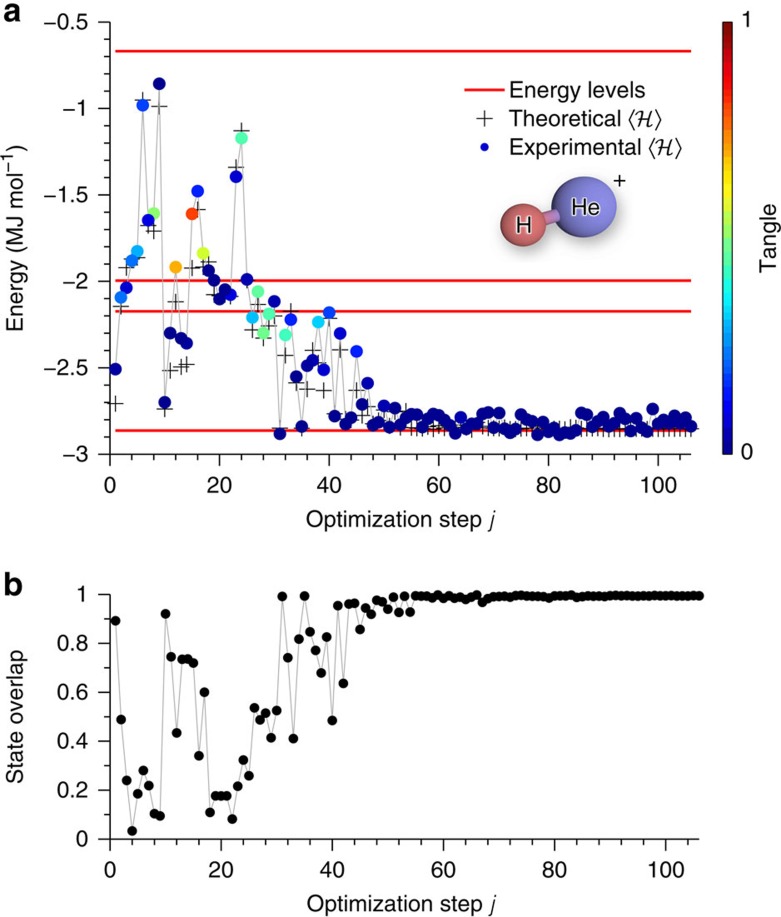
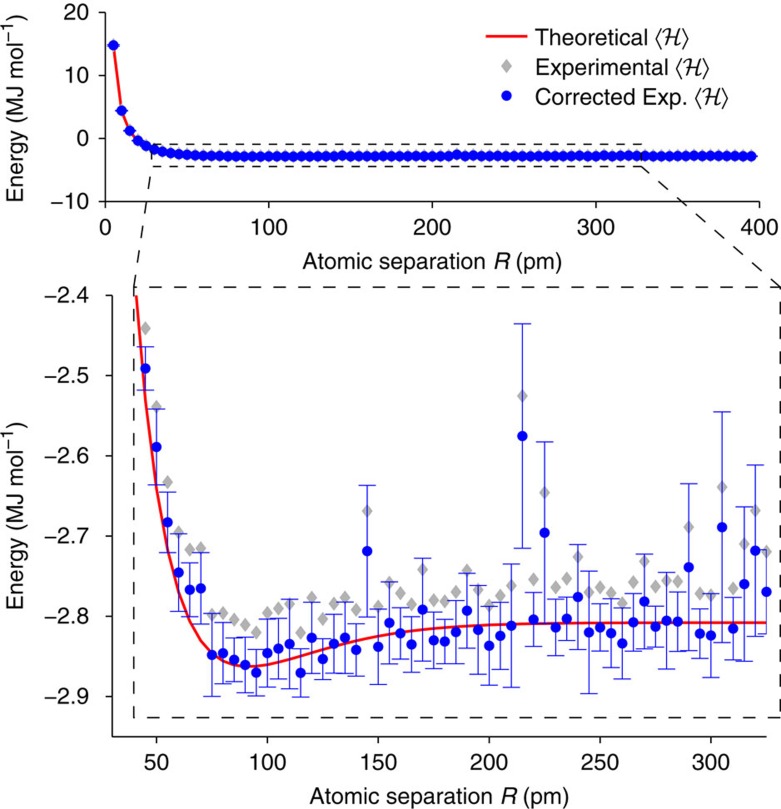
- The authors report an experimental ground-state result for He–H\(^+\): after correcting for experimental errors, they estimate the equilibrium bond length as \(R = 92.3 \pm 0.1\) pm and the ground-state electronic energy as \(E = -2.865 \pm 0.008\) MJ mol\(^{-1}\).
- For the bond dissociation curve, more than 96% of the experimental data are within chemical accuracy of the theoretical values.
- In the discussion, they state that for a 4 × 4 Hamiltonian like the one demonstrated, the QPE circuit would require at least 12 CNOT gates, whereas their method requires one.
- The full experiment was performed in about 158 h, and the bond dissociation curve was obtained by finding the ground states of 79 Hamiltonians.
## Methods
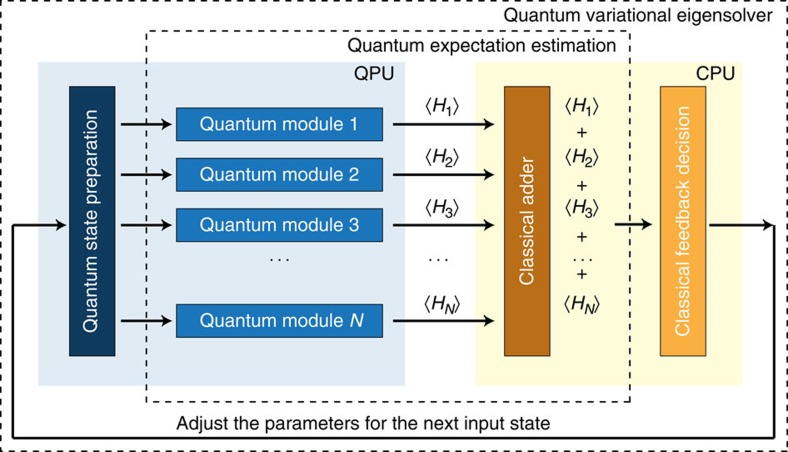
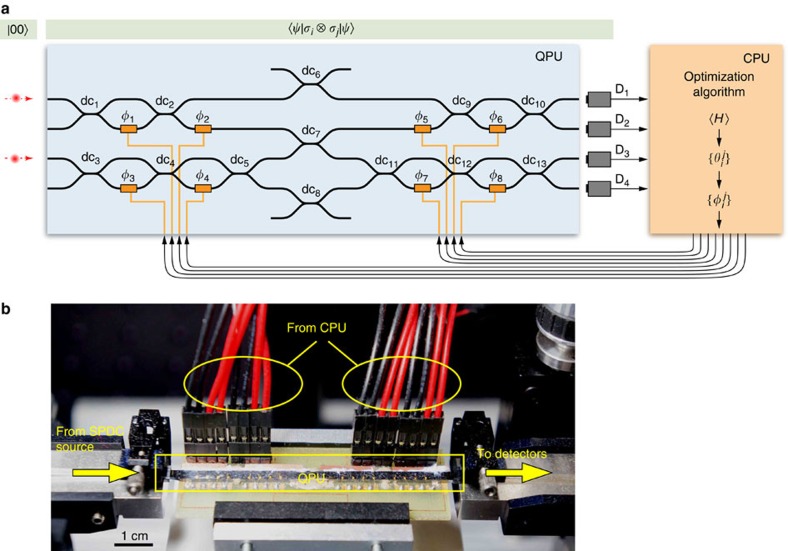
- The paper combines a reconfigurable integrated photonic quantum processor with a classical optimization algorithm: the quantum device estimates Hamiltonian expectation values, and the classical processor updates the state parameters variationally.
- The photonic chip prepares and measures arbitrary two-qubit pure states using single-qubit rotations and one two-qubit entangling gate; the experimental demonstration uses the He–H\(^+\) molecule in a minimal basis.
- For the classical optimization, they use the Nelder–Mead algorithm; expectation values are reconstructed from four two-qubit Pauli measurements at each point.
## Limitations
- The paper states that the method still requires a good approximation to the ground state as input/initialization, and the reliance on multiple separate measurements makes it sensitive to variations in state preparation between calculations.
- The authors report a constant systematic shift of \(\varepsilon = 50\) kJ mol\(^{-1}\) in the measured expectation values; they attribute this to photon-source impurity/distinguishability, circuit imperfections, and unbalanced coupling efficiencies.
- Evident from the text: the demonstration is limited to a two-qubit / 4 × 4 Hamiltonian prototype, so the scalability claim is not experimentally validated here.
Model-written summary. Check it against the paper before relying on it.
Integrity signals
Registry
Cites
Statistics
Figures
Verification
Claims the paper makes
7 Valid · 4 Not valid · 11 Not checked · 59 Own results and interpretations
The cited sources support only part of this claim — read each source’s verdict below.
In the paper
“Recent developments in the field of quantum computation offer a way forward for determining efficient solutions of many instances of large eigenvalue problems that are classically intractable6789101112”
§ A variational eigenvalue solver on a photonic quantum processor > Abstract
What the sources say
- Not matchedcites [6] Nielsen, M. A. & Chuang, I. L. Quantum Computation and Quantum Information Cambridge University Press (2000).
Couldn’t be matched to a paper in Crossref, so it can’t be checked.
- Could not verifycites [7] Kitaev, A. Quantum measurements and the Abelian stabilizer problem. Electronic Colloquium on Computational Complexity (ECCC) 3 (1996). sourceExperimental — accuracy not yet measured
Our copy under this DOI is the ISAAC 2021 paper 'Effective Resistance and Capacitance in Simplicial Complexes and a Quantum Algorithm' (Kitaev's 1995 work appears only as reference [9] in its bibliography), and it nowhere asserts that quantum computation gives efficient solutions to classically intractable large eigenvalue problems. Eigenvalues enter only as complexity parameters — λ, the smallest eigenvalue of the normalized up-Laplacian, in Lemma 31 and Theorem 26 (Section 6.3, 'Time efficient implementations') and in the phase-estimation machinery of Appendix A — and Section 1.1 ('Our Contributions') actually reports the opposite direction for its own problem: 'the quantum algorithm is slower than the classical algorithm in the worst case'. Searched: 'eigenvalue problems classically intractable', 'quantum speedup / exponential advantage', 'phase estimation', 'faster than classical'; no passage addresses the claim's point. (LLM, conf=0.70)
- Partly supportedcites [8] Griffiths, R. B. & Niu, C.-S. Semiclassical fourier transform for quantum computation. Phys. Rev. Lett. 76, 3228–3231 (1996). sourceExperimental — accuracy not yet measured
On p. 1, the paper says a quantum computer, if built, could solve certain problems such as factoring long numbers much faster than conventional algorithms. It also describes a simpler Fourier transform for Shor’s factorization and discrete-logarithm algorithms (p. 1). The copy does not support the claim about efficient solutions to many large eigenvalue problems. (LLM, conf=0.84)
plainstates a cause- Asserted: passes — The authors put it forward as true.
- Checkable: passes — It can be checked against evidence.
- Load-bearing: passes — The paper’s conclusions depend on it.
- Based: passes — The paper gives a reason why it holds.
- Not matched
Every source the paper cites for this claim was checked and supports it.
In the paper
“this would suffer from the N-representability problem, which is known to be intractable for both classical and quantum computers (it is in the quantum complexity class QMA-Hard24).”
§ A variational eigenvalue solver on a photonic quantum processor > Results > Quantum expectation estimation
What the sources say
- Supportedcites [24] Liu, Y.-K., Christandl, M. & Verstraete, F. Quantum computational complexity of the n-representability problem: Qma complete. Phys. Rev. Lett. 98, 110503 (2007). source
The paper states that N-representability is QMA-complete and hence QMA-hard and NP-hard (Abstract). Its discussion of quantum-chemistry relevance says the problem is intractable in the worst case even on a quantum computer, while allowing that particular physical systems may be easier. (LLM, conf=0.93)
boosted- Asserted: passes — The authors put it forward as true.
- Checkable: passes — It can be checked against evidence.
- Load-bearing: passes — The paper’s conclusions depend on it.
- Based: passes — The paper gives a reason why it holds.
- Supported
Every source the paper cites for this claim was checked and supports it.
In the paper
“We have implemented the QPU using integrated quantum photonics technology30.”
§ A variational eigenvalue solver on a photonic quantum processor > Results > Prototype demonstration
What the sources say
- Supportedcites [30] O'Brien, J. L., Furusawa, A. & Vuckovic, J. Photonic quantum technologies. Nat. Photon. 3, 687–695 (2009). source
The citation identifies integrated quantum photonics as the technology used, rather than attributing the citing authors’ QPU implementation to this review. The “Integrated quantum optical circuits” section (p. 6) describes on-chip waveguide circuits performing quantum logic gates and a compiled quantum factoring algorithm. (LLM, conf=0.87)
plain- Asserted: passes — The authors put it forward as true.
- Checkable: passes — It can be checked against evidence.
- Load-bearing: passes — The paper’s conclusions depend on it.
- Based: passes — The paper gives a reason why it holds.
- Supported
The cited sources support only part of this claim — read each source’s verdict below.
In the paper
“The time the quantum computer must remain coherent is determined by the necessity of O(p−1) successive applications of , each of which can require on the order of millions or billions of quantum gates for practical applications1719, as compared to the tens to hundreds of gates achievable in the short term.”
§ A variational eigenvalue solver on a photonic quantum processor > Abstract
What the sources say
- Partly supportedcites [17] Whitfield, J. D., Biamonte, J. & Aspuru-Guzik, A. Simulation of electronic structure hamiltonians using quantum computers. Mol. Phys. 109, 735–750 (2011). sourceExperimental — accuracy not yet measured
Split into 2 atoms — 1 confirmed, 1 partially supported, 0 disputed, 0 misattributed, 0 unverifiable. Expand the claim to see per-atom verdicts.
- Partly supportedcites [19] Jones, N. C. et al. Faster quantum chemistry simulation on fault-tolerant quantum computers. New J. Phys. 14, 115023 (2012). sourceExperimental — accuracy not yet measured
Split into 2 atoms — 0 confirmed, 2 partially supported, 0 disputed, 0 misattributed, 0 unverifiable. Expand the claim to see per-atom verdicts.
plainstates a cause- Asserted: passes — The authors put it forward as true.
- Checkable: passes — It can be checked against evidence.
- Load-bearing: passes — The paper’s conclusions depend on it.
- Based: passes — The paper gives a reason why it holds.
- Partly supported
A result the paper reports from its own data — it cites no other source for it, so there is none to check. The quote shows it is in the paper.
In the paper
“We experimentally demonstrate the feasibility of this approach with an example from quantum chemistry—calculating the ground-state molecular energy for He–H+.”
§ A variational eigenvalue solver on a photonic quantum processor > Abstract
boostedstates a causeSingle case- Asserted: passes — The authors put it forward as true.
- Checkable: passes — It can be checked against evidence.
- Load-bearing: passes — The paper’s conclusions depend on it.
- Based: passes — The paper gives a reason why it holds.
31 more claims
Create a free account to see all 81 claims and to verify the 4 references still open.
- It may state two separate claims as one. 28
- Probably not a substantial claim. 24
Claims other papers make about this one
Each is checked against this paper’s own text: does it say what the citing paper says it does?
The cited source doesn’t support the claim as written.
In the citing paper
“Leveraging quantum resources, the UCC ansatz was instead realized as a PQC on a photonic processor (Peruzzo et al. , 2014).”
From Noisy intermediate-scale quantum algorithms (2022) · cites this paper as Peruzzo et al., 2014
Checked by a reasoning model — may be wrong.
Experimental — accuracy not yet measuredThe cited source doesn’t support the claim as written.
In the citing paper
“The first on-chip GMM of four-qubit cluster state was realised in a laser-writing chip ( Fig.4e ), by manipulating both the polarisation and path DoFs of two photons [85].”
From Integrated photonic quantum technologies (2020) · cites this paper as [85]
Checked by a reasoning model — may be wrong.
Experimental — accuracy not yet measuredThe cited source doesn’t support the claim as written.
In the citing paper
“four-qubit linear- and box-cluster states are generated in a laser-writing photonic chip. This is enabled by on-chip manipulating the two-photon four-qubit hyperentangled state and cluster state, that are encoded in photon's path and polarisation DoFs. The Grover's search algorithm on a four-element database was implemented by controlling the device.”
From Integrated photonic quantum technologies (2020) · cites this paper as [85]
Checked by a reasoning model — may be wrong.
Experimental — accuracy not yet measuredThe source backs part of the claim, not all of it — or backs it for a different population, condition or comparison.
In the citing paper
“Due to its versatility, the variational Hamiltonian ansatz has been implemented for quantum chemistry [21, 29], optimization [24], and for quantum simulation problems [30].”
From Variational quantum algorithms (2021) · cites this paper as [29]
Experimental — accuracy not yet measuredThe source backs part of the claim, not all of it — or backs it for a different population, condition or comparison.
In the citing paper
“For the original VQE (Peruzzo et al. , 2014) and QAOA (Farhi et al. , 2014) it can, for example, be described as a single expectation value min θ ⟨ H ⟩ U ( θ ) , where the differences solely appear in the specific form and construction of the qubit Hamiltonian.”
From Noisy intermediate-scale quantum algorithms (2022) · cites this paper as Peruzzo et al., 2014
Experimental — accuracy not yet measured
12 more claims about this paper
Create a free account to see every claim other papers make about this one.
Citations
Cites
A Simplex Method for Function Minimization
Nelder, J. A., & Mead, R. (1965) · The Computer Journal · doi:10.1093/comjnl/7.4.308 · Cited by 28,905
Quantum computation and quantum information
Law, J. (2001) · ACM SIGSOFT Software Engineering Notes · doi:10.1145/505482.505499 · Cited by 18,842
(1999) · Cited by 12,854
Practical Methods of Optimization
Fletcher, R. (2000) · Wiley eBooks · doi:10.1002/9781118723203 · Cited by 7,605 · cited 3×
“[12] S.”
BackgroundMethodPractical methods of optimization
(1988) · Mathematics and Computers in Simulation · doi:10.1016/0378-4754(88)90129-2 · Cited by 5,818
Quantum Algorithm for Linear Systems of Equations
Harrow, A. W., Hassidim, A., & Lloyd, S. (2009) · Physical Review Letters · doi:10.1103/physrevlett.103.150502 · Cited by 3,325
Conn, A. R., Gould, N. I. M., & Toint, P. L. (2000) · Society for Industrial and Applied Mathematics eBooks · doi:10.1137/1.9780898719857 · Cited by 2,981 · cited 3×
“[14] D.”
MethodInfluential�ber das Paulische �quivalenzverbot
Jordan, P., & Wigner, E. (1928) · Zeitschrift f�r Physik · doi:10.1007/bf01331938 · Cited by 2,597
Molecular Electronic‐Structure Theory
Helgaker, T., Jørgensen, P., & Olsen, J. (2000) · doi:10.1002/9781119019572 · Cited by 2,594
O'Brien, J. L., Furusawa, A., & Vučković, J. (2009) · Nature Photonics · doi:10.1038/nphoton.2009.229 · Cited by 2,388
Self-citation
Research works printed but not linked: 3
- Helgaker, T., Jorgensen, P. & Olsen, J. Mol. Electronic Struct. Theory Wiley, Sussex (2002).
- Saad, Y. Numerical Methods for Large Eigenvalue Problems Vol. 158, (SIAM (1992).
- Rayleigh, J. W. In finding the correction for the open end of an organ-pipe. Phil. Trans. 161, 77 (1870).
Cited by
Items 3,401–3,500 of 4,572
Towards a Unified Architectural Representation in HPCQC: Extending Sys-Sage for Quantum Technologies
Mishra, D., Vanecek, S., Echavarria, J., Deng, X., Mete, B., Schulz, L. B., & Schulz, M. (2025) · ISC High Performance (ISC) · doi:10.23919/isc.2025.11017506 · Cited by 2
Generative flow-based warm start of the variational quantum eigensolver
Zou, H., Rahm, M., Kockum, A. F., & Olsson, S. (2025) · npj Quantum Information · doi:10.1038/s41534-025-01159-x · Cited by 11
“Amongthem,the variational quantum eigensolver (VQE) 6,9 is a widely adopted approach that uses parameterized quantum circuits, together with classical optimization of the parameters, to approximate the ground state of a many-body Hamiltonian.”
Symmetry checking in band-structure calculations on a noisy quantum computer
Zhang, S., Karim, A., Quiney, H. M., & Usman, M. (2025) · Physical Review Applied · doi:10.1103/vpyb-ynmz · Cited by 2
“Among the promising applications of NISQ devices is quantum chemistry, where parameterized quantum circuits are constructed to approximate the electronic structure, specifically, the energy spectra and eigenstates of quantum systems [6–14].”
Universal approximation of continuous functions with minimal quantum circuits
Pérez-Salinas, A., Rad, M. Y., Barthe, A., & Dunjko, V. (2025) · Physical Review Research · doi:10.1103/t49h-jmty · Cited by 13
“Such variational approaches may be utilized in a plethora of contexts, including quantum optimization [2–4] or quantum machine learning [5–8], among others.”
Chai, Y., Jansen, K., Kühn, S., Schwägerl, T., & Stollenwerk, T. (2025) · EPJ Quantum Technology · doi:10.1140/epjqt/s40507-025-00452-0 · Cited by 7
“The Variational Quantum Eigensolver (VQE) is a classical–quantum hybrid algorithm that uses parametrized quantum circuits as ansätze [1, 2].”
Warm-Starting PCE for Traveling Salesman Problem
do Carmo, R. S., dos Reis, R. G., Silva, S. F. F., Arruda, L. G. E., & Fanchini, F. F. (2025) · Brazilian Journal of Physics · doi:10.1007/s13538-025-01966-9 · Cited by 10
Comparative studies of optimizer performance in a variational quantum eigensolver
Lü, Q. (2025) · The Journal of Chemical Physics · doi:10.1063/5.0305677 · Cited by 1
Generating three-dimensional genome structures with a variational quantum algorithm
Siciliano, A. J., & Wang, Z. (2025) · Briefings in Bioinformatics · doi:10.1093/bib/bbaf663 · Cited by 1
“Typically, H is decomposed into a set of Pauli strings, and the expected energy is computed using the Hamiltonian averaging technique [57, 82].”
Belaloui, N. E., Tounsi, A., Khamadja, A. R., Benkadour, H., Louamri, M. M., Benslama, A., & Rouabah, M. T. (2025) · Physica Scripta · doi:10.1088/1402-4896/ae2f3e · Cited by 3
“The variational quantum eigensolver (VQE) [15], an iterative, hybrid quantum-classical algorithm for approximating the minimum eigenvalue of a Hamiltonian, is one of the earliest VQAs to be introduced.”
Distributed learning with quantum-classical collaborative management
Du, Z., & Mao, Y. (2025) · Elsevier eBooks · doi:10.1016/b978-0-44-330259-6.00014-1 · Cited by 1
Variational Quantum Algorithm for Photonic Crystals(Invited Paper)
Chen, L., Li, X., Su, J., Huang, S., Cai, Z., Yu, Z., Ning, Y., Xiao, Q., Zhang, J., Ma, Q., et al. (2025) · Electromagnetic waves · doi:10.2528/pier25081203 · Cited by 3
Reshaping computation with quantum mechanics
(2025) · Nature Computational Science · doi:10.1038/s43588-025-00942-2 · Cited by 1
Edge of Many-Body Quantum Chaos in Quantum Reservoir Computing
Kobayashi, K., & Motome, Y. (2025) · Physical Review Letters · doi:10.1103/j2qj-vwcl · Cited by 29
“These advances have, in turn, inspired extensive research e ff orts in quantum machine learning, with various approaches—notably variational quantum algorithms (VQAs)—being actively explored [6–11].”
Quantum Machine Learning for Drug Discovery: Taxonomy, Research Challenges, and the Road Ahead
Duong, Y. H. P., Rizvi, S. M. A., McNiven, B. D. E., Nguyen, T. T., Shin, H., Dobre, O. A., & Duong, T. Q. (2025) · ACM Computing Surveys · doi:10.1145/3785660 · Cited by 7
“A variety of quantum algorithms have been developed, ranging from those requiring error-corrected, large-scale quantum computers to more NISQ-friendly algorithms that can run on imperfect hardware.”
InfluentialVariational determination of penalty parameters in quantum annealing
Qin, J.-Q., Yunlong, Y., & Wang, X. (2025) · Quantum Science and Technology · doi:10.1088/2058-9565/ae30a2 · Cited by 1
“Quantum optimization algorithms, such as quantum annealing (QA) [6–12], variational quantum algorithm (VQA) [13–22] and quantum imaginary time evolution [23] are considered as promising candidates for solving these constrained problems on current quantum hardware more effectively, where the…”
Efficient and scalable branch-and-bound algorithm for exact qubit allocation
Valois, J.-P., Helbecque, G., & Melab, N. (2025) · Future Generation Computer Systems · doi:10.1016/j.future.2025.108342 · Cited by 3
Optimal compilation strategies for QFT circuits in neutral-atom quantum computing
Gao, D., Li, Y., Ying, S., & Li, S. (2025) · Scientific Reports · doi:10.1038/s41598-025-32572-z · Cited by 4
Senapati, P., Zhu, S., Peng, B., Fang, B., & Guan, Q. (2025) · IEEE International Conference on Computer Design: VLSI in Computers and Processors (ICCD) · doi:10.1109/iccd65941.2025.00058 · Cited by 2
“VQAs are used in chemistry, optimization, and machine learning, with VQE estimating ground-state energies [52] and QAOA tackling discrete problems via alternating Hamiltonians [54].”
Windom, Z. W., Bertels, L. W., Claudino, D., & Bartlett, R. J. (2026) · The Journal of Chemical Physics · doi:10.1063/5.0296472 · Cited by 2
Quantum-Enhanced Artificial Intelligence: The Next Frontier in Computing and Decision-Making
Ansarullah, S. I., Ikhlaq, S., Yousuf, T., et al. (2026) · Studies in big data · doi:10.1007/978-3-032-00586-1_4 · Cited by 1
Distributed photonic variational quantum eigensolver with parameterized weak measurements
Lee, D., Bilash, B., Lee, J., Lim, H., Kim, Y., Lee, S.-W., & Kim, Y.-S. (2026) · npj Quantum Information · doi:10.1038/s41534-025-01163-1 · Cited by 5
“The Hamiltonian of thissimplecationisdescribedbytwoPaulioperators,providinganidealtest caseforourdistributedVQEsetup 14 .”
Quantum computing for radiation therapy optimization
Rahimi, R., Saitoh, A., Modiri, A., Nakano, Y., Okada, K. N., Tsukano, S., Zhang, B., Fujii, K., Kitagawa, M., & Sawant, A. R. (2026) · Medical Physics · doi:10.1002/mp.70269 · Cited by 4
Measuring central charge on a universal quantum processor
Köylüoğlu, N. U., Majumder, S., Amico, M., Mostame, S., van den Berg, E., Rajabpour, M. A., Minev, Z., & Najafi, K. (2026) · Nature Communications · doi:10.1038/s41467-025-66775-9 · Cited by 22
“The objective is to minimize a cost function de fi ned as energy expectation with respect to the target Hamiltonian H : C ( θ ) = 〈 ψ ( θ ) ∣ H ∣ ψ ( θ ) 〉 30,31 .”
InfluentialQuantum Glassiness from Efficient Learning
Anschuetz, E. R. (2026) · Communications in Mathematical Physics · doi:10.1007/s00220-025-05536-7 · Cited by 9
Zhang, H., Bai, D., & Ren, Z. (2026) · Physics Letters B · doi:10.1016/j.physletb.2026.140174 · Cited by 3
“…(HHL) [44] has been employed to solve linear systems, quantum phase estimation (QPE) [45, 46], the variational quantum eigensolver (VQE) [47–52], the variants of VQE [53–62], and the quantum neural network (QNN) [63– 67] have achieved substantial progress in solving eigenvalue problems…”
Pornmaneerattanatri, S., Tsuji, M., Maheshwari, K., & Sato, M. (2026) · doi:10.1145/3784828.3786263 · Cited by 1
Velocity Verlet-based optimization for variational quantum eigensolvers
Miura, R. (2026) · Quantum Information Processing · doi:10.1007/s11128-026-05068-6 · Cited by 2
“VQE seeks θ ∗ = arg min θ E ( θ ), using a classical optimizer in an outer loop to update θ based on energy and, when available, gradient information [1, 2, 7–11].”
Hamamura, I., Imamura, T., Arakawa, T., Sumimoto, S., Yamazaki, K., Hu, Y., 古家, 真., & Nakajima, K. (2026) · doi:10.1145/3784828.3785259 · Cited by 1
Triple equivalence in modelling insight and creativity: Classical and quantum perspectives
Isomura, T. (2026) · Neuroscience Research · doi:10.1016/j.neures.2026.105025 · Cited by 2
Davis, G., & Freericks, J. K. (2026) · Symmetry · doi:10.3390/sym18020251 · Cited by 1
“While many different algorithms have been proposed for this problem, one of the most common approaches is variational algorithms, exemplified by the variational quantum eigensolver (VQE) [1].”
Comparative performance analysis of quantum feature maps for quantum kernel-based machine learning
Jha, R. K., Kasabov, N. K., Bhattacharyya, S., Coyle, D., & Prasad, G. (2026) · Scientific Reports · doi:10.1038/s41598-026-39392-9 · Cited by 7
Leveraging quantum computing for heat conduction analysis: A case study in thermal engineering
Asinari, P., Piredda, M. M., Barletta, G., Angelis, P. D., Alghamdi, N. M., Trezza, G., Provenzano, M., Fasano, M., & Chiavazzo, E. (2026) · Case Studies in Thermal Engineering · doi:10.1016/j.csite.2026.107813 · Cited by 2
Cabral, D. G. A., Allen, B., Pavošević, F., Hammes‐Schiffer, S., Díez-Valle, P., Baker, J. S., Saxena, G., Kyaw, T. H., & Batista, V. S. (2026) · Journal of Chemical Theory and Computation · doi:10.1021/acs.jctc.5c01911 · Cited by 4
“14 15–19 Within VQE, the unitary coupled cluster (UCC) ansatz, 20 derived from the coupled cluster formalism, 21 provides a physically grounded and systematically extensible representation of correlated wavefunctions.”
Quantum artificial intelligence: A comprehensive survey
Jiang, H., Pan, Y., Chen, J., Liu, Z., Sun, L., Li, Q., Zhang, L., Zhu, D., Wang, X., Liu, W., et al. (2026) · Meta-Radiology · doi:10.1016/j.metrad.2026.100205 · Cited by 2
Impact of measurement noise on escaping saddles in variational quantum algorithms
Kaminishi, E., Mori, T., Sugawara, M., & Yamamoto, N. (2026) · Scientific Reports · doi:10.1038/s41598-026-40123-3 · Cited by 6
“One of the most important examples is VQE (Variational Quantum Eigensolver) [3, 4], an algorithm that uses a quantum computer to obtain the ground state and its energy of a given Hamiltonian.”
Fourier Analysis of Parameterized Quantum Circuits and the Barren Plateau Problem
Okumura, S., & Ohzeki, M. (2026) · Journal of the Physical Society of Japan · doi:10.7566/jpsj.95.033002 · Cited by 10
“Parameterized quantum circuits (PQCs) serve as their core, forming the basis of the variational quantum eigensolver (VQE), 5) quantum approximate optimization algorithm (QAOA), 6) and quantum neural networks (QNNs), 7,8) applied across fields such as finance 9,10) and quantum chemistry.”
Mapping Bloch-Redfield dynamics into a unitary gate-based quantum algorithm
Aydoğan, K., Abbasi, M., Short, W., Fahrenbruch, M. Z., Krogmeier, T. J., Schlimgen, A. W., & Head-Marsden, K. (2026) · Digital Discovery · doi:10.1039/d5dd00405e · Cited by 1
On the Transfer of Knowledge in Quantum Algorithms
Villar-Rodríguez, E., Osaba, E., Oregi, I., Romero, S. V., & Ferreiro-Vélez, J. (2026) · Expert Systems · doi:10.1111/exsy.70211 · Cited by 7
“Concrete examples of VQA are the QAOA [87] and the VQE [88].”
Simulating fermions with a digital quantum computer
Chien, R. W., Chiew, M., Harrison, B., Necaise, J., Wang, W., Mudassar, M., McLauchlan, C., Henderson, T. M., Scuseria, G. E., Strelchuk, S., et al. (2026) · Nature Reviews Physics · doi:10.1038/s42254-025-00914-5 · Cited by 12
Shayegan, A. H. S. (2026) · Scientific Reports · doi:10.1038/s41598-026-40910-y · Cited by 6
“( θ Typical ansatz constructions employ layered structures composed of single-qubit rotations (e.g., R y ) or R z ( θ ) gates) combined with entangling operations such as CNOT gates 22,24 .”
Learning parameterized quantum circuits with quantum gradient
Li, K., Wang, Y., Gao, P., & Zheng, S. (2026) · npj Quantum Information · doi:10.1038/s41534-025-01179-7 · Cited by 6
“When p = 1 and F 1 ,i = F j, 1 = 0 for i, j ∈ [ d + 1], the problem simplifies to finding the ground state, where F encodes the information of Hamiltonian [18, 19].”
Hangun, B., Altun, O., & Eyecioğlu, Ö. (2026) · IEEE Access · doi:10.1109/access.2026.3668295 · Cited by 1
“The Variational Quantum Eigen-solver (VQE), first proposed in [30], pioneered the hybrid quantum-classical optimization framework that serves as the foundation for contemporary variational quantum algorithms.”
Yousef, N., Parmar, C., Sata, A. V., & Edacherian, A. (2026) · Quantum Information Processing · doi:10.1007/s11128-026-05113-4 · Cited by 3
“The output of the encoded qubits is then passed through variational quantum circuits (VQCs), which typically consist of the following: • Parameterized Rotation Gates: Rx( θ ), Ry( θ ), and Rz( θ ) with trainable parameters [51].”
Vukšić, M., Ćelić, J., & Cuculić, A. (2026) · IEEE Access · doi:10.1109/access.2026.3670749 · Cited by 6
“Two-qubit gates in trapped-ion systems typically operate on a timescale of tens to hundreds of microseconds; significantly slower than in solid-state qubit platforms [32].”
Dalporto, B. A. L., Mary, S., & Gallur, S. (2026) · Revista Multidisciplinar Epistemología de las Ciencias · doi:10.71112/05g0gd73 · Cited by 1
Qubit‐Efficient Quantum Local Search for Combinatorial Optimization
Podobrii, M., Kuzmin, V., Voloshinov, V., Veshchezerova, M., & Perelshtein, M. R. (2026) · Advanced Quantum Technologies · doi:10.1002/qute.202500438 · Cited by 2
“This limit is similar to algorithms that use the so-called complete encoding [ 8 ], such as VQE [ 14, 15 ] and QAOA [ 16, 17 ], where the number of qubits is equal to the number of classical variables.”
GraMA: A gradient matrix-guided assignment method for solving qubit mapping problems
Piao, X., Kim, J., & Kim, J. (2026) · Future Generation Computer Systems · doi:10.1016/j.future.2026.108485 · Cited by 2
Noise-resilient nonadiabatic geometric quantum computation for bosonic binomial codes
Li, D.-S., Xiao, Y., Wang, Y., Liu, Y., Shi, Z., Chen, Y., Kang, Y.-H., & Xia, Y. R. (2026) · Science China Physics Mechanics and Astronomy · doi:10.1007/s11433-026-3017-5 · Cited by 1
Fuglsbjerg, J. H., Reinholdt, P., Kjellgren, E. R., Jensen, P. W. K., Coriani, S., Kongsted, J., & Sauer, S. P. A. (2026) · Journal of Chemical Theory and Computation · doi:10.1021/acs.jctc.5c01951 · Cited by 2
“A popular chemistry-inspired ansatz for quantum computing is the unitary coupled cluster singles doubles (UCCSD) ansatz [32, 33].”
A full-quantum algorithm for solving the exact cover problem via quantum gradient descent iteration
Huo, J., Fan, L., Zhang, R., & Cao, C. (2026) · Laser Physics · doi:10.1088/1555-6611/ae5047 · Cited by 1
Karthikeyan, M. P., Kumar, S. J. S., Manimuthu.P, & S.Sridevi (2025) · International Conference on Signal Processing, Computation, Electronics, Power and Telecommunication (IConSCEPT) · doi:10.1109/iconscept66142.2025.11436364 · Cited by 1
“Quantum algorithm such as variation methods including QAOA and the Variational Quantum Eigensolver (VQE) have been proposed to circumvent the obstructions by calculating molecular systems more efficiently and to simulate on quantum interactions [9], [10].”
From membership-privacy leakage to quantum machine unlearning
Su, J., He, R., Li, G., Qin, S., He, Z., Situ, H., & Gao, F. (2026) · Physical Review Applied · doi:10.1103/mdfc-pgsl · Cited by 6
C2|Q>: A Robust Framework for Bridging Classical and Quantum Software Development
Ye, B., Khan, A. A., Pihkakoski, T., Liang, P., Akbar, M. A., Silveri, M., & Malmi, L. (2026) · ACM Transactions on Software Engineering and Methodology · doi:10.1145/3803018 · Cited by 1
Hybrid Quantum-Classical Inverse Design of Metasurfaces for Tailored High Q-factor Response
Warrier, S. R., & Dontabhaktuni, J. (2026) · Applied Physics A · doi:10.1007/s00339-026-09503-4 · Cited by 1
A Comprehensive Review of Hybrid Quantum–Classical Approaches for Image Classification
Jha, A., Bhandari, R., & Chadha, R. (2025) · IEEE Global Conference on Wireless Computing and Networking (GCWCN) · doi:10.1109/gcwcn66157.2025.11448343 · Cited by 1
Geometric entanglement entropy on projective Hilbert space
Cairano, L. D. (2026) · Physical Review A · doi:10.1103/3y4g-2ykl · Cited by 5
Exact gradient for general cost functions in variational quantum algorithms
Urbaneja, J., & Ho, L. B. (2026) · Physical Review A · doi:10.1103/6s2c-mxgx · Cited by 2
Ankalaki, S., Hukkeri, G. S., & Bhatnagar, S. (2026) · Archives of Computational Methods in Engineering · doi:10.1007/s11831-026-10553-3 · Cited by 5
“A hybrid quantum-classical loop is then executed: the quantum processor prepares | ψ ( θ ) ⟩ and estimates the energy expectation value ⟨ H ⟩ , while a classical optimizer updates θ to minimize this energy [17].”
Chen, S. Y.-C. (2026) · IEEE Circuits and Systems Magazine · doi:10.1109/mcas.2026.3660997 · Cited by 5
Symmetry-guided quantum state preparation: branched-subspaces adiabatic preparation (B-SAP)
Cugini, D., Guarnieri, G., Motta, M., & Gerace, D. (2026) · Quantum Science and Technology · doi:10.1088/2058-9565/ae5ad0 · Cited by 1
“In the last few years, VQAs have emerged as a promising framework to tackle the problem of eigenstates preparation, leveraging the hybrid quantum–classical paradigm of optimizing quantum states within a parameterized ansatz quantum circuit [18, 29–31].”
Obtaining accurate ground-state properties on near-term quantum devices
Ding, Q.-M., Peng, J., Huang, J., Zhang, Y., Wang, H., Xu, X., Ren, J., Ma, Y., & Yuan, X. (2026) · Physical Review Applied · doi:10.1103/lx3w-w6jx · Cited by 1
Fundamentals of Quantum Machine Learning and Robustness
Pira, L., & Rebentrost, P. (2026) · Quantum science and technology · doi:10.1007/978-3-032-11153-1_1 · Cited by 4
Geng, Z., Wang, X., Li, X., & Zhang, F. (2026) · Quantum Machine Intelligence · doi:10.1007/s42484-026-00381-w · Cited by 1
“…quantum circuits (VQCs) represent a hybrid computational paradigm where parameterized quantum operations are optimized using classical gradient-based methods (Peruzzo et al. 2014; Friedrich and Maziero 2023; Chen et al. 2024 , 2021 ; Yan et al. 2020 ; Khan et al. 2024 ; Guala et al. 2023 ).”
Balaji, P., Conefrey-Shinozaki, C., Draper, P., Elhaderi, J. K., Gupta, D., Hidalgo, L., & Lytle, A. (2026) · Physical review. D/Physical review. D. · doi:10.1103/m719-7tdf · Cited by 25
“An alternative approach, the variational quantum eigen-solver (VQE) [36,37], was developed as a hybrid classical-quantum algorithm that can iteratively construct a reasonable ground state with a relatively shallower circuit.”
Selvaraj, A., Jayawant, M., Kayalvizhi, N., Krishnan, M., Puvaneshvari, N., Kumar, A. W. S., & Rameshkumar, N. (2026) · Methods · doi:10.1016/j.ymeth.2026.04.006 · Cited by 1
Quantum Science with Arrays of Metastable Helium-3 Atoms
Li, Z., De, R., Sivakumar, R., Huie, W., Wei, H., Piel, J., Greene, C. H., Hazzard, K. R. A., Yan, Z. Z., & Covey, J. P. (2026) · PRX Quantum · doi:10.1103/hpnb-6ql3 · Cited by 5
“A variational quantum eigensolver (VQE) [125] can be implemented with spin-less 3 He ∗ fermions in tweezers, with the goal being to prepare an individual eigenstate (typically the ground state) in molecular Hamiltonians.”
Kalam, A., Deb, P., Sakurai, A., Sahoo, B. K., Prasannaa, V. S., & Das, B. P. (2026) · Physical Review Research · doi:10.1103/kmb5-nkqz · Cited by 1
Nguyen, V. D., Kuci, E., Rasquin, M., & Noels, L. (2026) · Acta Mechanica Sinica · doi:10.1007/s10409-025-25157-x · Cited by 6
“…decades of research; the existing gate-based quantum computers are referred to as noisy-intermediate-scale quantum (NISQ) devices, for which variational quantum algorithms (VQA), such as variational quantum eigensolver [12] and quantum approximate optimisation algorithm (QAOA) [13], are suitable.”
Noisy monitored quantum circuits
Liu, S., Jian, S.-K., & Zhang, S. (2026) · Journal of Physics Condensed Matter · doi:10.1088/1361-648x/ae6a58 · Cited by 9
“In the noisy intermediate-scale quantum (NISQ) era, the variational quantum eigensolver (VQE) [41, 248–255] is one of the most promising algorithms to get the target ground state, in which a parameterized quantum circuit is optimized by a classical optimizer to minimize a cost function, usually…”
Exploring the Synergy of Quantum-Classical Integration in Machine Learning Algorithms
Vedhashree, L., V, Anushree, G., C, U. K., Suresha, R., Jeevitha, R., & Kathyanian, A. (2026) · International Conference on Smart Futuristic Technology (SMARTTECH) · doi:10.1109/icsft66733.2026.11508098 · Cited by 3
“The Variational Quantum Eigensolver (VQE) is a hybrid algorithm for ground-state and low-lying excited-state estimation in quantum chemistry and condensed-matter models [59].”
Constructing Compact ADAPT Unitary Coupled-Cluster Ansatz with Parameter-Based Criterion
He, R., Hong, X., Chai, Q., Guan, J., Zhou, J., Ablimit, A., Cui, G., & Ying, S. (2026) · Journal of Chemical Theory and Computation · doi:10.1021/acs.jctc.6c00269 · Cited by 6
“The emergence of quantum computing [4] offers a promising solution to this challenge, and the variational quantum eigensolver (VQE) algorithm [5–7] is among the most promising and widely investigated approaches for future quantum chemistry applications.”
QTIS: A QAOA-based Quantum Time Interval Scheduler
Tirado-Domínguez, J. A., Gutiérrez, E., & Plata, Ó. (2026) · Future Generation Computer Systems · doi:10.1016/j.future.2026.108594 · Cited by 3
“Two of the most widely studied variational algorithms are the Variational Quantum Eigensolver (VQE) [30] and the Quantum Approximate Optimization Algorithm (QAOA) [21, 36].”
Fourier Analysis Perspective on Quantum Neural Networks
Oh, S., Roh, E. J., Vasilakos, A. V., Park, S., & Kim, J. (2026) · Communications Physics · doi:10.1038/s42005-026-02680-x · Cited by 6
Vista: Verifier-in-the-Loop Agentic Reinforcement Learning for Quantum Program Synthesis
Yu, C., Shi, T., Uotila, V., Deng, S., You, L., & Zhao, B. (2026) · ACM Conference on AI and Agentic Systems (CAIS) · doi:10.1145/3786335.3813148 · Cited by 1
Relational Database Engines on Quantum Platforms: Concepts, Algorithms, and Implementations
Kesarwani, M., & Haritsa, J. (2026) · SIGMOD Companion · doi:10.1145/3788853.3801876 · Cited by 1
Moghaddam, B. P. (2026) · International Journal of Dynamics and Control · doi:10.1007/s40435-026-02173-3 · Cited by 1
Sarkar, M., Roy, L., Gutal, A. P., Atul Kumar Dnyaan Prasad Global University, & Paranjothy, M. (2026) · The Journal of Physical Chemistry A · doi:10.1021/acs.jpca.6c00363 · Cited by 6
“In order to compute the ground state energy for any molecule, VQE algorithm utilizes variational principle along with a classical gradient-based optimizer[39]- a quantum-classical hybrid algo-rithm.”
Counterdiabatic ADAPT-VQE for Molecular Simulation
Tancara, D., Díaz-Moraga, H., & Goyeneche, D. (2026) · Journal of Chemical Theory and Computation · doi:10.1021/acs.jctc.6c00197 · Cited by 4
“In the foundational work [11], an ansatz for molecular simulations was proposed based on the unitary coupled cluster with single and double excitations (UCCSD).”
Singh, R., & Suseelan, A. D. (2026) · Electronics · doi:10.3390/electronics15132832 · Cited by 1
Hamiltonian expressibility for ansatz selection in variational quantum algorithms
Brozzi, F., Turati, G., Dacrema, M. F., Caruso, F., & Cremonesi, P. (2026) · Quantum Machine Intelligence · doi:10.1007/s42484-026-00407-3 · Cited by 4
“• Problem-inspired ans¨atze (Peruzzo et al. 2014; Farhi et al. 2014), which incorporate domain knowledge to tailor the circuit structure to the problem at hand.”
El agente cuántico: automating quantum simulations
Gustín, I., Calderón, L., Pérez-Sánchez, J. B., Crebolder, C., Gonthier, J. F., Vakili, M. G., Nakamura, Y., Panicker, K., Ramprasad, M., Yin, A., et al. (2026) · Reports on Progress in Physics · doi:10.1088/1361-6633/ae8933 · Cited by 19
“This approach follows the dominant strategy for near-term quantum simulation and variational algorithms [14, 21, 103, 153].”
Self-citationRovibrational energy levels of H2O by quantum computing
Lötstedt, E., & Szidarovszky, T. (2026) · The Journal of Chemical Physics · doi:10.1063/5.0333947 · Cited by 2
Quantum machine learning for predicting properties of van der Waals bilayers
Chowdhury, C., & Giordano, L. (2026) · The Journal of Chemical Physics · doi:10.1063/5.0330379 · Cited by 1
Hybrid Oscillator-Qubit Quantum Processors: Simulating Fermions, Bosons, and Gauge Fields
Crane, E., Smith, K. C., Tomesh, T., Eickbusch, A., Martyn, J. M., Kühn, S., Funcke, L., DeMarco, M. A., Chuang, I. L., Wiebe, N., et al. (2026) · Physical Review X · doi:10.1103/s5bn-z4jq · Cited by 99
Shot‐Based Quantum Encoding: A Data‐Loading Paradigm for Quantum Neural Networks
Kyriacou, B., Patapovich, V., Periyasamy, M., & Melnikov, A. A. (2026) · Advanced Computing · doi:10.1002/adco.70004 · Cited by 1
Framework for Robust Quantum Speedups in Practical Correlated Electronic Structure and Dynamics
Anonymous, & Chan, G. K. (2026) · Physical Review Letters · doi:10.1103/v2ms-wmz1 · Cited by 10
“Further optimization is possible with alternative definitions of the oracle [6, 7], although the asymptotic scaling doesn’t change.”
Unpredictability and entanglement in open quantum systems
Kazemi, J., & Weimer, H. (2023) · New Journal of Physics · doi:10.1088/1367-2630/acf151 · Cited by 2
OnCall Operator Scheduling for Satellites with Grover’s Algorithm
Scherer, A., Guggemos, T., Grundner-Culemann, S., Pomplun, N., Prüfer, S., & Spörl, A. K. (2021) · Lecture notes in computer science · doi:10.1007/978-3-030-77980-1_2 · Cited by 6
Blankson, R., & Pavlovskiy, E. (2021) · Lecture notes in networks and systems · doi:10.1007/978-981-16-5348-3_38 · Cited by 1
Nearest Neighbor Synthesis of CNOT Circuit Based on Matrix Transformation
Cheng, X., Zhu, M., Li, X., & Guan, Z. (2022) · Lecture notes on data engineering and communications technologies · doi:10.1007/978-3-030-89698-0_16 · Cited by 2
Some Recent Progress in Learning Theory: The Quantum Side
Anshu, A. (2022) · Harvard Data Science Review · doi:10.1162/99608f92.9c47e402 · Cited by 4
“They are the focus of research efforts in near-term quantum algorithms (Farhi et al., 2014; Peruzzo et al., 2014) and offer provable advantage over similar classical computations (Bravyi et al.”
BackgroundQuantum Potential Speed-Up of Combinatorial Optimization Solvers for AUV Path Planning
Monbroussou, L., & Kukla, R. (2021) · MTS/IEEE OCEANS Conference (OCEANS) · doi:10.23919/oceans44145.2021.9706114 · Cited by 1
Guaranteed-accuracy quantum annealing
Imoto, T., Seki, Y., Matsuzaki, Y., & Kawabata, S. (2022) · Physical Review A · doi:10.1103/physreva.106.042615 · Cited by 3
General Vapnik–Chervonenkis dimension bounds for quantum circuit learning
Chen, C.-C., Sogabe, M., Shiba, K., Sakamoto, K., & Sogabe, T. (2022) · Journal of Physics Complexity · doi:10.1088/2632-072x/ac9f9b · Cited by 3
Experimental determination of a multiqubit ground state via a cluster mean-field algorithm
Zhan, Z., Fei, Y., Run, C., Zong, Z., Xiang, L., Jin, W., Jia, Z.-L., Duan, P., Guo, G., Wu, J., et al. (2022) · Physical Review Research · doi:10.1103/physrevresearch.4.l042043 · Cited by 1
Optimized meta-VQE Algorithm for Better Trend Learning of Ground State Energy
Zeng, H., Li, Z., Luan, T., et al. (2022) · International Conference on Wireless Communications and Signal Processing (WCSP) · doi:10.1109/wcsp55476.2022.10039381 · Cited by 1
“The most classical algorithm in the variational quantum algorithm is the variable component eigenvalue Solver (VQE) [3].”
MethodEntanglement concentration of multi-qubit entangled states: an IBM quantum experience
Ram, J., Dutt, D., Dhiman, S. K., Behera, B. K., & Panigrahi, P. K. (2023) · Quantum Studies Mathematics and Foundations · doi:10.1007/s40509-023-00298-0 · Cited by 1
“In this quantum protocol, the multi-qubit entangled states are mapped to an ansatz state (a many-body entangled wave function) which is the key ingredient of VQE algorithm [63].”
MethodTowards Symmetry-Aware Efficient Simulation of Quantum Systems and Beyond
Chen, M., Liu, M., Oh, C., Jiang, L., Alexeev, Y., & Liu, J. (2025) · IEEE International Conference on Trust, Privacy and Security in Intelligent Systems and Applications (TPS-ISA) · doi:10.1109/tps-isa67132.2025.00073 · Cited by 2
“While quantum devices hold the long-term promise of efficiently tackling classically intractable many-body problems [1], current hardware in the Noisy Intermediate-Scale Quantum (NISQ) era [2] remains limited in system size, coherence, and overall noise levels.”
Solving the Fully Entangled Fraction on Near-Term Quantum Devices
Liu, X., Qu, Y.-D., Wang, J., Li, M., & Shen, S. (2023) · International Journal of Theoretical Physics · doi:10.1007/s10773-023-05328-6 · Cited by 1
“Many of the proposed VQAs have demonstrated the power of such algorithms, including variational eigenvalue solver [8, 9], variational quantum singular value”
BackgroundMulti-Class Classification Using Quantum Kernel Methods
Mokhles, M., & Makarov, I. (2023) · International Russian Smart Industry Conference (SmartIndustryCon) · doi:10.1109/smartindustrycon57312.2023.10110752 · Cited by 1
“Based on the concept of the variational quantum eigen-solver VQE [5], the generalization of the algorithm was introduced [6] with some improvements for practical implementation.”
Method
Metadata
- Authors
- Peruzzo, A., McClean, J., Shadbolt, P., Yung, M.-H., Zhou, X.-Q., Love, P. J., Aspuru-Guzik, A., & O’Brien, J. L.
- Affiliations
- The University of Sydney (AU)
- Harvard University (US)
- University of Bristol (GB)
- Haverford College (US)
- Corresponding author
- Peruzzo, Alberto
- O’Brien, Jeremy L.
- Venue
- Nature Communications
- Published
- 2014-07-23
- Volume
- 5
- Issue
- 1
- Pages
- 4213-4213
- ISSN
- 2041-1723 (ISSN-L)
- PMC
- PMC4124861
- OpenAlex
- W2161685427
- Cited by
- 4,552
- References
- 48
- Citations by year
- 2026: 591 · 2025: 765 · 2024: 722 · 2023: 658 · 2022: 564 · 2021: 561 · 2020: 346 · 2019: 191 · 2018: 83 · 2017: 29 · 2016: 18 · 2015: 16 · 2014: 4
- FWCI
- 22.24
- Type
- journal article
- Language
- en
- Open access
- hybrid
- doi.org
- Licence
- cc-by-nc-nd
- creativecommons.org/licenses/by-nc-nd/4.0 (tdm)
- creativecommons.org/licenses/by-nc-nd/4.0 (vor)
- Locations
- Nature Communications (publishedVersion, cc-by-nc-nd)
- Europe PMC (PubMed Central) (publishedVersion, cc-by-nc-nd)
- PubMed Central (publishedVersion, cc-by-nc-nd)
- PubMed (publishedVersion)
- arXiv (Cornell University) (submittedVersion)
- OSTI OAI (U.S. Department of Energy Office of Scientific and Technical Information) (submittedVersion, cc-by-nc-nd)
- Digital Access to Scholarship at Harvard (DASH) (Harvard University) (submittedVersion, cc-by)
- RePEc: Research Papers in Economics (submittedVersion)
- RMIT Research Repository (RMIT University Library) (submittedVersion, cc-by-nc-nd)
- Figshare (submittedVersion, cc-by-nc-nd)
- UWA Profiles and Research Repository (UWA) (submittedVersion, cc-by-nc-nd)
- Bristol Research (University of Bristol) (submittedVersion)
- arXiv (Cornell University)
- Funders
- National Science Foundation (DE-FG02-97ER25308, 0955518, 1037992)
- U.S. Department of Energy (DEFG0297ER25308, DE‐FG02‐, FG02-97ER25308)
- Alfred P. Sloan Foundation
- John Templeton Foundation
- Camille and Henry Dreyfus Foundation
- Royal Academy of Engineering
- National Natural Science Foundation of China (61033001, 61361136003)
- Engineering and Physical Sciences Research Council (EP/J017175/1, EP/L024020/1, EP/K021931/1)
- Australian Research Council (DE140101700)
- National Key Research and Development Program of China (61033001, 2011CBA00301, 61361136003, 2011CBA00300)
- Division of Chemistry (CHE-1037992)
- Air Force Office of Scientific Research (FA 9550-12-1-0046, FA9550-, FA9550-12, FA9550‐12‐1)
- Topics
- Physical Sciences › Computer Science › Artificial Intelligence › Quantum Computing Algorithms and Architecture
- Physical Sciences › Physics and Astronomy › Atomic and Molecular Physics, and Optics › Quantum Information and Cryptography
- Physical Sciences › Physics and Astronomy › Atomic and Molecular Physics, and Optics › Quantum many-body systems
- Keywords
- variational quantum eigensolver, photonic quantum processors, quantum chemistry, classical optimization, hybrid quantum-classical computation
About these checks
Registry, retraction, Cites and statistics results are computed, not judged, with one exception: a printed reference that no index lists is read once by a model before it counts as a citation error. Claims are extracted by a model and kept only when their quote appears verbatim in the text; each cited source is then checked, with a model’s help, for whether it says what the claim relies on. Those verdicts can be wrong — read the claim’s quote and the cited source before relying on one.
The claim verdicts this report counts are experimental: their accuracy is not yet measured.
A language model drew the claims from the paper on 2026-10-10, under version 3 of the claim definition (model deepseek-v4.1-flash, prompt extract-v3).
A second model labelled each claim on 2026-10-10 (model jev-1.13-20260917, definition revision gold-guideline-v0.2).
Cited sources are checked with a language model’s help (qwen3.8-omni-flash and gpt-6-sol).
Statistics and arithmetic are recomputed, not judged.
Confidence bands are shown only for fields calibrated on our annotated test set. None is calibrated yet, so no band is shown.
What counts as a claim ›How we measure confidence ›How we check this ›
Are you an author, or do you see a problem with this page? Request a review
Data sources
Bibliographic data: Semantic Scholar, OpenAlex, Crossref.
Contains information from the Semantic Scholar Academic Graph Datasets, made available under the ODC Attribution License (ODC-BY 1.0).
Semantic Scholar’s data is described in: Kinney, R., et al. (2023). The Semantic Scholar Open Data Platform. arXiv:2301.10140.
