

A variational eigenvalue solver on a photonic quantum processor
Open accessThe DOI matches its Crossref record; 47 of the 48 references it cites were found in a registry or an index; 14 of the 31 sources its claims cite were checked for support.
Abstract
Quantum computers promise to efficiently solve important problems that are intractable on a conventional computer. For quantum systems, where the physical dimension grows exponentially, finding the eigenvalues of certain operators is one such intractable problem and remains a fundamental challenge. The quantum phase estimation algorithm efficiently finds the eigenvalue of a given eigenvector but requires fully coherent evolution. Here we present an alternative approach that greatly reduces the requirements for coherent evolution and combine this method with a new approach to state preparation based on ansätze and classical optimization. We implement the algorithm by combining a highly reconfigurable photonic quantum processor with a conventional computer. We experimentally demonstrate the feasibility of this approach with an example from quantum chemistry—calculating the ground-state molecular energy for He–H+. The proposed approach drastically reduces the coherence time requirements, enhancing the potential of quantum resources available today and in the near future. Quantum computers promise to efficiently solve problems that would be practically impossible with a normal computer. Peruzzo et al. develop a variational computation approach that uses any available quantum resources and, with a photonic quantum processing unit, find the ground-state molecular energy of He–H+.
Overview
CoChat Summary
## TL;DR
The paper introduces a variational alternative to quantum phase estimation for finding eigenvalues, combining short coherent quantum measurements with classical optimization. It experimentally demonstrates the approach on a photonic processor by estimating the ground-state energy curve of He–H\(^+\).
## Key findings
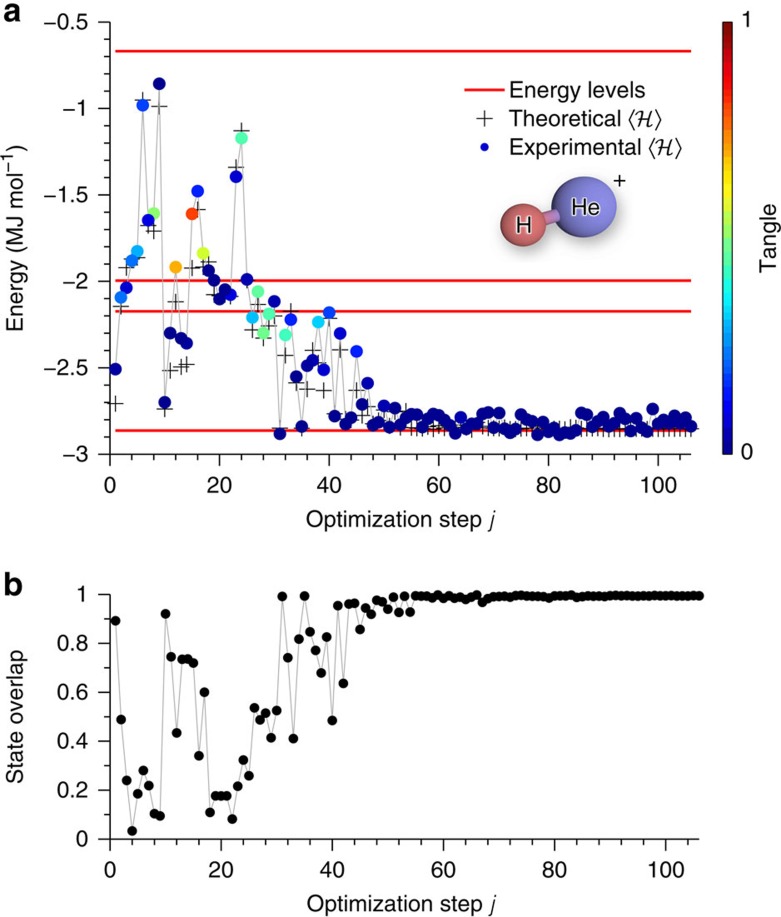
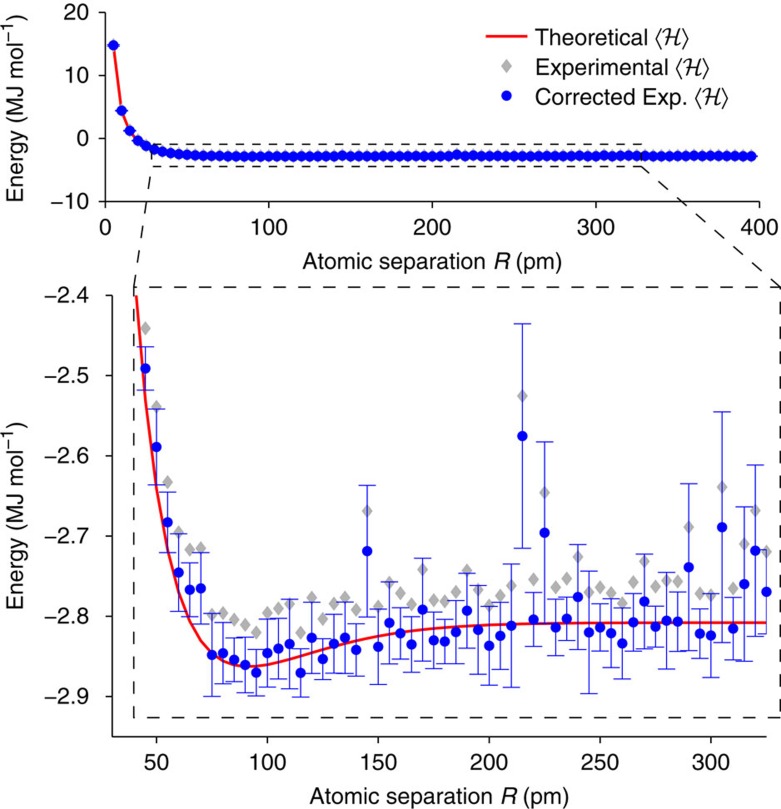
- The authors report an experimental ground-state result for He–H\(^+\): after correcting for experimental errors, they estimate the equilibrium bond length as \(R = 92.3 \pm 0.1\) pm and the ground-state electronic energy as \(E = -2.865 \pm 0.008\) MJ mol\(^{-1}\).
- For the bond dissociation curve, more than 96% of the experimental data are within chemical accuracy of the theoretical values.
- In the discussion, they state that for a 4 × 4 Hamiltonian like the one demonstrated, the QPE circuit would require at least 12 CNOT gates, whereas their method requires one.
- The full experiment was performed in about 158 h, and the bond dissociation curve was obtained by finding the ground states of 79 Hamiltonians.
## Methods
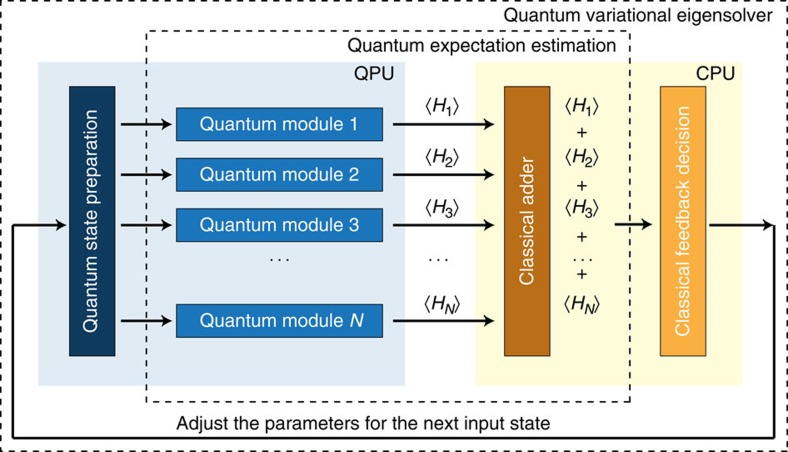
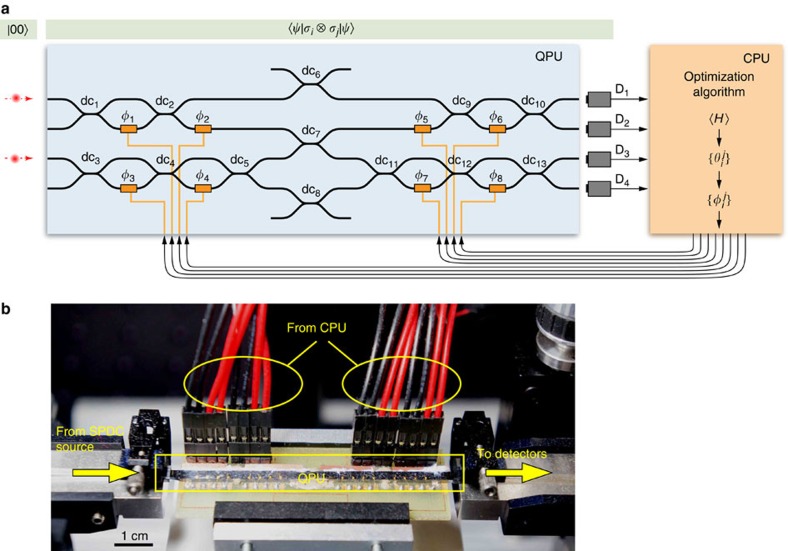
- The paper combines a reconfigurable integrated photonic quantum processor with a classical optimization algorithm: the quantum device estimates Hamiltonian expectation values, and the classical processor updates the state parameters variationally.
- The photonic chip prepares and measures arbitrary two-qubit pure states using single-qubit rotations and one two-qubit entangling gate; the experimental demonstration uses the He–H\(^+\) molecule in a minimal basis.
- For the classical optimization, they use the Nelder–Mead algorithm; expectation values are reconstructed from four two-qubit Pauli measurements at each point.
## Limitations
- The paper states that the method still requires a good approximation to the ground state as input/initialization, and the reliance on multiple separate measurements makes it sensitive to variations in state preparation between calculations.
- The authors report a constant systematic shift of \(\varepsilon = 50\) kJ mol\(^{-1}\) in the measured expectation values; they attribute this to photon-source impurity/distinguishability, circuit imperfections, and unbalanced coupling efficiencies.
- Evident from the text: the demonstration is limited to a two-qubit / 4 × 4 Hamiltonian prototype, so the scalability claim is not experimentally validated here.
Model-written summary. Check it against the paper before relying on it.
Integrity signals
Registry
Cites
Statistics
Figures
Verification
Claims the paper makes
7 Valid · 4 Not valid · 11 Not checked · 59 Own results and interpretations
The cited sources support only part of this claim — read each source’s verdict below.
In the paper
“Recent developments in the field of quantum computation offer a way forward for determining efficient solutions of many instances of large eigenvalue problems that are classically intractable6789101112”
§ A variational eigenvalue solver on a photonic quantum processor > Abstract
What the sources say
- Not matchedcites [6] Nielsen, M. A. & Chuang, I. L. Quantum Computation and Quantum Information Cambridge University Press (2000).
Couldn’t be matched to a paper in Crossref, so it can’t be checked.
- Could not verifycites [7] Kitaev, A. Quantum measurements and the Abelian stabilizer problem. Electronic Colloquium on Computational Complexity (ECCC) 3 (1996). sourceExperimental — accuracy not yet measured
Our copy under this DOI is the ISAAC 2021 paper 'Effective Resistance and Capacitance in Simplicial Complexes and a Quantum Algorithm' (Kitaev's 1995 work appears only as reference [9] in its bibliography), and it nowhere asserts that quantum computation gives efficient solutions to classically intractable large eigenvalue problems. Eigenvalues enter only as complexity parameters — λ, the smallest eigenvalue of the normalized up-Laplacian, in Lemma 31 and Theorem 26 (Section 6.3, 'Time efficient implementations') and in the phase-estimation machinery of Appendix A — and Section 1.1 ('Our Contributions') actually reports the opposite direction for its own problem: 'the quantum algorithm is slower than the classical algorithm in the worst case'. Searched: 'eigenvalue problems classically intractable', 'quantum speedup / exponential advantage', 'phase estimation', 'faster than classical'; no passage addresses the claim's point. (LLM, conf=0.70)
- Partly supportedcites [8] Griffiths, R. B. & Niu, C.-S. Semiclassical fourier transform for quantum computation. Phys. Rev. Lett. 76, 3228–3231 (1996). sourceExperimental — accuracy not yet measured
On p. 1, the paper says a quantum computer, if built, could solve certain problems such as factoring long numbers much faster than conventional algorithms. It also describes a simpler Fourier transform for Shor’s factorization and discrete-logarithm algorithms (p. 1). The copy does not support the claim about efficient solutions to many large eigenvalue problems. (LLM, conf=0.84)
plainstates a cause- Asserted: passes — The authors put it forward as true.
- Checkable: passes — It can be checked against evidence.
- Load-bearing: passes — The paper’s conclusions depend on it.
- Based: passes — The paper gives a reason why it holds.
- Not matched
Every source the paper cites for this claim was checked and supports it.
In the paper
“this would suffer from the N-representability problem, which is known to be intractable for both classical and quantum computers (it is in the quantum complexity class QMA-Hard24).”
§ A variational eigenvalue solver on a photonic quantum processor > Results > Quantum expectation estimation
What the sources say
- Supportedcites [24] Liu, Y.-K., Christandl, M. & Verstraete, F. Quantum computational complexity of the n-representability problem: Qma complete. Phys. Rev. Lett. 98, 110503 (2007). source
The paper states that N-representability is QMA-complete and hence QMA-hard and NP-hard (Abstract). Its discussion of quantum-chemistry relevance says the problem is intractable in the worst case even on a quantum computer, while allowing that particular physical systems may be easier. (LLM, conf=0.93)
boosted- Asserted: passes — The authors put it forward as true.
- Checkable: passes — It can be checked against evidence.
- Load-bearing: passes — The paper’s conclusions depend on it.
- Based: passes — The paper gives a reason why it holds.
- Supported
Every source the paper cites for this claim was checked and supports it.
In the paper
“We have implemented the QPU using integrated quantum photonics technology30.”
§ A variational eigenvalue solver on a photonic quantum processor > Results > Prototype demonstration
What the sources say
- Supportedcites [30] O'Brien, J. L., Furusawa, A. & Vuckovic, J. Photonic quantum technologies. Nat. Photon. 3, 687–695 (2009). source
The citation identifies integrated quantum photonics as the technology used, rather than attributing the citing authors’ QPU implementation to this review. The “Integrated quantum optical circuits” section (p. 6) describes on-chip waveguide circuits performing quantum logic gates and a compiled quantum factoring algorithm. (LLM, conf=0.87)
plain- Asserted: passes — The authors put it forward as true.
- Checkable: passes — It can be checked against evidence.
- Load-bearing: passes — The paper’s conclusions depend on it.
- Based: passes — The paper gives a reason why it holds.
- Supported
The cited sources support only part of this claim — read each source’s verdict below.
In the paper
“The time the quantum computer must remain coherent is determined by the necessity of O(p−1) successive applications of , each of which can require on the order of millions or billions of quantum gates for practical applications1719, as compared to the tens to hundreds of gates achievable in the short term.”
§ A variational eigenvalue solver on a photonic quantum processor > Abstract
What the sources say
- Partly supportedcites [17] Whitfield, J. D., Biamonte, J. & Aspuru-Guzik, A. Simulation of electronic structure hamiltonians using quantum computers. Mol. Phys. 109, 735–750 (2011). sourceExperimental — accuracy not yet measured
Split into 2 atoms — 1 confirmed, 1 partially supported, 0 disputed, 0 misattributed, 0 unverifiable. Expand the claim to see per-atom verdicts.
- Partly supportedcites [19] Jones, N. C. et al. Faster quantum chemistry simulation on fault-tolerant quantum computers. New J. Phys. 14, 115023 (2012). sourceExperimental — accuracy not yet measured
Split into 2 atoms — 0 confirmed, 2 partially supported, 0 disputed, 0 misattributed, 0 unverifiable. Expand the claim to see per-atom verdicts.
plainstates a cause- Asserted: passes — The authors put it forward as true.
- Checkable: passes — It can be checked against evidence.
- Load-bearing: passes — The paper’s conclusions depend on it.
- Based: passes — The paper gives a reason why it holds.
- Partly supported
A result the paper reports from its own data — it cites no other source for it, so there is none to check. The quote shows it is in the paper.
In the paper
“We experimentally demonstrate the feasibility of this approach with an example from quantum chemistry—calculating the ground-state molecular energy for He–H+.”
§ A variational eigenvalue solver on a photonic quantum processor > Abstract
boostedstates a causeSingle case- Asserted: passes — The authors put it forward as true.
- Checkable: passes — It can be checked against evidence.
- Load-bearing: passes — The paper’s conclusions depend on it.
- Based: passes — The paper gives a reason why it holds.
31 more claims
Create a free account to see all 81 claims and to verify the 4 references still open.
- It may state two separate claims as one. 28
- Probably not a substantial claim. 24
Claims other papers make about this one
Each is checked against this paper’s own text: does it say what the citing paper says it does?
The cited source doesn’t support the claim as written.
In the citing paper
“Leveraging quantum resources, the UCC ansatz was instead realized as a PQC on a photonic processor (Peruzzo et al. , 2014).”
From Noisy intermediate-scale quantum algorithms (2022) · cites this paper as Peruzzo et al., 2014
Checked by a reasoning model — may be wrong.
Experimental — accuracy not yet measuredThe cited source doesn’t support the claim as written.
In the citing paper
“The first on-chip GMM of four-qubit cluster state was realised in a laser-writing chip ( Fig.4e ), by manipulating both the polarisation and path DoFs of two photons [85].”
From Integrated photonic quantum technologies (2020) · cites this paper as [85]
Checked by a reasoning model — may be wrong.
Experimental — accuracy not yet measuredThe cited source doesn’t support the claim as written.
In the citing paper
“four-qubit linear- and box-cluster states are generated in a laser-writing photonic chip. This is enabled by on-chip manipulating the two-photon four-qubit hyperentangled state and cluster state, that are encoded in photon's path and polarisation DoFs. The Grover's search algorithm on a four-element database was implemented by controlling the device.”
From Integrated photonic quantum technologies (2020) · cites this paper as [85]
Checked by a reasoning model — may be wrong.
Experimental — accuracy not yet measuredThe source backs part of the claim, not all of it — or backs it for a different population, condition or comparison.
In the citing paper
“Due to its versatility, the variational Hamiltonian ansatz has been implemented for quantum chemistry [21, 29], optimization [24], and for quantum simulation problems [30].”
From Variational quantum algorithms (2021) · cites this paper as [29]
Experimental — accuracy not yet measuredThe source backs part of the claim, not all of it — or backs it for a different population, condition or comparison.
In the citing paper
“For the original VQE (Peruzzo et al. , 2014) and QAOA (Farhi et al. , 2014) it can, for example, be described as a single expectation value min θ ⟨ H ⟩ U ( θ ) , where the differences solely appear in the specific form and construction of the qubit Hamiltonian.”
From Noisy intermediate-scale quantum algorithms (2022) · cites this paper as Peruzzo et al., 2014
Experimental — accuracy not yet measured
12 more claims about this paper
Create a free account to see every claim other papers make about this one.
Citations
Cites
A Simplex Method for Function Minimization
Nelder, J. A., & Mead, R. (1965) · The Computer Journal · doi:10.1093/comjnl/7.4.308 · Cited by 28,905
Quantum computation and quantum information
Law, J. (2001) · ACM SIGSOFT Software Engineering Notes · doi:10.1145/505482.505499 · Cited by 18,842
(1999) · Cited by 12,854
Practical Methods of Optimization
Fletcher, R. (2000) · Wiley eBooks · doi:10.1002/9781118723203 · Cited by 7,605 · cited 3×
“[12] S.”
BackgroundMethodPractical methods of optimization
(1988) · Mathematics and Computers in Simulation · doi:10.1016/0378-4754(88)90129-2 · Cited by 5,818
Quantum Algorithm for Linear Systems of Equations
Harrow, A. W., Hassidim, A., & Lloyd, S. (2009) · Physical Review Letters · doi:10.1103/physrevlett.103.150502 · Cited by 3,325
Conn, A. R., Gould, N. I. M., & Toint, P. L. (2000) · Society for Industrial and Applied Mathematics eBooks · doi:10.1137/1.9780898719857 · Cited by 2,981 · cited 3×
“[14] D.”
MethodInfluential�ber das Paulische �quivalenzverbot
Jordan, P., & Wigner, E. (1928) · Zeitschrift f�r Physik · doi:10.1007/bf01331938 · Cited by 2,597
Molecular Electronic‐Structure Theory
Helgaker, T., Jørgensen, P., & Olsen, J. (2000) · doi:10.1002/9781119019572 · Cited by 2,594
O'Brien, J. L., Furusawa, A., & Vučković, J. (2009) · Nature Photonics · doi:10.1038/nphoton.2009.229 · Cited by 2,388
Self-citation
Research works printed but not linked: 3
- Helgaker, T., Jorgensen, P. & Olsen, J. Mol. Electronic Struct. Theory Wiley, Sussex (2002).
- Saad, Y. Numerical Methods for Large Eigenvalue Problems Vol. 158, (SIAM (1992).
- Rayleigh, J. W. In finding the correction for the open end of an organ-pipe. Phil. Trans. 161, 77 (1870).
Cited by
Items 3,601–3,700 of 4,572
Pulse-level characterization of qubits on quantum devices
Salamanca, Q., & Andrés, D. B. (2021) · Cited by 1
On a Possible Quantum Variational Autoencoder Circuit
Pramanik, S., & Chandra, M. G. (2021) · International Joint Conference on Neural Networks (IJCNN) · doi:10.1109/ijcnn52387.2021.9533801 · Cited by 1
“It is to be noted that since the quantum circuit is parameterized and classical optimization is used to minimize a cost function and adjust the parameters, we also have another “variational” aspect in terms of quantum-classical hybrid architecture [14].”
MethodApproximation Method for Optimization Problems in Gate-Model Quantum Computers
Gyöngyösi, L. (2021) · Chaos Solitons & Fractals X · doi:10.1016/j.csfx.2021.100066 · Cited by 1
Combinatorial optimization with variational approaches on noisy quantum devices
Miki, T., Okita, R., Shimada, M., & Shirakashi, J. (2021) · IEEE International Conference on Manipulation, Manufacturing and Measurement on the Nanoscale (3M-NANO) · doi:10.1109/3m-nano49087.2021.9599740 · Cited by 1
Photonic scheme of quantum phase estimation for quantum algorithms via quantum dots
Heo, J., & Choi, S. G. (2021) · Quantum Information Processing · doi:10.1007/s11128-021-03335-2 · Cited by 1
“In practice, the rejection filtering phase estimation [29] with realistic noise sources can be approaching the high performance as a scalable, practical method, compared with the previous works [21, 24] by numerical simulation.”
MethodSimulation and randomized measurement of topological phase on a trapped-ion quantum computer
Ahn, C.-E., & Cho, G. Y. (2022) · Journal of the Korean Physical Society · doi:10.1007/s40042-022-00536-5 · Cited by 1
“Given a Hamiltonian H, VQE is a classical-quantum hybrid algorithm, where the quantum computer is used to realize a parameterized family of quantum states || ( ) ⟩ and measure the energy expectation value E( ) = ⟨ ( )||H|| ( ) ⟩ [17, 18].”
MethodOn Quantum Algorithms for Random Walks in the Nonnegative Quarter Plane
Kalantzis, V., Squillante, M. S., Ubaru, S., & Lior Horesh, C. (2022) · ACM SIGMETRICS Performance Evaluation Review · doi:10.1145/3561074.3561089 · Cited by 1
“Indeed, many Quantum Eigen-solvers (QEs) exist that effectively compute the eigenvalues of a given matrix; see, e.g., [12].”
BackgroundChallenges and opportunities of quantum-computational chemistry
Li, Z., Liu, J., Shen, X., & Gao, F. (2022) · Scientia Sinica Chimica · doi:10.1360/ssc-2022-0222 · Cited by 1
Hybrid Integration of Quantum-Dot Non-classical Light Sources on Si
Katsumi, R., Ota, Y., Iwamoto, S., & Arakawa, Y. (2022) · Topics in applied physics · doi:10.1007/978-3-031-16518-4_4 · Cited by 1
Towards Efficient Reasoning of Quantum Programs
Yu, N. (2022) · Lecture notes in computer science · doi:10.1007/978-3-031-22308-2_2 · Cited by 1
Circuit connectivity boosts by quantum-classical-quantum interfaces
Wiersema, R., Guerini, L., Carrasquilla, J., & Aolita, L. (2022) · Physical Review Research · doi:10.1103/physrevresearch.4.043221 · Cited by 6
“[9] Alberto Peruzzo, Jarrod McClean, Peter Shadbolt, ManHong Yung, Xiao-Qi Zhou, Peter J.”
BackgroundMethodJensen, P. W. K., Kjellgren, E. R., Reinholdt, P., et al. (2023) · PubMed · doi:10.48550/arxiv.2312.12386 · Cited by 1
“18,19 Yet, there is widespread interest in calculating the energy spectrum of a Hamiltonian, for example, to understand optical spectra in quantum chemistry.”
BackgroundIdentifikasi Karakteristik Mesoscale Convective Complex (MCC) di Wilayah Papua dan Sekitarnya
Saragih, R. W. (2022) · Jurnal Fisika · doi:10.15294/jf.v12i2.39190 · Cited by 1
On quantum ensembles of quantum classifiersPreprint
Abbas, A., Schuld, M., & Petruccione, F. (2020) · arXiv (Cornell University) · doi:10.48550/arxiv.2001.10833 · Cited by 1
Zhang, T., Li, C., & Evangelista, F. A. (2019) · arXiv (Cornell University) · doi:10.48550/arxiv.1903.11637 · Cited by 1
Machine Learning Kernel Method from a Quantum Generative ModelPreprint
Sadowski, P. (2019) · arXiv (Cornell University) · doi:10.48550/arxiv.1907.05103 · Cited by 2
“In particular, the kernel can be joined with methods that operate on states with known preparation scheme but without the need to obtain the representation in computational basis, as in VQE [15].”
MethodQuantum transfer component analysis for domain adaptationPreprint
He, X., Lyu, C., Hsieh, M.-H., & Wang, X. (2019) · arXiv (Cornell University) · doi:10.48550/arxiv.1912.09113 · Cited by 3
“In order to avoid this required demand, we attempt to design a variational hybrid quantum-classical algo-rithm inspired by the variational quantum eigensolver (VQE) [19].”
MethodGabor, T., Sünkel, L., Ritz, F., Phan, T., Belzner, L., Roch, C., Feld, S., & Linnhoff–Popien, C. (2020) · arXiv (Cornell University) · doi:10.48550/arxiv.2004.14035 · Cited by 4
“These algorithms provide faster solutions to computationally hard problems like computing eigenvalues (variational quantum eigensolver [43]) or solv-”
MethodXia, R., & Kais, S. (2020) · arXiv (Cornell University) · doi:10.48550/arxiv.2005.08451 · Cited by 1
“More recently, hybrid classical-quantum algorithms have been developed such as the variational quantum eigenslover (VQE) [10]–[13] and quantum machine learning techniques [14] for electronic structure calculations.”
MethodTangible Reduction of Sample Complexity with Large Classical Samples and Small Quantum SystemPreprint
Song, W., Wieśniak, M., Liu, N., Pawłowski, M., Lee, J., Kim, J., & Bang, J. (2019) · arXiv (Cornell University) · Cited by 1
Efficient 2D Tensor Network Simulation of Quantum SystemsPreprint
Pang, Y., Hao, T., Dugad, A., et al. (2020) · arXiv (Cornell University) · doi:10.48550/arxiv.2006.15234 · Cited by 1
“2) Variational Quantum Eigensolver Simulation: We benchmark VQE with the spin- 12 J1-J2 Heisenberg Model (see Equation (7)).”
BackgroundInfluentialQuantum circuit to estimate pi using quantum amplitude estimationPreprint
Noto, T. (2020) · arXiv (Cornell University) · doi:10.48550/arxiv.2008.02623 · Cited by 2
“that are based on the use of fewer qubits and fewer gates than the ideal ones for the future have been developed [1-3].”
BackgroundA Quantum-Inspired Algorithm for the Factorized Form of Unitary Coupled Cluster TheoryPreprint
Chen, J., Cheng, H., & Freericks, J. K. (2020) · arXiv (Cornell University) · doi:10.48550/arxiv.2008.06637
Efficient trainability of linear optical modules in quantum optical neural networksPreprint
Volkoff, T. J. (2020) · arXiv (Cornell University) · doi:10.48550/arxiv.2008.09173 · Cited by 1
Neural-Network Quantum States for the Electronic Structure of Real SolidsPreprint
Yoshioka, N., Mizukami, W., & Nori, F. (2020) · arXiv (Cornell University) · Cited by 1
Improving the Quantum Approximate Optimization Algorithm with postselectionPreprint
Boulebnane, S. (2020) · arXiv (Cornell University) · doi:10.48550/arxiv.2011.05425 · Cited by 3
“QAOA is a variational quantum algorithm (35; 1; 37; 39) drawing inspiration from the quantum adiabatic algorithm (19); more precisely, the latter may be simulated by QAOA as the depth of the variational ansatz goes to infinity.”
BackgroundLaplacian Eigenmaps with variational circuits: a quantum embedding of graph dataPreprint
Thabet, S., & Hullo, J. (2020) · arXiv (Cornell University) · doi:10.48550/arxiv.2011.05128 · Cited by 4
Approximate Phase Search and Eigen Estimation using Modified Grover's AlgorithmPreprint
Pramanik, S., Chandra, M. G., Sarkar, S., & Nambiar, M. K. (2020) · arXiv (Cornell University) · doi:10.48550/arxiv.2012.11497 · Cited by 1
“Thus, within a range, all of the eigenvalues and eigenvectors of the system can be obtained by looping over a single parameter, without having to find the ground state first and then finding each subsequent excited state using variational algorithms [11], [12] as discussed in [13].”
MethodQuantum Theory from Principles, Quantum Software from DiagramsPreprint
van de Wetering, J. (2021) · arXiv (Cornell University) · doi:10.48550/arxiv.2101.03608 · Cited by 4
“Phase teleportation could also be directly used on parametric circuits such as the quantum variational eigensolver [179].”
MethodMaritime Just-in-time navigation with Quantum algorithmsPreprint
Imrecke, M., Klos, F., Mergenthaler, W., Nowak, M., & Wueschner, J. (2021) · arXiv (Cornell University) · doi:10.48550/arxiv.2104.07978 · Cited by 4
Error Mitigation in Quantum Computers through Instruction SchedulingPreprint
Smith, K. N., Ravi, G. S., Murali, P., Baker, J. M., Earnest, N., Javadi-Abhari, A., & Chong, F. T. (2021) · arXiv (Cornell University) · doi:10.48550/arxiv.2105.01760 · Cited by 11
“• Variational Quantum Eigensolver: VQE [35] is a hybrid algorithm like QAOA and is used to variationally find the lowest eigenvalue of a given problem matrix by computing a difficult cost function on the QPU and feeding this value into an optimization routine running on a CPU.”
MethodThe quantum condition spacePreprint
Hu, Z., & Kais, S. (2021) · arXiv (Cornell University) · doi:10.48550/arxiv.2107.05713 · Cited by 1
“Over the years, numerous quantum algorithms have been proposed with the potential to outperform classical methods with decisive quantum advantage – these include the phase estimation algorithm [14], Shor’s factorization algorithm [15], the Harrow-Hassidim-Lloyd algorithm for linear systems [16], the hybrid classical-q…”
MethodSample Complexity of Learning Quantum CircuitsPreprint
Cai, H., Ye, Q., & Deng, D.-L. (2021) · arXiv (Cornell University) · Cited by 1
Machine learning for quantum physics and quantum physics for machine learning
Huembeli, P. (2021) · UPCommons institutional repository (Universitat Politècnica de Catalunya) · doi:10.5821/dissertation-2117-348901 · Cited by 1
Insights from an adaptive variational wave function study of the Fermi-Hubbard ModelPreprint
Gyawali, G., & Lawler, M. J. (2021) · arXiv (Cornell University) · Cited by 1
Reducing runtime and error in VQE using deeper and noisier quantum circuitsPreprint
Katabarwa, A., Kunitsa, A. A., Peropadre, B., & Johnson, P. D. (2021) · arXiv (Cornell University) · doi:10.48550/arxiv.2110.10664 · Cited by 16
Localized Quantum Chemistry on Quantum ComputersPreprint
Otten, M., Hermes, M. R., Pandharkar, R., Alexeev, Y., Gray, S. K., & Gagliardi, L. (2021) · doi:10.33774/chemrxiv-2021-0nmwt · Cited by 5
An exponentially more efficient optimization algorithm for noisy quantum computersPreprint
Rančić, M. J. (2021) · arXiv (Cornell University) · doi:10.5281/zenodo.5592833 · Cited by 3
Optimization of Quantum Algorithm Protocols without Barren PlateausPreprint
Broers, L., & Mathey, L. (2021) · arXiv (Cornell University) · Cited by 2
ORQVIZ: Visualizing High-Dimensional Landscapes in Variational Quantum AlgorithmsPreprint
Rudolph, M. S., Sim, S., Raza, A., Stęchły, M., McClean, J. R., Anschuetz, E. R., Serrano, L., & Perdomo‐Ortiz, A. (2021) · arXiv (Cornell University) · doi:10.48550/arxiv.2111.04695 · Cited by 27
“The Variational Quantum Eigensolver (VQE) [9] is a near-term algorithm for approximating the ground state energy of a Hamiltonian.”
Self-citationMitigating Noise-Induced Gradient Vanishing in Variational Quantum Algorithm TrainingPreprint
Wu, A., Li, G., Ding, Y., & Xie, Y. (2021) · arXiv (Cornell University) · doi:10.48550/arxiv.2111.13209 · Cited by 8
“It has demonstrated potential applicability in optimization [26, 27], classification [28, 29], chemistry simulation [30, 31], etc.”
Measuring Correlated Qubit Errors on Quantum ComputersPreprint
Schales, P. (2021) · Research Square · doi:10.21203/rs.3.rs-1035320/v1 · Cited by 1
Quantum algorithm for band structures with local tight-binding orbitalsPreprint
Sherbert, K., Jayaraj, A., & Nardelli, M. B. (2022) · Research Square · doi:10.21203/rs.3.rs-1318951/v1 · Cited by 1
Quantum Speedup for Index ModulationPreprint
Ishikawa, N. (2021) · doi:10.36227/techrxiv.14561586 · Cited by 1
Characterization and implementation of robust quantum information processing
Fernandez, D. (2020) · Cronfa (Swansea University) · doi:10.23889/suthesis.56913 · Cited by 1
Mode Analysis of the Passive and Active Slab Waveguides Using Scattering MatrixPreprint
Khorrami, Y., Fathi, D., Khavasi, A., et al. (2022) · SSRN Electronic Journal · doi:10.2139/ssrn.4153640 · Cited by 1
Variational quantum iterative power algorithms for global optimizationPreprint
Kyaw, T. H., Soley, M. B., Allen, B., Bergold, P., Sun, C., Batista, V. S., & Aspuru‐Guzik, A. (2022) · arXiv (Cornell University) · doi:10.48550/arxiv.2208.10470 · Cited by 1
Self-citationAlgorithm-Aware Qubit MappingPreprint
Ji, Y., & Polian, I. (2022) · doi:10.36227/techrxiv.21786146.v1 · Cited by 2
On quantum computing and geometry optimizationPreprint
Malik, A. J., & Verma, C. S. (2023) · bioRxiv (Cold Spring Harbor Laboratory) · doi:10.1101/2023.03.16.532929 · Cited by 2
Cryogenic Embedded System to Support Quantum Computing: From 5nm FinFET to Full ProcessorPreprint
Genßler, P. R., Klemme, F., Parihar, S. S., et al. (2023) · doi:10.36227/techrxiv.23548242 · Cited by 1
Discrete optimization: A quantum revolution (Part II)Preprint
Creemers, S., & Armas, L. F. P. (2023) · SSRN Electronic Journal · doi:10.2139/ssrn.4494506 · Cited by 1
Hybrid Quantum Algorithms and Quantum Software Development FrameworksPreprint
Ramouthar, R., & Şeker, H. (2023) · AfricArXiv (OSF Preprints) · doi:10.31730/osf.io/fsw24 · Cited by 1
From Quantum Computing to Quantum-inspired Computation for Neuromorphic Advancement – A SurveyPreprint
Jha, R. K. (2023) · doi:10.36227/techrxiv.24053250 · Cited by 6
Manenti, R., & Motta, M. (2023) · Oxford University Press eBooks · doi:10.1093/oso/9780198787488.005.0003 · Cited by 1
Quantum overlapping tomography based on linear optics
Yang, Z. (2023) · DR-NTU (Nanyang Technological University) · doi:10.32657/10356/170876 · Cited by 1
Efficient preparation of the AKLT State with Measurement-based Imaginary Time EvolutionPreprint
Chen, T., & Byrnes, T. (2023) · Research Square · doi:10.21203/rs.3.rs-3453292/v1 · Cited by 1
Quantum Feasibility Labeling for NP-complete Vertex Coloring ProblemPreprint
Zhan, J. (2023) · Research Square · doi:10.21203/rs.3.rs-3571509/v1 · Cited by 1
A meta-trained generator for quantum architecture searchPreprint
He, Z., Chen, C., Situ, H., et al. (2024) · Research Square · doi:10.21203/rs.3.rs-3798393/v1 · Cited by 1
Information Processing at The Speed of LightPreprint
AbuGhanem, M. (2024) · SSRN Electronic Journal · doi:10.2139/ssrn.4748781 · Cited by 1
Qhyper: An Integration Library for Hybrid Quantum-Classical OptimizationPreprint
Lamża, T., Zawalska, J., Jurek, K., Sterzel, M., & Rycerz, K. (2024) · SSRN Electronic Journal · doi:10.2139/ssrn.4866623 · Cited by 3
Multi-target quantum compilation algorithmPreprint
Ho, L. B., Hai, V. T., Viet, N. T., Urbaneja, J., Linh, N. V., & Tran, L. N. (2024) · Research Square · doi:10.21203/rs.3.rs-4678149/v1 · Cited by 1
Dapena, O. S. B. (2025) · Preprints.org · doi:10.20944/preprints202506.1276.v1 · Cited by 4
Variational Quantum Algorithms: From Theory to NISQ-Era Applications Challenges and OpportunitiesPreprint
Benamer, H. (2025) · Preprints.org · doi:10.20944/preprints202508.1482.v1 · Cited by 3
From Bound States to Quantum Spin Models: Chiral Coherent Dynamics in Topological Photonic RingsPreprint
Davoodi, F. (2025) · Research Square · doi:10.21203/rs.3.rs-7373395/v1 · Cited by 1
Scaling Hybrid Quantum--HPC Applications with the Quantum Framework
Chundury, S., Shehata, A., Kim, S., Meena, M. G., Lu, C., Gottiparthi, K. C., Pérez, E. A. C., Mueller, F., & Suh, I. (2025) · International Conference for High Performance Computing, Networking, Storage and Analysis (SC) · doi:10.1145/3731599.3767553 · Cited by 10
“Such algorithms, including the Quantum Approximate Optimization Algorithm (QAOA) [11, 12], the Variational Quantum Linear Solver (VQLS) [13], and the Variational Quantum Eigen solver [14], leverage the quantum-classical hybrid structure, coupling near-term QPUs with HPC-scale classical optimization.”
Dead Gate Elimination in Hybrid Quantum-Classical ProgramsPreprint
Chen, Y., Mendl, C. B., & Seidl, H. (2025) · SSRN Electronic Journal · doi:10.2139/ssrn.5869935 · Cited by 1
Jiang, Q., Lu, L., Xiang, D., Chu, T., Zhu, T., Leng, J., Liang, Y. E., Sun, X., & Yin, J. (2025) · IEEE/ACM International Symposium on Microarchitecture (MICRO) · doi:10.1145/3725843.3756107 · Cited by 1
Evidence of scaling advantage on an NP-complete problem with enhanced quantum solvers
Lu, Q., Wei, S., Li, K., Gao, P., Yan, B., Zheng, M., Zhang, H., Zeng, J., & Long, G.-L. (2026) · Nature Computational Science · doi:10.1038/s43588-026-01007-8 · Cited by 1
“Quantum optimization algorithms, including the quantum approximate optimization algorithm (QAOA) 1 and the variational quantum eigensolver (VQE) 2 , are promising candidates for achieving quantum advantage in the noisy intermediate-scale quantum (NISQ) era 3 , which is characterized by limited…”
VAQEM: A Variational Approach to Quantum Error Mitigation
Ravi, G. S., Smith, K. N., Gokhale, P., Mari, A., Earnest, N., Javadi-Abhari, A., & Chong, F. T. (2022) · Unicam Scientific Publications (University of Camerino) · doi:10.1109/hpca53966.2022.00029 · Cited by 48
“In particular, variational algorithms have innate error resilience, due to the hybrid alternation with a noise-robust classical optimizer [26], [32].”
BackgroundMethodInfluentialClustering and enhanced classification using a hybrid quantum autoencoder
Srikumar, M., Hill, C. D., & Hollenberg, L. C. L. (2021) · Quantum Science and Technology · doi:10.1088/2058-9565/ac3c53 · Cited by 38
Quantum optimal control for pure-state preparation using one initial state
Günther, S., Petersson, N. A., & DuBois, J. L. (2021) · AVS Quantum Science · doi:10.1116/5.0060262 · Cited by 25
Analog quantum approximate optimization algorithm
Barraza, N., Barrios, G. A., Peng, J., Lamata, L., Solano, E., & Albarrán-Arriagada, F. (2022) · Quantum Science and Technology · doi:10.1088/2058-9565/ac91f0 · Cited by 17
“Some examples of these classes of algorithms are the variational quantum algorithms [11–13], the digital quantum approximate optimization algorithm (QAOA) [14, 15], the adaptive random quantum eigensolver [16], and the digitized counterdiabatic QAOA [17] among others.”
Bethe ansatz on a quantum computer?
Nepomechie, R. I. (2021) · Quantum Information and Computation · doi:10.26421/qic21.3-4-4 · Cited by 25
“Significant attention is being focused on an algorithm in quantum computing known as the Variational Quantum Eigensolver (VQE) [1–3] .”
Resonant Coupling Parameter Estimation with Superconducting Qubits
Béjanin, J. H., Earnest, C. T., Sanders, Y. R., & Mariantoni, M. (2021) · PRX Quantum · doi:10.1103/prxquantum.2.040343 · Cited by 4
Algorithms Bridging Quantum Computation and Chemistry
McClean, J. R. (2015) · Digital Access to Scholarship at Harvard (DASH) (Harvard University) · Cited by 2
Self-citationQubit and cavity measurement in circuit quantum electrodynamics
Govia, L. C. G. (2015) · Publications of the UdS (Saarland University) · doi:10.22028/d291-23092
“In particular, readout of the parity of multiple qubits has applications to quantum error correction [7] such as the surface code [49], to quantum phase estimation [90], to the implementation of multiqubit gates [91, 92], and to entanglement generation [93, 50, 94].”
Ground state solver on a silicon quantum photonic chip
Santagati, R., Wang, J., Paesani, S., Gentile, A. A., Bonneau, D., Silverstone, J. W., Morley-Short, S., Zhou, X., Shadbolt, P., Wiebe, N., et al. (2016) · Conference on Lasers and Electro-Optics · doi:10.1364/cleo_qels.2016.fth4c.3
“These methods offer a scalable route to solve quantum chemistry problems because of their intrinsic robustness to quantum errors, and capability to explore classically inaccessible regions of the Hilbert space [5, 6].”
BackgroundSelf-citationMacrae, R. M. (2017) · PubMed Central · doi:10.3184/003685017x14859543105069a
Viewpoint: Cloud Quantum Computing Tackles Simple Nucleus
Gandolfi, S. (2018)
Quantum Computing for Training
Schuld, M., & Petruccione, F. (2018) · Quantum science and technology · doi:10.1007/978-3-319-96424-9_7
Investigating the lower bound of minimum gate times using optimal control
Zhang, X.-P., Shao, B., & Zou, J. (2018) · Modern Physics Letters B · doi:10.1142/s0217984918503220
Hartmann, W., Rath, P., & Pernice, W. H. P. (2018) · NATO science for peace and security series. B, Physics and biophysics · doi:10.1007/978-94-024-1544-5_22
Cloud Quantum Computing Tackles Simple Nucleus
Gandolfi, S. (2018) · Physics · doi:10.1103/physics.11.51
Fabrication Technologies for Superconducting Quantum Circuits for Large-scale Quantum Computing
Terai, H., Qiu, W., & Yamashita, T. (2018) · TEION KOGAKU (Journal of Cryogenics and Superconductivity Society of Japan) · doi:10.2221/jcsj.53.295
Witness assisted eigenspectra solver on a silicon quantum photonic simulator
Gentile, A. A., Santagati, R., Wang, J., Paesani, S., Wiebe, N., McClean, J. R., Bonneau, D., Silverstone, J. W., Morley-Short, S., Shadbolt, P., et al. (2018) · doi:10.1364/cleopr.2018.th1d.4
“Crucially, the analysis of excited states with VQE has for long remained elusive of successful experimental implementations [2,3].”
BackgroundSelf-citationMaking Quantum Computing Open: Lessons from Open-Source ProjectsPreprint
Shaydulin, R., Thomas, C., & Rodeghero, P. (2019) · arXiv (Cornell University) · doi:10.48550/arxiv.1902.00991
“To address this challenge, a number of NISQ approaches have been proposed, most prominent of them Variational Quantum Eigensolver (VQE) [19] and Quantum Approximate Optimization Algorithm (QAOA) [13].”
MethodBayesian ACRONYM TuningPreprint
Gamble, J. K., Granade, C., & Wiebe, N. (2019) · arXiv (Cornell University) · doi:10.48550/arxiv.1902.05940
“This point is important not just for choosing the best optimizer to minimize experimental costs for tuning hardware, it also potentially reveals a new way of optimizing parameters in variational quantum eigensolvers [33], as well as QAOA [34] and quantum machine learning algorithms [35].”
Photoexcitations of Model Manganite Systems using Matrix-Product States
Köhler, T. (2019) · eDiss (Georg-August-Universität Göttingen) · doi:10.53846/goediss-7251 · Cited by 1
Local Field Response Method Working as Quasi-Quantum Annealing
Tomaru, T. (2019) · Journal of the Physical Society of Japan · doi:10.7566/jpsj.88.061016
Supervised Quantum Learning as Quantum Channel Simulation
Banchi, L., & Pirandola, S. (2019) · doi:10.1364/qim.2019.s4b.5
Approaching graph problems with continuous variable quantum computingPreprint
Stęchły, M., Bashige, N. T., & Chojecki, P. (2019) · arXiv (Cornell University) · doi:10.48550/arxiv.1906.07047 · Cited by 1
Certification of many-body systems
Baccari, F. (2019) · UPCommons institutional repository (Universitat Politècnica de Catalunya) · doi:10.5821/dissertation-2117-134619 · Cited by 1
Silva, M. P. D., & Johnson, B. (2019)
Gaining a Deeper Understanding of Nature with Quantum Simulators and Quantum Computers
Cohn, J. (2019) · DigitalGeorgetown (Georgetown University Library)
Quantum algorithmic techniques for fault-tolerant quantum computers
Kieferová, M. (2020) · Macquarie University · doi:10.25949/19431368 · Cited by 2
Quantum Circuit Parameters Learning with Gradient Descent Using BackpropagationPreprint
Watabe, M., Shiba, K., Sogabe, M., Sakamoto, K., & Sogabe, T. (2019) · arXiv (Cornell University) · doi:10.48550/arxiv.1910.14266 · Cited by 13
“The latter approach has triggered many algorithms, such as quantum approximation optimization algorithm (QAOA) [3] and variation quantum eigensolver (VQE) [4] and many others[5–7].”
BackgroundQuantum computation of nanosheets in a background magnetic field for external control of nanosystems
Miceli, R., & McGuigan, M. (2019) · doi:10.1109/nysds.2019.8909731
Quantum computation for early universe cosmology
Kaufman, A., Sundy, D., & McGuigan, M. (2019) · New York Scientific Data Summit (NYSDS) · doi:10.1109/nysds.2019.8909801 · Cited by 2
Optimization Problems in Quantum Circuit Design
Yamashita, S. (2021) · IEICE ESS FUNDAMENTALS REVIEW · doi:10.1587/essfr.14.4_337
Metadata
- Authors
- Peruzzo, A., McClean, J., Shadbolt, P., Yung, M.-H., Zhou, X.-Q., Love, P. J., Aspuru-Guzik, A., & O’Brien, J. L.
- Affiliations
- The University of Sydney (AU)
- Harvard University (US)
- University of Bristol (GB)
- Haverford College (US)
- Corresponding author
- Peruzzo, Alberto
- O’Brien, Jeremy L.
- Venue
- Nature Communications
- Published
- 2014-07-23
- Volume
- 5
- Issue
- 1
- Pages
- 4213-4213
- ISSN
- 2041-1723 (ISSN-L)
- PMC
- PMC4124861
- OpenAlex
- W2161685427
- Cited by
- 4,552
- References
- 48
- Citations by year
- 2026: 591 · 2025: 765 · 2024: 722 · 2023: 658 · 2022: 564 · 2021: 561 · 2020: 346 · 2019: 191 · 2018: 83 · 2017: 29 · 2016: 18 · 2015: 16 · 2014: 4
- FWCI
- 22.24
- Type
- journal article
- Language
- en
- Open access
- hybrid
- doi.org
- Licence
- cc-by-nc-nd
- creativecommons.org/licenses/by-nc-nd/4.0 (tdm)
- creativecommons.org/licenses/by-nc-nd/4.0 (vor)
- Locations
- Nature Communications (publishedVersion, cc-by-nc-nd)
- Europe PMC (PubMed Central) (publishedVersion, cc-by-nc-nd)
- PubMed Central (publishedVersion, cc-by-nc-nd)
- PubMed (publishedVersion)
- arXiv (Cornell University) (submittedVersion)
- OSTI OAI (U.S. Department of Energy Office of Scientific and Technical Information) (submittedVersion, cc-by-nc-nd)
- Digital Access to Scholarship at Harvard (DASH) (Harvard University) (submittedVersion, cc-by)
- RePEc: Research Papers in Economics (submittedVersion)
- RMIT Research Repository (RMIT University Library) (submittedVersion, cc-by-nc-nd)
- Figshare (submittedVersion, cc-by-nc-nd)
- UWA Profiles and Research Repository (UWA) (submittedVersion, cc-by-nc-nd)
- Bristol Research (University of Bristol) (submittedVersion)
- arXiv (Cornell University)
- Funders
- National Science Foundation (DE-FG02-97ER25308, 0955518, 1037992)
- U.S. Department of Energy (DEFG0297ER25308, DE‐FG02‐, FG02-97ER25308)
- Alfred P. Sloan Foundation
- John Templeton Foundation
- Camille and Henry Dreyfus Foundation
- Royal Academy of Engineering
- National Natural Science Foundation of China (61033001, 61361136003)
- Engineering and Physical Sciences Research Council (EP/J017175/1, EP/L024020/1, EP/K021931/1)
- Australian Research Council (DE140101700)
- National Key Research and Development Program of China (61033001, 2011CBA00301, 61361136003, 2011CBA00300)
- Division of Chemistry (CHE-1037992)
- Air Force Office of Scientific Research (FA 9550-12-1-0046, FA9550-, FA9550-12, FA9550‐12‐1)
- Topics
- Physical Sciences › Computer Science › Artificial Intelligence › Quantum Computing Algorithms and Architecture
- Physical Sciences › Physics and Astronomy › Atomic and Molecular Physics, and Optics › Quantum Information and Cryptography
- Physical Sciences › Physics and Astronomy › Atomic and Molecular Physics, and Optics › Quantum many-body systems
- Keywords
- variational quantum eigensolver, photonic quantum processors, quantum chemistry, classical optimization, hybrid quantum-classical computation
About these checks
Registry, retraction, Cites and statistics results are computed, not judged, with one exception: a printed reference that no index lists is read once by a model before it counts as a citation error. Claims are extracted by a model and kept only when their quote appears verbatim in the text; each cited source is then checked, with a model’s help, for whether it says what the claim relies on. Those verdicts can be wrong — read the claim’s quote and the cited source before relying on one.
The claim verdicts this report counts are experimental: their accuracy is not yet measured.
A language model drew the claims from the paper on 2026-10-10, under version 3 of the claim definition (model deepseek-v4.1-flash, prompt extract-v3).
A second model labelled each claim on 2026-10-10 (model jev-1.13-20260917, definition revision gold-guideline-v0.2).
Cited sources are checked with a language model’s help (qwen3.8-omni-flash and gpt-6-sol).
Statistics and arithmetic are recomputed, not judged.
Confidence bands are shown only for fields calibrated on our annotated test set. None is calibrated yet, so no band is shown.
What counts as a claim ›How we measure confidence ›How we check this ›
Are you an author, or do you see a problem with this page? Request a review
Data sources
Bibliographic data: Semantic Scholar, OpenAlex, Crossref.
Contains information from the Semantic Scholar Academic Graph Datasets, made available under the ODC Attribution License (ODC-BY 1.0).
Semantic Scholar’s data is described in: Kinney, R., et al. (2023). The Semantic Scholar Open Data Platform. arXiv:2301.10140.
