

The DOI matches its Crossref record; 47 of the 48 references it cites were found in a registry or an index; 14 of the 31 sources its claims cite were checked for support.
A variational eigenvalue solver on a photonic quantum processor
Open accessAbstract
Quantum computers promise to efficiently solve important problems that are intractable on a conventional computer. For quantum systems, where the physical dimension grows exponentially, finding the eigenvalues of certain operators is one such intractable problem and remains a fundamental challenge. The quantum phase estimation algorithm efficiently finds the eigenvalue of a given eigenvector but requires fully coherent evolution. Here we present an alternative approach that greatly reduces the requirements for coherent evolution and combine this method with a new approach to state preparation based on ansätze and classical optimization. We implement the algorithm by combining a highly reconfigurable photonic quantum processor with a conventional computer. We experimentally demonstrate the feasibility of this approach with an example from quantum chemistry—calculating the ground-state molecular energy for He–H+. The proposed approach drastically reduces the coherence time requirements, enhancing the potential of quantum resources available today and in the near future. Quantum computers promise to efficiently solve problems that would be practically impossible with a normal computer. Peruzzo et al. develop a variational computation approach that uses any available quantum resources and, with a photonic quantum processing unit, find the ground-state molecular energy of He–H+.
Overview
CoChat Summary
## TL;DR
The paper introduces a variational alternative to quantum phase estimation for finding eigenvalues, combining short coherent quantum measurements with classical optimization. It experimentally demonstrates the approach on a photonic processor by estimating the ground-state energy curve of He–H\(^+\).
## Key findings
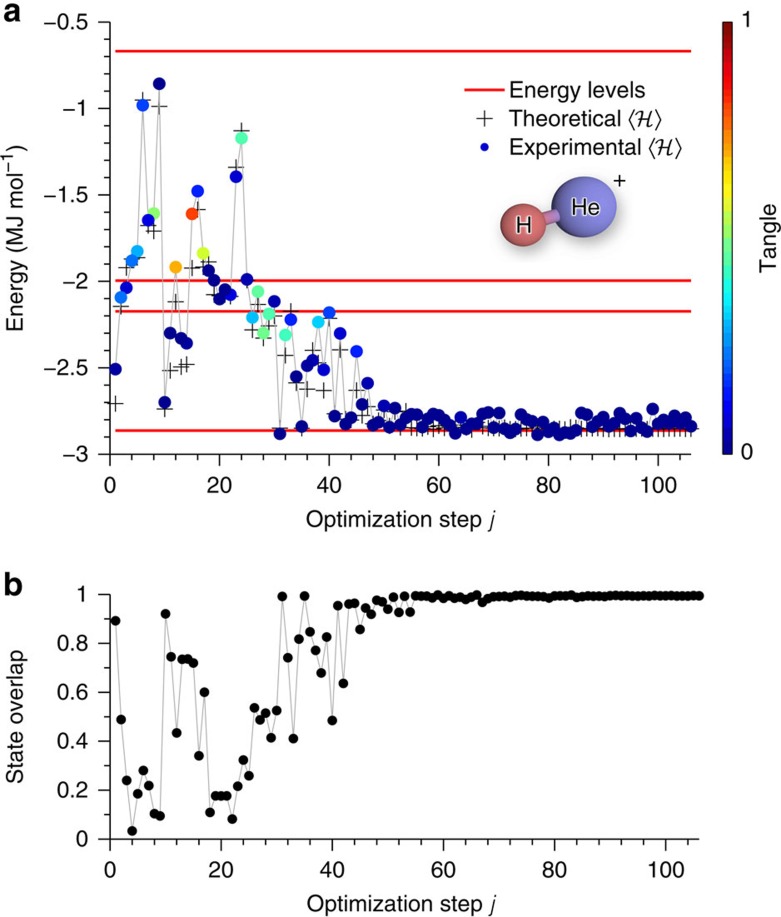
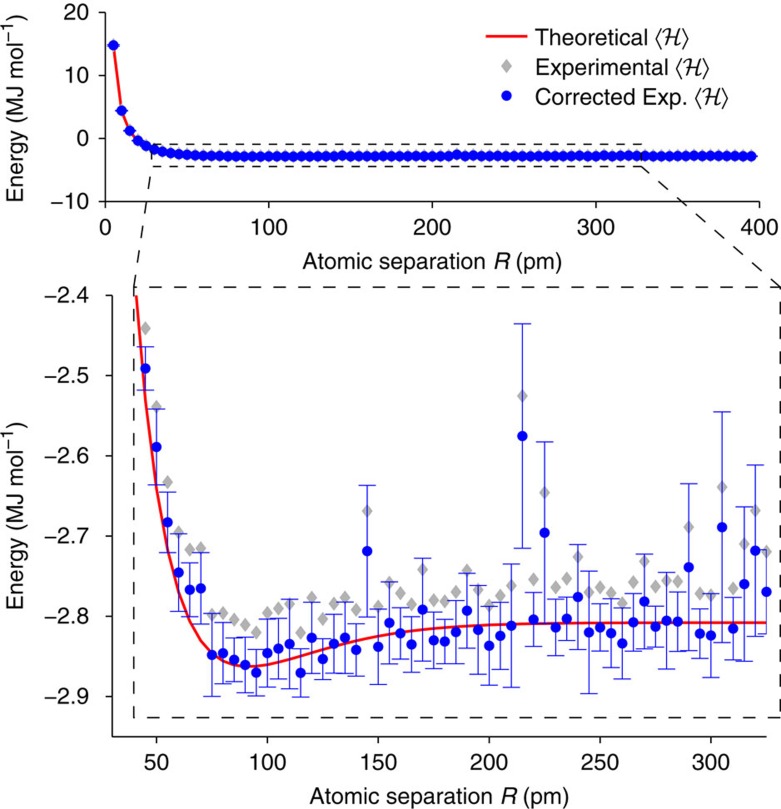
- The authors report an experimental ground-state result for He–H\(^+\): after correcting for experimental errors, they estimate the equilibrium bond length as \(R = 92.3 \pm 0.1\) pm and the ground-state electronic energy as \(E = -2.865 \pm 0.008\) MJ mol\(^{-1}\).
- For the bond dissociation curve, more than 96% of the experimental data are within chemical accuracy of the theoretical values.
- In the discussion, they state that for a 4 × 4 Hamiltonian like the one demonstrated, the QPE circuit would require at least 12 CNOT gates, whereas their method requires one.
- The full experiment was performed in about 158 h, and the bond dissociation curve was obtained by finding the ground states of 79 Hamiltonians.
## Methods
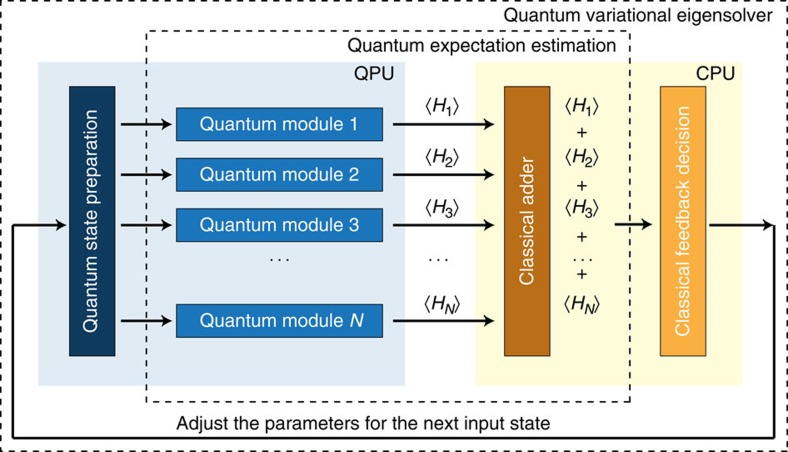
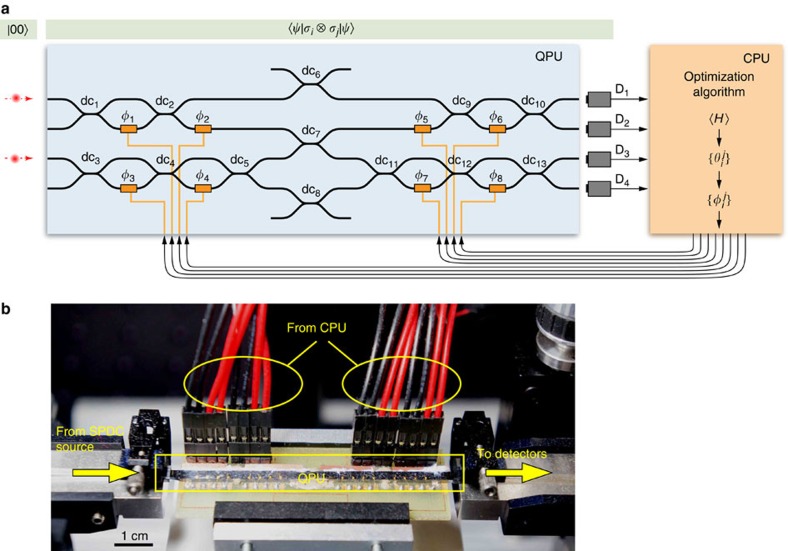
- The paper combines a reconfigurable integrated photonic quantum processor with a classical optimization algorithm: the quantum device estimates Hamiltonian expectation values, and the classical processor updates the state parameters variationally.
- The photonic chip prepares and measures arbitrary two-qubit pure states using single-qubit rotations and one two-qubit entangling gate; the experimental demonstration uses the He–H\(^+\) molecule in a minimal basis.
- For the classical optimization, they use the Nelder–Mead algorithm; expectation values are reconstructed from four two-qubit Pauli measurements at each point.
## Limitations
- The paper states that the method still requires a good approximation to the ground state as input/initialization, and the reliance on multiple separate measurements makes it sensitive to variations in state preparation between calculations.
- The authors report a constant systematic shift of \(\varepsilon = 50\) kJ mol\(^{-1}\) in the measured expectation values; they attribute this to photon-source impurity/distinguishability, circuit imperfections, and unbalanced coupling efficiencies.
- Evident from the text: the demonstration is limited to a two-qubit / 4 × 4 Hamiltonian prototype, so the scalability claim is not experimentally validated here.
Model-written summary. Check it against the paper before relying on it.
Integrity signals
Registry
Cites
Statistics
Figures
Verification
Claims the paper makes
7 Valid · 4 Not valid · 11 Not checked · 59 Own results and interpretations
The cited sources support only part of this claim — read each source’s verdict below.
In the paper
“Recent developments in the field of quantum computation offer a way forward for determining efficient solutions of many instances of large eigenvalue problems that are classically intractable6789101112”
§ A variational eigenvalue solver on a photonic quantum processor > Abstract
What the sources say
- Not matchedcites [6] Nielsen, M. A. & Chuang, I. L. Quantum Computation and Quantum Information Cambridge University Press (2000).
Couldn’t be matched to a paper in Crossref, so it can’t be checked.
- Could not verifycites [7] Kitaev, A. Quantum measurements and the Abelian stabilizer problem. Electronic Colloquium on Computational Complexity (ECCC) 3 (1996). sourceExperimental — accuracy not yet measured
Our copy under this DOI is the ISAAC 2021 paper 'Effective Resistance and Capacitance in Simplicial Complexes and a Quantum Algorithm' (Kitaev's 1995 work appears only as reference [9] in its bibliography), and it nowhere asserts that quantum computation gives efficient solutions to classically intractable large eigenvalue problems. Eigenvalues enter only as complexity parameters — λ, the smallest eigenvalue of the normalized up-Laplacian, in Lemma 31 and Theorem 26 (Section 6.3, 'Time efficient implementations') and in the phase-estimation machinery of Appendix A — and Section 1.1 ('Our Contributions') actually reports the opposite direction for its own problem: 'the quantum algorithm is slower than the classical algorithm in the worst case'. Searched: 'eigenvalue problems classically intractable', 'quantum speedup / exponential advantage', 'phase estimation', 'faster than classical'; no passage addresses the claim's point. (LLM, conf=0.70)
- Partly supportedcites [8] Griffiths, R. B. & Niu, C.-S. Semiclassical fourier transform for quantum computation. Phys. Rev. Lett. 76, 3228–3231 (1996). sourceExperimental — accuracy not yet measured
On p. 1, the paper says a quantum computer, if built, could solve certain problems such as factoring long numbers much faster than conventional algorithms. It also describes a simpler Fourier transform for Shor’s factorization and discrete-logarithm algorithms (p. 1). The copy does not support the claim about efficient solutions to many large eigenvalue problems. (LLM, conf=0.84)
plainstates a cause- Asserted: passes — The authors put it forward as true.
- Checkable: passes — It can be checked against evidence.
- Load-bearing: passes — The paper’s conclusions depend on it.
- Based: passes — The paper gives a reason why it holds.
- Not matched
Every source the paper cites for this claim was checked and supports it.
In the paper
“this would suffer from the N-representability problem, which is known to be intractable for both classical and quantum computers (it is in the quantum complexity class QMA-Hard24).”
§ A variational eigenvalue solver on a photonic quantum processor > Results > Quantum expectation estimation
What the sources say
- Supportedcites [24] Liu, Y.-K., Christandl, M. & Verstraete, F. Quantum computational complexity of the n-representability problem: Qma complete. Phys. Rev. Lett. 98, 110503 (2007). source
The paper states that N-representability is QMA-complete and hence QMA-hard and NP-hard (Abstract). Its discussion of quantum-chemistry relevance says the problem is intractable in the worst case even on a quantum computer, while allowing that particular physical systems may be easier. (LLM, conf=0.93)
boosted- Asserted: passes — The authors put it forward as true.
- Checkable: passes — It can be checked against evidence.
- Load-bearing: passes — The paper’s conclusions depend on it.
- Based: passes — The paper gives a reason why it holds.
- Supported
Every source the paper cites for this claim was checked and supports it.
In the paper
“We have implemented the QPU using integrated quantum photonics technology30.”
§ A variational eigenvalue solver on a photonic quantum processor > Results > Prototype demonstration
What the sources say
- Supportedcites [30] O'Brien, J. L., Furusawa, A. & Vuckovic, J. Photonic quantum technologies. Nat. Photon. 3, 687–695 (2009). source
The citation identifies integrated quantum photonics as the technology used, rather than attributing the citing authors’ QPU implementation to this review. The “Integrated quantum optical circuits” section (p. 6) describes on-chip waveguide circuits performing quantum logic gates and a compiled quantum factoring algorithm. (LLM, conf=0.87)
plain- Asserted: passes — The authors put it forward as true.
- Checkable: passes — It can be checked against evidence.
- Load-bearing: passes — The paper’s conclusions depend on it.
- Based: passes — The paper gives a reason why it holds.
- Supported
The cited sources support only part of this claim — read each source’s verdict below.
In the paper
“The time the quantum computer must remain coherent is determined by the necessity of O(p−1) successive applications of , each of which can require on the order of millions or billions of quantum gates for practical applications1719, as compared to the tens to hundreds of gates achievable in the short term.”
§ A variational eigenvalue solver on a photonic quantum processor > Abstract
What the sources say
- Partly supportedcites [17] Whitfield, J. D., Biamonte, J. & Aspuru-Guzik, A. Simulation of electronic structure hamiltonians using quantum computers. Mol. Phys. 109, 735–750 (2011). sourceExperimental — accuracy not yet measured
Split into 2 atoms — 1 confirmed, 1 partially supported, 0 disputed, 0 misattributed, 0 unverifiable. Expand the claim to see per-atom verdicts.
- Partly supportedcites [19] Jones, N. C. et al. Faster quantum chemistry simulation on fault-tolerant quantum computers. New J. Phys. 14, 115023 (2012). sourceExperimental — accuracy not yet measured
Split into 2 atoms — 0 confirmed, 2 partially supported, 0 disputed, 0 misattributed, 0 unverifiable. Expand the claim to see per-atom verdicts.
plainstates a cause- Asserted: passes — The authors put it forward as true.
- Checkable: passes — It can be checked against evidence.
- Load-bearing: passes — The paper’s conclusions depend on it.
- Based: passes — The paper gives a reason why it holds.
- Partly supported
A result the paper reports from its own data — it cites no other source for it, so there is none to check. The quote shows it is in the paper.
In the paper
“We experimentally demonstrate the feasibility of this approach with an example from quantum chemistry—calculating the ground-state molecular energy for He–H+.”
§ A variational eigenvalue solver on a photonic quantum processor > Abstract
boostedstates a causeSingle case- Asserted: passes — The authors put it forward as true.
- Checkable: passes — It can be checked against evidence.
- Load-bearing: passes — The paper’s conclusions depend on it.
- Based: passes — The paper gives a reason why it holds.
31 more claims
Create a free account to see all 81 claims and to verify the 4 references still open.
- It may state two separate claims as one. 28
- Probably not a substantial claim. 24
Claims other papers make about this one
Each is checked against this paper’s own text: does it say what the citing paper says it does?
The cited source doesn’t support the claim as written.
In the citing paper
“Leveraging quantum resources, the UCC ansatz was instead realized as a PQC on a photonic processor (Peruzzo et al. , 2014).”
From Noisy intermediate-scale quantum algorithms (2022) · cites this paper as Peruzzo et al., 2014
Checked by a reasoning model — may be wrong.
Experimental — accuracy not yet measuredThe cited source doesn’t support the claim as written.
In the citing paper
“The first on-chip GMM of four-qubit cluster state was realised in a laser-writing chip ( Fig.4e ), by manipulating both the polarisation and path DoFs of two photons [85].”
From Integrated photonic quantum technologies (2020) · cites this paper as [85]
Checked by a reasoning model — may be wrong.
Experimental — accuracy not yet measuredThe cited source doesn’t support the claim as written.
In the citing paper
“four-qubit linear- and box-cluster states are generated in a laser-writing photonic chip. This is enabled by on-chip manipulating the two-photon four-qubit hyperentangled state and cluster state, that are encoded in photon's path and polarisation DoFs. The Grover's search algorithm on a four-element database was implemented by controlling the device.”
From Integrated photonic quantum technologies (2020) · cites this paper as [85]
Checked by a reasoning model — may be wrong.
Experimental — accuracy not yet measuredThe source backs part of the claim, not all of it — or backs it for a different population, condition or comparison.
In the citing paper
“Due to its versatility, the variational Hamiltonian ansatz has been implemented for quantum chemistry [21, 29], optimization [24], and for quantum simulation problems [30].”
From Variational quantum algorithms (2021) · cites this paper as [29]
Experimental — accuracy not yet measuredThe source backs part of the claim, not all of it — or backs it for a different population, condition or comparison.
In the citing paper
“For the original VQE (Peruzzo et al. , 2014) and QAOA (Farhi et al. , 2014) it can, for example, be described as a single expectation value min θ ⟨ H ⟩ U ( θ ) , where the differences solely appear in the specific form and construction of the qubit Hamiltonian.”
From Noisy intermediate-scale quantum algorithms (2022) · cites this paper as Peruzzo et al., 2014
Experimental — accuracy not yet measured
12 more claims about this paper
Create a free account to see every claim other papers make about this one.
Citations
Cites
A Simplex Method for Function Minimization
Nelder, J. A., & Mead, R. (1965) · The Computer Journal · doi:10.1093/comjnl/7.4.308 · Cited by 28,905
Quantum computation and quantum information
Law, J. (2001) · ACM SIGSOFT Software Engineering Notes · doi:10.1145/505482.505499 · Cited by 18,842
(1999) · Cited by 12,854
Practical Methods of Optimization
Fletcher, R. (2000) · Wiley eBooks · doi:10.1002/9781118723203 · Cited by 7,605 · cited 3×
“[12] S.”
BackgroundMethodPractical methods of optimization
(1988) · Mathematics and Computers in Simulation · doi:10.1016/0378-4754(88)90129-2 · Cited by 5,818
Quantum Algorithm for Linear Systems of Equations
Harrow, A. W., Hassidim, A., & Lloyd, S. (2009) · Physical Review Letters · doi:10.1103/physrevlett.103.150502 · Cited by 3,325
Conn, A. R., Gould, N. I. M., & Toint, P. L. (2000) · Society for Industrial and Applied Mathematics eBooks · doi:10.1137/1.9780898719857 · Cited by 2,981 · cited 3×
“[14] D.”
MethodInfluential�ber das Paulische �quivalenzverbot
Jordan, P., & Wigner, E. (1928) · Zeitschrift f�r Physik · doi:10.1007/bf01331938 · Cited by 2,597
Molecular Electronic‐Structure Theory
Helgaker, T., Jørgensen, P., & Olsen, J. (2000) · doi:10.1002/9781119019572 · Cited by 2,594
O'Brien, J. L., Furusawa, A., & Vučković, J. (2009) · Nature Photonics · doi:10.1038/nphoton.2009.229 · Cited by 2,388
Self-citation
Research works printed but not linked: 3
- Helgaker, T., Jorgensen, P. & Olsen, J. Mol. Electronic Struct. Theory Wiley, Sussex (2002).
- Saad, Y. Numerical Methods for Large Eigenvalue Problems Vol. 158, (SIAM (1992).
- Rayleigh, J. W. In finding the correction for the open end of an organ-pipe. Phil. Trans. 161, 77 (1870).
Cited by
Items 3,501–3,600 of 4,570
The effect of the processing and measurement operators on the expressive power of quantum models
Gratsea, A., & Huembeli, P. (2023) · Quantum Machine Intelligence · doi:10.1007/s42484-023-00109-0 · Cited by 7
Long-Term Analysis of the Dependability of Cloud-based NISQ Quantum Computers
Xu, C., & Szefer, J. M. (2023) · International Conference on Availability, Reliability and Security (ARES) · doi:10.1145/3600160.3600192 · Cited by 3
“Or the output probabilities can be used to drive optimization of the algorithm and its future iterations, as is the case for VQE [13] and quantum machine learning [2].”
MethodEvaluating Quantum Algorithms for Linear Solver Workflows
Kolak, S., Mohammadbagherpoor, H., Daloukas, K., Kafousas, K., Rouet, F.-H., Koutsoyannopoulos, Y., Earnest, N., & Lucas, R. F. (2023) · Lecture notes in computer science · doi:10.1007/978-3-031-40843-4_47 · Cited by 1
Orbital expansion variational quantum eigensolver
Wu, Y., Huang, Z., Sun, J., Yuan, X., Wang, J. B., & Lv, D. (2023) · Quantum Science and Technology · doi:10.1088/2058-9565/acf9c7 · Cited by 5
Efficiently Solving the Max-cut Problem via a Quantum Qubit Rotation Algorithm
Wang, X. (2023) · Chinese Control Conference (CCC) · doi:10.23919/ccc58697.2023.10240622 · Cited by 1
Modularized and scalable compilation for double quantum dot quantum computing
He, R.-H., Xu, X., Byrd, M., & Wang, Z.-M. (2023) · Quantum Science and Technology · doi:10.1088/2058-9565/acfe38 · Cited by 5
“By virtue of multi-basis graph encoding and nonlinear activation functions, based on traditional VQE [38, 52] and tensor networks [55], the multi-basis encodings VQE (MBE-VQE) improves performance using only half the quantum hardware overhead (qubit number) as well as shallower quantum circuit, and…”
Qubit recycling and the path-counting problem
Song, Z., & Kim, I. H. (2023) · Physical Review A · doi:10.1103/physreva.108.042416 · Cited by 1
“One approach that garnered a lot of attentions in recent years is the variational quantum eigensolver (VQE) [4, 5].”
BackgroundBenchmarking Adaptive Quantum Circuit Optimization Algorithms for Quantum Chemistry
Saib, W., Bonet-Monroig, X., Dunjko, V., Tavernelli, I., Bäck, T., & Wang, H. (2023) · IEEE International Conference on Quantum Computing and Engineering (QCE) · doi:10.1109/qce57702.2023.10188 · Cited by 4
“One of the most popular variants of VQAs is the so-called Variational Quantum Eigensolver (VQE) [6]–[8] in which one targets the ground-state and ground-state energy of a physical or chemical system.”
BackgroundSimulating Kondo quantum dots on NISQ devices
Riso, G. D., Bisogno, V., Cipriani, F., Schiavo, M. L., Villani, L., Romano, A., & Noce, C. (2023) · IEEE Nanotechnology Materials and Devices Conference (NMDC) · doi:10.1109/nmdc57951.2023.10343849 · Cited by 1
Error mitigation strategies for simple quantum systems
Zambello, K., D’Elia, M., & Bassa, R. P. (2024) · International Symposium on Lattice Field Theory (LATTICE) · doi:10.22323/1.453.0221 · Cited by 1
Singh, H., Mishra, S., & Majumder, S. (2023) · International Conference on Quantum Technologies, Communications, Computing, Hardware and Embedded Systems Security (iQ-CCHESS) · doi:10.1109/iq-cchess56596.2023.10391502 · Cited by 1
“There have been a bunch of theoretical [8]–[10] and experimental [11], [12] developments in the applications of quantum computing research related to quantum chemistry over the years, and work has been done to reduce the cost of circuit execution [13].”
Quantum Machine Learning Approach for Eigen Solving and Fourier Series Analysis
Vasista, V. L. K., Sahithi, B., Sona, K., Rao, T. K. R. K., Pedarla, J., & Prakash, K. B. (2023) · International Conference On Smart Technologies For Smart Nation (SmartTechCon) · doi:10.1109/smarttechcon57526.2023.10391433 · Cited by 1
“[15] When a ansatz is selected, an appropriate optimizer must be chosen, which has a substantial impact on the VQE optimization's convergence rate & total cost of the procedure.”
MethodRobustness of optimized numerical estimation schemes for noisy variational quantum algorithms
Teo, Y. S. (2024) · Physical Review A · doi:10.1103/physreva.109.012620 · Cited by 3
“Examples are quantum eigen-solvers designed for quantum-chemistry [30–32], combinatorial tasks [33, 34] and quantum machine learning [35–43].”
BackgroundMethodWu, G., Huang, D., Shuang, F., & Gao, F. (2024) · Computer Physics Communications · doi:10.1016/j.cpc.2024.109117 · Cited by 1
Two methods for breaking down a quantum algorithm
Murça, M., Magano, D., & Omar, Y. (2024) · Physical Review A · doi:10.1103/physreva.109.022412 · Cited by 1
Euclidean time method in generalized eigenvalue equation
Hwang, M.-R., Jung, E., Kim, M., & Park, D. (2024) · Quantum Information Processing · doi:10.1007/s11128-024-04275-3 · Cited by 2
A Quantum Approach to Solve N-Queens Problem
Santhosh, G. S., Joshi, P., Barui, A., et al. (2024) · International Conference on Communication Systems & Networks (COMSNETS) · doi:10.1109/comsnets59351.2024.10427458 · Cited by 1
Improving Parameter Training for VQEs by Sequential Hamiltonian Assembly
Stein, J., Roshani, N., Zorn, M., Altmann, P. J., Kölle, M., & Linnhoff–Popien, C. (2024) · International Conference on Agents and Artificial Intelligence (ICAART) · doi:10.5220/0012312500003636 · Cited by 4
“The Variational Quantum Eigensolver is a quantum optimization algorithm that utilizes a PQC U ( θ ) to approximate the ground state of a given Hamiltonian ˆ H , i.e., an eigenvector of ˆ H corresponding to its smallest eigenvalue (Peruzzo et al., 2014).”
MethodQuantum-Assisted Open-Pit Optimization
Paradezhenko, G. V., Pervishko, A. A., & Yudin, D. (2024) · Journal of Experimental and Theoretical Physics Letters · doi:10.1134/s0021364023604256 · Cited by 2
Quantum-computing study of the electronic structure of crystals: the case study of Si
Ďuriška, M., Miháliková, I., & Friák, M. (2023) · NANOCOM ... · doi:10.37904/nanocon.2023.4774 · Cited by 1
Quantum harmonic oscillator model for simulation of intercity population mobility
Hu, X. L., Qian, L., Niu, X., Gao, M. X., Luo, W., Yuan, L., & Yu, Z. (2024) · Journal of Geographical Sciences · doi:10.1007/s11442-024-2213-3 · Cited by 2
“…al ., 2009), big data least squares fitting algorithm (Wiebe et al ., 2012), support vector machine quantum algorithm (Rebentrost et al ., 2014), variational quantum eigenvalue solving algorithm (Peruzzo et al ., 2014), and quantum approximation optimization algorithm (Medvidović and Carleo, 2021).”
Andelita, N., Sudiarta, I. W., & Kurniawidi, D. W. (2021) · Jurnal Fisika · doi:10.15294/jf.v11i2.30192 · Cited by 1
Brown, J. C. (2024) · Journal of Chemical Theory and Computation · doi:10.1021/acs.jctc.3c01177 · Cited by 2
“M j time-steps of M j = 1 , 2 , 6 limits the times at which the time-dependant Hamiltonian potential need to be generated.”
MethodInfluentialHybrid quantum-gap-estimation algorithm using a filtered time series
Lee, W., Scott, R., & Scarola, V. W. (2024) · Physical Review A · doi:10.1103/physreva.109.052403 · Cited by 8
“Variational quantum eigensolvers (VQEs) [24, 27, 28] turned out to yield noise-tolerant, but biased, estimates of ground-state energy levels.”
BackgroundRunning Qiskit on ROCm Platform
Bi, Y., Xu, S., & Ma, Y. (2024) · EPJ Web of Conferences · doi:10.1051/epjconf/202429511022 · Cited by 1
Quantum metric learning with fuzzy-informed learning
Huang, C., Zhang, S., Chang, Y. Z., & Yan, L. (2024) · Physica A Statistical Mechanics and its Applications · doi:10.1016/j.physa.2024.129801 · Cited by 1
High-dimensional graphs convolution for quantum walks photonic applications
Abramov, R., Fedichkin, L. E., Tsarev, D. V., & Alodjants, A. P. (2024) · Quantum Information Processing · doi:10.1007/s11128-024-04351-8 · Cited by 1
“Photonic circuits represent one of the promising tools for quantum computing now [28].”
Spin textures of coherent photons with SU(4) symmetry
Saito, S. (2024) · Results in Physics · doi:10.1016/j.rinp.2024.107745 · Cited by 1
Laskar, M. R., Bhattacharya, A., & Dasgputa, K. (2024) · Scientific Reports · doi:10.1038/s41598-024-60605-6 · Cited by 1
Quantum circuit for high order perturbation theory corrections
Li, J., & Gao, X. (2024) · Scientific Reports · doi:10.1038/s41598-024-64854-3 · Cited by 1
“In this context, a branch of approaches has been employed to solve the classically intractable electronic structure problems, such as the powerful variational quantum eigensolver 19–22 , quantum Monte Carlo simulations 23–26 , and the flexible variational quantum simulator 27,28 .”
MethodQuantum sequential scattering model for quantum state learning
Jing, M., Liu, G., Ren, H., & Wang, X. (2024) · Physical Review A · doi:10.1103/physreva.109.062425 · Cited by 2
“Each partial derivative of C k at θ ∗ k can be explicitly determined by (7), which can be efficiently computable via shifting the corresponding parameter and applying variational quantum eigensolver [40].”
BackgroundA quantum algorithm of multislice method
Wang, Y. C., Sun, Y., & Ding, Z. (2024) · Results in Physics · doi:10.1016/j.rinp.2024.107834 · Cited by 1
Towards an efficient variational quantum algorithm for solving linear equations
Xu, W.-S., Zhou, R., Li, Y., & Zhang, X.-X. (2024) · Communications in Theoretical Physics · doi:10.1088/1572-9494/ad597d · Cited by 1
“Accordingly, the concept of variational quantum algorithms was proposed and has since gained widespread adoption [ 9, 35 – 41 ] .”
Swap-test interferometry with biased qubit noise
Černotík, O., Pietikäinen, I., Puri, S., Girvin, S. M., & Filip, R. (2024) · Physical Review Research · doi:10.1103/physrevresearch.6.033074 · Cited by 4
The influence of basis sets and ansatze building to quantum computing in chemistry
Porto, C. M., Nome, R. A., & Morgon, N. H. (2024) · Journal of Molecular Modeling · doi:10.1007/s00894-024-06072-2 · Cited by 1
“Among them, the variational quantum eigensolver (VQE) has been the most commonly used one for calculating the electronic energy of atoms and molecules [12].”
Integrated photonic quantum computing
Zhang, Y. Y. (2024) · Elsevier eBooks · doi:10.1016/b978-0-323-91765-0.00008-6 · Cited by 2
Estimation of Waveguide Eigenmodes Based on Subspace-Search Variational Quantum Algorithm
Miao, Z., & Meng, F. (2024) · IEEE Microwave and Wireless Technology Letters · doi:10.1109/lmwt.2024.3440058 · Cited by 1
“A key approach hoped to achieve quantum advantage on NISQ devices involves the use of variational quantum eigen-solver (VQE) [2], [3], [4], [5], [6].”
BackgroundQuantum Simulation of 1D & 2D Lattice-based Fermi Hubbard Model using Variational Quantum Algorithms
Shalini, D., Ganguly, S., & Jain, P. (2024) · International Conference on Trends in Quantum Computing and Emerging Business Technologies (TQCEBT) · doi:10.1109/tqcebt59414.2024.10545118 · Cited by 1
“Since Fermi-Hubbard is a model to characterize quantum mechanical phenomena happening in solid-state materials and systems, it can explored with the variational quantum eigensolver (VQE) [5] for the simulation of lattice structures and deriving useful properties.”
BackgroundRaja, T. Y., Bhattacherjee, R., & Bitragunta, S. (2024) · IEEE International Conference on Electronics, Computing and Communication Technologies (CONECCT) · doi:10.1109/conecct62155.2024.10677246 · Cited by 2
“The first of these to bring VQAs into the spotlight was the VQ Eigensolver (VQE) [8], introduced in 2014.”
BackgroundQuantum state transfer in a ring geometry of optical waveguides having nonuniform couplings
Beder, I., & Brandão, P. A. (2024) · Physics Letters A · doi:10.1016/j.physleta.2024.129926 · Cited by 3
OnionVQE optimization strategy for ground state preparation on NISQ devices
Gratsea, A., Selisko, J., Amsler, M., Wever, C., Eckl, T., & Samsonidze, G. G. (2024) · Quantum Science and Technology · doi:10.1088/2058-9565/ad8a85 · Cited by 4
“…for the 4, 6, 8, 10, and 12-qubit circuits, we utilized the layouts [ 4 , 7 , 10 , 12 ] , [ 4 , 7 , 10 , 12 , 13 , 14 ] , [ 1 , 4 , 7 , 10 , 12 , 13 , 14 , 16 ] , [ 3 , 2 , 1 , 4 , 7 , 10 , 12 , 13 , 14 , 16 ] , and [ 3 , 2 , 1 , 4 , 7 , 10 , 12 , 13 , 14 , 16 , 19 , 22 ] , respectively.”
Quantum Entanglement to Extract a True Ground State from an Approximate Ground State
Oshima, K. (2024) · Progress of Theoretical and Experimental Physics · doi:10.1093/ptep/ptae164 · Cited by 1
Bayesian network structure learning using quantum generative models
Ohno, H. (2024) · Quantum Machine Intelligence · doi:10.1007/s42484-024-00217-5 · Cited by 1
“For the QML such as quantum supervised and unsupervised learning, the hybrid quantum-classical framework (Peruzzo et al. 2014) was used, which typically requires classical input-data encoding, classical post-processing of quantum output, and a classical optimization algorithm for quantum-model…”
Quantum Computation of Hydride Ion using Variational Quantum Algorithm
Kalam, A., Kumar, S., Kumar, A., & Panigrahi, P. K. (2024) · ChemistrySelect · doi:10.1002/slct.202402699 · Cited by 1
Effective and Efficient Parallel Qubit Mapper
Fu, H., Zhu, M., Chen, F., Zhang, C., Wu, J., Xie, W., & Li, X. (2024) · IEEE Transactions on Computer-Aided Design of Integrated Circuits and Systems · doi:10.1109/tcad.2024.3500784 · Cited by 5
Max-Cut Linear Binary Classifier Based on Quantum Approximate Optimization Algorithm
Wang, J., Wang, Y., Li, X., Liu, S., Zhuang, J., & Qin, C. (2024) · International Journal of Theoretical Physics · doi:10.1007/s10773-024-05826-1 · Cited by 1
Chemical reaction simulator on quantum computers by first quantization—Basic treatment: Theoretical
Tomaru, T., Takahashi, H., Hirano, T., Tahara, S., & Sato, F. (2024) · AIP Advances · doi:10.1063/5.0239980 · Cited by 3
Coherent and non-unitary errors in ZZ-generated gates
Müller, T., Stollenwerk, T., Headley, D., Epping, M., & Wilhelm, F. K. (2024) · Quantum Science and Technology · doi:10.1088/2058-9565/ad9be2 · Cited by 4
“In recent years variational quantum algorithms [5, 6] have gained more attention due to their potential to be useful in the NISQ era.”
GALIC: hybrid multi-qubitwise pauli grouping for quantum computing measurement
Burns, M. X., Liu, C., Stein, S., Peng, B., Kowalski, K., & Li, A. (2024) · Quantum Science and Technology · doi:10.1088/2058-9565/ad9d74 · Cited by 6
“NISQ-era systems offer potential advantage through shallow-circuit algorithms such as the Variational Quantum Eigensolver (VQE) [5, 6] which leverage quantum entanglement and vast Hilbert space for expectation value estimation beyond the reach of classical resources.”
Ding, X., Liu, F., Wang, W., Zhu, Y., Hou, Y., Huang, Y., Xu, J., & Shan, Z. (2024) · Machine Learning Science and Technology · doi:10.1088/2632-2153/ada0a4 · Cited by 5
Studying evaporating black hole using quantum computation algorithms on IBM quantum processor
Dhaulakhandi, R., Das, R., Behera, B. K., & Seo, F. J. (2024) · AIP Advances · doi:10.1063/5.0231558 · Cited by 1
Variational Learning of Integrated Quantum Photonic Circuits via Genetic Algorithm
Zhang, H., Yang, C., Mok, W., Wan, L., Cai, H. N., Li, Q., Gao, F., Luo, X., Lo, G., Chin, L. K., et al. (2024) · Laser & Photonics Review · doi:10.1002/lpor.202400359 · Cited by 2
Information-Theoretic Concepts to Elucidate Local and Non-Local Aspects of Chemical Phenomena
Esquivel, R. O. (2025) · Journal of the Mexican Chemical Society · doi:10.29356/jmcs.v69i1.2307 · Cited by 4
Variational Quantum Algorithm Landscape Reconstruction by Low-Rank Tensor Completion
Hao, T., He, Z., Shaydulin, R., Pistoia, M., & Tannu, S. (2024) · IEEE International Conference on Quantum Computing and Engineering (QCE) · doi:10.1109/qce60285.2024.00139 · Cited by 4
“The variational quantum eigensolver (VQE) is a VQA designed for finding the ground state of a given molecule [20], and has been generalized with various ansatzes to solve a wide range of problems [3].”
Hybrid Meta-Solving for Practical Quantum Computing
Eichhorn, D., Schweikart, M., Poser, N., et al. (2024) · IEEE International Conference on Quantum Computing and Engineering (QCE) · doi:10.1109/qce60285.2024.00056 · Cited by 1
“For example, one approach to solving QUBOs involves the Variational Quantum Eigensolver (VQE) [14], whose performance depends heavily on finding a suitable ansatz, which can be highly problem specific.”
MethodNoise-Robust Molecule Decomposition for Variational Quantum Eigensolver
Iijima, N., Imamura, S., Kasagi, A., & Yoshida, E. (2024) · IEEE International Conference on Quantum Computing and Engineering (QCE) · doi:10.1109/qce60285.2024.00054 · Cited by 2
Ko, T., Li, X., & Wang, C. (2024) · IEEE International Conference on Quantum Computing and Engineering (QCE) · doi:10.1109/qce60285.2024.00084 · Cited by 2
Adaptive Quantum Generative Training using an Unbounded Loss Function
Sherbert, K., Furches, J., Shirali, K., Economou, S. E., & Marrero, C. O. (2024) · IEEE International Conference on Quantum Computing and Engineering (QCE) · doi:10.1109/qce60285.2024.00202 · Cited by 3
“Many promising quantum machine learning algorithms almost exclusively use a linear bounded operator as their ob-jective functions during training [1]–[6].”
BackgroundMethodEfficient Internal Strategies in Quantum Relaxation Based Branch-and-Bound
Matsuyama, H., Huang, W., Nishimura, K., & Yamashiro, Y. (2024) · IEEE International Conference on Quantum Computing and Engineering (QCE) · doi:10.1109/qce60285.2024.00062 · Cited by 5
“One is the computation of optimal lower bounds by exact diagonalization, and the other is by Variational Quantum Eigensolver (VQE) [27].”
Variational Quantum Based Simulation of Cylindrical Waveguides
Colella, E., Baldwin, B. A., Kelso, S., Bastianelli, L., Primiani, V. M., Moglie, F., & Gradoni, G. (2025) · IEEE journal on multiscale and multiphysics computational techniques · doi:10.1109/jmmct.2025.3531134 · Cited by 2
“The variational quantum eigensolver (VQE) and the quantum approximate optimization algorithm (QAOA) represent two prominent examples of VQAs [14], [15].”
Quantum Algorithms and Hybrid Solutions for Real-Time Vision Applications: Evaluation and Comparison
Seyfipoor, M., Zafarqandi, M. J. S., & Mohammadi, S. (2024) · International Symposium on Telecommunications · doi:10.1109/ist64061.2024.10843426 · Cited by 1
“For example, a variational eigenvalue solver on a photonic quantum processor has been utilized to compute molecular energies, effectively reducing coherence time requirements and improving the practicality of current quanhim technologies [5].”
Preparing ground and excited states using adiabatic CoVaR
Hwang, W., & Koczor, B. (2025) · New Journal of Physics · doi:10.1088/1367-2630/adb173 · Cited by 6
“Such variational quantum algorithms [2–4] have received significant attention and have been extended to a broad range of application areas such as simulating time evolution [5] or finding ground and excited states [6–10].”
Noise-Mitigated Variational Quantum Eigensolver with Pre-training and Zero-Noise Extrapolation
Sun, W., Xu, J., & Duan, C. (2025) · IEEE International Conference on Acoustics Speech and Signal Processing · doi:10.1109/icassp49660.2025.10887977 · Cited by 3
“In 2014, Peruzzo et al. first applied the Variational Quantum Eigensolver (VQE) combined with unitary coupled cluster theory to quantum chemistry simulations [11], successfully determining the ground state energy of the He-H + system.”
Robust preparation of ground state phases under noisy imaginary time evolution
Khindanov, A., Yao, Y., & Iadecola, T. (2025) · Physical Review Research · doi:10.1103/physrevresearch.7.013263 · Cited by 4
“While various approaches to the ground state preparation have been proposed, such as adiabatic [5–7] and variational [8–10] state preparation, many of them suffer from limitations, particularly when being executed on near-term devices where resources for quantum computation are scant.”
A quantum approach for optimal control
Sandesara, H., Shukla, A., & Vedula, P. (2025) · Quantum Information Processing · doi:10.1007/s11128-025-04710-z · Cited by 5
“As research is being carried out to tackle these challenges [16–18], variational quantum algorithms (VQAs) [19, 20] have emerged as the leading approach to harness quantum advantage on noisy intermediate-scale quantum (NISQ) devices.”
Eclipse Qrisp QAOA: Description and Preliminary Comparison with Qiskit Counterparts
Osaba, E., Petrič, M., Oregi, I., Seidel, R., Ruiz, A., Bock, S., & Kourtis, M. (2025) · Communications in computer and information science · doi:10.1007/978-3-031-85884-0_12 · Cited by 4
Hamiltonian formulations of centroid-based clustering
Seong, M., & Park, D. K. (2025) · Frontiers in Physics · doi:10.3389/fphy.2025.1544623 · Cited by 6
“…computer using quantum simulation techniques such as those based on quantum phase estimation and amplitude amplification [16–20], the variational quantum eigensolver [21–23], the quantum approximate optimization algorithm (QAOA) [24], quantum annealing [25], or quantum-inspired algorithms [26].”
Kattemölle, J., & Hariharan, S. (2025) · ACM Transactions on Quantum Computing · doi:10.1145/3733842 · Cited by 7
“VQEs form are a promising method for computing ground state energies of various many-body systems in the NISQ era [9, 34, 44].”
Ehrlich, J., Urban, D. F., & Elsässer, C. (2025) · Journal of Physics Condensed Matter · doi:10.1088/1361-648x/add4db · Cited by 7
“In order to solve the AIM for the GS we employ a hybrid quantum-classical variational quantum eigensolver (VQE) algorithm [33].”
Quantum Algorithms’ Approach: A Case Study on Bladeless Wind Turbine and Solar Panel
Sinha, P. K., & Marimuthu, R. (2025) · IEEE Access · doi:10.1109/access.2025.3570393 · Cited by 6
“Moreover, simplistically Hamiltonian encodes the parameters of a system to be studied and their interactions within the system [24].”
Hybrid Encoding-based Quantum Self Attention for Financial Time Series Analysis
Lokes, S., Reddy, S., & Chen, S. Y. C. (2025) · IEEE International Conference on Acoustics, Speech, and Signal Processing Workshops (ICASSPW) · doi:10.1109/icasspw65056.2025.11011079 · Cited by 1
“One of the key advantages of VQCs is their flexibility—they can be tailored to specific problem types, making them applicable in various fields, such as time series analysis and quantum-enhanced machine learning [31], [32].”
q-Point: A Numeric Format for Quantum Circuit Simulation Using Polar Form Complex Numbers
Choi, S., Jang, E., Kim, Y., Ahn, S., & Ro, W. W. (2025) · IEEE Transactions on Emerging Topics in Computing · doi:10.1109/tetc.2025.3572935 · Cited by 1
“Variational quantum eigensolver [18] is also a quantum-classical hybrid algorithm that is known to efficiently approximate the ground state energy of a given quantum system.”
A quantum algorithm for the linear response of nuclei
Singh, N., Singh, A., & Arumugam, P. (2025) · Indian Journal of Physics · doi:10.1007/s12648-025-03627-8 · Cited by 5
Liliopoulos, I., Varsamis, G. D., & Karafyllidis, I. G. (2025) · Emergence, complexity and computation · doi:10.1007/978-3-031-81097-8_4 · Cited by 1
Azanaw, G. M. (2025) · International Journal of Emerging Science and Engineering · doi:10.35940/ijese.g2606.13070625 · Cited by 2
Quantum natural gradient with thermal-state initialization
Minervini, M., Patel, D., & Wilde, M. M. (2025) · Physical Review A · doi:10.1103/49b1-fbc3 · Cited by 7
Self-piloted Unmanned Vehicles in the Quantum Realm
Kodur, S. K., & Chaudhry, U. B. (2025) · Advanced sciences and technologies for security applications · doi:10.1007/978-3-031-96782-5_4 · Cited by 1
Simulation of Quantum and Artificial Systems
Natarajan, V. (2025) · Springer eBooks · doi:10.1007/978-981-96-5051-4_4 · Cited by 1
Hyperfine Coupling Constants on Quantum Computers: Performance, Errors, and Future Prospects
Jensen, P. W. K., Hedemark, G. S., Ziems, K. M., Kjellgren, E. R., Reinholdt, P., Knecht, S., Coriani, S., Kongsted, J., & Sauer, S. P. A. (2025) · Journal of Chemical Theory and Computation · doi:10.1021/acs.jctc.5c00893 · Cited by 6
Ileana, M., Petrov, P., & Milev, V. (2025) · International Symposium on Innovative Approaches in Smart Technologies (ISAS) · doi:10.1109/isas66241.2025.11101908 · Cited by 1
Benchmarking a heuristic Floquet adiabatic algorithm for the Max-Cut problem
Granet, E., & Dreyer, H. (2025) · Scientific Reports · doi:10.1038/s41598-025-13923-2 · Cited by 6
Research on Quantum Circuit Learning Models for Molecular Dynamics Simulation
Nishida, Y. (2025) · The Journal of Physical Chemistry A · doi:10.1021/acs.jpca.5c03624 · Cited by 2
A Hybrid Quantum‐Assisted Column Generation Algorithm for the Fleet Conversion Problem
Chatterjee, Y., Allybokus, Z., Rančić, M. J., & Bourreau, E. (2025) · Quantum Engineering · doi:10.1155/que2/9984337 · Cited by 5
“Within the scope of optimization applications, there has been a growing interest in quantum variational algorithms [10, 11, 12, 13, 14].”
Quantum optical approach to the K-nearest neighbour algorithm
Mehta, V., Petruccione, F., & Roy, U. (2025) · Quantum Machine Intelligence · doi:10.1007/s42484-025-00320-1 · Cited by 2
“Thus, a hybrid quantum-classical approach is widely studied in the contexts of quantum eigen-solver [5–7], optimization problems [8, 9], nonlinear differential equations [10, 11], and machine learning [12–15].”
Enhancing Quantum Expectation Values Via Exponential Error Suppression and CVaR Optimization
Atif, T. A., Tate, R., & Eidenbenz, S. (2025) · IEEE International Symposium on Information Theory (ISIT) · doi:10.1109/isit63088.2025.11195610
“The accurate computation of quantum expectation values plays a crucial role in the development and verification of a plethora of quantum algorithms [1]–[5].”
Optimal quantum overlapping tomography: Theory and experiment
Wei, C., Yang, K., Che, L., Xu, F., Song, J., & Xin, T. (2025) · Physical Review Applied · doi:10.1103/z2d4-3r8z · Cited by 2
Synalgebraic Reasoning for Automation of Photonic Quantum Learning
de Araujo, A. B. (2025) · IEEE International Conference on Quantum Computing and Engineering (QCE) · doi:10.1109/qce65121.2025.10340 · Cited by 1
“As we mentioned in the first section, in its original [17] form VQE was integrated with NM, instead of the usual preference for GD in the machine learning community.”
Towards Synalgebraic Photonic Quantum Computing
de Araujo, A. B. (2025) · IEEE International Conference on Quantum Computing and Engineering (QCE) · doi:10.1109/qce65121.2025.00166 · Cited by 1
“V below displays a synalgebraic representation of the basic building block of the VQE presented in [18].”
Quantum-enhanced neural exchange-correlation functionals
Sokolov, I. O., Both, G., Bochevarov, A. D., Dub, P. A., Levine, D. S., Brown, C. T., Acheche, S., Barkoutsos, P. K., & Elfving, V. E. (2025) · Physical Review A · doi:10.1103/m51l-fys2 · Cited by 5
Variational Quantum Eigensolver for Clinical Biomarker Discovery: A Multi-Qubit Model
González, J. P. A., Sánchez-Adame, M., & Montiel, O. (2025) · Axioms · doi:10.3390/axioms15010023 · Cited by 2
“The variational quantum eigensolver (VQE) [20] is a prime example of a hybrid quantum-classical algorithm that has been adapted from its traditional use in molecular ground state estimation to solve optimization problems [21].”
Approximate quantum circuit compilation for proton-transfer kinetics on quantum processors
Kovyrshin, A., Manawadu, D., Altamura, E., Pennington, G., Jaderberg, B., Brandhofer, S., Nykänen, A., Miller, A., Talarico, N. W., Knecht, S., et al. (2026) · Physical Chemistry Chemical Physics · doi:10.1039/d5cp04097c · Cited by 6
“To address these computational challenges, we adapt our protocol for compatibility with variational quantum algorithms, specifically the variational quantum eigen-solver (variational quantum eigensolver (VQE)) [32].”
Double-bracket quantum algorithms for high-fidelity ground-state preparation
Robbiati, M., Pedicillo, E., Pasquale, A., Xiaoyue, L., Kiss, O., Wright, A. L., Farias, R. M. S., Giang, K. U., Son, J., Knörzer, J., et al. (2026) · Physical Review Research · doi:10.1103/jz88-32rb · Cited by 16
“…to the choice of initialization method and there exist many potential candidates depending on the problem, including: parametrized circuits [26], the Hamiltonian variational ansatz [27–29], Hartree-Fock circuits [30], tensor networks [31, 32], quantum imaginary-a We propose a two-stage…”
Super-Resolution for Imagery Enhancement Using Variational Quantum Eigensolver
Alves, Y. C. D. S. (2019) · IEEE Global Conference on Signal and Information Processing · doi:10.1109/globalsip45357.2019.8969496 · Cited by 1
Hybrid Quantum-Classical Eigensolver without Variation or Parametric Gates
Jouzdani, P., & Bringuier, S. A. (2021) · Quantum Reports · doi:10.3390/quantum3010008 · Cited by 4
Mandal, A., & Hunt, K. L. C. (2021) · The Journal of Chemical Physics · doi:10.1063/5.0020169 · Cited by 1
Solving linear equation systems on noisy intermediate‐scale quantum computers
Mielke, A., & Ricken, T. (2021) · PAMM · doi:10.1002/pamm.202000266 · Cited by 1
An Attack on Quantum Circuits Based on the Error Rates of NISQ Systems and a Countermeasure
Acharya, N., Saravanan, V., & Saeed, S. M. (2021) · Communications in computer and information science · doi:10.1007/978-3-030-72725-3_8 · Cited by 1
Fock State-enhanced Expressivity of Quantum Machine Learning Models
Gan, B. Y., Leykam, D., & Angelakis, D. G. (2021) · Conference on Lasers and Electro-Optics · doi:10.1364/cleo_at.2021.jw1a.73 · Cited by 2
Pulse-level characterization of qubits on quantum devices
Salamanca, Q., & Andrés, D. B. (2021) · Cited by 1
On a Possible Quantum Variational Autoencoder Circuit
Pramanik, S., & Chandra, M. G. (2021) · International Joint Conference on Neural Networks (IJCNN) · doi:10.1109/ijcnn52387.2021.9533801 · Cited by 1
“It is to be noted that since the quantum circuit is parameterized and classical optimization is used to minimize a cost function and adjust the parameters, we also have another “variational” aspect in terms of quantum-classical hybrid architecture [14].”
Method
Metadata
- Authors
- Peruzzo, A., McClean, J., Shadbolt, P., Yung, M.-H., Zhou, X.-Q., Love, P. J., Aspuru-Guzik, A., & O’Brien, J. L.
- Affiliations
- The University of Sydney (AU)
- Harvard University (US)
- University of Bristol (GB)
- Haverford College (US)
- Corresponding author
- Peruzzo, Alberto
- O’Brien, Jeremy L.
- Venue
- Nature Communications
- Published
- 2014-07-23
- Volume
- 5
- Issue
- 1
- Pages
- 4213-4213
- ISSN
- 2041-1723 (ISSN-L)
- PMC
- PMC4124861
- OpenAlex
- W2161685427
- Cited by
- 4,552
- References
- 48
- Citations by year
- 2026: 591 · 2025: 765 · 2024: 722 · 2023: 658 · 2022: 564 · 2021: 561 · 2020: 346 · 2019: 191 · 2018: 83 · 2017: 29 · 2016: 18 · 2015: 16 · 2014: 4
- FWCI
- 22.24
- Type
- journal article
- Language
- en
- Open access
- hybrid
- doi.org
- Licence
- cc-by-nc-nd
- creativecommons.org/licenses/by-nc-nd/4.0 (tdm)
- creativecommons.org/licenses/by-nc-nd/4.0 (vor)
- Locations
- Nature Communications (publishedVersion, cc-by-nc-nd)
- Europe PMC (PubMed Central) (publishedVersion, cc-by-nc-nd)
- PubMed Central (publishedVersion, cc-by-nc-nd)
- PubMed (publishedVersion)
- arXiv (Cornell University) (submittedVersion)
- OSTI OAI (U.S. Department of Energy Office of Scientific and Technical Information) (submittedVersion, cc-by-nc-nd)
- Digital Access to Scholarship at Harvard (DASH) (Harvard University) (submittedVersion, cc-by)
- RePEc: Research Papers in Economics (submittedVersion)
- RMIT Research Repository (RMIT University Library) (submittedVersion, cc-by-nc-nd)
- Figshare (submittedVersion, cc-by-nc-nd)
- UWA Profiles and Research Repository (UWA) (submittedVersion, cc-by-nc-nd)
- Bristol Research (University of Bristol) (submittedVersion)
- arXiv (Cornell University)
- Funders
- National Science Foundation (DE-FG02-97ER25308, 0955518, 1037992)
- U.S. Department of Energy (DEFG0297ER25308, DE‐FG02‐, FG02-97ER25308)
- Alfred P. Sloan Foundation
- John Templeton Foundation
- Camille and Henry Dreyfus Foundation
- Royal Academy of Engineering
- National Natural Science Foundation of China (61033001, 61361136003)
- Engineering and Physical Sciences Research Council (EP/J017175/1, EP/L024020/1, EP/K021931/1)
- Australian Research Council (DE140101700)
- National Key Research and Development Program of China (61033001, 2011CBA00301, 61361136003, 2011CBA00300)
- Division of Chemistry (CHE-1037992)
- Air Force Office of Scientific Research (FA 9550-12-1-0046, FA9550-, FA9550-12, FA9550‐12‐1)
- Topics
- Physical Sciences › Computer Science › Artificial Intelligence › Quantum Computing Algorithms and Architecture
- Physical Sciences › Physics and Astronomy › Atomic and Molecular Physics, and Optics › Quantum Information and Cryptography
- Physical Sciences › Physics and Astronomy › Atomic and Molecular Physics, and Optics › Quantum many-body systems
- Keywords
- variational quantum eigensolver, photonic quantum processors, quantum chemistry, classical optimization, hybrid quantum-classical computation
About these checks
Registry, retraction, Cites and statistics results are computed, not judged, with one exception: a printed reference that no index lists is read once by a model before it counts as a citation error. Claims are extracted by a model and kept only when their quote appears verbatim in the text; each cited source is then checked, with a model’s help, for whether it says what the claim relies on. Those verdicts can be wrong — read the claim’s quote and the cited source before relying on one.
The claim verdicts this report counts are experimental: their accuracy is not yet measured.
A language model drew the claims from the paper on 2026-10-10, under version 3 of the claim definition (model deepseek-v4.1-flash, prompt extract-v3).
A second model labelled each claim on 2026-10-10 (model jev-1.13-20260917, definition revision gold-guideline-v0.2).
Cited sources are checked with a language model’s help (qwen3.8-omni-flash and gpt-6-sol).
Statistics and arithmetic are recomputed, not judged.
Confidence bands are shown only for fields calibrated on our annotated test set. None is calibrated yet, so no band is shown.
What counts as a claim ›How we measure confidence ›How we check this ›
Are you an author, or do you see a problem with this page? Request a review
Data sources
Bibliographic data: Semantic Scholar, OpenAlex, Crossref.
Contains information from the Semantic Scholar Academic Graph Datasets, made available under the ODC Attribution License (ODC-BY 1.0).
Semantic Scholar’s data is described in: Kinney, R., et al. (2023). The Semantic Scholar Open Data Platform. arXiv:2301.10140.
