

A variational eigenvalue solver on a photonic quantum processor
Open accessThe DOI matches its Crossref record; 47 of the 48 references it cites were found in a registry or an index; 14 of the 31 sources its claims cite were checked for support.
Abstract
Quantum computers promise to efficiently solve important problems that are intractable on a conventional computer. For quantum systems, where the physical dimension grows exponentially, finding the eigenvalues of certain operators is one such intractable problem and remains a fundamental challenge. The quantum phase estimation algorithm efficiently finds the eigenvalue of a given eigenvector but requires fully coherent evolution. Here we present an alternative approach that greatly reduces the requirements for coherent evolution and combine this method with a new approach to state preparation based on ansätze and classical optimization. We implement the algorithm by combining a highly reconfigurable photonic quantum processor with a conventional computer. We experimentally demonstrate the feasibility of this approach with an example from quantum chemistry—calculating the ground-state molecular energy for He–H+. The proposed approach drastically reduces the coherence time requirements, enhancing the potential of quantum resources available today and in the near future. Quantum computers promise to efficiently solve problems that would be practically impossible with a normal computer. Peruzzo et al. develop a variational computation approach that uses any available quantum resources and, with a photonic quantum processing unit, find the ground-state molecular energy of He–H+.
Overview
CoChat Summary
## TL;DR
The paper introduces a variational alternative to quantum phase estimation for finding eigenvalues, combining short coherent quantum measurements with classical optimization. It experimentally demonstrates the approach on a photonic processor by estimating the ground-state energy curve of He–H\(^+\).
## Key findings
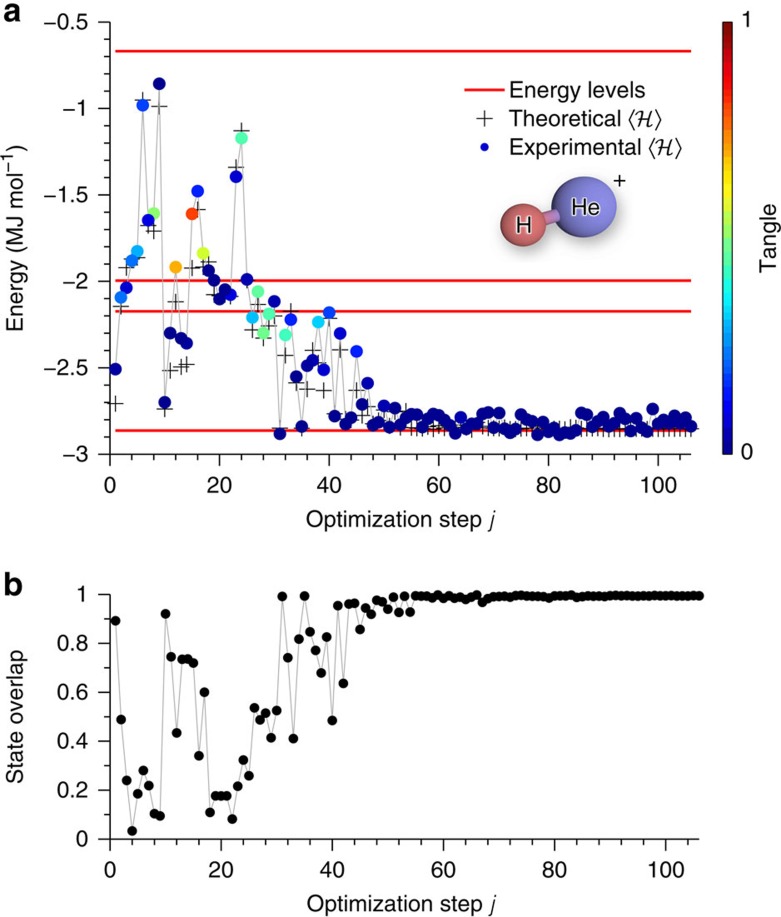
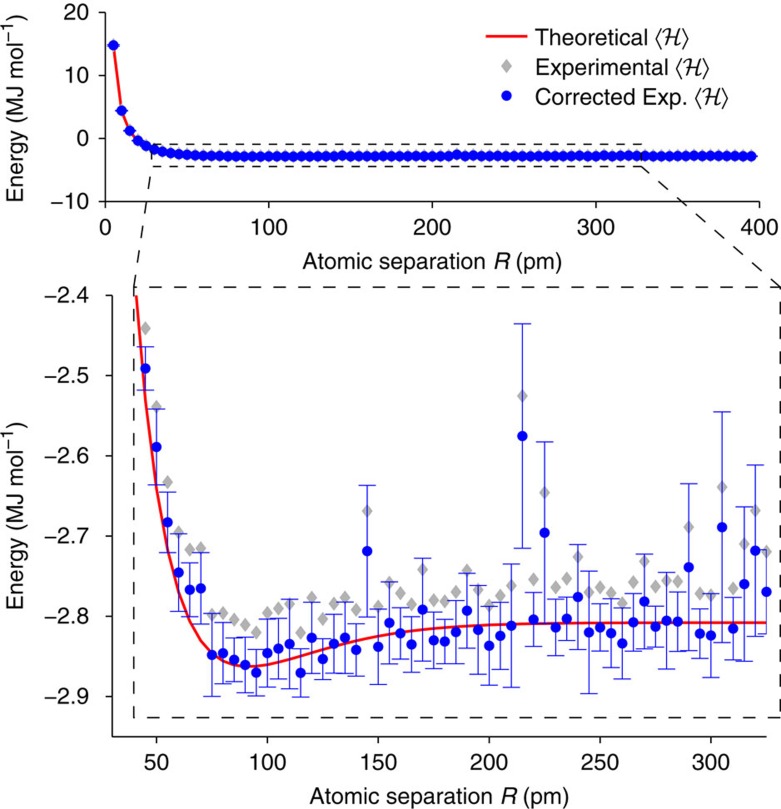
- The authors report an experimental ground-state result for He–H\(^+\): after correcting for experimental errors, they estimate the equilibrium bond length as \(R = 92.3 \pm 0.1\) pm and the ground-state electronic energy as \(E = -2.865 \pm 0.008\) MJ mol\(^{-1}\).
- For the bond dissociation curve, more than 96% of the experimental data are within chemical accuracy of the theoretical values.
- In the discussion, they state that for a 4 × 4 Hamiltonian like the one demonstrated, the QPE circuit would require at least 12 CNOT gates, whereas their method requires one.
- The full experiment was performed in about 158 h, and the bond dissociation curve was obtained by finding the ground states of 79 Hamiltonians.
## Methods
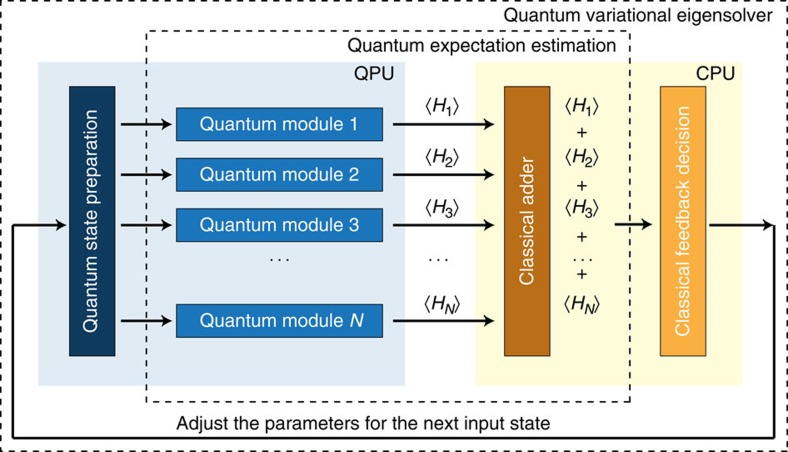
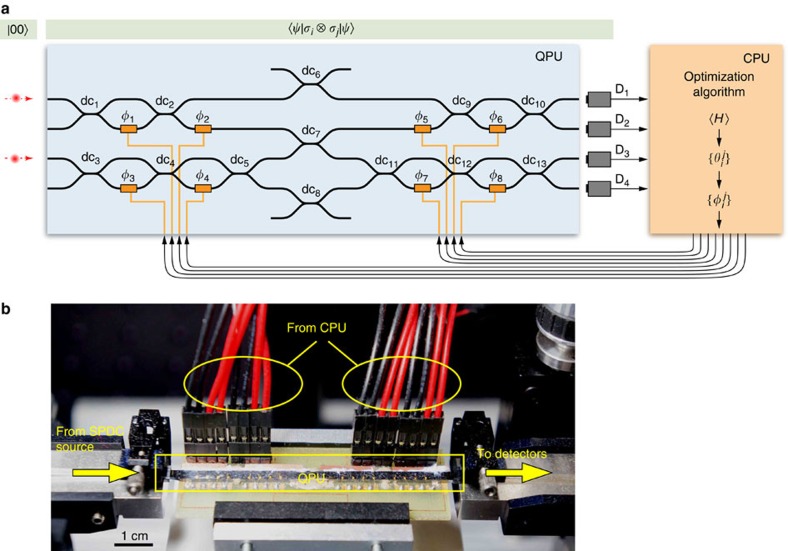
- The paper combines a reconfigurable integrated photonic quantum processor with a classical optimization algorithm: the quantum device estimates Hamiltonian expectation values, and the classical processor updates the state parameters variationally.
- The photonic chip prepares and measures arbitrary two-qubit pure states using single-qubit rotations and one two-qubit entangling gate; the experimental demonstration uses the He–H\(^+\) molecule in a minimal basis.
- For the classical optimization, they use the Nelder–Mead algorithm; expectation values are reconstructed from four two-qubit Pauli measurements at each point.
## Limitations
- The paper states that the method still requires a good approximation to the ground state as input/initialization, and the reliance on multiple separate measurements makes it sensitive to variations in state preparation between calculations.
- The authors report a constant systematic shift of \(\varepsilon = 50\) kJ mol\(^{-1}\) in the measured expectation values; they attribute this to photon-source impurity/distinguishability, circuit imperfections, and unbalanced coupling efficiencies.
- Evident from the text: the demonstration is limited to a two-qubit / 4 × 4 Hamiltonian prototype, so the scalability claim is not experimentally validated here.
Model-written summary. Check it against the paper before relying on it.
Integrity signals
Registry
Cites
Statistics
Figures
Verification
Claims the paper makes
7 Valid · 4 Not valid · 11 Not checked · 59 Own results and interpretations
The cited sources support only part of this claim — read each source’s verdict below.
In the paper
“Recent developments in the field of quantum computation offer a way forward for determining efficient solutions of many instances of large eigenvalue problems that are classically intractable6789101112”
§ A variational eigenvalue solver on a photonic quantum processor > Abstract
What the sources say
- Not matchedcites [6] Nielsen, M. A. & Chuang, I. L. Quantum Computation and Quantum Information Cambridge University Press (2000).
Couldn’t be matched to a paper in Crossref, so it can’t be checked.
- Could not verifycites [7] Kitaev, A. Quantum measurements and the Abelian stabilizer problem. Electronic Colloquium on Computational Complexity (ECCC) 3 (1996). sourceExperimental — accuracy not yet measured
Our copy under this DOI is the ISAAC 2021 paper 'Effective Resistance and Capacitance in Simplicial Complexes and a Quantum Algorithm' (Kitaev's 1995 work appears only as reference [9] in its bibliography), and it nowhere asserts that quantum computation gives efficient solutions to classically intractable large eigenvalue problems. Eigenvalues enter only as complexity parameters — λ, the smallest eigenvalue of the normalized up-Laplacian, in Lemma 31 and Theorem 26 (Section 6.3, 'Time efficient implementations') and in the phase-estimation machinery of Appendix A — and Section 1.1 ('Our Contributions') actually reports the opposite direction for its own problem: 'the quantum algorithm is slower than the classical algorithm in the worst case'. Searched: 'eigenvalue problems classically intractable', 'quantum speedup / exponential advantage', 'phase estimation', 'faster than classical'; no passage addresses the claim's point. (LLM, conf=0.70)
- Partly supportedcites [8] Griffiths, R. B. & Niu, C.-S. Semiclassical fourier transform for quantum computation. Phys. Rev. Lett. 76, 3228–3231 (1996). sourceExperimental — accuracy not yet measured
On p. 1, the paper says a quantum computer, if built, could solve certain problems such as factoring long numbers much faster than conventional algorithms. It also describes a simpler Fourier transform for Shor’s factorization and discrete-logarithm algorithms (p. 1). The copy does not support the claim about efficient solutions to many large eigenvalue problems. (LLM, conf=0.84)
plainstates a cause- Asserted: passes — The authors put it forward as true.
- Checkable: passes — It can be checked against evidence.
- Load-bearing: passes — The paper’s conclusions depend on it.
- Based: passes — The paper gives a reason why it holds.
- Not matched
Every source the paper cites for this claim was checked and supports it.
In the paper
“this would suffer from the N-representability problem, which is known to be intractable for both classical and quantum computers (it is in the quantum complexity class QMA-Hard24).”
§ A variational eigenvalue solver on a photonic quantum processor > Results > Quantum expectation estimation
What the sources say
- Supportedcites [24] Liu, Y.-K., Christandl, M. & Verstraete, F. Quantum computational complexity of the n-representability problem: Qma complete. Phys. Rev. Lett. 98, 110503 (2007). source
The paper states that N-representability is QMA-complete and hence QMA-hard and NP-hard (Abstract). Its discussion of quantum-chemistry relevance says the problem is intractable in the worst case even on a quantum computer, while allowing that particular physical systems may be easier. (LLM, conf=0.93)
boosted- Asserted: passes — The authors put it forward as true.
- Checkable: passes — It can be checked against evidence.
- Load-bearing: passes — The paper’s conclusions depend on it.
- Based: passes — The paper gives a reason why it holds.
- Supported
Every source the paper cites for this claim was checked and supports it.
In the paper
“We have implemented the QPU using integrated quantum photonics technology30.”
§ A variational eigenvalue solver on a photonic quantum processor > Results > Prototype demonstration
What the sources say
- Supportedcites [30] O'Brien, J. L., Furusawa, A. & Vuckovic, J. Photonic quantum technologies. Nat. Photon. 3, 687–695 (2009). source
The citation identifies integrated quantum photonics as the technology used, rather than attributing the citing authors’ QPU implementation to this review. The “Integrated quantum optical circuits” section (p. 6) describes on-chip waveguide circuits performing quantum logic gates and a compiled quantum factoring algorithm. (LLM, conf=0.87)
plain- Asserted: passes — The authors put it forward as true.
- Checkable: passes — It can be checked against evidence.
- Load-bearing: passes — The paper’s conclusions depend on it.
- Based: passes — The paper gives a reason why it holds.
- Supported
The cited sources support only part of this claim — read each source’s verdict below.
In the paper
“The time the quantum computer must remain coherent is determined by the necessity of O(p−1) successive applications of , each of which can require on the order of millions or billions of quantum gates for practical applications1719, as compared to the tens to hundreds of gates achievable in the short term.”
§ A variational eigenvalue solver on a photonic quantum processor > Abstract
What the sources say
- Partly supportedcites [17] Whitfield, J. D., Biamonte, J. & Aspuru-Guzik, A. Simulation of electronic structure hamiltonians using quantum computers. Mol. Phys. 109, 735–750 (2011). sourceExperimental — accuracy not yet measured
Split into 2 atoms — 1 confirmed, 1 partially supported, 0 disputed, 0 misattributed, 0 unverifiable. Expand the claim to see per-atom verdicts.
- Partly supportedcites [19] Jones, N. C. et al. Faster quantum chemistry simulation on fault-tolerant quantum computers. New J. Phys. 14, 115023 (2012). sourceExperimental — accuracy not yet measured
Split into 2 atoms — 0 confirmed, 2 partially supported, 0 disputed, 0 misattributed, 0 unverifiable. Expand the claim to see per-atom verdicts.
plainstates a cause- Asserted: passes — The authors put it forward as true.
- Checkable: passes — It can be checked against evidence.
- Load-bearing: passes — The paper’s conclusions depend on it.
- Based: passes — The paper gives a reason why it holds.
- Partly supported
A result the paper reports from its own data — it cites no other source for it, so there is none to check. The quote shows it is in the paper.
In the paper
“We experimentally demonstrate the feasibility of this approach with an example from quantum chemistry—calculating the ground-state molecular energy for He–H+.”
§ A variational eigenvalue solver on a photonic quantum processor > Abstract
boostedstates a causeSingle case- Asserted: passes — The authors put it forward as true.
- Checkable: passes — It can be checked against evidence.
- Load-bearing: passes — The paper’s conclusions depend on it.
- Based: passes — The paper gives a reason why it holds.
31 more claims
Create a free account to see all 81 claims and to verify the 4 references still open.
- It may state two separate claims as one. 28
- Probably not a substantial claim. 24
Claims other papers make about this one
Each is checked against this paper’s own text: does it say what the citing paper says it does?
The cited source doesn’t support the claim as written.
In the citing paper
“Leveraging quantum resources, the UCC ansatz was instead realized as a PQC on a photonic processor (Peruzzo et al. , 2014).”
From Noisy intermediate-scale quantum algorithms (2022) · cites this paper as Peruzzo et al., 2014
Checked by a reasoning model — may be wrong.
Experimental — accuracy not yet measuredThe cited source doesn’t support the claim as written.
In the citing paper
“The first on-chip GMM of four-qubit cluster state was realised in a laser-writing chip ( Fig.4e ), by manipulating both the polarisation and path DoFs of two photons [85].”
From Integrated photonic quantum technologies (2020) · cites this paper as [85]
Checked by a reasoning model — may be wrong.
Experimental — accuracy not yet measuredThe cited source doesn’t support the claim as written.
In the citing paper
“four-qubit linear- and box-cluster states are generated in a laser-writing photonic chip. This is enabled by on-chip manipulating the two-photon four-qubit hyperentangled state and cluster state, that are encoded in photon's path and polarisation DoFs. The Grover's search algorithm on a four-element database was implemented by controlling the device.”
From Integrated photonic quantum technologies (2020) · cites this paper as [85]
Checked by a reasoning model — may be wrong.
Experimental — accuracy not yet measuredThe source backs part of the claim, not all of it — or backs it for a different population, condition or comparison.
In the citing paper
“Due to its versatility, the variational Hamiltonian ansatz has been implemented for quantum chemistry [21, 29], optimization [24], and for quantum simulation problems [30].”
From Variational quantum algorithms (2021) · cites this paper as [29]
Experimental — accuracy not yet measuredThe source backs part of the claim, not all of it — or backs it for a different population, condition or comparison.
In the citing paper
“For the original VQE (Peruzzo et al. , 2014) and QAOA (Farhi et al. , 2014) it can, for example, be described as a single expectation value min θ ⟨ H ⟩ U ( θ ) , where the differences solely appear in the specific form and construction of the qubit Hamiltonian.”
From Noisy intermediate-scale quantum algorithms (2022) · cites this paper as Peruzzo et al., 2014
Experimental — accuracy not yet measured
12 more claims about this paper
Create a free account to see every claim other papers make about this one.
Citations
Cites
A Simplex Method for Function Minimization
Nelder, J. A., & Mead, R. (1965) · The Computer Journal · doi:10.1093/comjnl/7.4.308 · Cited by 28,905
Quantum computation and quantum information
Law, J. (2001) · ACM SIGSOFT Software Engineering Notes · doi:10.1145/505482.505499 · Cited by 18,842
(1999) · Cited by 12,854
Practical Methods of Optimization
Fletcher, R. (2000) · Wiley eBooks · doi:10.1002/9781118723203 · Cited by 7,605 · cited 3×
“[12] S.”
BackgroundMethodPractical methods of optimization
(1988) · Mathematics and Computers in Simulation · doi:10.1016/0378-4754(88)90129-2 · Cited by 5,818
Quantum Algorithm for Linear Systems of Equations
Harrow, A. W., Hassidim, A., & Lloyd, S. (2009) · Physical Review Letters · doi:10.1103/physrevlett.103.150502 · Cited by 3,325
Conn, A. R., Gould, N. I. M., & Toint, P. L. (2000) · Society for Industrial and Applied Mathematics eBooks · doi:10.1137/1.9780898719857 · Cited by 2,981 · cited 3×
“[14] D.”
MethodInfluential�ber das Paulische �quivalenzverbot
Jordan, P., & Wigner, E. (1928) · Zeitschrift f�r Physik · doi:10.1007/bf01331938 · Cited by 2,597
Molecular Electronic‐Structure Theory
Helgaker, T., Jørgensen, P., & Olsen, J. (2000) · doi:10.1002/9781119019572 · Cited by 2,594
O'Brien, J. L., Furusawa, A., & Vučković, J. (2009) · Nature Photonics · doi:10.1038/nphoton.2009.229 · Cited by 2,388
Self-citation
Research works printed but not linked: 3
- Helgaker, T., Jorgensen, P. & Olsen, J. Mol. Electronic Struct. Theory Wiley, Sussex (2002).
- Saad, Y. Numerical Methods for Large Eigenvalue Problems Vol. 158, (SIAM (1992).
- Rayleigh, J. W. In finding the correction for the open end of an organ-pipe. Phil. Trans. 161, 77 (1870).
Cited by
Items 3,801–3,900 of 4,572
Strategiebildung im Quantencomputing – ein holistischer Ansatz für die chemische Industrie
Weiß, H., Volz, D., Kühn, M., & Standen, B. (2022) · Springer eBooks · doi:10.1007/978-3-658-37534-8_14
Der (lange) Weg zu einem Quantenvorteil in der Pharmabranche
Streif, M., Degroote, M., Kyoseva, E. S., Santagati, R., Tautermann, C. S., Utschig-Utschig, C., & Moll, N. (2022) · Springer eBooks · doi:10.1007/978-3-658-37534-8_15
Quantencomputing als Integrationsproblem: Quantenanwendungen sind in der Praxis immer hybride
Barzen, J., & Leymann, F. (2022) · Springer eBooks · doi:10.1007/978-3-658-37534-8_12
Quantencomputer heute und in naher Zukunft: eine realistische Perspektive
Faehrmann, P. K., Meyer, J. J., & Eisert, J. (2022) · Springer eBooks · doi:10.1007/978-3-658-37534-8_6
The Pricing of American Options on the Quantum ComputerPreprint
Pracht, R. (2023) · SSRN Electronic Journal · doi:10.2139/ssrn.4350641
Lang, V. (2022) · Springer eBooks · doi:10.1007/978-3-662-66285-4_2
Quantum Approximate Optimization for Continuous Problems on a Programmable Photonic Quantum Computer
Enomoto, Y., Anai, K., Udagawa, K., & Takeda, S. (2022) · Frontiers in Optics · doi:10.1364/fio.2022.fm5b.3 · Cited by 1
Modularized and Scalable Compilation for Double Quantum Dot Quatum ComputingPreprint
He, R.-H., Xu, X., Byrd, M., & Wang, Z.-M. (2023) · Research Square · doi:10.21203/rs.3.rs-2596937/v1
Accelerating NISQ variational methods using geometry
Atif, T. A., Chukwu, U., Berwald, J., & Dridi, R. (2023) · Quantum Computing, Communication, and Simulation · doi:10.1117/12.2655793
“1 and vary N in the interval [2 , 10].”
BackgroundKhumalo, M. T., Prag, K., & Nixon, K. J. (2022) · International Conference on Soft Computing & Machine Intelligence (ISCMI) · doi:10.1109/iscmi56532.2022.10068445 · Cited by 2
“The literature postulates that COPs can be solved using quantum hybrid heuristics [10] such as the VQE [2] and the QAOA [1].”
BackgroundMethodSenjean, B., Yalouz, S., & Saubanère, M. (2022) · SciPost Physics · doi:10.21468/scipost.report.5731
Senjean, B., Yalouz, S., & Saubanère, M. (2022) · SciPost Physics · doi:10.21468/scipost.report.5276
A reduction from an LWE problem to maximum independent set problems
Kawano, Y. (2023) · Scientific Reports · doi:10.1038/s41598-023-34366-7
Kang, M., Nuomin, H., Chowdhury, S. N., et al. (2023) · arXiv (Cornell University) · doi:10.48550/arxiv.2305.03156
Bowmick, D., Liu, D., Sengupta, P., & Tan, K. C. (2023) · Research Square · doi:10.21203/rs.3.rs-2922743/v1
Report on scipost_202206_00017v2
Wiersema, R., Zhou, C., Carrasquilla, J., et al. (2022) · SciPost Physics · doi:10.21468/scipost.report.6291
Report on scipost_202206_00017v1
Wiersema, R., Zhou, C., Carrasquilla, J., et al. (2022) · SciPost Physics · doi:10.21468/scipost.report.5465
Report on scipost_202206_00017v1
Wiersema, R., Zhou, C., Carrasquilla, J., et al. (2022) · SciPost Physics · doi:10.21468/scipost.report.5303
Atzarakis, K., Kalogeris, I., Stavroulakis, G., & Papadopoulos, V. (2023) · Preprints.org · doi:10.20944/preprints202307.0470.v1
Preti, F., Schilling, M., Jerbi, S., Trenkwalder, L. M., Nautrup, H. P., Motzoi, F., & Briegel, H. J. (2023) · arXiv (Cornell University) · doi:10.34734/fzj-2024-03349
Exponential Qubit Reduction in Optimization for Financial Transaction SettlementPreprint
Huber, E. X., Tan, B. Y. L., Griffin, P., & Angelakis, D. G. (2023) · arXiv (Cornell University) · doi:10.48550/arxiv.2307.07193
Fast bit flipping based on stability transition of coupled spins
Kieler, M. F. I., & Bäcker, A. (2023) · Physical review. E · doi:10.1103/physreve.108.l022203
“Despite a lot of recent progress, quantum computing will not supersede classical computing, instead they are expected to complement each other [2, 3].”
BackgroundOptimizing Transportation Plans of Designated Radioactive Waste Using Quantum Annealing
Yabuki, N., Makino, J., & Fukuda, T. (2023) · Civil-comp conferences · doi:10.4203/ccc.5.1.7
“2 (QAOA), but their practical significance for conventional computing is yet to be confirmed due to the requirement for a quantum computer with over one million qubits that does not currently exist [1], [2], [3]; meanwhile, quantum annealing, a computational method for solving combinatorial optimization problems, has…”
MethodIyengar, S. S., Saha, D., Dwivedi, A., Lopez-Ruiz, M. A., Kumar, A., Zhang, J. H., Ricard, T. C., Richerme, P., & Sabry, A. (2023) · Elsevier eBooks · doi:10.1016/b978-0-12-821978-2.00139-2
Real-time hybrid quantum-classical computations for trapped ions with Python control-flow
Schmale, T., Temesi, B., Trittschanke, N., Pulido-Mateo, N., Elenskiy, I., Krinner, L., Dubielzig, T., Ospelkaus, C., Weimer, H., & Borcherding, D. (2023) · IEEE International Conference on Quantum Software (QSW) · doi:10.1109/qsw59989.2023.00031 · Cited by 2
“VQEs find the ground state of a Hamiltonian by varying the parameters in the ansatz circuit, such that the energy (cost function) of the system is minimized.”
MethodInfluentialAlgorithm-Aware Qubit MappingPreprint
Ji, Y., & Polian, I. (2023) · doi:10.36227/techrxiv.21786146.v2
โมเดลควอนตัมโครงข่ายประสาทเทียมสำหรับปัญหาการถดถอย
เหล่าคนดี, ส. (2021) · Chula Digiverse · doi:10.58837/chula.the.2021.957
Divide-and-conquer quantum algorithm for hybrid de novo genome assembly of short and long readsPreprint
Fang, J.-K., Lin, Y., Huang, J.-H., Chen, Y., Fan, G.-M., Sun, Y., Feng, G., Guo, C., Meng, T., Zhang, Y., et al. (2023) · bioRxiv (Cold Spring Harbor Laboratory) · doi:10.1101/2023.09.19.558544
Variational Quantum Algorithm Parameter Tuning with Estimation of Distribution Algorithms
Soloviev, V. P., Larrañaga, P., & Bielza, C. (2023) · IEEE Congress on Evolutionary Computation (CEC) · doi:10.1109/cec53210.2023.10254138 · Cited by 3
“(QAOA) [26] and the variational quantum eigensolver (VQE) [27] have shown to be quite resilient to quantum noises present in NISQ devices and to achieve competitive results in a wide range of problems [7].”
BackgroundMethodSynthetic quantum matter using atoms and light
Argüello-Luengo, J. (2022) · UPCommons institutional repository (Universitat Politècnica de Catalunya) · doi:10.5821/dissertation-2117-377148
Investigating quantum many-body systems with tensor networks, machine learning and quantum computers
Kottmann, K. (2022) · UPCommons institutional repository (Universitat Politècnica de Catalunya) · doi:10.5821/dissertation-2117-379461 · Cited by 3
Are different types of photon-pair sources equally indistinguishable in silicon photonics?
Baldazzi, A., Lee, J.-M., Sanna, M., et al. (2023) · Advanced Photonics Congress · doi:10.1364/iprsn.2023.itu3a.4
Manenti, R., & Motta, M. (2023) · Oxford University Press eBooks · doi:10.1093/oso/9780198787488.003.0006
Microwave resonators for superconducting devices
Manenti, R., & Motta, M. (2023) · Oxford University Press eBooks · doi:10.1093/oso/9780198787488.003.0013
(2023) · Oxford University Press eBooks · doi:10.1093/oso/9780198787488.002.0003
The rotating wave approximation
Manenti, R., & Motta, M. (2023) · Oxford University Press eBooks · doi:10.1093/oso/9780198787488.005.0001
Manenti, R., & Motta, M. (2023) · Oxford University Press eBooks · doi:10.1093/oso/9780198787488.003.0004
Manenti, R., & Motta, M. (2023) · Oxford University Press eBooks · doi:10.1093/oso/9780198787488.003.0007
Quantum simulation of Hamiltonian eigenstates
Manenti, R., & Motta, M. (2023) · Oxford University Press eBooks · doi:10.1093/oso/9780198787488.003.0012
Manenti, R., & Motta, M. (2023) · Oxford University Press eBooks · doi:10.1093/oso/9780198787488.003.0002
Quantum simulation of Hamiltonian dynamics
Manenti, R., & Motta, M. (2023) · Oxford University Press eBooks · doi:10.1093/oso/9780198787488.003.0011
Manenti, R., & Motta, M. (2023) · Oxford University Press eBooks · doi:10.1093/oso/9780198787488.003.0009
The molecular Hamiltonian in second quantization
Manenti, R., & Motta, M. (2023) · Oxford University Press eBooks · doi:10.1093/oso/9780198787488.005.0004
Manenti, R., & Motta, M. (2023) · Oxford University Press eBooks · doi:10.1093/oso/9780198787488.003.0005
Manenti, R., & Motta, M. (2023) · Oxford University Press eBooks · doi:10.1093/oso/9780198787488.003.0008
Oblivious amplitude amplification lemma
Manenti, R., & Motta, M. (2023) · Oxford University Press eBooks · doi:10.1093/oso/9780198787488.005.0005
Manenti, R., & Motta, M. (2023) · Oxford University Press eBooks · doi:10.1093/oso/9780198787488.005.0006
Manenti, R., & Motta, M. (2023) · Oxford University Press eBooks · doi:10.1093/oso/9780198787488.003.0003
Manenti, R., & Motta, M. (2023) · Oxford University Press eBooks · doi:10.1093/oso/9780198787488.003.0001
Manenti, R., & Motta, M. (2023) · Oxford University Press eBooks · doi:10.1093/oso/9780198787488.003.0014
(2023) · Oxford University Press eBooks · doi:10.1093/oso/9780198787488.002.0005
(2023) · Oxford University Press eBooks · doi:10.1093/oso/9780198787488.002.0004
Manenti, R., & Motta, M. (2023) · Oxford University Press eBooks · doi:10.1093/oso/9780198787488.003.0010
MVITA, M. J., Zulu, N. G., Thethwayo, B., & Makhamisa, S. (2023) · International Conference on Industrial Engineering and Operations Management (IEOM) · doi:10.46254/eu6.20230207
Report on scipost_202211_00047v1
Erbanni, R., Bharti, K., Kwek, L. C., et al. (2023) · SciPost Physics · doi:10.21468/scipost.report.6592
Report on scipost_202211_00047v1
Erbanni, R., Bharti, K., Kwek, L. C., et al. (2023) · SciPost Physics · doi:10.21468/scipost.report.6495
Roca-Jerat, S., Sancho-Lorente, T., Román-Roche, J., et al. (2023) · SciPost Physics · doi:10.21468/scipost.report.7257
Roca-Jerat, S., Sancho-Lorente, T., Román-Roche, J., et al. (2023) · SciPost Physics · doi:10.21468/scipost.report.7423
Liu, Z. (2023) · Springer theses · doi:10.1007/978-981-99-6167-2_8
Multi-Programming Mechanism on Near-Term Quantum Computing
Niu, S., & Todri‐Sanial, A. (2023) · Springer eBooks · doi:10.1007/978-3-031-37966-6_2 · Cited by 2
Machine Learning Reliability Assessment from Application to Pulse Level
Saravanan, V., & Saeed, S. M. (2023) · Springer eBooks · doi:10.1007/978-3-031-37966-6_7 · Cited by 1
Symmetry Breaking Slows Convergence of the ADAPT Variational Quantum Eigensolver
Bertels, L. W., Grimsley, H. R., Economou, S. E., Barnes, E., & Mayhall, N. J. (2023) · IEEE International Conference on Quantum Computing and Engineering (QCE) · doi:10.1109/qce57702.2023.10190
Tensor Train Optimization of Parameterized Quantum Circuits
Paradezhenko, G. V., Pervishko, A. A., & Yudin, D. (2023) · Journal of Experimental and Theoretical Physics Letters · doi:10.1134/s0021364023603056
Quantum algorithms for charged particle track reconstruction in the LUXE experiment
Yap, Y. C. (2023) · European Physical Society Conference on High Energy Physics (EPS-HEP) · doi:10.22323/1.449.0562
Hamiltonian Minimization in the NISQ EraPreprint
da Silva, R. P. (2023) · SSRN Electronic Journal · doi:10.2139/ssrn.4652979
Research on a Quantum Machine Learning Approach to Mismatched Filter Design
Xiao, J., Dong, S., & Xia, L. (2023) · International Conference on Communication, Image and Signal Processing (CCISP) · doi:10.1109/ccisp59915.2023.10355822
“As a result, these types of algorithms are also referred to as quantum machine learning (QML) algorithms [13], which have already provided efficient solutions for quantum chemistry [14], [15], linear algebra [16], [17], and typical machine learning tasks [18]–[20].”
BackgroundSimulating dimensionally reduced 4D Yang-Mills theory on a quantum computer
Butt, N., Draper, P., & Shen, J. (2023) · Physical review. D/Physical review. D. · doi:10.1103/physrevd.108.114510 · Cited by 7
Engineering Philosophy of Quantum Artificial Intelligence
Cheng, P., & Tan, H. (2021) · JOURNAL OF ENGINEERING STUDIES · doi:10.3724/sp.j.1224.2021.00479
Track reconstruction of charged particles using a 4D quantum algorithm
Spataro, D., Meloni, F., & Yap, Y. C. (2024) · European Physical Society Conference on High Energy Physics (EPS-HEP) · doi:10.22323/1.449.0560
“This transformed problem can then be optimised using a Variational Quantum Eigensolver (VQE), a hybrid classical-quantum algorithm [4].”
MethodSymmetry Verification and Circuit Implementation using Qiskit
Chung, Y., Ha, J., Kang, Y., & Heo, J. (2023) · International Conference on Information and Communication Technology Convergence (ICTC) · doi:10.1109/ictc58733.2023.10392960
“ARIATIONAL Q UANTUM E IGENSOLVER The Variational Quantum Eigensolver (VQE) was originally developed by Peruzzo et al. [6], and its theoretical framework was formalized by McClean et al. [7].”
MethodA Grover-like Quantum Algorithm for Minimum Distance Decoding of Linear Block Codes
Kim, G., & Oh, J. (2023) · International Conference on Information and Communication Technology Convergence (ICTC) · doi:10.1109/ictc58733.2023.10393803
“Furthermore, a range of quantum algorithms, including quantum approximate optimization algorithm (QAOA) [7] and variational quantum eigensolver (VQE) [15], have surfaced, indicating the capacity of quantum computers to solve numerous problems beyond the reach of classical computers [14].”
BackgroundHour, L., Go, M., & Han, Y. (2023) · International SoC Design Conference · doi:10.1109/isocc59558.2023.10396406
Mayfield, J., & Naqa, I. E. (2024) · Research Square · doi:10.21203/rs.3.rs-3888632/v1
Landscape approximation of low-energy solutions to binary optimization problems
Tan, B. Y. L., Gan, B. Y., Leykam, D., & Angelakis, D. G. (2024) · Physical Review A · doi:10.1103/physreva.109.012433 · Cited by 1
Introducing Reduced-Width QNNs, an AI-Inspired Ansatz Design Pattern
Stein, J., Rohe, T., Nappi, F., Hager, J., Bucher, D., Zorn, M., Kölle, M., & Linnhoff–Popien, C. (2024) · International Conference on Agents and Artificial Intelligence (ICAART) · doi:10.5220/0012449800003636 · Cited by 4
“The Variational Quantum Eigensolver (VQE) is an algorithm targeted towards finding the ground state of a given Hamiltonian ˆ H using the variational method (Peruzzo et al., 2014).”
MethodRealizing quantum imaginary time evolution in experiment
Yuan, X. (2023) · Science China Physics Mechanics and Astronomy · doi:10.1007/s11433-024-2330-4
Cho, C., Su, J.-W., Yu, L.-P., Chang, C., Chen, P., Lin, T.-W., Liu, S.-H., Li, T.-H., & Lee, Y.-Y. (2024) · Industrial & Engineering Chemistry Research · doi:10.1021/acs.iecr.3c03331
Hamiltonian-reconstruction distance as a success metric for the variational quantum eigensolver
Moon, L. J. I., Sohoni, M. M., Shimizu, M. A., Viswanathan, P., Zhang, K., Kim, E.-A., & McMahon, P. L. (2026) · Quantum Science and Technology · doi:10.1088/2058-9565/ae528d · Cited by 1
“Canonical examples include unitary coupled-cluster-type constructions [1, 11–14], symmetry-preserving ansatze [15–17], and ansatze based on Trotterized evolutions of Hamiltonian terms [18, 19].”
Physics for secure and efficient societies
Barbato, F. C. T., Barthélemy, M., Beck, C., Biamonte, J., Cirac, J. I., Malz, D., Marino, A., Seskir, Z. C., & Ventura‐Traveset, J. (2024) · Institute of Physics eBooks · doi:10.1088/978-0-7503-6342-6ch7 · Cited by 1
Practical quantum approximate optimization algorithms on IBM quantum processors
Medwig, G., Choi, S., Castillo, P., & Yu, K. (2024) · Quantum Computing, Communication, and Simulation · doi:10.1117/12.3002940 · Cited by 1
“On the other hand, Variational Quantum Algorithms (VQAs), such as Quantum Approximate Optimization Algorithm (QAOA), 18, 19 Variation Quantum Eigensolver (VQE), 20 and Quantum Machine Learning, 21–25 have drawn attention as a promising candidate to achieve quantum advantage on NISQ devices.”
MethodGomosma, G., Agusta, M. K., & Dipojono, H. K. (2024) · Journal of Physics Conference Series · doi:10.1088/1742-6596/2734/1/012052
“Among the promising quantum algorithms for the NISQ era is the Variational Quantum Eigensolver (VQE), which was first conceptualized and experimentally implemented by Peruzzo et al. [10].”
MethodEfficient Quantum Circuit Simulation by Tensor Network Methods on Modern GPUsPreprint
Pan, F. P., Gu, H., Kuang, L., et al. (2023) · arXiv (Cornell University) · doi:10.48550/arxiv.2310.03978
Tensor train optimization of parameterized quantum circuits
Paradezhenko, G. V., Pervishko, A. A., & Yudin, D. (2023) · Письма в Журнал экспериментальной и теоретической физики · doi:10.31857/s1234567823240114
Quantum Computing's Paradigm Shift: Implications and Opportunities for Cloud ComputingPreprint
Ainala, V. B., Arikatla, Y., Seru, V., et al. (2024) · SSRN Electronic Journal · doi:10.2139/ssrn.4790529
Correr, G. I. (2024) · Digital Library of Theses and Dissertations (Universidade de São Paulo) · doi:10.11606/d.76.2024.tde-24042024-083735
A Novel Classical-Quantum Transfer Learning Framework for Image RecognitionPreprint
Ruan, B., Liu, Z., & Li, X. (2024) · SSRN Electronic Journal · doi:10.2139/ssrn.4806924
Ying, M. (2024) · Elsevier eBooks · doi:10.1016/b978-0-44-315942-8.00027-7
(2024) · Elsevier eBooks · doi:10.1016/b978-0-44-315942-8.00030-7
Optimizing Product Influence of Shelf DisplayPreprint
Chaimanowong, W., Cisternas, F., & Neira, D. E. B. (2024) · SSRN Electronic Journal · doi:10.2139/ssrn.4821663
Light cone cancellation for variational quantum eigensolver in solving noisy Max-Cut
Lee, X., Yan, X., Xie, N., Saito, Y., Kurosawa, L., Asai, N., Cai, D., & Lau, H. C. (2026) · Scientific Reports · doi:10.1038/s41598-025-31798-1 · Cited by 3
“Another VQA, the variational quantum eigensolver (VQE) [8], is also capable of solving COPs, although it is better known for its application to quantum chemistry.”
Low-cost nonlocal Toffoli gate in a linear quantum network topology
Chen, H., Hou, G., & Zhu, C. (2024) · Modern Physics Letters B · doi:10.1142/s0217984924503706
Simulation of time-dependent quantum dynamics using quantum computers
Lötstedt, E., Nishi, T., & Yamanouchi, K. (2024) · Advances in atomic, molecular, and optical physics · doi:10.1016/bs.aamop.2024.05.002 · Cited by 1
A machine learning ride in the physics theme park: from quantum to biophysics
Requena, B. (2024) · UPCommons institutional repository (Universitat Politècnica de Catalunya) · doi:10.5821/dissertation-2117-409132
Interpreting variational quantum models with active paths in parameterized quantum circuits
Lee, K., Jeon, H., Lee, D., Kim, B., Bang, J., & Kim, T. (2024) · Machine Learning Science and Technology · doi:10.1088/2632-2153/ad5412
Alejo, A. G. (2024) · doi:10.31274/td-20240617-153
Ansatz optimization of the variational quantum eigensolver tested on the atomic Anderson model
Riso, G. D., Cipriani, F., Villani, L., Bisogno, V., Schiavo, M. L., Romano, A., & Noce, C. (2024) · New Journal of Physics · doi:10.1088/1367-2630/ad5a61
Hybrid quantum-classical clustering for preparing a prior distribution of eigenspectrum
Ren, M., Chen, Y., Lai, C.-J., Hsieh, M.-H., & Hu, A. (2026) · npj Quantum Information · doi:10.1038/s41534-026-01194-2 · Cited by 1
Wang, S., Li, G., Wang, Z., Chen, Z., Wang, P., Gu, Y., Wu, Y.-C., & Guo, G. (2026) · Physical Review A · doi:10.1103/2p4m-5mt8 · Cited by 3
“In this instance, the basis state corresponding to the interpolated minimum energy is located in sub-ansatz sa 2[4 , 4] .”
BackgroundInfluentialJi, Y., & Polian, I. (2024) · OPUS Publication Server of the University of Stuttgart (University of Stuttgart) · doi:10.18419/opus-14924
Quantum-Classical Synergy: Enhancing De Novo Genome Assembly with Hybridized QUBO OptimizationPreprint
Mukherjee, A., & Mallik, B. B. (2024) · Research Square · doi:10.21203/rs.3.rs-4653117/v1
Metadata
- Authors
- Peruzzo, A., McClean, J., Shadbolt, P., Yung, M.-H., Zhou, X.-Q., Love, P. J., Aspuru-Guzik, A., & O’Brien, J. L.
- Affiliations
- The University of Sydney (AU)
- Harvard University (US)
- University of Bristol (GB)
- Haverford College (US)
- Corresponding author
- Peruzzo, Alberto
- O’Brien, Jeremy L.
- Venue
- Nature Communications
- Published
- 2014-07-23
- Volume
- 5
- Issue
- 1
- Pages
- 4213-4213
- ISSN
- 2041-1723 (ISSN-L)
- PMC
- PMC4124861
- OpenAlex
- W2161685427
- Cited by
- 4,552
- References
- 48
- Citations by year
- 2026: 591 · 2025: 765 · 2024: 722 · 2023: 658 · 2022: 564 · 2021: 561 · 2020: 346 · 2019: 191 · 2018: 83 · 2017: 29 · 2016: 18 · 2015: 16 · 2014: 4
- FWCI
- 22.24
- Type
- journal article
- Language
- en
- Open access
- hybrid
- doi.org
- Licence
- cc-by-nc-nd
- creativecommons.org/licenses/by-nc-nd/4.0 (tdm)
- creativecommons.org/licenses/by-nc-nd/4.0 (vor)
- Locations
- Nature Communications (publishedVersion, cc-by-nc-nd)
- Europe PMC (PubMed Central) (publishedVersion, cc-by-nc-nd)
- PubMed Central (publishedVersion, cc-by-nc-nd)
- PubMed (publishedVersion)
- arXiv (Cornell University) (submittedVersion)
- OSTI OAI (U.S. Department of Energy Office of Scientific and Technical Information) (submittedVersion, cc-by-nc-nd)
- Digital Access to Scholarship at Harvard (DASH) (Harvard University) (submittedVersion, cc-by)
- RePEc: Research Papers in Economics (submittedVersion)
- RMIT Research Repository (RMIT University Library) (submittedVersion, cc-by-nc-nd)
- Figshare (submittedVersion, cc-by-nc-nd)
- UWA Profiles and Research Repository (UWA) (submittedVersion, cc-by-nc-nd)
- Bristol Research (University of Bristol) (submittedVersion)
- arXiv (Cornell University)
- Funders
- National Science Foundation (DE-FG02-97ER25308, 0955518, 1037992)
- U.S. Department of Energy (DEFG0297ER25308, DE‐FG02‐, FG02-97ER25308)
- Alfred P. Sloan Foundation
- John Templeton Foundation
- Camille and Henry Dreyfus Foundation
- Royal Academy of Engineering
- National Natural Science Foundation of China (61033001, 61361136003)
- Engineering and Physical Sciences Research Council (EP/J017175/1, EP/L024020/1, EP/K021931/1)
- Australian Research Council (DE140101700)
- National Key Research and Development Program of China (61033001, 2011CBA00301, 61361136003, 2011CBA00300)
- Division of Chemistry (CHE-1037992)
- Air Force Office of Scientific Research (FA 9550-12-1-0046, FA9550-, FA9550-12, FA9550‐12‐1)
- Topics
- Physical Sciences › Computer Science › Artificial Intelligence › Quantum Computing Algorithms and Architecture
- Physical Sciences › Physics and Astronomy › Atomic and Molecular Physics, and Optics › Quantum Information and Cryptography
- Physical Sciences › Physics and Astronomy › Atomic and Molecular Physics, and Optics › Quantum many-body systems
- Keywords
- variational quantum eigensolver, photonic quantum processors, quantum chemistry, classical optimization, hybrid quantum-classical computation
About these checks
Registry, retraction, Cites and statistics results are computed, not judged, with one exception: a printed reference that no index lists is read once by a model before it counts as a citation error. Claims are extracted by a model and kept only when their quote appears verbatim in the text; each cited source is then checked, with a model’s help, for whether it says what the claim relies on. Those verdicts can be wrong — read the claim’s quote and the cited source before relying on one.
The claim verdicts this report counts are experimental: their accuracy is not yet measured.
A language model drew the claims from the paper on 2026-10-10, under version 3 of the claim definition (model deepseek-v4.1-flash, prompt extract-v3).
A second model labelled each claim on 2026-10-10 (model jev-1.13-20260917, definition revision gold-guideline-v0.2).
Cited sources are checked with a language model’s help (qwen3.8-omni-flash and gpt-6-sol).
Statistics and arithmetic are recomputed, not judged.
Confidence bands are shown only for fields calibrated on our annotated test set. None is calibrated yet, so no band is shown.
What counts as a claim ›How we measure confidence ›How we check this ›
Are you an author, or do you see a problem with this page? Request a review
Data sources
Bibliographic data: Semantic Scholar, OpenAlex, Crossref.
Contains information from the Semantic Scholar Academic Graph Datasets, made available under the ODC Attribution License (ODC-BY 1.0).
Semantic Scholar’s data is described in: Kinney, R., et al. (2023). The Semantic Scholar Open Data Platform. arXiv:2301.10140.
