

A variational eigenvalue solver on a photonic quantum processor
Open accessThe DOI matches its Crossref record; 47 of the 48 references it cites were found in a registry or an index; 14 of the 31 sources its claims cite were checked for support.
Abstract
Quantum computers promise to efficiently solve important problems that are intractable on a conventional computer. For quantum systems, where the physical dimension grows exponentially, finding the eigenvalues of certain operators is one such intractable problem and remains a fundamental challenge. The quantum phase estimation algorithm efficiently finds the eigenvalue of a given eigenvector but requires fully coherent evolution. Here we present an alternative approach that greatly reduces the requirements for coherent evolution and combine this method with a new approach to state preparation based on ansätze and classical optimization. We implement the algorithm by combining a highly reconfigurable photonic quantum processor with a conventional computer. We experimentally demonstrate the feasibility of this approach with an example from quantum chemistry—calculating the ground-state molecular energy for He–H+. The proposed approach drastically reduces the coherence time requirements, enhancing the potential of quantum resources available today and in the near future. Quantum computers promise to efficiently solve problems that would be practically impossible with a normal computer. Peruzzo et al. develop a variational computation approach that uses any available quantum resources and, with a photonic quantum processing unit, find the ground-state molecular energy of He–H+.
Overview
CoChat Summary
## TL;DR
The paper introduces a variational alternative to quantum phase estimation for finding eigenvalues, combining short coherent quantum measurements with classical optimization. It experimentally demonstrates the approach on a photonic processor by estimating the ground-state energy curve of He–H\(^+\).
## Key findings
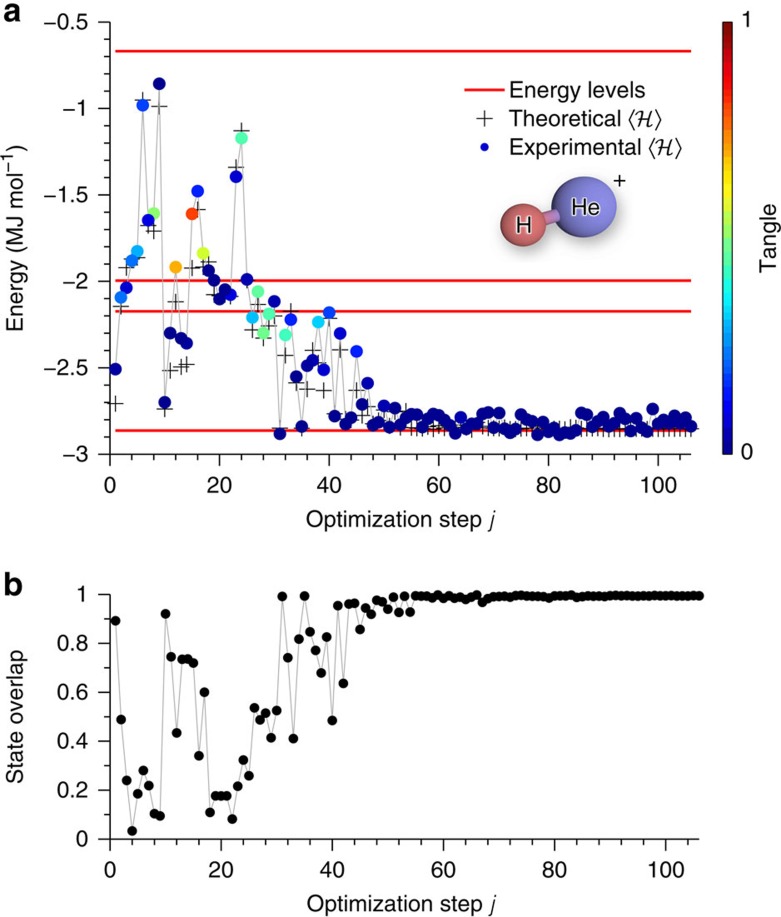
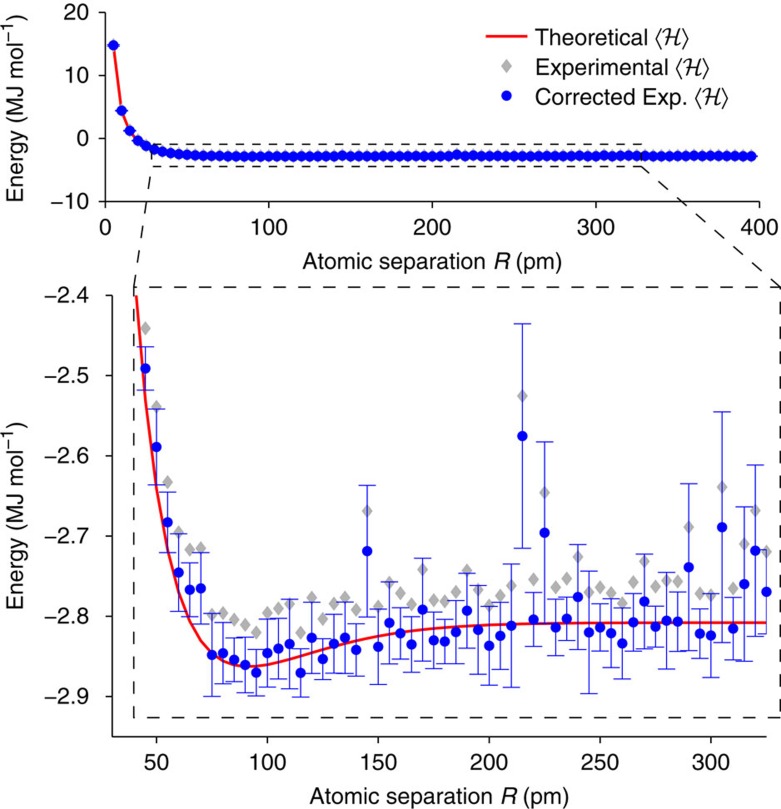
- The authors report an experimental ground-state result for He–H\(^+\): after correcting for experimental errors, they estimate the equilibrium bond length as \(R = 92.3 \pm 0.1\) pm and the ground-state electronic energy as \(E = -2.865 \pm 0.008\) MJ mol\(^{-1}\).
- For the bond dissociation curve, more than 96% of the experimental data are within chemical accuracy of the theoretical values.
- In the discussion, they state that for a 4 × 4 Hamiltonian like the one demonstrated, the QPE circuit would require at least 12 CNOT gates, whereas their method requires one.
- The full experiment was performed in about 158 h, and the bond dissociation curve was obtained by finding the ground states of 79 Hamiltonians.
## Methods
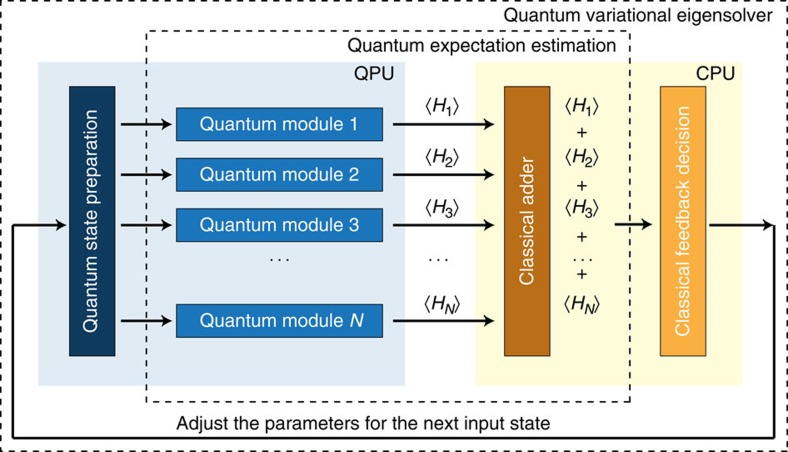
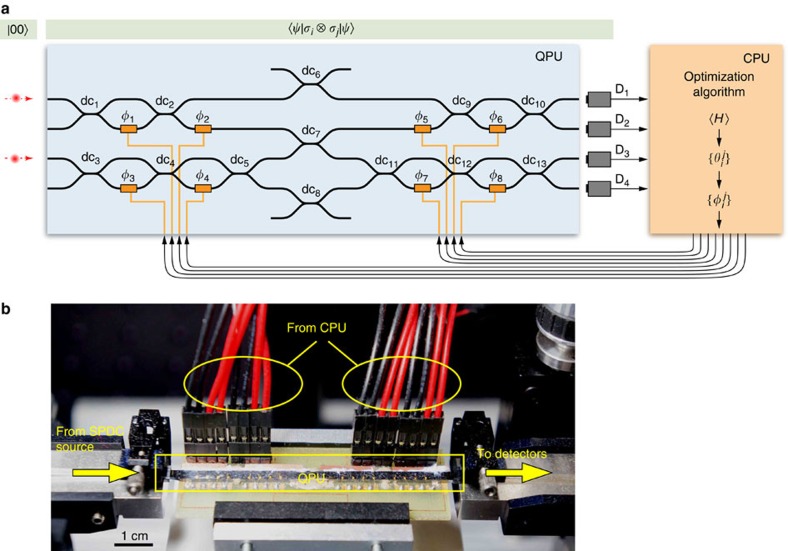
- The paper combines a reconfigurable integrated photonic quantum processor with a classical optimization algorithm: the quantum device estimates Hamiltonian expectation values, and the classical processor updates the state parameters variationally.
- The photonic chip prepares and measures arbitrary two-qubit pure states using single-qubit rotations and one two-qubit entangling gate; the experimental demonstration uses the He–H\(^+\) molecule in a minimal basis.
- For the classical optimization, they use the Nelder–Mead algorithm; expectation values are reconstructed from four two-qubit Pauli measurements at each point.
## Limitations
- The paper states that the method still requires a good approximation to the ground state as input/initialization, and the reliance on multiple separate measurements makes it sensitive to variations in state preparation between calculations.
- The authors report a constant systematic shift of \(\varepsilon = 50\) kJ mol\(^{-1}\) in the measured expectation values; they attribute this to photon-source impurity/distinguishability, circuit imperfections, and unbalanced coupling efficiencies.
- Evident from the text: the demonstration is limited to a two-qubit / 4 × 4 Hamiltonian prototype, so the scalability claim is not experimentally validated here.
Model-written summary. Check it against the paper before relying on it.
Integrity signals
Registry
Cites
Statistics
Figures
Verification
Claims the paper makes
7 Valid · 4 Not valid · 11 Not checked · 59 Own results and interpretations
The cited sources support only part of this claim — read each source’s verdict below.
In the paper
“Recent developments in the field of quantum computation offer a way forward for determining efficient solutions of many instances of large eigenvalue problems that are classically intractable6789101112”
§ A variational eigenvalue solver on a photonic quantum processor > Abstract
What the sources say
- Not matchedcites [6] Nielsen, M. A. & Chuang, I. L. Quantum Computation and Quantum Information Cambridge University Press (2000).
Couldn’t be matched to a paper in Crossref, so it can’t be checked.
- Could not verifycites [7] Kitaev, A. Quantum measurements and the Abelian stabilizer problem. Electronic Colloquium on Computational Complexity (ECCC) 3 (1996). sourceExperimental — accuracy not yet measured
Our copy under this DOI is the ISAAC 2021 paper 'Effective Resistance and Capacitance in Simplicial Complexes and a Quantum Algorithm' (Kitaev's 1995 work appears only as reference [9] in its bibliography), and it nowhere asserts that quantum computation gives efficient solutions to classically intractable large eigenvalue problems. Eigenvalues enter only as complexity parameters — λ, the smallest eigenvalue of the normalized up-Laplacian, in Lemma 31 and Theorem 26 (Section 6.3, 'Time efficient implementations') and in the phase-estimation machinery of Appendix A — and Section 1.1 ('Our Contributions') actually reports the opposite direction for its own problem: 'the quantum algorithm is slower than the classical algorithm in the worst case'. Searched: 'eigenvalue problems classically intractable', 'quantum speedup / exponential advantage', 'phase estimation', 'faster than classical'; no passage addresses the claim's point. (LLM, conf=0.70)
- Partly supportedcites [8] Griffiths, R. B. & Niu, C.-S. Semiclassical fourier transform for quantum computation. Phys. Rev. Lett. 76, 3228–3231 (1996). sourceExperimental — accuracy not yet measured
On p. 1, the paper says a quantum computer, if built, could solve certain problems such as factoring long numbers much faster than conventional algorithms. It also describes a simpler Fourier transform for Shor’s factorization and discrete-logarithm algorithms (p. 1). The copy does not support the claim about efficient solutions to many large eigenvalue problems. (LLM, conf=0.84)
plainstates a cause- Asserted: passes — The authors put it forward as true.
- Checkable: passes — It can be checked against evidence.
- Load-bearing: passes — The paper’s conclusions depend on it.
- Based: passes — The paper gives a reason why it holds.
- Not matched
Every source the paper cites for this claim was checked and supports it.
In the paper
“this would suffer from the N-representability problem, which is known to be intractable for both classical and quantum computers (it is in the quantum complexity class QMA-Hard24).”
§ A variational eigenvalue solver on a photonic quantum processor > Results > Quantum expectation estimation
What the sources say
- Supportedcites [24] Liu, Y.-K., Christandl, M. & Verstraete, F. Quantum computational complexity of the n-representability problem: Qma complete. Phys. Rev. Lett. 98, 110503 (2007). source
The paper states that N-representability is QMA-complete and hence QMA-hard and NP-hard (Abstract). Its discussion of quantum-chemistry relevance says the problem is intractable in the worst case even on a quantum computer, while allowing that particular physical systems may be easier. (LLM, conf=0.93)
boosted- Asserted: passes — The authors put it forward as true.
- Checkable: passes — It can be checked against evidence.
- Load-bearing: passes — The paper’s conclusions depend on it.
- Based: passes — The paper gives a reason why it holds.
- Supported
Every source the paper cites for this claim was checked and supports it.
In the paper
“We have implemented the QPU using integrated quantum photonics technology30.”
§ A variational eigenvalue solver on a photonic quantum processor > Results > Prototype demonstration
What the sources say
- Supportedcites [30] O'Brien, J. L., Furusawa, A. & Vuckovic, J. Photonic quantum technologies. Nat. Photon. 3, 687–695 (2009). source
The citation identifies integrated quantum photonics as the technology used, rather than attributing the citing authors’ QPU implementation to this review. The “Integrated quantum optical circuits” section (p. 6) describes on-chip waveguide circuits performing quantum logic gates and a compiled quantum factoring algorithm. (LLM, conf=0.87)
plain- Asserted: passes — The authors put it forward as true.
- Checkable: passes — It can be checked against evidence.
- Load-bearing: passes — The paper’s conclusions depend on it.
- Based: passes — The paper gives a reason why it holds.
- Supported
The cited sources support only part of this claim — read each source’s verdict below.
In the paper
“The time the quantum computer must remain coherent is determined by the necessity of O(p−1) successive applications of , each of which can require on the order of millions or billions of quantum gates for practical applications1719, as compared to the tens to hundreds of gates achievable in the short term.”
§ A variational eigenvalue solver on a photonic quantum processor > Abstract
What the sources say
- Partly supportedcites [17] Whitfield, J. D., Biamonte, J. & Aspuru-Guzik, A. Simulation of electronic structure hamiltonians using quantum computers. Mol. Phys. 109, 735–750 (2011). sourceExperimental — accuracy not yet measured
Split into 2 atoms — 1 confirmed, 1 partially supported, 0 disputed, 0 misattributed, 0 unverifiable. Expand the claim to see per-atom verdicts.
- Partly supportedcites [19] Jones, N. C. et al. Faster quantum chemistry simulation on fault-tolerant quantum computers. New J. Phys. 14, 115023 (2012). sourceExperimental — accuracy not yet measured
Split into 2 atoms — 0 confirmed, 2 partially supported, 0 disputed, 0 misattributed, 0 unverifiable. Expand the claim to see per-atom verdicts.
plainstates a cause- Asserted: passes — The authors put it forward as true.
- Checkable: passes — It can be checked against evidence.
- Load-bearing: passes — The paper’s conclusions depend on it.
- Based: passes — The paper gives a reason why it holds.
- Partly supported
A result the paper reports from its own data — it cites no other source for it, so there is none to check. The quote shows it is in the paper.
In the paper
“We experimentally demonstrate the feasibility of this approach with an example from quantum chemistry—calculating the ground-state molecular energy for He–H+.”
§ A variational eigenvalue solver on a photonic quantum processor > Abstract
boostedstates a causeSingle case- Asserted: passes — The authors put it forward as true.
- Checkable: passes — It can be checked against evidence.
- Load-bearing: passes — The paper’s conclusions depend on it.
- Based: passes — The paper gives a reason why it holds.
31 more claims
Create a free account to see all 81 claims and to verify the 4 references still open.
- It may state two separate claims as one. 28
- Probably not a substantial claim. 24
Claims other papers make about this one
Each is checked against this paper’s own text: does it say what the citing paper says it does?
The cited source doesn’t support the claim as written.
In the citing paper
“Leveraging quantum resources, the UCC ansatz was instead realized as a PQC on a photonic processor (Peruzzo et al. , 2014).”
From Noisy intermediate-scale quantum algorithms (2022) · cites this paper as Peruzzo et al., 2014
Checked by a reasoning model — may be wrong.
Experimental — accuracy not yet measuredThe cited source doesn’t support the claim as written.
In the citing paper
“The first on-chip GMM of four-qubit cluster state was realised in a laser-writing chip ( Fig.4e ), by manipulating both the polarisation and path DoFs of two photons [85].”
From Integrated photonic quantum technologies (2020) · cites this paper as [85]
Checked by a reasoning model — may be wrong.
Experimental — accuracy not yet measuredThe cited source doesn’t support the claim as written.
In the citing paper
“four-qubit linear- and box-cluster states are generated in a laser-writing photonic chip. This is enabled by on-chip manipulating the two-photon four-qubit hyperentangled state and cluster state, that are encoded in photon's path and polarisation DoFs. The Grover's search algorithm on a four-element database was implemented by controlling the device.”
From Integrated photonic quantum technologies (2020) · cites this paper as [85]
Checked by a reasoning model — may be wrong.
Experimental — accuracy not yet measuredThe source backs part of the claim, not all of it — or backs it for a different population, condition or comparison.
In the citing paper
“Due to its versatility, the variational Hamiltonian ansatz has been implemented for quantum chemistry [21, 29], optimization [24], and for quantum simulation problems [30].”
From Variational quantum algorithms (2021) · cites this paper as [29]
Experimental — accuracy not yet measuredThe source backs part of the claim, not all of it — or backs it for a different population, condition or comparison.
In the citing paper
“For the original VQE (Peruzzo et al. , 2014) and QAOA (Farhi et al. , 2014) it can, for example, be described as a single expectation value min θ ⟨ H ⟩ U ( θ ) , where the differences solely appear in the specific form and construction of the qubit Hamiltonian.”
From Noisy intermediate-scale quantum algorithms (2022) · cites this paper as Peruzzo et al., 2014
Experimental — accuracy not yet measured
12 more claims about this paper
Create a free account to see every claim other papers make about this one.
Citations
Cites
A Simplex Method for Function Minimization
Nelder, J. A., & Mead, R. (1965) · The Computer Journal · doi:10.1093/comjnl/7.4.308 · Cited by 28,905
Quantum computation and quantum information
Law, J. (2001) · ACM SIGSOFT Software Engineering Notes · doi:10.1145/505482.505499 · Cited by 18,842
(1999) · Cited by 12,854
Practical Methods of Optimization
Fletcher, R. (2000) · Wiley eBooks · doi:10.1002/9781118723203 · Cited by 7,605 · cited 3×
“[12] S.”
BackgroundMethodPractical methods of optimization
(1988) · Mathematics and Computers in Simulation · doi:10.1016/0378-4754(88)90129-2 · Cited by 5,818
Quantum Algorithm for Linear Systems of Equations
Harrow, A. W., Hassidim, A., & Lloyd, S. (2009) · Physical Review Letters · doi:10.1103/physrevlett.103.150502 · Cited by 3,325
Conn, A. R., Gould, N. I. M., & Toint, P. L. (2000) · Society for Industrial and Applied Mathematics eBooks · doi:10.1137/1.9780898719857 · Cited by 2,981 · cited 3×
“[14] D.”
MethodInfluential�ber das Paulische �quivalenzverbot
Jordan, P., & Wigner, E. (1928) · Zeitschrift f�r Physik · doi:10.1007/bf01331938 · Cited by 2,597
Molecular Electronic‐Structure Theory
Helgaker, T., Jørgensen, P., & Olsen, J. (2000) · doi:10.1002/9781119019572 · Cited by 2,594
O'Brien, J. L., Furusawa, A., & Vučković, J. (2009) · Nature Photonics · doi:10.1038/nphoton.2009.229 · Cited by 2,388
Self-citation
Research works printed but not linked: 3
- Helgaker, T., Jorgensen, P. & Olsen, J. Mol. Electronic Struct. Theory Wiley, Sussex (2002).
- Saad, Y. Numerical Methods for Large Eigenvalue Problems Vol. 158, (SIAM (1992).
- Rayleigh, J. W. In finding the correction for the open end of an organ-pipe. Phil. Trans. 161, 77 (1870).
Cited by
Items 3,701–3,800 of 4,572
On numerical methods in quantum spin systems
Kochkov, D. (2019) · Illinois Digital Environment for Access to Learning and Scholarship (University of Illinois at Urbana-Champaign)
Noise Analysis of Quantum Approximate Optimization Algorithm on Weighted MAX-CUT
Priyadarshi, L., & Azad, U. (2019) · IEEE Conference on Information and Communication Technology (CICT) · doi:10.1109/cict48419.2019.9066254
“The representative algorithms for variational approaches are the Variational Quantum Eigensolver (VQE) [15] and the Quantum Approximate Optimization Algorithm (QAOA) [13].”
MethodApplying Bayesian Techniques to the Optimization of Parameterized Quantum Circuits
Rattew, A. G. (2020) · Open Scholarship Institutional Repository (Washington University in St. Louis) · doi:10.7936/0p21-hp84
Hardness of efficiently generating ground states in postselected quantum computation
Takeuchi, Y., Takahashi, Y., & Tani, S. (2021) · Physical Review Research · doi:10.1103/physrevresearch.3.013213 · Cited by 1
Quantum comparator circuit on superconducting quantum computer
Benchasattabuse, N. (2019) · Chula Digiverse · doi:10.58837/chula.the.2019.156 · Cited by 1
Quantum Gaussian Processes for Data-Driven Design of Metamaterials
Kuś, G. (2019) · Research Repository (Delft University of Technology)
Development of Fast Quantum Algorithms
Tani, S., & Takahashi, Y. (2020) · IEICE ESS FUNDAMENTALS REVIEW · doi:10.1587/essfr.14.1_15
An Overview of Quantum Algorithms
Tani, S. (2020) · Denshi Jouhou Tsuushin Gakkai Tsuushin Sosaieti magajin/B-plus/Denshi Jouhou Tsuushin Gakkai Tsuushin Sosaeti magajin · doi:10.1587/bplus.14.102
Zhang, Z. (2020) · arXiv (Cornell University) · doi:10.48550/arxiv.2009.03537 · Cited by 1
Optimization of chemical reaction path via molecular geometry generation using quantum circuitsPreprint
Kanno, S. (2020) · arXiv (Cornell University)
On the Theory of Modern Quantum Algorithms.Preprint
Biamonte, J. (2020) · arXiv (Cornell University)
Using Quantum Algorithms to Solve Optimal Control Problems
Huang, T., Chien, W., & Chang, C. (2020) · OSA Quantum 2.0 Conference · doi:10.1364/quantum.2020.qw6a.19
Applications of Near-Term Quantum Computers
Huggins, W. J. (2020) · eScholarship (California Digital Library)
Scoggins, M. T., & Rahmani, A. (2021) · Physical Review Research · doi:10.1103/physrevresearch.3.043165
“The idea has been explored for state preparation [9–11], and has showed remarkable theoretical [12–26] and experimental [27–34] success, particularly, in quantum chemistry simulations.”
BackgroundQuantum ComputationPreprint
Bishnoi, B. (2020) · arXiv (Cornell University) · doi:10.48550/arxiv.2006.02799 · Cited by 7
“A variational quantum eigensolver [96–103] determines the lowest-energy state of a quantum system, a difficult task of importance to quantum chemistry.”
BackgroundTeleportation of the Bell States on IBM Q Computers Under Their Hardware Errors
Gerdt, V. P., & Kotkova, E. A. (2020) · Communications in computer and information science · doi:10.1007/978-3-030-66242-4_11
Variational Quantum Eigensolvers Applied to Problems in High Energy Physics
Ferguson, R. (2021) · UWSpace (University of Waterloo) · Cited by 1
Proper Cost Hamiltonian Design for Combinatorial Optimization Problems: A Boolean Function Approach
Choi, J., Oh, S., Park, S., Kim, J., & Kim, J. (2021) · International Conference on Information Networking · doi:10.1109/icoin50884.2021.9333931 · Cited by 1
A Quantum Interpretation of Bunched Logic for Quantum Separation LogicPreprint
Zhou, L., Barthe, G., Hsu, J., Ying, M., & Yu, N. (2021) · arXiv (Cornell University) · doi:10.48550/arxiv.2102.00329 · Cited by 5
“Variational quantum algorithms (VQA) are a class of hybrid quantum/classical algorithms solving a fundamental problem in quantum chemistry – determine the ground state of a quantum system [14], [15].”
BackgroundEntanglement Diagnostics for Efficient Quantum ComputationPreprint
Kim, J., & Oz, Y. (2021) · arXiv (Cornell University) · doi:10.48550/arxiv.2102.12534
“The variational quantum algorithms (VQA) consist of two elements [4].”
MethodHauru, M., Damme, M. V., & Haegeman, J. (2021) · SciPost Physics · doi:10.21468/scipost.report.2459
Quantum Computing and Many-Particle Problems
Aabø, H. O. (2020) · NORA - Norwegian Open Research Archives
Classical Computation in the Quantum World
Huang, J. (2019) · Deep Blue (University of Michigan)
Hauru, M., Damme, M. V., & Haegeman, J. (2020) · SciPost Physics · doi:10.21468/scipost.report.2308
“Furthermore, tensor networks constructed from isometric tensors are equivalent to quantum circuits that could potentially be implemented on a quantum computer, and have attracted recent attention from this point of view [14–17].”
Quantum Computation for Predicting Solids-state Material PropertiesPreprint
Choudhary, K. K. (2021) · arXiv (Cornell University)
В., И. О., Korenkov, V., Tyatyushkina, O., Ulyanov, S. V., & Fukuda, T. (2020) · System Analysis in Science and Education · doi:10.37005/2071-9612-2020-1-85-125
Mapping quantum chemical dynamics problems onto spin-lattice simulatorsPreprint
Saha, D., Iyengar, S. S., Richerme, P., Smith, J. M., & Sabry, A. (2021) · arXiv (Cornell University) · doi:10.48550/arxiv.2103.07420
Variational Quantum Algorithms for Euclidean Discrepancy and Covariate-BalancingPreprint
Lebl, J., & Shakeel, A. (2021) · arXiv (Cornell University) · doi:10.48550/arxiv.2103.09090
Logical Abstractions for Noisy Variational Quantum Algorithm SimulationPreprint
Huang, Y., Holtzen, S., Millstein, T. D., et al. (2021) · arXiv (Cornell University) · doi:10.48550/arxiv.2103.17226
“Examples include the quantum approximate optimization algorithm (QAOA) [26, 27] and the variational quantum eigensolver (VQE) [53] algorithm for physical simulations.”
MethodResource-efficient encoding algorithm for variational bosonic quantum simulationsPreprint
Majland, M., & Zinner, N. T. (2021) · arXiv (Cornell University) · doi:10.48550/arxiv.2102.11886 · Cited by 1
QuaSiMo: A composable library to program hybrid workflows for quantum simulation
Nguyen, T., Oftelie, L. B., Lotshaw, P. C., Lyakh, D. I., McCaskey, A., Leyton‐Ortega, V., Pooser, R. C., Elwasif, W. R., Humble, T. S., & de Jong, W. A. (2021) · IET Quantum Communication · doi:10.1049/qtc2.12024 · Cited by 7
Aspects of Quantum Information and AdS/CFT Duality
Balushi, A. A. (2021) · UWSpace (University of Waterloo)
A graphene edge-mediated quantum gate
Weinberg, P., & Feiguin, A. E. (2021) · Applied Physics Letters · doi:10.1063/5.0058667 · Cited by 1
On Assessing the Quantum Advantage for MaxCut Provided by Quantum Neural Network AnsätzePreprint
Lee, J. (2021) · arXiv (Cornell University) · doi:10.48550/arxiv.2105.05365
“Since their inception in the early 2010s [11, 12], significant attention has been paid to the quantum component of variational quantum algorithms, particularly in developing ways to evaluate the”
BackgroundTowards a NISQ Algorithm to Simulate Hermitian Matrix ExponentiationPreprint
Li, K. (2021) · arXiv (Cornell University) · doi:10.48550/arxiv.2105.13610
“Parameterized quantum circuit is an important part for the NISQ algorithms, providing a concrete way to implement algorithms in the NISQ era, such as quantum approximation optimization algorithm and variant quantum eigensolver[21, 22].”
MethodQuantum State Classification via Quantum Fourier.Preprint
Heidari, M., & Szpankowski, W. (2021) · arXiv (Cornell University)
Terra quantum at MIPT-QUANT 2020
Pflitsch, M., Kirsanov, N. S., Perelshtein, M. R., Vinokur, V. M., & Lesovik, G. B. (2021) · AIP conference proceedings · doi:10.1063/5.0054886
“Among many other methods, the most promising are quantum neural networks [6, 7] and quantum kernels [8] that are expected to beat classical models with current noisy quantum devices.”
BackgroundPhase estimation based on four beam linear optical scheme
Zemlyanov, V. V., Tsovianov, S. Y., Kirsanov, N. S., Solovyov, A. V., & Lesovik, G. B. (2021) · AIP conference proceedings · doi:10.1063/5.0054945
“…Fourier (cid:1) transform (cid:1) plays (cid:1) an (cid:1) indispensable role (cid:1) in (cid:1) many (cid:1) quantum (cid:1) computational (cid:1) [5, (cid:1) 13, (cid:1) 14] (cid:1) and (cid:1) metrological (cid:1) [15, (cid:1) 16, (cid:1) 17, (cid:1) 18] (cid:1) algorithms (cid:1) as (cid:1) it…”
Variational Quantum Eigensolver and Its Applications
Matsuo, A. (2021) · Lecture notes in computer science · doi:10.1007/978-3-030-79837-6_2 · Cited by 1
Quantum generative models for data generation
Sun, T., Wu, Y.-C., & Guo, G. (2021) · Acta Physica Sinica · doi:10.7498/aps.70.20210930 · Cited by 2
Concepts and methods for benchmarking quantum computers
Boone, K. (2021) · UWSpace (University of Waterloo) · Cited by 5
Advantages and learning for quantum modelling
Liu, Q. (2021) · DR-NTU (Nanyang Technological University) · doi:10.32657/10356/152073
Dou, T., Zhou, Z., Wang, K., et al. (2021) · arXiv (Cornell University) · doi:10.48550/arxiv.2107.08171
Multiple Query Optimization using a Hybrid Approach of Classical and Quantum ComputingPreprint
Fankhauser, T., Solèr, M. E., Füchslin, R. M., & Stockinger, K. (2021) · arXiv (Cornell University) · doi:10.48550/arxiv.2107.10508 · Cited by 5
“More recently, quantum computers are considered for mathematical optimization [12], or simulation of molecules for chemistry [32].”
BackgroundMethodSugisaki, K., Kato, T., Minato, Y., Okuwaki, K., & Mochizuki, Y. (2021) · doi:10.33774/chemrxiv-2021-w7n78
Single photon detection and manipulation in photonic integrated circuits
Yanikgonul, S. (2021) · DR-NTU (Nanyang Technological University) · doi:10.32657/10356/151499
Making fermionic quantum simulators more affordable
Leykam, D. (2021) · doi:10.22331/qv-2021-08-17-57
Optimizing Quantum Variational Circuits with Deep Reinforcement LearningPreprint
Lockwood, O. (2021) · arXiv (Cornell University) · doi:10.48550/arxiv.2109.03188 · Cited by 16
The Effect of Noise on the Performance of Variational Algorithms for Quantum Chemistry
Saib, W., Wallden, P., & Akhalwaya, I. Y. (2021) · IEEE International Conference on Quantum Computing and Engineering (QCE) · doi:10.1109/qce52317.2021.00020 · Cited by 19
“The Variational Quantum Eigensolver (VQE) [5]–[7] was one of the first such algorithm and is designed to approximate the ground state energy of a Hamiltonian.”
BackgroundMethod1. Quantum Applications - Fachbeitrag: Warum Moleküle Quantencomputer brauchen
Streif, M., Degroote, M., Kyoseva, E. S., Moll, N., Santagati, R., Tautermann, C. S., & Utschig-Utschig, C. (2021) · Digitale Welt · doi:10.1007/s42354-021-0398-5
Blank, C., & Petruccione, F. (2021) · Digitale Welt · doi:10.1007/s42354-021-0403-z
Low-Depth Unitary Coupled Cluster Theory for Quantum ComputationPreprint
Chen, J., Cheng, H., & Freericks, J. K. (2021) · arXiv (Cornell University) · doi:10.48550/arxiv.2109.14134
Application of graph theory in quantum computer sciencePreprint
Glos, A. (2021) · arXiv (Cornell University) · doi:10.48550/arxiv.2109.12978
Classifying quantum circuits with qubit functional configurations.Preprint
Hu, Z., & Kais, S. (2021) · arXiv (Cornell University)
From Molecules to Quantum Computers: A Research Retrospective
McClean, J. R. (2021) · Computing in Science & Engineering · doi:10.1109/mcse.2021.3120703
Self-citationGocho, S., Nakamura, H., Kanno, S., et al. (2021) · arXiv (Cornell University) · doi:10.48550/arxiv.2110.14448
Benchmarking Quantum SimulatorsPreprint
Shaw, A. (2021) · arXiv (Cornell University) · doi:10.48550/arxiv.2110.13025
Gentini, L., Cuccoli, A., & Banchi, L. (2022) · Physical Review Applied · doi:10.1103/physrevapplied.18.034025 · Cited by 1
Quantum Algorithms for Unsupervised Machine Learning and Neural NetworksPreprint
Landman, J. (2021) · arXiv (Cornell University) · doi:10.48550/arxiv.2111.03598
Reflection-Based Adiabatic State PreparationPreprint
Lemieux, J., Scherer, A., & Ronagh, P. (2021) · arXiv (Cornell University) · doi:10.48550/arxiv.2111.05461 · Cited by 2
Chemistry beyond the Hartree-Fock limit via quantum computed momentsPreprint
Jones, M. A., Vallury, H. J., Hill, C. D., & Hollenberg, L. C. L. (2021) · arXiv (Cornell University) · doi:10.48550/arxiv.2111.08132
“The scaling problem in VQE has led to various methods designed to reduce the number of measurements required.”
MethodInfluentialExploring Airline Gate-Scheduling Optimization Using Quantum ComputersPreprint
Mohammadbagherpoor, H., Dreher, P., Ibrahim, M. M. A., Oh, Y.-H., Hall, J. S., Stone, R., & Stojković, M. (2021) · arXiv (Cornell University) · doi:10.48550/arxiv.2111.09472 · Cited by 27
“The lowest eigenvalue is of primary interest in the VQE approach since it is the optimum solution of the problem, same as the lowest energy is the solution to a Hamiltonian in physical systems.”
BackgroundMethodInfluentialA REVIEW OF LITERATURE ON THE POTENTIAL USE OF QUANTUM COMPUTING IN DIFFERENT INDUSTRIES
Gangopadhyay, S., & Majumder, J. (2021) · Journal of Emerging Technologies and Innovative Research
Hartung, T., Funcke, L., Jansen, K., Kühn, S., Schneider, M., & Stornati, P. (2022) · International Symposium on Lattice Field Theory (LATTICE) · doi:10.22323/1.396.0575 · Cited by 2
Report on scipost_202106_00008v2
Borle, A., Elfving, V. E., & Lomonaco, S. J. (2021) · SciPost Physics Core · doi:10.21468/scipost.report.3619
“We hope that our work provides insights to fellow researchers to further explore the use of NISQ era methods [4], [18] for problems in linear algebra and numerical computation.”
On methods of calculation of pi on quantum computers
Bochkin, G. A. (2022) · International Conference on Micro- and Nano-Electronics (ICMNE) · doi:10.1117/12.2624562
“(For examples of such approach, see 6–11 ).”
BackgroundFabrication of superconducting qubits and auxiliary devices with niobium base layer
Su, F., Yang, Z., Zhao, S., Hai-sheng, Y., Tian, Y., & Zhao, S.-P. (2022) · Acta Physica Sinica · doi:10.7498/aps.71.20211865
2D Nearest Neighbor Optimization Method Based on Constrained Programming
Zhou, L., Guo, B., & Lin, C. (2021) · International Conference on Computer, Internet of Things and Control Engineering (CITCE) · doi:10.1109/citce54390.2021.00012
Stancil, D. D., & Byrd, G. T. (2022) · Wiley eBooks · doi:10.1002/9781119750758.biblio
Gaussian Amplitude Amplification for Quantum Pathfinding
Koch, D., Cutugno, M., Karlson, S., Patel, S., Wessing, L., & Alsing, P. M. (2022) · Entropy · doi:10.3390/e24070963 · Cited by 23
Report on scipost_202105_00027v2
Lau, J. W. Z., Haug, T., Kwek, L. C., et al. (2021) · SciPost Physics · doi:10.21468/scipost.report.3904
Report on scipost_202105_00027v2
Lau, J. W. Z., Haug, T., Kwek, L. C., et al. (2021) · SciPost Physics · doi:10.21468/scipost.report.3818
Fluctuation Relations and Nonequilibrium Thermodynamics in Classical and Quantum Systems
Chiara, G. D. (2020) · MDPI eBooks · doi:10.3390/books978-3-03936-999-7
Report on scipost_202106_00008v1
Borle, A., Elfving, V. E., & Lomonaco, S. J. (2021) · SciPost Physics Core · doi:10.21468/scipost.report.3307
Report on scipost_202106_00008v1
Borle, A., Elfving, V. E., & Lomonaco, S. J. (2021) · SciPost Physics Core · doi:10.21468/scipost.report.3409
Supervised Quantum Learning as Quantum Channel Simulation
Banchi, L., & Pirandola, S. (2019) · doi:10.1364/qim.2019.s4d.6
Hauru, M., Damme, M. V., & Haegeman, J. (2021) · SciPost Physics · doi:10.21468/scipost.report.2476
Hauru, M., Damme, M. V., & Haegeman, J. (2020) · SciPost Physics · doi:10.21468/scipost.report.2348
Stochastic parameter-shift rule for quantum metrology with general HamiltoniansPreprint
Ho, L. B. (2022) · Research Square · doi:10.21203/rs.3.rs-1705991/v1
Quantum relaxed row and column iteration methods based on block-encoding
Liu, X., Wang, J., Li, M., Shen, S., Li, W., & Fei, S.-M. (2022) · Quantum Information Processing · doi:10.1007/s11128-022-03569-8
“Furthermore, it is generally believed that the quantum computing community has entered the computing era of noisy intermedial-scale quantum (NISQ) [7] and variational quantum algorithms [8] have been widely used for NISQ devices.”
BackgroundHarnessing Bayesian Optimisation for Quantum Information Processing
Martínez-García, F. (2022) · Cronfa (Swansea University) · doi:10.23889/suthesis.60301
Modern Approaches to Topological Quantum Error Correction
Parrado-Rodríguez, P. (2022) · Cronfa (Swansea University) · doi:10.23889/suthesis.60302
A NISQ Method to Simulate Hermitian Matrix Evolution
Li, K., & Gao, P. (2022) · Entropy · doi:10.3390/e24070899
“One typical NISQ module is the layered circuit, which concretely implement near term applications [23,24].”
BackgroundVQE Algorithm in Quantum Chemistry
Tan, X. (2022) · Highlights in Science Engineering and Technology · doi:10.54097/hset.v5i.739
Djordjević, I. B. (2022) · Elsevier eBooks · doi:10.1016/b978-0-12-822942-2.00010-8 · Cited by 3
Experimental resource-efficient photonic variational quantum eigensolver
Lee, D., Lee, J., Hong, S., et al. (2022) · Conference on Lasers and Electro-Optics · doi:10.1364/cleo_qels.2022.ff3j.1
Böer, K. W., & Pohl, U. W. (2022) · Springer eBooks · doi:10.1007/978-3-319-06540-3_14-4
Report on scipost_202202_00044v1
Zhang, K., Lederer, S., Choo, K., et al. (2022) · SciPost Physics · doi:10.21468/scipost.report.4770
Report on scipost_202202_00044v1
Zhang, K., Lederer, S., Choo, K., et al. (2022) · SciPost Physics · doi:10.21468/scipost.report.4917
Gate-based Quantum Computing for Protein DesignPreprint
Kim, P., Khatami, M. H., Mendes, U. C., & Wiebe, N. (2022) · Research Square · doi:10.21203/rs.3.rs-1976229/v1
Protein folding using quantum computersPreprint
Vishwakarma, R. K. (2022) · OSF Preprints (OSF Preprints) · doi:10.31219/osf.io/8byzf
Protein folding using quantum computersPreprint
Vishwakarma, R. K. (2022) · doi:10.22541/au.166490980.02296248/v1 · Cited by 1
Highly optimized quantum circuits synthesized via data-flow engines
Rakyta, P., Morse, G., Nádori, J., et al. (2022) · Repository of the Academy's Library (Library of the Hungarian Academy of Sciences) · doi:10.48550/arxiv.2211.07685
Li, H., Gao, P., Zhang, J., Liu, Z., Wei, H., Wen, K., Wei, S., & Long, G. (2022) · Quantum Engineering · doi:10.1155/2022/5872283
“Compared with VQE where its optimization step is completed on a classical computer, FQE, using the quantum gradient descent algorithm in the LCU paradigm, is a fully quantum algorithm where the calculation of the expectation value of Hamiltonian and the optimization process is fully conducted on quantum computers, ena…”
MethodInfluentialVariational Quantum Search with Exponential SpeedupPreprint
Zhan, J. (2022) · Research Square · doi:10.21203/rs.3.rs-2388911/v1 · Cited by 1
Quantum chemistry of the excited state: advances in 2020–2021
Cuéllar-Zuquin, J., Carmona‐García, J., Navarrete‐Miguel, M., Cerdán, L., Francés‐Monerris, A., Giussani, A., Segarra‐Martí, J., & Roca‐Sanjuán, D. (2022) · Royal Society of Chemistry eBooks · doi:10.1039/9781839167676-00028
Towards Solving the Bcs Hamiltonian Gap in Near-Term Quantum ComputersPreprint
Sá, N., Oliveira, I. S., & Roditi, I. (2022) · SSRN Electronic Journal · doi:10.2139/ssrn.4238458
Vertex reconstruction in particle detectors using quantum computing algorithms
Cuevas, F. M., & del Árbol, P. M. R. (2022) · EPJ Web of Conferences · doi:10.1051/epjconf/202227409002
Quantum-Classical Variational Approaches with Single-Qubit Operation on Near-Term Quantum Processors
Miki, T., Tsukayama, D., Okita, R., Shimada, M., & Shirakashi, J. (2022) · IEEE International Conference on Nanotechnology (IEEE-NANO) · doi:10.1109/nano54668.2022.9928623 · Cited by 1
“Gradient-free optimization algorithms are widely used in the literature of VQE since it has a smaller number of hyperparameters than the gradient-based method [16,19].”
MethodPradhan, S., Nayak, A., Satpathy, S. K., Behera, T. S., Misra, A., Swain, D., & Behera, B. K. (2023) · International Journal of Quantum Information · doi:10.1142/s0219749923500028
Metadata
- Authors
- Peruzzo, A., McClean, J., Shadbolt, P., Yung, M.-H., Zhou, X.-Q., Love, P. J., Aspuru-Guzik, A., & O’Brien, J. L.
- Affiliations
- The University of Sydney (AU)
- Harvard University (US)
- University of Bristol (GB)
- Haverford College (US)
- Corresponding author
- Peruzzo, Alberto
- O’Brien, Jeremy L.
- Venue
- Nature Communications
- Published
- 2014-07-23
- Volume
- 5
- Issue
- 1
- Pages
- 4213-4213
- ISSN
- 2041-1723 (ISSN-L)
- PMC
- PMC4124861
- OpenAlex
- W2161685427
- Cited by
- 4,552
- References
- 48
- Citations by year
- 2026: 591 · 2025: 765 · 2024: 722 · 2023: 658 · 2022: 564 · 2021: 561 · 2020: 346 · 2019: 191 · 2018: 83 · 2017: 29 · 2016: 18 · 2015: 16 · 2014: 4
- FWCI
- 22.24
- Type
- journal article
- Language
- en
- Open access
- hybrid
- doi.org
- Licence
- cc-by-nc-nd
- creativecommons.org/licenses/by-nc-nd/4.0 (tdm)
- creativecommons.org/licenses/by-nc-nd/4.0 (vor)
- Locations
- Nature Communications (publishedVersion, cc-by-nc-nd)
- Europe PMC (PubMed Central) (publishedVersion, cc-by-nc-nd)
- PubMed Central (publishedVersion, cc-by-nc-nd)
- PubMed (publishedVersion)
- arXiv (Cornell University) (submittedVersion)
- OSTI OAI (U.S. Department of Energy Office of Scientific and Technical Information) (submittedVersion, cc-by-nc-nd)
- Digital Access to Scholarship at Harvard (DASH) (Harvard University) (submittedVersion, cc-by)
- RePEc: Research Papers in Economics (submittedVersion)
- RMIT Research Repository (RMIT University Library) (submittedVersion, cc-by-nc-nd)
- Figshare (submittedVersion, cc-by-nc-nd)
- UWA Profiles and Research Repository (UWA) (submittedVersion, cc-by-nc-nd)
- Bristol Research (University of Bristol) (submittedVersion)
- arXiv (Cornell University)
- Funders
- National Science Foundation (DE-FG02-97ER25308, 0955518, 1037992)
- U.S. Department of Energy (DEFG0297ER25308, DE‐FG02‐, FG02-97ER25308)
- Alfred P. Sloan Foundation
- John Templeton Foundation
- Camille and Henry Dreyfus Foundation
- Royal Academy of Engineering
- National Natural Science Foundation of China (61033001, 61361136003)
- Engineering and Physical Sciences Research Council (EP/J017175/1, EP/L024020/1, EP/K021931/1)
- Australian Research Council (DE140101700)
- National Key Research and Development Program of China (61033001, 2011CBA00301, 61361136003, 2011CBA00300)
- Division of Chemistry (CHE-1037992)
- Air Force Office of Scientific Research (FA 9550-12-1-0046, FA9550-, FA9550-12, FA9550‐12‐1)
- Topics
- Physical Sciences › Computer Science › Artificial Intelligence › Quantum Computing Algorithms and Architecture
- Physical Sciences › Physics and Astronomy › Atomic and Molecular Physics, and Optics › Quantum Information and Cryptography
- Physical Sciences › Physics and Astronomy › Atomic and Molecular Physics, and Optics › Quantum many-body systems
- Keywords
- variational quantum eigensolver, photonic quantum processors, quantum chemistry, classical optimization, hybrid quantum-classical computation
About these checks
Registry, retraction, Cites and statistics results are computed, not judged, with one exception: a printed reference that no index lists is read once by a model before it counts as a citation error. Claims are extracted by a model and kept only when their quote appears verbatim in the text; each cited source is then checked, with a model’s help, for whether it says what the claim relies on. Those verdicts can be wrong — read the claim’s quote and the cited source before relying on one.
The claim verdicts this report counts are experimental: their accuracy is not yet measured.
A language model drew the claims from the paper on 2026-10-10, under version 3 of the claim definition (model deepseek-v4.1-flash, prompt extract-v3).
A second model labelled each claim on 2026-10-10 (model jev-1.13-20260917, definition revision gold-guideline-v0.2).
Cited sources are checked with a language model’s help (qwen3.8-omni-flash and gpt-6-sol).
Statistics and arithmetic are recomputed, not judged.
Confidence bands are shown only for fields calibrated on our annotated test set. None is calibrated yet, so no band is shown.
What counts as a claim ›How we measure confidence ›How we check this ›
Are you an author, or do you see a problem with this page? Request a review
Data sources
Bibliographic data: Semantic Scholar, OpenAlex, Crossref.
Contains information from the Semantic Scholar Academic Graph Datasets, made available under the ODC Attribution License (ODC-BY 1.0).
Semantic Scholar’s data is described in: Kinney, R., et al. (2023). The Semantic Scholar Open Data Platform. arXiv:2301.10140.
