

A variational eigenvalue solver on a photonic quantum processor
Open accessThe DOI matches its Crossref record; 47 of the 48 references it cites were found in a registry or an index; 14 of the 31 sources its claims cite were checked for support.
Abstract
Quantum computers promise to efficiently solve important problems that are intractable on a conventional computer. For quantum systems, where the physical dimension grows exponentially, finding the eigenvalues of certain operators is one such intractable problem and remains a fundamental challenge. The quantum phase estimation algorithm efficiently finds the eigenvalue of a given eigenvector but requires fully coherent evolution. Here we present an alternative approach that greatly reduces the requirements for coherent evolution and combine this method with a new approach to state preparation based on ansätze and classical optimization. We implement the algorithm by combining a highly reconfigurable photonic quantum processor with a conventional computer. We experimentally demonstrate the feasibility of this approach with an example from quantum chemistry—calculating the ground-state molecular energy for He–H+. The proposed approach drastically reduces the coherence time requirements, enhancing the potential of quantum resources available today and in the near future. Quantum computers promise to efficiently solve problems that would be practically impossible with a normal computer. Peruzzo et al. develop a variational computation approach that uses any available quantum resources and, with a photonic quantum processing unit, find the ground-state molecular energy of He–H+.
Overview
CoChat Summary
## TL;DR
The paper introduces a variational alternative to quantum phase estimation for finding eigenvalues, combining short coherent quantum measurements with classical optimization. It experimentally demonstrates the approach on a photonic processor by estimating the ground-state energy curve of He–H\(^+\).
## Key findings
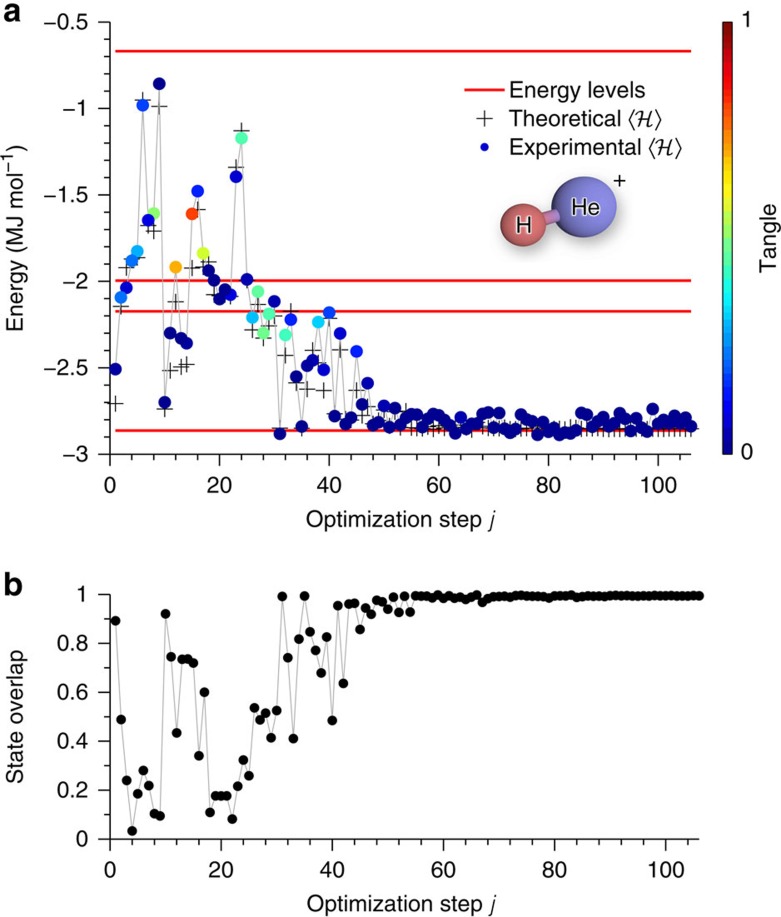
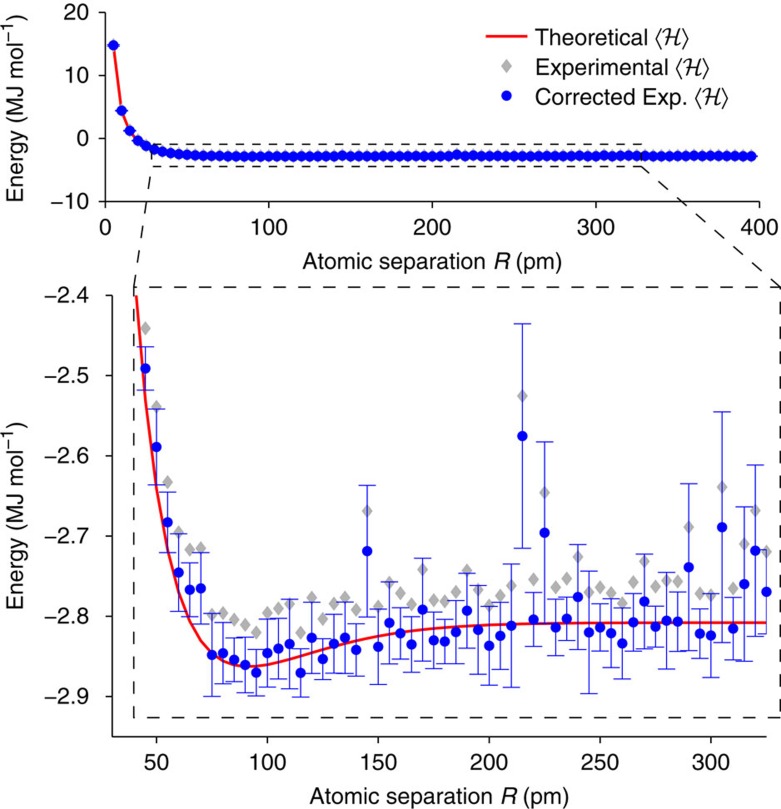
- The authors report an experimental ground-state result for He–H\(^+\): after correcting for experimental errors, they estimate the equilibrium bond length as \(R = 92.3 \pm 0.1\) pm and the ground-state electronic energy as \(E = -2.865 \pm 0.008\) MJ mol\(^{-1}\).
- For the bond dissociation curve, more than 96% of the experimental data are within chemical accuracy of the theoretical values.
- In the discussion, they state that for a 4 × 4 Hamiltonian like the one demonstrated, the QPE circuit would require at least 12 CNOT gates, whereas their method requires one.
- The full experiment was performed in about 158 h, and the bond dissociation curve was obtained by finding the ground states of 79 Hamiltonians.
## Methods
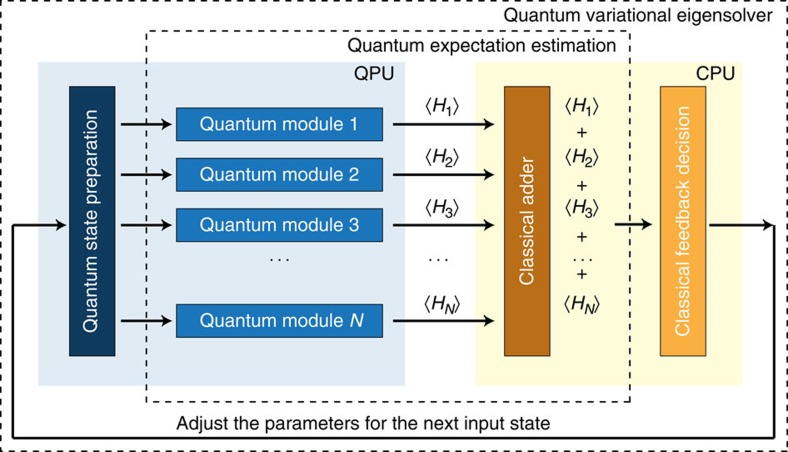
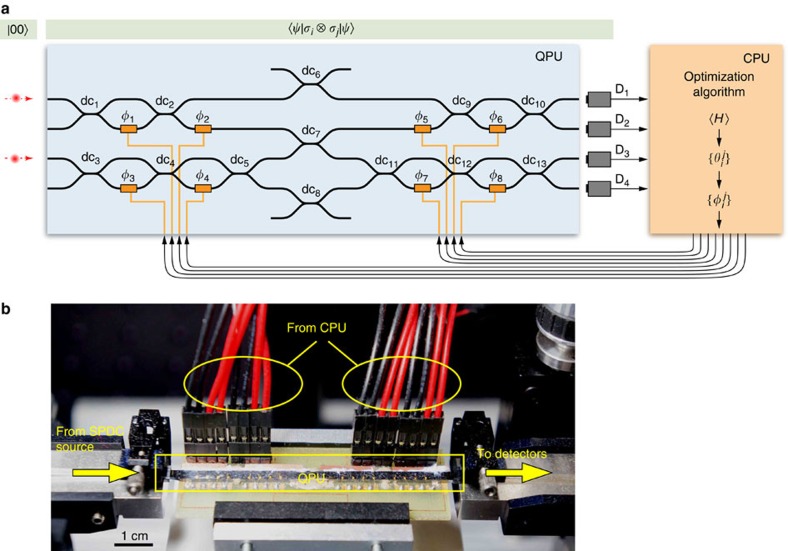
- The paper combines a reconfigurable integrated photonic quantum processor with a classical optimization algorithm: the quantum device estimates Hamiltonian expectation values, and the classical processor updates the state parameters variationally.
- The photonic chip prepares and measures arbitrary two-qubit pure states using single-qubit rotations and one two-qubit entangling gate; the experimental demonstration uses the He–H\(^+\) molecule in a minimal basis.
- For the classical optimization, they use the Nelder–Mead algorithm; expectation values are reconstructed from four two-qubit Pauli measurements at each point.
## Limitations
- The paper states that the method still requires a good approximation to the ground state as input/initialization, and the reliance on multiple separate measurements makes it sensitive to variations in state preparation between calculations.
- The authors report a constant systematic shift of \(\varepsilon = 50\) kJ mol\(^{-1}\) in the measured expectation values; they attribute this to photon-source impurity/distinguishability, circuit imperfections, and unbalanced coupling efficiencies.
- Evident from the text: the demonstration is limited to a two-qubit / 4 × 4 Hamiltonian prototype, so the scalability claim is not experimentally validated here.
Model-written summary. Check it against the paper before relying on it.
Integrity signals
Registry
Cites
Statistics
Figures
Verification
Claims the paper makes
7 Valid · 4 Not valid · 11 Not checked · 59 Own results and interpretations
The cited sources support only part of this claim — read each source’s verdict below.
In the paper
“Recent developments in the field of quantum computation offer a way forward for determining efficient solutions of many instances of large eigenvalue problems that are classically intractable6789101112”
§ A variational eigenvalue solver on a photonic quantum processor > Abstract
What the sources say
- Not matchedcites [6] Nielsen, M. A. & Chuang, I. L. Quantum Computation and Quantum Information Cambridge University Press (2000).
Couldn’t be matched to a paper in Crossref, so it can’t be checked.
- Could not verifycites [7] Kitaev, A. Quantum measurements and the Abelian stabilizer problem. Electronic Colloquium on Computational Complexity (ECCC) 3 (1996). sourceExperimental — accuracy not yet measured
Our copy under this DOI is the ISAAC 2021 paper 'Effective Resistance and Capacitance in Simplicial Complexes and a Quantum Algorithm' (Kitaev's 1995 work appears only as reference [9] in its bibliography), and it nowhere asserts that quantum computation gives efficient solutions to classically intractable large eigenvalue problems. Eigenvalues enter only as complexity parameters — λ, the smallest eigenvalue of the normalized up-Laplacian, in Lemma 31 and Theorem 26 (Section 6.3, 'Time efficient implementations') and in the phase-estimation machinery of Appendix A — and Section 1.1 ('Our Contributions') actually reports the opposite direction for its own problem: 'the quantum algorithm is slower than the classical algorithm in the worst case'. Searched: 'eigenvalue problems classically intractable', 'quantum speedup / exponential advantage', 'phase estimation', 'faster than classical'; no passage addresses the claim's point. (LLM, conf=0.70)
- Partly supportedcites [8] Griffiths, R. B. & Niu, C.-S. Semiclassical fourier transform for quantum computation. Phys. Rev. Lett. 76, 3228–3231 (1996). sourceExperimental — accuracy not yet measured
On p. 1, the paper says a quantum computer, if built, could solve certain problems such as factoring long numbers much faster than conventional algorithms. It also describes a simpler Fourier transform for Shor’s factorization and discrete-logarithm algorithms (p. 1). The copy does not support the claim about efficient solutions to many large eigenvalue problems. (LLM, conf=0.84)
plainstates a cause- Asserted: passes — The authors put it forward as true.
- Checkable: passes — It can be checked against evidence.
- Load-bearing: passes — The paper’s conclusions depend on it.
- Based: passes — The paper gives a reason why it holds.
- Not matched
Every source the paper cites for this claim was checked and supports it.
In the paper
“this would suffer from the N-representability problem, which is known to be intractable for both classical and quantum computers (it is in the quantum complexity class QMA-Hard24).”
§ A variational eigenvalue solver on a photonic quantum processor > Results > Quantum expectation estimation
What the sources say
- Supportedcites [24] Liu, Y.-K., Christandl, M. & Verstraete, F. Quantum computational complexity of the n-representability problem: Qma complete. Phys. Rev. Lett. 98, 110503 (2007). source
The paper states that N-representability is QMA-complete and hence QMA-hard and NP-hard (Abstract). Its discussion of quantum-chemistry relevance says the problem is intractable in the worst case even on a quantum computer, while allowing that particular physical systems may be easier. (LLM, conf=0.93)
boosted- Asserted: passes — The authors put it forward as true.
- Checkable: passes — It can be checked against evidence.
- Load-bearing: passes — The paper’s conclusions depend on it.
- Based: passes — The paper gives a reason why it holds.
- Supported
Every source the paper cites for this claim was checked and supports it.
In the paper
“We have implemented the QPU using integrated quantum photonics technology30.”
§ A variational eigenvalue solver on a photonic quantum processor > Results > Prototype demonstration
What the sources say
- Supportedcites [30] O'Brien, J. L., Furusawa, A. & Vuckovic, J. Photonic quantum technologies. Nat. Photon. 3, 687–695 (2009). source
The citation identifies integrated quantum photonics as the technology used, rather than attributing the citing authors’ QPU implementation to this review. The “Integrated quantum optical circuits” section (p. 6) describes on-chip waveguide circuits performing quantum logic gates and a compiled quantum factoring algorithm. (LLM, conf=0.87)
plain- Asserted: passes — The authors put it forward as true.
- Checkable: passes — It can be checked against evidence.
- Load-bearing: passes — The paper’s conclusions depend on it.
- Based: passes — The paper gives a reason why it holds.
- Supported
The cited sources support only part of this claim — read each source’s verdict below.
In the paper
“The time the quantum computer must remain coherent is determined by the necessity of O(p−1) successive applications of , each of which can require on the order of millions or billions of quantum gates for practical applications1719, as compared to the tens to hundreds of gates achievable in the short term.”
§ A variational eigenvalue solver on a photonic quantum processor > Abstract
What the sources say
- Partly supportedcites [17] Whitfield, J. D., Biamonte, J. & Aspuru-Guzik, A. Simulation of electronic structure hamiltonians using quantum computers. Mol. Phys. 109, 735–750 (2011). sourceExperimental — accuracy not yet measured
Split into 2 atoms — 1 confirmed, 1 partially supported, 0 disputed, 0 misattributed, 0 unverifiable. Expand the claim to see per-atom verdicts.
- Partly supportedcites [19] Jones, N. C. et al. Faster quantum chemistry simulation on fault-tolerant quantum computers. New J. Phys. 14, 115023 (2012). sourceExperimental — accuracy not yet measured
Split into 2 atoms — 0 confirmed, 2 partially supported, 0 disputed, 0 misattributed, 0 unverifiable. Expand the claim to see per-atom verdicts.
plainstates a cause- Asserted: passes — The authors put it forward as true.
- Checkable: passes — It can be checked against evidence.
- Load-bearing: passes — The paper’s conclusions depend on it.
- Based: passes — The paper gives a reason why it holds.
- Partly supported
A result the paper reports from its own data — it cites no other source for it, so there is none to check. The quote shows it is in the paper.
In the paper
“We experimentally demonstrate the feasibility of this approach with an example from quantum chemistry—calculating the ground-state molecular energy for He–H+.”
§ A variational eigenvalue solver on a photonic quantum processor > Abstract
boostedstates a causeSingle case- Asserted: passes — The authors put it forward as true.
- Checkable: passes — It can be checked against evidence.
- Load-bearing: passes — The paper’s conclusions depend on it.
- Based: passes — The paper gives a reason why it holds.
31 more claims
Create a free account to see all 81 claims and to verify the 4 references still open.
- It may state two separate claims as one. 28
- Probably not a substantial claim. 24
Claims other papers make about this one
Each is checked against this paper’s own text: does it say what the citing paper says it does?
The cited source doesn’t support the claim as written.
In the citing paper
“Leveraging quantum resources, the UCC ansatz was instead realized as a PQC on a photonic processor (Peruzzo et al. , 2014).”
From Noisy intermediate-scale quantum algorithms (2022) · cites this paper as Peruzzo et al., 2014
Checked by a reasoning model — may be wrong.
Experimental — accuracy not yet measuredThe cited source doesn’t support the claim as written.
In the citing paper
“The first on-chip GMM of four-qubit cluster state was realised in a laser-writing chip ( Fig.4e ), by manipulating both the polarisation and path DoFs of two photons [85].”
From Integrated photonic quantum technologies (2020) · cites this paper as [85]
Checked by a reasoning model — may be wrong.
Experimental — accuracy not yet measuredThe cited source doesn’t support the claim as written.
In the citing paper
“four-qubit linear- and box-cluster states are generated in a laser-writing photonic chip. This is enabled by on-chip manipulating the two-photon four-qubit hyperentangled state and cluster state, that are encoded in photon's path and polarisation DoFs. The Grover's search algorithm on a four-element database was implemented by controlling the device.”
From Integrated photonic quantum technologies (2020) · cites this paper as [85]
Checked by a reasoning model — may be wrong.
Experimental — accuracy not yet measuredThe source backs part of the claim, not all of it — or backs it for a different population, condition or comparison.
In the citing paper
“Due to its versatility, the variational Hamiltonian ansatz has been implemented for quantum chemistry [21, 29], optimization [24], and for quantum simulation problems [30].”
From Variational quantum algorithms (2021) · cites this paper as [29]
Experimental — accuracy not yet measuredThe source backs part of the claim, not all of it — or backs it for a different population, condition or comparison.
In the citing paper
“For the original VQE (Peruzzo et al. , 2014) and QAOA (Farhi et al. , 2014) it can, for example, be described as a single expectation value min θ ⟨ H ⟩ U ( θ ) , where the differences solely appear in the specific form and construction of the qubit Hamiltonian.”
From Noisy intermediate-scale quantum algorithms (2022) · cites this paper as Peruzzo et al., 2014
Experimental — accuracy not yet measured
12 more claims about this paper
Create a free account to see every claim other papers make about this one.
Citations
Cites
A Simplex Method for Function Minimization
Nelder, J. A., & Mead, R. (1965) · The Computer Journal · doi:10.1093/comjnl/7.4.308 · Cited by 28,905
Quantum computation and quantum information
Law, J. (2001) · ACM SIGSOFT Software Engineering Notes · doi:10.1145/505482.505499 · Cited by 18,842
(1999) · Cited by 12,854
Practical Methods of Optimization
Fletcher, R. (2000) · Wiley eBooks · doi:10.1002/9781118723203 · Cited by 7,605 · cited 3×
“[12] S.”
BackgroundMethodPractical methods of optimization
(1988) · Mathematics and Computers in Simulation · doi:10.1016/0378-4754(88)90129-2 · Cited by 5,818
Quantum Algorithm for Linear Systems of Equations
Harrow, A. W., Hassidim, A., & Lloyd, S. (2009) · Physical Review Letters · doi:10.1103/physrevlett.103.150502 · Cited by 3,325
Conn, A. R., Gould, N. I. M., & Toint, P. L. (2000) · Society for Industrial and Applied Mathematics eBooks · doi:10.1137/1.9780898719857 · Cited by 2,981 · cited 3×
“[14] D.”
MethodInfluential�ber das Paulische �quivalenzverbot
Jordan, P., & Wigner, E. (1928) · Zeitschrift f�r Physik · doi:10.1007/bf01331938 · Cited by 2,597
Molecular Electronic‐Structure Theory
Helgaker, T., Jørgensen, P., & Olsen, J. (2000) · doi:10.1002/9781119019572 · Cited by 2,594
O'Brien, J. L., Furusawa, A., & Vučković, J. (2009) · Nature Photonics · doi:10.1038/nphoton.2009.229 · Cited by 2,388
Self-citation
Research works printed but not linked: 3
- Helgaker, T., Jorgensen, P. & Olsen, J. Mol. Electronic Struct. Theory Wiley, Sussex (2002).
- Saad, Y. Numerical Methods for Large Eigenvalue Problems Vol. 158, (SIAM (1992).
- Rayleigh, J. W. In finding the correction for the open end of an organ-pipe. Phil. Trans. 161, 77 (1870).
Cited by
Items 101–200 of 4,572
Subspace-search variational quantum eigensolver for excited states
Nakanishi, K. M., Mitarai, K., & Fujii, K. (2019) · Physical Review Research · doi:10.1103/physrevresearch.1.033062 · Cited by 337
An initialization strategy for addressing barren plateaus in parametrized quantum circuits
Grant, E., Wossnig, L., Ostaszewski, M., & Benedetti, M. (2019) · UCL Discovery (University College London) · Cited by 338
Probabilistic error cancellation with sparse Pauli–Lindblad models on noisy quantum processors
van den Berg, E., Minev, Z. K., Kandala, A., & Temme, K. (2023) · Nature Physics · doi:10.1038/s41567-023-02042-2 · Cited by 305
“H = −J∑ j ZjZj+1 + h∑ j Xj = −JHZZ + hHX, (4) −1 0 1 −1 0 1”
BackgroundQuantum implementation of the unitary coupled cluster for simulating molecular electronic structure
Shen, Y., Zhang, X., Zhang, S., Zhang, J.-N., Yung, M.-H., & Kim, K. (2017) · Physical Review A · doi:10.1103/physreva.95.020501 · Cited by 295
Self-citationQulacs: a fast and versatile quantum circuit simulator for research purpose
Suzuki, Y., Kawase, Y., Masumura, Y., Hiraga, Y., Nakadai, M., Chen, J., Nakanishi, K. M., Mitarai, K., Imai, R., Tamiya, S., et al. (2021) · Quantum · doi:10.22331/q-2021-10-06-559 · Cited by 295
“One is optimizing a target function using variational quantum circuits such as the variational quantum eigensolver (VQE) [35].”
MethodQubit Coupled Cluster Method: A Systematic Approach to Quantum Chemistry on a Quantum Computer
Ryabinkin, I. G., Yen, T.-C., Genin, S. N., & Izmaylov, A. F. (2018) · Journal of Chemical Theory and Computation · doi:10.1021/acs.jctc.8b00932 · Cited by 287
General parameter-shift rules for quantum gradients
Wierichs, D., Izaac, J., Wang, C., & Lin, C. Y.-Y. (2022) · Quantum · doi:10.22331/q-2022-03-30-677 · Cited by 299
Quantum computing for energy systems optimization: Challenges and opportunities
Ajagekar, A., & You, F. (2019) · Energy · doi:10.1016/j.energy.2019.04.186 · Cited by 289
“In the field of chemistry and optimization, a classical-quantum hybrid algorithm called Variational Quantum Eigensolver (VQE) has shown exceptional performance in terms of speed and resource utilization [31].”
BackgroundHybrid quantum-classical convolutional neural networks
Liu, J., Lim, K. H., Wood, K. L., Huang, W., Guo, C., & Huang, H.-L. (2021) · Science China Physics, Mechanics & Astronomy · doi:10.1007/s11433-021-1734-3 · Cited by 289
Woerner, S., & Egger, D. J. (2019) · npj Quantum Information · doi:10.1038/s41534-019-0130-6 · Cited by 286
Herman, D., Googin, C., Liu, X., Sun, Y., Galda, A., Safro, I., Pistoia, M., & Alexeev, Y. (2023) · Nature Reviews Physics · doi:10.1038/s42254-023-00603-1 · Cited by 284
Quantum Computation of Electronic Transitions Using a Variational Quantum Eigensolver
Parrish, R. M., Hohenstein, E. G., McMahon, P. L., & Martínez, T. J. (2019) · Physical Review Letters · doi:10.1103/physrevlett.122.230401 · Cited by 282
Hybrid integration methods for on-chip quantum photonics
Kim, J.-H., Aghaeimeibodi, S., Carolan, J., Englund, D., & Waks, E. (2020) · Optica · doi:10.1364/optica.384118 · Cited by 272
Differentiable learning of quantum circuit Born machines
Liu, J.-G., & Wang, L. (2018) · Physical Review A · doi:10.1103/physreva.98.062324 · Cited by 279
Obstacles to State Preparation and Variational Optimization from Symmetry Protection
Bravyi, S., Kliesch, A., Koenig, R., & Tang, E. (2019) · arXiv · doi:10.48550/arxiv.1910.08980 · Cited by 279
Obstacles to Variational Quantum Optimization from Symmetry Protection
Bravyi, S., Kliesch, A., Koenig, R., & Tang, E. (2020) · Physical Review Letters · doi:10.1103/physrevlett.125.260505 · Cited by 278
Recurrent neural network wave functions
Hibat-Allah, M., Ganahl, M., Hayward, L. E., Melko, R. G., & Carrasquilla, J. (2020) · Physical Review Research · doi:10.1103/physrevresearch.2.023358 · Cited by 274
“[15] Alberto Peruzzo, Jarrod McClean, Peter Shadbolt, ManHong Yung, Xiao-Qi Zhou, Peter J.”
Scaling silicon-based quantum computing using CMOS technology
Gonzalez-Zalba, M. F., de Franceschi, S., Charbon, E., Meunier, T., Vinet, M., & Dzurak, A. S. (2021) · Nature Electronics · doi:10.1038/s41928-021-00681-y · Cited by 272
“FPGAs will likely be used to enable fast back and forth communication in QEC but also in hybrid quantum-classical algorithms like the Variational Quantum Eigensolvers (VQE) [24] and quantum approximate optimization algorithms (QAOA) [25].”
MethodSimulating Large Quantum Circuits on a Small Quantum Computer
Peng, T., Harrow, A. W., Ozols, M., & Wu, X. (2020) · Physical Review Letters · doi:10.1103/physrevlett.125.150504 · Cited by 267
Gard, B. T., Zhu, L., Barron, G. S., Mayhall, N. J., Economou, S. E., & Barnes, E. (2020) · npj Quantum Information · doi:10.1038/s41534-019-0240-1 · Cited by 266
Measurement optimization in the variational quantum eigensolver using a minimum clique cover
Verteletskyi, V., Yen, T.-C., & Izmaylov, A. F. (2020) · The Journal of Chemical Physics · doi:10.1063/1.5141458 · Cited by 269
Scalable Mitigation of Measurement Errors on Quantum Computers
Nation, P. D., Kang, H., Sundaresan, N., & Gambetta, J. M. (2021) · PRX Quantum · doi:10.1103/prxquantum.2.040326 · Cited by 269
“…radius of one, that is diagonal in the computational basis Near-term algorithms such as the ubiquitous Variational Quantum Eigensolver (VQE) [20, 30] and quantum machine learning [22, 27] rely on the computation of expectation values, making the correction of measurement errors in these…”
BackgroundImproving Variational Quantum Optimization using CVaR
Barkoutsos, P. K., Nannicini, G., Robert, A., Tavernelli, I., & Woerner, S. (2020) · Quantum · doi:10.22331/q-2020-04-20-256 · Cited by 263
“The Variational Quantum Eigensolver (VQE) is a hybrid quantum/classical algorithm originally proposed to approximate the ground state of a quantum chemical system, i.e., the state attaining the minimum energy [20].”
BackgroundVariational Quantum Linear Solver
Bravo-Prieto, C., LaRose, R., Cerezo, M., Subasi, Y., Cincio, L., & Coles, P. J. (2023) · Quantum · doi:10.22331/q-2023-11-22-1188 · Cited by 260
“The assumption that A is given in this form is analogous to the assumption that the Hamiltonian H in the variational quantum eigensolver [20] is given as a linear combination of Pauli operators H = =1 c l σ l , where naturally one makes the assumption that L is only a polynomial function of the…”
BackgroundQuantum computing enhanced computational catalysis
von Burg, V., Low, G. H., Häner, T., Steiger, D. S., Reiher, M., Roetteler, M., & Troyer, M. (2020) · arXiv · doi:10.48550/arxiv.2007.14460 · Cited by 258
Variational quantum algorithms for discovering Hamiltonian spectra
Jones, T., Endo, S., McArdle, S., Yuan, X., & Benjamin, S. C. (2019) · Physical Review A · doi:10.1103/physreva.99.062304 · Cited by 256
Efficient and noise resilient measurements for quantum chemistry on near-term quantum computers
Huggins, W. J., McClean, J. R., Rubin, N. C., Jiang, Z., Wiebe, N., Whaley, K. B., & Babbush, R. (2021) · npj Quantum Information · doi:10.1038/s41534-020-00341-7 · Cited by 256
Self-citationSoftware Mitigation of Crosstalk on Noisy Intermediate-Scale Quantum Computers
Murali, P., Mckay, D. C., Martonosi, M., & Javadi-Abhari, A. (2020) · Proceedings of the Twenty-Fifth International Conference on Architectural Support for Programming Languages and Operating Systems · doi:10.1145/3373376.3378477 · Cited by 253
“This computational model has proven effective in diverse fields such as cryptography [54], chemistry [28, 48] and machine learning [3, 32].”
MethodQuantum computing enhanced computational catalysis
von Burg, V., Low, G. H., Häner, T., Steiger, D. S., Reiher, M., Roetteler, M., & Troyer, M. (2021) · Physical Review Research · doi:10.1103/physrevresearch.3.033055 · Cited by 252
Information-Theoretic Bounds on Quantum Advantage in Machine Learning
Huang, H.-Y., Kueng, R., & Preskill, J. (2021) · Physical Review Letters · doi:10.1103/physrevlett.126.190505 · Cited by 250
Experimental quantum Hamiltonian learning
Wang, J., Paesani, S., Santagati, R., Knauer, S., Gentile, A. A., Wiebe, N., Petruzzella, M., O’Brien, J. L., Rarity, J. G., Laing, A., et al. (2017) · Nature Physics · doi:10.1038/nphys4074 · Cited by 247
Self-citationLow-cost error mitigation by symmetry verification
Bonet-Monroig, X., Sagastizabal, R., Singh, M., & O'Brien, T. E. (2018) · Physical Review A · doi:10.1103/physreva.98.062339 · Cited by 250
Effect of barren plateaus on gradient-free optimization
Arrasmith, A., Cerezo, M., Czarnik, P., Cincio, L., & Coles, P. J. (2021) · Quantum · doi:10.22331/q-2021-10-05-558 · Cited by 248
“In this case, the cost takes a simpler form, where the training set contains a single state ( S = 1 ) and the cost is C ( θ ) = Tr[ OV ( θ ) ρV † ( θ )] , with O a Hermitian operator [3–14].”
BackgroundQuantum Computer Systems for Scientific Discovery
Alexeev, Y., Bacon, D., Brown, K. R., Calderbank, R., Carr, L. D., Chong, F. T., DeMarco, B., Englund, D., Farhi, E., Fefferman, B., et al. (2021) · PRX Quantum · doi:10.1103/prxquantum.2.017001 · Cited by 248
OpenQASM 3: A Broader and Deeper Quantum Assembly Language
Cross, A., Javadi-Abhari, A., Alexander, T., De Beaudrap, N., Bishop, L. S., Heidel, S., Ryan, C. A., Sivarajah, P., Smolin, J., Gambetta, J. M., et al. (2022) · ACM Transactions on Quantum Computing · doi:10.1145/3505636 · Cited by 248
“For example, the variational quantum eigensolver depends on classical computation to calculate an energy or cost function and uses classical optimization to tune circuit parameters [66].”
MethodInfluentialError-Mitigated Digital Quantum Simulation
McArdle, S., Yuan, X., & Benjamin, S. (2019) · Physical Review Letters · doi:10.1103/physrevlett.122.180501 · Cited by 245
A versatile single-photon-based quantum computing platform
Maring, N., Fyrillas, A., Pont, M., Ivanov, E., Stepanov, P., Margaria, N., Hease, W., Pishchagin, A., Lemaître, A., Sagnes, I., et al. (2024) · Nature Photonics · doi:10.1038/s41566-024-01403-4 · Cited by 247
“…computation possibilities by implementing a VQE algorithm to compute the ground-state energies of an H 2 molecule; VQE exploits the variational principle stating that, given a Hamiltonian ̂ℋ and an ansatz wavefunction || ψ ( ⃗ θ )⟩ parameterized by ⃗ θ , the ground-state energy associated 40).”
Hybrid Quantum-Classical Approach to Correlated Materials
Bauer, B., Wecker, D., Millis, A. J., Hastings, M. B., & Troyer, M. (2016) · Physical Review X · doi:10.1103/physrevx.6.031045 · Cited by 243
Quantum Computer Systems for Scientific Discovery
Alexeev, Y., Bacon, D., Brown, K. R., Calderbank, R., Carr, L. D., Chong, F. T., DeMarco, B., Englund, D., Farhi, E., Fefferman, B., et al. (2021) · DSpace@MIT (Massachusetts Institute of Technology) · doi:10.6082/h7fqg-6vt65 · Cited by 240
Accelerated Variational Quantum Eigensolver
Wang, D., Higgott, O., & Brierley, S. (2019) · Physical Review Letters · doi:10.1103/physrevlett.122.140504 · Cited by 241
Variational Quantum Simulation of General Processes
Endo, S., Sun, J., Li, Y., Benjamin, S. C., & Yuan, X. (2020) · Physical Review Letters · doi:10.1103/physrevlett.125.010501 · Cited by 237
Learning-based quantum error mitigation
Strikis, A., Qin, D., Chen, Y., Benjamin, S. C., & Li, Y. (2020) · arXiv · doi:10.48550/arxiv.2005.07601 · Cited by 237
Fully integrated quantum photonic circuit with an electrically driven light source
Khasminskaya, S., Pyatkov, F., Słowik, K., Ferrari, S., Kahl, O., Kovalyuk, V., Rath, P., Vetter, A., Hennrich, F., Kappes, M. M., et al. (2016) · Nature Photonics · doi:10.1038/nphoton.2016.178 · Cited by 234
Exploring Entanglement and Optimization within the Hamiltonian Variational Ansatz
Wiersema, R., Zhou, C., de Sereville, Y., Carrasquilla, J. F., Kim, Y. B., & Yuen, H. (2020) · PRX Quantum · doi:10.1103/prxquantum.1.020319 · Cited by 235
Toward large-scale fault-tolerant universal photonic quantum computing
Takeda, S., & Furusawa, A. (2019) · APL Photonics · doi:10.1063/1.5100160 · Cited by 234
Variational fast forwarding for quantum simulation beyond the coherence time
Cîrstoiu, C., Holmes, Z., Iosue, J., Cincio, L., Coles, P. J., & Sornborger, A. (2020) · npj Quantum Information · doi:10.1038/s41534-020-00302-0 · Cited by 232
Programming languages and compiler design for realistic quantum hardware
Chong, F. T., Franklin, D., & Martonosi, M. (2017) · Nature · doi:10.1038/nature23459 · Cited by 230
Learning-Based Quantum Error Mitigation
Strikis, A., Qin, D., Chen, Y., Benjamin, S. C., & Li, Y. (2021) · PRX Quantum · doi:10.1103/prxquantum.2.040330 · Cited by 237
“In many potential NISQ applications, for example the use of variational quantum algorithms (QVAs) in eigen-solver or simulation [5, 18, 19], a key task is to evaluate mean values of some observables – in essence, to measure the expected value of one or more qubits as the output of a circuit.”
BackgroundSimulating the vibrational quantum dynamics of molecules using photonics
Sparrow, C., Martín-López, E., Maraviglia, N., Neville, A., Harrold, C., Carolan, J., Joglekar, Y. N., Hashimoto, T., Matsuda, N., O’Brien, J. L., et al. (2018) · Nature · doi:10.1038/s41586-018-0152-9 · Cited by 230
Self-citationQuantum machine learning beyond kernel methods
Jerbi, S., Fiderer, L. J., Poulsen Nautrup, H., Kübler, J. M., Briegel, H. J., & Dunjko, V. (2023) · Nature Communications · doi:10.1038/s41467-023-36159-y · Cited by 229
Provably efficient machine learning for quantum many-body problems
Huang, H.-Y., Kueng, R., Torlai, G., Albert, V. V., & Preskill, J. (2022) · Science · doi:10.1126/science.abk3333 · Cited by 228
Limitations of optimization algorithms on noisy quantum devices
Stilck França, D., & García-Patrón, R. (2021) · Nature Physics · doi:10.1038/s41567-021-01356-3 · Cited by 232
Quantum variational algorithms are swamped with traps
Anschuetz, E. R., & Kiani, B. T. (2022) · Nature Communications · doi:10.1038/s41467-022-35364-5 · Cited by 226
“We also consider the training performance of VQE in fi nding the ground state of a Heisenberg XYZ Hamiltonian 43 .”
InfluentialBarren plateaus in variational quantum computing
Larocca, M., Thanasilp, S., Wang, S., Sharma, K., Biamonte, J., Coles, P. J., Cincio, L., McClean, J. R., Holmes, Z., & Cerezo, M. (2025) · Nature Reviews Physics · doi:10.1038/s42254-025-00813-9 · Cited by 257
“The unitary coupled cluster singles and doubles (UCCSD) ansatz is a problem-inspired PQC used to find the ground state of a fermionic molecular Hamiltonian using the variational quantum eigensolver 117,140,141 .”
Self-citationA quantum deep convolutional neural network for image recognition
Li, Y., Zhou, R.-G., Xu, R., Luo, J., & Hu, W. (2020) · Quantum Science and Technology · doi:10.1088/2058-9565/ab9f93 · Cited by 225
VQE method: a short survey and recent developments
Fedorov, D. A., Peng, B., Govind, N., & Alexeev, Y. (2022) · Materials Theory · doi:10.1186/s41313-021-00032-6 · Cited by 224
Hybrid Integration of Solid-State Quantum Emitters on a Silicon Photonic Chip
Kim, J.-H., Aghaeimeibodi, S., Richardson, C. J. K., Leavitt, R. P., Englund, D., & Waks, E. (2017) · Nano Letters · doi:10.1021/acs.nanolett.7b03220 · Cited by 223
Quantum chemistry as a benchmark for near-term quantum computers
McCaskey, A. J., Parks, Z. P., Jakowski, J., Moore, S. V., Morris, T. D., Humble, T. S., & Pooser, R. C. (2019) · npj Quantum Information · doi:10.1038/s41534-019-0209-0 · Cited by 223
From transistor to trapped-ion computers for quantum chemistry
Yung, M.-H., Casanova, J., Mezzacapo, A., McClean, J., Lamata, L., Aspuru-Guzik, A., & Solano, E. (2014) · Scientific Reports · doi:10.1038/srep03589 · Cited by 221
Self-citationA Practical Quantum Instruction Set Architecture
Lee, D., Perrelle, V., Valiron, B., & Xu, Z. (2016) · arXiv (Cornell University) · doi:10.4230/lipics.fsttcs.2021.51 · Cited by 217
Exact parameterization of fermionic wave functions via unitary coupled cluster theory
Evangelista, F. A., Chan, G. K.-L., & Scuseria, G. E. (2019) · The Journal of Chemical Physics · doi:10.1063/1.5133059 · Cited by 220
A quantum computing view on unitary coupled cluster theory
Anand, A., Schleich, P., Alperin-Lea, S., Jensen, P. W. K., Sim, S., Díaz-Tinoco, M., Kottmann, J. S., Degroote, M., Izmaylov, A. F., & Aspuru-Guzik, A. (2022) · Chemical Society Reviews · doi:10.1039/d1cs00932j · Cited by 223
Self-citationApplications of single photons to quantum communication and computing
Couteau, C., Barz, S., Durt, T., Gerrits, T., Huwer, J., Prevedel, R., Rarity, J., Shields, A., & Weihs, G. (2023) · Nature Reviews Physics · doi:10.1038/s42254-023-00583-2 · Cited by 216
“H+ was calculated using photons 202 .”
Stochastic gradient descent for hybrid quantum-classical optimization
Sweke, R., Wilde, F., Meyer, J., Schuld, M., Faehrmann, P. K., Meynard-Piganeau, B., & Eisert, J. (2020) · Quantum · doi:10.22331/q-2020-08-31-314 · Cited by 219
“Unlike VQE however, the QAOA algorithm is defined additionally by a specific parameterized circuit architecture, designed such that the variational circuit implements a discretized adiabatic evolution, from some known initial state, into the desired target state.”
MethodInfluentialTraining of quantum circuits on a hybrid quantum computer
Zhu, D., Linke, N. M., Benedetti, M., Landsman, K. A., Nguyen, N. H., Alderete, C. H., Perdomo-Ortiz, A., Korda, N., Garfoot, A., Brecque, C., et al. (2019) · Science Advances · doi:10.1126/sciadv.aaw9918 · Cited by 215
The prospects of quantum computing in computational molecular biology
Outeiral, C., Strahm, M., Shi, J., Morris, G. M., Benjamin, S. C., & Deane, C. M. (2021) · WIREs Computational Molecular Science · doi:10.1002/wcms.1481 · Cited by 232
“An early hybrid quantum-classical algorithm was the variational quantum eigensolver (VQE), proposed and demonstrated by Peruzzo et al. [169] and later formalized by McClean et al. [170].”
MethodQuantum Computing for High-Energy Physics: State of the Art and Challenges
Di Meglio, A., Jansen, K., Tavernelli, I., Alexandrou, C., Arunachalam, S., Bauer, C. W., Borras, K., Carrazza, S., Crippa, A., Croft, V., et al. (2024) · PRX Quantum · doi:10.1103/prxquantum.5.037001 · Cited by 215
Diagnosing Barren Plateaus with Tools from Quantum Optimal Control
Larocca, M., Czarnik, P., Sharma, K., Muraleedharan, G., Coles, P. J., & Cerezo, M. (2022) · Quantum · doi:10.22331/q-2022-09-29-824 · Cited by 214
“[18] Alberto Peruzzo, Jarrod McClean, Peter Shadbolt, Man-Hong Yung, Xiao-Qi Zhou, Peter J Love, Alán Aspuru-Guzik, and Jeremy L O’brien.”
BackgroundMethodStructure optimization for parameterized quantum circuits
Ostaszewski, M., Grant, E., & Benedetti, M. (2019) · arXiv · doi:10.48550/arxiv.1905.09692 · Cited by 214
Witnessing eigenstates for quantum simulation of Hamiltonian spectra
Santagati, R., Wang, J., Gentile, A. A., Paesani, S., Wiebe, N., McClean, J. R., Morley-Short, S., Shadbolt, P. J., Bonneau, D., Silverstone, J. W., et al. (2018) · Science Advances · doi:10.1126/sciadv.aap9646 · Cited by 211
Self-citationMachine Learning: Quantum vs Classical
Khan, T. M., & Robles-Kelly, A. (2020) · IEEE Access · doi:10.1109/access.2020.3041719 · Cited by 211
“Eigensolver [12], show that there can be a quantum advantage partially robust to noise with some applications in optimisation and quantum chemistry.”
BackgroundQuantum-dot-based deterministic photon–emitter interfaces for scalable photonic quantum technology
Uppu, R., Midolo, L., Zhou, X., Carolan, J., & Lodahl, P. (2021) · Nature Nanotechnology · doi:10.1038/s41565-021-00965-6 · Cited by 209
Self-citationOptimizing Variational Quantum Algorithms Using Pontryagin’s Minimum Principle
Yang, Z.-C., Rahmani, A., Shabani, A., Neven, H., & Chamon, C. (2017) · Physical Review X · doi:10.1103/physrevx.7.021027 · Cited by 210
Real- and Imaginary-Time Evolution with Compressed Quantum Circuits
Lin, S.-H., Dilip, R., Green, A. G., Smith, A., & Pollmann, F. (2021) · PRX Quantum · doi:10.1103/prxquantum.2.010342 · Cited by 206
“[32] Alberto Peruzzo, Jarrod McClean, Peter Shadbolt, ManHong Yung, Xiao-Qi Zhou, Peter J Love, Alán AspuruGuzik, and Jeremy L OâĂŹbrien, “A variational eigenvalue solver on a photonic quantum processor,” Nature communications 5, 4213 (2014).”
BackgroundMethodInfluentialStructure optimization for parameterized quantum circuits
Ostaszewski, M., Grant, E., & Benedetti, M. (2021) · Quantum · doi:10.22331/q-2021-01-28-391 · Cited by 206
“For example, these have been demonstrated in chemical simulation, combinatorial optimization, generative modeling and classification [1–8].”
BackgroundChallenges and Opportunities of Near-Term Quantum Computing Systems
Corcoles, A. D., Kandala, A., Javadi-Abhari, A., McClure, D. T., Cross, A. W., Temme, K., Nation, P. D., Steffen, M., & Gambetta, J. M. (2020) · Proceedings of the IEEE · doi:10.1109/jproc.2019.2954005 · Cited by 203
“Examples for such quantum - classical hybrid schemes are variational algorithms for quantum many-body systems [37], [108], [109] and machine learning [36].”
BackgroundResource-efficient quantum algorithm for protein folding
Robert, A., Barkoutsos, P. K., Woerner, S., & Tavernelli, I. (2021) · npj Quantum Information · doi:10.1038/s41534-021-00368-4 · Cited by 201
Quantum Machine Learning: A Review and Case Studies
Zeguendry, A., Jarir, Z., & Quafafou, M. (2023) · Entropy · doi:10.3390/e25020287 · Cited by 197
“It was suggested using the variational quantum eigensolver (VQE) method for quantum chemistry [46] and the quantum approximation optimization algorithm (QAOA) [31] for optimization based on classical machine learning.”
BackgroundMethodQuantum equation of motion for computing molecular excitation energies on a noisy quantum processor
Ollitrault, P. J., Kandala, A., Chen, C.-F., Barkoutsos, P. K., Mezzacapo, A., Pistoia, M., Sheldon, S., Woerner, S., Gambetta, J. M., & Tavernelli, I. (2020) · Physical Review Research · doi:10.1103/physrevresearch.2.043140 · Cited by 200
“Recently, the Variational Quantum Eigensolver (VQE) algorithm [8–11] was proposed for the efficient approximation of the electronic structure in near-term quantum computers.”
BackgroundChemical basis of Trotter-Suzuki errors in quantum chemistry simulation
Babbush, R., McClean, J., Wecker, D., Aspuru-Guzik, A., & Wiebe, N. (2015) · Physical Review A · doi:10.1103/physreva.91.022311 · Cited by 199
Self-citationVariational quantum state diagonalization
LaRose, R., Tikku, A., O’Neel-Judy, É., Cincio, L., & Coles, P. J. (2019) · npj Quantum Information · doi:10.1038/s41534-019-0167-6 · Cited by 199
“Variational hybrid algorithms have been proposed for Hamiltonian ground state and excited state preparation [8, 14, 15], approximate optimization [7], error correction [16], quantum data compression [17, 18], quantum simulation [19, 20], and quantum compiling [21].”
BackgroundMethodInfluentialEfficient Bayesian Phase Estimation
Wiebe, N., & Granade, C. (2016) · Physical Review Letters · doi:10.1103/physrevlett.117.010503 · Cited by 197
QuantumNAS: Noise-Adaptive Search for Robust Quantum Circuits
Wang, H., Ding, Y., Gu, J., Lin, Y., Pan, D. Z., Chong, F. T., & Han, S. (2022) · 2022 IEEE International Symposium on High-Performance Computer Architecture (HPCA) · doi:10.1109/hpca53966.2022.00057 · Cited by 198
“The variational method has shown huge potentials in applications such as quantum machine learning [4], [7], [56], [63], numerical analysis [37], [39], quantum simulation [30], [31], [52], and optimizations [18], [47].”
BackgroundMethodInfluentialQuantum simulations of materials on near-term quantum computers
Ma, H., Govoni, M., & Galli, G. (2020) · npj Computational Materials · doi:10.1038/s41524-020-00353-z · Cited by 197
“mbedding theory, we investigated the stronglycorrelated electronic states of the NV center in diamond using quantum phase estimation algorithm (PEA) [46, 8] and variational quantum eigensolvers (VQE) [47, 48, 49], and we show that quantum simulations yield results in agreement with those obtained with classical FCI ca…”
MethodResultNoise resilience of variational quantum compiling
Sharma, K., Khatri, S., Cerezo, M., & Coles, P. J. (2020) · New Journal of Physics · doi:10.1088/1367-2630/ab784c · Cited by 196
“The most famous VHQCA is the variational quantum eigensolver (VQE) [8], where the cost function is the energy for some Hamiltonian and hence the goal is to prepare the ground state.”
BackgroundUnbiasing fermionic quantum Monte Carlo with a quantum computer
Huggins, W. J., O’Gorman, B. A., Rubin, N. C., Reichman, D. R., Babbush, R., & Lee, J. (2022) · Nature · doi:10.1038/s41586-021-04351-z · Cited by 195
“8 NISQ algorithms for the computation of ground states have largely centered around the variational quantum eigensolver (VQE) framework, 9,10 which necessitates coping with optimization difficulties, measurement overhead, and circuit noise.”
Stochastic gradient descent for hybrid quantum-classical optimization
Sweke, R., Sweke, R., Meyer, J. J., Meyer, J. J., Faehrmann, P. K., Meynard-Piganeau, B., & Eisert, J. (2020) · Refubium (Universitätsbibliothek der Freien Universität Berlin) · doi:10.17169/refubium-28427 · Cited by 194
Adiabatic Quantum Simulation of Quantum Chemistry
Babbush, R., Love, P. J., & Aspuru-Guzik, A. (2014) · Scientific Reports · doi:10.1038/srep06603 · Cited by 191
Self-citationScalable error mitigation for noisy quantum circuits produces competitive expectation values
Kim, Y., Wood, C. J., Yoder, T. J., Merkel, S. T., Gambetta, J. M., Temme, K., & Kandala, A. (2023) · Nature Physics · doi:10.1038/s41567-022-01914-3 · Cited by 191
“While error mitigation only improves the estimation of expectation values, such computations represent a sizable portion of near-term quantum algorithms, for instance, the estimation of molecular energies [13, 14] in variational quantum eigensolvers, or kernel estimation in machine learning [15, 16].”
BackgroundPerspective on the Current State-of-the-Art of Quantum Computing for Drug Discovery Applications
Blunt, N. S., Camps, J., Crawford, O., Izsák, R., Leontica, S., Mirani, A., Moylett, A. E., Scivier, S. A., Sünderhauf, C., Schopf, P., et al. (2022) · Journal of Chemical Theory and Computation · doi:10.1021/acs.jctc.2c00574 · Cited by 192
Designing metamaterials with quantum annealing and factorization machines
Kitai, K., Guo, J., Ju, S., Tanaka, S., Tsuda, K., Shiomi, J., & Tamura, R. (2020) · Physical Review Research · doi:10.1103/physrevresearch.2.013319 · Cited by 181
Romero, J., & Aspuru‐Guzik, A. (2021) · Advanced Quantum Technologies · doi:10.1002/qute.202000003 · Cited by 186
Self-citationChallenges and opportunities in quantum optimization
Abbas, A., Ambainis, A., Augustino, B., Bärtschi, A., Buhrman, H., Coffrin, C., Cortiana, G., Dunjko, V., Egger, D. J., Elmegreen, B. G., et al. (2024) · Nature Reviews Physics · doi:10.1038/s42254-024-00770-9 · Cited by 201
“VQAs are a family of search algorithms, originally proposed for quantum chemistry applications 255 , which utilize parameterized quantum states and cost functions to iteratively optimize parameters and find good solutions 4,256–258 .”
Sequential minimal optimization for quantum-classical hybrid algorithms
Nakanishi, K. M., Fujii, K., & Todo, S. (2020) · Physical Review Research · doi:10.1103/physrevresearch.2.043158 · Cited by 221
Open source software in quantum computing
Fingerhuth, M., Babej, T., & Wittek, P. (2018) · PLOS ONE · doi:10.1371/journal.pone.0208561 · Cited by 185
“It contains implementations of popular quantum algorithms such as the quantum approximate optimization algorithm [11], the variational quantum eigensolver [54] and the quantum Fourier transform.”
MethodSolving nonlinear differential equations with differentiable quantum circuits
Kyriienko, O., Paine, A. E., & Elfving, V. E. (2021) · Physical Review A · doi:10.1103/physreva.103.052416 · Cited by 185
Optimal metrology with programmable quantum sensors
Marciniak, C. D., Feldker, T., Pogorelov, I., Kaubruegger, R., Vasilyev, D. V., van Bijnen, R., Schindler, P., Zoller, P., Blatt, R., & Monz, T. (2022) · Nature · doi:10.1038/s41586-022-04435-4 · Cited by 185
Quantum circuit architecture search for variational quantum algorithms
Du, Y., Huang, T., You, S., Hsieh, M.-H., & Tao, D. (2022) · npj Quantum Information · doi:10.1038/s41534-022-00570-y · Cited by 184
“To tackle this task, the conventional VQE [6] and its variants [7–9] optimize the trainable parameters in U ( θ ) to prepare the ground state The hyper-parameters of QAS to compute the lowest energy eigenvalues of H h are as follows.”
BackgroundMethodInfluentialSolving nonlinear differential equations with differentiable quantum circuits
Kyriienko, O., Paine, A. E., & Elfving, V. E. (2020) · arXiv · doi:10.48550/arxiv.2011.10395 · Cited by 185
Experimental Bayesian Quantum Phase Estimation on a Silicon Photonic Chip
Paesani, S., Gentile, A. A., Santagati, R., Wang, J., Wiebe, N., Tew, D. P., O’Brien, J. L., & Thompson, M. G. (2017) · Physical Review Letters · doi:10.1103/physrevlett.118.100503 · Cited by 182
“Experimental evidence with realistic noise sources is now required to demonstrate the high performance of the approach, potentially vindicating RFPE as a scalable, practical and quadratically faster alternative to other statistical methods [17, 18].”
MethodSelf-citation
Metadata
- Authors
- Peruzzo, A., McClean, J., Shadbolt, P., Yung, M.-H., Zhou, X.-Q., Love, P. J., Aspuru-Guzik, A., & O’Brien, J. L.
- Affiliations
- The University of Sydney (AU)
- Harvard University (US)
- University of Bristol (GB)
- Haverford College (US)
- Corresponding author
- Peruzzo, Alberto
- O’Brien, Jeremy L.
- Venue
- Nature Communications
- Published
- 2014-07-23
- Volume
- 5
- Issue
- 1
- Pages
- 4213-4213
- ISSN
- 2041-1723 (ISSN-L)
- PMC
- PMC4124861
- OpenAlex
- W2161685427
- Cited by
- 4,552
- References
- 48
- Citations by year
- 2026: 591 · 2025: 765 · 2024: 722 · 2023: 658 · 2022: 564 · 2021: 561 · 2020: 346 · 2019: 191 · 2018: 83 · 2017: 29 · 2016: 18 · 2015: 16 · 2014: 4
- FWCI
- 22.24
- Type
- journal article
- Language
- en
- Open access
- hybrid
- doi.org
- Licence
- cc-by-nc-nd
- creativecommons.org/licenses/by-nc-nd/4.0 (tdm)
- creativecommons.org/licenses/by-nc-nd/4.0 (vor)
- Locations
- Nature Communications (publishedVersion, cc-by-nc-nd)
- Europe PMC (PubMed Central) (publishedVersion, cc-by-nc-nd)
- PubMed Central (publishedVersion, cc-by-nc-nd)
- PubMed (publishedVersion)
- arXiv (Cornell University) (submittedVersion)
- OSTI OAI (U.S. Department of Energy Office of Scientific and Technical Information) (submittedVersion, cc-by-nc-nd)
- Digital Access to Scholarship at Harvard (DASH) (Harvard University) (submittedVersion, cc-by)
- RePEc: Research Papers in Economics (submittedVersion)
- RMIT Research Repository (RMIT University Library) (submittedVersion, cc-by-nc-nd)
- Figshare (submittedVersion, cc-by-nc-nd)
- UWA Profiles and Research Repository (UWA) (submittedVersion, cc-by-nc-nd)
- Bristol Research (University of Bristol) (submittedVersion)
- arXiv (Cornell University)
- Funders
- National Science Foundation (DE-FG02-97ER25308, 0955518, 1037992)
- U.S. Department of Energy (DEFG0297ER25308, DE‐FG02‐, FG02-97ER25308)
- Alfred P. Sloan Foundation
- John Templeton Foundation
- Camille and Henry Dreyfus Foundation
- Royal Academy of Engineering
- National Natural Science Foundation of China (61033001, 61361136003)
- Engineering and Physical Sciences Research Council (EP/J017175/1, EP/L024020/1, EP/K021931/1)
- Australian Research Council (DE140101700)
- National Key Research and Development Program of China (61033001, 2011CBA00301, 61361136003, 2011CBA00300)
- Division of Chemistry (CHE-1037992)
- Air Force Office of Scientific Research (FA 9550-12-1-0046, FA9550-, FA9550-12, FA9550‐12‐1)
- Topics
- Physical Sciences › Computer Science › Artificial Intelligence › Quantum Computing Algorithms and Architecture
- Physical Sciences › Physics and Astronomy › Atomic and Molecular Physics, and Optics › Quantum Information and Cryptography
- Physical Sciences › Physics and Astronomy › Atomic and Molecular Physics, and Optics › Quantum many-body systems
- Keywords
- variational quantum eigensolver, photonic quantum processors, quantum chemistry, classical optimization, hybrid quantum-classical computation
About these checks
Registry, retraction, Cites and statistics results are computed, not judged, with one exception: a printed reference that no index lists is read once by a model before it counts as a citation error. Claims are extracted by a model and kept only when their quote appears verbatim in the text; each cited source is then checked, with a model’s help, for whether it says what the claim relies on. Those verdicts can be wrong — read the claim’s quote and the cited source before relying on one.
The claim verdicts this report counts are experimental: their accuracy is not yet measured.
A language model drew the claims from the paper on 2026-10-10, under version 3 of the claim definition (model deepseek-v4.1-flash, prompt extract-v3).
A second model labelled each claim on 2026-10-10 (model jev-1.13-20260917, definition revision gold-guideline-v0.2).
Cited sources are checked with a language model’s help (qwen3.8-omni-flash and gpt-6-sol).
Statistics and arithmetic are recomputed, not judged.
Confidence bands are shown only for fields calibrated on our annotated test set. None is calibrated yet, so no band is shown.
What counts as a claim ›How we measure confidence ›How we check this ›
Are you an author, or do you see a problem with this page? Request a review
Data sources
Bibliographic data: Semantic Scholar, OpenAlex, Crossref.
Contains information from the Semantic Scholar Academic Graph Datasets, made available under the ODC Attribution License (ODC-BY 1.0).
Semantic Scholar’s data is described in: Kinney, R., et al. (2023). The Semantic Scholar Open Data Platform. arXiv:2301.10140.
