

A variational eigenvalue solver on a photonic quantum processor
Open accessThe DOI matches its Crossref record; 47 of the 48 references it cites were found in a registry or an index; 14 of the 31 sources its claims cite were checked for support.
Abstract
Quantum computers promise to efficiently solve important problems that are intractable on a conventional computer. For quantum systems, where the physical dimension grows exponentially, finding the eigenvalues of certain operators is one such intractable problem and remains a fundamental challenge. The quantum phase estimation algorithm efficiently finds the eigenvalue of a given eigenvector but requires fully coherent evolution. Here we present an alternative approach that greatly reduces the requirements for coherent evolution and combine this method with a new approach to state preparation based on ansätze and classical optimization. We implement the algorithm by combining a highly reconfigurable photonic quantum processor with a conventional computer. We experimentally demonstrate the feasibility of this approach with an example from quantum chemistry—calculating the ground-state molecular energy for He–H+. The proposed approach drastically reduces the coherence time requirements, enhancing the potential of quantum resources available today and in the near future. Quantum computers promise to efficiently solve problems that would be practically impossible with a normal computer. Peruzzo et al. develop a variational computation approach that uses any available quantum resources and, with a photonic quantum processing unit, find the ground-state molecular energy of He–H+.
Overview
CoChat Summary
## TL;DR
The paper introduces a variational alternative to quantum phase estimation for finding eigenvalues, combining short coherent quantum measurements with classical optimization. It experimentally demonstrates the approach on a photonic processor by estimating the ground-state energy curve of He–H\(^+\).
## Key findings
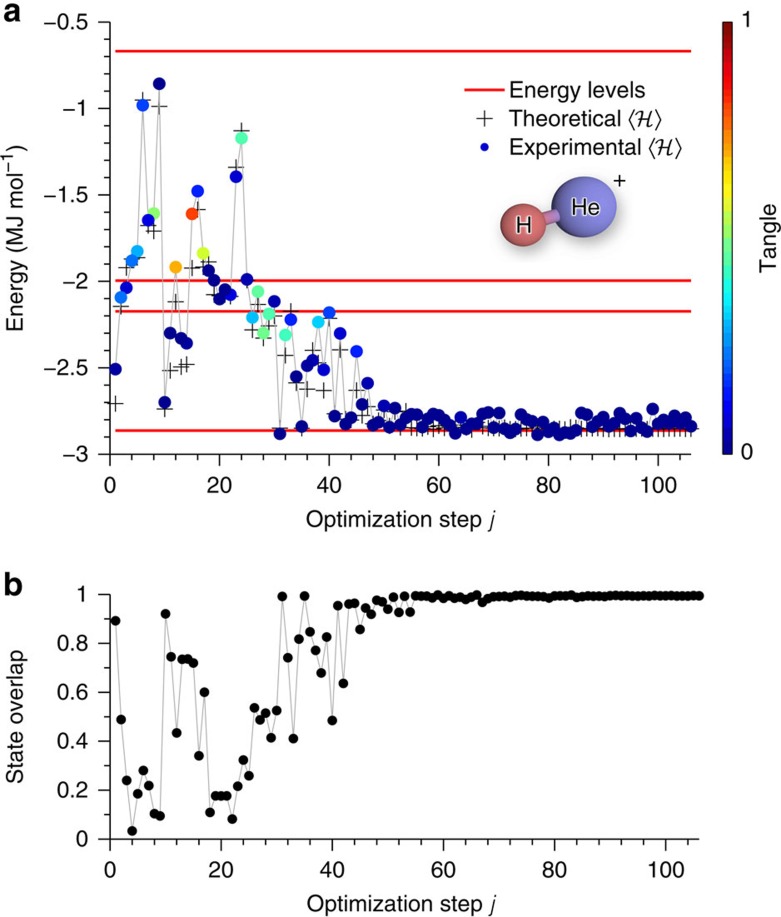
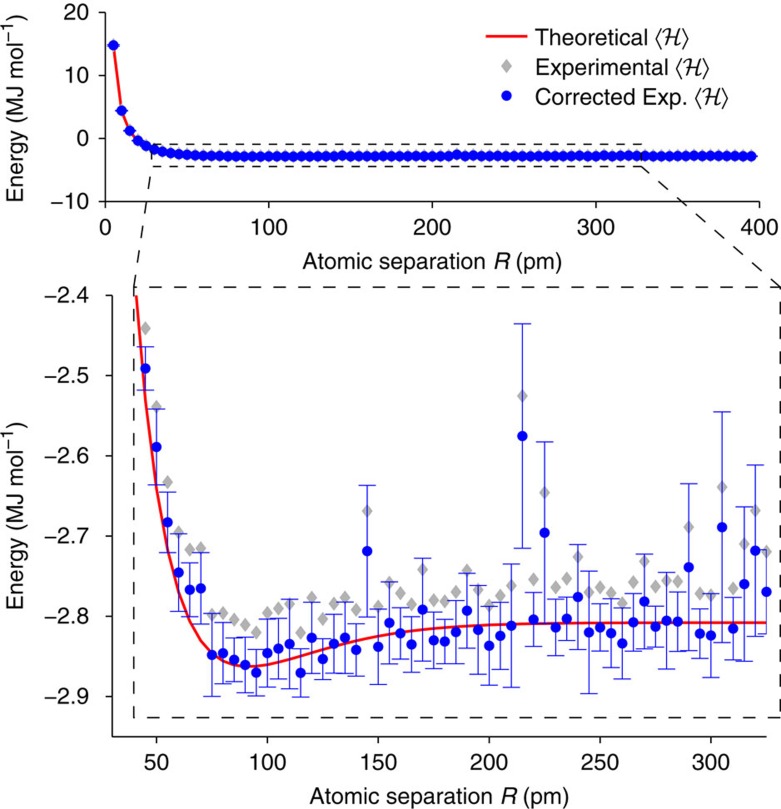
- The authors report an experimental ground-state result for He–H\(^+\): after correcting for experimental errors, they estimate the equilibrium bond length as \(R = 92.3 \pm 0.1\) pm and the ground-state electronic energy as \(E = -2.865 \pm 0.008\) MJ mol\(^{-1}\).
- For the bond dissociation curve, more than 96% of the experimental data are within chemical accuracy of the theoretical values.
- In the discussion, they state that for a 4 × 4 Hamiltonian like the one demonstrated, the QPE circuit would require at least 12 CNOT gates, whereas their method requires one.
- The full experiment was performed in about 158 h, and the bond dissociation curve was obtained by finding the ground states of 79 Hamiltonians.
## Methods
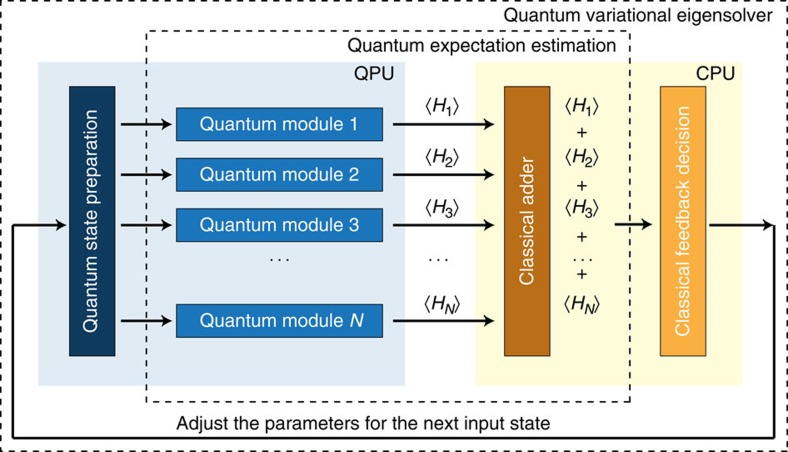
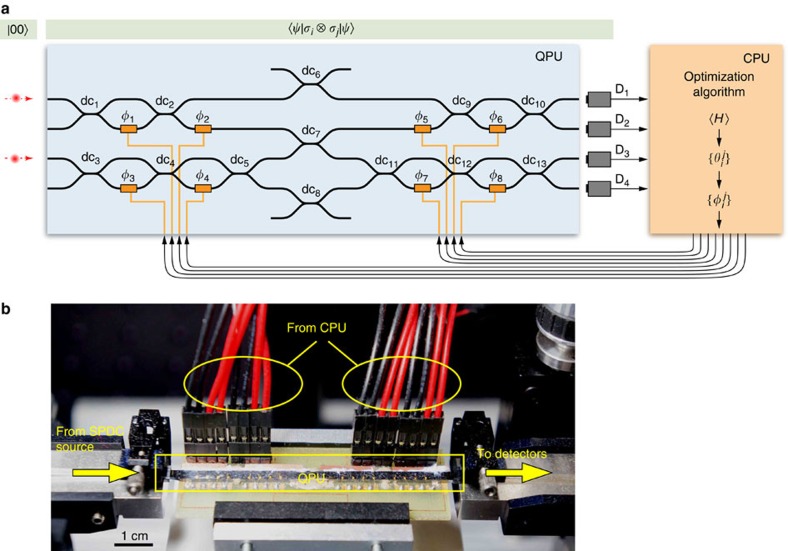
- The paper combines a reconfigurable integrated photonic quantum processor with a classical optimization algorithm: the quantum device estimates Hamiltonian expectation values, and the classical processor updates the state parameters variationally.
- The photonic chip prepares and measures arbitrary two-qubit pure states using single-qubit rotations and one two-qubit entangling gate; the experimental demonstration uses the He–H\(^+\) molecule in a minimal basis.
- For the classical optimization, they use the Nelder–Mead algorithm; expectation values are reconstructed from four two-qubit Pauli measurements at each point.
## Limitations
- The paper states that the method still requires a good approximation to the ground state as input/initialization, and the reliance on multiple separate measurements makes it sensitive to variations in state preparation between calculations.
- The authors report a constant systematic shift of \(\varepsilon = 50\) kJ mol\(^{-1}\) in the measured expectation values; they attribute this to photon-source impurity/distinguishability, circuit imperfections, and unbalanced coupling efficiencies.
- Evident from the text: the demonstration is limited to a two-qubit / 4 × 4 Hamiltonian prototype, so the scalability claim is not experimentally validated here.
Model-written summary. Check it against the paper before relying on it.
Integrity signals
Registry
Cites
Statistics
Figures
Verification
Claims the paper makes
7 Valid · 4 Not valid · 11 Not checked · 59 Own results and interpretations
The cited sources support only part of this claim — read each source’s verdict below.
In the paper
“Recent developments in the field of quantum computation offer a way forward for determining efficient solutions of many instances of large eigenvalue problems that are classically intractable6789101112”
§ A variational eigenvalue solver on a photonic quantum processor > Abstract
What the sources say
- Not matchedcites [6] Nielsen, M. A. & Chuang, I. L. Quantum Computation and Quantum Information Cambridge University Press (2000).
Couldn’t be matched to a paper in Crossref, so it can’t be checked.
- Could not verifycites [7] Kitaev, A. Quantum measurements and the Abelian stabilizer problem. Electronic Colloquium on Computational Complexity (ECCC) 3 (1996). sourceExperimental — accuracy not yet measured
Our copy under this DOI is the ISAAC 2021 paper 'Effective Resistance and Capacitance in Simplicial Complexes and a Quantum Algorithm' (Kitaev's 1995 work appears only as reference [9] in its bibliography), and it nowhere asserts that quantum computation gives efficient solutions to classically intractable large eigenvalue problems. Eigenvalues enter only as complexity parameters — λ, the smallest eigenvalue of the normalized up-Laplacian, in Lemma 31 and Theorem 26 (Section 6.3, 'Time efficient implementations') and in the phase-estimation machinery of Appendix A — and Section 1.1 ('Our Contributions') actually reports the opposite direction for its own problem: 'the quantum algorithm is slower than the classical algorithm in the worst case'. Searched: 'eigenvalue problems classically intractable', 'quantum speedup / exponential advantage', 'phase estimation', 'faster than classical'; no passage addresses the claim's point. (LLM, conf=0.70)
- Partly supportedcites [8] Griffiths, R. B. & Niu, C.-S. Semiclassical fourier transform for quantum computation. Phys. Rev. Lett. 76, 3228–3231 (1996). sourceExperimental — accuracy not yet measured
On p. 1, the paper says a quantum computer, if built, could solve certain problems such as factoring long numbers much faster than conventional algorithms. It also describes a simpler Fourier transform for Shor’s factorization and discrete-logarithm algorithms (p. 1). The copy does not support the claim about efficient solutions to many large eigenvalue problems. (LLM, conf=0.84)
plainstates a cause- Asserted: passes — The authors put it forward as true.
- Checkable: passes — It can be checked against evidence.
- Load-bearing: passes — The paper’s conclusions depend on it.
- Based: passes — The paper gives a reason why it holds.
- Not matched
Every source the paper cites for this claim was checked and supports it.
In the paper
“this would suffer from the N-representability problem, which is known to be intractable for both classical and quantum computers (it is in the quantum complexity class QMA-Hard24).”
§ A variational eigenvalue solver on a photonic quantum processor > Results > Quantum expectation estimation
What the sources say
- Supportedcites [24] Liu, Y.-K., Christandl, M. & Verstraete, F. Quantum computational complexity of the n-representability problem: Qma complete. Phys. Rev. Lett. 98, 110503 (2007). source
The paper states that N-representability is QMA-complete and hence QMA-hard and NP-hard (Abstract). Its discussion of quantum-chemistry relevance says the problem is intractable in the worst case even on a quantum computer, while allowing that particular physical systems may be easier. (LLM, conf=0.93)
boosted- Asserted: passes — The authors put it forward as true.
- Checkable: passes — It can be checked against evidence.
- Load-bearing: passes — The paper’s conclusions depend on it.
- Based: passes — The paper gives a reason why it holds.
- Supported
Every source the paper cites for this claim was checked and supports it.
In the paper
“We have implemented the QPU using integrated quantum photonics technology30.”
§ A variational eigenvalue solver on a photonic quantum processor > Results > Prototype demonstration
What the sources say
- Supportedcites [30] O'Brien, J. L., Furusawa, A. & Vuckovic, J. Photonic quantum technologies. Nat. Photon. 3, 687–695 (2009). source
The citation identifies integrated quantum photonics as the technology used, rather than attributing the citing authors’ QPU implementation to this review. The “Integrated quantum optical circuits” section (p. 6) describes on-chip waveguide circuits performing quantum logic gates and a compiled quantum factoring algorithm. (LLM, conf=0.87)
plain- Asserted: passes — The authors put it forward as true.
- Checkable: passes — It can be checked against evidence.
- Load-bearing: passes — The paper’s conclusions depend on it.
- Based: passes — The paper gives a reason why it holds.
- Supported
The cited sources support only part of this claim — read each source’s verdict below.
In the paper
“The time the quantum computer must remain coherent is determined by the necessity of O(p−1) successive applications of , each of which can require on the order of millions or billions of quantum gates for practical applications1719, as compared to the tens to hundreds of gates achievable in the short term.”
§ A variational eigenvalue solver on a photonic quantum processor > Abstract
What the sources say
- Partly supportedcites [17] Whitfield, J. D., Biamonte, J. & Aspuru-Guzik, A. Simulation of electronic structure hamiltonians using quantum computers. Mol. Phys. 109, 735–750 (2011). sourceExperimental — accuracy not yet measured
Split into 2 atoms — 1 confirmed, 1 partially supported, 0 disputed, 0 misattributed, 0 unverifiable. Expand the claim to see per-atom verdicts.
- Partly supportedcites [19] Jones, N. C. et al. Faster quantum chemistry simulation on fault-tolerant quantum computers. New J. Phys. 14, 115023 (2012). sourceExperimental — accuracy not yet measured
Split into 2 atoms — 0 confirmed, 2 partially supported, 0 disputed, 0 misattributed, 0 unverifiable. Expand the claim to see per-atom verdicts.
plainstates a cause- Asserted: passes — The authors put it forward as true.
- Checkable: passes — It can be checked against evidence.
- Load-bearing: passes — The paper’s conclusions depend on it.
- Based: passes — The paper gives a reason why it holds.
- Partly supported
A result the paper reports from its own data — it cites no other source for it, so there is none to check. The quote shows it is in the paper.
In the paper
“We experimentally demonstrate the feasibility of this approach with an example from quantum chemistry—calculating the ground-state molecular energy for He–H+.”
§ A variational eigenvalue solver on a photonic quantum processor > Abstract
boostedstates a causeSingle case- Asserted: passes — The authors put it forward as true.
- Checkable: passes — It can be checked against evidence.
- Load-bearing: passes — The paper’s conclusions depend on it.
- Based: passes — The paper gives a reason why it holds.
31 more claims
Create a free account to see all 81 claims and to verify the 4 references still open.
- It may state two separate claims as one. 28
- Probably not a substantial claim. 24
Claims other papers make about this one
Each is checked against this paper’s own text: does it say what the citing paper says it does?
The cited source doesn’t support the claim as written.
In the citing paper
“Leveraging quantum resources, the UCC ansatz was instead realized as a PQC on a photonic processor (Peruzzo et al. , 2014).”
From Noisy intermediate-scale quantum algorithms (2022) · cites this paper as Peruzzo et al., 2014
Checked by a reasoning model — may be wrong.
Experimental — accuracy not yet measuredThe cited source doesn’t support the claim as written.
In the citing paper
“The first on-chip GMM of four-qubit cluster state was realised in a laser-writing chip ( Fig.4e ), by manipulating both the polarisation and path DoFs of two photons [85].”
From Integrated photonic quantum technologies (2020) · cites this paper as [85]
Checked by a reasoning model — may be wrong.
Experimental — accuracy not yet measuredThe cited source doesn’t support the claim as written.
In the citing paper
“four-qubit linear- and box-cluster states are generated in a laser-writing photonic chip. This is enabled by on-chip manipulating the two-photon four-qubit hyperentangled state and cluster state, that are encoded in photon's path and polarisation DoFs. The Grover's search algorithm on a four-element database was implemented by controlling the device.”
From Integrated photonic quantum technologies (2020) · cites this paper as [85]
Checked by a reasoning model — may be wrong.
Experimental — accuracy not yet measuredThe source backs part of the claim, not all of it — or backs it for a different population, condition or comparison.
In the citing paper
“Due to its versatility, the variational Hamiltonian ansatz has been implemented for quantum chemistry [21, 29], optimization [24], and for quantum simulation problems [30].”
From Variational quantum algorithms (2021) · cites this paper as [29]
Experimental — accuracy not yet measuredThe source backs part of the claim, not all of it — or backs it for a different population, condition or comparison.
In the citing paper
“For the original VQE (Peruzzo et al. , 2014) and QAOA (Farhi et al. , 2014) it can, for example, be described as a single expectation value min θ ⟨ H ⟩ U ( θ ) , where the differences solely appear in the specific form and construction of the qubit Hamiltonian.”
From Noisy intermediate-scale quantum algorithms (2022) · cites this paper as Peruzzo et al., 2014
Experimental — accuracy not yet measured
12 more claims about this paper
Create a free account to see every claim other papers make about this one.
Citations
Cites
A Simplex Method for Function Minimization
Nelder, J. A., & Mead, R. (1965) · The Computer Journal · doi:10.1093/comjnl/7.4.308 · Cited by 28,905
Quantum computation and quantum information
Law, J. (2001) · ACM SIGSOFT Software Engineering Notes · doi:10.1145/505482.505499 · Cited by 18,842
(1999) · Cited by 12,854
Practical Methods of Optimization
Fletcher, R. (2000) · Wiley eBooks · doi:10.1002/9781118723203 · Cited by 7,605 · cited 3×
“[12] S.”
BackgroundMethodPractical methods of optimization
(1988) · Mathematics and Computers in Simulation · doi:10.1016/0378-4754(88)90129-2 · Cited by 5,818
Quantum Algorithm for Linear Systems of Equations
Harrow, A. W., Hassidim, A., & Lloyd, S. (2009) · Physical Review Letters · doi:10.1103/physrevlett.103.150502 · Cited by 3,325
Conn, A. R., Gould, N. I. M., & Toint, P. L. (2000) · Society for Industrial and Applied Mathematics eBooks · doi:10.1137/1.9780898719857 · Cited by 2,981 · cited 3×
“[14] D.”
MethodInfluential�ber das Paulische �quivalenzverbot
Jordan, P., & Wigner, E. (1928) · Zeitschrift f�r Physik · doi:10.1007/bf01331938 · Cited by 2,597
Molecular Electronic‐Structure Theory
Helgaker, T., Jørgensen, P., & Olsen, J. (2000) · doi:10.1002/9781119019572 · Cited by 2,594
O'Brien, J. L., Furusawa, A., & Vučković, J. (2009) · Nature Photonics · doi:10.1038/nphoton.2009.229 · Cited by 2,388
Self-citation
Research works printed but not linked: 3
- Helgaker, T., Jorgensen, P. & Olsen, J. Mol. Electronic Struct. Theory Wiley, Sussex (2002).
- Saad, Y. Numerical Methods for Large Eigenvalue Problems Vol. 158, (SIAM (1992).
- Rayleigh, J. W. In finding the correction for the open end of an organ-pipe. Phil. Trans. 161, 77 (1870).
Cited by
Items 201–300 of 4,572
A Multireference Quantum Krylov Algorithm for Strongly Correlated Electrons
Stair, N. H., Huang, R., & Evangelista, F. A. (2020) · Journal of Chemical Theory and Computation · doi:10.1021/acs.jctc.9b01125 · Cited by 183
Review on novel methods for lattice gauge theories
Carmen Bañuls, M., & Cichy, K. (2020) · Reports on Progress in Physics · doi:10.1088/1361-6633/ab6311 · Cited by 181
Strategies for solving the Fermi-Hubbard model on near-term quantum computers
Cade, C., Mineh, L., Montanaro, A., & Stanisic, S. (2020) · Physical Review B · doi:10.1103/physrevb.102.235122 · Cited by 178
“nent class of methods for producing ground states are variational methods, and in particular the variational quantum eigensolver [10, 11] (VQE).”
BackgroundMethodInfluentialHeisenberg-Limited Ground-State Energy Estimation for Early Fault-Tolerant Quantum Computers
Lin, L., & Tong, Y. (2022) · PRX Quantum · doi:10.1103/prxquantum.3.010318 · Cited by 176
Real- and Imaginary-Time Evolution with Compressed Quantum Circuits
Lin, S.-H., Dilip, R., Green, A. G., Smith, A., & Pollmann, F. (2021) · UCL Discovery (University College London) · Cited by 192
Efficient quantum measurement of Pauli operators in the presence of finite sampling error
Crawford, O., Straaten, B. V., Wang, D., Parks, T., Campbell, E., & Brierley, S. (2021) · Quantum · doi:10.22331/q-2021-01-20-385 · Cited by 188
“For example, expectation estimation of a Hamiltonian features prominently as the quantum sub-routine of the variational quantum eigensolver (VQE) algorithm [1].”
BackgroundMaterial platforms for integrated quantum photonics
Bogdanov, S., Shalaginov, M. Y., Boltasseva, A., & Shalaev, V. M. (2017) · Optical Materials Express · doi:10.1364/ome.7.000111 · Cited by 176
Hardware-efficient variational quantum algorithms for time evolution
Benedetti, M., Fiorentini, M., & Lubasch, M. (2020) · arXiv · doi:10.48550/arxiv.2009.12361 · Cited by 176
Quantum phase estimation of multiple eigenvalues for small-scale (noisy) experiments
O’Brien, T. E., Tarasinski, B., & Terhal, B. M. (2019) · New Journal of Physics · doi:10.1088/1367-2630/aafb8e · Cited by 174
Yen, T.-C., Verteletskyi, V., & Izmaylov, A. F. (2020) · Journal of Chemical Theory and Computation · doi:10.1021/acs.jctc.0c00008 · Cited by 178
Efficient Estimation of Pauli Observables by Derandomization
Huang, H.-Y., Kueng, R., & Preskill, J. (2021) · Physical Review Letters · doi:10.1103/physrevlett.127.030503 · Cited by 175
Emerging quantum computing algorithms for quantum chemistry
Motta, M., & Rice, J. E. (2022) · WIREs Computational Molecular Science · doi:10.1002/wcms.1580 · Cited by 173
“The ground state is approximated [250, 277, 279, 293–295] by an exponential Ansatz, where | Ψ 0 i is a reference Slater determinant and ˆ T is a linear combination of up to k particle-hole excitation operators that promote electrons from the hole (occupied) to the particle (unoccupied) orbitals of…”
BackgroundTheory of overparametrization in quantum neural networks
Larocca, M., Ju, N., García-Martín, D., Coles, P. J., & Cerezo, M. (2023) · Nature Computational Science · doi:10.1038/s43588-023-00467-6 · Cited by 176
“First, we use the VQE algorithm [103–105] to minimize the loss function and find the ground state of the Hamiltonian of the transverse field Ising model H TFIM .”
MethodNISQ computing: where are we and where do we go?
Lau, J. W. Z., Lim, K. H., Shrotriya, H., & Kwek, L. C. (2022) · AAPPS Bulletin · doi:10.1007/s43673-022-00058-z · Cited by 173
Quantum dots for photonic quantum information technology
Heindel, T., Kim, J.-H., Gregersen, N., Rastelli, A., & Reitzenstein, S. (2023) · Advances in Optics and Photonics · doi:10.1364/aop.490091 · Cited by 172
Izmaylov, A. F., Yen, T.-C., Lang, R. A., & Verteletskyi, V. (2020) · Journal of Chemical Theory and Computation · doi:10.1021/acs.jctc.9b00791 · Cited by 171
Quantum equation of motion for computing molecular excitation energies on a noisy quantum processor
Ollitrault, P. J., Kandala, A., Chen, C.-F., Barkoutsos, P. K., Mezzacapo, A., Pistoia, M., Sheldon, S., Woerner, S., Gambetta, J., & Tavernelli, I. (2020) · Repository for Publications and Research Data (ETH Zurich) · doi:10.3929/ethz-b-000467868 · Cited by 166
Iterative Qubit Coupled Cluster Approach with Efficient Screening of Generators
Ryabinkin, I. G., Lang, R. A., Genin, S. N., & Izmaylov, A. F. (2020) · Journal of Chemical Theory and Computation · doi:10.1021/acs.jctc.9b01084 · Cited by 170
Low rank representations for quantum simulation of electronic structure
Motta, M., Ye, E., McClean, J. R., Li, Z., Minnich, A. J., Babbush, R., & Chan, G. K.-L. (2021) · npj Quantum Information · doi:10.1038/s41534-021-00416-z · Cited by 171
“i1⁄41 Uð‘Þ pi λ ð‘Þ i U ð‘Þ si a y pas ; (7)”
Self-citationUnderstanding Polaritonic Chemistry from Ab Initio Quantum Electrodynamics
Ruggenthaler, M., Sidler, D., & Rubio, A. (2023) · Chemical Reviews · doi:10.1021/acs.chemrev.2c00788 · Cited by 170
Takeshita, T., Rubin, N. C., Jiang, Z., Lee, E., Babbush, R., & McClean, J. R. (2020) · Physical Review X · doi:10.1103/physrevx.10.011004 · Cited by 165
“Prime candidates for this possibility have been variational algorithms, such as the variational quantum eigensolver (VQE) [22,23] or the quantum approximation optimization algorithm [24].”
BackgroundMethodSelf-citationStandard model physics and the digital quantum revolution: thoughts about the interface
Klco, N., Roggero, A., & Savage, M. J. (2022) · Reports on Progress in Physics · doi:10.1088/1361-6633/ac58a4 · Cited by 166
Exploiting Symmetry in Variational Quantum Machine Learning
Meyer, J. J., Mularski, M., Gil-Fuster, E., Mele, A. A., Arzani, F., Wilms, A., & Eisert, J. (2023) · PRX Quantum · doi:10.1103/prxquantum.4.010328 · Cited by 169
Tapering off qubits to simulate fermionic Hamiltonians
Bravyi, S. B., Gambetta, J., Mezzacapo, A., & Temme, K. (2017) · arXiv (Cornell University) · doi:10.48550/arxiv.1701.08213 · Cited by 162
Quantum variational autoencoder
Khoshaman, A., Vinci, W., Denis, B., Andriyash, E., Sadeghi, H., & Amin, M. H. (2018) · Quantum Science and Technology · doi:10.1088/2058-9565/aada1f · Cited by 167
Variational quantum eigensolver with fewer qubits
Liu, J.-G., Zhang, Y.-H., Wan, Y., & Wang, L. (2019) · Physical Review Research · doi:10.1103/physrevresearch.1.023025 · Cited by 166
Variational algorithms for linear algebra
Xu, X., Sun, J., Endo, S., Li, Y., Benjamin, S. C., & Yuan, X. (2021) · Science Bulletin · doi:10.1016/j.scib.2021.06.023 · Cited by 163
“Then we apply the recently proposed variational meth-ods, such as variational quantum eigensolver (VQE) [12, 55], imaginary time evolution (ITE) [27, 28] and adaptive variational methods [56, 57], to find the ground state and hence the solution.”
BackgroundMethodInfluentialNoise resilience of variational quantum compiling
Sharma, K., Khatri, S., Cerezo, M., & Coles, P. J. (2020) · Civil War Book Review · Cited by 184
Sokolov, I. O., Barkoutsos, P. K., Ollitrault, P. J., Greenberg, D., Rice, J., Pistoia, M., & Tavernelli, I. (2020) · The Journal of Chemical Physics · doi:10.1063/1.5141835 · Cited by 164
“49 In all our applications we use the VQE algorithm 25 for the calculation of the ground state energies according to the following steps: ( 1 ) After setting the coordinates, charge and spin multiplicity of the molecule we perform a RHF calculation in the minimal, STO-3G basis set, using the PySCF…”
MethodA Lie algebraic theory of barren plateaus for deep parameterized quantum circuits
Ragone, M., Bakalov, B. N., Sauvage, F., Kemper, A. F., Ortiz Marrero, C., Larocca, M., & Cerezo, M. (2024) · Nature Communications · doi:10.1038/s41467-024-49909-3 · Cited by 167
On Circuit-Based Hybrid Quantum Neural Networks for Remote Sensing Imagery Classification
Sebastianelli, A., Zaidenberg, D. A., Spiller, D., Le Saux, B., & Ullo, S. (2022) · IEEE Journal of Selected Topics in Applied Earth Observations and Remote Sensing · doi:10.1109/jstars.2021.3134785 · Cited by 162
“By iterating through these classical variations and quantum calculations, a hybrid minimization process is established [14].”
BackgroundMethodModel-free readout-error mitigation for quantum expectation values
van den Berg, E., Minev, Z. K., & Temme, K. (2022) · Physical Review A · doi:10.1103/physreva.105.032620 · Cited by 162
A Tutorial on Quantum Convolutional Neural Networks (QCNN)
Oh, S., Choi, J., & Kim, J. (2020) · 2020 International Conference on Information and Communication Technology Convergence (ICTC) · doi:10.1109/ictc49870.2020.9289439 · Cited by 166
“There are Variational Quantum Eigen-solver (VQE) [2], [3] and Quantum Approximate Optimization Algorithm (QAOA) [4], [5], which provide new ways to solve the problems of physics and chemistry in complex structures or NP-hard algorithm problems.”
MethodQuantum Computing and Communications: An Engineering Approach
Imre, S., & Balázs, F. (2004) · Wiley eBooks · doi:10.1002/9780470869048 · Cited by 163
Trainability of Dissipative Perceptron-Based Quantum Neural Networks
Sharma, K., Cerezo, M., Cincio, L., & Coles, P. J. (2022) · Physical Review Letters · doi:10.1103/physrevlett.128.180505 · Cited by 159
“There, it was shown that variational quantum algorithms [20–30], which aim to train QNNs to accomplish specific tasks, may exhibit gradients that vanish exponentially with the system size.”
BackgroundHardware-efficient variational quantum algorithms for time evolution
Benedetti, M., Fiorentini, M., & Lubasch, M. (2021) · Physical Review Research · doi:10.1103/physrevresearch.3.033083 · Cited by 161
Mitigating Depolarizing Noise on Quantum Computers with Noise-Estimation Circuits
Urbanek, M., Nachman, B., Pascuzzi, V. R., He, A., Bauer, C. W., & de Jong, W. A. (2021) · Physical Review Letters · doi:10.1103/physrevlett.127.270502 · Cited by 163
Doubling the Size of Quantum Simulators by Entanglement Forging
Eddins, A., Motta, M., Gujarati, T. P., Bravyi, S., Mezzacapo, A., Hadfield, C., & Sheldon, S. (2022) · PRX Quantum · doi:10.1103/prxquantum.3.010309 · Cited by 160
Differentiable quantum architecture search
Zhang, S.-X., Hsieh, C.-Y., Zhang, S., & Yao, H. (2022) · Quantum Science and Technology · doi:10.1088/2058-9565/ac87cd · Cited by 158
“Several prototypical examples in this category include finding the ground state of complex quantum systems by variational quantum eigensolver (VQE) [2–4], exploring better approximation for NP hard combinatorial optimization problems by quantum approximation optimization algorithms (QAOA) [5–7], and…”
Fundamental limits of quantum error mitigation
Takagi, R., Endo, S., Minagawa, S., & Gu, M. (2022) · npj Quantum Information · doi:10.1038/s41534-022-00618-z · Cited by 160
“For an observable A= ∑a aΠa where Πa is the projector corresponding to measuring outcome a, the POVMs fMðkÞ aðkÞ g Rþ1 k1⁄41 and classical estimator function eA take the forms: MðkÞ aðkÞ 1⁄4 ΠaðkÞ k 1⁄4 1; 1⁄4 ; Rþ 1; (41)”
Estimating the gradient and higher-order derivatives on quantum hardware
Mari, A., Bromley, T. R., & Killoran, N. (2021) · Physical Review A · doi:10.1103/physreva.103.012405 · Cited by 159
“Most algorithms designed for near-term quantum computers are based on the variational optimization of quantum circuits [1–6].”
BackgroundMethodInfluentialGeneral methods for digital quantum simulation of gauge theories
Lamm, H., Lawrence, S., & Yamauchi, Y. (2019) · Physical review. D/Physical review. D. · doi:10.1103/physrevd.100.034518 · Cited by 210
Is the Trotterized UCCSD Ansatz Chemically Well-Defined?
Grimsley, H. R., Claudino, D., Economou, S. E., Barnes, E., & Mayhall, N. J. (2019) · Journal of Chemical Theory and Computation · doi:10.1021/acs.jctc.9b01083 · Cited by 201
Quantum Simulation of Helium Hydride Cation in a Solid-State Spin Register
Wang, Y., Dolde, F., Biamonte, J., Babbush, R., Bergholm, V., Yang, S., Jakobi, I., Neumann, P., Aspuru-Guzik, A., Whitfield, J. D., et al. (2015) · ACS Nano · doi:10.1021/acsnano.5b01651 · Cited by 152
Self-citationApplication-Oriented Performance Benchmarks for Quantum Computing
Lubinski, T., Johri, S., Varosy, P., Coleman, J., Zhao, L., Necaise, J., Baldwin, C. H., Mayer, K., & Proctor, T. (2023) · IEEE Transactions on Quantum Engineering · doi:10.1109/tqe.2023.3253761 · Cited by 154
“, process data from quantum circuits already run (as in variational algorithms [49], [50], [51]).”
MethodGrover Adaptive Search for Constrained Polynomial Binary Optimization
Gilliam, A., Woerner, S., & Gonciulea, C. (2021) · Quantum · doi:10.22331/q-2021-04-08-428 · Cited by 153
Quantum many-body simulations on digital quantum computers: State-of-the-art and future challenges
Fauseweh, B. (2024) · Nature Communications · doi:10.1038/s41467-024-46402-9 · Cited by 152
“In comparison to QPE, which estimates energy eigenvalues through coherent time evolution of the Hamiltonian 5 , VQE has signi fi cantly reduced requirements for coherent gate execution.”
InfluentialReducing the number of non-Clifford gates in quantum circuits
Kissinger, A., & van de Wetering, J. (2020) · Physical Review A · doi:10.1103/physreva.102.022406 · Cited by 149
“This could potentially yield significant improvements in the performance of hybrid classical / quantum algorithms relying on parametrized circuits, such as the quantum variational eigensolver [32].”
MethodApplication of fermionic marginal constraints to hybrid quantum algorithms
Rubin, N. C., Babbush, R., & McClean, J. (2018) · New Journal of Physics · doi:10.1088/1367-2630/aab919 · Cited by 152
Self-citationReachability Deficits in Quantum Approximate Optimization
Akshay, V., Philathong, H., Morales, M. E. S., & Biamonte, J. D. (2020) · Physical Review Letters · doi:10.1103/physrevlett.124.090504 · Cited by 151
Singh, A., Dev, K., Siljak, H., Joshi, H. D., & Magarini, M. (2021) · IEEE Communications Surveys & Tutorials · doi:10.1109/comst.2021.3109944 · Cited by 151
Machine learning for quantum matter
Carrasquilla, J. (2020) · Advances in Physics X · doi:10.1080/23746149.2020.1797528 · Cited by 308
“Variational quantum algorithms such as the variational quantum eigensolver (VQE) [202] or the quantum approximate optimization algorithm (QAOA) [203] aim to simulate low-energy properties of quantum many-body systems or to find approximate solutions of combinatorial optimization problems.”
MethodAng, Y. S., Yang, S. A., Zhang, C., Ma, Z., & Ang, L. K. (2017) · Physical review. B./Physical review. B · doi:10.1103/physrevb.96.245410 · Cited by 157
Entanglement devised barren plateau mitigation
Patti, T. L., Najafi, K., Gao, X., & Yelin, S. F. (2021) · Physical Review Research · doi:10.1103/physrevresearch.3.033090 · Cited by 227
A non-orthogonal variational quantum eigensolver
Huggins, W. J., Lee, J., Baek, U., O’Gorman, B., & Whaley, K. B. (2020) · New Journal of Physics · doi:10.1088/1367-2630/ab867b · Cited by 148
“One appealing strategy, the variational quantum eigensolver (VQE) [3, 4], uses a potentially noisy quantum computer as a black box to prepare parametrized wavefunctions and measure their energy.”
MethodFormulating and Solving Routing Problems on Quantum Computers
Harwood, S., Gambella, C., Trenev, D., Simonetto, A., Bernal Neira, D., & Greenberg, D. (2021) · IEEE Transactions on Quantum Engineering · doi:10.1109/tqe.2021.3049230 · Cited by 145
“Variational algorithms such as the quantum approximate optimization algorithm (QAOA) [11] and variational quantum eigensolver (VQE) [12] can be implemented on current gate-based devices.”
MethodAjagekar, A., & You, F. (2022) · Renewable and Sustainable Energy Reviews · doi:10.1016/j.rser.2022.112493 · Cited by 184
Computational advantage of quantum random sampling
Hangleiter, D., & Eisert, J. (2023) · Reviews of Modern Physics · doi:10.1103/revmodphys.95.035001 · Cited by 145
Iterative qubit-excitation based variational quantum eigensolver
Yordanov, Y., Armaos, V., Barnes, C., & Arvidsson-Shukur, D. (2021) · doi:10.21203/rs.3.rs-404173/v1 · Cited by 145
Fermionic Partial Tomography via Classical Shadows
Zhao, A., Rubin, N. C., & Miyake, A. (2021) · Physical Review Letters · doi:10.1103/physrevlett.127.110504 · Cited by 144
“Of note is the variational quantum eigensolver (VQE) [7, 8], where short-depth quantum circuits are repeatedly executed in order to estimate observable expectation values.”
BackgroundDong, Y., Lin, L., & Tong, Y. (2022) · PRX Quantum · doi:10.1103/prxquantum.3.040305 · Cited by 298
“We did not compare with heuristic algorithms such as the variational quantum eigensolver [52, 60, 61].”
MethodLarge gradients via correlation in random parameterized quantum circuits
Volkoff, T., & Coles, P. J. (2021) · Quantum Science and Technology · doi:10.1088/2058-9565/abd891 · Cited by 143
“Variational quantum algorithms [1] are a class of quantum algorithms especially suited to near-term applications including eigenvalue estimation [1–7], quantum compiling [8, 9], linear systems [10, 11], and quantum dynamics [12–16].”
Using Gaussian Boson Sampling to Find Dense Subgraphs
Arrazola, J. M., & Bromley, T. R. (2018) · Physical Review Letters · doi:10.1103/physrevlett.121.030503 · Cited by 138
SupermarQ: A Scalable Quantum Benchmark Suite
Tomesh, T., Gokhale, P., Omole, V., Ravi, G. S., Smith, K. N., Viszlai, J., Wu, X.-C., Hardavellas, N., Martonosi, M. R., & Chong, F. T. (2022) · arXiv · doi:10.48550/arxiv.2202.11045 · Cited by 143
Farrell, R. C., Illa, M., Ciavarella, A. N., & Savage, M. J. (2024) · PRX Quantum · doi:10.1103/prxquantum.5.020315 · Cited by 284
Exponential Error Suppression for Near-Term Quantum Devices
Koczor, B. (2021) · Physical Review X · doi:10.1103/physrevx.11.031057 · Cited by 147
Variational Thermal Quantum Simulation via Thermofield Double States
Wu, J., & Hsieh, T. H. (2019) · Physical Review Letters · doi:10.1103/physrevlett.123.220502 · Cited by 139
Hybrid quantum-classical algorithms in the noisy intermediate-scale quantum era and beyond
Callison, A., & Chancellor, N. (2022) · Physical Review A · doi:10.1103/physreva.106.010101 · Cited by 205
“…can be performed by inserting the quantum processor into a feedback loop that incorporates a classical optimization algorithm; the original proposal [25] used the Nelder-Mead simplex method [78], but more recent work has used other optimization methods (see the reviews [79, 80] for examples).”
InfluentialMethodology for replacing indirect measurements with direct measurements
Mitarai, K., & Fujii, K. (2019) · Physical Review Research · doi:10.1103/physrevresearch.1.013006 · Cited by 139
Performance of hybrid quantum-classical variational heuristics for combinatorial optimization
Nannicini, G. (2019) · Physical Review E · doi:10.1103/physreve.99.013304 · Cited by 138
“, chemistry [19, 14], machine learning [23, 10], optimization [17, 11, 8].”
BackgroundQuantum eigenvalue estimation via time series analysis
Somma, R. D. (2019) · New Journal of Physics · doi:10.1088/1367-2630/ab5c60 · Cited by 142
Efficient variational simulation of non-trivial quantum states
Ho, W. W., & Hsieh, T. H. (2019) · SciPost Physics · doi:10.21468/scipostphys.6.3.029 · Cited by 139
“optimized; the resulting quantum state is then the near to the target state. Such variational quantum approaches have been developed and utilized in a number of contexts, such as in quantum chemistry [24,25], and also in classical optimization problems (for example, as the ‘Quantum Approximate Optimization Algorithm’…”
BackgroundTheBravyi–Kitaev transformation: Properties and applications
Tranter, A., Sofia, S., Seeley, J., Kaicher, M., McClean, J., Babbush, R., Coveney, P. V., Mintert, F., Wilhelm, F., & Love, P. J. (2015) · International Journal of Quantum Chemistry · doi:10.1002/qua.24969 · Cited by 136
Self-citationThree-nucleon forces: Implementation and applications to atomic nuclei and dense matter
Hebeler, K. (2020) · Physics Reports · doi:10.1016/j.physrep.2020.08.009 · Cited by 182
Equivalence of quantum barren plateaus to cost concentration and narrow gorges
Arrasmith, A., Holmes, Z., Cerezo, M., & Coles, P. J. (2022) · Quantum Science and Technology · doi:10.1088/2058-9565/ac7d06 · Cited by 253
“[5] Alberto Peruzzo, Jarrod McClean, Peter Shadbolt, ManHong Yung, Xiao-Qi Zhou, Peter J Love, Alán AspuruGuzik, and Jeremy L O’brien, “A variational eigenvalue solver on a photonic quantum processor,” Nature communications 5, 1–7 (2014).”
Qubit-excitation-based adaptive variational quantum eigensolver
(2021) · doi:10.1038/s42005-021-00730-0 · Cited by 145
Variational quantum state eigensolver
Cerezo, M., Sharma, K., Arrasmith, A., & Coles, P. J. (2022) · npj Quantum Information · doi:10.1038/s41534-022-00611-6 · Cited by 136
“Due to the rapid rise of VQE [2], much research has gone into how to prepare ground and excited states on NISQ devices.”
BackgroundMethodQuantum Algorithm Implementations for Beginners
J., A., Adedoyin, A., Ambrosiano, J., Anisimov, P., Casper, W., Chennupati, G., Coffrin, C., Djidjev, H., Gunter, D., Karra, S., et al. (2022) · ACM Transactions on Quantum Computing · doi:10.1145/3517340 · Cited by 245
“s are optimal. Conducting an exhaustive search over a fine grid is proposed in [43] for the selection of each round’s optimal β,γ angles. The use of a quantum-variational-eigensolver is also possible [74, 79]. The translation of the clauses to Hamiltonians and the determination of the final expectation value depends o…”
BackgroundMethodInfluentialExponentially more precise quantum simulation of fermions in second quantization
Babbush, R., Berry, D. W., Kivlichan, I. D., Wei, A. Y., Love, P. J., & Aspuru-Guzik, A. (2016) · New Journal of Physics · doi:10.1088/1367-2630/18/3/033032 · Cited by 135
Self-citationQuantum simulation of fundamental particles and forces
Bauer, C., Davoudi, Z., Klco, N., & Savage, M. J. (2023) · Nature Reviews Physics · doi:10.1038/s42254-023-00599-8 · Cited by 267
“…techniques include adiabatically approaching states of a target theory from those of a simpler theory [147], adiabaticity-violating processes such as quenched dynamics, imaginary-time evolution [148–151], and variational procedures that may incorporate global entangling operators [152–154].”
BackgroundHubregtsen, T., Pichlmeier, J., Stecher, P., & Bertels, K. (2021) · Quantum Machine Intelligence · doi:10.1007/s42484-021-00038-w · Cited by 135
Chen, S., Yu, W., Zeng, P., & Flammia, S. T. (2021) · PRX Quantum · doi:10.1103/prxquantum.2.030348 · Cited by 229
Variational Spin-Squeezing Algorithms on Programmable Quantum Sensors
Kaubruegger, R., Silvi, P., Kokail, C., van Bijnen, R., Rey, A. M., Ye, J., Kaufman, A. M., & Zoller, P. (2019) · Physical Review Letters · doi:10.1103/physrevlett.123.260505 · Cited by 133
On-surface synthesis of a doubly anti-aromatic carbon allotrope
Gao, Y., Albrecht, F., Rončević, I., Ettedgui, I., Kumar, P., Scriven, L. M., Christensen, K. E., Mishra, S., Righetti, L., Rossmannek, M., et al. (2023) · Nature · doi:10.1038/s41586-023-06566-8 · Cited by 166
“Here, we investigate C 16 using both state-of-the-art computational methods and a variational quantum eigensolver 28 paired with the quantum unitary coupled-cluster singles Article and doubles (q-UCCSD) 29 ansatz.”
MethodYao.jl: Extensible, Efficient Framework for Quantum Algorithm Design
Luo, X.-Z., Liu, J.-G., Zhang, P., & Wang, L. (2020) · Quantum · doi:10.22331/q-2020-10-11-341 · Cited by 157
“Many of these quantum algorithms, including the variational quantum eigensolver [2–4], quantum approximate optimization algorithm [5], quantum circuit learning [6, 7], and quantum circuit Born machine for generative modeling [8, 9] have had small scale demonstrations in experiments [10–14].”
BackgroundNear-optimal ground state preparation
Lin, L., & Tong, Y. (2020) · Quantum · doi:10.22331/q-2020-12-14-372 · Cited by 187
“The variational quantum eigenvalue solver (VQE) [37] has gained much attention recently because of its low requirement for circuit depth and its variational structure.”
BackgroundSupermarQ: A Scalable Quantum Benchmark Suite
Tomesh, T., Gokhale, P., Omole, V., Ravi, G. S., Smith, K. N., Viszlai, J., Wu, X.-C., Hardavellas, N., Martonosi, M., & Chong, F. T. (2022) · IEEE International Symposium on High-Performance Computer Architecture (HPCA) · doi:10.1109/hpca53966.2022.00050 · Cited by 262
Gate-Efficient Simulation of Molecular Eigenstates on a Quantum Computer
Ganzhorn, M., Egger, D. J., Barkoutsos, P., Ollitrault, P. J., Salis, G., Moll, N., Roth, M., Fuhrer, A., Mueller, P., Woerner, S., et al. (2019) · Physical Review Applied · doi:10.1103/physrevapplied.11.044092 · Cited by 170
“Recently, the molecular ground state energy of hydrogen and helium have been computed via VQE in proof of concept experiments using NMR quantum simulators [12–14], photonic architectures [6] or nitrogenvacancy centers in diamond [15].”
MethodSimulations of subatomic many-body physics on a quantum frequency processor
Lu, H., Klco, N., Lukens, J. M., Morris, T., Bansal, A., Ekström, A., Hagen, G., Papenbrock, T., Weiner, A. M., Savage, M. J., et al. (2019) · Physical Review A · doi:10.1103/physreva.100.012320 · Cited by 151
A non-orthogonal variational quantum eigensolver
Huggins, W., Lee, J., Baek, U., O'Gorman, B., & Whaley, K. (2020) · eScholarship (California Digital Library) · Cited by 128
Quantum computation with universal error mitigation on a superconducting quantum processor
Song, C., Cui, J., Wang, H., Hao, J., Feng, H., & Li, Y. (2019) · Science Advances · doi:10.1126/sciadv.aaw5686 · Cited by 131
Qibo : a framework for quantum simulation with hardware acceleration
Efthymiou, S., Ramos-Calderer, S., Bravo-Prieto, C., Pérez-Salinas, A., García-Martín, D., García-Sáez, A., Latorre, J. I., & Carrazza, S. (2021) · Quantum Science and Technology · doi:10.1088/2058-9565/ac39f5 · Cited by 214
“The backend layers are required in order to build quantum algorithms such as the Variation Quantum Eigensolver (VQE) [60], perform measurement shots, etc.”
MethodSilicon Carbide Photonics Bridging Quantum Technology
Castelletto, S., Peruzzo, A., Bonato, C., Johnson, B. C., Radulaski, M., Ou, H., Kaiser, F., & Wrachtrup, J. (2022) · ACS Photonics · doi:10.1021/acsphotonics.1c01775 · Cited by 146
Self-citationFull-stack, real-system quantum computer studies: architectural comparisons and design insights
Murali, P., Linke, N. M., Martonosi, M., Abhari, A. J., Nguyen, N. H., & Alderete, C. H. (2019) · Proceedings of the 46th International Symposium on Computer Architecture · doi:10.1145/3307650.3322273 · Cited by 128
“Quantum computing (QC) is emerging as a promising paradigm for solving classically intractable computational problems in areas such as machine learning [4, 39], cryptography [60], chemistry [32, 50] and others.”
BackgroundBenchmarking Quantum Computers and the Impact of Quantum Noise
Resch, S., & Karpuzcu, U. R. (2021) · ACM Computing Surveys · doi:10.1145/3464420 · Cited by 218
“Currently, classical-quantum hybrid algorithms [69, 70, 71, 72] are popular due to their ability to make use of the limited resources of modern quantum”
BackgroundSimulating 2D Effects in Lattice Gauge Theories on a Quantum Computer
Paulson, D., Dellantonio, L., Haase, J. F., Celi, A., Kan, A., Jena, A., Kokail, C., van Bijnen, R., Jansen, K., Zoller, P., et al. (2021) · PRX Quantum · doi:10.1103/prxquantum.2.030334 · Cited by 177
Measurements of Quantum Hamiltonians with Locally-Biased Classical Shadows
Hadfield, C., Bravyi, S., Raymond, R., & Mezzacapo, A. (2020) · arXiv · doi:10.48550/arxiv.2006.15788 · Cited by 129
Electron-Phonon Systems on a Universal Quantum Computer
Macridin, A., Spentzouris, P., Amundson, J. F., & Harnik, R. (2018) · Physical Review Letters · doi:10.1103/physrevlett.121.110504 · Cited by 173
Compiler Design for Distributed Quantum Computing
Ferrari, D., Cacciapuoti, A. S., Amoretti, M., & Caleffi, M. (2021) · IEEE Transactions on Quantum Engineering · doi:10.1109/tqe.2021.3053921 · Cited by 188
“Specifically, we consider quantum circuits that are publicly available and widely adopted for testing quantum compilers [25], [26], 11 [48], [49] and the RYRZ heuristic [50] wavefunction Ansätze.”
MethodTranter, A., Love, P. J., Mintert, F., & Coveney, P. V. (2018) · Journal of Chemical Theory and Computation · doi:10.1021/acs.jctc.8b00450 · Cited by 198
Self-citation
Metadata
- Authors
- Peruzzo, A., McClean, J., Shadbolt, P., Yung, M.-H., Zhou, X.-Q., Love, P. J., Aspuru-Guzik, A., & O’Brien, J. L.
- Affiliations
- The University of Sydney (AU)
- Harvard University (US)
- University of Bristol (GB)
- Haverford College (US)
- Corresponding author
- Peruzzo, Alberto
- O’Brien, Jeremy L.
- Venue
- Nature Communications
- Published
- 2014-07-23
- Volume
- 5
- Issue
- 1
- Pages
- 4213-4213
- ISSN
- 2041-1723 (ISSN-L)
- PMC
- PMC4124861
- OpenAlex
- W2161685427
- Cited by
- 4,552
- References
- 48
- Citations by year
- 2026: 591 · 2025: 765 · 2024: 722 · 2023: 658 · 2022: 564 · 2021: 561 · 2020: 346 · 2019: 191 · 2018: 83 · 2017: 29 · 2016: 18 · 2015: 16 · 2014: 4
- FWCI
- 22.24
- Type
- journal article
- Language
- en
- Open access
- hybrid
- doi.org
- Licence
- cc-by-nc-nd
- creativecommons.org/licenses/by-nc-nd/4.0 (tdm)
- creativecommons.org/licenses/by-nc-nd/4.0 (vor)
- Locations
- Nature Communications (publishedVersion, cc-by-nc-nd)
- Europe PMC (PubMed Central) (publishedVersion, cc-by-nc-nd)
- PubMed Central (publishedVersion, cc-by-nc-nd)
- PubMed (publishedVersion)
- arXiv (Cornell University) (submittedVersion)
- OSTI OAI (U.S. Department of Energy Office of Scientific and Technical Information) (submittedVersion, cc-by-nc-nd)
- Digital Access to Scholarship at Harvard (DASH) (Harvard University) (submittedVersion, cc-by)
- RePEc: Research Papers in Economics (submittedVersion)
- RMIT Research Repository (RMIT University Library) (submittedVersion, cc-by-nc-nd)
- Figshare (submittedVersion, cc-by-nc-nd)
- UWA Profiles and Research Repository (UWA) (submittedVersion, cc-by-nc-nd)
- Bristol Research (University of Bristol) (submittedVersion)
- arXiv (Cornell University)
- Funders
- National Science Foundation (DE-FG02-97ER25308, 0955518, 1037992)
- U.S. Department of Energy (DEFG0297ER25308, DE‐FG02‐, FG02-97ER25308)
- Alfred P. Sloan Foundation
- John Templeton Foundation
- Camille and Henry Dreyfus Foundation
- Royal Academy of Engineering
- National Natural Science Foundation of China (61033001, 61361136003)
- Engineering and Physical Sciences Research Council (EP/J017175/1, EP/L024020/1, EP/K021931/1)
- Australian Research Council (DE140101700)
- National Key Research and Development Program of China (61033001, 2011CBA00301, 61361136003, 2011CBA00300)
- Division of Chemistry (CHE-1037992)
- Air Force Office of Scientific Research (FA 9550-12-1-0046, FA9550-, FA9550-12, FA9550‐12‐1)
- Topics
- Physical Sciences › Computer Science › Artificial Intelligence › Quantum Computing Algorithms and Architecture
- Physical Sciences › Physics and Astronomy › Atomic and Molecular Physics, and Optics › Quantum Information and Cryptography
- Physical Sciences › Physics and Astronomy › Atomic and Molecular Physics, and Optics › Quantum many-body systems
- Keywords
- variational quantum eigensolver, photonic quantum processors, quantum chemistry, classical optimization, hybrid quantum-classical computation
About these checks
Registry, retraction, Cites and statistics results are computed, not judged, with one exception: a printed reference that no index lists is read once by a model before it counts as a citation error. Claims are extracted by a model and kept only when their quote appears verbatim in the text; each cited source is then checked, with a model’s help, for whether it says what the claim relies on. Those verdicts can be wrong — read the claim’s quote and the cited source before relying on one.
The claim verdicts this report counts are experimental: their accuracy is not yet measured.
A language model drew the claims from the paper on 2026-10-10, under version 3 of the claim definition (model deepseek-v4.1-flash, prompt extract-v3).
A second model labelled each claim on 2026-10-10 (model jev-1.13-20260917, definition revision gold-guideline-v0.2).
Cited sources are checked with a language model’s help (qwen3.8-omni-flash and gpt-6-sol).
Statistics and arithmetic are recomputed, not judged.
Confidence bands are shown only for fields calibrated on our annotated test set. None is calibrated yet, so no band is shown.
What counts as a claim ›How we measure confidence ›How we check this ›
Are you an author, or do you see a problem with this page? Request a review
Data sources
Bibliographic data: Semantic Scholar, OpenAlex, Crossref.
Contains information from the Semantic Scholar Academic Graph Datasets, made available under the ODC Attribution License (ODC-BY 1.0).
Semantic Scholar’s data is described in: Kinney, R., et al. (2023). The Semantic Scholar Open Data Platform. arXiv:2301.10140.
