

Live biotherapeutic products: the importance of a defined regulatory framework
Open accessThe DOI matches its Crossref record; 30 of the 30 references it cites were found in a registry or an index.
Abstract
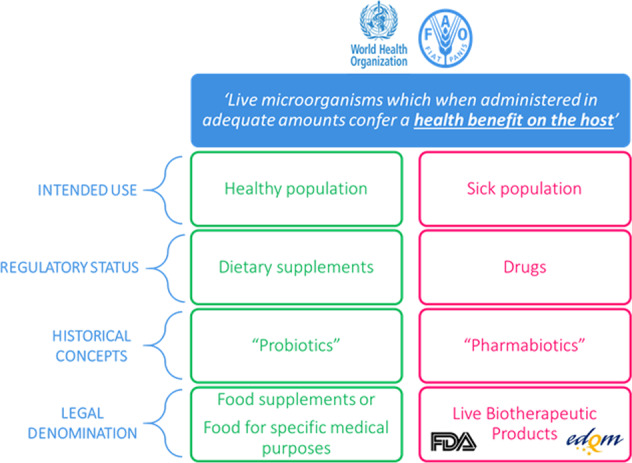
Probiotics have been defined as “Live microorganisms that when administered in adequate amounts confer a health benefit on the host”. This definition covers a wide range of applications, target populations and (combinations of) microorganisms. Improved knowledge on the importance of the microbiota in terms of health and disease has further diversified the potential scope of a probiotic intervention, whether intended to reach the market as a food, a food supplement or a drug, depending on the intended use. However, the increased interest in the clinical application of probiotics may require specific attention given their administration in a diseased population. In addition to safety, the impact of the type of product, in terms of quality, production method and, e.g., the acceptance of side effects, is now part of the current regulatory constraints for developers. In the European Union, foods are regulated by the European Food Safety Authority and drugs by the European Medicines Agency; in the United States, the Food and Drug Administration (FDA) deals with both categories. More recently, the FDA has defined a new “live biotherapeutic products” (LBP) category, clarifying pharmaceutical expectations. Since 2019, the quality requirements for this category of drug products have also been clarified by the European Pharmacopoeia (Ph. Eur.). Similar to all products intended to prevent or treat diseases, LBPs will have to be registered as medicinal products to reach the market in the US and in Europe. In this area, regulatory authorities and the pharmaceutical industry will routinely use guidelines of the “International Council for Harmonization of Technical Requirements for Pharmaceuticals for Human Use” (ICH). Although ICH guidelines are not legally binding, they provide very important recommendations, recognized by almost all drug authorities in the world. In this review, we discuss some aspects of this regulatory framework, especially focusing on products with an intended use in a diseased or vulnerable target population.
Overview
The claims and statistics of this paper haven’t been checked yet.
Free: it reads the open-access text and checks the first 5 claims that cite a source we can check. Create a free account to check every claim.
Integrity signals
Registry
Cites
Statistics
Figures
Verification
Claims the paper makes
The claims and statistics of this paper haven’t been checked yet.
Free: it reads the open-access text and checks the first 5 claims that cite a source we can check. Create a free account to check every claim.
Claims other papers make about this one
Each is checked against this paper’s own text: does it say what the citing paper says it does?
The source backs part of the claim, not all of it — or backs it for a different population, condition or comparison.
In the citing paper
“Probiotics marketed as foods or dietary supplements are subject to food and consumer product safety legislation. In contrast, live biotherapeutic products, intended to treat or prevent diseases, are regulated as biological medicinal products. This means that they must undergo rigorous safety, efficacy, and quality testing similar to that applied to pharmaceuticals [29,30].”
From Current Concepts in Probiotic Safety and Efficacy (2026) · cites this paper as [30]
Experimental — accuracy not yet measured
Self-check
Percentages, sums and reported differences re-computed from the paper’s own numbers.
The self-check needs the paper’s full text.
Citations
Cites
1 retracted
Badehnoosh, B., Karamali, M., Zarrati, M., Jamilian, M., Bahmani, F., Tajabadi-Ebrahimi, M., Jafari, P., Rahmani, E., & Asemi, Z. (2018) · The Journal of Maternal-Fetal & Neonatal Medicine · doi:10.1080/14767058.2017.1310193 · Cited by 130
RetractedAbraham, J. (2010) · Handbook of Transnational Economic Governance Regimes · doi:10.1163/ej.9789004163300.i-1081.897 · Cited by 2,582
The impact of diet and lifestyle on gut microbiota and human health
Conlon, M., & Bird, A. (2014) · Nutrients · doi:10.3390/nu7010017 · Cited by 1,567
Diet and the evolution of human amylase gene copy number variation
Perry, G. H., Dominy, N. J., Claw, K. G., Lee, A. S., Fiegler, H., Redon, R., Werner, J., Villanea, F. A., Mountain, J. L., Misra, R., et al. (2007) · Nature Genetics · doi:10.1038/ng2123 · Cited by 1,465
The Human Gut Microbiome: From Association to Modulation
Schmidt, T. S. B., Raes, J., & Bork, P. (2018) · Cell · doi:10.1016/j.cell.2018.02.044 · Cited by 845
Baber, N. (1994) · British Journal of Clinical Pharmacology · doi:10.1111/j.1365-2125.1994.tb05705.x · Cited by 759
The human gut microbiome: ecology and recent evolutionary changes
Walter, J., & Ley, R. (2011) · Annual Review of Microbiology · doi:10.1146/annurev-micro-090110-102830 · Cited by 720
Our gut microbiome: The evolving inner self
Kundu, P., Blacher, E., Elinav, E., & Pettersson, S. (2017) · Cell · doi:10.1016/j.cell.2017.11.024 · Cited by 633
Towards a better understanding of Lactobacillus rhamnosus GG - host interactions
Segers, M. E., & Lebeer, S. (2014) · Microbial Cell Factories · doi:10.1186/1475-2859-13-s1-s7 · Cited by 500
(EFSA), E. F. S. A. (2007) · EFSA Journal · doi:10.2903/j.efsa.2007.587 · Cited by 479
Lebeer, S., Claes, I., Tytgat, H. L. P., Verhoeven, T. L. A., Marien, E., von Ossowski, I., Reunanen, J., Palva, A., de Vos, W. M., De Keersmaecker, S. C. J., et al. (2012) · Applied and Environmental Microbiology · doi:10.1128/aem.06192-11 · Cited by 378
Emerging Health Concepts in the Probiotics Field: Streamlining the Definitions
Martín, R., & Langella, P. (2019) · Frontiers in Microbiology · doi:10.3389/fmicb.2019.01047 · Cited by 363
Barlow, S., Chesson, A., Collins, J. D., Dybing, E., Flynn, A., Fruijtier-Pölloth, C., Hardy, A., Knaap, A. G. A. C., Schans, J., Silano, V., et al. (2007) · Cited by 232
The human gut microbiome in health: Establishment and resilience of microbiota over a lifetime
Greenhalgh, K., Meyer, K. M., Aagaard, K. M., & Wilmes, P. (2016) · Environmental Microbiology · doi:10.1111/1462-2920.13318 · Cited by 218
Impact of Diet on Human Intestinal Microbiota and Health
Salonen, A., & de Vos, W. M. (2014) · Annual Review of Food Science and Technology · doi:10.1146/annurev-food-030212-182554 · Cited by 215
Humans as holobionts: implications for prevention and therapy
van de Guchte, M., Blottière, H. M., & Doré, J. (2018) · Microbiome · doi:10.1186/s40168-018-0466-8 · Cited by 191
El-Nezami, H. S., Polychronaki, N. N., Ma, J., Zhu, H., Ling, W., Salminen, E. K., Juvonen, R. O., Salminen, S. J., Poussa, T., & Mykkänen, H. M. (2006) · The American Journal of Clinical Nutrition · doi:10.1093/ajcn/83.5.1199 · Cited by 184
Nair, A. T., Ramachandran, V., Joghee, N. M., Antony, S., & Ramalingam, G. (2018) · Journal of Neurogastroenterology and Motility · doi:10.5056/jnm17105 · Cited by 155
Zheng, H. J., Guo, J., Jia, Q., Huang, Y. S., Huang, W.-J., Zhang, W., Zhang, F., Liu, W. J., & Wang, Y. (2019) · Pharmacological Research · doi:10.1016/j.phrs.2019.02.016 · Cited by 139
Gordon, J., Youle, M., Knowlton, N., Rohwer, F., & Relman, D. A. (2013) · Microbe Magazine · doi:10.1128/microbe.8.152.1 · Cited by 92
Salami, M., Kouchaki, E., Asemi, Z., & Tamtaji, O. R. (2019) · Journal of Functional Foods · doi:10.1016/j.jff.2018.10.023 · Cited by 88
The Hologenome Across Environments and the Implications of a Host-Associated Microbial Repertoire
Carrier, T. J., & Reitzel, A. M. (2017) · Frontiers in Microbiology · doi:10.3389/fmicb.2017.00802 · Cited by 81
Probiotics and prebiotics in clinical tests: an update
Brüssow, H. (2019) · F1000Research · doi:10.12688/f1000research.19043.1 · Cited by 76
Luminal Conversion and Immunoregulation by Probiotics
Ganesh, B. P., & Versalovic, J. A. (2015) · Frontiers in Pharmacology · doi:10.3389/fphar.2015.00269 · Cited by 46
The complex relationship between drugs and the microbiome
Savage, N. (2020) · Nature · doi:10.1038/d41586-020-00196-0 · Cited by 43
Robert, S., & Steidler, L. (2014) · Microbial Cell Factories · doi:10.1186/1475-2859-13-s1-s11 · Cited by 42
Jenzsch, M., Gnoth, S., Kleinschmidt, M., Simutis, R., & Lübbert, A. (2006) · Bioprocess and Biosystems Engineering · doi:10.1007/s00449-006-0080-1 · Cited by 37
Nivoliez, A., Veisseire, P., Alaterre, E., Dausset, C., Baptiste, F., Camarès, O., Gachinat, M., Bonnet, M., Forestier, C., & Bornes, S. (2014) · Applied Microbiology and Biotechnology · doi:10.1007/s00253-014-6110-z · Cited by 28 · cited 2×
“Another example was provided by Nivoliez et al.19 in a study were they comparatively assessed the cell wall characteristics of the strain Lactobacillus rhamnosus Lcr35, in which they could show that the manufacturing process influenced the cell wall properties.”
ResultMussen, F., Salek, S., & Walker, S. (2008) · doi:10.1002/9780470748114.app3 · Cited by 14
Anti-Inflammatory probiotic biomarkers in Fermented foods
Ahmed Farid, E., & Ahmed Nancy, C. (2019) · Journal of Clinical Nephrology · doi:10.29328/journal.jcn.1001023 · Cited by 7
Research works printed but not linked: 4
- ICH. Guideline M3(R2) International Conference on Harmonisation of Technical Requirements for Registration of Pharmaceuticals For Human Use. 10.1163/ej.9789004163300.i-1081.897 (ICH, 2010). · DOI · Paper page
- ICH. Guideline Q11 International Conference on Harmonisation of Technical Requirements for Registration of Pharmaceuticals For Human Use. 10.1163/ej.9789004163300.i-1081.897 (ICH, 2010). · DOI · Paper page
- ICH. Guideline Q8 (R2) International Conference on Harmonisation of Technical Requirements for Registration of Pharmaceuticals for Human Use. 10.1163/ej.9789004163300.i-1081.897 (ICH, 2010). · DOI · Paper page
- ICH. Guideline S6(R1)International Conference on Harmonisation of Technical Requirements for Registration of Pharmaceuticals for Human Use. 10.1163/ej.9789004163300.i-1081.897 (ICH, 2010). · DOI · Paper page
Cited by
Akkermansia muciniphila: paradigm for next-generation beneficial microorganisms
Cani, P. D., Depommier, C., Derrien, M., Everard, A., & de Vos, W. M. (2022) · Nature Reviews Gastroenterology & Hepatology · doi:10.1038/s41575-022-00631-9 · Cited by 1,192
Engineered living biomaterials
Rodrigo-Navarro, A., Sankaran, S., Dalby, M. J., del Campo, A., & Salmeron-Sanchez, M. (2021) · Nature Reviews Materials · doi:10.1038/s41578-021-00350-8 · Cited by 494
A core microbiome signature as an indicator of health
Wu, G., Xu, T., Zhao, N., Lam, Y. Y., Ding, X., Wei, D., Fan, J., Shi, Y., Li, X., Li, M., et al. (2024) · Cell · doi:10.1016/j.cell.2024.09.019 · Cited by 250
Abouelela, M. E., & Helmy, Y. A. (2024) · Microorganisms · doi:10.3390/microorganisms12030430 · Cited by 238
“Probiotics are typically marketed, after receiving FDA institutional approval, as dietary food supplements after its evaluation to ensure the safety [16].”
BackgroundChakrabarti, A., Geurts, L., Hoyles, L., Iozzo, P., Kraneveld, A. D., La Fata, G., Miani, M., Patterson, E., Pot, B., Shortt, C., et al. (2022) · Cellular and Molecular Life Sciences · doi:10.1007/s00018-021-04060-w · Cited by 237
“Such work could lead to novel therapeutic strategies, fuelled by so-called microbiotic medicinal products (MMPs) [63].”
BackgroundSelf-citation
Metadata
- Authors
- Cordaillat-Simmons, M., Rouanet, A., & Pot, B.
- Affiliations
- Vrije Universiteit Brussel (BE)
- Corresponding author
- Pot, Bruno
- Venue
- Experimental & Molecular Medicine
- Published
- 2020-09
- Volume
- 52
- Issue
- 9
- Pages
- 1397-1406
- ISSN
- 1226-3613 (ISSN-L)
- 2092-6413
- PMC
- PMC8080583
- OpenAlex
- W3083900288
- Cited by
- 328
- References
- 29
- Citations by year
- 2026: 99 · 2025: 85 · 2024: 53 · 2023: 36 · 2022: 32 · 2021: 20 · 2020: 3
- FWCI
- 1.92
- Type
- journal article
- Language
- en
- Open access
- gold
- doi.org
- Licence
- cc-by
- creativecommons.org/licenses/by/4.0 (tdm)
- creativecommons.org/licenses/by/4.0 (vor, 9 d)
- Locations
- Experimental & Molecular Medicine (publishedVersion, cc-by)
- PubMed Central (publishedVersion, cc-by)
- PubMed (publishedVersion)
- DOAJ (DOAJ: Directory of Open Access Journals) (submittedVersion, cc-by-sa)
- Topics
- Life Sciences › Agricultural and Biological Sciences › Food Science › Probiotics and Fermented Foods
- Health Sciences › Medicine › Public Health, Environmental and Occupational Health › Healthcare Regulation
- Health Sciences › Nursing › Issues, ethics and legal aspects › Biomedical Ethics and Regulation
- Keywords
- live biotherapeutic products, probiotics, regulatory framework, ICH guidelines, non-functional requirements, European Pharmacopoeia, FDA, European Medicines Agency, EFSA, microbiota, drug registration, vulnerable populations
- MeSH terms
- Drug Development, Animals, Biological Products, Biological Therapy, Humans, Legislation, Drug, Guidelines as Topic, Probiotics
About these checks
Registry, retraction, Cites and statistics results are computed, not judged, with one exception: a printed reference that no index lists is read once by a model before it counts as a citation error. Claims are extracted by a model and kept only when their quote appears verbatim in the text; each cited source is then checked, with a model’s help, for whether it says what the claim relies on. Those verdicts can be wrong — read the claim’s quote and the cited source before relying on one.
Statistics and arithmetic are recomputed, not judged.
Confidence bands are shown only for fields calibrated on our annotated test set. None is calibrated yet, so no band is shown.
What counts as a claim ›How we measure confidence ›How we check this ›
Are you an author, or do you see a problem with this page? Request a review
Data sources
Bibliographic data: Semantic Scholar, OpenAlex, Crossref.
Contains information from the Semantic Scholar Academic Graph Datasets, made available under the ODC Attribution License (ODC-BY 1.0).
Semantic Scholar’s data is described in: Kinney, R., et al. (2023). The Semantic Scholar Open Data Platform. arXiv:2301.10140.
