

The role of anxious distress in immune dysregulation in patients with major depressive disorder
Open accessThe DOI matches its Crossref record; 68 of the 68 references it cites were found in a registry or an index.
Abstract
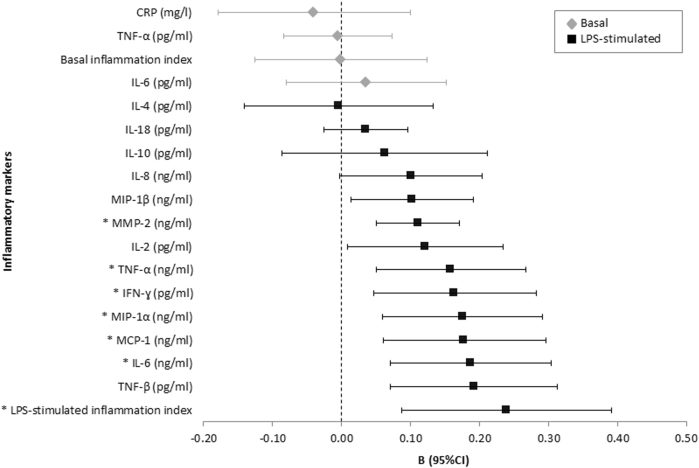
Although depression with anxious distress appears to be a clinically relevant subtype of major depressive disorder (MDD), whether it involves specific pathophysiology remains unclear. Inflammation has been implicated, but not comprehensively studied. We examined within a large MDD sample whether anxious distress and related anxiety features are associated with differential basal inflammation and innate cytokine production capacity. Data are from 1078 MDD patients from the Netherlands Study of Depression and Anxiety. In addition to the DSM-5 anxious distress specifier, we studied various dimensional anxiety scales (e.g. Inventory of Depressive Symptomatology anxiety arousal subscale [IDS-AA], Beck Anxiety Inventory [BAI], Mood and Anxiety Symptoms Questionnaire Anxious Arousal scale [MASQ-AA]). The specifier was constructed using five self-report items from the IDS and BAI. Basal inflammatory markers included C-reactive protein (CRP), interleukin (IL)-6 and tumor necrosis factor (TNF)-α. Innate production capacity was assessed by 13 lipopolysaccharide (LPS)-stimulated inflammatory markers. Basal and LPS-stimulated inflammation index scores were created. Basal inflammation was not associated with anxious distress (prevalence = 54.3%) in MDD patients, except for a modest positive association for BAI score. However, anxious distress was associated with higher LPS-stimulated levels (interferon-γ, IL-6, monocyte chemotactic protein (MCP)-1, macrophage inflammatory protein (MIP)-1α, matrix metalloproteinase (MMP)-2, TNF-α, LPS-stimulated index). Other anxiety indicators (anxious distress specifier score, BAI, MASQ-AA) were also associated with increased innate production capacity. Within a large MDD sample, the anxious distress specifier was associated with increased innate cytokine production capacity but not with basal inflammation. Results from dimensional anxiety indicators largely confirm these results. These findings provide new insight into the pathophysiology of anxious depression.
Overview
The claims and statistics of this paper haven’t been checked yet.
Free: it reads the open-access text and checks the first 5 claims that cite a source we can check. Create a free account to check every claim.
Integrity signals
Registry
Cites
Statistics
Figures
Verification
Claims the paper makes
The claims and statistics of this paper haven’t been checked yet.
Free: it reads the open-access text and checks the first 5 claims that cite a source we can check. Create a free account to check every claim.
Claims other papers make about this one
Each is checked against this paper’s own text: does it say what the citing paper says it does?
The cited source says what the claim attributes to it.
In the citing paper
“Depression with anxious distress is a clinically relevant subtype of MDD associated with higher levels of lipopolysaccharide-stimulated inflammatory markers, including MIP-1α [185].”
From Selected biomarkers of depression: what are the effects of cytokines and inflammation (2022) · cites this paper as [185]
In the citing paper
“neuroinflammation has recently been recognized as a potential pathophysiological mechanism contributing to the onset and/or maintenance at least in subgroups of anxiety patients, opening the possibility to propose immune-targeting interventions as complementary or alternative routes of treatment (Furtado & Katzman, 2015;Gaspersz et al., 2017;Kim & Jeon, 2018).”
From Novel pharmacological targets in drug development for the treatment of anxiety and anxiety-related disorders (2019) · cites this paper as Gaspersz et al., 2017
Self-check
Percentages, sums and reported differences re-computed from the paper’s own numbers.
The self-check needs the paper’s full text.
Citations
Cites
International physical activity questionnaire: 12-country reliability and validity
CRAIG, C. L., MARSHALL, A. L., SJ??STR??M, M., BAUMAN, A. E., BOOTH, M. L., AINSWORTH, B. E., PRATT, M., EKELUND, U., YNGVE, A., SALLIS, J. F., et al. (2003) · Medicine & Science in Sports & Exercise · doi:10.1249/01.mss.0000078924.61453.fb · Cited by 21,619
An inventory for measuring clinical anxiety: Psychometric properties.
Beck, A. T., Epstein, N., Brown, G., & Steer, R. A. (1988) · Journal of Consulting and Clinical Psychology · doi:10.1037/0022-006x.56.6.893 · Cited by 14,407
The control of the false discovery rate in multiple testing under dependency
Benjamini, Y., & Yekutieli, D. (2001) · The Annals of Statistics · doi:10.1214/aos/1013699998 · Cited by 10,490
Molecular Mechanisms of Depression: Perspectives on New Treatment Strategies
Lang, U. E., & Borgwardt, S. (2013) · Cellular Physiology and Biochemistry · doi:10.1159/000350094 · Cited by 8,475
Development and validation of the Penn State Worry Questionnaire
Meyer, T. J., Miller, M. L., Metzger, R. L., & Borkovec, T. D. (1990) · Behaviour Research and Therapy · doi:10.1016/0005-7967(90)90135-6 · Cited by 5,099
A Meta-Analysis of Cytokines in Major Depression
Dowlati, Y., Herrmann, N., Swardfager, W., Liu, H., Sham, L., Reim, E. K., & Lanctôt, K. L. (2010) · Biological Psychiatry · doi:10.1016/j.biopsych.2009.09.033 · Cited by 4,729
Overweight, Obesity, and Depression: A Systematic Review and Meta-analysis of Longitudinal Studies
Luppino, F. S., de Wit, L. M., Bouvy, P. F., Stijnen, T., Cuijpers, P., Penninx, B. W. J. H., & Zitman, F. G. (2010) · Archives of General Psychiatry · doi:10.1001/archgenpsychiatry.2010.2 · Cited by 4,322
Self-citationThe role of inflammation in depression: from evolutionary imperative to modern treatment target
Miller, A. H., & Raison, C. L. (2016) · Nature Reviews Immunology · doi:10.1038/nri.2015.5 · Cited by 3,942
Inflammation and Its Discontents: The Role of Cytokines in the Pathophysiology of Major Depression
Miller, A. H., Maletic, V., & Raison, C. L. (2009) · Biological Psychiatry · doi:10.1016/j.biopsych.2008.11.029 · Cited by 3,848
Rush, A. J., Trivedi, M. H., Ibrahim, H. M., Carmody, T. J., Arnow, B., Klein, D. N., Markowitz, J. C., Ninan, P. T., Kornstein, S., Manber, R., et al. (2003) · Biological Psychiatry · doi:10.1016/s0006-3223(02)01866-8 · Cited by 3,829
Associations of depression with C-reactive protein, IL-1, and IL-6: a meta-analysis.
Howren, M. B., Lamkin, D. M., & Suls, J. (2009) · Psychosomatic Medicine · doi:10.1097/psy.0b013e3181907c1b · Cited by 2,766
Inflammasomes in health and disease
Strowig, T., Henao-Mejia, J., Elinav, E., & Flavell, R. (2012) · Nature · doi:10.1038/nature10759 · Cited by 2,230
The Inventory of Depressive Symptomatology (IDS): Psychometric properties
Rush, A. J., Gullion, C. M., Basco, M. R., Jarrett, R. B., & Trivedi, M. H. (1996) · Psychological Medicine · doi:10.1017/s0033291700035558 · Cited by 2,177
Brief standard self-rating for phobic patients
Marks, I. M., & Mathews, A. M. (1979) · Behaviour Research and Therapy · doi:10.1016/0005-7967(79)90041-x · Cited by 1,801
Raison, C. L., Rutherford, R. E., Woolwine, B. J., Shuo, C., Schettler, P., Drake, D. F., Haroon, E., & Miller, A. H. (2013) · JAMA Psychiatry · doi:10.1001/2013.jamapsychiatry.4 · Cited by 1,617
CRP, IL-6 and depression: a systematic review and meta-analysis of longitudinal studies.
Valkanova, V., Ebmeier, K. P., & Allan, C. L. (2013) · Journal of Affective Disorders · doi:10.1016/j.jad.2013.06.004 · Cited by 972
Liu, Y., Ho, R. C.-M., & Mak, A. (2012) · Journal of Affective Disorders · doi:10.1016/j.jad.2011.08.003 · Cited by 948
Köhler, O., Benros, M. E., Nordentoft, M., Farkouh, M. E., Iyengar, R. L., Mors, O., & Krogh, J. (2014) · JAMA Psychiatry · doi:10.1001/jamapsychiatry.2014.1611 · Cited by 941
The Netherlands Study of Depression and Anxiety (NESDA): rationale, objectives and methods
Penninx, B. W. J. H., Beekman, A. T. F., Smit, J. H., Zitman, F. G., Nolen, W. A., Spinhoven, P., Cuijpers, P., De Jong, P. J., Van Marwijk, H. W. J., Assendelft, W. J. J., et al. (2008) · International Journal of Methods in Psychiatric Research · doi:10.1002/mpr.256 · Cited by 927
Self-citationFava, M., Rush, A. J., Alpert, J. E., Balasubramani, G. K., Wisniewski, S. R., Carmin, C. N., Biggs, M. M., Zisook, S., Leuchter, A., Howland, R., et al. (2008) · American Journal of Psychiatry · doi:10.1176/appi.ajp.2007.06111868 · Cited by 927
Miller, A. H., Haroon, E., Raison, C. L., & Felger, J. C. (2013) · Depression and Anxiety · doi:10.1002/da.22084 · Cited by 892
Beyond Bonferroni: Less conservative analyses for conservation genetics
Narum, S. R. (2006) · Conservation Genetics · doi:10.1007/s10592-005-9056-y · Cited by 862
Penninx, B. W., Milaneschi, Y., Lamers, F., & Vogelzangs, N. (2013) · BMC Medicine · doi:10.1186/1741-7015-11-129 · Cited by 839
Self-citationGenetic influence on cytokine production and fatal meningococcal disease
Westendorp, R. G., Langermans, J. A., Huizinga, T. W., Elouali, A. H., Verweij, C. L., Boomsma, D. I., & Vandenbrouke, J. P. (1997) · The Lancet · doi:10.1016/s0140-6736(96)06413-6 · Cited by 800
Beyond Bonferroni: less conservative analyses for conservation genetics
Narum, S. R. (2006) · Conservation Genetics · doi:10.1007/s10592-006-9189-7 · Cited by 786
An autonomic flexibility–neurovisceral integration model of anxiety and cardiac vagal tone
Friedman, B. H. (2007) · Biological Psychology · doi:10.1016/j.biopsycho.2005.08.009 · Cited by 739
Inflammation and clinical response to treatment in depression: A meta-analysis
Strawbridge, R., Arnone, D., Danese, A., Papadopoulos, A., Herane Vives, A., & Cleare, A. J. (2015) · European Neuropsychopharmacology · doi:10.1016/j.euroneuro.2015.06.007 · Cited by 666
The inflammasome: Pathways linking psychological stress, depression, and systemic illnesses
Iwata, M., Ota, K. T., & Duman, R. S. (2013) · Brain, Behavior, and Immunity · doi:10.1016/j.bbi.2012.12.008 · Cited by 580
Inflammasome signaling affects anxiety- and depressive-like behavior and gut microbiome composition
Wong, M.-L., Inserra, A., Lewis, M. D., Mastronardi, C. A., Leong, L., Choo, J., Kentish, S., Xie, P., Morrison, M., Wesselingh, S. L., et al. (2016) · Molecular Psychiatry · doi:10.1038/mp.2016.46 · Cited by 568
Anxiety disorders and inflammation in a large adult cohort
Vogelzangs, N., Beekman, A. T. F., de Jonge, P., & Penninx, B. W. J. H. (2013) · Translational Psychiatry · doi:10.1038/tp.2013.27 · Cited by 458
Self-citationC-Reactive Protein: An Activator of Innate Immunity and a Modulator of Adaptive Immunity
Du Clos, T. W., & Mold, C. (2004) · Immunologic Research · doi:10.1385/ir:30:3:261 · Cited by 407
Pariante, C. M. (2017) · European Neuropsychopharmacology · doi:10.1016/j.euroneuro.2017.04.001 · Cited by 382
Duivis, H. E., Vogelzangs, N., Kupper, N., de Jonge, P., & Penninx, B. W. J. H. (2013) · Psychoneuroendocrinology · doi:10.1016/j.psyneuen.2013.01.002 · Cited by 282
Self-citationThe relationship between heart rate variability and inflammatory markers in cardiovascular diseases
Haensel, A., Mills, P. J., Nelesen, R. A., Ziegler, M. G., & Dimsdale, J. E. (2008) · Psychoneuroendocrinology · doi:10.1016/j.psyneuen.2008.08.007 · Cited by 281
Genetic Contributions of Inflammation to Depression
Barnes, J., Mondelli, V., & Pariante, C. M. (2017) · Neuropsychopharmacology · doi:10.1038/npp.2016.169 · Cited by 237
The psychoneuroimmunology of depression
Leonard, B. E., & Myint, A. (2009) · Human Psychopharmacology: Clinical and Experimental · doi:10.1002/hup.1011 · Cited by 236
Novick, J. S., Stewart, J. W., Wisniewski, S. R., Cook, I. A., Manev, R., Nierenberg, A. A., Rosenbaum, J. F., Shores-Wilson, K., Balasubramani, G. K., Biggs, M. M., et al. (2005) · The Journal of Clinical Psychiatry · doi:10.4088/jcp.v66n0807 · Cited by 211
van den Biggelaar, A. H. J., Gussekloo, J., de Craen, A. J. M., Frölich, M., Stek, M. L., van der Mast, R. C., & Westendorp, R. G. J. (2007) · Experimental Gerontology · doi:10.1016/j.exger.2007.01.011 · Cited by 209
Cytokine production capacity in depression and anxiety
Vogelzangs, N., de Jonge, P., Smit, J. H., Bahn, S., & Penninx, B. W. (2016) · Translational Psychiatry · doi:10.1038/tp.2016.92 · Cited by 193
Self-citationWardenaar, K. J., van Veen, T., Giltay, E. J., de Beurs, E., Penninx, B. W. J. H., & Zitman, F. G. (2010) · Psychiatry Research · doi:10.1016/j.psychres.2009.03.005 · Cited by 192
Self-citationHeritability estimates of innate immunity: an extended twin study
de Craen, A. J. M., Posthuma, D., Remarque, E. J., van den Biggelaar, A. H. J., Westendorp, R. G. J., & Boomsma, D. I. (2005) · Genes & Immunity · doi:10.1038/sj.gene.6364162 · Cited by 188
Neuroinflammatory pathways in anxiety, posttraumatic stress, and obsessive compulsive disorders
Furtado, M., & Katzman, M. A. (2015) · Psychiatry Research · doi:10.1016/j.psychres.2015.05.036 · Cited by 173
Carvalho, L. A., Torre, J. P., Papadopoulos, A. S., Poon, L., Juruena, M. F., Markopoulou, K., Cleare, A. J., & Pariante, C. M. (2013) · Journal of Affective Disorders · doi:10.1016/j.jad.2012.10.036 · Cited by 167
Goldberg, D., & Fawcett, J. (2012) · Depression and Anxiety · doi:10.1002/da.21939 · Cited by 155 · cited 1×
“According to the DSM-5 criterion, the anxious distress specifier was present when a participant endorsed ≥2 of the following symptoms: (1) feeling keyed up or tense (IDS item 7); (2) feeling unusually restless (IDS item 24); (3) difficulty concentrating because of worry (IDS item 15); (4) fear that something awful mig…”
BackgroundNEUROBIOLOGY OF ANXIOUS DEPRESSION: A REVIEW: Review: Neurobiology of Anxious Depression
Ionescu, D. F., Niciu, M. J., Mathews, D. C., Richards, E. M., & Zarate, C. A. (2013) · Depression and Anxiety · doi:10.1002/da.22095 · Cited by 139
Cattaneo, A., Ferrari, C., Uher, R., Bocchio-Chiavetto, L., Riva, M. A., the MRC ImmunoPsychiatry Consortium, & Pariante, C. M. (2016) · International Journal of Neuropsychopharmacology · doi:10.1093/ijnp/pyw045 · Cited by 132
van der Linden, M. W., Huizinga, T. W. J., Stoeken, D.-J., Sturk, A., & Westendorp, R. G. J. (1998) · Journal of Immunological Methods · doi:10.1016/s0022-1759(98)00108-2 · Cited by 130
Liukkonen, T., Räsänen, P., Jokelainen, J., Leinonen, M., Järvelin, M.-R., Meyer-Rochow, V. B., & Timonen, M. (2011) · European Psychiatry · doi:10.1016/j.eurpsy.2011.02.001 · Cited by 127
Clinical and Demographic Factors Associated With DSM-IV Melancholic Depression
Khan, A. Y., Carrithers, J., Preskorn, S. H., Lear, R., Wisniewski, S. R., Rush, A. J., Stegman, D., Kelley, C., Kreiner, K., Nierenberg, A. A., et al. (2006) · Annals of Clinical Psychiatry · doi:10.1080/10401230600614496 · Cited by 125
Defining anxious depression: a review of the literature
Ionescu, D. F., Niciu, M. J., Henter, I. D., & Zarate, C. A. (2013) · CNS Spectrums · doi:10.1017/s1092852913000114 · Cited by 119
Wardenaar, K. J., van Veen, T., Giltay, E. J., den Hollander-Gijsman, M. E., Penninx, B. W. J. H., & Zitman, F. G. (2010) · Journal of Affective Disorders · doi:10.1016/j.jad.2009.12.020 · Cited by 109
Self-citationDistinctive clinical characteristics and suicidal tendencies of patients with anxious depression
Seo, H.-J., Jung, Y.-E., Kim, T.-S., Kim, J.-B., Lee, M.-S., Kim, J.-M., Lim, H.-W., & Jun, T.-Y. (2011) · Journal of Nervous & Mental Disease · doi:10.1097/nmd.0b013e3182043b60 · Cited by 94 · cited 1×
“According to the DSM-5 criterion, the anxious distress specifier was present when a participant endorsed ≥2 of the following symptoms: (1) feeling keyed up or tense (IDS item 7); (2) feeling unusually restless (IDS item 24); (3) difficulty concentrating because of worry (IDS item 15); (4) fear that something awful mig…”
BackgroundGaspersz, R., Lamers, F., Kent, J. M., Beekman, A. T. F., Smit, J. H., van Hemert, A. M., Schoevers, R. A., & Penninx, B. W. J. H. (2017) · The Journal of Clinical Psychiatry · doi:10.4088/jcp.15m10221 · Cited by 88 · cited 1×
“According to the DSM-5 criterion, the anxious distress specifier was present when a participant endorsed ≥2 of the following symptoms: (1) feeling keyed up or tense (IDS item 7); (2) feeling unusually restless (IDS item 24); (3) difficulty concentrating because of worry (IDS item 15); (4) fear that something awful mig…”
BackgroundSelf-citationGaspersz, R., Lamers, F., Kent, J. M., Beekman, A. T. F., Smit, J. H., van Hemert, A. M., Schoevers, R. A., & Penninx, B. W. J. H. (2017) · Journal of Psychiatric Research · doi:10.1016/j.jpsychires.2016.09.018 · Cited by 88
Self-citationAlmeida, O. P., Norman, P. E., Allcock, R., Bockxmeer, F. V., Hankey, G. J., Jamrozik, K., & Flicker, L. (2009) · International Journal of Epidemiology · doi:10.1093/ije/dyp199 · Cited by 80
Wu, Z., Chen, J., Yuan, C., Hong, W., Peng, D., Zhang, C., Cao, L., & Fang, Y. (2013) · Journal of Affective Disorders · doi:10.1016/j.jad.2013.03.012 · Cited by 77
McIntyre, R. S., Woldeyohannes, H. O., Soczynska, J. K., Vinberg, M., Cha, D. S., Lee, Y., Gallaugher, L. A., Dale, R. S., Alsuwaidan, M. T., Mansur, R. B., et al. (2016) · Therapeutic Advances in Chronic Disease · doi:10.1177/2040622315627805 · Cited by 63
Pharmacologic Treatment of Dimensional Anxious Depression: A Review
Ionescu, D. F., Niciu, M. J., Richards, E. M., & Zarate, C. A. (2014) · The Primary Care Companion For CNS Disorders · doi:10.4088/pcc.13r01621 · Cited by 56
Comorbid anxiety increases cognitive control activation in Major Depressive Disorder: Crane et al.
Crane, N. A., Jenkins, L. M., Dion, C., Meyers, K. K., Weldon, A. L., Gabriel, L. B., Walker, S. J., Hsu, D. T., Noll, D. C., Klumpp, H., et al. (2016) · Depression and Anxiety · doi:10.1002/da.22541 · Cited by 51
Anxious-depressive comorbidity: effects on HPA axis and CNS noradrenergic functions.
Cameron, O. G. (2006) · PubMed · Cited by 44
Is anxious-depression an inflammatory state?
Camacho, Á. (2013) · Medical Hypotheses · doi:10.1016/j.mehy.2013.07.006 · Cited by 39
Baek, J. H., Kim, H., Fava, M., Mischoulon, D., Papakostas, G. I., Nierenberg, A. A., Heo, J.-Y., & Jeon, H. J. (2016) · Psychiatry Investigation · doi:10.4306/pi.2016.13.3.321 · Cited by 38
Haarala, A., Kähönen, M., Eklund, C., Jylhävä, J., Koskinen, T., Taittonen, L., Huupponen, R., Lehtimäki, T., Viikari, J., Raitakari, O. T., et al. (2011) · European Journal of Clinical Investigation · doi:10.1111/j.1365-2362.2011.02485.x · Cited by 35
Ionescu, D. F., Nugent, A. C., Luckenbaugh, D. A., Niciu, M. J., Richards, E. M., Zarate, C. A., & Furey, M. L. (2015) · Acta Neuropsychiatrica · doi:10.1017/neu.2014.46 · Cited by 34
Baek, J. H., Heo, J., Fava, M., Mischoulon, D., Nierenberg, A. A., Hong, J. P., Roh, S.-W., & Jeon, H. J. (2015) · Journal of Affective Disorders · doi:10.1016/j.jad.2015.08.006 · Cited by 33 · cited 1×
“According to the DSM-5 criterion, the anxious distress specifier was present when a participant endorsed ≥2 of the following symptoms: (1) feeling keyed up or tense (IDS item 7); (2) feeling unusually restless (IDS item 24); (3) difficulty concentrating because of worry (IDS item 15); (4) fear that something awful mig…”
BackgroundShim, I. H., Woo, Y. S., & Bahk, W. (2016) · General Hospital Psychiatry · doi:10.1016/j.genhosppsych.2016.07.003 · Cited by 31
CRH challenge test in anxious depression
Meller, W. H., Kathol, R. G., Samuelson, S. D., Gehris, T. L., Carroll, B. T., Pitts, A. F., & Clayton, P. J. (1995) · Biological Psychiatry · doi:10.1016/0006-3223(94)00132-m · Cited by 30
SUICIDE AND ANXIETY IN DSM-5: The Cutting Edge: Suicide and Anxiety in DSM-5
Fawcett, J. (2013) · Depression and Anxiety · doi:10.1002/da.22058 · Cited by 18 · cited 1×
“According to the DSM-5 criterion, the anxious distress specifier was present when a participant endorsed ≥2 of the following symptoms: (1) feeling keyed up or tense (IDS item 7); (2) feeling unusually restless (IDS item 24); (3) difficulty concentrating because of worry (IDS item 15); (4) fear that something awful mig…”
Background
Cited by
Immune targets for therapeutic development in depression: towards precision medicine
Drevets, W. C., Wittenberg, G. M., Bullmore, E. T., & Manji, H. K. (2022) · Nature Reviews Drug Discovery · doi:10.1038/s41573-021-00368-1 · Cited by 348
Self-citationComorbid Anxiety and Depression: Clinical and Conceptual Consideration and Transdiagnostic Treatment
Choi, K. W., Kim, Y.-K., & Jeon, H. J. (2020) · Advances in Experimental Medicine and Biology · doi:10.1007/978-981-32-9705-0_14 · Cited by 304
Selected biomarkers of depression: what are the effects of cytokines and inflammation
Harsanyi, S., Kupcova, I., Danisovic, L., & Klein, M. (2022) · International Journal of Molecular Sciences · doi:10.3390/ijms24010578 · Cited by 299
Sartori, S. B., & Singewald, N. (2019) · Pharmacology & Therapeutics · doi:10.1016/j.pharmthera.2019.107402 · Cited by 236
Inflammation-Related Functional and Structural Dysconnectivity as a Pathway to Psychopathology
Goldsmith, D. R., Bekhbat, M., Mehta, N. D., & Felger, J. C. (2023) · Biological Psychiatry · doi:10.1016/j.biopsych.2022.11.003 · Cited by 214
“between CRP/cytokines and anxiety (62-64), including longitudinally (65) and depression (66).”
Metadata
- Authors
- Gaspersz, R., Lamers, F., Wittenberg, G., Beekman, A. T. F., van Hemert, A. M., Schoevers, R. A., & Penninx, B. W. J. H.
- Affiliations
- Amsterdam Public Health (NL)
- Amsterdam UMC Location Vrije Universiteit Amsterdam (NL)
- University Medical Center Groningen (NL)
- Corresponding author
- Gaspersz, Roxanne
- ORCID
- Venue
- Translational Psychiatry
- Published
- 2017-12-08
- Volume
- 7
- Issue
- 12
- Pages
- 1268-1268
- ISSN
- 2158-3188 (ISSN-L)
- PMC
- PMC5802575
- OpenAlex
- W2773099978
- Cited by
- 71
- References
- 68
- Citations by year
- 2026: 5 · 2025: 8 · 2024: 12 · 2023: 8 · 2022: 10 · 2021: 9 · 2020: 6 · 2019: 9 · 2018: 4
- FWCI
- 1.73
- Type
- journal article
- Language
- en
- Open access
- gold
- doi.org
- Licence
- cc-by
- creativecommons.org/licenses/by/4.0 (tdm)
- creativecommons.org/licenses/by/4.0 (vor)
- Locations
- Translational Psychiatry (publishedVersion, cc-by)
- PubMed Central (publishedVersion, cc-by)
- PubMed (publishedVersion)
- Amsterdam UMC (VU Amsterdam) - Institutional Repository (publishedVersion)
- Leiden Repository (Leiden University) (submittedVersion)
- Data Archiving and Networked Services (DANS) (submittedVersion, other-oa)
- DOAJ (DOAJ: Directory of Open Access Journals) (submittedVersion)
- Pure Amsterdam UMC (submittedVersion, other-oa)
- University of Groningen research database (University of Groningen / Centre for Information Technology) (submittedVersion, cc-by)
- Data Archiving and Networked Services (DANS) (submittedVersion)
- Funders
- Universiteit Leiden (10‐000‐1002)
- ZonMw (10‐000‐1002)
- Vrije Universiteit Amsterdam
- Topics
- Life Sciences › Neuroscience › Biological Psychiatry › Tryptophan and brain disorders
- Life Sciences › Neuroscience › Behavioral Neuroscience › Stress Responses and Cortisol
- Health Sciences › Medicine › Pharmacology (medical) › Treatment of Major Depression
- Keywords
- major depressive disorder, anxious distress, anxious depression, immune dysregulation, inflammation, lipopolysaccharide stimulation, C-reactive protein, interleukin-6, TNF-α, interferon-gamma, depression pathophysiology
- MeSH terms
- Adult, Anxiety, Major Depressive Disorder, Female, Humans, Immune System, Inflammation, Male, Middle Aged, Tumor Necrosis Factor-alpha, Interleukin-6
About these checks
Registry, retraction, Cites and statistics results are computed, not judged, with one exception: a printed reference that no index lists is read once by a model before it counts as a citation error. Claims are extracted by a model and kept only when their quote appears verbatim in the text; each cited source is then checked, with a model’s help, for whether it says what the claim relies on. Those verdicts can be wrong — read the claim’s quote and the cited source before relying on one.
Statistics and arithmetic are recomputed, not judged.
Confidence bands are shown only for fields calibrated on our annotated test set. None is calibrated yet, so no band is shown.
What counts as a claim ›How we measure confidence ›How we check this ›
Are you an author, or do you see a problem with this page? Request a review
Data sources
Bibliographic data: Semantic Scholar, OpenAlex, Crossref.
Contains information from the Semantic Scholar Academic Graph Datasets, made available under the ODC Attribution License (ODC-BY 1.0).
Semantic Scholar’s data is described in: Kinney, R., et al. (2023). The Semantic Scholar Open Data Platform. arXiv:2301.10140.
