

Genome-wide DNA methylation comparison between live human brain and peripheral tissues within individuals
Open accessThe DOI matches its Crossref record; 36 of the 36 references it cites were found in a registry or an index.
Abstract
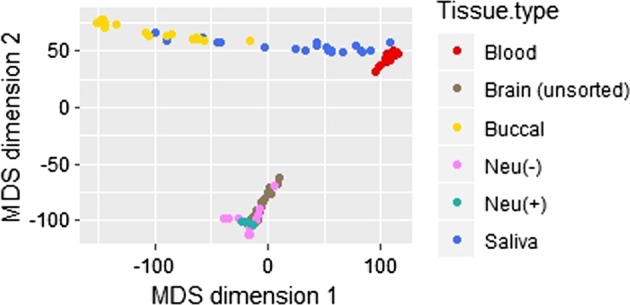
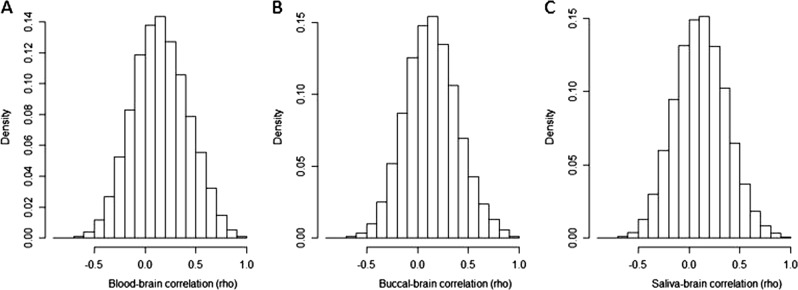
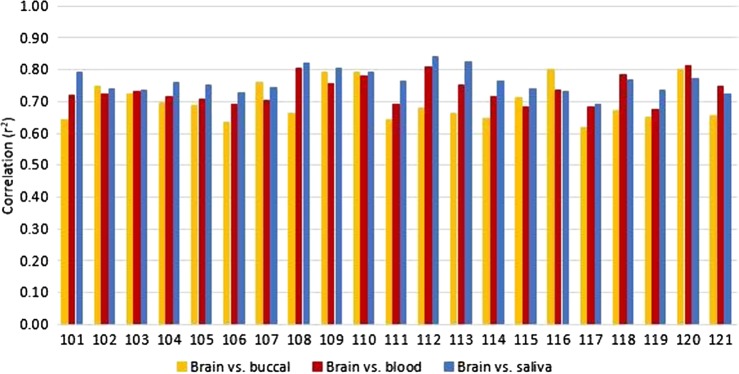
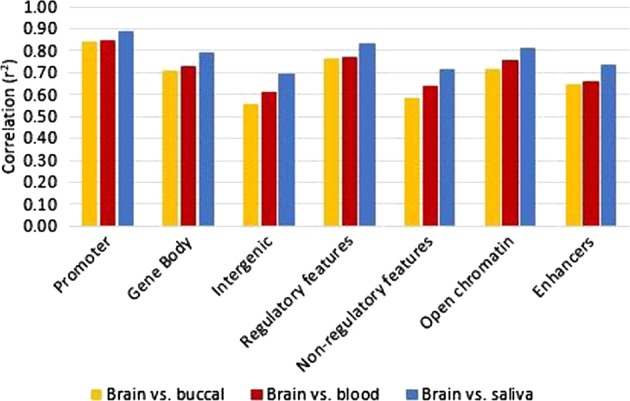
Differential DNA methylation in the brain is associated with many psychiatric diseases, but access to brain tissues is essentially limited to postmortem samples. The use of surrogate tissues has become common in identifying methylation changes associated with psychiatric disease. In this study, we determined the extent to which peripheral tissues can be used as surrogates for DNA methylation in the brain. Blood, saliva, buccal, and live brain tissue samples from 27 patients with medically intractable epilepsy undergoing brain resection were collected (age range 5–61 years). Genome-wide methylation was assessed with the Infinium HumanMethylation450 ( n = 12) and HumanMethylationEPIC BeadChip arrays ( n = 21). For the EPIC methylation data averaged for each CpG across subjects, the saliva–brain correlation ( r = 0.90) was higher than that for blood–brain (r = 0.86) and buccal–brain ( r = 0.85) comparisons. However, within individual CpGs, blood had the highest proportion of CpGs correlated to brain at nominally significant levels (20.8%), as compared to buccal tissue (17.4%) and saliva (15.1%). For each CpG and each gene, levels of brain-peripheral tissue correlation varied widely. This indicates that to determine the most useful surrogate tissue for representing brain DNA methylation, the patterns specific to the genomic region of interest must be considered. To assist in that objective, we have developed a website, IMAGE-CpG, that allows researchers to interrogate DNA methylation levels and degree of cross-tissue correlation in user-defined locations across the genome.
Overview
The claims and statistics of this paper haven’t been checked yet.
Free: it reads the open-access text and checks the first 5 claims that cite a source we can check. Create a free account to check every claim.
Integrity signals
Registry
Cites
Statistics
Figures
Verification
Claims the paper makes
The claims and statistics of this paper haven’t been checked yet.
Free: it reads the open-access text and checks the first 5 claims that cite a source we can check. Create a free account to check every claim.
Claims other papers make about this one
Each is checked against this paper’s own text: does it say what the citing paper says it does?
The source backs part of the claim, not all of it — or backs it for a different population, condition or comparison.
In the citing paper
“However, at the individual CpG level, correlations for all peripheral tissues were only nominally significantly correlated with brain tissue.”
From Epigenetics and depression (2019) · cites this paper as [33]
Experimental — accuracy not yet measuredThe source backs part of the claim, not all of it — or backs it for a different population, condition or comparison.
In the citing paper
“overlap in DNA methylation levels measured in saliva, buccal cells and blood is limited”
From The applied implications of epigenetics in anxiety, affective and stress-related disorders - A review and synthesis on psychosocial stress, psychotherapy and prevention (2020) · cites this paper as Braun et al., 2019
Experimental — accuracy not yet measuredThe source backs part of the claim, not all of it — or backs it for a different population, condition or comparison.
In the citing paper
“Still, it may be useful in developing biomarkers of disease and treatment response.98”
From Epigenetic regulation in major depression and other stress-related disorders: molecular mechanisms, clinical relevance and therapeutic potential (2023) · cites this paper as [98]
Experimental — accuracy not yet measuredThe cited source says what the claim attributes to it.
In the citing paper
“a recent study performed genome-wide methylation assays on blood, brain, saliva, and buccal samples and found that cross-tissue correlation strength was highly region-specific, with the correlation coefficient varying widely for different CpGs.”
From Epigenetics and depression (2019) · cites this paper as [33]
The cited source says what the claim attributes to it.
In the citing paper
“it has been suggested that DNA methylation patterns in saliva may be closer to that of brain tissue than DNA methylation in blood or buccal cells (Braun et al., 2019;Lowe et al., 2013;Smith et al., 2015).”
From The applied implications of epigenetics in anxiety, affective and stress-related disorders - A review and synthesis on psychosocial stress, psychotherapy and prevention (2020) · cites this paper as Braun et al., 2019
4 more claims about this paper
Create a free account to see every claim other papers make about this one.
Self-check
Percentages, sums and reported differences re-computed from the paper’s own numbers.
The self-check needs the paper’s full text.
Citations
Cites
Biological insights from 108 schizophrenia-associated genetic loci
Schizophrenia Working Group of the Psychiatric Genomics Consortium (2014) · Nature · doi:10.1038/nature13595 · Cited by 7,577
Aryee, M. J., Jaffe, A. E., Corrada-Bravo, H., Ladd-Acosta, C., Feinberg, A. P., Hansen, K. D., & Irizarry, R. A. (2014) · Bioinformatics · doi:10.1093/bioinformatics/btu049 · Cited by 4,397
eQTLGen, Wray, N. R., 23andMe, the Major Depressive Disorder Working Group of the Psychiatric Genomics Consortium, Ripke, S., Mattheisen, M., Trzaskowski, M., Byrne, E. M., Abdellaoui, A., Adams, M. J., et al. (2018) · Nature Genetics · doi:10.1038/s41588-018-0090-3 · Cited by 3,005
cocor: A Comprehensive Solution for the Statistical Comparison of Correlations
Diedenhofen, B., & Musch, J. (2015) · PLOS ONE · doi:10.1371/journal.pone.0121945 · Cited by 1,919
Teschendorff, A. E., Marabita, F., Lechner, M., Bartlett, T., Tegner, J., Gomez-Cabrero, D., & Beck, S. (2013) · Bioinformatics · doi:10.1093/bioinformatics/bts680 · Cited by 1,683
Protoplasmic Astrocytes in CA1 Stratum Radiatum Occupy Separate Anatomical Domains
Bushong, E. A., Martone, M. E., Jones, Y. Z., & Ellisman, M. H. (2002) · The Journal of Neuroscience · doi:10.1523/jneurosci.22-01-00183.2002 · Cited by 1,578
Genome-wide association study identifies 30 loci associated with bipolar disorder
eQTLGen Consortium, Stahl, E. A., BIOS Consortium, the Bipolar Disorder Working Group of the Psychiatric Genomics Consortium, Breen, G., Forstner, A. J., McQuillin, A., Ripke, S., Trubetskoy, V., Mattheisen, M., et al. (2019) · Nature Genetics · doi:10.1038/s41588-019-0397-8 · Cited by 1,519
Self-citationLow-level processing of Illumina Infinium DNA Methylation BeadArrays
Triche, T. J., Weisenberger, D. J., Van Den Berg, D., Laird, P. W., & Siegmund, K. D. (2013) · Nucleic Acids Research · doi:10.1093/nar/gkt090 · Cited by 905
Preprocessing, normalization and integration of the Illumina HumanMethylationEPIC array with minfi
Fortin, J.-P., Triche, T. J., & Hansen, K. D. (2017) · Bioinformatics · doi:10.1093/bioinformatics/btw691 · Cited by 865
Aging effects on DNA methylation modules in human brain and blood tissue
Horvath, S., Zhang, Y., Langfelder, P., Kahn, R. S., Boks, M. P., van Eijk, K., van den Berg, L. H., & Ophoff, R. A. (2012) · Genome Biology · doi:10.1186/gb-2012-13-10-r97 · Cited by 645
Cited by
Items 101–200 of 472
Lüth, T., Laß, J., Schaake, S., Wohlers, I., Pozojevic, J., Jamora, R. D. G., Rosales, R. L., Brüggemann, N., Saranza, G., Diesta, C. C. E., et al. (2022) · Genes · doi:10.3390/genes13010126 · Cited by 22
Social Environment and Epigenetics
Merrill, S. M., Gladish, N., & Kobor, M. S. (2019) · Current topics in behavioral neurosciences · doi:10.1007/7854_2019_114 · Cited by 25
Epigenome-wide association study of seizures in childhood and adolescence
Caramaschi, D., Hatcher, C., Mulder, R. H., Felix, J. F., Cecil, C. A. M., Relton, C. L., & Walton, E. (2020) · Clinical Epigenetics · doi:10.1186/s13148-019-0793-z · Cited by 23
Gujar, H., Mehta, A., Li, H., Tsai, Y., Qiu, X., Weisenberger, D. J., Jasiulionis, M. G., In, G. K., & Liang, G. (2021) · Genome Medicine · doi:10.1186/s13073-021-00946-3 · Cited by 24
“GSE111165 for epilepsy brain tissue DNA methylation data [111].”
BackgroundAssociation between maternal depression during pregnancy and newborn DNA methylation
Drzymalla, E., Gladish, N., Koen, N., Epstein, M. P., Kobor, M. S., Zar, H. J., Stein, D. J., & Hüls, A. (2021) · Translational Psychiatry · doi:10.1038/s41398-021-01697-w · Cited by 24
Robakis, T. K., Roth, M. C., King, L. S., Humphreys, K. L., Ho, M., Zhang, X., Chen, Y., Li, T., Rasgon, N., Watson, K. T., et al. (2022) · Molecular Psychiatry · doi:10.1038/s41380-022-01592-w · Cited by 22
Sarnowski, C., Huan, T., Ma, Y., Joehanes, R., Beiser, A., DeCarli, C. S., Heard‐Costa, N. L., Levy, D. A., Lin, H., Liu, C., et al. (2023) · Clinical Epigenetics · doi:10.1186/s13148-023-01589-4 · Cited by 24
“Using IMAGE-CpG browser[44] (Additional file 1: Table S17), we detect significant positive correlations of DNA methylation in live human brain and blood cells for cg27640302– TIMM10 (450 K, r = 0.75), cg15150970– DNMT3A ( r = 0.53), cg12729894– CTSD ( r = 0.55), cg11024682– SREBF1 ( r = 0.46), and…”
BackgroundInfluentialZheng, J., Womer, F. Y., Tang, L., Guo, H., Zhang, X., Tang, Y., & Wang, F. (2024) · Translational Psychiatry · doi:10.1038/s41398-023-02724-8 · Cited by 22
“…in MDD. Additionally, the moderate correlation between peripheral DNA methylation and brain DNA methylation indicates that peripheral DNA methylation could be used as a proxy for brain DNA methylation, providing a more accessible and cost-effective method for epigenomic analysis [11, 31, 32].”
MethodBonham, L. W., Sirkis, D. W., Pang, A. P. S., Sugrue, L. P., Santamaría‐García, H. A., Ibáñez, A. M., Miller, B. L., Yokoyama, J. S., Corley, M. J., & Initiative, A. D. N. (2025) · npj Dementia · doi:10.1038/s44400-025-00007-1 · Cited by 27
“However, data from multiple studies has shown that peripheral blood methylation changes are a reasonable proxy for the brain with r > 0.85 21,22 and may also provide additional AD-relevant data about immune function as well as cardiovascular and metabolic disease.”
InfluentialCullell, N., Soriano‐Tárraga, C., Gallego-Fábrega, C., Cárcel‐Márquez, J., Muiño, E., Llucià‐Carol, L., Lledós, M., Esteller, M., de Moura, M. C., Montaner, J., et al. (2022) · Clinical Epigenetics · doi:10.1186/s13148-022-01340-5 · Cited by 21
“86 correlation in global methylation [66].”
A systematic assessment of cell type deconvolution algorithms for DNA methylation data
Song, J., & Kuan, P. F. (2022) · Briefings in Bioinformatics · doi:10.1093/bib/bbac449 · Cited by 21
Lu, A. K.-M., Lin, J., Tseng, H., Wang, X., Jang, F.-L., Chen, P.-S., Huang, C. J., Hsieh, S., & Lin, S.-H. (2022) · Journal of Psychiatric Research · doi:10.1016/j.jpsychires.2022.11.008 · Cited by 21
Martz, C. D., Benner, A. D., Goosby, B. J., Mitchell, C. M., & Gaydosh, L. M. (2024) · Social Science & Medicine · doi:10.1016/j.socscimed.2024.116724 · Cited by 25
Cortical cellular diversity and development in schizophrenia
Price, A. J., Jaffe, A. E., & Weinberger, D. R. (2020) · Molecular Psychiatry · doi:10.1038/s41380-020-0775-8 · Cited by 25
“genes of interest and still suffer from heterogeneity concerns [128, 136].”
BackgroundCorvo, M. D., Bongiorni, S., Stefanon, B., Sgorlon, S., Valentini, A., Ajmone‐Marsan, P., & Chillemi, G. (2020) · Genes · doi:10.3390/genes11080850 · Cited by 25
“Third, it was previously demonstrated that methylation levels at CpG sites in leukocytes could serve as an accurate predictor of CpG site variability in other tissues, especially the brain [22,51].”
BackgroundOverbeek, G. J., Creasey, N., Wesarg, C., Huijzer-Engbrenghof, M., & Spencer, H. (2020) · New Directions for Child and Adolescent Development · doi:10.1002/cad.20362 · Cited by 27
Åsenius, F., Gorrie-Stone, T. J., Brew, A., Panchbhaya, Y., Williamson, E., Schalkwyk, L. C., Rakyan, V. K., Holland, M. L., Marzi, S. J., & Williams, D. J. (2020) · PLoS Genetics · doi:10.1371/journal.pgen.1009035 · Cited by 20
“This is slightly lower than what has been reported for comparisons of DNA methylation between whole brain and peripheral tissues [39].”
Lee, Y., Haftorn, K. L., Denault, W. R. P., Nustad, H. E., Page, C. M., Lyle, R., Lee-Ødegård, S., Moen, G.-H., Prasad, R. B., Groop, L., et al. (2020) · BMC Genomics · doi:10.1186/s12864-020-07168-8 · Cited by 25
“We validated eABEC in an extended test set consisting of the test set for ABEC and two independent cohorts (GSE111165 and GSE115278) from GEO.”
BackgroundMethodInfluentialMyers, L., Pan, P., Remnélius, K. L., Neufeld, J., Marschik, P. B., Jonsson, U., & Bölte, S. (2021) · JCPP Advances · doi:10.1111/jcv2.12017 · Cited by 21
NTRK2 methylation is related to reduced PTSD risk in two African cohorts of trauma survivors
Vukojevic, V., Coynel, D., Ghaffari, N. R., Freytag, V., Elbert, T., Kolassa, I.-T., Wilker, S., McGaugh, J. L., Papassotiropoulos, A., & de Quervain, D. J.-F. (2020) · Proceedings of the National Academy of Sciences · doi:10.1073/pnas.2008415117 · Cited by 19
“Additionally, studies that have addressed brain to periphery variation of DNA methylation suggest that a part of the methylome signatures is significantly shared across the tissues (82, 83), especially in the genomic regions that contain a high density of cytosine guanine dinucleotides, as seen in the specific region…”
BackgroundRaffetti, E., Melas, P. A., Landgren, A. J., Andersson, F., Forsell, Y., Lavebratt, C., & Galanti, M. R. (2021) · Translational Psychiatry · doi:10.1038/s41398-021-01601-6 · Cited by 25
Müller, D., Grevet, E. H., da Silva, N. A. F., Bandeira, C. E., Barbosa, E., Vitola, E. S., Charão, M. F., Linden, R., Rohde, L. A., Ramos, J. K. N., et al. (2022) · Molecular Psychiatry · doi:10.1038/s41380-022-01493-y · Cited by 23
“We assessed DNA from blood, but once brain tissues are not available for research in living subjects and the correlation of blood-brain genome-wide methylation averaged for each CpG across subjects is high [65], the use of this tissue is a common choice and can be applied to search potential biomarkers.”
Tabano, S. M., Tassi, L., Cannone, M. G., Brescia, G., Gaudioso, G., Ferrara, M., Colapietro, P., Fontana, L., Miozzo, M. R., Croci, G. A., et al. (2022) · European Archives of Psychiatry and Clinical Neuroscience · doi:10.1007/s00406-022-01472-y · Cited by 24
Everson, T. M., Kaczor, K., Makoroff, K. L., Meyers, G., Rosado, N., Charleston, E., Bertocci, G. E., Young, A., Flores, J., Lehnig, K., et al. (2023) · Pediatric Research · doi:10.1038/s41390-022-02441-w · Cited by 18
“buccal, and live brain tissue samples collected from 21 epileptic patients (ages ranged from 5 to 61 years).(20) We used Spearman’s correlations to examine whether brain DNAm was highly correlated with buccal or blood DNAm at our identified CpGs.”
MethodResultKimbrel, N. A., Garrett, M. E., Evans, M. K., Mellows, C., Dennis, M. F., Hair, L. P., Hauser, M. A., Workgroup, T. V. M.-A. M., Ashley‐Koch, A. E., & Beckham, J. C. (2023) · Frontiers in Psychiatry · doi:10.3389/fpsyt.2023.1145375 · Cited by 19
“To better understand the degree to which our top blood-based DNAm probe values might correlate with brain-based methylation values at the same CpG site, the Iowa Methylation Array Graphing for Experimental Comparison of Peripheral tissue & Gray matter [IMAGE-CpG; (36)] database was used to look up blood–brain DNAm cor…”
BackgroundMethodInfluentialSmirnova, L., Modafferi, S., Schlett, C., Osborne, L. M., Payne, J. L., & Sabunciyan, S. (2024) · Molecular Psychiatry · doi:10.1038/s41380-023-02384-6 · Cited by 21
Schizophrenia is associated with altered DNA methylation variance
Kiltschewskij, D. J., Reay, W. R., & Cairns, M. J. (2024) · Molecular Psychiatry · doi:10.1038/s41380-024-02749-5 · Cited by 24
Wiegand, A., Munk, M. H. J., Drohm, S., Fallgatter, A. J., MacIsaac, J. L., Kobor, M. S., Nieratschker, V., & Kreifelts, B. (2021) · Journal of Psychiatry and Neuroscience · doi:10.1503/jpn.210064 · Cited by 21
Sánchez‐Jiménez, P., Elizalde-Horcada, M., García, A. S., Granero‐Cremades, I., de Toledo, M., Pulido, P., Navas, M., Gago‐Veiga, A. B., Alonso, L., Alonso‐Cerezo, M. C., et al. (2023) · Molecular Neurobiology · doi:10.1007/s12035-022-03180-z · Cited by 18
Mendonça, V., Soares‐Lima, S. C., & Moreira, M. Â. M. (2024) · Communications Biology · doi:10.1038/s42003-024-06591-x · Cited by 22
DNA methylation mediates the link between adversity and depressive symptoms
Lussier, A. A., Smith, B. J., Fisher, J., Luo, M., Cerutti, J., Schneper, L. M., Smith, T., Cecil, C. A. M., Felix, J. F., Mitchell, C. M., et al. (2024) · Nature Mental Health · doi:10.1038/s44220-024-00345-8 · Cited by 26
“5), suggesting concomitant DNAm differences could potentially co-occur in central tissues 35 .”
No association between FKBP5 gene methylation and acute and long-term cortisol output
Alexander, N., Kirschbaum, C., Stalder, T., Muehlhan, M., & Vogel, S. (2020) · Translational Psychiatry · doi:10.1038/s41398-020-0846-2 · Cited by 18
Arranz, M. J., Gallego-Fabrega, C., Martín-Blanco, A., Soler, J., Elices, M., Dominguez-Clavé, E., Salazar, J., Vega, D., Briones-Buixassa, L., & Pascual, J. C. (2021) · Translational Psychiatry · doi:10.1038/s41398-020-01139-z · Cited by 17
Li, Y., Su, Z., Zhao, K., Liu, X., Chen, S., Yang, X., & Zhou, L. (2025) · Current Neuropharmacology · doi:10.2174/1570159x23666241220163832 · Cited by 20
“However, studies have found a positive correlation between the DNA methylation patterns of peripheral tissues (including blood) and brain tissue in epilepsy patients [43].”
Effects of stressful life-events on DNA methylation in panic disorder and major depressive disorder
Czamara, D., Neufang, A., Dieterle, R., Iurato, S., Arloth, J., Martins, J., Ising, M., Binder, E. B., & Erhardt, A. (2022) · Clinical Epigenetics · doi:10.1186/s13148-022-01274-y · Cited by 20
Toxicoepigenetics and Environmental Health: Challenges and Opportunities
Svoboda, L. K., Perera, B. P. U., Morgan, R. K., Polemi, K. M., Pan, J., & Dolinoy, D. C. (2022) · Chemical Research in Toxicology · doi:10.1021/acs.chemrestox.1c00445 · Cited by 17
Zong, X., Zhang, J., Li, L., Yao, T., Ma, S., Kang, L., Zhang, N., Nie, Z., Liu, Z., Zheng, J., et al. (2022) · Asian Journal of Psychiatry · doi:10.1016/j.ajp.2022.103406 · Cited by 16
Epigenome-wide DNA methylation in externalizing behaviours: A review and combined analysis
Meijer, M., Franke, B., Sandi, C., & Klein, M. (2022) · Neuroscience & Biobehavioral Reviews · doi:10.1016/j.neubiorev.2022.104997 · Cited by 25
“Attempts have been made to compare DNAm levels across different tissue sources (Braun et al., 2019; Hannon et al., 2015), which shows that DNAm profiles are highly cell type-specific (Murata et al.”
Bingen, J. M., Clark, L. V., Band, M. R., Munzir, S. I., & Carrithers, M. D. (2023) · Frontiers in Genetics · doi:10.3389/fgene.2022.1058817 · Cited by 18
“That study suggested that analysis of peripheral blood samples can detect approximately 20%–30% of differential methylation observed in live brain tissue (Braun et al., 2019).”
BackgroundEpigenome-wide association study identifies novel genes associated with ischemic stroke
Peng, H. Y., Palma‐Gudiel, H., Soriano‐Tárraga, C., Jiménez-Conde, J., Zhang, M., Zhang, Y., & Zhao, J. (2023) · Clinical Epigenetics · doi:10.1186/s13148-023-01520-x · Cited by 17
“Nonetheless, previous research has shown that blood DNA methylation may partially reflect changes in the targeted tissue and thus can serve as proxy non-invasive markers [50].”
BackgroundGui, A., Jones, E. J. H., Wong, C. C. Y., Meaburn, E. L., Xia, B., Pasco, G., Lloyd‐Fox, S., Charman, T., Bolton, P., & Johnson, M. H. (2020) · Infant Behavior and Development · doi:10.1016/j.infbeh.2019.101409 · Cited by 20
DNA methylation and psychotherapy response in trauma-exposed men with appetitive aggression
Xulu, K. R., Womersley, J. S., Sommer, J. E., Hinsberger, M., Elbert, T. R., Weierstall, R., Kaminer, D., Malan‐Müller, S., Seedat, S., & Hemmings, S. M. J. (2020) · Psychiatry Research · doi:10.1016/j.psychres.2020.113608 · Cited by 18
DNA methylation in the TNF-alpha gene decreases along with aging among delirium inpatients
Yamanashi, T., Saito, T., Yu, T., Alario, A. A., Comp, K. R., Crutchley, K. J., Sullivan, E. J., Anderson, Z. M., Marra, P. S., Chang, G., et al. (2021) · Neurobiology of Aging · doi:10.1016/j.neurobiolaging.2021.05.005 · Cited by 15
Self-citationZarandooz, S., & Raffington, L. (2025) · Clinical Epigenetics · doi:10.1186/s13148-025-01868-2 · Cited by 20
“%) with medically intractable epilepsy from the University of Iowa Hospitals and Clinics, USA, aged from 5 to 61 years (mean 30.95 years, SD = 16.39) [31].”
InfluentialDomschke, K., Schiele, M. A., Salvador, Ó. C., Zillich, L., Lipovsek, J., Pittig, A., Heinig, I., Ridderbusch, I. C., Straube, B., Richter, J., et al. (2025) · Molecular Psychiatry · doi:10.1038/s41380-025-03038-5 · Cited by 22
Prenatal risk factors and neonatal DNA methylation in very preterm infants
Camerota, M., Graw, S., Everson, T. M., McGowan, E. C., Hofheimer, J. A., O’Shea, T. M., Carter, B. S., Helderman, J., Check, J. F., Neal, C. R., et al. (2021) · Clinical Epigenetics · doi:10.1186/s13148-021-01164-9 · Cited by 19
“Additionally, we found that DNAm levels at one CpG within the ZNF398 gene (cg22102865) were positively correlated between brain and buccal tissues from publicly available data [46].”
BackgroundMethodInfluentialInfant DNA methylation: an early indicator of intergenerational trauma?
Moore, S. R., Merrill, S. M., Sekhon, B., MacIsaac, J. L., Kobor, M. S., Giesbrecht, G. F., & Letourneau, N. L. (2021) · Early Human Development · doi:10.1016/j.earlhumdev.2021.105519 · Cited by 21
Silk, T. J., Dipnall, L. M., Wong, Y. T., & Craig, J. M. (2022) · Current topics in behavioral neurosciences · doi:10.1007/7854_2022_339 · Cited by 20
Yamanashi, T., Crutchley, K. J., Wahba, N. E., Nagao, T., Marra, P. S., Akers, C. C., Sullivan, E. J., Iwata, M., Howard, M. A., Cho, H. R., et al. (2022) · Psychiatry and Clinical Neurosciences · doi:10.1111/pcn.13495 · Cited by 17
“Methods Subject recruitments Details of study subjects and the enrollment process have been described previously.(18,19) Briefly, we recruited subjects who were scheduled for brain resection surgery due to their medicationrefractory epilepsy at the University of Iowa Hospitals and Clinics between April 2015 and July 2…”
MethodSelf-citationSommerer, Y., Ohlei, O., Dobričić, V., Oakley, D. H., Wesse, T., Sabet, S. S., Demuth, I., Franke, A., Hyman, B. T., Lill, C. M., et al. (2022) · Clinical Epigenetics · doi:10.1186/s13148-022-01357-w · Cited by 16
“%) of the 854 remaining correlated CpG sites from Braun et al. (17) were also significantly correlated in our re-analysis of the Braun et al. data after multiple testing adjustment using a False Discovery Rate (FDR) q-value threshold of 0.05 (Supplementary Table 2).”
BackgroundMethodResultInfluentialCirculating cell-free DNA methylation mirrors alterations in cerebral patterns in epilepsy
Martins-Ferreira, R., Leal, B., Chaves, J., Ciudad, L., Samões, R., da Silva, A. M., Costa, P., & Ballestar, E. (2022) · Clinical Epigenetics · doi:10.1186/s13148-022-01416-2 · Cited by 17
“Furthermore, the DNA methylation profiles of peripheral tissues, including blood, positively correlate with brain tissue in epilepsy patients [39].”
BackgroundRijlaarsdam, J., Cecil, C. A. M., Relton, C. L., & Barker, E. D. (2021) · Development and Psychopathology · doi:10.1017/s0954579420001662 · Cited by 19
“…tool (Edgar, Jones, Meaney, Turecki, & Kobor, 2017) and the Iowa Methylation Array Graphing for Experimental Comparison of Peripheral Tissue & Gray Matter (IMAGE-CpG) tool (Braun et al., 2019), we found no evidence that DNAm levels of our three DMPs correlate between blood and brain samples.”
Associations of age, sex, sexual abuse, and genotype with monoamine oxidase a gene methylation
Checknita, D., Tiihonen, J., Hodgins, S., & Nilsson, K. W. (2021) · Journal of Neural Transmission · doi:10.1007/s00702-021-02403-2 · Cited by 17
Derakhshan, M., Kessler, N. J., Ishida, M., Demetriou, C., Brucato, N., Moore, G. E., Fall, C. H. D., Chandak, G. R., Ricaut, F., Prentice, A. M., et al. (2022) · Nucleic Acids Research · doi:10.1093/nar/gkac503 · Cited by 17
“…the extent to which variable methylation states in accessible tissues (such as blood) reflect those in inaccessible tissues such as brain (65,90–93); compared methylation patterns between peripheral tissues (66,94,95); directly identified SIV loci using tissues derived from different germ…”
Psychosocial Factors Associated With Accelerated GrimAge in Male U.S. Military Veterans
Tamman, A. J. F., Nagamatsu, S. T., Krystal, J. H., Gelernter, J. E., Montalvo‐Ortiz, J. L., & Pietrzak, R. H. (2022) · American Journal of Geriatric Psychiatry · doi:10.1016/j.jagp.2022.09.002 · Cited by 15
Oxytocin system gene methylation is associated with empathic responses towards children
Spencer, H., Lesemann, F. H. P., Kraaijenvanger, E. J., Overbeek, G. J., Montoya, E. R., Branje, S., Boks, M. P., & Bos, P. A. (2021) · Psychoneuroendocrinology · doi:10.1016/j.psyneuen.2021.105629 · Cited by 15
“While saliva is heterogeneous, two important studies have demonstrated that overall DNA methylation patterns can provide useful proxies of brain tissue (Braun et al., 2019; Smith et al., 2015).”
BackgroundLu, A. K.-M., Hsieh, S., Yang, C., Wang, X., & Lin, S.-H. (2023) · Frontiers in Genetics · doi:10.3389/fgene.2022.1046700 · Cited by 19
Larsen, M., He, F., Kawasawa, Y. I., Berg, A. S., Vgontzas, A. N., Liao, D., Bixler, E. O., & Fernández‐Mendoza, J. (2023) · Clinical Epigenetics · doi:10.1186/s13148-023-01553-2 · Cited by 16
“Although methylation at some CpG sites does not necessarily reflect changes in brain tissue for many sites [46], the GO pathway analysis showed an overall overrepresentation of methylation changes in genes involved in neural development with longer habitual SOL measured subjectively and objectively.”
BackgroundGroßmann, N. L., Weihs, A., Kühn, A. L., Sauer, S., Röh, S., Wiechmann, T., Rex‐Haffner, M., Völzke, H., Völker, U., Binder, E. B., et al. (2024) · International Journal of Molecular Sciences · doi:10.3390/ijms25031485 · Cited by 20
“However, the latter is limited to post-mortem studies and thus is not feasible for large-scale studies and application as a biomarker [34].”
BackgroundWigley, I. L. C. M., Mascheroni, E., Fontana, C., Giorda, R., Morandi, F., Bonichini, S., McGlone, F., Fumagalli, M., & Montirosso, R. (2021) · Developmental Psychobiology · doi:10.1002/dev.22218 · Cited by 20
Zong, X., He, C., Huang, X., Xiao, J., Li, L., Li, M., Yao, T., Hu, M., Liu, Z., Duan, X., et al. (2022) · Frontiers in Neuroscience · doi:10.3389/fnins.2022.853186 · Cited by 18
“Third, the DNAm status was derived from peripheral cells rather than brain tissue samples of the subcortical structures, although DNAm sites were moderately and robustly associated between brain and blood (Braun et al., 2019).”
BackgroundPaul, K. C., Kusters, C., Furlong, M., Zhang, K., Yu, Y., Folle, A. D., Rosario, I. P. C. D., Keener, A. M., Bronstein, J. M., Sinsheimer, J. S., et al. (2022) · Brain Behavior & Immunity - Health · doi:10.1016/j.bbih.2022.100530 · Cited by 16
“Given the neurologic pathogenesis of PD and depression as well as the enrichment of neural function pathways, we next assessed the correlation of methylation levels in blood and brain for the depression EWAS CpGs using the Iowa Methylation Array Graphing Experiment for Comparison of Peripheral Tissue and Grey matter (…”
MethodRijlaarsdam, J., Cosín‐Tomás, M., Schellhas, L., Abrishamcar, S., Malmberg, A., Neumann, A., Felix, J. F., Sunyer, J., Gützkow, K. B., Gražulevičienė, R., et al. (2022) · Molecular Psychiatry · doi:10.1038/s41380-022-01871-6 · Cited by 17
Littlejohn, B. P., Price, D. M., Neuendorff, D. A., Carroll, J. A., VANN, R. C., Riggs, P. K., Riley, D. G., Long, C. R., Randel, R. D., & Welsh, T. H. (2019) · Journal of Animal Science · doi:10.1093/jas/skz368 · Cited by 18
Duffy, H. B. D., & Roth, T. L. (2020) · Frontiers in Human Neuroscience · doi:10.3389/fnhum.2020.594244 · Cited by 16
Schiele, M. A., Crespo Salvador, O., Lipovsek, J., Schwarte, K., Schlosser, P., Zwanzger, P., Arolt, V., Baune, B. T., Köttgen, A., & Domschke, K. (2024) · International Journal of Neuropsychopharmacology · doi:10.1093/ijnp/pyae045 · Cited by 13
Shen, X., Barbu, M. C., Caramaschi, D., Arathimos, R., Czamara, D., David, F. S., Dearman, A., Dilkes, E., Herrera-Rivero, M., Huider, F., et al. (2025) · Nature Mental Health · doi:10.1038/s44220-025-00486-4 · Cited by 25
“Studies have shown that the genetic drivers of DNAm have similar effects across multiple cell types 51 .”
CpG Methylation Levels in HPA Axis Genes Predict Chronic Pain Outcomes Following Trauma Exposure
Branham, E. M., McLean, S. A., Deliwala, I., Mauck, M. C., Zhao, Y., McKibben, L. A., Lee, A., Spencer, A. B., Zannas, A. S., Lechner, M., et al. (2023) · Journal of Pain · doi:10.1016/j.jpain.2023.03.001 · Cited by 14
Genome-wide DNA methylation analysis related to ALS patient progression and survival
Yang, T., Li, C., Wei, Q., Pang, D., Cheng, Y., Huang, J., Lin, J., Xiao, Y., Jiang, Q., Wang, S., et al. (2024) · Journal of Neurology · doi:10.1007/s00415-024-12222-6 · Cited by 14
“It is worth noting that DNA methylation is often tissue specific [47], while ALS predominantly affects the central nervous system.”
Camerota, M., Lester, B. M., Castellanos, F. X., Carter, B. S., Check, J. F., Helderman, J., Hofheimer, J. A., McGowan, E. C., Neal, C. R., Pastyrnak, S. L., et al. (2024) · Translational Psychiatry · doi:10.1038/s41398-024-02841-y · Cited by 15
Schizotypy and altered hemispheric asymmetries: The role of cilia genes
Schmitz, J., Fraenz, C., Schlüter, C., Friedrich, P., Kumsta, R., Moser, D., Güntürkün, O., Genç, E., & Ocklenburg, S. (2019) · Psychiatry Research Neuroimaging · doi:10.1016/j.pscychresns.2019.110991 · Cited by 14
Sato, K., Mano, T., Suzuki, K., Toda, T., Iwatsubo, T., Iwata, A., & Initiative, A. D. N. (2020) · Journal of Alzheimer s Disease Reports · doi:10.3233/adr-200205 · Cited by 12
“Despite a good correlation in some of the DNAme signatures in between the brain and blood [14, 15], the alterations in DNAme following the pathological changes may not always be reflected with each other.”
BackgroundCheng, W., Luo, N., Zhang, Y., Zhang, X., Tan, H. Y., Zhang, D., Sui, J., Yue, W., & Yan, H. (2021) · Cerebral Cortex · doi:10.1093/cercor/bhab117 · Cited by 14
“2017), and the Iowa Methylation Array Graphing for Experimental Comparison of Peripheral tissue & Gray matter (IMAGE-CpG) (Braun et al. 2019).”
BackgroundMaternal SARS-CoV-2 exposure alters infant DNA methylation
Hill, R., Gibbons, A. S., Han, U., Suwakulsiri, W., Taseska, A., Hammet, F., Southey, M. C., Malhotra, A. K., Fahey, M. C., Palmer, K. R., et al. (2022) · Brain Behavior & Immunity - Health · doi:10.1016/j.bbih.2022.100572 · Cited by 37
Delacrétaz, A., Glatard, A., Dubath, C., Gholam‐Rezaee, M., Sanchez-Mut, J. V., Gräff, J., von Gunten, A., Conus, P., & Eap, C. B. (2019) · Clinical Epigenetics · doi:10.1186/s13148-019-0792-0 · Cited by 13
Epigenetic Signatures of Smoking in Five Brain Regions
Zillich, E., Poisel, E., Streit, F., Frank, J., Fries, G. R., Foo, J. C., Friske, M. M., Sirignano, L., Hansson, A. C., Nöthen, M. M., et al. (2022) · Journal of Personalized Medicine · doi:10.3390/jpm12040566 · Cited by 16
“The strong overall correlation of methylation levels in matched blood and brain samples is in line with previous findings of high cross-tissue correlation coefficients [29,30].”
ResultAssche, E. V., Hohoff, C., Zang, J. C. S., Knight, M. J., & Baune, B. T. (2023) · Progress in Neuro-Psychopharmacology and Biological Psychiatry · doi:10.1016/j.pnpbp.2023.110835 · Cited by 12
Divergent epigenetic responses to perinatal asphyxia in severe mental disorders
Wortinger, L. A., Stavrum, A.-K., Shadrin, A. A., Szabó, A., Rukke, S. H., Nerland, S., Smelror, R. E., Jørgensen, K. N., Barth, C., Andreou, D., et al. (2024) · Translational Psychiatry · doi:10.1038/s41398-023-02709-7 · Cited by 13
“Due to its availability and ease of collection, this EWAS used blood as a surrogate tissue rather than disease speci fi c tissue; however, methylation levels in blood and brain-tissue have a concordance [54].”
MethodSocial Stress-Related Epigenetic Changes Associated With Increased Heart Rate Variability in Infants
Aghagoli, G., Conradt, E. D., Padbury, J. F., Sheinkopf, S. J., Tokadjian, H., Dansereau, L. M., Tronick, E. Z., Marsit, C. J., & Lester, B. M. (2020) · Frontiers in Behavioral Neuroscience · doi:10.3389/fnbeh.2019.00294 · Cited by 16
D’Addario, C., Macellaro, M., Bellia, F., Benatti, B., Annunzi, E., Palumbo, R., Conti, D., Fasciana, F., Vismara, M. E. M., Varinelli, A., et al. (2021) · Current Medicinal Chemistry · doi:10.2174/0929867328666211208115536 · Cited by 10
Monoamine and genome-wide DNA methylation investigation in behavioral addiction
Asaoka, Y., Won, M., Morita, T., Ishikawa, E., Lee, Y., & Goto, Y. (2020) · Scientific Reports · doi:10.1038/s41598-020-68741-5 · Cited by 13
Dean, D., Madrid, A., Planalp, E. M., Moody, J. F., Papale, L. A., Knobel, K. M., Wood, E. K., McAdams, R. M., Coe, C. L., Goldsmith, H. H., et al. (2021) · Scientific Reports · doi:10.1038/s41598-021-91642-0 · Cited by 13
GWAS loci associated with Chagas cardiomyopathy influences DNA methylation levels
Casares‐Marfil, D., Kerick, M., Andrés‐León, E., Bosch‐Nicolau, P., Molina, I., Chagas Genetics CYTED Network, Martin, J. J., & Acosta‐Herrera, M. (2021) · PLoS neglected tropical diseases · doi:10.1371/journal.pntd.0009874 · Cited by 13
“Thus, despite the high tissue specificity of the DNAm patterns [37], surrogate tissues as whole blood could be widely used, as in other diseases with high correlation of results [38].”
BackgroundPerini, S., Filosi, M., The Italian Autism Network, Allibrio, G., Basadonne, I., Benvenuto, A., Buono, S., Bravaccio, C., Casonato, C., Ceppi, E., et al. (2023) · Translational Psychiatry · doi:10.1038/s41398-023-02407-4 · Cited by 16
“[90] to investigate the degree of correlation between blood and brain for some of the identified DMRs, i.”
BackgroundMethodRevisiting genetic artifacts on DNA methylation microarrays exposes novel biological implications
Jiménez, B. P., Kayser, M., & Vidaki, A. (2021) · Genome biology · doi:10.1186/s13059-021-02484-y · Cited by 15
“covery of saliva/blood-brain proxy CpGs in epigenetic psychiatry [22, 23], betweentissue correlated CpGs [24, 25] and metastable epialleles [26].”
BackgroundKim, B., Sasaki, A., Murphy, K. E., & Matthews, S. G. (2022) · Translational Psychiatry · doi:10.1038/s41398-022-01902-4 · Cited by 16
“86) reported in average methylation levels between blood and live brain samples resected during neurosurgery [16].”
BackgroundWoods, R. M., Lorusso, J. M., Harris, I., Kowash, H. M., Murgatroyd, C., Neill, J. C., Glazier, J. D., Harte, M., & Hager, R. (2023) · Biomolecules · doi:10.3390/biom13030489 · Cited by 15
“Indeed, Reelin signalling is known to regulate DAB1 phosphorylation and degradation [26,32], while Reeler mice, which have reduced Reelin availability, have increased DAB1 protein expression [74].”
BackgroundVenkataraghavan, S., Pankow, J. S., Boerwinkle, E., Fornage, M., Selvin, E., & Ray, D. (2025) · Diabetologia · doi:10.1007/s00125-024-06352-9 · Cited by 13
“However, DNAm measurements across tissues are correlated for certain genes and CpG regions [81] and can lead to valuable findings using blood-based DNAm measurements that are much less invasive.”
Intra-individual methylomics detects the impact of early-life adversity
Jiang, S., Kamei, N., Bolton, J. L., Ma, X., Stern, H. S., Baram, T. Z., & Mortazavi, A. (2019) · Life Science Alliance · doi:10.26508/lsa.201800204 · Cited by 16
“Finally, several studies found that DNA methylation profiles in buccal swab cells are more similar to patterns from several brain regions than methylation profiles in WBCs (21, 22, 23, 24).”
BackgroundKassam, I., Tan, S., Gan, F. F., Saw, W., Tan, L. W.-L., Moong, D. K. N., Soong, R. C. T., Teo, Y., & Loh, M. C. S. (2021) · Human Molecular Genetics · doi:10.1093/hmg/ddab038 · Cited by 12
Müller, S., Moser, D., Frach, L., Wimberger, P., Nitzsche, K. I., Li, S., Kirschbaum, C., & Alexander, N. (2022) · Translational Psychiatry · doi:10.1038/s41398-022-01828-x · Cited by 11
“Even though a genome-wide study showed significant correlations between DNAM in the live human brain and whole blood within individuals (for brain-blood correlation see website IMAGE-CpG [58]: FKBP5: r= 0.95; SLC6A4: r= 0.94), the relevance for crucial brain structures involved in HPA-axis regulation (e.g. the hippoca…”
BackgroundInfluentialMorales-Marín, M. E., Castro-Martínez, X. H., Centeno-Cruz, F., Barajas-Olmos, F. M., López, O. N., Cotero, A. G. G., Orozco, L., & Nicolini, H. (2023) · Brain Sciences · doi:10.3390/brainsci13101420 · Cited by 16
“It is worth mentioning that most of the genes that we found with DMCs show similar methylation profiles between saliva or the oral epithelium and the brain, as reported in the IMAGE-CpG database [49].”
ResultEpigenetic signals associated with delirium replicated across four independent cohorts
Nishizawa, Y., Thompson, K. C., Yamanashi, T., Wahba, N. E., Saito, T., Marra, P. S., Nagao, T., Nishiguchi, T., Shibata, K., Yamanishi, K., et al. (2024) · Translational Psychiatry · doi:10.1038/s41398-024-02986-w · Cited by 10
“In case of NSG cohort, careful chart review of medical records including physical, neurological, and mental status exams as well as nursing reports were conducted to identify delirium cases [21].”
MethodSelf-citationGardini, E., Fiacco, S., Mernone, L., & Ehlert, U. (2020) · Nature and Science of Sleep · doi:10.2147/nss.s256102 · Cited by 11
Kallak, T. K., Fransson, E., Bränn, E., Berglund, H., Lager, S., Comasco, E., Lyle, R., & Skalkidou, A. (2022) · Translational Psychiatry · doi:10.1038/s41398-022-01954-6 · Cited by 14
“Identified CpGs were annotated by use of the CpG sites of interest which were annotated to genes, genomic regions, and chromosomal and map locations with the UCSC genome browser in accordance with GRCH37/ hg19 and further investigated by use of genecards.org and the EWAS Atalas http://bigd.big.ac.cn/ewas.”
BackgroundInfluentialIs Peripheral BDNF Promoter Methylation a Preclinical Biomarker of Dementia?
Fransquet, P., Ritchie, K. A., Januar, V., Saffery, R., Ancelin, M., & Ryan, J. L. (2019) · Journal of Alzheimer s Disease · doi:10.3233/jad-190738 · Cited by 11
“Buccalepithelialcellsarealsoapossible surrogateforneuraltissuesinmethylationstudies, asbothtissuesarederivedfromembryonicecto-dermduringdevelopment[14].”
Evaluation of Stress Management and Stress Prevention Using Epigenetic Markers
Stoffel, M., Gardini, E., Ehrenthal, J. C., Abbruzzese, E., & Ditzen, B. (2020) · Verhaltenstherapie · doi:10.1159/000506323 · Cited by 12
Epigenetic predictors of lifestyle traits applied to the blood and brain
Gadd, D. A., Stevenson, A. J., Hillary, R. F., McCartney, D. L., Wrobel, N., McCafferty, S., Murphy, L., Russ, T. C., Harris, S. E., Redmond, P. H., et al. (2021) · Brain Communications · doi:10.1093/braincomms/fcab082 · Cited by 11
Duan, K., Mayer, A. R., Shaff, N. A., Chen, J., Lin, D., Calhoun, V. D., Jensen, D., & Liu, J. (2021) · Clinical Epigenetics · doi:10.1186/s13148-021-01128-z · Cited by 13
“The top 12 unique CpG sites highlighted in ICs 1–5 (Table 4) were matched in the IMAGE-CpG data-base [50].”
BackgroundThe Potential of Circulating Cell-Free DNA Methylation as an Epilepsy Biomarker
Martins-Ferreira, R., Leal, B., & Costa, P. (2022) · Frontiers in Cellular Neuroscience · doi:10.3389/fncel.2022.852151 · Cited by 10
“Major efforts have been made for the use of DNA methylation as peripheral biomarkers, namely by demonstrating the correlation of DNA methylation patterns in brain tissue and peripheral tissues, such as blood, saliva, and buccal mucosa (Braun et al., 2019).”
Background
Metadata
- Authors
- Braun, P. R., Han, S., Hing, B., Nagahama, Y., Gaul, L. N., Heinzman, J. T., Grossbach, A. J., Close, L., Dlouhy, B. J., Howard, M. A., Kawasaki, H., Potash, J. B., & Shinozaki, G.
- Affiliations
- University of Iowa (US)
- Corresponding author
- Shinozaki, Gen
- ORCID
- Venue
- Translational Psychiatry
- Published
- 2019-01-31
- Volume
- 9
- Issue
- 1
- Pages
- 47-47
- ISSN
- 2158-3188 (ISSN-L)
- PMC
- PMC6355837
- OpenAlex
- W2913887378
- Cited by
- 467
- References
- 34
- Citations by year
- 2026: 44 · 2025: 52 · 2024: 68 · 2023: 65 · 2022: 80 · 2021: 78 · 2020: 58 · 2019: 21
- FWCI
- 19.50
- Type
- journal article
- Language
- en
- Open access
- gold
- doi.org
- Licence
- cc-by
- creativecommons.org/licenses/by/4.0 (tdm)
- creativecommons.org/licenses/by/4.0 (vor)
- Locations
- Translational Psychiatry (publishedVersion, cc-by)
- Europe PMC (PubMed Central) (publishedVersion, other-oa)
- PubMed Central (publishedVersion, cc-by)
- PubMed (publishedVersion)
- DOAJ (DOAJ: Directory of Open Access Journals) (submittedVersion)
- Funders
- U.S. Department of Health & Human Services | National Institutes of Health (K23MH107654, T32GM008629)
- Topics
- Life Sciences › Biochemistry, Genetics and Molecular Biology › Molecular Biology › Epigenetics and DNA Methylation
- Life Sciences › Biochemistry, Genetics and Molecular Biology › Genetics › Genetic Associations and Epidemiology
- Life Sciences › Biochemistry, Genetics and Molecular Biology › Genetics › Genetic Syndromes and Imprinting
- Keywords
- DNA methylation, brain tissue, saliva, buccal tissue, blood, drug-resistant epilepsy, mental illness, CpG sites
- MeSH terms
- Adolescent, Adult, Mental Disorders, Brain, Child, Child, Preschool, Female, Humans, Male, Middle Aged, Saliva, CpG Islands, DNA Methylation, Epigenesis, Genetic, Genome-Wide Association Study, Young Adult
About these checks
Registry, retraction, Cites and statistics results are computed, not judged, with one exception: a printed reference that no index lists is read once by a model before it counts as a citation error. Claims are extracted by a model and kept only when their quote appears verbatim in the text; each cited source is then checked, with a model’s help, for whether it says what the claim relies on. Those verdicts can be wrong — read the claim’s quote and the cited source before relying on one.
Statistics and arithmetic are recomputed, not judged.
Confidence bands are shown only for fields calibrated on our annotated test set. None is calibrated yet, so no band is shown.
What counts as a claim ›How we measure confidence ›How we check this ›
Are you an author, or do you see a problem with this page? Request a review
Data sources
Bibliographic data: Semantic Scholar, OpenAlex, Crossref.
Contains information from the Semantic Scholar Academic Graph Datasets, made available under the ODC Attribution License (ODC-BY 1.0).
Semantic Scholar’s data is described in: Kinney, R., et al. (2023). The Semantic Scholar Open Data Platform. arXiv:2301.10140.
