

Genome-wide DNA methylation comparison between live human brain and peripheral tissues within individuals
Open accessThe DOI matches its Crossref record; 36 of the 36 references it cites were found in a registry or an index.
Abstract
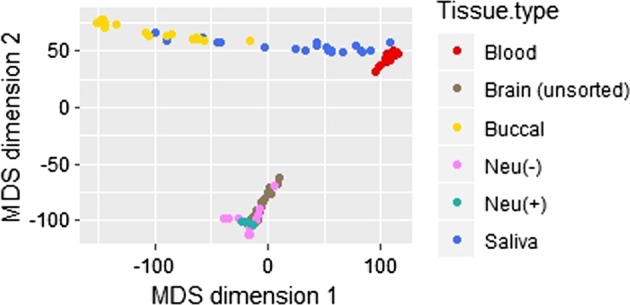
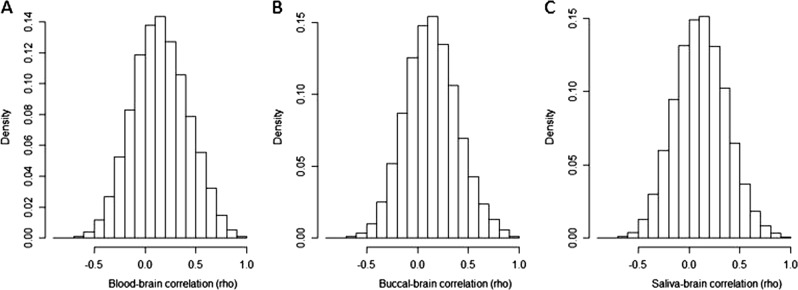
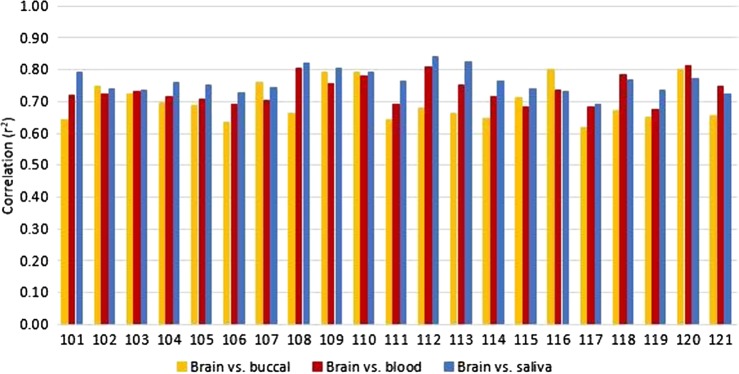
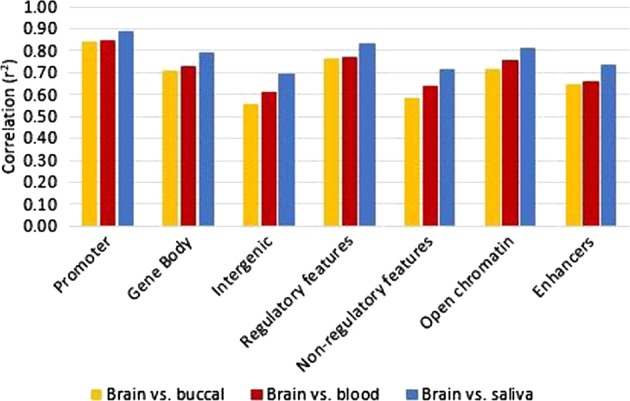
Differential DNA methylation in the brain is associated with many psychiatric diseases, but access to brain tissues is essentially limited to postmortem samples. The use of surrogate tissues has become common in identifying methylation changes associated with psychiatric disease. In this study, we determined the extent to which peripheral tissues can be used as surrogates for DNA methylation in the brain. Blood, saliva, buccal, and live brain tissue samples from 27 patients with medically intractable epilepsy undergoing brain resection were collected (age range 5–61 years). Genome-wide methylation was assessed with the Infinium HumanMethylation450 ( n = 12) and HumanMethylationEPIC BeadChip arrays ( n = 21). For the EPIC methylation data averaged for each CpG across subjects, the saliva–brain correlation ( r = 0.90) was higher than that for blood–brain (r = 0.86) and buccal–brain ( r = 0.85) comparisons. However, within individual CpGs, blood had the highest proportion of CpGs correlated to brain at nominally significant levels (20.8%), as compared to buccal tissue (17.4%) and saliva (15.1%). For each CpG and each gene, levels of brain-peripheral tissue correlation varied widely. This indicates that to determine the most useful surrogate tissue for representing brain DNA methylation, the patterns specific to the genomic region of interest must be considered. To assist in that objective, we have developed a website, IMAGE-CpG, that allows researchers to interrogate DNA methylation levels and degree of cross-tissue correlation in user-defined locations across the genome.
Overview
The claims and statistics of this paper haven’t been checked yet.
Free: it reads the open-access text and checks the first 5 claims that cite a source we can check. Create a free account to check every claim.
Integrity signals
Registry
Cites
Statistics
Figures
Verification
Claims the paper makes
The claims and statistics of this paper haven’t been checked yet.
Free: it reads the open-access text and checks the first 5 claims that cite a source we can check. Create a free account to check every claim.
Claims other papers make about this one
Each is checked against this paper’s own text: does it say what the citing paper says it does?
The source backs part of the claim, not all of it — or backs it for a different population, condition or comparison.
In the citing paper
“However, at the individual CpG level, correlations for all peripheral tissues were only nominally significantly correlated with brain tissue.”
From Epigenetics and depression (2019) · cites this paper as [33]
Experimental — accuracy not yet measuredThe source backs part of the claim, not all of it — or backs it for a different population, condition or comparison.
In the citing paper
“overlap in DNA methylation levels measured in saliva, buccal cells and blood is limited”
From The applied implications of epigenetics in anxiety, affective and stress-related disorders - A review and synthesis on psychosocial stress, psychotherapy and prevention (2020) · cites this paper as Braun et al., 2019
Experimental — accuracy not yet measuredThe source backs part of the claim, not all of it — or backs it for a different population, condition or comparison.
In the citing paper
“Still, it may be useful in developing biomarkers of disease and treatment response.98”
From Epigenetic regulation in major depression and other stress-related disorders: molecular mechanisms, clinical relevance and therapeutic potential (2023) · cites this paper as [98]
Experimental — accuracy not yet measuredThe cited source says what the claim attributes to it.
In the citing paper
“a recent study performed genome-wide methylation assays on blood, brain, saliva, and buccal samples and found that cross-tissue correlation strength was highly region-specific, with the correlation coefficient varying widely for different CpGs.”
From Epigenetics and depression (2019) · cites this paper as [33]
The cited source says what the claim attributes to it.
In the citing paper
“it has been suggested that DNA methylation patterns in saliva may be closer to that of brain tissue than DNA methylation in blood or buccal cells (Braun et al., 2019;Lowe et al., 2013;Smith et al., 2015).”
From The applied implications of epigenetics in anxiety, affective and stress-related disorders - A review and synthesis on psychosocial stress, psychotherapy and prevention (2020) · cites this paper as Braun et al., 2019
4 more claims about this paper
Create a free account to see every claim other papers make about this one.
Self-check
Percentages, sums and reported differences re-computed from the paper’s own numbers.
The self-check needs the paper’s full text.
Citations
Cites
Biological insights from 108 schizophrenia-associated genetic loci
Schizophrenia Working Group of the Psychiatric Genomics Consortium (2014) · Nature · doi:10.1038/nature13595 · Cited by 7,577
Aryee, M. J., Jaffe, A. E., Corrada-Bravo, H., Ladd-Acosta, C., Feinberg, A. P., Hansen, K. D., & Irizarry, R. A. (2014) · Bioinformatics · doi:10.1093/bioinformatics/btu049 · Cited by 4,397
eQTLGen, Wray, N. R., 23andMe, the Major Depressive Disorder Working Group of the Psychiatric Genomics Consortium, Ripke, S., Mattheisen, M., Trzaskowski, M., Byrne, E. M., Abdellaoui, A., Adams, M. J., et al. (2018) · Nature Genetics · doi:10.1038/s41588-018-0090-3 · Cited by 3,005
cocor: A Comprehensive Solution for the Statistical Comparison of Correlations
Diedenhofen, B., & Musch, J. (2015) · PLOS ONE · doi:10.1371/journal.pone.0121945 · Cited by 1,919
Teschendorff, A. E., Marabita, F., Lechner, M., Bartlett, T., Tegner, J., Gomez-Cabrero, D., & Beck, S. (2013) · Bioinformatics · doi:10.1093/bioinformatics/bts680 · Cited by 1,683
Protoplasmic Astrocytes in CA1 Stratum Radiatum Occupy Separate Anatomical Domains
Bushong, E. A., Martone, M. E., Jones, Y. Z., & Ellisman, M. H. (2002) · The Journal of Neuroscience · doi:10.1523/jneurosci.22-01-00183.2002 · Cited by 1,578
Genome-wide association study identifies 30 loci associated with bipolar disorder
eQTLGen Consortium, Stahl, E. A., BIOS Consortium, the Bipolar Disorder Working Group of the Psychiatric Genomics Consortium, Breen, G., Forstner, A. J., McQuillin, A., Ripke, S., Trubetskoy, V., Mattheisen, M., et al. (2019) · Nature Genetics · doi:10.1038/s41588-019-0397-8 · Cited by 1,519
Self-citationLow-level processing of Illumina Infinium DNA Methylation BeadArrays
Triche, T. J., Weisenberger, D. J., Van Den Berg, D., Laird, P. W., & Siegmund, K. D. (2013) · Nucleic Acids Research · doi:10.1093/nar/gkt090 · Cited by 905
Preprocessing, normalization and integration of the Illumina HumanMethylationEPIC array with minfi
Fortin, J.-P., Triche, T. J., & Hansen, K. D. (2017) · Bioinformatics · doi:10.1093/bioinformatics/btw691 · Cited by 865
Aging effects on DNA methylation modules in human brain and blood tissue
Horvath, S., Zhang, Y., Langfelder, P., Kahn, R. S., Boks, M. P., van Eijk, K., van den Berg, L. H., & Ophoff, R. A. (2012) · Genome Biology · doi:10.1186/gb-2012-13-10-r97 · Cited by 645
Cited by
Penner-Goeke, S., & Binder, E. B. (2019) · Dialogues in Clinical Neuroscience · doi:10.31887/dcns.2019.21.4/ebinder · Cited by 254
DNA methylation-based predictors of health: applications and statistical considerations
Yousefi, P. D., Suderman, M., Langdon, R., Whitehurst, O., Davey Smith, G., & Relton, C. L. (2022) · Nature Reviews Genetics · doi:10.1038/s41576-022-00465-w · Cited by 235
Yuan, M., Yang, B., Rothschild, G., Mann, J. J., Sanford, L. D., Tang, X., Huang, C., Wang, C., & Zhang, W. (2023) · Signal Transduction and Targeted Therapy · doi:10.1038/s41392-023-01519-z · Cited by 246
“98 Never-theless, DNA methylation detected in the brain or peripheral tissue could offer instructive insights into different biological pathways implicated in the etiopathogenesis of MDD and other stress-related psychiatric disorders (Fig.”
BackgroundParade, S. H., Huffhines, L., Daniels, T. E., Stroud, L. R., Nugent, N. R., & Tyrka, A. R. (2021) · Translational Psychiatry · doi:10.1038/s41398-021-01207-y · Cited by 170
Smigielski, L., Jagannath, V., Rössler, W., Walitza, S., & Grünblatt, E. (2020) · Molecular Psychiatry · doi:10.1038/s41380-019-0601-3 · Cited by 168
Childhood maltreatment and DNA methylation: A systematic review
Cecil, C. A. M., Zhang, Y., & Nolte, T. (2020) · Neuroscience & Biobehavioral Reviews · doi:10.1016/j.neubiorev.2020.02.019 · Cited by 169
Schiele, M. A., Gottschalk, M. G., & Domschke, K. (2020) · Clinical Psychology Review · doi:10.1016/j.cpr.2020.101830 · Cited by 156
The DNA Methylation in Neurological Diseases
Younesian, S., Yousefi, A., Momeny, M., Ghaffari, S. H., & Bashash, D. (2022) · Cells · doi:10.3390/cells11213439 · Cited by 153
“To tackle this obstacle, many claims to use blood samples as a surrogate for affected brain tissue; however, there is a possibility that disease-associated epigenetic alteration may change in surrogate tissues [100,107,108].”
BackgroundThe role of epigenetics in psychological resilience
Smeeth, D., Beck, S., Karam, E. G., & Pluess, M. (2021) · The Lancet Psychiatry · doi:10.1016/s2215-0366(20)30515-0 · Cited by 108
Epigenomic Dysregulation in Schizophrenia: In Search of Disease Etiology and Biomarkers
Khavari, B., & Cairns, M. J. (2020) · Cells · doi:10.3390/cells9081837 · Cited by 145
the Traumatic Stress Brain Study Group, Logue, M. W., Miller, M. W., Wolf, E. J., Huber, B. R., Morrison, F. G., Zhou, Z., Zheng, Y., Smith, A. K., Daskalakis, N. P., et al. (2020) · Clinical Epigenetics · doi:10.1186/s13148-020-0820-0 · Cited by 110
Hop, P. J., Zwamborn, R. A. J., Hannon, E., Shireby, G. L., Nabais, M. F., Walker, E. M., van Rheenen, W., van Vugt, J. J. F. A., Dekker, A. M., Westeneng, H.-J., et al. (2022) · Science Translational Medicine · doi:10.1126/scitranslmed.abj0264 · Cited by 97
“Although some blood DNA methylation patterns reflect those in brain tissue more closely than others—as previously shown for the DMPs that we identified in the C9orf72 locus (54)—DNA methylation is often tissue specific (55).”
Backgroundstudy, T. A. I. B. A. L., Nabais, M. F., Initiative, T. A. D. N., Laws, S. M., Lin, T., Vallerga, C. L., Armstrong, N. J., Blair, I. P., Kwok, J. B., Mather, K. A., et al. (2021) · Genome Biology · doi:10.1186/s13059-021-02275-5 · Cited by 99
Vasanthakumar, A., Davis, J. W., Idler, K., Waring, J. F., Asque, E., Riley-Gillis, B., Grosskurth, S., Srivastava, G., Kim, S., Nho, K., et al. (2020) · Clinical Epigenetics · doi:10.1186/s13148-020-00864-y · Cited by 98
Linking environmental risk factors with epigenetic mechanisms in Parkinson’s disease
Tsalenchuk, M., Gentleman, S., & Marzi, S. J. (2023) · npj Parkinson s Disease · doi:10.1038/s41531-023-00568-z · Cited by 105
“Evidence has indicated that epigenetic marks are not generally transferable from blood or saliva to disease-relevant cell types, necessitating brain-speci fi c studies of PD 117,156,157 .”
BackgroundOxytocin receptor DNA methylation and alterations of brain volumes in maltreated children
Fujisawa, T. X., Nishitani, S., Takiguchi, S., Shimada, K., Smith, A. K., & Tomoda, A. (2019) · Neuropsychopharmacology · doi:10.1038/s41386-019-0414-8 · Cited by 85
The Relationship between DNA Methylation and Antidepressant Medications: A Systematic Review
Webb, L. M., Phillips, K. E., Ho, M. C., Veldic, M., & Blacker, C. J. (2020) · International Journal of Molecular Sciences · doi:10.3390/ijms21030826 · Cited by 84
“Which better reflects the methylation status of the CNS with regard to BDNF methylation remains to be discovered because the blood and buccal tissue types are almost equally concordant with the brain [93].”
BackgroundThe neurobiological effects of childhood maltreatment on brain structure, function, and attachment
Tomoda, A., Nishitani, S., Takiguchi, S., Fujisawa, T. X., Sugiyama, T., & Teicher, M. H. (2024) · European Archives of Psychiatry and Clinical Neuroscience · doi:10.1007/s00406-024-01779-y · Cited by 132
“However, correlations between peripheral and brain methylation levels have recently been confirmed in independent databases constructed with Caucasian (https:// han-lab. org/ methy lation/ defau lt/ image CpG) [217] and Japanese samples (https:// snish it- amaze-cpg. web. app) [218].”
Nishitani, S., Isozaki, M., Yao, A., Higashino, Y., Yamauchi, T., Kidoguchi, M., Kawajiri, S., Tsunetoshi, K., Neish, H., Imoto, H., et al. (2023) · Translational Psychiatry · doi:10.1038/s41398-023-02370-0 · Cited by 93
“As previously reported [4], we evaluated cross-tissue DNA methylation correlations in two different ways.”
BackgroundMethodResultInfluentialSelf-citationChen, J., Zang, Z., Braun, U., Schwarz, K., Harneit, A., Kremer, T., Ma, R., Schweiger, J., Moessnang, C., Geiger, L., et al. (2020) · JAMA Psychiatry · doi:10.1001/jamapsychiatry.2019.4792 · Cited by 69
Fetal alcohol spectrum disorders: Genetic and epigenetic mechanisms
Kaminen‐Ahola, N. (2020) · Prenatal Diagnosis · doi:10.1002/pd.5731 · Cited by 79
Associations between indicators of socioeconomic position and DNA methylation: a scoping review
Cerutti, J., Lussier, A. A., Zhu, Y., Liu, J., & Dunn, E. C. (2021) · Clinical Epigenetics · doi:10.1186/s13148-021-01189-0 · Cited by 72
“Third, beyond including repeated DNAm assessments in future studies, epigenetic analyses should also be thoughtful around approaches to DNAm analysis, tissue specificity, multiple testing procedures, covariates, reporting of results, and replication/validation efforts [121, 122].”
BackgroundSymeonides, C., Vacy, K., Thomson, S., Tanner, S., Chua, H. K., Dixit, S., Mansell, T., O’Hely, M., Novakovic, B., Herbstman, J. B., et al. (2024) · Nature Communications · doi:10.1038/s41467-024-48897-8 · Cited by 66
“While these effects were identi fi ed in cord blood, methylation of CYP19A1 shows striking concordance between blood and brain tissue (Spearman ’ s rank correlation across the whole gene: ρ =0.74 (95% CI 0.59, 0.84); over promoter PI.f window: ρ =0.94 (95% CI 0.54, 0.99) 32 .”
InfluentialHannon, E. J., Mansell, G., Walker, E., Nabais, M. F., Burrage, J., Kepa, A., Best-Lane, J., Rose, A., Heck, S., Moffitt, T. E., et al. (2021) · PLoS Genetics · doi:10.1371/journal.pgen.1009443 · Cited by 68
Katrinli, Ş., Maihofer, A. X., Wani, A. H., Pfeiffer, J. R., Ketema, E., Ratanatharathorn, A. D., Baker, D. G., Boks, M. P., Geuze, E., Kessler, R. C., et al. (2022) · Molecular Psychiatry · doi:10.1038/s41380-021-01398-2 · Cited by 64
“Correlation between blood and brain DNAm of associated CpGs was examined using the IMAGE-CpG database [30].”
BackgroundMethodInfluentialUnravelling the role of epigenetics in reproductive adaptations to early-life environment
Bar-Sadeh, B., Rudnizky, S., Pnueli, L., Bentley, G. R., Stöger, R. J., Kaplan, A., & Melamed, P. (2020) · Nature Reviews Endocrinology · doi:10.1038/s41574-020-0370-8 · Cited by 65
Zhou, J., Li, M., Wang, X., He, Y., Xia, Y., Sweeney, J. A., Kopp, R. F., Liu, C., & Chen, C. (2021) · Frontiers in Neuroscience · doi:10.3389/fnins.2021.674273 · Cited by 56
“DNAm, the DNAm patterns specific to the genomic region of interest between these two tissues must be considered (Braun et al., 2019).”
BackgroundEpigenetics of alcohol use disorder—A review of recent advances in DNA methylation profiling
Longley, M. J., Lee, J., Jung, J., & Lohoff, F. W. (2021) · Addiction Biology · doi:10.1111/adb.13006 · Cited by 66
Progress with stem cell therapies for tendon tissue regeneration
Migliorini, F., Tingart, M., & Maffulli, N. (2020) · Expert Opinion on Biological Therapy · doi:10.1080/14712598.2020.1786532 · Cited by 55
Ondičová, M., Irwin, R. E., Thursby, S.-J., Hilman, L., Caffrey, A., Cassidy, T., McLaughlin, M., Lees‐Murdock, D. J., Ward, M., Murphy, M. M., et al. (2022) · Clinical Epigenetics · doi:10.1186/s13148-022-01282-y · Cited by 59
DNA methylation in relation to gestational age and brain dysmaturation in preterm infants
Wheater, E., Galdi, P., McCartney, D. L., Blesa, M., Sullivan, G., Stoye, D. Q., Lamb, G. J., Sparrow, S. A., Murphy, L., Wrobel, N., et al. (2022) · Brain Communications · doi:10.1093/braincomms/fcac056 · Cited by 57
An epigenome-wide association study of early-onset major depression in monozygotic twins
Roberson‐Nay, R., Lapato, D. M., Wolen, A. R., Lancaster, E. E., Webb, B. T., Verhulst, B., Hettema, J. M., & York, T. P. (2020) · Translational Psychiatry · doi:10.1038/s41398-020-00984-2 · Cited by 68
Methylome Patterns of Cattle Adaptation to Heat Stress
Corvo, M. D., Lazzari, B., Capra, E., Zavarez, L. B., Milanesi, M., Utsunomiya, Y. T., Utsunomiya, A. T. H., Stella, A., Nogueira, G. D. P., Garcia, J. F., et al. (2021) · Frontiers in Genetics · doi:10.3389/fgene.2021.633132 · Cited by 57
Luo, C., Pi, X., Hu, N., Wang, X., Xiao, Y., Li, S., Sweeney, J. A., Bishop, J. R., Gong, Q., Xie, D., et al. (2021) · Molecular Psychiatry · doi:10.1038/s41380-021-01308-6 · Cited by 55
“5) between blood and brain [23], suggesting that a proportion of peripheral changes in methylation may act as a proxy for brain tissue methylation status.”
BackgroundGadd, D. A., Hillary, R. F., McCartney, D. L., Shi, L., Stolicyn, A., Robertson, N., Walker, R. M., McGeachan, R. I., Campbell, A., Shen, X., et al. (2022) · Nature Communications · doi:10.1038/s41467-022-32319-8 · Cited by 48
The DNA methylome in panic disorder: A case-control and longitudinal psychotherapy-epigenetic study
Ziegler, C., Grundner-Culemann, F., Schiele, M. A., Schlosser, P., Kollert, L., Mahr, M., Gajewska, A., Lesch, K.-P., Deckert, J., Köttgen, A., et al. (2019) · Translational Psychiatry · doi:10.1038/s41398-019-0648-6 · Cited by 47
Cediel-Ulloa, A., Gliga, A. R., Love, T., Pineda, D., Mruzek, D. W., Watson, G. E., Davidson, P. W., Shamlaye, C. F., Strain, J., MYERS, G. J., et al. (2020) · Environment International · doi:10.1016/j.envint.2020.106321 · Cited by 50
“Previous work has shown that the average level of DNA methylation correlates well between saliva and the brain (r = 0.90); however, for each CpG site and each gene, the correlation be-tween brain and peripheral tissue methylation can vary widely (Braun et al., 2019).”
InfluentialQin, X., Li, J., Wu, T., Wu, Y., Tang, X., Gao, P., Li, L., Wang, M., Wu, Y. Y., Wang, X., et al. (2019) · Clinical Epigenetics · doi:10.1186/s13148-019-0784-0 · Cited by 53
“the role of blood that could be used for identifying the methylation changes associated with stroke [35].”
Herrgott, G. A., Snyder, J. M., She, R., Malta, T. M., Sabedot, T. S., Lee, I. Y., Pawloski, J., Gondim, G. G. P., Asmaro, K. P., Zhang, J., et al. (2023) · Nature Communications · doi:10.1038/s41467-023-41434-z · Cited by 45
“…supervised analysis between internally-pro fi led MNG tissue specimens ( n = 31) and publicly available nontumor control specimens ( n = 21) 31 , selecting CpG probes which exhibit differential methylation between the two groups accordingtoarandomlyselectedsigni fi…”
BackgroundMethodInfluentialPersaud, N. S., & Cates, H. M. (2023) · eneuro · doi:10.1523/eneuro.0109-21.2021 · Cited by 41
CheekAge: a next-generation buccal epigenetic aging clock associated with lifestyle and health
Shokhirev, M. N., Torosin, N. S., Kramer, D. J., Johnson, A. A., & Cuellar, T. L. (2024) · GeroScience · doi:10.1007/s11357-024-01094-3 · Cited by 44
“We then downloaded and reprocessed a publicly available dataset [14] containing multi-tissue data from patients with intractable epilepsy.”
MethodShinozaki, G., Braun, P., Hing, B. W. Q., Ratanatharathorn, A. D., Klisares, M. J., Duncan, G. N., Jellison, S. S., Heinzman, J. T., Nagahama, Y., Close, L. N., et al. (2018) · Frontiers in Aging Neuroscience · doi:10.3389/fnagi.2018.00311 · Cited by 42
“A more detailed overview of study participants and sample collection process has been described previously (Braun et al., 2017; Shinozaki et al., 2017).”
Self-citationXiu, J., Li, J., Liu, Z., Wei, H., Zhu, C., Han, R., Liu, Z., Zhu, W., Shen, Y., & Xu, Q. (2022) · Proceedings of the National Academy of Sciences · doi:10.1073/pnas.2201967119 · Cited by 42
Reed, R. G., Carroll, J., Marsland, A. L., & Manuck, S. B. (2022) · Aging · doi:10.18632/aging.204376 · Cited by 47
Suicide epigenetics, a review of recent progress
Cheung, S., Woo, J., Maes, M. S., & Zai, C. C. H. (2020) · Journal of Affective Disorders · doi:10.1016/j.jad.2020.01.040 · Cited by 45
PTSD is associated with increased DNA methylation across regions of HLA-DPB1 and SPATC1L
Katrinli, Ş., Zheng, Y., Gautam, A., Hammamieh, R., Yang, R., Venkateswaran, S., Kilaru, V., Lori, A., Hinrichs, R. C., Powers, A. D., et al. (2020) · Brain Behavior and Immunity · doi:10.1016/j.bbi.2020.10.023 · Cited by 39
“The degree of correlation between blood and brain tissue methylation of CpGs in the DMRs were assessed using data from IMAGE-CpG (Iowa Methylation Array Graphing for Experimental Comparison of Peripheral tissue & Gray matter (Brain)) (Braun et al., 2019).”
MethodDanoff, J. S., Connelly, J. J., Morris, J. P., & Perkeybile, A. M. (2021) · Comprehensive Psychoneuroendocrinology · doi:10.1016/j.cpnec.2021.100098 · Cited by 39
Epigenetic clocks in neurodegenerative diseases: a systematic review
Yang, T., Xiao, Y., Cheng, Y., Huang, J., Wei, Q., Li, C., & Shang, H. (2023) · Journal of Neurology Neurosurgery & Psychiatry · doi:10.1136/jnnp-2022-330931 · Cited by 44
Mood and microbes: a comprehensive review of intestinal microbiota’s impact on depression
Luqman, A., He, M., Hassan, A., Ullah, M., Zhang, L., Khan, M. R., Din, A. U., Ullah, K., Wang, W. J., & Wang, G. (2024) · Frontiers in Psychiatry · doi:10.3389/fpsyt.2024.1295766 · Cited by 43
“Nonetheless, it could be useful in developing biomarkers for disease and the ef fi cacy of a treatment (200).”
BackgroundResidential surrounding greenness and DNA methylation: An epigenome-wide association study
Xu, R., Li, S., Li, S., Wong, E. M., Southey, M. C., Hopper, J. L., Abramson, M. J., & Guo, Y. (2021) · Environment International · doi:10.1016/j.envint.2021.106556 · Cited by 41
Pathak, G. A., Silzer, T. K., Sun, J., Zhou, Z., Daniel, A. A., Johnson, L. A., O’Bryant, S. E., Phillips, N., & Barber, R. C. (2019) · Journal of Alzheimer s Disease · doi:10.3233/jad-190634 · Cited by 40
Musanabaganwa, C., Wani, A. H., Donglasan, J., Fatumo, S., Jansen, S., Mutabaruka, J., Rutembesa, E., Uwineza, A., Hermans, E. J., Roozendaal, B., et al. (2022) · Epigenomics · doi:10.2217/epi-2021-0310 · Cited by 35
Shen, X., Caramaschi, D., Adams, M. J., Walker, R. M., Min, J. L., Kwong, A. S. F., Hemani, G., Whalley, H. C., Whalley, H. C., Harris, S. E., et al. (2021) · Genome Medicine · doi:10.1016/j.euroneuro.2021.07.038 · Cited by 37
Gomaa, N. A., Konwar, C., Gladish, N., Au‐Young, S. H., Guo, T., Sheng, M., Merrill, S. M., Kelly, E., Chau, V., Branson, H. M., et al. (2022) · JAMA Network Open · doi:10.1001/jamanetworkopen.2022.39796 · Cited by 39
Epigenetic analyses in forensic medicine: future and challenges
Gerra, M. C., Dallabona, C., & Cecchi, R. (2024) · International Journal of Legal Medicine · doi:10.1007/s00414-024-03165-8 · Cited by 47
“The levels of DNA methylation in brain-peripheral tissues were shown to vary widely for each CpG and each gene, and tools were proposed to reveal the degree of cross-tissue correlation [68].”
BackgroundDNA methylation in APOE: The relationship with Alzheimer's and with cardiovascular health
Mur, J., McCartney, D. L., Walker, R. M., Campbell, A., Bermingham, M. L., Morris, S. W., Porteous, D. J., McIntosh, A. M., Deary, I. J., Evans, K. L., et al. (2020) · Alzheimer s & Dementia Translational Research & Clinical Interventions · doi:10.1002/trc2.12026 · Cited by 38
Utility of DNA Methylation as a Biomarker in Aging and Alzheimer’s Disease
Milicic, L., Porter, T., Vacher, M. A., & Laws, S. M. (2023) · Journal of Alzheimer s Disease Reports · doi:10.3233/adr-220109 · Cited by 40
Saito, T., Toda, H., Duncan, G. N., Jellison, S. S., Yu, T., Klisares, M. J., Daniel, S., Andreasen, A. J., Leyden, L. R., Hellman, M. M., et al. (2020) · Journal of Psychiatric Research · doi:10.1016/j.jpsychires.2020.06.005 · Cited by 31
“Methylome assays were performed as previously described (Braun et al., 2019).”
MethodSelf-citationAroke, E. N., Overstreet, D. S., Penn, T. M., Crossman, D. K., Jackson, P., Tollefsbol, T. O., Quinn, T. L., Yi, N., & Goodin, B. R. (2020) · Molecular Pain · doi:10.1177/1744806920972889 · Cited by 35
Rygiel, C. A., Goodrich, J. M., Solano-González, M., Mercado‐García, A., Hu, H., Téllez‐Rojo, M. M., Peterson, K. E., & Dolinoy, D. C. (2021) · Environmental Health Perspectives · doi:10.1289/ehp8507 · Cited by 35
“…databases compared matched blood and brain tissue DNA methylation pro fi les that allow researchers to assess the level of similarity between human whole blood and various brain tissues at CpG sites available on the 450K (Edgar et al. 2017; Hannon et al. 2015) and EPIC arrays (Braun et al. 2019).”
Accelerated Epigenetic Aging in Peripheral Blood does not Predict Dementia Risk
Fransquet, P., Lacaze, P. A., Saffery, R., Shah, R. C., Vryer, R., Murray, A. M., Woods, R. L., & Ryan, J. L. (2021) · Current Alzheimer Research · doi:10.2174/1567205018666210823100721 · Cited by 33
“Another limitation is that although some methylation sites are strongly conserved across brain and blood tissue [44], the sites used in measuring the epigenetic clocks do not necessarily reflect age-related changes in the brain.”
BackgroundAssociations of socioeconomic disparities with buccal DNA-methylation measures of biological aging
Raffington, L., Schwaba, T., Aikins, M., Richter, D., Wagner, G. G., Harden, K. P., Belsky, D. W., & Tucker–Drob, E. M. (2023) · Clinical Epigenetics · doi:10.1186/s13148-023-01489-7 · Cited by 30
“n = 21 people [16], Illumina EPIC array dataset in Gene Expression Omnibus accession GSE11116, https:// www.”
DNA methylation-based age estimation in pediatric healthy tissues and brain tumors
Kling, T., Wenger, A., & Carén, H. (2020) · Aging · doi:10.18632/aging.202145 · Cited by 35
“Number of samples Blood_CTRL GSE36054 [24] 134 children GSE111165 [36] 6 children GSE104812 [61] 48 children Brain_NeuN- GSE111165 [36] 4 children, 8 adults Brain_NeuN+ GSE111165 [36] 4 children, 1 adult Brain_unsorted/CTRL GSE111165 [36] 6 children, 15 adults GSE44684 [62] 4 children GSE52556 [63] 14 children GSE4182…”
BackgroundInfluentialMontalvo‐Ortiz, J. L., Gelernter, J. E., Cheng, Z., Girgenti, M. J., Xu, K., Zhang, X., Gopalan, S., Zhou, H., Duman, R. S., Southwick, S. M., et al. (2022) · Translational Psychiatry · doi:10.1038/s41398-022-01822-3 · Cited by 37
England-Mason, G., Merrill, S. M., Gladish, N., Moore, S. R., Giesbrecht, G. F., Letourneau, N. L., MacIsaac, J. L., MacDonald, A. M., Kinniburgh, D. W., Ponsonby, A., et al. (2022) · Environment International · doi:10.1016/j.envint.2022.107183 · Cited by 36
D’Addario, C., Pucci, M., Bellia, F., Girella, A., Sabatucci, A., Fanti, F., Vismara, M. E. M., Benatti, B., Ferrara, L., Fasciana, F., et al. (2022) · Clinical Epigenetics · doi:10.1186/s13148-022-01264-0 · Cited by 31
“In terms of epigenetic modifications, it has been reported that there is higher correlation between saliva and brain tissues when compared to brain and blood [80].”
BackgroundYang, G. S., Mi, X., Jackson‐Cook, C. K., Starkweather, A. R., Kelly, D. L., Archer, K. J., Zou, F., & Lyon, D. (2019) · Epigenetics · doi:10.1080/15592294.2019.1699695 · Cited by 36
“In their comparison of live human brain to concurrently collected peripheral tissues, Braun et al. (2019) noted relatively high overall correlations in DNA methylation values between brain and blood specimens, but did caution that correlation patterns can vary for individual CpGs [56].”
BackgroundBurghardt, K. J., Khoury, A. S., Msallaty, Z., Yi, Z., & Seyoum, B. (2020) · Pharmacotherapy The Journal of Human Pharmacology and Drug Therapy · doi:10.1002/phar.2375 · Cited by 30
“methylation correlations across various tissues within the brain.(51) Of note, peripheral blood DNA methylation has been found to have lower correlation with brain DNA methylation whereas saliva appears to have a higher correlation.”
BackgroundEpigenome-wide DNA methylation in obsessive-compulsive disorder
Schiele, M. A., Lipovsek, J., Schlosser, P., Soutschek, M., Schratt, G. M., Zaudig, M., Berberich, G., Köttgen, A., & Domschke, K. (2022) · Translational Psychiatry · doi:10.1038/s41398-022-01996-w · Cited by 32
“io/BECon/, consulted on 29 July 2021) and the IMAGE-CpG database [25] (https://han-lab.”
BackgroundZhou, J., Chen, Q., Braun, P., Mandell, K. A. P., Jaffe, A. E., Tan, H. Y., Hyde, T. M., Kleinman, J. E., Potash, J. B., Shinozaki, G., et al. (2022) · Proceedings of the National Academy of Sciences · doi:10.1073/pnas.2206069119 · Cited by 36
Self-citationMirza, S. A., Docherty, A. R., Bakian, A. V., Coon, H. H., Soares, J. C., Walss‐Bass, C., & Fries, G. R. (2022) · American Journal of Medical Genetics Part B Neuropsychiatric Genetics · doi:10.1002/ajmg.b.32917 · Cited by 39
“Methylation signature and noncoding RNA expression vary by cell and tissue type, with correlations between methylation in saliva, blood, and brain ranging from 0.85 to 0.90 (Braun et al., 2019).”
BackgroundInfluentialEpigenetic alterations in patients with anorexia nervosa—a systematic review
Käver, L., Hinney, A., Rajcsanyi, L. S., Maier, H. B., Frieling, H., Steiger, H., Voelz, C., Beyer, C., Trinh, S., & Seitz, J. (2024) · Molecular Psychiatry · doi:10.1038/s41380-024-02601-w · Cited by 36
“…status, or medication intake, and are highly cell speci fi c. Epigenetic patterns cannot be assessed in the brains of living beings [36], but peripheral DNA methylation has been validated as being re fl ective of brain processes and can thus be informative in a mental-health context [37 – 40].”
Dubnov, S., Bennett, E. R., Yayon, N., Yakov, O., Bennett, D. A., Seshadri, S. S., Mufson, E. J., Tzur, Y., Greenberg, D., Kuro‐o, M., et al. (2024) · Communications Biology · doi:10.1038/s42003-024-06407-y · Cited by 35
Genome‐wide DNA methylation investigation of glucocorticoid exposure within buccal samples
Braun, P., Tanaka‐Sahker, M., Chan, A. C., Jellison, S. S., Klisares, M. J., Hing, B. W. Q., Shabbir, Y., Gaul, L. N., Nagahama, Y., Robles, J., et al. (2019) · Psychiatry and Clinical Neurosciences · doi:10.1111/pcn.12835 · Cited by 26
“org/methylation/default/imageCpG).(36) We observed non-significant moderate correlation between brain and buccal DNAm for the CpG in WDFY2 (cg06335209; rho = 0.”
BackgroundSelf-citationLøkhammer, S., Stavrum, A.-K., Polushina, T. V., Aas, M., Ottesen, A. A., Andreassen, O. A., Melle, I. S., & Hellard, S. L. (2022) · Translational Psychiatry · doi:10.1038/s41398-022-01936-8 · Cited by 34
“Research supports a high blood-brain concordance in DNA methylation levels [74].”
BackgroundDNA Methylation Signature of Aging: Potential Impact on the Pathogenesis of Parkinson’s Disease
Yazar, V., Dawson, V. L., Dawson, T. M., & Kang, S.-U. (2023) · Journal of Parkinson s Disease · doi:10.3233/jpd-223517 · Cited by 35
Epigenetics of Fear, Anxiety and Stress – Focus on Histone Modifications
Ell, M. A., Schiele, M. A., Iovino, N., & Domschke, K. (2023) · Current Neuropharmacology · doi:10.2174/1570159x21666230322154158 · Cited by 32
“…persist following transcriptional events e.g ., [146], and several studies suggest that certain peripheral DNA methylation marks might reflect central nervous sys-tem patterns (for review see 8; in silico databases such as BECon, IMAGE-CpG or Blood Brain DNA Methylation Comparison Tool), [147-149].”
BackgroundAltered DNA methylation profiles in blood from patients with sporadic Creutzfeldt–Jakob disease
Dabin, L. C., Guntoro, F., Campbell, T., Bélicard, T., Smith, A. R., Smith, R. G., Raybould, R., Schott, J. M., Lunnon, K., Sarkies, P., et al. (2020) · Acta Neuropathologica · doi:10.1007/s00401-020-02224-9 · Cited by 32
“However, the vast majority of the literature suggests that the degree of crosstissue correlation for DNA methylation signals is not very high[6].”
BackgroundSingh, O., Pratt, D. W., & Aldape, K. (2021) · Acta Neuropathologica Communications · doi:10.1186/s40478-021-01249-9 · Cited by 32
“The following publicly-available datasets (GSE, GEO database; E-MTAB, ArrayExpress) were included for downstream analyses: GSE104293 [4], GSE109381 [10], GSE124617 [6], GSE128654 [79], E-MTAB-5528 [57], GSE140124 [59], GSE61160 [60], GSE103659 [46], GSE111165 [7], GSE122994 [45], GSE131482, GSE157397 [25], GSE123678 […”
Neonatal NR3C1 Methylation and Social-Emotional Development at 6 and 18 Months of Age
Folger, A. T., Ding, L., Ji, H., Yolton, K. A., Ammerman, R. T., Ginkel, J. B. V., & Bowers, K. A. (2019) · Frontiers in Behavioral Neuroscience · doi:10.3389/fnbeh.2019.00014 · Cited by 31
Epigenetic protection: maternal touch and DNA-methylation in early life
Wigley, I. L. C. M., Mascheroni, E., Bonichini, S., & Montirosso, R. (2021) · Current Opinion in Behavioral Sciences · doi:10.1016/j.cobeha.2021.09.004 · Cited by 52
Yamanashi, T., Nagao, T., Wahba, N. E., Marra, P. S., Crutchley, K. J., Meyer, A. A., Andreasen, A. J., Hellman, M. M., Jellison, S. S., Hughes, C. G., et al. (2021) · Translational Psychiatry · doi:10.1038/s41398-021-01752-6 · Cited by 30
“Eighteen of them were subjects who were recruited in our previous studies [17, 18].”
BackgroundSelf-citationAlteration of the brain methylation landscape following postnatal inflammatory injury in rat pups
Pierre, W. C., Legault, L., Londoño, I., McGraw, S., & Lodygensky, G. A. (2019) · The FASEB Journal · doi:10.1096/fj.201901461r · Cited by 28
Engdahl, E., Svensson, K., Lin, P., Alavian‐Ghavanini, A., Lindh, C. H., Rüegg, J., & Bornehag, C. (2021) · Environment International · doi:10.1016/j.envint.2021.106617 · Cited by 32
“…(5 – 61 years) with medically intractable epilepsy, showed correlation (r) of 0.88 within gene regulatory regions, and 20.4% of “ variable CpGs ” , i.e. CpGs showing large inter-individuals DNAm variations, were nominally correlated between buccal cells and brain cells (Braun et al., 2019).”
Influentialde Witte, L. D., Wang, Z., Snijders, G. J. L., Mendelev, N., Liu, Q., Sneeboer, M. A. M., Boks, M. P., Ge, Y., & Haghighi, F. G. (2021) · Biological Psychiatry · doi:10.1016/j.biopsych.2021.10.020 · Cited by 30
“…the contribution of age and sex on DNA methylation patterns, we performed PCA, and in line with previous studies in other cell types and tissues (52), we found that age has a much larger impact on the microglial methylome, explaining 21.7% of the variability, than sex, with only 2.1% (Figure…”
InfluentialNishitani, S., Fujisawa, T. X., Hiraoka, D., Makita, K., Takiguchi, S., Hamamura, S., Yao, A., Shimada, K., Smith, A. K., & Tomoda, A. (2021) · Translational Psychiatry · doi:10.1038/s41398-021-01714-y · Cited by 28
“We have tested whether saliva correlates with brain OXT methylations using the IMAGE-CpG database [51] (Supplementary Table S5).”
MethodCiuculete, D. M., Voisin, S. A. C., Kular, L., Welihinda, N., Jonsson, J., Jagodic, M., Mwinyi, J., & Schiöth, H. B. (2019) · Epigenetics · doi:10.1080/15592294.2019.1700628 · Cited by 30
“Additionally, the EPIC array used in our discovery analysis showed higher proportion of correlated CpGs between blood and brain than the previously used 450K array [64].”
MethodSpindola, L. M., Santoro, M. L., Pan, P. M., Ota, V. K., Xavier, G., Carvalho, C. M., Talarico, F., Sleiman, P., March, M., Pellegrino, R., et al. (2019) · Clinical Epigenetics · doi:10.1186/s13148-019-0740-z · Cited by 25
DNA methylation in cord blood in association with prenatal depressive symptoms
Kallak, T. K., Bränn, E., Fransson, E., Johansson, Å., Lager, S., Comasco, E., Lyle, R., & Skalkidou, A. (2021) · Clinical Epigenetics · doi:10.1186/s13148-021-01054-0 · Cited by 26
“DNA methylation in blood has been found to be in good agreement with DNA methylation in brain, especially when comparing individual CpGs [22].”
BackgroundThe impact of epigenetic mechanisms in migraine: Current knowledge and future directions
Gallardo, V. J., Vila‐Pueyo, M., & Pozo‐Rosich, P. (2023) · Cephalalgia · doi:10.1177/03331024221145916 · Cited by 29
“Although epigenetic modifications confer a reversible adaptation of the genome to the internal and external environment, they have a strong cell- and tissue-type dependence; hence, the epigenetic status between different tissues, for example brain and blood, has been found to differ in most cases, although there are s…”
ResultConole, E. L. S., Vaher, K., Blesa, M., Sullivan, G., Stevenson, A. J., Hall, J., Murphy, L., Thrippleton, M. J., Quigley, A. J., Bastin, M. E., et al. (2023) · Brain Behavior and Immunity · doi:10.1016/j.bbi.2023.03.011 · Cited by 26
Booij, L., & Steiger, H. (2020) · Current Opinion in Psychiatry · doi:10.1097/yco.0000000000000632 · Cited by 30
Saito, T., Braun, P., Daniel, S., Jellison, S. S., Hellman, M. M., Shinozaki, E., Lee, S., Cho, H. R., Yoshino, A., Toda, H., et al. (2020) · Neurobiology of Aging · doi:10.1016/j.neurobiolaging.2020.06.003 · Cited by 21
“Details of the methylome analysis are described in a previous study (Braun et al., 2019).”
InfluentialSelf-citationTakenaka, S., Sukenaga, N., Ohmuraya, M., Matsuki, Y., Maeda, L., Takao, Y., & Hirose, M. (2020) · Medicine · doi:10.1097/md.0000000000019325 · Cited by 23
“Although methylation rates of the TRPA1 promoter region can be a biomarker for neuropathic pain, the origin of the TRPA1 gene in peripheral blood do not necessarily correlate with the peripheral nervous system and immune cells.([33,34]) Further investigations are needed to reveal the origin of the TRPA1 gene.”
BackgroundDistinctions between sex and time in patterns of DNA methylation across puberty
Moore, S. R., Humphreys, K. L., Colich, N. L., Davis, E., Lin, D. T. S., MacIsaac, J. L., Kobor, M. S., & Gotlib, I. H. (2020) · BMC Genomics · doi:10.1186/s12864-020-06789-3 · Cited by 36
Nardi, L. D., Carpentieri, V., Pascale, E., Pucci, M., D’Addario, C., Cerniglia, L., Adriani, W., & Cimino, S. (2020) · International Journal of Environmental Research and Public Health · doi:10.3390/ijerph17217956 · Cited by 26
“Several studies underlined that saliva samples with higher epithelial content were more similar to brain with regard to DNA methylation levels [27,28].”
BackgroundAttachment-related dimensions in the epigenetic era: A systematic review of the human research
Craig, F., Tenuta, F., Rizzato, V., Costabile, A., Trabacca, A., & Montirosso, R. (2021) · Neuroscience & Biobehavioral Reviews · doi:10.1016/j.neubiorev.2021.03.006 · Cited by 26
Perinatal stress and methylation of the NR3C1 gene in newborns: systematic review
Chalfun, G., Reis, M. M., de Oliveira, M. B. G., de Araújo Brasil, A., dos Santos Salú, M., da Cunha, A. J. L. A., Prata-Barbosa, A., & de Magalhães-Barbosa, M. C. (2022) · Epigenetics · doi:10.1080/15592294.2021.1980691 · Cited by 22
“Besides, variations of DNA methylations in different cell types and tissues of the same individual and between different individuals [69,71,72], in addition to factors such as changes in blood T cell count and macrophages [73] and response to external stimuli, such as drug use, must be considered [74].”
BackgroundBlood epigenome-wide association studies of suicide attempt in adults with bipolar disorder
Mirza, S. A., Lima, C. N. D. C., Favero-Campbell, A. D., Rubinstein, A., Topolski, N., Cabrera‐Mendoza, B., Kovács, E. H. C., Blumberg, H. P., Richards, J. G., Williams, A. J., et al. (2024) · Translational Psychiatry · doi:10.1038/s41398-024-02760-y · Cited by 25
Angerfors, A., Lindvall, M. O., Andersson, B., Nilsson, S., López, M. D., Hansson, L., Stanne, T. M., & Jern, C. (2020) · Thrombosis and Haemostasis · doi:10.1055/s-0040-1720980 · Cited by 28
Metadata
- Authors
- Braun, P. R., Han, S., Hing, B., Nagahama, Y., Gaul, L. N., Heinzman, J. T., Grossbach, A. J., Close, L., Dlouhy, B. J., Howard, M. A., Kawasaki, H., Potash, J. B., & Shinozaki, G.
- Affiliations
- University of Iowa (US)
- Corresponding author
- Shinozaki, Gen
- ORCID
- Venue
- Translational Psychiatry
- Published
- 2019-01-31
- Volume
- 9
- Issue
- 1
- Pages
- 47-47
- ISSN
- 2158-3188 (ISSN-L)
- PMC
- PMC6355837
- OpenAlex
- W2913887378
- Cited by
- 467
- References
- 34
- Citations by year
- 2026: 44 · 2025: 52 · 2024: 68 · 2023: 65 · 2022: 80 · 2021: 78 · 2020: 58 · 2019: 21
- FWCI
- 19.50
- Type
- journal article
- Language
- en
- Open access
- gold
- doi.org
- Licence
- cc-by
- creativecommons.org/licenses/by/4.0 (tdm)
- creativecommons.org/licenses/by/4.0 (vor)
- Locations
- Translational Psychiatry (publishedVersion, cc-by)
- Europe PMC (PubMed Central) (publishedVersion, other-oa)
- PubMed Central (publishedVersion, cc-by)
- PubMed (publishedVersion)
- DOAJ (DOAJ: Directory of Open Access Journals) (submittedVersion)
- Funders
- U.S. Department of Health & Human Services | National Institutes of Health (K23MH107654, T32GM008629)
- Topics
- Life Sciences › Biochemistry, Genetics and Molecular Biology › Molecular Biology › Epigenetics and DNA Methylation
- Life Sciences › Biochemistry, Genetics and Molecular Biology › Genetics › Genetic Associations and Epidemiology
- Life Sciences › Biochemistry, Genetics and Molecular Biology › Genetics › Genetic Syndromes and Imprinting
- Keywords
- DNA methylation, brain tissue, saliva, buccal tissue, blood, drug-resistant epilepsy, mental illness, CpG sites
- MeSH terms
- Adolescent, Adult, Mental Disorders, Brain, Child, Child, Preschool, Female, Humans, Male, Middle Aged, Saliva, CpG Islands, DNA Methylation, Epigenesis, Genetic, Genome-Wide Association Study, Young Adult
About these checks
Registry, retraction, Cites and statistics results are computed, not judged, with one exception: a printed reference that no index lists is read once by a model before it counts as a citation error. Claims are extracted by a model and kept only when their quote appears verbatim in the text; each cited source is then checked, with a model’s help, for whether it says what the claim relies on. Those verdicts can be wrong — read the claim’s quote and the cited source before relying on one.
Statistics and arithmetic are recomputed, not judged.
Confidence bands are shown only for fields calibrated on our annotated test set. None is calibrated yet, so no band is shown.
What counts as a claim ›How we measure confidence ›How we check this ›
Are you an author, or do you see a problem with this page? Request a review
Data sources
Bibliographic data: Semantic Scholar, OpenAlex, Crossref.
Contains information from the Semantic Scholar Academic Graph Datasets, made available under the ODC Attribution License (ODC-BY 1.0).
Semantic Scholar’s data is described in: Kinney, R., et al. (2023). The Semantic Scholar Open Data Platform. arXiv:2301.10140.
