

Human monoclonal antibodies block the binding of SARS-CoV-2 spike protein to angiotensin converting enzyme 2 receptor
Open accessPublished version of a preprint
The DOI matches its Crossref record; 31 of the 31 references it cites were found in a registry or an index.
Abstract
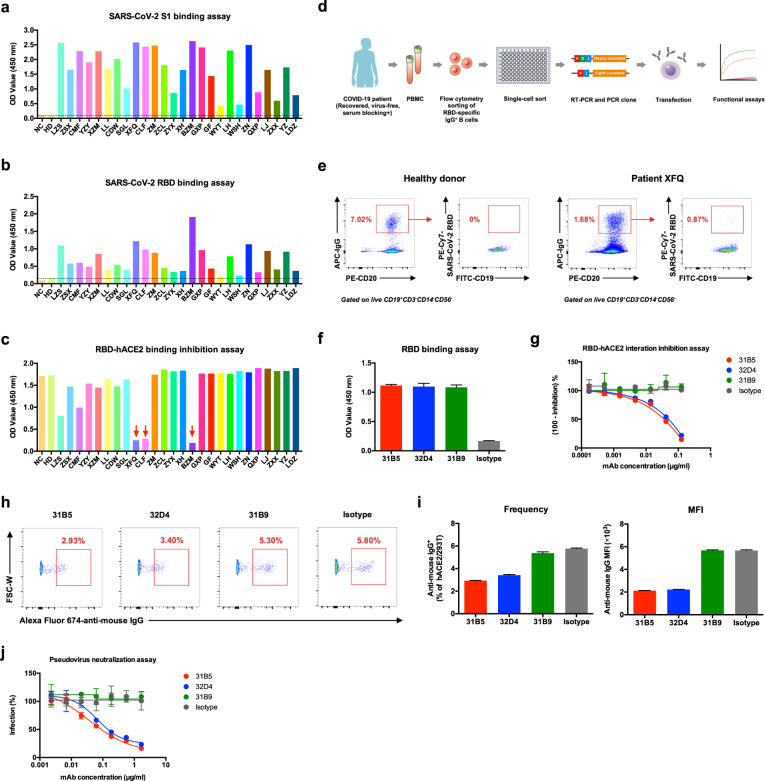
The severe acute respiratory syndrome coronavirus 2 (SARS-CoV-2) has caused a global pandemic of novel corona virus disease (COVID-19). To date, no prophylactic vaccines or approved therapeutic agents are available for preventing and treating this highly transmittable disease. Here we report two monoclonal antibodies (mAbs) cloned from memory B cells of patients recently recovered from COVID-19, and both mAbs specifically bind to the spike (S) protein of SARS-CoV-2, block the binding of receptor binding domain (RBD) of SARS-CoV-2 to human angiotensin converting enzyme 2 (hACE2), and effectively neutralize S protein-pseudotyped virus infection. These human mAbs hold the promise for the prevention and treatment of the ongoing pandemic of COVID-19.
Overview
The claims and statistics of this paper haven’t been checked yet.
Free: it reads the open-access text and checks the first 5 claims that cite a source we can check. Create a free account to check every claim.
Integrity signals
Registry
Cites
Statistics
Figures
Verification
Claims the paper makes
The claims and statistics of this paper haven’t been checked yet.
Free: it reads the open-access text and checks the first 5 claims that cite a source we can check. Create a free account to check every claim.
Self-check
Percentages, sums and reported differences re-computed from the paper’s own numbers.
The self-check needs the paper’s full text.
Citations
Cites
Clinical features of patients infected with 2019 novel coronavirus in Wuhan, China
Huang, C., Wang, Y., Li, X., Ren, L., Zhao, J., Hu, Y., Zhang, L., Fan, G., Xu, J., Gu, X., et al. (2020) · The Lancet · doi:10.1016/s0140-6736(20)30183-5 · Cited by 48,884
Self-citationA novel coronavirus from patients with pneumonia in China, 2019
Zhu, N., Zhang, D., Wang, W., Li, X., Yang, B., Song, J., Zhao, X., Huang, B., Shi, W., Lu, R., et al. (2020) · New England Journal of Medicine · doi:10.1056/nejmoa2001017 · Cited by 28,244
A pneumonia outbreak associated with a new coronavirus of probable bat origin
Zhou, P., Yang, X.-L., Wang, X.-G., Hu, B., Zhang, L., Zhang, W., Si, H.-R., Zhu, Y., Li, B., Huang, C.-L., et al. (2020) · Nature · doi:10.1038/s41586-020-2012-7 · Cited by 21,969
Chen, N., Zhou, M., Dong, X., Qu, J., Gong, F., Han, Y., Qiu, Y., Wang, J., Liu, Y., Wei, Y., et al. (2020) · The Lancet · doi:10.1016/s0140-6736(20)30211-7 · Cited by 21,415
Wang, D., Hu, B., Hu, C., Zhu, F., Liu, X., Zhang, J., Wang, B., Xiang, H., Cheng, Z., Xiong, Y., et al. (2020) · JAMA · doi:10.1001/jama.2020.1585 · Cited by 20,148
La certeza de lo impredecible: Cultura Educación y Sociedad en tiempos de COVID19
Martínez González, M. (2020) · DSPACE System - Metalibrary (University of the Coast) · Cited by 18,463
Martínez–González, M. B. (2020) · DSPACE System - Metalibrary (University of the Coast) · Cited by 18,294
A new coronavirus associated with human respiratory disease in China
Wu, F., Zhao, S., Yu, B., Chen, Y.-M., Wang, W., Song, Z.-G., Hu, Y., Tao, Z.-W., Tian, J.-H., Pei, Y.-Y., et al. (2020) · Nature · doi:10.1038/s41586-020-2008-3 · Cited by 11,688
Self-citationYang, X., Yu, Y., Xu, J., Shu, H., Xia, J., Liu, H., Wu, Y., Zhang, L., Yu, Z., Fang, M., et al. (2020) · The Lancet Respiratory Medicine · doi:10.1016/s2213-2600(20)30079-5 · Cited by 10,066
Self-citationCryo-EM structure of the 2019-nCoV spike in the prefusion conformation
Wrapp, D., Wang, N., Corbett, K. S., Goldsmith, J. A., Hsieh, C.-L., Abiona, O., Graham, B. S., & McLellan, J. S. (2020) · Science · doi:10.1126/science.abb2507 · Cited by 8,897 · cited 1×
“[16] [17] [18] Given the critical role of the RBD in initiating invasion of SARS-CoV-2 into host cells, it becomes a vulnerable target for neutralizing antibodies.”
BackgroundStructure of the SARS-CoV-2 spike receptor-binding domain bound to the ACE2 receptor
Lan, J., Ge, J., Yu, J., Shan, S., Zhou, H., Fan, S., Zhang, Q., Shi, X., Wang, Q., Zhang, L., et al. (2020) · Nature · doi:10.1038/s41586-020-2180-5 · Cited by 5,983
Structural basis for the recognition of SARS-CoV-2 by full-length human ACE2
Yan, R., Zhang, Y., Li, Y., Xia, L., Guo, Y., & Zhou, Q. (2020) · Science · doi:10.1126/science.abb2762 · Cited by 5,040
Ou, X., Liu, Y., Lei, X., Li, P., Mi, D., Ren, L., Guo, L., Guo, R., Chen, T., Hu, J., et al. (2020) · Nature Communications · doi:10.1038/s41467-020-15562-9 · Cited by 3,097
Self-citationStructure, Function, and Evolution of Coronavirus Spike Proteins
Li, F. (2016) · Annual Review of Virology · doi:10.1146/annurev-virology-110615-042301 · Cited by 2,740
Structure of SARS Coronavirus Spike Receptor-Binding Domain Complexed with Receptor
Li, F., Li, W., Farzan, M., & Harrison, S. C. (2005) · Science · doi:10.1126/science.1116480 · Cited by 2,031
Immunology of COVID-19: Current State of the Science
Vabret, N., Britton, G. J., Gruber, C., Hegde, S., Kim, J., Kuksin, M., Levantovsky, R., Malle, L., Moreira, A., Park, M. D., et al. (2020) · Immunity · doi:10.1016/j.immuni.2020.05.002 · Cited by 1,623
A human monoclonal antibody blocking SARS-CoV-2 infection
Wang, C., Li, W., Drabek, D., Okba, N. M. A., van Haperen, R., Osterhaus, A. D. M. E., van Kuppeveld, F. J. M., Haagmans, B. L., Grosveld, F., & Bosch, B.-J. (2020) · Nature Communications · doi:10.1038/s41467-020-16256-y · Cited by 1,132
Immunogenicity and structures of a rationally designed prefusion MERS-CoV spike antigen
Pallesen, J., Wang, N., Corbett, K. S., Wrapp, D., Kirchdoerfer, R. N., Turner, H. L., Cottrell, C. A., Becker, M. M., Wang, L., Shi, W., et al. (2017) · Proceedings of the National Academy of Sciences · doi:10.1073/pnas.1707304114 · Cited by 1,073 · cited 1×
“provide a very limited window for the immunogenic epitopes of RBD exposure to specific B cells.(20) Next, we set out to clone human mAbs using the blood samples from three COVID-19 recovered patients, of which their sera showed potent hACE2 receptor binding inhibition.”
BackgroundCOVID-19: Transmission, prevention, and potential therapeutic opportunities
Lotfi, M., Hamblin, M. R., & Rezaei, N. (2020) · Clinica Chimica Acta · doi:10.1016/j.cca.2020.05.044 · Cited by 1,016
Pre-fusion structure of a human coronavirus spike protein
Kirchdoerfer, R. N., Cottrell, C. A., Wang, N., Pallesen, J., Yassine, H. M., Turner, H. L., Corbett, K. S., Graham, B. S., McLellan, J. S., & Ward, A. B. (2016) · Nature · doi:10.1038/nature17200 · Cited by 765 · cited 1×
“[16] [17] [18] Given the critical role of the RBD in initiating invasion of SARS-CoV-2 into host cells, it becomes a vulnerable target for neutralizing antibodies.”
BackgroundGui, M., Song, W., Zhou, H., Xu, J., Chen, S., Xiang, Y., & Wang, X. (2017) · Cell Research · doi:10.1038/cr.2016.152 · Cited by 589
Rapid generation of fully human monoclonal antibodies specific to a vaccinating antigen
Smith, K., Garman, L., Wrammert, J., Zheng, N.-Y., Capra, J. D., Ahmed, R., & Wilson, P. C. (2009) · Nature Protocols · doi:10.1038/nprot.2009.3 · Cited by 470
A human monoclonal antibody blocking SARS-CoV-2 infectionPreprint
Wang, C., Li, W., Drabek, D., et al. (2020) · bioRxiv (Cold Spring Harbor Laboratory) · doi:10.1101/2020.03.11.987958 · Cited by 289
Monoclonal antibody-based therapies for microbial diseases
Saylor, C., Dadachova, E., & Casadevall, A. (2009) · Vaccine · doi:10.1016/j.vaccine.2009.09.105 · Cited by 172
Crystal structure of the 2019-nCoV spike receptor-binding domain bound with the ACE2 receptor
Lan, J., Ge, J., Yu, J., Shan, S., Zhou, H., Fan, S., Zhang, Q., Shi, X., Wang, Q., Zhang, L., et al. (2020) · doi:10.1101/2020.02.19.956235 · Cited by 154
Diamanti, A. P., Rosado, M. M., Pioli, C., Sesti, G., & Laganà, B. (2020) · International Journal of Molecular Sciences · doi:10.3390/ijms21093330 · Cited by 143
Adjunct Immunotherapies for the Management of Severely Ill COVID-19 Patients
Bonam, S. R., Kaveri, S. V., Sakuntabhai, A., Gilardin, L., & Bayry, J. (2020) · Cell Reports Medicine · doi:10.1016/j.xcrm.2020.100016 · Cited by 135
Structural basis for the recognition of the 2019-nCoV by human ACE2Preprint
Yan, R., Zhang, Y., Guo, Y., Xia, L., & Zhou, Q. (2020) · bioRxiv (Cold Spring Harbor Laboratory) · doi:10.1101/2020.02.19.956946 · Cited by 134
Monoclonal Antibodies for Emerging Infectious Diseases — Borrowing from History
Marston, H. D., Paules, C. I., & Fauci, A. S. (2018) · New England Journal of Medicine · doi:10.1056/nejmp1802256 · Cited by 125
Byrnes, J. R., Zhou, X. X., Lui, I., Elledge, S. K., Glasgow, J. E., Lim, S. A., Loudermilk, R. P., Chiu, C. Y., Wang, T. T., Wilson, M. R., et al. (2020) · mSphere · doi:10.1128/msphere.00802-20 · Cited by 82
Self-citationOu, X., Liu, Y., Lei, X., Li, P., Mi, D., Ren, L., Guo, L., Chen, T., Hu, J., Xiang, Z., et al. (2020) · doi:10.21203/rs.2.24016/v1 · Cited by 8
Self-citation
Cited by
Huang, Y., Yang, C., Xu, X.-F., Xu, W., & Liu, S.-W. (2020) · Acta Pharmacologica Sinica · doi:10.1038/s41401-020-0485-4 · Cited by 2,224
Immunology of COVID-19: Current State of the Science
Vabret, N., Britton, G. J., Gruber, C., Hegde, S., Kim, J., Kuksin, M., Levantovsky, R., Malle, L., Moreira, A., Park, M. D., et al. (2020) · Immunity · doi:10.1016/j.immuni.2020.05.002 · Cited by 1,623
A neutralizing human antibody binds to the N-terminal domain of the Spike protein of SARS-CoV-2
Chi, X., Yan, R., Zhang, J., Zhang, G., Zhang, Y., Hao, M., Zhang, Z., Fan, P., Dong, Y., Yang, Y., et al. (2020) · Science · doi:10.1126/science.abc6952 · Cited by 1,385
Self-citationPotent neutralizing antibodies against multiple epitopes on SARS-CoV-2 spike
Liu, L., Wang, P., Nair, M. S., Yu, J., Rapp, M., Wang, Q., Luo, Y., Chan, J. F.-W., Sahi, V., Figueroa, A., et al. (2020) · Nature · doi:10.1038/s41586-020-2571-7 · Cited by 1,349
Escape from neutralizing antibodies by SARS-CoV-2 spike protein variants
Weisblum, Y., Schmidt, F., Zhang, F., DaSilva, J., Poston, D., Lorenzi, J. C., Muecksch, F., Rutkowska, M., Hoffmann, H.-H., Michailidis, E., et al. (2020) · eLife · doi:10.7554/elife.61312 · Cited by 1,308
Metadata
- Authors
- Chen, X., Li, R., Pan, Z., Qian, C., Yang, Y., You, R., Zhao, J., Liu, P., Gao, L., Li, Z., Huang, Q., Xu, L., Tang, J., Tian, Q., Yao, W., Hu, L., Yan, X., Zhou, X., Wu, Y., Deng, K., Zhang, Z., Qian, Z., Chen, Y., & Ye, L.
- Affiliations
- Army Medical University (CN)
- Northeast Agricultural University (CN)
- Chongqing Public Health Medical Center (CN)
- China Agricultural University (CN)
- Sun Yat-sen University (CN)
- Shenzhen Third People’s Hospital (CN)
- Chinese Academy of Medical Sciences & Peking Union Medical College (CN)
- Corresponding author
- Qian, Zhaohui
- Chen, Yaokai
- Ye, Lilin
- ORCID
- Venue
- Cellular & Molecular Immunology
- Published
- 2020-04-20
- Volume
- 17
- Issue
- 6
- Pages
- 647-649
- ISSN
- 1672-7681 (ISSN-L)
- 2042-0226
- PMC
- PMC7167496
- OpenAlex
- W3017300461
- Semantic Scholar
- 7a2fd5d17d5b755dfaf9ef39423db3dcf2bb147e
- Cited by
- 342
- References
- 27
- Citations by year
- 2026: 4 · 2025: 7 · 2024: 11 · 2023: 30 · 2022: 66 · 2021: 128 · 2020: 96
- FWCI
- 10.62
- Type
- journal article
- Language
- en
- Open access
- hybrid
- doi.org
- Licence
- cc-by
- creativecommons.org/licenses/by/4.0 (tdm)
- creativecommons.org/licenses/by/4.0 (vor)
- Locations
- Cellular and Molecular Immunology (publishedVersion, cc-by)
- medRxiv (submittedVersion)
- PubMed Central (publishedVersion, cc-by)
- PubMed (publishedVersion)
- Greater South Information System
- Topics
- Health Sciences › Medicine › Infectious Diseases › SARS-CoV-2 and COVID-19 Research
- Life Sciences › Immunology and Microbiology › Immunology › Monoclonal and Polyclonal Antibodies Research
- Health Sciences › Medicine › Infectious Diseases › COVID-19 Clinical Research Studies
- Keywords
- SARS-CoV-2, COVID-19 pandemic, monoclonal antibodies, spike protein, angiotensin-converting enzyme 2 receptor, receptor binding inhibition, SARS-CoV, coronavirus pathogenesis
- MeSH terms
- Adult, Antibodies, Monoclonal, Antibodies, Viral, Cloning, Molecular, Humans, Protein Binding, Receptor, Angiotensin, Type 2, Antibodies, Neutralizing, HEK293 Cells, Spike Glycoprotein, Coronavirus
About these checks
Registry, retraction, Cites and statistics results are computed, not judged, with one exception: a printed reference that no index lists is read once by a model before it counts as a citation error. Claims are extracted by a model and kept only when their quote appears verbatim in the text; each cited source is then checked, with a model’s help, for whether it says what the claim relies on. Those verdicts can be wrong — read the claim’s quote and the cited source before relying on one.
Statistics and arithmetic are recomputed, not judged.
Confidence bands are shown only for fields calibrated on our annotated test set. None is calibrated yet, so no band is shown.
What counts as a claim ›How we measure confidence ›How we check this ›
Are you an author, or do you see a problem with this page? Request a review
Data sources
Bibliographic data: Semantic Scholar, OpenAlex, Crossref.
Contains information from the Semantic Scholar Academic Graph Datasets, made available under the ODC Attribution License (ODC-BY 1.0).
Semantic Scholar’s data is described in: Kinney, R., et al. (2023). The Semantic Scholar Open Data Platform. arXiv:2301.10140.
