

Functional mapping and annotation of genetic associations with FUMA
Open accessPublished version of a preprint
The DOI matches its Crossref record; 67 of the 67 references it cites were found in a registry or an index.
Abstract
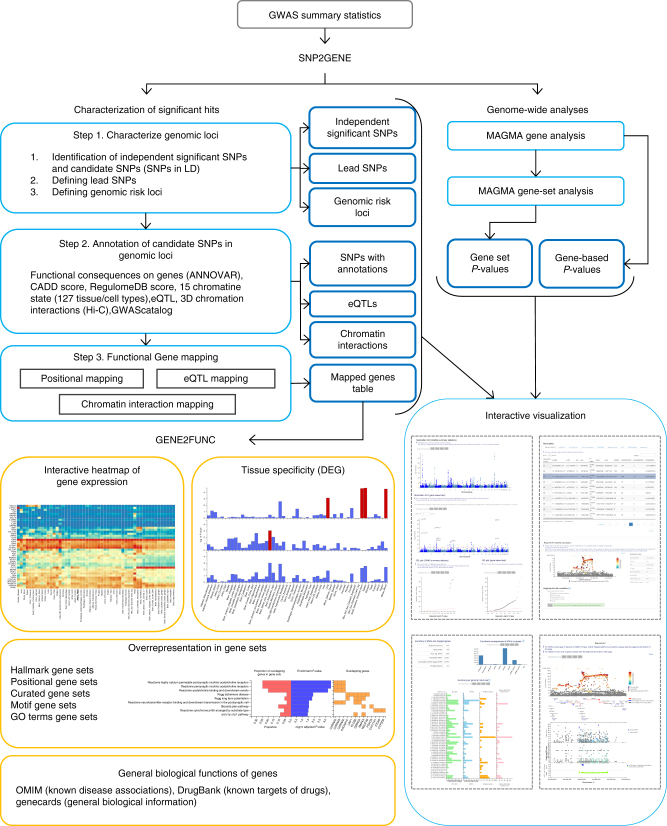
A main challenge in genome-wide association studies (GWAS) is to pinpoint possible causal variants. Results from GWAS typically do not directly translate into causal variants because the majority of hits are in non-coding or intergenic regions, and the presence of linkage disequilibrium leads to effects being statistically spread out across multiple variants. Post-GWAS annotation facilitates the selection of most likely causal variant(s). Multiple resources are available for post-GWAS annotation, yet these can be time consuming and do not provide integrated visual aids for data interpretation. We, therefore, develop FUMA: an integrative web-based platform using information from multiple biological resources to facilitate functional annotation of GWAS results, gene prioritization and interactive visualization. FUMA accommodates positional, expression quantitative trait loci (eQTL) and chromatin interaction mappings, and provides gene-based, pathway and tissue enrichment results. FUMA results directly aid in generating hypotheses that are testable in functional experiments aimed at proving causal relations.
Overview
The claims and statistics of this paper haven’t been checked yet.
Free: it reads the open-access text and checks the first 5 claims that cite a source we can check. Create a free account to check every claim.
Integrity signals
Registry
Cites
Statistics
Figures
Verification
Claims the paper makes
The claims and statistics of this paper haven’t been checked yet.
Free: it reads the open-access text and checks the first 5 claims that cite a source we can check. Create a free account to check every claim.
Claims other papers make about this one
Each is checked against this paper’s own text: does it say what the citing paper says it does?
The cited source says what the claim attributes to it.
In the citing paper
“Independently associated loci from the metaanalysis were defined using FUMA 24 (see URLs), an online platform for functional mapping of genetic variants.”
From Genome-wide association meta-analysis in 269,867 individuals identifies new genetic and functional links to intelligence (2018) · cites this paper as [24]
The check wasn’t confident either way, so it gives no verdict — never disputed.
In the citing paper
“The genetic architecture of fertility showed enrichment for gene expression in brain and ovarian tissues, which is consistent with known biology33,34.”
From Genetic trade-offs in fertility and longevity explain the maintenance of disease-associated alleles in humans (2026) · cites this paper as [33]
Experimental — accuracy not yet measuredIn the citing paper
“While traditional Hi-C guided gene mapping restricts its analysis to genome-wide significant (GWS) loci7, H-MAGMA can leverage signals from sub-threshold loci that explain a significant proportion of heritability8.”
From A computational tool (H-MAGMA) for improved prediction of brain-disorder risk genes by incorporating brain chromatin interaction profiles (2020) · cites this paper as [7]
In the citing paper
“Gene-based analysis using FUMA28, with input SNPs mapped by position to 18,232 protein-coding genes, identified an additional locus for walking (near HP1BP3) and moderate activity (near KCNA6) (Supplementary Data 4).”
From GWAS identifies 14 loci for device-measured physical activity and sleep duration (2018) · cites this paper as [28]
In the citing paper
“Although several databases have been developed to collect eQTL summary statistics from individual studies11–17, these efforts have relied on the heterogeneous set of files provided by the original authors.”
From A compendium of uniformly processed human gene expression and splicing quantitative trait loci (2021) · cites this paper as [13]
1 more claim about this paper
Create a free account to see every claim other papers make about this one.
Self-check
Percentages, sums and reported differences re-computed from the paper’s own numbers.
The self-check needs the paper’s full text.
Citations
Cites
PLINK: a tool set for whole-genome association and population-based linkage analyses.
Purcell, S., Neale, B., Todd-Brown, K., Thomas, L., Ferreira, M. A. R., Bender, D., Maller, J., Sklar, P., de Bakker, P. I. W., Daly, M. J., et al. (2007) · The American Journal of Human Genetics · doi:10.1086/519795 · Cited by 34,089 · cited 2×
“In FUMA, this task is automated by using pairwise LD ( r 2 ) of SNPs in the reference panel (1000 genomes project phase 3 27 ) pre-computed by PLINK, resulting in a list of independent signi fi cant SNPs, lead SNPs and genomic risk loci based on the GWAS input fi le.”
MethodA global reference for human genetic variation
The 1000 Genomes Project Consortium, authors, C., Auton, A., Abecasis, G. R., Steering committee, Altshuler, D. M., Durbin, R. M., Abecasis, G. R., Bentley, D. R., Chakravarti, A., et al. (2015) · Nature · doi:10.1038/nature15393 · Cited by 18,247 · cited 1×
“In FUMA, this task is automated by using pairwise LD ( r 2 ) of SNPs in the reference panel (1000 genomes project phase 3 27 ) pre-computed by PLINK, resulting in a list of independent signi fi cant SNPs, lead SNPs and genomic risk loci based on the GWAS input fi le.”
MethodAn integrated encyclopedia of DNA elements in the human genome
The ENCODE Project Consortium (2012) · Nature · doi:10.1038/nature11247 · Cited by 18,072
ANNOVAR: functional annotation of genetic variants from high-throughput sequencing data
Wang, K., Li, M., & Hakonarson, H. (2010) · Nucleic Acids Research · doi:10.1093/nar/gkq603 · Cited by 14,621 · cited 3×
“…the independent signi fi cant SNPs are then annotated for functional consequences on gene functions (based on Ensembl genes (build 85) using ANNOVAR 12 ), deleteriousness score (CADD score 13 ), potential regulatory functions (RegulomeDB score 14 and 15-core chromatin state predicted by ChromHMM…”
MethodSudlow, C., Gallacher, J., Allen, N., Beral, V., Burton, P., Danesh, J., Downey, P., Elliott, P., Green, J., Landray, M., et al. (2015) · PLOS Medicine · doi:10.1371/journal.pmed.1001779 · Cited by 12,728 · cited 5×
“9; see Supplementary Note 5 and Supplementary Fig.”
BackgroundMethodResultInfluentialAnalysis of protein-coding genetic variation in 60,706 humans
Exome Aggregation Consortium, Lek, M., Karczewski, K. J., Minikel, E. V., Samocha, K. E., Banks, E., Fennell, T., O’Donnell-Luria, A. H., Ware, J. S., Hill, A. J., et al. (2016) · Nature · doi:10.1038/nature19057 · Cited by 9,587 · cited 1×
“For mapped genes, two scores of intolerance to functional mutations are annotated; probability of being loss-of-function intolerant (pLI) 58 and non-coding residual variation intolerance score (ncRVIS) 59 .”
BackgroundThe Ensembl Variant Effect Predictor
McLaren, W., Gil, L., Hunt, S. E., Riat, H. S., Ritchie, G. R. S., Thormann, A., Flicek, P., & Cunningham, F. (2016) · Genome Biology · doi:10.1186/s13059-016-0974-4 · Cited by 8,099
Biological insights from 108 schizophrenia-associated genetic loci
Schizophrenia Working Group of the Psychiatric Genomics Consortium (2014) · Nature · doi:10.1038/nature13595 · Cited by 7,577 · cited 3×
“We also applied FUMA to the most recent Schizophrenia (SCZ; 36,989 cases and 113,075 controls) GWAS summary statistics 3 , and 128 lead SNPs from 269 independent signi fi cant SNPs across 109 genomic loci were identi fi ed (Supplementary Note 5, Supplementary Fig.”
BackgroundMethodResultMolecular signatures database (MSigDB) 3.0
Liberzon, A., Subramanian, A., Pinchback, R., Thorvaldsdóttir, H., Tamayo, P., & Mesirov, J. P. (2011) · Bioinformatics · doi:10.1093/bioinformatics/btr260 · Cited by 7,111 · cited 3×
“To test for overrepresentation of biological functions, the prioritized genes (or a list of genes of interest) are tested against gene sets obtained from MsigDB (i.e., hallmark gene sets, positional gene sets, curated gene sets, motif gene sets, computational gene sets, GO gene sets, oncogenic signatures, and immunolo…”
MethodIntegrative analysis of 111 reference human epigenomes
Roadmap Epigenomics Consortium, Kundaje, A., Meuleman, W., Ernst, J., Bilenky, M., Yen, A., Heravi-Moussavi, A., Kheradpour, P., Zhang, Z., Wang, J., et al. (2015) · Nature · doi:10.1038/nature14248 · Cited by 6,368
Cited by
Items 301–400 of 1,048
Laskar, R. S., Qu, C., Huyghe, J. R., Harrison, T. A., Hayes, R. B., Cao, Y., Campbell, P. T., Steinfelder, R. S., Talukdar, F. R., Brenner, H., et al. (2024) · Annals of Oncology · doi:10.1016/j.annonc.2024.02.008 · Cited by 94
Tadros, R., Zheng, S. L., Grace, C., Jordà, P., Francis, C., West, D. M., Jurgens, S. J., Thomson, K. L., Harper, A. R., Ormondroyd, E., et al. (2025) · Nature Genetics · doi:10.1038/s41588-025-02087-4 · Cited by 98
“TWAS identified 127 genes significantly associated with HCM at P 3.7 × 10 −6 (Supplementary Table 14), of which 50 were not mapped to MTAG loci using either FUMA or OpenTargets, including HHATL ( P = 1 × 10 −11 )—a gene of uncertain function prioritized based on dominant LV expression and whose depletion in zebrafish…”
InfluentialZhang, Y., Ho, K., Keaton, J. M., Hartzel, D. N., Day, F., Justice, A. E., Josyula, N. S., Pendergrass, S. A., Actkins, K., Davis, L. K., et al. (2020) · American Journal of Obstetrics and Gynecology · doi:10.1016/j.ajog.2020.04.004 · Cited by 91
Hwang, L., Lin, C., Gharahkhani, P., Cuéllar-Partida, G., Ong, J., An, J., Gordon, S. D., Zhu, G., MacGregor, S., Lawlor, D. A., et al. (2019) · American Journal of Clinical Nutrition · doi:10.1093/ajcn/nqz043 · Cited by 94
Bidirectional causal associations between type 2 diabetes and COVID‐19
Cao, H., Baranova, A. V., Wei, X., Wang, C., & Zhang, F. (2022) · Journal of Medical Virology · doi:10.1002/jmv.28100 · Cited by 96
“For each set of genes, the tissue specificity was measured against each of the differentially expressed gene sets using the hypergeometric test.(38) For each gene set, pathway enrichment analyses of gene ontology molecular functions were conducted using FUMA.”
MethodInfluentialRosoff, D. B., Mavromatis, L. A., Bell, A. S., Wagner, J., Jung, J., Marioni, R. E., Smith, G. D., Horvath, S., & Lohoff, F. W. (2023) · Nature Aging · doi:10.1038/s43587-023-00455-5 · Cited by 93
Gelernter, J., Sun, N., Polimanti, R., Pietrzak, R. H., Levey, D. F., Lu, Q., Hu, Y., Li, B., Radhakrishnan, K., Aslan, M., et al. (2019) · Biological Psychiatry · doi:10.1016/j.biopsych.2019.03.984 · Cited by 89
“Watanabe K, Taskesen E, van Bochoven A, Posthuma D (2017): FUMA: Functional mapping and annotation of genetic associations. bioRxiv.”
MethodA genetic perspective on the relationship between eudaimonic –and hedonic well-being
Baselmans, B. M. L., & Bartels, M. (2018) · Scientific Reports · doi:10.1038/s41598-018-32638-1 · Cited by 92
Deciphering the genetic and epidemiological landscape of mitochondrial DNA abundance
Hägg, S., Jylhävä, J., Wang, Y., Czene, K., & Graßmann, F. (2020) · Human Genetics · doi:10.1007/s00439-020-02249-w · Cited by 91
Chen, C.-Y., Chen, T.-T., Feng, Y.-C. A., Yu, M., Lin, S.-C., Longchamps, R. J., Wang, S.-H., Hsu, Y.-H., Yang, H.-I., Kuo, P.-H., et al. (2023) · Cell Genomics · doi:10.1016/j.xgen.2023.100436 · Cited by 82
Hübel, C., Gaspar, H. A., Coleman, J. R. I., Hanscombe, K. B., Purves, K., Prokopenko, I., Graff, M., Ngwa, J. S., Workalemahu, T., ADHD Working Group of the Psychiatric Genomics Consortium, et al. (2019) · Nature Communications · doi:10.1038/s41467-019-13544-0 · Cited by 87
“Overlapping clumps were merged with a second clumping procedure in FUMA, merging all lead SNPs with r 2 = 0.1 to genomic loci.”
MethodInfluentialSanchez‐Roige, S., Fontanillas, P., Jennings, M. V., Bianchi, S. B., Huang, Y., Hatoum, A. S., Sealock, J., Davis, L. K., Elson, S. L., Agee, M., et al. (2021) · Molecular Psychiatry · doi:10.1038/s41380-021-01335-3 · Cited by 91
“08 [19, 20] to perform competitive gene-set and pathway analyses.”
MethodZorina-Lichtenwalter, K., Bango, C. I., Oudenhove, L. V., Čeko, M., Lindquist, M. A., Grotzinger, A. D., Keller, M. C., Friedman, N. P., & Wager, T. D. (2023) · Pain · doi:10.1097/j.pain.0000000000002922 · Cited by 90
Rongve, A., Witoelar, A., Ruiz, A., Athanasiu, L., Abdelnour, C., Clarimon, J., Heilmann-Heimbach, S., Hernández, I., Moreno-Grau, S., de Rojas, I., et al. (2019) · Scientific Reports · doi:10.1038/s41598-019-43458-2 · Cited by 78
A sex-specific genome-wide association study of depression phenotypes in UK Biobank
Silveira, P. P., Pokhvisneva, I., Howard, D. M., & Meaney, M. J. (2023) · Molecular Psychiatry · doi:10.1038/s41380-023-01960-0 · Cited by 90
“Gene-and region-based analyses of the signi fi cant genes ( P 2.6×10 – 6 ) were conducted using MAGMA (Multi-marker Analysis of GenoMic Annotation) available on FUMA_GWAS (Functional Mapping and Annotation of Genome-Wide Association Studies) [38].”
MethodInfluentialStrom, N. I., Verhulst, B., Bacanu, S., Cheesman, R., Purves, K. L., Gedik, H., Mitchell, B. L., Kwong, A. S. F., Faucon, A. B., Singh, K., et al. (2026) · Nature Genetics · doi:10.1038/s41588-025-02485-8 · Cited by 94
“6.1) 47 .”
InfluentialUnraveling genetic sensitivity of beef cattle to environmental variation under tropical conditions
Carvalheiro, R., Costilla, R., Neves, H. H. D. R., de Albuquerque, L. G., Moore, S. S., & Hayes, B. J. (2019) · Genetics Selection Evolution · doi:10.1186/s12711-019-0470-x · Cited by 91
“3 [35], using all the human genes with bovine orthologs as background, totaling 18,425 genes with unique Entrez ID retrieved from the Ensembl genes 93 database.”
MethodInnes, H., Buch, S., Hutchinson, S., Guha, I. N., Morling, J. R., Barnes, E., Irving, W., Forrest, E., Pedergnana, V., Goldberg, D., et al. (2020) · Gastroenterology · doi:10.1053/j.gastro.2020.06.014 · Cited by 79
“5),[23] in order to identify a set of independent genomic risk loci for each phenotype.”
Adewuyi, E. O., O’Brien, E. K., Nyholt, D. R., Porter, T., & Laws, S. M. (2022) · Communications Biology · doi:10.1038/s42003-022-03607-2 · Cited by 83
Li, Z., Farias, F. H. G., Dube, U., Del-Aguila, J. L., Mihindukulasuriya, K. A., Fernandez, M. V., Ibanez, L., Budde, J. P., Wang, F., Lake, A. M., et al. (2020) · Acta Neuropathologica · doi:10.1007/s00401-019-02066-0 · Cited by 85
Meng, W., Adams, M. J., Hébert, H. L., Deary, I. J., McIntosh, A. M., & Smith, B. H. (2018) · EBioMedicine · doi:10.1016/j.ebiom.2018.01.023 · Cited by 86
Zhu, Z., Lin, Y., Li, X., Driver, J. A., & Liang, L. (2019) · Human Genetics · doi:10.1007/s00439-019-01988-9 · Cited by 85
Dorajoo, R., Chang, X., Gurung, R. L., Li, Z., Wang, L., Wang, R., Beckman, K. B., Adams‐Haduch, J. M., Yiamunaa, M., Liu, S., et al. (2019) · Nature Communications · doi:10.1038/s41467-019-10443-2 · Cited by 90
Genomic influences on self-reported childhood maltreatment
Dalvie, S., Maihofer, A. X., Coleman, J. R. I., Bradley, B., Breen, G. D., Brick, L. A. D., Chen, C., Choi, K. W., Duncan, L. E., Guffanti, G., et al. (2020) · Translational Psychiatry · doi:10.1038/s41398-020-0706-0 · Cited by 91
Davyson, E., Shen, X., Gadd, D. A., Bernabeu, E., Hillary, R. F., McCartney, D. L., Adams, M. J., Marioni, R. E., & McIntosh, A. M. (2023) · Biological Psychiatry · doi:10.1016/j.biopsych.2023.01.027 · Cited by 89
“1) on the SNP2GENE tool within FUMA software (53).”
Biological insights from multi-omic analysis of 31 genomic risk loci for adult hearing difficulty
Kalra, G., Milon, B. C., Casella, A. M., Herb, B. R., Humphries, E., Song, Y., Rose, K. P., Hertzano, R. P., & Ament, S. A. (2020) · PLoS Genetics · doi:10.1371/journal.pgen.1009025 · Cited by 87
Wang, Y., Kartasalo, K., Weitz, P., Ács, B., Valkonen, M., Larsson, C., Ruusuvuori, P., Hartman, J., & Rantalainen, M. (2021) · Cancer Research · doi:10.1158/0008-5472.can-21-0482 · Cited by 83
“For the pathway analysis of transcripts with nonsignificant predictions, sincemodel performance cannot be applied as a ranking criteria, we adopted a set-based approach using the FUMA platform (33) with Reactome and Hallmark gene sets.”
MethodThorpe, H. (2023) · The Atrium (University of Guelph) · doi:10.1038/s41398-023-02453-y
“08 [34, 35] to explore the functional consequences of the GWAS loci and to conduct gene-based analyses.”
BackgroundPark, S., Kim, S., Kim, B., Kim, D. S., Kim, J., Ahn, Y., Kim, H., Song, M., Shim, I., Jung, S., et al. (2024) · Nature Genetics · doi:10.1038/s41588-024-01933-1 · Cited by 88
“We observed a significant negative correlation with gray matter volume ( r g = −0.24; 95% CI = −0.31 to −0.17) after applying Bonferroni correction ( P < 4.95 × 10 −4 ) (Supplementary Table 20).”
InfluentialHuang, D., Yi, X., Zhang, S., Zheng, Z., Wang, P., Xuan, C., Sham, P. C., Wang, J., & Li, M. J. (2018) · Nucleic Acids Research · doi:10.1093/nar/gky407 · Cited by 83
“Compared with the available features among several new or commonly used online resources, including HaploReg (19), RegulomeDB (20), rSNPBase (21), 3DSNP (23) and PINES (https://doi.org/10.1101/083642) and FUMA (25), we found that our GWAS4D provides the most comprehensive information and functions in the identificatio…”
BackgroundInfluentialThe Transcriptional Landscape of Microglial Genes in Aging and Neurodegenerative Disease
Bonham, L. W., Sirkis, D. W., & Yokoyama, J. S. (2019) · Frontiers in Immunology · doi:10.3389/fimmu.2019.01170 · Cited by 83
“Microglial Gene Enrichment in Alzheimer’s Disease Genome-Wide Association Study (GWAS) Data We tested whether our microglial gene set showed specific enrichment for AD risk genes using FUMA GWAS (Functional Mapping and Annotation of Genome-Wide Association Studies), a platform developed to characterize and interpret t…”
Gallois, A., Mefford, J., Ko, A., Vaysse, A., Julienne, H., Ala-Korpela, M., Laakso, M., Zaitlen, N., Pajukanta, P., & Aschard, H. (2019) · Nature Communications · doi:10.1038/s41467-019-12703-7 · Cited by 81
Trpchevska, N., Freidin, M. B., Broer, L., Oosterloo, B. C., Yao, S., Zhou, Y., Vona, B., Bishop, C. E., Bizaki-Vallaskangas, A. J., Canlon, B., et al. (2022) · The American Journal of Human Genetics · doi:10.1016/j.ajhg.2022.04.010 · Cited by 84
Causal effect of COVID‐19 on Alzheimer's disease: A Mendelian randomization study
Baranova, A. V., Cao, H., & Zhang, F. (2022) · Journal of Medical Virology · doi:10.1002/jmv.28107 · Cited by 86
“Pathway enrichment analyses of the disease‐gene associations were conducted by FUMA.24”
MethodInfluentialInvestigating the shared genetic architecture between hypothyroidism and rheumatoid arthritis
Peng, Z., Huang, W., Tang, M., Chen, B., Yang, R., Liu, Q., Liu, C., & Long, P. (2024) · Frontiers in Immunology · doi:10.3389/fimmu.2023.1286491 · Cited by 84
“In our study, for TYK2 and IL2RA , the most likely risk genes were identi fi ed through four methods (PLACO_FUMA, MTAG, Bayesian colocalization analysis, and TWAS) and three methods (PLACO_FUMA, MTAG, and Bayesian colocalization analysis), respectively.”
MethodInfluentialThe molecular genetics of hand preference revisited
de Kovel, C. G. F., & Francks, C. (2019) · Scientific Reports · doi:10.1038/s41598-019-42515-0 · Cited by 84
Yao, X., Glessner, J. T., Li, J., Qi, X., Hou, X., Zhu, C., Li, X., March, M. E., Yang, L., Mentch, F. D., et al. (2021) · Translational Psychiatry · doi:10.1038/s41398-020-01195-5 · Cited by 85
Georges, A. B., Yang, M., Berrandou, T.-E., Bakker, M. K., Dikilitas, O., Kiando, S. R., Ma, L., Satterfield, B. A., Sengupta, S., Yu, M., et al. (2021) · Nature Communications · doi:10.1038/s41467-021-26174-2 · Cited by 87
Genetic architecture of heart failure with preserved versus reduced ejection fraction
Joseph, J., Liu, C., Hui, Q., Aragam, K. G., Wang, Z., CHAREST, B. R., Huffman, J. E., Keaton, J. M., Edwards, T. L., Demissie, S., et al. (2022) · Nature Communications · doi:10.1038/s41467-022-35323-0 · Cited by 86
“platform that annotates, prioritizes, visualizes and interprets GWAS results.(27) Genome-wide significant SNPs (P<5×10⁻⁸) were grouped into a genomic locus based on either r2 > 0.”
BackgroundBourgault, J., Abner, E., Manikpurage, H. D., Pujol‐Gualdo, N., Laisk, T., Gobeil, É., Gagnon, É., Girard, A. S., Mitchell, P. L., Thériault, S., et al. (2023) · Gastroenterology · doi:10.1053/j.gastro.2023.01.028 · Cited by 86
An epigenome-wide association study meta-analysis of educational attainment
BIOS Consortium, Karlsson Linnér, R., Marioni, R. E., Rietveld, C. A., Simpkin, A. J., Davies, N. M., Watanabe, K., Armstrong, N. J., Auro, K., Baumbach, C., et al. (2017) · Molecular Psychiatry · doi:10.1038/mp.2017.210 · Cited by 80
Self-citationAdams, M. J., Hill, W. D., Howard, D. M., Dashti, H. S., Davis, K. A. S., Campbell, A., Clarke, T.-K., Deary, I. J., Hayward, C., Porteous, D., et al. (2020) · International Journal of Epidemiology · doi:10.1093/ije/dyz134 · Cited by 82
Noordam, R., Bos, M. M., Wang, H., Winkler, T. W., Bentley, A. R., Kilpeläinen, T. O., de Vries, P. S., Sung, Y. J., Schwander, K., Cade, B. E., et al. (2019) · Nature Communications · doi:10.1038/s41467-019-12958-0 · Cited by 83
Han, X., Steven, K., Qassim, A., Marshall, H. N., Bean, C., Tremeer, M., An, J., Siggs, O. M., Gharahkhani, P., Craig, J. E., et al. (2021) · The American Journal of Human Genetics · doi:10.1016/j.ajhg.2021.05.005 · Cited by 84
“49,50 All other analyses were performed with R software.”
MethodProteomic aging clock ( PAC ) predicts age‐related outcomes in middle‐aged and older adults
Kuo, C., Chen, Z., Liu, P., Pilling, L. C., Atkins, J. L., Fortinsky, R. H., Kuchel, G. A., & Diniz, B. S. (2024) · Aging Cell · doi:10.1111/acel.14195 · Cited by 84
“Significant proteins (Bonferroni-corrected p 0.05) were carried forward to perform a gene set analysis and a gene property analysis for tissue specific - ity using the Functional Mapping and Annotation of Genome-Wide Association Studies (FUMA version 1.6.0) (Watanabe et al., 2017).”
MethodInfluentialSchormair, B., Zhao, C., Bell, S., Didriksen, M., Nawaz, M. S., Schandra, N., Stefani, A., Högl, B., Dauvilliers, Y. A., Bachmann, C. G., et al. (2024) · Nature Genetics · doi:10.1038/s41588-024-01763-1 · Cited by 85
The genetic architecture of biological age in nine human organ systems
Wen, J., Tian, Y., Skampardoni, I., Yang, Z., Cui, Y., Anagnostakis, F., Mamourian, E., Zhao, B., Toga, A. W., Zalesky, A., et al. (2024) · Nature Aging · doi:10.1038/s43587-024-00662-8 · Cited by 85
“Annotation of genomic loci and mapped genes was performed using FUMA 63 .”
InfluentialIdentification of 22 susceptibility loci associated with testicular germ cell tumors
Pluta, J. B., Pyle, L. C., Nead, K. T., Wilf, R., Li, M., Mitra, N., Weathers, B., D'Andrea, K. P., Almstrup, K., Anson‐Cartwright, L., et al. (2021) · Nature Communications · doi:10.1038/s41467-021-24334-y · Cited by 86
Disentangling Genetic Risks for Metabolic Syndrome
van Walree, E. S., Jansen, I. E., Bell, N. Y., Savage, J. E., de Leeuw, C., Nieuwdorp, M., van der Sluis, S., & Posthuma, D. (2022) · Diabetes · doi:10.2337/db22-0478 · Cited by 71
“The number of significant genomic risk loci was determined in FUMA (24).”
BackgroundMethodInfluentialSelf-citationPleiotropic genetic architecture and novel loci for C-reactive protein levels
Koskeridis, F., Εvangelou, Ε., Said, S., Boyle, J. J., Elliott, P., Dehghan, A., & Tzoulaki, I. (2022) · Nature Communications · doi:10.1038/s41467-022-34688-6 · Cited by 85
The genetic architecture and evolution of the human skeletal form
Kun, E., Javan, E. M., Smith, O. S., Gulamali, F. F., de la Fuente, J., Flynn, B. I., Vajrala, K., Trutner, Z. D., Jayakumar, P., Tucker–Drob, E. M., et al. (2023) · Science · doi:10.1126/science.adf8009 · Cited by 80
“We performed gene set enrichment analyses in 10,678 gene sets using functional mapping and annotation (FUMA) of GWASs to identify biological processes and pathways enriched in each skeletaltrait( 30 , 43 ).”
MethodSterenborg, R. B. T. M., Steinbrenner, I., Li, Y., Bujnis, M. N., Naito, T., Marouli, E., Galesloot, T. E., Babajide, O., Andreasen, L., Astrup, A., et al. (2024) · Nature Communications · doi:10.1038/s41467-024-44701-9 · Cited by 79
“The speci fi c analysis method of the MAGMA gene property analysis are described in detail elsewhere 41,79 .”
BackgroundMethodInfluentialExamining Sex-Differentiated Genetic Effects Across Neuropsychiatric and Behavioral Traits
Martin, J., Khramtsova, E. A., Goleva, S. B., Blokland, G. A. M., Traglia, M., Walters, R. K., Hübel, C., Coleman, J. R. I., Breen, G., Børglum, A. D., et al. (2021) · Biological Psychiatry · doi:10.1016/j.biopsych.2020.12.024 · Cited by 79
Mortlock, S., Corona, R. I., Kho, P. F., Pharoah, P., Seo, J.-H., Freedman, M. L., Gayther, S. A., Siedhoff, M. T., Rogers, P. A. W., Leuchter, R., et al. (2022) · Cell Reports Medicine · doi:10.1016/j.xcrm.2022.100542 · Cited by 54
“The GENE2FUNC option in FUMA (Watanabe et al. , 2017) was also used to investigate the expression of nearby (within 10kb) genes across tissues and enrichment of functional and biological pathways.”
InfluentialVerma, S. S., Gudiseva, H. V., Chavali, V. R. M., Salowe, R., Bradford, Y., Guare, L. A., Lucas, A., Collins, D. W., Vrathasha, V., Nair, R. M., et al. (2024) · Cell · doi:10.1016/j.cell.2023.12.006 · Cited by 80
Hillary, R. F., McCartney, D. L., Harris, S. E., Stevenson, A. J., Seeboth, A., Zhang, Q., Liewald, D. C., Evans, K. L., Ritchie, C. W., Tucker-Drob, E. M., et al. (2019) · Nature Communications · doi:10.1038/s41467-019-11177-x · Cited by 78
Li, H., Zhang, C., Hui, L., Zhou, D., Li, Y., Zhang, C., Wang, C., Wang, L., Li, W., Yang, Y., et al. (2020) · JAMA Psychiatry · doi:10.1001/jamapsychiatry.2020.3738 · Cited by 84
Schultebraucks, K., Choi, K. W., Galatzer‐Levy, I. R., & Bonanno, G. A. (2021) · JAMA Psychiatry · doi:10.1001/jamapsychiatry.2021.0228 · Cited by 82
Oxytocin receptor expression patterns in the human brain across development
Rokicki, J., Kaufmann, T., de Lange, A. G., van der Meer, D., Bahrami, S., Sartorius, A. M., Haukvik, U. K., Steen, N. E., Schwarz, E., Stein, D. J., et al. (2022) · Neuropsychopharmacology · doi:10.1038/s41386-022-01305-5 · Cited by 89
“The functional significance of genes spatiotemporally associated with OXTR To explore the functional significance of spatiotemporal expression patterns of genes strongly coupled with OXTR, a geneset with the top 100 genes with the strongest spatiotemporal correlations with OXTR was submitted to FUMA for annotation of…”
MethodGenetic architecture of the white matter connectome of the human brain
Sha, Z., Schijven, D., Fisher, S. E., & Francks, C. (2023) · Science Advances · doi:10.1126/sciadv.add2870 · Cited by 79
Rødevand, L. N., Rahman, Z., Hindley, G., Smeland, O. B., Frei, O., Filiz, T. T., Kutrolli, G., Bahrami, S., Hoseth, E. Z., Shadrin, A. A., et al. (2023) · American Journal of Psychiatry · doi:10.1176/appi.ajp.20220660 · Cited by 82
Conditional GWAS analysis to identify disorder-specific SNPs for psychiatric disorders
Byrne, E. M., Zhu, Z., Qi, T., Skene, N., Bryois, J., Pardiñas, A. F., Stahl, E. A., Smoller, J. W., Rietschel, M., Owen, M. J., et al. (2020) · Molecular Psychiatry · doi:10.1038/s41380-020-0705-9 · Cited by 80
1,000 ancient genomes uncover 10,000 years of natural selection in EuropePreprint
Le, M. K., Smith, O. S., Akbari, A., Harpak, A., Reich, D., & Narasimhan, V. M. (2022) · bioRxiv (Cold Spring Harbor Laboratory) · doi:10.1101/2022.08.24.505188 · Cited by 79
Genome-wide study on 72,298 individuals in Korean biobank data for 76 traits
Nam, K., Kim, J., & Lee, S. (2022) · Cell Genomics · doi:10.1016/j.xgen.2022.100189 · Cited by 77
Slenders, L., Landsmeer, L. P. L., Cui, K., Depuydt, M. A. C., Verwer, M., Mekke, J., Timmerman, N., van den Dungen, N. A. M., Kuiper, J., de Winther, M. P. J., et al. (2022) · European Heart Journal Open · doi:10.1093/ehjopen/oeab043 · Cited by 76
Multi-trait genome-wide association study of opioid addiction: OPRM1 and beyond
Gaddis, N., Mathur, R., Marks, J. A., Zhou, L., Quach, B. C., Waldrop, A., Levran, O., Agrawal, A., Randesi, M., Adelson, M., et al. (2022) · Scientific Reports · doi:10.1038/s41598-022-21003-y · Cited by 80
The impact of rare protein coding genetic variation on adult cognitive function
Chen, C., Tian, R., Ge, T., Lam, M., Sánchez-Andrade, G., Singh, T., Urpa, L., Liu, J. Z., Sanderson, M., Rowley, C., et al. (2023) · Nature Genetics · doi:10.1038/s41588-023-01398-8 · Cited by 77
Jang, S.-K., Saunders, G., Liu, M., Jiang, Y., Liu, D. J., & Vrieze, S. I. (2020) · Psychological Medicine · doi:10.1017/s003329172000272x · Cited by 79
Examining sex-differentiated genetic effects across neuropsychiatric and behavioral traits
(2020) · doi:10.1101/2020.05.04.076042 · Cited by 77
Small, A. M., Peloso, G. M., Linefsky, J., Aragam, J., Galloway, A., Tanukonda, V., Wang, L.-C., Yu, Z., Sunitha Selvaraj, M., Farber-Eger, E. H., et al. (2023) · Circulation · doi:10.1161/circulationaha.122.061451 · Cited by 76
Bonfiglio, F., Zheng, T., Garcia-Etxebarria, K., Hadizadeh, F., Bujanda, L., Bresso, F., Agreus, L., Andreasson, A., Dlugosz, A., Lindberg, G., et al. (2018) · Gastroenterology · doi:10.1053/j.gastro.2018.03.064 · Cited by 76
Shared genetic etiology underlying Alzheimer’s disease and major depressive disorder
Lutz, M. W., Sprague, D., Barrera, J., & Chiba‐Falek, O. (2020) · Translational Psychiatry · doi:10.1038/s41398-020-0769-y · Cited by 79
Adewuyi, E. O., Mehta, D., Sapkota, Y., International Endogene Consortium, Sapkota, Y., Yoshihara, K., Nyegaard, M., Steinthorsdottir, V., Morris, A. P., Fassbender, A., et al. (2021) · Human Genetics · doi:10.1007/s00439-020-02223-6 · Cited by 80
“Using FUMA (Watanabe et al.”
MethodInfluentialA genome-wide association study for gut metagenome in Chinese adults illuminates complex diseases
Liu, X., Tang, S., Zhong, H., Tong, X., Jie, Z., Ding, Q., Wang, D., Guo, R., Xiao, L., Xu, X., et al. (2021) · Cell Discovery · doi:10.1038/s41421-020-00239-w · Cited by 70
Characterizing the Genetic Overlap Between Psychiatric Disorders and Sleep-Related Phenotypes
O’Connell, K. S., Frei, O., Bahrami, S., Smeland, O. B., Bettella, F., Cheng, W., Chu, Y., Hindley, G., Lin, A., Shadrin, A. A., et al. (2021) · Biological Psychiatry · doi:10.1016/j.biopsych.2021.07.007 · Cited by 79
“6 with one of the independent significant SNPs, was performed using multiple tools, implemented in FUMA (Supplemental Methods in Supplement 1) (35).”
MethodInfluentialCruceanu, C., Dony, L., Krontira, A. C., Fischer, D. S., Roeh, S., Giaimo, R. D., Kyrousi, C., Kaspar, L., Arloth, J., Czamara, D., et al. (2021) · American Journal of Psychiatry · doi:10.1176/appi.ajp.2021.21010095 · Cited by 79
Investigating the shared genetics of non-syndromic cleft lip/palate and facial morphology
Howe, L. J., Lee, M. K., Sharp, G. C., Smith, G. D., Pourcain, B. S., Shaffer, J. R., Ludwig, K. U., Mangold, E., Marazita, M. L., Feingold, E., et al. (2018) · PLoS Genetics · doi:10.1371/journal.pgen.1007501 · Cited by 87
“The ALSPAC/3DFN meta-analysis GWAS summary statistics of implicated facial phenotypes were subsequently analysed and functionally annotated [59] with the potential overlap between philtrum-width associated SNPs and expression quantitative trait loci (eQTLs) investigated using the Genotype-Tissue…”
Jia, X., Yamamura, T., Gbadegesin, R., McNulty, M. T., Song, K., Nagano, C., Hitomi, Y., Lee, D., Aiba, Y., Khor, S., et al. (2020) · Kidney International · doi:10.1016/j.kint.2020.05.029 · Cited by 77
Rahman, M. S., Winsvold, B. S., Chavez Chavez, S. O., Børte, S., Tsepilov, Y. A., Sharapov, S. Z., Aulchenko, Y. S., Hagen, K., Fors, E. A., Hveem, K., et al. (2021) · Annals of the Rheumatic Diseases · doi:10.1136/annrheumdis-2020-219624 · Cited by 61
“Four different gene mapping strategies were implemented in FUMA (genome- wide gene- based association analysis, positional, expression quantitative trait locus (eQTL) and chromatin interaction mapping) linking annotated SNPs to 89 genes of which MST1, GMPPB, APEH, RNF123, ARVCF, AMIGO3, IP6K1, TANGO2 and TRAIP were id…”
BackgroundMethodInfluentialKachuri, L., Jeon, S., DeWan, A. T., Metayer, C., Ma, X., Witte, J. S., Chiang, C. W. K., Wiemels, J. L., & de Smith, A. J. (2021) · The American Journal of Human Genetics · doi:10.1016/j.ajhg.2021.08.004 · Cited by 79
Genome-wide Association Meta-analysis of Childhood and Adolescent Internalizing Symptoms
Jami, E. S., Hammerschlag, A. R., Ip, H. F., Allegrini, A. G., Benyamin, B., Border, R., Diemer, E. W., Jiang, C., Karhunen, V., Lu, Y., et al. (2022) · Journal of the American Academy of Child & Adolescent Psychiatry · doi:10.1016/j.jaac.2021.11.035 · Cited by 80
“38 The tissue enrichment analyses used 2 types of tissues from GTEx v8: namely, 30 general tissue types from multiple organs and 53 specific tissue types within these organs.”
InfluentialNarcolepsy risk loci outline role of T cell autoimmunity and infectious triggers in narcolepsy
Ollila, H. M., Sharon, E., Lin, L., Sinnott-Armstrong, N., Ambati, A., Yogeshwar, S., Hillary, R. P., Jolanki, O., Faraco, J. H., Einen, M. A., et al. (2023) · Nature Communications · doi:10.1038/s41467-023-36120-z · Cited by 78
Mapping the cellular etiology of schizophrenia and complex brain phenotypes
Duncan, L. E., Li, T., Salem, M., Li, W., Mortazavi, L., Senturk, H., Shahverdizadeh, N., Vesuna, S. S., Shen, H., Yoon, J. H., et al. (2025) · Nature Neuroscience · doi:10.1038/s41593-024-01834-w · Cited by 78
Meng, W., Adams, M. J., Palmer, C. N. A., Agee, M., Alipanahi, B., Bell, R. K., Bryc, K., Elson, S. L., Fontanillas, P., Furlotte, N. A., et al. (2019) · Communications Biology · doi:10.1038/s42003-019-0568-2 · Cited by 75
Genetic aetiology of self-harm ideation and behaviour
Campos, A. I., Verweij, K. J. H., Statham, D. J., Madden, P. A. F., Maciejewski, D. F., Davis, K. A. S., John, A., Hotopf, M., Heath, A. C., Martin, N. G., et al. (2020) · Scientific Reports · doi:10.1038/s41598-020-66737-9 · Cited by 74
Crawford, A. A., Bankier, S., Altmaier, E., Barnes, C. L. K., Clark, D. W., Ermel, R., Friedrich, N., van der Harst, P., Joshi, P. K., Karhunen, V., et al. (2021) · Journal of Human Genetics · doi:10.1038/s10038-020-00895-6 · Cited by 74
“Gene- and pathway- based associations, which assign SNPs to genes and biological pathways respectively, were performed using MAGMA and FUMA software [23, 24].”
Genome-wide association studies of antidepressant class response and treatment-resistant depression
Li, Q. S., Tian, C., Hinds, D. A., Agee, M., Alipanahi, B., Auton, A., Bell, R. K., Bryc, K., Elson, S. L., Fontanillas, P., et al. (2020) · Translational Psychiatry · doi:10.1038/s41398-020-01035-6 · Cited by 79
Zhao, B., Shan, Y., Yang, Y., Yu, Z., Li, T., Wang, X., Luo, T., Zhu, Z., Sullivan, P. F., Zhao, H., et al. (2021) · Nature Communications · doi:10.1038/s41467-021-23130-y · Cited by 79
Whole genome sequence analysis of blood lipid levels in >66,000 individuals
Selvaraj, M. S., Li, X., Li, Z., Pampana, A., Zhang, D. Y., Park, J., Aslibekyan, S., Bis, J. C., Brody, J. A., Cade, B. E., et al. (2022) · Nature Communications · doi:10.1038/s41467-022-33510-7 · Cited by 69
Zhang, W., Sweeney, J. A., Bishop, J. R., Gong, Q., & Lui, S. (2023) · Nature Mental Health · doi:10.1038/s44220-023-00019-x · Cited by 79
Lai, D., Wetherill, L. F., Bertelsen, S. E., Carey, C. E., Kamarajan, C., Kapoor, M., Meyers, J. L., Anokhin, A. P., Bennett, D. A., Bucholz, K. K., et al. (2019) · Genes Brain & Behavior · doi:10.1111/gbb.12579 · Cited by 74
Cabana‐Domínguez, J., Shivalikanjli, A., Fernàndez‐Castillo, N., & Cormand, B. (2019) · Progress in Neuro-Psychopharmacology and Biological Psychiatry · doi:10.1016/j.pnpbp.2019.109667 · Cited by 77
Rødevand, L. N., Bahrami, S., Frei, O., Lin, A., Gani, O., Shadrin, A. A., Smeland, O. B., Connell, K. S. O., Elvsåshagen, T., Winterton, A., et al. (2021) · Translational Psychiatry · doi:10.1038/s41398-020-01142-4 · Cited by 79
Shirai, Y., Nakanishi, Y., Suzuki, A., Konaka, H., Nishikawa, R., Sonehara, K., Namba, S., Tanaka, H., Masuda, T., Yaga, M., et al. (2022) · Annals of the Rheumatic Diseases · doi:10.1136/annrheumdis-2022-222460 · Cited by 74
“For the cross-population meta-analysis, we referred 1000G-ALL reference panel, which is the only available cross-population LD reference panel in FUMA.”
InfluentialFrancis, C., Futschik, M. E., Huang, J. V., Bai, W., Sargurupremraj, M., Teumer, A., Breteler, M. M. B., Petretto, E. G., Ho, A. S. R., Amouyel, P., et al. (2022) · Nature Communications · doi:10.1038/s41467-022-32219-x · Cited by 74
Li, W., Zhang, Z., Kumar, S., Botey-Bataller, J., Zoodsma, M., Ehsani, A., Zhan, Q., Alaswad, A., Zhou, L., Grondman, I., et al. (2025) · Nature Aging · doi:10.1038/s43587-025-00819-z · Cited by 80
Sex differences in the genetic architecture of obsessive–compulsive disorder
Khramtsova, E. A., Heldman, R., Derks, E. M., Yu, D., Tourette Syndrome/Obsessive‐Compulsive Disorder Working Group of the Psychiatric Genomics Consortium, Davis, L. K., & Stranger, B. E. (2019) · American Journal of Medical Genetics Part B: Neuropsychiatric Genetics · doi:10.1002/ajmg.b.32687 · Cited by 66
Shade, L. M. P., Katsumata, Y., Abner, E. L., Aung, K. Z., Claas, S. A., Qiao, Q., Heberle, B. A., Brandon, J. A., Page, M. L., Hohman, T. J., et al. (2024) · Nature Genetics · doi:10.1038/s41588-024-01939-9 · Cited by 72
“https://doi.org/10.1038/s41588-024-01939-9 (Supplementary Table 3) 37 .”
InfluentialGenome‐Wide Association Study Identifies Risk Loci for Cluster Headache
O’Connor, E., Fourier, C., Ran, C., Sivakumar, P., Liesecke, F., Southgate, L., Harder, A. V. E., Vijfhuizen, L. S., Yip, J., Giffin, N., et al. (2021) · Annals of Neurology · doi:10.1002/ana.26150 · Cited by 77
“6a and the Variant Annotation Integrator tool.(20,21) The selected lead SNP from each associated locus was annotated.”
Lu, H., Qiao, J., Shao, Z., Wang, T., Huang, S., & Zeng, P. (2021) · BMC Medicine · doi:10.1186/s12916-021-02186-z · Cited by 75
“Functional analysis for pleiotropic genes Afterwards, we performed differential expression analysis and gene set enrichment analysis for pleiotropic genes identified by PLACO using FUMA [86].”
MethodInfluential
Metadata
- Authors
- Watanabe, K., Taskesen, E., van Bochoven, A., & Posthuma, D.
- Affiliations
- Vrije Universiteit Amsterdam (NL)
- Venue
- Nature Communications
- Published
- 2017-11-28
- Volume
- 8
- Issue
- 1
- Pages
- 1826-1826
- ISSN
- 2041-1723 (ISSN-L)
- PMC
- PMC5705698
- OpenAlex
- W2770092353
- Semantic Scholar
- 5962b3ca064a021d7bd3203f3037c759e203b442
- Cited by
- 4,083
- References
- 66
- Citations by year
- 2026: 522 · 2025: 740 · 2024: 715 · 2023: 543 · 2022: 530 · 2021: 435 · 2020: 277 · 2019: 213 · 2018: 97 · 2017: 8
- FWCI
- 66.54
- Type
- journal article
- Language
- en
- Open access
- gold
- doi.org
- Licence
- cc-by
- creativecommons.org/licenses/by/4.0 (tdm)
- creativecommons.org/licenses/by/4.0 (vor)
- Locations
- Nature Communications (publishedVersion, cc-by)
- bioRxiv (Cold Spring Harbor Laboratory) (acceptedVersion, cc-by-nc-nd)
- Europe PMC (PubMed Central) (publishedVersion, cc-by)
- PubMed Central (publishedVersion, cc-by)
- PubMed (publishedVersion)
- Pure Amsterdam UMC (publishedVersion, other-oa)
- Amsterdam UMC (VU Amsterdam) - Institutional Repository (publishedVersion)
- VU Research Portal (publishedVersion, other-oa)
- RePEc: Research Papers in Economics (submittedVersion)
- DOAJ (DOAJ: Directory of Open Access Journals) (submittedVersion, cc-by-sa)
- DOAJ (DOAJ: Directory of Open Access Journals) (submittedVersion)
- Data Archiving and Networked Services (DANS) (submittedVersion, other-oa)
- Data Archiving and Networked Services (DANS) (submittedVersion)
- Funders
- Nederlandse Organisatie voor Wetenschappelijk Onderzoek (VICI 453-14-005, NWO VICI 453-14-005, 453-13-005, 453-14-005)
- Lundbeckfonden (R155-2014-1724)
- Topics
- Life Sciences › Biochemistry, Genetics and Molecular Biology › Molecular Biology › Bioinformatics and Genomic Networks
- Life Sciences › Biochemistry, Genetics and Molecular Biology › Genetics › Genetic Associations and Epidemiology
- Life Sciences › Biochemistry, Genetics and Molecular Biology › Genetics › Genetic Mapping and Diversity in Plants and Animals
- Keywords
- FUMA, causal variant identification, functional annotation, gene prioritization, expression quantitative trait loci, chromatin interactions, pathway enrichment, web-based annotation platform, linkage disequilibrium
- MeSH terms
- Chromatin, Chromosome Mapping, Crohn Disease, Humans, Linkage Disequilibrium, Genome, Human, Computational Biology, Genetic Predisposition to Disease, Internet, Databases, Genetic, Quantitative Trait Loci, Genome-Wide Association Study, Molecular Sequence Annotation
About these checks
Registry, retraction, Cites and statistics results are computed, not judged, with one exception: a printed reference that no index lists is read once by a model before it counts as a citation error. Claims are extracted by a model and kept only when their quote appears verbatim in the text; each cited source is then checked, with a model’s help, for whether it says what the claim relies on. Those verdicts can be wrong — read the claim’s quote and the cited source before relying on one.
Statistics and arithmetic are recomputed, not judged.
Confidence bands are shown only for fields calibrated on our annotated test set. None is calibrated yet, so no band is shown.
What counts as a claim ›How we measure confidence ›How we check this ›
Are you an author, or do you see a problem with this page? Request a review
Data sources
Bibliographic data: Semantic Scholar, OpenAlex, Crossref.
Contains information from the Semantic Scholar Academic Graph Datasets, made available under the ODC Attribution License (ODC-BY 1.0).
Semantic Scholar’s data is described in: Kinney, R., et al. (2023). The Semantic Scholar Open Data Platform. arXiv:2301.10140.
