

Functional mapping and annotation of genetic associations with FUMA
Open accessPublished version of a preprint
The DOI matches its Crossref record; 67 of the 67 references it cites were found in a registry or an index.
Abstract
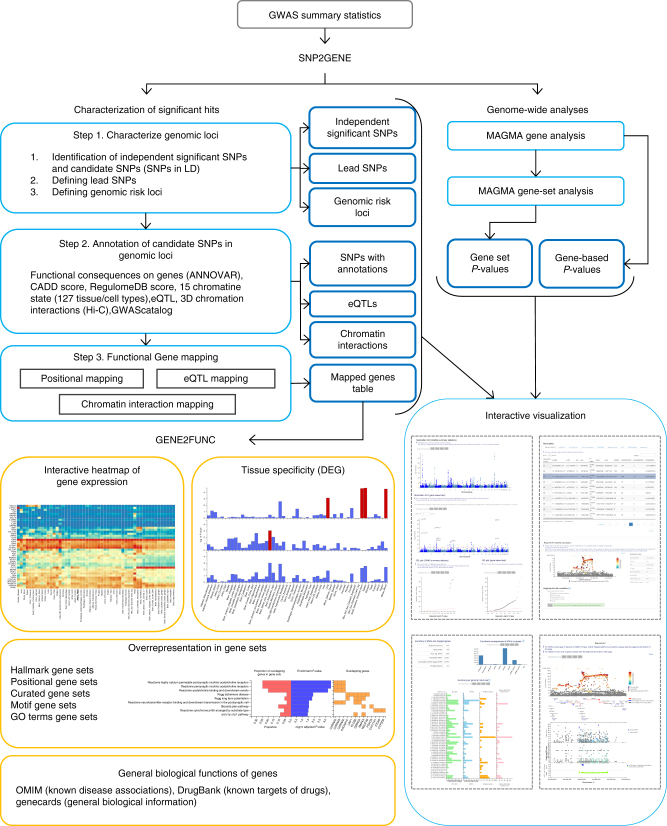
A main challenge in genome-wide association studies (GWAS) is to pinpoint possible causal variants. Results from GWAS typically do not directly translate into causal variants because the majority of hits are in non-coding or intergenic regions, and the presence of linkage disequilibrium leads to effects being statistically spread out across multiple variants. Post-GWAS annotation facilitates the selection of most likely causal variant(s). Multiple resources are available for post-GWAS annotation, yet these can be time consuming and do not provide integrated visual aids for data interpretation. We, therefore, develop FUMA: an integrative web-based platform using information from multiple biological resources to facilitate functional annotation of GWAS results, gene prioritization and interactive visualization. FUMA accommodates positional, expression quantitative trait loci (eQTL) and chromatin interaction mappings, and provides gene-based, pathway and tissue enrichment results. FUMA results directly aid in generating hypotheses that are testable in functional experiments aimed at proving causal relations.
Overview
The claims and statistics of this paper haven’t been checked yet.
Free: it reads the open-access text and checks the first 5 claims that cite a source we can check. Create a free account to check every claim.
Integrity signals
Registry
Cites
Statistics
Figures
Verification
Claims the paper makes
The claims and statistics of this paper haven’t been checked yet.
Free: it reads the open-access text and checks the first 5 claims that cite a source we can check. Create a free account to check every claim.
Claims other papers make about this one
Each is checked against this paper’s own text: does it say what the citing paper says it does?
The cited source says what the claim attributes to it.
In the citing paper
“Independently associated loci from the metaanalysis were defined using FUMA 24 (see URLs), an online platform for functional mapping of genetic variants.”
From Genome-wide association meta-analysis in 269,867 individuals identifies new genetic and functional links to intelligence (2018) · cites this paper as [24]
The check wasn’t confident either way, so it gives no verdict — never disputed.
In the citing paper
“The genetic architecture of fertility showed enrichment for gene expression in brain and ovarian tissues, which is consistent with known biology33,34.”
From Genetic trade-offs in fertility and longevity explain the maintenance of disease-associated alleles in humans (2026) · cites this paper as [33]
Experimental — accuracy not yet measuredIn the citing paper
“While traditional Hi-C guided gene mapping restricts its analysis to genome-wide significant (GWS) loci7, H-MAGMA can leverage signals from sub-threshold loci that explain a significant proportion of heritability8.”
From A computational tool (H-MAGMA) for improved prediction of brain-disorder risk genes by incorporating brain chromatin interaction profiles (2020) · cites this paper as [7]
In the citing paper
“Gene-based analysis using FUMA28, with input SNPs mapped by position to 18,232 protein-coding genes, identified an additional locus for walking (near HP1BP3) and moderate activity (near KCNA6) (Supplementary Data 4).”
From GWAS identifies 14 loci for device-measured physical activity and sleep duration (2018) · cites this paper as [28]
In the citing paper
“Although several databases have been developed to collect eQTL summary statistics from individual studies11–17, these efforts have relied on the heterogeneous set of files provided by the original authors.”
From A compendium of uniformly processed human gene expression and splicing quantitative trait loci (2021) · cites this paper as [13]
1 more claim about this paper
Create a free account to see every claim other papers make about this one.
Self-check
Percentages, sums and reported differences re-computed from the paper’s own numbers.
The self-check needs the paper’s full text.
Citations
Cites
PLINK: a tool set for whole-genome association and population-based linkage analyses.
Purcell, S., Neale, B., Todd-Brown, K., Thomas, L., Ferreira, M. A. R., Bender, D., Maller, J., Sklar, P., de Bakker, P. I. W., Daly, M. J., et al. (2007) · The American Journal of Human Genetics · doi:10.1086/519795 · Cited by 34,089 · cited 2×
“In FUMA, this task is automated by using pairwise LD ( r 2 ) of SNPs in the reference panel (1000 genomes project phase 3 27 ) pre-computed by PLINK, resulting in a list of independent signi fi cant SNPs, lead SNPs and genomic risk loci based on the GWAS input fi le.”
MethodA global reference for human genetic variation
The 1000 Genomes Project Consortium, authors, C., Auton, A., Abecasis, G. R., Steering committee, Altshuler, D. M., Durbin, R. M., Abecasis, G. R., Bentley, D. R., Chakravarti, A., et al. (2015) · Nature · doi:10.1038/nature15393 · Cited by 18,247 · cited 1×
“In FUMA, this task is automated by using pairwise LD ( r 2 ) of SNPs in the reference panel (1000 genomes project phase 3 27 ) pre-computed by PLINK, resulting in a list of independent signi fi cant SNPs, lead SNPs and genomic risk loci based on the GWAS input fi le.”
MethodAn integrated encyclopedia of DNA elements in the human genome
The ENCODE Project Consortium (2012) · Nature · doi:10.1038/nature11247 · Cited by 18,072
ANNOVAR: functional annotation of genetic variants from high-throughput sequencing data
Wang, K., Li, M., & Hakonarson, H. (2010) · Nucleic Acids Research · doi:10.1093/nar/gkq603 · Cited by 14,621 · cited 3×
“…the independent signi fi cant SNPs are then annotated for functional consequences on gene functions (based on Ensembl genes (build 85) using ANNOVAR 12 ), deleteriousness score (CADD score 13 ), potential regulatory functions (RegulomeDB score 14 and 15-core chromatin state predicted by ChromHMM…”
MethodSudlow, C., Gallacher, J., Allen, N., Beral, V., Burton, P., Danesh, J., Downey, P., Elliott, P., Green, J., Landray, M., et al. (2015) · PLOS Medicine · doi:10.1371/journal.pmed.1001779 · Cited by 12,728 · cited 5×
“9; see Supplementary Note 5 and Supplementary Fig.”
BackgroundMethodResultInfluentialAnalysis of protein-coding genetic variation in 60,706 humans
Exome Aggregation Consortium, Lek, M., Karczewski, K. J., Minikel, E. V., Samocha, K. E., Banks, E., Fennell, T., O’Donnell-Luria, A. H., Ware, J. S., Hill, A. J., et al. (2016) · Nature · doi:10.1038/nature19057 · Cited by 9,587 · cited 1×
“For mapped genes, two scores of intolerance to functional mutations are annotated; probability of being loss-of-function intolerant (pLI) 58 and non-coding residual variation intolerance score (ncRVIS) 59 .”
BackgroundThe Ensembl Variant Effect Predictor
McLaren, W., Gil, L., Hunt, S. E., Riat, H. S., Ritchie, G. R. S., Thormann, A., Flicek, P., & Cunningham, F. (2016) · Genome Biology · doi:10.1186/s13059-016-0974-4 · Cited by 8,099
Biological insights from 108 schizophrenia-associated genetic loci
Schizophrenia Working Group of the Psychiatric Genomics Consortium (2014) · Nature · doi:10.1038/nature13595 · Cited by 7,577 · cited 3×
“We also applied FUMA to the most recent Schizophrenia (SCZ; 36,989 cases and 113,075 controls) GWAS summary statistics 3 , and 128 lead SNPs from 269 independent signi fi cant SNPs across 109 genomic loci were identi fi ed (Supplementary Note 5, Supplementary Fig.”
BackgroundMethodResultMolecular signatures database (MSigDB) 3.0
Liberzon, A., Subramanian, A., Pinchback, R., Thorvaldsdóttir, H., Tamayo, P., & Mesirov, J. P. (2011) · Bioinformatics · doi:10.1093/bioinformatics/btr260 · Cited by 7,111 · cited 3×
“To test for overrepresentation of biological functions, the prioritized genes (or a list of genes of interest) are tested against gene sets obtained from MsigDB (i.e., hallmark gene sets, positional gene sets, curated gene sets, motif gene sets, computational gene sets, GO gene sets, oncogenic signatures, and immunolo…”
MethodIntegrative analysis of 111 reference human epigenomes
Roadmap Epigenomics Consortium, Kundaje, A., Meuleman, W., Ernst, J., Bilenky, M., Yen, A., Heravi-Moussavi, A., Kheradpour, P., Zhang, Z., Wang, J., et al. (2015) · Nature · doi:10.1038/nature14248 · Cited by 6,368
Cited by
Items 1,001–1,048 of 1,048
Ghouse, J., Ahlberg, G., Andreasen, L., Banasik, K., Brunak, S., Schwinn, M., Larsen, I. H., Petersen, O., Sørensen, E., Ullum, H., et al. (2021) · Journal of the American College of Cardiology · doi:10.1016/j.jacc.2021.05.054 · Cited by 24
Eszlari, N., Millinghoffer, A., Petschner, P., Gonda, X., Baksa, D., Pulay, A. J., Réthelyi, J. M., Breen, G., Deakin, J. F. W., Antal, P., et al. (2019) · Translational Psychiatry · doi:10.1038/s41398-019-0454-1 · Cited by 24
Wang, M., Zhao, S., Wu, D., Zhang, Y.-H., Han, Y.-K., Zhao, K., Qi, T., Liu, Y., Cui, L., & Wei, Y. (2024) · Psychoradiology · doi:10.1093/psyrad/kkae005 · Cited by 25
Andreu‐Sánchez, S., Ahmad, S., Kurilshikov, A., Beekman, M., Ghanbari, M., van Faassen, M. H. J. R., van den Munckhof, I., Steur, M., Harms, A. C., Hankemeier, T., et al. (2024) · iMeta · doi:10.1002/imt2.183 · Cited by 26
“Functional mapping, annotation, and enrichment analysis Functional Mapping and Annotation of genetic associations (FUMA) was used to characterize genomic loci [87].”
MethodMammographic density mediates the protective effect of early-life body size on breast cancer risk
Vabistsevits, M., Smith, G. D., Richardson, T. G., Richmond, R. C., Sieh, W., Rothstein, J. H., Habel, L. A., Alexeeff, S., Lloyd‐Lewis, B., & Sanderson, E. C. M. (2024) · Nature Communications · doi:10.1038/s41467-024-48105-7 · Cited by 26
“For gene mapping, we used the SNP2Gene function on the FUMA (the Functional Mapping and Annotation of GWAS) platform 87 , applying positional mapping (500 kb) and eQTL-based mapping (including only GTEx v8 breast or adipose tissue datasets).”
Manzoni, C., Kia, D. A., Ferrari, R., Leonenko, G., Costa, B., Saba, V., Jabbari, E., Tan, M. M. X., Albani, D., Álvarez, V., et al. (2024) · The American Journal of Human Genetics · doi:10.1016/j.ajhg.2024.05.017 · Cited by 26
The goldmine of GWAS summary statistics: a systematic review of methods and tools
Kontou, P. I., & Bagos, P. G. (2024) · BioData Mining · doi:10.1186/s13040-024-00385-x · Cited by 26
“Notably, tools like aSPU [168], snpGeneSets [178], Pascal/PascalX [179, 180], MAGMA, chromMAGMA [181] and FUMA [182], also offer the option of performing gene-set analysis after performing the gene-based analysis (see next section), whereas HSVS-M [168, 183] tests the association of a gene with…”
MethodUnraveling the genetic links between depression and type 2 diabetes
Baranova, A. V., Liu, D., Chandhoke, V., Cao, H., & Zhang, F. (2025) · Progress in Neuro-Psychopharmacology and Biological Psychiatry · doi:10.1016/j.pnpbp.2025.111258 · Cited by 24
Ayele, F. T., Biedrzycki, R. J., Habtewold, T. D., Wijesiriwardhana, P., Burt, A., Marsit, C. J., Ouidir, M., & Wapner, R. J. (2025) · Nature Communications · doi:10.1038/s41467-025-58128-3 · Cited by 24
The overlapping genetic architecture of psychiatric disorders and cortical brain structure
Sha, Z., Warrier, V., Bethlehem, R. A. I., Schultz, L. M., Merikangas, A. K., Sun, K. Y., Gur, R. C., Gur, R. E., Shinohara, R. T., Gandal, M. J., et al. (2025) · Nature Mental Health · doi:10.1038/s44220-025-00475-7 · Cited by 24
“FUMA used an FDR threshold of 0.05 (default parameter) within each analysis to identify significant eQTL associations.”
InfluentialGorman, B. R., Francis, M., Nealon, C. L., Halladay, C. W., Duro, N., Markianos, K., Genovese, G., Hysi, P. G., Choquet, H., Afshari, N. A., et al. (2024) · Communications Biology · doi:10.1038/s42003-024-06046-3 · Cited by 23
A missense variant in SHARPIN mediates Alzheimer’s disease-specific brain damages
Park, J. Y., Lee, D., Lee, J. J., Gim, J., Gunasekaran, T. I., Choi, K. Y., Kang, S., Do, A. R., Jo, J., Park, J., et al. (2021) · Translational Psychiatry · doi:10.1038/s41398-021-01680-5 · Cited by 21
“01 that were annotated using the SNP2GENE function implemented in the FUMA program [32].”
MethodAlemany, S., Soler-Artigas, M., Cabana-Domínguez, J., Fakhreddine, D., Llonga, N., Vilar-Ribó, L., Rodríguez-Urrutia, A., Palacio, J., González-Castro, A. M., Lobo, B., et al. (2023) · Journal of Translational Medicine · doi:10.1186/s12967-023-04107-5 · Cited by 20
“Functional annotation of the credible variants was conducted using FUMA [31].”
MethodInfluentialGenetic architecture of plasma Alzheimer disease biomarkers
Bradley, J., Gorijala, P., Schindler, S. E., Sung, Y. J., Ances, B., the Alzheimer’s Disease Neuroimaging Initiative, T. H. C. P., Ertekin-Taner, N., Younkin, S., Golde, T., Price, N., et al. (2023) · Human Molecular Genetics · doi:10.1093/hmg/ddad087 · Cited by 20
Chen, Y., & Chen, W. (2022) · Journal of Investigative Dermatology · doi:10.1016/j.jid.2022.04.021 · Cited by 19
Shared genetic architectures of educational attainment in East Asian and European populations
Chen, T.-T., Kim, J., Lam, M., Chuang, Y.-F., Chiu, Y.-L., Lin, S.-C., Jung, S.-H., Kim, B., Kim, S., Cho, C., et al. (2024) · Nature Human Behaviour · doi:10.1038/s41562-023-01781-9 · Cited by 18
“We extended the region of a significant locus, identified through FUMA 22 , by adding 250 kb to each side, if the region was less than 1 Mb.”
InfluentialA General Cognitive Ability Factor for the UK Biobank
Williams, C. M., Labouret, G., Wolfram, T., Peyre, H., & Ramus, F. (2023) · Behavior Genetics · doi:10.1007/s10519-022-10127-6 · Cited by 18
Family-based genome-wide association study of autism spectrum disorder in middle eastern families
Al-Sarraj, Y., Al-Dous, E., Taha, R. Z., Ahram, D., Alshaban, F., Tolfat, M., El-Shanti, H., & Albagha, O. M. E. (2021) · Genes · doi:10.3390/genes12050761 · Cited by 17
Genome-wide determinants of mortality and motor progression in Parkinson’s disease
Tan, M. M. X., Lawton, M. A., Pollard, M. I., Brown, E., Real, R., Carrasco, A. M., Bekadar, S., Jabbari, E., Reynolds, R. H., Iwaki, H., et al. (2024) · npj Parkinson's Disease · doi:10.1038/s41531-024-00729-8 · Cited by 17
“We report the proportional hazards assumption p-valuesforeachofthetop10SNPsineachcohortinSupplementaryTables 7and8.”
BackgroundYang, Y., Bartz, T. M., Brown, M. R., Guo, X., Zilhão, N. R., Trompet, S., Weiss, S., Yao, J., Brody, J. A., Defilippi, C. R., et al. (2021) · Circulation: Genomic and Precision Medicine · doi:10.1161/circgen.121.003460 · Cited by 16
Meta-analysis of ACE inhibitor-induced angioedema identifies novel risk locus.
Mathey, C. M., Maj, C., Eriksson, N., Krebs, K., Westmeier, J., David, F. S., Koromina, M., Scheer, A. B., Szabo, N., Wedi, B., et al. (2024) · Journal of Allergy and Clinical Immunology · doi:10.1016/j.jaci.2023.11.921 · Cited by 15
Rare copy number variation in extremely impulsively violent males
Vevera, J., Zarrei, M., Hartmannová, H., Jedličková, I., Mušálková, D., Přistoupilová, A., Oliveriusová, P., Trešlová, H., Nosková, L., Hodaňová, K., et al. (2019) · Genes, Brain and Behavior · doi:10.1111/gbb.12536 · Cited by 15
Chen, K., Gao, T., Liu, Y., Zhu, K., Wang, T., & Zeng, P. (2024) · Neurobiology of Aging · doi:10.1016/j.neurobiolaging.2023.09.017 · Cited by 15
“The variant annotations through FUMA for the 190 SNPs are summarized in Supplementary Table S7.”
BackgroundMethodInfluentialSanchez-Roige, S., Palmer, A. A., Fontanillas, P., Elson, S. L., The 23andMe Research Team, Substance Use Disorder Working Group of the Psychiatric Genomics Consortium, Adams, M. J., Howard, D. M., Edenberg, H. J., Davies, G., et al. (2018) · doi:10.1101/275917 · Cited by 14
“8 (22) to study the functional consequences of the index SNPs, and of the SNPs contained in each credible set, which included ANNOVAR categories, Combined Annotation Dependent Depletion (CADD) scores, RegulomeDB scores, eQTLs, and chromatin”
InfluentialJones, S. E., Hees, V. T. V., Mazzotti, D. R., Marques-Vidal, P., Sabia, S., der Spek, A. V., Dashti, H. S., Engmann, J., Kocevska, D., Tyrrell, J., et al. (2018) · doi:10.1101/303925 · Cited by 14
Liu, R., Shang, X., Fu, Y., Wang, Y., Wang, P., & Yan, S. (2024) · Molecular Immunology · doi:10.1016/j.molimm.2024.02.002 · Cited by 13
Wendt, F. R., Pathak, G. A., & Polimanti, R. (2022) · Nature Communications · doi:10.1038/s41467-022-35423-x · Cited by 12
Guo, Y., Ma, G., Wang, Y., Lin, T., Hu, Y., & Zang, T. (2024) · Aging Cell · doi:10.1111/acel.14271 · Cited by 12
“The definition of independent genomic loci was consistent with FUMA (Watanabe et al., 2017 ) protocol.”
Integrative proteomics and pharmacogenomics analysis of methylphenidate treatment response
da Silva, B. S., Leffa, D. T., Beys-da-Silva, W. O., Torres, I. L. S., Rovaris, D. L., Victor, M. M., Rohde, L. A., Mota, N. R., Oliveira, C. D., Berger, M., et al. (2019) · Translational Psychiatry · doi:10.1038/s41398-019-0649-5 · Cited by 12
Proteomic clusters underlie heterogeneity in preclinical Alzheimer’s disease progression
Wisch, J. K., Butt, O. H., Gordon, B. A., Schindler, S. E., Fagan, A. M., Henson, R. L., Yang, C., Boerwinkle, A. H., Benzinger, T. L. S., Holtzman, D. M., et al. (2023) · Brain · doi:10.1093/brain/awac484 · Cited by 11
Thomassen, J. Q., Leonard, H., Ulms, B., Grenier-Boley, B., Heikkinen, S., Garcia-González, P., Castillo-Morales, A., Kikuchi, M., Gim, J., Cao, H., et al. (2026) · Nature Genetics · doi:10.1038/s41588-026-02713-9 · Cited by 9
EADB, Bellenguez, C., Castillo Morales, A., Amin, N., van der Lee, S. J., Muntaner, M., Parveen, K., Küçükali, F., Grenier-Boley, B., Heikkinen, S., et al. (2026) · Nature Genetics · doi:10.1038/s41588-026-02583-1 · Cited by 36
“5.2) 44 , we extracted all variants in LD ( r 2 > 0.75) with the index variants of the new tier 1 and tier 2 loci in the EUR population from 1000 Genomes Phase 3.”
InfluentialBrigos-Barril, E., Vasallo, C., Farré, X., Morcillo-Suárez, C., Polo-Alonso, S., Rodríguez-Fernández, B., Valenzuela, A., Sarabia, C., Bosch, E., Laayouni, H., et al. (2026) · Nature Ecology & Evolution · doi:10.1038/s41559-026-03140-z · Cited by 6
“The genetic architecture of fertility showed enrichment for gene expression in brain and ovarian tissues, which is consistent with known biology 33,34 .”
Zammit, A. R., Klein, H.-U., Yu, L., Levey, A. I., Seyfried, N. T., Wingo, A. P., Wingo, T. S., Schneider, J. A., Bennett, D. A., & Buchman, A. S. (2024) · Neurology · doi:10.1212/wnl.0000000000207816 · Cited by 6
Debette, S., Caro, I., Western, D., Namba, S., Sun, N., Kawaguchi, S., He, Y., Fujita, M., Roshchupkin, G., D'Aoust, T., et al. (2024) · doi:10.21203/rs.3.rs-4535534/v1 · Cited by 5
Detecting genetic interactions with visible neural networks
(2025) · doi:10.1038/s42003-025-08157-x · Cited by 5
“For the IBD dataset we used similar neural networks but with gene annotations from FUMA 36 .”
Wootton, O., Shadrin, A. A., Mohn, C., Susser, E., Ramesar, R., Gur, R. C., Andreassen, O. A., Stein, D. J., & Dalvie, S. (2023) · Molecular Psychiatry · doi:10.1038/s41380-023-02292-9 · Cited by 5
“Genomic risk loci for RTV were characterised from the GWAS results using Functional Mapping and Annotation of Genome-Wide Association Studies (FUMA) [30].”
MethodIdentifying Genes Associated with Alzheimer’s Disease Using Gene-Based Polygenic Risk Score
Lai, D., Zhang, M., Li, R., Zhang, C., Zhang, P., Liu, Y., Gao, S., & Foroud, T. (2023) · Journal of Alzheimer's Disease · doi:10.3233/jad-230510 · Cited by 3
Genetic drivers of progression in Alzheimer’s disease are distinct from disease risk
Cohen, C. E., Fernandez, S., Yaman, U., Ehyaei, A. R., Kodosaki, E., Askarova, A., Porter, T., O’Brien, E., Study, A. I. B. A. L., Initiative, A. D. N., et al. (2026) · Alzheimer's Research & Therapy · doi:10.1186/s13195-026-02036-1 · Cited by 3
“Summary statistics were analysed through the FUMA SNP2GENE pipeline [37] to identify suggestively significant results.”
Cholerton, B., Godrich, D., Pasteris, J., Rivero, J., Martin, E. R., Kunkle, B. W., Naj, A. C., Hamilton-Nelson, K. L., Wang, H., Lee, W.-P., et al. (2026) · PLOS Genetics · doi:10.1371/journal.pgen.1012170 · Cited by 1
“5.2) [81] combined annotation-dependent depletion [82], and RegulomeDB [83].”
InfluentialLeung, Y. Y., Marcora, E. M., Naj, A., Patel, T., Sedgwick, K., Katanic, Z., Corces, R. M., Wang, L.-S., Mayeux, R. C., Goate, A. M., et al. (2026) · doi:10.64898/2026.05.14.26353247 · Cited by 1
Wu, Q., Yang, F., An, Q., Liu, Y., Tian, H., Du, Y., Cai, W., Lei, M., Xu, J., Deng, L., et al. (2026) · Journal of the American Heart Association · doi:10.1161/jaha.126.049987
Lin, J., Wu, S., Lin, C., Jin, S., Chen, L., Luo, J., Xu, S., Jin, L., Yu, M., Zheng, Y., et al. (2026) · Journal of the American Heart Association · doi:10.1161/jaha.126.050327
Veltman, L. J., Lee, S. H., Benyamin, B., 23andMe Research Institute, Cohen-Woods, S., Hyppönen, E., & Stacey, D. (2026) · Psychological Medicine · doi:10.1017/s0033291726106308
Genome-wide meta-analysis dissects the genetic basis and health implications of circulating taurine
Zhou, S., Tan, J., Li, X., Ran, Z., He, J., Li, Y., Yuan, X., Hu, Y., Chen, M., Dai, Y., et al. (2026) · Functional & Integrative Genomics · doi:10.1007/s10142-026-02067-9
“In parallel, we employed FUMA to annotate all SNPs within each locus with eQTL data, pinpointing the gene with the most significant eQTL signal and draw - ing annotations from multiple databases, such as Genotype-Tissue Expression (GTEx) and the eQTL catalog (Watanabe et al. 2017).”
InfluentialLi, M., Yao, Y., Zhao, Y., Guo, Q., Li, C., Lv, C., Zhang, B., Li, J., & Zhao, H. (2026) · Biogerontology · doi:10.1007/s10522-026-10537-7
Xu, Y., Wang, J., Zhang, R., Hou, C., Sun, X., Li, Q., & Liu, C. (2026) · Journal of the American Heart Association · doi:10.1161/jaha.126.050689
Zheng, X., Feng, H., Ren, L., & Zhang, Y. (2026) · Translational Psychiatry · doi:10.1038/s41398-026-04213-0
Metadata
- Authors
- Watanabe, K., Taskesen, E., van Bochoven, A., & Posthuma, D.
- Affiliations
- Vrije Universiteit Amsterdam (NL)
- Venue
- Nature Communications
- Published
- 2017-11-28
- Volume
- 8
- Issue
- 1
- Pages
- 1826-1826
- ISSN
- 2041-1723 (ISSN-L)
- PMC
- PMC5705698
- OpenAlex
- W2770092353
- Semantic Scholar
- 5962b3ca064a021d7bd3203f3037c759e203b442
- Cited by
- 4,083
- References
- 66
- Citations by year
- 2026: 522 · 2025: 740 · 2024: 715 · 2023: 543 · 2022: 530 · 2021: 435 · 2020: 277 · 2019: 213 · 2018: 97 · 2017: 8
- FWCI
- 66.54
- Type
- journal article
- Language
- en
- Open access
- gold
- doi.org
- Licence
- cc-by
- creativecommons.org/licenses/by/4.0 (tdm)
- creativecommons.org/licenses/by/4.0 (vor)
- Locations
- Nature Communications (publishedVersion, cc-by)
- bioRxiv (Cold Spring Harbor Laboratory) (acceptedVersion, cc-by-nc-nd)
- Europe PMC (PubMed Central) (publishedVersion, cc-by)
- PubMed Central (publishedVersion, cc-by)
- PubMed (publishedVersion)
- Pure Amsterdam UMC (publishedVersion, other-oa)
- Amsterdam UMC (VU Amsterdam) - Institutional Repository (publishedVersion)
- VU Research Portal (publishedVersion, other-oa)
- RePEc: Research Papers in Economics (submittedVersion)
- DOAJ (DOAJ: Directory of Open Access Journals) (submittedVersion, cc-by-sa)
- DOAJ (DOAJ: Directory of Open Access Journals) (submittedVersion)
- Data Archiving and Networked Services (DANS) (submittedVersion, other-oa)
- Data Archiving and Networked Services (DANS) (submittedVersion)
- Funders
- Nederlandse Organisatie voor Wetenschappelijk Onderzoek (VICI 453-14-005, NWO VICI 453-14-005, 453-13-005, 453-14-005)
- Lundbeckfonden (R155-2014-1724)
- Topics
- Life Sciences › Biochemistry, Genetics and Molecular Biology › Molecular Biology › Bioinformatics and Genomic Networks
- Life Sciences › Biochemistry, Genetics and Molecular Biology › Genetics › Genetic Associations and Epidemiology
- Life Sciences › Biochemistry, Genetics and Molecular Biology › Genetics › Genetic Mapping and Diversity in Plants and Animals
- Keywords
- FUMA, causal variant identification, functional annotation, gene prioritization, expression quantitative trait loci, chromatin interactions, pathway enrichment, web-based annotation platform, linkage disequilibrium
- MeSH terms
- Chromatin, Chromosome Mapping, Crohn Disease, Humans, Linkage Disequilibrium, Genome, Human, Computational Biology, Genetic Predisposition to Disease, Internet, Databases, Genetic, Quantitative Trait Loci, Genome-Wide Association Study, Molecular Sequence Annotation
About these checks
Registry, retraction, Cites and statistics results are computed, not judged, with one exception: a printed reference that no index lists is read once by a model before it counts as a citation error. Claims are extracted by a model and kept only when their quote appears verbatim in the text; each cited source is then checked, with a model’s help, for whether it says what the claim relies on. Those verdicts can be wrong — read the claim’s quote and the cited source before relying on one.
Statistics and arithmetic are recomputed, not judged.
Confidence bands are shown only for fields calibrated on our annotated test set. None is calibrated yet, so no band is shown.
What counts as a claim ›How we measure confidence ›How we check this ›
Are you an author, or do you see a problem with this page? Request a review
Data sources
Bibliographic data: Semantic Scholar, OpenAlex, Crossref.
Contains information from the Semantic Scholar Academic Graph Datasets, made available under the ODC Attribution License (ODC-BY 1.0).
Semantic Scholar’s data is described in: Kinney, R., et al. (2023). The Semantic Scholar Open Data Platform. arXiv:2301.10140.
