

Functional mapping and annotation of genetic associations with FUMA
Open accessPublished version of a preprint
The DOI matches its Crossref record; 67 of the 67 references it cites were found in a registry or an index.
Abstract
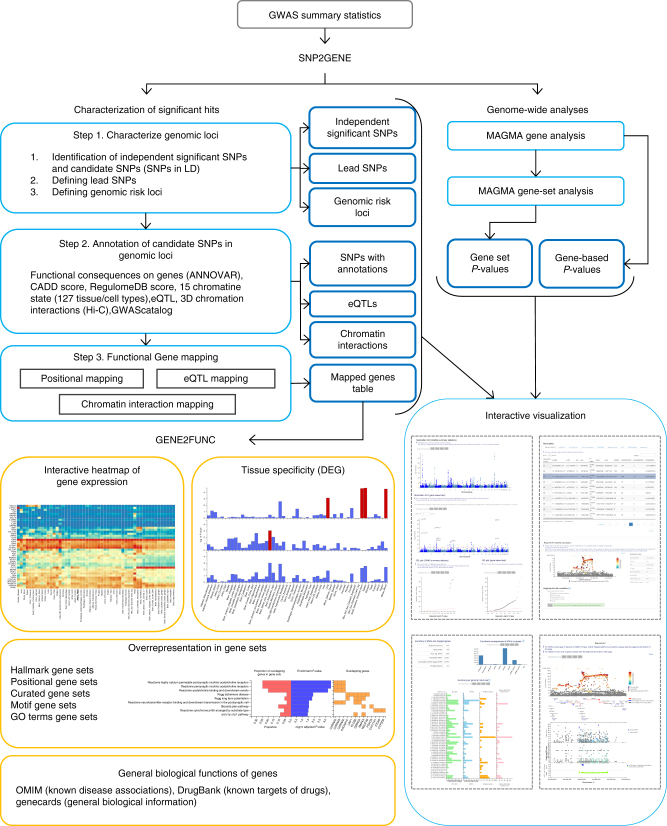
A main challenge in genome-wide association studies (GWAS) is to pinpoint possible causal variants. Results from GWAS typically do not directly translate into causal variants because the majority of hits are in non-coding or intergenic regions, and the presence of linkage disequilibrium leads to effects being statistically spread out across multiple variants. Post-GWAS annotation facilitates the selection of most likely causal variant(s). Multiple resources are available for post-GWAS annotation, yet these can be time consuming and do not provide integrated visual aids for data interpretation. We, therefore, develop FUMA: an integrative web-based platform using information from multiple biological resources to facilitate functional annotation of GWAS results, gene prioritization and interactive visualization. FUMA accommodates positional, expression quantitative trait loci (eQTL) and chromatin interaction mappings, and provides gene-based, pathway and tissue enrichment results. FUMA results directly aid in generating hypotheses that are testable in functional experiments aimed at proving causal relations.
Overview
The claims and statistics of this paper haven’t been checked yet.
Free: it reads the open-access text and checks the first 5 claims that cite a source we can check. Create a free account to check every claim.
Integrity signals
Registry
Cites
Statistics
Figures
Verification
Claims the paper makes
The claims and statistics of this paper haven’t been checked yet.
Free: it reads the open-access text and checks the first 5 claims that cite a source we can check. Create a free account to check every claim.
Claims other papers make about this one
Each is checked against this paper’s own text: does it say what the citing paper says it does?
The cited source says what the claim attributes to it.
In the citing paper
“Independently associated loci from the metaanalysis were defined using FUMA 24 (see URLs), an online platform for functional mapping of genetic variants.”
From Genome-wide association meta-analysis in 269,867 individuals identifies new genetic and functional links to intelligence (2018) · cites this paper as [24]
The check wasn’t confident either way, so it gives no verdict — never disputed.
In the citing paper
“The genetic architecture of fertility showed enrichment for gene expression in brain and ovarian tissues, which is consistent with known biology33,34.”
From Genetic trade-offs in fertility and longevity explain the maintenance of disease-associated alleles in humans (2026) · cites this paper as [33]
Experimental — accuracy not yet measuredIn the citing paper
“While traditional Hi-C guided gene mapping restricts its analysis to genome-wide significant (GWS) loci7, H-MAGMA can leverage signals from sub-threshold loci that explain a significant proportion of heritability8.”
From A computational tool (H-MAGMA) for improved prediction of brain-disorder risk genes by incorporating brain chromatin interaction profiles (2020) · cites this paper as [7]
In the citing paper
“Gene-based analysis using FUMA28, with input SNPs mapped by position to 18,232 protein-coding genes, identified an additional locus for walking (near HP1BP3) and moderate activity (near KCNA6) (Supplementary Data 4).”
From GWAS identifies 14 loci for device-measured physical activity and sleep duration (2018) · cites this paper as [28]
In the citing paper
“Although several databases have been developed to collect eQTL summary statistics from individual studies11–17, these efforts have relied on the heterogeneous set of files provided by the original authors.”
From A compendium of uniformly processed human gene expression and splicing quantitative trait loci (2021) · cites this paper as [13]
1 more claim about this paper
Create a free account to see every claim other papers make about this one.
Self-check
Percentages, sums and reported differences re-computed from the paper’s own numbers.
The self-check needs the paper’s full text.
Citations
Cites
PLINK: a tool set for whole-genome association and population-based linkage analyses.
Purcell, S., Neale, B., Todd-Brown, K., Thomas, L., Ferreira, M. A. R., Bender, D., Maller, J., Sklar, P., de Bakker, P. I. W., Daly, M. J., et al. (2007) · The American Journal of Human Genetics · doi:10.1086/519795 · Cited by 34,089 · cited 2×
“In FUMA, this task is automated by using pairwise LD ( r 2 ) of SNPs in the reference panel (1000 genomes project phase 3 27 ) pre-computed by PLINK, resulting in a list of independent signi fi cant SNPs, lead SNPs and genomic risk loci based on the GWAS input fi le.”
MethodA global reference for human genetic variation
The 1000 Genomes Project Consortium, authors, C., Auton, A., Abecasis, G. R., Steering committee, Altshuler, D. M., Durbin, R. M., Abecasis, G. R., Bentley, D. R., Chakravarti, A., et al. (2015) · Nature · doi:10.1038/nature15393 · Cited by 18,247 · cited 1×
“In FUMA, this task is automated by using pairwise LD ( r 2 ) of SNPs in the reference panel (1000 genomes project phase 3 27 ) pre-computed by PLINK, resulting in a list of independent signi fi cant SNPs, lead SNPs and genomic risk loci based on the GWAS input fi le.”
MethodAn integrated encyclopedia of DNA elements in the human genome
The ENCODE Project Consortium (2012) · Nature · doi:10.1038/nature11247 · Cited by 18,072
ANNOVAR: functional annotation of genetic variants from high-throughput sequencing data
Wang, K., Li, M., & Hakonarson, H. (2010) · Nucleic Acids Research · doi:10.1093/nar/gkq603 · Cited by 14,621 · cited 3×
“…the independent signi fi cant SNPs are then annotated for functional consequences on gene functions (based on Ensembl genes (build 85) using ANNOVAR 12 ), deleteriousness score (CADD score 13 ), potential regulatory functions (RegulomeDB score 14 and 15-core chromatin state predicted by ChromHMM…”
MethodSudlow, C., Gallacher, J., Allen, N., Beral, V., Burton, P., Danesh, J., Downey, P., Elliott, P., Green, J., Landray, M., et al. (2015) · PLOS Medicine · doi:10.1371/journal.pmed.1001779 · Cited by 12,728 · cited 5×
“9; see Supplementary Note 5 and Supplementary Fig.”
BackgroundMethodResultInfluentialAnalysis of protein-coding genetic variation in 60,706 humans
Exome Aggregation Consortium, Lek, M., Karczewski, K. J., Minikel, E. V., Samocha, K. E., Banks, E., Fennell, T., O’Donnell-Luria, A. H., Ware, J. S., Hill, A. J., et al. (2016) · Nature · doi:10.1038/nature19057 · Cited by 9,587 · cited 1×
“For mapped genes, two scores of intolerance to functional mutations are annotated; probability of being loss-of-function intolerant (pLI) 58 and non-coding residual variation intolerance score (ncRVIS) 59 .”
BackgroundThe Ensembl Variant Effect Predictor
McLaren, W., Gil, L., Hunt, S. E., Riat, H. S., Ritchie, G. R. S., Thormann, A., Flicek, P., & Cunningham, F. (2016) · Genome Biology · doi:10.1186/s13059-016-0974-4 · Cited by 8,099
Biological insights from 108 schizophrenia-associated genetic loci
Schizophrenia Working Group of the Psychiatric Genomics Consortium (2014) · Nature · doi:10.1038/nature13595 · Cited by 7,577 · cited 3×
“We also applied FUMA to the most recent Schizophrenia (SCZ; 36,989 cases and 113,075 controls) GWAS summary statistics 3 , and 128 lead SNPs from 269 independent signi fi cant SNPs across 109 genomic loci were identi fi ed (Supplementary Note 5, Supplementary Fig.”
BackgroundMethodResultMolecular signatures database (MSigDB) 3.0
Liberzon, A., Subramanian, A., Pinchback, R., Thorvaldsdóttir, H., Tamayo, P., & Mesirov, J. P. (2011) · Bioinformatics · doi:10.1093/bioinformatics/btr260 · Cited by 7,111 · cited 3×
“To test for overrepresentation of biological functions, the prioritized genes (or a list of genes of interest) are tested against gene sets obtained from MsigDB (i.e., hallmark gene sets, positional gene sets, curated gene sets, motif gene sets, computational gene sets, GO gene sets, oncogenic signatures, and immunolo…”
MethodIntegrative analysis of 111 reference human epigenomes
Roadmap Epigenomics Consortium, Kundaje, A., Meuleman, W., Ernst, J., Bilenky, M., Yen, A., Heravi-Moussavi, A., Kheradpour, P., Zhang, Z., Wang, J., et al. (2015) · Nature · doi:10.1038/nature14248 · Cited by 6,368
Cited by
Items 801–900 of 1,048
Bang, L., Bahrami, S., Hindley, G., Smeland, O. B., Rødevand, L. N., Jaholkowski, P. P., Shadrin, A. A., Connell, K. S. O., Frei, O., Lin, A., et al. (2023) · Translational Psychiatry · doi:10.1038/s41398-023-02585-1 · Cited by 37
“…genetic correlations between AN and the following disorders and traits: SCZ ( r g = 0.26, SE = 0.03, p = 6.64 × 10 Please note that the statistical signi fi cance of certain genetic correlations (e.g., AN and SCZ) is higher than others (e.g., MD and SCZ) despite a lower point estimate…”
BackgroundMethodInfluentialGenomic loci influence patterns of structural covariance in the human brain
Wen, J., Nasrallah, I. M., Abdulkadir, A., Satterthwaite, T. D., Yang, Z., Erus, G., Robert‐Fitzgerald, T., Singh, A., Sotiras, A., Boquet-Pujadas, A., et al. (2023) · Proceedings of the National Academy of Sciences · doi:10.1073/pnas.2300842120 · Cited by 36
“We used the FUMA (24) online platform to perform SNP2GENE for annotating the mapped genes and GENE2FUNC for prioritized gene set enrichment analyses ( Method 4F ).”
InfluentialKim, M. S., Song, M., Kim, B., Shim, I., Kim, D. S., Natarajan, P., Do, R., & Won, H. (2023) · Cell Reports Medicine · doi:10.1016/j.xcrm.2023.101112 · Cited by 35
Kurmasheva, N., Said, A., Wong, B., Kinderman, P., Han, X., Rahimic, A. H. F., Kress, A., Carter-Timofte, M. E., Holm, E., van der Horst, D., et al. (2024) · Nature Communications · doi:10.1038/s41467-024-48422-x · Cited by 34
Liu, J., Xiao, S., Hu, S., Huang, R., Chen, L., Tomlinson, J., Cobbold, J., Howson, J. M. M., & van Duijn, C. M. (2025) · Journal of Hepatology · doi:10.1016/j.jhep.2025.05.026 · Cited by 36
“17 We looked at the gene expression levels using log2 transformed average expression values and conducted enrichment analysis based on pre-calculated differentially expressed gene sets across 30 different general tissue types.”
van der Laan, C. M., Ip, H. F., Schipper, M., Hottenga, J., Pourcain, B. S., Zayats, T., Pool, R., Krapohl, E. M. L., Brikell, I., Artigas, M. S., et al. (2025) · Nature Genetics · doi:10.1038/s41588-025-02295-y · Cited by 35
“FUMA enrichment analyses further revealed 29 transcription factor targets that may be of interest for ADHD.”
InfluentialGenomic analyses implicate hormonal and metabolic dysregulation in polycystic ovary syndrome
Moolhuijsen, L. M. E., Zhu, J., Mullin, B. H., Pujol‐Gualdo, N., Actkins, K. V., Mack, J. A., Rao, H., Trivedi, B., Kentistou, K. A., Zhao, Y., et al. (2026) · Nature Genetics · doi:10.1038/s41588-026-02543-9 · Cited by 38
“Identified variants were annotated using FUMA (v1.”
InfluentialBarešić, A., Nash, A. J., Dahoun, T., Howes, O. D., & Lenhard, B. (2019) · Molecular Psychiatry · doi:10.1038/s41380-019-0518-x · Cited by 35
“Recently, the complexity of the gene regulation has become more broadly appreciated [20, 21], and there have”
BackgroundPharmacoresponse in Genetic Generalized Epilepsy: A Genome-Wide Association Study
Wolking, S., Schulz, H., Nies, A. T., McCormack, M., Schaeffeler, E., Auce, P., Avberšek, A., Becker, F., Klein, K. M., Krenn, M., et al. (2020) · Pharmacogenomics · doi:10.2217/pgs-2019-0179 · Cited by 34
Reynolds, T., Johnson, E. C., Huggett, S. B., Bubier, J. A., Palmer, R. H. C., Agrawal, A., Baker, E. J., & Chesler, E. J. (2020) · Neuropsychopharmacology · doi:10.1038/s41386-020-00795-5 · Cited by 33
“A landmark contribution to our current ability to annotate GWAS signals arise from FUMA [15], a platform for functional and regulatory annotation of variants.”
BackgroundBiological computation and computational biology: survey, challenges, and discussion
Dagdia, Z. C., Avdeyev, P., & Bayzid, M. S. (2021) · Artificial Intelligence Review · doi:10.1007/s10462-020-09951-1 · Cited by 36
Noordam, R., Läll, K., Smit, R. A. J., Laisk, T., Metspalu, A., Esko, T., Milani, L. A., Loos, R. J. F., Mägi, R., van Dijk, K. W., et al. (2021) · Diabetes · doi:10.2337/db20-0602 · Cited by 37
“SNPs reaching a P value threshold of 1e-8, which takes into account a total of five GWAS, were first processed using the online tool FUMA (18) to identify independent lead SNPs and to perform gene mapping.”
Method3D facial phenotyping by biometric sibling matching used in contemporary genomic methodologies
Hoskens, H., Liu, D., Naqvi, S., Lee, M. K., Eller, R. J., Indencleef, K., White, J. D., Li, J., Larmuseau, M., Hens, G., et al. (2021) · PLoS Genetics · doi:10.1371/journal.pgen.1009528 · Cited by 36
Epidemiological and genetic overlap among biological aging clocks: New challenges in biogerontology
Gialluisi, A., Santoro, A., Tirozzi, A., Cerletti, C., Donati, M. B., de Gaetano, G., Franceschi, C., & Iacoviello, L. (2021) · Ageing Research Reviews · doi:10.1016/j.arr.2021.101502 · Cited by 33
Causal Association and Shared Genetics Between Asthma and COVID-19
Baranova, A. V., Cao, H., Chen, J., & Zhang, F. (2022) · Frontiers in Immunology · doi:10.3389/fimmu.2022.705379 · Cited by 33
“Tissue Specificity and Pathway Enrichment Analyses Tissue specificity of the genome-wide genes was measured against each of the differentially expressed gene (DEG) sets from GTEx v8 (36) using the hypergeometric test (33).”
MethodInfluentialOmics approaches to discover pathophysiological pathways contributing to human pain
Diatchenko, L. B., Parisien, M., Esfahani, S. J., & Mogil, J. S. (2022) · Pain · doi:10.1097/j.pain.0000000000002726 · Cited by 35
Ding, H., Xie, M., Wang, J., Ouyang, M., Huang, Y., Yuan, F., Jia, Y., Zhang, X., Liu, N., & Zhang, N. (2023) · Journal of Psychiatric Research · doi:10.1016/j.jpsychires.2023.01.037 · Cited by 36
Schulz, C., Lemoine, M. D., Mearini, G., Koivumäki, J. T., Sani, J., Schwedhelm, E., Kirchhof, P. F., Ghalawinji, A., Stoll, M., Hansen, A., et al. (2023) · Circulation Arrhythmia and Electrophysiology · doi:10.1161/circep.122.011602 · Cited by 36
Koel, M., Võsa, U., Jõeloo, M., Läll, K., Pujol‐Gualdo, N., Laivuori, H. M., Lemmelä, S. M., Daly, M. J., FinnGen, Palta, P., et al. (2023) · Human Molecular Genetics · doi:10.1093/hmg/ddad043 · Cited by 35
“We used FUMA (51) to annotate credible set variants with chromatin 15-state marks in the HeLa-S3 Cervical Carcinoma cell line (E117) and in available ‘proxy’ tissues (E106—a sigmoid colon; E079—oesophagus; E055-E061, E126, E127—skin) from the Roadmap Epigenomics Project (55).”
BackgroundMethodInfluentialWen, J., Yang, Z., Nasrallah, I. M., Cui, Y., Erus, G., Srinivasan, D., Abdulkadir, A., Mamourian, E., Skampardoni, I., Hwang, G., et al. (2024) · Translational Psychiatry · doi:10.1038/s41398-024-03121-5 · Cited by 36
“The genomic loci and mapped genes were manually queried in the GWAS Catalog [55] to determine whether they were previously associated with AD (newly identi fi ed or not).”
BackgroundMethodInfluentialHermosillo, R. J. M., Mooney, M. A., Feczko, E., Earl, E., Marr, M. C., Sturgeon, D., Perrone, A. J., Miranda-Domínguez, Ó., Faraone, S. V., Wilmot, B., et al. (2019) · Biological Psychiatry Cognitive Neuroscience and Neuroimaging · doi:10.1016/j.bpsc.2019.11.014 · Cited by 37
“FUMA GWAS was used to map SNPs to genes, and using several expression repositories, map gene expression to tissues (31).”
BackgroundMethodQi, G., Strober, B. J., Popp, J. M., Keener, R., Ji, H., & Battle, A. J. (2023) · Nature Communications · doi:10.1038/s41467-023-42016-9 · Cited by 34
“We conduct gene set enrichment analysis for 657 D-ASE genes identi-fi ed by DAESC-Mix using FUMA GWAS 37 .”
Ning, C., Fan, L., Jin, M., Wang, W., Hu, Z., Cai, Y., Chen, L., Lu, Z., Zhang, M., Chen, C., et al. (2023) · Nature Communications · doi:10.1038/s41467-023-43771-5 · Cited by 33
“The web tool Functional Mapping and Annotation of Genome-Wide Association Studies (FUMA) has previously been described in detail (https://fuma.ctglab.nl/) 51 .”
Gene-level analysis reveals the genetic aetiology and therapeutic targets of schizophrenia
Dang, X., Teng, Z., Yang, Y., Li, W., Liu, J., Hui, L., Zhou, D.-S., Gong, D., Dai, S.-S., Li, Y., et al. (2025) · Nature Human Behaviour · doi:10.1038/s41562-024-02091-4 · Cited by 33
“10), which uses the gene expression profile of Article https://doi.org/10.1038/s41562-024-02091-4 53 GTEx tissues 65 .”
Influentialvan Rooij, I. A. L. M., Ludwig, K. U., Welzenbach, J., Ishorst, N., Thonissen, M., Galesloot, T. E., Ongkosuwito, E. M., Bergé, S. J., Aldhorae, K., Rojas‐Martínez, A., et al. (2019) · Genes · doi:10.3390/genes10121023 · Cited by 36
Carpena, M. X., Bonilla, C., Matijasevich, A., Martins‐Silva, T., Genro, J. P., Hutz, M. H., Rohde, L. A., & Tovo‐Rodrigues, L. (2021) · The World Journal of Biological Psychiatry · doi:10.1080/15622975.2021.1907719 · Cited by 35
“Enrichment of prioritised genes in biological pathways and functional categories were tested using the hypergeometric test against gene sets obtained from MsigDB (Liberzon et al. 2011; Watanabe et al. 2017).”
MethodInfluentialRheumatoid arthritis and osteoporosis: shared genetic effect, pleiotropy and causality
Yu, X., Yang, Y., Cao, R., Cai, M.-K., Zhang, L., Deng, F., & Lei, S. (2021) · Human Molecular Genetics · doi:10.1093/hmg/ddab158 · Cited by 32
Genome wide study of tardive dyskinesia in schizophrenia
Lim, K., Lam, M., Zai, C. C. H., Tay, J., Karlsson, N., Deshpande, S. N., Thelma, B. K., Ozaki, N., Inada, T., Sim, K., et al. (2021) · Translational Psychiatry · doi:10.1038/s41398-021-01471-y · Cited by 33
Torgersen, K. S., Bahrami, S., Frei, O., Shadrin, A. A., Connell, K. S. O., Smeland, O. B., Munkhaugen, J., Djurovic, S., Dammen, T., & Andreassen, O. A. (2021) · Translational Psychiatry · doi:10.1038/s41398-021-01466-9 · Cited by 34
Peyre, H., Schoeler, T., Liu, C.-Y., Williams, C. M., Hoertel, N., Havdahl, A., & Pingault, J. (2021) · Journal of Child Psychology and Psychiatry · doi:10.1111/jcpp.13479 · Cited by 33
Wiström, E. D., O’Connell, K. S., Karadag, N., Bahrami, S., Hindley, G., Lin, A., Cheng, W., Steen, N. E., Shadrin, A. A., Frei, O., et al. (2021) · Addiction · doi:10.1111/add.15680 · Cited by 32
Mocci, E., Ward, K., Perry, J. A., Starkweather, A. R., Stone, L. S., Schabrun, S. M., Renn, C. L., Dorsey, S. G., & Ament, S. A. (2023) · PLoS Genetics · doi:10.1371/journal.pgen.1010977 · Cited by 33
LaBianca, S., Brikell, I., Helenius, D., Loughnan, R. J., Mefford, J., Palmer, C. E., Walker, R. L., Gådin, J. R., Krebs, M. D., Appadurai, V., et al. (2023) · Nature Genetics · doi:10.1038/s41588-023-01593-7 · Cited by 32
Bracher-Smith, M., Leonenko, G., Baker, E., Crawford, K., Graham, A. C., Salih, D. A., Howell, B. W., Hardy, J., & Escott-Price, V. (2022) · Neurobiology of Aging · doi:10.1016/j.neurobiolaging.2022.07.009 · Cited by 31
CDH6 and HAGH protein levels in plasma associate with Alzheimer’s disease in APOE ε4 carriers
Ahmad, S., Milan, M. D. C., Hansson, O., Demirkan, A., Agustin, R., Sáez, M. E., Giagtzoglou, N., Cabrera-Socorro, A., Bakker, M. H. M., Ramirez, A., et al. (2020) · Scientific Reports · doi:10.1038/s41598-020-65038-5 · Cited by 31
Machine learning nominates the inositol pathway and novel genes in Parkinson’s disease
Yu, E., Larivière, R., Thomas, R. A., Liu, L., Senkevich, K. A., Rahayel, S., Trempe, J., Fon, E. A., & Gan‐Or, Z. (2023) · Brain · doi:10.1093/brain/awad345 · Cited by 33
“11 In the FUMA settings, we chose the UK Biobank release2b 10k European reference panel, a maximum distance of 1000 kb from SNPs to gene, and included the major histocompatibility complex (MHC) region.”
MethodGenome-wide association study unravels mechanisms of brain glymphatic activity
Huang, S., Ge, Y., Ren, P., Wu, B., Gong, W., Du, J., Chen, S.-D., Kang, J., Ma, Q., Bokde, A. L. W., et al. (2025) · Nature Communications · doi:10.1038/s41467-024-55706-9 · Cited by 34
“We then utilized the FUMA pipeline 31 to discovered 25 independent signi fi cant variants ( r 2 0.6) and 15 lead variants( r 2 0.1)ofmALPS-index,whichmappedto15uniquegenomic loci (Table 2, Fig.”
InfluentialFan, Y., Yuan, J., Somekh, J., Peleg, M., Zhu, Y., Jia, Z., Wu, F. L., & Huang, Z. (2025) · Science Advances · doi:10.1126/sciadv.adr3757 · Cited by 35
“The standard interregional distance threshold of 250 kb were used, as per the default settings in FUMA ( 98 ), where SNPs with the smallest association P values were selected as the lead SNPs for the corresponding regions.”
Jee, Y. H., Wang, Y., Jung, K. J., Lee, J., Kimm, H., Duan, R., Price, A. L., Martin, A. R., & Kraft, P. L. (2025) · Nature Communications · doi:10.1038/s41467-025-59950-5 · Cited by 34
Dentate gyrus volume deficit in schizophrenia
Nakahara, S., Turner, J. A., Calhoun, V. D., Lim, K. O., Mueller, B., Bustillo, J. R., O'Leary, D. S., McEwen, S., Voyvodic, J. T., Belger, A., et al. (2019) · Psychological Medicine · doi:10.1017/s0033291719001144 · Cited by 34
“2) was created using SNP2GENE software (http://fuma.ctglab.nl/) (Watanabe et al., 2017).”
MethodJamshidi, J., Williams, L. M., Schofield, P. R., Park, H. R. P., Montalto, A., Chilver, M. R., Bryant, R. A., Toma, C., Fullerton, J. M., & Gatt, J. M. (2020) · Genes Brain & Behavior · doi:10.1111/gbb.12694 · Cited by 34
“6) was employed to link candidate SNPs to genes.(22) FUMA first identified linkage disequilibrium (LD) independent SNPs with suggestive association (1000G Phase3 EUR; r(2) < 0.”
MethodHerrera-Rivero, M., Stoll, M., Hegenbarth, J.-C., Rühle, F., Limperger, V., Junker, R., Franke, A., Hoffmann, P., Shneyder, M., Stach, M., et al. (2021) · Thrombosis and Haemostasis · doi:10.1055/s-0041-1723988 · Cited by 31
Nuclear genome-wide associations with mitochondrial heteroplasmy
Nandakumar, P., Tian, C., O’Connell, J., Hinds, D. A., Paterson, A. D., & Sondheimer, N. (2021) · Science Advances · doi:10.1126/sciadv.abe7520 · Cited by 34
Pyun, J.-M., Park, Y. H., Lee, K.-J., Kim, S., Saykin, A. J., Nho, K., & Initiative, F. T. A. D. N. (2021) · Translational Neurodegeneration · doi:10.1186/s40035-021-00259-w · Cited by 23
Sulc, J., Sonrel, A., Mounier, N., Auwerx, C., Marouli, E., Darrous, L., Draganski, B., Kilpeläinen, T. O., Joshi, P. K., Loos, R. J. F., et al. (2021) · Communications Biology · doi:10.1038/s42003-021-02550-y · Cited by 33
Wang, X., Allen, M., İş, Ö., Reddy, J. S., Tutor‐New, F. Q., Casey, M. C., Carrasquillo, M. M., Oatman, S. R., Min, Y., Asmann, Y. W., et al. (2021) · Journal of Clinical Investigation · doi:10.1172/jci149904 · Cited by 31
“Thus, we first analyzed DEGs that were downregulated in AD and PSP or upregulated in AD and PSP using the Functional Mapping and Annotation (FUMA) GWAS web server (12).”
MethodPlacental multi-omics integration identifies candidate functional genes for birthweight
Ayele, F. T., Zeng, X., Chatterjee, S., Ouidir, M., Lesseur, C., Hao, K., Chen, J., Tesfaye, M., Marsit, C. J., Workalemahu, T., et al. (2022) · Nature Communications · doi:10.1038/s41467-022-30007-1 · Cited by 33
de la Fuente, J., Grotzinger, A. D., Marioni, R. E., Nivard, M. G., & Tucker-Drob, E. M. (2022) · PLOS Genetics · doi:10.1371/journal.pgen.1010208 · Cited by 28
“As 16 SNPs in the APOE block (rs429358) produced very large Z statistics such that their p-value was treated by FUMA as 0 and excluded, we manually entered the most significant SNP in the APOE block into FUMA as the lead SNP. Prevalence rates in relation to the heritability of clinical AD and biological AD Clinical AD.”
MethodInfluentialA genome-wide association study of total child psychiatric problems scores
Neumann, A., Nolte, I. M., Pappa, I., Ahluwalia, T. S., Pettersson, E., Rodriguez, A., Whitehouse, A., Beijsterveldt, C. E. M. V., Benyamin, B., Hammerschlag, A. R., et al. (2022) · PLoS ONE · doi:10.1371/journal.pone.0273116 · Cited by 36
“We also used the FUMA web tool[36] to explore potential functional implications of”
Tissink, E., Werme, J., de Lange, S. C., Savage, J. E., Wei, Y., de Leeuw, C., Nagel, M., Posthuma, D., & van den Heuvel, M. P. (2023) · eNeuro · doi:10.1523/eneuro.0242-22.2023 · Cited by 33
Self-citationProfiling the immune epigenome across global cattle breeds
Powell, J., Talenti, A., Fisch, A., Hemmink, J. D., Paxton, E. A., Toye, P. G., Santos, I. K. F. D. M., Ferreira, B. R., Connelley, T., Morrison, L. J., et al. (2023) · Genome biology · doi:10.1186/s13059-023-02964-3 · Cited by 32
Joint multi-ancestry and admixed GWAS reveals the complex genetics behind human cranial vault shape
Goovaerts, S., Hoskens, H., Eller, R. J., Herrick, N., Musolf, A. M., Justice, C. M., Yuan, M., Naqvi, S., Lee, M. K., Vandermeulen, D., et al. (2023) · Nature Communications · doi:10.1038/s41467-023-43237-8 · Cited by 33
Bonazzola, R., Ferrante, E., Ravikumar, N., Xia, Y., Keavney, B. D., Plein, S., Syeda-Mahmood, T. F., & Frangi, A. F. (2024) · Nature Machine Intelligence · doi:10.1038/s42256-024-00801-1 · Cited by 37
“For this, we used a diverse array of tools: the functional mapping and annotation (FUMA) web tool 14 , g:Profiler 15 , S-PrediXcan 16 and the Ensembl Biomart database 17 .”
The Shared Genetic Basis of Educational Attainment and Cerebral Cortical Morphology
Ge, T., Chen, C., Doyle, A. E., Vettermann, R., Tuominen, L. J., Holt, D. J., Sabuncu, M. R., & Smoller, J. W. (2018) · Cerebral Cortex · doi:10.1093/cercor/bhy216 · Cited by 32
Guen, Y. L., Philippe, C., Rivière, D., Lemaître, H., Grigis, A., Fischer, C., Dehaene‐Lambertz, G., Mangin, J., & Frouin, V. (2018) · Brain Structure and Function · doi:10.1007/s00429-018-1808-9 · Cited by 31
“The functional annotations of loci were provided by FUMA (Watanabe et al. 2017) which notably annotates SNP location, expression quantitative trait (eQTL) effects [e.”
MethodHan, X., Qassim, A., An, J., Marshall, H. N., Zhou, T., Ong, J., Hassall, M., Hysi, P. G., Foster, P. J., Khaw, P. T., et al. (2019) · Human Molecular Genetics · doi:10.1093/hmg/ddz193 · Cited by 32
He, D., Liu, H., Wei, W., Zhao, Y., Cai, Q., Shi, S., Chu, X., Qin, X., Zhang, N., Xu, P., et al. (2023) · Osteoporosis International · doi:10.1007/s00198-023-06852-1 · Cited by 30
“FUMA is an online platform that integrates information from various biological resources, facilitates functional annotation and gene prioritization, and provides gene-based enrichment results [25].”
BackgroundMethodInfluentialLi, Y., Dang, X., Chen, R., Teng, Z., Wang, J., Li, S., Yue, Y., Mitchell, B. L., Zeng, Y., Yao, Y.-G., et al. (2025) · Nature Human Behaviour · doi:10.1038/s41562-024-02073-6 · Cited by 30
“3.7 was used to define the risk loci 73 , with the default parameters.”
InfluentialGenetic architectures of cerebral ventricles and their overlap with neuropsychiatric traits
Ge, Y., Wu, B., Zhang, Y., Chen, S.-D., Zhang, Y.-R., Kang, J., Deng, Y., Ou, Y., He, X., Zhao, Y., et al. (2023) · Nature Human Behaviour · doi:10.1038/s41562-023-01722-6 · Cited by 31
“The FUMA enrichment analysis yielded 262 unique Gene Ontology terms, pathways and GWAS Catalog phenotypes, while the most significant gene sets were driven by the asymmetry of the lateral ventricles (Fig.”
InfluentialDeep learning and genome-wide association meta-analyses of bone marrow adiposity in the UK Biobank
Xu, W., Mesa‐Eguiagaray, I., Morris, D. M., Wang, C., Gray, C. D., Sjöström, S., Papanastasiou, G., Badr, S., Paccou, J., Li, X., et al. (2025) · Nature Communications · doi:10.1038/s41467-024-55422-4 · Cited by 30
“In cases where the LD blocks of multiple independent signi fi cant SNPs are in close physical proximity to each other (within 250-kb), the LD blocks were merged into a single genomic locus 84 .”
Atlas of genetic and phenotypic associations across 42 female reproductive health diagnoses
Pujol‐Gualdo, N., Džigurski, J., Rukins, V., Pajuste, F., Wolford, B. N., Võsa, M., GOLOB, M., Haug, L., Alver, M., Läll, K., et al. (2025) · Nature Medicine · doi:10.1038/s41591-025-03543-8 · Cited by 33
Donati, G., Dumontheil, I., & Meaburn, E. L. (2019) · Mind Brain and Education · doi:10.1111/mbe.12198 · Cited by 33
“Gene-based association analyses were performed using MAGMA within the FUMA program using the summary statistics from each GWA analysis (de Leeuw, Mooij, Heskes, & Posthuma, 2015; Watanabe, Taskesen, van Bochoven, & Posthuma, 2017).”
Fryett, J. J., Morris, A. P., & Cordell, H. J. (2020) · Genetic Epidemiology · doi:10.1002/gepi.22290 · Cited by 33
“Gene set enrichment was conducted using FUMA (Watanabe, Taskesen, van Bochoven, & Posthuma, 2017).”
MethodBlood DNA methylation sites predict death risk in a longitudinal study of 12, 300 individuals
Colicino, E., Marioni, R. E., Ward-Caviness, C. K., Gondalia, R., Guan, W., Chen, B. H., Tsai, P.-C., Huan, T., Gao, X., Agha, G., et al. (2020) · Aging · doi:10.18632/aging.103408 · Cited by 30
“Finally, we distinguished between genes upregulated and downregulated in a specific tissue compared to other tissues by accounting for sign of the t-score [29].”
BackgroundMethodLi, Y., Haber, A., Preuß, C., Cai, J., Uyar, A., Yang, H. S., Logsdon, B. A., Philip, V. M., Karuturi, R. K. M., Carter, G. W., et al. (2021) · Alzheimer s & Dementia Diagnosis Assessment & Disease Monitoring · doi:10.1002/dad2.12140 · Cited by 30
Similar Genetic Architecture of Alzheimer’s Disease and Differential APOE Effect Between Sexes
Wang, H., Lo, M.-T., Rosenthal, S. B., Makowski, C., Andreassen, O. A., Salem, R. M., McEvoy, L. K., Fiecas, M. J. A., & Chen, C. (2021) · Frontiers in Aging Neuroscience · doi:10.3389/fnagi.2021.674318 · Cited by 32
“The gene-based p-value was calculated based on the mean of the summary statistic (χ2 statistic) of GWAS for the SNPs in a gene (de Leeuw et al., 2015; Watanabe et al., 2017).”
MethodIntegrative transcriptome-wide analysis of atopic dermatitis for drug repositioning
Song, J., Kim, D., Lee, S., Jung, J., Joo, J. W. J., & Jang, W. (2022) · Communications Biology · doi:10.1038/s42003-022-03564-w · Cited by 31
Discerning asthma endotypes through comorbidity mapping
Jia, G., Zhong, X. Y., Im, H. K., Schoettler, N., Pividori, M., Hogarth, D. K., Sperling, A. I., White, S. R., Naureckas, E. T., Lyttle, C. S., et al. (2022) · Nature Communications · doi:10.1038/s41467-022-33628-8 · Cited by 31
Bidirectional genetic overlap between autism spectrum disorder and cognitive traits
Hope, S., Shadrin, A. A., Lin, A., Bahrami, S., Rødevand, L. N., Frei, O., Hübenette, S. J., Cheng, W., Hindley, G., Nag, H. E., et al. (2023) · Translational Psychiatry · doi:10.1038/s41398-023-02563-7 · Cited by 30
“Third, we applied FUMA to annotate the identi fi ed loci to determine tissue expression and molecular functions of shared risk variants for ASD and cognitive traits [39].”
BackgroundMethodInfluentialPasanen, A., Karjalainen, M. K., FinnGen, Zhang, G., Tiensuu, H., Haapalainen, A. M., Ojaniemi, M., Feenstra, B., Jacobsson, B., Palotie, A. V., et al. (2023) · PLoS Genetics · doi:10.1371/journal.pgen.1010982 · Cited by 34
Qi, X., Jia, Y., Pan, C., Li, C., Wen, Y. F., Hao, J., Liu, L., Cheng, B., Cheng, S., Yao, Y., et al. (2022) · Neuroscience & Biobehavioral Reviews · doi:10.1016/j.neubiorev.2022.104806 · Cited by 31
Li, Y., Dang, X., Chen, R., Wang, J., Li, S., Mitchell, B. L., Yao, Y.-G., Li, M., Li, T., Zhang, Z., et al. (2023) · doi:10.1101/2023.02.24.23286411 · Cited by 30
No phenotypic or genotypic evidence for a link between sleep duration and brain atrophy
Fjell, A. M., Sørensen, Ø., Wang, Y., Amlien, I. K., Baaré, W. F. C., Bartrés-Faz, D., Bertram, L., Boraxbekk, C.-J., Brandmaier, A. M., Demuth, I., et al. (2023) · Nature Human Behaviour · doi:10.1038/s41562-023-01707-5 · Cited by 29
“The FUMA server 126 was used to annotate the GWAS results to genomic regions and nearby genes with the default parameters.”
MethodPersonality traits and brain health: a large prospective cohort study
Zhang, Y.-R., Deng, Y., Li, Y., Zhang, R., Kuo, K., Ge, Y., Wu, B., Zhang, W., Smith, A. D., Suckling, J., et al. (2023) · Nature Mental Health · doi:10.1038/s44220-023-00119-8 · Cited by 31
An integrative framework to prioritize genes in more than 500 loci associated with body mass index
Hemerich, D., Svenstrup, V., Díez‐Obrero, V., Preuss, M. H., Moscati, A., Hirschhorn, J. N., & Loos, R. J. F. (2024) · The American Journal of Human Genetics · doi:10.1016/j.ajhg.2024.04.016 · Cited by 29
“32 We integrated all HiC data in brain (dorsolateral prefrontal cortex, hippocampus, neural progenitor cell, adult and fetal cortex, temporal cortex, and cerebellum) available on FUMA v.1.3.5, 33 using the aforementioned tool (https://fuma.ctglab.nl/).”
InfluentialGenome-wide analysis identifies novel shared loci between depression and white matter microstructure
Zhao, Q., Wang, S., Xiong, D., Liu, M., Zhang, Y., Zhao, G., Zhao, J., Shi, Z., Zhang, Z., Lei, M., et al. (2025) · Molecular Psychiatry · doi:10.1038/s41380-025-02932-2 · Cited by 31
“To validate our fi ndings, we conducted several experiments.”
InfluentialThe genetic architecture of and evolutionary constraints on the human pelvic form
Xu, L., Kun, E., Pandey, D., Wang, J. Y., Brasil, M. F., Singh, T., & Narasimhan, V. M. (2025) · Science · doi:10.1126/science.adq1521 · Cited by 31
Sex-Specific Genetic Associations for Barrett’s Esophagus and Esophageal Adenocarcinoma
Dong, J., Maj, C., Tsavachidis, S., Ostrom, Q. T., Gharahkhani, P., Anderson, L. A., Wu, A. H., Ye, W., Bernstein, L., Borisov, O., et al. (2020) · Gastroenterology · doi:10.1053/j.gastro.2020.08.052 · Cited by 29
Bhattacharyya, U., Deshpande, S. N., Bhatia, T., & Thelma, B. K. (2020) · Schizophrenia Bulletin · doi:10.1093/schbul/sbaa179 · Cited by 30
Nishizawa, D., Iseki, M., Arita, H., Hanaoka, K., Yajima, C., Kato, J., Ogawa, S., Hiranuma, A., Kasai, S., Hasegawa, J., et al. (2021) · Molecular Pain · doi:10.1177/1744806921999924 · Cited by 33
Deep learning model reveals potential risk genes for ADHD, especially Ephrin receptor gene EPHA5
Liu, L., Feng, X., Li, H., Li, S. C., Qian, Q., & Wang, Y. (2021) · Briefings in Bioinformatics · doi:10.1093/bib/bbab207 · Cited by 30
“The GO terms analysis was performed using FUMA [25] and Benjamini–Hochberg correction (FDR) was used for multiple D ow nloaded from https://academ ic.oup.com /bib/article/22/6/bbab207/6295376 by C ity U niversity of H ong Kong Library user on 09 M arch 2022 test correction methods in gene-set enrichment testing.”
MethodLeyden, G. M., Shapland, C. Y., Smith, G. D., Sanderson, E. C. M., Greenwood, M. P., Murphy, D., & Richardson, T. G. (2022) · The American Journal of Human Genetics · doi:10.1016/j.ajhg.2021.12.013 · Cited by 30
Boua, P. R., Brandenburg, J., Choudhury, A., Sorgho, H., Nonterah, E. A., Agongo, G., Asiki, G., Micklesfield, L. K., Choma, S., Gómez-Olivé, F. X., et al. (2022) · Nature Communications · doi:10.1038/s41467-022-28276-x · Cited by 31
Shared genetic links between frontotemporal dementia and psychiatric disorders
Li, C., Pang, D., Lin, J., Yang, T., & Shang, H. (2022) · BMC Medicine · doi:10.1186/s12916-022-02335-y · Cited by 29
“We defined independent genomic loci using FUMA with default parameters [31], which is an online platform for functional annotation and interpretation of genetic variants (http:// fuma.”
MethodOverview of Transcriptomic Research on Type 2 Diabetes: Challenges and Perspectives
Tonyan, Z. N., Nasykhova, Y. A., Danilova, M. M., Barbitoff, Y. A., Changalidis, A. I., Mikhailova, A. A., & Glotov, A. S. (2022) · Genes · doi:10.3390/genes13071176 · Cited by 32
David, F. S., Stein, F., Andlauer, T. F. M., Streit, F., Witt, S. H., Herms, S., Hoffmann, P., Heilmann‐Heimbach, S., Opel, N., Repple, J., et al. (2023) · Schizophrenia Research · doi:10.1016/j.schres.2023.01.002 · Cited by 29
Is Short Sleep Bad for the Brain? Brain Structure and Cognitive Function in Short Sleepers
Fjell, A. M., Sørensen, Ø., Wang, Y., Amlien, I. K., Baaré, W. F. C., Bartrés‐Faz, D., Boraxbekk, C., Brandmaier, A. M., Demuth, I., Drevon, C. A., et al. (2023) · Journal of Neuroscience · doi:10.1523/jneurosci.2330-22.2023 · Cited by 32
Räsänen, J., Heikkinen, S., Mäklin, K., Lipponen, A., Kuulasmaa, T., Mehtonen, J., Korhonen, V. E., Junkkari, A., Grenier‐Boley, B., Bellenguez, C., et al. (2024) · Neurology · doi:10.1212/wnl.0000000000209694 · Cited by 33
“Alter-natively, separate research cohorts, collected before the en-actment of the Finnish Biobank Act (in September 2013) and the start of FinnGen (in August 2017), were collected based on study-speci c consents and transferred to the Finnish biobanks after approval by Fimea (Finnish Medicines…”
MethodSkampardoni, I., Nasrallah, I. M., Abdulkadir, A., Wen, J., Melhem, R., Mamourian, E., Erus, G., Doshi, J., Singh, A., Yang, Z., et al. (2024) · JAMA Psychiatry · doi:10.1001/jamapsychiatry.2023.5599 · Cited by 28
de Rojas, I., Moreno-Grau, S., Tesi, N., Grenier-Boley, B., Andrade, V., Jansen, I., Pedersen, N. L., Stringa, N., Zettergren, A., Hernández, I., et al. (2019) · doi:10.1101/19012021 · Cited by 28
Self-citationValid inference for machine learning-assisted genome-wide association studies
Miao, J., Wu, Y., Sun, Z., Miao, X., Lu, T., Zhao, J., & Lu, Q. (2024) · Nature Genetics · doi:10.1038/s41588-024-01934-0 · Cited by 28
DNA methylation and breast cancer-associated variants
Ho, P. J., Dorajoo, R., Ivanković, I., Ong, S. S., Khng, A. J., Tan, B. K. T., Tan, V. K. M., Lim, S. H., Tan, E. Y., Tan, S.-M., et al. (2021) · Breast Cancer Research and Treatment · doi:10.1007/s10549-021-06185-9 · Cited by 28
Sex‐specific genetic architecture of late‐life memory performance
Eissman, J. M., Archer, D. B., Mukherjee, S., Lee, M. L., Choi, S., Scollard, P., Trittschuh, E. H., Mez, J., Bush, W. S., Kunkle, B. W., et al. (2023) · Alzheimer s & Dementia · doi:10.1002/alz.13507 · Cited by 28
Burns, K. A., Mullin, B. H., Moolhuijsen, L. M. E., Laisk, T., Tyrmi, J. S., Cui, J., Actkins, K. V., Louwers, Y. V., Metspalu, A., Milani, L. A., et al. (2024) · BMC Genomics · doi:10.1186/s12864-024-09990-w · Cited by 29
“Data for this locus from FUMA [14] analysis illustrates the large size of the region and number of variants at this site in LD (Supplementary Fig.”
BackgroundMethodInfluentialChen, Y., Li, W., Lv, L., & Yue, W. (2024) · Schizophrenia Bulletin · doi:10.1093/schbul/sbae044 · Cited by 29
Zhukovsky, P., Tio, E. S., Coughlan, G., Bennett, D. A., Wang, Y., Hohman, T. J., Pizzagalli, D. A., Mulsant, B. H., Voineskos, A. N., & Felsky, D. (2024) · Nature Communications · doi:10.1038/s41467-024-49430-7 · Cited by 30
“We used the online FUMA (Functional Mapping and Annotation of Genome-Wide Association Studies, https://fuma.ctglab.nl/) toolkit with default settings for de fi nitions of the lead SNPs and genomic risk loci 79,80 .”
Principled distillation of UK Biobank phenotype data reveals underlying structure in human variation
Carey, C. E., Shafee, R., Wedow, R., Elliott, A., Palmer, D. S., Compitello, J., Kanai, M., Abbott, L. E., Schultz, P., Karczewski, K. J., et al. (2024) · Nature Human Behaviour · doi:10.1038/s41562-024-01909-5 · Cited by 36
“We used the FUMA 84 pipeline to identify independent genomic loci.”
MethodDeForest, N., Wang, Y., Zhu, Z., Dron, J. S., Koesterer, R., Natarajan, P., Flannick, J. A., Amariuta, T., Peloso, G. M., & Majithia, A. R. (2024) · Nature Communications · doi:10.1038/s41467-024-52105-y · Cited by 31
Pilalis, E., Zisis, D., Andrinopoulou, C., Karamanidou, T., Antonara, M., Stavropoulos, T. G., & Chatziioannou, A. A. (2025) · Frontiers in Pharmacology · doi:10.3389/fphar.2025.1474026 · Cited by 30
“FUMA implements MAGMA gene-based analysis and gene-set analysis on the full GWAS input data.”
InfluentialLocal patterns of genetic sharing between neuropsychiatric and insulin resistance-related conditions
Fanelli, G., Franke, B., Fabbri, C., Werme, J., Erdogan, I., Witte, W. D., Poelmans, G., Ruisch, I. H., Reus, L. M., van Gils, V., et al. (2025) · Translational Psychiatry · doi:10.1038/s41398-025-03349-9 · Cited by 28
“We employed the GENE2FUNC module within the Functional Mapping and Annotation of Genome-Wide Association Studies (FUMA) platform [28], using default parameters and multiple testing correction [28].”
Metadata
- Authors
- Watanabe, K., Taskesen, E., van Bochoven, A., & Posthuma, D.
- Affiliations
- Vrije Universiteit Amsterdam (NL)
- Venue
- Nature Communications
- Published
- 2017-11-28
- Volume
- 8
- Issue
- 1
- Pages
- 1826-1826
- ISSN
- 2041-1723 (ISSN-L)
- PMC
- PMC5705698
- OpenAlex
- W2770092353
- Semantic Scholar
- 5962b3ca064a021d7bd3203f3037c759e203b442
- Cited by
- 4,083
- References
- 66
- Citations by year
- 2026: 522 · 2025: 740 · 2024: 715 · 2023: 543 · 2022: 530 · 2021: 435 · 2020: 277 · 2019: 213 · 2018: 97 · 2017: 8
- FWCI
- 66.54
- Type
- journal article
- Language
- en
- Open access
- gold
- doi.org
- Licence
- cc-by
- creativecommons.org/licenses/by/4.0 (tdm)
- creativecommons.org/licenses/by/4.0 (vor)
- Locations
- Nature Communications (publishedVersion, cc-by)
- bioRxiv (Cold Spring Harbor Laboratory) (acceptedVersion, cc-by-nc-nd)
- Europe PMC (PubMed Central) (publishedVersion, cc-by)
- PubMed Central (publishedVersion, cc-by)
- PubMed (publishedVersion)
- Pure Amsterdam UMC (publishedVersion, other-oa)
- Amsterdam UMC (VU Amsterdam) - Institutional Repository (publishedVersion)
- VU Research Portal (publishedVersion, other-oa)
- RePEc: Research Papers in Economics (submittedVersion)
- DOAJ (DOAJ: Directory of Open Access Journals) (submittedVersion, cc-by-sa)
- DOAJ (DOAJ: Directory of Open Access Journals) (submittedVersion)
- Data Archiving and Networked Services (DANS) (submittedVersion, other-oa)
- Data Archiving and Networked Services (DANS) (submittedVersion)
- Funders
- Nederlandse Organisatie voor Wetenschappelijk Onderzoek (VICI 453-14-005, NWO VICI 453-14-005, 453-13-005, 453-14-005)
- Lundbeckfonden (R155-2014-1724)
- Topics
- Life Sciences › Biochemistry, Genetics and Molecular Biology › Molecular Biology › Bioinformatics and Genomic Networks
- Life Sciences › Biochemistry, Genetics and Molecular Biology › Genetics › Genetic Associations and Epidemiology
- Life Sciences › Biochemistry, Genetics and Molecular Biology › Genetics › Genetic Mapping and Diversity in Plants and Animals
- Keywords
- FUMA, causal variant identification, functional annotation, gene prioritization, expression quantitative trait loci, chromatin interactions, pathway enrichment, web-based annotation platform, linkage disequilibrium
- MeSH terms
- Chromatin, Chromosome Mapping, Crohn Disease, Humans, Linkage Disequilibrium, Genome, Human, Computational Biology, Genetic Predisposition to Disease, Internet, Databases, Genetic, Quantitative Trait Loci, Genome-Wide Association Study, Molecular Sequence Annotation
About these checks
Registry, retraction, Cites and statistics results are computed, not judged, with one exception: a printed reference that no index lists is read once by a model before it counts as a citation error. Claims are extracted by a model and kept only when their quote appears verbatim in the text; each cited source is then checked, with a model’s help, for whether it says what the claim relies on. Those verdicts can be wrong — read the claim’s quote and the cited source before relying on one.
Statistics and arithmetic are recomputed, not judged.
Confidence bands are shown only for fields calibrated on our annotated test set. None is calibrated yet, so no band is shown.
What counts as a claim ›How we measure confidence ›How we check this ›
Are you an author, or do you see a problem with this page? Request a review
Data sources
Bibliographic data: Semantic Scholar, OpenAlex, Crossref.
Contains information from the Semantic Scholar Academic Graph Datasets, made available under the ODC Attribution License (ODC-BY 1.0).
Semantic Scholar’s data is described in: Kinney, R., et al. (2023). The Semantic Scholar Open Data Platform. arXiv:2301.10140.
