

Clustering huge protein sequence sets in linear time
Open accessPublished version of a preprint
The DOI matches its Crossref record; 33 of the 33 references it cites were found in a registry or an index.
Abstract
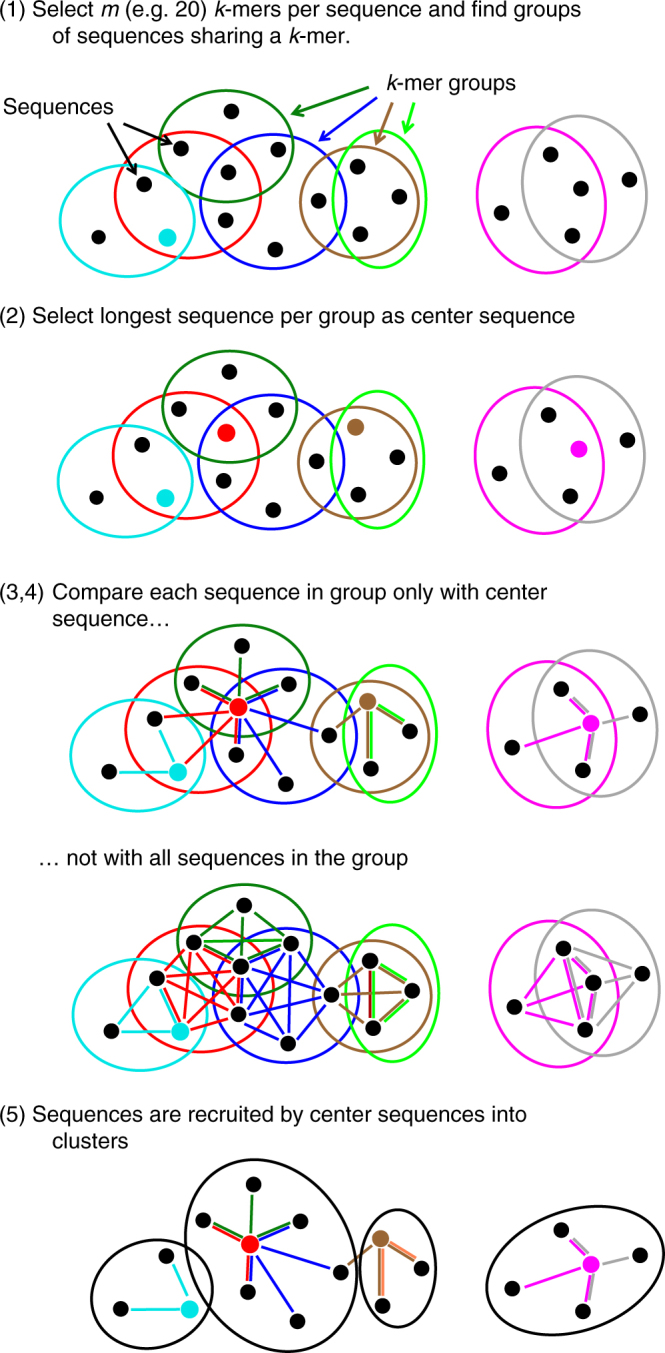
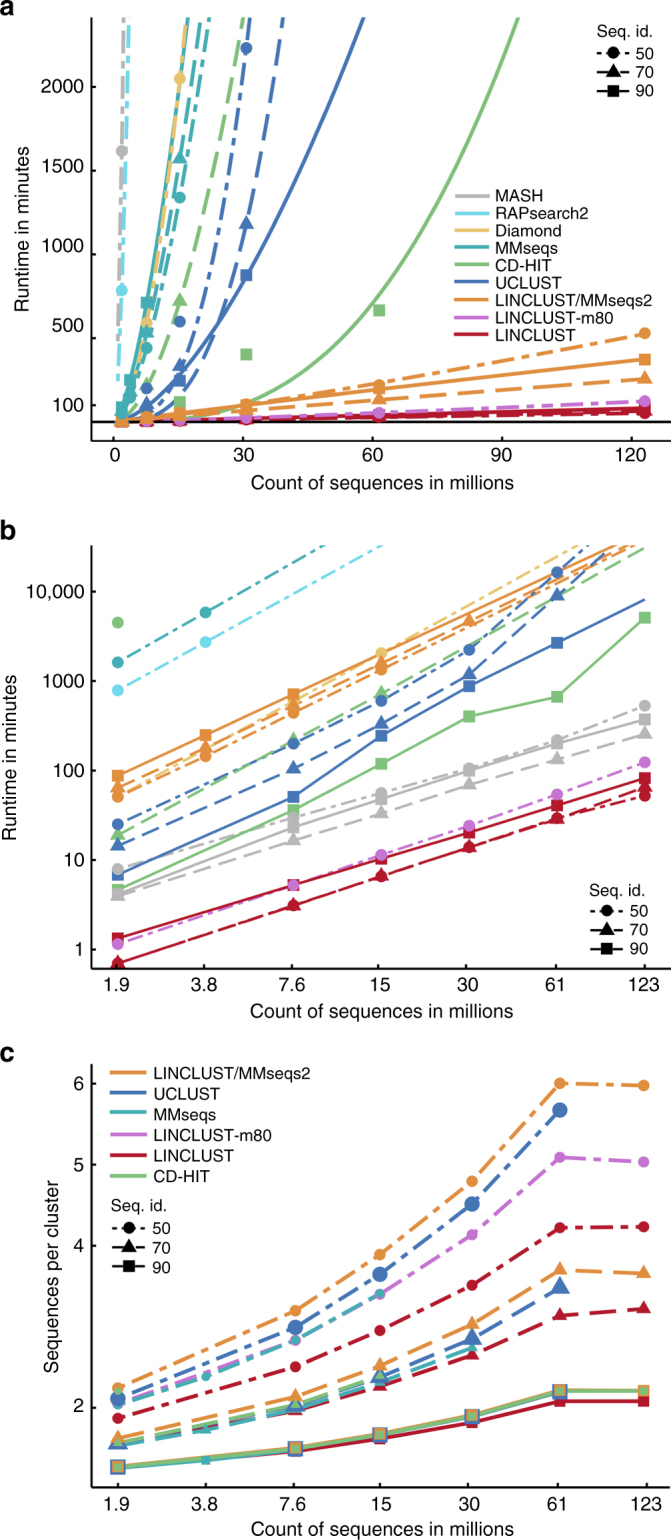
Metagenomic datasets contain billions of protein sequences that could greatly enhance large-scale functional annotation and structure prediction. Utilizing this enormous resource would require reducing its redundancy by similarity clustering. However, clustering hundreds of millions of sequences is impractical using current algorithms because their runtimes scale as the input set size N times the number of clusters K, which is typically of similar order as N, resulting in runtimes that increase almost quadratically with N. We developed Linclust, the first clustering algorithm whose runtime scales as N, independent of K. It can also cluster datasets several times larger than the available main memory. We cluster 1.6 billion metagenomic sequence fragments in 10 h on a single server to 50% sequence identity, >1000 times faster than has been possible before. Linclust will help to unlock the great wealth contained in metagenomic and genomic sequence databases.
Overview
The claims and statistics of this paper haven’t been checked yet.
Free: it reads the open-access text and checks the first 5 claims that cite a source we can check. Create a free account to check every claim.
Integrity signals
Registry
Cites
Statistics
Figures
Verification
Claims the paper makes
The claims and statistics of this paper haven’t been checked yet.
Free: it reads the open-access text and checks the first 5 claims that cite a source we can check. Create a free account to check every claim.
Self-check
Percentages, sums and reported differences re-computed from the paper’s own numbers.
The self-check needs the paper’s full text.
Citations
Cites
Basic local alignment search tool
Altschul, S. F., Gish, W., Miller, W., Myers, E. W., & Lipman, D. J. (1990) · Journal of Molecular Biology · doi:10.1006/jmbi.1990.9999 · Cited by 98,669 · cited 1×
“For each clustering run, we searched with BLAST [15] a random sample of 1 000 representative sequences against all representative sequences of the clustering.”
MethodSearch and clustering orders of magnitude faster than BLAST
Edgar, R. C. (2010) · Bioinformatics · doi:10.1093/bioinformatics/btq461 · Cited by 20,826
Fast and sensitive protein alignment using DIAMOND
Buchfink, B., Xie, C., & Huson, D. H. (2015) · Nature Methods · doi:10.1038/nmeth.3176 · Cited by 14,201 · cited 3×
“At 50% identity, Linclust clusters the 123 million sequences 10 times faster than Linclust/MMseqs2 and, by extrapolation, 2300 times faster than UCLUST, 720 times faster than MMseqs, 4600 times faster than CD-HIT, 1600 times faster than DIAMOND [12], 69 000 times faster than MASH [13], and 26 000 times faster than RAP…”
BackgroundInfluentialProdigal: prokaryotic gene recognition and translation initiation site identification
Hyatt, D., Chen, G.-L., LoCascio, P. F., Land, M. L., Larimer, F. W., & Hauser, L. J. (2010) · BMC Bioinformatics · doi:10.1186/1471-2105-11-119 · Cited by 12,587
Cd-hit: a fast program for clustering and comparing large sets of protein or nucleotide sequences
Li, W., & Godzik, A. (2006) · Bioinformatics · doi:10.1093/bioinformatics/btl158 · Cited by 11,410 · cited 1×
“Similar to the k-mer prefilter used in CD-HIT, UCLUST, kclust and MMseqs [8, 11, 26, 27], the preclustering reduces the number of comparisons by a large factor F using the slow, exact measure, but the time complexity of the ex240 act distance calculation O(N(2)/F ) is still quadratic in N .”
MethodCd-hit: Accelerated for clustering the next-generation sequencing data
Fu, L., Niu, B., Zhu, Z., Wu, S., & Li, W. (2012) · Bioinformatics · doi:10.1093/bioinformatics/bts565 · Cited by 11,175 · cited 15×
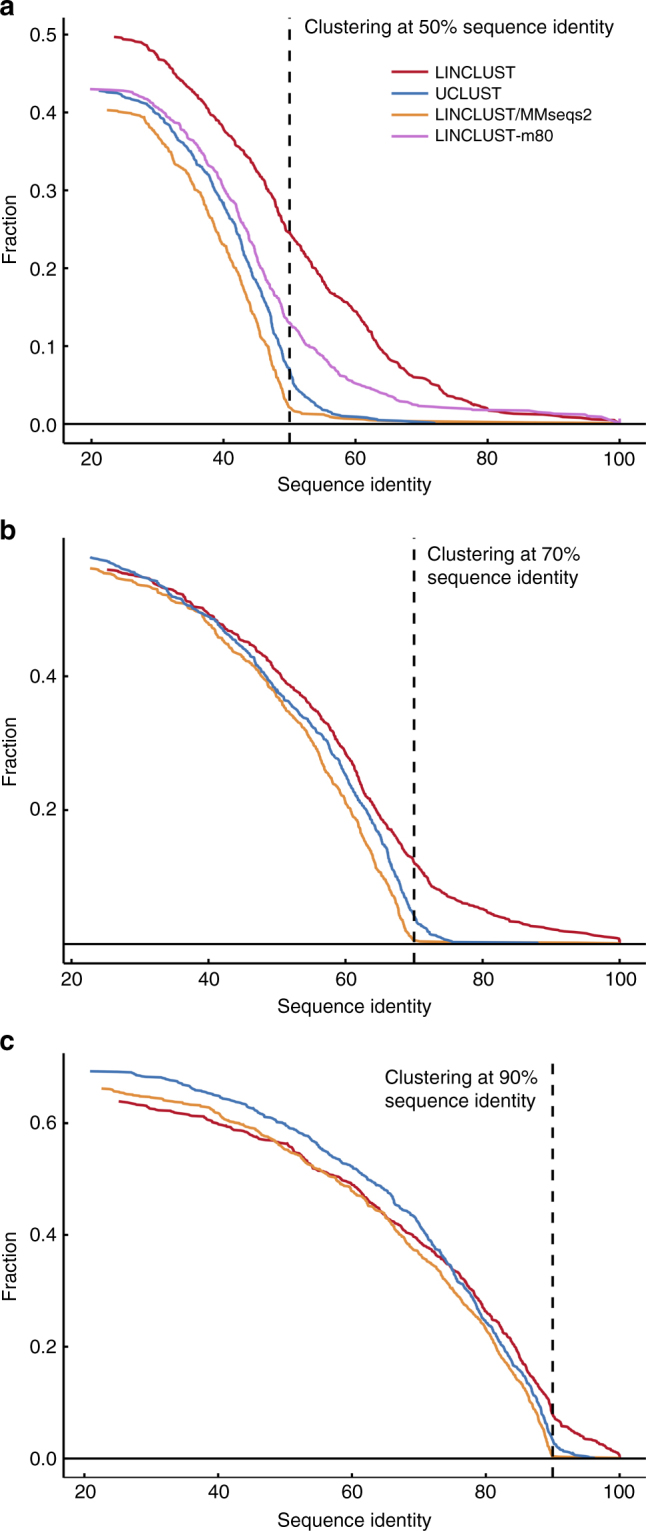
“By increasing m from 20 to 80, Linclust takes only 1.5 to 2 times longer but attains a sensitivity similar to UCLUST (pink in Fig.”
MethodInfluentialThe Pfam protein families database: towards a more sustainable future
Finn, R. D., Coggill, P., Eberhardt, R. Y., Eddy, S. R., Mistry, J., Mitchell, A. L., Potter, S. C., Punta, M., Qureshi, M., Sangrador-Vegas, A., et al. (2016) · Nucleic Acids Research · doi:10.1093/nar/gkv1344 · Cited by 5,975 · cited 1×
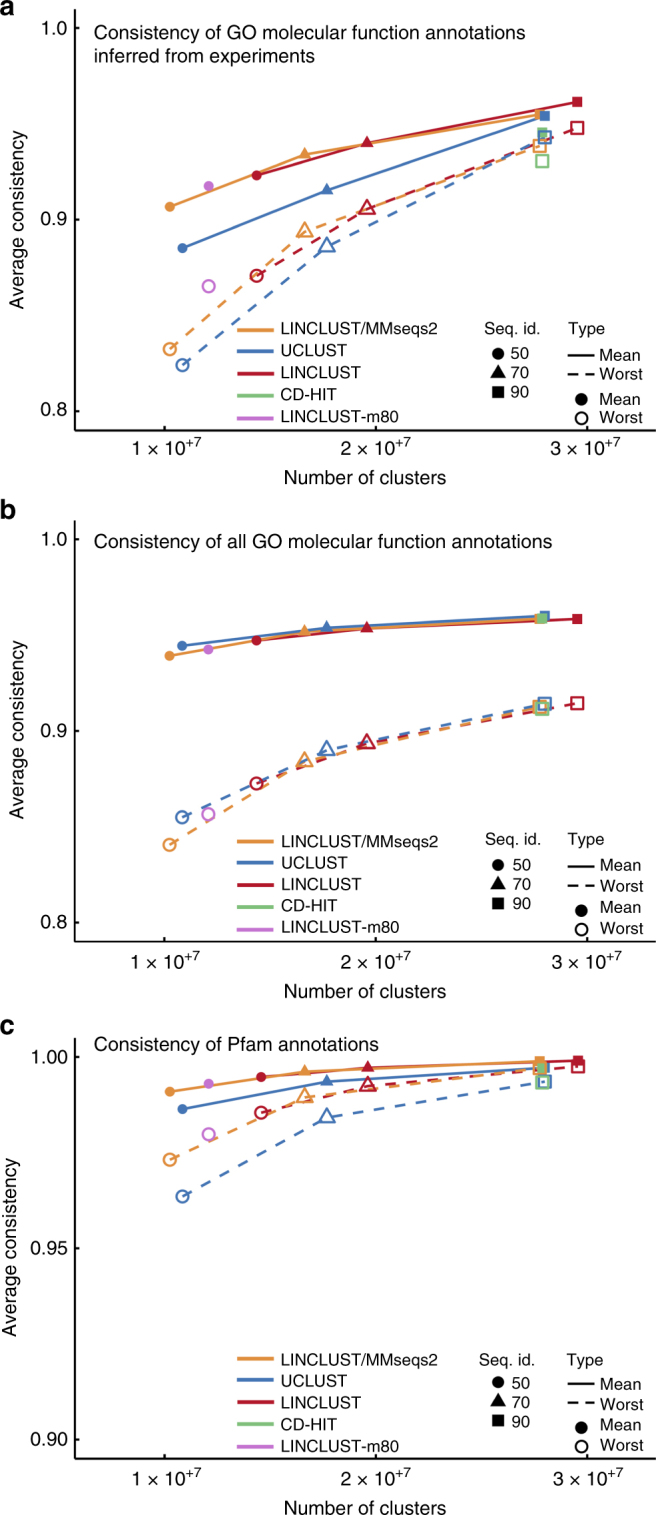
“4a,b) and Pfam domain annotations [18] (Fig.”
MMseqs2 enables sensitive protein sequence searching for the analysis of massive data sets
Steinegger, M., & Söding, J. (2017) · Nature Biotechnology · doi:10.1038/nbt.3988 · Cited by 4,840
Self-citationThe Universal Protein Resource (UniProt)
Bairoch, A. (2004) · Nucleic Acids Research · doi:10.1093/nar/gki070 · Cited by 3,774 · cited 1×
“, 100}, we determined these thresholds empirically on 4 million local alignments sampled from an all-against-all comparison of the UniProt database [31].”
MethodGene Ontology Consortium: going forward
The Gene Ontology Consortium (2015) · Nucleic Acids Research · doi:10.1093/nar/gku1179 · Cited by 3,492 · cited 2×
“We assess Gene Ontology (GO) annotations [17] (Fig.”
BackgroundMethod
Research works printed but not linked: 1
- Wang, J. Shen, H. T., Song, J. & Ji., J. Hashing for similarity search: a survey. Preprint at https://arxiv.org/abs/1408.2927 (2014). · arXiv
Cited by
Items 801–900 of 962
Méthodes d'analyse comparative de la variabilité intraspécifique des pangénomes procaryotes
Bazin, A. (2022) · theses.fr (ABES) · doi:10.70675/8abdb8b7zf1b4z4cfbz8645zd7a4f27bc512
Steels, E., Huntress, H., Zuscik, M. J., Bukata, S. V., Rosen, C. J., Kiel, D. P., Travison, T. G., Charbonneau, M. R., Toledo, G. V., Schott, E. M., et al. (2024) · Research Square · doi:10.21203/rs.3.rs-4366119/v1
A Systematic Bioinformatics Approach for Mapping the Minimal Set of a Viral Peptidome
Chong, L. C., & Khan, A. M. (2024) · Current Protocols · doi:10.1002/cpz1.1056
“Notably, the clustering tool, M any-against-M any seq uence s earching (MMseqs2; https://github.com/ soedinglab/MMseqs2 ) is an alternative to CD-HIT, particularly for big data, with an ultra-fast execution time (Steinegger & Söding, 2018).”
MethodAn In-Depth Assessment of Sequence Clustering Software in Bioinformatics
Ju, Z., Wang, M., Li, X., Meng, J., Xi, W., & Wei, Y. (2024) · Lecture notes in computer science · doi:10.1007/978-981-97-5128-0_29
ProtParts, an automated web server for clustering and partitioning protein datasetPreprint
Li, Y., & Barra, C. (2024) · bioRxiv (Cold Spring Harbor Laboratory) · doi:10.1101/2024.07.12.603234 · Cited by 1
“MMseqs2 employs the greedy set cover algorithm, which iteratively generates sub-clusters by sequence percentage identity, E-value and coverage to find a representative sequence for each individual cluster (15, 16).”
MethodSite-specific metabolic labeling reveals proteome-wide phospho-dynamicsPreprint
Alevra, M., Marrero, M. C., Kluever, V., Mandad, S., Kumar, N. H., Pan, K., van Gerwen, J., Kabatas, S., Wildhagen, H., Ischebeck, T., et al. (2024) · bioRxiv (Cold Spring Harbor Laboratory) · doi:10.1101/2024.07.23.604744
“To avoid this, we cluster proteins by sequence identity, using MMseqs2 29,30 with greedy incremental clustering (mode 2) and a minimum sequence identity of 30%.”
MethodCRULoc: A protein subcellular localization prediction model based on BiGRU and CNN
Lu, Y. (2024) · International Conference on Computer Information Science and Application Technology (CISAT) · doi:10.1109/cisat62382.2024.10695442
“These models learn high-quality representations of proteins through self-supervised learning [6] from protein databases containing large amounts of unlabeled sequences, such as Uniprot [7] and metagenomic databases like the Big Fantastic Database [8] (BFD) [9].”
BackgroundDNA-protein quasi-mapping for rapid differential gene expression analysis in non-model organisms
Santiago, K. C. L., & Shrestha, A. M. S. (2024) · BMC Bioinformatics · doi:10.1186/s12859-024-05924-1
“As a practical remedy for the case of multi-species reference, it might be better to first reduce redundancy by running sequence clustering tools (e.g. CD-HIT [26] or MMSeq [27]) or find orthogroups (e.g. using OrthoFinder [28]).”
MethodZhao, C., & Wang, S. (2024) · ACM International Conference on Bioinformatics, Computational Biology, and Health Informatics (ACM-BCB) · doi:10.1145/3698587.3701400
“Additionally, we used DeepMSA+[22] with a four-stage search algorithm to query Uniclust30 (2020.03), Uniref90 (2018-04)[23], Metaclust[24], and BFD databases.”
InfluentialProteogenomic peptide discovery in large search spaces
Horokhovskyi, Y. (2025) · eDiss (Georg-August-Universität Göttingen) · doi:10.53846/goediss-11048
Beyond Natural Antibodies: Scaffold-Based Generation of Novel Anti-3CL pro Nanobody Nb01Preprint
Zhan, Z., Xiong, J., Jiang, Y., Li, Y., Cai, Y., Luo, C. T., Huang, F., & Liu, J. (2025) · bioRxiv (Cold Spring Harbor Laboratory) · doi:10.1101/2025.05.06.652338
“We used MMseqs2 to cluster CDR sequences (with default parameters) [31, 42] and used the probability of a non-redundant CDR being selected as the ratio of the cluster size of the sequence in which it is located to the total set of sequences as the probability of selecting that non-redundant CDR.”
Beyond Sequence: Advanced Homology Detection for Cancer Protein using MS_HITAMPE
Rajarajeswari, S., & Kannan, S. (2025) · Procedia Computer Science · doi:10.1016/j.procs.2025.04.259
Scalable Genomic Context Analysis with GCsnap2 on HPC Clusters
Krummenacher, R., Simsek, O. S., Leemann, M., Alexander, L. T., Schwede, T. F., Ciorba, F. M., & Pereira, J. (2025) · Platform for Advanced Scientific Computing Conference (PASC) · doi:10.1145/3732775.3733579
“The assessment supports the claim that GCsnap1 Desktop cannot manage substantial workloads consisting of thousands of target sequences.”
InfluentialProtein Language Model Based Structure-guided Antibody Screening for Disordered Protein TargetsPreprint
Chenna, A., Priyadarshi, P., Kolluru, K., Singal, S., & Goel, G. (2025) · bioRxiv (Cold Spring Harbor Laboratory) · doi:10.1101/2025.06.21.660895
ClusterEmbed: Efficient Protein Structure Prediction with Clustering and Embeddings
Mu, B. (2025) · BIO Web of Conferences · doi:10.1051/bioconf/202518202013
Li, S., Yan, X. D., Ndayishimiye, J. C., Smirnov, A. V., Tsyganov, A. N., Nassonova, E., Mazei, N. G., Mazei, Y., & Yang, J. (2025) · Journal of Environmental Sciences · doi:10.1016/j.jes.2025.07.053 · Cited by 1
A Fast and Reliable Approach to Protein Structure Prediction Using K-Mer Matching and ModellerPreprint
Mishra, R., & Pal, M. K. (2025) · SSRN Electronic Journal · doi:10.2139/ssrn.5385342
Mo, X., Zhang, Z., Wang, M., Zhang, Q., Sun, G., Hu, W., Chen, G., Kong, D., Dong, C., Zeng, H., et al. (2025) · Organic Geochemistry · doi:10.1016/j.orggeochem.2025.105061
Uncovering differential tolerance to deletions versus substitutions with a protein language model
Goldman, G., Chati, P., & Ntranos, V. (2025) · Cell Systems · doi:10.1016/j.cels.2025.101373
PhyloNaP: a user-friendly database of phylogeny for natural product–producing enzymes
Korenskaia, A. E., Adamek, M., Szenei, J., Vader, L., Blin, K., Weber, T., & Ziemert, N. (2026) · Bioinformatics · doi:10.1093/bioinformatics/btag393
“The system first uses MMseqs2 (Steinegger and S € oding 2017) to identify similar proteins within the PhyloNaP database, using a default minimum threshold of 30% identity and 50% coverage; sequences below this threshold are not considered, as they are unlikely to support reliable functional inference.”
Deep learning in protein structure prediction
Wu, J. (2025) · Elsevier eBooks · doi:10.1016/b978-0-44-332908-1.00023-4
Binsarhan, M., Bramanti, L., Rivière, B., Montiel, L., Latorre, F., del Campo, J., Galand, P. E., & Logares, R. (2025) · bioRxiv (Cold Spring Harbor Laboratory) · doi:10.1101/2025.10.17.683177
An ensemble-based model comprising deep learning for predicting peptide-binding residues in proteins
Chandra, A. A., Dehzangi, A., Tsunoda, T., Sattar, A., & Sharma, A. K. (2025) · NAR Genomics and Bioinformatics · doi:10.1093/nargab/lqaf137
“ProtT5, a model with 3 billion parameters, was trained on the Big Fantastic Database (2.1 billion proteins) [ 54 ] and fine-tuned on the UniRef50 database (45 million proteins) [ 55 ].”
InfluentialCui, X., Ge, L., Yang, X., Li, X., & Zhang, G. (2025) · bioRxiv (Cold Spring Harbor Laboratory) · doi:10.1101/2025.10.23.684122
From Circles to Signals: Representation Learning on Ultra-Long Extrachromosomal Circular DNAPreprint
Li, J., Liu, Z., Zhang, Z., Zhang, J., & Singh, R. (2025) · bioRxiv (Cold Spring Harbor Laboratory) · doi:10.1101/2025.11.22.689941
Blini: lightweight nucleotide sequence search and dereplication
Lavon, A. (2026) · The Journal of Open Source Software · doi:10.21105/joss.09494
“The clustering (dereplication) procedure follows a similar scheme to LinClust (Steinegger and Söding 2018).”
Farag, P. F., Abdel-monem, K. S., Albasri, H. M., Alhhazmi, A. A., & Ismail, R. H. (2025) · Frontiers in Cellular and Infection Microbiology · doi:10.3389/fcimb.2025.1716723
“Proteins were clustered according to structural similarity using AFDB/MMseqs2 via AFDB clusters (Steinegger and Söding, 2018 ; Barrio-Hernandez et al., 2023), and sequence similarity using the NCBI BLASTp 2.16 (Database is nr and E value < 1 x 10 − 20 ) via SkyBLAST (https://sky-blast.com/ blast/p).”
InfluentialGini, C., Tiezzi, F., Jiang, J., Byrd, M. H., Johnson, J. S., Brito, L. F., van Vliet, S., Ahsin, M., Ali, L. A., da Silva, J. V., et al. (2025) · Research Square · doi:10.21203/rs.3.rs-7899948/v1
Development of an AMP-SECreting Platform in E. coli for Simpler AMP Development (AMPSEC)
Tomaro, K. (2022) · uO Research (University of Ottawa) · doi:10.20381/ruor-28042
Improvement of alphaFold2-based methods for modelling quaternary structures of proteins
Genc, A. G. (2025) · CentAUR (University of Reading) · doi:10.48683/1926.00120612
Benler, S., Yutin, N., Antipov, D., Rayko, M., Shmakov, S., Gussow, A. B., Pevzner, P. A., & Koonin, E. V. (2021) · Figshare · doi:10.6084/m9.figshare.14337768
Additional file 3 of A genome catalog of the early-life human skin microbiome
Shen, Z., Robert, L., Stolpman, M., Che, Y., Allen, K. J., Saffery, R., Walsh, A., Young, A., Eckert, J., Deming, C., et al. (2024) · Figshare · doi:10.6084/m9.figshare.26636187
Petersen, M., Winter, S., Coimbra, R. T. F., J. de Jong, M., Kapitonov, V. V., & Nilsson, M. A. (2021) · Figshare · doi:10.6084/m9.figshare.17086904
Sung, I., Lee, S., Pak, M., Shin, Y., & Kim, S. (2022) · Figshare · doi:10.6084/m9.figshare.19656881
Dong, Y., Chen, W.-H., & Zhao, X.-M. (2024) · Figshare · doi:10.6084/m9.figshare.26182321
A computational framework for large-scale cell lineage reconstruction
Kiyota, B. (2024) · cIRcle (University of British Columbia) · doi:10.14288/1.0441463
Russo, E. T., Laio, A., & Punta, M. (2021) · Figshare · doi:10.6084/m9.figshare.14211341
Benler, S., Yutin, N., Antipov, D., Rayko, M., Shmakov, S., Gussow, A. B., Pevzner, P. A., & Koonin, E. V. (2021) · Figshare · doi:10.6084/m9.figshare.14337786
Benler, S., Yutin, N., Antipov, D., Rayko, M., Shmakov, S., Gussow, A. B., Pevzner, P. A., & Koonin, E. V. (2021) · Figshare · doi:10.6084/m9.figshare.14337792
Petersen, M., Winter, S., Coimbra, R. T. F., J. de Jong, M., Kapitonov, V. V., & Nilsson, M. A. (2021) · Figshare · doi:10.6084/m9.figshare.17086901
Xu, X., Yin, Z., Yan, L., Zhang, H., Xu, B., Wei, Y., 牛北方, Bertil, S., & Liu, W. (2024) · Figshare · doi:10.6084/m9.figshare.26590026
Xu, X., Yin, Z., Yan, L., Zhang, H., Xu, B., Wei, Y., 牛北方, Bertil, S., & Liu, W. (2024) · Figshare · doi:10.6084/m9.figshare.26590032
Benler, S., Yutin, N., Antipov, D., Rayko, M., Shmakov, S., Gussow, A. B., Pevzner, P. A., & Koonin, E. V. (2021) · Figshare · doi:10.6084/m9.figshare.14337762
Benler, S., Yutin, N., Antipov, D., Rayko, M., Shmakov, S., Gussow, A. B., Pevzner, P. A., & Koonin, E. V. (2021) · Figshare · doi:10.6084/m9.figshare.14337789
Benler, S., Yutin, N., Antipov, D., Rayko, M., Shmakov, S., Gussow, A. B., Pevzner, P. A., & Koonin, E. V. (2021) · Figshare · doi:10.6084/m9.figshare.14337777
Xu, X., Yin, Z., Yan, L., Zhang, H., Xu, B., Wei, Y., 牛北方, Schmidt, B., & Liu, W. (2024) · Figshare · doi:10.6084/m9.figshare.26590023
Benler, S., Yutin, N., Antipov, D., Rayko, M., Shmakov, S., Gussow, A. B., Pevzner, P. A., & Koonin, E. V. (2021) · Figshare · doi:10.6084/m9.figshare.14337756
Benler, S., Yutin, N., Antipov, D., Rayko, M., Shmakov, S., Gussow, A. B., Pevzner, P. A., & Koonin, E. V. (2021) · Figshare · doi:10.6084/m9.figshare.14337759
Dong, Y., Chen, W.-H., & Zhao, X.-M. (2024) · Figshare · doi:10.6084/m9.figshare.26182185
Xu, X., Yin, Z., Yan, L., Zhang, H., Xu, B., Wei, Y., 牛北方, Schmidt, B., & Liu, W. (2024) · Figshare · doi:10.6084/m9.figshare.26590035
Petersen, M., Winter, S., Coimbra, R. T. F., J. de Jong, M., Kapitonov, V. V., & Nilsson, M. A. (2021) · Figshare · doi:10.6084/m9.figshare.17086907
Additional file 1 of Clustering biological sequences with dynamic sequence similarity threshold
Chiu, J. K. H., & Ong, R. T.-H. (2022) · Figshare · doi:10.6084/m9.figshare.19470490
Additional file 3 of Pre-Cambrian roots of novel Antarctic cryptoendolithic bacterial lineages
Albanese, D., Coleine, C., Rota‐Stabelli, O., Onofri, S., Tringe, S. G., Stajich, J., Selbmann, L., & Donati, C. (2021) · Figshare · doi:10.6084/m9.figshare.14251833
Levy Karin, E., Mirdita, M., & Söding, J. (2020) · Figshare · doi:10.6084/m9.figshare.12082380
Self-citationKrinos, A. I., Cohen, N. R., Follows, M. J., & Alexander, H. (2024) · Figshare · doi:10.6084/m9.figshare.26572657
Additional file 1 of Protein embedding based alignment
Iovino, B. G., & Ye, Y. (2024) · Figshare · doi:10.6084/m9.figshare.25302885
Additional file 2 of A genome catalog of the early-life human skin microbiome
Shen, Z., Robert, L., Stolpman, M., Che, Y., Allen, K. J., Saffery, R., Walsh, A., Young, A., Eckert, J., Deming, C., et al. (2024) · Figshare · doi:10.6084/m9.figshare.26636184
Xu, X., Yin, Z., Yan, L., Zhang, H., Xu, B., Wei, Y., 牛北方, Bertil, S., & Liu, W. (2024) · Figshare · doi:10.6084/m9.figshare.26590029
Huang, G., Tang, X., & Zheng, P. (2024) · Figshare · doi:10.6084/m9.figshare.26644078
Additional file 1 of Pre-Cambrian roots of novel Antarctic cryptoendolithic bacterial lineages
Albanese, D., Coleine, C., Rota‐Stabelli, O., Onofri, S., Tringe, S. G., Stajich, J., Selbmann, L., & Donati, C. (2021) · Figshare · doi:10.6084/m9.figshare.14251827
Wu, T., Guo, Z., Hou, J., & Cheng, J. (2021) · Figshare · doi:10.6084/m9.figshare.13642274
Benler, S., Yutin, N., Antipov, D., Rayko, M., Shmakov, S., Gussow, A. B., Pevzner, P. A., & Koonin, E. V. (2021) · Figshare · doi:10.6084/m9.figshare.14337765
Additional file 1 of A genome catalog of the early-life human skin microbiome
Shen, Z., Robert, L., Stolpman, M., Che, Y., Allen, K. J., Saffery, R., Walsh, A., Young, A., Eckert, J., Deming, C., et al. (2024) · Figshare · doi:10.6084/m9.figshare.26636181
Evolution of Transmembrane Protein Prediction
Bernhofer, M., Rost, B., & München, T. U. (2023)
Transposable Element Dynamics in Genomes of Giant Insect - Killing Fungi of the Entomophthoraceae
Xu, X. (2025) · eScholarship (California Digital Library)
Park, S., Kim, H., lee, K., & Oh, H.-S. (2025) · bioRxiv (Cold Spring Harbor Laboratory) · doi:10.64898/2025.12.22.695895
RabbitTClust2: Fast, Scalable, and Versatile Clustering for Massive Genomic Datasets
Zhang, T., Xu, X., Yin, Z., Yan, L., Yang, Y., Gao, Y., Duan, X., Schmidt, B., & Liu, W. (2025) · IEEE International Conference on Bioinformatics and Biomedicine (BIBM) · doi:10.1109/bibm66473.2025.11356063
“As a consequence many widely used clustering tools, such as CD-HIT [6], Linclust [7] and UCLUST, are not well suited for clustering large-scale long genomic sequences [8].”
PlasRAG: comprehensive plasmid characterization and retrieval through sequence-text alignment
Ji, Y., Liao, H., Guan, J., Shang, J., & Sun, Y. (2026) · Genome biology · doi:10.1186/s13059-026-03966-7 · Cited by 1
New HisKA-like HMM profiles uncover insights on histidine kinase diversity
Silly, L., Perrière, G., & Ortet, P. (2026) · BMC Bioinformatics · doi:10.64898/2026.02.27.708494 · Cited by 1
Kujović, A. (2024) · Repository of the University of Ljubljana (University of Ljubljana)
FAMUS: a few-shot learning framework for large-scale protein annotation
Shur, G., & Burstein, D. (2026) · Bioinformatics · doi:10.1093/bioinformatics/btag761
“To create sub-families, we sub-clustered orthologous groups using mmseqs2 (Steinegger and S € oding 2018) cluster (commit bad16c7).”
A Contrastive Learning Framework for Efficient Viral Escape Prediction
Tenekeci, S., Sezgin, E., & Tekır, S. (2026) · IEEE Transactions on Computational Biology and Bioinformatics · doi:10.1109/tcbbio.2026.3674782
“Advancements in NLP and the availability of large protein databases like UniProt [22] and BFD [23] have driven the development of pre-trained protein language models (PLMs), including UniRep [24], TAPE [25], ProtTrans [26], ProteinBERT [27], MSA Transformer [28], ESM-1b [29], ESM-1v [30], ESM-2,…”
SegDesign : A modular framework for controllable protein segment engineering
Feng, C., Yin, J., Zha, C., Saif, M., Xu, X., Gao, X., & He, W. (2026) · Protein Science · doi:10.1002/pro.70542
Medicinal chemistry enabling advances in protein structure prediction
Munasinghe, A., Zhang, Z., & Wu, H. (2026) · Elsevier eBooks · doi:10.1016/b978-0-443-29808-0.00096-0
Dupas, A., Ibranosyan, M., Ginévra, C., Jarraud, S., & Lemoine, J. (2026) · bioRxiv (Cold Spring Harbor Laboratory) · doi:10.64898/2026.04.01.715759
“However, depending on the studies, criteria of 90 down to 50% of identity may be retained for protein sequence grouping 35–40 .”
Talibart, H. (2021) · theses.fr (ABES) · doi:10.70675/39227349z5a97z4f0az892az7102dbffadeb
CRISPRi screens in bacterial genomics
Rousset, F. (2020) · theses.fr (ABES) · doi:10.70675/b0192b7fzcd2az4a96z8d07z108b9a663eae
Tools for massive bacterial comparative genomics : Development and Applications
Perrin, A. (2022) · theses.fr (ABES) · doi:10.70675/a061aa00z774bz40c5zb870zba9af4cac64b
Etude globale de la domestication virale chez les insectes parasitoïdes
Guinet, B. (2023) · theses.fr (ABES) · doi:10.70675/ed4bc662z8813z4e5fz908cz44e644c38d12
Buton, N. (2023) · theses.fr (ABES) · doi:10.70675/fe334370z7f12z4f52z9b72zc9196d7a0989 · Cited by 1
Annotation computationnelle de génomes : des organismes uniques aux communautés complexes
Strozzi, F. (2024) · theses.fr (ABES) · doi:10.70675/c9da71c3zac1cz426fz8f3az8a3c7fcf3c17
Numerical and analytical modelling of olfactory perception
Lalis, M. (2024) · theses.fr (ABES) · doi:10.70675/6844a9aaz6126z49c4zb2fbzdf6c3db0ceb7
Analyse de données à grande échelle pour découvrir le talon d’Achille microbien
Ribeiro, S. (2024) · theses.fr (ABES) · doi:10.70675/89700e1dzfab2z4dfcz9406zadc846c1eada
Senadheera, U. E., Takimoto, Y., Nakayama, T., & Jayasanka, J. (2026) · International Conference on Artificial Intelligence, Computer, Data Sciences and Applications (ACDSA) · doi:10.1109/acdsa67686.2026.11467832
“The modelled structure was further validated using AlphaFold database protein sequences by MMseqs2 algorithm with a maximum sequence identity of 50% and achieving a 90% bi-directional sequence overlap with the most extended sequence of the cluster representative [15].”
Efficient exploration of peptide libraries using active learning with AlphaFold-based screeningPreprint
Gaza, J. T., Santos, J. B. W., Singh, B., Quintana, R. A. M., & Pérez, A. (2026) · bioRxiv (Cold Spring Harbor Laboratory) · doi:10.64898/2026.04.16.718999
“By clustering peptide sequences (see methods 31,32 ), we transform the exploration of sequence space into a bandit problem where each cluster represents a hypothesis about binder enrichment.”
A multimodal human protein embeddings database: DeepDrug Protein Embeddings Bank (DPEB)
Sajol, M. S. I., Rajasekaran, M., Gemeinhardt, H., Bess, A., Alvin, C., & Mukhopadhyay, S. (2026) · NAR Genomics and Bioinformatics · doi:10.1093/nargab/lqag042
“We generate protein embeddings using a prot-trans_bert_bfd LM model [33] trained on BFD large dataset [34].”
Devlin, K. L., Lamichhane, G., Nelson, W. C., Lin, V., & Beatty, K. E. (2026) · mSystems · doi:10.1128/msystems.00564-26
“Integration of reciprocal best hits, OrthoFinder (24), Markov clustering, MMSEQS2 clustering (25), and consideration of gene synteny were performed to optimally identify one-to-one gene mappings across organisms.”
An atomic interaction conserved for over 600 million years gates inhibitory neurotransmissionPreprint
Borghese, C. M., Desai, N. G., Garlapati, P., Shah, S. K., Galpin, J. D., Segura, L., Haloi, N., Zakon, H. H., Howard, R. J., Lindahl, E. R., et al. (2026) · bioRxiv (Cold Spring Harbor Laboratory) · doi:10.64898/2026.05.22.727206
“Datasets per species were deduplicated with MMseq2 (Steinegger & Söding, 2018) and 95% sequence similarity.”
Wang, Q., Chu, Y., Mao, X., & Wei, D. (2026) · Journal of Chemical Information and Modeling · doi:10.1021/acs.jcim.5c02461
ABUS: A Framework for Evaluating Protein Language Models with Multimodal Capabilities
Ensafitakaldani, F., Haspel, N., & Haehn, D. (2026) · Communications in computer and information science · doi:10.1007/978-3-032-26028-4_11
Predicting host-pathogen interactions using a proteome-scale language modelPreprint
Malbranke, C., Fruet, C., & Bitbol, A. (2026) · bioRxiv (Cold Spring Harbor Laboratory) · doi:10.64898/2026.05.29.728699
“…proteins, we evaluate using grouped cross-validation: clusters are computed separately for pathogen and host proteins at 40% identity (MMseqs2 (Steinegger and S¨oding, 2018)), and each protein pair is assigned to its pathogen-cluster, host-cluster group, ensuring that no homologous protein…”
Improving protein and protein interactions using pseudo-dimers derived from monomeric proteins
Du, H., Zheng, X., Ren, Y., Huang, H., Gong, X., Ouyang, W., Zhang, Y., & Lu, Y. (2026) · Nature Communications · doi:10.1038/s41467-026-73885-5
Periplasmic detoxification of urate hydroperoxide underpins E. coli survival in the inflamed gutPreprint
Vincent, M. S., Loiseau, L., Jones, M., Stocker, P., Karkouri, K. E., Chéry, M., Choudhary, D., Vidal, N., Winter, M. G., Tanner, N. W., et al. (2026) · bioRxiv (Cold Spring Harbor Laboratory) · doi:10.64898/2026.06.01.729251
“%) of the dataset using MMseqs2 algorithm 40,41 .”
Metadata
- Authors
- Steinegger, M., & Söding, J.
- Affiliations
- Seoul National University (KR)
- Max Planck Institute for Biophysical Chemistry (DE)
- Corresponding author
- Steinegger, Martin
- Söding, Johannes
- Venue
- Nature Communications
- Published
- 2018-06-29
- Volume
- 9
- Issue
- 1
- Pages
- 2542-2542
- ISSN
- 2041-1723 (ISSN-L)
- PMC
- PMC6026198
- OpenAlex
- W2953008890
- Cited by
- 875
- References
- 32
- Citations by year
- 2026: 110 · 2025: 154 · 2024: 168 · 2023: 123 · 2022: 111 · 2021: 129 · 2020: 52 · 2019: 28
- FWCI
- 18.49
- Type
- journal article
- Language
- en
- Open access
- gold
- doi.org
- Licence
- cc-by
- creativecommons.org/licenses/by/4.0 (tdm)
- creativecommons.org/licenses/by/4.0 (vor)
- Locations
- Nature Communications (publishedVersion, cc-by)
- Europe PMC (PubMed Central) (publishedVersion, cc-by)
- PubMed Central (publishedVersion, cc-by)
- PubMed (publishedVersion)
- OSTI OAI (U.S. Department of Energy Office of Scientific and Technical Information) (submittedVersion)
- DOAJ (DOAJ: Directory of Open Access Journals) (submittedVersion, cc-by-sa)
- DOAJ (DOAJ: Directory of Open Access Journals) (submittedVersion)
- mediaTUM (Technical University of Munich) (submittedVersion, other-oa)
- GoeScholar The Publication Server of the Georg-August-Universität Göttingen (Georg-August-Universität Göttingen) (submittedVersion, cc-by)
- Seoul National University Open Repository (Seoul National University) (submittedVersion)
- Funders
- U.S. Department of Energy
- Joint Genome Institute
- Seoul National University
- Horizon 2020 Framework Programme (685778)
- Topics
- Life Sciences › Biochemistry, Genetics and Molecular Biology › Molecular Biology › Genomics and Phylogenetic Studies
- Physical Sciences › Mathematics › Theoretical Computer Science › Algorithms and Data Compression
- Life Sciences › Biochemistry, Genetics and Molecular Biology › Molecular Biology › Fractal and DNA sequence analysis
- Keywords
- protein sequence clustering, metagenomics, functional annotation, memory-efficient clustering, sequence similarity
- MeSH terms
- Algorithms, Animals, DNA, Humans, Prokaryotic Cells, Proteins, Cluster Analysis, Genome, Sequence Analysis, DNA, Computational Biology, Databases, Nucleic Acid, Databases, Protein, Metagenomics, Datasets as Topic
About these checks
Registry, retraction, Cites and statistics results are computed, not judged, with one exception: a printed reference that no index lists is read once by a model before it counts as a citation error. Claims are extracted by a model and kept only when their quote appears verbatim in the text; each cited source is then checked, with a model’s help, for whether it says what the claim relies on. Those verdicts can be wrong — read the claim’s quote and the cited source before relying on one.
Statistics and arithmetic are recomputed, not judged.
Confidence bands are shown only for fields calibrated on our annotated test set. None is calibrated yet, so no band is shown.
What counts as a claim ›How we measure confidence ›How we check this ›
Are you an author, or do you see a problem with this page? Request a review
Data sources
Bibliographic data: Semantic Scholar, OpenAlex, Crossref.
Contains information from the Semantic Scholar Academic Graph Datasets, made available under the ODC Attribution License (ODC-BY 1.0).
Semantic Scholar’s data is described in: Kinney, R., et al. (2023). The Semantic Scholar Open Data Platform. arXiv:2301.10140.
