

Clustering huge protein sequence sets in linear time
Open accessPublished version of a preprint
The DOI matches its Crossref record; 33 of the 33 references it cites were found in a registry or an index.
Abstract
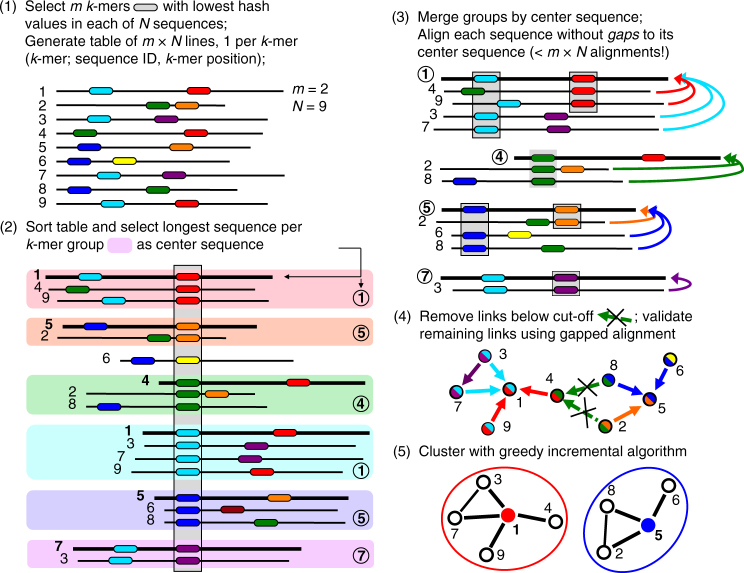
Metagenomic datasets contain billions of protein sequences that could greatly enhance large-scale functional annotation and structure prediction. Utilizing this enormous resource would require reducing its redundancy by similarity clustering. However, clustering hundreds of millions of sequences is impractical using current algorithms because their runtimes scale as the input set size N times the number of clusters K, which is typically of similar order as N, resulting in runtimes that increase almost quadratically with N. We developed Linclust, the first clustering algorithm whose runtime scales as N, independent of K. It can also cluster datasets several times larger than the available main memory. We cluster 1.6 billion metagenomic sequence fragments in 10 h on a single server to 50% sequence identity, >1000 times faster than has been possible before. Linclust will help to unlock the great wealth contained in metagenomic and genomic sequence databases.
Overview
The claims and statistics of this paper haven’t been checked yet.
Free: it reads the open-access text and checks the first 5 claims that cite a source we can check. Create a free account to check every claim.
Integrity signals
Registry
Cites
Statistics
Figures
Verification
Claims the paper makes
The claims and statistics of this paper haven’t been checked yet.
Free: it reads the open-access text and checks the first 5 claims that cite a source we can check. Create a free account to check every claim.
Self-check
Percentages, sums and reported differences re-computed from the paper’s own numbers.
The self-check needs the paper’s full text.
Citations
Cites
Basic local alignment search tool
Altschul, S. F., Gish, W., Miller, W., Myers, E. W., & Lipman, D. J. (1990) · Journal of Molecular Biology · doi:10.1006/jmbi.1990.9999 · Cited by 98,669 · cited 1×
“For each clustering run, we searched with BLAST [15] a random sample of 1 000 representative sequences against all representative sequences of the clustering.”
MethodSearch and clustering orders of magnitude faster than BLAST
Edgar, R. C. (2010) · Bioinformatics · doi:10.1093/bioinformatics/btq461 · Cited by 20,826
Fast and sensitive protein alignment using DIAMOND
Buchfink, B., Xie, C., & Huson, D. H. (2015) · Nature Methods · doi:10.1038/nmeth.3176 · Cited by 14,201 · cited 3×
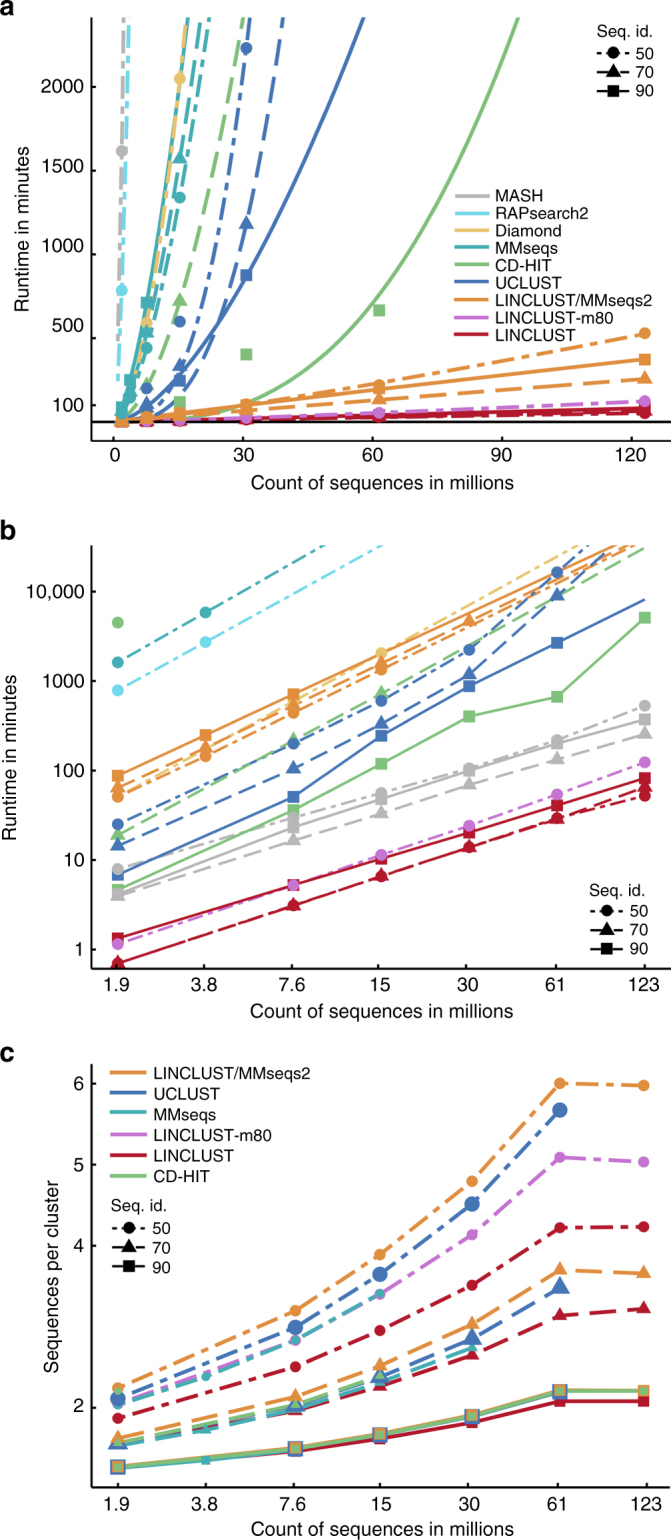
“At 50% identity, Linclust clusters the 123 million sequences 10 times faster than Linclust/MMseqs2 and, by extrapolation, 2300 times faster than UCLUST, 720 times faster than MMseqs, 4600 times faster than CD-HIT, 1600 times faster than DIAMOND [12], 69 000 times faster than MASH [13], and 26 000 times faster than RAP…”
BackgroundInfluentialProdigal: prokaryotic gene recognition and translation initiation site identification
Hyatt, D., Chen, G.-L., LoCascio, P. F., Land, M. L., Larimer, F. W., & Hauser, L. J. (2010) · BMC Bioinformatics · doi:10.1186/1471-2105-11-119 · Cited by 12,587
Cd-hit: a fast program for clustering and comparing large sets of protein or nucleotide sequences
Li, W., & Godzik, A. (2006) · Bioinformatics · doi:10.1093/bioinformatics/btl158 · Cited by 11,410 · cited 1×
“Similar to the k-mer prefilter used in CD-HIT, UCLUST, kclust and MMseqs [8, 11, 26, 27], the preclustering reduces the number of comparisons by a large factor F using the slow, exact measure, but the time complexity of the ex240 act distance calculation O(N(2)/F ) is still quadratic in N .”
MethodCd-hit: Accelerated for clustering the next-generation sequencing data
Fu, L., Niu, B., Zhu, Z., Wu, S., & Li, W. (2012) · Bioinformatics · doi:10.1093/bioinformatics/bts565 · Cited by 11,175 · cited 15×
“By increasing m from 20 to 80, Linclust takes only 1.5 to 2 times longer but attains a sensitivity similar to UCLUST (pink in Fig.”
MethodInfluentialThe Pfam protein families database: towards a more sustainable future
Finn, R. D., Coggill, P., Eberhardt, R. Y., Eddy, S. R., Mistry, J., Mitchell, A. L., Potter, S. C., Punta, M., Qureshi, M., Sangrador-Vegas, A., et al. (2016) · Nucleic Acids Research · doi:10.1093/nar/gkv1344 · Cited by 5,975 · cited 1×
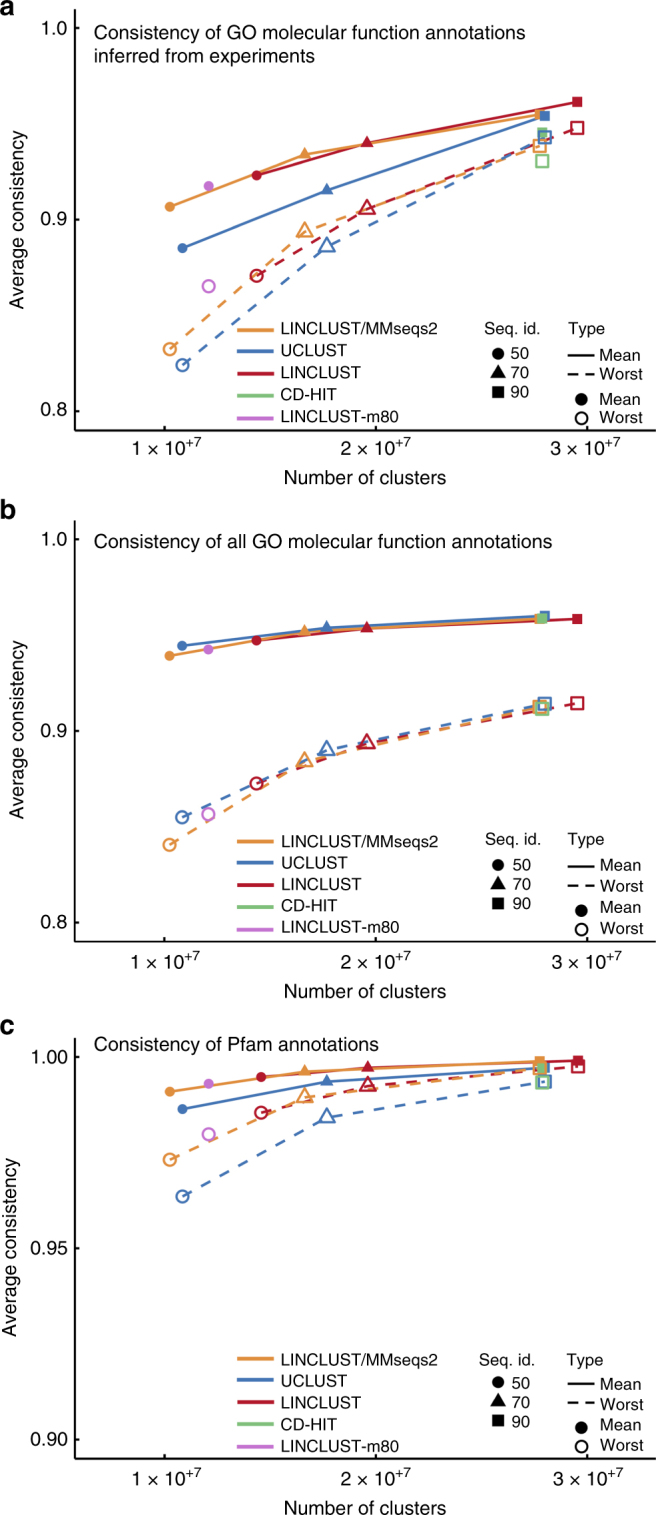
“4a,b) and Pfam domain annotations [18] (Fig.”
MMseqs2 enables sensitive protein sequence searching for the analysis of massive data sets
Steinegger, M., & Söding, J. (2017) · Nature Biotechnology · doi:10.1038/nbt.3988 · Cited by 4,840
Self-citationThe Universal Protein Resource (UniProt)
Bairoch, A. (2004) · Nucleic Acids Research · doi:10.1093/nar/gki070 · Cited by 3,774 · cited 1×
“, 100}, we determined these thresholds empirically on 4 million local alignments sampled from an all-against-all comparison of the UniProt database [31].”
MethodGene Ontology Consortium: going forward
The Gene Ontology Consortium (2015) · Nucleic Acids Research · doi:10.1093/nar/gku1179 · Cited by 3,492 · cited 2×
“We assess Gene Ontology (GO) annotations [17] (Fig.”
BackgroundMethod
Research works printed but not linked: 1
- Wang, J. Shen, H. T., Song, J. & Ji., J. Hashing for similarity search: a survey. Preprint at https://arxiv.org/abs/1408.2927 (2014). · arXiv
Cited by
Highly accurate protein structure prediction with AlphaFold
Jumper, J., Evans, R., Pritzel, A., Green, T., Figurnov, M., Ronneberger, O., Tunyasuvunakool, K., Bates, R., Žídek, A., Potapenko, A., et al. (2021) · Nature · doi:10.1038/s41586-021-03819-2 · Cited by 43,764
Self-citationColabFold - Making protein folding accessible to all
Mirdita, M., Schütze, K., Moriwaki, Y., Heo, L., Ovchinnikov, S., & Steinegger, M. (2021) · doi:10.1101/2021.08.15.456425 · Cited by 9,391
“To update the database we searched the proteins from the SMAG (eukaryotes) 14 , MetaEuk (eukaryotes) 13 , TOPAZ (eukaryotes) 15 , MGV (DNA viruses) 16 , GPD (bacteriophages) 17 and an updated version of MetaClust 18 against the BFD/MGnify centroids using MMseqs2 and assigned each sequence to the respective cluster if…”
MethodInfluentialSelf-citationUniProt: the universal protein knowledgebase in 2021
The UniProt Consortium, Bateman, A., Martin, M.-J., Orchard, S., Magrane, M., Agivetova, R., Ahmad, S., Alpi, E., Bowler-Barnett, E. H., Britto, R., et al. (2021) · Nucleic Acids Research · doi:10.1093/nar/gkaa1100 · Cited by 6,372
“We have adopted the MMseqs2 algorithm to improve the speed of UniRef production (11), decreasing the time taken to perform UniRef50 clustering from four weeks to 60 hours, and improved procedures to compute proteome clusters and identify representative proteomes, pan proteomes, and core and…”
MethodMMseqs2 enables sensitive protein sequence searching for the analysis of massive data sets
Steinegger, M., & Söding, J. (2017) · Nature Biotechnology · doi:10.1038/nbt.3988 · Cited by 4,840
Self-citationProtein complex prediction with AlphaFold-Multimer
Evans, R., O’Neill, M., Pritzel, A., Antropova, N., Senior, A., Green, T., Žídek, A., Bates, R., Blackwell, S., Yim, J., et al. (2021) · doi:10.1101/2021.10.04.463034 · Cited by 3,808
“Moreover, we add extra positional encodings denoting whether a given pair of amino acids corresponds to different chains and whether they belong to different homomer or heteromer chains.”
BackgroundProtTrans: Toward Understanding the Language of Life Through Self-Supervised Learning
Elnaggar, A., Heinzinger, M., Dallago, C., Rehawi, G., Wang, Y., Jones, L., Gibbs, T., Feher, T., Angerer, C., Steinegger, M., et al. (2022) · IEEE Transactions on Pattern Analysis and Machine Intelligence · doi:10.1109/tpami.2021.3095381 · Cited by 2,329
“LMs were trained on the largest protein database ever used for this purpose, namely BFD [36], which was more than an order of magnitude larger than UniProt [37], the standard in the field.”
MethodSelf-citationBeghini, F., McIver, L. J., Blanco-Míguez, A., Dubois, L., Asnicar, F., Maharjan, S., Mailyan, A., Manghi, P., Scholz, M., Thomas, A. M., et al. (2021) · eLife · doi:10.7554/elife.65088 · Cited by 2,303
(2020) · doi:10.1101/2020.11.19.388223 · Cited by 2,303
A unified catalog of 204,938 reference genomes from the human gut microbiome
Almeida, A., Nayfach, S., Boland, M., Strozzi, F., Beracochea, M., Shi, Z. J., Pollard, K. S., Sakharova, E., Parks, D. H., Hugenholtz, P., et al. (2021) · Nature Biotechnology · doi:10.1038/s41587-020-0603-3 · Cited by 1,367
Identification of mobile genetic elements with geNomad
Camargo, A. P., Roux, S., Schulz, F., Babinski, M., Xu, Y., Hu, B., Chain, P. S. G., Nayfach, S., & Kyrpides, N. C. (2024) · Nature Biotechnology · doi:10.1038/s41587-023-01953-y · Cited by 980
Improved prediction of protein-protein interactions using AlphaFold2
Bryant, P., Pozzati, G., & Elofsson, A. (2021) · doi:10.1101/2021.09.15.460468 · Cited by 1,022
From nature to industry: Harnessing enzymes for biocatalysis
Buller, R., Lutz, S., Kazlauskas, R. J., Snajdrova, R., Moore, J. C., & Bornscheuer, U. T. (2023) · Science · doi:10.1126/science.adh8615 · Cited by 706
Diverse enzymatic activities mediate antiviral immunity in prokaryotes
Gao, L., Altae-Tran, H., Böhning, F., Makarova, K. S., Segel, M., Schmid-Burgk, J. L., Koob, J., Wolf, Y. I., Koonin, E. V., & Zhang, F. (2020) · Science · doi:10.1126/science.aba0372 · Cited by 603
Zheng, W., Zhang, C., Li, Y., Pearce, R., Bell, E. W., & Zhang, Y. (2021) · Cell Reports Methods · doi:10.1016/j.crmeth.2021.100014 · Cited by 569
“This HMM is then searched against the Metaclust (Steinegger and Söding, 2018) metagenome sequence database by HMMsearch from HMMER to extract full-length hits.”
MethodMGnify: the microbiome analysis resource in 2020
Mitchell, A. L., Almeida, A., Beracochea, M., Boland, M., Burgin, J., Cochrane, G., Crusoe, M. R., Kale, V., Potter, S. C., Richardson, L. J., et al. (2019) · Nucleic Acids Research · doi:10.1093/nar/gkz1035 · Cited by 562
“To better understand the redundancy within the MGnify protein database, and to provide a more manageable dataset for users, we have used Linclust from the MMseqs (51) suite to cluster the sequences using 90% thresholds for overlap (of the shortest sequence) and sequence identity.”
MethodZhou, X., Zheng, W., Li, Y., Pearce, R., Zhang, C., Bell, E. W., Zhang, G., & Zhang, Y. (2022) · Nature Protocols · doi:10.1038/s41596-022-00728-0 · Cited by 519
“…create the deep-learning model, the multiple sequence alignment (MSA) is fi rst created by iteratively searching the query against four metagenome sequence databases (Metaclust 48 , BFD 49 , Mgnify 50 and IMG/M 51 ) and two whole-genome databases (Uni-clust30 52 and Uniref90 53 ) using DeepMSA 54 .”
MethodMGnify: the microbiome sequence data analysis resource in 2023
Richardson, L., Allen, B., Baldi, G., Beracochea, M., Bileschi, M. L., Burdett, T., Burgin, J., Caballero-Pérez, J., Cochrane, G., Colwell, L. J., et al. (2023) · Nucleic Acids Research · doi:10.1093/nar/gkac1080 · Cited by 432
“At each release this set of sequences is clustered using Linclust, part of the MMseqs2 package (20), employing coverage and identity thresholds of 0.”
MethodProGen2: Exploring the boundaries of protein language models
Nijkamp, E., Ruffolo, J. A., Weinstein, E. N., Naik, N., & Madani, A. (2023) · Cell Systems · doi:10.1016/j.cels.2023.10.002 · Cited by 480
Protein-level assembly increases protein sequence recovery from metagenomic samples manyfold
Steinegger, M., Mirdita, M., & Söding, J. (2019) · Nature Methods · doi:10.1038/s41592-019-0437-4 · Cited by 445
Self-citationColabFold - Making protein folding accessible to all
Ovchinnikov, S., Steinegger, M., Mirdita, M., konsti, Moriwaki, Y., Kim, R. S., Wang, P., Kosinski, J., Tadej Satler, P., Cha, S., et al. (2021) · bioRxiv (Cold Spring Harbor Laboratory) · doi:10.5281/zenodo.5123296 · Cited by 425
Self-citationBurley, S. K., Bhatt, R., Bhikadiya, C., Bi, C., Biester, A., Biswas, P., Bittrich, S., Blaumann, S., Brown, R., Chao, H., et al. (2025) · Nucleic Acids Research · doi:10.1093/nar/gkae1091 · Cited by 329
Elnaggar, A., Heinzinger, M., Dallago, C., Rihawi, G., Wang, Y., Jones, L., Gibbs, T., Fehér, T., Angerer, C. M., Steinegger, M., et al. (2020) · arXiv (Cornell University) · doi:10.48550/arxiv.2007.06225 · Cited by 67
“LMs were trained on the largest protein database ever used for this purpose, namely BFD [36], which was more than an order of magnitude larger than UniProt [37], the standard in the field.”
MethodSelf-citationFast, accurate antibody structure prediction from deep learning on massive set of natural antibodies
Ruffolo, J. A., Chu, L.-S., Mahajan, S. P., & Gray, J. J. (2023) · Nature Communications · doi:10.1038/s41467-023-38063-x · Cited by 316
“108 To produce a diverse set of structures for data augmentation, we clustered (35) the paired and unpaired partitions 109 of the Observed Antibody Space (31) at 40% and 70% sequence identity, respectively.”
MethodClustering predicted structures at the scale of the known protein universe
Barrio-Hernandez, I., Yeo, J., Jänes, J., Mirdita, M., Gilchrist, C. L. M., Wein, T., Varadi, M., Velankar, S., Beltrao, P., & Steinegger, M. (2023) · Nature · doi:10.1038/s41586-023-06510-w · Cited by 362
“To speed up the process of clustering amino acid sequences, a linear time algorithm, Linclust 17 , has been proposed to reduce the computational time significantly.”
MethodInfluentialSelf-citationBERTology Meets Biology: Interpreting Attention in Protein Language Models
Vig, J., Madani, A., Varshney, L. R., Xiong, C., Socher, R., & Rajani, N. F. (2020) · doi:10.1101/2020.06.26.174417 · Cited by 338
Using deep learning to annotate the protein universe
Bileschi, M. L., Belanger, D., Bryant, D. H., Sanderson, T., Carter, B., Sculley, D., Bateman, A., DePristo, M. A., & Colwell, L. J. (2022) · Nature Biotechnology · doi:10.1038/s41587-021-01179-w · Cited by 332
Protein design and variant prediction using autoregressive generative models
Shin, J.-E., Riesselman, A. J., Kollasch, A. W., McMahon, C., Simon, E., Sander, C., Manglik, A., Kruse, A. C., & Marks, D. S. (2021) · Nature Communications · doi:10.1038/s41467-021-22732-w · Cited by 320
“Due to a large number of sequences in the llama immune repertoire, sequence weights were approximated using Linclust 102 by clustering sequences at both 80 and 90% sequence identity thresholds.”
MethodLevy Karin, E., Mirdita, M., & Söding, J. (2020) · Microbiome · doi:10.1186/s40168-020-00808-x · Cited by 299
Large AI Models in Health Informatics: Applications, Challenges, and the Future
Qiu, J., Li, L., Sun, J., Peng, J., Shi, P., Zhang, R., Dong, Y., Lam, K., Lo, F. P.-W., Xiao, B., et al. (2023) · IEEE Journal of Biomedical and Health Informatics · doi:10.1109/jbhi.2023.3316750 · Cited by 233
“Elnaggar et al. [81] devised ProtT5-XXL (11B) which was first trained on BFD [82] and then fine-tuned on UniRef50 [83] to predict the secondary structure.”
MethodImproved protein structure prediction by deep learning irrespective of co-evolution information
(2021) · doi:10.1038/s42256-021-00348-5 · Cited by 256
Rose, Y., Duarte, J. M., Lowe, R., Segura, J., Bi, C., Bhikadiya, C., Chen, L., Rose, A. S., Bittrich, S., Burley, S. K., et al. (2021) · Journal of Molecular Biology · doi:10.1016/j.jmb.2020.11.003 · Cited by 239
“34,35 For each matching sequence, the service returns a unique identifier for the PDB polymer sequence, matching scores (e.g., sequence identity, E-value, and bit-score), and the residue boundary positions of the matching sequence.”
PredictProtein - Predicting Protein Structure and Function for 29 Years
Bernhofer, M., Dallago, C., Karl, T., Satagopam, V., Heinzinger, M., Littmann, M., Olenyi, T., Qiu, J., Schütze, K., Yachdav, G., et al. (2021) · Nucleic Acids Research · doi:10.1093/nar/gkab354 · Cited by 233
Self-citationSteinegger, M., & Salzberg, S. L. (2020) · Genome Biology · doi:10.1186/s13059-020-02023-1 · Cited by 246
Self-citationDesign of highly functional genome editors by modelling CRISPR–Cas sequences
Ruffolo, J. A., Nayfach, S., Gallagher, J. P., Bhatnagar, A., Beazer, J., Hussain, R., Russ, J., Yip, J., Hill, E., Pačesa, M., et al. (2025) · Nature · doi:10.1038/s41586-025-09298-z · Cited by 249
Phylogenetic background and habitat drive the genetic diversification of Escherichia coli
Touchon, M., Perrin, A., de Sousa, J. A. M., Vangchhia, B., Burn, S., O’Brien, C. L., Denamur, E., Gordon, D., & Rocha, E. P. (2020) · PLOS Genetics · doi:10.1371/journal.pgen.1008866 · Cited by 224
Phage–host coevolution in natural populations
Piel, D., Bruto, M., Labreuche, Y., Blanquart, F., Goudenège, D., Barcia-Cruz, R., Chenivesse, S., Le Panse, S., James, A., Dubert, J., et al. (2022) · Nature Microbiology · doi:10.1038/s41564-022-01157-1 · Cited by 202
PhageScope: a well-annotated bacteriophage database with automatic analyses and visualizations
Wang, R. H., Yang, S., Liu, Z., Zhang, Y., Wang, X., Xu, Z., Wang, J., & Li, S. C. (2024) · Nucleic Acids Research · doi:10.1093/nar/gkad979 · Cited by 209
Machine Learning-Guided Protein Engineering
Kouba, P., Kohout, P., Haddadi, F., Bushuiev, A., Samusevich, R., Sedlar, J., Damborsky, J., Pluskal, T., Sivic, J., & Mazurenko, S. (2023) · ACS Catalysis · doi:10.1021/acscatal.3c02743 · Cited by 209
“Automated curation may be feasible for some types of data, e.g. , MMseqs2 and Foldseek enable fast deduplication and clustering of sequences 80,298 and monomeric structures.”
Informed training set design enables efficient machine learning-assisted directed protein evolution
Wittmann, B. J., Yue, Y., & Arnold, F. H. (2021) · Cell Systems · doi:10.1016/j.cels.2021.07.008 · Cited by 213
Chen, B., Cheng, X., Li, P., Geng, Y., Gong, J., Li, S., Bei, Z., Tan, X., Wang, B., Zeng, X., et al. (2025) · Nature Methods · doi:10.1038/s41592-025-02636-z · Cited by 242
Scientific Large Language Models: A Survey on Biological & Chemical Domains
Zhang, Q., Ding, K., Lv, T., Wang, X., Yin, Q., Zhang, Y., Yu, J., Wang, Y., Li, X., Xiang, Z., et al. (2025) · ACM Computing Surveys · doi:10.1145/3715318 · Cited by 122
“The former, which often lacks labels, is commonly employed for self-supervised pre-training, such as UniProtKB (Swiss-Prot and TrEMBL) [22, 155], Pfam [63], and BFD [99, 196, 197].”
InfluentialMulti‐state modeling of G‐protein coupled receptors at experimental accuracy
Heo, L., & Feig, M. (2022) · Proteins: Structure, Function, and Bioinformatics · doi:10.1002/prot.26382 · Cited by 215
Multi-State Modeling of G-protein Coupled Receptors at Experimental Accuracy
Heo, L., & Feig, M. (2021) · doi:10.1101/2021.11.26.470086 · Cited by 215
Kieser, S., Brown, J., Zdobnov, E. M., Trajkovski, M., & McCue, L. A. (2020) · BMC Bioinformatics · doi:10.1186/s12859-020-03585-4 · Cited by 209
Nagata, N., Nishijima, S., Kojima, Y., Hisada, Y., Imbe, K., Miyoshi-Akiyama, T., Suda, W., Kimura, M., Aoki, R., Sekine, K., et al. (2022) · Gastroenterology · doi:10.1053/j.gastro.2022.03.054 · Cited by 209
Deep‐learning contact‐map guided protein structure prediction in CASP13
Zheng, W., Li, Y., Zhang, C., Pearce, R., Mortuza, S. M., & Zhang, Y. (2019) · Proteins: Structure, Function, and Bioinformatics · doi:10.1002/prot.25792 · Cited by 208
(2023) · doi:10.1101/2023.12.07.570727 · Cited by 207
“• ProGen2 ProGen2 [Nijkamp et al., 2022] is an autoregressive protein language model trained on a mixture of UniRef90 [Suzek et al., 2014] and BFD30 [Steinegger and Söding, 2018].”
MethodGlobal marine microbial diversity and its potential in bioprospecting
Chen, J., Jia, Y., Sun, Y., Liu, K., Zhou, C., Liu, C., Li, D., Liu, G., Zhang, C., Yang, T., et al. (2024) · Nature · doi:10.1038/s41586-024-07891-2 · Cited by 190
“113e3) 140 with the parameters “--cov-mode 1 -c 0.99 --min-seq-id 0.95” to construct a unique global ocean microbiome protein catalogue (GOPC).”
InfluentialA genomic catalogue of soil microbiomes boosts mining of biodiversity and genetic resources
Ma, B., Lu, C., Wang, Y., Yu, J., Zhao, K., Xue, R., Ren, H., Lv, X., Pan, R., Zhang, J., et al. (2023) · Nature Communications · doi:10.1038/s41467-023-43000-z · Cited by 171
Deng, X., Zhang, N., Li, Y., Zhu, C., Qu, B., Liu, H., Li, R., Bai, Y., Shen, Q., & Falcao Salles, J. (2022) · New Phytologist · doi:10.1111/nph.18221 · Cited by 193
AbLang: an antibody language model for completing antibody sequences
Olsen, T. H., Moal, I. H., & Deane, C. M. (2022) · Bioinformatics Advances · doi:10.1093/bioadv/vbac046 · Cited by 198
“The heavy and light chain sequences were then clustered separately based on identical CDR3s and thereafter clustered further by 70% identity over the whole sequence using Linclust (Steinegger and Söding, 2018), with the longest sequence selected from each cluster.”
MethodHigh-throughput prediction of protein conformational distributions with subsampled AlphaFold2
Monteiro da Silva, G., Cui, J. Y., Dalgarno, D. C., Lisi, G. P., & Rubenstein, B. M. (2024) · Nature Communications · doi:10.1038/s41467-024-46715-9 · Cited by 196
“This algorithm builds the MSA by querying sequences from the UniRef90 33 , Small BFD 34 , and MGnify 35 databases.”
A roadmap for metagenomic enzyme discovery
Robinson, S. L., Piel, J., & Sunagawa, S. (2021) · Natural Product Reports · doi:10.1039/d1np00006c · Cited by 182
A simple guide to de novo transcriptome assembly and annotation
Raghavan, V., Kraft, L., Mesny, F., & Rigerte, L. (2022) · Briefings in Bioinformatics · doi:10.1093/bib/bbab563 · Cited by 174
Beresford-Jones, B. S., Forster, S. C., Stares, M. D., Notley, G., Viciani, E., Browne, H. P., Boehmler, D. J., Soderholm, A. T., Kumar, N., Vervier, K., et al. (2022) · Cell Host & Microbe · doi:10.1016/j.chom.2021.12.003 · Cited by 194
Thousands of previously unknown phages discovered in whole-community human gut metagenomes
Benler, S., Yutin, N., Antipov, D., Rayko, M., Shmakov, S., Gussow, A. B., Pevzner, P., & Koonin, E. V. (2021) · Microbiome · doi:10.1186/s40168-021-01017-w · Cited by 194
IgLM: Infilling language modeling for antibody sequence design
Shuai, R. W., Ruffolo, J. A., & Gray, J. J. (2023) · Cell Systems · doi:10.1016/j.cels.2023.10.001 · Cited by 163
Warmth Prevents Bone Loss Through the Gut Microbiota
Chevalier, C., Kieser, S., Çolakoğlu, M., Hadadi, N., Brun, J., Rigo, D., Suárez-Zamorano, N., Spiljar, M., Fabbiano, S., Busse, B., et al. (2020) · Cell Metabolism · doi:10.1016/j.cmet.2020.08.012 · Cited by 179
Embeddings from deep learning transfer GO annotations beyond homology
Littmann, M., Heinzinger, M., Dallago, C., Olenyi, T., & Rost, B. (2021) · Scientific Reports · doi:10.1038/s41598-020-80786-0 · Cited by 175
“ProtBert was trained with 30 attention layers, each having 16 attention heads with a hidden state size of 1024 resulting in a total of 420 M free parameters which were optimized on 2.1B protein sequences (BFD) 39,40 which is 70 times larger than UniRef50.”
MethodNagata, N., Nishijima, S., Miyoshi-Akiyama, T., Kojima, Y., Kimura, M., Aoki, R., Ohsugi, M., Ueki, K., Miki, K., Iwata, E., et al. (2022) · Gastroenterology · doi:10.1053/j.gastro.2022.06.070 · Cited by 178
Zhang, C., Zheng, W., Mortuza, S. M., Li, Y., & Zhang, Y. (2020) · Bioinformatics · doi:10.1093/bioinformatics/btz863 · Cited by 182
“Three stages of MSA generations are performed consecutively using sequences from HHblits search through Uniclust30 (first column), Jackhmmer through UniRef (second column) and HMMsearch through Metaclust (third column) D ow nloaded from https://academ ic.oup.com /bioinform atics/article-abstract/36/7/2105/5628221 by U…”
BackgroundInfluentialCompact RNA editors with small Cas13 proteins
Kannan, S., Altae-Tran, H., Jin, X., Madigan, V. J., Oshiro, R., Makarova, K. S., Koonin, E. V., & Zhang, F. (2022) · Nature Biotechnology · doi:10.1038/s41587-021-01030-2 · Cited by 176
Embeddings from protein language models predict conservation and variant effects
(2021) · doi:10.1007/s00439-021-02411-y · Cited by 174
“Did this imply that the pLMs extracted evolutionary information from unlabeled sequence databases (BFD (Steinegger and Söding 2018) and UniProt (The UniProt Consortium 2021))?”
InfluentialUncovering the functional diversity of rare CRISPR-Cas systems with deep terascale clustering
Altae-Tran, H., Kannan, S., Suberski, A. J., Mears, K. S., Demircioglu, F. E., Moeller, L., Kocalar, S., Oshiro, R., Makarova, K. S., Macrae, R. K., et al. (2023) · Science · doi:10.1126/science.adi1910 · Cited by 158
“However, existing methods rely on algorithms that have quadratic runtime, such as all-against-all comparisons and protein clustering (9), which quickly become impractical for mining exponentially growing datasets containing billions of proteins (11).”
MethodInfluentialAFsample: improving multimer prediction with AlphaFold using massive sampling
Wallner, B. (2023) · Bioinformatics · doi:10.1093/bioinformatics/btad573 · Cited by 164
Improving peptide-protein docking with AlphaFold-Multimer using forced sampling
Johansson-Åkhe, I., & Wallner, B. (2022) · Frontiers in Bioinformatics · doi:10.3389/fbinf.2022.959160 · Cited by 162
Improving Peptide-Protein Docking with AlphaFold-Multimer using Forced Sampling
Johansson-Åkhe, I., & Wallner, B. (2021) · doi:10.1101/2021.11.16.468810 · Cited by 162
Kalign 3: multiple sequence alignment of large datasets
Lassmann, T. (2020) · Bioinformatics · doi:10.1093/bioinformatics/btz795 · Cited by 150
Zheng, W., Wuyun, Q., Li, Y., Zhang, C., Freddolino, L., & Zhang, Y. (2024) · Nature Methods · doi:10.1038/s41592-023-02130-4 · Cited by 130
“These include three third-party databases (Metaclust 31 , BFD 31 and Mgnify 32 ) and three in-house databases (TaraDB 21 , MetaSourceDB 6 and JGIclust).”
InfluentialFLIP: Benchmark tasks in fitness landscape inference for proteins
Dallago, C., Mou, J., Johnston, K. E., Wittmann, B. J., Bhattacharya, N., Goldman, S., Madani, A., & Yang, K. K. (2021) · bioRxiv (Cold Spring Harbor Laboratory) · doi:10.1101/2021.11.09.467890 · Cited by 125
“Rapid advances in genomic sequencing technology have led to an explosion of putative protein sequences [12, 13] deposited in databases like UniProt [14].”
BackgroundThe impact of genetic diversity on gene essentiality within the Escherichia coli species
Rousset, F., Cabezas-Caballero, J., Piastra-Facon, F., Fernández-Rodríguez, J., Clermont, O., Denamur, E., Rocha, E. P. C., & Bikard, D. (2021) · Nature Microbiology · doi:10.1038/s41564-020-00839-y · Cited by 129
Zheng, W., Zhang, C., Wuyun, Q., Pearce, R., Li, Y., & Zhang, Y. (2019) · Nucleic Acids Research · doi:10.1093/nar/gkz384 · Cited by 136
“This HMM is then searched against the Metaclust (26) metagenome sequence database by HMMsearch from HMMER to extract full-length hits.”
MethodSayols-Baixeras, S., Dekkers, K. F., Baldanzi, G., Jönsson, D., Hammar, U., Lin, Y., Ahmad, S., Nguyen, D. T., Varotsis, G., Pita, S., et al. (2023) · Circulation · doi:10.1161/circulationaha.123.063914 · Cited by 154
Unifying the known and unknown microbial coding sequence space
Vanni, C., Schechter, M. S., Acinas, S. G., Barberán, A., Buttigieg, P. L., Casamayor, E. O., Delmont, T. O., Duarte, C. M., Eren, A. M., Finn, R. D., et al. (2022) · eLife · doi:10.7554/elife.67667 · Cited by 134
“67667 16 of 60 Determination of the gene clusters We clustered the metagenomic predicted genes using the cascaded- clustering workflow of the MMseqs2 software (Steinegger and Söding, 2018) (“--covmode 0 c 0.”
BackgroundMethodSelf-citationAMP‐BERT: Prediction of antimicrobial peptide function based on a BERT model
Lee, H., Lee, S., Lee, I., & Nam, H. (2023) · Protein Science · doi:10.1002/pro.4529 · Cited by 119
“…fine-tuning task in our research, we utilize the Hugging Face Transformers API (Wolf et al., 2019) and ProtBERT-BFD, a BERT-based model that was pre-trained with approximately 2.1 billion protein sequences from the Big Fantastic Database (BFD) (Steinegger & Söding, 2018; Steinegger et al., 2019).”
MethodInfluentialLight attention predicts protein location from the language of life
Stärk, H., Dallago, C., Heinzinger, M., & Rost, B. (2021) · Bioinformatics Advances · doi:10.1093/bioadv/vbab035 · Cited by 130
Deep-learning-based single-domain and multidomain protein structure prediction with D-I-TASSER
Zheng, W. H., Wuyun, Q., Li, Y., Liu, Q., Zhou, X., Peng, C., Zhu, Y., Freddolino, L., & Zhang, Y. (2025) · Nature Biotechnology · doi:10.1038/s41587-025-02654-4 · Cited by 147
Dual roles of microbes in mediating soil carbon dynamics in response to warming
Qin, S., Zhang, D., Wei, B., & Yang, Y. (2024) · Nature Communications · doi:10.1038/s41467-024-50800-4 · Cited by 136
Accurate reconstruction of bacterial pan- and core genomes with PEPPAN
Zhou, Z., Charlesworth, J., & Achtman, M. (2020) · Genome Research · doi:10.1101/gr.260828.120 · Cited by 123
Evolutionary trajectory of pattern recognition receptors in plants
(2024) · doi:10.1038/s41467-023-44408-3 · Cited by 119
Evolutionary Trajectory of Pattern Recognition Receptors in Plants
Ngou, B. P. M., Wyler, M., Schmid, M. W., Kadota, Y., & Shirasu, K. (2023) · doi:10.1101/2023.07.04.547604 · Cited by 119
Notin, P., Dias, M., Frazer, J., Marchena-Hurtado, J., Gomez, A., Marks, D. S., & Gal, Y. (2022) · arXiv · doi:10.48550/arxiv.2205.13760 · Cited by 118
Multiple protein structure alignment at scale with FoldMason
Gilchrist, C. L. M., Mirdita, M., & Steinegger, M. (2026) · Science · doi:10.1126/science.ads6733 · Cited by 117
Self-citationFunctional and evolutionary significance of unknown genes from uncultivated taxa
Rodríguez del Río, Á., Giner-Lamia, J., Cantalapiedra, C. P., Botas, J., Deng, Z., Hernández-Plaza, A., Munar-Palmer, M., Santamaría-Hernando, S., Rodríguez-Herva, J. J., Ruscheweyh, H.-J., et al. (2024) · Nature · doi:10.1038/s41586-023-06955-z · Cited by 101
Multiple Protein Structure Alignment at Scale with FoldMason
Gilchrist, C. L. M., Mirdita, M., & Steinegger, M. (2024) · doi:10.1101/2024.08.01.606130 · Cited by 117
Self-citationCao, J., Zhang, D., Ren, B., Song, P., & Xu, W. (2024) · Energy & Environmental Science · doi:10.1039/d4ee01783h · Cited by 118
Logan: Planetary-Scale Genome Assembly Surveys Life’s Diversity
Chikhi, R., Lemane, T., Loll-Krippleber, R., Montoliu-Nerin, M., Raffestin, B., Camargo, A. P., Miller, C. J., Fiamenghi, M. B., Agustinho, D. P., Majidian, S., et al. (2024) · bioRxiv (Cold Spring Harbor Laboratory) · doi:10.1101/2024.07.30.605881 · Cited by 73
“These subsets were then clustered using Linclust [73] (commit 62a2ad ) on AWS Batch/EC2; the input was streamed from Amazon S3 and partitioned into fixed-size line chunks sized to instance memory (up to 1.5 billion proteins per chunk).”
InfluentialSelf-citationTaxonomic classification of DNA sequences beyond sequence similarity using deep neural networks
Mock, F., Kretschmer, F., Kriese, A., Böcker, S., & Marz, M. (2022) · Proceedings of the National Academy of Sciences · doi:10.1073/pnas.2122636119 · Cited by 134
Masked inverse folding with sequence transfer for protein representation learning
(2022) · doi:10.1093/protein/gzad015 · Cited by 110
Learned Embeddings from Deep Learning to Visualize and Predict Protein Sets
Dallago, C., Schütze, K., Heinzinger, M., Olenyi, T., Littmann, M., Lu, A. X., Yang, K. K., Min, S., Yoon, S., Morton, J. T., et al. (2021) · Current Protocols · doi:10.1002/cpz1.113 · Cited by 104
“To do so, type and execute the following: print("The arbitrary sequence is predicted to be located in: " f"{sequence_subcellular_prediction}") Above, you import the “ ProtTransBertBFDEmbedder ” and initialize it.”
BackgroundMethodInfluentialPei, Q., Zhang, W., Zhu, J., Wu, K., Gao, K., Wu, L., Xia, Y., & Yan, R. (2023) · Conference on Empirical Methods in Natural Language Processing (EMNLP) · doi:10.18653/v1/2023.emnlp-main.70 · Cited by 190
Sequence-structure-function relationships in the microbial protein universe
Koehler Leman, J., Szczerbiak, P., Renfrew, P. D., Gligorijevic, V., Berenberg, D., Vatanen, T., Taylor, B. C., Chandler, C., Janssen, S., Pataki, A., et al. (2023) · Nature Communications · doi:10.1038/s41467-023-37896-w · Cited by 100
“First, redundancy in the dataset was removed by using linclust (i.e., clustering at 100% sequence identity), as implemented in MMSeqs2 42,43 .”
Youngblut, N. D., de la Cuesta-Zuluaga, J., Reischer, G. H., Dauser, S., Schuster, N., Walzer, C., Stalder, G., Farnleitner, A. H., & Ley, R. E. (2020) · mSystems · doi:10.1128/msystems.01045-20 · Cited by 101
rawMSA: End-to-end Deep Learning using raw Multiple Sequence Alignments
Mirabello, C., & Wallner, B. (2019) · PLOS ONE · doi:10.1371/journal.pone.0220182 · Cited by 105
Structure prediction of alternative protein conformations
Bryant, P., & Noé, F. (2024) · Nature Communications · doi:10.1038/s41467-024-51507-2 · Cited by 105
“This process constitutes the mainbottleneck for the predictions as very large databases suchas the Big Fantastic Database 25,26 are searched, which is very time-consuming 27 .”
Ten common issues with reference sequence databases and how to mitigate them
Chorlton, S. D. (2024) · Frontiers in Bioinformatics · doi:10.3389/fbinf.2024.1278228 · Cited by 116
“Others, mainly working with protein, 16S rRNA gene or specialized databases, have clustered sequences to reduce duplication (Quast et al., 2013; Steinegger and Söding, 2018; Blanco-Míguez et al., 2023).”
BackgroundA survey of geometric graph neural networks: data structures, models and applications
Han, J., Cen, J., Wu, L., Li, Z., Kong, X., Jiao, R., Yu, Z., Xu, T., Wu, F., Wang, Z., et al. (2025) · Frontiers of Computer Science · doi:10.1007/s11704-025-41426-w · Cited by 132
“BFD [233], on the other hand, represents a larger sequence dataset, formed by amalgamating UniProt with protein sequences sourced from metagenomic sequencing projects.”
PanACoTA: a modular tool for massive microbial comparative genomics.
Perrin, A., & Rocha, E. P. C. (2021) · PubMed · doi:10.1093/nargab/lqaa106 · Cited by 87
Protein Structure Prediction: Conventional and Deep Learning Perspectives
Jisna, V. A., & Jayaraj, P. B. (2021) · The Protein Journal · doi:10.1007/s10930-021-10003-y · Cited by 116
A text-guided protein design framework
Liu, S., Li, Y., Li, Z., Gitter, A., Zhu, Y., Lu, J., Xu, Z., Nie, W., Ramanathan, A., Xiao, C., et al. (2025) · Nature Machine Intelligence · doi:10.1038/s42256-025-01011-z · Cited by 134
“Prot-BERT was pretrained on BFD in a masked language model manner 27,28 , a self-supervised learning method predicted the masked tokens, and only the protein sequence information is included.”
Metadata
- Authors
- Steinegger, M., & Söding, J.
- Affiliations
- Seoul National University (KR)
- Max Planck Institute for Biophysical Chemistry (DE)
- Corresponding author
- Steinegger, Martin
- Söding, Johannes
- Venue
- Nature Communications
- Published
- 2018-06-29
- Volume
- 9
- Issue
- 1
- Pages
- 2542-2542
- ISSN
- 2041-1723 (ISSN-L)
- PMC
- PMC6026198
- OpenAlex
- W2953008890
- Cited by
- 875
- References
- 32
- Citations by year
- 2026: 110 · 2025: 154 · 2024: 168 · 2023: 123 · 2022: 111 · 2021: 129 · 2020: 52 · 2019: 28
- FWCI
- 18.49
- Type
- journal article
- Language
- en
- Open access
- gold
- doi.org
- Licence
- cc-by
- creativecommons.org/licenses/by/4.0 (tdm)
- creativecommons.org/licenses/by/4.0 (vor)
- Locations
- Nature Communications (publishedVersion, cc-by)
- Europe PMC (PubMed Central) (publishedVersion, cc-by)
- PubMed Central (publishedVersion, cc-by)
- PubMed (publishedVersion)
- OSTI OAI (U.S. Department of Energy Office of Scientific and Technical Information) (submittedVersion)
- DOAJ (DOAJ: Directory of Open Access Journals) (submittedVersion, cc-by-sa)
- DOAJ (DOAJ: Directory of Open Access Journals) (submittedVersion)
- mediaTUM (Technical University of Munich) (submittedVersion, other-oa)
- GoeScholar The Publication Server of the Georg-August-Universität Göttingen (Georg-August-Universität Göttingen) (submittedVersion, cc-by)
- Seoul National University Open Repository (Seoul National University) (submittedVersion)
- Funders
- U.S. Department of Energy
- Joint Genome Institute
- Seoul National University
- Horizon 2020 Framework Programme (685778)
- Topics
- Life Sciences › Biochemistry, Genetics and Molecular Biology › Molecular Biology › Genomics and Phylogenetic Studies
- Physical Sciences › Mathematics › Theoretical Computer Science › Algorithms and Data Compression
- Life Sciences › Biochemistry, Genetics and Molecular Biology › Molecular Biology › Fractal and DNA sequence analysis
- Keywords
- protein sequence clustering, metagenomics, functional annotation, memory-efficient clustering, sequence similarity
- MeSH terms
- Algorithms, Animals, DNA, Humans, Prokaryotic Cells, Proteins, Cluster Analysis, Genome, Sequence Analysis, DNA, Computational Biology, Databases, Nucleic Acid, Databases, Protein, Metagenomics, Datasets as Topic
About these checks
Registry, retraction, Cites and statistics results are computed, not judged, with one exception: a printed reference that no index lists is read once by a model before it counts as a citation error. Claims are extracted by a model and kept only when their quote appears verbatim in the text; each cited source is then checked, with a model’s help, for whether it says what the claim relies on. Those verdicts can be wrong — read the claim’s quote and the cited source before relying on one.
Statistics and arithmetic are recomputed, not judged.
Confidence bands are shown only for fields calibrated on our annotated test set. None is calibrated yet, so no band is shown.
What counts as a claim ›How we measure confidence ›How we check this ›
Are you an author, or do you see a problem with this page? Request a review
Data sources
Bibliographic data: Semantic Scholar, OpenAlex, Crossref.
Contains information from the Semantic Scholar Academic Graph Datasets, made available under the ODC Attribution License (ODC-BY 1.0).
Semantic Scholar’s data is described in: Kinney, R., et al. (2023). The Semantic Scholar Open Data Platform. arXiv:2301.10140.
