

Clustering huge protein sequence sets in linear time
Open accessPublished version of a preprint
The DOI matches its Crossref record; 33 of the 33 references it cites were found in a registry or an index.
Abstract
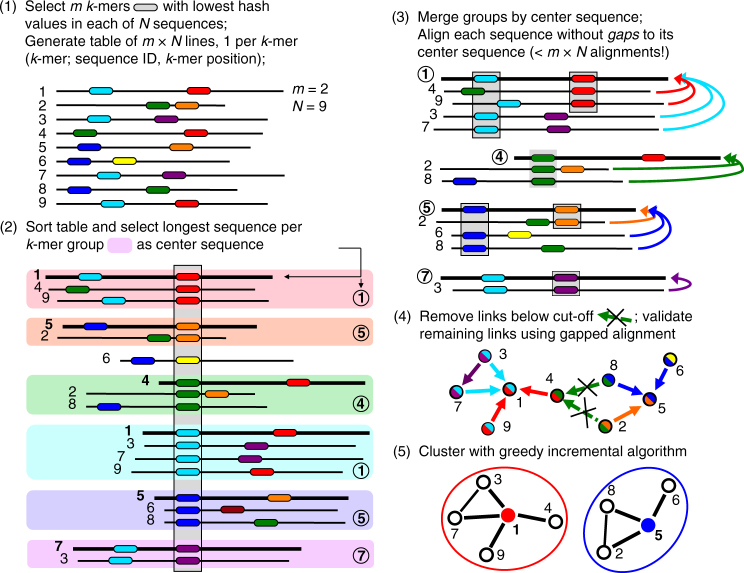
Metagenomic datasets contain billions of protein sequences that could greatly enhance large-scale functional annotation and structure prediction. Utilizing this enormous resource would require reducing its redundancy by similarity clustering. However, clustering hundreds of millions of sequences is impractical using current algorithms because their runtimes scale as the input set size N times the number of clusters K, which is typically of similar order as N, resulting in runtimes that increase almost quadratically with N. We developed Linclust, the first clustering algorithm whose runtime scales as N, independent of K. It can also cluster datasets several times larger than the available main memory. We cluster 1.6 billion metagenomic sequence fragments in 10 h on a single server to 50% sequence identity, >1000 times faster than has been possible before. Linclust will help to unlock the great wealth contained in metagenomic and genomic sequence databases.
Overview
The claims and statistics of this paper haven’t been checked yet.
Free: it reads the open-access text and checks the first 5 claims that cite a source we can check. Create a free account to check every claim.
Integrity signals
Registry
Cites
Statistics
Figures
Verification
Claims the paper makes
The claims and statistics of this paper haven’t been checked yet.
Free: it reads the open-access text and checks the first 5 claims that cite a source we can check. Create a free account to check every claim.
Self-check
Percentages, sums and reported differences re-computed from the paper’s own numbers.
The self-check needs the paper’s full text.
Citations
Cites
Basic local alignment search tool
Altschul, S. F., Gish, W., Miller, W., Myers, E. W., & Lipman, D. J. (1990) · Journal of Molecular Biology · doi:10.1006/jmbi.1990.9999 · Cited by 98,669 · cited 1×
“For each clustering run, we searched with BLAST [15] a random sample of 1 000 representative sequences against all representative sequences of the clustering.”
MethodSearch and clustering orders of magnitude faster than BLAST
Edgar, R. C. (2010) · Bioinformatics · doi:10.1093/bioinformatics/btq461 · Cited by 20,826
Fast and sensitive protein alignment using DIAMOND
Buchfink, B., Xie, C., & Huson, D. H. (2015) · Nature Methods · doi:10.1038/nmeth.3176 · Cited by 14,201 · cited 3×
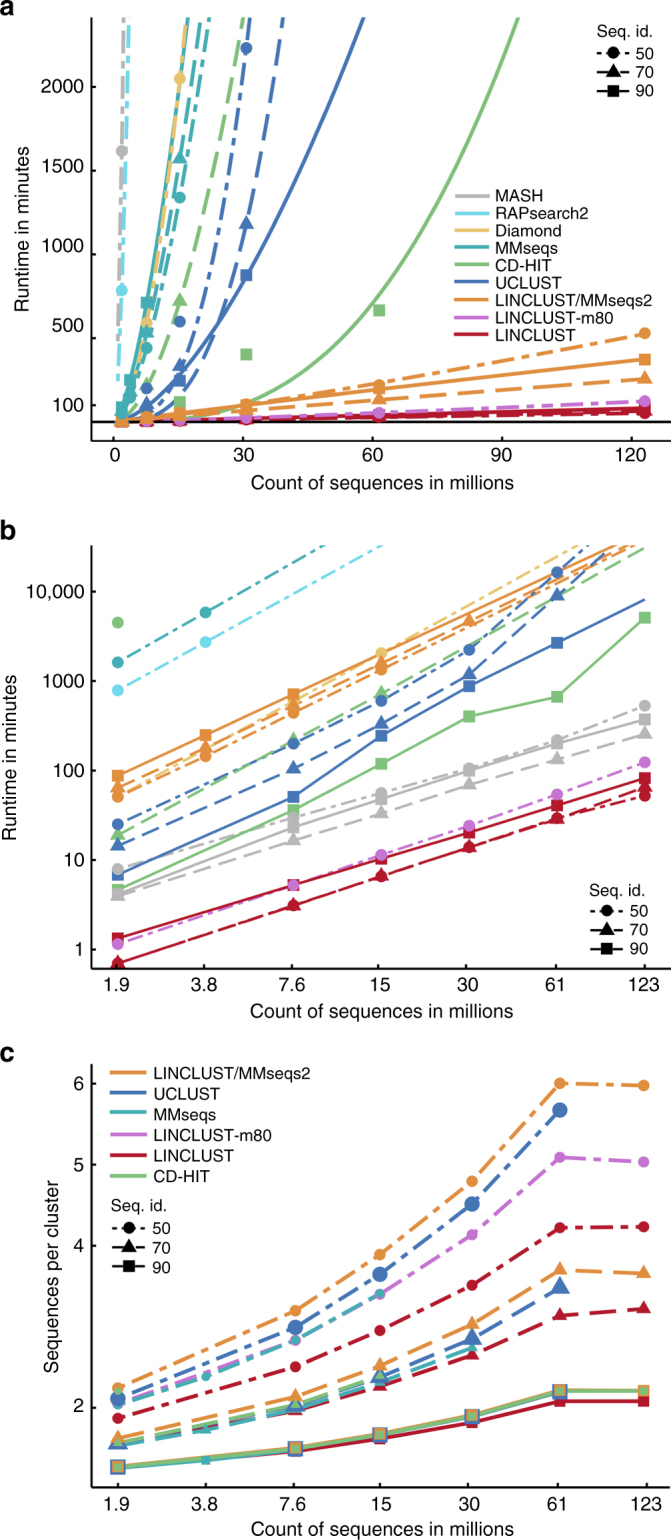
“At 50% identity, Linclust clusters the 123 million sequences 10 times faster than Linclust/MMseqs2 and, by extrapolation, 2300 times faster than UCLUST, 720 times faster than MMseqs, 4600 times faster than CD-HIT, 1600 times faster than DIAMOND [12], 69 000 times faster than MASH [13], and 26 000 times faster than RAP…”
BackgroundInfluentialProdigal: prokaryotic gene recognition and translation initiation site identification
Hyatt, D., Chen, G.-L., LoCascio, P. F., Land, M. L., Larimer, F. W., & Hauser, L. J. (2010) · BMC Bioinformatics · doi:10.1186/1471-2105-11-119 · Cited by 12,587
Cd-hit: a fast program for clustering and comparing large sets of protein or nucleotide sequences
Li, W., & Godzik, A. (2006) · Bioinformatics · doi:10.1093/bioinformatics/btl158 · Cited by 11,410 · cited 1×
“Similar to the k-mer prefilter used in CD-HIT, UCLUST, kclust and MMseqs [8, 11, 26, 27], the preclustering reduces the number of comparisons by a large factor F using the slow, exact measure, but the time complexity of the ex240 act distance calculation O(N(2)/F ) is still quadratic in N .”
MethodCd-hit: Accelerated for clustering the next-generation sequencing data
Fu, L., Niu, B., Zhu, Z., Wu, S., & Li, W. (2012) · Bioinformatics · doi:10.1093/bioinformatics/bts565 · Cited by 11,175 · cited 15×
“By increasing m from 20 to 80, Linclust takes only 1.5 to 2 times longer but attains a sensitivity similar to UCLUST (pink in Fig.”
MethodInfluentialThe Pfam protein families database: towards a more sustainable future
Finn, R. D., Coggill, P., Eberhardt, R. Y., Eddy, S. R., Mistry, J., Mitchell, A. L., Potter, S. C., Punta, M., Qureshi, M., Sangrador-Vegas, A., et al. (2016) · Nucleic Acids Research · doi:10.1093/nar/gkv1344 · Cited by 5,975 · cited 1×
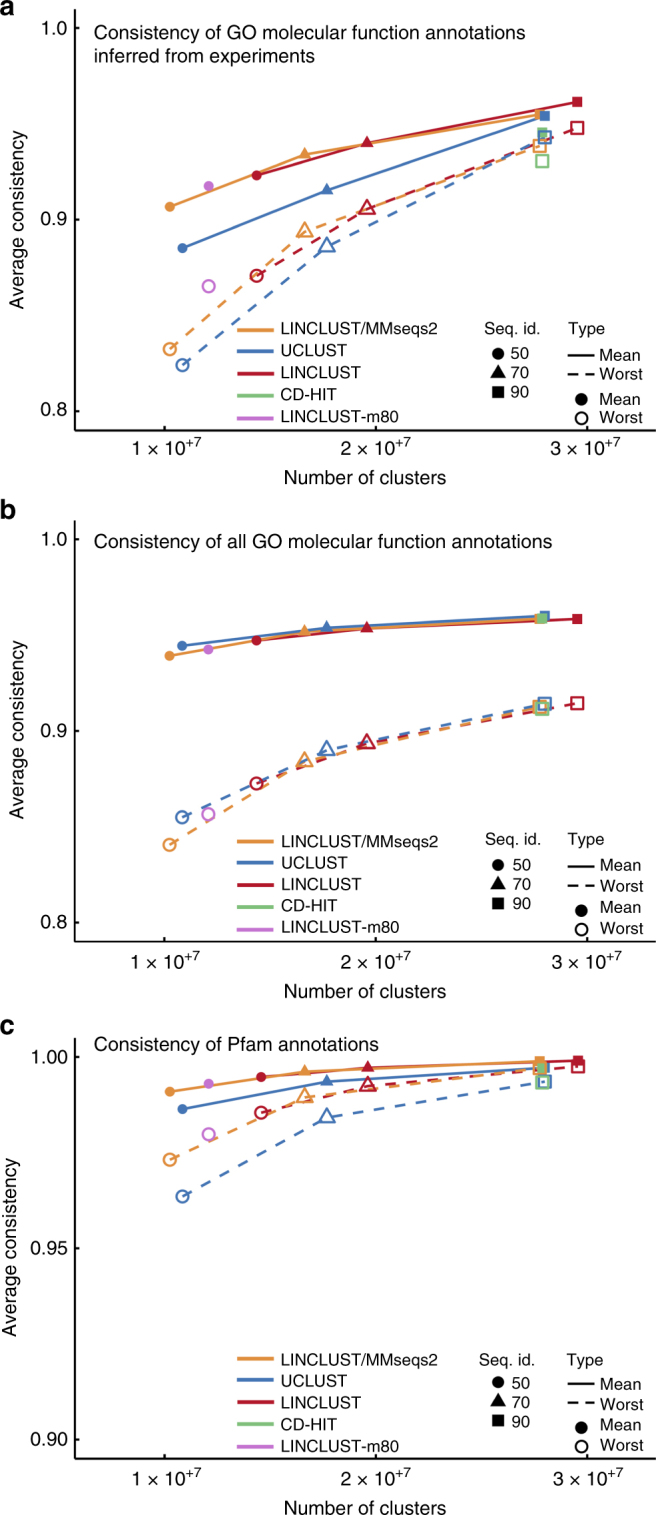
“4a,b) and Pfam domain annotations [18] (Fig.”
MMseqs2 enables sensitive protein sequence searching for the analysis of massive data sets
Steinegger, M., & Söding, J. (2017) · Nature Biotechnology · doi:10.1038/nbt.3988 · Cited by 4,840
Self-citationThe Universal Protein Resource (UniProt)
Bairoch, A. (2004) · Nucleic Acids Research · doi:10.1093/nar/gki070 · Cited by 3,774 · cited 1×
“, 100}, we determined these thresholds empirically on 4 million local alignments sampled from an all-against-all comparison of the UniProt database [31].”
MethodGene Ontology Consortium: going forward
The Gene Ontology Consortium (2015) · Nucleic Acids Research · doi:10.1093/nar/gku1179 · Cited by 3,492 · cited 2×
“We assess Gene Ontology (GO) annotations [17] (Fig.”
BackgroundMethod
Research works printed but not linked: 1
- Wang, J. Shen, H. T., Song, J. & Ji., J. Hashing for similarity search: a survey. Preprint at https://arxiv.org/abs/1408.2927 (2014). · arXiv
Cited by
Items 201–300 of 962
Polonsky, K., Pupko, T., & Freund, N. T. (2023) · doi:10.1101/2023.08.03.551715 · Cited by 40
Szikszai, M., Magnus, M., Sanghi, S., Kadyan, S., Bouatta, N., & Rivas, E. (2024) · Journal of Molecular Biology · doi:10.1016/j.jmb.2024.168552 · Cited by 38
Unexpected genetic and microbial diversity for arsenic cycling in deep sea cold seep sediments
Zhang, C., Liu, X., Shi, L.-D., Li, J., Xiao, X., Shao, Z., & Dong, X. (2023) · npj Biofilms and Microbiomes · doi:10.1038/s41522-023-00382-8 · Cited by 38
Chandra, A. A., Sharma, A. K., Dehzangi, A., Tsunoda, T., & Sattar, A. (2023) · Scientific Reports · doi:10.1038/s41598-023-47624-5 · Cited by 38
Analysis of several key factors influencing deep learning-based inter-residue contact prediction
Wu, T., Hou, J., Adhikari, B., & Cheng, J. (2020) · Bioinformatics · doi:10.1093/bioinformatics/btz679 · Cited by 40
“6 billion metagenomic sequence fragments with 50% sequence identity (Steinegger and Soding, 2018).”
BackgroundDetecting and correcting misclassified sequences in the large-scale public databases
Bagheri, H., Severin, A. J., & Rajan, H. (2020) · Bioinformatics · doi:10.1093/bioinformatics/btaa586 · Cited by 38
“have built a novel clustering tool that clusters a huge protein database in linear time( Steinegger and Söding (2018)).”
MethodStructural Comparison and Drug Screening of Spike Proteins of Ten SARS-CoV-2 Variants
Yang, Q., Jian, X., Syed, A. A. S., Fahira, A., Zheng, C., Zhu, Z., Wang, K., Zhang, J., Wen, Y., Li, Z., et al. (2022) · Research · doi:10.34133/2022/9781758 · Cited by 44
Mach, N., Midoux, C., Leclercq, S., Pennarun, S., Moyec, L. L., Rué, O., Robert, C., Sallé, G., & Barrey, É. (2022) · Communications Biology · doi:10.1038/s42003-022-03977-7 · Cited by 39
Digging into the 3D Structure Predictions of AlphaFold2 with Low Confidence: Disorder and Beyond
Bruley, A., Mornon, J.-P., Duprat, E., & Callebaut, I. (2022) · Biomolecules · doi:10.3390/biom12101467 · Cited by 36
“It is the most comprehensive database used by AF2 in order to build multiple sequence alignments, gathering sequences from genomic and metagenomic databases (UniprotKB [41] and metaclust [42] and datasets assembled with Plass [43]).”
MethodSzikszai, M., Magnus, M., Sanghi, S., Kadyan, S., Bouatta, N., & Rivas, E. (2024) · doi:10.1101/2024.01.30.578025 · Cited by 38
Pretraining model for biological sequence data
Song, B., Li, Z., Lin, X., Wang, J., Wang, T., & Fu, X. (2021) · Briefings in Functional Genomics · doi:10.1093/bfgp/elab025 · Cited by 39
“BFD [40] 2018 Protein sequences Largest set of protein sequences https://metaclust.”
BackgroundNew antiviral defences are genetically embedded within prokaryotic immune systemsPreprint
Payne, L. J., Hughes, T. C. D., Fineran, P. C., & Jackson, S. A. (2024) · bioRxiv (Cold Spring Harbor Laboratory) · doi:10.1101/2024.01.29.577857 · Cited by 39
“7e284 (Steinegger and Söding, 2017, 2018).”
Humolli, D., Piel, D., Maffei, E., Heyer, Y., Agustoni, E., Shaidullina, A., Willi, L., Imwinkelried, P., Estermann, F., Cuénod, A., et al. (2025) · PLOS Biology · doi:10.1371/journal.pbio.3003063 · Cited by 36
Kim, D. N., McNaughton, A. D., & Kumar, N. (2024) · Bioengineering · doi:10.3390/bioengineering11020185 · Cited by 40
“Similar to the situation present in general protein data, there is a huge amount of sequence data available (for example, metagenomic sequences surpass 1.6 billion [42], while the Protein Data Bank (PDB) [43] only has 214,000 structures).”
BackgroundInfluentialNuhamunada, M., Mohite, O. S., Phaneuf, P. V., Palsson, B. Ø., & Weber, T. (2024) · Nucleic Acids Research · doi:10.1093/nar/gkae314 · Cited by 37
“Briefly, MMSeqs2 was used to build a protein sequence similarity network of selected BGCs, which allowed us to cluster the coding sequences into candidate Clusters of Orthol-ogous Groups of proteins (COGs) ( 41 ).”
Clustering the protein universe of life using DIAMOND DeepClust
Buchfink, B., Barbe, E., Ashkenazy, H., Reuter, K., Kennedy, J. A., & Drost, H. (2026) · Nature Methods · doi:10.1038/s41592-026-03030-z · Cited by 40
“While MMseqs2/Linclust marked an important advancement in providing a sequence clustering algorithm that scaled linear with dataset size, for practical purposes its scalability to large datasets is impeded by several factors.”
InfluentialNgugi, D. K., Salcher, M. M., Andrei, A., Ghai, R., Klotz, F., Chiriac, M., Ionescu, D., Büsing, P., Grossart, H., Xing, P., et al. (2023) · Science Advances · doi:10.1126/sciadv.adc9392 · Cited by 38
Machine learning classification for field distributions of photonic modes
Barth, C., & Becker, C. (2018) · Communications Physics · doi:10.1038/s42005-018-0060-1 · Cited by 36
“Machine learning is currently applied to all aspects of science, from not only health sciences and psychology 2,3 , biology 4 – 6 and environmental 7 and material sciences 8,9 , but also to matters of everyday life from online security to fi nance and insurance.”
BackgroundAccurate and fast graph-based pangenome annotation and clustering with ggCaller
Horsfield, S., Tonkin‐Hill, G. Q., Croucher, N. J., & Lees, J. A. (2023) · Genome Research · doi:10.1101/gr.277733.123 · Cited by 38
“ORFs are then clustered using a method based on Linclust (Steinegger and Söding 2018).”
Method(2024) · doi:10.1101/2024.09.12.612763 · Cited by 36
Accurate prediction of antibody function and structure using bio-inspired antibody language model
Jing, H., Gao, Z., Xu, S. Y., Shen, T., Peng, Z., He, S., You, T., Ye, S., Lin, W. J., & Sun, S. (2024) · Briefings in Bioinformatics · doi:10.1093/bib/bbae245 · Cited by 41
“All antibody sequences are sourced from the OAS [15] dataset and were clustered using LinClust [34] with a 40% sequence identity.”
Wang, Y., Shi, Q., Yang, P., Zhang, C., Mortuza, S. M., Xue, Z., Ning, K., & Zhang, Y. (2019) · Genome Biology · doi:10.1186/s13059-019-1823-z · Cited by 36
Protein Language Models: Applications and Perspectives
Leclercq, M., & Droit, A. (2025) · Journal of Proteome Research · doi:10.1021/acs.jproteome.5c00506 · Cited by 43
Shen, T., Wu, J., Lan, H., Zheng, L., Pei, J., Wang, S., Liu, W., & Huang, J. (2021) · Proteins Structure Function and Bioinformatics · doi:10.1002/prot.26232 · Cited by 38
Protein–protein contact prediction by geometric triangle-aware protein language models
Lin, P., Tao, H., Li, H., & Huang, S. (2023) · Nature Machine Intelligence · doi:10.1038/s42256-023-00741-2 · Cited by 37
“Specifically, all the homodimers are downloaded from the Protein Data Bank (PDB) 56 and clustered into a non-redundant dataset using MMSeq2 57,58 .”
MethodTemBERTure: advancing protein thermostability prediction with deep learning and attention mechanisms
Rodella, C., Lazaridi, S., & Lemmin, T. (2024) · Bioinformatics Advances · doi:10.1093/bioadv/vbae103 · Cited by 39
“It was built on top of the pre-trained protBERT-BFD model (Elnaggar et al. 2022), a BERT model composed of 30 layers, 16 heads, and 1024 hidden layers and trained on over 2 billion protein sequences from the BFD100 (Steinegger and S € oding 2018, Steinegger et al. 2019) dataset.”
Hao, Y., Liu, X., Fu, H., Shao, X., & Cai, W. (2024) · Bioinformatics · doi:10.1093/bioinformatics/btae497 · Cited by 35
“ProtT5 adopts a 24-layer transformer architecture with 1024 hidden layers size, pretrained on the Big Fantastic Database (BFD) (Steinegger and S € oding 2018, Steinegger et al. 2019) and subsequently fine-tuned on UniRef50 (Suzek et al. 2015).”
BackgroundAge-related dynamics of predominant methanogenic archaea in the human gut microbiome
Mohammadzadeh, R., Mahnert, A., Shinde, T., Kumpitsch, C., Weinberger, V., Schmidt, H., & Moissl‐Eichinger, C. (2025) · BMC Microbiology · doi:10.1186/s12866-025-03921-9 · Cited by 35
“Elimination of duplicate genes was achieved through linclust with minid = 0.9 and coverag = 0.9 parameters [38].”
InfluentialHugouvieux‐Cotte‐Pattat, N., Brochier‐Armanet, C., Flandrois, J., & Reverchon, S. (2020) · INTERNATIONAL JOURNAL OF SYSTEMATIC AND EVOLUTIONARY MICROBIOLOGY · doi:10.1099/ijsem.0.004306 · Cited by 33
Barcia‐Cruz, R., Goudenège, D., de Sousa, J. A. M., Piel, D., Marbouty, M., Rocha, E. P. C., & Roux, F. L. (2024) · Nature Communications · doi:10.1038/s41467-024-44965-1 · Cited by 33
Single Layers of Attention Suffice to Predict Protein Contacts
Bhattacharya, N., Thomas, N., Rao, R., Dauparas, J., Koo, P. K., Baker, D., Song, Y. S., & Ovchinnikov, S. (2020) · bioRxiv (Cold Spring Harbor Laboratory) · doi:10.1101/2020.12.21.423882 · Cited by 29
Improving protein tertiary structure prediction by deep learning and distance prediction in CASP14
Liu, J., Wu, T., Guo, Z., Hou, J., & Cheng, J. (2022) · Proteins: Structure, Function, and Bioinformatics · doi:10.1002/prot.26186 · Cited by 32
“For some hard targets, the MSAs generated by HHblits on the Big Fantastic Database (BFD) (Steinegger, Mirdita, & Söding, 2019; Steinegger & Söding, 2018) are also used to predict distance maps.”
MethodHecatomb: an integrated software platform for viral metagenomics
Roach, M. J., Beecroft, S. J., Mihindukulasuriya, K. A., Wang, L., Paredes, A. M., Cárdenas, L. A. C., Henry-Cocks, K., Lima, L. F. O., Dinsdale, E. A., Edwards, R. A., et al. (2024) · GigaScience · doi:10.1093/gigascience/giae020 · Cited by 34
“Sequences free of contamination and host are clustered using the nucleotide version of Linclust packaged with MMSeqs2 [48,75].”
MethodGeothermal Gases Shape the Microbial Community of the Volcanic Soil of Pantelleria, Italy
Picone, N., Hogendoorn, C., Cremers, G., Poghosyan, L., Pol, A., van Alen, T. A., Gagliano, A. L., D’Alessandro, W., Quatrini, P., Jetten, M. S. M., et al. (2020) · mSystems · doi:10.1128/msystems.00517-20 · Cited by 37
“0 package (100) (“-v 0 – kmer-per-seq 160 –min-seq-id 0.”
Going to extremes – a metagenomic journey into the dark matter of life
Aevarsson, A., Kaczorowska, A., Aðalsteinsson, B. Þ., Ahlqvist, J., Al‐Karadaghi, S., Altenbuchner, J., Arsın, H., Atlason, Ú. Á., Brandt, D., Cichowicz-Cieślak, M., et al. (2021) · FEMS Microbiology Letters · doi:10.1093/femsle/fnab067 · Cited by 35
Self-citationYan, H., Vestergaard, G., Deng, L., Kot, W., Thymann, T., Brunse, A., & Nielsen, D. S. (2022) · npj Biofilms and Microbiomes · doi:10.1038/s41522-022-00310-2 · Cited by 35
Ma, Q., Meng, N., Su, J., Li, Y., Gu, J., Wang, Y., Wang, J., Qu, Y., Zhao, Z., & Sun, Y. (2022) · Journal of Environmental Sciences · doi:10.1016/j.jes.2022.06.025 · Cited by 32
Improving AlphaFold2-based protein tertiary structure prediction with MULTICOM in CASP15
Liu, J., Guo, Z., Wu, T., Roy, R. S., Chen, C., & Cheng, J. (2023) · Communications Chemistry · doi:10.1038/s42004-023-00991-6 · Cited by 31
Guerrero-Egido, G., Pintado, A., Bretscher, K. M., Arias-Giraldo, L. M., Paulson, J. N., Spaink, H. P., Claessen, D., Ramos, C., Cazorla, F. M., Medema, M. H., et al. (2024) · Nature Communications · doi:10.1038/s41467-024-46302-y · Cited by 32
Li, Y., Xu, X., Zhang, X., Xu, Z., Zhao, J., Zhu, R., Wang, Z., Ran, W., Zhao, W., Yan, N., et al. (2025) · Gut Microbes · doi:10.1080/19490976.2025.2523811 · Cited by 34
Pre-Cambrian roots of novel Antarctic cryptoendolithic bacterial lineages
Albanese, D., Coleine, C., Rota‐Stabelli, O., Onofri, S., Tringe, S. G., Stajich, J., Selbmann, L., & Donati, C. (2021) · Microbiome · doi:10.1186/s40168-021-01021-0 · Cited by 33
Modularity and diversity of target selectors in Tn7 transposons
Faure, G., Saito, M., Benler, S., Peng, I., Wolf, Y. I., Strecker, J., Altae-Tran, H., Neumann, E. N., Li, D., Makarova, K. S., et al. (2023) · Molecular Cell · doi:10.1016/j.molcel.2023.05.013 · Cited by 32
“12- 113e3).(47) From each cluster, members were aligned together using mafft-linsi.”
MethodZeng, S., Zhou, R., Bao, S., Li, X., Deng, Z., Hou, D., Weng, S., He, J., & Huang, Z. (2020) · Frontiers in Genetics · doi:10.3389/fgene.2020.00071 · Cited by 33
How to Hallucinate Functional ProteinsPreprint
Costello, Z., & Martín, H. G. (2019) · arXiv (Cornell University) · doi:10.48550/arxiv.1903.00458 · Cited by 38
“This operation was performed using the Linclust command line tool (27).”
MethodGroussman, R. D., Blaskowski, S., Coesel, S., & Armbrust, E. V. (2023) · Scientific Data · doi:10.1038/s41597-023-02842-4 · Cited by 33
Orthology inference at scale with FastOMA
Majidian, S., Nevers, Y., Yazdizadeh Kharrazi, A., Warwick Vesztrocy, A., Pascarelli, S., Moi, D., Glover, N., Altenhoff, A. M., & Dessimoz, C. (2025) · Nature Methods · doi:10.1038/s41592-024-02552-8 · Cited by 30
“Next, we resolve the nested structure of the HOGs (Supplementary Information 1) corresponding to each ancestor, in an efficient leaf-to-root traversal of the species tree.”
InfluentialProtein embeddings improve phage-host interaction prediction
Gonzales, M. E. M., Ureta, J. C., & Shrestha, A. M. S. (2023) · PLoS ONE · doi:10.1371/journal.pone.0289030 · Cited by 31
“• We constructed a random forest model for predicting phage-host interaction and showed that embeddings of RBPs outperform handcrafted genomic and protein sequence features, with the use of the protein language model ProtT5 resulting in the highest performance.”
Campaña, M. B., Irudayanathan, F. J., Davis, T. R., McGovern-Gooch, K. R., Loftus, R., Ashkar, M., Escoffery, N., Navarro, M., Sieburg, M. A., Nangia, S., et al. (2019) · Journal of Biological Chemistry · doi:10.1074/jbc.ac119.009749 · Cited by 29
“S2), guided our hGOAT structural modeling (17, 20, 21).”
BackgroundMethodJain, A., Terashi, G., Kagaya, Y., Maddhuri Venkata Subramaniya, S. R., Christoffer, C., & Kihara, D. (2021) · Scientific Reports · doi:10.1038/s41598-021-87204-z · Cited by 29
SpatialPPI: Three-dimensional space protein-protein interaction prediction with AlphaFold Multimer
(2024) · doi:10.1016/j.csbj.2024.03.009 · Cited by 29
“The AlphaFold Multimer was executed using the jackhmmer search from HMMER3 [47] targeting Uniref90 [48], UniProt [49], and MGnify [50], and a joint search of the Big Fantastic Database [51,52] and UniRef30[53] using HHBlits [54].”
MethodProtein embedding based alignment
Iovino, B. G., & Ye, Y. (2024) · BMC Bioinformatics · doi:10.1186/s12859-024-05699-5 · Cited by 29
“This approach can be applied to protein sequences where language models are trained on large protein databases, like UniRef50 [21], UniRef100 [21], and BFD [20] [19], and are able to learn about the “language of life” [4].”
MethodKaragöl, T., Karagöl, A., & Zhang, S. (2024) · PLoS ONE · doi:10.1371/journal.pone.0300340 · Cited by 30
Research progress of reduced amino acid alphabets in protein analysis and prediction
Liang, Y., Yang, S., Zheng, L., Wang, H., Zhou, J., Huang, S., Yang, L., & Zuo, Y. (2022) · Computational and Structural Biotechnology Journal · doi:10.1016/j.csbj.2022.07.001 · Cited by 29
“Steinegger et al. proposed that the Kmer based on RAA alphabets and BLO-SUM62 matrix can greatly improve the efficiency of sequence alignment, and developed a series of sequence search/clustering algorithms and tools for MMSeq based on this method [44–46].”
MethodInteraction between arsenic metabolism genes and arsenic leads to a lose-lose situation
Zhou, M., Liu, Z., Zhang, B., Yang, J., & Hu, B. (2022) · Environmental Pollution · doi:10.1016/j.envpol.2022.119971 · Cited by 29
OpenProteinSet: Training data for structural biology at scale
Ahdritz, G., Bouatta, N., Kadyan, S., Jarosch, L., Berenberg, D., Fisk, I., Watkins, A. M., Ra, S., Bonneau, R., & AlQuraishi, M. (2023) · arXiv (Cornell University) · doi:10.48550/arxiv.2308.05326 · Cited by 14
“Raw sequence and structure data are available in large quantities under open licenses [23, 41, 42, 43] and there also exist several mature, open-source software suites for computing MSAs at varying levels of sensitivity [44, 45, 46].”
BackgroundSpatialPPI: three-dimensional space protein-protein interaction prediction with AlphaFold Multimer
Hu, W., & Ohue, M. (2023) · doi:10.1101/2023.12.14.571766 · Cited by 29
PoET: A generative model of protein families as sequences-of-sequences
Truong, T. F., & Bepler, T. (2023) · arXiv (Cornell University) · doi:10.48550/arxiv.2306.06156 · Cited by 28
“ProGen2 [5] (ensemble) is an ensemble of five Transformer-based causal language models ranging between 150M and 6.4B parameters and trained on UniRef90 and BFD [45].”
MethodClustering biological sequences with dynamic sequence similarity threshold
Chiu, J. K. H., & Ong, R. T. (2022) · BMC Bioinformatics · doi:10.1186/s12859-022-04643-9 · Cited by 29
“In addition, the sequence clustering tool Linclust [24] can be run as a pre-processing step to divide the sequences into intermediate clusters for individual graph clustering in each intermediate cluster for scalability.”
MethodChen, T.-R., Juan, S.-H., Huang, Y.-W., Lin, Y.-C., & Lo, W. (2021) · PLoS ONE · doi:10.1371/journal.pone.0255076 · Cited by 29
“Since the official PDB nr sets were prepared by heuristic clustering [82], for ensuring the 25% identity, homology reduction methods CD-HIT [83], USEARCH [84], and MMseqs2 [85] were iteratively applied to it until no sequence could be removed at the 25% identity cutoff.”
MethodXu, S., & Onoda, A. (2023) · Journal of Chemical Information and Modeling · doi:10.1021/acs.jcim.3c01202 · Cited by 29
Genomic sketching with multiplicities and locality-sensitive hashing using Dashing 2
Baker, D. N., & Langmead, B. (2023) · Genome Research · doi:10.1101/gr.277655.123 · Cited by 34
“We note that although there are tools for large-scale clustering that use similar ideas, like Linclust (Steinegger and Söding 2018), no other genomic sketching method (Mash, BinDash, Sourmash) currently has this ability.”
MethodProtein Embeddings Predict Binding Residues in Disordered Regions
Jahn, L. R., Marquet, C., Heinzinger, M., & Rost, B. (2024) · doi:10.1101/2024.03.05.583540 · Cited by 28
Zhang, C., Zheng, W., Cheng, M., Omenn, G. S., Freddolino, P. L., & Zhang, Y. (2021) · Journal of Proteome Research · doi:10.1021/acs.jproteome.0c00359 · Cited by 27
“27,28 Brie fl y, C-I-TASSER fi rst uses DeepMSA 31 to search the query protein sequence against three whole-genome and metagenome protein sequence databases, including Uniclust30, 32 UniRef90, 33 and Metaclust, 34 to obtain a multiple sequence alignment (MSA).”
MethodProtein embeddings predict binding residues in disordered regions
(2024) · doi:10.1038/s41598-024-64211-4 · Cited by 27
“Although the past rule-of-thumb of 10 of the minority-class samples (here the positives accounting for 38% of all points) per free parameter are more often ignored by orders of magnitude than not in the era of deep learning, modern AI is simply data hungry.”
BackgroundAlphaFold‐Guided Bespoke Gene Editing Enhances Field‐Grown Soybean Oil Contents
Wang, J., ZHANG, L., Wang, S., Wang, X., Li, S., Gong, P., Bai, M., Paul, A., Tvedt, N. C., Ren, H., et al. (2025) · Advanced Science · doi:10.1002/advs.202500290 · Cited by 29
Zeng, D., Liang, K. M., Guo, F. Z., Wu, Y., & Wu, G. (2020) · Separation and Purification Technology · doi:10.1016/j.seppur.2020.116799 · Cited by 27
Zhu, H.-Z., Jiang, M.-Z., Zhou, N., Jiang, C., & Liu, S. (2021) · Applied Microbiology and Biotechnology · doi:10.1007/s00253-021-11565-8 · Cited by 28
“80) and non-redundant gene catalogue construction (Steinegger and Söding 2018).”
BackgroundOn Pre-trained Language Models for AntibodyPreprint
Wang, D., Ye, F., & Hao, Z. (2023) · bioRxiv (Cold Spring Harbor Laboratory) · doi:10.1101/2023.01.29.525793 · Cited by 29
“Antigen Binding Accurate antigen-binding prediction approaches could allow significantly more efficient antibody discovery with higher affinity.”
BackgroundMethodSeq-InSite: sequence supersedes structure for protein interaction site prediction
Hosseini, S., Golding, G. B., & Ilie, L. (2024) · Bioinformatics · doi:10.1093/bioinformatics/btad738 · Cited by 26
Accurately clustering biological sequences in linear time by relatedness sorting
Wright, E. S. (2024) · Nature Communications · doi:10.1038/s41467-024-47371-9 · Cited by 31
“Hashing functions meet these criteria as they allow for rare k-mers to be repeatably identi fi ed across sequences 16 .”
InfluentialHawlitschek, O., Ortiz, E. M., Noori, S., Webster, K. C., Husemann, M., & Pereira, R. J. (2022) · Molecular Phylogenetics and Evolution · doi:10.1016/j.ympev.2022.107439 · Cited by 28
Seasonality of biogeochemically relevant microbial genes in a coastal ocean microbiome
Auladell, A., Ferrera, I., Montiel, L., Júnior, C. D. S., Sebastián, M., Logares, R., & Gasol, J. M. (2023) · Environmental Microbiology · doi:10.1111/1462-2920.16367 · Cited by 27
Salinity causes differences in stratigraphic methane sources and sinks
Qu, Y., Zhao, Y., Yao, X., Wang, J., Liu, Z., Hong, Y., Zheng, P., Wang, L., & Hu, B. (2023) · Environmental Science and Ecotechnology · doi:10.1016/j.ese.2023.100334 · Cited by 30
“Unigenes (non-redundant gene catalog) were obtained after running Linclust [59].”
MethodA genome catalog of the early-life human skin microbiome
Shen, Z., Robert, L., Stolpman, M., Che, Y., Allen, K. J., Saffery, R., Walsh, A., Young, A., Eckert, J., Deming, C., et al. (2023) · Genome biology · doi:10.1186/s13059-023-03090-w · Cited by 28
“Protein clustering across all species of with the “easy-linclust” function of MMseqs2 v13-45111 using parameters “–cov-mode 1 -c 0.8 –kmer-per-seq 80 –min-seq-id 0.9” to generate protein clusters at 90% amino acid identity, respectively [66].”
InfluentialNeural Distance Embeddings for Biological SequencesPreprint
Corso, G., Ying, R., Pándy, M., Veličković, P., Leskovec, J., & Lió, P. (2021) · arXiv (Cornell University) · doi:10.17863/cam.78685 · Cited by 29
Microdroplet screening rapidly profiles a biocatalyst to enable its AI-assisted engineeringPreprint
Gantz, M., Mathis, S. V., Nintzel, F. E. H., Penner, M., Zurek, P. J., Knaus, T., Tseliou, V., Patel, E., Boros, D., Weberling, F.-M., et al. (2024) · bioRxiv (Cold Spring Harbor Laboratory) · doi:10.1101/2024.04.08.588565 · Cited by 27
“A custom python script was used to extract the UMI sequences 27 and the generated fasta file was clustered using the mmseqs2 suite 69 (min-seq-id 0.8, seq-id-mode 2, cov-mode 0 -c 0.8).”
MethodInfluentialSeq-InSite: sequence supersedes structure for protein interaction site prediction
Hosseini, S., Golding, G. B., & Ilie, L. (2023) · doi:10.1101/2023.06.19.545575 · Cited by 26
Sen, N., Anishchenko, I., Bordin, N., Sillitoe, I., Velankar, S., Baker, D., & Orengo, C. (2022) · Briefings in Bioinformatics · doi:10.1093/bib/bbac187 · Cited by 25
“…with additional homologs by performing iterative sequence hhblits [102] searches against uniclust30 (version UniRef30_2020_01) [103] and BFD [104, 105] databases as outlined by Anishchenko and colleagues [106] (details in Supplementary Text 12 available online at http://bib.oxfordjournals.org/).”
Pita, S., Myers, P. N., Johansen, J., Russel, J., Nielsen, M. C., Eklund, A. C., & Nielsen, H. B. (2024) · Frontiers in Microbiology · doi:10.3389/fmicb.2024.1425489 · Cited by 28
Planetary microbiome structure and generalist-driven gene flow across disparate habitats
Kim, C. Y., Podlesny, D., Schiller, J., Khedkar, S., Fullam, A., Orakov, A. N., Schudoma, C., Robbani, S. M., Grekova, A., Kuhn, M., et al. (2026) · Cell · doi:10.1016/j.cell.2025.12.051 · Cited by 28
Gene ancestries reveal diverse microbial associations during eukaryogenesis
Bernabeu, M., Manzano-Morales, S., Marcet‐Houben, M., & Gabaldón, T. (2026) · Nature · doi:10.1038/s41586-026-10639-9 · Cited by 26
Chitin utilization by marine picocyanobacteria and the evolution of a planktonic lifestyle
Capovilla, G., Braakman, R., Fournier, G. P., Hackl, T., Schwartzman, J. A., Lu, X., Yelton, A. P., Longnecker, K., Soule, M. C. K., Thomas, E., et al. (2023) · Proceedings of the National Academy of Sciences · doi:10.1073/pnas.2213271120 · Cited by 27
Beauvais, M., Schatt, P., Montiel, L., Logares, R., Galand, P. E., & Bouget, F. (2023) · Environmental Microbiology · doi:10.1111/1462-2920.16545 · Cited by 25
Diversity and evolutionary dynamics of spore-coat proteins in spore-forming species of Bacillales
Secaira-Morocho, H., Castillo, J. A., & Driks, A. (2020) · Microbial Genomics · doi:10.1099/mgen.0.000451 · Cited by 28
“(2) Clustering analysis of spore-coat proteins was performed using the software package Many- against-Many sequence searching (MMseqs2) [31] to group proteins from the 161 Bacillales genomes with well-known spore-coat proteins (i.e. the 86 spore-coat proteins mentioned above) with a minimum of…”
DeepDist: real-value inter-residue distance prediction with deep residual convolutional networkPreprint
Wu, T., Guo, Z., Hou, J., & Cheng, J. (2020) · bioRxiv (Cold Spring Harbor Laboratory) · doi:10.1101/2020.03.17.995910 · Cited by 25
Sen, N., Anishchenko, I., Bordin, N., Sillitoe, I., Velankar, S., Baker, D., & Orengo, C. (2021) · doi:10.1101/2021.11.17.468998 · Cited by 25
Li, Y., Zhang, C., Zheng, W. H., Zhou, X., Bell, E. W., Yu, D., & Zhang, Y. (2021) · Proteins Structure Function and Bioinformatics · doi:10.1002/prot.26211 · Cited by 27
Jarnot, P., Ziemska-Legięcka, J., Grynberg, M., & Gruca, A. (2022) · Briefings in Bioinformatics · doi:10.1093/bib/bbac299 · Cited by 32
“A metric designed for LCR comparison is crucial for better performance of general purpose protein sequence clustering since many methods use it to create clusters [77, 78].”
Alkuhlani, A., Gad, W. K., Roushdy, M. I., Voskoglou, M. G., & Salem, A.-B. M. (2022) · Axioms · doi:10.3390/axioms11090469 · Cited by 25
Deep transfer learning for inter-chain contact predictions of transmembrane protein complexes
Lin, P., Yan, Y., Tao, H., & Huang, S. (2023) · Nature Communications · doi:10.1038/s41467-023-40426-3 · Cited by 29
Automated benchmarking of combined protein structure and ligand conformation prediction
Leemann, M., Sagasta, A., Eberhardt, J., Schwede, T., Robin, X., & Durairaj, J. (2023) · Proteins: Structure, Function, and Bioinformatics · doi:10.1002/prot.26605 · Cited by 23
“49 Six different sequence-based clustering patterns were obtained as a result of clustering with minimum sequence identity thresholds of 100%, 95%, 90%, 70%, 50%, and 30%, respectively.”
MethodInsights into the inner workings of transformer models for protein function prediction
Wenzel, M. A., Grüner, E., & Strodthoff, N. (2024) · Bioinformatics · doi:10.1093/bioinformatics/btae031 · Cited by 27
“Definitions of the aforementioned UniProt annotations (per amino acid) and matching GO terms (class labels of proteins) are compiled in Supplementary Table A.1 (tables/figures with prefix letters are shown in the Supplementary material).”
BackgroundSubramaniya, S. R. M. V., Terashi, G., Jain, A., Kagaya, Y., & Kihara, D. (2021) · Bioinformatics · doi:10.1093/bioinformatics/btab220 · Cited by 27
“, 2015) dated April 2018 and Metaclust_NR database (Steinegger and Söding, 2018) dated January 2018 were used.”
MethodAdapting protein language models for structure-conditioned designPreprint
Ruffolo, J. A., Bhatnagar, A., Beazer, J., Nayfach, S., Russ, J., Hill, E., Hussain, R., Gallagher, J. P., & Madani, A. (2024) · bioRxiv (Cold Spring Harbor Laboratory) · doi:10.1101/2024.08.03.606485 · Cited by 28
Gonzales, M. E. M., Ureta, J. C., & Shrestha, A. M. S. (2024) · Bioinformatics · doi:10.1093/bioinformatics/btaf016 · Cited by 23
“These models were pretrained in a self-supervised fashion on sequences from large-scale protein databases [6, 55, 50, 52] and have been shown to cap-43 ture relevant physicochemical characteristics [21, 47, 27, 40].”
MethodRational exploration of fold atlas for human solute carrier proteins
Xie, T., Chi, X., Huang, B., Ye, F., Zhou, Q., & Huang, J. (2022) · Structure · doi:10.1016/j.str.2022.05.015 · Cited by 23
Rapid and accurate prediction of protein homo-oligomer symmetry using Seq2Symm
Kshirsagar, M., Meller, A., Humphreys, I. R., Sledzieski, S., Xu, Y., Dodhia, R., Horvitz, E., Berger, B., Bowman, G. R., Ferres, J. L., et al. (2025) · Nature Communications · doi:10.1038/s41467-025-57148-3 · Cited by 23
“…we were able to construct MSAs for 94 structures using the HHblits algorithm 31 with an e-value cut-off 1e-3 (searching over the following databases: protein sequences from the UniRef30_2023_02 32 version and BFD 33 ) and fi ltered for quality using hh fi lter with 90% identity and 75% coverage.”
PATO: Pangenome Analysis Toolkit
Fernández-de-Bobadilla, M. D., Talavera-Rodríguez, A., Chacón, L., Baquero, F., Coque, T. M., & Lanza, V. F. (2021) · Bioinformatics · doi:10.1093/bioinformatics/btab697 · Cited by 25
Hu, Y.-M., Wang, Y.-J., Hu, X., Chao, H.-Y., Li, S.-D., Ni, Q., Zhu, Y., Hu, Y.-X., Zhao, Z., & Chen, M. (2024) · Computational and Structural Biotechnology Journal · doi:10.1016/j.csbj.2024.01.015 · Cited by 22
“…” [38], which is a Transformer model, (ii) "ProtBert" [37], which is a BERT-based encoder model [35] , generating two pLMs pre-trained on BFD [86] and UniRef100 [87] data, respectively, (iii) ProtT5-XL [37], which is an encoder model based on T5 [88], generating two pLMs pre-trained on BFD…”
NMR‐assisted protein structure prediction with MELDxMD
Robertson, J. C., Nassar, R., Liu, C., Brini, E., Dill, K. A., & Pérez, A. (2019) · Proteins Structure Function and Bioinformatics · doi:10.1002/prot.25788 · Cited by 23
Metadata
- Authors
- Steinegger, M., & Söding, J.
- Affiliations
- Seoul National University (KR)
- Max Planck Institute for Biophysical Chemistry (DE)
- Corresponding author
- Steinegger, Martin
- Söding, Johannes
- Venue
- Nature Communications
- Published
- 2018-06-29
- Volume
- 9
- Issue
- 1
- Pages
- 2542-2542
- ISSN
- 2041-1723 (ISSN-L)
- PMC
- PMC6026198
- OpenAlex
- W2953008890
- Cited by
- 875
- References
- 32
- Citations by year
- 2026: 110 · 2025: 154 · 2024: 168 · 2023: 123 · 2022: 111 · 2021: 129 · 2020: 52 · 2019: 28
- FWCI
- 18.49
- Type
- journal article
- Language
- en
- Open access
- gold
- doi.org
- Licence
- cc-by
- creativecommons.org/licenses/by/4.0 (tdm)
- creativecommons.org/licenses/by/4.0 (vor)
- Locations
- Nature Communications (publishedVersion, cc-by)
- Europe PMC (PubMed Central) (publishedVersion, cc-by)
- PubMed Central (publishedVersion, cc-by)
- PubMed (publishedVersion)
- OSTI OAI (U.S. Department of Energy Office of Scientific and Technical Information) (submittedVersion)
- DOAJ (DOAJ: Directory of Open Access Journals) (submittedVersion, cc-by-sa)
- DOAJ (DOAJ: Directory of Open Access Journals) (submittedVersion)
- mediaTUM (Technical University of Munich) (submittedVersion, other-oa)
- GoeScholar The Publication Server of the Georg-August-Universität Göttingen (Georg-August-Universität Göttingen) (submittedVersion, cc-by)
- Seoul National University Open Repository (Seoul National University) (submittedVersion)
- Funders
- U.S. Department of Energy
- Joint Genome Institute
- Seoul National University
- Horizon 2020 Framework Programme (685778)
- Topics
- Life Sciences › Biochemistry, Genetics and Molecular Biology › Molecular Biology › Genomics and Phylogenetic Studies
- Physical Sciences › Mathematics › Theoretical Computer Science › Algorithms and Data Compression
- Life Sciences › Biochemistry, Genetics and Molecular Biology › Molecular Biology › Fractal and DNA sequence analysis
- Keywords
- protein sequence clustering, metagenomics, functional annotation, memory-efficient clustering, sequence similarity
- MeSH terms
- Algorithms, Animals, DNA, Humans, Prokaryotic Cells, Proteins, Cluster Analysis, Genome, Sequence Analysis, DNA, Computational Biology, Databases, Nucleic Acid, Databases, Protein, Metagenomics, Datasets as Topic
About these checks
Registry, retraction, Cites and statistics results are computed, not judged, with one exception: a printed reference that no index lists is read once by a model before it counts as a citation error. Claims are extracted by a model and kept only when their quote appears verbatim in the text; each cited source is then checked, with a model’s help, for whether it says what the claim relies on. Those verdicts can be wrong — read the claim’s quote and the cited source before relying on one.
Statistics and arithmetic are recomputed, not judged.
Confidence bands are shown only for fields calibrated on our annotated test set. None is calibrated yet, so no band is shown.
What counts as a claim ›How we measure confidence ›How we check this ›
Are you an author, or do you see a problem with this page? Request a review
Data sources
Bibliographic data: Semantic Scholar, OpenAlex, Crossref.
Contains information from the Semantic Scholar Academic Graph Datasets, made available under the ODC Attribution License (ODC-BY 1.0).
Semantic Scholar’s data is described in: Kinney, R., et al. (2023). The Semantic Scholar Open Data Platform. arXiv:2301.10140.
