

Clustering huge protein sequence sets in linear time
Open accessPublished version of a preprint
The DOI matches its Crossref record; 33 of the 33 references it cites were found in a registry or an index.
Abstract
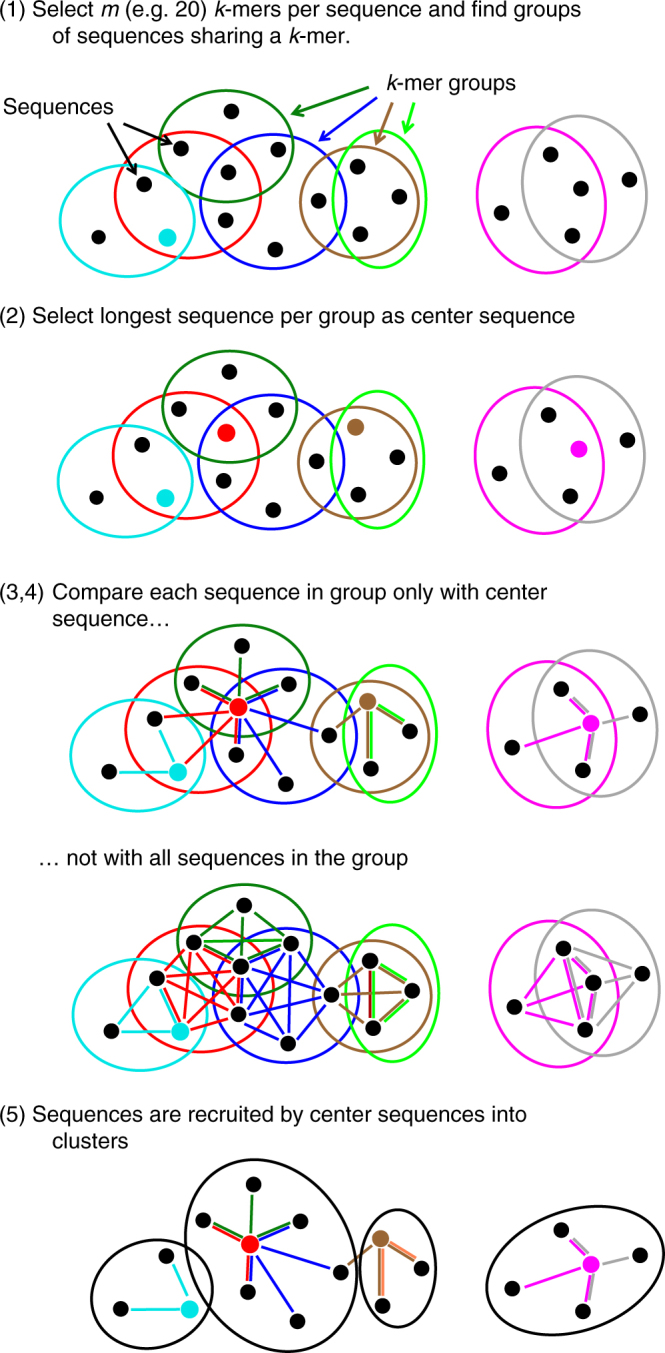
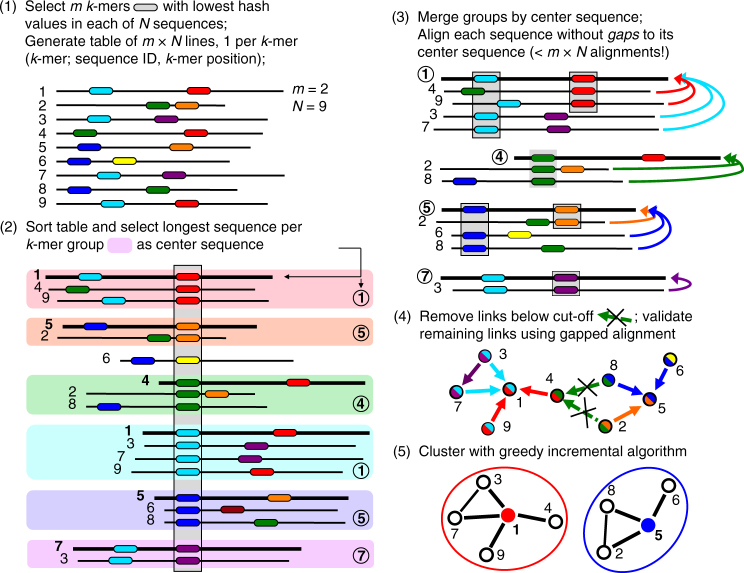
Metagenomic datasets contain billions of protein sequences that could greatly enhance large-scale functional annotation and structure prediction. Utilizing this enormous resource would require reducing its redundancy by similarity clustering. However, clustering hundreds of millions of sequences is impractical using current algorithms because their runtimes scale as the input set size N times the number of clusters K, which is typically of similar order as N, resulting in runtimes that increase almost quadratically with N. We developed Linclust, the first clustering algorithm whose runtime scales as N, independent of K. It can also cluster datasets several times larger than the available main memory. We cluster 1.6 billion metagenomic sequence fragments in 10 h on a single server to 50% sequence identity, >1000 times faster than has been possible before. Linclust will help to unlock the great wealth contained in metagenomic and genomic sequence databases.
Overview
The claims and statistics of this paper haven’t been checked yet.
Free: it reads the open-access text and checks the first 5 claims that cite a source we can check. Create a free account to check every claim.
Integrity signals
Registry
Cites
Statistics
Figures
Verification
Claims the paper makes
The claims and statistics of this paper haven’t been checked yet.
Free: it reads the open-access text and checks the first 5 claims that cite a source we can check. Create a free account to check every claim.
Self-check
Percentages, sums and reported differences re-computed from the paper’s own numbers.
The self-check needs the paper’s full text.
Citations
Cites
Basic local alignment search tool
Altschul, S. F., Gish, W., Miller, W., Myers, E. W., & Lipman, D. J. (1990) · Journal of Molecular Biology · doi:10.1006/jmbi.1990.9999 · Cited by 98,669 · cited 1×
“For each clustering run, we searched with BLAST [15] a random sample of 1 000 representative sequences against all representative sequences of the clustering.”
MethodSearch and clustering orders of magnitude faster than BLAST
Edgar, R. C. (2010) · Bioinformatics · doi:10.1093/bioinformatics/btq461 · Cited by 20,826
Fast and sensitive protein alignment using DIAMOND
Buchfink, B., Xie, C., & Huson, D. H. (2015) · Nature Methods · doi:10.1038/nmeth.3176 · Cited by 14,201 · cited 3×
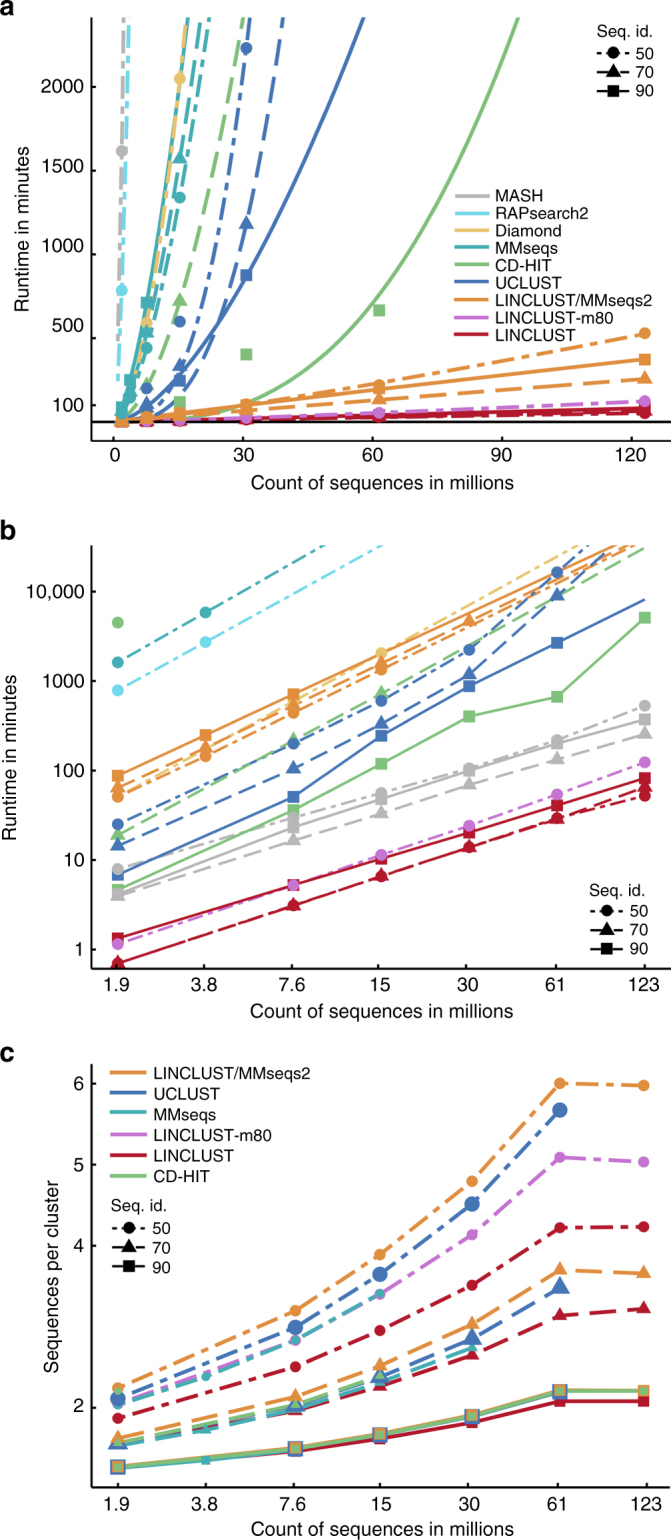
“At 50% identity, Linclust clusters the 123 million sequences 10 times faster than Linclust/MMseqs2 and, by extrapolation, 2300 times faster than UCLUST, 720 times faster than MMseqs, 4600 times faster than CD-HIT, 1600 times faster than DIAMOND [12], 69 000 times faster than MASH [13], and 26 000 times faster than RAP…”
BackgroundInfluentialProdigal: prokaryotic gene recognition and translation initiation site identification
Hyatt, D., Chen, G.-L., LoCascio, P. F., Land, M. L., Larimer, F. W., & Hauser, L. J. (2010) · BMC Bioinformatics · doi:10.1186/1471-2105-11-119 · Cited by 12,587
Cd-hit: a fast program for clustering and comparing large sets of protein or nucleotide sequences
Li, W., & Godzik, A. (2006) · Bioinformatics · doi:10.1093/bioinformatics/btl158 · Cited by 11,410 · cited 1×
“Similar to the k-mer prefilter used in CD-HIT, UCLUST, kclust and MMseqs [8, 11, 26, 27], the preclustering reduces the number of comparisons by a large factor F using the slow, exact measure, but the time complexity of the ex240 act distance calculation O(N(2)/F ) is still quadratic in N .”
MethodCd-hit: Accelerated for clustering the next-generation sequencing data
Fu, L., Niu, B., Zhu, Z., Wu, S., & Li, W. (2012) · Bioinformatics · doi:10.1093/bioinformatics/bts565 · Cited by 11,175 · cited 15×
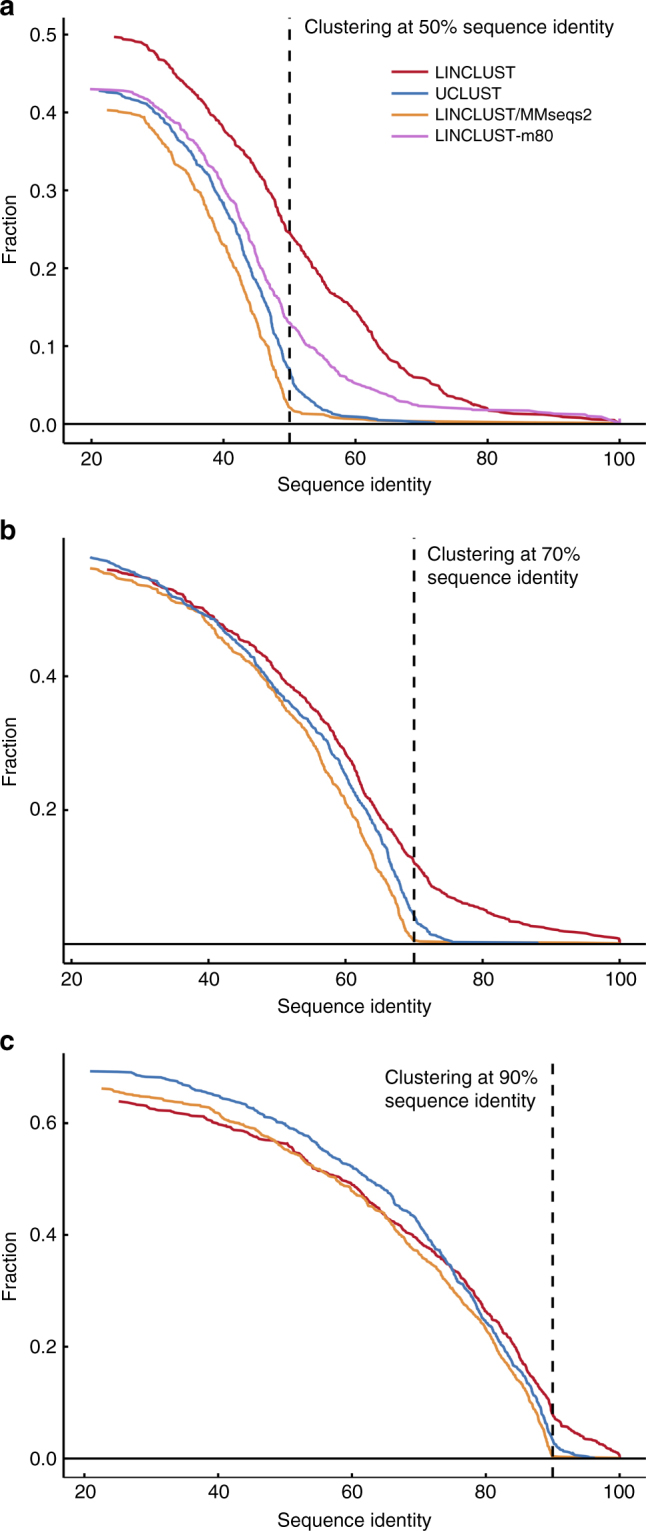
“By increasing m from 20 to 80, Linclust takes only 1.5 to 2 times longer but attains a sensitivity similar to UCLUST (pink in Fig.”
MethodInfluentialThe Pfam protein families database: towards a more sustainable future
Finn, R. D., Coggill, P., Eberhardt, R. Y., Eddy, S. R., Mistry, J., Mitchell, A. L., Potter, S. C., Punta, M., Qureshi, M., Sangrador-Vegas, A., et al. (2016) · Nucleic Acids Research · doi:10.1093/nar/gkv1344 · Cited by 5,975 · cited 1×
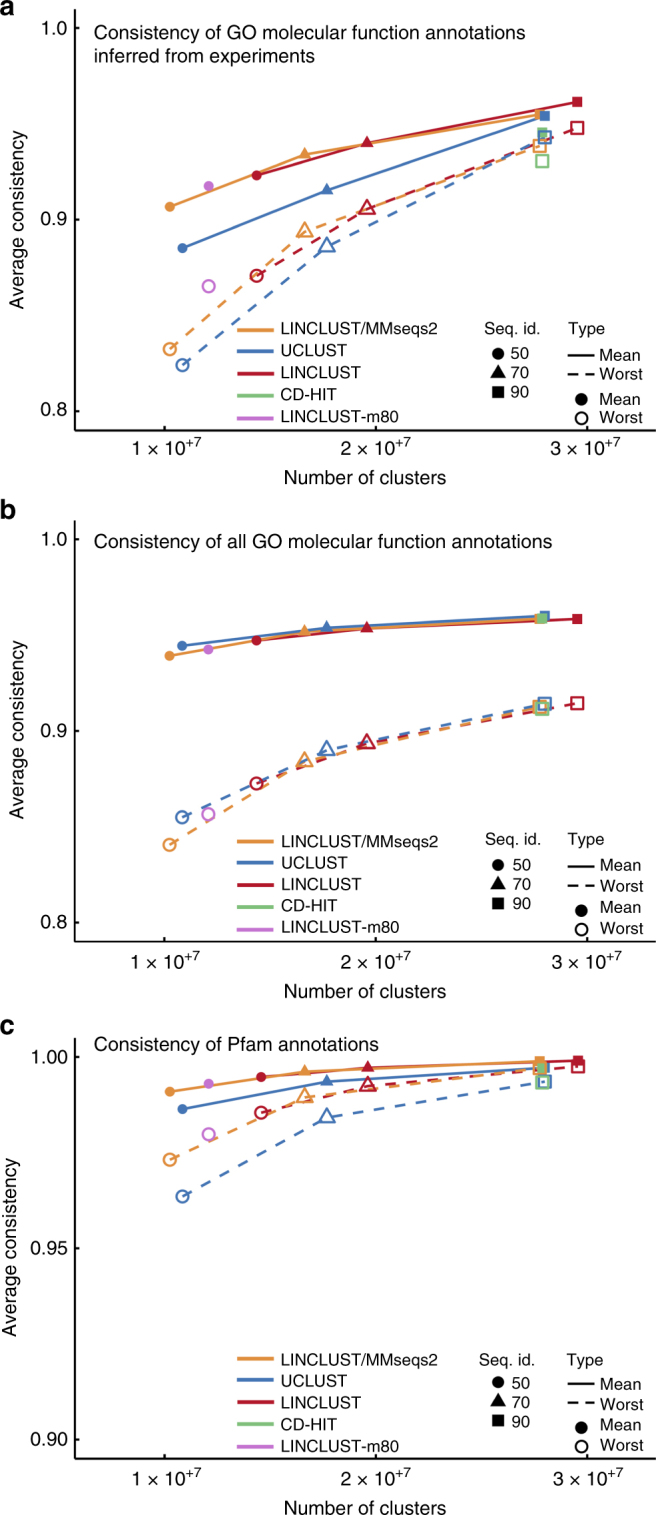
“4a,b) and Pfam domain annotations [18] (Fig.”
MMseqs2 enables sensitive protein sequence searching for the analysis of massive data sets
Steinegger, M., & Söding, J. (2017) · Nature Biotechnology · doi:10.1038/nbt.3988 · Cited by 4,840
Self-citationThe Universal Protein Resource (UniProt)
Bairoch, A. (2004) · Nucleic Acids Research · doi:10.1093/nar/gki070 · Cited by 3,774 · cited 1×
“, 100}, we determined these thresholds empirically on 4 million local alignments sampled from an all-against-all comparison of the UniProt database [31].”
MethodGene Ontology Consortium: going forward
The Gene Ontology Consortium (2015) · Nucleic Acids Research · doi:10.1093/nar/gku1179 · Cited by 3,492 · cited 2×
“We assess Gene Ontology (GO) annotations [17] (Fig.”
BackgroundMethod
Research works printed but not linked: 1
- Wang, J. Shen, H. T., Song, J. & Ji., J. Hashing for similarity search: a survey. Preprint at https://arxiv.org/abs/1408.2927 (2014). · arXiv
Cited by
Items 501–600 of 962
ESMDynamic: Fast and accurate prediction of protein dynamic contact maps from single sequences
Kleiman, D. E., Feng, J., Xue, Z., & Shukla, D. (2026) · Nature Communications · doi:10.1038/s41467-026-76361-2 · Cited by 8
“Despite these limitations, leveraging heterogeneous structural datasets has proven effective in large-scale protein modeling efforts, including both structure prediction 1 – 5, 8, 9 We perform additional characterization of dynamic contacts in Supplementary Note 1 (see also Supplementary Tables 1 – 4 and Supplementary…”
InfluentialClostridium pasteurianum in kaolin bioleaching: Iron reduction and whitening mechanisms
Li, K., Lin, J., Owens, G., & Chen, Z. (2025) · Applied Clay Science · doi:10.1016/j.clay.2025.107998 · Cited by 7
Karim, W., Alvi, R., Zaman, S. B., Abian, A. I., Raiaan, M. A. K., Mukta, S. H., Rashid, M. R. U., Islam, R., Sebastian, Y., & Azam, S. (2026) · Archives of Computational Methods in Engineering · doi:10.1007/s11831-026-10743-z · Cited by 7
“Comprehensive protein sequence repositories such as UniProtKB [118], UniRef90 [123], BFD30 [124], CATH-Gene3D [125], and Pfam [122] provide widespread annotations that support protein language modeling and generative structure prediction.”
Application of protein language models for antibody developability prediction
Amini, S., Huang, Y., Julian, M. C., Palmer, C., Sciabola, S., & Wang, Y. C. (2026) · mAbs · doi:10.1080/19420862.2026.2647489 · Cited by 7
“15,16 Clustering thresholds were selected to allow each dataset to be represented by approximately five folds (see Supplementary Information for details).”
Insights into diversity, host-range, and temporal stability of Bacteroides and Phocaeicola prophages
Stopnišek, N., Hedžet, S., Accetto, T., & Rupnik, M. (2025) · BMC Microbiology · doi:10.1186/s12866-025-03827-6 · Cited by 8
“For that we clustered all sequences based on 100% similarity using MMseqs2 [31, 32].”
InfluentialA Comparative Study of Sequence Clustering Algorithms
Ju, Z., Zhang, H., Zhang, J., Xi, W., Huang, D. K., Feng, S., Meng, J., & Wei, Y. (2025) · Big Data Mining and Analytics · doi:10.26599/bdma.2025.9020010 · Cited by 7
Wu, W., Wang, C., Chen, L., Yin, M., Zhu, Y., Fu, K., Ye, J., Xiong, H., & Wang, Z. (2025) · ACM SIGKDD Conference on Knowledge Discovery and Data Mining (KDD) · doi:10.1145/3711896.3737138 · Cited by 17
“Given the vast availability of sequence-only data and limited sequence-structure paired data (from both experimental and computational sources) within protein domain [75, 76, 80, 84], we propose a sequence/ structure fused protein encoder that is capable of accommodating inputs in either form.”
Quantifying Shared and Unique Gene Content across 17 Microbial Ecosystems
Zimmerman, S. E., Tierney, B. T., Patel, C. J., & Kostic, A. D. (2023) · mSystems · doi:10.1128/msystems.00118-23 · Cited by 8
“495 We then clustered all Open Reading Frames predicted by Prokka using the linclust (36) 496 and cluster functions from the MMseqs2 (37) package.”
MethodNeural Embeddings for kNN Search in Biological Sequence
Chang, Z., Yu, L., Xu, Y., & Hu, W. (2024) · Proceedings of the AAAI Conference on Artificial Intelligence · doi:10.1609/aaai.v38i1.27753 · Cited by 7
“…for numerous tasks, including gene prediction (Chothia and Lesk 1986), homology analysis (Sander and Schneider 1991), sequence clustering (Steinegger and S¨oding 2018; Li and Godzik 2021), etc. Traditional methods for measuring global or local similarity between sequences rely on…”
Transformer Encoder with Protein Language Model for Protein Secondary Structure Prediction
Kazm, A., Ali, A. O., & Hashim, H. B. (2024) · Engineering Technology & Applied Science Research · doi:10.48084/etasr.6855 · Cited by 7
“While most approaches rely on these models for extracting features, this study takes an approach by utilizing the Ankh model [39], which is a large unsupervised PLM. Ankh, built on a transformer-based architecture and has been trained on the BFD [41] and UniRef50 [42] dataset.”
MethodRubén, P.-B., Enault, F., & Galiez, C. (2025) · Peer Community Journal · doi:10.24072/pcjournal.627 · Cited by 7
Xu, G., Wang, Q., & Ma, J. (2021) · Bioinformatics · doi:10.1093/bioinformatics/btab633 · Cited by 8
“DeepMSA is a state-of-the-art multiple sequence alignment method which searches the alignment results in UniRef90, Uniclust30 and Metaclust 38.”
MethodDynamic order Markov model for categorical sequence clustering
Chen, R., Sun, H., Chen, L., Zhang, J., & Wang, S. (2021) · Journal Of Big Data · doi:10.1186/s40537-021-00547-2 · Cited by 7
Sung, I., Lee, S., Pak, M., Shin, Y., & Kim, S. (2022) · BMC Bioinformatics · doi:10.1186/s12859-022-04679-x · Cited by 7
“K -mer encoding, on the other hand, loses positional information, but it has the same encoding length for a fixed value of k , and has the advantage of being able to learn the local context of a biological sequence [32–35].”
BackgroundEstG is a novel esterase required for cell envelope integrity in Caulobacter
Daitch, A. K., Orsburn, B. C., Chen, Z., Álvarez, L., Eberhard, C. D., Sundararajan, K., Zeinert, R., Kreitler, D. F., Jakoncic, J., Chien, P., et al. (2022) · Current Biology · doi:10.1016/j.cub.2022.11.037 · Cited by 8
Rahimzadeh, F., Khanli, L. M., Salehpoor, P., Golabi, F., & Pourbahrami, S. (2024) · Computers in Biology and Medicine · doi:10.1016/j.compbiomed.2024.108815 · Cited by 9
Artificial intelligence in bioinformatics
Feng, S., Xu, J., & Shen, H. (2019) · Elsevier eBooks · doi:10.1016/b978-0-12-816034-3.00007-9 · Cited by 7
The North Pacific Eukaryotic Gene Catalog of metatranscriptome assemblies and annotations
Groussman, R. D., Coesel, S., Durham, B. P., Schatz, M. J., & Armbrust, E. V. (2024) · Scientific Data · doi:10.1038/s41597-024-04005-5 · Cited by 7
Unified Deep Learning of Molecular and Protein Language Representations with T5ProtChem
Kelly, T., Xia, S., Lü, J., & Zhang, Y. (2025) · Journal of Chemical Information and Modeling · doi:10.1021/acs.jcim.5c00051 · Cited by 6
Yu, W., Zhang, J., Shi, Z., Wang, S., Lai, S., Huang, X., Zhang, J., Cai, Z., & Zhao, J. (2025) · Journal of Hazardous Materials · doi:10.1016/j.jhazmat.2025.140745 · Cited by 7
Yu, X., Ge, F., Yu, D., & Deng, Z. (2026) · Briefings in Bioinformatics · doi:10.1093/bib/bbag050 · Cited by 6
“ProtTrans [30], which was developed by using the UniRef and Big Fantastic Database dataset with up to 393 billion amino acids [33, 34], leverages 1024-dimensional embeddings per residue.”
Mulnaes, D., Schott‐Verdugo, S., Koenig, F., & Gohlke, H. (2021) · Journal of Chemical Theory and Computation · doi:10.1021/acs.jctc.1c00685 · Cited by 6
Jha, P., Tiwari, A., Bharill, N., Ratnaparkhe, M. B., Patel, O. P., Harshith, N., Mounika, M., & Nagendra, N. (2023) · International Journal of Data Science and Analytics · doi:10.1007/s41060-022-00381-6 · Cited by 6
“Clustering protein sequences predicted from sequencing reads can impressively reduce the excess of sequence sets and the expense of downstream analysis and storage [5,6].”
BackgroundNguyen, R., Sokhansanj, B. A., Polikar, R., & ROSEN, G. L. (2023) · PeerJ · doi:10.7717/peerj.14779 · Cited by 6
Gleich, S. J., Hu, S. K., Krinos, A. I., & Caron, D. A. (2023) · Environmental Microbiology · doi:10.1111/1462-2920.16556 · Cited by 7
Arıkan, M., & Atabay, B. (2024) · Journal of Proteome Research · doi:10.1021/acs.jproteome.4c00665 · Cited by 7
SeqDPI : A 1D ‐ CNN approach for predicting binding affinity of kinase inhibitors
Mishra, V. P., Singh, Y. N., Khan, F., & Dutta, M. K. (2024) · Journal of Computational Chemistry · doi:10.1002/jcc.27518 · Cited by 6
Conformational switching of Arp5 subunit regulates INO80 chromatin remodeling
Shukla, S., Paul, S., García, J., Zhong, Y., Juste, S. S., Beauchemin, K., & Bartholomew, B. (2024) · Nucleic Acids Research · doi:10.1093/nar/gkae1187 · Cited by 6
Hohmann, M., Iliasov, D., Larralde, M., Johannes, W. U., Janssen, K., Zeller, G., Mascher, T., & Gulder, T. A. M. (2025) · ACS Synthetic Biology · doi:10.1021/acssynbio.5c00042 · Cited by 6
Zhang, M., Yang, Q., Lou, J., Hu, Y., & Shi, Y. (2025) · Biochimica et Biophysica Acta (BBA) - Molecular Basis of Disease · doi:10.1016/j.bbadis.2025.167772 · Cited by 7
Unicore Enables Scalable and Accurate Phylogenetic Reconstruction with Structural Core Genes
Kim, D., Park, S., & Steinegger, M. (2025) · Genome Biology and Evolution · doi:10.1093/gbe/evaf109 · Cited by 8
Self-citationДмитриевна, М. А., Dyachkova, M. S., Say, A. V., Burskaia, V., Artyushin, I. V., & Shipulin, G. A. (2022) · Microorganisms · doi:10.3390/microorganisms10081540 · Cited by 6
“To build a multiple alignment, we searched for homologues in the following databases: Uniref90 [61], Mgnify [62], BFD [63], UniClust30 [64] and pdb70 [65].”
MethodHan, R., Yoon, H., Yoo, J., & Lee, Y. (2023) · Computational and Structural Biotechnology Journal · doi:10.1016/j.csbj.2023.01.010 · Cited by 6
“When there were too many sequences (for the P1 or P2Y whole-class level), MMseq2 [10] was used to perform sequence clustering with a similarity value of 0.”
MethodInfluentialLi, C., Du, X., Huang, C., & Zhang, Z. (2023) · Membranes · doi:10.3390/membranes13070650 · Cited by 6
AntiRef: reference clusters of human antibody sequences
Briney, B. S. (2023) · Bioinformatics Advances · doi:10.1093/bioadv/vbad109 · Cited by 7
“This clustering approach was selected because the runtime of linclust scales linearly with input dataset size and because MMseqs2 provides tools for updating a previously clustered dataset with additional input data without re-clustering the entire dataset from scratch.”
MethodZhang, H., Wu, Y., Zhu, Y., Ge, L., Huang, J., & Qin, Z. (2024) · International Journal of Biological Macromolecules · doi:10.1016/j.ijbiomac.2024.130852 · Cited by 8
Xing, Y., Clark, J. R., Chang, J. D., Zulk, J. J., Chirman, D. M., Piedra, F.-A., Vaughan, E. E., Santos, H. H., Patras, K. A., & Maresso, A. W. (2024) · Infection and Immunity · doi:10.1128/iai.00440-23 · Cited by 6
“For multiple sequence alignment (MSA) necessary to build the consensus model for the structure of HlyA, we used MMseq2 (95, 96).”
MethodHu, L., Xue, J., & Wu, H. (2024) · Water · doi:10.3390/w16182569 · Cited by 7
Park, S., Steinegger, M., Cho, H.-S., & Chun, J. (2020) · Frontiers in Microbiology · doi:10.3389/fmicb.2020.585622 · Cited by 6
Self-citationHow to Cluster Protein Sequences: Tools, Tips and Commands
Pavlopoulos, G. A. (2017) · MOJ Proteomics & Bioinformatics · doi:10.15406/mojpb.2017.05.00174 · Cited by 6
RAFTS3G: an efficient and versatile clustering software to analyses in large protein datasets
Nichio, B. T. D. L., de Oliveira, A. M. R., Pierri, C. R. D., Santos, L. G. C., Lejambre, A. Q., Vialle, R. A., Coimbra, N. D. R., Guizelini, D., Marchaukoski, J. N., Pedrosa, F. D. O., et al. (2019) · BMC Bioinformatics · doi:10.1186/s12859-019-2973-4 · Cited by 7
“In the end, the greedy incremental algorithm locates a cluster so that each input sequence has an edge to the representative sequence of its cluster [21].”
MethodChryseobacterium mulctrae sp. nov., isolated from raw cow’s milk
Yoon, S.-H., Lee, J., Han, R.-H., Kwon, M., & Kim, G. (2019) · INTERNATIONAL JOURNAL OF SYSTEMATIC AND EVOLUTIONARY MICROBIOLOGY · doi:10.1099/ijsem.0.003647 · Cited by 6
Density-based binning of gene clusters to infer function or evolutionary history using GeneGrouper
McFarland, A. G., Kennedy, N. W., Mills, C. E., Tullman‐Ercek, D., Huttenhower, C., & Hartmann, E. M. (2021) · Bioinformatics · doi:10.1093/bioinformatics/btab752 · Cited by 6
Accurate Prediction of Antibody Function and Structure Using Bio-Inspired Antibody Language ModelPreprint
Jing, H., Gao, Z., Xu, S. Y., Shen, T., Peng, Z., He, S., You, T., Ye, S., Lin, W., & Sun, S. (2023) · bioRxiv (Cold Spring Harbor Laboratory) · doi:10.1101/2023.08.30.555473 · Cited by 6
PLANET-MD: Ultra-fast Proteome-scale Prediction of Allosteric Networks in ProteinsPreprint
Sledzieski, S., & Hanson, S. M. (2025) · bioRxiv (Cold Spring Harbor Laboratory) · doi:10.1101/2025.06.12.659353 · Cited by 6
Molecular Display of the Animal Meta-Venome for Discovery of Novel Therapeutic Peptides
Hsiao, M.-H., Miao, Y., Liu, Z., Schütze, K., Limjunyawong, N., Chien, D. C.-C., Monteiro, W. D., Chu, L.-S., Morgenlander, W., Jayaraman, S., et al. (2024) · doi:10.1101/2024.05.27.595990 · Cited by 6
Self-citationDi Pierro, F., Sagheddu, V., Galletti, S., Casaroli, A., Labrini, E., Soldi, S., Cazzaniga, M., Bertuccioli, A., Matera, M., Cavecchia, I., et al. (2026) · Probiotics and Antimicrobial Proteins · doi:10.1007/s12602-025-10522-5 · Cited by 5
“All proteins were clustered using MMseqs2 [99] according to 80% identity and 80% coverage; gene families were assigned to “persistent,” “shell,” or “cloud” partitions and saved.”
Molecular Display of the Animal Meta-Venome for Discovery of Novel Therapeutic Peptides
Hsiao, M.-H., Miao, Y., Liu, Z., Schütze, K., Limjunyawong, N., Chien, D. C.-C., Monteiro, W. D., Chu, L.-S., Morgenlander, W., Jayaraman, S., et al. (2025) · Molecular & Cellular Proteomics · doi:10.1016/j.mcpro.2024.100901 · Cited by 5
Self-citationGOBoost: leveraging long-tail gene ontology terms for accurate protein function prediction
Zhang, L., Wang, Y., Chen, X., Hou, J., Si, D., Ding, R., Jiang, B., Ledenko, H., & Cao, R. (2025) · Bioinformatics · doi:10.1093/bioinformatics/btaf267 · Cited by 5
“Subsequently, MMseqs (Steinegger and S € oding 2018) was used to cluster protein sequences with a 25% sequence similarity, resulting in 38 185 training proteins, 4 242 validation proteins, and 567 test proteins.”
Shuvo, M. H., & Bhattacharya, D. (2025) · Computational and Structural Biotechnology Journal · doi:10.1016/j.csbj.2024.12.015 · Cited by 6
Benchmarking the impact of reference genome selection on taxonomic profiling accuracy
van Bemmelen, J., Nika, I., & Baaijens, J. A. (2026) · BMC Genomics · doi:10.1186/s12864-026-12874-w · Cited by 5
“For example, CD-HIT performs global alignment and then defines the similarity as the number of identical characters divided by the length of the shortest sequence of the two, whereas UCLUST divides by the average length of both sequences.”
Ramon, A., Frassetto, N., Zhao, H., Xu, X., Greenig, M., Onuoha, S. C., & Sormanni, P. (2026) · mAbs · doi:10.1080/19420862.2026.2646361 · Cited by 9
Xie, Y., Cao, H., Bei, Q., Yao, S., Xu, L., Bian, Y., Jiang, X., Song, Y., & Ćwieląg‐Piasecka, I. (2025) · Eco-Environment & Health · doi:10.1016/j.eehl.2025.100196 · Cited by 5
“The Linclust software was used for gene clustering and redundancy to obtain the non-redundant gene catalogue [44].”
Effector innovation in genome-reduced phytoplasmas and other host-dependent mollicutes
Mirkin, F. G., Mugford, S. T., Thole, V., Marzo, M., & Hogenhout, S. A. (2025) · PLoS Genetics · doi:10.1371/journal.pgen.1011946 · Cited by 5
“Protein sequence similarity was evaluated with MMseqs2 [125], using the parameter -e 0.01.”
InfluentialBae, I. H., Kim, H., Kim, S., & Lee, Y. H. (2025) · Microbiome · doi:10.1186/s40168-025-02292-7 · Cited by 5
“The predicted proteins were further clustered into representatives using mmseqs2 (v. 15 .6f452) [49] with the default option, resulting in 17,024,354 bacterial and 579,346 fungal representative proteins.”
Exploring the protein universe with distant similarity detection methods
Sahakyan, H., Mutz, P., Tobiasson, V., & Koonin, E. V. (2025) · Protein Science · doi:10.1002/pro.70397 · Cited by 5
Structures of Get3d reveal a distinct architecture associated with the emergence of photosynthesis
Barlow, A. N., Manu, M. S., Saladi, S. M., Tarr, P. T., Yadav, Y., Thinn, A. M. M., Zhu, Y., Laganowsky, A. D., Clemons, W., & Ramasamy, S. (2023) · Journal of Biological Chemistry · doi:10.1016/j.jbc.2023.104752 · Cited by 5
“A reference alignment of Get3/ArsA domains was then created by clustering domains using mmseqs at 65% sequence identity (68).”
MethodDeepHLAPred: a deep learning-based method for non-classical HLA binder prediction
Huang, G., Tang, X., & Zheng, P. (2023) · BMC Genomics · doi:10.1186/s12864-023-09796-2 · Cited by 5
“…initial representations from peptides,, which is a BERT model [33–35] trained by the protein sequences from the UniRef100 [36] as well as BFD [37] databases then employed bi-directional LSTM (Bi-LSTM) to refine contextual semantics, utilized the Umap [38] to reduce the dimensions, and…”
MethodPeng, J., Hou, J., Liu, H., Mavrodi, D. V., Mavrodi, O. V., Sun, F., Shen, M., Wang, X., Dang, K., Yan, M., et al. (2025) · Geoderma · doi:10.1016/j.geoderma.2025.117273 · Cited by 6
Duru, I. C., Lecomte, A., Laine, P., Shishido, T. K., Suppula, J., Paulin, L. G., Scheperjans, F., Pereira, P. A. B., & Auvinen, P. (2025) · Scientific Reports · doi:10.1038/s41598-025-96924-5 · Cited by 6
Shrestha, A. M. S., Guiao, J. E. B., & Santiago, K. C. L. (2022) · BMC Genomics · doi:10.1186/s12864-021-08278-7 · Cited by 5
“To use Swiss-Prot as reference, it is advisable to remove sequence redundancies by using tools such as CD-HIT [48] or MMSeq2 [49] and by selecting a subset of Swiss-Prot based on taxa.”
MethodA randomized algorithm for clustering discrete sequences
Jiang, M., Hu, L., Han, X., Zhou, Y. G., & He, Z. (2024) · Pattern Recognition · doi:10.1016/j.patcog.2024.110388 · Cited by 5
Discovery of mosaic genomic islands in Pseudomonas spp.
Jani, M., & Azad, R. K. (2021) · Archives of Microbiology · doi:10.1007/s00203-021-02253-2 · Cited by 5
Ensemble of Template-Free and Template-Based Classifiers for Protein Secondary Structure Prediction
de Oliveira, G. B., Pedrini, H., & Dias, Z. (2021) · International Journal of Molecular Sciences · doi:10.3390/ijms222111449 · Cited by 8
Chryseobacterium vaccae sp. nov., isolated from raw cow's milk
Lee, J., Yoon, S.-H., Lee, G. Y., Lee, D.-H., Huh, C., & Kim, G. (2020) · INTERNATIONAL JOURNAL OF SYSTEMATIC AND EVOLUTIONARY MICROBIOLOGY · doi:10.1099/ijsem.0.004250 · Cited by 5
Kim, J., Kim, Y.-S., Shin, J. W., Kim, Y., Lee, D. H., Park, J.-W., Lee, D., Kim, H.-C., Lee, J., Lee, S. H., et al. (2024) · Scientific Data · doi:10.1038/s41597-024-04033-1 · Cited by 5
A Comparative Review of Deep Learning Methods for RNA Tertiary Structure PredictionPreprint
Martinović, I., Vlašić, T., Li, Y., Hooi, B., Zhang, Y., & Šikić, M. (2024) · bioRxiv (Cold Spring Harbor Laboratory) · doi:10.1101/2024.11.27.625779 · Cited by 7
“Starting with a download of all available RNA chains from PDB, which was 20 , 320 RNA chains, we applied sequence identity clustering using MMseqs2 [44, 45], filtering for a minimum sequence identity of 90% and coverage of at least 80%, resulting in 3 , 822 clusters.”
AlphaFlex: Accuracy modeling of protein multiple conformations via predicted flexible residuesPreprint
Ge, L., Cui, X., Zhao, K., Zhou, X., Zhang, Y., & Zhang, G. (2025) · bioRxiv (Cold Spring Harbor Laboratory) · doi:10.1101/2025.07.11.664327 · Cited by 5
Thomas, D. P. G., Garcia Fernandez, C. M., Haydarlou, R., & Feenstra, K. A. (2025) · Scientific Reports · doi:10.1038/s41598-025-88445-y · Cited by 4
Predicting RNA Structure Utilizing Attention from Pretrained Language Models
Papazoglou, I., Chatzigoulas, A., Tsekenis, G., & Cournia, Z. (2025) · Journal of Chemical Information and Modeling · doi:10.1021/acs.jcim.4c02094 · Cited by 4
Highlights of Model Quality Assessment in CASP16
Fadini, A., Adiyaman, R., Alhaddad, S. N., Behzadi, B., Cheng, J., Cui, X., Edmunds, N. S., Freddolino, L., Genc, A. G., Liang, F., et al. (2025) · Proteins Structure Function and Bioinformatics · doi:10.1002/prot.70035 · Cited by 4
“These sub-pipelines are iteratively employed to gather homologous sequences from genomic and metagenomic databases, including Uniclust30 [14], UniRef90 [15], Metaclust [16], Mgnify [17], BFD [16], and the IMG/M [18] large-scale metag-enomics database.”
Wuyun, Q., Liu, Q., Ni, W., Peng, C., Zhang, Z., Zhou, X., Hu, G., Freddolino, L., & Zheng, W. H. (2025) · Proteins Structure Function and Bioinformatics · doi:10.1002/prot.70059 · Cited by 5
“…against the Uniclust30 [18], UniRef90 [19], and Metaclust [20] databases in three stages (labeled stage 1–3 in the order listed above). qMSA is an extended version of dMSA with a new search added between stage 2 and stage 3 of dMSA, where HHblits is used to search the BFD [20] metagenomic database.”
Li, J., Zhao, X., Fan, Q., Long, Y., Liu, R., Zhai, J., Pan, Q., & Li, Y. (2025) · Nature Communications · doi:10.1038/s41467-025-64293-2 · Cited by 4
“The strategy evaluates shorter sequences and employs Linclust, an algorithm that scales linearly with the number of sequences, before extending to the full 34-nt S1).”
Sampaio, J. V., Santos-Costa, A. H., Albuquerque, A. O., Souza, J. S., Almeida, D. S., Gaieta, E. M., Almeida, M. V., Sartori, G., & da Silva, J. H. M. (2026) · Journal of Chemical Information and Modeling · doi:10.1021/acs.jcim.5c01924 · Cited by 4
2Pipe starts with a question: matching you with the correct pipeline for MAG reconstruction
Yepes-García, J., & Falquet, L. (2026) · mSystems · doi:10.1128/msystems.00844-25 · Cited by 4
Bae, J., Kang, M., Lee, D., Yoon, K., & Jung, Y. (2026) · Nature Communications · doi:10.1038/s41467-026-76248-2 · Cited by 5
“To prevent over-estimation of performance due to sequence homology between training and test sets, proteins were grouped into 234 distinct clusters using MMseqs2 21 , ensuring that sequences in different clusters shared 20% identity at 90% coverage.”
Vasco, K. A., Hansen, Z. A., Schilmiller, A. L., Bowcutt, B., Carbonell, S. L., Ruegg, P. L., Quinn, R. A., Zhang, L., & Manning, S. D. (2024) · Frontiers in Molecular Biosciences · doi:10.3389/fmolb.2024.1364637 · Cited by 5
“The following databases were used: ChocoPhlAn 3 (Beghini et al., 2021) for taxonomic identi fi cation, UniRef90 (Steinegger and Söding, 2018) for enzyme commission number screening, and MetaCyc v24.”
MethodvClean: assessing virus sequence contamination in viral genomes
Wagatsuma, R., Nishikawa, Y., Hosokawa, M., & Takeyama, H. (2025) · NAR Genomics and Bioinformatics · doi:10.1093/nargab/lqae185 · Cited by 5
Missing value replacement in strings and applications
Bernardini, G., Liu, C., Loukides, G., Marchetti-Spaccamela, A., Pissis, S. P., Stougie, L., & Sweering, M. (2025) · Data Mining and Knowledge Discovery · doi:10.1007/s10618-024-01074-3 · Cited by 4
Li, J., Zhu, L., Li, X., Han, X., Yi, J., Wu, Y., & Wang, M. (2025) · Environmental Pollution · doi:10.1016/j.envpol.2025.126147 · Cited by 4
Emission of CO2 enhanced by thiamethoxam and cadmium in agricultural soil
Ge, Z., Lü, X., Zhang, S., & Yi, L. (2025) · Environmental Pollution · doi:10.1016/j.envpol.2025.126190 · Cited by 4
Gao, Z.-Q., Su, J., Qin, Y., Ye, T., Cao, H., Yang, L., & Elsheikha, H. M. (2025) · BMC Microbiology · doi:10.1186/s12866-025-04296-7 · Cited by 5
“Clustering was then performed with the easy-cluster workflow from MMseqs2 [27, 28] (options: –split-mode 2 –split-memory-limit 150G –cov-mode 2 -c 0.9 –min-seq-id 0.95 –cluster-mode 2 –cluster-reassign 1 –kmer-per-seq 200 –kmer-per-seq-scale 0.8), resulting in a non-redundant microbial gene catalog…”
InfluentialmetagRoot: a comprehensive database of protein families associated with plant root microbiomes
Chasapi, M. N., Chasapi, I. N., Aplakidou, E., Baltoumas, F. A., Karatzas, E., Iliopoulos, I., Stravopodis, D. J., Emiris, I. Z., Buluç, A., Georgakopoulos‐Soares, I., et al. (2025) · Nucleic Acids Research · doi:10.1093/nar/gkaf862 · Cited by 4
“For protein family generation, the MMseqs2 [ 25 ] Linclust [ 26 ] clustering algorithm was executed in bidirectional mode with parameters set to 30% sequence identity and 80% coverage.”
CarpeDeam: a de novo metagenome assembler for heavily damaged ancient datasets
Kraft, L., Söding, J., Steinegger, M., Jochheim, A., Sackett, P. W., Fernàndez-Guerra, A., & Renaud, G. (2025) · Genome biology · doi:10.1186/s13059-025-03839-5 · Cited by 4
“2 ), sequences are clustered based on shared k -mers via the MMseqs2 linclust algorithm [68].”
Self-citationV- and VL-scores unveil viral signatures and origins of protein families
Zhou, K., Kosmopoulos, J. C., Dieppa-Colón, E., Badciong, P. J., & Anantharaman, K. (2026) · Nature Communications · doi:10.1038/s41467-026-72028-0 · Cited by 4
Li, C., Maqbool, T., Kang, H., & Zhang, Z. (2022) · Membranes · doi:10.3390/membranes12090865 · Cited by 5
“Gene clusters were predicted by Linclust [36].”
Insights into dynamics and gating properties of T2SS secretins
Barbat, B., Douzi, B., Ball, G., Tribout, M., Karkouri, K. E., Kellenberger, C., & Voulhoux, R. (2023) · Science Advances · doi:10.1126/sciadv.adg6996 · Cited by 4
Anselmi, N. K., Vanyo, S. T., Clark, N. D., Rodriguez, D. M. L., Jones, M. M., Rosenthal, S., Patel, D. T., Marconi, R. T., & Visser, M. B. (2024) · Molecular Oral Microbiology · doi:10.1111/omi.12484 · Cited by 4
AlphaCRV: a pipeline for identifying accurate binder topologies in mass-modeling with AlphaFold
Guzmán-Vega, F. J., & Arold, S. T. (2024) · Bioinformatics Advances · doi:10.1093/bioadv/vbae131 · Cited by 4
“We show that AlphaCRV successfully identifies biologically relevant binders in screens of a bait protein against all 43 595 proteins of the rice proteome.”
BackgroundEvidence for endogenous hydrogen peroxide production by E. coli fatty acyl-CoA dehydrogenase
Sirithanakorn, C., & Imlay, J. A. (2024) · PLoS ONE · doi:10.1371/journal.pone.0309988 · Cited by 4
Gene Expression and Alternative Splicing Analysis in a Large-Scale Multiple Sclerosis Study
Sak, M., Chariker, J. H., Park, J. W., & Rouchka, E. C. (2024) · International Journal of Molecular Sciences · doi:10.3390/ijms252211957 · Cited by 4
Zhang, L., Wang, S., Wang, Y., & Zhao, T. (2024) · Bioinformatics · doi:10.1093/bioinformatics/btae724 · Cited by 6
“The whole process is trained on the BFD (Steinegger and S € oding 2018) protein sequence corpora, which contain 393 billion amino acids, and then fine-tuned on the UniRef50 (Suzek et al. 2015) dataset.”
Topology-Enhanced Machine Learning Model (Top-ML) for Anticancer Peptide Prediction
Tan, J. Z. E., Wee, J., Gong, X., & Xia, K. (2025) · Journal of Chemical Information and Modeling · doi:10.1021/acs.jcim.5c00476 · Cited by 4
Scalable remote homology detection and fold recognition in massive protein networks
Petegrosso, R., Li, Z., Srour, M. A., Saad, Y., Zhang, W., & Kuang, R. (2019) · Proteins Structure Function and Bioinformatics · doi:10.1002/prot.25669 · Cited by 6
“It is also possible to apply sequence clusteringmethods to databaseD to choose representative sequences from each cluster [17, 18].”
BackgroundLee, S., Lee, T., Noh, Y., & Kim, S. (2019) · IEEE Transactions on Computational Biology and Bioinformatics · doi:10.1109/tcbb.2019.2938949 · Cited by 4
“More recently, a k -mer based clustering method [39] that used reference sequences for defining and merging clusters has been proposed.”
MethodComputational Identification of Repeat-Containing Proteins and Systems
Altae-Tran, H., Gao, L. A., Strecker, J., Macrae, R. K., & Zhang, F. (2020) · QRB Discovery · doi:10.1017/qrd.2020.14 · Cited by 4
“Within each contig, all putative proteins were clustered at a minimum identity of 45% and a minimum coverage of 30% using MMeqs2 Linclust (Steinegger and Söding, 2017, 2018), and all clusters with both six or more putative proteins and a median protein length of 100 amino acids or larger were…”
MethodRusso, E. T., Laio, A., & Punta, M. (2021) · BMC Bioinformatics · doi:10.1186/s12859-021-04013-x · Cited by 5
Banerjee, R., Chaudhari, N. M., Lahiri, A., Gautam, A., Bhowmik, D., Dutta, C., Chattopadhyay, S., Huson, D. H., & Paul, S. (2021) · Frontiers in Microbiology · doi:10.3389/fmicb.2021.639995 · Cited by 4
“, 2012) for clustering of all the amino acid sequences by considering 50% sequence identity and alignment coverage as orthologous clustering criteria (Edgar, 2010; Li et al., 2012; Steinegger and Söding, 2018; Tonkin-Hill et al., 2020) to construct strain-wise gene presence/absence– abundance pan-matrix.”
MethodAn Efficient Greedy Incremental Sequence Clustering Algorithm
Ju, Z., Zhang, H., Meng, J., Zhang, J., Li, X., Fan, J., Pan, Y., Liu, W., & Wei, Y. (2021) · Lecture notes in computer science · doi:10.1007/978-3-030-91415-8_50 · Cited by 4
Vajjala, M., Johnson, B., Kasparek, L., Leuze, M. R., & Yao, Q. (2022) · Frontiers in Genetics · doi:10.3389/fgene.2022.935351 · Cited by 4
“Linclust is one of the most recent protein clustering techniques that can approach both the good accuracy and linear time complexity (Steinegger and Söding, 2018).”
BackgroundMethod
Metadata
- Authors
- Steinegger, M., & Söding, J.
- Affiliations
- Seoul National University (KR)
- Max Planck Institute for Biophysical Chemistry (DE)
- Corresponding author
- Steinegger, Martin
- Söding, Johannes
- Venue
- Nature Communications
- Published
- 2018-06-29
- Volume
- 9
- Issue
- 1
- Pages
- 2542-2542
- ISSN
- 2041-1723 (ISSN-L)
- PMC
- PMC6026198
- OpenAlex
- W2953008890
- Cited by
- 875
- References
- 32
- Citations by year
- 2026: 110 · 2025: 154 · 2024: 168 · 2023: 123 · 2022: 111 · 2021: 129 · 2020: 52 · 2019: 28
- FWCI
- 18.49
- Type
- journal article
- Language
- en
- Open access
- gold
- doi.org
- Licence
- cc-by
- creativecommons.org/licenses/by/4.0 (tdm)
- creativecommons.org/licenses/by/4.0 (vor)
- Locations
- Nature Communications (publishedVersion, cc-by)
- Europe PMC (PubMed Central) (publishedVersion, cc-by)
- PubMed Central (publishedVersion, cc-by)
- PubMed (publishedVersion)
- OSTI OAI (U.S. Department of Energy Office of Scientific and Technical Information) (submittedVersion)
- DOAJ (DOAJ: Directory of Open Access Journals) (submittedVersion, cc-by-sa)
- DOAJ (DOAJ: Directory of Open Access Journals) (submittedVersion)
- mediaTUM (Technical University of Munich) (submittedVersion, other-oa)
- GoeScholar The Publication Server of the Georg-August-Universität Göttingen (Georg-August-Universität Göttingen) (submittedVersion, cc-by)
- Seoul National University Open Repository (Seoul National University) (submittedVersion)
- Funders
- U.S. Department of Energy
- Joint Genome Institute
- Seoul National University
- Horizon 2020 Framework Programme (685778)
- Topics
- Life Sciences › Biochemistry, Genetics and Molecular Biology › Molecular Biology › Genomics and Phylogenetic Studies
- Physical Sciences › Mathematics › Theoretical Computer Science › Algorithms and Data Compression
- Life Sciences › Biochemistry, Genetics and Molecular Biology › Molecular Biology › Fractal and DNA sequence analysis
- Keywords
- protein sequence clustering, metagenomics, functional annotation, memory-efficient clustering, sequence similarity
- MeSH terms
- Algorithms, Animals, DNA, Humans, Prokaryotic Cells, Proteins, Cluster Analysis, Genome, Sequence Analysis, DNA, Computational Biology, Databases, Nucleic Acid, Databases, Protein, Metagenomics, Datasets as Topic
About these checks
Registry, retraction, Cites and statistics results are computed, not judged, with one exception: a printed reference that no index lists is read once by a model before it counts as a citation error. Claims are extracted by a model and kept only when their quote appears verbatim in the text; each cited source is then checked, with a model’s help, for whether it says what the claim relies on. Those verdicts can be wrong — read the claim’s quote and the cited source before relying on one.
Statistics and arithmetic are recomputed, not judged.
Confidence bands are shown only for fields calibrated on our annotated test set. None is calibrated yet, so no band is shown.
What counts as a claim ›How we measure confidence ›How we check this ›
Are you an author, or do you see a problem with this page? Request a review
Data sources
Bibliographic data: Semantic Scholar, OpenAlex, Crossref.
Contains information from the Semantic Scholar Academic Graph Datasets, made available under the ODC Attribution License (ODC-BY 1.0).
Semantic Scholar’s data is described in: Kinney, R., et al. (2023). The Semantic Scholar Open Data Platform. arXiv:2301.10140.
