

The DOI matches its Crossref record; 90 of the 90 references it cites were found in a registry or an index.
Network-based approach to prediction and population-based validation of in silico drug repurposing
Open accessAbstract
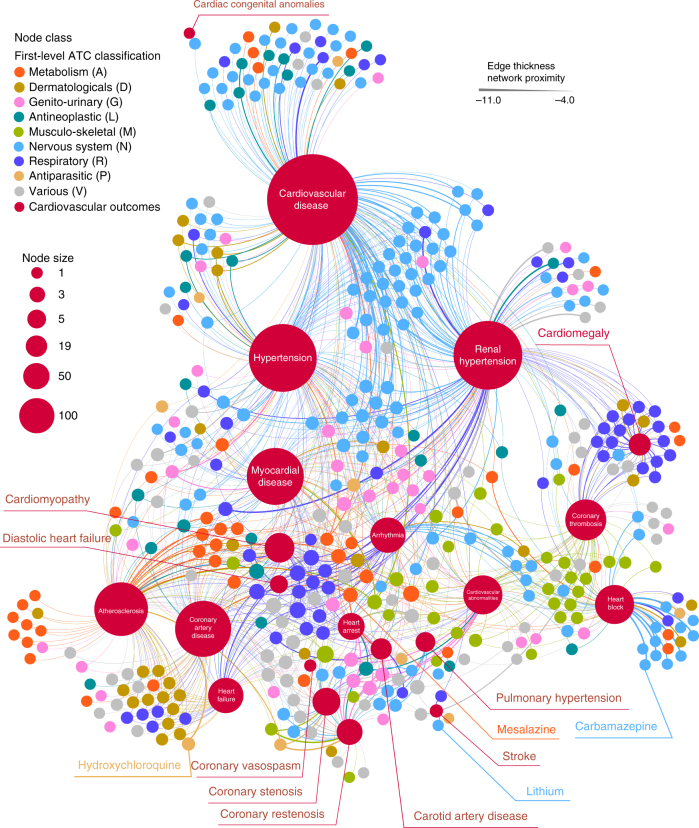
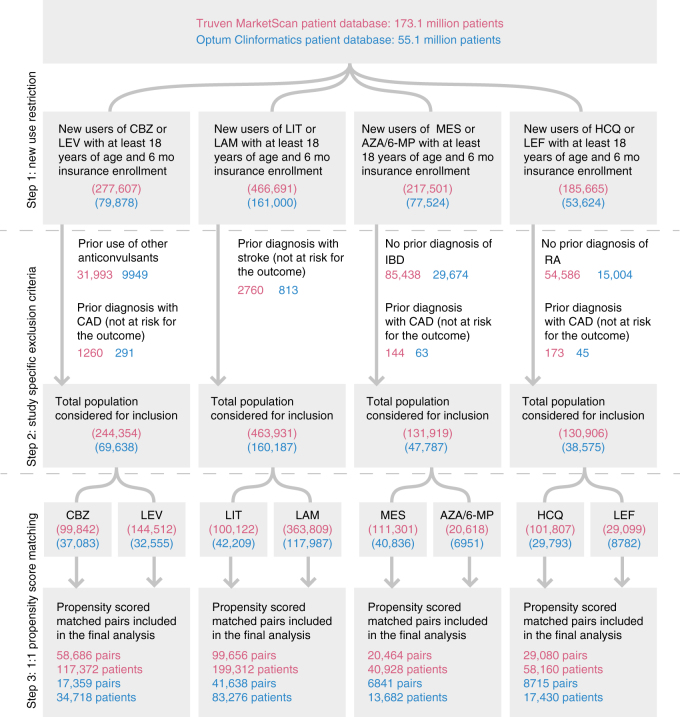
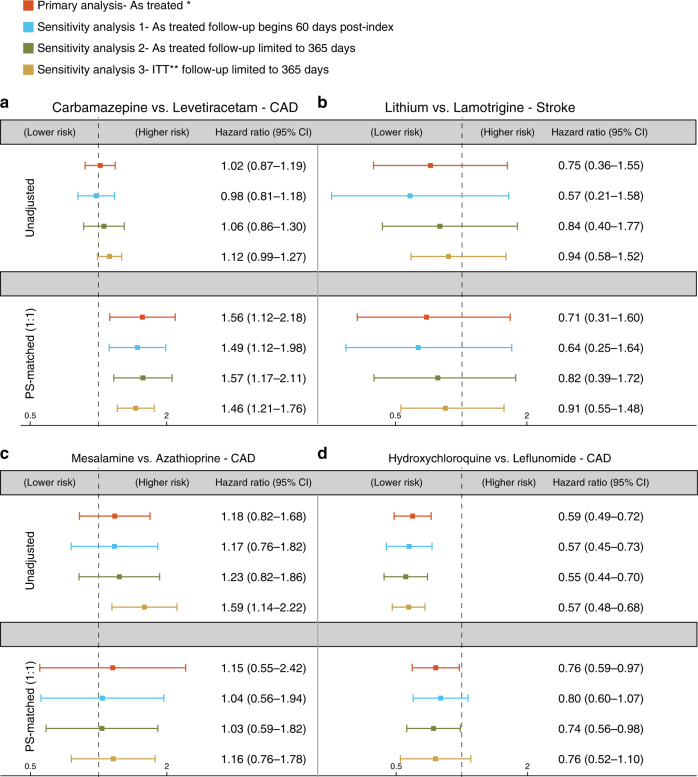
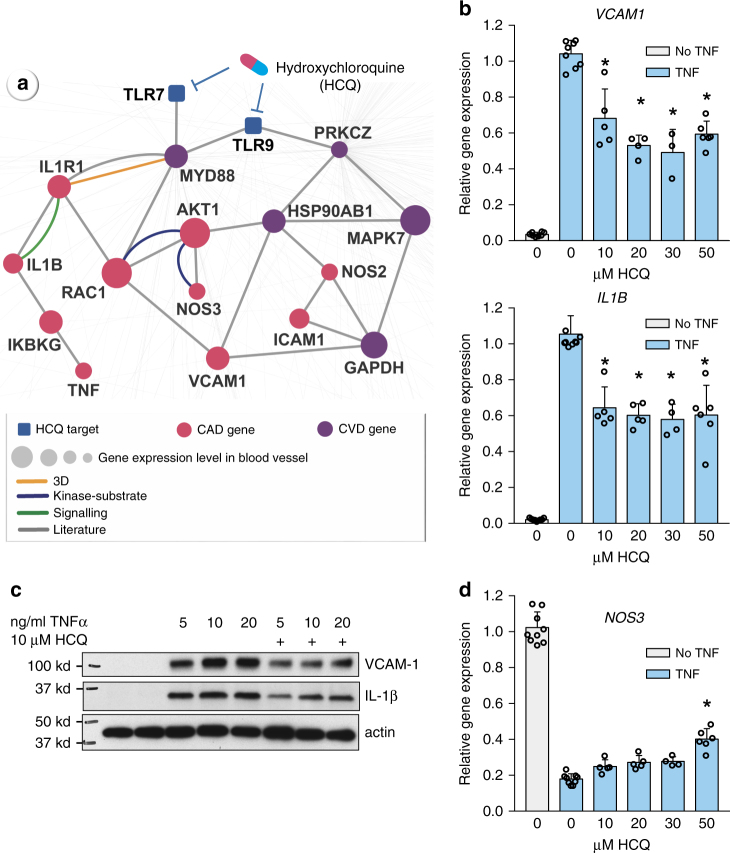
Here we identify hundreds of new drug-disease associations for over 900 FDA-approved drugs by quantifying the network proximity of disease genes and drug targets in the human (protein–protein) interactome. We select four network-predicted associations to test their causal relationship using large healthcare databases with over 220 million patients and state-of-the-art pharmacoepidemiologic analyses. Using propensity score matching, two of four network-based predictions are validated in patient-level data: carbamazepine is associated with an increased risk of coronary artery disease (CAD) [hazard ratio (HR) 1.56, 95% confidence interval (CI) 1.12–2.18], and hydroxychloroquine is associated with a decreased risk of CAD (HR 0.76, 95% CI 0.59–0.97). In vitro experiments show that hydroxychloroquine attenuates pro-inflammatory cytokine-mediated activation in human aortic endothelial cells, supporting mechanistically its potential beneficial effect in CAD. In summary, we demonstrate that a unique integration of protein-protein interaction network proximity and large-scale patient-level longitudinal data complemented by mechanistic in vitro studies can facilitate drug repurposing.
Overview
The claims and statistics of this paper haven’t been checked yet.
Run the check — free, no account needed. It reads the open-access text and checks the sources it cites.
Integrity signals
Registry
Cites
Statistics
Figures
Verification
Claims the paper makes
The claims and statistics of this paper haven’t been checked yet.
Run the check — free, no account needed. It reads the open-access text and checks the sources it cites.
Claims other papers make about this one
Each is checked against this paper’s own text: does it say what the citing paper says it does?
In the citing paper
“Because gene expression data can be noisy and variational, recent advances include fusing the co-expression matrices with existing biomedical networks, such as GO annotations and PPI, and feeding the resulting graph into graph convolution layers (Section 2.2) [150, 151, 152].”
From Graph representation learning in biomedicine and healthcare (2022) · cites this paper as [152]
In the citing paper
“Doing so has enabled more interpretable disease classification models (e.g., weighting gene interactions based on existing biological knowledge).”
From Graph representation learning in biomedicine and healthcare (2022) · cites this paper as [152]
Self-check
Percentages, sums and reported differences re-computed from the paper’s own numbers.
The self-check needs the paper’s full text.
Citations
Cites
Meta-analysis in clinical trials
DerSimonian, R., & Laird, N. (1986) · Controlled Clinical Trials · doi:10.1016/0197-2456(86)90046-2 · Cited by 39,552
The central role of the propensity score in observational studies for causal effects
ROSENBAUM, P. R., & RUBIN, D. B. (1983) · Biometrika · doi:10.1093/biomet/70.1.41 · Cited by 31,241
Database resources of the National Center for Biotechnology Information: update
Wheeler, D. L. (2003) · Nucleic Acids Research · doi:10.1093/nar/gkh073 · Cited by 10,695
Inflammation, Atherosclerosis, and Coronary Artery Disease
Hansson, G. K. (2005) · New England Journal of Medicine · doi:10.1056/nejmra043430 · Cited by 8,773
UniProt: the Universal Protein knowledgebase
Apweiler, R. (2003) · Nucleic Acids Research · doi:10.1093/nar/gkh131 · Cited by 7,593
ChEMBL: a large-scale bioactivity database for drug discovery
Gaulton, A., Bellis, L. J., Bento, A. P., Chambers, J., Davies, M., Hersey, A., Light, Y., McGlinchey, S., Michalovich, D., Al-Lazikani, B., et al. (2012) · Nucleic Acids Research · doi:10.1093/nar/gkr777 · Cited by 4,382
The unified medical language system (UMLS): integrating biomedical terminology
Bodenreider, O. (2004) · Nucleic Acids Research · doi:10.1093/nar/gkh061 · Cited by 4,356
ClinVar: public archive of relationships among sequence variation and human phenotype
Landrum, M. J., Lee, J. M., Riley, G. R., Jang, W., Rubinstein, W. S., Church, D. M., & Maglott, D. R. (2014) · Nucleic Acids Research · doi:10.1093/nar/gkt1113 · Cited by 3,516
PhosphoSitePlus, 2014: mutations, PTMs and recalibrations
Hornbeck, P. V., Zhang, B., Murray, B., Kornhauser, J. M., Latham, V., & Skrzypek, E. (2015) · Nucleic Acids Research · doi:10.1093/nar/gku1267 · Cited by 3,411
Goh, K.-I., Cusick, M. E., Valle, D., Childs, B., Vidal, M., & Barabási, A.-L. (2007) · Proceedings of the National Academy of Sciences · doi:10.1073/pnas.0701361104 · Cited by 3,242
Research works printed but not linked: 1
- Muller-Calleja, N., Manukyan, D., Canisius, A., Strand, D. & Lackner, K. J. Hydroxychloroquine inhibits proinflammatory signalling pathways by targeting endosomal NADPH oxidase. Ann. Rheum. Dis. 76, 891–897 (2016). · DOI
Cited by
Sorted by citations
Items 101–200 of 573
Accumulation of α-synuclein mediates podocyte injury in Fabry nephropathy
Braun, F., Abed, A., Sellung, D., Rogg, M., Woidy, M., Eikrem, Ø., Wanner, N., Gambardella, J., Laufer, S. D., Haas, F., et al. (2023) · Journal of Clinical Investigation · doi:10.1172/jci157782 · Cited by 50
“Written informed consent was obtained from each subject. ease module that connects the detected up-and downregulated proteins associated with GLA knockout, we used a large data set of known protein interactions recently compiled by Cheng and colleagues (85).”
MethodPrecision Approaches to Chronic Obstructive Pulmonary Disease Management
Moll, M. R., & Silverman, E. K. (2023) · Annual Review of Medicine · doi:10.1146/annurev-med-060622-101239 · Cited by 48
Wang, X., Xin, B., Tan, W., Xu, Z., Li, K., Li, F., Zhong, W., & Peng, S. (2021) · Briefings in Bioinformatics · doi:10.1093/bib/bbab226 · Cited by 44
“Fortunately, with the rapid development of systems biology and network pharmacology, the drug research paradigm has been changed from the linear mode ‘one drug, one target, one disease’ to the network mode ‘multi-drugs, multi-targets, multi diseases’ [10].”
BackgroundArtificial intelligence for COVID-19: battling the pandemic with computational intelligence
Xu, Z., Su, C., Xiao, Y., & Wang, F. (2021) · Intelligent Medicine · doi:10.1016/j.imed.2021.09.001 · Cited by 48
“This method provides a great chance for identifying drugs quickly [41] .”
Wei, X., Hou, W., Liang, J., Fang, P., Dou, B., Wang, Z., Sai, J., Xu, T., Ma, C., Zhang, Q., et al. (2021) · Frontiers in Pharmacology · doi:10.3389/fphar.2021.693701 · Cited by 44
“Therefore, to evaluate the relationship between SNS targets and NAFLD targets, we used a well-performed network-based drug-disease proximity algorithm on the human interactome, which had an area under the receiver operating characteristic curve (AUC) of over 70% in a previous study (Cheng et al., 2018).”
MethodSelf-citationPaci, P., Fiscon, G., Conte, F., Wang, R., Handy, D. E., Farina, L., & Loscalzo, J. (2022) · npj Systems Biology and Applications · doi:10.1038/s41540-022-00221-0 · Cited by 49
“The human protein – protein interactome was down-loaded from 21 , where the authors assembled their in-house systematic human protein – protein interactome with 15 commonly used databases supported by several types of experimental evidence (e.g., binary PPIs from three-dimensional protein…”
BackgroundMethodSelf-citationOld drugs, new uses: Drug repurposing in hematological malignancies
Kale, V. P., Habib, H., Chitren, R. J., Patel, M., Pramanik, K. C., Jonnalagadda, S. C., Challagundla, K. B., & Pandey, M. K. (2020) · Seminars in Cancer Biology · doi:10.1016/j.semcancer.2020.03.005 · Cited by 45
Evaluating the performance of drug-repurposing technologies
Schuler, J., Falls, Z., Mangione, W., Hudson, M. L., Bruggemann, L., & Samudrala, R. (2021) · Drug Discovery Today · doi:10.1016/j.drudis.2021.08.002 · Cited by 43
“19,21,60,126 In the future, some of these technologies might approach or even rival the current best method for elucidating the usefulness of a drug, which for now remains double-blinded, placebo-controlled, randomized trials with clinically relevant primary endpoints (prolonged life or improved…”
BackgroundChallenges in phytotherapy research
Panossian, A. (2023) · Frontiers in Pharmacology · doi:10.3389/fphar.2023.1199516 · Cited by 62
“, 2021c) and validated at least in vivo experiments on rodents followed by clinical studies in humans (Cheng et al., 2018; Wang et al., 2021).”
BackgroundMachine learning for drug repositioning: Recent advances and challenges
Cai, L., Chu, J., Xu, J., Meng, Y., Lu, C., Tang, X., Wang, G., Tian, G., & Yang, J. (2023) · Current Research in Chemical Biology · doi:10.1016/j.crchbi.2023.100042 · Cited by 43
Network medicine in Cardiovascular Research
Lee, L. Y.-H., Pandey, A. K., Maron, B. A., & Loscalzo, J. (2020) · Cardiovascular Research · doi:10.1093/cvr/cvaa321 · Cited by 42
“(iii) patient prognosis, (iv) biomarker discovery, and (v) drug discovery and repurposing.(5,6) We also review the rising concept of reticulotypes”
BackgroundInfluentialSelf-citationChen, Y.-W., Diamante, G., Ding, J., Nghiem, T. X., Yang, J., Ha, S. M., Cohn, P., Arneson, D. V., Blencowe, M., García, J., et al. (2022) · iScience · doi:10.1016/j.isci.2022.104052 · Cited by 43
“This concept has prompted drug repositioning studies to repurpose approved drugs for new disease indications (Baraba´si et al., 2011; Corbett et al., 2012; Hall et al., 2014; Guney et al., 2016; Subramanian et al., 2017; Cheng et al., 2018).”
BackgroundMethodInfluentialGao, K., Song, Y., & Song, A. (2020) · BioData Mining · doi:10.1186/s13040-020-00229-4 · Cited by 40
Yang, J., Li, Z., Wu, W. K. K., Shi, Y., Xu, Z., Chu, Q., & Zhang, Q. (2022) · Briefings in Bioinformatics · doi:10.1093/bib/bbac469 · Cited by 41
Maiorino, E., Baek, S. H., Guo, F., Zhou, X., Kothari, P. H., Silverman, E. K., Barabási, A.-Ĺ., Weiss, S. T., Raby, B. A., & Sharma, A. (2020) · Nature Communications · doi:10.1038/s41467-020-14600-w · Cited by 41
Genomic signatures of the unjamming transition in compressed human bronchial epithelial cells
Marzio, M. D., Kılıç, A., Maiorino, E., Mitchel, J. A., Mwase, C., O’Sullivan, M. J., McGill, M., Chase, R., Fredberg, J. J., Park, J., et al. (2021) · Science Advances · doi:10.1126/sciadv.abf1088 · Cited by 41
Liu, J., Hu, F., Zou, Q., Tiwari, P., Wu, H., & Ding, Y. (2024) · Information Fusion · doi:10.1016/j.inffus.2024.102563 · Cited by 37
Network Pharmacology of Adaptogens in the Assessment of Their Pleiotropic Therapeutic Activity
Panossian, A., & Efferth, T. (2022) · Pharmaceuticals · doi:10.3390/ph15091051 · Cited by 49
“Novel network-based methods of studying drug–target interactions and their disease–gene relationships represent attractive tools to systematically screen the human protein–protein interactome to reposition already approved drugs [66,67].”
Network approaches for modeling the effect of drugs and diseases
Rintala, T., Ghosh, A., & Fortino, V. (2022) · Briefings in Bioinformatics · doi:10.1093/bib/bbac229 · Cited by 39
Ren, A., Wu, T., Wang, Y., Fan, Q., Yang, Z., Zhang, S., Cao, Y., & Cui, G. (2023) · Chinese Medicine · doi:10.1186/s13020-023-00814-9 · Cited by 36
“Network-based framework methodology, measuring the relative proximity between the disease-associated genes and drug targets in the human PPI network, has been successfully used to analyze the relationship between diseases and drugs [20, 30].”
MethodJin, S., Zeng, X., Fang, J., Lin, J., Chan, S. Y., ERZURUM, S. C., & Cheng, F. (2019) · npj Systems Biology and Applications · doi:10.1038/s41540-019-0115-2 · Cited by 35
Self-citationCardiac risk stratification in cancer patients: A longitudinal patient–patient network analysis
Hou, Y., Zhou, Y., Hussain, M., Budd, G. T., Tang, W. H. W., Abraham, J., Xu, B., Shah, C., Moudgil, R., Popović, Z., et al. (2021) · PLoS Medicine · doi:10.1371/journal.pmed.1003736 · Cited by 38
Self-citationComputational repurposing of therapeutic small molecules from cancer to pulmonary hypertension
Negi, V., Yang, J., Speyer, G., Pulgarin, A., Handen, A. L., Zhao, J., Tai, Y., Tang, Y., Culley, M. K., Yu, Q., et al. (2021) · Science Advances · doi:10.1126/sciadv.abh3794 · Cited by 35
“Extension of advancing deep learning methods using scientific literature with computational linguistics and graph theory (44), epidemiologic data (45), and advanced network theory (46) with EDDY-CTRP-PH would be attractive.”
MethodRelation-aware Heterogeneous Graph Transformer based drug repurposing
Mei, X., Cai, X., Yang, L., & Wang, N. (2021) · Expert Systems with Applications · doi:10.1016/j.eswa.2021.116165 · Cited by 35
Zhang, L., Fan, S., Vera, J., & Lai, X. (2022) · Computational and Structural Biotechnology Journal · doi:10.1016/j.csbj.2022.11.037 · Cited by 37
“Over the last 15 years, researchers have made great efforts to develop drug repurposing methods, from early statistics-based chemoinformatics approaches [84] to recent ones using artificial intelligence [85,86,87] and network-based methods [88,89].”
BackgroundEmerging strategies on in silico drug development against COVID-19: challenges and opportunities
Yadav, M., Dhagat, S., & Eswari, S. (2020) · European Journal of Pharmaceutical Sciences · doi:10.1016/j.ejps.2020.105522 · Cited by 34
A global network for network medicine
Maron, B. A., Altucci, L., Balligand, J., Baumbach, J., Ferdinandy, P., Filetti, S., Parini, P., Petrillo, E., Silverman, E. K., Barabási, A.-Ĺ., et al. (2020) · npj Systems Biology and Applications · doi:10.1038/s41540-020-00143-9 · Cited by 34
Self-citationCTpathway: a CrossTalk-based pathway enrichment analysis method for cancer research
Liu, H., Yuan, M., Mitra, R., Zhou, X., Min, L., Lei, W., Zhou, S., Huang, Y. L., Hou, F., Eischen, C. M., et al. (2022) · Genome Medicine · doi:10.1186/s13073-022-01119-6 · Cited by 35
“PPI data We obtained PPIs from 12 sources (Additional file 1: Table S1) collected by previous researchers [34, 35].”
MethodNetwork-Based Methods and Their Applications in Drug Discovery
Yu, Z., Wu, Z., Wang, Z., Wang, Y., Zhou, M., Li, W., Liu, G., & Tang, Y. (2023) · Journal of Chemical Information and Modeling · doi:10.1021/acs.jcim.3c01613 · Cited by 37
Brown, J. S. (2022) · Neuroscience & Biobehavioral Reviews · doi:10.1016/j.neubiorev.2022.104809 · Cited by 34
Computational design of PD-L1 small molecule inhibitors for cancer therapy
Chandrasekaran, J., Elumalai, S., Murugesan, V., Kunjiappan, S., Pavadai, P., & Theivendren, P. (2022) · Molecular Diversity · doi:10.1007/s11030-022-10516-3 · Cited by 33
“Previously, the benefits, approaches, and successful implementations of network-based drug repurposing were discussed [29–32].”
BackgroundDecoding the Foodome: Molecular Networks Connecting Diet and Health
Menichetti, G., Barabási, A.-L., & Loscalzo, J. (2024) · Annual Review of Nutrition · doi:10.1146/annurev-nutr-062322-030557 · Cited by 32
“The resulting set of network methodologies developed since 2015 can help identify functional pathways tied to specific phenotypes and diseases (131),pinpoint potential drug targets,highlight drug repurposing opportunities (30, 117), and identify effective drug combinations (31, 56).”
BackgroundSelf-citationAccurate and transferable drug–target interaction prediction with DrugLAMP
Luo, Z., Wu, W., Sun, Q., & Wang, J. (2024) · Bioinformatics · doi:10.1093/bioinformatics/btae693 · Cited by 34
Comprehensive Real-World Assessment of Marketed Medications to Guide Parkinson’s Drug Discovery
Cepeda, M. S., Kern, D. M., Seabrook, G. R., & Lovestone, S. (2019) · Clinical Drug Investigation · doi:10.1007/s40261-019-00830-4 · Cited by 32
The application of ‘omics’ to pulmonary arterial hypertension
Harbaum, L., Rhodes, C. J., Otero‐Núñez, P., Wharton, J., & Wilkins, M. R. (2020) · British Journal of Pharmacology · doi:10.1111/bph.15056 · Cited by 34
Giménez, N., Tripathi, R., Giró, A., Rosich, L., López‐Guerra, M., López‐Oreja, I., Playà-Albinyana, H., Arenas, F., Mas, J. M., Pérez‐Galán, P., et al. (2020) · Scientific Reports · doi:10.1038/s41598-020-78315-0 · Cited by 31
Jung, S. M., Park, K., & Kim, K. (2021) · Annals of the Rheumatic Diseases · doi:10.1136/annrheumdis-2021-220493 · Cited by 31
Integrated Network Pharmacology Approach for Drug Combination Discovery: A Multi-Cancer Case Study
Federico, A., Fratello, M., Scala, G., Möbus, L., Pavel, A., del Giudice, G., Ceccarelli, M., Costa, V., Ciccodicola, A., Fortino, V., et al. (2022) · Cancers · doi:10.3390/cancers14082043 · Cited by 33
“In the context of mechanistic drug repositioning, network pharmacology approaches have shown to be a precious instrument that accelerates the discovery of novel associations between drugs and diseases [4].”
BackgroundPepe, J., Rossi, M., Battafarano, G., Vernocchi, P., Conte, F., Marzano, V., Mariani, E., Mortera, S. L., Cipriani, C., Rana, I., et al. (2020) · Journal of Bone and Mineral Research · doi:10.1002/jbmr.4688 · Cited by 32
“Finally, proteins belonging to the brown module, identified in the WGCNA, were mapped on the human interactome [protein– protein interaction (PPI) network]((19)) in order to identify the molecular interconnections (Fig.”
Effect of nitric oxide reduction on arterial thrombosis
Costa, D., Benincasa, G., Lucchese, R., Infante, T., Nicoletti, G. F., & Claudio Napoli, A. (2019) · Scandinavian Cardiovascular Journal · doi:10.1080/14017431.2019.1581943 · Cited by 31
“In the era of network medicine, the analysis of topological properties of protein-protein interactions (PPIs), regulatory, as well as co-expression networks guide research from cellular-molecular level of protein-protein interactions to correlational studies of gene expression in biological samples [16,17,73,74].”
BackgroundInfluentialExploratory Data Mining for Subgroup Cohort Discoveries and Prioritization
Liu, D., Baskett, W. I., Beversdorf, D. Q., & Shyu, C. (2019) · IEEE Journal of Biomedical and Health Informatics · doi:10.1109/jbhi.2019.2939149 · Cited by 34
“Moreover, we plan to embed the cost and impact on intervention development, such as drug repositioning [66], in the J value calculation, to tailor meaningful cohorts of patients.”
Uncovering New Drug Properties in Target-Based Drug–Drug Similarity Networks
Udrescu, L., Bogdan, P., Chiş, A. R., Sîrbu, I. O., Topîrceanu, A., Văruţ, R.-M., & Udrescu, M. (2020) · Pharmaceutics · doi:10.3390/pharmaceutics12090879 · Cited by 30
Hou, Y., Zhou, Y., Gack, M. U., Lathia, J. D., Kallianpur, A. R., Mehra, R., Chan, T. A.-T., Jung, J. U., Jehi, L. E., Eng, C., et al. (2021) · Signal Transduction and Targeted Therapy · doi:10.1038/s41392-021-00709-x · Cited by 32
“The detailed description for building human protein–protein interactome are provided in our recent studies.(66,75)”
MethodSelf-citationPeng, J., Yang, K., Tian, H., Lin, Y., Hou, M., Gao, Y., Zhou, X., Gao, Z., & Ren, J. (2022) · Phytomedicine · doi:10.1016/j.phymed.2022.154525 · Cited by 30
Drug Repurposing for COVID-19 Treatment by Integrating Network Pharmacology and Transcriptomics
Liu, D., Liu, J., Liang, S., Meng, X., Greenbaum, J., Xiao, H., Tan, L., & Deng, H. (2021) · Pharmaceutics · doi:10.3390/pharmaceutics13040545 · Cited by 32
“Drug repurposing, as an effective and rapid drug discovery strategy from existing drugs [11,12], is considered the most practical approach as a rapid response to the emergent pandemic since the candidate treatments have already previously been tested for their safety [13].”
BackgroundDrug repurposing in silico screening platforms
Mullins, J. G. L. (2022) · Biochemical Society Transactions · doi:10.1042/bst20200967 · Cited by 29
Fang, J., Cai, C., Chai, Y.-T., Zhou, J., Huang, Y., Gao, L., Wang, Q., & Cheng, F. (2018) · European Journal of Medicinal Chemistry · doi:10.1016/j.ejmech.2018.10.020 · Cited by 29
“S3), which is comparable to a previous network proximity approach [30].”
BackgroundMethodResultInfluentialSelf-citationIn silico drug repurposing in COVID-19: A network-based analysis
Sibilio, P., Bini, S., Fiscon, G., Sponziello, M., Conte, F., Pecce, V., Durante, C., Paci, P., Falcone, R., Norata, G. D., et al. (2021) · Biomedicine & Pharmacotherapy · doi:10.1016/j.biopha.2021.111954 · Cited by 30
“The rationale behind SAveRUNNER builds on the hypothesis that for a drug to be effective against a specific disease, its associated targets (drug module) and the disease-specific associated genes (disease module) should be located nearby in the human interactome [20] (Fig.”
Zhang, P., Hou, Y., Tu, W., Campbell, N. L., Pieper, A. A., Leverenz, J. B., Gao, S., Cummings, J. L., & Cheng, F. (2022) · Alzheimer s & Dementia · doi:10.1002/alz.12819 · Cited by 31
“Figure 3C presents additional analyses of the telmisartan and/or lisinopril cohort (an active-comparator design 52 ).”
Self-citationOpportunities and challenges of graph neural networks in electrical engineering
Chien, E., Li, M., Aportela, A., Ding, K., Jia, S., Maji, S., Zhao, Z., Duarte, J. M., Fung, V., Hao, C., et al. (2024) · Nature Reviews Electrical Engineering · doi:10.1038/s44287-024-00076-z · Cited by 31
“…— GNNs have increasingly become a key instrument in network medicine, aiding in the development of predictive models and therapeutic strategies 190,191 and the prediction of drug–disease associations 55 , drug–drug and drug–target interactions 179,192 , which are problems crucial for…”
LiPLike: towards gene regulatory network predictions of high certainty
Magnusson, R., & Gustafsson, M. (2019) · Bioinformatics · doi:10.1093/bioinformatics/btz950 · Cited by 26
“Nevertheless, network analysis has emerged as a prominent tool that is used to both distinguish and interpret cellular processes [2–6].”
MethodRai, A., Kumar, V., Jerath, G., Kartha, C. S., & Ramakrishnan, V. (2021) · npj Systems Biology and Applications · doi:10.1038/s41540-021-00171-z · Cited by 26
Cheng, F., Rao, S., & Mehra, R. (2020) · Cleveland Clinic Journal of Medicine · doi:10.3949/ccjm.87a.ccc037 · Cited by 26
“36 Among patients hospitalized in metropolitan New York with COVID-19, treat-ment with hydroxychloroquine was not significantly associated with differences in in-hospital mortality.”
Self-citationApplications of Genome-Wide Screening and Systems Biology Approaches in Drug Repositioning
Mohammadi, E., Benfeitas, R., Türkez, H., Borén, J., Nielsen, J., Uhlén, M., & Mardinoğlu, A. (2020) · Cancers · doi:10.3390/cancers12092694 · Cited by 25
Network module‐based drug repositioning for pulmonary arterial hypertension
Wang, R., & Loscalzo, J. (2021) · CPT Pharmacometrics & Systems Pharmacology · doi:10.1002/psp4.12670 · Cited by 24
Self-citationStrategy for Efficient Discovery of Cocrystals via a Network-Based Recommendation Model
Zheng, L., Zhu, B., Wu, Z., Fang, X., Hong, M., Liu, G., Li, W., Ren, G., & Tang, Y. (2020) · Crystal Growth & Design · doi:10.1021/acs.cgd.0c00911 · Cited by 25
The New Paradigm of Network Medicine to Analyze Breast Cancer Phenotypes
Grimaldi, A., Conte, F., Pane, K., Fiscon, G., Mirabelli, P., Baselice, S., Giannatiempo, R., Messina, F., Franzese, M., Salvatore, M., et al. (2020) · International Journal of Molecular Sciences · doi:10.3390/ijms21186690 · Cited by 24
“The human interactome exploited for this analysis was retrieved from [43].”
MethodDebnath, P., Bhaumik, S., Sen, D., Muttineni, R., & Debnath, S. (2021) · ChemistrySelect · doi:10.1002/slct.202100854 · Cited by 24
Cancer driver drug interaction explorer
Hartung, M., Anastasi, E., Mamdouh, Z. M., Nogales, C., Schmidt, H. H. H. W., Baumbach, J., Zolotareva, O. I., & List, M. (2022) · Nucleic Acids Research · doi:10.1093/nar/gkac384 · Cited by 24
“Network-based algorithms have proven successful for drug repurposing and to detect possible off-target effects (7).”
Hsieh, K., Plascencia‐Villa, G., Lin, K., Perry, G. L., Jiang, X., & Kim, Y. (2022) · iScience · doi:10.1016/j.isci.2022.105678 · Cited by 24
“These different approaches provide complementary evidence for potential drugs.(16) Success in a single aspect, however, cannot guarantee clinical effectiveness due to AD’s heterogeneous pathogenesis.”
BackgroundWang, Y., Zhang, Z., Piao, C., Huang, Y. P., Zhang, Y., Zhang, C., Lu, Y., & Liu, D. (2023) · Health Information Science and Systems · doi:10.1007/s13755-023-00243-w · Cited by 24
Zulhafiz, N. A., Teoh, T.-C., Chin, A., & Chang, S. (2025) · Computer Methods and Programs in Biomedicine · doi:10.1016/j.cmpb.2025.108604 · Cited by 28
Huang, Y., Zhang, Y., Wan, T., Mei, Y., Wang, Z., Xue, J., Luo, Y., Li, M., Fang, S., Pan, H., et al. (2020) · Cell Biology and Toxicology · doi:10.1007/s10565-020-09563-z · Cited by 23
Wang, J., Luo, L., Ding, Q. J., Wu, Z., Peng, Y., Li, J., Wang, X., Li, W., Liu, G., Zhang, B., et al. (2021) · Frontiers in Pharmacology · doi:10.3389/fphar.2021.754175 · Cited by 24
“assembled 15 commonly used databases, focusing on high-quality protein-protein interactions (PPIs) with various types of evidence, to build an unbiased, systematic human protein-protein interactome dataset (Cheng et al., 2018; Cheng et al., 2019).”
BackgroundMethodConstruction, comparison and evolution of networks in life sciences and other disciplines
Gysi, D. M., & Nowick, K. (2020) · Journal of The Royal Society Interface · doi:10.1098/rsif.2019.0610 · Cited by 25
“Perturbations of disease modules by drugs can be analysed and related to the drug efficacy and side effects [227,228].”
BackgroundIDDkin: network-based influence deep diffusion model for enhancing prediction of kinase inhibitors
Shen, C., Luo, J., Ouyang, W., Ding, P., & Chen, X. (2020) · Bioinformatics · doi:10.1093/bioinformatics/btaa1058 · Cited by 23
Tian, S., Xu, M., Geng, X., Fang, J., Xu, H., Xue, X., Hu, H., Zhang, Q., Yu, D., Guo, M., et al. (2024) · Advanced Science · doi:10.1002/advs.202410285 · Cited by 22
Network medicine: an approach to complex kidney disease phenotypes
Pandey, A. K., & Loscalzo, J. (2023) · Nature Reviews Nephrology · doi:10.1038/s41581-023-00705-0 · Cited by 23
Self-citationRepurposing Drugs for the Treatment of COVID-19 and Its Cardiovascular Manifestations
Wang, R., & Loscalzo, J. (2023) · Circulation Research · doi:10.1161/circresaha.122.321879 · Cited by 23
Self-citationNetwork medicine for patients' stratification: From single‐layer to multi‐omics
Petti, M., & Farina, L. (2023) · WIREs Mechanisms of Disease · doi:10.1002/wsbm.1623 · Cited by 23
Ahmed, F., Samantasinghar, A., Ali, W., & Choi, K. H. (2024) · Molecular Diversity · doi:10.1007/s11030-023-10784-7 · Cited by 25
Network determinants of cardiovascular calcification and repositioned drug treatments
Song, J.-S., Wang, R., Leopold, J. A., & Loscalzo, J. (2020) · The FASEB Journal · doi:10.1096/fj.202001062r · Cited by 22
Self-citationIida, M., Iwata, M., & Yamanishi, Y. (2020) · Bioinformatics · doi:10.1093/bioinformatics/btaa439 · Cited by 22
Comprehensive assessment of side effects in COVID-19 drug pipeline from a network perspective
Wu, Q., Fan, X., Hong, H., Gu, Y., Liu, Z., Fang, S., Wang, Q., Cai, C., & Fang, J. (2020) · Food and Chemical Toxicology · doi:10.1016/j.fct.2020.111767 · Cited by 19
“In order to prioritize these drug-side effect pairs identified by network-based approaches, rigorous validation is mandatory (Cheng et al., 2018).”
Computationally prioritized drugs inhibit SARS-CoV-2 infection and syncytia formation
Serra, A., Fratello, M., Federico, A., Ojha, R., Provenzani, R., Tasnádi, E., Cattelani, L., del Giudice, G., Kinaret, P., Saarimäki, L. A., et al. (2021) · Briefings in Bioinformatics · doi:10.1093/bib/bbab507 · Cited by 21
“Recently, several drug repositioning approaches have been developed, based on the analysis of gene coexpression networks and drug–targets relationships [35, 36].”
Accelerating network layouts using graph neural networks
Both, C., Dehmamy, N., Yu, R., & Barabási, A.-Ĺ. (2023) · Nature Communications · doi:10.1038/s41467-023-37189-2 · Cited by 26
“…of network science has played a key role in the scienti fi c community ’ s ability to explore large complex systems, helping to predict and manage the COVID pandemic 1,2 , identify drug repurposing opportunities 3 , quantify traf fi c patterns in cities 4 , or understand the spread of fake news 5,6 .”
BackgroundArtificial intelligence streamlines scientific discovery of drug–target interactions
Yang, Y., & Cheng, F. (2025) · British Journal of Pharmacology · doi:10.1111/bph.17427 · Cited by 22
“…to rigorously test models and their predictions is crucial in streamlining the drug discovery process. instance, a network-based approach has been developed to explore the relationship between disease genes and drug targets within the human protein – protein interactome (Cheng et al., 2018).”
Self-citationDrug repurposing for COVID-19 using graph neural network and harmonizing multiple evidence.Preprint
Hsieh, K., Wang, Y., Chen, L., Zhao, Z., Savitz, S. I., Jiang, X., Tang, J. P., & Kim, Y. (2022) · PubMed · Cited by 21
AI-Based Computational Methods in Early Drug Discovery and Post Market Drug Assessment: A Survey
Rajaei, F., Minoccheri, C., Wittrup, E. M., Wilson, R. C., Athey, B. D., Omenn, G. S., & Najarian, K. (2024) · IEEE Transactions on Computational Biology and Bioinformatics · doi:10.1109/tcbb.2024.3492708 · Cited by 24
Alzheimer Combination Therapies: Overview and Scenarios
Cummings, J. L., Burstein, A. H., & Fillit, H. M. (2025) · The Journal of Prevention of Alzheimer s Disease · doi:10.1016/j.tjpad.2025.100328 · Cited by 22
“Known drug networks can be explored to determine their proximity to disease networks and the relative likelihood of an impact on disease processes[85].”
Genomics of drug target prioritization for complex diseases
Chen, R. K., Duffy, Á., & Do, R. (2025) · Nature Reviews Genetics · doi:10.1038/s41576-025-00904-4 · Cited by 28
“Several studies have prioritized targets with the greatest network proximity to disease-related protein modules, either known genetic associations or approved drug targets, generally using PPI networks 126,129,130 .”
InfluentialPharmacogenomics for immunotherapy and immune-related cardiotoxicity
Lal, J. C., Eng, C., & Cheng, F. (2020) · Human Molecular Genetics · doi:10.1093/hmg/ddaa137 · Cited by 21
Self-citationBuchwald, P. (2022) · Frontiers in Drug Discovery · doi:10.3389/fddsv.2022.898035 · Cited by 20
Industrializing AI-powered drug discovery: lessons learned from the Patrimony computing platform
Guedj, M., Swindle, J., Hamon, A., Hubert, S., Desvaux, E., Laplume, J., Xuereb, L., Lefèbvre, C., Haudry, Y., Gabarroca, C., et al. (2022) · Expert Opinion on Drug Discovery · doi:10.1080/17460441.2022.2095368 · Cited by 23
“Referred to as drug repurposing, drug rescuing or indication extension, this approach has generated a growing interest during the last decade, with evidence that mining available biomedical data with proper algorithms can generate fast and valid innovative hypotheses [41,66–68].”
BackgroundSchäfer, S., Smelik, M., Sysoev, O., Zhao, Y., Eklund, D., Lilja, S., Gustafsson, M., Heyn, H., Julià, A., Kovács, I. A., et al. (2024) · Genome Medicine · doi:10.1186/s13073-024-01314-7 · Cited by 20
Self-citationA network-based trans-omics approach for predicting synergistic drug combinations
Iida, M., Kuniki, Y., Yagi, K., Goda, M., Namba, S., Takeshita, J., Sawada, R., Iwata, M., Zamami, Y., Ishizawa, K., et al. (2024) · Communications Medicine · doi:10.1038/s43856-024-00571-2 · Cited by 19
“Network-based methodshavetraditionally used drug target moleculestocharacterizedrugs and construct drug modules 13,15,58,59 ; however, few drugs have known target molecules.”
Groza, V., Udrescu, M., Bozdog, A., & Udrescu, L. (2021) · Pharmaceutics · doi:10.3390/pharmaceutics13122117 · Cited by 20
Repurposing Histaminergic Drugs in Multiple Sclerosis
Amadio, S., Conte, F., Esposito, G., Fiscon, G., Paci, P., & Volonté, C. (2022) · International Journal of Molecular Sciences · doi:10.3390/ijms23116347 · Cited by 19
“, the cellular network of all physical molecular interactions), was downloaded from Cheng and co-authors [28], where the authors assembled their in-house systematic human protein–protein interactome with 15 commonly used databases of several types of experimental evidence (e.”
MethodApplications of machine learning approaches to combat COVID-19: A survey
Tiwari, S. M., Doğan, O., Jabbar, M. A., Shandilya, S. K., Ortiz, F., Bajpai, S., & Banerjee, S. (2022) · Elsevier eBooks · doi:10.1016/b978-0-323-99878-9.00014-5 · Cited by 19
“Several drugs have been repurposed as anti-HCoV, using network proximity analysis (Cheng et al., 2018) and “complementary exposure” pattern (Cheng et al., 2019) of drugs and HCoV-host interactions in the human genome.”
Wang, Y., Zou, Z., Wang, S., Ren, A., Ding, Z., Li, Y., Wang, Y., Qian, Z., Bian, B., Huang, B., et al. (2024) · Chinese Medicine · doi:10.1186/s13020-024-00912-2 · Cited by 19
“We constructed a human protein–protein interaction network based on 18 databases and the literature [20– 23].”
MethodNHLBI-CMREF Workshop Report on Pulmonary Vascular Disease Classification
Oldham, W. M., Hemnes, A. R., Aldred, M. A., Barnard, J., Brittain, E. L., Chan, S. Y., Cheng, F., Cho, M. H., Desai, A. A., Garcia, J. G. N., et al. (2021) · Journal of the American College of Cardiology · doi:10.1016/j.jacc.2021.02.056 · Cited by 21
“Many metrics may be valuable in weighing the most promising avenues for investigation including analytical tools such as network-based drug target proximity (49-53), as well as pragmatic judgements about biological plausibility, therapeutic efficacy, and patient tolerability.”
BackgroundSelf-citationMasoudi‐Sobhanzadeh, Y., & Masoudi‐Nejad, A. (2020) · BMC Bioinformatics · doi:10.1186/s12859-020-03644-w · Cited by 18
“…reported that the theory-based methods are not applicable to the most projects and to qualify, they need to meet some other criteria [25]. iii) The graph and network theory-based researches: these studies employ a graph or a network to show the communication among the biological components [26].”
BackgroundPhosphorylation of PLCγ1 by EphA2 Receptor Tyrosine Kinase Promotes Tumor Growth in Lung Cancer
Song, W., Kim, L. C., Han, W., Hou, Y., Edwards, D. N., Wang, S., Blackwell, T. S., Cheng, F., Brantley‐Sieders, D. M., & Chen, J. (2020) · Molecular Cancer Research · doi:10.1158/1541-7786.mcr-20-0075 · Cited by 18
Self-citationRöhl, A., Baek, S. H., Kachroo, P., Morrow, J. D., Tantisira, K. G., Silverman, E. K., Weiss, S. T., Sharma, A., Glass, K., & DeMeo, D. L. (2022) · Respiratory Research · doi:10.1186/s12931-022-01963-5 · Cited by 19
“To study the topological robustness of the modules, we evaluated whether highlighted module genes form significantly connected components in five different PPIs (BioGRID [43], STRING [44], Hint [45], PPI2016 [46], and BioPlex [47]).”
BackgroundA compact review of progress and prospects of deep learning in drug discovery
Li, H., Zou, L., Kowah, J. A. H., He, D., Liu, Z., Ding, X., Wen, H., Wang, L., Yuan, M., & Liu, X. (2023) · Journal of Molecular Modeling · doi:10.1007/s00894-023-05492-w · Cited by 19
“[97] identified novel drug-disease associations by constructing a neighborhood network of human disease genes and drug targets, which were validated in vitro experiments.”
BackgroundVitte, J., Michel, M., Mezouar, S., Diallo, A. B., Boumaza, A. F., Mège, J., & Desnues, B. (2020) · Frontiers in Immunology · doi:10.3389/fimmu.2020.02159 · Cited by 18
“Healthcare registry data for 220 million individuals showed that HCQ intake was associated with a lower risk for coronary artery disease (64).”
BackgroundMasoudi‐Sobhanzadeh, Y., Salemi, A., Pourseif, M. M., Jafari, B., Omidi, Y., & Masoudi‐Nejad, A. (2021) · Briefings in Bioinformatics · doi:10.1093/bib/bbab113 · Cited by 18
“generated network were specified, some potential inhibitor drugs were introduced [22].”
BackgroundIdentifying miRNAs in multiple sclerosis gray matter lesions that correlate with atrophy measures
Tripathi, A. K., Pandit, I., Perles, A., Zhou, Y., Cheng, F., & Dutta, R. (2021) · Annals of Clinical and Translational Neurology · doi:10.1002/acn3.51365 · Cited by 18
Self-citationDesvaux, E., Hamon, A., Hubert, S., Boudjeniba, C., Chassagnol, B., Swindle, J., Aussy, A., Laigle, L., Laplume, J., Soret, P., et al. (2021) · PLoS ONE · doi:10.1371/journal.pone.0254374 · Cited by 18
“therapeutic targets was established and used to computationally assess a topological proximity with drug targets within the comprehensive human protein-protein interactome [21, 22].”
MethodDrug repurposing candidates to treat core symptoms in autism spectrum disorder
Koch, E. M., & Demontis, D. (2022) · Frontiers in Pharmacology · doi:10.3389/fphar.2022.995439 · Cited by 16
“Therefore, network-based drugdisease proximity within networks of PPIs can unravel the relationship between drugs and diseases, and serves as a useful tool to identify new indications for approved drugs with known safety profiles (Cheng et al., 2018).”
Background
Metadata
- Authors
- Cheng, F., Desai, R. J., Handy, D. E., Wang, R., Schneeweiss, S., Barabási, A.-L., & Loscalzo, J.
- Affiliations
- Northeastern University (US)
- Brigham and Women's Hospital (US)
- Corresponding author
- Loscalzo, Joseph
- Venue
- Nature Communications
- Published
- 2018-07-12
- Volume
- 9
- Issue
- 1
- Pages
- 2691-2691
- ISSN
- 2041-1723 (ISSN-L)
- PMC
- PMC6043492
- OpenAlex
- W2826750344
- Cited by
- 552
- References
- 90
- Citations by year
- 2026: 47 · 2025: 66 · 2024: 60 · 2023: 58 · 2022: 88 · 2021: 97 · 2020: 86 · 2019: 43 · 2018: 5
- FWCI
- 43.38
- Type
- journal article
- Language
- en
- Open access
- gold
- doi.org
- Locations
- Nature Communications (publishedVersion, cc-by)
- Europe PMC (PubMed Central) (publishedVersion, other-oa)
- PubMed Central (publishedVersion, cc-by)
- PubMed (publishedVersion)
- RePEc: Research Papers in Economics (submittedVersion)
- DOAJ (DOAJ: Directory of Open Access Journals) (submittedVersion, cc-by-sa)
- DOAJ (DOAJ: Directory of Open Access Journals) (submittedVersion)
- Open Research (Auckland University of Technology) (submittedVersion, cc-by)
- Funders
- U.S. Department of Health & Human Services | National Institutes of Health (HL106373, HG007690, GM 107618, HL016795, HL108630)
- Patient-Centered Outcomes Research Institute (ME-1303-5638)
- Topics
- Life Sciences › Pharmacology, Toxicology and Pharmaceutics › Drug Discovery › Computational Drug Discovery Methods
- Life Sciences › Biochemistry, Genetics and Molecular Biology › Molecular Biology › Bioinformatics and Genomic Networks
- Life Sciences › Biochemistry, Genetics and Molecular Biology › Genetics › Genetic Associations and Epidemiology
- Keywords
- drug repurposing, protein-protein interaction network, network proximity, drug-disease associations, coronary artery disease, carbamazepine, hydroxychloroquine, pharmacoepidemiology, propensity score matching, endothelial inflammation, inflammatory cytokines, FDA-approved drugs
- MeSH terms
- Carbamazepine, Computer Simulation, Coronary Artery Disease, Humans, Hydroxychloroquine, Prognosis, Risk Factors, Reproducibility of Results, Proportional Hazards Models, Databases, Factual, Risk Assessment, Propensity Score, Drug Repositioning, Protein Interaction Maps
About these checks
Registry, retraction, Cites and statistics results are computed, not judged, with one exception: a printed reference that no index lists is read once by a model before it counts as a citation error. Claims are extracted by a model and kept only when their quote appears verbatim in the text; each cited source is then checked, with a model’s help, for whether it says what the claim relies on. Those verdicts can be wrong — read the claim’s quote and the cited source before relying on one.
Statistics and arithmetic are recomputed, not judged.
Confidence bands are shown only for fields calibrated on our annotated test set. None is calibrated yet, so no band is shown.
What counts as a claim ›How we measure confidence ›How we check this ›
Are you an author, or do you see a problem with this page? Request a review
