

The DOI matches its Crossref record; 90 of the 90 references it cites were found in a registry or an index.
Network-based approach to prediction and population-based validation of in silico drug repurposing
Open accessAbstract
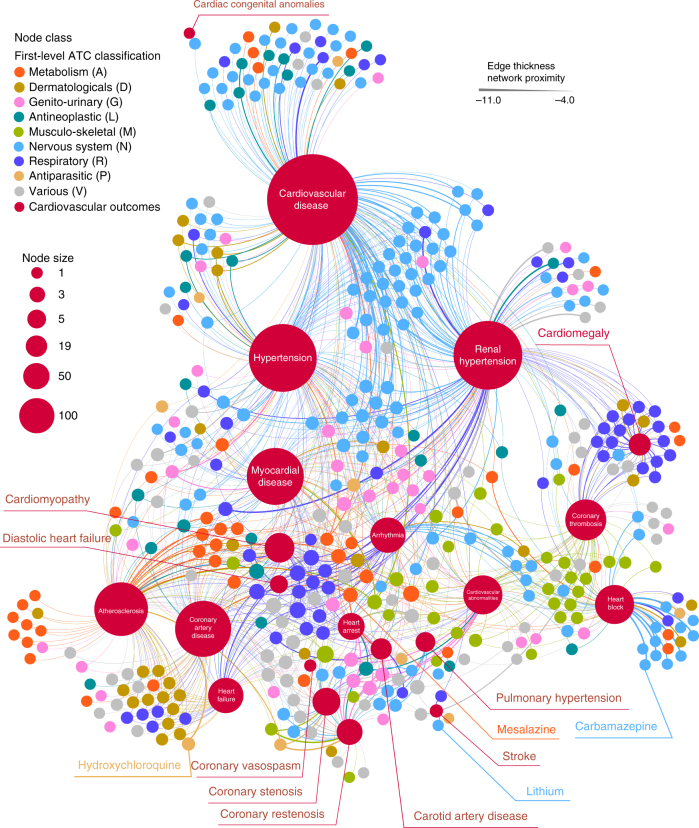
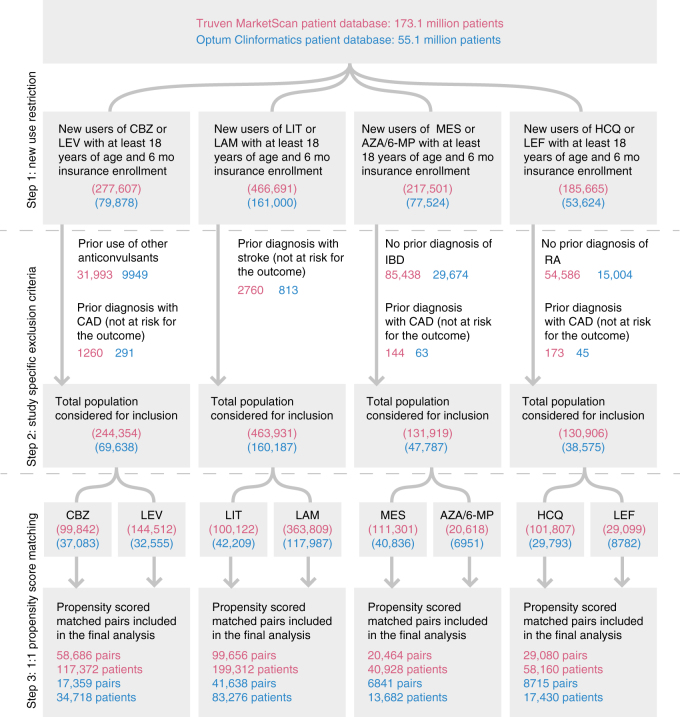
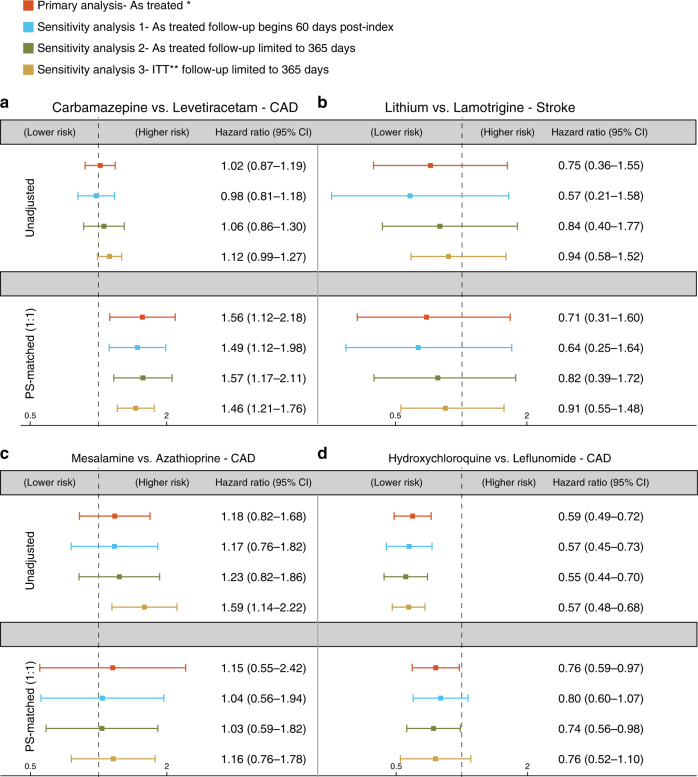
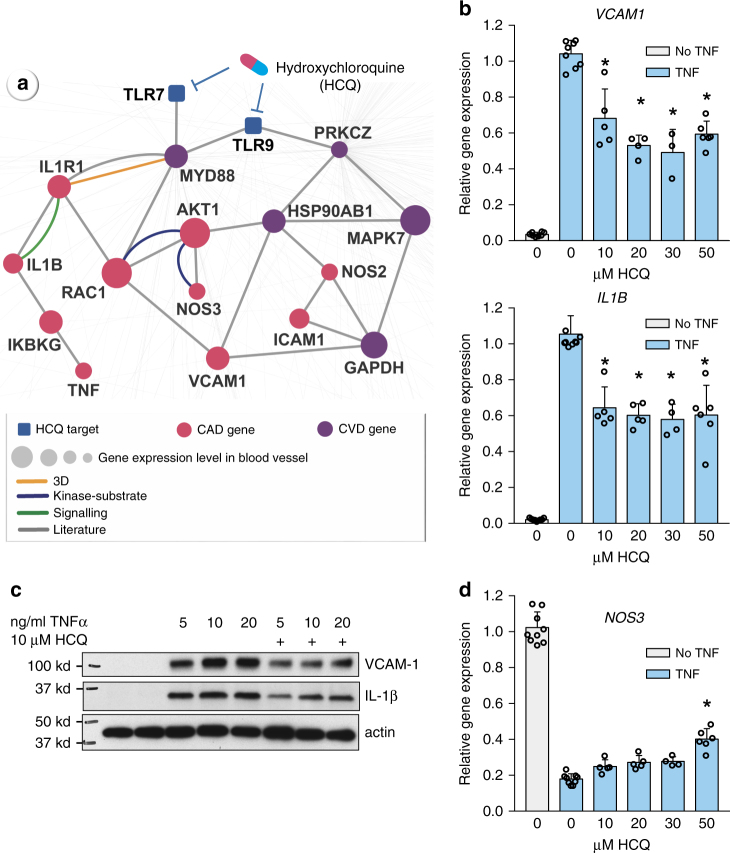
Here we identify hundreds of new drug-disease associations for over 900 FDA-approved drugs by quantifying the network proximity of disease genes and drug targets in the human (protein–protein) interactome. We select four network-predicted associations to test their causal relationship using large healthcare databases with over 220 million patients and state-of-the-art pharmacoepidemiologic analyses. Using propensity score matching, two of four network-based predictions are validated in patient-level data: carbamazepine is associated with an increased risk of coronary artery disease (CAD) [hazard ratio (HR) 1.56, 95% confidence interval (CI) 1.12–2.18], and hydroxychloroquine is associated with a decreased risk of CAD (HR 0.76, 95% CI 0.59–0.97). In vitro experiments show that hydroxychloroquine attenuates pro-inflammatory cytokine-mediated activation in human aortic endothelial cells, supporting mechanistically its potential beneficial effect in CAD. In summary, we demonstrate that a unique integration of protein-protein interaction network proximity and large-scale patient-level longitudinal data complemented by mechanistic in vitro studies can facilitate drug repurposing.
Overview
The claims and statistics of this paper haven’t been checked yet.
Run the check — free, no account needed. It reads the open-access text and checks the sources it cites.
Integrity signals
Registry
Cites
Statistics
Figures
Verification
Claims the paper makes
The claims and statistics of this paper haven’t been checked yet.
Run the check — free, no account needed. It reads the open-access text and checks the sources it cites.
Claims other papers make about this one
Each is checked against this paper’s own text: does it say what the citing paper says it does?
In the citing paper
“Because gene expression data can be noisy and variational, recent advances include fusing the co-expression matrices with existing biomedical networks, such as GO annotations and PPI, and feeding the resulting graph into graph convolution layers (Section 2.2) [150, 151, 152].”
From Graph representation learning in biomedicine and healthcare (2022) · cites this paper as [152]
In the citing paper
“Doing so has enabled more interpretable disease classification models (e.g., weighting gene interactions based on existing biological knowledge).”
From Graph representation learning in biomedicine and healthcare (2022) · cites this paper as [152]
Self-check
Percentages, sums and reported differences re-computed from the paper’s own numbers.
The self-check needs the paper’s full text.
Citations
Cites
Meta-analysis in clinical trials
DerSimonian, R., & Laird, N. (1986) · Controlled Clinical Trials · doi:10.1016/0197-2456(86)90046-2 · Cited by 39,552
The central role of the propensity score in observational studies for causal effects
ROSENBAUM, P. R., & RUBIN, D. B. (1983) · Biometrika · doi:10.1093/biomet/70.1.41 · Cited by 31,241
Database resources of the National Center for Biotechnology Information: update
Wheeler, D. L. (2003) · Nucleic Acids Research · doi:10.1093/nar/gkh073 · Cited by 10,695
Inflammation, Atherosclerosis, and Coronary Artery Disease
Hansson, G. K. (2005) · New England Journal of Medicine · doi:10.1056/nejmra043430 · Cited by 8,773
UniProt: the Universal Protein knowledgebase
Apweiler, R. (2003) · Nucleic Acids Research · doi:10.1093/nar/gkh131 · Cited by 7,593
ChEMBL: a large-scale bioactivity database for drug discovery
Gaulton, A., Bellis, L. J., Bento, A. P., Chambers, J., Davies, M., Hersey, A., Light, Y., McGlinchey, S., Michalovich, D., Al-Lazikani, B., et al. (2012) · Nucleic Acids Research · doi:10.1093/nar/gkr777 · Cited by 4,382
The unified medical language system (UMLS): integrating biomedical terminology
Bodenreider, O. (2004) · Nucleic Acids Research · doi:10.1093/nar/gkh061 · Cited by 4,356
ClinVar: public archive of relationships among sequence variation and human phenotype
Landrum, M. J., Lee, J. M., Riley, G. R., Jang, W., Rubinstein, W. S., Church, D. M., & Maglott, D. R. (2014) · Nucleic Acids Research · doi:10.1093/nar/gkt1113 · Cited by 3,516
PhosphoSitePlus, 2014: mutations, PTMs and recalibrations
Hornbeck, P. V., Zhang, B., Murray, B., Kornhauser, J. M., Latham, V., & Skrzypek, E. (2015) · Nucleic Acids Research · doi:10.1093/nar/gku1267 · Cited by 3,411
Goh, K.-I., Cusick, M. E., Valle, D., Childs, B., Vidal, M., & Barabási, A.-L. (2007) · Proceedings of the National Academy of Sciences · doi:10.1073/pnas.0701361104 · Cited by 3,242
Research works printed but not linked: 1
- Muller-Calleja, N., Manukyan, D., Canisius, A., Strand, D. & Lackner, K. J. Hydroxychloroquine inhibits proinflammatory signalling pathways by targeting endosomal NADPH oxidase. Ann. Rheum. Dis. 76, 891–897 (2016). · DOI
Cited by
Sorted by citations
Items 301–400 of 573
de Anda‐Jáuregui, G., McGregor, B. A., Guo, K., & Hur, J. (2019) · CPT Pharmacometrics & Systems Pharmacology · doi:10.1002/psp4.12383 · Cited by 7
Zang, C., Zhang, H., Xu, J., Zhang, H., Fouladvand, S., Havaldar, S., Cheng, F., Chen, K., Chen, Y., Glicksberg, B. S., et al. (2022) · medRxiv · doi:10.1101/2022.01.31.22270132 · Cited by 7
Self-citationTrejo-Castro, A. I., Martínez-Ledesma, E., & Martínez‐Torteya, A. (2025) · Heliyon · doi:10.1016/j.heliyon.2025.e42750 · Cited by 6
Wu, J., Lai, J., Zhao, X., Wang, Z., Zhang, Y., Wang, L., Su, Y., He, Y., Li, S., Jiang, Y. H., et al. (2025) · Advanced Science · doi:10.1002/advs.202416958 · Cited by 6
Wang, Y., Yao, J., Sui, Y., Jiang, H., Ma, B., Lai, S., Xu, X., Gao, Z., & Tan, N. (2026) · Targetome · doi:10.48130/targetome-0026-0013 · Cited by 6
Network Science and Machine Learning for Precision Nutrition
Sebek, M., & Menichetti, G. (2023) · Elsevier eBooks · doi:10.1016/b978-0-443-15315-0.00012-2 · Cited by 6
Pulmonary hypertension: Proteins in the blood
Wilkins, M. R. (2020) · Global Cardiology Science and Practice · doi:10.21542/gcsp.2020.7 · Cited by 6
A Network-Based Analysis of Disease Modules From a Taxonomic Perspective
Grani, G., Madeddu, L., & Velardi, P. (2021) · IEEE Journal of Biomedical and Health Informatics · doi:10.1109/jbhi.2021.3106787 · Cited by 6
Khurana, P., Varshney, R. K., & Gupta, A. (2022) · Heliyon · doi:10.1016/j.heliyon.2022.e09387 · Cited by 6
Hickey, S. L., McKim, A., Mancuso, C. A., & Krishnan, A. (2022) · Frontiers in Pharmacology · doi:10.3389/fphar.2022.995459 · Cited by 6
Conte, F., Sibilio, P., Fiscon, G., & Paci, P. (2022) · Symmetry · doi:10.3390/sym14112230 · Cited by 6
Network modeling helps to tackle the complexity of drug–disease systems
Recanatini, M., & Menestrina, L. (2023) · WIREs Mechanisms of Disease · doi:10.1002/wsbm.1607 · Cited by 6
Shen, J., Hou, Y., Zhou, Y., Mehra, R., Jehi, L. E., & Cheng, F. (2020) · Frontiers in Neuroscience · doi:10.2139/ssrn.3675423 · Cited by 7
Self-citationChan, K. W., Chow, T. Y., Yu, K. Y., Yu-long, X., Zhang, N. L., Wong, V. T., Li, S., & Tang, S. C. W. (2021) · Frontiers in Medicine · doi:10.3389/fmed.2021.682090 · Cited by 6
“Annual rate of GFR change over the follow-up period (in weeks) with repeated measures was analyzed by mixed models with unstructured covariance and adjusted for (1) baseline levels of hemoglobin A1c (HbA1c), systolic blood pressure, low-density lipoprotein, log-transformed urine albumin-to-creatinine ratio (UACR), and…”
BackgroundMethodInfluentialCreighton, R., Schuch, V., Urbanski, A. H., Giddaluru, J., Costa-Martins, A. G., & Nakaya, H. I. (2020) · Seminars in Immunology · doi:10.1016/j.smim.2020.101420 · Cited by 6
Vitali, F., Berghout, J., Fan, J. W., Li, J., Li, Q., Li, H., & Lussier, Y. A. (2018) · Pacific Symposium on Biocomputing (PSB) · doi:10.1142/9789813279827_0028 · Cited by 6
EK-DRD: A Comprehensive Database for Drug Repositioning Inspired by Experimental Knowledge
Zhao, C., Dai, X., Li, Y., Guo, Q., Zhang, J., Zhang, X., & Wang, L. (2019) · Journal of Chemical Information and Modeling · doi:10.1021/acs.jcim.9b00365 · Cited by 6
The role for artificial intelligence in identifying combination therapies for Alzheimer’s disease
Cheng, F., Sha, Z., Zhou, Y., Hou, Y., Zhang, P., Pieper, A. A., & Cummings, J. L. (2025) · The Journal of Prevention of Alzheimer s Disease · doi:10.1016/j.tjpad.2025.100366 · Cited by 6
Self-citationDrug repurposing: databases and pipelines
Kowshik, A. V., Manoj, M., Sowmyanarayan, S., & Chatterjee, J. (2023) · CNS Spectrums · doi:10.1017/s1092852923002365 · Cited by 5
Al‐Odat, O. S., Nelson, E., Budak-Alpdoǧan, T., Jonnalagadda, S. C., Desai, D. H., & Pandey, M. K. (2024) · Cancers · doi:10.3390/cancers16132381 · Cited by 5
Gao, K., Cao, W., He, Z., Liu, L., Guo, J., Dong, L., Song, J., Wu, Y., & Zhao, Y. C. (2024) · Frontiers in Endocrinology · doi:10.3389/fendo.2024.1373054 · Cited by 5
Kim, Y., Ahn, I., Cho, H. N., Gwon, H., Kang, H. J., Seo, H., Choi, H., Kim, K., Jun, T. J., & Kim, Y. (2022) · Computer Methods and Programs in Biomedicine · doi:10.1016/j.cmpb.2022.106866 · Cited by 5
Identifying cooperating cancer driver genes in individual patients through hypergraph random walk
Zhang, T., Zhang, S., Xie, M., & Li, Y. (2024) · Journal of Biomedical Informatics · doi:10.1016/j.jbi.2024.104710 · Cited by 5
Identification of candidate disease genes in patients with common variable immunodeficiency
Liu, G., Bolkov, M. A., Тузанкина, И. А., & Danilova, I. G. (2019) · Quantitative Biology · doi:10.1007/s40484-019-0174-9 · Cited by 5
“[37], including 217,160 interactions provided by eleven databases (e.”
BackgroundAddressing Non-linear System Dynamics of Single-Strand RNA Virus–Host Interaction
Romano, A., Casazza, M., & Gonella, F. (2021) · Frontiers in Microbiology · doi:10.3389/fmicb.2020.600254 · Cited by 7
iBRET Screen of the ABCD1 Peroxisomal Network and Mutation-Induced Network Perturbations
Lotz-Havla, A. S., Woidy, M., Guder, P., Friedel, C. C., Klingbeil, J. M., Bulau, A., Schultze, A., Dahmen, I., Noll‐Puchta, H., Kemp, S., et al. (2021) · Journal of Proteome Research · doi:10.1021/acs.jproteome.1c00330 · Cited by 5
Personalizing treatments for patients based on cardiovascular phenotyping
Leopold, J. A. (2022) · Expert Review of Precision Medicine and Drug Development · doi:10.1080/23808993.2022.2028548 · Cited by 4
Bernardo, L., Lomagno, A., Mauri, P., & Silvestre, D. D. (2023) · Biology · doi:10.3390/biology12091196 · Cited by 4
“Like the betweenness, or other centralities for the selection of hubs, the proximity distance was found to be useful to rank the potential benefits of ready-to-use drugs [20,56,111].”
BackgroundSpäth, J., Wang, R., Humphrey, M., Baumbach, J., & Loscalzo, J. (2023) · CPT Pharmacometrics & Systems Pharmacology · doi:10.1002/psp4.13076 · Cited by 5
Self-citationSystems biology and network medicine: An integrated approach to redox biology and pathobiology
Lee, L. Y.-H., & Loscalzo, J. (2019) · Elsevier eBooks · doi:10.1016/b978-0-12-818606-0.00003-1 · Cited by 5
Self-citationData-Driven Drug Repurposing for COVID-19Preprint
Mall, R., Elbasir, A., Almeer, H., Chawla, S., & Ullah, E. (2020) · ChemRxiv · doi:10.26434/chemrxiv.12661103 · Cited by 5
Martin, B. J., Jacob, H. J., Hajduk, P. J., Wolfe, E., Chen, L., Crosby, H., Lefever, M., & Wendell, R. (2022) · bioRxiv (Cold Spring Harbor Laboratory) · doi:10.1101/2022.12.20.521235 · Cited by 5
NetMedPy: a Python package for large-scale network medicine screening
Aldana, A., Sebek, M., Ispirova, G., Dorantes-Gilardi, R., Loscalzo, J., Barabási, A.-Ĺ., & Menichetti, G. (2025) · Bioinformatics · doi:10.1093/bioinformatics/btaf338 · Cited by 5
“…has: (i) successfully identified functional pathways linked to specific phenotypes and diseases (Sharma et al. 2015); (ii) pinpointed potential drug targets, highlighting opportunities for drug repurposing (Cheng et al. 2018, Patten et al. 2022) and effective drug combinations (Cheng et al. 2019).”
Self-citationSystem biology approaches for drug repurposing
Israr, J., Alam, S., & Kumar, A. (2024) · Progress in molecular biology and translational science · doi:10.1016/bs.pmbts.2024.03.027 · Cited by 4
Integrated edge information and pathway topology for drug-disease associations
Li, X., Zan, X., Liu, T., Dong, X., Zhang, H., Li, Q., Bao, Z., & Lin, J. (2024) · iScience · doi:10.1016/j.isci.2024.110025 · Cited by 4
Advances in Computational Drug Repurposing, Driver Genes, and Therapeutics in Lung Adenocarcinoma
Nematzadeh, S., & Karaul, A. (2025) · Biomolecules · doi:10.3390/biom15101373 · Cited by 4
“Foundational work established and validated proximity at the population scale, and generalized it into a practical repurposing framework and platform tools [3,8].”
Li, X., Ruan, W., Lu, G., Ban, D., Tian, L., Wang, B., Liu, T., Zhang, G., Wang, C., & Lin, J. (2025) · Computer Methods and Programs in Biomedicine · doi:10.1016/j.cmpb.2025.109177 · Cited by 4
Guo, L., Liu, S., Lv, N., Ji, J., Lin, X., Ke, Y., Liu, Z., Sun, C., & Wang, Y. (2025) · Molecular Neurobiology · doi:10.1007/s12035-025-05356-9 · Cited by 4
“Network-based drug-disease mapping offers valuable insights into the associations between drug (drug targets) and diseases (molecular determinants in disease modules) [16, 17].”
Single‐cell digital twins identify drug targets and repurposable medicine in Alzheimer’s disease
Ren, Y., Hu, M., Li, Y. E., Pieper, A. A., Cummings, J. L., & Cheng, F. (2025) · Alzheimer s & Dementia · doi:10.1002/alz70859_102982 · Cited by 4
Self-citationArtificial Intelligence to Guide Repurposing of Drugs
Fu, Z., Yang, Y., Chung, M. K., & Cheng, F. (2026) · Annual Review of Medicine · doi:10.1146/annurev-med-050224-122802 · Cited by 17
Self-citationDatta, C., Das, P., Dutta, S., Prasad, T., Banerjee, A., Gehlot, S., Ghosal, A., Dhabal, S., Biswas, P., De, D., et al. (2024) · Life Sciences · doi:10.1016/j.lfs.2024.122857 · Cited by 4
Sharmila, K. S., Revathi, S. T., & Pokkuluri, K. S. (2024) · International Journal of Artificial Intelligence Tools · doi:10.1142/s0218213024500039 · Cited by 4
Repurpose Analysis Expanding Biomedical Benefits by Omics Data Integration
Zeng, T. (2019) · Elsevier eBooks · doi:10.1016/b978-0-12-801238-3.11387-x · Cited by 4
Pharmacogenomics meets precision cardio-oncology: is there synergistic potential?
Hockings, J. K., Lal, J. C., & Cheng, F. (2020) · Human Molecular Genetics · doi:10.1093/hmg/ddaa134 · Cited by 5
“A drug with multiple targets to be on-target effective for a disease or to cause off-target adverse effects, its target proteins/genes should be within or in the immediate vicinity of the corresponding disease module in the human interactome (89).”
BackgroundSelf-citationArtificial Intelligence in Alzheimer’s Drug Discovery
Cheng, F., & Cummings, J. L. (2022) · Cambridge University Press eBooks · doi:10.1017/9781108975759.007 · Cited by 5
Self-citationLee, S., Jeon, S., & Kim, H. (2022) · Endocrinology and Metabolism · doi:10.3803/enm.2022.1404 · Cited by 5
“For instance, hydroxychloroquine has been proposed to exert potentially beneficial effects in coronary artery disease due to evidence from a protein-protein interaction network and large-scale patient data [23].”
BackgroundSaraswathi, N. T., Jeevanandam, J., Esackimuthu, P., Palanisamy, A., & Raghavendran, S. (2022) · Current Computer - Aided Drug Design · doi:10.2174/1573409918666220914092145 · Cited by 4
Time-stage driven pathfinding framework for optimized medical treatments
Gishyan, K., Sahakyan, H., & Aslanyan, L. H. (2023) · Cogent Engineering · doi:10.1080/23311916.2023.2249258 · Cited by 4
Drug and Protein Interaction Network Construction for Drug Repurposing in Alzheimer’s Disease
Dimitrakopoulos, G. Ν., Vrahatis, A. G., Exarchos, T. P., Krokidis, M. G., & Vlamos, P. (2023) · Future Pharmacology · doi:10.3390/futurepharmacol3040045 · Cited by 5
“These methods offer a streamlined way to identify new uses for approved drugs known for their safety, efficacy, and potential side effects [13].”
Shared etiology of Mendelian and complex disease supports drug discovery
Lalagkas, P. N., & Melamed, R. (2024) · BMC Medical Genomics · doi:10.1186/s12920-024-01988-3 · Cited by 3
“Building on these results, we propose that genetic similarity could contribute to discovering thera-peutically relevant shared etiology of Mendelian and complex diseases [23, 24].”
BackgroundNetwork-based methods for disease-gene predictionPreprint
Madeddu, L., Stilo, G., & Velardi, P. (2019) · arXiv (Cornell University) · doi:10.48550/arxiv.1902.10117 · Cited by 4
“In this context, biological networks have become a central hub of multidisciplinary research [1], to address important challenges on both diagnostic and therapeutic aspects, such as drug development and disease classification [2][3][4].”
BackgroundChen, Y.-W., Diamante, G., Ding, J., Nghiem, T. X., Yang, J., Ha, S. M., Cohn, P., Arneson, D. V., Blencowe, M., García, J., et al. (2019) · bioRxiv (Cold Spring Harbor Laboratory) · doi:10.1101/837773 · Cited by 4
Dr-COVID: Graph Neural Networks for SARS-CoV-2 Drug RepurposingPreprint
Doshi, S., & Chepuri, S. P. (2020) · arXiv (Cornell University) · doi:10.48550/arxiv.2012.02151 · Cited by 4
“[13] Cheng F, Desai RJ, Handy DE, Wang R, Schneeweiss S, Barábasi AL, et al.”
BackgroundMethodDhanalakshmi, M., Das, K., Pandya, M. D., Shah, S. B., Gadnayak, A., Dave, S., & Das, J. (2021) · Research Square · doi:10.21203/rs.3.rs-513443/v1 · Cited by 4
Yang, J., Li, Z., Wu, W. K. K., Shi, Y., Chu, Q., & Zhang, Q. (2022) · Research Square · doi:10.21203/rs.3.rs-1269212/v1 · Cited by 4
Predicting drug outcome of population via clinical knowledge graphPreprint
Brbić, M., Yasunaga, M., Agarwal, P., & Leskovec, J. (2024) · medRxiv · doi:10.1101/2024.03.06.24303800 · Cited by 6
Digital Twins as Global Learning Health and Disease Models of IndividualsPreprint
Li, X., Loscalzo, J., Mahmud, A. F., Aly, D. M., Rzhetsky, A., Žitnik, M., & Benson, M. (2024) · Preprints.org · doi:10.20944/preprints202406.0357.v1 · Cited by 4
Self-citationMenestrina, L., & Recanatini, M. (2022) · Artificial Intelligence in the Life Sciences · doi:10.1016/j.ailsci.2022.100042 · Cited by 3
Jiang, Y., Zhang, J., & Liu, R. (2022) · PLoS Computational Biology · doi:10.1371/journal.pcbi.1010744 · Cited by 3
“Furthermore, we compared our algorithms with existing network-based drug repurposing meth-ods, including the Guney’s distance [19,20], Zhou’s distance [17], diffusion state distance (DSD) methods [19], and graph kernel-based methods [18].”
Mariani, R., Vuono, M. C. D., Businaro, E., Ivaldi, S., Dell’Armi, T., Gallo, M., & Ardigò, D. (2024) · Pharmaceutical Medicine · doi:10.1007/s40290-024-00533-y · Cited by 4
“Digital methodologies contribute to the efficient design of drug molecules, synthesis planning, and optimization of their interactions with targeted biological entities [16–22].”
MethodSynergistic mechanism of olaparib and cisplatin on breast cancer elucidated by network pharmacology
Niu, Q., & Zhang, T. (2025) · Scientific Reports · doi:10.1038/s41598-025-99741-y · Cited by 5
Funari, A., Smaele, E. D., Paci, P., & Fiscon, G. (2025) · Biotechnology Reports · doi:10.1016/j.btre.2025.e00909 · Cited by 3
“The interactome, also known as the protein-protein interaction network, used in this study, was derived from the work of Cheng et al. [10] and comprises 15,970 proteins, along with 217,160 edges representing interactions between protein pairs.”
A needle for Alzheimer’s in a haystack of claims data
Güney, E., & Athie, A. (2021) · Nature Aging · doi:10.1038/s43587-021-00139-y · Cited by 3
Drug Repositioning Using Temporal Trajectories of Accompanying Comorbidities in Diabetes Mellitus
Park, N., Jeon, J. Y., Jeong, E., Kim, S., & Yoon, D. (2022) · Endocrinology and Metabolism · doi:10.3803/enm.2021.1275 · Cited by 3
Majumder, R., Ghosh, S., Singh, M. K., Das, A., Chowdhury, S. R., Saha, A., & Saha, R. P. (2023) · COVID · doi:10.3390/covid3040037 · Cited by 3
Mohiuddin, A. K. M., & Mondal, S. (2023) · Infectious Disorders - Drug Targets · doi:10.2174/1871526523666230816151614 · Cited by 3
Systems medicine framework for repurposable drug combinations for COVID-19 comorbidities
Saranya, S. V., Thamanna, L., & Chellapandi, P. (2024) · Medicine in Omics · doi:10.1016/j.meomic.2024.100038 · Cited by 3
Roberts, J. A., Varma, V. R., Jones, A., & Thambisetty, M. (2024) · Journal of Alzheimer s Disease · doi:10.3233/jad-240680 · Cited by 5
“In our third, ongoing study we have implemented a powerful alternative to STEP 1-2 of DREAM by applying a network proximity method [92, 93].”
Genome-wide discovery of hidden genes mediating known drug-disease association using KDDANet
Yu, H., Lu, L., Chen, M., Li, C., & Zhang, J. (2021) · npj Genomic Medicine · doi:10.1038/s41525-021-00216-6 · Cited by 3
Zhong, Y., Shen, C., Wu, H., Xu, T., & Luo, L. (2022) · Interdisciplinary Sciences Computational Life Sciences · doi:10.1007/s12539-022-00523-1 · Cited by 3
“Existing studies indicate that network-based methods are critical in drug discovery as well as other tasks [19–21], including drug–target interactions (DTI) [22, 23], drug repositioning [24, 25] and drug combinations [20, 26].”
BackgroundDrug repurposing of dextromethorphan as a cellular target for the management of influenza
Cummings, T. H., Magagnoli, J., Hardin, J. W., & Sutton, S. S. (2021) · Pharmacotherapy The Journal of Human Pharmacology and Drug Therapy · doi:10.1002/phar.2618 · Cited by 3
Data-Driven Drug Repurposing for COVID-19Preprint
Mall, R., Elbasir, A., Almeer, H., Chawla, S., & Ullah, E. (2020) · ChemRxiv · doi:10.26434/chemrxiv.12661103.v1 · Cited by 3
ACE2 Protein-protein Interaction Networks Reveal Potential Druggable Targets for SARS-CoV-2Preprint
Xia, Q., Chen, M., Zhou, X., Lin, L., Zhao, Y., Zheng, X., Huang, M., Wang, S., & Du, Z. (2020) · Research Square · doi:10.21203/rs.3.rs-54096/v1 · Cited by 3
“With the development of network pharmacology, the drug discovery paradigm has changed from the traditional model “one drug → one target → one disease'" to the network mode “multi-drugs → multitargets → multi-diseases"[26, 27].”
Backgrounddo Valle, Í. F., Roweth, H. G., Malloy, M. W., Moco, S., Barron, D., Battinelli, E. M., Loscalzo, J., & Barabási, A.-Ĺ. (2020) · bioRxiv (Cold Spring Harbor Laboratory) · doi:10.1101/2020.08.27.270173 · Cited by 3
“For this analysis, we 141 grouped all 19,435 polyphenol-disease associations between 65 polyphenols and 299 142 diseases into known (1,525) and unknown (17,910) associations.”
MethodSelf-citationAccounting for Spatial Correlation in Graphical Analysis of Spatial Transcriptomics DataPreprint
Vasconcelos, A. G., Danaher, P. J., McGuire, D., Wakefield, J., & Shojaie, A. (2025) · bioRxiv (Cold Spring Harbor Laboratory) · doi:10.1101/2025.07.23.666450 · Cited by 3
Integrative multi-omics approach for drug repositioning in Alzheimer's disease
Yang, J., Guo, K., Ren, X., Zhang, X., Zhao, S., Fang, J., Yu, W., Yang, P., Wang, W., Wang, H., et al. (2025) · Precision medication. · doi:10.1016/j.prmedi.2025.100050 · Cited by 2
Talukdar, N., Zhang, X., Paithankar, S., Wang, H., & Chen, B. (2025) · Drug Discovery Today · doi:10.1016/j.drudis.2025.104552 · Cited by 2
Bykova, M., Karavani, E., Danziger, M. M., Tonegawa‐Kuji, R., Martin, W., Sha, Z., Pieper, A. A., Rosen‐Zvi, M., & Cheng, F. (2026) · Neurotherapeutics · doi:10.1016/j.neurot.2026.e00836 · Cited by 2
“We evaluated the connectivity of components discovered using the shortest path proximity measures [17,24,55].”
Self-citationMeng, L., & Wen, W. (2026) · Oral Oncology · doi:10.1016/j.oraloncology.2026.107918 · Cited by 3
Drug repurposing in oncology: Bridging computational discovery to clinical application
Baskar, S., & Prasad, N. R. (2026) · International Journal of Cancer · doi:10.1002/ijc.70429 · Cited by 2
Combinational Drug Repurposing from Genetic Networks Applied to Alzheimer’s Disease
Nabirotchkin, S., Bouaziz, J., Glibert, F., Mandel, J., Foucquier, J., Hajj, R., Callizot, N., Cholet, N., Guedj, M., & Cohen, D. (2022) · Journal of Alzheimer s Disease · doi:10.3233/jad-220120 · Cited by 2
Bowen, E. R., DiGiacomo, P., Fraser, H. P., Guttenplan, K. A., Smith, B. A. H., Heberling, M. L., Vidano, L. M., Shah, N. H., Shamloo, M., Wilson, J. L., et al. (2023) · Discover Mental Health · doi:10.1007/s44192-023-00050-5 · Cited by 4
“Further, advances in analysis of electronic health records (EHRs) have enabled the identification of drugs with previously unknown, but favorable effects on conditions including Alzheimer’s disease, hypertension [16], colitis [17], and others.”
BackgroundZong, W., Tian, S., Niu, Q., Li, X., Wang, P., Tong, L. X., Zhang, S., Zheng, D., Zhang, Y., Xiong, W., et al. (2024) · Journal of Ethnopharmacology · doi:10.1016/j.jep.2024.118764 · Cited by 2
Sha, Z., Freda, P. J., Bhandary, P., Ghosh, A., Matsumoto, N., Moore, J. H., & Hu, T. (2024) · BioData Mining · doi:10.1186/s13040-024-00413-w · Cited by 2
“To this end, various biological networks, including protein-protein interaction networks [23–25], metabolic networks [26–29], gene regulatory networks [30, 31], and epistatic networks [32], have been proposed to describe the complex processes that drive traits and diseases.”
Computational Drug Repositioning in Cardiorenal Disease: Opportunities, Challenges, and Approaches
Perco, P., Ley, M., Kęska, K., Wojenska, D., Bono, E., Walter, S. M., Fillinger, L., & Kratochwill, K. (2025) · PROTEOMICS · doi:10.1002/pmic.202400109 · Cited by 2
Wang, X., Wang, M., Wang, H., Yin, G., & Zhang, Y. (2025) · Journal of Alzheimer s Disease · doi:10.1177/13872877251360009 · Cited by 3
“49 Numerous studies have used network approaches to identify AD-related genes and pathways as potential drug targets.”
Pathway Interactions Based on Drug-Induced Datasets
Kim, S. (2019) · Cancer Informatics · doi:10.1177/1176935119851518 · Cited by 2
Predicting Disease Genes Using Connectivity and Functional Features
Madeddu, L., Stilo, G., & Velardi, P. (2019) · IEEE International Conference on Bioinformatics and Biomedicine (BIBM) · doi:10.1109/bibm47256.2019.8982929 · Cited by 2
“In this context, biological networks have become a central hub of multidisciplinary research [1], to address important challenges on both diagnostic and therapeutic aspects, such as drug development and disease classification [2]–[4].”
BackgroundNetwork Pharmacology and Modern Drug R&D Cases
Zhang, W., & Zhao, J. (2021) · Springer eBooks · doi:10.1007/978-981-16-0753-0_6 · Cited by 2
Magic bullets: Drug repositioning and drug combinations
Yella, J., & Jegga, A. G. (2021) · Elsevier eBooks · doi:10.1016/b978-0-12-820472-6.00116-x · Cited by 2
springD2A: capturing uncertainty in disease–drug association prediction with model integration
Wang, W., Zhang, X.-W., & Dai, D. (2021) · Bioinformatics · doi:10.1093/bioinformatics/btab820 · Cited by 2
AI for Drug Repurposing in the Pandemic Response
Truong, A. T. L., Blasiak, A., Egermark, M., & Ho, D. (2022) · Springer eBooks · doi:10.1007/978-3-031-08506-2_3 · Cited by 2
Artificial Intelligence in Medicine and Healthcare
Özçift, A. (2023) · doi:10.59287/pcshs.365 · Cited by 2
Ellahham, S. H., Claudio Napoli, A., & Benincasa, G. (2021) · Current Diabetes Reviews · doi:10.2174/1573399818666211222164400 · Cited by 2
Liu, R., Wei, L., & Zhang, P. (2020) · arXiv (Cornell University) · doi:10.48550/arxiv.2007.10152 · Cited by 2
“Few researchers have already validated a small number of repurposing drug candidates on RWD [11, 12].”
BackgroundWang, X., Xin, B., Xu, Z., Kenli, L. I., Li, F., Wu, Z., Tan, W., & Peng, S. (2020) · ChemRxiv · doi:10.26434/chemrxiv.12531314.v1 · Cited by 2
“have suggested that the integration of multiple perspectives network contributes to understanding and analysis of molecular action mechanisms [14].”
BackgroundDeep Contextual Learners for Protein NetworksPreprint
Li, M. M., & Žitnik, M. (2021) · arXiv (Cornell University) · doi:10.48550/arxiv.2106.02246 · Cited by 2
“Protein interaction (PPI) networks have been indispensable for such applications (Cheng et al., 2018; Menche et al., 2015; Sonawane et al., 2019).”
Dowaidar, M. (2021) · OSF Preprints (OSF Preprints) · doi:10.31219/osf.io/nksbw · Cited by 2
Network-based drug repurposing for psychiatric disorders using single-cell genomicsPreprint
Gupta, C., Kalafut, N. C., Clarke, D., Choi, J. J., Arachchilage, K. H., Khullar, S., Xia, Y., Zhou, X., Gerstein, M., & Wang, D. (2024) · medRxiv · doi:10.1101/2024.12.01.24318008 · Cited by 2
Firoozbakht, F., Süwer, S., Elkjaer, M. L., Handy, D. E., Maier, A., Li, J., Lancashire, L., Loscalzo, J., & Baumbach, J. (2026) · bioRxiv (Cold Spring Harbor Laboratory) · doi:10.64898/2026.01.04.697552 · Cited by 2
“Computational approaches, particularly network-based methods, have become central to advancing network medicine applications such as drug repurposing and therapeutic discovery 6– 9 .”
Self-citation
Metadata
- Authors
- Cheng, F., Desai, R. J., Handy, D. E., Wang, R., Schneeweiss, S., Barabási, A.-L., & Loscalzo, J.
- Affiliations
- Northeastern University (US)
- Brigham and Women's Hospital (US)
- Corresponding author
- Loscalzo, Joseph
- Venue
- Nature Communications
- Published
- 2018-07-12
- Volume
- 9
- Issue
- 1
- Pages
- 2691-2691
- ISSN
- 2041-1723 (ISSN-L)
- PMC
- PMC6043492
- OpenAlex
- W2826750344
- Cited by
- 552
- References
- 90
- Citations by year
- 2026: 47 · 2025: 66 · 2024: 60 · 2023: 58 · 2022: 88 · 2021: 97 · 2020: 86 · 2019: 43 · 2018: 5
- FWCI
- 43.38
- Type
- journal article
- Language
- en
- Open access
- gold
- doi.org
- Locations
- Nature Communications (publishedVersion, cc-by)
- Europe PMC (PubMed Central) (publishedVersion, other-oa)
- PubMed Central (publishedVersion, cc-by)
- PubMed (publishedVersion)
- RePEc: Research Papers in Economics (submittedVersion)
- DOAJ (DOAJ: Directory of Open Access Journals) (submittedVersion, cc-by-sa)
- DOAJ (DOAJ: Directory of Open Access Journals) (submittedVersion)
- Open Research (Auckland University of Technology) (submittedVersion, cc-by)
- Funders
- U.S. Department of Health & Human Services | National Institutes of Health (HL106373, HG007690, GM 107618, HL016795, HL108630)
- Patient-Centered Outcomes Research Institute (ME-1303-5638)
- Topics
- Life Sciences › Pharmacology, Toxicology and Pharmaceutics › Drug Discovery › Computational Drug Discovery Methods
- Life Sciences › Biochemistry, Genetics and Molecular Biology › Molecular Biology › Bioinformatics and Genomic Networks
- Life Sciences › Biochemistry, Genetics and Molecular Biology › Genetics › Genetic Associations and Epidemiology
- Keywords
- drug repurposing, protein-protein interaction network, network proximity, drug-disease associations, coronary artery disease, carbamazepine, hydroxychloroquine, pharmacoepidemiology, propensity score matching, endothelial inflammation, inflammatory cytokines, FDA-approved drugs
- MeSH terms
- Carbamazepine, Computer Simulation, Coronary Artery Disease, Humans, Hydroxychloroquine, Prognosis, Risk Factors, Reproducibility of Results, Proportional Hazards Models, Databases, Factual, Risk Assessment, Propensity Score, Drug Repositioning, Protein Interaction Maps
About these checks
Registry, retraction, Cites and statistics results are computed, not judged, with one exception: a printed reference that no index lists is read once by a model before it counts as a citation error. Claims are extracted by a model and kept only when their quote appears verbatim in the text; each cited source is then checked, with a model’s help, for whether it says what the claim relies on. Those verdicts can be wrong — read the claim’s quote and the cited source before relying on one.
Statistics and arithmetic are recomputed, not judged.
Confidence bands are shown only for fields calibrated on our annotated test set. None is calibrated yet, so no band is shown.
What counts as a claim ›How we measure confidence ›How we check this ›
Are you an author, or do you see a problem with this page? Request a review
