

The DOI matches its Crossref record; 90 of the 90 references it cites were found in a registry or an index.
Network-based approach to prediction and population-based validation of in silico drug repurposing
Open accessAbstract
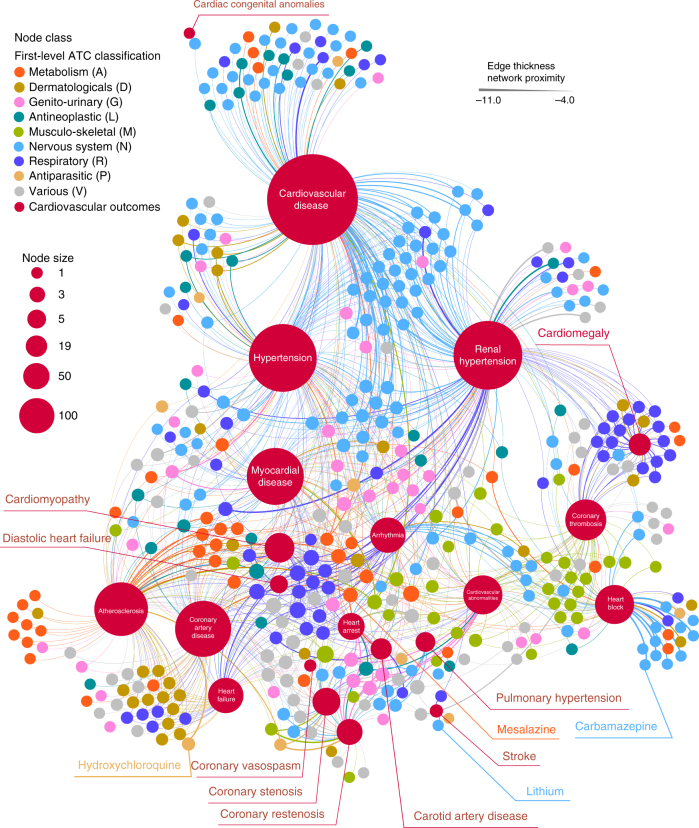
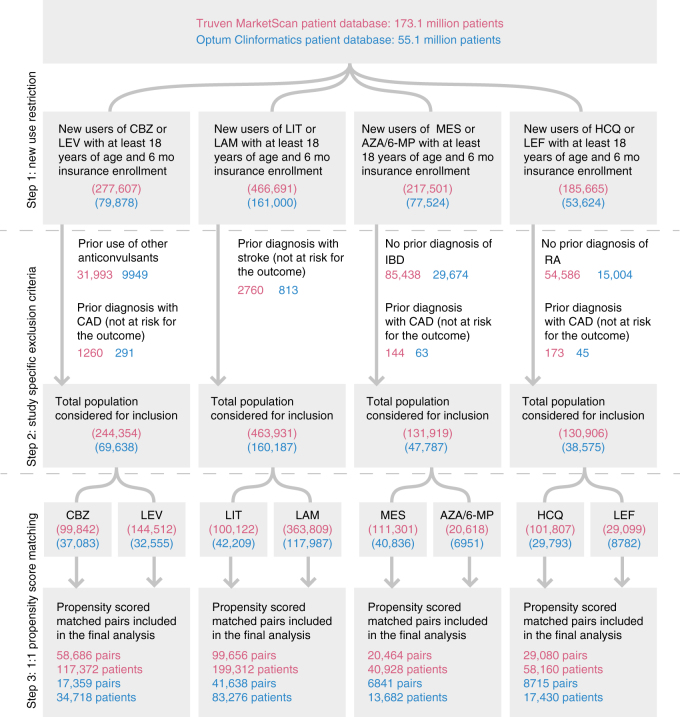
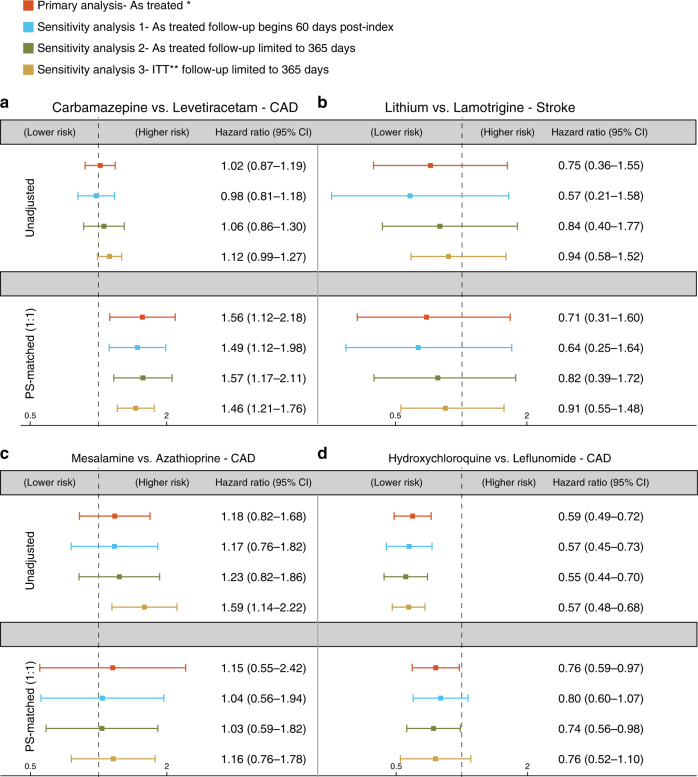
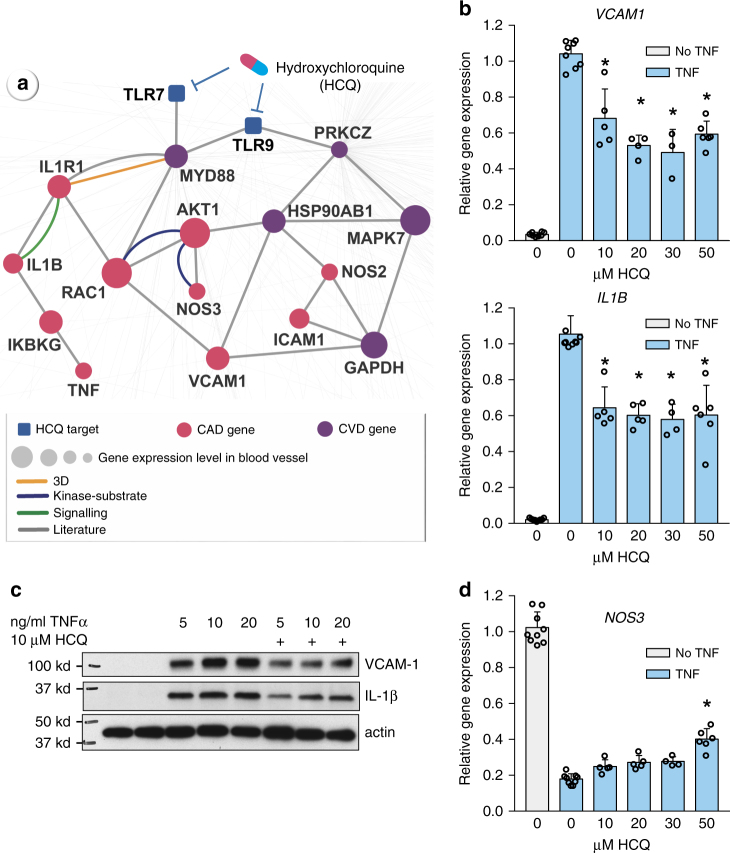
Here we identify hundreds of new drug-disease associations for over 900 FDA-approved drugs by quantifying the network proximity of disease genes and drug targets in the human (protein–protein) interactome. We select four network-predicted associations to test their causal relationship using large healthcare databases with over 220 million patients and state-of-the-art pharmacoepidemiologic analyses. Using propensity score matching, two of four network-based predictions are validated in patient-level data: carbamazepine is associated with an increased risk of coronary artery disease (CAD) [hazard ratio (HR) 1.56, 95% confidence interval (CI) 1.12–2.18], and hydroxychloroquine is associated with a decreased risk of CAD (HR 0.76, 95% CI 0.59–0.97). In vitro experiments show that hydroxychloroquine attenuates pro-inflammatory cytokine-mediated activation in human aortic endothelial cells, supporting mechanistically its potential beneficial effect in CAD. In summary, we demonstrate that a unique integration of protein-protein interaction network proximity and large-scale patient-level longitudinal data complemented by mechanistic in vitro studies can facilitate drug repurposing.
Overview
The claims and statistics of this paper haven’t been checked yet.
Run the check — free, no account needed. It reads the open-access text and checks the sources it cites.
Integrity signals
Registry
Cites
Statistics
Figures
Verification
Claims the paper makes
The claims and statistics of this paper haven’t been checked yet.
Run the check — free, no account needed. It reads the open-access text and checks the sources it cites.
Claims other papers make about this one
Each is checked against this paper’s own text: does it say what the citing paper says it does?
In the citing paper
“Because gene expression data can be noisy and variational, recent advances include fusing the co-expression matrices with existing biomedical networks, such as GO annotations and PPI, and feeding the resulting graph into graph convolution layers (Section 2.2) [150, 151, 152].”
From Graph representation learning in biomedicine and healthcare (2022) · cites this paper as [152]
In the citing paper
“Doing so has enabled more interpretable disease classification models (e.g., weighting gene interactions based on existing biological knowledge).”
From Graph representation learning in biomedicine and healthcare (2022) · cites this paper as [152]
Self-check
Percentages, sums and reported differences re-computed from the paper’s own numbers.
The self-check needs the paper’s full text.
Citations
Cites
Meta-analysis in clinical trials
DerSimonian, R., & Laird, N. (1986) · Controlled Clinical Trials · doi:10.1016/0197-2456(86)90046-2 · Cited by 39,552
The central role of the propensity score in observational studies for causal effects
ROSENBAUM, P. R., & RUBIN, D. B. (1983) · Biometrika · doi:10.1093/biomet/70.1.41 · Cited by 31,241
Database resources of the National Center for Biotechnology Information: update
Wheeler, D. L. (2003) · Nucleic Acids Research · doi:10.1093/nar/gkh073 · Cited by 10,695
Inflammation, Atherosclerosis, and Coronary Artery Disease
Hansson, G. K. (2005) · New England Journal of Medicine · doi:10.1056/nejmra043430 · Cited by 8,773
UniProt: the Universal Protein knowledgebase
Apweiler, R. (2003) · Nucleic Acids Research · doi:10.1093/nar/gkh131 · Cited by 7,593
ChEMBL: a large-scale bioactivity database for drug discovery
Gaulton, A., Bellis, L. J., Bento, A. P., Chambers, J., Davies, M., Hersey, A., Light, Y., McGlinchey, S., Michalovich, D., Al-Lazikani, B., et al. (2012) · Nucleic Acids Research · doi:10.1093/nar/gkr777 · Cited by 4,382
The unified medical language system (UMLS): integrating biomedical terminology
Bodenreider, O. (2004) · Nucleic Acids Research · doi:10.1093/nar/gkh061 · Cited by 4,356
ClinVar: public archive of relationships among sequence variation and human phenotype
Landrum, M. J., Lee, J. M., Riley, G. R., Jang, W., Rubinstein, W. S., Church, D. M., & Maglott, D. R. (2014) · Nucleic Acids Research · doi:10.1093/nar/gkt1113 · Cited by 3,516
PhosphoSitePlus, 2014: mutations, PTMs and recalibrations
Hornbeck, P. V., Zhang, B., Murray, B., Kornhauser, J. M., Latham, V., & Skrzypek, E. (2015) · Nucleic Acids Research · doi:10.1093/nar/gku1267 · Cited by 3,411
Goh, K.-I., Cusick, M. E., Valle, D., Childs, B., Vidal, M., & Barabási, A.-L. (2007) · Proceedings of the National Academy of Sciences · doi:10.1073/pnas.0701361104 · Cited by 3,242
Research works printed but not linked: 1
- Muller-Calleja, N., Manukyan, D., Canisius, A., Strand, D. & Lackner, K. J. Hydroxychloroquine inhibits proinflammatory signalling pathways by targeting endosomal NADPH oxidase. Ann. Rheum. Dis. 76, 891–897 (2016). · DOI
Cited by
Sorted by citations
Network-based drug repurposing for novel coronavirus 2019-nCoV/SARS-CoV-2
Zhou, Y., Hou, Y., Shen, J., Huang, Y., Martin, W., & Cheng, F. (2020) · Cell Discovery · doi:10.1038/s41421-020-0153-3 · Cited by 1,623
Self-citationNetwork-based prediction of drug combinations
Cheng, F., Kovács, I. A., & Barabási, A.-Ĺ. (2019) · Nature Communications · doi:10.1038/s41467-019-09186-x · Cited by 819
Self-citationArtificial intelligence in COVID-19 drug repurposing
Zhou, Y., Wang, F., Tang, J., Nussinov, R., & Cheng, F. (2020) · The Lancet Digital Health · doi:10.1016/s2589-7500(20)30192-8 · Cited by 636
Xin, W. A. N. G., Wang, Z., Zheng, J., & Li, S. (2021) · Chinese Journal of Natural Medicines · doi:10.1016/s1875-5364(21)60001-8 · Cited by 559
deepDR: a network-based deep learning approach toin silicodrug repositioning
Zeng, X., Zhu, S., Liu, X., Zhou, Y., Nussinov, R., & Cheng, F. (2019) · Bioinformatics · doi:10.1093/bioinformatics/btz418 · Cited by 540
Self-citationCOVID-19 and Cardiovascular Disease
Chung, M. K., Zidar, D. A., Bristow, M. R., Cameron, S. J., Chan, T. A.-T., Harding, C. V., Kwon, D. H., Singh, T. K., Tilton, J. C., Tsai, E. J., et al. (2021) · Circulation Research · doi:10.1161/circresaha.121.317997 · Cited by 377
Self-citationTarget identification among known drugs by deep learning from heterogeneous networks
Zeng, X., Zhu, S., Lu, W., Liu, Z., Huang, J., Zhou, Y., Fang, J., Huang, Y., Guo, H., Li, L., et al. (2020) · Chemical Science · doi:10.1039/c9sc04336e · Cited by 357
Self-citationMachine learning identifies candidates for drug repurposing in Alzheimer’s disease
Rodriguez, S., Hug, C., Todorov, P., Moret, N., Boswell, S. A., Evans, K., Zhou, G., Johnson, N. T., Hyman, B. T., Sorger, P. K., et al. (2021) · Nature Communications · doi:10.1038/s41467-021-21330-0 · Cited by 299
A knowledge graph to interpret clinical proteomics data
Santos, A., Colaço, A. R., Nielsen, A. B., Niu, L., Strauss, M. T., Geyer, P. E., Coscia, F., Albrechtsen, N. J. W., Mundt, F., Jensen, L. J., et al. (2022) · Nature Biotechnology · doi:10.1038/s41587-021-01145-6 · Cited by 360
“Graph-based predictions have been used in multiple scenarios, including drug repurposing, protein–protein interaction (PPI) prediction, disease comorbidity risks or diet-based cancer therapy associations 78–80 .”
MethodGraph representation learning in biomedicine and healthcare
Li, M. M., Huang, K., & Zitnik, M. (2022) · Nature Biomedical Engineering · doi:10.1038/s41551-022-00942-x · Cited by 294
Repurpose Open Data to Discover Therapeutics for COVID-19 Using Deep Learning
Zeng, X., Song, X. H., Ma, T., Pan, X., Zhou, Y., Hou, Y., Zhang, Z., Li, K., Karypis, G., & Cheng, F. (2020) · Journal of Proteome Research · doi:10.1021/acs.jproteome.0c00316 · Cited by 261
Self-citationGAP43-dependent mitochondria transfer from astrocytes enhances glioblastoma tumorigenicity
Watson, D. C., Bayık, D., Storevik, S., Moreino, S. S., Sprowls, S. A., Han, J., Augustsson, M. T., Lauko, A. J., Palavalasa, S., Røsland, G. V., et al. (2023) · Nature Cancer · doi:10.1038/s43018-023-00556-5 · Cited by 266
Self-citationMyeloid-Derived Suppressor Cell Subsets Drive Glioblastoma Growth in a Sex-Specific Manner
Bayık, D., Zhou, Y., Park, C., Hong, C., Vail, D. J., Silver, D. J., Lauko, A. J., Roversi, G. A., Watson, D. C., Lo, A., et al. (2020) · Cancer Discovery · doi:10.1158/2159-8290.cd-19-1355 · Cited by 241
Self-citationComprehensive characterization of protein–protein interactions perturbed by disease mutations
Cheng, F., Zhao, J., Wang, Y., Lü, W., Liu, Z., Zhou, Y., Martin, W. R., Wang, R., Huang, J. Y., Hao, T., et al. (2021) · Nature Genetics · doi:10.1038/s41588-020-00774-y · Cited by 220
“Previous studies have demonstrated that the human protein–protein interactome provides a powerful network-based tool to quantify disease–disease 6 and drug–disease 7–9 relationships; however, the functional network consequences of disease-associated mutations remain largely unknown.”
BackgroundSelf-citationReducing acetylated tau is neuroprotective in brain injury
Shin, M.-K., Vázquez-Rosa, E., Koh, Y., Dhar, M., Chaubey, K., Cintrón-Pérez, C. J., Barker, S., Miller, E., Franke, K., Noterman, M. F., et al. (2021) · Cell · doi:10.1016/j.cell.2021.03.032 · Cited by 226
“Two cohort analyses were conducted to evaluate the predicted association, based on individual level of longitudinal patient data and pharmacoepidemiologic methods, as previously established (Cheng et al., 2018).”
BackgroundMethodSelf-citationComputational network biology: Data, models, and applications
Liu, C., Ma, Y., Zhao, J., Nussinov, R., Zhang, Y., Cheng, F., & Zhang, Z. (2019) · Physics Reports · doi:10.1016/j.physrep.2019.12.004 · Cited by 230
Self-citationDeep Learning-Based Prediction of Drug-Induced Cardiotoxicity
Cai, C., Guo, P., Zhou, Y., Zhou, J., Wang, Q., Zhang, F., Fang, J., & Cheng, F. (2019) · Journal of Chemical Information and Modeling · doi:10.1021/acs.jcim.8b00769 · Cited by 224
Self-citationA genome-wide positioning systems network algorithm for in silico drug repurposing
Cheng, F., Lu, W., Liu, C., Fang, J., Hou, Y., Handy, D. E., Wang, R., Zhao, Y., Yang, Y., Huang, J., et al. (2019) · Nature Communications · doi:10.1038/s41467-019-10744-6 · Cited by 215
“…doxorubicin, and tamoxifen) de fi ned by the fi rst-level of the Anatomical Therapeutic Chemical Classi fi cation codes are correctly predicted by the network proximity approach compared to GSEA, revealing the power of the network approach for drug repurposing, consistent with our recent study 8 .”
BackgroundMethodResultInfluentialSelf-citationKong, J., Lee, H., Kim, D., Han, S. K., Ha, D., Shin, K., & Kim, S. (2020) · Nature Communications · doi:10.1038/s41467-020-19313-8 · Cited by 225
Molecular networks in Network Medicine: Development and applications
Silverman, E. K., Schmidt, H. H. H. W., Anastasiadou, E., Altucci, L., Angelini, M., Badimón, L., Balligand, J., Benincasa, G., Capasso, G., Conte, F., et al. (2020) · WIREs Systems Biology and Medicine · doi:10.1002/wsbm.1489 · Cited by 218
“Furthermore, a systems pharmacology-based platform measuring the distance between disease proteins and drug targets in the human PPI was developed (Cheng et al., 2018).”
BackgroundMethodInfluentialSelf-citationZhou, Y., Liu, Y., Gupta, S., Paramo, M. I., Hou, Y., Mao, C., Luo, Y., Judd, J., Wierbowski, S. D., Bertolotti, M., et al. (2022) · Nature Biotechnology · doi:10.1038/s41587-022-01474-0 · Cited by 214
Self-citationFang, J., Zhang, P., Zhou, Y., Chiang, C.-W., Tan, J., Hou, Y., Stauffer, S., Li, L., Pieper, A. A., Cummings, J., et al. (2021) · Nature Aging · doi:10.1038/s43587-021-00138-z · Cited by 206
Self-citationZhou, Y., Hou, Y., Shen, J., Mehra, R., Kallianpur, A., Culver, D. A., Gack, M. U., Farha, S., Zein, J., Comhair, S., et al. (2020) · PLoS Biology · doi:10.1371/journal.pbio.3000970 · Cited by 180
“the network-based relationships between COVID-19 and human diseases in the human interactome model using state-of-the-art network proximity analysis [32,33,49].”
BackgroundMethodInfluentialSelf-citationGan, X., Shu, Z., Wang, X., Yan, D., Li, J., Ofaim, S., Albert, R., Li, X., Liu, B., Zhou, X., et al. (2023) · Science Advances · doi:10.1126/sciadv.adh0215 · Cited by 178
“…and shorter network distance between two disease modules is indicative of their comorbidity ( 16 ); more-over, drug efficacy can be predicted by leveraging the network relation between drug targets and disease modules ( 17 , 18 ), leading to the development of drug-repurposing methodologies ( 19 ).”
BackgroundIdentification of disease treatment mechanisms through the multiscale interactome
Ruiz, C., Zitnik, M., & Leskovec, J. (2021) · Nature Communications · doi:10.1038/s41467-021-21770-8 · Cited by 172
“Construct a reference distribution of shortest paths for these two protein pairs by following 762 the approach in [10, 13].”
BackgroundMoving Beyond the Sarcomere to Explain Heterogeneity in Hypertrophic Cardiomyopathy
Maron, B. J., Maron, M. S., Maron, B. A., & Loscalzo, J. (2019) · Journal of the American College of Cardiology · doi:10.1016/j.jacc.2019.01.061 · Cited by 161
Self-citationZhou, Y., Xu, J., Hou, Y., Leverenz, J. B., Kallianpur, A. R., Mehra, R., Liu, Y., Yu, H., Pieper, A. A., Jehi, L. E., et al. (2021) · Alzheimer s Research & Therapy · doi:10.1186/s13195-021-00850-3 · Cited by 165
“Therefore, degree-controlled permutation tests were based on gene sets that had similar degree distributions to the gene sets-of-interest to reduce the effect of literature-based degree biases based on our previous studies [33, 38, 56].”
BackgroundMethodInfluentialSelf-citationTargeting the Immune System in Atherosclerosis
Zhao, T. X., & Mallat, Z. (2019) · Journal of the American College of Cardiology · doi:10.1016/j.jacc.2018.12.083 · Cited by 161
Zeng, X., Zhu, S., Hou, Y., Zhang, P., Li, L., Li, J., Huang, L. F., Lewis, S. J., Nussinov, R., & Cheng, F. (2020) · Bioinformatics · doi:10.1093/bioinformatics/btaa010 · Cited by 141
Self-citationFang, J., Zhang, P., Wang, Q., Chiang, C.-W., Zhou, Y., Hou, Y., Xu, J., Chen, R., Zhang, B., Lewis, S. J., et al. (2022) · Alzheimer's Research & Therapy · doi:10.1186/s13195-021-00951-z · Cited by 140
“To examine the potential application of ARGs on AD drug repurposing, we applied a network proximity approach [15] to quantify the interplay between AD modules from ARGs and drug targets in the human interactome network.”
BackgroundMethodResultInfluentialSelf-citationExploration of databases and methods supporting drug repurposing: a comprehensive survey
Tanoli, Z., Seemab, U., Scherer, A., Wennerberg, K., Tang, J., & Vähä-Koskela, M. (2021) · Briefings in Bioinformatics · doi:10.1093/bib/bbaa003 · Cited by 131
The multiplex network of human diseases
Halu, A., Domenico, M. D., Arenas, À., & Sharma, A. (2019) · npj Systems Biology and Applications · doi:10.1038/s41540-019-0092-5 · Cited by 139
Niazi, S. K. (2023) · Drug Design Development and Therapy · doi:10.2147/dddt.s424991 · Cited by 152
“Repositioning for Rare Diseases Identify potential drug candidates for treating rare diseases by analyzing molecular profiles, gene expression data, and clinical information.(124)”
BackgroundSinha, S. K., Prasad, S. K., Islam, M. A., Gurav, S. S., Patil, R. B., AlFaris, N. A., Aldayel, T. S., AlKehayez, N. M., Wabaidur, S. M., & Shakya, A. (2020) · Journal of Biomolecular Structure and Dynamics · doi:10.1080/07391102.2020.1779132 · Cited by 132
“In principle, the cost-effective and time-efficient computational technique provides a powerful network-based tool (Cheng et al., 2018) to test a novel hypotheses conceptualizing systematic drug repositioning strategy for rapid identification of therapeutic lead and/or potential leads combinations…”
BackgroundMercurio, I., Tragni, V., Busto, F., Grassi, A., & Pierri, C. L. (2020) · Cellular and Molecular Life Sciences · doi:10.1007/s00018-020-03580-1 · Cited by 129
Robustness and lethality in multilayer biological molecular networks
Liu, X., Maiorino, E., Halu, A., Glass, K., Prasad, R. B., Loscalzo, J., Gao, J., & Sharma, A. (2020) · Nature Communications · doi:10.1038/s41467-020-19841-3 · Cited by 124
Self-citationLessons from the COVID-19 pandemic for advancing computational drug repurposing strategies
Galindez, G., Matschinske, J., Rose, T. D., Sadegh, S., Salgado-Albarrán, M., Späth, J., Baumbach, J., & Pauling, J. K. (2021) · Nature Computational Science · doi:10.1038/s43588-020-00007-6 · Cited by 123
“Network proximity relies on the principle that a drug can be effective if it targets proteins within the neighborhood of disease-associated proteins in the interactome 67 .”
Backgrounddo Valle, Í. F., Roweth, H. G., Malloy, M. W., Moco, S., Barron, D., Battinelli, E. M., Loscalzo, J., & Barabási, A.-Ĺ. (2021) · Nature Food · doi:10.1038/s43016-021-00243-7 · Cited by 120
Self-citationCurrent and future directions in network biology
Žitnik, M., Li, M. M., Wells, A., Glass, K., Gysi, D. M., Krishnan, A., Murali, T. M., Predrag Radivojac, A., Roy, S., Baudot, A., et al. (2024) · Bioinformatics Advances · doi:10.1093/bioadv/vbae099 · Cited by 128
Liu, R., Wei, L., & Zhang, P. (2021) · Nature Machine Intelligence · doi:10.1038/s42256-020-00276-w · Cited by 124
Xu, J., Mao, C., Hou, Y., Luo, Y., Binder, J. L., Zhou, Y., Bekris, L. M., Shin, J., Hu, M., Wang, F., et al. (2022) · Cell Reports · doi:10.1016/j.celrep.2022.111717 · Cited by 115
Self-citationMoingeon, P. E., Kuenemann, M. A., & Guedj, M. (2021) · Drug Discovery Today · doi:10.1016/j.drudis.2021.09.006 · Cited by 122
Advancing pharmaceutical research: A comprehensive review of cutting-edge tools and technologies
Chen, J., Lin, A., & Luo, P. (2024) · Current Pharmaceutical Analysis · doi:10.1016/j.cpan.2024.11.001 · Cited by 112
Digital twins as global learning health and disease models for preventive and personalized medicine
Li, X., Loscalzo, J., Mahmud, A. K. M. F., Aly, D. M., Rzhetsky, A., Žitnik, M., & Benson, M. (2025) · Genome Medicine · doi:10.1186/s13073-025-01435-7 · Cited by 135
Self-citationNetwork medicine framework for identifying drug-repurposing opportunities for COVID-19
Morselli Gysi, D., do Valle, Í., Zitnik, M., Ameli, A., Gan, X., Varol, O., Ghiassian, S. D., Patten, J. J., Davey, R. A., Loscalzo, J., et al. (2021) · Proceedings of the National Academy of Sciences · doi:10.1073/pnas.2025581118 · Cited by 107
“(1) First, it uses the current aggregated ranking R to update the importance weights K r for each ranked list.”
MethodSelf-citationYang, J., Tian, S., Zhao, J., & Zhang, W. (2020) · Pharmacological Research · doi:10.1016/j.phrs.2020.105034 · Cited by 106
Network-based multi-omics integrative analysis methods in drug discovery: a systematic review
Jiang, W., Ye, W., Tan, X., & Bao, Y. (2025) · BioData Mining · doi:10.1186/s13040-025-00442-z · Cited by 134
“…inheritance patterns, curated genetic data [39] CIVIC Clinical interpretations Clinical evidence summaries, drug-disease relationships, evidence quality scoring [29] hubs often has far-reaching consequences, potentially leading to systemic dysfunction and disease manifestation [50, 51].”
SAveRUNNER: A network-based algorithm for drug repurposing and its application to COVID-19
Fiscon, G., Conte, F., Farina, L., & Paci, P. (2021) · PLoS Computational Biology · doi:10.1371/journal.pcbi.1008686 · Cited by 108
“This randomization procedure allows to preserve the biological meaning of the network connections between any pair of nodes [14, 18].”
BackgroundMethodResultInfluentialNetwork Medicine in Pathobiology
Lee, L. Y.-H., & Loscalzo, J. (2019) · The American Journal of Pathology · doi:10.1016/j.ajpath.2019.03.009 · Cited by 95
“107 Cheng et al 16 examined new drug-disease interactions involving over 900 FDA-approved drugs by measuring the network proximity between known drug targets and disease proteins in the human interactome.”
BackgroundSelf-citationDing, J., Blencowe, M., Nghiem, T. X., Ha, S. M., Chen, Y.-W., Li, G., & Yang, X. (2021) · Nucleic Acids Research · doi:10.1093/nar/gkab405 · Cited by 99
“Network-based drug repositioning ranks drugs based on the degree of connectivity of genes influenced by drug treatments to disease gene signatures in a given gene network model (44).”
BackgroundHarnessing endophenotypes and network medicine for Alzheimer's drug repurposing
Fang, J., Pieper, A. A., Nussinov, R., Lee, G., Bekris, L. M., Leverenz, J. B., Cummings, J. L., & Cheng, F. (2020) · Medicinal Research Reviews · doi:10.1002/med.21709 · Cited by 96
“In recent years, various bioinformatic or network‐based approaches have provided tools for mechanistic examination of endophenotypes implicated in AD.(19,142) For example, the Multi‐objective Analyzer for Genetic Marker Acquisition (MAGMA) algorithm was utilized to explore whether genetic risk of AD (such as AD GWAS c…”
BackgroundMethodInfluentialSelf-citationA paradigm shift in medicine: A comprehensive review of network-based approaches
Conte, F., Fiscon, G., Licursi, V., Bizzarri, D., D'Antò, T., Farina, L., & Paci, P. (2019) · Biochimica et Biophysica Acta (BBA) - Gene Regulatory Mechanisms · doi:10.1016/j.bbagrm.2019.194416 · Cited by 99
Ahmed, F., Soomro, A. M., Salih, A. R. C., Samantasinghar, A., Asif, A., Kang, I. S., & Choi, K. H. (2022) · Biomedicine & Pharmacotherapy · doi:10.1016/j.biopha.2022.113350 · Cited by 92
“PPI data gathered from 15 commonly used databases was retrieved from [171].”
Computational systems biology in disease modeling and control, review and perspectives
Yue, R., & Dutta, A. (2022) · npj Systems Biology and Applications · doi:10.1038/s41540-022-00247-4 · Cited by 103
“Drug-target interaction (DTI) networks have been applied to study the prediction of drug response 51 , interaction pro fi les of new drug-target pairs 16,26,27,52 , and side effects of unknown drug combination 22,53,54 .”
MethodWang, Z., Zhou, M., & Arnold, C. W. (2020) · Bioinformatics · doi:10.1093/bioinformatics/btaa437 · Cited by 91
“Network-based approaches (Cheng et al., 2018, 2019; Guney et al., 2016; Luo et al., 2016; Zeng et al., 2019) model graphstructured information among different biological networks to boost the performance for DR. Typically, in these models, the nodes in the networks represent either drug, disease or gene products and e…”
BackgroundInfluentialPaci, P., Fiscon, G., Conte, F., Wang, R., Farina, L., & Loscalzo, J. (2021) · npj Systems Biology and Applications · doi:10.1038/s41540-020-00168-0 · Cited by 87
Self-citationDeepScreening: a deep learning-based screening web server for accelerating drug discovery
Liu, Z., Du, J., Fang, J., Yin, Y., Xu, G., & Xie, L. (2019) · Database · doi:10.1093/database/baz104 · Cited by 89
Integrative proteomics and phosphoproteomics in pulmonary arterial hypertension
Xu, W., COMHAIR, S. A. A., Chen, R., Hu, B., Hou, Y., Zhou, Y., Mavrakis, L. A., Janocha, A. J., Li, L., Zhang, D., et al. (2019) · Scientific Reports · doi:10.1038/s41598-019-55053-6 · Cited by 84
Self-citationZhou, Y., Fang, J., Bekris, L. M., Kim, Y. H., Pieper, A. A., Leverenz, J. B., Cummings, J. L., & Cheng, F. (2021) · Alzheimer s Research & Therapy · doi:10.1186/s13195-020-00760-w · Cited by 85
Self-citationAutomated data-adaptive analytics for electronic healthcare data to study causal treatment effects
Schneeweiß, S. (2018) · Clinical Epidemiology · doi:10.2147/clep.s166545 · Cited by 84
Repurposing Medications for Treatment of Pulmonary Arterial Hypertension: What's Old Is New Again
Prins, K. W., Thenappan, T., Weir, Ε. K., Kalra, R., PRITZKER, M. R., & Archer, S. L. (2018) · Journal of the American Heart Association · doi:10.1161/jaha.118.011343 · Cited by 80
Huang, Y., Fang, J., Lü, W., Wang, Z., Wang, Q., Hou, Y., Jiang, X., Reizes, O., Lathia, J. D., Nussinov, R., et al. (2019) · Cell chemical biology · doi:10.1016/j.chembiol.2019.05.004 · Cited by 73
“Recent advances in systems biology and omics technologies have enabled the development of in silico - network-based (Cheng et al., 2018; Cheng et al., 2019a; Cheng et al., 2012b), genomics-based (Jahchan et al.”
BackgroundMethodResultInfluentialSelf-citationPharmacogenomics of COVID-19 therapies
Takahashi, T., Luzum, J. A., Nicol, M. R., & Jacobson, P. A. (2020) · npj Genomic Medicine · doi:10.1038/s41525-020-00143-y · Cited by 76
High-dimensional role of AI and machine learning in cancer research
Capobianco, E. (2022) · British Journal of Cancer · doi:10.1038/s41416-021-01689-z · Cited by 76
“A few major directions are: (i) repurposing existing drugs for treatment decisions supported by multi-sourced protein–protein interaction networks [4], (ii) developing ML algorithms predictive of anticancer drug efficacy [5], (iii) advancing semantics to deploy public cancer genomic datasets as linked data and offer a…”
BackgroundSAveRUNNER: an R-based tool for drug repurposing
Fiscon, G., & Paci, P. (2021) · BMC Bioinformatics · doi:10.1186/s12859-021-04076-w · Cited by 78
Sarno, F., Benincasa, G., List, M., Barabási, A.-L., Baumbach, J., Ciardiello, F., Filetti, S., Glass, K., Loscalzo, J., Marchese, C., et al. (2021) · Clinical Epigenetics · doi:10.1186/s13148-021-01047-z · Cited by 78
Self-citationHost metabolic reprogramming in response to SARS-CoV-2 infection: A systems biology approach
Moolamalla, S. T. R., Balasubramanian, R., Chauhan, R., Priyakumar, U. D., & Vinod, P. K. U. (2021) · Microbial Pathogenesis · doi:10.1016/j.micpath.2021.105114 · Cited by 82
Wang, X., Cheng, Y., Yang, Y., Yu, Y., Li, F., & Peng, S. (2023) · Nature Machine Intelligence · doi:10.1038/s42256-023-00640-6 · Cited by 77
“To improve the efficiency of drug discovery, a great number of researchers have devoted to developing or leveraging deep learning to speed up its intermediate steps, such as molecular property prediction [3-4], drug-target interaction (DTI) predictions [5-8], and drug-drug interaction (DDI) predictions [9-11].”
A network-based approach to identify deregulated pathways and drug effects in metabolic syndrome
Misselbeck, K., Parolo, S., Lorenzini, F., Savoca, V., Leonardelli, L., Bora, P., Morine, M. J., Mione, M., Domenici, E., & Priami, C. (2019) · Nature Communications · doi:10.1038/s41467-019-13208-z · Cited by 72
Comprehensive germline genomic profiles of children, adolescents and young adults with solid tumors
Akhavanfard, S., Padmanabhan, R., Yehia, L., Cheng, F., & Eng, C. (2020) · Nature Communications · doi:10.1038/s41467-020-16067-1 · Cited by 71
“Other solid tumor (10) 3 4 3 10 Non-malignant tumor (4) 3 1 4”
Self-citationHigh-throughput target trial emulation for Alzheimer’s disease drug repurposing with real-world data
Zang, C., Zhang, H., Xu, J., Zhang, H., Fouladvand, S., Havaldar, S., Cheng, F., Chen, K., Chen, Y., Glicksberg, B. S., et al. (2023) · Nature Communications · doi:10.1038/s41467-023-43929-1 · Cited by 69
“These variabilities can become big challenges for existing observational studies that use a single controlgroup 41 orasinglewayofbuildingmultiplecontrolgroups(e.g. only random control groups) 7 .”
Self-citationWu, H., Lu, X., & Wang, H. (2023) · JMIR AI · doi:10.2196/38397 · Cited by 69
“At the molecular level, protein structure prediction, novel nucleic acid testing, drug repurposing, and drug discovery all rely on AI and deep-learning algorithms [7-9].”
BackgroundAmbati, J., Magagnoli, J., Leung, H., Wang, S.-B., Andrews, C. A., Fu, D., Pandey, A., Sahu, S., Narendran, S., Hirahara, S., et al. (2020) · Nature Communications · doi:10.1038/s41467-020-18528-z · Cited by 66
Host-directed therapy, an untapped opportunity for antimalarial intervention
Wei, L., Adderley, J., Leroy, D., Drewry, D. H., Wilson, D. W., Kaushansky, A., & Doerig, C. (2021) · Cell Reports Medicine · doi:10.1016/j.xcrm.2021.100423 · Cited by 62
“In addition to their therapeutic applications in cancers and coronary artery disease, 88,89 network-based approaches have facilitated drug discovery and repurposing to treat infectious diseases such as pandemic and seasonal respiratory infections by redirecting the usage of known drugs to target…”
Signature-based approaches for informed drug repurposing: targeting CNS disorders
Shukla, R., Henkel, N., Alganem, K., Hamoud, A.-R. A., Reigle, J. K., Alnafisah, R. S., Eby, H., Imami, A. S., Creeden, J. F., Miruzzi, S. A., et al. (2020) · Neuropsychopharmacology · doi:10.1038/s41386-020-0752-6 · Cited by 66
“While comparison of across studies and species is a common practice for in silico approaches, the most rigorous in silico validation could include using large-scale patient-level routine health care data involving the repositioned drug [141].”
BackgroundAhmed, F., Lee, J. W., Samantasinghar, A., Kim, Y. S., Kim, K. H., Kang, I. S., Memon, F. H., Lim, J., & Choi, K. H. (2022) · Frontiers in Public Health · doi:10.3389/fpubh.2022.902123 · Cited by 66
Wang, B., Zhang, T., Liu, Q., Sutcharitchan, C., Zhou, Z., Zhang, D., & Li, S. (2024) · Journal of Pharmaceutical Analysis · doi:10.1016/j.jpha.2024.101144 · Cited by 68
“By quantifying the network proximity of disease genes and drug targets within the human protein-protein interactome, Cheng et al. [38] identify hundreds of new drug-disease associations for over 900 U.S. Food and Drug Administration (U.S. FDA)-approved drugs.”
Cheng, F., Wang, F., Tang, J., Zhou, Y., Fu, Z., Zhang, P., Haines, J. L., Leverenz, J. B., Gan, L., Hu, J., et al. (2024) · Cell Reports Medicine · doi:10.1016/j.xcrm.2023.101379 · Cited by 63
Self-citationA computational approach to drug repurposing using graph neural networks
Doshi, S., & Chepuri, S. P. (2022) · Computers in Biology and Medicine · doi:10.1016/j.compbiomed.2022.105992 · Cited by 66
Systems Biology Approaches to Understanding the Human Immune System
Dhillon, B. K., Smith, M. L., Baghela, A. S., Lee, A. H., & Hancock, R. E. W. (2020) · Frontiers in Immunology · doi:10.3389/fimmu.2020.01683 · Cited by 62
“As such, along with numerous other studies [e.g., (89–92)], it has been shown that integrating omics datasets using resources such as InnateDB and DrugBank can reveal potential drug targets for improved therapies.”
ResultTopological network measures for drug repositioning
Badkas, A., Landtsheer, S. D., & Sauter, T. (2020) · Briefings in Bioinformatics · doi:10.1093/bib/bbaa357 · Cited by 61
“This approach was used to suggest associations between several approved drugs and diseases, validating two of them via patient records and in vitro experiments [79].”
MethodPersonal Mutanomes Meet Modern Oncology Drug Discovery and Precision Health
Cheng, F., Liang, H., Butte, A. J., Eng, C., & Nussinov, R. (2018) · Pharmacological Reviews · doi:10.1124/pr.118.016253 · Cited by 58
Self-citationLoucera, C., Esteban‐Medina, M., Rian, K., Falco, M. M., Dopazo, J., & Peña-Chilet, M. (2020) · Signal Transduction and Targeted Therapy · doi:10.1038/s41392-020-00417-y · Cited by 61
“In recent years, approaches based on network biology have demonstrated to be superior to genecentric ones.(1) Here, we use an innovative methodology that combines mechanistic modeling of the signal transduction circuits related to SARS-CoV-2 infection (the COVID-19 disease map) with a machine-learning algorithm that l…”
MethodClinical Knowledge Graph Integrates Proteomics Data into Clinical Decision-MakingPreprint
Santos, A., Colaço, A. R., Nielsen, A. B., Niu, L., Geyer, P. E., Coscia, F., Albrechtsen, N. J. W., Mundt, F. O., Jensen, L. J., & Mann, M. (2020) · bioRxiv (Cold Spring Harbor Laboratory) · doi:10.1101/2020.05.09.084897 · Cited by 59
“10 interaction (PPI) prediction, disease comorbidity risks or diet-based cancer therapy associations (Cheng et al., 2018; Halu et al., 2019; Menche et al., 2015; Veselkov et al., 2019).”
BackgroundLoscalzo, J. (2022) · The FASEB Journal · doi:10.1096/fj.202201683r · Cited by 55
Self-citationPredicting Herb-disease Associations Through Graph Convolutional Network
Hu, X., Lu, Y., Tian, G., Bing, P., Wang, B., & He, B. (2023) · Current Bioinformatics · doi:10.2174/1574893618666230504143647 · Cited by 56
Infante, T., Viscovo, L. D., Rimini, M. L. D., Padula, S., Caso, P., & Claudio Napoli, A. (2019) · Journal of Atherosclerosis and Thrombosis · doi:10.5551/jat.52407 · Cited by 59
Mapping the perturbome network of cellular perturbations
Caldera, M., Müller, F., Kaltenbrunner, I., Licciardello, M. P., Lardeau, C.-H., Kubicek, S., & Menche, J. (2019) · Nature Communications · doi:10.1038/s41467-019-13058-9 · Cited by 54
Machine learning and network medicine approaches for drug repositioning for COVID-19
Santos, S. D. S., Torres, M., Galeano, D., Sánchez, M. D. M., Cernuzzi, L., & Paccanaro, A. (2021) · Patterns · doi:10.1016/j.patter.2021.100396 · Cited by 57
“We re-computed the kernel-based scores using the recently released HuRI PPI 50 as well as the interactome compiled by Cheng et al. 30 Results are presented in Note S7.”
Lv, S., Wang, Q., Zhang, X., Ning, F., Liu, W., Cui, M., & Xu, Y. (2023) · Phytomedicine · doi:10.1016/j.phymed.2023.155231 · Cited by 58
Smith, I. N., Thacker, S., Seyfi, M., Cheng, F., & Eng, C. (2019) · The American Journal of Human Genetics · doi:10.1016/j.ajhg.2019.03.009 · Cited by 54
Self-citationA new precision medicine initiative at the dawn of exascale computing
Nussinov, R., Jang, H., Nir, G., Tsai, C., & Cheng, F. (2021) · Signal Transduction and Targeted Therapy · doi:10.1038/s41392-020-00420-3 · Cited by 54
Self-citationMa, C., Yan, K., Wang, Z., Zhang, Q., Gao, L., Xu, T., Sai, J., Cheng, F., & Du, Y. (2021) · Bioengineered · doi:10.1080/21655979.2021.1933302 · Cited by 57
“The human protein-protein interaction (PPI) network was constructed from Professor Barabasi’s team [16], which was integrated with 15 commonly used protein-protein interactome databases and in-house data.”
MethodSelf-citationDissecting the m6A methylation affection on afatinib resistance in non-small cell lung cancer
Meng, Q., Wang, S., Zhou, S., Liu, H., Ma, X., Zhou, X., Liu, H., Xu, C., & Jiang, W. (2019) · The Pharmacogenomics Journal · doi:10.1038/s41397-019-0110-4 · Cited by 51
Results of the Seventh Scientific Workshop of ECCO: Precision Medicine in IBD—What, Why, and How
Fiocchi, C., Dragoni, G., Iliopoulos, D., Katsanos, K. H., Hernández, V., Suzuki, K., Verstockt, B., Fiocchi, C., Torres, J., & Scharl, M. M. (2021) · Journal of Crohn s and Colitis · doi:10.1093/ecco-jcc/jjab051 · Cited by 54
Lal, J. C., Mao, C., Zhou, Y., Gore-Panter, S. R., Rennison, J. H., Lovano, B. S., Castel, L., Shin, J., Gillinov, A. M., Smith, J. D., et al. (2022) · Cell Reports Medicine · doi:10.1016/j.xcrm.2022.100749 · Cited by 47
“In prior work, we described a human 2 Cell Reports Medicine 3, 100749, October 18, 2022 protein-protein interactome generated from five types of PPIs.20,24,25,30,31 To depict the human interactome network, we gathered associated proteins from five levels of evidence: (1) binary PPIs tested by high-throughput yeast two…”
BackgroundResultInfluentialSelf-citationRepurposed drug candidates for antituberculosis therapy
An, Q., Li, C., Chen, Y., Deng, Y., Yang, T., & Luo, Y. (2020) · European Journal of Medicinal Chemistry · doi:10.1016/j.ejmech.2020.112175 · Cited by 50
Integrated transcriptomic correlation network analysis identifies COPD molecular determinants
Paci, P., Fiscon, G., Conte, F., Licursi, V., Morrow, J. D., Hersh, C. P., Cho, M. H., Castaldi, P. J., Glass, K., Silverman, E. K., et al. (2020) · Scientific Reports · doi:10.1038/s41598-020-60228-7 · Cited by 49
Drug Repurposing: A Leading Strategy for New Threats and Targets
Mishra, A. S., Vasanthan, M., & Malliappan, S. P. (2024) · ACS Pharmacology & Translational Science · doi:10.1021/acsptsci.3c00361 · Cited by 55
Drug Repurposing: A Network-based Approach to Amyotrophic Lateral Sclerosis
Fiscon, G., Conte, F., Amadio, S., Volonté, C., & Paci, P. (2021) · Neurotherapeutics · doi:10.1007/s13311-021-01064-z · Cited by 48
“The rationale behind SAveRUNNER lies in the hypothesis that, for a drug to be effective against a specific disease, its associated targets (drug module) and the disease-specific associated genes (disease module) should be nearby in the human interactome [21].”
BackgroundMethodInfluential
Metadata
- Authors
- Cheng, F., Desai, R. J., Handy, D. E., Wang, R., Schneeweiss, S., Barabási, A.-L., & Loscalzo, J.
- Affiliations
- Northeastern University (US)
- Brigham and Women's Hospital (US)
- Corresponding author
- Loscalzo, Joseph
- Venue
- Nature Communications
- Published
- 2018-07-12
- Volume
- 9
- Issue
- 1
- Pages
- 2691-2691
- ISSN
- 2041-1723 (ISSN-L)
- PMC
- PMC6043492
- OpenAlex
- W2826750344
- Cited by
- 552
- References
- 90
- Citations by year
- 2026: 47 · 2025: 66 · 2024: 60 · 2023: 58 · 2022: 88 · 2021: 97 · 2020: 86 · 2019: 43 · 2018: 5
- FWCI
- 43.38
- Type
- journal article
- Language
- en
- Open access
- gold
- doi.org
- Locations
- Nature Communications (publishedVersion, cc-by)
- Europe PMC (PubMed Central) (publishedVersion, other-oa)
- PubMed Central (publishedVersion, cc-by)
- PubMed (publishedVersion)
- RePEc: Research Papers in Economics (submittedVersion)
- DOAJ (DOAJ: Directory of Open Access Journals) (submittedVersion, cc-by-sa)
- DOAJ (DOAJ: Directory of Open Access Journals) (submittedVersion)
- Open Research (Auckland University of Technology) (submittedVersion, cc-by)
- Funders
- U.S. Department of Health & Human Services | National Institutes of Health (HL106373, HG007690, GM 107618, HL016795, HL108630)
- Patient-Centered Outcomes Research Institute (ME-1303-5638)
- Topics
- Life Sciences › Pharmacology, Toxicology and Pharmaceutics › Drug Discovery › Computational Drug Discovery Methods
- Life Sciences › Biochemistry, Genetics and Molecular Biology › Molecular Biology › Bioinformatics and Genomic Networks
- Life Sciences › Biochemistry, Genetics and Molecular Biology › Genetics › Genetic Associations and Epidemiology
- Keywords
- drug repurposing, protein-protein interaction network, network proximity, drug-disease associations, coronary artery disease, carbamazepine, hydroxychloroquine, pharmacoepidemiology, propensity score matching, endothelial inflammation, inflammatory cytokines, FDA-approved drugs
- MeSH terms
- Carbamazepine, Computer Simulation, Coronary Artery Disease, Humans, Hydroxychloroquine, Prognosis, Risk Factors, Reproducibility of Results, Proportional Hazards Models, Databases, Factual, Risk Assessment, Propensity Score, Drug Repositioning, Protein Interaction Maps
About these checks
Registry, retraction, Cites and statistics results are computed, not judged, with one exception: a printed reference that no index lists is read once by a model before it counts as a citation error. Claims are extracted by a model and kept only when their quote appears verbatim in the text; each cited source is then checked, with a model’s help, for whether it says what the claim relies on. Those verdicts can be wrong — read the claim’s quote and the cited source before relying on one.
Statistics and arithmetic are recomputed, not judged.
Confidence bands are shown only for fields calibrated on our annotated test set. None is calibrated yet, so no band is shown.
What counts as a claim ›How we measure confidence ›How we check this ›
Are you an author, or do you see a problem with this page? Request a review
