

The DOI matches its Crossref record; 90 of the 90 references it cites were found in a registry or an index.
Network-based approach to prediction and population-based validation of in silico drug repurposing
Open accessAbstract
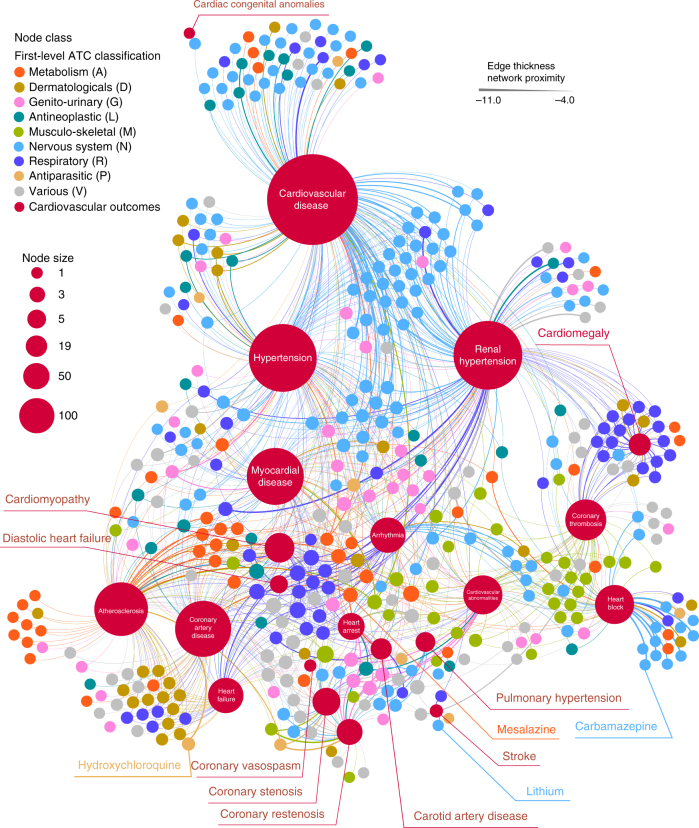
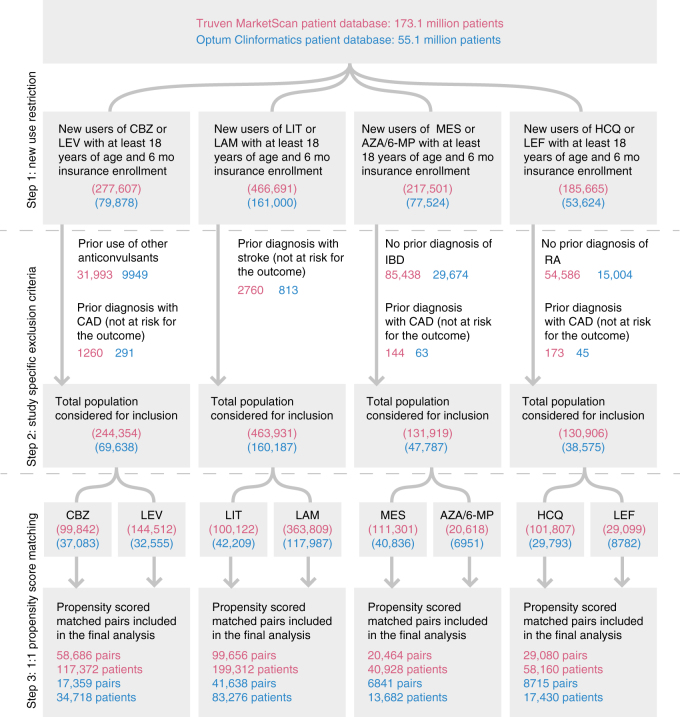
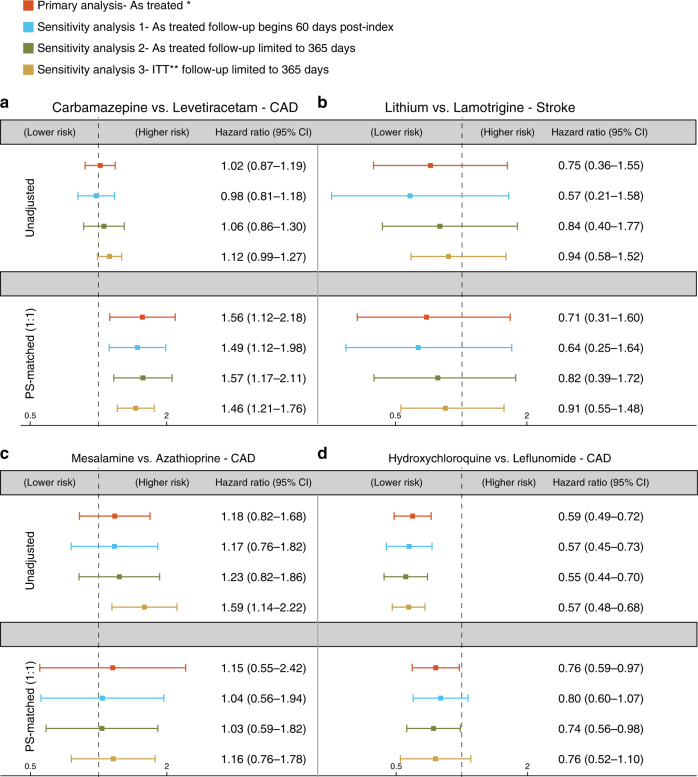
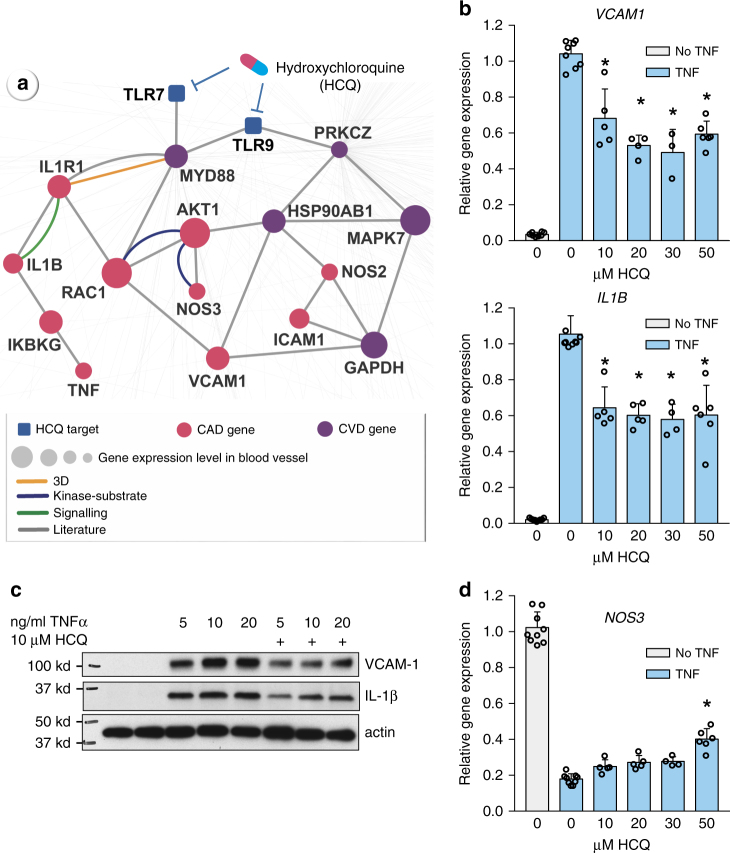
Here we identify hundreds of new drug-disease associations for over 900 FDA-approved drugs by quantifying the network proximity of disease genes and drug targets in the human (protein–protein) interactome. We select four network-predicted associations to test their causal relationship using large healthcare databases with over 220 million patients and state-of-the-art pharmacoepidemiologic analyses. Using propensity score matching, two of four network-based predictions are validated in patient-level data: carbamazepine is associated with an increased risk of coronary artery disease (CAD) [hazard ratio (HR) 1.56, 95% confidence interval (CI) 1.12–2.18], and hydroxychloroquine is associated with a decreased risk of CAD (HR 0.76, 95% CI 0.59–0.97). In vitro experiments show that hydroxychloroquine attenuates pro-inflammatory cytokine-mediated activation in human aortic endothelial cells, supporting mechanistically its potential beneficial effect in CAD. In summary, we demonstrate that a unique integration of protein-protein interaction network proximity and large-scale patient-level longitudinal data complemented by mechanistic in vitro studies can facilitate drug repurposing.
Overview
The claims and statistics of this paper haven’t been checked yet.
Run the check — free, no account needed. It reads the open-access text and checks the sources it cites.
Integrity signals
Registry
Cites
Statistics
Figures
Verification
Claims the paper makes
The claims and statistics of this paper haven’t been checked yet.
Run the check — free, no account needed. It reads the open-access text and checks the sources it cites.
Claims other papers make about this one
Each is checked against this paper’s own text: does it say what the citing paper says it does?
In the citing paper
“Because gene expression data can be noisy and variational, recent advances include fusing the co-expression matrices with existing biomedical networks, such as GO annotations and PPI, and feeding the resulting graph into graph convolution layers (Section 2.2) [150, 151, 152].”
From Graph representation learning in biomedicine and healthcare (2022) · cites this paper as [152]
In the citing paper
“Doing so has enabled more interpretable disease classification models (e.g., weighting gene interactions based on existing biological knowledge).”
From Graph representation learning in biomedicine and healthcare (2022) · cites this paper as [152]
Self-check
Percentages, sums and reported differences re-computed from the paper’s own numbers.
The self-check needs the paper’s full text.
Citations
Cites
Meta-analysis in clinical trials
DerSimonian, R., & Laird, N. (1986) · Controlled Clinical Trials · doi:10.1016/0197-2456(86)90046-2 · Cited by 39,552
The central role of the propensity score in observational studies for causal effects
ROSENBAUM, P. R., & RUBIN, D. B. (1983) · Biometrika · doi:10.1093/biomet/70.1.41 · Cited by 31,241
Database resources of the National Center for Biotechnology Information: update
Wheeler, D. L. (2003) · Nucleic Acids Research · doi:10.1093/nar/gkh073 · Cited by 10,695
Inflammation, Atherosclerosis, and Coronary Artery Disease
Hansson, G. K. (2005) · New England Journal of Medicine · doi:10.1056/nejmra043430 · Cited by 8,773
UniProt: the Universal Protein knowledgebase
Apweiler, R. (2003) · Nucleic Acids Research · doi:10.1093/nar/gkh131 · Cited by 7,593
ChEMBL: a large-scale bioactivity database for drug discovery
Gaulton, A., Bellis, L. J., Bento, A. P., Chambers, J., Davies, M., Hersey, A., Light, Y., McGlinchey, S., Michalovich, D., Al-Lazikani, B., et al. (2012) · Nucleic Acids Research · doi:10.1093/nar/gkr777 · Cited by 4,382
The unified medical language system (UMLS): integrating biomedical terminology
Bodenreider, O. (2004) · Nucleic Acids Research · doi:10.1093/nar/gkh061 · Cited by 4,356
ClinVar: public archive of relationships among sequence variation and human phenotype
Landrum, M. J., Lee, J. M., Riley, G. R., Jang, W., Rubinstein, W. S., Church, D. M., & Maglott, D. R. (2014) · Nucleic Acids Research · doi:10.1093/nar/gkt1113 · Cited by 3,516
PhosphoSitePlus, 2014: mutations, PTMs and recalibrations
Hornbeck, P. V., Zhang, B., Murray, B., Kornhauser, J. M., Latham, V., & Skrzypek, E. (2015) · Nucleic Acids Research · doi:10.1093/nar/gku1267 · Cited by 3,411
Goh, K.-I., Cusick, M. E., Valle, D., Childs, B., Vidal, M., & Barabási, A.-L. (2007) · Proceedings of the National Academy of Sciences · doi:10.1073/pnas.0701361104 · Cited by 3,242
Research works printed but not linked: 1
- Muller-Calleja, N., Manukyan, D., Canisius, A., Strand, D. & Lackner, K. J. Hydroxychloroquine inhibits proinflammatory signalling pathways by targeting endosomal NADPH oxidase. Ann. Rheum. Dis. 76, 891–897 (2016). · DOI
Cited by
Sorted by citations
Items 201–300 of 573
Sadegh, S., Skelton, J., Anastasi, E., Maier, A., Adamowicz, K., Möller, A. C., Kriege, N. M., Kronberg, J., Haller, T., Kacprowski, T., et al. (2023) · Nature Communications · doi:10.1038/s41467-023-37349-4 · Cited by 18
“Guney et al. 21 and Cheng et al. 22 showed that the network-based separation between drug targets and disease modules is indicative of drug ef fi cacy.”
BackgroundBayraktar, A., Li, X., Kim, W., Zhang, C., Türkez, H., Shoaie, S., & Mardinoğlu, A. (2023) · Journal of Translational Medicine · doi:10.1186/s12967-023-04192-6 · Cited by 16
“We integrated the drug-target interactions dataset and two extensive protein–protein interaction datasets [33, 34], which have been created again from multiple sources meticulously, to build an interactome (12057 unique drug-protein interactions (DPIs) and 262549 protein–protein interactions (PPIs), connecting 4383 co…”
MethodUsing common genetic variants to find drugs for common epilepsies
Mirza, N., Stevelink, R., Taweel, B. A., Koeleman, B. P. C., Marson, A. G., Abou-Khalil, B. W., Auce, P., Avberšek, A., Bahlo, M., Balding, D. J., et al. (2021) · Brain Communications · doi:10.1093/braincomms/fcab287 · Cited by 16
Gene coexpression analysis offers important modules and pathway of human lung adenocarcinomas
Wei, Z., Zhongqiu, T., Lu, S., Zhang, F., Xie, W., & Wang, Y. (2019) · Journal of Cellular Physiology · doi:10.1002/jcp.28985 · Cited by 17
“In parallel, the network medicine has also developed quickly, which deepen our knowledge of disease mechanisms and promoted the design of drugs (Cheng et al., 2018; Yong‐Hwa Lee & Loscalzo, 2019).”
BackgroundUzundurukan, A., Nelson, M., Teske, C., Islam, M. S., Elzagheid, M. I., Christy, J. V., Martin, H., Muratov, E. N., Glover, S., & Fuoco, D. (2025) · The Pharmacogenomics Journal · doi:10.1038/s41397-025-00368-z · Cited by 16
“…a complex disease, consisting not only of a simple viral infection but a complicated framework of symptoms and unpredictable transmissibility (as a result of the variants) with varying outcomes [51] according to the different patient populations (de Oliviera et al. [52], Ramsay et al. [53]).”
Deep learning of multimodal networks with topological regularization for drug repositioning
Ohnuki, Y., Akiyama, M., & Sakakibara, Y. (2024) · Journal of Cheminformatics · doi:10.1186/s13321-024-00897-y · Cited by 16
“Cheng et al. [6] quantified the network proximity between disease genes and drug targets in the human protein–protein interactome.”
BackgroundLeveraging pleiotropy for the improved treatment of psychiatric disorders
Woodward, D. J., Thorp, J. G., Middeldorp, C. M., Akóṣílè, W., Derks, E. M., & Gerring, Z. F. (2024) · Molecular Psychiatry · doi:10.1038/s41380-024-02771-7 · Cited by 15
“Disease-associated genes tend to cluster together in well-de fi ned neighbourhoods, known as disease modules, with a drug ’ s ef fi cacy and potential adverse effects related to the proximity to these small network neighbourhoods [109, 110].”
Repurposing of medications for pulmonary arterial hypertension
Toshner, M. R., Spiekerkoetter, E. F., Bogaard, H. J., Hansmann, G., Nikkho, S. M., & Prins, K. W. (2020) · Pulmonary Circulation · doi:10.1177/2045894020941494 · Cited by 17
“examples that carbamazepine is associated with increased risk of coronary artery disease while hydroxychloroquine decreases coronary artery disease risk.(71) Although not explored in detail in the manuscript, there was a drugpulmonary hypertension network.”
BackgroundInfluentialIdentification of disease treatment mechanisms through the multiscale interactomePreprint
Ruiz, C., Žitnik, M., & Leskovec, J. (2020) · bioRxiv (Cold Spring Harbor Laboratory) · doi:10.1101/2020.04.30.069690 · Cited by 17
Li, S., Zhang, F., Xiao, X., Guo, Y., Wen, Z., Li, M., & Pu, X. (2021) · Frontiers in Pharmacology · doi:10.3389/fphar.2021.634097 · Cited by 16
“In the human PPI network, when a drug targets the corresponding subnetwork of a disease or its adjacent communities, the drug is more likely to have therapeutic effects on the disease than other drugs with targets far from the disease subnetwork (Cheng et al., 2018; Cheng et al., 2019).”
Towards an expanded neuroscientific understanding of social play
Kellman, J., & Radwan, K. (2021) · Neuroscience & Biobehavioral Reviews · doi:10.1016/j.neubiorev.2021.11.005 · Cited by 17
Dhanalakshmi, M., Das, K., Pandya, M. D., Shah, S., Gadnayak, A., Dave, S., & Das, J. (2022) · Applied Biochemistry and Biotechnology · doi:10.1007/s12010-022-03928-2 · Cited by 16
SOAR elucidates disease mechanisms and empowers drug discovery through spatial transcriptomicsPreprint
Li, Y., Dennis, S., Hutch, M. R., Ding, Y., Zhou, Y., Li, Y., Pillai, M., Ghotbaldini, S., Garcia, M., Broad, M. S., et al. (2022) · bioRxiv (Cold Spring Harbor Laboratory) · doi:10.1101/2022.04.17.488596 · Cited by 16
Self-citationFang, J., Wu, Q., Ye, F., Cai, C., Xu, L., Gu, Y., Wang, Q., Liu, A., Tan, W., & Du, G. (2021) · Frontiers in Genetics · doi:10.3389/fgene.2021.728960 · Cited by 14
Sperry, M. M., Novak, R., Keshari, V., Dinis, A., Cartwright, M. J., Camacho, D. M., Paré, J., Super, M., Levin, M. G., & Ingber, D. E. (2022) · Advanced Science · doi:10.1002/advs.202200222 · Cited by 13
Ding, J., Wu, J., Wei, H., Sui, L., Huang, M., Wang, Y., & Fang, Q. (2022) · Frontiers in Cardiovascular Medicine · doi:10.3389/fcvm.2022.804801 · Cited by 15
“Approaches based on network pharmacology are promising research tools that can help us understand the relationship between drugs and disease in a more comprehensive and detailed way (15, 16).”
BackgroundPeng, H., Zeng, X., Zhou, Y., Zhang, D., Nussinov, R., & Cheng, F. (2019) · PLoS Computational Biology · doi:10.1371/journal.pcbi.1006772 · Cited by 15
Self-citationSommese, L., Benincasa, G., Schiano, C., Marfella, R., Grimaldi, V., Sorriento, A., Lucchese, R., Fiorito, C., Sardu, C., Nicoletti, G. F., et al. (2019) · Expert Review of Endocrinology & Metabolism · doi:10.1080/17446651.2019.1620103 · Cited by 15
Strategies to identify candidate repurposable drugs: COVID-19 treatment as a case example
Imami, A. S., McCullumsmith, R. E., & O'Donovan, S. M. (2021) · Translational Psychiatry · doi:10.1038/s41398-021-01724-w · Cited by 17
Nasirian, F., & Menichetti, G. (2023) · Arteriosclerosis Thrombosis and Vascular Biology · doi:10.1161/atvbaha.122.318332 · Cited by 13
Sperry, M. M., Oskotsky, T., Marić, I., Kaushal, S., Takeda, T., Horváth, V., Powers, R. K., Rodas, M. J., Furlong, B. A., Soong, M., et al. (2023) · PLoS Computational Biology · doi:10.1371/journal.pcbi.1011050 · Cited by 15
“A related approach has previously been used to identify repurposed drugs for coronary artery disease by integration of protein-protein interaction network proximity and large-scale patient-level longitudinal data [15].”
MethodArtificial Intelligence and Network Medicine: Path to Precision Medicine
Altucci, L., Badimón, L., Balligand, J., Baumbach, J., Catapano, A. L., Cheng, F., DeMeo, D. L., Gupta, R. M., Hacker, M., Liu, Y., et al. (2025) · NEJM AI · doi:10.1056/aira2401229 · Cited by 17
Self-citationFiscon, G., Conte, F., Farina, L., & Paci, P. (2022) · International Journal of Molecular Sciences · doi:10.3390/ijms23073703 · Cited by 16
“where f function refers to five different metrics, including the standard minimum measure [17] and the other here-proposed ones (i.”
BackgroundMethodInfluentialBoswell, Z., Verga, J. U., Mackle, J., Guerrero‐Vázquez, K., Thomas, O., Cray, J., Wolf, B. J., Choo, Y., Croot, P. L., Hamann, M. T., et al. (2023) · Infection and Drug Resistance · doi:10.2147/idr.s395203 · Cited by 15
“Multitask Deep Neural Networks (DNNs) are used to infer small-molecules properties and activities and make predictions about the readout of a molecule in a new experimental setup.(72,73) These methods significantly boosted the classical statistical methods used before, due to the fact that they are faster and can effi…”
MethodYu, M., Xu, J., Dutta, R., Trapp, B. D., Pieper, A. A., & Cheng, F. (2024) · npj Systems Biology and Applications · doi:10.1038/s41540-024-00449-y · Cited by 16
“We next turned to perform the network proximity analyses of the predictedALS-associatedgenesbycalculatingtheclosestdistancebetweena drug ’ s binding targets and the ALS disease module on the human PPI network 11,15 .”
MethodSelf-citationMetabolic endophenotype associated with right ventricular glucose uptake in pulmonary hypertension
Farha, S., COMHAIR, S. A. A., Hou, Y., Park, M. M., Sharp, J., Peterson, L., Willard, B. B., Zhang, R., DiFilippo, F. P., Neumann, D. R., et al. (2021) · Pulmonary Circulation · doi:10.1177/20458940211054325 · Cited by 14
“The details are provided in our recent studies.(29,44) To build a comprehensive metabolite-enzyme network, we assembled data from three commonly used metabolism databases: Kyoto Encyclopedia of Genes and Genomes (KEGG),(45) Recon3D,(46) and human metabolic atlas.”
MethodSelf-citationConstruction and contextualization approaches for protein-protein interaction networks
Badkas, A., Landtsheer, S. D., & Sauter, T. (2022) · Computational and Structural Biotechnology Journal · doi:10.1016/j.csbj.2022.06.040 · Cited by 14
“Method based on network proximity of disease proteins and drug targets in a PPIN [10] Cheng et al.”
MethodNetwork Medicine Approach in Prevention and Personalized Treatment of Dyslipidemias
Benincasa, G., de Candia, P., Costa, D., Faenza, M., Mansueto, G., Ambrosio, G., & Claudio Napoli, A. (2020) · Lipids · doi:10.1002/lipd.12290 · Cited by 14
Akgüller, Ö., Balcı, M. A., & Cioca, G. (2025) · International Journal of Molecular Sciences · doi:10.3390/ijms262010003 · Cited by 13
Zou, Y., & Jing, L. (2019) · Oncology Letters · doi:10.3892/ol.2019.10725 · Cited by 13
A REVIEW OF ARTIFICIAL INTELLIGENCE IN TREATMENT OF COVID-19
Gandla, K., Teja, K., Babu, P. V., Sagapola, R., & Sudhakar, P. (2022) · Journal of Pharmaceutical Negative Results · doi:10.47750/pnr.2022.13.s01.31 · Cited by 16
Dou, L., Xu, Z., Xu, J., Zang, C., Su, C., Pieper, A. A., Leverenz, J. B., Wang, F., Zhu, X., Cummings, J. L., et al. (2025) · npj Parkinson s Disease · doi:10.1038/s41531-025-00870-y · Cited by 21
Self-citationDrug repurposing in amyotrophic lateral sclerosis (ALS)
Carroll, E., Scaber, J., Huber, K., Brennan, P. E., Thompson, A. G., Turner, M. R., & Talbot, K. (2025) · Expert Opinion on Drug Discovery · doi:10.1080/17460441.2025.2474661 · Cited by 14
Network-based drug repurposing for the treatment of COVID-19 patients in different clinical stages
Wang, X., Wang, H., Yin, G., & Zhang, Y. (2023) · Heliyon · doi:10.1016/j.heliyon.2023.e14059 · Cited by 13
Wang, L., Wei, C., Xu, Y., Deng, X., Wang, Q., Ying, J., Zhang, S., Yuan, X., Xuan, T., Pan, Y., et al. (2019) · Oncology Letters · doi:10.3892/ol.2019.10961 · Cited by 13
“org/) was used to estimate the shortest distance between each target and a particular prognostic gene for each FDA‐approved drug (21).”
MethodA Network Medicine Approach for Drug Repurposing in Duchenne Muscular Dystrophy
Lombardo, S. D., Basile, M. S., Ciurleo, R., Bramanti, A., Arcidiacono, A. A., Mangano, K., Bramanti, P., Nicoletti, F., & Fagone, P. (2021) · Genes · doi:10.3390/genes12040543 · Cited by 15
TSMDA: Target and symptom-based computational model for miRNA-disease-association prediction
Uthayopas, K., de Sá, A. G. C., Alavi, A., Pires, D. E. V., & Ascher, D. B. (2021) · Molecular Therapy — Nucleic Acids · doi:10.1016/j.omtn.2021.08.016 · Cited by 13
“44,45 This approach has displayed a robust correlation between calculated similarity and molecular-level disease components.”
BackgroundChallenges and opportunities in the network medicine of complex diseases
d’Andrea, V., Loscalzo, J., & Domenico, M. D. (2025) · Med · doi:10.1016/j.medj.2025.100920 · Cited by 19
Self-citationCandidates for Drug Repurposing to Address the Cognitive Symptoms in Schizophrenia
Koch, E. M., Kauppi, K., & Chen, C. (2022) · Progress in Neuro-Psychopharmacology and Biological Psychiatry · doi:10.1016/j.pnpbp.2022.110637 · Cited by 14
Gajić, M., Schröder‐Heurich, B., & Mayer-Pickel, K. I. (2024) · Frontiers in Pharmacology · doi:10.3389/fphar.2024.1298928 · Cited by 14
“It has been suggested that this inhibition goes through the activation of ERK5 (Le et al., 2014; Cheng et al., 2018).”
BackgroundChen, W., Zhang, C., Xu, M., Li, P., Li, X., Li, P., Gong, X., Qu, Y., Zhou, C., Mao, X., et al. (2024) · Phytomedicine · doi:10.1016/j.phymed.2024.156354 · Cited by 12
Wilson, J. L., Gravina, A., & Grimes, K. (2022) · Integrative Biology · doi:10.1093/intbio/zyac002 · Cited by 12
Fiscon, G., Sibilio, P., Funari, A., Conte, F., & Paci, P. (2022) · Journal of Personalized Medicine · doi:10.3390/jpm12101731 · Cited by 12
“The human protein–protein interactome was downloaded from [6], where the authors asse bled their in-house systematic human protein–protein interactome with 15 commonly used databases supported by several types of experimental evidence (e.”
BackgroundMethodInfluentialZhang, Q., Song, W., Ayidaerhan, N., & He, Z. (2020) · International Journal of COPD · doi:10.2147/copd.s250576 · Cited by 12
“High-throughput sequencing has progressed rapidly over the past decade, while the development of bioinformatics has deepened our understanding of disease mechanisms and promoted the development of drug targets.(5) Next-generation sequencing has been widely applied for studying numerous tumors, as well as COPD.”
BackgroundCummings, T. H., Magagnoli, J., Hardin, J. W., & Sutton, S. S. (2022) · Pathogens · doi:10.3390/pathogens11020270 · Cited by 11
“There are important limitations to our drug disease observational study intrinsic to all health insurance claims database analyses, particularly proper documentation and coding [20,21].”
BackgroundHost metabolic reprogramming in response to SARS-Cov-2 infectionPreprint
Moolamalla, S. T. R., Chauhan, R., Priyakumar, U. D., & Vinod, P. K. U. (2020) · bioRxiv (Cold Spring Harbor Laboratory) · doi:10.1101/2020.08.02.232645 · Cited by 12
Functional stratification of cancer drugs through integrated network similarity
Beyge, Ş. Ü., & Tunçbağ, N. (2022) · npj Systems Biology and Applications · doi:10.1038/s41540-022-00219-8 · Cited by 12
“Therefore, network-based approaches may unveil many unknowns about drug response across various cancer types 12 – 14 .”
BackgroundYan, Y., Yang, Y., Tong, Z., Wang, Y., Yang, F., Pan, Z., Liu, C., Bai, M., Xie, Y., Li, Y., et al. (2025) · Journal of Pharmaceutical Analysis · doi:10.1016/j.jpha.2025.101275 · Cited by 14
“Each drug-target interaction (DTI) must be understood within a multi-faceted biological context [2,5].”
Network-Based Approaches for Drug Target Identification
Koutsandreas, T., Tsafou, K., Horn, H., Barrett, I. P., & Petsalaki, E. (2025) · Annual Review of Biomedical Data Science · doi:10.1146/annurev-biodatasci-101424-120950 · Cited by 14
SOAR elucidates biological insights and empowers drug discovery through spatial transcriptomics
Li, Y., Ding, Y., Dennis, S., Hutch, M. R., Zhou, J., Zhou, Y., Li, Y., Pillai, M., Ghotbaldini, S., Garcia, M., et al. (2025) · Science Advances · doi:10.1126/sciadv.adt7450 · Cited by 28
Self-citationProteomics and Drug Repurposing in CLL towards Precision Medicine
Mavridou, D., Psatha, K., & Aivaliotis, M. (2021) · Cancers · doi:10.3390/cancers13143391 · Cited by 11
Dominant KPNA3 Mutations Cause Infantile‐Onset Hereditary Spastic Paraplegia
Schob, C., Hempel, M., Brožková, D. Š., Jiang, H., Kim, S. Y., Batzir, N. A., Orenstein, N., Bierhals, T., Johannsen, J., Mészárosová, A. U., et al. (2021) · Annals of Neurology · doi:10.1002/ana.26228 · Cited by 11
“nected by 243,603 protein–protein interactions (PPIs) was used.(21) In the interactome, proteins associated with a particular disease tend to cluster, forming disease modules, such as”
BackgroundChignon, A., Mathieu, S., Rufiange, A., Argaud, D., Voisine, P., Bossé, Y., Arsenault, B. J., Thériault, S., & Mathieu, P. (2022) · Human Genomics · doi:10.1186/s40246-022-00381-4 · Cited by 11
“Drug targets are enriched in hub molecules [61] and the present data are in line with this notion.”
Recent computational drug repositioning strategies against SARS-CoV-2
Lu, L., Qin, J., Chen, J., Yu, N., Miyano, S., Deng, Z., & Li, C. (2022) · Computational and Structural Biotechnology Journal · doi:10.1016/j.csbj.2022.10.017 · Cited by 11
“By incorporating these virus-human interactions together with human protein–protein interactions (PPI) [79–81] and drug-target interactions [82], a heterogenous network can be constructed that includes nodes as biological entities (e.g. a drug, a disease or a protein), and with edges referring to…”
BackgroundBoehm, M., Bukosza, É. N., Huttary, N., Herzog, R., Aufricht, C., Kratochwill, K., & Gebeshuber, C. A. (2019) · PLoS ONE · doi:10.1371/journal.pone.0214332 · Cited by 11
Multi-Omics and Network-Based Drug Repurposing for Septic Cardiomyopathy
Liu, P., Yu, X., Pan, Q.-Q., Ren, J., Han, Y., Zhang, K., Wang, Y., Huang, Y., & Ban, T. (2025) · Pharmaceuticals · doi:10.3390/ph18010043 · Cited by 10
“To minimize bias, we applied a Z-score metric and a permutation test to assess the proximity between drugs and the SCM.”
A drug repurposing method based on inhibition effect on gene regulatory network
Li, X., Liao, M., Wang, B., Zan, X., Huo, Y., Liu, Y., Bao, Z., Xu, P., & Liu, W. (2023) · Computational and Structural Biotechnology Journal · doi:10.1016/j.csbj.2023.09.007 · Cited by 11
“Furthermore, Cheng et al. [28] used an already available approach to identify candidate drugs for 220 million patients from Guney et al. [29] and it was based on network proximity.”
Li, B., Zhang, J., Dong, H., Feng, X., Yu, L., Zhu, J., & Zhang, J. (2023) · Journal of Translational Medicine · doi:10.1186/s12967-023-04674-7 · Cited by 11
“Advances in bio-informatics have enhanced our comprehension of disease pathogenesis and contributed to the investigation of therapeutic targets [3].”
BackgroundMolecular targets and system biology approaches for drug repurposing against SARS-CoV-2
SINGH, R. K., Yadav, B. S., & Mohapatra, T. M. (2020) · Bulletin of the National Research Centre/Bulletin of the National Research Center · doi:10.1186/s42269-020-00444-3 · Cited by 10
Computational approaches for drug repositioning and repurposing to combat SARS-CoV-2 infection
Panda, S., Kumari, L., Badwaik, H. R., & Shanmugarajan, D. (2022) · Elsevier eBooks · doi:10.1016/b978-0-323-91172-6.00008-x · Cited by 10
“Since drugs that target one disease could target another via a shared functional protein (cid:1) protein interaction network, therefore analyzing the relationship between drug targets and human disorders can offer insights for potential drug repurposing (Cheng et al., 2018).”
BackgroundDrug repositioning for esophageal squamous cell carcinoma
Bennett, A. N., Huang, R., He, Q., Lee, N. P. Y., Sung, W.-K. K., & Chan, K. H. K. (2022) · Frontiers in Genetics · doi:10.3389/fgene.2022.991842 · Cited by 10
“This gene signature-based approach has been adopted by previous research to identify drugs that can be repositioned to treat a variety of diseases including, but not limited to, cancer, Alzheimer’s, hyperlipidaemia, hypertension, and inflammatory disease (Corbett et al., 2012; Hall et al., 2014; Guney et al., 2016; Su…”
MethodMulti-Omics and Single-Cell Omics: New Tools in Drug Target Discovery
Loscalzo, J. (2024) · Arteriosclerosis Thrombosis and Vascular Biology · doi:10.1161/atvbaha.124.320686 · Cited by 10
Self-citationBioinformatics Perspective of Drug Repurposing
Patel, B., Gelat, B., Soni, M. N., Rathaur, P., & Johar, K. (2023) · Current Bioinformatics · doi:10.2174/0115748936264692230921071504 · Cited by 9
Zhang, Z., Yang, W., Chen, J., Chen, X., & Gu, Y. (2024) · Journal of Ethnopharmacology · doi:10.1016/j.jep.2024.118828 · Cited by 11
Zhao, J., Guo, P., Fang, J., Wang, C., Yan, C., Bai, Y., Wang, Z., Du, G., & Liu, A. (2024) · Phytotherapy Research · doi:10.1002/ptr.8064 · Cited by 9
“The reference distance between the drug and a specific disease was similarly calculated 1000 times, and the p value was analysed and converted into the normalised distance to calculate the Z score and quantify the shortest path between drug targets and AD-associated proteins (Cheng et al., 2018).”
InfluentialIntegrating traditional medicine with network pharmacology for Alzheimer's treatment
Kadiri, S. K., & Tiwari, P. K. (2025) · Health Sciences Review · doi:10.1016/j.hsr.2025.100223 · Cited by 9
Network-based drug repurposing for psychiatric disorders using single-cell genomics
Gupta, C., Kalafut, N. C., Clarke, D., Choi, J. J., Arachchilage, K. H., Khullar, S., Xia, Y., Zhou, X., Dursun, C., Gerstein, M., et al. (2025) · Cell Genomics · doi:10.1016/j.xgen.2025.101003 · Cited by 11
Recent advances in network medicine: From disease mechanisms to new treatment strategies
do Valle, Í. F. (2020) · Multiple Sclerosis Journal · doi:10.1177/1352458519877002 · Cited by 9
Khan, M. R. U. Z., & Trivedi, V. (2023) · Journal of Biomolecular Structure and Dynamics · doi:10.1080/07391102.2023.2220036 · Cited by 9
“Consequently, the effective treatment of many diseases often requires a combination of approaches, involving multiple therapies that target different proteins and pathways involved in the disease process (Barab � asi et al., 2011; Cheng et al., 2018; Reddy & Zhang, 2013; Sonawane et al., 2019).”
BackgroundWang, J., Chavda, V. P., Prajapati, R., Bedse, A. P., Patel, J., Popat, S., Jogi, G., Nalla, L. V., Jetha, K. L., Shen, B., et al. (2023) · Current Research in Biotechnology · doi:10.1016/j.crbiot.2023.100159 · Cited by 10
Can hydroxychloroquine be protective against COVID-19-associated thrombotic events ?
Devaux, C. A., Camoin‐Jau, L., Mège, J., & Raoult, D. (2021) · Journal of Microbiology Immunology and Infection · doi:10.1016/j.jmii.2020.12.010 · Cited by 9
“In vitro, HCQ was found to induce attenuation of human aortic endothelial cells activation upon exposure to proinflammatory cytokine TNFa by reducing of VCAM and IL-1b production.(9) The ectonucleoside triphosphate diphosphohydrolase I/CD39, present on endothelial cells and circulating blood cells such as leukocytes,…”
Rivero-García, I., Castresana-Aguirre, M., Guglielmo, L., Guala, D., & Sonnhammer, E. L. L. (2021) · Scientific Reports · doi:10.1038/s41598-021-99721-y · Cited by 9
“Advantages, strategies, and successful implementations of network-based drug repurposing have been described previously 20–23 .”
BackgroundSystem and network biology-based computational approaches for drug repositioning
Pandita, V., Parihar, A., Parihar, D. S., Panda, S., Shanmugarajan, D., Kumari, L., & Badwaik, H. R. (2022) · Elsevier eBooks · doi:10.1016/b978-0-323-91172-6.00003-0 · Cited by 11
“Many computational approaches based on systems biology have been created and verified over the past decade (Guney et al., 2016; Cheng et al., 2018; Zitnik et al., 2018).”
BackgroundLoscalzo, J. (2019) · Endocrine · doi:10.1007/s12020-019-02042-4 · Cited by 9
Self-citationTong, Y., Li, X., Wan, J., Zhou, Q. X., Jiang, C., Li, N., Jin, Z., Gu, J., Li, F., & Li, J. (2025) · Journal of Separation Science · doi:10.1002/jssc.70072 · Cited by 8
Salemi, A., Pourseif, M. M., Masoudi‐Sobhanzadeh, Y., Ansari, R. A., & Omidi, Y. (2025) · Molecular Immunology · doi:10.1016/j.molimm.2025.05.016 · Cited by 8
Hossain, M. M., Evamoni, F. Z., & Morshed, M. M. (2025) · In Silico Research in Biomedicine · doi:10.1016/j.insi.2025.100117 · Cited by 8
Gao, X., Feng, Y., Hong, Z., Mi, S., & Tan, J. (2022) · Expert Systems with Applications · doi:10.1016/j.eswa.2022.117525 · Cited by 8
Network-based drug repurposing for potential stroke therapy
Wu, Q., Chen, C., Liu, W., Zhou, Y., Weng, G., & Gu, Y. (2023) · Computational and Structural Biotechnology Journal · doi:10.1016/j.csbj.2023.04.018 · Cited by 8
“presented network-based approach for prediction of in silico drug repurposing, and identified that carbamazepine was associated with an increased risk of coronary artery disease (CAD) while hydroxychloroquine was associated with a decreased risk of CAD [16].”
BackgroundResultApplications de l’intelligence artificielle au développement de nouveaux médicaments
Moingeon, P. E. (2021) · Annales Pharmaceutiques Françaises · doi:10.1016/j.pharma.2021.01.008 · Cited by 9
Artificial Intelligence for Drug Discovery
Tang, J., Wang, F., & Cheng, F. (2021) · ACM SIGKDD Conference on Knowledge Discovery and Data Mining (KDD) · doi:10.1145/3447548.3470796 · Cited by 8
“[45 min, presented by Feixiong and Fei] – Network-based approach [1] – Graph Neural Network-based approach [4] – Case Study on COVID-19 [4, 17] • Other Topics.”
MethodSelf-citationDDREL: From drug-drug relationships to drug repurposing
Allahgholi, M., Rahmani, H., Javdani, D., Adl, Z. S., Bender, A., Módos, D., & Weiß, G. (2022) · Intelligent Data Analysis · doi:10.3233/ida-215745 · Cited by 8
“DDREL used the accuracy measure, same as previous work [69,70] to evaluate the detected repurposing drugs.”
In silico recognition of a prognostic signature in basal-like breast cancer patients
Conte, F., Sibilio, P., Grimaldi, A., Salvatore, M., Paci, P., & Incoronato, M. (2022) · PLoS ONE · doi:10.1371/journal.pone.0264024 · Cited by 8
“The human interactome, also called protein-protein interaction (PPI) network, was downloaded from Cheng and coauthors [10], where the authors assembled their in-house systematic human interactome with 15 commonly used databases with several types of experimental evidences (e.”
MethodEFMSDTI: Drug-target interaction prediction based on an efficient fusion of multi-source data
Zhang, Y., Wu, M., Wang, S., & Chen, W. (2022) · Frontiers in Pharmacology · doi:10.3389/fphar.2022.1009996 · Cited by 8
“Over recent years, a substantial number of computational methods have been developed for predicting drug discovery (Zhu et al., 2005; Sousa et al., 2006; Keiser et al., 2007; Bleakley and Yamanishi, 2009; Buza and Peška, 2017; Luo et al., 2017; Cheng et al., 2018; Olayan et al., 2018; Wan et al., 2018; Yan et al., 201…”
BackgroundVoitalov, I., Zhang, L., Kilpatrick, C. L., Withers, J. B., Saleh, A., Akmaev, V. R., & Ghiassian, S. D. (2022) · Scientific Reports · doi:10.1038/s41598-022-26276-x · Cited by 8
“Studying network properties of these interconnected clusters has advanced understanding of disease molecular mechanisms, target discovery and drug repurposing 17,19,32,33 .”
BackgroundNetwork Medicine: From Conceptual Frameworks to Applications and Future Trends
Ayar, E. S., Dadmand, S., & Tunçbağ, N. (2023) · IEEE Transactions on Molecular Biological and Multi-Scale Communications · doi:10.1109/tmbmc.2023.3308689 · Cited by 9
The peripheral and core regions of virus-host network of COVID-19
Wang, B., Dong, X., Hu, J., Ma, X., Han, C., Wang, Y., & Gao, L. (2021) · Briefings in Bioinformatics · doi:10.1093/bib/bbab169 · Cited by 8
Huang, Y., Wang, J., Liu, J., Shi, D., Li, X., Wang, M., Lu, T., Jiang, B., Xia, C., Lin, H., et al. (2021) · Journal of Chemical Information and Modeling · doi:10.1021/acs.jcim.1c00132 · Cited by 8
Comparator choices in pharmacoepidemiology studies of Alzheimer’s disease
Her, Q. L., Kahrs, J. C., & Stürmer, T. (2023) · Nature Aging · doi:10.1038/s43587-023-00417-x · Cited by 8
Yang, B., Li, W., Xu, Z., Li, W., & Hu, G. (2025) · Biochimica et Biophysica Acta (BBA) - Molecular Basis of Disease · doi:10.1016/j.bbadis.2025.167688 · Cited by 7
Li, Y., Shen, Y. L., Cai, Y., Zhang, Y., Gao, J., Huang, L. F., Si, W., Zhou, K., Gao, S., & Luo, Q. (2025) · Scientific Reports · doi:10.1038/s41598-024-82498-1 · Cited by 7
Navigating the Computational Landscape for Drug Repurposing
Álvarez‐Pérez, A., Santamaría, L. P., Casas, A. I., Loscalzo, J., & Rodríguez‐González, A. (2026) · The Annual Review of Pharmacology and Toxicology · doi:10.1146/annurev-pharmtox-121924-042636 · Cited by 7
Self-citationFerolito, B. R., do Valle, Í. F., Gerlovin, H., Costa, L., Casas, J. P., Gaziano, J. M., GAGNON, D. R., Begoli, E., Barabási, A.-Ĺ., & Cho, K. (2022) · Scientific Reports · doi:10.1038/s41598-022-19244-y · Cited by 8
“While recent studies 61 , drug repurposing 63 or revealing disease relationships based on expression levels 62 or the interactome 7 .”
BackgroundResultInfluentialCheminformatics and Bioinformatics at the Interface with Systems Biology
Kaushik, A. C., Mehmood, A., Wei, D., Nawab, S., Sahi, S., & Kumar, A. (2023) · Royal Society of Chemistry eBooks · doi:10.1039/9781839166037 · Cited by 7
Junus, A., & YIP, P. S. F. (2023) · Journal of Affective Disorders · doi:10.1016/j.jad.2023.11.060 · Cited by 8
Osmanoğlu, Ö., Gupta, S. K., Almasi, A., Yagci, S., Srivastava, M., Araujo, G. H. M., Nagy, Z., Balkenhol, J., & Dandekar, T. (2023) · Frontiers in Immunology · doi:10.3389/fimmu.2023.1285345 · Cited by 7
Somadi, G., & Sivan, S. K. (2020) · Journal of Theoretical and Computational Chemistry · doi:10.1142/s0219633620500285 · Cited by 7
Validation approaches for computational drug repurposing: a review.
Wu, D., & Pillai, M. (2024) · PubMed Central · doi:10.17615/dmfd-x198 · Cited by 7
Pharmacogenomic network analysis of the gene-drug interaction landscape underlying drug disposition
Zhou, Y., & Lauschke, V. M. (2019) · Computational and Structural Biotechnology Journal · doi:10.1016/j.csbj.2019.11.010 · Cited by 7
“…network proximity-based approaches that leverage drug-drug interaction networks and disease modules within the human protein–protein interactome can furthermore facilitate the identification of novel drug-disease associations, which, in turn, can be exploited for rational drug repurposing [9– 11].”
Overcoming Sparseness of Biomedical Networks to Identify Drug Repositioning Candidates
Poleksić, A. (2021) · IEEE Transactions on Computational Biology and Bioinformatics · doi:10.1109/tcbb.2021.3059807 · Cited by 7
Metadata
- Authors
- Cheng, F., Desai, R. J., Handy, D. E., Wang, R., Schneeweiss, S., Barabási, A.-L., & Loscalzo, J.
- Affiliations
- Northeastern University (US)
- Brigham and Women's Hospital (US)
- Corresponding author
- Loscalzo, Joseph
- Venue
- Nature Communications
- Published
- 2018-07-12
- Volume
- 9
- Issue
- 1
- Pages
- 2691-2691
- ISSN
- 2041-1723 (ISSN-L)
- PMC
- PMC6043492
- OpenAlex
- W2826750344
- Cited by
- 552
- References
- 90
- Citations by year
- 2026: 47 · 2025: 66 · 2024: 60 · 2023: 58 · 2022: 88 · 2021: 97 · 2020: 86 · 2019: 43 · 2018: 5
- FWCI
- 43.38
- Type
- journal article
- Language
- en
- Open access
- gold
- doi.org
- Locations
- Nature Communications (publishedVersion, cc-by)
- Europe PMC (PubMed Central) (publishedVersion, other-oa)
- PubMed Central (publishedVersion, cc-by)
- PubMed (publishedVersion)
- RePEc: Research Papers in Economics (submittedVersion)
- DOAJ (DOAJ: Directory of Open Access Journals) (submittedVersion, cc-by-sa)
- DOAJ (DOAJ: Directory of Open Access Journals) (submittedVersion)
- Open Research (Auckland University of Technology) (submittedVersion, cc-by)
- Funders
- U.S. Department of Health & Human Services | National Institutes of Health (HL106373, HG007690, GM 107618, HL016795, HL108630)
- Patient-Centered Outcomes Research Institute (ME-1303-5638)
- Topics
- Life Sciences › Pharmacology, Toxicology and Pharmaceutics › Drug Discovery › Computational Drug Discovery Methods
- Life Sciences › Biochemistry, Genetics and Molecular Biology › Molecular Biology › Bioinformatics and Genomic Networks
- Life Sciences › Biochemistry, Genetics and Molecular Biology › Genetics › Genetic Associations and Epidemiology
- Keywords
- drug repurposing, protein-protein interaction network, network proximity, drug-disease associations, coronary artery disease, carbamazepine, hydroxychloroquine, pharmacoepidemiology, propensity score matching, endothelial inflammation, inflammatory cytokines, FDA-approved drugs
- MeSH terms
- Carbamazepine, Computer Simulation, Coronary Artery Disease, Humans, Hydroxychloroquine, Prognosis, Risk Factors, Reproducibility of Results, Proportional Hazards Models, Databases, Factual, Risk Assessment, Propensity Score, Drug Repositioning, Protein Interaction Maps
About these checks
Registry, retraction, Cites and statistics results are computed, not judged, with one exception: a printed reference that no index lists is read once by a model before it counts as a citation error. Claims are extracted by a model and kept only when their quote appears verbatim in the text; each cited source is then checked, with a model’s help, for whether it says what the claim relies on. Those verdicts can be wrong — read the claim’s quote and the cited source before relying on one.
Statistics and arithmetic are recomputed, not judged.
Confidence bands are shown only for fields calibrated on our annotated test set. None is calibrated yet, so no band is shown.
What counts as a claim ›How we measure confidence ›How we check this ›
Are you an author, or do you see a problem with this page? Request a review
