

The DOI matches its Crossref record; 90 of the 90 references it cites were found in a registry or an index.
Network-based approach to prediction and population-based validation of in silico drug repurposing
Open accessAbstract
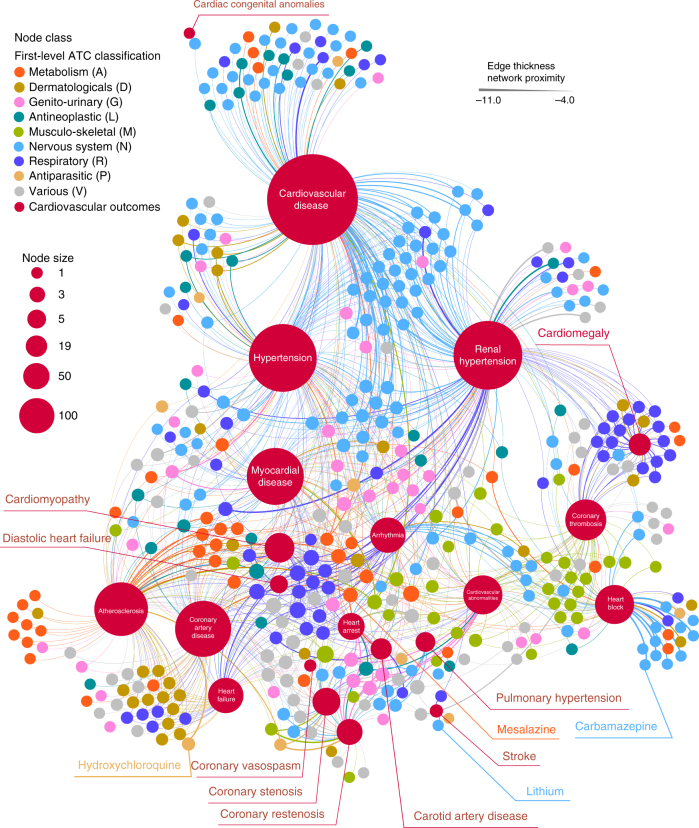
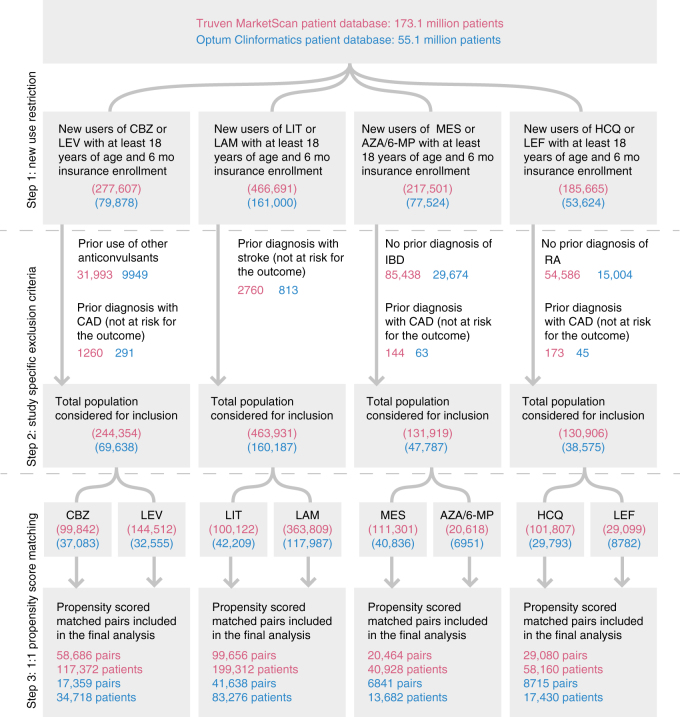
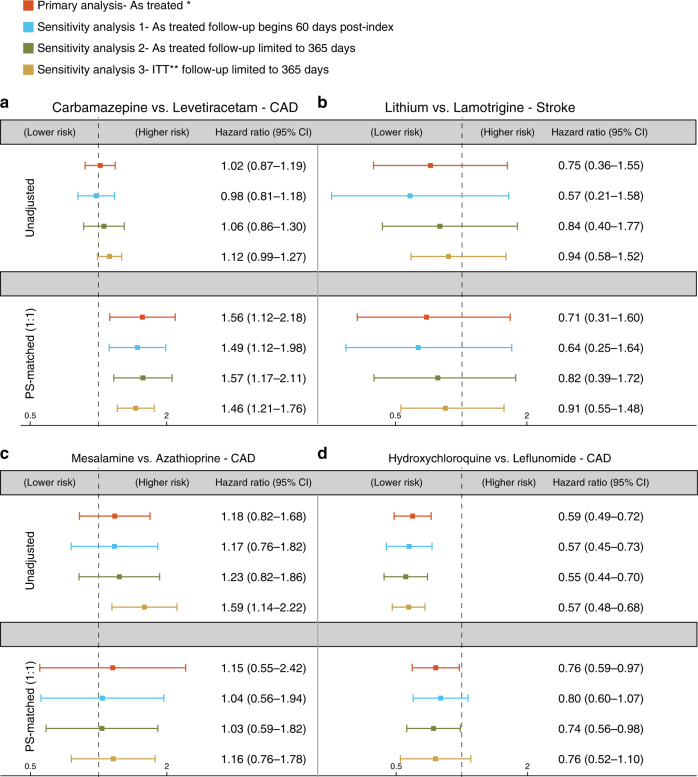
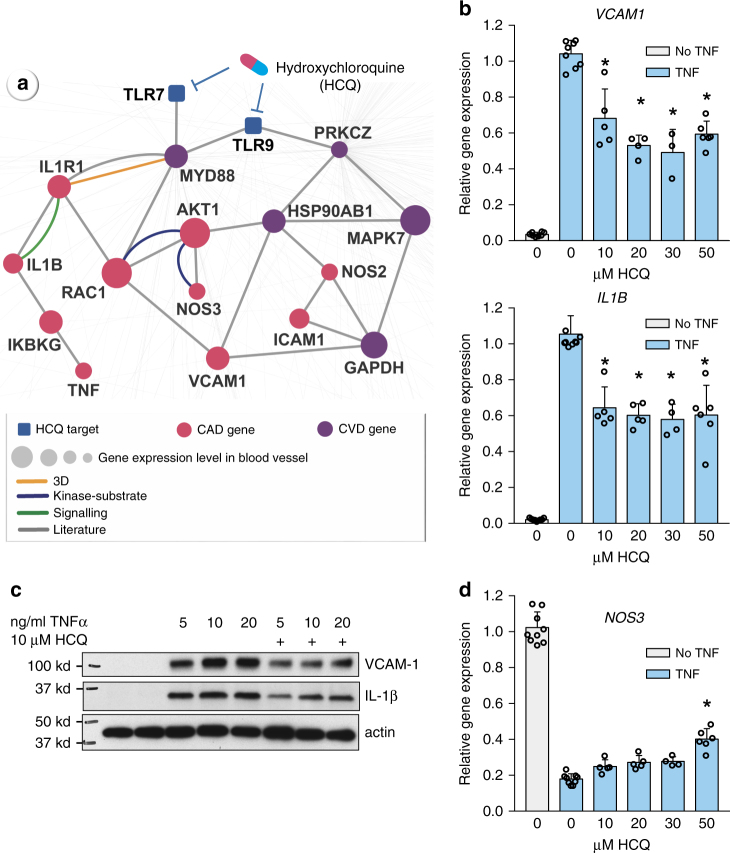
Here we identify hundreds of new drug-disease associations for over 900 FDA-approved drugs by quantifying the network proximity of disease genes and drug targets in the human (protein–protein) interactome. We select four network-predicted associations to test their causal relationship using large healthcare databases with over 220 million patients and state-of-the-art pharmacoepidemiologic analyses. Using propensity score matching, two of four network-based predictions are validated in patient-level data: carbamazepine is associated with an increased risk of coronary artery disease (CAD) [hazard ratio (HR) 1.56, 95% confidence interval (CI) 1.12–2.18], and hydroxychloroquine is associated with a decreased risk of CAD (HR 0.76, 95% CI 0.59–0.97). In vitro experiments show that hydroxychloroquine attenuates pro-inflammatory cytokine-mediated activation in human aortic endothelial cells, supporting mechanistically its potential beneficial effect in CAD. In summary, we demonstrate that a unique integration of protein-protein interaction network proximity and large-scale patient-level longitudinal data complemented by mechanistic in vitro studies can facilitate drug repurposing.
Overview
The claims and statistics of this paper haven’t been checked yet.
Run the check — free, no account needed. It reads the open-access text and checks the sources it cites.
Integrity signals
Registry
Cites
Statistics
Figures
Verification
Claims the paper makes
The claims and statistics of this paper haven’t been checked yet.
Run the check — free, no account needed. It reads the open-access text and checks the sources it cites.
Claims other papers make about this one
Each is checked against this paper’s own text: does it say what the citing paper says it does?
In the citing paper
“Because gene expression data can be noisy and variational, recent advances include fusing the co-expression matrices with existing biomedical networks, such as GO annotations and PPI, and feeding the resulting graph into graph convolution layers (Section 2.2) [150, 151, 152].”
From Graph representation learning in biomedicine and healthcare (2022) · cites this paper as [152]
In the citing paper
“Doing so has enabled more interpretable disease classification models (e.g., weighting gene interactions based on existing biological knowledge).”
From Graph representation learning in biomedicine and healthcare (2022) · cites this paper as [152]
Self-check
Percentages, sums and reported differences re-computed from the paper’s own numbers.
The self-check needs the paper’s full text.
Citations
Cites
Meta-analysis in clinical trials
DerSimonian, R., & Laird, N. (1986) · Controlled Clinical Trials · doi:10.1016/0197-2456(86)90046-2 · Cited by 39,552
The central role of the propensity score in observational studies for causal effects
ROSENBAUM, P. R., & RUBIN, D. B. (1983) · Biometrika · doi:10.1093/biomet/70.1.41 · Cited by 31,241
Database resources of the National Center for Biotechnology Information: update
Wheeler, D. L. (2003) · Nucleic Acids Research · doi:10.1093/nar/gkh073 · Cited by 10,695
Inflammation, Atherosclerosis, and Coronary Artery Disease
Hansson, G. K. (2005) · New England Journal of Medicine · doi:10.1056/nejmra043430 · Cited by 8,773
UniProt: the Universal Protein knowledgebase
Apweiler, R. (2003) · Nucleic Acids Research · doi:10.1093/nar/gkh131 · Cited by 7,593
ChEMBL: a large-scale bioactivity database for drug discovery
Gaulton, A., Bellis, L. J., Bento, A. P., Chambers, J., Davies, M., Hersey, A., Light, Y., McGlinchey, S., Michalovich, D., Al-Lazikani, B., et al. (2012) · Nucleic Acids Research · doi:10.1093/nar/gkr777 · Cited by 4,382
The unified medical language system (UMLS): integrating biomedical terminology
Bodenreider, O. (2004) · Nucleic Acids Research · doi:10.1093/nar/gkh061 · Cited by 4,356
ClinVar: public archive of relationships among sequence variation and human phenotype
Landrum, M. J., Lee, J. M., Riley, G. R., Jang, W., Rubinstein, W. S., Church, D. M., & Maglott, D. R. (2014) · Nucleic Acids Research · doi:10.1093/nar/gkt1113 · Cited by 3,516
PhosphoSitePlus, 2014: mutations, PTMs and recalibrations
Hornbeck, P. V., Zhang, B., Murray, B., Kornhauser, J. M., Latham, V., & Skrzypek, E. (2015) · Nucleic Acids Research · doi:10.1093/nar/gku1267 · Cited by 3,411
Goh, K.-I., Cusick, M. E., Valle, D., Childs, B., Vidal, M., & Barabási, A.-L. (2007) · Proceedings of the National Academy of Sciences · doi:10.1073/pnas.0701361104 · Cited by 3,242
Research works printed but not linked: 1
- Muller-Calleja, N., Manukyan, D., Canisius, A., Strand, D. & Lackner, K. J. Hydroxychloroquine inhibits proinflammatory signalling pathways by targeting endosomal NADPH oxidase. Ann. Rheum. Dis. 76, 891–897 (2016). · DOI
Cited by
Sorted by citations
Items 501–573 of 573
Schäfer, S., Smelik, M., Sysoev, O., Zhao, Y., Eklund, D., Lilja, S., Gustafsson, M., Heyn, H., Julia, A., Kovács, I. A., et al. (2024) · Figshare · doi:10.6084/m9.figshare.26695929
Self-citationWang, Y., Zou, Z., Wang, S., Ren, A., Ding, Z., Li, Y., Wang, Y., Qian, Z., Bian, B., Huang, B., et al. (2024) · Figshare · doi:10.6084/m9.figshare.26687834
Leighton, J., Jones, D. E. J., Dyson, J. K., & Cordell, H. J. (2024) · Figshare · doi:10.6084/m9.figshare.26019707
Schäfer, S., Smelik, M., Sysoev, O., Zhao, Y., Eklund, D., Lilja, S., Gustafsson, M., Heyn, H., Julia, A., Kovács, I. A., et al. (2024) · Figshare · doi:10.6084/m9.figshare.25449100
Self-citationAdditional file 3 of SAveRUNNER: an R-based tool for drug repurposing
Fiscon, G., & Paci, P. (2021) · Figshare · doi:10.6084/m9.figshare.14302887
Ren, A., Wu, T., Wang, Y., Fan, Q., Yang, Z., Zhang, S., Cao, Y., & Cui, G. (2024) · Figshare · doi:10.6084/m9.figshare.26610144
Ren, A., Wu, T., Wang, Y., Fan, Q., Yang, Z., Zhang, S., Cao, Y., & Cui, G. (2024) · Figshare · doi:10.6084/m9.figshare.26610150
Schäfer, S., Smelik, M., Sysoev, O., Zhao, Y., Eklund, D., Lilja, S., Gustafsson, M., Heyn, H., Julia, A., Kovács, I. A., et al. (2024) · Figshare · doi:10.6084/m9.figshare.26695920
Self-citationZhou, Y., Xu, J., Hou, Y., Leverenz, J. B., Kallianpur, A. R., Mehra, R., Liu, Y., Yu, H., Pieper, A. A., Jehi, L., et al. (2021) · Figshare · doi:10.6084/m9.figshare.14759706
Self-citationSchäfer, S., Smelik, M., Sysoev, O., Zhao, Y., Eklund, D., Lilja, S., Gustafsson, M., Heyn, H., Julia, A., Kovács, I. A., et al. (2024) · Figshare · doi:10.6084/m9.figshare.26695923
Self-citationLeighton, J., Jones, D. E. J., Dyson, J. K., & Cordell, H. J. (2024) · Figshare · doi:10.6084/m9.figshare.26732416
Zhou, Y., Xu, J., Hou, Y., Leverenz, J. B., Kallianpur, A. R., Mehra, R., Liu, Y., Yu, H., Pieper, A. A., Jehi, L., et al. (2021) · Figshare · doi:10.6084/m9.figshare.14759694
Self-citationWang, Y., Zou, Z., Wang, S., Ren, A., Ding, Z., Li, Y., Wang, Y., Qian, Z., Bian, B., Huang, B., et al. (2024) · Figshare · doi:10.6084/m9.figshare.26687837
Schäfer, S., Smelik, M., Sysoev, O., Zhao, Y., Eklund, D., Lilja, S., Gustafsson, M., Heyn, H., Julia, A., Kovács, I. A., et al. (2024) · Figshare · doi:10.6084/m9.figshare.25448998
Self-citationSchäfer, S., Smelik, M., Sysoev, O., Zhao, Y., Eklund, D., Lilja, S., Gustafsson, M., Heyn, H., Julia, A., Kovács, I. A., et al. (2024) · Figshare · doi:10.6084/m9.figshare.26695926
Self-citationBayraktar, A., Li, X., Kim, W., Zhang, C., Turkez, H., Shoaie, S., & Mardinoğlu, A. (2024) · Figshare · doi:10.6084/m9.figshare.26590631
Ren, A., Wu, T., Wang, Y., Fan, Q., Yang, Z., Zhang, S., Cao, Y., & Cui, G. (2024) · Figshare · doi:10.6084/m9.figshare.26610147
Wang, Y., Zou, Z., Wang, S., Ren, A., Ding, Z., Li, Y., Wang, Y., Qian, Z., Bian, B., Huang, B., et al. (2024) · Figshare · doi:10.6084/m9.figshare.26687840
Zhou, Y., Fang, J., Bekris, L. M., Kim, Y. H., Pieper, A. A., Leverenz, J. B., Cummings, J. L., & Cheng, F. (2021) · Figshare · doi:10.6084/m9.figshare.13572118
Self-citationSchäfer, S., Smelik, M., Sysoev, O., Zhao, Y., Eklund, D., Lilja, S., Gustafsson, M., Heyn, H., Julia, A., Kovács, I. A., et al. (2024) · Figshare · doi:10.6084/m9.figshare.26695932
Self-citationWang, Y., Zou, Z., Wang, S., Ren, A., Ding, Z., Li, Y., Wang, Y., Qian, Z., Bian, B., Huang, B., et al. (2024) · Figshare · doi:10.6084/m9.figshare.26687831
Ren, A., Wu, T., Wang, Y., Fan, Q., Yang, Z., Zhang, S., Cao, Y., & Cui, G. (2024) · Figshare · doi:10.6084/m9.figshare.26610153
Leighton, J., Jones, D. E. J., Dyson, J. K., & Cordell, H. J. (2024) · Figshare · doi:10.6084/m9.figshare.26019517
Li, B., Zhang, J., Dong, H., Feng, X., Yu, L., Zhu, J., & Zhang, J. (2024) · Figshare · doi:10.6084/m9.figshare.24522867
Survey on Deep Learning Methods in Drug Repurposing
Elsoud, A. A., Mounir, M., Gad, W. K., & Badr, N. L. (2025) · International Conference on Intelligent Computing and Information Systems (ICICIS) · doi:10.1109/icicis66182.2025.11313173 · Cited by 1
From Code to Cure: Computational Strategies in Drug Repurposing
Sijina, K. P., & Rajanikant, G. K. (2025) · Springer handbooks · doi:10.1007/978-3-031-81728-1_32
Daclatasvir, A Symmetric Drug for an Anti-Symmetric Target
Córdova-Bahena, L., Sánchez-Álvarez, A. A., López-Lerma, I., Salinas-Jazmín, N., Medina‐Franco, J. L., & Velasco-Velázquez, M. A. (2026) · Journal of the Mexican Chemical Society · doi:10.29356/jmcs.v70i1.2393
Drug repositioning by belief networks and ensemble method
Le, M. H., Anh, D. N., & Dang, X. T. (2026) · Biomedical Physics & Engineering Express · doi:10.1088/2057-1976/ae43f0
The KD Atlas: A Multi-Omics Network Resource for Kidney Disease ResearchPreprint
Nsangou, Y. A. N., Haug, S., Wörheide, M. A., Bellur, O., Römisch‐Margl, W., Dönitz, J., Köttgen, A., Arnold, M., & Kastenmüller, G. (2026) · medRxiv · doi:10.64898/2026.02.19.26346652
Zhu, Z., & He, X. (2026) · Frontiers in Pharmacology · doi:10.3389/fphar.2026.1770261
“…target candidates were inferred using the Similarity Ensemble Approach (SEA; https://sea.bkslab.org/) based on chemical similarity profiles (Cheng et al., 2018), and the spironolactone structure was queried in SwissTargetPrediction (https://www.swisstargetprediction.ch/) to obtain…”
BioMNEDR: mechanism-guided network embedding for drug repurposing
Zeng, Y., Wang, L., & Liu, X. (2026) · Briefings in Bioinformatics · doi:10.1093/bib/bbag101
“Specifically, overly long paths (exceeding five nodes) were excluded based on empirical and methodological literature indicating that such extended paths tend to introduce semantic noise and weaken mechanism-specific associations [26].”
Reimer, R. J., Soper, B., Wilson, J. L., Goncalves, A. R., Cadena, J., Suarez, P., Gryshuk, A. L., Osborne, T. F., Grimes, K., & Ray, P. (2026) · The Lancet Digital Health · doi:10.1016/j.landig.2025.100963
Zaidi, A. Z., Meenakshi, K., & Kushwaha, P. K. (2025) · International Conference on Advances in Computation, Communication and Information Technology (ICAICCIT) · doi:10.1109/icaiccit68829.2025.11434046
“Studies by Cheng et al. (2018) demonstrated that network proximity measures could predict drug repurposing opportunities with 76% accuracy [5],[15],[17].”
Drug repurposing: Innovative antimicrobial strategies for discovering new antibiotics
Luo, Q., & Guo, J. (2026) · Elsevier eBooks · doi:10.1016/b978-0-443-36518-8.00014-x
Sun, G., & Zhou, Y. (2026) · Briefings in Bioinformatics · doi:10.1093/bib/bbag129
“Existing network-based methods [2, 5] are largely static, identifying disease-associated genes without predictive models for therapeutic intervention effects [4, 6].”
Circadian rhythm involvement in the host immune response
Diallo, A. B. (2020) · theses.fr (ABES) · doi:10.70675/d0ae13c6zedf6z402cz9fbfz469e58c326a0
Pathophysiological study of Tropheryma whipplei infections
Boumaza, A. F. (2021) · theses.fr (ABES) · doi:10.70675/d5f58b7cz43a0z4857za270zcb40959daf0d
Yan, X., Guo, Z., Zhou, F., Cui, Y., Zhang, Z., Jing, Z., Wang, L., Fan, Z., Lu, J., Xing, X., et al. (2026) · Journal of Advanced Research · doi:10.1016/j.jare.2026.04.010
STDrug enables spatially informed personalized drug repurposing from spatial transcriptomicsPreprint
Yang, Y., Unjitwattana, T., Zhou, S. W., Kadomoto, S., Yang, X., Chen, T., Karaaslanli, A., Du, Y., Zhang, W., Liang, H., et al. (2026) · bioRxiv (Cold Spring Harbor Laboratory) · doi:10.64898/2026.04.03.715101
Premières étapes dans l'interaction hôte-pathogène : rôle de l'immunité locale et innée
Michel, M. (2022) · theses.fr (ABES) · doi:10.70675/4647f4d2zd802z40abza572z8ff228db523f
PRL2/PTP4A2, a modulator of lymphatic functions and inflammation
Magaut, R. (2023) · theses.fr (ABES) · doi:10.70675/bf04d860z767fz4413z8ba9z70496d71fff7
Liao, Y., Shen, C., Sun, L., Ding, P., Luo, L., & Luo, J. (2026) · Computational Biology and Chemistry · doi:10.1016/j.compbiolchem.2026.109065
Arora, H. S., Dhakal, S., Psarellis, Y. M., Chandrasekaran, S., Mavroudis, P. D., & Pillai, N. (2026) · bioRxiv (Cold Spring Harbor Laboratory) · doi:10.64898/2026.04.14.718573
“…structure, known side effects, etc., and their corresponding MeSH (Medical Subject Headings) terms, drug-drug and disease-disease similarity, drug-disease associations, gene-expression profiles, and proteomic proximity to identify overlap between drug targets and disease pathways [10]– [14].”
Metapath-guided transfer learning with clinical validation for identifying herb-drug interactions
Lee, W.-Y., Mo, K. H., Kim, S., Keum, D. H., Jin, B. H., Kim, S., Han, Y., Kim, Y., Park, S., Yoo, H. H., et al. (2026) · Phytomedicine · doi:10.1016/j.phymed.2026.158421
Lüleci, H. B., Jones, A., Neff, R. A., Bennett, D. A., Zhang, B., Çakır, T., & Thambisetty, M. (2026) · Molecular Neurobiology · doi:10.1007/s12035-026-05978-7
“Furthermore, we applied a GEM-based drug target prediction algorithm [15] to identify candidate therapeutic targets to reverse metabolic perturbations in each subgroup [16].”
Decoding Gene-Disease Associations With Computational Methods: A Survey
Zhai, Y., Li, M., Yu, L., Wang, X., Luo, S., & Yang, L. (2026) · IEEE Transactions on Computational Biology and Bioinformatics · doi:10.1109/tcbbio.2026.3707525
“Computational approaches seek to systematically predict GDAs by integrating statistical and machine learning models, thereby supporting early detection, risk stratification, and precision medicine initiatives [3].”
InfluentialTizhe, D. T., Ogra, I. O., Adaji, J. Z., Usman, S., Apeji, Y. E., Kwaga, J. K. P., Kia, G. S. N., & Sossou, K. (2026) · Malaria Journal · doi:10.1186/s12936-026-06015-7
“Key approaches such as network-based analyses, machine learning models, and signature-matching techniques have generated viable candidate drugs by identifying shared molecular pathways between drugs and diseases [5, 6].”
Huang, T., Bai, J., Cui, X., Chen, X., Chen, Y., & Liang, Z. (2026) · Research Square · doi:10.21203/rs.3.rs-8583672/v1
Computational approaches to pleiotropic drug design for intestinal ischemia-reperfusion injury
Hezekiah, O. S., Afolabi, O. A., Ajike, R. A., Oyekunle, O. S., Ezekiel Oladele, O. J. O., & KOMOLAFE, A. I. (2026) · In Silico Research in Biomedicine · doi:10.1016/j.insi.2026.100511
Anderson, M., Wong, L., & Lee, S. (2025) · International Journal of Pharmaceutical and Phytopharmacological Research · doi:10.51847/mjhdttrbdk
Zhang, W., Hui, C., & Tan, M. (2025) · International Journal of Pharmaceutical and Phytopharmacological Research · doi:10.51847/vtfecfftct
Taylor, W., Davis, E., & Wilson, T. (2025) · International Journal of Pharmaceutical and Phytopharmacological Research · doi:10.51847/tpll52sy4s
Mwangi, J., Wanjiru, G., Kiprop, S., & Atieno, C. (2025) · International Journal of Pharmaceutical and Phytopharmacological Research · doi:10.51847/toaoxanf3i
Leveraging Machine Learning for Network Pharmacology
Singh, S. D., & Nagamani, S. (2026) · Royal Society of Chemistry eBooks · doi:10.1039/9781837070206-00721
AI-Driven Drug Repurposing Strategies for Precision Therapy in Breast Cancer
Jakkula, B. K., & Shyam, P. (2026) · Pharmaceutical science. · doi:10.5772/intechopen.1016336
Tian, S.-S., Lu, J., Guo, C., Gu, W., Huang, P., Xu, X.-K., Wang, Q., & Zhang, W.-D. (2026) · Engineering · doi:10.1016/j.eng.2026.07.014
Costa, R., Watson, E., Benziane, K., & Silva, A. (2025) · Pharmacophore · doi:10.51847/49pn9gi36y
Raju, K. V., Sathvika, A., & Nori, L. P. (2026) · Letters in Applied NanoBioScience · doi:10.33263/lianbs152.082
“This method identifies probable pathways for new drug-disease indications, side effects, and the impacts of established medications, thereby addressing critical challenges in drug development and care [48].”
Zhang, Z., Wang, M., Yang, W., Li, S., Cai, Y., Chen, J., Chen, X., Gu, M., & Gu, Y. (2026) · Journal of Ethnopharmacology · doi:10.1016/j.jep.2026.122349
Brecher, V., Androutsopoulou, V. A., Sicouri, S., Ramlawi, B., Avgerinos, D. V., Athanasiou, T., & Magouliotis, D. E. (2026) · Frontiers in Systems Biology · doi:10.3389/fsysb.2026.1897299
Hazra, M., & Anandaram, H. (2026) · Frontiers in Pharmacology · doi:10.3389/fphar.2026.1915973
“…biological contextualization, and mechanistic interpretability (Huaneg et al., 2024; Jiménez et al., 2024; Ma et al., 2023; Guney et al., 2016; Cheng et al., 2018; Himmelstein et al., 2017), while real-world repurposing methods rely on observational patient data or emulated trials to test…”
InfluentialWu, X., Wang, H., Zhang, L., Wang, B., Tan, X., Zhu, L., Nie, J., & Liu, D. (2026) · Microbiology Spectrum · doi:10.1128/spectrum.03825-25
Bai, L., Hu, F., Zhan, X., & Liu, C. (2026) · Neurocomputing · doi:10.1016/j.neucom.2026.135201
Lim, D. (2026) · International Journal of Molecular Sciences · doi:10.3390/ijms27198548
“A framework that first learns the molecular characteristics of established therapeutic drugs and subsequently applies this learned representation to candidate formulations may therefore provide a complementary and less candidate-centered strategy for prioritization [15].”
In Vivo Transcriptomics-Based Framework for Systematic Indication ExpansionPreprint
Palmer, Z., Koirala, S., Talukdar, N., Zhang, X., Garver, H. S., Mahlmeister, M., Huang, L., Joseph, D., Leshchiner, D. R., Shankar, R., et al. (2026) · bioRxiv (Cold Spring Harbor Laboratory) · doi:10.64898/2026.10.12.758524
Jurj, E.-D., Voicu, A., Colibăşanu, D., Voicu, M., Nicolov, M. F., & Udrescu, L. (2026) · Pharmaceuticals · doi:10.3390/ph19101634
BindingDB Entry 50018470: Repurposed drug candidates for antituberculosis therapy.
BindingDB (2024) · UC San Diego · doi:10.7270/q2zk5mvq
Immunogenetic regulation of organ crosstalk in long COVID
Rajendran, M., Sekar, P. K. C., & Veerabathiran, R. (2026) · Academia Immunity and Disease · doi:10.20935/acadimmunodis8621
Liao, J., Wang, Y., Zhang, J., Xie, T., Yang, P., Zhao, L., Gao, T., Wang, Q., 梁杰佳, Li, Q., et al. (2026) · Frontiers in Cardiovascular Medicine · doi:10.3389/fcvm.2026.1886312
Li, X., & Gozes, I. (2026) · Frontiers in Pharmacology · doi:10.3389/fphar.2026.1999276
Metadata
- Authors
- Cheng, F., Desai, R. J., Handy, D. E., Wang, R., Schneeweiss, S., Barabási, A.-L., & Loscalzo, J.
- Affiliations
- Northeastern University (US)
- Brigham and Women's Hospital (US)
- Corresponding author
- Loscalzo, Joseph
- Venue
- Nature Communications
- Published
- 2018-07-12
- Volume
- 9
- Issue
- 1
- Pages
- 2691-2691
- ISSN
- 2041-1723 (ISSN-L)
- PMC
- PMC6043492
- OpenAlex
- W2826750344
- Cited by
- 552
- References
- 90
- Citations by year
- 2026: 47 · 2025: 66 · 2024: 60 · 2023: 58 · 2022: 88 · 2021: 97 · 2020: 86 · 2019: 43 · 2018: 5
- FWCI
- 43.38
- Type
- journal article
- Language
- en
- Open access
- gold
- doi.org
- Locations
- Nature Communications (publishedVersion, cc-by)
- Europe PMC (PubMed Central) (publishedVersion, other-oa)
- PubMed Central (publishedVersion, cc-by)
- PubMed (publishedVersion)
- RePEc: Research Papers in Economics (submittedVersion)
- DOAJ (DOAJ: Directory of Open Access Journals) (submittedVersion, cc-by-sa)
- DOAJ (DOAJ: Directory of Open Access Journals) (submittedVersion)
- Open Research (Auckland University of Technology) (submittedVersion, cc-by)
- Funders
- U.S. Department of Health & Human Services | National Institutes of Health (HL106373, HG007690, GM 107618, HL016795, HL108630)
- Patient-Centered Outcomes Research Institute (ME-1303-5638)
- Topics
- Life Sciences › Pharmacology, Toxicology and Pharmaceutics › Drug Discovery › Computational Drug Discovery Methods
- Life Sciences › Biochemistry, Genetics and Molecular Biology › Molecular Biology › Bioinformatics and Genomic Networks
- Life Sciences › Biochemistry, Genetics and Molecular Biology › Genetics › Genetic Associations and Epidemiology
- Keywords
- drug repurposing, protein-protein interaction network, network proximity, drug-disease associations, coronary artery disease, carbamazepine, hydroxychloroquine, pharmacoepidemiology, propensity score matching, endothelial inflammation, inflammatory cytokines, FDA-approved drugs
- MeSH terms
- Carbamazepine, Computer Simulation, Coronary Artery Disease, Humans, Hydroxychloroquine, Prognosis, Risk Factors, Reproducibility of Results, Proportional Hazards Models, Databases, Factual, Risk Assessment, Propensity Score, Drug Repositioning, Protein Interaction Maps
About these checks
Registry, retraction, Cites and statistics results are computed, not judged, with one exception: a printed reference that no index lists is read once by a model before it counts as a citation error. Claims are extracted by a model and kept only when their quote appears verbatim in the text; each cited source is then checked, with a model’s help, for whether it says what the claim relies on. Those verdicts can be wrong — read the claim’s quote and the cited source before relying on one.
Statistics and arithmetic are recomputed, not judged.
Confidence bands are shown only for fields calibrated on our annotated test set. None is calibrated yet, so no band is shown.
What counts as a claim ›How we measure confidence ›How we check this ›
Are you an author, or do you see a problem with this page? Request a review
