

Mechanically tunable conductive interpenetrating network hydrogels that mimic the elastic moduli of biological tissue
Open accessThe DOI matches its Crossref record; 47 of the 48 references it cites were found in a registry or an index.
Abstract
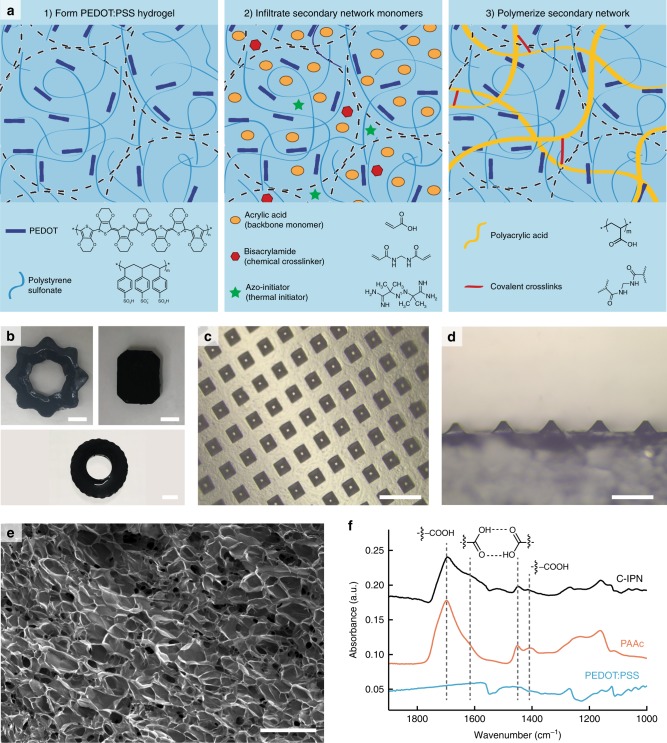
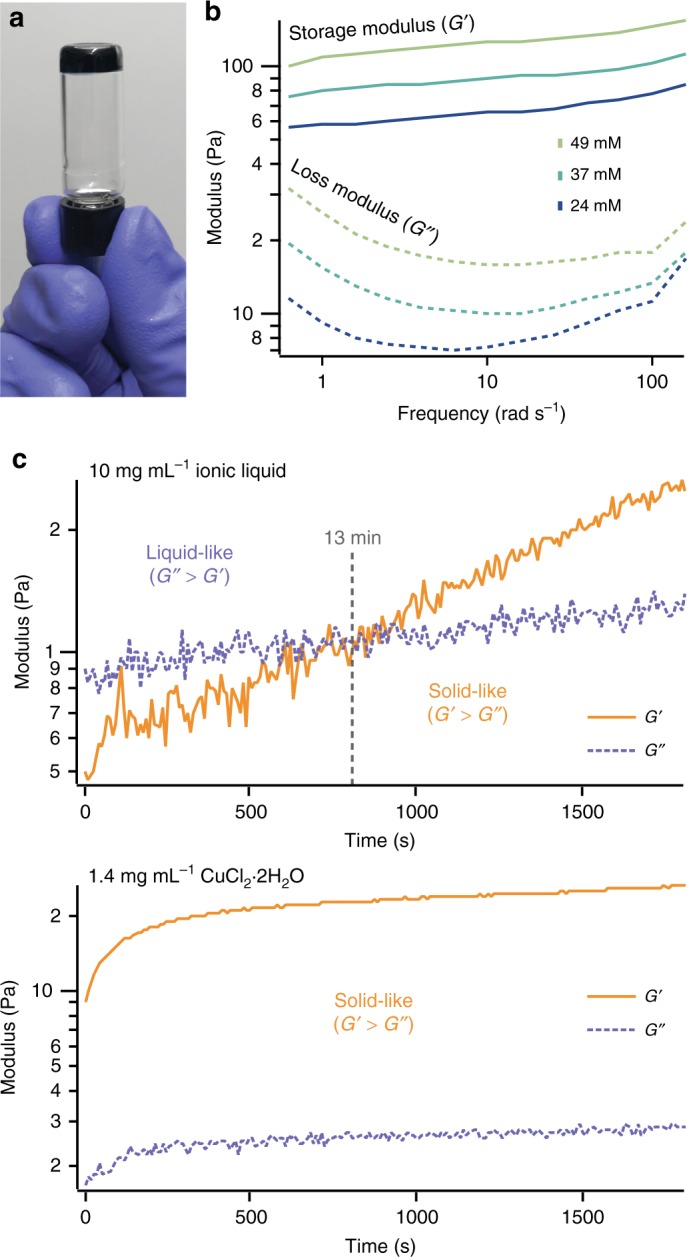
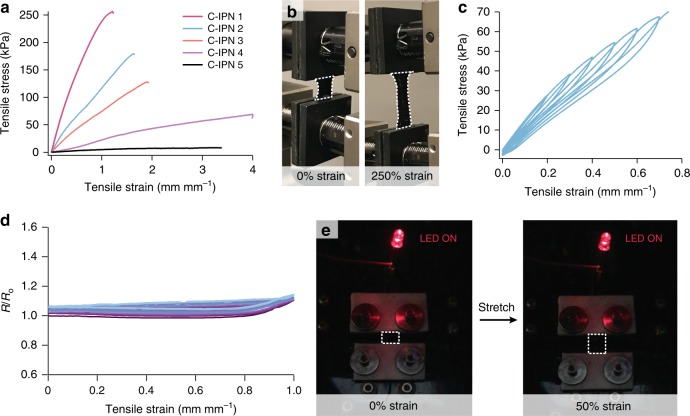
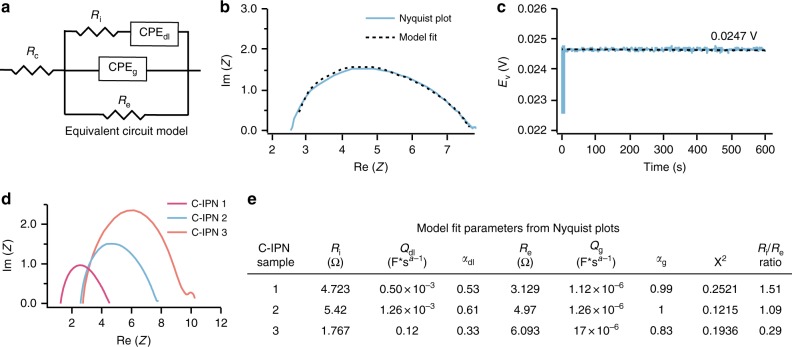
Conductive and stretchable materials that match the elastic moduli of biological tissue (0.5–500 kPa) are desired for enhanced interfacial and mechanical stability. Compared with inorganic and dry polymeric conductors, hydrogels made with conducting polymers are promising soft electrode materials due to their high water content. Nevertheless, most conducting polymer-based hydrogels sacrifice electronic performance to obtain useful mechanical properties. Here we report a method that overcomes this limitation using two interpenetrating hydrogel networks, one of which is formed by the gelation of the conducting polymer PEDOT:PSS. Due to the connectivity of the PEDOT:PSS network, conductivities up to 23 S m −1 are achieved, a record for stretchable PEDOT:PSS-based hydrogels. Meanwhile, the low concentration of PEDOT:PSS enables orthogonal control over the composite mechanical properties using a secondary polymer network. We demonstrate tunability of the elastic modulus over three biologically relevant orders of magnitude without compromising stretchability ( > 100%) or conductivity ( > 10 S m − 1 ).
Overview
The claims and statistics of this paper haven’t been checked yet.
Free: it reads the open-access text and checks the first 5 claims that cite a source we can check. Create a free account to check every claim.
Integrity signals
Registry
Cites
Statistics
Figures
Verification
Claims the paper makes
The claims and statistics of this paper haven’t been checked yet.
Free: it reads the open-access text and checks the first 5 claims that cite a source we can check. Create a free account to check every claim.
Claims other papers make about this one
Each is checked against this paper’s own text: does it say what the citing paper says it does?
The source backs part of the claim, not all of it — or backs it for a different population, condition or comparison.
In the citing paper
“In addition, the combination of hydrogels and conductive polymers is a hot area of research since the former has mechanical properties similar to those of nerves and can provide a hydrophilic interface that reduces the adhesion of non-specific proteins.[58,539–542]”
From Flexible Electronics and Devices as Human–Machine Interfaces for Medical Robotics (2022) · cites this paper as [540]
Experimental — accuracy not yet measured
Self-check
Percentages, sums and reported differences re-computed from the paper’s own numbers.
The self-check needs the paper’s full text.
Citations
Cites
Tissue Cells Feel and Respond to the Stiffness of Their Substrate
Discher, D. E., Janmey, P., & Wang, Y.-L. (2005) · Science · doi:10.1126/science.1116995 · Cited by 6,382
Highly stretchable and tough hydrogels
Sun, J.-Y., Zhao, X., Illeperuma, W. R. K., Chaudhuri, O., Oh, K. H., Mooney, D. J., Vlassak, J. J., & Suo, Z. (2012) · Nature · doi:10.1038/nature11409 · Cited by 5,481
A general relationship between disorder, aggregation and charge transport in conjugated polymers
Noriega, R., Rivnay, J., Vandewal, K., Koch, F. P. V., Stingelin, N., Smith, P., Toney, M. F., & Salleo, A. (2013) · Nature Materials · doi:10.1038/nmat3722 · Cited by 2,206
A highly stretchable, transparent, and conductive polymer
Wang, Y., Zhu, C., Pfattner, R., Yan, H., Jin, L., Chen, S., Molina-Lopez, F., Lissel, F., Liu, J., Rabiah, N. I., et al. (2017) · Science Advances · doi:10.1126/sciadv.1602076 · Cited by 1,442
Self-citationMulti-scale multi-mechanism design of tough hydrogels: building dissipation into stretchy networks
Zhao, X. (2014) · Soft Matter · doi:10.1039/c3sm52272e · Cited by 1,252
The role of matrix stiffness in regulating cell behavior†
Wells, R. G. (2008) · Hepatology · doi:10.1002/hep.22193 · Cited by 1,059
Yang, T., Gregori, G., Pellet, N., Grätzel, M., & Maier, J. (2015) · Angewandte Chemie International Edition · doi:10.1002/anie.201500014 · Cited by 553
Deep-Brain Stimulation for Parkinson's Disease
Okun, M. S. (2012) · New England Journal of Medicine · doi:10.1056/nejmct1208070 · Cited by 541
Chen, Q.-Z., Bismarck, A., Hansen, U., Junaid, S., Tran, M. Q., Harding, S. E., Ali, N. N., & Boccaccini, A. R. (2008) · Biomaterials · doi:10.1016/j.biomaterials.2007.09.010 · Cited by 530
Biomechanical Properties of In Vivo Human Skin From Dynamic Optical Coherence Elastography
Liang, X., & Boppart, S. A. (2010) · IEEE Transactions on Biomedical Engineering · doi:10.1109/tbme.2009.2033464 · Cited by 470
Research works printed but not linked: 1
- Grill, W. M. in Indwelling Neural Implants: Strategies for Contending with the In Vivo Environment (ed. WM, R.) (CRC Press/Taylor & Francis, 2008). 21204399
Cited by
Items 301–400 of 643
Rijns, L., Peeters, J. W., Hendrikse, S. I. S., Vleugels, M. E. J., Lou, X., Janssen, H. M., Meijer, E. W., & Dankers, P. Y. W. (2023) · Chemistry of Materials · doi:10.1021/acs.chemmater.3c01676 · Cited by 36
Liao, Y., Liu, C., Guo, L., Wang, L., Xu, S., Zhou, G., Zhou, S., & Yuan, M. (2024) · Chemical Engineering Journal · doi:10.1016/j.cej.2024.153666 · Cited by 36
Yang, J., Chang, L., Ma, C., Cao, Z., & Liu, H. (2021) · Macromolecular Rapid Communications · doi:10.1002/marc.202100557 · Cited by 36
Fast Visible‐Light 3D Printing of Conductive PEDOT:PSS Hydrogels
Lopez‐Larrea, N., Gallastegui, A., Lezama, L. M., Criado‐Gonzalez, M., Casado, N., & Mecerreyes, D. (2023) · Macromolecular Rapid Communications · doi:10.1002/marc.202300229 · Cited by 36
Liquid metal–hydrogel composites for flexible electronics
Chen, J., Tian, G., Liang, C., Yang, D., Zhao, Q., Liu, Y., & Qi, D. (2023) · Chemical Communications · doi:10.1039/d3cc04198k · Cited by 37
Yang, Y., Ma, Y., Wang, J., Zhang, R., Wu, M., Zhong, S., He, W., & Cui, X. (2024) · ACS Applied Materials & Interfaces · doi:10.1021/acsami.4c09465 · Cited by 35
Wireless, Programmable, and Refillable Hydrogel Bioelectronics for Enhanced Diabetic Wound Healing
Du, N., Fan, Y., Zhang, Y., Huang, H., Lyu, Y., Cai, R., Zhang, Y., Zhang, T., Guan, Y., & Nan, K. (2024) · Advanced Science · doi:10.1002/advs.202407820 · Cited by 35
Cell-free biodegradable electroactive scaffold for urinary bladder tissue regeneration
Keate, R. L., Bury, M. I., Mendez-Santos, M., Gerena, A., Goedegebuure, M. M., Rivnay, J., Sharma, A. K., & Ameer, G. A. (2025) · Nature Communications · doi:10.1038/s41467-024-55401-9 · Cited by 35
Wu, J., Hong, J., Gao, X., Wang, Y., Wang, W., Zhang, H., Park, J., Shi, W., & Guo, W. (2025) · Gels · doi:10.3390/gels11080589 · Cited by 35
“The bio-compatibility of hydrogels is influenced by various factors, including chemical composition, molecular structure, surface characteristics, and pore structure, which collectively determine their ability to interact with biological tissues [70].”
Nikolka, M., Simatos, D., Foudeh, A. M., Pfattner, R., McCulloch, I. A., & Bao, Z. (2020) · ACS Applied Materials & Interfaces · doi:10.1021/acsami.0c10201 · Cited by 35
Self-citationKneading‐Inspired Versatile Design for Biomimetic Skins with a Wide Scope of Customizable Features
Huang, J., & Wu, P. (2022) · Advanced Science · doi:10.1002/advs.202200108 · Cited by 35
Super-soft, firm, and strong elastomers toward replication of tissue viscoelastic response
Dashtimoghadam, E., Maw, M., Keith, A. N., Vashahi, F., Kempkes, V., Gordievskaya, Y. D., Kramarenko, E. Y., Bersenev, E. A., Nikitina, E. A., Ivanov, D. A., et al. (2022) · Materials Horizons · doi:10.1039/d2mh00844k · Cited by 36
Gradual Morphological Change in PEDOT:PSS Thin Films Immersed in an Aqueous Solution
Lee, I., Park, S., Lee, Y. S., Kim, Y., Kang, M. H., & Yun, C. (2023) · Langmuir · doi:10.1021/acs.langmuir.2c03038 · Cited by 34
Zhang, Y., Li, Z., Xu, Z., Xiao, M., Yuan, Y., Jia, X., Shi, R., Zhang, L., & Wan, P. (2024) · Aggregate · doi:10.1002/agt2.566 · Cited by 34
Fabrication of conducting polymer microelectrodes and microstructures for bioelectronics
Zhang, P., & Travaš‐Sejdić, J. (2021) · Journal of Materials Chemistry C · doi:10.1039/d1tc01618k · Cited by 34
Rehman, T. U., Khan, S. A., Shah, L. A., & Fu, J. (2025) · Materials Advances · doi:10.1039/d4ma00992d · Cited by 33
Fang, G., Zhao, R., Zhu, L., Wang, Q., Peng, S., Kang, L., Lu, H. S., Zhang, G., & Tang, B. (2025) · Journal of Controlled Release · doi:10.1016/j.jconrel.2024.12.075 · Cited by 36
Tu, S., Tian, T., Zhang, J., Liang, S., Pan, G., Ma, X., Liu, L., Fischer, R. A., & Müller‐Buschbaum, P. (2024) · ACS Nano · doi:10.1021/acsnano.4c12502 · Cited by 31
Recent Progress of Biomaterial-Based Hydrogels for Wearable and Implantable Bioelectronics
Chen, B., Zhu, Y., Yu, R., Feng, Y., Han, Z., Liu, C., Zhu, P., Lu, L., & Mao, Y. (2025) · Gels · doi:10.3390/gels11060442 · Cited by 31
Wang, T., Liu, J., Zhao, Y., & Lu, Y. (2025) · Bioactive Materials · doi:10.1016/j.bioactmat.2025.06.015 · Cited by 32
Recent Progress and Future Prospects in Transient Polymer Electronics
Chan, E. W. C., Sun, X., & Travaš‐Sejdić, J. (2023) · Macromolecules · doi:10.1021/acs.macromol.3c00254 · Cited by 32
Sun, M., Qiu, J., Jin, S., Liu, W., & Sakai, E. (2020) · Colloids and Surfaces A Physicochemical and Engineering Aspects · doi:10.1016/j.colsurfa.2020.125438 · Cited by 31
Chemical Circularity in 3D Printing with Biobased Δ‐Valerolactone
Yue, L., Su, Y., Li, M., Yu, L., Sun, X., Cho, J., Brettmann, B. K., Gutekunst, W. R., Ramprasad, R., & Qi, H. J. (2024) · Advanced Materials · doi:10.1002/adma.202310040 · Cited by 30
Standardized Electrochemical Characterization of Conductive Hydrogels
Daso, R. E., Posey, R. G., Garza, H., Perry, A., Petersen, C., Fritz, A. C., Rivnay, J., & Tropp, J. (2025) · Advanced Functional Materials · doi:10.1002/adfm.202508859 · Cited by 30
Casado, N., Zendegi, S., Tomé, L. C., Velasco‐Bosom, S., Aguzin, A., Picchio, M. L., Criado‐Gonzalez, M., Malliaras, G. G., Forsyth, M., & Mecerreyes, D. (2022) · Journal of Materials Chemistry C · doi:10.1039/d2tc03248a · Cited by 30
Taussig, L., Ghasemi, M., Han, S., Kwansa, A. L., Li, R., Keene, S. T., Woodward, N., Yingling, Y. G., Malliaras, G. G., Gomez, E. D., et al. (2024) · Matter · doi:10.1016/j.matt.2023.12.021 · Cited by 30
Wang, J., Zhang, C.-N., Xu, X., Sun, T., Kong, L.-C., & Ning, R. (2024) · ACS Omega · doi:10.1021/acsomega.4c08537 · Cited by 30
Wan, S., Wu, N., Ye, Y., Li, S., Huang, H., Chen, L., Bi, H., & Sun, L. (2021) · Small Structures · doi:10.1002/sstr.202100105 · Cited by 29
Ascidian-Inspired Supramolecular Cellulose Nanocomposite Hydrogels with Antibacterial Activity
Carnicero, A., González, A., Dalosto, S. D., Passeggi, M. C. G., Minari, R. J., Igarzabal, C. I. Á., Martinelli, M., & Picchio, M. L. (2022) · ACS Biomaterials Science & Engineering · doi:10.1021/acsbiomaterials.2c00935 · Cited by 29
Hydrogels in wearable neural interfaces
Yao, M., Hsieh, J.-C., Tang, K. W. K., & Wang, H. (2024) · Med-X · doi:10.1007/s44258-024-00040-4 · Cited by 28
“…while synthetic options like polyethylene glycol [70–72], polyacrylamide [35, 42, 55, 65, 73–76], polyvinyl alcohol [77–81], polyacrylic acid [40, 82–84], and poly (2-Acrylamido-2-methylpropane sulfonic acid) [52, 85, 86] offer enhanced control over the hydrogel’s mechanical characteristics.”
Conductive Hydrogel‐Based Neural Interfaces: From Fabrication Methods, Properties, to Applications
Xue, X., Han, L., Cai, H., Zhang, K., Sun, Z., Liu, R., Wang, T. H., Pan, F., Man, W., Wang, D., et al. (2025) · Small Structures · doi:10.1002/sstr.202400696 · Cited by 30
Guo, B., Lin, C., Ye, H., Xue, Y., Mo, J., Chen, J., Cui, Y., Fu, C., Bai, J., Ge, Q., et al. (2025) · International Journal of Extreme Manufacturing · doi:10.1088/2631-7990/add971 · Cited by 29
Yue, Y., Liu, J., Gao, S., Pei, Y., Jiang, Y., Tang, K., Zhang, J. P., Liu, J., & Zheng, X. (2022) · European Polymer Journal · doi:10.1016/j.eurpolymj.2022.111230 · Cited by 28
Nguyen, D. M., Wu, Y., Nolin, A., Lo, C., Guo, T., Dhong, C., Martin, D. C., & Kayser, L. V. (2022) · Advanced Engineering Materials · doi:10.1002/adem.202200280 · Cited by 28
Lim, J. H., Kim, M. J., Yoon, H. G., & Kim, S. W. (2022) · Composites Part B Engineering · doi:10.1016/j.compositesb.2022.110299 · Cited by 28
Lee, S., Park, K., Kum, J., An, S., Yu, K. J., Kim, H., Shin, M., & Son, D. (2022) · Polymers · doi:10.3390/polym15010084 · Cited by 28
Liquid metal-based plant electronic tattoos for in-situ monitoring of plant physiology
Qu, C., Cao, L., Li, M., Wang, X., & He, Z. (2023) · Science China Technological Sciences · doi:10.1007/s11431-023-2431-4 · Cited by 28
Manipulation of cross-linking in PEDOT:PSS hydrogels for biointerfacing
Goestenkors, A. P., Liu, T., Okafor, S. S., Semar, B. A., Alvarez, R. M., Montgomery, S. K., Friedman, L. C., & Rutz, A. L. (2023) · Journal of Materials Chemistry B · doi:10.1039/d3tb01415k · Cited by 28
High tough, self‐adhesive, conductive double network hydrogel for flexible strain sensors
Li, F., Liu, P., Li, X., Bi, Y., Chen, C., Zhang, H., Li, Y., Yu, Y., Gu, Y., & Tang, N. (2024) · Journal of Polymer Science · doi:10.1002/pol.20240234 · Cited by 28
Decellularized peripheral nerve as an injectable delivery vehicle for neural applications
Bousalis, D., McCrary, M. W., Vaughn, N. E., Hlavac, N., Evering, A., Kolli, S., Song, Y. H., Morley, C. D., Angelini, T. E., & Schmidt, C. E. (2021) · Journal of Biomedical Materials Research Part A · doi:10.1002/jbm.a.37312 · Cited by 28
Flexible sensitive hydrogel sensor with self-powered capability
Han, L., Zhou, Q., Chen, D., Qu, R., Liu, L., Chen, Y., Yang, J. R., & Song, X. (2022) · Colloids and Surfaces A Physicochemical and Engineering Aspects · doi:10.1016/j.colsurfa.2022.128381 · Cited by 27
Yang, H., Lin, Z., Yang, Y. K., Jiang, T., Shang, J., & Luo, Z. (2022) · Micromachines · doi:10.3390/mi13111951 · Cited by 27
“In addition to the external properties, the inherent good electrical conductivity of the ion gels is the greatest strength supporting their wide application [19,20].”
BackgroundCorzo, D., Alexandre, E. B., Alshareef, Y., Bokhari, F. F., Xin, Y., Zhang, Y., Kosel, J., Bryant, D., Gilles Lubineau, A., & Baran, D. (2024) · Materials Today · doi:10.1016/j.mattod.2024.06.015 · Cited by 27
Policastro, S. A., Anderson, R. M., Hangarter, C. M., Arcari, A., & Iezzi, E. B. (2023) · Coatings · doi:10.3390/coatings13071285 · Cited by 26
Zhang, C., Zhang, Y., Wang, Y., & Huang, Y. (2025) · Materials Horizons · doi:10.1039/d5mh00577a · Cited by 26
Engineering Conducting Polymer Hydrogels for Bioelectronic Interfacing
Xue, Y., Ni, Z., Wang, Y., Shan, L., & Liu, J. (2025) · Advanced Functional Materials · doi:10.1002/adfm.202521327 · Cited by 25
Ionic Tunability of Conjugated Polyelectrolyte Solutions
Danielsen, S. P. O., Thompson, B. J., Fredrickson, G. H., Nguyen, T., Bazan, G. C., & Segalman, R. A. (2022) · Macromolecules · doi:10.1021/acs.macromol.2c00178 · Cited by 25
Using Periodic Dynamic Polymers to Form Supramolecular Nanostructures
Cooper, C. B., & Bao, Z. (2022) · Accounts of Materials Research · doi:10.1021/accountsmr.2c00101 · Cited by 25
Self-citationMechanically Matched Heart-on-a-Chip Platform Mediated Maturation of Excitation–Contraction Coupling
Han, J., Xu, X., Li, J., Zhang, H., Su, W., Wang, K., Li, H., Xu, Z., Chen, J., Cai, X., et al. (2025) · ACS Nano · doi:10.1021/acsnano.5c06655 · Cited by 24
Smart Hydrogels in Wearable Electronics for Wound Treatments
Li, B., Li, M., & Wang, Y. (2025) · Small · doi:10.1002/smll.202507368 · Cited by 24
Liu, Y. Z., Wang, X. M., Wang, J., Li, Z., Ao, K., Liang, G., Liu, H., Zhang, Q., Pan, M., & Shou, D. (2026) · Nano-Micro Letters · doi:10.1007/s40820-026-02094-y · Cited by 24
“Among various conductive fillers such as carbon nano-materials [25], liquid metals [26], or conducting polymers [27], poly(3,4-ethylenedioxythiophene):polystyrene sulfonate (PEDOT:PSS) stands out for its high conductivity, biocompatibility, and environmental stability [4, 5, 28–30].”
Feng, X., Hu, S., Yu, J., Guo, Z., Wang, R., Zhu, W., & Deng, Y. (2023) · Journal of Material Science and Technology · doi:10.1016/j.jmst.2023.02.047 · Cited by 24
Printable and flexible integrated sensing systems for wireless healthcare
Zhou, K., Ding, R., Ma, X., & Lin, Y. (2024) · Nanoscale · doi:10.1039/d3nr06099c · Cited by 24
Dutta, S. D., Ganguly, K., Randhawa, A., Patil, T. V., Kim, H., Acharya, R., & Lim, K. (2024) · Advanced Materials Technologies · doi:10.1002/admt.202301874 · Cited by 24
Azo dye aggregates and their roles in the morphology and conductivity of polypyrrole
Li, Y., Wang, Y., Bian, C., Stejskal, J., Zheng, Y., & Jing, X. (2020) · Dyes and Pigments · doi:10.1016/j.dyepig.2020.108329 · Cited by 23
Hussain, I., Ma, X., Wu, L., & Luo, Z. (2022) · Cellulose · doi:10.1007/s10570-022-04622-6 · Cited by 23
Tseng, A., & Sakata, T. (2022) · ACS Applied Materials & Interfaces · doi:10.1021/acsami.2c01779 · Cited by 22
Fu, H., Wang, B., Li, J., Li, P., Duan, C., Tang, F., Jiang, H., Xu, J., Zeng, J., Gao, W., et al. (2025) · Progress in Materials Science · doi:10.1016/j.pmatsci.2025.101476 · Cited by 22
Nanoscale engineering of conducting polymers for emerging applications in soft electronics
Wang, T., Bao, Y., Zhuang, M., Li, J., Chen, J., & Xu, H. (2021) · Nano Research · doi:10.1007/s12274-021-3515-8 · Cited by 22
Low‐Temperature Resistant Stretchable Micro‐Supercapacitor Based on 3D Printed Octet‐Truss Design
Lin, C., Zhang, Y., Lu, D., Silva, A., Liu, Z., & Yang, H. Y. (2023) · Small · doi:10.1002/smll.202207634 · Cited by 22
Direct Wiring of Liquid Metal on an Ultrasoft Substrate Using a Polyvinyl Alcohol Lift-off Method
Murakami, K., Tochinai, R., Tachibana, D., Isano, Y., Matsuda, R., Nakamura, F., Kurotaki, Y., Isoda, Y., Yamane, M., Sugita, Y., et al. (2022) · ACS Applied Materials & Interfaces · doi:10.1021/acsami.1c20628 · Cited by 22
Hachim, D., Hernández‐Cruz, O., Foote, J. E. J., Wang, R., Delahaye, M. W., Stuckey, D. J., Feng, Z.-P., Wojciechowski, J. P., Salter, L. C. B., Lin, J., et al. (2025) · Advanced Healthcare Materials · doi:10.1002/adhm.202403995 · Cited by 21
Wang, S., Song, X., Song, X., Gu, Y., Cong, Z., Shen, Y., & Yu, L. (2026) · Nano-Micro Letters · doi:10.1007/s40820-025-02042-2 · Cited by 23
Fabrication of Sodium Trimetaphosphate-Based PEDOT:PSS Conductive Hydrogels
Reynolds, M., Stoy, L. M., Sun, J., Amponsah, P. E. O., Li, L., Soto, M., & Song, S. (2024) · Gels · doi:10.3390/gels10020115 · Cited by 20
Electrogelation of PEDOT:PSS and its copolymer for bioelectronics
Slaughter, C., Velasco‐Bosom, S., Tao, X., Serrano, R. R., Kissovsky, S., Mizuta, R., Mantione, D., Keene, S. T., Malliaras, G. G., & Dominguez‐Alfaro, A. (2024) · Journal of Materials Chemistry C · doi:10.1039/d4tc02908a · Cited by 20
A Self‐Powered Bioelectronic Suture via Hybrid Laser Treatment
Xu, Y., Li, T., Zhou, H., Lu, Y., Yuan, Y., Zhao, B., Wang, Y., Yang, H., Cai, X., Nan, K., et al. (2025) · Advanced Healthcare Materials · doi:10.1002/adhm.202501329 · Cited by 20
Azar, M. G., Dodda, J. M., Bělský, P., Šlouf, M., Vavrůňková, V., Kadlec, J., & Remiš, T. (2021) · Polymer International · doi:10.1002/pi.6232 · Cited by 20
Interpenetrating polymeric hydrogels as favorable materials for hygienic applications
(2020) · Biointerface Research in Applied Chemistry · doi:10.33263/briac102.011020 · Cited by 20
“Reinforcing agents are used to enhance the mechanical strengths of these gels [8,9].”
Santhanam, S., Feig, V. R., McConnell, K. W., Song, S., Gardner, E. E., Patel, J. J., Shan, D., Bao, Z., & George, P. M. (2023) · Advanced Materials Technologies · doi:10.1002/admt.202201724 · Cited by 19
Self-citationOruç, S., Boztepe, C., & Zengin, R. (2023) · Materials Today Communications · doi:10.1016/j.mtcomm.2023.106540 · Cited by 19
Soft and Conductive Polyethylene Glycol Hydrogel Electrodes for Electrocardiogram Monitoring
Lee, D., Song, J., Kim, J., Lee, J., Son, D., & Shin, M. (2023) · Gels · doi:10.3390/gels9120957 · Cited by 19
“Hence, there is a significant need for materials that can be intentionally engineered to exhibit mechanical characteristics resembling those of tissues while preserving their electronic functionality [41].”
BackgroundFu, F., Liu, C., Jiang, Z., Zhao, Q., Shen, A., Wu, Y., & Gu, W. (2024) · Smart Medicine · doi:10.1002/smmd.20240027 · Cited by 19
Yang, L., Ning, H., Wang, H., & Yu, Z. (2025) · Journal of Alloys and Compounds · doi:10.1016/j.jallcom.2025.181989 · Cited by 19
Tian, Z., & Kim, D. (2022) · Energy storage materials · doi:10.1016/j.ensm.2022.09.011 · Cited by 19
Ghovvati, M., Jain, S., Cheng, G. Z., Kaneko, N., Boys, J. A., Imahori, T., Maeseneer, T. D., Haghniaz, R., Cameron, R. B., Weiss, A. S., et al. (2025) · Science Translational Medicine · doi:10.1126/scitranslmed.adr6458 · Cited by 18
“On the other hand, synthetic polymers like polyacrylic acid (PAA) have been used to make strong hydrogels, and although they can enhance the Young’s modulus of the gel ( 48 ), they also reduce its flexibility ( 49 ).”
Shin, Y. M., Jo, Y. J., Ye, Y., Kim, K., Choi, S., Kim, Y. G., & Kim, T. (2025) · npj Flexible Electronics · doi:10.1038/s41528-025-00488-3 · Cited by 18
Jiao, Y., Miao, L., Zhu, J., Chang, R., & Qu, X. (2023) · PubMed Central · doi:10.12336/biomatertransl.2023.04.003 · Cited by 19
“100-102 Li et al. 103 designed a stretchable network electrode by combining the CP PEDOT:PSS hydrogel as a top layer with a resilient polystyrene-ethylene-butylene-styrene substrate bond.”
MethodDong, J., Liu, H., Lim, T., Oh, B., Peng, Y., Liu, T. X., Park, S., & Huang, Y. (2024) · ACS Applied Materials & Interfaces · doi:10.1021/acsami.4c06728 · Cited by 18
Varma, A. V. R., Das, T., Mredha, M. T. I., Gupta, T., Raulo, A., Lee, D., Lee, W., Jung, S., Todo, M., & Jeon, I. (2024) · Chemical Engineering Journal · doi:10.1016/j.cej.2024.153856 · Cited by 18
Yoon, S., Sim, H., Cho, S., Ko, H., Park, Y., Kim, Y., & Kim, H. (2020) · Advanced Materials Interfaces · doi:10.1002/admi.202001500 · Cited by 18
Kleber, C., Lienkamp, K., Rühe, J., & Asplund, M. (2019) · Advanced Biosystems · doi:10.1002/adbi.201900072 · Cited by 18
Stretchable surfaces and electrodes for triboelectric nanogenerators: Challenges and opportunities
Ahmed, T., Jose, R., Alam, M. M., Crispin, X., Nuge, T., Raj, V., & Saheed, M. S. M. (2025) · Nano Energy · doi:10.1016/j.nanoen.2025.111244 · Cited by 17
Thiruchelvam, P., & Dasmahapatra, A. K. (2025) · Small · doi:10.1002/smll.202502286 · Cited by 19
Zhu, Z., Li, Y., Wang, Y., Yin, Y., Zhou, X., Liu, Z., Chen, K., Yan, Y., Ji, J., & Zhang, P. (2026) · Advanced Materials · doi:10.1002/adma.72820 · Cited by 19
Lee, H., Kim, H. J., Shin, Y., & Kim, D. (2024) · Scientific Reports · doi:10.1038/s41598-024-51980-1 · Cited by 18
Injectable Hydrogels: A Paradigm Tailored with Design, Characterization, and Multifaceted Approaches
Singhal, R., Sarangi, M. K., & Rath, G. (2024) · Macromolecular Bioscience · doi:10.1002/mabi.202400049 · Cited by 17
Injectable conductive hydrogel electrodes for minimally invasive neural interfaces
Kušen, I., Lee, A., Cuttaz, E. A., Bailey, Z., Killilea, J., Aslie, S. M.-N., Goding, J. A., & Green, R. A. (2024) · Journal of Materials Chemistry B · doi:10.1039/d4tb00679h · Cited by 18
“38 Their composition and structure can also be precisely controlled, allowing for tuneable electrical properties.”
BackgroundSoft Artificial Synapse Electronics
Mojumder, M. R. H., Kim, S., & Yu, C. (2025) · Research · doi:10.34133/research.0582 · Cited by 17
Novikov, A. A., Goding, J. A., Chapman, C. A. R., Cuttaz, E. A., & Green, R. A. (2020) · APL Materials · doi:10.1063/5.0005410 · Cited by 17
Zhou, J., Chen, T., He, Z., Sheng, L., & Lu, X. (2023) · Journal of Materials Chemistry C · doi:10.1039/d3tc02357e · Cited by 18
Recent advances in low-impedance conductive nanocomposites for wearable and implantable electronics
Chu, Y., Zhao, S., Brown, S. A., He, S., Wu, S., Wang, C., & Peng, S. (2024) · Advanced Nanocomposites · doi:10.1016/j.adna.2024.08.001 · Cited by 16
Strong, tough and environment-tolerant organohydrogels for flaw-insensitive strain sensing
Wang, Y., Liu, Z., Liu, Y., Yan, J., Wu, H., Zhang, H., Li, H., Wang, J., Xue, H., Wang, L., et al. (2024) · Materials Horizons · doi:10.1039/d4mh00740a · Cited by 16
Ultrasoft Iontronics: Stretchable Diodes Enabled by Ionically Conductive Bottlebrush Elastomers
Wu, X., Xu, P., Zhang, Z., Yang, Q., Huang, X., Pan, P., & Liu, X. (2025) · Advanced Functional Materials · doi:10.1002/adfm.202503859 · Cited by 16
Xue, Y.-H., Lv, T., Zhang, H., Yang, Y.-Q., Yin, M., & An, Q. (2025) · Chemical Engineering Journal · doi:10.1016/j.cej.2025.163485 · Cited by 16
Facilely prepared conductive hydrogels based on polypyrrole nanotubes
Li, Y., Wang, Y., Liu, X., Wang, S., & Jing, X. (2021) · Chemical Papers · doi:10.1007/s11696-021-01559-1 · Cited by 17
“used ionic liquid induced gelation of PEDOT:PSS solution and further infiltrate acrylic acid to construct the secondary crosslinking network through radical polymerization (Feig et al. 2018).”
MethodPEDOT:PSS hydrogel gate electrodes for OTFT sensors
Arthur, J. N., Burns, S., Cole, C. M., Barthelme, Q. T., & Yambem, S. D. (2022) · Journal of Materials Chemistry C · doi:10.1039/d2tc01096h · Cited by 16
3D conductive material strategies for modulating and monitoring cells
Li, X., Mao, M., Han, K., Yao, C., Gu, B., He, J., & Li, D. (2022) · Progress in Materials Science · doi:10.1016/j.pmatsci.2022.101041 · Cited by 16
Weinbach, Q., Thakkar, S. V., Carvalho, A., Chaplais, G., Combet, J., Constantin, D., Stein, N., Collin, D., & Biniek, L. (2022) · Frontiers in Electronic Materials · doi:10.3389/femat.2022.875856 · Cited by 16
Emerging Technology of Nanofiber‐Composite Hydrogels for Biomedical Applications
Choi, C., Yun, E., & Cha, C. (2023) · Macromolecular Bioscience · doi:10.1002/mabi.202300222 · Cited by 16
Liu, X., & Wu, W. (2023) · Electrochimica Acta · doi:10.1016/j.electacta.2023.143080 · Cited by 16
Metadata
- Authors
- Feig, V. R., Tran, H., Lee, M., & Bao, Z.
- Affiliations
- Stanford University (US)
- Corresponding author
- Bao, Zhenan
- Venue
- Nature Communications
- Published
- 2018-07-16
- Volume
- 9
- Issue
- 1
- Pages
- 2740-2740
- ISSN
- 2041-1723 (ISSN-L)
- PMC
- PMC6048132
- OpenAlex
- W2816607594
- Semantic Scholar
- a51e52d8a500521cf9b9f2960a9749fdb5fa0dfd
- Cited by
- 585
- References
- 48
- Citations by year
- 2026: 35 · 2025: 98 · 2024: 102 · 2023: 85 · 2022: 86 · 2021: 78 · 2020: 55 · 2019: 41 · 2018: 5
- FWCI
- 22.34
- Type
- journal article
- Language
- en
- Update notices
- correction (2018-11-23)
- Open access
- gold
- doi.org
- Licence
- cc-by
- creativecommons.org/licenses/by/4.0 (tdm)
- creativecommons.org/licenses/by/4.0 (vor)
- Locations
- Nature Communications (publishedVersion, cc-by)
- Europe PMC (PubMed Central) (publishedVersion, other-oa)
- PubMed Central (publishedVersion, cc-by)
- PubMed (publishedVersion)
- RePEc: Research Papers in Economics (submittedVersion)
- DOAJ (DOAJ: Directory of Open Access Journals) (submittedVersion)
- DOAJ (DOAJ: Directory of Open Access Journals) (submittedVersion, cc-by-sa)
- OSTI OAI (U.S. Department of Energy Office of Scientific and Technical Information) (submittedVersion)
- Funders
- National Science Foundation (1542152)
- U.S. Department of Defense
- U.S. Department of Energy (ECCS-1542152)
- Office of the Director of National Intelligence
- National Research Foundation
- Schweizerischer Nationalfonds zur Förderung der Wissenschaftlichen Forschung (ECCS-1542152)
- National Research Foundation of Korea (NRF-2017R1A6A3A03007053)
- Oak Ridge Institute for Science and Education
- Stanford Precourt Institute for Energy
- Intelligence Community Postdoctoral Research Fellowship Program
- National Defense Science and Engineering Graduate
- NIH Office of the Director
- Division of Electrical, Communications and Cyber Systems (ECCS-1542152, 1542152)
- Topics
- Physical Sciences › Materials Science › Polymers and Plastics › Conducting polymers and applications
- Physical Sciences › Materials Science › Biomaterials › Hydrogels: synthesis, properties, applications
- Physical Sciences › Materials Science › Electronic, Optical and Magnetic Materials › Dielectric materials and actuators
- Keywords
- interpenetrating polymer network hydrogels, conductive hydrogels, PEDOT:PSS, stretchable conductors, soft electrodes, electrical conductivity, stretchability
- MeSH terms
- Electric Conductivity, Electrodes, Electrons, Humans, Materials Testing, Polystyrenes, Thiophenes, Hydrogels, Biomimetic Materials, Elastic Modulus
About these checks
Registry, retraction, Cites and statistics results are computed, not judged, with one exception: a printed reference that no index lists is read once by a model before it counts as a citation error. Claims are extracted by a model and kept only when their quote appears verbatim in the text; each cited source is then checked, with a model’s help, for whether it says what the claim relies on. Those verdicts can be wrong — read the claim’s quote and the cited source before relying on one.
Statistics and arithmetic are recomputed, not judged.
Confidence bands are shown only for fields calibrated on our annotated test set. None is calibrated yet, so no band is shown.
What counts as a claim ›How we measure confidence ›How we check this ›
Are you an author, or do you see a problem with this page? Request a review
Data sources
Bibliographic data: Semantic Scholar, OpenAlex, Crossref.
Contains information from the Semantic Scholar Academic Graph Datasets, made available under the ODC Attribution License (ODC-BY 1.0).
Semantic Scholar’s data is described in: Kinney, R., et al. (2023). The Semantic Scholar Open Data Platform. arXiv:2301.10140.
