

Mechanically tunable conductive interpenetrating network hydrogels that mimic the elastic moduli of biological tissue
Open accessThe DOI matches its Crossref record; 47 of the 48 references it cites were found in a registry or an index.
Abstract
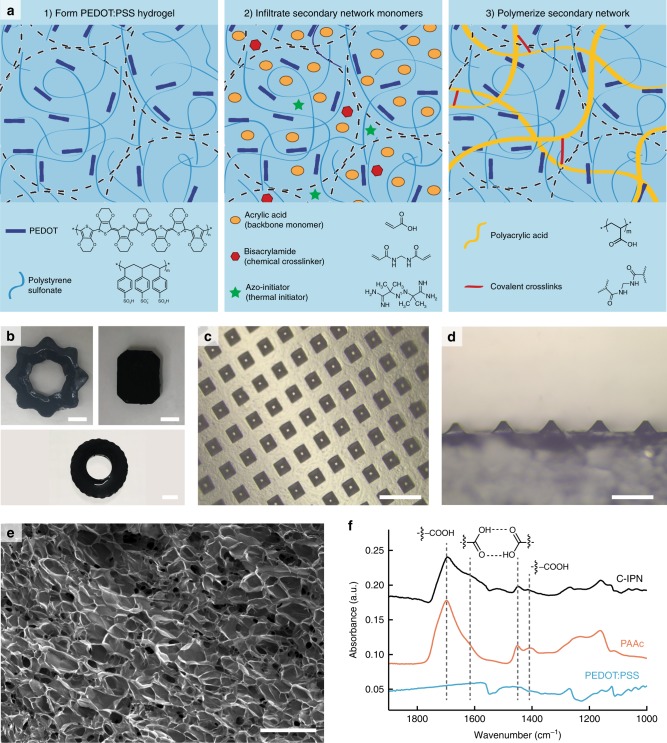
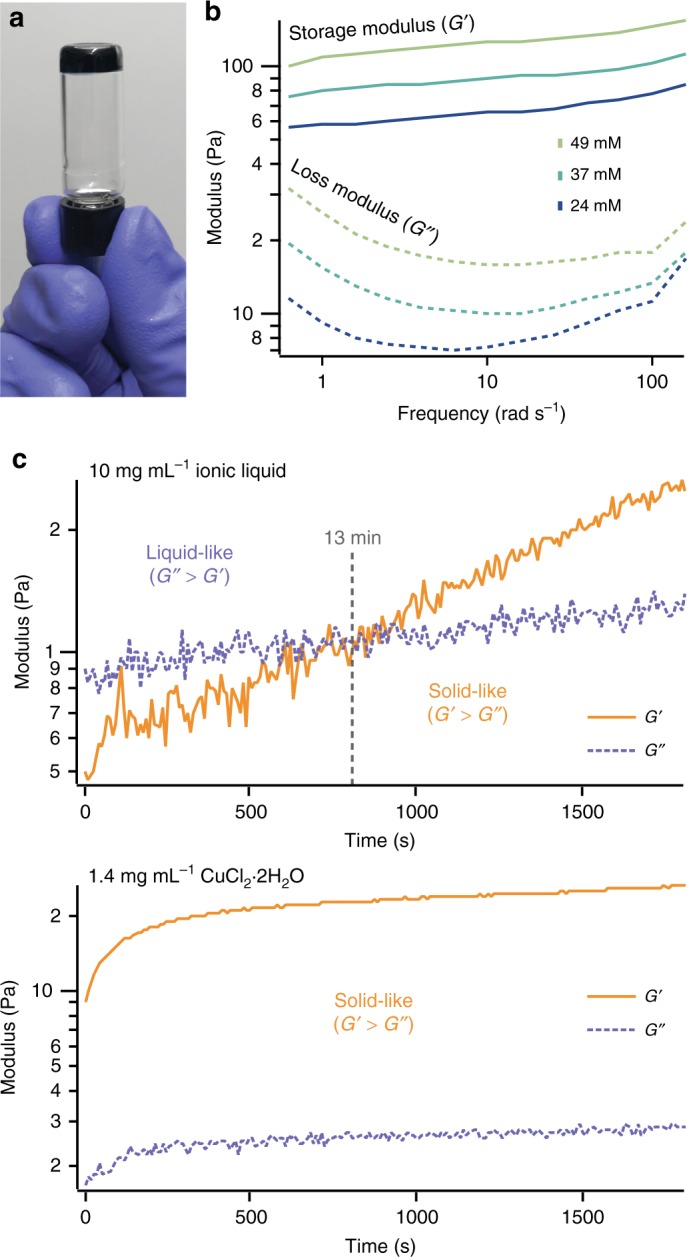
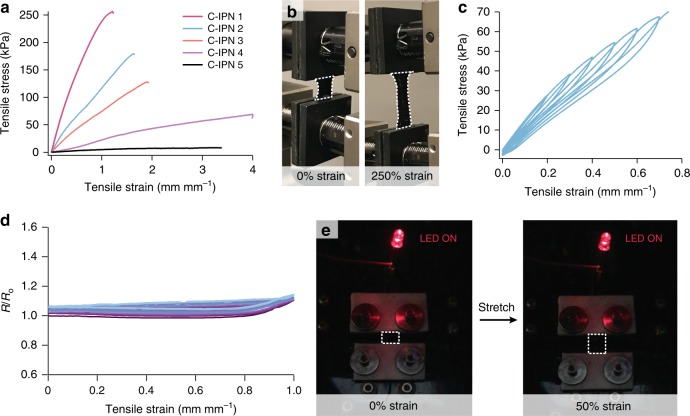
Conductive and stretchable materials that match the elastic moduli of biological tissue (0.5–500 kPa) are desired for enhanced interfacial and mechanical stability. Compared with inorganic and dry polymeric conductors, hydrogels made with conducting polymers are promising soft electrode materials due to their high water content. Nevertheless, most conducting polymer-based hydrogels sacrifice electronic performance to obtain useful mechanical properties. Here we report a method that overcomes this limitation using two interpenetrating hydrogel networks, one of which is formed by the gelation of the conducting polymer PEDOT:PSS. Due to the connectivity of the PEDOT:PSS network, conductivities up to 23 S m −1 are achieved, a record for stretchable PEDOT:PSS-based hydrogels. Meanwhile, the low concentration of PEDOT:PSS enables orthogonal control over the composite mechanical properties using a secondary polymer network. We demonstrate tunability of the elastic modulus over three biologically relevant orders of magnitude without compromising stretchability ( > 100%) or conductivity ( > 10 S m − 1 ).
Overview
The claims and statistics of this paper haven’t been checked yet.
Free: it reads the open-access text and checks the first 5 claims that cite a source we can check. Create a free account to check every claim.
Integrity signals
Registry
Cites
Statistics
Figures
Verification
Claims the paper makes
The claims and statistics of this paper haven’t been checked yet.
Free: it reads the open-access text and checks the first 5 claims that cite a source we can check. Create a free account to check every claim.
Claims other papers make about this one
Each is checked against this paper’s own text: does it say what the citing paper says it does?
The source backs part of the claim, not all of it — or backs it for a different population, condition or comparison.
In the citing paper
“In addition, the combination of hydrogels and conductive polymers is a hot area of research since the former has mechanical properties similar to those of nerves and can provide a hydrophilic interface that reduces the adhesion of non-specific proteins.[58,539–542]”
From Flexible Electronics and Devices as Human–Machine Interfaces for Medical Robotics (2022) · cites this paper as [540]
Experimental — accuracy not yet measured
Self-check
Percentages, sums and reported differences re-computed from the paper’s own numbers.
The self-check needs the paper’s full text.
Citations
Cites
Tissue Cells Feel and Respond to the Stiffness of Their Substrate
Discher, D. E., Janmey, P., & Wang, Y.-L. (2005) · Science · doi:10.1126/science.1116995 · Cited by 6,382
Highly stretchable and tough hydrogels
Sun, J.-Y., Zhao, X., Illeperuma, W. R. K., Chaudhuri, O., Oh, K. H., Mooney, D. J., Vlassak, J. J., & Suo, Z. (2012) · Nature · doi:10.1038/nature11409 · Cited by 5,481
A general relationship between disorder, aggregation and charge transport in conjugated polymers
Noriega, R., Rivnay, J., Vandewal, K., Koch, F. P. V., Stingelin, N., Smith, P., Toney, M. F., & Salleo, A. (2013) · Nature Materials · doi:10.1038/nmat3722 · Cited by 2,206
A highly stretchable, transparent, and conductive polymer
Wang, Y., Zhu, C., Pfattner, R., Yan, H., Jin, L., Chen, S., Molina-Lopez, F., Lissel, F., Liu, J., Rabiah, N. I., et al. (2017) · Science Advances · doi:10.1126/sciadv.1602076 · Cited by 1,442
Self-citationMulti-scale multi-mechanism design of tough hydrogels: building dissipation into stretchy networks
Zhao, X. (2014) · Soft Matter · doi:10.1039/c3sm52272e · Cited by 1,252
The role of matrix stiffness in regulating cell behavior†
Wells, R. G. (2008) · Hepatology · doi:10.1002/hep.22193 · Cited by 1,059
Yang, T., Gregori, G., Pellet, N., Grätzel, M., & Maier, J. (2015) · Angewandte Chemie International Edition · doi:10.1002/anie.201500014 · Cited by 553
Deep-Brain Stimulation for Parkinson's Disease
Okun, M. S. (2012) · New England Journal of Medicine · doi:10.1056/nejmct1208070 · Cited by 541
Chen, Q.-Z., Bismarck, A., Hansen, U., Junaid, S., Tran, M. Q., Harding, S. E., Ali, N. N., & Boccaccini, A. R. (2008) · Biomaterials · doi:10.1016/j.biomaterials.2007.09.010 · Cited by 530
Biomechanical Properties of In Vivo Human Skin From Dynamic Optical Coherence Elastography
Liang, X., & Boppart, S. A. (2010) · IEEE Transactions on Biomedical Engineering · doi:10.1109/tbme.2009.2033464 · Cited by 470
Research works printed but not linked: 1
- Grill, W. M. in Indwelling Neural Implants: Strategies for Contending with the In Vivo Environment (ed. WM, R.) (CRC Press/Taylor & Francis, 2008). 21204399
Cited by
Items 601–643 of 643
NATURE-INSPIRED MATERIAL STRATEGIES TOWARDS FUNCTIONAL DEVICES
Pradhan, S. (2021) · VCU Scholars Compass (Virginia Commonwealth University) · doi:10.25772/4d9v-rk41
Synthesis and Characterization of All-polymer Electrically Conductive Hydrogels
Nguyen, D. M. (2024) · Library, Museums and Press - UDSpace (University of Delaware) · doi:10.58088/6g0m-6977
Han, J., Jang, S., Kim, B.-K., & Park, K. (2024) · Figshare · doi:10.6084/m9.figshare.26567345
Domingue, L. (2023) · Archipel (Université du Québec à Montréal)
Research Progress in Soft Conductor Technologies Based on Conductive Hydrogel Nanocomposites
Ahn, M.-J., Kim, S. M., & Kim, S. H. (2025) · Journal of Flexible and Printed Electronics · doi:10.56767/jfpe.250022
Sensör uygulamaları için iletken polimerik malzemelerin geliştirilmesi
Aycan, D. (2023) · Dspace Repository (Marmara Üniversitesi)
Spontaneously Formed Higher-Order Architectures of Amphiphilic Polypeptides with Other Components
Rahman, M. M. (2019) · Institutional Repositories DataBase (IRDB) · doi:10.24561/00018878
Sun, M. (2021) · Institutional Repositories DataBase (IRDB)
Taussig, L. (2023) · theses.fr (ABES) · doi:10.70675/df29499cz788cz40f5z9aa0z6743faa68f29
Nanotechtonics for Deformable Electronic and Energy Devices
Veeresha, G., Krishnamurthy, G., & Kumar, A. S. S. (2026) · Engineering materials · doi:10.1007/978-981-95-4216-1_7
Hydrogels in Brain–Computer Interface
(2026) · Wiley eBooks · doi:10.1002/9783527854578.ch15
Shaari, N., Osman, S. H., Kamarudin, S. K., Basri, S., Zaki, S. M., Bahru, R., & Mohd, N. (2026) · International Journal of Hydrogen Energy · doi:10.1016/j.ijhydene.2026.155957
Yadav, K., Jang, I., Ji, Y., Kim, T., Lee, P. C.-W., & Lee, J. B. (2026) · Materials Horizons · doi:10.1039/d6mh00586a
Cicoira, F., Berggren, M., Colaprico, E., Crispin, X., Engquist, I., Evans, D., Fabiano, S., Fan, J., Guo, Z., Zou, J., et al. (2026) · Flexible and Printed Electronics · doi:10.1088/2058-8585/ae81bf
Małyszko, G., Wysocka, J., Jasiński, P., & Pawłowska, S. (2026) · International Journal of Hydrogen Energy · doi:10.1016/j.ijhydene.2026.156277
He, Q., Ren, L., Wu, N., Zeng, R., Song, W., Han, M., Huang, J. Y., Wang, J., & Zhang, Q. (2026) · Chemical Engineering Journal · doi:10.1016/j.cej.2026.179210
Photoactivable Surfactant Design for In Situ Stabilization of Hydrogel Bioelectronics
Lee, S. R., Lee, D., Lee, S., Lee, Y. K., Chong, J., Chang, G., Kim, H., Kim, A., Kim, K. S., Koo, J., et al. (2026) · Advanced Materials · doi:10.1002/adma.74162
Optoelectronic properties of G and rGO doped polymer based nanocomposites: A comparative study
Sharma, K., Sharma, M., Negi, C. M. S., Alvi, P. A., Diwedi, S. K., & Singh, V. (2026) · Physica B Condensed Matter · doi:10.1016/j.physb.2026.419136
Wang, M., Zhou, X., Liu, L., Liu, Y., Shi, Y., Miao, Y., Yu, H., Yue, B., & Zhu, L. (2026) · SSRN Electronic Journal · doi:10.2139/ssrn.7266139
Guo, K., Sui, S., Li, G., & Chen, X. (2026) · Chemical Engineering Journal · doi:10.1016/j.cej.2026.180723
Lloyd, E. C., Dhakal, S., Arachchige, S. B., Dementyev, M., Goel, S., Morozova, S., & Hickey, R. J. (2026) · ACS Applied Polymer Materials · doi:10.1021/acsapm.6c02944
Gao, N., Yang, S., Kong, L., Yang, Y., Xing, G., Weng, G., Zhu, X., & Wang, A. (2026) · Materials Today Chemistry · doi:10.1016/j.mtchem.2026.103964
Lee, S., Baek, K., Sinha, A., Kang, H., & So, H. (2026) · Sensors and Actuators Reports · doi:10.1016/j.snr.2026.100504
Functional hydrogel interface on fibers: A review
Wu, T., Liu, J., Liu, Q., Zhang, Z., Zhang, Y., Hou, K., Chen, G., & Zhu, M. (2026) · Progress in Polymer Science · doi:10.1016/j.progpolymsci.2026.102174
González, L., Pérez‐Torres, A., Fernández-Guerrero, Y., Pérez, D., López, B., & López, R. F. (2026) · Gels · doi:10.3390/gels12090818
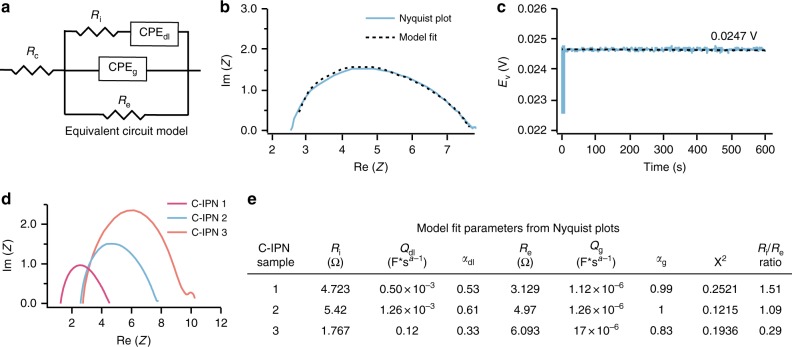
“Mixed-conducting hydrogel studies have, for example, resolved ionic and electronic resistances through parallel resistive/constant-phase-element models, providing separate estimates of σ ion and σ e [69,70].”
Momtazan, A., Ehsani, M., Karimi, M., Tybrandt, K., & Kim, N. (2026) · SSRN Electronic Journal · doi:10.2139/ssrn.7434422
Bioorthogonal Click Degradable Mechanically Strong Hydrogels
Zhang, K., Ren, J., Nosrati, H., Bi, S., Tang, B., & Hoogenboom, R. (2026) · Journal of the American Chemical Society · doi:10.1021/jacs.6c12152
Lu, Y., Liang, S., Niu, J., Jie, C., Zhang, S., Zhang, H., Jia, D., & Huang, W. (2026) · Advanced Science · doi:10.1002/advs.77522
Hybrid hydrogel electrodes for highly stretchable and high-capacitance flexible supercapacitors
Wang, Y., Zhou, J., Yang, S., Zhao, W., Fan, X., Chen, J., Du, S., Yin, Z., Chen, J., Chen, F., et al. (2026) · Science China Technological Sciences · doi:10.1007/s11431-026-3360-0
Soft and Transient Bioelectronics Enabled by Polymer‐Free Ti 3 C 2 T x MXene Hydrogels
Garg, R., Laimo, F. A., Ippolito, S., Upadhyay, P., Averbeck, S. R., Boufidis, D., Assenmacher, C., Adewole, D. O., Panigrahy, S. N., Mohammadlou, B. S., et al. (2026) · Advanced Materials · doi:10.1002/adma.75137 · Cited by 1
Designing PEDOT:PSS hydrogels for bioelectronic interfaces
Zhang, W., Yuan, Y., Zhang, S., Liu, Z., Amidian, M., Jacob, R., Lima, A. B. P., & Cheng, H. (2026) · Materials Today · doi:10.1016/j.mattod.2026.103521
이예진, Seo, M., Pyo, S., Kim, Y., Choi, H. K., Shin, M., & Yoon, J. (2026) · Biosensors · doi:10.3390/bios16100541
“Beyond PEDOT:PSS, conductive hydrogels have emerged as next-generation bioelectronic interfaces by integrating the electrical properties of conductive materials with the mechanical compatibility of hydrogels for soft biological tissues [65–67].”
Kim, J., Park, J., Lee, Y., Kim, G., Shin, Y., Eom, S., & Jeong, J. (2026) · Gels · doi:10.3390/gels12100875
“Feig et al. controlled the crosslink density of an interpenetrating network (IPN) to tune the elastic modulus across a range of 8–374 kPa (three orders of magnitude) without any loss of conductivity [27].”
Topological Integration of Slide‐Ring and Entangled Networks
Pan, Y., Chen, L., Liu, M., Sheng, L., You, W., Xiao, M., Wang, Y., Hua, B., Yang, X., Li, G., et al. (2026) · Angewandte Chemie · doi:10.1002/ange.9631477
Topological Integration of Slide‐Ring and Entangled Networks
Pan, Y., Chen, L., Liu, M., Sheng, L., You, W., Xiao, M., Wang, Y., Hua, B., Yang, X., Li, G., et al. (2026) · Angewandte Chemie International Edition · doi:10.1002/anie.9631477
Chen, Y., Lo, W. K., Chen, Z., & Yang, S. (2026) · ACS Omega · doi:10.1021/acsomega.6c04927
Liu, C., Mao, Y., Ren, Z., Shang, Y., Xu, H., Feng, W., Zhou, J., Zhang, D., Cui, X., & Hu, X. (2026) · Materials Today Bio · doi:10.1016/j.mtbio.2026.103722
“However, conductive hydrogels cannot be generally classified as a single mixed conduction category [3,4].”
Hydrogel platforms for 3D cardiac tissue engineering and fibrotic disease modelling
Porritt, H., Winbo, A., & Malmström, J. (2026) · FEBS Open Bio · doi:10.1002/2211-5463.70361
“In ionically crosslinked alginate, increasing Ca 2 + concentration from 21.8 m M to 40.5 m M raises stiffness from 11 to 21 kPa [91].”
InfluentialPEDOT–bridged graphene hydrogels for stable conformal flexible electronics
Ding, H., Cui, L., Qin, T., & Dejun, K. (2026) · Applied Materials Today · doi:10.1016/j.apmt.2026.103463
Ying, X., Zhang, J., Guan, X., Lei, Z., Zheng, W., Zhu, J., Jin, Q., Yao, Y., Zhou, J., 叶俊毅, et al. (2026) · Chemical Engineering Journal · doi:10.1016/j.cej.2026.183903
Conductive and Stretchable Elastomers with Tissue-Matched Softness for Ultrasoft Electronics
Xu, P. (2024) · TSpace (University of Toronto)
Metadata
- Authors
- Feig, V. R., Tran, H., Lee, M., & Bao, Z.
- Affiliations
- Stanford University (US)
- Corresponding author
- Bao, Zhenan
- Venue
- Nature Communications
- Published
- 2018-07-16
- Volume
- 9
- Issue
- 1
- Pages
- 2740-2740
- ISSN
- 2041-1723 (ISSN-L)
- PMC
- PMC6048132
- OpenAlex
- W2816607594
- Semantic Scholar
- a51e52d8a500521cf9b9f2960a9749fdb5fa0dfd
- Cited by
- 585
- References
- 48
- Citations by year
- 2026: 35 · 2025: 98 · 2024: 102 · 2023: 85 · 2022: 86 · 2021: 78 · 2020: 55 · 2019: 41 · 2018: 5
- FWCI
- 22.34
- Type
- journal article
- Language
- en
- Update notices
- correction (2018-11-23)
- Open access
- gold
- doi.org
- Licence
- cc-by
- creativecommons.org/licenses/by/4.0 (tdm)
- creativecommons.org/licenses/by/4.0 (vor)
- Locations
- Nature Communications (publishedVersion, cc-by)
- Europe PMC (PubMed Central) (publishedVersion, other-oa)
- PubMed Central (publishedVersion, cc-by)
- PubMed (publishedVersion)
- RePEc: Research Papers in Economics (submittedVersion)
- DOAJ (DOAJ: Directory of Open Access Journals) (submittedVersion)
- DOAJ (DOAJ: Directory of Open Access Journals) (submittedVersion, cc-by-sa)
- OSTI OAI (U.S. Department of Energy Office of Scientific and Technical Information) (submittedVersion)
- Funders
- National Science Foundation (1542152)
- U.S. Department of Defense
- U.S. Department of Energy (ECCS-1542152)
- Office of the Director of National Intelligence
- National Research Foundation
- Schweizerischer Nationalfonds zur Förderung der Wissenschaftlichen Forschung (ECCS-1542152)
- National Research Foundation of Korea (NRF-2017R1A6A3A03007053)
- Oak Ridge Institute for Science and Education
- Stanford Precourt Institute for Energy
- Intelligence Community Postdoctoral Research Fellowship Program
- National Defense Science and Engineering Graduate
- NIH Office of the Director
- Division of Electrical, Communications and Cyber Systems (ECCS-1542152, 1542152)
- Topics
- Physical Sciences › Materials Science › Polymers and Plastics › Conducting polymers and applications
- Physical Sciences › Materials Science › Biomaterials › Hydrogels: synthesis, properties, applications
- Physical Sciences › Materials Science › Electronic, Optical and Magnetic Materials › Dielectric materials and actuators
- Keywords
- interpenetrating polymer network hydrogels, conductive hydrogels, PEDOT:PSS, stretchable conductors, soft electrodes, electrical conductivity, stretchability
- MeSH terms
- Electric Conductivity, Electrodes, Electrons, Humans, Materials Testing, Polystyrenes, Thiophenes, Hydrogels, Biomimetic Materials, Elastic Modulus
About these checks
Registry, retraction, Cites and statistics results are computed, not judged, with one exception: a printed reference that no index lists is read once by a model before it counts as a citation error. Claims are extracted by a model and kept only when their quote appears verbatim in the text; each cited source is then checked, with a model’s help, for whether it says what the claim relies on. Those verdicts can be wrong — read the claim’s quote and the cited source before relying on one.
Statistics and arithmetic are recomputed, not judged.
Confidence bands are shown only for fields calibrated on our annotated test set. None is calibrated yet, so no band is shown.
What counts as a claim ›How we measure confidence ›How we check this ›
Are you an author, or do you see a problem with this page? Request a review
Data sources
Bibliographic data: Semantic Scholar, OpenAlex, Crossref.
Contains information from the Semantic Scholar Academic Graph Datasets, made available under the ODC Attribution License (ODC-BY 1.0).
Semantic Scholar’s data is described in: Kinney, R., et al. (2023). The Semantic Scholar Open Data Platform. arXiv:2301.10140.
