

Genomic insights into multidrug-resistance, mating and virulence in Candida auris and related emerging species
Open accessPublished version of a preprint
The DOI matches its Crossref record; 64 of the 64 references it cites were found in a registry or an index.
Abstract
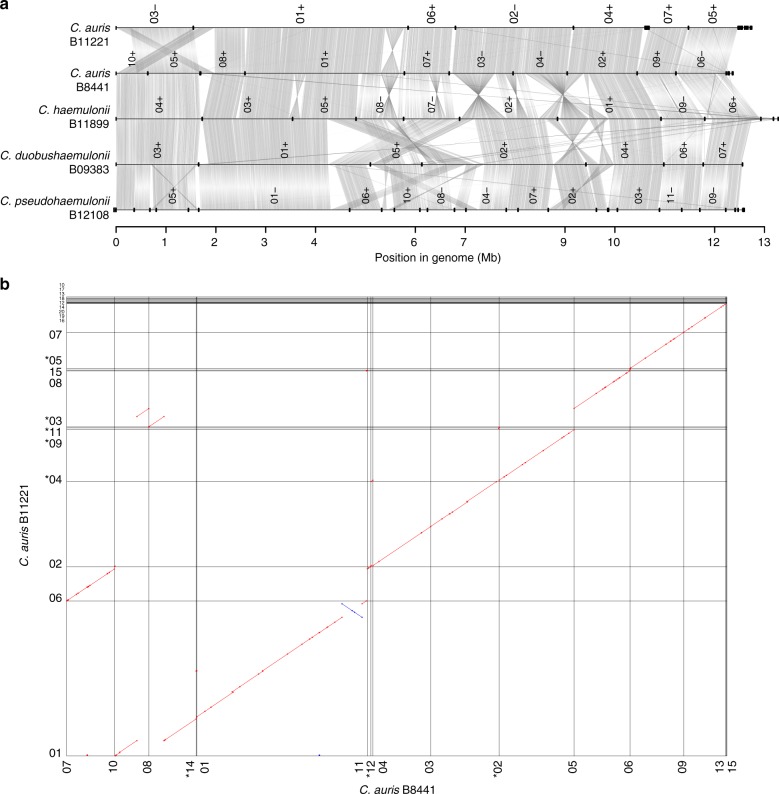
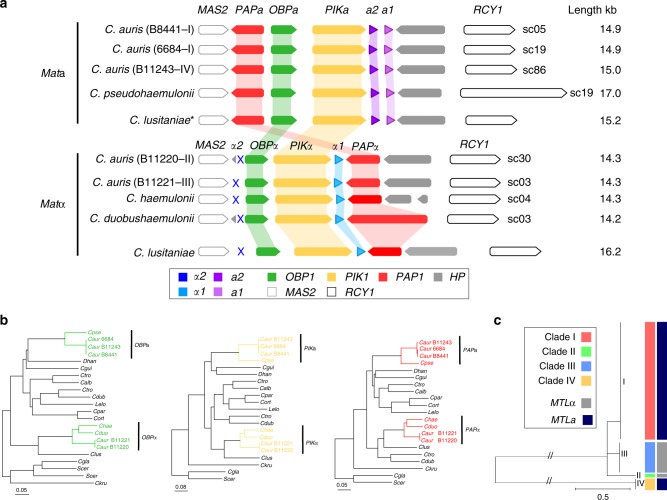
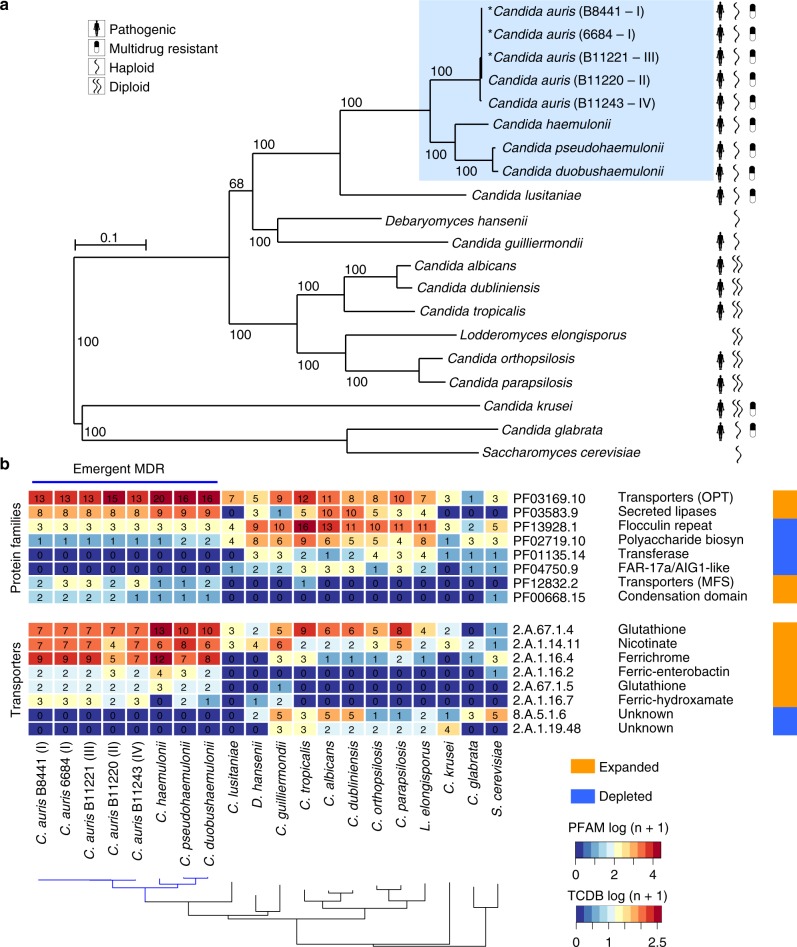
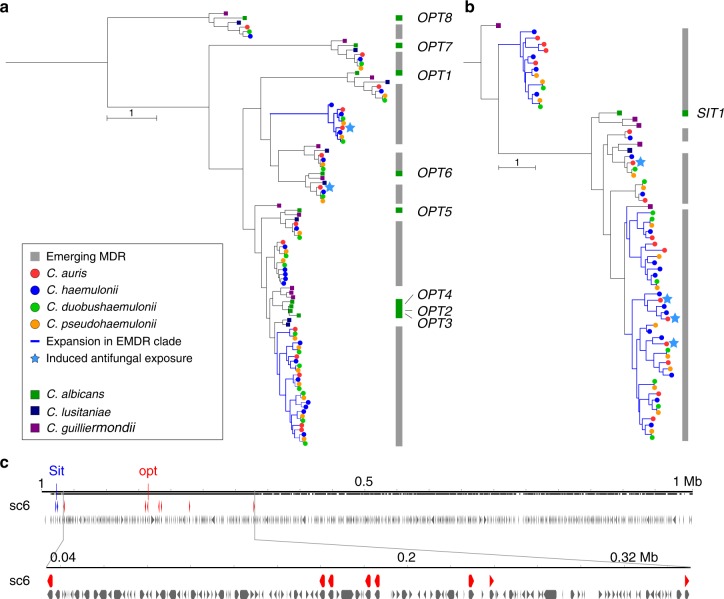
Candida auris is an emergent multidrug-resistant fungal pathogen causing increasing reports of outbreaks. While distantly related to C. albicans and C. glabrata , C. auris is closely related to rarely observed and often multidrug-resistant species from the C. haemulonii clade. Here, we analyze near complete genome assemblies for the four C. auris clades and three related species, and map intra- and inter-species rearrangements across the seven chromosomes. Using RNA-Seq-guided gene predictions, we find that most mating and meiosis genes are conserved and that clades contain either the MTL a or MTL α mating loci. Comparing the genomes of these emerging species to those of other Candida species identifies genes linked to drug resistance and virulence, including expanded families of transporters and lipases, as well as mutations and copy number variants in ERG11 . Gene expression analysis identifies transporters and metabolic regulators specific to C. auris and those conserved with related species which may contribute to differences in drug response in this emerging fungal clade.
Overview
The claims and statistics of this paper haven’t been checked yet.
Free: it reads the open-access text and checks the first 5 claims that cite a source we can check. Create a free account to check every claim.
Integrity signals
Registry
Cites
Statistics
Figures
Verification
Claims the paper makes
The claims and statistics of this paper haven’t been checked yet.
Free: it reads the open-access text and checks the first 5 claims that cite a source we can check. Create a free account to check every claim.
Claims other papers make about this one
Each is checked against this paper’s own text: does it say what the citing paper says it does?
The source backs part of the claim, not all of it — or backs it for a different population, condition or comparison.
In the citing paper
“Mutations in ERG11 have also been observed in Candida spp. and over 100 different ERG11 alleles have been described35.”
From Drug resistance and tolerance in fungi. (2020) · cites this paper as [35]
Experimental — accuracy not yet measuredThe source backs part of the claim, not all of it — or backs it for a different population, condition or comparison.
In the citing paper
“Furthermore, C. auris clades display substantial genetic diversity and show distinct phenotypic traits, especially diminished susceptibilities to antifungal therapies (11–14).”
From Transcriptomics and Phenotyping Define Genetic Signatures Associated with Echinocandin Resistance in Candida auris (2022) · cites this paper as [14]
Experimental — accuracy not yet measuredThe source backs part of the claim, not all of it — or backs it for a different population, condition or comparison.
In the citing paper
“It is worth noting that molecular mechanisms underlying the high rate of AMBR in C. auris remain largely enigmatic10,11.”
From Candida auris skin tropism and antifungal resistance are mediated by carbonic anhydrase Nce103 (2025) · cites this paper as [11]
Experimental — accuracy not yet measuredThe source backs part of the claim, not all of it — or backs it for a different population, condition or comparison.
In the citing paper
“Because U.S. isolates are closely related to those of South America and South Asia, we used the genome sequenced South Asian clade CA 0387 (B8441) to compare with C. albicans (4, 30 – 32).”
From Differential skin immune responses in mice intradermally infected with Candida auris and Candida albicans (2023) · cites this paper as [31]
Experimental — accuracy not yet measuredThe source backs part of the claim, not all of it — or backs it for a different population, condition or comparison.
In the citing paper
“multiple secreted lipases ( LIP ) for nutrient acquisition of lipids and adaptation (37, 38)”
From Candida auris metabolism and growth preferences in physiologically relevant skin-like conditions (2026) · cites this paper as [38]
Experimental — accuracy not yet measured
6 more claims about this paper
Create a free account to see every claim other papers make about this one.
Self-check
Percentages, sums and reported differences re-computed from the paper’s own numbers.
The self-check needs the paper’s full text.
Citations
Cites
Fast gapped-read alignment with Bowtie 2
Langmead, B., & Salzberg, S. L. (2012) · Nature Methods · doi:10.1038/nmeth.1923 · Cited by 56,400
Robinson, M. D., McCarthy, D. J., & Smyth, G. K. (2010) · Bioinformatics · doi:10.1093/bioinformatics/btp616 · Cited by 41,364
SPAdes: A New Genome Assembly Algorithm and Its Applications to Single-Cell Sequencing
Bankevich, A., Nurk, S., Antipov, D., Gurevich, A. A., Dvorkin, M., Kulikov, A. S., Lesin, V. M., Nikolenko, S. I., Pham, S., Prjibelski, A. D., et al. (2012) · Journal of Computational Biology · doi:10.1089/cmb.2012.0021 · Cited by 25,987
The variant call format and VCFtools
Danecek, P., Auton, A., Abecasis, G., Albers, C. A., Banks, E., DePristo, M. A., Handsaker, R. E., Lunter, G., Marth, G. T., Sherry, S. T., et al. (2011) · Bioinformatics · doi:10.1093/bioinformatics/btr330 · Cited by 16,200
RAxML-VI-HPC: maximum likelihood-based phylogenetic analyses with thousands of taxa and mixed models
Stamatakis, A. (2006) · Bioinformatics · doi:10.1093/bioinformatics/btl446 · Cited by 15,582
BUSCO: assessing genome assembly and annotation completeness with single-copy orthologs
Simão, F. A., Waterhouse, R. M., Ioannidis, P., Kriventseva, E. V., & Zdobnov, E. M. (2015) · Bioinformatics · doi:10.1093/bioinformatics/btv351 · Cited by 13,344
Conesa, A., Götz, S., García-Gómez, J. M., Terol, J., Talón, M., & Robles, M. (2005) · Bioinformatics · doi:10.1093/bioinformatics/bti610 · Cited by 11,495
tRNAscan-SE: A Program for Improved Detection of Transfer RNA Genes in Genomic Sequence
Lowe, T. M., & Eddy, S. R. (1997) · Nucleic Acids Research · doi:10.1093/nar/25.5.955 · Cited by 10,905
Statistical significance for genomewide studies
Storey, J. D., & Tibshirani, R. (2003) · Proceedings of the National Academy of Sciences · doi:10.1073/pnas.1530509100 · Cited by 9,692
Walker, B. J., Abeel, T., Shea, T., Priest, M., Abouelliel, A., Sakthikumar, S., Cuomo, C. A., Zeng, Q., Wortman, J., Young, S. K., et al. (2014) · PLoS ONE · doi:10.1371/journal.pone.0112963 · Cited by 9,197
Self-citation
Research works printed but not linked: 1
- Lockhart, S. R. et al. Simultaneous emergence of multidrug-resistant Candida auris on 3 continents confirmed by whole-genome sequencing and epidemiological analyses. Clin. Infect. Dis.64, 134–140 (2017); erratum 67, 987 (2018). PMC5215215 27988485
Cited by
Items 301–400 of 467
Hoa, V. V., Satyal, P., Vo, T. T. B., Le, T. T.-T., Nguyen, A. T.-G., Vu, H. T., Trung, N. T., Hùng, N. H., & Setzer, W. N. (2025) · Molecules · doi:10.3390/molecules30173602 · Cited by 6
“…activities against major bacterial and fungal species capable of multidrug resistance, which are listed as common causative agents of community-and hospital-acquired infections, including E. faecalis , S. aureus , B. cereus , E. coli , P. aeruginosa , S. enterica , and C. albicans [22–24].”
Genomic landscape of the DHA1 family in Candida auris and mapping substrate repertoire of CauMdr1
Khatoon, R., Sharma, S., Vishwakarma, P., Saini, A., Aggarwal, P., Lynn, A. M., Prakash, A., Prasad, R., & Banerjee, A. (2022) · Applied Microbiology and Biotechnology · doi:10.1007/s00253-022-12189-2 · Cited by 6
Infection caused by Candida auris: state of the art
Marena, G. D., Carvalho, G. C., Monazzi, L., Maschio-Lima, T., Almeida, M. D., Silva, J. D., Fortunato, G., Araújo, V., Venancio, D. C. V., Chang, M., et al. (2022) · Mycosphere · doi:10.5943/mycosphere/13/1/10 · Cited by 6
Candida auris: Problems in Diagnostics and Management
Ivanov, A. A., & Kulichenko, T. V. (2020) · Вопросы современной педиатрии · doi:10.15690/vsp.v19i1.2081 · Cited by 6
Tan, X., Baugh, K., Bulman, Z. P., & Wenzler, E. (2020) · Current Fungal Infection Reports · doi:10.1007/s12281-020-00388-1 · Cited by 8
Viana, R., Carreiro, T., Couceiro, D., Dias, Ó., Rocha, I., & Teixeira, M. C. (2023) · FEMS Yeast Research · doi:10.1093/femsyr/foad045 · Cited by 6
Clinical characteristics and risk factors for mortality in Candida auris infections
Li, K., Liu, X., Liu, D., Zhi, Y., Dong, C., Sun, P., Dong, Y., Pan, H., Zhang, Y., & Lei, H. (2024) · iLABMED · doi:10.1002/ila2.38 · Cited by 6
The high-osmolarity glycerol (HOG) pathway in Candida auris
Yaakoub, H., Courdavault, V., & Papon, N. (2025) · mBio · doi:10.1128/mbio.03538-24 · Cited by 6
Barough, R. E., Abastabar, M., Moazeni, M., Javidnia, J., Valadan, R., Bandegani, A., Nosratabadi, M., Haghani, I., Spruijtenburg, B., Armstrong-James, D. P. H., et al. (2025) · Mycopathologia · doi:10.1007/s11046-025-00945-7 · Cited by 5
Emerging Human Health Problems Caused by Pathogenic and Immuno-activating Fungi
Summerbell, R. C., & Scott, J. (2025) · Current topics in microbiology and immunology · doi:10.1007/82_2025_314 · Cited by 7
Zhou, H., Yang, X., Zhou, Q., Hu, C., Xin, C., & Song, Z. (2025) · Mycopathologia · doi:10.1007/s11046-025-01008-7 · Cited by 5
“While ERG11 mutations are well-documented in azole-resistant C. albicans [32], concurrent ERG11 upregulation in cd , a phenomenon previously linked to gene duplication in C. auris , suggested dual target alteration and dosage amplification mechanisms [33].”
Esquivel, B. D., Santos, A. R., Rybak, J. M., Santana, D. J., Rogers, P. D., & White, T. C. (2026) · mBio · doi:10.1128/mbio.03957-25 · Cited by 5
“Some of these C. auris-specific genes encode ABC transporters, perhaps further contributing to its intrinsic antifungal-resistant nature (27).”
Ahaik, I., Nunez‐Rodriguez, J. C., Abelló, S., Yanes, Ó., Bouhdid, S., & Gabaldón, T. (2026) · Frontiers in Pharmacology · doi:10.3389/fphar.2026.1756267 · Cited by 6
Shilman, M. M., Palumbo, J. D., Chan, K. L., Henderson, T., Gee, W. S., Sarreal, S. B. L., Henry, M., & Sellam, A. (2024) · ACS Agricultural Science & Technology · doi:10.1021/acsagscitech.4c00341 · Cited by 5
Pan, B., Weerasinghe, H., Sezmis, A. L., McDonald, M. J., Traven, A., Thompson, P. E., & Simm, C. (2023) · ACS Infectious Diseases · doi:10.1021/acsinfecdis.3c00199 · Cited by 5
Opportunistic Yeast Infections and Climate Change: The Emergence of Candida auris
León, M. G. F.-D., García-Salazar, E., Reyes-Montes, M. D. R., Duarte-Escalante, E., & Acosta‐Altamirano, G. (2022) · Fungal biology · doi:10.1007/978-3-030-89664-5_10 · Cited by 5
Wurster, S., Albert, N. D., & Kontoyiannis, D. P. (2022) · Methods in molecular biology · doi:10.1007/978-1-0716-2417-3_24 · Cited by 7
Bioinformatic Identification of ABC Transporters in Candida auris
Banerjee, A., Vishwakarma, P., Meena, N. K., Lynn, A. M., & Prasad, R. (2022) · Methods in molecular biology · doi:10.1007/978-1-0716-2417-3_18 · Cited by 5
Xu, C., Xu, W., Yuan, Y., Chen, X., Mo, O., Yin, Z., Huang, X., Wang, Y., Hu, L., Xue, W., et al. (2025) · Exploration · doi:10.1002/exp.20240482 · Cited by 6
Vaccaro, A., Cooper, J. F., Rodríguez, A. V., Badali, H., Kean, R., Ramage, G., & Lopez-Ribot, J. L. (2026) · Journal of Fungi · doi:10.3390/jof12040247 · Cited by 4
“Other putative virulence factors like lytic enzymes, which are critical for morphogenesis, adherence, and invasion, such as hydrolases, hemolysin, secreted aspartic proteinases (SAPs), and phospholipases have also been documented in C. auris [27,30,32,72].”
InfluentialZhao, Y., Zou, W., Su, C., & Lu, Y. (2026) · iFungi · doi:10.26599/ifungi.2026.9670011 · Cited by 4
Candidozyma auris Alert in South America: An Epidemiological and Therapeutic Update
Marena, G. D., Nosanchuk, J. D., & Taborda, C. P. (2025) · Current Tropical Medicine Reports · doi:10.1007/s40475-024-00338-8 · Cited by 5
“From different countries and for different clades, stud - ies report that isolates of C. auris were 93, 54, 35, 7 and 6% resistant to fluconazole, voriconazole, amphotericin B (AmB), the echinocandin group and flucytosine, respec - tively [30, 31].”
Rajesh-Khanna, D.-S., Páez, C. G. P., He, S., Dolan, E. G., Mirpuri, K. S., Stajich, J., & Hogan, D. A. (2025) · mBio · doi:10.1128/mbio.01323-25 · Cited by 4
“In C. auris , the OPT1 homolog is upregulated in response to stress, such as antifungal exposure (59) or macrophage phagocytosis (62).”
Long, S. W., Saavedra, M. O., Christensen, P. A., Musser, J. M., & Olsen, R. J. (2020) · Journal of Clinical Microbiology · doi:10.1128/jcm.02063-19 · Cited by 4
“The original African clade (clade III) isolate from Houston, strain LOM, is 25 SNPs distant to B11221.”
BackgroundInfluentialValdez, A. F., Bohner, F., Goldman, J. P., Jaquiery, A. B., do Amaral, E. V. C., Corrêa-Junior, D., Draganski, A. R., Nimrichter, L., Nosanchuk, J. D., & Zamith‐Miranda, D. (2025) · Microbiology Research · doi:10.3390/microbiolres16010015 · Cited by 4
Distribution and Antifungal Sensitivity of Candida Isolates Detected in Blood Cultures
Beder, D., Taşbent, F. E., & Doğan, M. (2020) · ANKEM Dergisi · doi:10.5222/ankem.2020.077 · Cited by 6
Ene, I. V., Hickman, M. A., & Gerstein, A. C. (2021) · Current Clinical Microbiology Reports · doi:10.1007/s40588-021-00171-x · Cited by 6
Gong, J., Shen, C., Xiao, M., Zhang, H., Zhao, F., Zhang, J., & Xiao, D. (2021) · Molecules · doi:10.3390/molecules26154470 · Cited by 5
Tone, K., Nagano, Y., Sakamoto, K., Komori, A., Tamura, T., Alshahni, M. M., Kobayashi, T., Masaki, T., Araya, J., & Makimura, K. (2025) · Medical Mycology Journal · doi:10.3314/mmj.24-00019 · Cited by 4
Oiki, S., Abe, M., Sadamoto, S., Amemiya, K., Shinohara, T., Otani, A., Koizumi, A., Umeyama, T., Makimura, K., & Miyazaki, Y. (2025) · Journal of Infection and Chemotherapy · doi:10.1016/j.jiac.2025.102747 · Cited by 3
Narayanan, A., Shaji, A. A., Pullepu, D., Bhattacharya, J., & Sanyal, K. (2025) · ACS Infectious Diseases · doi:10.1021/acsinfecdis.5c00081 · Cited by 3
Candida auris adhesins, specifically Als3, a key target to understand and mitigate
Lashine, Y., Hamdy, R., Dakalbab, S., Lazreg, I. K., Dhaheri, F. A. A., Chin, S. P., Hashim, N. M., & Soliman, S. S. M. (2025) · Mycologia · doi:10.1080/00275514.2025.2536345 · Cited by 3
“Despite this reduction, C. auris maintains one conserved ALS3 ortholog (Muñoz et al. 2018).”
InfluentialFleres, G., Cheng, S., Badrane, H., Dupont, C. L., Espinoza, J. L., Abbey, D., Driscoll, E., Newbrough, A., Hao, B., Mansour, A., et al. (2025) · The Journal of Infectious Diseases · doi:10.1093/infdis/jiaf495 · Cited by 3
Genetic and environmental control of parasexual reproduction in the pathogenic Candida species
Cao, C., Li, T., Hu, T., Chu, H., Perry, A. M., Nobile, C. J., & Huang, G. (2025) · Microbiology and Molecular Biology Reviews · doi:10.1128/mmbr.00002-25 · Cited by 3
“Despite the presence of most genes associated with mating and meiosis in its genome (161), sexual reproduction has not been observed in C. auris .”
β-Glucan chitosan particle provides cross-protection against multi-drug-resistant Candida auris
Singh, S., Barbarino, A. M., Youssef, E. G., Gupta, K. D., Nabeela, S., Gebremariam, T., Alkhazraji, S., Uppuluri, P., Ostroff, G. R., & Ibrahim, A. S. (2026) · npj Vaccines · doi:10.1038/s41541-026-01485-x · Cited by 3
“C.auris exhibitsabroadspectrumofdrugresistancemechanisms(including mutations in ERG genes involved in ergosterol synthesis and upregulation of ef fl ux pumps) present across all clades, making it challenging to develop new drug variants within existing antifungal classes 5,46 – 49 .”
Luo, Z., Ning, Y., Dai, R., Ainiwaer, A., Li, Y., Zhang, R., Xiao, M., Wang, X., Yang, Y., Huang, Y., et al. (2025) · International Journal of Medical Microbiology · doi:10.1016/j.ijmm.2025.151689 · Cited by 3
C. elegans as a tractable infection model for the emerging fungal pathogen Candida auris
Martinez, M., Cruz, M. R., Garsin, D. A., & Lorenz, M. C. (2026) · Microbiology Spectrum · doi:10.1128/spectrum.03156-25 · Cited by 3
“Indeed, the multidrug resistance common to C. auris is rare in other Candida species (26, 36–38).”
Candida auris: an emerging life-threatening fungal pathogen of global public health concern
Pal, M. S., Tariku, F., Upadhyay, D., Paula, C. R., & Patil, B. (2024) · Journal of Bacteriology & Mycology Open Access · doi:10.15406/jbmoa.2024.12.00371 · Cited by 7
Revisiting threats associated with neglected and emerging fungal pathogens in sub-Saharan Africa
Akinola, S. A., Adeyemo, R. O., Bale, M. I., Eilu, E., Afodun, A. M., Akinola, R. A. A., Binuyo, M. O., Odoma, S., Suleiman, I. E., Adegboyega, T. T., et al. (2024) · Discover Public Health · doi:10.1186/s12982-024-00318-3 · Cited by 4
“A comparative genomic analysis was conducted with the adoption of complete-genome assemblies from isolates within each of the four clades as well as closely related species within the C. haemulonii clade to fill information gaps about the unusual evolution of C. auris [189].”
Zhou, M., Yu, P., Hu, C., Fang, W., Jin, C., Li, S., & Sun, X. (2024) · Advanced Science · doi:10.1002/advs.202412514 · Cited by 3
Multidrug efflux pumps and innate azole resistance of Mucor lusitanicus
Toepfer, S., Lamping, E., James, J. E., Zenz, L.-M., Loacker-Schoech, J., Rosam, K., Majer, O., & Lackner, M. (2025) · Journal of Antimicrobial Chemotherapy · doi:10.1093/jac/dkaf343 · Cited by 3
Yeast sexes: mating types do not determine the sexes in Metschnikowia species
Lachance, M., Burke, C., Nygard, K. L., Courchesne, M. C. J., & Timoshenko, A. V. (2024) · FEMS Yeast Research · doi:10.1093/femsyr/foae014 · Cited by 4
“Non-sex genes have been more appropriately named non-mating genes in a discussion of Candida auris (Muñoz et al. 2018 ), a member of the family Metschnikowiaceae.”
BackgroundLima, J. C., Ramos, L. S., Barbosa, P. F., Barcellos, I. C., Branquinha, M. H., dos Santos, A. L. S., Instituto Federal de Educação, C. E. T. D. R. D. J. (., & Rede Micologia RJ – Fundação de Amparo à Pesquisa do Estado do Rio de Janeiro (FAPERJ), R. D. J. (2025) · AIMS Microbiology · doi:10.3934/microbiol.2025012 · Cited by 3
“While SAP -like genes and Sap-like activity have been identified in C. haemulonii [8,25], our understanding on their expression under optimal conditions remains limited.”
Zamith‐Miranda, D., Amatuzzi, R. F., Martins, S. T., Vieira, A. Z., da Rocha, I. M., Rodrigues, M. L., Trentin, G., Almeida, F. B. D. R., Nakayasu, E. S., Nosanchuk, J. D., et al. (2020) · bioRxiv (Cold Spring Harbor Laboratory) · doi:10.1101/2020.12.04.411843 · Cited by 3
“Upon amphotericin B treatment, the upregulated genes were related to translation and ribosomal proteins (52).”
BackgroundNakazato, G., Fávaro, W. J., Castro, G. R., & Durán, N. (2021) · doi:10.21467/preprints.337 · Cited by 3
MAESTRO uncovers tandem paralog dynamics as a core driver of fungal stress adaptationPreprint
Hsieh, P.-H., Sasaki, Y., Yang, C.-I., Wu, Z., Steindorff, A. S., Haridas, S., Ke, J., Fatma, Z., Zhao, Z., Opulente, D. A., et al. (2025) · bioRxiv (Cold Spring Harbor Laboratory) · doi:10.1101/2025.08.29.673034 · Cited by 3
van Rhijn, N., Gan, E., Hepo-oja, P., Wang, X., Li, J., Duggan, S., Firer, D., AlSharqi, L. E. O., Gifford, H., Steenwyk, J. L., et al. (2026) · bioRxiv (Cold Spring Harbor Laboratory) · doi:10.64898/2026.03.13.711634 · Cited by 3
“The genomes of the five clades are highly syntenic, as described in previous studies 29 .”
Self-citationPloidy plasticity drives fungal resistance to azoles used in agriculture and clinics
Sanyal, K., & Narayanan, A. (2025) · PLoS Biology · doi:10.1371/journal.pbio.3003083 · Cited by 2
“Copy number variations of ERG11 has been implicated previously in azole resistance in multiple fungal pathogens including C. tropicalis [4,12,13].”
Alquwaie, R., Almandil, N. B., AlJindan, R. Y., Mahmoud, N., Almofty, S. A., Almohazey, D., Alqudihi, H. H., Hunachagi, S., Dhas, T. S., Sowmiya, P., et al. (2025) · Computational and Structural Biotechnology Journal · doi:10.1016/j.csbj.2025.07.048 · Cited by 2
“These genetic alterations encompassed expanded groups of transporters and lipases, along with mutations and variations in copy numbers of ERG11 , a gene associated with resistance to anti-fungal drugs [23].”
Wan, G., Zhang, H., Yang, X. Y., Sun, Q., Wen, C., Hong, F., He, L., Mo, D., Chen, X., Li, Q., et al. (2025) · BMC Microbiology · doi:10.1186/s12866-025-04576-2 · Cited by 2
“In these drug-resistant isolates, regardless of Clade I or Clade III, neither the G145D mutation in B9J08_00281 [ERG28] nor the R252T mutation in B9J08_003025 [ERG24] was identified, which mutations have been reported to correlate with amphotericin B resistance [39, 56].”
mGem: Fungal adhesins in Candidozyma auris confer unique fitness for skin colonization
Balakumar, A., & Thangamani, S. (2026) · mBio · doi:10.1128/mbio.03805-25 · Cited by 2
Human keratinocytes and fibroblasts coordinate early cutaneous innate defenses against Candida auris
Seiser, S., Brezovec, H., Penninger, P., Phan-Canh, T., Moser, D., Assen, F. P., Ayub, T., Rademacher, F., Gläser, R., Cerbu, D., et al. (2026) · Journal of Investigative Dermatology · doi:10.1016/j.jid.2026.06.1279 · Cited by 2
Candida auris: Steckbrief eines neuen Pilzes
Wagener, J., & Kurzai, O. (2019) · Deutsches Ärzteblatt · doi:10.3238/persinfek.2019.07.22.01 · Cited by 3
Ahearn, D. G. (2023) · mBio · doi:10.1128/mbio.00954-23 · Cited by 2
Complete genome assembly of Candida auris representative strains of three geographical clades
Mahar, N. S., Kohli, S., Biswas, B., Xess, I., Thakur, A., & Gupta, I. (2024) · Microbiology Resource Announcements · doi:10.1128/mra.00882-23 · Cited by 2
Genomic Innovation and Virulence Evolution in the Emerging Human Fungal Pathogen Candida auris
Gifford, H., Rhodes, J. L., Wilson, D., & Farrer, R. A. (2024) · The mycota · doi:10.1007/978-3-031-75666-5_10 · Cited by 2
Self-citationMolecular Epidemiology and Antifungal Susceptibility Profile of Candidozyma Isolates From Argentina
Taverna, C. G., Córdoba, S. B., Haim, M. S., Lombardo, M., Vivot, M. E., Arias, B. A., Vivot, W., Szusz, W., Abbey, D., Poklépovich, T., et al. (2025) · Mycoses · doi:10.1111/myc.70025 · Cited by 2
“This technique has been used extensively to understand the emergence of Cz. auris and the molecular mechanisms involved in antifungal resistance [24–33].”
Tracking the origin and evolution of multidrug resistance in Candida auris
Papon, N., & Sanglard, D. (2020) · The Lancet Microbe · doi:10.1016/s2666-5247(20)30124-5 · Cited by 2
Ramos, L. S., Silva, L. N., de Mello, T. P., Frota, H. F., Branquinha, M. H., & dos Santos, A. L. S. (2022) · Current Topics in Medicinal Chemistry · doi:10.2174/1568026622666220520153748 · Cited by 3
An Optimized Electroporation Procedure for Genetic Transformation of Candida auris
Kasir, D., Osman, M., Hamzé, M., Bouchara, J., Courdavault, V., & Papon, N. (2022) · Methods in molecular biology · doi:10.1007/978-1-0716-2417-3_7 · Cited by 2
Generating Complete Genome Assemblies of Candida auris
Shea, T., & Cuomo, C. A. (2022) · Methods in molecular biology · doi:10.1007/978-1-0716-2417-3_16 · Cited by 2
Self-citationde Jong, A. W., Boden, S., Zandijk, A., Kortsinoglou, A. M., van den Ende, B. G., Francisco, E. C., Nefeli, P. K., Kouvelis, V. N., Zhou, M., & Hagen, F. (2024) · bioRxiv (Cold Spring Harbor Laboratory) · doi:10.1101/2024.05.16.594571 · Cited by 4
“C. auris and its pathogenic relatives C. haemulonii , C. duobushaemulonii , and C. pseudohaemulonii , share notable expansions of virulence related gene families described in C. albicans and other common pathogenic Candida species (Muñoz et al., 2018; Butler et al., 2009).”
BackgroundResultInfluentialFleres, G., Cheng, S., Badrane, H., Dupont, C. L., Espinoza, J. L., Abbey, D., Driscoll, E., Newbrough, A., Hao, B., Mansour, A., et al. (2024) · bioRxiv (Cold Spring Harbor Laboratory) · doi:10.1101/2024.10.16.618724 · Cited by 2
Determann, B. F., Fu, J., & Wickes, B. L. (2024) · Journal of Fungi · doi:10.3390/jof10070477 · Cited by 1
“For example, there are multiple CRISPR strategies [14–16], transformation by both electroporation and lithium acetate [17,18], multiple selectable and fluorescence markers [14,19–21], and almost 200 genome sequences available in public databases, many of which are annotated [6].”
BackgroundRamage, G., Kean, R., Mackay, W. G., Vaccaro, A., Lopez-Ribot, J. L., & Howe, M. H. (2025) · Springer series on biofilms · doi:10.1007/978-3-031-93315-8_7 · Cited by 2
Current Approaches in Genome Assembly of Human Fungal Pathogens
Rhodes, J. L. (2025) · Methods in molecular biology · doi:10.1007/978-1-0716-4702-8_11 · Cited by 1
Candida (Candidozyma) Auris: From Colonization to Invasive Disease
ARIKAN, H. B. A., & Sezak, N. (2025) · Forbes Journal of Medicine · doi:10.4274/forbes.galenos.2025.00378 · Cited by 1
Cytrynbaum, E. G., & McClean, M. N. (2025) · Advanced Drug Delivery Reviews · doi:10.1016/j.addr.2025.115740 · Cited by 1
Lee, S., Baritugo, K., Kim, H.-S., Lee, H., Ryu, S. W., Kim, S., Lee, C. H., Kim, Y. R., SHIN, J., Kim, J., et al. (2026) · Journal of Fungi · doi:10.3390/jof12010076 · Cited by 2
Chowdhury, F., Mah‐E‐Muneer, S., Khan, S., Lyman, M., Mamun, G. M. S., Lockhart, S. R., Habib, Z. H., Rahman, A., Hossain, K., Hassan, M. Z., et al. (2026) · Microbiology Spectrum · doi:10.1128/spectrum.03169-25 · Cited by 1
“Isolates belonging to Clade II were generally more susceptible to antifungal agents, whereas isolates from Clades I, III, and IV exhibited high levels of resistance (41–43).”
Ji, J., Xu, W., & Chen, Y. (2026) · Frontiers in Cellular and Infection Microbiology · doi:10.3389/fcimb.2026.1796121 · Cited by 1
“This failure of cell separation leads to the characteristic clumping phenotype (Muñoz et al., 2018; Rossato and Colombo, 2018).”
Brands, B., van Leuven, N., & Bockmühl, D. P. (2026) · Pathogens · doi:10.3390/pathogens15030313 · Cited by 1
“A lot of studies have been investigating several aspects of this yeast, covering the antifungal resistance [11–18], the ability to form biofilms [17,19] and the fact that different clades have been detected and characterized [1,20–22].”
Negi, P., Verma, N., Rishi, P., Multani, K., Sharma, M., Kumari, S., & Raj, K. (2026) · Archives of Microbiology · doi:10.1007/s00203-026-04864-z · Cited by 1
“Amphotericin B resistance is linked to overexpression of ergosterol synthesis genes ( ERG1 , ERG2 , ERG6 , and ERG13) in C. auris (Muñoz et al. 2018).”
Unraveling clade-specific differences in Candida auris: evolution, adaptation, and pathogenicity
Sharma, P., Bari, V. K., & Pasrija, R. (2026) · European Journal of Clinical Microbiology & Infectious Diseases · doi:10.1007/s10096-026-05569-3 · Cited by 1
From Oral Candidiasis to Candidemia: A Review of Superficial to Invasive Progression
Jerez, J. R., Ambrosio, M. V., Fernandes, M. E. O., & Mima, E. G. D. O. (2026) · MicrobiologyOpen · doi:10.1002/mbo3.70353 · Cited by 1
“In parallel, comparative genomic analyses support this limitation, demonstrating the absence of the ECE1 and HWP1 genes, which are highly expressed in C. albicans and strongly associated with hyphae formation (Muñoz et al. 2018).”
Tosunoğlu, A., Konyalı, Ö., & Demırci, M. (2026) · Northern Clinics of Istanbul · doi:10.14744/nci.2026.40040 · Cited by 1
“Second, the genetic distance between each isolate and the reference strains was calculated to verify that the in-ter-clade variation exceeded the established threshold of >3,000 SNPs, while intra-clade variation remained consistent with lineage-specific clonality [1, 10].”
InfluentialMISZELLEN - Where did Ramesses VI bury his nephew?
Peden, A. J. (2001) · Göttinger Miszellen: Beiträge zur ägyptologischen Diskussion · Cited by 3
Transcriptome in Human Mycoses
Peres, N. T. A., Bitencourt, T. A., Persinoti, G. F., Lang, E. A. S., Rossi, A., & Martinez-Rossi, N. M. (2022) · Springer eBooks · doi:10.1007/978-3-030-87821-4_17 · Cited by 1
Measuring Gene Expression via mRNA Abundance in Candida auris
Wasi, M., Nair, R., Khandelwal, N., & Prasad, R. (2022) · Methods in molecular biology · doi:10.1007/978-1-0716-2417-3_11 · Cited by 1
Candida auris: the most talked about multidrug-resistant emerging fungal pathogen
Irinyi, L., Malík, R., & Meyer, W. (2022) · Microbiology Australia · doi:10.1071/ma22057 · Cited by 1
Drug resistance in pathogenic species of Candida
Jaiswal, N., & Kumar, A. (2023) · Elsevier eBooks · doi:10.1016/b978-0-323-91643-1.00014-4 · Cited by 3
How Does Bioinformatics Play a Role in Fungal Drug Discovery?
Jaiswar, A., & Rai, N. (2024) · Springer eBooks · doi:10.1007/978-981-99-5696-8_24 · Cited by 2
Isolation of Fluconazole-Resistant South Asian Clade Candida auris in Beijing, China
Yan, L., Zhao, F., Zhang, K., Wang, P., & Hu, S. (2025) · American Journal of Tropical Medicine and Hygiene · doi:10.4269/ajtmh.24-0748 · Cited by 2
Seaside to Bedside: Assembly in Research for Emerging Human Fungal Pathogen Candida auris
Gifford, H., Wilson, D., Rhodes, J. L., & Farrer, R. A. (2025) · Methods in molecular biology · doi:10.1007/978-1-0716-4702-8_13 · Cited by 1
Self-citationDo farnesol and tyrosol production in Candidozyma auris biofilms reflect virulence potential?
dos Santos, M. M., Moure, H. S., Ferreira, M. J. P., & Ishida, K. (2025) · Virulence · doi:10.1080/21505594.2025.2561832 · Cited by 2
“In silico previous study also supported our hypothesis, indicating that C. auris possesses key enzymes such as farnesyl-diphosphate farnesyl transferase, farnesyl pyrophosphate synthase, and farne-syl transferase from the Far synthetic pathway [20], already described in C. albicans [21].”
The Curious Case of Nonrepetitive Centromeric DNA Sequences in Candida auris and Related Species
Lorenz, A., & Papon, N. (2021) · mBio · doi:10.1128/mbio.01476-21 · Cited by 1
Wentling, R. M. (1985) · Korean Society for the Study of Vocational Education · Cited by 1
The Wor2 phenotypic switching regulator controls biofilm formation in Candida auris
Liang, W., Guan, S., Bing, J., Du, H., Zheng, Q., Tao, L., Li, B., Huang, G., & Chu, H. (2026) · npj Biofilms and Microbiomes · doi:10.1038/s41522-026-01043-2
“virulence determinants with Candida albicans , such as the conserved transcriptional regulators including Bcr1, Ndt80, Tec1 and Brg1 25 – 27 .”
Targeting Casein Kinases in the Fungal Pathogen Candida albicans
Hyde, S. (2020) · TSpace (University of Toronto)
Cancino‐Muñoz, I. (2020) · DIGITAL.CSIC (Spanish National Research Council (CSIC))
Amaral, A. C. (2021) · Elsevier eBooks · doi:10.1016/b978-0-12-823381-8.00018-1
A Catalogus Immune Muris of the mouse immune responses to diverse pathogens
Barlier, C., Barriales, D., Samosyuk, A., Jung, S., Ravichandran, S., Medvedeva, Y. A., Anguíta, J., & del Sol, A. (2021) · Cell Death and Disease · doi:10.1038/s41419-021-04075-y
Mechanisms of pathogenesis and drug resistance in Candida auris
WeiNa, Z. H. A. O., Zhang, B., & QiMing, W. A. N. G. (2021) · Scientia Sinica Vitae · doi:10.1360/ssv-2021-0230
Microbial Genetics in Mycology
Rhodes, J. L. (2021) · Elsevier eBooks · doi:10.1016/b978-0-12-818731-9.00189-0
COMPARAÇÃO DE TRÊS TÉCNICAS DE DIAGNÓSTICO DA DOENÇA DE HIRSCHSPRUNG
Lopes, C. C. C., Bertuci, J. V. F., Lopes, E. B., Lopes, L. C., Barros, V. D. S., Zanatta, L., dos Santos, D. L., da Costa, M. M., Dias, T. G., Adami, E. R., et al. (2021) · doi:10.22533/at.ed.77221091111
Trentin, G. (2022) · Digital Library of Theses and Dissertations (Universidade de São Paulo) · doi:10.11606/d.17.2022.tde-20062022-161952
Zhang, L., Li, D., Calderone, R., & She, X. (2022) · Methods in molecular biology · doi:10.1007/978-1-0716-2549-1_10
Candida: Biofilm formation and antifungal resistance
Sharma, S., Singh, S. M., Mane, G., Pote, S. T., Patole, M. S., & Sharma, R. K. (2023) · Elsevier eBooks · doi:10.1016/b978-0-323-99977-9.00024-7
(2023) · Microbiology Australia · doi:10.1071/mav43n4
Candida Auris : What do We Know about the Most Enigmatic Pathogen of the 21 st Century?
Bogut, A. (2023) · Postępy Mikrobiologii - Advancements of Microbiology · doi:10.2478/am-2023-0003
Metadata
- Authors
- Muñoz, J. F., Gade, L., Chow, N. A., Loparev, V. N., Juieng, P., Berkow, E. L., Farrer, R. A., Litvintseva, A. P., & Cuomo, C. A.
- Affiliations
- Broad Institute (US)
- Centers for Disease Control and Prevention (US)
- Corresponding author
- Litvintseva, Anastasia P.
- Cuomo, Christina A.
- ORCID
- Venue
- Nature Communications
- Published
- 2018-12-17
- Volume
- 9
- Issue
- 1
- Pages
- 5346-5346
- ISSN
- 2041-1723 (ISSN-L)
- PMC
- PMC6297351
- OpenAlex
- W2951867871
- Semantic Scholar
- 66e56b3513c248d181f77faab6a93d9ab844712d
- Cited by
- 458
- References
- 64
- Citations by year
- 2026: 50 · 2025: 67 · 2024: 59 · 2023: 71 · 2022: 48 · 2021: 59 · 2020: 64 · 2019: 31 · 2018: 7
- FWCI
- 30.45
- Type
- journal article
- Language
- en
- Open access
- gold
- doi.org
- Licence
- cc-by
- creativecommons.org/licenses/by/4.0 (tdm)
- creativecommons.org/licenses/by/4.0 (vor)
- Locations
- Nature Communications (publishedVersion, cc-by)
- bioRxiv (Cold Spring Harbor Laboratory) (acceptedVersion, cc-by)
- Europe PMC (PubMed Central) (publishedVersion, cc-by)
- PubMed Central (publishedVersion, cc-by)
- PubMed (publishedVersion)
- RePEc: Research Papers in Economics (submittedVersion)
- DOAJ (DOAJ: Directory of Open Access Journals) (submittedVersion, cc-by-sa)
- DOAJ (DOAJ: Directory of Open Access Journals) (submittedVersion)
- Funders
- U.S. Department of Health and Human Services (U19-AI110818)
- National Institutes of Health
- National Institute of Allergy and Infectious Diseases (U19AI110818)
- Topics
- Health Sciences › Medicine › Infectious Diseases › Antifungal resistance and susceptibility
- Life Sciences › Biochemistry, Genetics and Molecular Biology › Molecular Biology › Fungal and yeast genetics research
- Life Sciences › Immunology and Microbiology › Microbiology › Yeasts and Rust Fungi Studies
- Keywords
- Candida auris, multidrug resistance, meiosis genes, virulence genes, genome rearrangement, ERG11, copy number variation, drug transporters, lipase, gene expression, emerging fungal pathogens
- MeSH terms
- Whole Genome Sequencing, Antifungal Agents, Candida, Candidiasis, Cytochrome P-450 Enzyme System, Microbial Sensitivity Tests, Virulence, Genome, Fungal, Communicable Diseases, Emerging, Drug Resistance, Multiple, Fungal
About these checks
Registry, retraction, Cites and statistics results are computed, not judged, with one exception: a printed reference that no index lists is read once by a model before it counts as a citation error. Claims are extracted by a model and kept only when their quote appears verbatim in the text; each cited source is then checked, with a model’s help, for whether it says what the claim relies on. Those verdicts can be wrong — read the claim’s quote and the cited source before relying on one.
Statistics and arithmetic are recomputed, not judged.
Confidence bands are shown only for fields calibrated on our annotated test set. None is calibrated yet, so no band is shown.
What counts as a claim ›How we measure confidence ›How we check this ›
Are you an author, or do you see a problem with this page? Request a review
Data sources
Bibliographic data: Semantic Scholar, OpenAlex, Crossref.
Contains information from the Semantic Scholar Academic Graph Datasets, made available under the ODC Attribution License (ODC-BY 1.0).
Semantic Scholar’s data is described in: Kinney, R., et al. (2023). The Semantic Scholar Open Data Platform. arXiv:2301.10140.
